JIEM, 2015 – 8(3): 963-980 – Online ISSN: 2013-0953 – Print ISSN: 2013-8423 http://dx.doi.org/10.3926/jiem.1444
The Simulation and Optimization Research on Manufacturing
Enterprise’s Supply Chain Process from the Perspective of
Social Network
Chun Fu, Zhenzhen Shuai
Central South University (China)
[email protected], [email protected]
Received: March 2015 Accepted: June 2015
Abstract:
Purpose:
By studying the case of a Changsha engineering machinery manufacturing firm, this
paper aims to find out the optimization tactics to reduce enterprise’s logistics operational
cost.
Design/methodology/approach:
This paper builds the structure model of manufacturing
enterprise’s logistics operational costs from the perspective of social firm network and
simulates the model based on system dynamics.
Findings:
It concludes that applying system dynamics in the research of manufacturing
enterprise’s logistics cost control can better reflect the relationship of factors in the system.
And the case firm can optimize the logistics costs by implement joint distribution.
Practical implications:
This study puts forward some optimization tactics to reduce
enterprise’s logistics operational cost. And it is of great significance for enterprise’s supply chain
management optimization and logistics cost control.
Originality/value:
Differing from the existing literatures, this paper builds the structure model
of manufacturing enterprise’s logistics operational costs from the perspective of social firm
network and simulates the model based on system dynamics.
Keywords:
system dynamics, logistics operational cost, supply chain management, simulation
1. Introduction
Social firm network is the sum of the dynamic interactions among various entities—whether individuals or organizations. Firms interact to obtain competitive advantages. A network is not a one-time deal but a stable and lasting relationship. Logistics cost is the monetary form of materialized and direct labor cost in the process of products’ spatial displacement. The costs associated with logistics activities normally consist of the following components: transportation, warehousing, order processing/customer service, administration, and inventory holding.
Along with the fast development of economics and technology, social firm network plays a more critical role in enterprise’s competitions and cost control. So Manufacturing enterprise’s logistics system becomes more complicated.
a genetic algorithm to solve the reverse logistics problem involving product returns, which decreases the reverse logistics costs. Through order splitting, Dullaert, Maesb, Vernimmence and Witlox (2004) develops an Evolutionary algorithm to minimize total logistics costs based ono different transport options.
Sun, Peng and Chen (2006) apply DEA model for logistics operational cost control of enterprises, take a logistics operational as a decision making unit to evaluate the efficiency of inputs and outputs. Conclusions show that low efficient activities are eliminated or improved with explicit goals and methods. However, this paper only discusses the cost control theoretically without simulation analysis. Wong, Oudheusden and Cattrysse (2007) use the game theoretic models to analyze the cost allocation problem in the context of repairable spare parts pooling. This study consider two situations: cooperation between members and competition exists. And the cost allocation policy influences the companies in making their inventory decisions. The simulation model is an approach to analyze and quantity the research problem by constructing Mathematical model or systematic model. Logistics cost system of manufacturing enterprises is a discrete event dynamic system. To solve these large, complex and diverse logistics cost control problems, the simulation is an efficient tool. Given uncertain demand, Schuster (1987) uses the Monte Carlo simulation to analyze distribution costs to increase profits by controlling costs. Mason, Ribera, Farris and Kirk (2003) develop a discrete event simulation model based on a multi-product supply chain, which integrates the transportation and inventory to control costs.
This paper build the structure model of manufacturing enterprise’s logistics operational costs from the perspective of social firm network and simulates the model based on system dynamics. This rest of paper is organized as follows: Firstly we introduce methods of logistics cost control and the application fields of system dynamics. Secondly we build logistics operational cost model based on system dynamics and also explains the related mechanism. Thirdly we make simulation and optimization research in a Changsha engineering machinery manufacturing firm. Lastly we conclude and put forward the research prospects.
2. Logistics Operational Costs Modeling
As for manufacturing enterprises, the total logistics costs comprise several complex dynamic subsystems. And there is a real lag between system variables. Also the factors influencing logistics operational costs can form a causal loop relationship. So the total logistics cost system is a complex and non-linear feedback system which including several dynamic subsystems. The system dynamics is a valuable and feasible tool to deal with this system. It also acts as a policy lab; we can change the environmental parameters to estimate policy response, which help the policy makers to make effective decisions.
The total logistics costs comprise order costs, transportation costs and inventory costs. From a systemic perspective, we can use system dynamics (SD) to study the total logistics costs as a single system. So this study select the “order-transportation-consumers” process as the object, to analyze the logistics operational costs.
2.1. The model Structure
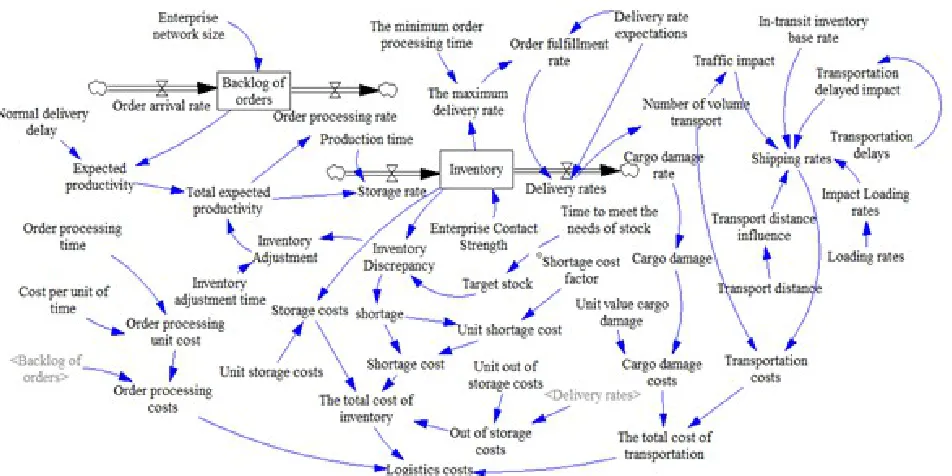
subsystem and total transportation costs subsystem. They influence and interact with each other and constitute an organic whole. The model structure is shown in Figure 1.
Figure 1. the system of Logistics operation cost
2.2. The Subsystem Analyses
2.2.1. The Order Processing Costs Subsystem
The total order processing costs are influenced by order backlog and unit order cost. The order processing time and cost time of per unit also influence the unit order cost. The processing time is constant. The order processing rate is determined by order backlog and inventory. So the main variables in order costs subsystem are arrival rate, order backlog, original order quantities, processing rate, expected productivity, total expected productivity, delay in normal delivery, processing time, unit order cost, cost per unit time and order processing cost and so on.
2.2.2. The Inventory Costs Subsystem
2.2.3. The Transportation Costs Subsystem
The total transportation cost consists of transportation cost and damage cost. Transportation cost is equal to transport capacity multiplied by shipping rate. Walker (2006) pointed out that shipping rate is affected by transport delay, distance, capacity, real loading rate. Different delay days mean different pipeline inventory costs. The longer the distance, the higher the transportation costs. However given the distance economic law, marginal transportation cost decreases with the increase of the distance (Sterman, 2008). When considering the scale economic law, marginal transportation cost also decreases with the increase of the distance. Because the fixed costs of extraction, delivery and administrative costs decrease with the increase of the capacity. In addition, the higher the real loading rate is, the lower the transportation costs are and the smaller the impact factor of real loading rate is. Main variables in this parts are transport capacity, shipping rate, pipeline inventory rate, transportation costs, cargo damage, cargo damage rate, transport distance, transport delay, real loading rate and so on.
2.3. The Model Building
Through the above analysis, we can build the logistics operational cost model flow chart from the perspective of social firm network (Figure 2). The mathematical relationship between the two variables connected by arrows is artificially constructed and simulated. Model parameters and meanings are shown in Table 1.
Variable Nature Variable Nature Variable Nature
Orders arrival rate Flow In-transit inventorybase rate Constant Shortage cost variablesAuxiliary
Storage rate Flow Traffic impact FunctionsTable Storage costs variablesAuxiliary
Delivery rates Flow Transport distanceinfluence FunctionsTable Out of storage costs variablesAuxiliary
Order processing
rate Flow Impact of loadingrates FunctionsTable The total cost ofinventory variablesAuxiliary
Order backlog Stock delayed impactTransportation FunctionsTable Traffic variablesAuxiliary
Inventory Stock Total expectedproductivity variablesAuxiliary Damage to cargovolume variablesAuxiliary
Cost time of per unit Constant Order processingtime variablesAuxiliary Cargo damage costs variablesAuxiliary
The minimum order
quantity Constant Expected productivity variablesAuxiliary Transport distance variablesAuxiliary Normal delivery
delay Constant Order processing unitcost variablesAuxiliary Loading rates variablesAuxiliary Inventory
adjustment time Constant Order processingcosts variablesAuxiliary Transportation delays variablesAuxiliary The minimum order
processing time Constant The maximumdelivery rate variablesAuxiliary Shipping rates variablesAuxiliary
Production time Constant Order fulfillment rate variablesAuxiliary Transportation costs variablesAuxiliary
Time to meet the
inventory Constant Delivery rateexpectations variablesAuxiliary The total transportcosts variablesAuxiliary
Shortage cost factor Constant Inventory Adjustment variablesAuxiliary Logistics costs variablesAuxiliary
Unit storage costs Constant DiscrepancyInventory variablesAuxiliary Enterprise ContactStrength variablesAuxiliary
Unit out of storage
costs Constant Target stock variablesAuxiliary Enterprise networksize variablesAuxiliary
Cargo damage rate Constant the amount ofShortages variablesAuxiliary
Unit cargo damage
costs Constant Unit shortage cost variablesAuxiliary
Table 1. Model parameters and meanings
3. The Empirical Analyses
3.1. The Main Parameters and Simulation Equation
1) About the order arrival rate. Through the investigation and research, we can obtain the order quantities every month in 2011-2013 (Table 2). It concludes that the order arrival rate obeys Normal distribution approximately based on Matlab analyses.
1 2 3 4 5 6 7 8 9 10 11 12
2011 521 553 539 559 551 510 559 535 535 550 536 516
2012 559 517 531 558 528 525 530 520 533 551 521 539
2013 519 532 301 516 519 517 525 537 555 399 536 512
Table 2. Monthly orders arrival rates
Apply Kolmogorov-Smirnov test. Procedure is as follows:
x=[521, 553, 539, 559, 551, 510, 559, 535, 535, 550,536,516, 559, 517, 531, 558, 528, 525, 530, 520, 533, 551, 521, 539, 519, 532, 301, 516, 519, 517, 525, 537, 555, 399, 536, 512];
y=zscore[x];
[h, p, k, c]=kstest (y, [], 0.05, 0)
If h=0, then the order arrival rate obeys Normal distribution approximately.
Based on the test, the order arrival rate is: the order arrival rate=RANDOM NORMAL (410, 590, 500, 40, 0).
2) Through the investigation and research, we can obtain the data in February (Table 3).
Variable Nature Variable Nature
Normal delivery delay 4 Unit storage costs 2000
Cost per unit of time 5 Unit cargo damage costs 15000
Initial orders 100 Unit out of storage costs 1000
In-transit inventory base rate 300 The time to meet Inventory 3
Order processing time 5 Shortage cost factor 0.2
The minimum order processing time 3 Production time 3.5
The actual inventory conditions 2 Enterprise network size 5
Cargo damage rate 0.02 Enterprise Contact Strength 3.5
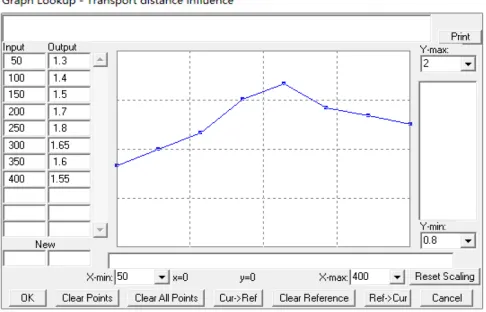
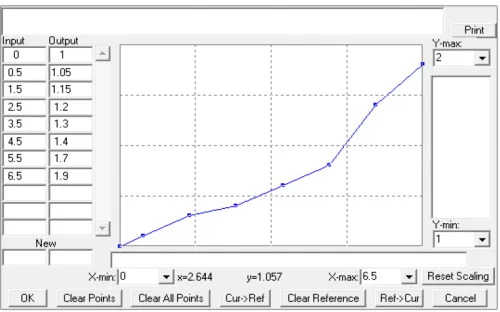
3) The relationship between shipping rate and transport capacity, transport distance, transport delay, the real cargo rate is described by Table functions in Figures 3-6, respectively. Figure 3 shows the relationship between shipping rate and transport capacity, the shipping rate first goes up then goes down with the increase of the transport capacity. Figure 4 shows the relationship between shipping rate and transport distance, the change trend is the same as the transport capacity but the change scope is different. As a whole, there exists a decreasing trend between shipping rate and transport delay (as shown in Figure 5). Figure 6 shows an increasing trend between shipping rate and transport the real cargo rate.
Figure 3. Table function of Transport capacity impact
Figure 5. Table function of Transportation delayed impact
Figure 6. Table function of cargo rate impact
4) About the simulation equation.
The simulation equation of order processing rate is: order processing rate=total expected productivity; total expected productivity=expected productivity + inventory adjustment. So the order processing rate adjusts with the change of inventory and order backlog.
Storage rate=DALAY3 (total expected productivity, production time). Storage rate does not respond to total expected productivity immediately. On the contrary, there exists lag effect. However it will change fast once began to response.
relationship between DR and MDR is always restricted in the bottom right of the two datum lines. When the enterprise has the enough storage, the maximum total delivery rate is rather higher than required delivery rate. Then products shortage will not happen, and order fulfillment rate is 1. When the max total delivery rate decreases, the possibility of shortage will increase and order fulfillment rate will decrease. When the max total delivery rate goes down below required delivery rate, the order fulfillment rate will be less than 1. The decrease of the future supply capacity forces the order fulfillment rate go down, until it deliver the goods according to the maximum delivery rate.
Figure 7. Table function of Order fulfillment rate
3.2. The Model Test
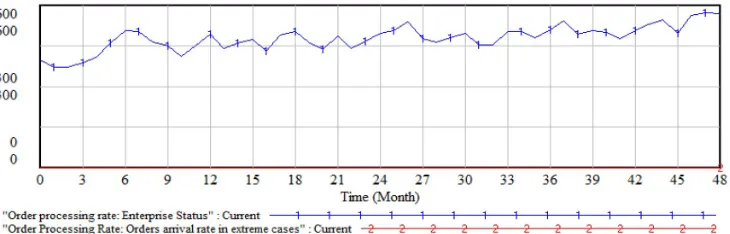
Figure 9. Model tested in extreme conditions
3.3. The Simulation Analysis
We input data into the simulation model, set the simulation time for 4 years. The simulation results are as follows:
1. Order backlog is diversified every month and order processing costs fluctuate (Figure 10). The maximum is 12712 yuan, the minimum is 10000.34 yuan.
2. Total inventory costs include warehousing cost, shortage cost, storage and out of storage cost. The simulation results is shown in Figure 11.
3. Total transportation cost consists of transport cost and shortage cost. As is shown in Figure 12.
4. Logistics operational costs are constituted by order costs, inventory costs and total transportation costs. Figure 13 describes the results.
Figure 11. the total cost of inventory
Figure 12. The total cost of transportation
Figure 13. Logistics costs
3.4. The Costs Optimization Control
shortage costs but also reduce the delivery cost per unit, storage cost per unit and the coefficient of the shortage cost; The other is to control the total transportation costs. That is, to control the changes of shipping rate. However the shipping rate is affected by transport distance, transport capacity, transport delay and the real cargo rate. So the Changsha engineering machinery manufacturing firm must focus on the above four factors and reduce their influence.
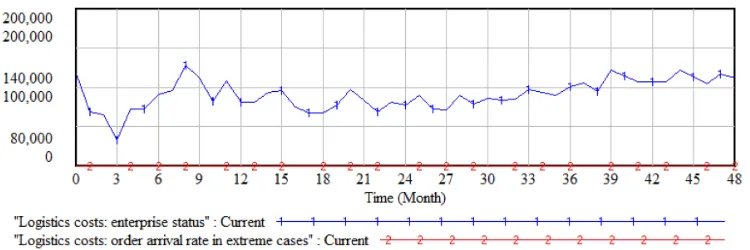
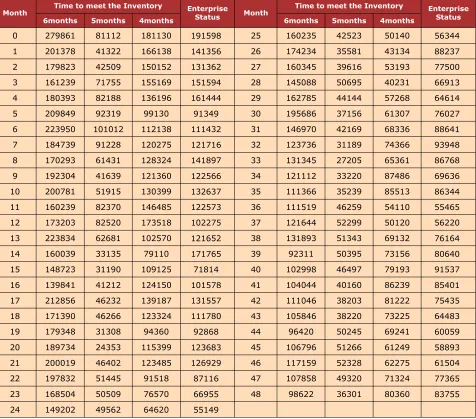
1. Strategy 1: Improve the time to meet the inventory to decrease shortage costs. Given there exist benefit conflicts between total transportation costs and inventory costs, it is found that the logistics cost reaches to the minimum when the time to meet the inventory is five months (Line 3 in Figure 14-15 and Table 4).
2. Strategy 2: Improve the real cargo rate. The Changsha engineering machinery manufacturing firm can optimize the logistics costs by implement joint distribution.
Figure 16. Comparison of the Shortages cost
Month Time to meet the Inventory EnterpriseStatus Month Time to meet the Inventory EnterpriseStatus
6months 5months 4months 6months 5months 4months
0 279861 81112 181130 191598 25 160235 42523 50140 56344
1 201378 41322 166138 141356 26 174234 35581 43134 88237
2 179823 42509 150152 131362 27 160345 39616 53193 77500
3 161239 71755 155169 151594 28 145088 50695 40231 66913
4 180393 82188 136196 161444 29 162785 44144 57268 64614
5 209849 92319 99130 91349 30 195686 37156 61307 76027
6 223950 101012 112138 111432 31 146970 42169 68336 88641
7 184739 91228 120275 121716 32 123736 31189 74366 93948
8 170293 61431 128324 141897 33 131345 27205 65361 86768
9 192304 41639 121360 122566 34 121112 33220 87486 69636
10 200781 51915 130399 132637 35 111366 35239 85513 86344
11 160239 82370 146485 122573 36 111519 46259 54110 55465
12 173203 82520 173518 102275 37 121644 52299 50120 56220
13 223834 62681 102570 121652 38 131893 51343 69132 76164
14 160039 33135 79110 171765 39 92311 50395 73156 80640
15 148723 31190 109125 71814 40 102998 46497 79193 91537
16 139841 41212 124150 101578 41 104044 40160 86239 85401
17 212856 46232 139187 131557 42 111046 38203 81222 75435
18 171390 46266 123324 111780 43 105846 38220 73225 64483
19 179348 31308 94360 92868 44 96420 50245 69241 60059
20 189734 24353 115399 123683 45 106796 51266 61249 58893
21 200019 46402 123485 126929 46 117159 52328 62275 61504
22 197832 51445 91518 87116 47 107858 49320 71324 77365
23 168504 50509 76570 66955 48 98622 36301 80360 83755
24 149202 49562 64620 55149
Table 4. Comparison of the logistics cost
4. Conclusions and Prospects
This paper builds the logistics operational costs model of a Changsha engineering machinery manufacturing firm and simulates the model based on system dynamics. The findings are as follows:
1. The simulation model is feasible and valuable and is able to express the relationship of factors in the system. In the simulation period, the simulation results better reflect the real logistics operational cost in the case firm.
The total logistics cost system is a complex and non-linear feedback system including several dynamic subsystems. Although building the logistics operational cost model of order costs, inventory costs and transportation costs, this study still lacks comprehensive consideration about the variables quantities and quantitative of the control factors. In the future, we should strengthen the collection of data and information about the engineering manufacturing firms and improve the logistics operational cost model.
References
Bertazzi, L., Speranza, M.G., & Ukovich, W. (1997). Minimization of logistics costs with given frequencies. Transportation Research Part B, Methodological, 31, 327-340.
http://dx.doi.org/10.1016/S0191-2615(96)00029-X
Chai, T.Z. (2006). The modeling and simulation research on the costs of 3PL based on system dynamics. Hebei University of Technology.
Dullaert, W., Maesb, B., Vernimmence, B., & Witlox, F. (2004). An evolutionary algorithm for order splitting with multiple transport alternative. Expert System with Application, 28, 201-208. http://dx.doi.org/10.1016/j.eswa.2004.10.002
Eden, C., Williams, T., & Ackermann, F. (2005). A analyzing project cost overruns: comparing the measured mile analyses and system dynamics modeling. International Journal of Project Management, 23, 135-139. http://dx.doi.org/10.1016/j.ijproman.2004.07.006
Gong, L. (2009). Study on optimal model of automotive logistics cost. Wuhan University of Technology.
Hu, T.L., Shen, J.B., & Huang, K.H. (2002). A reverse logistics cost, minimization model for the treatment of hazardous wastes. Transportation Research Part E: Logistics and Transportation Review, 38, 457-473. http://dx.doi.org/10.1016/S1366-5545(02)00020-0
Huang, F.Y., & Nie, R.H. (2003). Research on a multi-objective optimizing stochastic model of logistics for ono-linear programming. Journal of South China Normal University: Natural Science, 3, 54-59.
Kara, S., Rugrungruang, F., & Kaebernick, H. (2007). Simulation modeling of reverse logistics networks. International Journal of Production Economics, 106, 61-69.
Manunen, O. (2000). An activity-based costing model for logistics operations of manufacturers and wholesalers. The national Journal of Logistics: Research and Applications, 3, 53-65.
http://dx.doi.org/10.1080/13675560050006673
Mason, S.J., Ribera, P.M., Farris, J.A., & Kirk, R.G. (2003). Integrating the warehousing and transportation functions of the supply chain. Transportation Research Part E: Logistics and Transportation Review, 39, 141-159. http://dx.doi.org/10.1016/S1366-5545(02)00043-1
Min, H., Ko, H.J., & Ko, C.S. (2004). A genetic algorithm approach to developing the multi-echelon reverse logistics network for product returns. Omega, 56-69.
Mu, J., & Ma, L.L. (2015). Analysis of evolutionary game of information sharing for food supply chain based on SD. Science and Technology Management Research, 34, 182-185.
Ning, X.Q., & Wang, Q.F. (2004). Application of system dynamics model in project time and cost estimate. Science & Technology Review, 9, 54-57.
Sachan, A., Sahay, B.S., & Sharma, D. (2004). Developing India grain supply chain cost model: A system dynamics approach. International Journal of Productivity and Performance Management, 54, 187-205. http://dx.doi.org/10.1108/17410400510584901
Schuster, E.W. (1987). A logistics application of simulation to determine distribution costs resulting from a forward warehouse operation. Proceeding of the 1987 Winter simulation conference. Atanta, GA. 845-852. http://dx.doi.org/10.1145/318371.318706
Sheffi, Y., Eskandari, B., & Kourtsopoulos, H.N. (1988). Transportation mode choice based on total logistics costs. Journal of Business Logistics, 9, 137-154.
Shi, Y.Q., Peng, S., Zhang, Z.Y., & Yang, L. (2015). Mode of TPL cross docking supply hub based on system dynamics. Journal of management sciences in China, 18, 13-22.
Sterman, D.J. (2008). Business Dynamics-System Thinking and modeling for a Complex World. Beijing, Tsinghua University Press.
Sun, Z.Y., Peng, Q.Y., & Chen, X. (2006). DEA model for logistics activity cost control of enterprises. Journal of Southwest Jiaotong University, 41, 649-652.
Walker, O.C. Jr. (2006). The Adaptability of Network Organizations: Some Unexplored Questions. Journal of Academy of Marketing Science, 25, 75-82.
Wong, H., Oudheusden, D.V., & Cattrysse, D. (2007). Cost allocation in spare parts inventory pooling. Transportation Research Part E: Logistics and Transportation Review, 43, 370-386.
http://dx.doi.org/10.1016/j.tre.2006.01.001
Zhang, L.B., Hang, Y.Q., & Chen, J. (2007). System cost & bullwhip effect in quantity-based VMI consolidation replenishment system. Computer Integrated Systems, 13, 410-416.
Journal of Industrial Engineering and Management, 2015 (www.jiem.org)
Article's contents are provided on a Attribution-Non Commercial 3.0 Creative commons license. Readers are allowed to copy, distribute and communicate article's contents, provided the author's and Journal of Industrial Engineering and Management's names are included.