Issues
ISSN: 2146-4138
available at http: www.econjournals.com
International Journal of Economics and Financial Issues, 2017, 7(4), 453-458.
The Effect of Ownership Structure on Cash Conversion Cycle in
Listed Firms on Tehran Stock Exchange
Elaheh Javadi
1*, Hashem Nikoumaram
21Department of Accounting, Master’s Student in Accounting, Science and Research Branch, Islamic Azad University, Tehran, Iran, 2Department of Accounting, Science and Research Branch, Islamic Azad University, Tehran, Iran. *Email: [email protected]
ABSTRACT
This study aims to investigate the effect of ownership structure in terms of ownership type and ownership concentrate on cash conversion cycle (CCC) in 115 listed firms on Tehran stock exchange between 2008 and 2014. The theoretical basis and the data used in this study were obtained through library research. Also, the hypotheses formulated in the present research were tested using correlation analysis based on multivariate regression analysis. The results obtained by testing the hypotheses show that there is a significant and negative correlation between institutional ownership and CCC and a significant and positive correlation between firm ownership and CCC. The results of the study also indicate that there is not a significant correlation between major shareholder ownership and CCC.
Keywords: Cash Conversion Cycle, Ownership Structure, Institutional Ownership, Cash
JEL Classifications: C32, O13, O47
1. INTRODUCTION
Economic enterprises have effective presence in the economic
area. The efficiency is financially determined by two indicators, including liquidity power and profitability. Profitability is the
indication of enterprise and liquidity power is the indication of
survival of economic enterprise. In other words, if a firm is not profitable, it is sick but if it has not any liquidity, its survival is in
danger. Although both factors are important, however, liquidity has more importance (Bardia, 1988).
In recent years, many firms are encountered with inappropriate
situation of liquidity that the investigation of the factors associated
with this situation is important. Management of effective working capital is known as one of the important dimensions of practices of financial management in all organizational forms. Existence of extensive literature in this field suggests that management of effective working capital directly affects liquidity and profitability of firms (Raheman and Naser, 2007; Naser, 2010).
One of the broad criteria of management of working capital is cash conversion cycle (CCC) considering all financial streams dependent on inventory, receivables and payments (Nobanee, 2011).
After financial confusions at the end of 2000, management of working capital has been more addressed by the researchers and it also needs more investigation (Rehn, 2012).
Many researches have been carried out concerning the relationship
between ownership structure and concepts in Iran such as firm guidance, firm performance and profit and its quality, firm value and cashable stock. However, one of the issues ignored in empirical
research, not only about ownership structure but also in relation
to other fields is the concept of CCC.
The importance of the research is that due to economic recession across the country in recent years as well as the crisis of liquidity of
most firms, the research empirically indicates the shareholders and managers of firms that whether ownership structure(institutional, firm, major shareholder) of a firm has an impact on CCC or not.
The scientific added value of research is as follows:
Firstly, the results cause the extension of theoretical
foundations of the previous research. Secondly, the research results show that what the relationship between ownership
well as legislators of the stock exchange. Thirdly, the research
results can provide suggestions for legislators and accounting researchers.
2. THEORETICAL FOUNDATIONS OF
RESEARCH
2.1. Hypotheses Concerned with the Supervisory Role of Institutional Shareholders
Two hypotheses of effective monitoring and homogeneity of
benefits have been proposed:
A. Hypothesis of effective monitoring
Hypothesis of effective monitoring suggests that
through more investment of institutional shareholders, effective monitoring is applied by them and differences
of believe and agency disputes are more likely removed (Hasas, 2008). According to the hypothesis, Graham et al. (2014) believes that institutional
owners are professional investors having long-run focus. Therefore, given the volume of investment of
skillfulness of these shareholders, their presence causes monitoring on management and it maximizes firm value
in the long-run. Shelifer and Robert (1997) believe that in terms of theory, institutional shareholders may also have incentives for active monitoring on management and then the increase of shareholders. Bushee (1998) also suggests that institutional investors monitor the
firm by data collection and pricing decisions implicitly and by managing the activities of firm explicitly. It is naturally expected that the relationship between
institutional ownership and firm performance is desirable.
B. Hypothesis of homogeneity of benefits
Hypothesis of homogeneity of benefits suggests that
great institutional shareholders have strategic unity and
continuity with management (Hasas, 2008). According to the hypothesis, Porter (1992) believes that the frequent
transaction and focus on short-run goals by the institutions cause incentive for the management in order to be avoided failure because the investment may be sold by institutional investors and reduction of the price of shares. Therefore,
institutional investors mainly focus on current profits and
they may also be along with managers in this way.
Pound (1988) believes that institutions do not still effectively monitor firm because they do not still have enough experience and they are unsatisfied with free riders or they may get along with
manager by using a certain policy. Kim (1993) also believes that
great institutional investors have access to confidential information extracted for commercial purposes. More focused ownership can
be (focus of shares may be more at the disposal of institutional shareholders), more will be access of great shareholders to
confidential information. In such situations, great shareholders may have less tendency to encourage manager to report profit with content. In this state, it is naturally expected that the relationship between institutional ownership and firm performance is not a
desirable relationship.
2.2. Pressure - Sensitive and Pressure - Insensitive Institutional Investors
Researchers such as Elyasiani and Jia (2010) and Lina et al. (2015) divided institutional investors into pressure-sensitive and
pressure-insensitive.
Consequently, pressure-sensitive institutional investors (non-observer) are those having less tendency for challenge with management. Therefore, it seems that this category of institutional shareholders have more compliance with the hypothesis of
homogeneity of benefits. However, on the other hand, there are
pressure-insensitive institutional investors (observer) having more incentives for monitoring and control of management. This group of institutional shareholders have more compliance with
the hypothesis of effective monitoring (Elyasiani and Jia, 2010.
p. 158).
In a research, Rabindra (2016) investigated the effect of CCC on measuring efficiency of management of cash in medical section.
The results showed that CCC is dynamic measurement from continuous liquidity management due to the simultaneous use
from financial statements of balance sheet and statement of profit
and loss (data with the dimension of time).
In a research entitled “CCC and profitability of firm: Empirical
analysis composed of 4226 Italian small and medium manufacturing
enterprise,” Marco (2015) evaluated effect of CCC on profitability.
The results showed that the average period of receivables have
significant positive relationship with profitability indicating that
it is not necessary that the moral conclusion of the story is not
always as follows: Less the size of CCC is, more the profitability will be. The present study considers revenues before interest, tax,
fall of price and depreciation about net sales as the criterion of
profitability for presenting dependent variables.
In a research, Lina (2015) investigated “the effect of CCC on liquidity of Jordan service firms.” The results showed that there is
not any considerable effect of CCC on liquidity of Jordan service companies and there is not any considerable effect of CCC on
current ratio and the quick ratio of Jordan service firms.
In a research, Kazi and Somnath (2015) investigated “the effect of
CCC on cash maintenance.” The results showed that more CCC is, less cash maintenance will be.
In a research entitled “the effect of management of working capital on profitability of firm with the different business cycles,” Graham et al. (2014) studied procedures of management of working capital of a sample of listed firms in Finland stock exchange during
18-years period. They showed that the management of active
working capital is important and they should be considered in the financial planning of firm.
In a research, Nobanee et al. (2011) investigated the relationship between the CCC on profitability of Japanese firms. It was carried out during 1990-2004. The results showed that there is a significant relationship between CCC of firms and profitability and return of
investment in all samples studied.
By investigating the determinant role of ownership structure in
the policies of finance from the debts in a sample consisting of 833 Japanese year-firms during 1992-2000, Namazi and Kermani (2008) obtained the following conclusions.
There is a significant and positive relationship between debt and cash free streams that this relationship in the firms having
low growth opportunity is more than the firms having high
growth opportunity. In the firms having low growth opportunity, institutional investors prevent managers from excessive
investments. In the firms having high growth opportunity, institutional investors support more borrowing.
In a research entitled “the effect of investment in the working capital given the finance limitations on sensitivity of cash stream” and according to a sample consisting of 70 firms during 2005-2011, Alinejad, Saroukalaei and Ayin concluded that among the criteria of management of working capital and considering the financial
limitations on sensitivity of cash stream, the effect of period of
receivables is only positive and significant; however, considering the financial limitations on sensitivity of cash stream, the effect of
deposit period of creditors, inventory turnover period and CCC
is not significant.
Izadinia and Rasaeian (2010) investigated the regulatory navigation tools of firm, level of cash maintenance and performance of listed firms in Tehran stock exchange. The results showed that there is a positive and significant relationship between the percentage of investors’ institutional ownership and the value of listed firms in Tehran stock exchange, however there is not any significant
relationship between the percentage of non-obligatory members
of the board of directors and value of listed firms in Tehran stock exchange. Level of cash maintenance also has a positive and significant relationship with the value of listed firms in Tehran stock exchange.
Setayesh and Kazemnejad (2010) investigated the effect of
ownership structure and combination of the board of directors
on the policy of dividing profit of listed firms in Tehran stock exchange. The results showed that firm ownership and the
independence of board of directors positively affect the ratio
of divided profit of listed firms in Tehran stock exchange and
institutional ownership negatively affects the ratio of divided
profit of listed firms in Tehran stock exchange. Nevertheless, it was observed no evidence suggesting the significant relationship
between managerial ownership and the range of focus of ownership
with the policy of profit division.
Namazi and Kermani (2008) investigated the effect of ownership structure on the performance of listed firms in Tehran stock exchange. To test the hypotheses, it was defined four models based on the dependent variables. The findings showed that there
is a significant and negative relationship between “institutional
ownership” and firm performance and there is a significant
and positive relationship between “firm ownership” and firm performance. “Managerial ownership” significantly and negatively affects firm performance.
3. RESEARCH HYPOTHESES
In line with achievement to the research purposes and answering the research questions, the following hypotheses are presented based on the theoretical foundations of research:
• The first hypothesis: There is a significant relationship between
level of institutional ownership and CCC.
• The second hypothesis: There is a significant relationship between level of firm ownership and CCC.
• The third hypothesis: There is a significant relationship
between major shareholder ownership and CCC.
4. RESEARCH METHODOLOGY
The spatial domain of the present research is the listed firms in Tehran stock exchange. The time domain also is a 7-years period based on the financial statements from 1387 to 1393 of the sample firms.
To determine statistical sample, it was used from systematic deletion.
For this purpose, firms of the population having the following conditions are selected as statistical sample and the remained firms are removed. The fiscal year of firms ended in the date of end of Esfand in every year. The firm should not do change of fiscal year during the period under review. The firm under review should not be investment firms, holding firms, firms of financial intermediation and insurance firms. Their information and data should be available. The transactions of firm stocks should be continuously done in Tehran stock exchange and the trading stop about the mentioned stock should not be occurred more than 3 months.
Considering the above conditions and limitations, among the listed
firms in Tehran stock exchange, 115 firms were totally selected as
the research statistical sample.
In terms of purpose, the research is functional and in terms of nature, it is a descriptive research emphasizing correlational relationships and the research method of argument also is
inductive-deductive. To calculate and making data ready used
for the required information of research and also their analyses,
it was used from Excel and Eviews8 software’s.
4.1. Variables and Research Model
In this research, the level of institutional ownership, the level
of firm ownership and the major shareholder ownership are
independent variables. CCC was also considered as dependent
variable. Furthermore, firm size, current ratio, leverage ratio
and sale growth were considered as control variables. Then the
operational definition of any these variables are considered: • Level of institutional ownership (INSOWN): Is equal to the
maintained stocks by the governmental and public firms from
• Ownership concentration (OWNCON): A percentage from the published firm shares which is in the hands of the first great firm shareholders.
• Cash conversion cycle (CCC): CCC is obtained by the sum of receivables cycle period (RCP) and inventory cycle period (ICP) minus payables deferral period (PDP).
• CCC = RCP + ICP - PDP.
• RCP = It is a fraction that 360 is in its numerator and its
denominator is the ratio of receivables cycle.
• ICP = It is a fraction that 360 is in its numerator and its
denominator is the ratio of inventory cycle.
• PDP = It is a fraction that 360 is in its numerator and its
denominator is the ratio of obligations (debts).
• Ratio of receivables cycle: Sales of goods divided by the
average receivables in the beginning and end of period.
• Ratio of inventory cycle: The final price of sold goods divided
by the average inventory in the beginning and end of period.
• Ratio of obligations (debts) cycle: The final price of sold goods
divided by the average payables deferral in the beginning and end of period.
• Firm size (SIZE): Firm size is obtained by the total natural logarithm of firm assets.
• Current ratio (CURR): This variable is obtained by the division
of the whole current assets by the whole current debts.
• Levarage ratio (LEV): Leverage ratio is obtained by the
division of the whole debts by the whole assets.
• Sales growth (GROWTH): Sales growth is obtained by the
division of difference of sales of the current year and the sales of previous year by the sales of previous year.
To test research hypotheses, the following multivariate regression model is used:
Relation 1:
CCCit = β0+β1INSOWNit+β2FIROWNit+β3OWNCONit+β4SIZEit +β5CURRit+β6LEVit+β7GROWTHit+εit
That in the above model: CCC represents cash conversion cycle; INSOWN represents level of institutional ownership; FIROWN represents level of firm ownership; OWNCON represents major shareholder ownership; SIZE represents firm size; CURR represents current ratio; LEV represents leverage ratio and growth
represents sales growth.
5. RESEARCH RESULTS
5.1. Research Descriptive Statistic
In Table 1, some concepts of descriptive statistics of variables have been presented such as average, median, minimum observations,
maximum observations and standard deviation. The results showed that in the firms under review, on average 37% firm shares in the ownership of shareholders are institutional. In more than 50% sample firms, 27% minimum shares in the ownership of shareholders are institutional. The results showed that the current ratio of firms
under review during the research period is almost 1.269 on average.
On average, almost 62% their financial sources were financed by debt. The average cash conversion cycle is almost 90.5 days.
6. RESULTS OF TESTING HYPOTHESES
The first hypothesis: There is a significant relationship between
level of institutional ownership and cash conversion cycle.
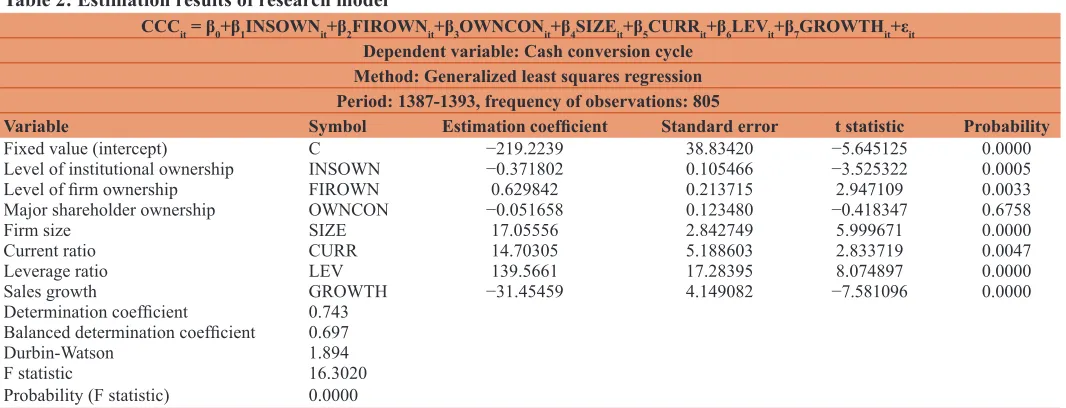
To test the hypothesis, it was used from the estimation results of the model presented in Table 2. Probability value (or significance level) F = 0.0000 and because the value is <0.05, the null hypothesis is rejected at 95% confidence level, that is, the model is significant. Durbin-Watson statistic value is 1.894 that the value suggests lack of autocorrelation. The results associated with the balanced determination coefficient show that almost 69.7% variations of dependent variable are explained by the independent
and control variables of the model.
The results show that given t statistic, except the variable of major
shareholder ownership, the rest of available variables in the model
are significant at 95% confidence level. The results obtained from control variables showed that firm size, current ratio and leverage ratio have positive and significant relationship with cash conversion cycle while sales growth has negative and significant
relationship with cash conversion cycle.
In general, the results showed that the variable coefficient of level of institutional ownership was −0.371802 suggesting the negative
effect of level of institutional ownership on cash conversion cycle
that considering t statistic of the variable coefficient of level of institutional ownership is significant, in other words, it can be said that there is a negative and significant relationship between level
of institutional ownership and cash conversion cycle. According
to the above cases, the first research hypothesis can be confirmed at 95% confidence level, in other words, it can be said that by
increasing level of institutional ownership, cash conversion cycle decreases and vice versa.
Third hypothesis: There is a significant relationship between major
shareholder ownership and cash conversion cycle.
To test the hypothesis, it was also used from the estimation results of the model presented in Table 2. In general, the results showed
that the variable coefficient of major shareholder ownership was −0.051658 suggesting the negative effect of major shareholder
ownership on cash conversion cycle, however, given t statistic
of the variable coefficient of major shareholder ownership are not significant in the model, in other words, it can be said that there is a negative and insignificant relationship between major
shareholder ownership and cash conversion cycle. Considering
the above cases, the third hypothesis cannot be confirmed at 95% confidence level, in other words, it can be said that there is not significant relationship between major shareholder ownership and
cash conversion cycle.
7. SUMMARY AND CONCLUSION
7.1. First Hypothesis
According to the hypothesis, it is expected that there is a significant
estimated by using the method of panel data (type of model is the
fixed effects) that the results of estimation model were presented
in Table 2. By using t-test, significance of estimated variable coefficient of level of institutional ownership was examined that the results suggest the significance of estimated variable coefficient of level of institutional ownership. F statistic also shows that the whole estimated model is valid. In general, at 95% confidence level, the results showed that there is a negative and significant relationship between level of institutional ownership
and cash conversion cycle. In other words, by increasing the level of institutional ownership, cash conversion cycle decreases and vice versa. The results of the hypothesis is in accordance with
the results of research carried out by Hasas (2008) and Izadinia and Rasaeian (2010) and it is also in reverse order of the results
suggested by Namazi and Kermani (1387).
7.2. Second Hypothesis
According to the hypothesis, it is expected that there is a significant relationship between level of firm ownership and cash conversion
cycle. To test the hypothesis, regression model was estimated by
using the method of panel data (type of model is the fixed effects)
that the results of estimation model were presented in Table 2.
By using t-test, significance of estimated variable coefficient of level of firm ownership was examined that the results suggest the significance of estimated variable coefficient of level of firm
ownership. F statistic also shows that the whole estimated model is
valid. In general, at 95% confidence level, the results showed that
there is a positive and significant relationship between level of firm
ownership and cash conversion cycle. In other words, by increasing
the level of firm ownership, cash conversion cycle also increases
and vice versa. The results of the hypothesis are also in reverse
order of the results suggested by Namazi and Kermani (2008).
7.3. Third Hypothesis
According to the hypothesis, it is expected that there is a significant
relationship between major shareholder ownership and cash conversion cycle. To test the hypothesis, regression model was estimated by using the method of panel data (type of model is the
fixed effects) that the results of estimation model were presented
in Table 2. By using t test, significance of estimated variable coefficient of major shareholder ownership was examined that the results suggest the insignificance of estimated variable coefficient
of major shareholder ownership. F statistic also shows that the
whole estimated model is valid. In general, at 95% confidence level, the results showed that there is not significant relationship
between major shareholder ownership and cash conversion cycle. The results of the hypothesis are also in accordance with the results
suggested by Setayesh and Kazemnejad (2010).
8. RESEARCH SUGGESTIONS
A. The results of the first hypothesis show that there is a negative
relationship between the level of institutional ownership and cash conversion cycle, in other words, by increasing the level
Table 1: Descriptive statistics of research variables
Variables Symbol Frequency of
observations Average Median Maximum Minimum Standard deviation
Cash conversion cycle CCC 805 90.511 67.071 334.781 5.8771 76.543
Level of institutional ownership INSOWN 805 37.026 27.1 93.25 3.11 29.288
Level of firm ownership FIROWN 805 22.478 23.5 30.66 0.63 5.498
Major shareholder ownership OWNCON 805 75.729 77.975 92.85 49.2 11.426
Firm size SIZE 805 13.779 13.615 18.455 10.086 1.434
Current ratio CURR 805 1.269 1.217 2.613 0.599 0.411
Leverage ratio LEV 805 0.621 0.637 0.929 0.313 0.154
Sales growth GROWTH 805 0.189 0.168 0.839 −0.287 0.234
CCC: Cash conversion cycle
Table 2: Estimation results of research model
CCCit = β0+β1INSOWNit+β2FIROWNit+β3OWNCONit+β4SIZEit+β5CURRit+β6LEVit+β7GROWTHit+εit
Dependent variable: Cash conversion cycle Method: Generalized least squares regression Period: 1387-1393, frequency of observations: 805
Variable Symbol Estimation coefficient Standard error t statistic Probability
Fixed value (intercept) C −219.2239 38.83420 −5.645125 0.0000
Level of institutional ownership INSOWN −0.371802 0.105466 −3.525322 0.0005
Level of firm ownership FIROWN 0.629842 0.213715 2.947109 0.0033
Major shareholder ownership OWNCON −0.051658 0.123480 −0.418347 0.6758
Firm size SIZE 17.05556 2.842749 5.999671 0.0000
Current ratio CURR 14.70305 5.188603 2.833719 0.0047
Leverage ratio LEV 139.5661 17.28395 8.074897 0.0000
Sales growth GROWTH −31.45459 4.149082 −7.581096 0.0000
Determination coefficient 0.743 Balanced determination coefficient 0.697
Durbin-Watson 1.894
F statistic 16.3020
of institutional ownership, cash conversion cycle decreases.
It can be argued that these findings has conformity with the hypothesis of homogeneity of benefits and pressure-sensitive in the field of ownership structure, that is, by increasing level
of institutional ownership, the agency problems between
firm and management decreases, in other words, the level of institutional ownership causes that the benefits of shareholders
and those of managers become in line with each other. In this
regard, it is recommended to users from the financial reports of firm that in the time of evaluation of efficiency of management of the working capital or cash conversion cycle, they should
consider the positive role of level of shares of institutional
owners in the firm efficiency.
B. The results of the second hypothesis show that there is a
positive relationship between the level of firm ownership
and cash conversion cycle. In other words, by increasing the
level of firm ownership, cash conversion cycle increases. It can be argued that by increasing level of firm ownership, the
length of cash conversion cycle also increases, in other words,
by increasing the level of firm ownership, the efficiency of working capital and firm operational performance decreases. In this regard, it is recommended to users from the financial reports of firm that in the time of evaluation of efficiency of management of the working capital or cash conversion cycle,
they should consider the negative role of level of shares of
firm owners in the firm efficiency.
C. The results of the third hypothesis show that there is a
significant relationship between major shareholder ownership
and cash conversion cycle, in other words, by increasing or decreasing major shareholder ownership, cash conversion cycle does not change. It can be argued that change in the major shareholder ownership has no effect on the length of cash conversion cycle. In this regard, it is recommended to
users from the financial reports of firm that in the time of evaluation of efficiency of management of the working capital
or cash conversion cycle, they should not consider major shareholder ownership.
REFERENCES
Autukaite, R., Molay, E. (2013), Cash Holdings, Working Capital and Firm Value: Evidence from France. Available from: http://www. studymode.com/essays/Cash-Holdings-Working-Capital-And-Firm-1462727.html. [Last retrieved on 2013July02].
Bardia, S.C. (1988), Working Capital Management. Jaipur, India: Pointer Publisher. p32-38.
Bushee, B.J (1998), The influence of institutional investors on myopic R and D investment behavior. Accounting Review, 73, 305-334. Elyasiani, E., Jia, J. (2010), Distribution of institutional ownership on
corporate operating performance. Journal of Banking and Finance, 34, 606-620.
Graham, M., Enqvist, J., Nikkinen, J. (2014), The impact of working capital management on firm profitability in different business cycles: Evidence from Finland. International Research Journal of Finance and Economics, 66, 40.
Hasas, Y., Moradi, M., Eskandar, M.(2008), The investigation of the relationship between institutional investors and firm value. Seasonly Journal of Accounting and Auditing Studies, 52, 107-122.
Izadinia, N., Rasaeian, A. (2010), Corporate governance regulatory tools, Cash holdings and listed firm performance on Tehran stock exchange. Seasonally Journal of Economic Research and Policies, 55, 141-154. Kazi, N., Somnath, D. (2015), Impact of cash conversion cycle on cash
holding-a study on FMCG sector. Accounting, 1, 1-16.
Kim, O. (1993), Disagreement among shareholders over a firm’s disclosure policy. Journal Financial, 2, 747-760.
Lina, H.W. (2015), The impact of cash conversion cycle on services firms’ liquidity: An empirical study based on Jordanian data. International Journal of Business and Management, 10(10), 108-115.
Marco, M. (2015), Cash conversion cycle and firm’s profitability: An empirical analysis on a sample of 4,226 manufacturing SMEs of Italy. International Journal of Business and Management, 9(5), p25-35. Namazi, M., Kermani, E. (2008), Impact of ownership structure on listed
firm performance on Tehran stock exchange. Seasonly Journal of Accounting and Auditing Studies, 53, 83-100.
Nobanee, H. (2011), Working Capital Management and Firms Profitability: An Optimal Cash Conversion Cycle. Available from: http://www.ssrn.com.13910218.
Porter, M.E. (1992), Capital disadvantage: America’s failing capital investment system. Harvard Business Review, 70, 65-82.
Pound, J. (1988), Proxy contests and the efficiency of shareholder oversight. Journal of Financial Economics, 20, 237-265.
Rabindra, M. (2016), Impact of cash conversion cycle for measuring the efficiency of cash management: A study on pharmaceutical sector. Contents Lists Available at Growing Science Accounting, 2, 143-150. Raheman, A., Nasr, M. (2007), Working capital management and
profitability-case of Pakistan firms. International Review of Business Research Papers, 3, 279-300.
Rehn, E. (2012), Effects of Working Capital Management on company Profitability. Master`s Thesis. Hanken Schoole of Economics. Available from: http://www.google.com.
Setayesh, M., Kazemnejad, M. (2010), The investigation of the impact of ownership structure and composition of the board of directors on policy of dividing profit of listed firms on Tehran stock exchange. Journal of Accounting Knowledge, 1389, 29-51.