Volume 3, Issue 1, 2016, pp. 66-73 Available online at www.jallr.com ISSN: 2376-760X
* Correspondence: Mustafa Shazali Mustafa Ahmed, Email: [email protected] © 2016 Journal of Applied Linguistics and Language Research
Students - Centered Learning as a Vital Decision by Material
Writers: A Case of English Language Extra - Activities in
Sudan Basic Schools
Mustafa Shazali Mustafa Ahmed
Nile Valley University, English Department, Sudan
Abstract
Extra-curricular Activities (ECA) can help enrich the manifest (official) syllabus. This paper investigates the importance of ECA in consolidating the manifest syllabus of the basic level in Sudan. Data were obtained from 60 English teachers who work in River Nile state in Sudan. The study has arrived at that ECA are of great value to the pedagogy of English Language teaching .It helps syllabus designers conceive properly the needs of the students. The Ministry of education in Sudan does not pay attention to this topic in its New Series of Spine. The researcher believes that superiority of teaching does not mean to teach with superior technologies (still blackboards, school libraries, and school broadcastings are greatly needed). So in the case of the developing countries where students study in large classes and at the same time depend only on the manifest syllabus for learning English language, the researcher assumes the importance of these activities in vitalizing the school environment and consolidating the learning and teaching situation in a country like Sudan. The study has assumed that two parts of program implementation, i.e., material writings and teacher trainers, should be flexible and innovative.
Keywords: manifest syllabus, super technology, extra-activities, basic Level, program implementation
INTRODUCTION
needs. So what is selected by the written materials of a course may not satisfy students' needs. It is noticeable that, in most written materials of English languages courses in Sudan, that is, learning English is just like completing a series of short, controlled exercises. This specified content areas or activity types are clearly stated by Littlejohn and Windeatt quoted in Levinson (1989, p. 163) in the following quotation:
ELT Materials are normally organized into 'units' or 'lesson's with a repetitive pattern of subsections labeled according to the content or type of activity involved, learners may see learning a foreign language as involving the development of abilities in the specified content areas or activity types.
Students' perception of learning a language may, however, be seen in terms of what they are required to do in each sub-section of a particular ELT course book. What are the steps, then, taken by teachers when they find the materials of a course are lacking? Littlejohn and Windeatt (1989) in their paper suggested three possibilities. The first is that teachers should supplement the materials with other materials, whether from their own or published in the official syllabus. The second one is rejecting or abandoning the material, and using other materials or no materials at all. The third possibility is to retain and tune the material by making them the object of critical focus in the classroom. A set of materials should project the view of the majority of the language learning students. Hence, Extra-Curricular Activities may be considered as a necessary element to supplement the manifest English curriculum.
English clubs, school broadcasting programs and drama group generally help students to perform better in their future academic life.
Jawida (2006) showed how English clubs introduced to young learners in basic schools help children develop positive attitude towards learning English language. Jawida's study has shown activities such as singing songs, making things, and solving puzzles that have been practiced in English clubs in Tunisia were useful to students in their future levels of education. Lines (2006) stressed the importance of using favorite songs with young children as a means of learning vocabulary, especially unfamiliar ones. Mixon and Philomena (2006) discussed the influence of storytelling on the language skills and its importance in English language learning. They stated that by telling story each pupil will be able to express himself/herself by suggesting a picture that describes the story. They also thought that the four skills can be developed by using the technique of storytelling. Listening skill can be enhanced when the teacher as a teller of a story holds the attention of learners with the power of eye-contact and the element of suspense. Reading skill can be developed by giving each a student to read a sentence and by doing so in turns all children will be involved in the exercise and this may lessen students' sense of inhibition. This reading activity of storytelling can be conducted in classrooms as well as in ECA such as English club, morning assembly or on cultural weeks and open days. ECA may also develop the role of the teachers including the use of eye-contact strategy and the post-story activity which centered mainly on forwarding some comprehension questions in addition to giving a chance for pupils to participate by expressing their own comments and ideas. Also, the word ‘curriculum’ is defined by Johnson (1989, p. 1) as:
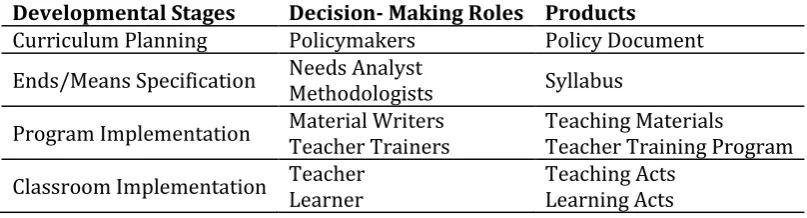
… all the relevant decision making processes of all the participants. The products of these decisions making processes generally exist in some concrete form and can be observed and described: for example policy documents, syllabuses, teacher-training programs, teacher materials and resources, and teaching and learning acts.
This decision-making framework for the language coherent curriculum is clearly identified in following table:
Table 1. Stages, decision-making roles and products in curriculum development Developmental Stages Decision- Making Roles Products
Curriculum Planning Policymakers Policy Document Ends/Means Specification Needs Analyst Methodologists Syllabus
Program Implementation Material Writers Teacher Trainers Teaching Materials Teacher Training Program
Classroom Implementation Teacher Learner Teaching Acts Learning Acts (Levinson, 1989, p.3)
decisions in this stage develop teaching and learning resources, and these resources can properly be used by the teachers in questions. Material writer's job is to make sure that the ends and means specifications can possibly be met. Materials should have curriculum integration with what is decided in the prior stage of ends/means specification. Materials writing should be decided by specialized committees with a deep knowledge in the particular subject. The curriculum materials should not be alien, complex, or outside the scope of the local community. More importantly, appropriate curriculum decisions can only be considered within the context of a particular teaching and learning situation' (see, Johnson, 1989, p. 9).
Hence, the present study provides the idea of English language extra materials, as a consolidating element for student-centered learning, to be practiced by basic level students outside classrooms as a unique part of English language material writing process. That is, table 1 can be changed according to the practical exigencies of the particular subject's nature (e.g., chemistry, physics, mathematics, and language) and its educational philosophy underlying the above ordering of curriculum development process. Teacher trainer should promote their roles from merely applied linguists (whose main task is what to do with materials rather than why already the materials in question designed) by training teachers to consider the program as an integrated whole. METHODOLOGY
Under what conditions may we infer that a change in the dependent variable (students’ practice of English language and their vocabulary development) is really caused by the independent variable (Extra Curricular Activities). The study seeks internal validity by having confidence that the results of study accurately depict whether one variable is or not a cause of another. The study adopted a descriptive approach with rating simple statistical calculations to gain a better understanding of the topic The present study did not endeavor to show the causes behind these 'extra-activities' lacking in Sudanese basic schools. The three requirements suggested by Lazarsfed (1959) were met in this study. The first requirement is a causal relationship between the above two variables. That is the cause (ECA) precedes the effect which is the change in the dependent variable which is in this case is students' motivation of learning English language in Sudan basic schools. The second requirement is that both variables are empirically correlated. The third one is that the observed empirical correlation between the two variables must not be explained away as being due to the influence of some third variable that causes both of them.
Participants
the study preserves gender neutrality by selecting half of the sample from male teachers and the other half is from female teachers. The study assigned number of teachers from different basic schools using quota matrix selection and simple random sampling to achieve these goals of the study.
Reliability of the questionnaire
Providing information on whether the data collection procedure (the questionnaire) is consistent and accurate, the researcher used Pearson equation for finding the partial coefficient of the questionnaire. A sample of 30 teachers has been selected and divided into two groups. Having counted the odd statements and the even statements, Pearson's equation was conducted and the statistics reliability was 0.859.
RESULTS AND DISCUSSION
In analyzing the data obtained from the questionnaire, the present study followed the strategy of collapsing by winding up with two columns of 'agree', and 'disagree'. To wind up with two columns, the study combines ‘strongly disagree', and 'disagree' into one column and combine 'strongly agree', and 'agree' and ' undecided' into another column. Also, the study reduces the questionnaire's underlying assumptions to seven categories representing all the points raised by the questionnaire That is, the researcher collect all the percentages for similar assumption and added them to each other to reach at a total value of each big assumption. The philosophy, of breaking further discrete assumptions and regain them again under general proposition, is to confirm real collection of data. That is, the questionnaire provides a choice of selection for the participants who are all English language basic level teachers. The questionnaire avoids using sophisticated technical terms and follows this simple strategy to guarantee positive responses and to guarantee a certain level of reliability.
Table 2. Synthesis of the questionnaire answers
Disagree Agree
English Language Teachers attitudes Towards Extra–Activities
in Sudan Basic Schools Freq. % Freq. %
-100 60
Extra - curricular Activities (ECA) are very useful and beneficial for English language learning.
20 12 80 48 Through ECA lessons or syllabus can be consolidated or confirmed.
15 9 85 51 ECA are neglected or not activated in Sudan basic schools
30 18 70 42 In the programs of in service training courses for teachers, ECA are rarely included.
25 15 75 45 ECA Should be considered by the ministry of Education when
deciding about best- fit English language materials
14. 5 8.7 85.5 51.3 ECA aids (e.g. English clubs/societies, microphones, Musical
instruments, are not sufficiently found in basic schools
students in their future careers. They also believed that ECA could supplement the tasks and activities assigned to the school curriculum. There was a unanimous agreement of 85% percent of all the teachers that ECA are not used in basic schools. 70% of the teachers acknowledged that they had never been given courses, workshop, and seminars on ECA. 75% blamed the English curriculum and the ministry of education for not giving them the advice necessary of the importance of these sustainable elements of the English language official syllabi.
Most of the sample (85,5%) showed that they had never received aids such as tape-recorder, musical instruments, loud speakers from the ministry of education (the department of students activities); and as a result schools have shown no programs or schedules for English ECA, however, ECA are proved not to be costly nor time-consuming. Many linguists nowadays advise using computer-assisted language learning programs (CALL) as a new strategy that can increase students' level of motivation (Martus & Kitayama, 1991, p. 83). A new study is urgently needed to identity the expenses of production of each type of these activities, and the degree of stimulation for ECA or CALL. ECA really cause the EFL learners' academic achievement and their increase of motivation in schools. What has been undertaken in this study is only obtrusive observation (Appendix). What is need in future studies is unobtrusive studies whose main concern is collecting data of ECA through carefully specifying and counting artifacts, such as books (Spine series–the Sudan Official Syllabi), content and documentary analysis. It is worth mentioning here that the series of Spine focuses only on how ECA can be undertaken, however, what is needed is the actual application of ECA in our schools in general, and much more emphasis should be given to the Sudan basic schools.
CONCLUDING REMARKS
The present paper has thrown lights on ‘program implementation’ stage as an important part in curriculum policymaking process. This stage is divided by Johnson's (1989) table into two important aspects of 'material writers', and 'teacher trainer’. The present paper is concentrating on producing a kind of research that can provide answers to the question of extra-activities in Sudan as well as generating important questions and insights to the topic. Hess (2008) showed that questions and cautions are more valued issue in education research which is needed to be synthesized by neutral scientific bodies bear considerable attention to technical issues like 'sample consideration, 'measurement error', or 'internal validity'. He stated the following:
The present paper is completely in line with the concepts of research community, democratization of research findings, as refined issues that should fully be regarded by today nations who use the Internet as inexpensive dissemination strategy to communicate their scholars' research findings. The present study though, is hoping for a universal scholar’s research efforts to expand and synthesize this Program implementation stage. All the research findings from all over the world should provide generalized findings pertaining to this vital stage of curriculum development, and by doing so, the study, hopes to enlarge Hess' (2008) conception of 'research community' to include all the scholars around the world and not only the American academes. By the advent of the Internet, the study thinks, there is a great need, also, reconsider widening, the educational concepts such as scholar', 'ends/means specifications’, 'curriculum planning', 'program implementation, 'classroom implementation' and ‘applied evaluation’, etc. That is, these issues should be seen as educational universal perspectives rather that local ones.
The research community mentioned in Hess’ (2008) quotation is related to American researchers who may experience some difficulties in choice between being neutral researchers, and their political convenience towards a particular party when arguing their methodological questions about sample size or measurement error. The present study though, takes the concept of democratization of research through the Internet dissemination as a new factor that helps purify the academic research from the effect of this unconscious political convenience, besides, it helps provide and share academic knowledge with the other parts of the world.
REFERENCES
Hess, F. M. (2008). When education research matters. Society, 45(6), 534-539.
Huxley, R., & Ingram, E. (Eds.). (1971). Language acquisition: Models and methods. New York: Academic Press.
Jawida, B. (2006). English clubs. English Teaching Forum, 44(2), 20-37.
Johnson, R. K. (1989). A decision–making framework for the coherent language curriculum. In R. K. Johnson (Ed.) The second language curriculum. Cambridge: Cambridge University Press.
Lazarsfed, P. (1959). Problems in methodology. In R. K. Merton (Ed.), Sociology today
(pp. 39-78). New York: Basic Books.
Linse, C. (2006). Using favorite songs and poems with young learners. English Teaching
Forum, 44(2), 38-43.
Littlejohn, A., & Windeatt, S. (1989). Beyond Language Learning: Perspectives on Material Design. In R. K. Johnson (Ed.) The second language curriculum.
Cambridge: Cambridge University Press.
Markus, S., & Kitayama, A. (1991). Attitudes and motivation in foreign language learning.
Mixon, M., & Temu, P. (2006). First road to learning language through stories. English
Teaching Forum, 44(2), 14-19.
Mymes, D. (1971). Competence and performance in linguistic theory. In R. Huxley and E. Ingram (Eds.) Language acquisition: models and methods (pp. 3- 39.)London: Academic Press.
APPENDIX
Choose the number that you think is matching with your answer. Your answers will be confidentially kept.
1. Strongly agree 2. Disagree 3. Agree Strongly disagree 5. Undecided
1. Extra - curricular Activities (ECA)are very useful and beneficial for English language learning. ( ) 2. ECA can help in revealing out the hidden skills, talents and potentialities of pupils. ( ) 3. Through ECA, pupils can get enough time to learn or practice what they have been taught in classroom in a more relaxed atmosphere. ( )
4. ECA are helpful in the sense that teachers will be able to know more about the strength and the weakness of their pupils. For instance, in writing, in reading, in
speaking etc… ( )
5. Through ECA lessons or syllabus can be consolidated or confirmed. ( )
6. Getting pupils of Basic schools exposed to the language through ECA will enable them to practice and use the language more easily in the years that follow and develop their Education and future career.
( )
7. Through ECA, the future career of pupils can be discovered. For instance pupils who sing well can be good and famous future singers. ( )
8. ECA are neglected or not activated in Sudan basic schools. ( )
9. English syllabus lacks ECA ( )
10. ECA are neglected or not activated, ECA such as microphones, Musical instruments, Theatres etc. are not sufficiently found in basic schools ( )
11. English teachers rarely use, ECA ( )
12. On Cultural days, open days or even on school National occasions English programs of basic schools are rarely presented. ( )
13. Co-curricular Activities such as English clubs/societies are rarely found in basic schools. ( ) 14. In the programs of in service training courses for teachers, ECA are rarely given. ( ) 15. When English language inspectors of education come to the basic schools, they rarely talk or give advice on ECA to teachers ( ) 16. School calendars in most basic schools have no specific times days for ECA. ( )