38 Sound © 2007 Marshall Cavendish International (S) Pte Ltd
Build your understanding!
Attempt the following questions on your own or in a group setting.
1. Sound is an example of a longitudinal wave and comprises a series of compressions and rarefactions in the medium.
(a) What are compressions and rarefactions?
(b) What is the distance, in terms of wavelength, between
(i) two consecutive compressions or two consecutive rarefactions?
(ii) the centre of a compression and the centre of the nearest rarefaction?
2. State one common occurrence when sound is not immediately heard after it is produced.
3.
Figure 15.1 shows a large diameter steel pipe 80 m long (not drawn to scale). An experimenter at E bangs the pipe and his assistant at O listens for the sound reaching him.
(a) Explain why the assistant will hear two sounds, one arriving before the other.
Worksheet 15A
Sound
For topics
15.1 What is Sound? 15.2 Transmission of Sound
!Figure 15.1
O E
steel pipe
Compressions are regions where the air pressure is slightly higher than the surrounding air pressure. Rarefactions are regions where the air pressure is slightly lower than the surrounding air pressure.
one wavelength half wavelength
Seeing the fl ash of a gun fi red at a distance but not hearing the sound immediately until a short
time later.
One sound travels through air to reach the assistant. The other sound reaches him through the pipe
metal. The time difference is due to the difference of the speed of sound in the two media.
J72PHYS WB_SE_Vol 2 • 15.indd 38
Physics Matters Workbook Volume 2 39
© 2007 Marshall Cavendish International (S) Pte Ltd
(b) In an experiment to measure the time needed for the sound to travel through the air from E to O, fi ve values were recorded: 0.20 s, 0.28 s, 0.25 s, 0.27 s, 0.23 s.
Hence, fi nd the (i) mean time,
(ii) mean speed of sound in air.
(c) Suggest how you would attempt to fi nd the time needed for the sound to travel from E to O through air.
(Nov85/P2/Q6a–c)
Total time = 0.20 + 0.28 + 0.25 + 0.27 + 0.23 = 1.23 s
Mean time = 1.235 = 0.246 s = 0.25 s
Total distance travelled by the sound = 80 m Mean time = 0.246 s
Therefore speed of sound in air = distancetime = 0.24680 = 325 m s–1
Using a stopwatch or a suitable data logger: Start recording the time when the experimenter is seen banging the pipe and stop recording when the second sound is heard.
J72PHYS WB_SE_Vol 2 • 15.indd 39
40 Sound © 2007 Marshall Cavendish International (S) Pte Ltd 4. (a) State the approximate values of the speed of sound in air, liquids and solids
at room temperature.
(b) Before World War II, the people in Singapore relied on trains to transport food to them from Malaya. When the Japanese invaded Malaya, train services were disrupted, causing grave concern that possible food shortages would arise. Many people would gather and place their ears close to the railway tracks during the time of the day when trains transporting food were scheduled to set off. Why did people do this?
Check your understanding
!
"
Can you describe the production of sound?!
Can you describe the longitudinal nature of sound waves in terms of compressions and rarefactions?!
Do you know that sound waves require a medium to be transmitted, and that the speed at which they travel differs in air, liquids and solids?Approximately 300 m s–1 (in air), 1500 m s–1 (in liquids), 5000 m s–1 (in solids).
Sound travels much faster through solids than through air. By placing their ears onto the metallic
tracks, the people could hear the train coming before seeing it or hearing it through air.
J72PHYS WB_SE_Vol 2 • 15.indd 40
Physics Matters Workbook Volume 2 41 © 2007 Marshall Cavendish International (S) Pte Ltd
Challenge yourself!
Attempt the following questions on your own. You are advised to spend no more than the time indicated.
1. Which of the following correctly describes the natures of sound, light and radio waves?
Sound Waves Light Waves Radio Waves
A Longitudinal Transverse Longitudinal
B Longitudinal Transverse Transverse
C Transverse Longitudinal Longitudinal
D Transverse Longitudinal Transverse ( )
2. Table 15.1 shows how the speed of sound varies with substances of different densities.
!Table 15.1
Substance Speed of sound insubstance/m s–1 substance/kg mDensity of –3
Air (gas) Oxygen (gas) Aluminium (metal)
Iron (metal) Lead (metal)
330 320 5100 5000 1200
1.29 1.43 2710 7870 11 300
From this information, what conclusion can you draw about the speed of sound?
A The speed increases as the density of the substance increases.
B The speed is greater in less dense substances.
C The speed is greater in metals than in gases.
D The speed is greatest in the densest metal. ( )
B
C
J72PHYS WB_SE_Vol 2 • 15.indd 41
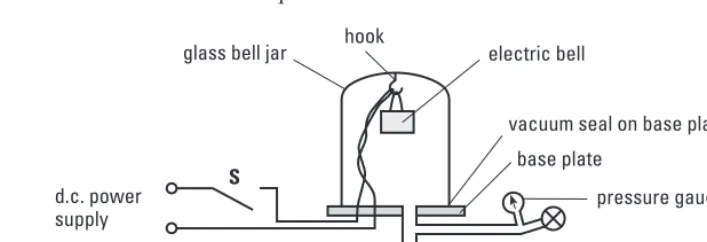
42 Sound © 2007 Marshall Cavendish International (S) Pte Ltd !Figure 15.2 3. (a) Figure 15.2 illustrates an apparatus which can be used to demonstrate that the
transmission of sound requires a material medium.
The stages in the demonstration are set out below. Initially, the air inside the bell jar is at atmospheric pressure. State what is seen and heard at each of the following stages and what deductions can be made.
Stage 1 The bell circuit is completed by closing switch S.
Seen and heard:
Deduction:
Stage 2 The tap is closed and the vacuum pump is switched on.
Seen and heard:
Deduction:
Stage 3 The vacuum pump is switched off and the tap opened.
Seen and heard:
Deduction:
(b) Why is the demonstration more conclusive if the bell is
suspended, as in Figure 15.2, rather than supported on a metal stand as in Figure 15.3?
(Jun88/P2/Q4)
bell
tripod glass bell jar
S d.c. power
supply
vacuum pump hook
electric bell
vacuum seal on base plate base plate
pressure gauge
tap
"Figure 15.3
The striker is seen vibrating against the bell and a sound is heard.
Sound can be transmitted in air.
The striker is seen vibrating against the bell but a fainter sound is heard.
Sound cannot be transmitted in the absence of air.
The striker is seen vibrating against the bell and a sound is heard, which increases in loudness.
Sound can be transmitted in air.
This is because sound may be transmitted through the tripod in Figure 15.3 even in the absence of air. This would make the experiment inaccurate.
J72PHYS WB_SE_Vol 2 • 15.indd 42