ISSN 2392-8042 (online) © Faculty of Management (SNSPA)
Exploring Knowledge Entropy in Organizations
Constantin BRATIANU
Bucharest University of Economic Studies Piata Romana 6, Sector 1, 010374 Bucharest, Romania
Academy of Romanian Scientists
Splaiul Independetei 5, 05009 Bucharest, Romania [email protected]
Abstract. The purpose of this paper is to explore the knowledge entropy processes within organizations and how they are reflected in the knowledge management and organizational intellectual capital. Entropy is a very powerful concept, which can be found today in almost any branch of science and technology. It was introduced by Rudolf Clausius in 1865 in Thermodynamics, then used in the communication theory by Claude Shannon, and expanded by Nicholas Georgescu-Roegen in economics. However, dues to its extensive use in so many different research domains, the concept of entropy became fuzzy and sometimes misleading in applications. Also, its statistical formulations based on the Boltzmann theory made the entropy understanding rather difficult and its interpretations on the edge of coherence. Knowledge entropy is an extension of information entropy and used within the framework of knowledge management. Our conceptual analysis aims to shed light on the appropriate use of knowledge entropy and its potential in knowledge management research and practice. Since knowledge entropy is associated to all transformational processes in knowledge creation, knowledge sharing, knowledge acquisition, and knowledge loss, we may say that knowledge management can be interpreted as the process of managing knowledge entropy within organizations.
Keywords: entropy; information entropy; knowledge entropy; thermodynamics entropy; intellectual capital; knowledge fields; knowledge management.
Introduction
to reflect generic processes whose nature can be described by probability distributions (Shannon & Weaver, 1949).
Today, the concept of entropy is used in many scientific domains, with many interpretations and mathematical formulations. Basurdo-Flores, Guzman-Vargas, Velasco, Medina, and Calvo Hernandez (2018) present an interesting analysis concerning the pervasiveness of entropy in different research domains, with different names but reflecting the same statistical nature of a multitude of phenomena. For instance, in their literature search for the period January 1, 1996 – December 31, 2015, done during October 2016 by using the Scopus database, they found the following situation: the input “Clausius entropy” appears in the title or the abstract of 1917 documents; the input “Boltzmann entropy” appears in 15739 documents; the input “Gibbs entropy” appears in 31310 documents; the input “von Neumann entropy” appears in 8819 documents; the input “Shannon entropy” appears in 30194 documents. The “Clausius entropy” and “von Neumann entropy” are frequently referenced as “thermodynamics entropy”, appearing in 102456 documents. Also, they found that “the most cited entropy related concepts, listed in descending order, are: structure, information, equilibrium, development, evolution, probability, complexity, knowledge, constraints, diversity, dispersion, degradation, disorder, dissipation, irreversibility, and intelligibility” (Basurdo-Flores et al., 2018, p.7).
The entropy concept is intrinsic related to the second law of thermodynamics since it describes the state of a thermodynamic system. Many scientists consider that this law is fundamental in understanding any transformational process in nature and society. For instance, Atkins (2010, p.37) states that: “The second law is of central importance in the whole of science, and hence in our rational understanding of the universe, because it provides a foundation for understanding why any change occurs”. That explains the use of entropy and the second law of thermodynamics not only in classical thermodynamics but also in statistical mechanics, information theory, biology, linguistics, musical creativity, economics, business and knowledge management. However, due to such a variety of utilizations, the risk of misinterpreting the concept of entropy is quite high, and researchers should pay attention in avoiding any semantic drift of the core meaning (Ben-Naim, 2012; Kovalev, 2016).
Classical thermodynamics entropy
The rapid development of heat engines in the 19th century needed strong theoretical
support in order to design more powerful and efficient engines. The main difficulty came at that time from the interpretation of heat as a weightless and invisible fluid that flows from a hot body to a cold one. That was the caloric theory of heat developed by analogy with a falling fluid which puts into motion a water mill. The whole process was explained by using Newtonian mechanics. Although that metaphor was wrong, Sadi Carnot imagined an idealistic cycle for a heat engine working in between two different temperature levels and producing mechanical work, whose efficiency depends only on the source and sink temperatures. It took some time and thinking efforts from researchers to discover that heat is not a fluid or other entity. "In thermodynamics, heat is not an entity or even a form of energy: heat is a mode of transfer of energy” (Atkins, 2010, p.22).
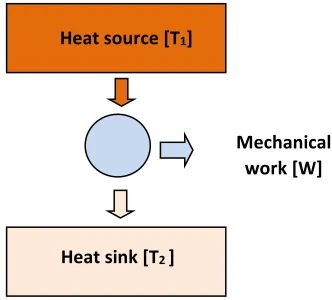
As a result of this discovery, it was possible to analyze heat engines from a new perspective and to look for law able to establish the transformation of heat into mechanical work. That was the second law of thermodynamics which received several formulations but revealing the same reality. One of the first scientists to formulate this law was Lord Kelvin: “No cyclic process is possible in which heat is taken from a hot source and converted completely into work” (Atkins, 2010, p.41). In other words, heat can generate mechanical work if the energy is transferred from a heat source with a high temperature to a heat sink with a lower temperature. The Clausius statement of the second law of thermodynamics is expressed in reverse terms, but it describes the same fundamental condition of having two heat sources: “Heat does not pass from a body at low temperature to one at high temperature without an accompanying change elsewhere” (Atkins, 2010, p.42). A simple illustration of this thermodynamic process is presented in Figure 1.
Figure 1. The transformation of heat into mechanical work
The heat transfer from the source to the sink is an irreversible process, which cannot be described by using the Newtonian mechanics. During the process, there is a degradation of energy, i.e., a change in its quality. To describe that phenomenon Clausius introduced in 1865, the concept of entropy, as a new state function of the whole system (Atkins, 2010; Ben-Naim, 2012). The name of entropy comes from a Greek expression having the
Heat source [T1]
Heat sink [T2 ]
meaning of “transformation content”. Due to some mathematical difficulties in elaborating a formula for expressing entropy as a quantity, he preferred to express the change in entropy of the system as follows:
dS = dQ/T (1)
Where dS is the entropy variation, dQ the heat transferred at the absolute temperature T (Atkins, 2010, p.47). Here the symbol d stands for a very small change in the heat transfer and entropy variation. We have to emphasize the fact that entropy is not an attribute of a given entity, but a function of the state of the system, depending on its change from an initial state to a final state. Making use of the new concept, Clausius provided a unifying formulation of the second law of thermodynamics, as follows (Atkins, 2010, p.49): “The entropy of the universe increases in the course of any spontaneous change”. Here, the term universe is used to designate the thermodynamic system together with its surroundings. The formulation is considered for an isolated system and for spontaneous or natural processes. It is important to understand this phenomenon of energy transformation from thermal energy into mechanical energy and generation of mechanical work according to the second law of thermodynamics since that has been used as an analogy in the theory of knowledge fields and the entropic model of the intellectual capital in organizations (Bratianu, 2011, 2013; Bratianu & Bejinaru, 2019).
The work done by Lord Kelvin and Rudolf Clausius is based on deterministic thinking and for macroscopic phenomena. Ludwig Boltzmann started to study thermal phenomena in gases, and his approach was based on statistical mechanics. Molecules have a chaotic behavior in gas, and their motion cannot be described individually, but only in an average way by using a probability distribution function. That is based on probabilistic thinking, which is specific for microscopic phenomena. If we consider a gas enclosed in a vessel composed of N molecules, and we consider that to each molecule it is possible to associate a microstate, then the macrostate of the whole gas system (W) is determined by the distribution of all its microstates. Based on this logic, Ludwig Boltzmann defined the absolute entropy (S) of the system as follows:
S = k log W (2)
Information entropy
The first idea of measuring the information transferred through a communication channel came from R.V.L. Hartley (1928), who decoupled the meaning of a message from its electrical support. Hartley focused on engineering communication systems and suggested to use a logarithmic function to measure the quantity of transmitted information. However, Hartley did not come out with a final mathematical formula to measure the information transmitted through a technical system.
The merit of developing a full mathematical theory of communication in order to solve the engineering problem of transmitting information efficiently through a technological channel is attributed to Claude E. Shannon (1948). He made it clear from the beginning that the fundamental problem of communication by using technological systems is that of having at the receiver the exact or a good approximation of the message sent by the source of the system. He was interested only in the engineering problem of electrical signals supporting the message and not in the semantics associated to them: "Frequently the messages have meaning; that is, they refer to or are correlated according to some system with certain physical or conceptual entities. These semantic aspects of communication are irrelevant to the engineering problem" (Shannon, 1948, p.379). For Shannon (1948), the only significance comes from the fact that each message is selected from a set of possible messages, which means to focus our attention to their probability distribution. He considered a generic transmitting information system composed of a source of information, a transmitter, a channel for transmitting electrical signals, a receiver, and the final user. The environment is considered as a source of noise or perturbations. After a whole mathematical demonstration, Shannon (1948, p.398) introduces the famous formula:
H = - K Σ pi log pi (3)
Where K is a positive constant, and pi is the probability of producing the event i, out of a
finite set of N events. Here, events are electrical signals used for messages transmission through a technological system. Shannon (1948, p. 398) emphasizes that “The form of H will be recognized as that of entropy as defined in certain formulations of statistical mechanics where pi is the probability of a system being in cell i of its phase space. H is
then, for example, the H in Boltzmann’s famous H theorem. We shall call H = - Σ pi log pi
the entropy of the set of probabilities p1 , …, pn “. Also, he says that H “will play a central
role in information theory as measures of information, choice, and uncertainty” (Shannon, 1948, p.398). In conclusion, the information entropy (H) defined by Shannon (1948) expresses a measure of a probability distribution within a finite set of events N, and is totally decoupled from the message meaning. This idea is also underlined by Bar-Hillel and Carnap (1953, p.147): "The measures, as defined, for instance, by Shannon, have nothing to do with what these symbols symbolize, but only with the frequency of their occurrence".
containing a finite number of semantic elements, which appear in messages with some known probabilities. However, any real language is almost infinite in its possibility to use meanings in social communication. The concept of semantic information is useful, but only in technological systems like robots and learning machines.
Floridi (2005, 2012, 2013) performs a philosophical analysis of the extensional interpretation of the information and information entropy concepts showing the difficulties and limitations of that extension. He remarks that “Polysemantic concepts such as information can be fruitfully analyzed only in relation to well-specified contexts of application” (Floridi, 2005, p.352). Floridi (2013) shows that information can be interpreted in three different perspectives: 1) information as reality, as in the case of analysis of electrical signals in a technological system; 2) information about reality, which means semantic information; and 3) information for reality, meaning action performed. The last perspective is specific for management, and it leads to knowledge entropy we shall discuss in this paper.
Entropy and organizational order or disorder
The concept of entropy has been related from the very beginning to the concept of order or disorder within a system. Intuitively, that comes easily in our mind if we try to imagine the dynamics of molecules of a gas contained in a cylinder with a piston inserted in it. When we move the piston, the distribution of molecules changes immediately as a natural tendency of the gas to occupy the whole available space (Ben-Naim, 2012; Handscombe & Patterson, 2004). Also, when the gas is heated somehow, the internal pressure increases and the gas expands, moving outward the piston. A part of the internal thermal energy is transformed into mechanical work according to thermodynamics laws, and the entropy of the system increases. Thus, the increase in entropy is correlated with the increase in disorder by a simple cause-effect relationship. We should mention the fact that molecules have chaotic dynamics, which is totally different from the deterministic behavior of a mechanical system.
The explanation given by Boltzmann is that any macrostate of a thermodynamic system is determined by the distribution of its microstates and the natural tendency of that system to achieve a more probable stable macrostate. “He showed that entropy is a measure of disorder in the system, that a multi-particle system tends to develop to a more probable state, and such a more probable state is a state of higher disorder. This development (toward disorder) continues until a system reaches thermodynamic equilibrium, which is the highest state of disorder for any given system” (Chalidze, 2000, p.11). We have already underlined the fact that entropy is not a characteristic of matter, but a characteristic of the state of matter. Although the phenomenology observed in nature intuitively guides us to associate entropy and disorder, as many researchers remarked, “disorder is a highly relative, if not wholly improper, concept: something is in disorder only in respect to some objective, nay, purpose” (Georgescu-Roegen, 1999, p.142).
evident in a solid where the motion is drastically restricted, and the entropy is very low. However, order and disorder are relative concepts, and it is practically impossible to describe and measure the level of order or disorder within a system. Moreover, as Chalidze (2000) remarks, we have the psychological tendency to compare order with disorder, but in nature and society, there is no universal referential framework to enable such a comparison.
Organizations are social systems characterized by a certain structure, which means a certain order (Simon, 1996). Since organizations are artificial constructions, which are designed to achieve some social purposes, they contain orderly structures. Order is induced through regulations, traditions, and organizational culture. Management has been invented as a mechanism to introduce order in organizations for increasing work productivity and efficiency (Taylor, 1998). The order is designed based on the principle of labor division and decision power distribution. While the principle of labor division leads to a horizontal structuring process, the authority and power distribution lead to a vertical structuring process yielding a hierarchical order. As Child (2005, p.61) remarks, "Hierarchy provides the backbone for conventional forms of organizations". They have the following generic features: a) positions are designed in different levels (i.e., vertical structure) in concordance with the degree of authority and responsibility assigned to them; b) positions on the top have higher decision power than those on the lower levels of the hierarchy; c) people from the same team report for their work to managers with responsibilities over them.
transformations, primarily when we deal with transformational leadership (Bratianu & Anagnoste, 2011).
Entropy and economics
Georgescu-Roegen (1999) was one of the most dedicated researchers on the topic of the entropy law or the second law of thermodynamics applications in economic processes. He considers that Sadi Carnot made the first connection between thermodynamics and economics in his analysis of the efficiency of a thermal cycle. Georgescu-Roegen (1999, p.281) emphasizes that "from the purely physical viewpoint, the economic process is entropic: it neither creates nor consumes matter or energy, but only transforms low into high entropy. But the whole physical process of the material environment is entropic too". The main difference between the technological phenomena analyzed by Carnot, Lord Kelvin, Clausius, Boltzmann, and other scientists, and the economic processes is that economic phenomena depend on human activity. He also showed the correlation between entropy and economic value: “Low entropy, as I have stated earlier, is a necessary condition for a thing to have value. This condition, however, is not also sufficient. The relation between economic value and low entropy is of the same type as that between price and economic value” (Georgescu-Roegen, 1999, p.282). In the entropy theory of value, economic value is defined as a logarithm function, just as information is defined as a logarithmic function. That makes mathematical modeling by using similar arguments. For Chen (2018, p.74), “value – just as information – in its general form can be defined as entropy, given that they are the same mathematically”. That could be written as follows:
V(x) = - Σ pi logb pi (4)
Where V(x) represents the value of the scarcity of a service or product x, and pi, i = 1, 2,
3, …, n represents the probability distribution of that scarcity. The base b of the logarithmic function can be understood as the number of products.
Zhou, Cai, and Tong (2013, p.4909) review the applications of entropy in finance and show that “The application of entropy in finance can be regarded as the extension of the information entropy and the probability entropy. It can be an important tool in portfolio selection and asset pricing”. Scholars who studied the application of entropy to the portfolio selection theory introduced some variations of the information mathematical formulation in order to accommodate different practical situations. Thus, they introduced incremental entropy, hybrid entropy, fuzzy mean-entropy, Tsallis entropy, and Kullback cross-entropy (Zhou et al., 2013). Regardless of the specific formulation, all of these computational mathematical formulas are based on the idea of a variety of solutions which can be expressed by using some probability distribution functions (Caraiani, 2018).
Entropy and knowledge management
information concept and in the associated information entropy function. In knowledge management, information is a result of data processing within a field of meanings. As Davenport and Prusak (2000, p.4) emphasize, "Data becomes information by adding value in various ways”. Information has meaning. It informs the receiver about a certain event and changes his or her level of knowing. Furthermore, knowledge is a result of processing information. Davenport and Prusak (2000, p.5) define knowledge as “a fluid mix of framed experience, values, contextual information, and expert insight that provides a framework for evaluating and incorporating new experiences and information. It originates and is applied in the minds of knowers. In organizations, it often becomes embedded not only in documents or repositories but also in organizational routines, processes, practices, and norms”.
Nonaka and Takeuchi (1995, p.58) provide a more concise definition of knowledge as "justified true belief". However, we should remark a difference between the traditional epistemological formulation and the Japanese view. While the traditional epistemology reflects a static, absolute and logical approach, in the Japanese view knowledge is considered as “a dynamic human process of justifying personal belief toward the truth” (Nonaka & Takeuchi, 1995, p.58). Also, while in the Western knowledge management the focus is on the rational knowledge which can be expressed by using a natural or symbolic language, in the Japanese knowledge management the focus is on tacit knowledge, which integrates the personal experience, emotions, and values. The dyad tacit-explicit knowledge constituted the backbone of the Japanese knowledge management, and of the knowledge creation dynamics framework designed by Nonaka and developed further by his colleagues (Nonaka, 1994; Nonaka et al., 2008).
Bratianu and Bejinaru (2019) change the knowledge metaphor from that of stocks-and-flows into that of energy and introduce the view of knowledge fields. They leave apart the classical dyad of tacit and explicit knowledge and introduce the triad of rational, emotional, and spiritual knowledge. Knowledge is created by people, but it is integrated at the organizational level by the managers and leaders (Bratianu, 2013). As a result of knowledge creation, knowledge acquisition, knowledge sharing, and knowledge loss phenomena, knowledge distribution within the organization is changing in time. If we consider that knowledge is distributed randomly within the organization, with a probability distribution p1, p2, p3, …, pn where n is the total number of employees, then
we can express the knowledge entropy of the whole organization by using the Boltzmann formula:
KE = - C Σ pi log pi (5)
Where we noted with KE the value of knowledge entropy, and with C a constant which is an arbitrary positive number chosen to adjust to a certain framework scale. Regarding the knowledge distribution, we make the following observations:
we just ignore it. However, for a multinational company with branches in different countries, the geographical distribution of knowledge becomes very important. • The probability distribution is not computed for a set of absolute values of knowledge, but for some relative values which finally could be normalized, such that we comply with the condition that Σ pi = 1.
• The knowledge spectrum can be evaluated through different methods, already in use in many companies where there are clear job descriptions or education levels and knowledge performance requirements.
• Formula (5) can be applied for only one type of knowledge (i.e., rational, emotional, and spiritual) or the whole field of knowledge.
The value of knowledge entropy KE can be a very good indicator for the knowledge distribution of a certain level within the organization, at a given moment of time since knowledge dynamics vary with time. Knowledge creation is an internal process of generating new knowledge (Nonaka & Takeuchi, 1995), and of changing the value of KE. That is important, especially in knowledge-intensive companies with a high degree of creativity and innovation. Here it is important to consider both individual contributions to knowledge creation through new ideas and the role of the team in developing and amplifying these ideas. "Organizational knowledge creation should be understood as a process that ‘organizationally' amplifies the knowledge created by individuals and crystalizes it at the group level through dialogue, discussion, experience sharing, or observation" (Nonaka & Takeuchi, 1995, p.239). Knowledge creation can be characterized by two dimensions: a) an epistemological dimension defined by the forms of tacit and explicit knowledge and b) an ontological dimension defined by the connectivity between individuals, teams and the whole organization. A similar effect may have knowledge acquisition, but with an input of knowledge from the external environment. Both strategies contribute to the rising level of the whole knowledge within the organization.
A quite different effect has knowledge sharing, and one of its versions intergenerational knowledge transfer, because these processes do not contribute to the increase of the organizational level of knowledge, but only to its re-distribution. Knowledge sharing is a voluntary process by which an individual is willing to share some of his or her knowledge and experience to other people when there is a climate of trust and common interest. Because knowledge sharing induces a sense of losing power, some people prefer knowledge hoarding (Cyr & Choo, 2010). Sharing tacit knowledge may have some contextual barriers, which reduces the final effect of the process. The cumulative effects of all possible organizational barriers are known in the literature as knowledge stickiness (Szulansky, 2000; Szulansky & Jensen, 2004). Knowledge sharing can be stimulated by creating communities of practice, which are fuzzy groups of people formed around a common knowing interest. According to Wenger, McDermott, and Snyder (2002, p. 4), "Communities of practice are groups of people who shape a concern, a set of problems, or a passion about a topic, and who deepen their knowledge and expertise in this area by interacting on ongoing basis". The greatest advantage of these communities of practice is the climate of trust which reduces the effects of knowledge stickiness and of knowledge hoarding (Leistner, 2010; O’Dell & Hubert, 2011; Wenger, 1998).
organizations which have a nested structure, formed of two or several generations of people, than to other organizations. A typical case is that of universities, where the academic hierarchies (i.e., assistant professor, associate professor, and full professor), and the dynamics of promotion create generations of faculty staff. In the same time, the specific work in a university encourages the promotion of intergenerational learning (Bratianu & Bejinaru, 2017; Bratianu, Agapie, Orzea, & Agoston, 2011; Lefter, Bratianu, Agapie, Agoston, & Orzea, 2011). Both knowledge sharing and intergenerational learning have as a direct effect a re-distribution of knowledge within the organization, by flattening the probability distribution and increasing the knowledge entropy. In other words, the organization is driven toward a more stable macrostate by flattening the knowledge probability distribution. From a general perspective, knowledge entropy can be a very good indicator of the outcomes of knowledge sharing and intergenerational learning, which also means an indicator of the potential core competence of innovation.
Conclusions, limitations and further research
Knowledge entropy reflects the probable distribution of knowledge within a given organization, at a specific moment of time. Although we consider organizational knowledge as being like a field, in reality, knowledge resides with individual people which leads to a certain distribution of individual knowledge, at a specific moment of time. This distribution is dynamic and its changes affect the innovation process and the core competencies leading to competitive advantage. Knowledge entropy can be considered similar from a mathematical modeling point of view with information entropy, but totally different from a semantic point of view. While the Shannonian information has no meaning because it is based on a probability distribution of a set of electrical signals used in engineering communication, knowledge entropy is based on a different concept of information, which means data with meaning. Knowledge entropy can be increased through knowledge creation, knowledge acquisition, knowledge sharing, and intergenerational knowledge learning. In a larger perspective, knowledge entropy can be enlarged by including in practical analyses organizational entropy and economic entropy which contain important information about the innovation capacity and competitive advantage of a certain company.
The limitation of the present research comes from the initial purpose of only exploring knowledge entropy without performing empirical research. Also, looking at the mathematical formulation we realize a rather fuzzy interpretation of the knowledge probability distribution function and some practical ways of getting significant data and computing the knowledge entropy indicator for a given context, at a given time. Further research would be in the direction of developing practical methods of determining knowledge distribution probability sets and in computing knowledge entropy. Also, more empirical research is necessary to explain the connection between the knowledge entropy concept and the performance of a certain organization.
References
Bar-Hillel, Y., & Carnap, R. (1953). Semantic information. The British Journal for the Philosophy of Science, 4(14), 147-157. doi: 10.1093/bjps/IV.14.147.
Basurdo-Flores, R., Guzman-Vargas, L., Velasco, S., Medina, A., & Calvo Hernandez, A. (2018). On entropy research analysis: cross-disciplinary knowledge transfer. Scientometrics, 117(1), 123-139. doi: 10.1007/s11192-018-2860-1.
Ben-Naim, A. (2012). Entropy and the second law: interpretations and miss-interpretations. London, UK: World Scientific.
Bratianu, C. (2011). A new perspective of the intellectual capital dynamics in organizations. In Vallejo-Alonso, B., Rodriguez-Castellanos, A., & Arregui-
Ayastuy, G. (Eds.), Identifying, measuring, and valuing knowledge-based intangible assets: new perspectives (pp.1-21). Hershey, PA: IGI Global.
Bratianu, C. (2013). Nonlinear integrators of the organizational intellectual capital. In Fathi, M. (Ed.), Integration of practice-oriented knowledge technology: trends and perspectives (pp.3-17). Heidelberg, Germany: Springer.
Bratianu, C. (2015). Developing strategic thinking in business education. Management Dynamics in the Knowledge Economy, 3(3), 409-429.
Bratianu, C., & Anagonoste, S. (2011). The role of transformational leadership in mergers and acquisitions in emergent economies. Management & Marketing, 6(2), 319-326.
Bratianu, C., & Bejinaru, R. (2017). Knowledge strategies for increasing IC of the universities. In Lopez, I.T., & Serrasqueiro, R. (Eds.), Proceedings of the 9th
European Conference on Intellectual Capital (pp.34-41). Reading, UK: Academic Conferences and Publishing International.
Bratianu, C., & Bejinaru, R. (2019). The theory of knowledge fields: a thermodynamic approach. Systems, 7(2), 20. doi: 10.3390/systems7020020.
Bratianu, C., & Vasilache, S. (2010). A factorial analysis of the managerial linear thinking model. International Journal of Innovation and Learning, 8(4), 393-407. Bratianu, C., Vasilache, S., & Jianu, I. (2006). In search of intelligent organizations.
Management and Marketing, 1(4), 71-82.
Bratianu, C., Agapie, A., Orzea, I., & Agoston, S. (2011). Intergenerational learning dynamics in universities. Electronic Journal of Knowledge Management, 9(1), 10-18.
Caraiani, P. (2018). Modeling the comovement of entropy between financial markets. Entropy, 20(6), 417. doi: 10.3390/e20060417.
Chalidze, V. (2000). Entropy demystified: potential order, life and money. Portland, OR: Universal Publishing.
Chen, J. (2018). An entropy theory of value. Structural Change and Economic Dynamics, 47(C), 73-81. doi: 10.1016/j.strueco.2018.07.008.
Child, J. (2005). Organization: contemporary principles and practice. Oxford, UK: Blackwell Publishing.
Cyr, S., & Choo, C.W. (2010). The individual and social dynamics of knowledge sharing: an exploratory study. The Journal of Documentation, 66(6), 824-846. doi:
10.1108/00220411011087832.
Dvenport, T.H., & Prusak, L. (2000). Working knowledge: how organizations manage what they know. Boston, MA: Harvard Business School Press.
Floridi, L. (2012). Semantic information and the network theory of account. Synthese, 184(3), 431-454. doi: 10.1007/s11229-010-9821-4.
Floridi, L. (2013). The philosophy of information. Oxford, UK: Oxford University Press. Georgescu-Roegen, N. (1999). The entropy law and the economic process. Cambridge,
MA: Harvard University Press.
Handscombe, R.D., & Patterson, E.A. (2004). The entropy vector: connecting science and business. London, UK: World Scientific.
Hartley, R.V.L. (1928). Transmission of information. Bell System Technical Journal, 7, 535-563.
Hatch, M.J. (1997). Organization theory: modern, symbolic, and postmodern perspectives. Oxford, UK: Oxford University Press.
Kovalev, A.V. (2016). Misuse of thermodynamic entropy in economics. Energy, 100, 129-136. doi: 10.1016/j.energy.2016.01.071.
Lefter, V., Bratianu, C., Agapie, A., Agoston, S., & Orzea, I. (2011). Intergenerational knowledge transfer in the academic environment of the knowledge-based economy. Amfiteatru Economic Journal, 13(30), 392-403.
Leistner, F. (2010). Mastering organizational flow: how to make knowledge sharing work. New York, NY: John Wiley & Sons.
Morgan, G. (1997). Images of organization. 2nd Edition. London, UK: SAGE
Publications.
Nonaka, I. (1994). A dynamic theory of organizational knowledge creation. Organizational Science, 5(1), 14-37.
Nonaka, I., & Takeuchi, H. (1995). The knowledge-creating company: how Japanese companies create the dynamics of innovation. Oxford, UK: Oxford University Press.
Nonaka, I., Toyama, R., & Hirata, T. (2008). Managing flow: a process theory of the knowledge-based firm. Houndmills, UK: Palgrave Macmillan.
Nonka, I., Kodama, M., Hirose, A., & Kohlbacher, F. (2014). Dynamic fractal organizations for promoting knowledge-based transformation – a new paradigm for organizational theory. European Management Journal, 32(1), 137-146. doi: 10.1016/j.emj.2013.02.003
O’Dell, C., & Hubert, C. (2011). The new edge of knowledge: how knowledge
management is changing the way we do business. New York, NY: John Wiley & Sons.
Shannon, C.E. (1948). A mathematical theory of communication. Bell System Technical Journal, 27(3), 379-423. doi: 10.1002/j.1538-7305.1948.tb01338.x.
Shannon, C.E., & Weaver, W. (1949). The mathematical theory of communication. Champaign, IL: University of Illinois Press.
Simon, H.A. (1996). The science of the artificial. 3rd Edition. Cambridge, MA: The MIT
Press.
Szulansky, G. (2000). The process of knowledge transfer: a diachronic analysis of stickiness. Organizational Behavior and Human Decision Process, 82(1), 9-27. doi: 10.1006/obhd.2000.2884.
Szulansky, G., & Jensen, R. (2004). Overcoming stickiness: an empirical investigation of the role of the template in the replication of organizational routines.
Managerial and Decision Economics, 25(67), 347-363. doi: 10.1002/mde.1195. Taylor, F.W. (1998). The principles of scientific management. Mineola, NY: Dover
Publications.
Cambridge, UK: Cambridge University Press.
Wenger, E., McDermott, R., & Snyder, W.M. (2002). A guide to managing knowledge: cultivating communities of practice. Boston, MA: Harvard Business School Press.
Yonghi, L., Wu, C., Luo, P., & Zhang, W. (2013). Exploring the characteristics of innovation adoption in social networks: structure, homophily, and strategy. Entropy, 15(7), 2662-2678. doi: 10.3390/e15072662.
Zhou, R., Cai, R., & Tong, G. (2013). Applications of entropy in finance: a review. Entropy, 15(11), 4909-4931. doi: 10.3390/e15114909.