Issues
ISSN: 2146-4138
available at http: www.econjournals.com
International Journal of Economics and Financial Issues, 2016, 6(2), 660-665.
Does Corruption Increase Antidumping Investigations?
1Veysel Avsar
1, Alexis Habiyaremye
2, Umut Unal
3*
1Department of Economics, Antalya International University, Antalya, Turkey, 2Department of Economics, Antalya International
University, Antalya, Turkey, 3Department of Economics, Turgut Ozal University, Ankara, Turkey. *Email: [email protected]
ABSTRACT
This paper represents the first attempt to examine the influence that corruption exerts on the worldwide use of antidumping (AD) claims as a means to
seek trade protection. Since the inception of the World Trade Organization and the concomitant dramatic fall in tariffs, AD duties have become one of the few permissible measures to provide temporary protection to foreign competition. Increased lobbying pressure in this area has gone hand in hand
with the explosion of number of AD filings. We hypothesized that corruption gives the import competing sector the opportunity to more effectively lobby for trade protection and this can be expected to result in more attempts to use AD filings. Using cross-country data on AD investigations, we
provide support to this hypothesis.
Keywords: Antidumping, Corruption, Institutions, Trade Policy
JEL Classifications: D72, D73, F13, F15
1. INTRODUCTION
While there has been a dramatic world-wide decline in tariffs over the last two decades, countries still impose non-tariff barriers to gain temporary protection, as permitted under World Trade
Organization (WTO) rules. Antidumping (AD) duties claims
account for the vast majority of these contingent non-tariff
protection tools. Efforts by industry to influence government officials in seeking trade protection are therefore expected to
shift from traditional focus on import restriction to invoking dumping allegations as a means to shield domestic producers
from fierce foreign competition. Protection from alleged dumping
has therefore become an unholy alliance between industries and government, and act as an effective protection device offering large payoffs to the industry in violation of WTO agreements
(Thompson, 2006. p. 229).
This alliance and its expected payoffs open the way to corruption
opportunities and unwarranted dumping allegations. If government
officials are responsive to industry lobbying seeking protection
under AD duties, increased rent seeking in that area is likely to
result in an increased number of AD filings. Conversely, domestic firms may lose faith in a corruptible bureaucracy that asks for unofficial payments if they perceive that illicit influence and bribe
payment are unacceptable costs and a morally wrong behaviour that might damage their reputation in the long-run. Moreover,
firms may fear that their petitions might be easily dismissed by a corrupt bureaucracy if the foreign competitors exert enough influence on domestic officials.
Given the explosion of the number of unsubstantiated AD filings
since the WTO inception and the corresponding rise in rent seeking
activities around state agencies and government officials in charge
of dealing with AD decisions, there is a suggestive relationship
between corruption and the number of AD filings2.1 It is pertinent
to ask whether corruption increases the number of AD petitions as
2 Dumping is defined as international price discrimination to conquer export
markets. Whenever an exporter exports a particular product below the
fair value, WTO permits their members to impose AD duties if that unfair pricing causes material injury to the domestic market of the importing
country. AD cases are filed by the individual firms, business associations
or labor unions to the trade agencies of the local governments. During an
AD investigation, the authorities evaluate the existence of dumping, the
magnitude of the damage as well as the causal link between them. They impose AD measures if necessary, or close the case without a duty if they
do not find enough evidence on material injury associated with dumping.
a means of seeking trade protection. This study is the first attempt
to address this suggestive relationship using cross country data on AD activity.
There are various theoretical and empirical grounds to argue that
corruption may affect the propensity of firms to file AD petitions.
First, there is ample empirical evidence showing that more corrupt
countries tend to be more protectionist (Dutt, 2009). Although this
relationship between rent seeking and protection was essentially established with traditional trade barriers, with the disappearance of most non-tariff tools of trade protection, AD duties are likely to be used by those countries as the remaining protection tool.
Second, it has been established that partisan interests and industry lobbying play an essential role in the determination of trade policies
(e.g. Hillman, 1989; Van Long and Vousden, 1991; Grossman and Helpman, 1994). The use of non-tariff barriers to trade has also
been found to be associated with more rent seeking because their
payoffs are high (Krueger, 1974). Special interests and industry
lobby using rent seeking to obtain trade protection will therefore often resort to paying campaign contributions or giving donations
to influential government officials and subsequently attempt to
cash the payoffs by allege dumping to be awarded protection under
AD filings. For the US, one of the heaviest AD users in the 90s, for instance, Hansen and Prusa (1996) report evidence showing that
the two bureaucratic agencies responsible for making decisions
on AD investigations are very susceptible to external political pressure. They argue that this susceptibility influences the AD filing practices of the industries. Since the decisions on unfair
foreign practices are ultimately made by political appointees in the Commerce Department, campaign contributions to politicians with some leverage on the AD decision making have many similarities
with corruptions and are also identified as being associated with subsequent AD claims by contributors (Drope and Hansen, 2004).
Third, the discretionary nature of the AD filing process gives rise to rent seeking opportunity to government officials tasked with investigating it. As noted in Blonigen (2006), the legal procedures
as well as the practical issues of how authorities implement the
AD rules are substantial; the plaintiffs face a process of repeated
interactions with the bureaucracy of their country, where they
exchange a considerable amount of ideas and information on
their petitions3.2 This degree of interaction suggests that the
characteristics of the country’s institutions may play an important
role in the propensity of firms to engage in AD filings. Firms facing
a bureaucracy that is more responsive to lobbying pressure are therefore more likely to use AD to seek protection from foreign competition than those facing an unresponsive bureaucracy.
3 Although the legal procedures to follow in an AD case are different in
each country, there are three main steps which are similar: (1) Collecting necessary information, (2) evaluating the collected information, (3) imposing provisional measures, final measures or price undertakings, or
the termination of the investigation without any action. Concerning the
first two steps, the petitioners must document a plausible application for
their case, in which they provide legal analysis, convincing arguments on
dumping, and non-confidential summary of confidential industry data. They
also cooperate with AD authorities in their inspection visits to determine the accuracy of the information provided by the petitioners and to gather more details in place.
The link between corruption and industry AD filing practices is however not unambiguously identifiable. While a bureaucracy sensitive to pressure and lobbying may attract more AD filings,
the cost associated with bribing bureaucrats and moral attitudes
towards corruption may refrain other firms from dealing with
such bureaucracies. The corruption literature has put forward two competing hypotheses for the way corruption may affect the
transactions between industry and bureaucrats (and therefore affect socio-economic outcomes): the “greasing wheels” hypothesis and the “sanding the wheels” hypothesis.
The “greasing the wheels” argument postulates that an inefficient
bureaucracy constitutes a major impediment to business
transactions so that some “speed money” or “grease” may help get things done (Leff, 1964). Proponents of the “greasing the wheels”
hypothesis argue that corruption facilitates business transactions that would otherwise not take place because of inefficient
bureaucracy or complex regulations. In the presence of ineffective rules, the opportunity to bribe may promote transaction efficiency
by allowing private sector agents to circumvent cumbersome
regulations (Leff, 1964; Huntington, 1968; Lui, 1986). Paying speed money may thus be beneficial as a second-best solution by
alleviating the distortions caused by ill-functioning bureaucracies.
Leys (1965) therefore examined bribes that give bureaucrats
incentive to speed up administrative procedures, and found that
corruption could enable active firms to get things done in an
otherwise sluggish administration4.3 If firms that consider filing
AD petitions perceive that the opportunity to bribe bureaucrats provides them with a greater likelihood to successfully obtain a
favorable decision they will be more willing to file.
The “sanding the wheels” hypothesis on the other hand contends that corruption imposes an unjustifiable cost on firms and reduces
their incentive to deal with the bureaucrats, which can negatively affect their investment decision and hamper their performance. This hypothesis is premised on the view that a corrupt bureaucracy
is a “grabbing hand” of self-interested government officials, which abuse the powers of public office for private gains (Shleifer and Vishny, 1993). Moreover, corruption creates a misallocation of talents and resources and therefore results in more inefficiency (Gray and Kaufmann, 1998).
Although the idea that corruption is harmful to growth has been the dominant paradigm in the academic research, the greasing
wheel argument is steadily gaining empirical confirmation. Méon and Weil (2010) for example tested the “greasing the wheels” hypothesis on a panel of 69 developing and developed countries and find that the relationship between corruption and inefficient
socioeconomic outcomes depends on institutional setting, with
corruption facilitating efficient business transactions and dealings with government officials in countries with weak institutional
setting, and impeding it in countries with strong institutions. The
4 The same type of corruption is subsequently examined by Lui (1986), who
role of corruption in getting things done in trade protection is
therefore consistent with general economic efficiency effects of
corruption.
The rest of the paper is organized as follows: The next section
presents the literature review on the role of corruption in speeding
up or impeding industry dealings with government officials, from
which we derive our arguments. In Section 3, we empirically test
the relationship between corruption and AD filings. The forth
section discusses the results while the last section concludes.
2. CORRUPTION AND TRADE
PROTECTION: LITERATURE REVIEW
As noted by Bandyopadhay and Roy (2007), countries with corrupt government officials that are more susceptible to lobbying will extend higher levels of trade protection. The level of corruption in an economy can thus serve as a proxy for the amenability of the
government to yield to lobby pressures and design protectionist trade policies. Trade policies are thus inherently more likely to be protectionist in corrupt countries than in non-corrupt ones as attested by both theoretical and empirical studies.
On the theoretical level, Krueger (1974) was one of the first
scholars to study the relationship between corruption and trade protection. She developed a formal model of rent seeking under
quantitative restrictions on trade in a competitive framework and
found corruption to be associated with trade protection policies.
Later, Grossman and Helpman (1994) developed a model of “protection for sale,” analysing the way the government interacts
strategically with special interest groups to shape trade policy. The
model equilibrium indicates that in the presence of lobby groups,
trade policies are implemented by taking into account the trade-offs between receiving campaign contributions and the reduction in consumer welfare associated with trade protectionism.
As for the empirical research linking corruption to trade policies, it has mainly focused on identifying the relationship based on the idea that causality runs from the need of trade protection to
corruption. For example, Ades and Di Tella (1999) showed that
corruption was negatively associated with competition from
foreign firms. Treisman (2000) also showed corruption to be associated with exposure to imports and exports, which may
suggest that the threat of import competition forms a motivation for
firms to use corruption in order to get trade protection. Dutt (2009) equally argues that protection increases bureaucratic corruption
even after controlling for other factors affecting corruption, while
Lee and Azfar (2002), analyzing the causality from corruption to trade protection examines the effect of corruption on trade
reforms and found higher levels of corruption to be associated
with higher tariff and non-tariff barriers. He conjectured that more
corrupt countries delay their trade reform programs and maintained protective policies. The effects of corruption on trade protection
are equally reported by Bandyopadhyay and Roy (2007), who analysed the corruption-protection nexus with panel data for 88 counties and showed higher corruption measures to significantly increase trade protection. Drope and Hansen (2004), one of the
few studies that specifically link corruption practices and lobbying pressure to the petition for protection through AD filing, argue that because of the “less visible” nature of the activities of the
agencies dealing with AD enforcement, they are more vulnerable
to lobbying pressure. Using 108 cases of AD petitions filed in the US between 1996 and 1999, they show that even when controlling
for economic merits of the studied AD petition cases there is a
statistically significant positive relationship between petitioners’ political pressure (in form of campaign contribution, lobbying expenditures or soft money donation) and favourable decisions on their AD petition cases. Hansen and Prusa (1997) also found
that an increase in Political Action Committees by AD petitioners increased their probability of obtaining a favourable ruling.
3. AD AND CORRUPTION: EMPIRICAL
ANALYSIS
On the basis of the results above and the expected equilibrium in Grossman and Helpman (1994) model, a positive correlation
between corruption and measure of trade protection is to be
expected when industry finds that paying for AD protection had
a positive pay off. Bureaucracies that are sensitive to lobbying pressure and bribery will attach a higher importance to protecting the domestic producers than to consumer surplus in their welfare
maximisation. This gives the import competing sectors the
opportunity to more effectively lobby for trade protection, and in the absence of other traditional tariffs and non-tariff barriers,
this can be expected to result in more attempts to use AD filings to protect lobbying domestic industries. The propensity to file for
protection under the AD regulations will thus go hand in hand with corruption and susceptibility to lobbying pressure.
In this paper, we therefore argue that increased susceptibility to lobbying and bribery leads to an increase in AD petitions, other
things being equal because the opportunity to bribe, by increasing
the probability of positive ruling for the petitioner, increases her/his payoffs.
In order to investigate the above noted relationship between corruption and AD, we estimate the following model:
ADit = β1Xit + β2Cit + εit (1)
Where, ADit is the total number of AD petitions filed in country i
in year t, Citis corruption index, Iit is an indicator to measure the
institutional quality of the country, Xit is a set of control variables.
Given that the dependent variable in our analysis is a count
variable, we can employ count models to estimate (1). There
are two estimation models widely used to analyse count data variables: the Poisson model and the negative binomial model,
which is a generalisation of the Poisson model. Poisson maximum likelihood estimation provides consistent and efficient estimates if the mean and the variance of the count variable is equal. The
negative binomial model, which generalizes Poisson model with
a conditional mean and variance, relaxes the assumption of equal
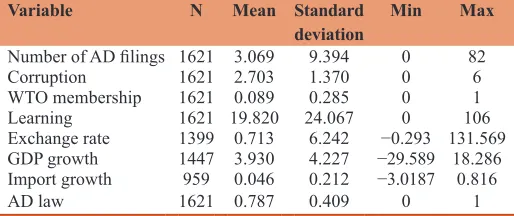
in Table 1, our dependent variable is over-dispersed. We therefore prefer the negative binomial estimation over Poisson.
Moreover, as shown in Figure 1, the dependent variable has
an excessive number of observations with zero value. The econometric theory suggests that excess zeros are resulting from
a separate process and can be modelled independently via
zero-inflated models. In the present situation, there are two basic reasons
for a country not to have any AD investigations: political and economic factors as well as the absence of AD legislation in the commercial code of the country. If a country has not implemented
AD law, the outcome (number of investigations) will always
be zero. Otherwise, if a country has an AD law, the number of investigations can be zero or non-zero depending on the occurrence of underlying political and economic AD related events and the
motivation of domestic producers to file.
The first part of the zero inflated regression is a logit model to
answer whether the zeros are associated with structural (no AD law) or sampling (other factors) processes and a negative binomial model (or Poisson) for the count process. Given the over-dispersion in the dependent variable, we will prefer the zero-inflated negative binomial (ZINB) model and use a dummy variable, (AD law)it, which takes on a value of 1 if the country i has AD law in year t
for the logit model to identify the structural zeros in our setting.
The literature on AD documented several additional factors that
affect AD filings. Knetter and Prusa (2003), for instance, showed that macroeconomic factors such as gross domestic product (GDP) growth and exchange rate significantly affect AD filings. Economic
slowdown and appreciation of the local currency is expected to trigger AD filings from the domestic industry. For this reason, we used the rate of change in the exchange rate and GDP as control variables in our model and expect a negative sign for the both. Additionally, Aggarwal (2007) and Bown (2008) show that import growth also affects the probability of having AD filings. We therefore also control for aggregate import growth. The expected
sign for this variable is positive, given the increase in pressure from international competition associated with aggregate import growth.
Moreover, we also included a dummy for WTO membership to
control for the effect of the regulations of WTO on the AD filings. A negative sign on this variable might indicate that the existence
of tedious settlement mechanisms under the WTO rules may act as a deterrent to potential petitioners. In contrast, a positive sign might imply that AD may have become a loophole for the domestic industries which seek protection resulting from the discipline on
binding the tariffs after WTO’s inception in 1995. To capture
the learning process on AD practices, we used a variable called learningwhich denotes increased familiarity of potential domestic
claimants with the use of AD filing procedure. It is measured by
the number of years that have elapsed since the implementation
of AD law in the country in question. It is reasonable to think that industries learn from their experience with the AD authorities
and this information is shared via business associations and other organizations. We believe that this interaction should increase
the number of filings as years pass, and thus we expect a positive coefficient on this variable5.4 Last but not least, we also used
country dummies to control for unobservable factors which might
be correlated with AD filings.
3.1. Data and Measurement
We obtained the information on the number of AD petitions and the WTO membership year of the countries from WTOs’ website. For the pre-WTO period, the data on AD activity was obtained
from Aggarwal (2007)6.5 For the data on GDP, exchange rate and
import growth, we used the World Bank’s World Development Indicators. The years of the implementation of AD law was
obtained from Zanardi (2004). For a measure of corruption, we used the corruption index from International Country Risk Guide (ICRG). This index gives a scale between 0 and 6 where
higher score implies better perception. To ensure that the measure increases with the degree of corruption, the measure has been
rescaled by subtracting the ICRG index from the maximum value of 6, so that the higher values of the used index coincide with
higher corruption.
To proxy the quality of institutions, we employed the bureaucratic quality index which measures the institutional strength to
govern without dramatic changes in policy or interruption when governments change7.6 This index is scaled between 0 and 4 and
higher values indicate better institutions. Table 1 documents the summary statistics for the variables used in the empirical analysis.
5 In this regard, Blonigen (2006) shows that firms’ prior experince in AD
petitions increases the likelihood of a succesful case.
6 Our sample covers the years between 1980 and 2010.
7 For more information on ICRG methodology, see http://www.prsgroup.
com/ICRG_methodology.aspx. Figure 1: Histogram of the number of antidumping filings
Table 1: AD filings, corruption and ınstitutions:
descriptive statistics
Variable N Mean Standard
deviation Min Max
Number of AD filings 1621 3.069 9.394 0 82
Corruption 1621 2.703 1.370 0 6 WTO membership 1621 0.089 0.285 0 1
Learning 1621 19.820 24.067 0 106
Exchange rate 1399 0.713 6.242 −0.293 131.569
GDP growth 1447 3.930 4.227 −29.589 18.286 Import growth 959 0.046 0.212 −3.0187 0.816
AD law 1621 0.787 0.409 0 1
We have a total of 1621 cases of AD claims from 93 countries,
the highest number of cases for a single country being the 82
claims from United States in 1992. We observe a large disparity in AD filings, with many countries having no claims at all while the explanatory variables seem less dispersed except the learning
variable that displays large standard deviation.
4. RESULTS
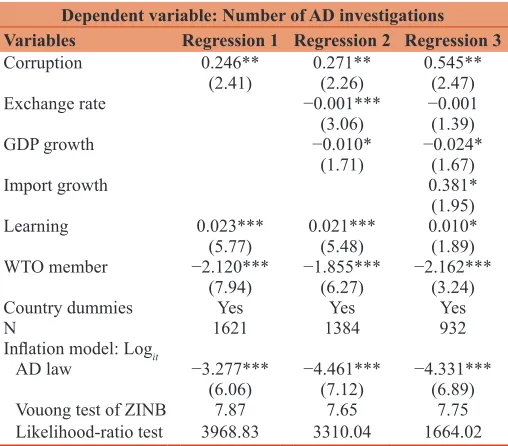
Because of the large number of zeros in the data, Equation (1) is estimated with the ZINB estimator. Table 2 presents the coefficient estimates obtained from ZINB model. The first three regressions
are run on the entire sample. Data availability on macroeconomic and import growth control variables reduces the main sample from
1621 observations to 932.
To check the behavior of AD filing as a function of corruption on the larger sample before this reduction, the first regression is run
without these two control variables. The regression results are likely to suffer from omitted variable bias. The second regression
controls for exchange rate and GDP growth, thereby reducing
the number of valid observations to 1384. The third regression controls also for import growth and use the smallest sample of
932 where all these data are available, but its estimates are more
reliable because they take more sources of variations into account.
Before proceeding, we would like to draw the attention on the
statistic tests to check the validity of the ZINB model. The first test
statistics at the bottom of Table 2, Vuong test statistics, compares
the ZINB model with ordinary binomial one. The second test statistics, the likelihood-ratio test, compares the ZINB model with zero-inflated Poisson. In both tests, a significant Z-test favours the ZINB model. In this regard, the choice of ZINB model is appropriate for our analysis. In addition, looking at the inflation
model, the predictor of the excess zeros, binary variable for having an AD law, is negative and statistically significant. The magnitude of the coefficient implies that the log odds of having excessive
zeros would decrease by around 4 when the countries implement the AD law.
Having ascertained the validity of our estimation model, we can now be relatively confident that the estimated coefficients represent a fair approximation of the propensity effects of the different variables of our models. The coefficient on the corruption variable is positive and significant across specifications. Since the policy
makers will attach a higher weight to protecting the domestic industries in countries that are sensitive to lobbying pressure and bribery, this gives the import competing sectors the opportunity to more effectively lobby for temporary trade protection. This
can be expected to result in more attempts to use AD filings
to protect lobbying domestic industries and this hypothesis is strongly supported by our estimates reported in Table 2. To gauge
economic significance, consider a standard deviation increase in the corruption index. Such an increase will increase the number of AD petitions by 0.33-0.74 depending on the speciation.
The control variables display relatively lower levels of significance
but affect the likelihood of AD claims in the predicted direction.
The exchange rate fluctuation has a significant negative effect,
which implies that the appreciation of the local currency increases the number of AD petitions. In addition, the positive sign on the learning variable implies that there is a trend of increase in the
number of AD filings from the year of the implementation of AD
law given the transfer of knowledge from AD authorities to the domestic industries. Both GDP growth and WTO membership are
only significant at 10% and negatively affect AD claims. In line
with the earlier studies, this shows that an economic slowdown in a country increases the number of AD investigations. While
the negative coefficient on WTO membership shows that the
discipline this institution brings via strict rules and dispute
settlement mechanism discourages the industries’ from filing AD petitions. Finally, the positive coefficient for import growth, whose correlation with AD filings is also significant only at 10%, confirms
the effect of the competitive pressure of a surge in foreign imports on the propensity by domestic producers to claim that their foreign competitors are dumping cheap products on their home market.
5. CONCLUSION
AD has become the most frequently used administrative protection
tool over the years. Especially after the sharp tariff cuts global trade
experienced, many developing and developed countries started
imposing such duties in order to enjoy temporary protection. Although an ideal AD petition aims to prevent unfair competition in the global market, it has been widely argued that these practices are also motivated by some political economic considerations. Several political and strategic factors and their effects on AD have been analyzed in the literature, yet the effect of corruption has not been
explored. This paper pushes the research on this issue forward.
On the basis of existing evidence in corruption and trade protection
literature, we have formulated and tested the hypothesis that the Table 2: Effect of corruption on anti‑dumping filings zero
ınflated negative binomial estimates
Dependent variable: Number of AD investigations Variables Regression 1 Regression 2 Regression 3
Corruption 0.246** 0.271** 0.545**
(2.41) (2.26) (2.47)
Exchange rate −0.001*** −0.001
(3.06) (1.39)
GDP growth −0.010* −0.024*
(1.71) (1.67)
Import growth 0.381*
(1.95)
Learning 0.023*** 0.021*** 0.010*
(5.77) (5.48) (1.89)
WTO member −2.120*** −1.855*** −2.162***
(7.94) (6.27) (3.24)
Country dummies Yes Yes Yes
N 1621 1384 932
Inflation model: Logit
AD law −3.277*** −4.461*** −4.331***
(6.06) (7.12) (6.89)
Vouong test of ZINB 7.87 7.65 7.75
Likelihood-ratio test 3968.83 3310.04 1664.02
Absolute value of t-statistics in parenthesis. Constant term is suppressed in all
specifications. *P<0.10, **P<0.05, ***P<0.01. ZINB: Zero-inflated negative binomial,
existence of corruption practices in a given country provides an
opportunity for domestic producers to channel funds to politicians and bureaucrats through political campaign contribution and to
subsequently use lobbying pressure to cash on these contributions
through AD protection. This kind of rent seeking activities was
conjectured to result in increased AD claim filing. Using
cross-country data on AD activity, our empirical analysis has provided strong support to this hypothesis.
REFERENCES
Aggarwal, A. (2007), The Anti-dumping Agreement and Developing Countries: An Introduction. New York: OUP Catalogue from Oxford
University Press.
Ades, A., Di Tella, R. (1999), Rents, competition and corruption. American Economic Review, 89(4), 982.
Bandyopadhyay, S., Roy, S. (2007), Corruption and Trade Protection:
Evidence from Panel Data.
Blonigen, B. (2006), Working the system: Firm learning and the
antidumping process. European Journal of Political Economy, 22, 715-731.
Bown, C.P. (2008), The WTO and antidumping in developing countries. Economics and Politics, 20(2), 255-288.
Drope, J., Hansen, W. (2004), Purchasing protection? The effect of
political spending on U.S. trade policy.Political Research Quarterly,
57(1), 27-37.
Dutt, P. (2009), Trade protection and bureaucratic corruption: An empirical investigation. Canadian Journal of Economics, 42(1), 155-183. Gray, C., Kaufman, D. (1998), Corruption and development. Finance and
Development, 35, 7-10.
Grossman, G., Helpman, E. (1994), Protection for sale. American Economic Review, 84(4), 833-50.
Hansen, W., Prusa, T.J. (1996), Cumulation and ITC decision making: The sum of the parts is greater than the whole. Economic Inquiry, 34, 746-769.
Hansen, W., Prusa, T. (1997), The economics and politics of trade
policy: An empirical analysis of ITC decision making.Review of
International Economics, 5(2), 230-245.
Hillman, A. (1989), The Political Economy of Protection. London, New York: Harwood Academic.
Huntington, S. (1968), Political Order in Changing Societies. London:
Yale University Press.
Knetter, M., Prusa, T.J. (2003), Macroeconomic factors and antidumping filings. Journal of International Economics, 61(1), 1-18.
Krueger, A. (1974), The political economy of the rent-seeking society. American Economic Review, 64(3), 291-303.
Lee, Y., Azfar, O. (2002), Does Corruption Delay Trade Reform? Working
Paper, IRIS Center, University of Maryland.
Leff, N.H. (1964), Economic development through bureaucratic
corruption. American Behavioral Scientist, 8(3), 8-14.
Leys, C. (1965), What is the problem about corruption? Journal of Modern African Studies, 3(2), 215-230.
Lui, F. (1986), A dynamic model of corruption deterrence. Journal of
Public Economics, 31, 215-236.
Méon, P.G., Weil, L. (2010), Is corruption an efficient grease?. World Development, 38(3), 244-259.
Shleifer, A., Vishny, R.W. (1993), Corruption. Quarterly Journal of Economics, 108(3), 599-617.
Thompson, H. (2006), International Economics. 2nd ed. Singapore: World
Scientific Publishing Co. Pvt. Ltd. p229.
Treisman, D. (2000), The causes of corruption: A cross-national study. Journal of Public Economics, 76(3), 399-457.
Van Long, N., Vousden, N. (1991), Protectionist responses and declining industries. Journal of International Economics, 30, 87-103.