Issues
ISSN: 2146-4138
available at http: www.econjournals.com
International Journal of Economics and Financial Issues, 2019, 9(3), 277-286.
The Effect of Quality Financial Reporting on Good Governance
Otniel Safkaur
1,2*, Nunuy Nur Afiah
3, Sugiono Poulus
3, Muhammad Dahlan
31Department of Accounting, Universitas Cendrawasih, Indonesia, 2Students in the Doctoral Program in Accounting Science,
Universitas Padjadjaran Bandung, Indonesia, 3Department of Accounting, Universitas Padjadjaran Bandung, Indonesia.
*Email: [email protected]
Received: 23 February 2019 Accepted: 15 April 2019 DOI: https://doi.org/10.32479/ijefi.8047
ABSTRACT
One of the factors triggering a lack of financial reporting caused by dishonest application of records, it has not been effectively transparent and accountable by various government agencies in Indonesia. This study aims to find out how the application of the accrual basis in accounting records in the government and its effect on good governance. This study uses a method of verifying causality to determine the influence between variables. The population in this study were 44 regency and city governments in the provinces of Papua and West Papua. Whereas the Observation Unit is DPPKAD in 44 Provinces/Cities/Districts in the regions of Papua and West Papua. The sampling technique uses a census so that all members of the population become the study sample. The results of this study show empirical evidence that the application of the accrual basis of financial reporting affects good governance resulting from financial reporting of 44 district and city governments in the provinces of Papua and West Papua.
Keywords: Financial reporting, Organizational structure, Good governance
JEL Classifications: G2, G3
1. INTRODUCTION
Public sector organizations have been considered by the public to be unproductive, inefficient, always losing, low quality, poor in innovation and creativity, and various other criticisms
(Solikin 2008). Therefore, Mardiasmo (2002) suggests that the
implementation of regional autonomy in Indonesia can be seen as a good strategy to respond to the demands of the local community for sharing of power, distribution of income, independence of the management system in the region, strengthening the regional economy, the threat of national disintegration, public panic due to weak security and public order and legal uncertainty
Ritonga, (2010): Changing the centralized system into a
decentralized system realized in the form of regional autonomy is one of the fundamental changes felt in the reform era. The implementation of regional autonomy is the realization of a system of good governance and is characterized by increasing regional independence, transparency and public accountability, regional governments that are increasingly responsive to society, increased
public participation in regional development, increased efficiency and effectiveness of financial management and public services, and increased democratization in the region (Mahmudi, 2010).
Further confirmed by Sulaiman, (2018), Darwanis, (2012) argues
that public sector good governance is a process of good governance by involving stakeholders in various economic activities, social
politics, and the use of various resources such as natural, financial
and human resources to the interests of the people carried out by
adhering to the principles of justice, equity, equality, efficiency,
transparency and accountability. The same thing was stated by
Hertati (2015), that good governance is closely related to reforms in the fields of bureaucracy, law enforcement, financial management,
improving the quality of public services, changing mind-sets and culture-sets, and changing mindset, attitude patterns, and action
patterns, become more productive, efficient and effective (Van Beest, 2009). The implementation of a country that implements good governance according to Mardiasmo (2004) means that the
administration of the country is based on the principles of good
governance, namely transparency, accountability, participation, law-abiding, responsiveness, consensus-oriented, fairness,
effectiveness and efficiency, strategic vision and interrelationships.
Research related to good governance has indeed been raised as
much as Solikin (2008), Zeyn (2011).
Arja (2000), Cheng (2002), Christiaens (1999), Christiaens (2001). The results of Coal research (2006), prove that the implementation of good governance is a demand for renewal of the financial system
with the aim that the management of public money is carried out transparently and accountability to realize community welfare
(Christiaens 2007). The phenomenon that illustrates the low level of good governance was stated by Transparency International (TI) in the 2014 Corruption Perception Index (CPI) survey, which placed
Indonesia as a country with a high level of corruption and ranked
107 out of 175 countries in the world with a score of 34 0-100 scale. CPI scores are in the range 0-100. Number 0 means that the state is perceived as very corrupt, while a score of 100 means that it is perceived as very clean (BPK RI, 2015). Furthermore, in 2015 TI in
the CPI, also said that Indonesia still showed a consistent increase in eradicating corruption, but was hampered by the high level of corruption in the law enforcement and political sector. This condition causes improvements in public service governance to only be able to increase Indonesia’s score to 36 and rank 88 of the 168 countries measured. Indonesia’s score slowly rose 2 points, and rose quite high
by 19 ratings from the previous year (BPK RI, 2015).
Then in Indonesia the CPI score in 2016 increased by one point by 37.
The increase in this score indicates that there is still a positive trend
to eradicate corruption in Indonesia. As of 2012, Indonesia’s CPI score has increased by 5 (five) points in a clean 5 year period (BPK RI, 2015). Furthermore, the phenomena associated with inadequate government performance have also been stated by Minister of Administrative Reform and Bureaucratic Reform (PAN-RB), that
the results of the evaluation of Performance Accountability of
Government Agencies (AKIP) in 2016 and districts have increased
2, 95 points. Despite the increase, the average performance of Pemkab and Pemkot across Indonesia is still in category C. Compared to the previous year, the value of the performance of the Regency/City Government has increased from 46.92 to 49.87. Although the evaluation value has increased, 83 percent of districts
and cities (425 regions) are still categorized as C values (BPK RI, 2016). The inadequate system of performance accountability of
local governments also occurs in the provinces of Papua and West Papua, because based on the results of an evaluation of the regional government’s performance accountability system carried out by
Assistant Deputy Region III of Menpan-RB Naptalina Sipayung in 2016, said that the results of six evaluations were Jayapura City, Jayapura Regency, Mimika, Meruake, Mappi, Jayawijaya won the title C (somewhat less), while Nabire, Yalimo, Mamberamo Raya, Yapen Islands, Waropen and Keerom District were given the title
D. While 17 districts in Papua did not submit reports Government
Institution Performance Accountability System (SAKIP) 2016 to the Ministry of Administrative Reform and Bureaucratic Reform to be evaluated cleanly (BPK RI, 2015). While the results of the evaluation
of the performance accountability system of local governments in
West Papua Province in 2015 were given the predicate B for West
Papua province, Sorong City, Sorong Regency, Fak-fak Regency and
Tambraw Regency. There are also a number of other districts that are not rated because they have not submitted a clean Government
Agency Performance Accountability report (BPK RI, 2016).
Based on the results of the evaluation of the performance accountability system of local governments in the provinces of Papua and West Papua, it can be said that it has not been a good commitment to realize good governance. The application of good governance in Indonesia is
accompanied by the birth of the concept of New Public Management (NPM) which is considered as a manifestation of the public sector reform movement, a system used to realize good governance. NPM
is the beginning of the birth of a bureaucracy marked by changes in public sector accounting in several countries related to organizational
accountability practices (Stamatiadis, 2009). The NPM concept also
led to reforms in the public sector accounting, meaning the period in which accounting principles that have been carried out in the private sector, can be adopted by the public sector so that information
produced by accounting becomes a tool to measure the extent of efficiency and accountability (Van Der,2005), Van Beest, (2009).
Quality financial reports in the public sector Accounting Standards Board (IPSASB) (2010. p29) include the following characteristics:
Relevance, faithful representation, understandability, timeliness,
comparability, and verifiability. Whereas according to Government Regulation Number 71 of 2010 there are four characteristics as normative prerequisites needed so that government financial
reports can meet the desired quality which consists of: Relevant,
reliable, comparable and understandable. The quality of financial
statements is not only intended for business entities, but also
for public entities. Quality financial reports in the public sector, especially in government, are financial reports that are able to present reliable and reliable financial information. To be able to find out whether the financial statements present relevant and reliable financial information, it is necessary to examine the financial statements. Examination of financial statements aims to assess the reasonableness of the presentation of financial
information including the realization of regional budget reports,
cash flow reports, balance sheets, and notes to financial statements prepared and presented by local governments (Mardiasmo, 2009).
The quality of financial statements can be reflected in opinions (Beest et al., 2009). Research Abdul and Abdullah (2006) states that regional financial statements can be said to be of high quality if the financial
statements presented each year receive an assessment in the form of
an Opinion from the Financial Supervisory Agency (BPK). When the BPK provides a Fair Without Exception (WTP) opinion on the LKPD report, it means that it can be said that the financial statements of a local government entity are presented and expressed in a reasonable
and quality manner. The phenomenon of the low quality of local
government financial reports (LKPD) also occurred in Papua and
West Papua Provinces, because based on the results of the BPK-RI
examination from 2012 to 2016 that the average opinion was given on the financial statements of the regency and city governments in Papua and Western Provinces is reasonable with exceptions (WDP), unnatural (TW) and not giving opinions (TMP). The following are developments in the results of the BPK-RI audit of the LKPD in the
provinces and districts/cities in the Province of Papua and Western
Based on the picture above, it can be said that the quality of opinion
of the LKPD in the provinces of Papua and West Papua continues
to increase. The figure also shows that in 2012 there were no WTP opinions on the financial statements of the district and city governments, but in 2013 it had increased to 4%, in 2014 obtained a 10% WTP opinion and in 2015 and 2016 obtained WTP opinions which increased dramatically namely an average of 18% The high
percentage indicates a serious effort by local governments in the provinces of Papua and West Papua to further optimize efforts for
better quality financial reporting. However, we cannot be satisfied
with the quality of transparency and accountability in regional
financial management with the improved BPK opinion, because
it does not describe the actual conditions of regional development.
Harahap (2006), the quality of government financial reports
can be produced through the application of accrual-based
accounting systems (Harun, 2009). Accrual-based accounting is an international based practice in modern financial management in accordance with the principles of the NPM that promotes transparency and financial management accountability. According to (Harun, 2009) that the accrual basis has become the basis
commonly used by companies, both large companies and small companies, both those who have gone public and those who have not gone public because the accrual basis is believed to provide a better picture regarding company performance, so companies can
make policies that are more relevant for the future Nazier (2009). The same thing can be confirmed by Van Der Hoek (2005), the
use of accrual basis is one of the characteristics of the practice
of modern financial management in the public sector that aims
to provide more transparent information about costs and also can improve the quality of government decision making using
expanded information (Indra, (2006). Furthermore, Hertati’s (2015) research on human factors, the inconsistency of the central government in issuing policies related to regional finance is a driving factor in the problematic regional financial accountability into a clean government Harahap, (2006).
2. ORGANIZATIONAL STRUCTURE
Hall (2005) states that the organizational structure is the
distribution of responsibilities, authority and accountability of
each part of an organization Robbins, W.A.,(1986). Similarly, according to Robbins & Judge (2014) which states that
organizational structure is determining how work is divided,
grouped, and formally coordinated. Madison (2010) that the
organizational structure has two models, namely mechanistic and organic.
2.1. Departmentalization
Departmentalization is the basis used to classify jobs so that the same or similar tasks can be coordinated. The main advantage
of the same type of grouping is the achievement of efficiency by
collecting the same specialization. Functional department seeks to achieve economies of scale by placing people with the same skills and orientation into shared units.
2.2. Span of control (range of control)
Control range is the relationship that occurs between superiors and subordinates in the form of the number of subordinates who can be
managed effectively and efficiently. The control range determines
the number of managers an organization must have.
2.3. Formalization
Formalization is the level at which work in the organization is standardized. The implementation of the work has a minimum quantity of freedom regarding what must be done. Where there is
a high formalization, there are job descriptions that are expressed in many organizational rules, and clearly defined procedures that cover work processes in the organization (Hall, 2005).
3. GOOD GOVERNANCE
Governance can be interpreted as a way of managing public affairs
(Mardiasmo, 2002). Hasyim, (2006) suggests governance as a
way for the government to manage social and economic resources
for the benefit of community development Arja (2000). Good governance according to Perkasa, et al. ( 2012) is a solid and
responsible management of development in line with the principles
of democracy and an efficient market, avoidance of misallocation
of investment funds and prevention of corruption both politically and administratively running budgetary disciplines as well as the creation of legal and politican frameworks for the growth
of business activity (Zarkasyi.W.2008). Yamin and Kurniawan,
(2011). In line with world bank, good governance according to the Van Der Hoek (2005), is the implementation of authority in the economic, political, and administrative fields to manage various
Figure 1: Development of LKPD opinions for 2012-2016 Papua and West Papua Provinces (in %)
state affairs in all levels and is an instrument of state policy to encourage the creation of conditions of welfare, integrity and social cohesiveness in the community or the establishment of synergic and constructive relationships between the state, the private sector and society. The main key to good governance is an understanding of the principles in it as a benchmark for assessing the merits and performance of a government. There are several good governance principles put forward by UNDP, namely
community participation (participation), upholding the rule of law (rule of law), transparency (transparency), caring for stakeholders/
business world, consensus-oriented, equity, effectiveness and
efficiency (effectiveness and efficiency), accountability and strategic vision (strategic vision).
Good governance according to Osborne and Geabler (1992) and Lundqvist (2001) is the implementation of solid and responsible and efficient and effective governance by maintaining the harmony
of constructive interactions between domains (state, private sector
and society). Furthermore, Osborne and Geabler (1992) suggested
three basic pillars that are interrelated with each other in realizing
good governance, namely (1) transparency, namely openness in
government, environmental, economic and social management;
(2) participation, namely the adoption of democratic decision
making and recognition of human rights, freedom of the press
and freedom to express people’s opinions or aspirations; (3)
accountability, which is the obligation to report and respond from those entrusted with trust to account for successes and failures to
trustees until those who give satisfaction are satisfied and if they are not available or dissatisfied, they can be sanctioned.
Robbins (2014) provides a definition of governance as “the way
state power is used in managing economic and social resources
for development of society.” Governance is defined as the way the government manages social and economic resources for the benefit of community development. The Van Der Hoek (2005), defines Good Governance as follows: Governance is the exercise of economic,
political, and administrative authority to manage a country’s affairs and means which promotes social cohesion, integration, and ensuring the well-being of their population which means: Governance is the implementation of authority/power in the economic, political and
administrative fields to manage various state affairs in all levels and is
an instrument of state policy to encourage the creation of conditions of welfare, integrity and social cohesiveness in society. In other words, a synergic and constructive relationship between the state, the
private sector and society (state, prevate, society). But in reality, the state is still the most dominant. Furthermore Tjokroamidjojo (2000),
states that: Good governance is safeguarded as long as governmental processes are transparent, individuals organize themselves, their
expressions are priorities and demands to government offices. In other words, good governance but also with the executive; at the
same time, it requires the declaration of decisions and of institutions and budgets. Good governance is protection during transparent
government processes, individuals organize themselves, express their priorities and demands for government offices. In other words,
good governance manifests itself in the success of interactions with constitutional power - especially with the legislature, but also
with the executive; at the same time, which requires decisions and
decentralization of institutions and budgets.
According to Mardiasmo (2002), that the World Bank provides a definition of governance as a way for the government to manage
social and economic resources for the benefit of community development, while the UNDP focuses more on ways of managing the state by considering political aspects that refer to policy making processes; economic aspects that refer to the decision-making process that has implications for the problem of equity, reducing poverty,
and improving the quality of life; and finally the administrative
aspects that refer to the system of policy implementation. Thus the orientation of the public sector development is intended to realize good governance. In Indonesia the views on good governance are
also expressed by several opinions, among others: The National Committee on Governance (KNKG) (2008) argues that good
governance is the embodiment of a country that can be competitively healthy and able to create sustainable added value through responsible management of resources responsible so that the state’s credibility is built, both in the framework of the administration of the country itself, as well as in various aspects of people’s lives, including the application of good corporate governance by the business world.
Based on the above opinion, what is meant by good governance is a good governance that is capable of managing the resources it has to lead to a just and prosperous society and can be competitively healthy and high by upholding the values of divinity, human rights, openness, accountability and the rule of law. The World Bank reveals a number of principles of good governance, namely: Strong and participatory civil society; open; predictable policy making;
responsible executive; professional bureaucracy; and obey the rule
of law. The principles of good governance proposed by the National
Committee on Governance Policy (KNKG) (2008) are as follows: Democracy, Transparency, Accountability, and Legal Culture as well as Fairness and equality. Next according to the National Committee on Governance (KNKG) (Zarkasyi, 2008), put forward the principles of Good Corporate Governance (GCG), namely.
3.1. Transparency
To maintain objectivity in conducting business, companies must provide material and relevant information in a way that is easily accessible and understood by stakeholders. The company must take the initiative to disclose not only problems that are implied by legislation, but also important matters for decision making by shareholders, creditors and other stakeholders. Here there are 2 indicators used in assessing company transparency, namely information and policies within the company.
3.2. Accountability
Companies must be able to account for their performance transparently and fairly. For this reason, the company must be managed correctly, measured and in accordance with the interests of the company while taking into account the interests of shareholders and other stakeholders. Accountability is a requirement needed to achieve sustainable performance. In assessing the accountability of a company can be seen from two indicators, namely the basis of work and audit.
3.3. Responsibility
that business continuity can be maintained in the long term and get recognition of Good Corporate Citizen Corporate Social
Responsibility and compliance (compliance) with laws and
regulations.
3.4. Independence (independency)
To facilitate the implementation of the GCG principles, companies must be managed independently so that each company organ does not dominate each other and cannot be intervened by other parties. There are 2 indicators to assess the company’s independence,
namely internal influences and external influences.
3.5. Equality and Fairness
In carrying out its activities, the company must always pay attention to the interests of shareholders, other stakeholders and all people involved in it based on the principle of equality and fairness. To assess equality and fairness that occur within the company there are 2 indicators that can be seen, namely shareholders and
stakeholders. By implementing existing GCG principles, it is expected that the company can run effectively and efficiently, so
that its performance becomes optimal.
Similar to the principles of good governance, which was put
forward by Tjokroamidjojo (2000), especially in the word good (good), the integrity of the implementation of governance if
governance - Both in government, business entities and community organization activities is carried out based on the following
principles: a. Accountability; b. Transparency (transparency) c. Openess; d. Rule of law (rule of law); e. Fairness guarantee.
Based on the above principles, then in this study to measure good governance is used the principle of transparency and the
principle of public accountability, because according to Mardiasmo (2009. p18) based on the principles of good governance there
are three things that can be played by public sector accounting namely transparency, public accountability, and value for money
(economy, efficiency, and effectiveness). Therefore, in this
study the principle that will be used is transparency and public accountability, because these two principles are most often stated.
4. QUALITY OF FINANCIAL REPORTING
Government financial reports are an important component in realizing the accountability of public financial management. The
increasing demand for the implementation of public accountability has implications for management in government agencies to provide information to the public, one of which is information about financial statements. The function of information in
financial statements will not have benefits if the presentation and delivery of financial information is not reliable and not timely. The
dimensions of public accountability include legal accountability and honesty, managerial accountability, program accountability,
policy accountability, and financial accountability. Regarding the task of enforcing financial accountability, especially in the regions, local governments are responsible for publishing financial reports to stakeholders. Accountability is the basis of financial reporting
in government based on the right of the community to know and
receive explanations for the collection of resources and their use.
Financial reporting covers all aspects related to the provision and delivery of financial information. Financial statements
are only one medium in the delivery of financial information.
Financial statements are basically assertions from the government management that present information that is useful in decision making and to show the accountability of the reporting entity
for the resources entrusted to it. Local government financial management must be based on good governance, namely financial
management carried out in a transparent and accountable manner, which enables users to access the results achieved in the local
government. Therefore, the information contained in the LKPD
must be useful and in accordance with the needs of the users. It must be realized that there are many parties who will rely on
information in financial reports published by local governments as
a basis for decision making. Financial statements are information that is used by an entity to communicate circumstances related
to its financial condition to interested parties both from internal entities and external entities (Kieso et al., 2012. p5). Accounting
information is the result of an accounting process that includes the
process of recording, grouping, and summarizing financial data of certain entities (Kieso et al., 2012). Financial statements can also be interpreted as the end result (output) of the accounting cycle, Laudon & Laudon, (2014).
Furthermore Aren (2014)and Homme (2010) say that financial
statements can be produced by each entity, both business entities
and public entities. Mardiasmo (2009) also argues that the financial
statements of business entities usually provide a summary of
the performance and financial position of the business. Whereas financial statements in the public sector, especially government financial reports are a form of transparency as a supporting
condition for accountability, namely in the form of openness of the
government to public resource management activities (Mardiasmo, 2009). Quality financial reports according to the International Public Sector Accounting Standards Board (IPSASB) (2010) are
the following characteristics: Relevance, faithful representation,
understandability, timeliness, comparability, and verifiability.
Whereas according to Government Regulation Number 71 of
2010 concerning SAP states that there are four characteristics
as normative prerequisites that are needed so that government
financial statements can meet the desired quality consisting of:
Relevant, reliable, comparable and understandable. The same thing
was stated by Mardiasmo (2009) that quality financial reports in the public sector, especially in government, are financial statements that are able to present reliable and reliable financial information. Van Der Hoek (2005), define the quality of financial statements
as reports that fairly present the state of the entity and activities for the end of the year and provide useful information for users of
financial statements. Brooks (2006) defines the quality of financial statements as reports in accordance with financial reporting accounting standards that indicate the financial position and results
of operations of an entity at the end of the period.
4.1. Purpose of Financial Statements
The opinion expressed by O’Briens and Marakas (2010) that the quality of accounting information can be explained from three
dimensions, namely: Relevance, timelines, accuracy. Besides
be understood, relevant, reliable and comparable. In accordance with the opinion of Arenset al. (2014) which states that users
of financial statements that rely on financial statements to take economic decisions assume that the auditor’s report as an
indication of the reliability of the financial statements. In line with the opinion of Boynton and Johnson (2006) that external users of financial statements rely on audited financial statements
to obtain guaranteed reliability of financial statements used to support decisions in lending. Furthermore, according to Boynton and Johnson (2006) that relevance and reliability
are the two main qualities that make accounting information
useful for decision makers. Users of financial statements see the
independent auditor’s report for guarantees about the reliability of information and conformity to applicable accounting principles.
According to Cohen and Kaimanakis (2011) that high-quality
financial statements must not only be in accordance with
accounting standards but at the same time financial statements must be accompanied by an external auditor’s report regarding comments on compliance in the preparation of financial statements. Compliance is very important so that financial statements are more informative. The audit report attached to the annual financial report
contains useful information and relates to the entity’s compliance with accounting standards.
4.2. Effect of Quality of Financial Statements on Good Governance
The financial statements are the government’s main tool of accountability to people’s representatives in parliament or to other state institutions of interest and the general public. In Indonesia, the accountability report is presented in the State/Regional Budget
(APBD) budget note. Based on these reports the parliament or any
party that has an interest in assessing government performance
(Harun, 2009). According to Mardiasmo (2002) that one of the
tools to facilitate the creation of public accountability is through the presentation of comprehensive Regional Government Financial Reports. In line with the implementation of regional autonomy
and fiscal decentralization, the challenge faced by public sector
accounting is to provide information that can be used to monitor
the accountability of local governments which include financial
accountability, managerial accountability, legal accountability, political accountability and accountability of policy.
Mardiasmo (2002), argues that public accountability is the obligation of the trustee (agent) to provide accountability,
present, report, and disclose all activities and activities that are
his responsibility to the trustee (principal) who has the right and
authority to ask for that responsibility. Public accountability
consists of two types, namely: 1) Vertical accountability, is
accountability for managing funds to higher authorities, for
example the accountability of work units (dinas) to local
governments, accountability of local government to the central
government, and the central government to the MPR; and 2)
horizontal accountability, namely accountability to the wider
community. Public accountability in the context of government
organizations is the provision of information and disclosure of
government financial activities and performance to those interested
in the report. The demand for public accountability requires public sector institutions to emphasize horizontal accountability not only
vertical accountability (vertical accountability). The demand that later arises is the need to make an external financial report that can
describe the performance of public sector institutions.
Local governments can make financial reports as a means of
controlling and evaluating the performance of the government
and local government work units (internal), while from the external user side the financial statements of local governments
as accountability and decision making. The climate of reform requires more transparent public sector accountability in terms
of more informative government financial reports as a necessity.
Based on these reforms, the Indonesian government has adopted an accrual accounting system as an asset reporting tool, operational
performance, and cash flow (Harun, 2009). Government Financial
Reports that are made must meet the qualitative characteristics of
adequate financial statements, namely normative measures that
need to be realized in accounting information so that they can
achieve their objectives. Qualitative characteristics of financial
statements as normative prerequisites are needed so that quality
government financial reports are relevant, reliable, understandable, and comparable (PP No. 71 of 2010). Based on PP 71 of 2010 which states that financial statements are prepared to provide relevant information about financial position and all transactions
carried out by a reporting entity during a reporting period.
Information transparency, especially financial and fiscal information, must be carried out in a form that is relevant and
easy to understand (Van Der Hoek, 2005). The management of
regional governments with accountability cannot be separated from the regional government budget. This is in accordance with
the opinion of Mardiasmo (2002), who said that the realization of
the implementation of regional autonomy is the use of resources
carried out economically, efficiently, effectively, fairly and evenly
to achieve public accountability. The budget is needed in managing
these resources well to achieve the performance expected by
the community and to create accountability. Good governance requires that governance be carried out by following the principles of good management, namely transparency, accountability, and participation, so that state resources that are in the management of
the government truly achieve the maximum goal for the prosperity
and progress of the people and the state. One tool to facilitate the creation of public transparency and accountability is through the presentation of comprehensive Regional Government Financial Reports. The contents of the report, the accuracy of the numbers
listed in the financial statements and produced by an adequate
accounting system with good control will greatly determine the
accountability of the reporting itself. Numbers that do reflect
transactions, every economic event that results in changes to an
entity. Numbers that reflect actual performance, numbers.
approach known as Service Efforts and Accomplishment (SEA), using non-financial indicators to measure the results of operations.
From the research, the GASB provides recommendations,
namely: 1) The central and regional governments should begin to submit external reports that contain a comprehensive set of SEA indicators. 2) More emphasis is placed on measuring outcomes in the reported set of SEA data. 3) Government entities should provide SEA indicators in a comprehensive format. 4) Reports
should present to the reader, a comparison of the results achieved now with benchmarks Good governance as the quality of the relationship between the government and the people served and protected, good governance includes three things, namely: State/ Government, private sector/business world, and society. Public
sector governance is defined as a process of governance, involving
stakeholders, various economic activities, socio-politics and
utilization of natural resources, finance implemented by adhering to the principles of justice, equity, equality, efficiency, transparency and accountability (Nunuy &Peny, 2015). Three pillars of the
basic elements that are interrelated with each other in realizing governace good are accountability, participation and transparency
(World Bank, 2000).
4.3. Influence of Organizational Atructions to Good
Corporate Governance
Organizational structure is a part that is related to corporate
governance (Laudon & Laudon, 2014). The organizational structure
associated with the implementation of tasks, roles and responsibilities is more coordinated and prevents irregularities in work and has become one of the bases that directs the implementation of a quality
information system. Quality (Peny, 2015) can mean success/success
is built with good corporate governance.
Peny (2015) that implementation can lead to an increase in the transparent quality of financial reporting reflected and it can be said that the organizational structure affects the quality of financial
reporting.
5. DATA ANALYSIS
Component structural equation modeling (SEM) or variant based on SEM was chosen based on the limited number of samples, where only 44 samples were taken and did not qualify using SEM based
on covariance for the second order factor model type. According
to Hair et al. (2014), Partial Least Square (PLS) is a powerful
analytical method because it is not based on many assumptions. Data does not have to be multivariate normally (indicators with categories, ordinal scale, intervals to ratios can be used on the same
model), samples do not have to be large. Hypothesis testing: The
hypothesis is formulated into operational equations as follows: Based on the framework that has been disclosed, it can be said
that the quality of good government financial statements will have a positive effect on good governance (Table 1).
Tests are not carried out using the t-test but by comparing the
magnitude of the influence value whether it is >0 or not. If the amount of influence is equal to 0 or smaller then H0 is accepted, but if the opposite path coefficient is greater, then H0 is rejected.
6. RESULTS AND DISCUSSION
6.1. Evaluation of Outer Models
In this study there are 2 latent variables namely financial reporting quality (Y), and Good Governance (Z). The first stage of evaluation
of the measurement model is to evaluate the criteria for convergent validity. Based on the estimation results using the help of the Smart
PLS 2.0 program application. the output obtained as shown in
Figure 2 and Table 2. Furthermore, the results of the recapitulation
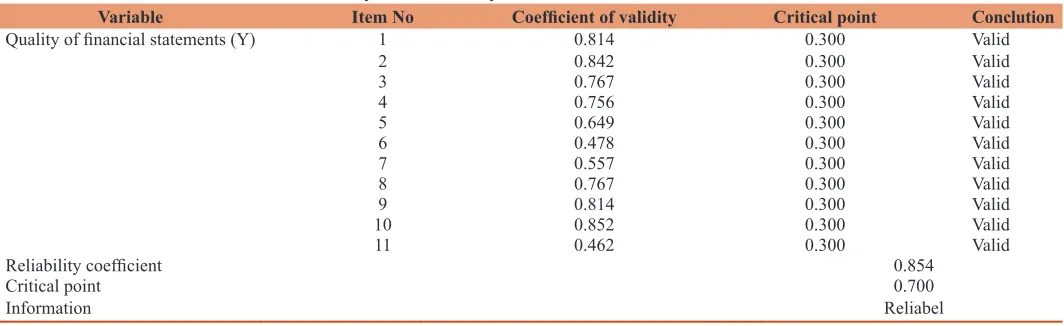
of validity and reliability tests for Y variables (quality of financial statements) can be seen in the following table.
Based on Table 2, it can be seen that all statements submitted
in shaping the quality of financial statements (X3) have validity coefficient values above the critical point of 0.3 which indicates
that all statements submitted have been declared valid. And for the
results of the reliability coefficient, the Cronbach’s Alpha value of 0.854 is >0.700 and declared reliable, so it can be concluded that all statements submitted in shaping the quality of financial
statements have been able to measure what they want to measure.
Table 2: Test results for instrument validity and reliability variables Y
Variable Item No Coefficient of validity Critical point Conclution
Quality of financial statements (Y) 1 0.814 0.300 Valid
2 0.842 0.300 Valid
3 0.767 0.300 Valid
4 0.756 0.300 Valid
5 0.649 0.300 Valid
6 0.478 0.300 Valid
7 0.557 0.300 Valid
8 0.767 0.300 Valid
9 0.814 0.300 Valid
10 0.852 0.300 Valid
11 0.462 0.300 Valid
Reliability coefficient 0.854
Critical point 0.700
Information Reliabel
Source: Data processed
Table 1: Hypothesis of indirect effects
H0: γ1.1≤0 There is no positive influence on financial reporting on good governance
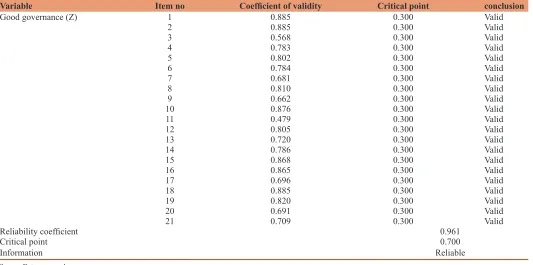
Furthermore, the results of the recapitulation of validity and
reliability tests for the Z variable (good governance) can be seen
in the following table.
Based on Table 3, it can be seen that all statements submitted in
forming good governance (Z) have a validity coefficient value above the critical point of 0.3 which indicates that all submitted
statements have been declared valid. And for the results of the
reliability coefficient, the Cronbach’s Alpha value of 0.961 is >0.700 and declared reliable, so it can be concluded that all
statements submitted in forming good governance have been able to measure what they want to measure. The variable quality
of financial statements is measured by four dimensions, namely
relevant, reliable, understandable and comparable.
6.2. Respondents’ Response
6.2.1. Regarding the principles of good governance
Measuring instruments on the principles of good governance
in this study were measured using 5 dimensions which were operationalized into 21 relevant statements. Good governance
variables are measured in five dimensions, namely transparency,
participation, accountability, independence and equality. Effect of Quality of Financial Statements on Good Governance. The
hypothesis that will be tested is the effect of the quality of financial
statements on the good governance of the provincial/district/city governments in Papua and West Papua. Based on the results of
data processing, the path coefficient results for the quality of financial statements on good governance are 0.621 and R2 is 0.386
as shown in Table 4.
From Table 4 above, the total effect of the quality of financial statements (Y) on good governance (Z) on the provincial/
district/municipal governments in Papua and West Papua is
0.386 or 38.6%. This means that as much as 38.6% of good governance (Z) in the provincial/district/city governments in Papua and West Papua are influenced by financial report quality factors (Y). In the diagram, the effect of financial report quality (Y) on good governance (Z) can be seen in the
following Figure 2:
From the path diagram depicted in Figure 2 above, it can be
calculated the effect of variable financial report quality (Y) on good governance (Z) using the following formula Z = 0.621* Y. By knowing the magnitude of the path coefficient as seen in the
equation and figure above, then further testing of the hypothesis
can be done to find out whether the effect of the variable quality of financial statements on the variables of good governance is significant or not.
Table 3: Test results for instrument validity and variable reliability
Variable Item no Coefficient of validity Critical point conclusion
Good governance (Z) 1 0.885 0.300 Valid
2 0.885 0.300 Valid
3 0.568 0.300 Valid
4 0.783 0.300 Valid
5 0.802 0.300 Valid
6 0.784 0.300 Valid
7 0.681 0.300 Valid
8 0.810 0.300 Valid
9 0.662 0.300 Valid
10 0.876 0.300 Valid
11 0.479 0.300 Valid
12 0.805 0.300 Valid
13 0.720 0.300 Valid
14 0.786 0.300 Valid
15 0.868 0.300 Valid
16 0.865 0.300 Valid
17 0.696 0.300 Valid
18 0.885 0.300 Valid
19 0.820 0.300 Valid
20 0.691 0.300 Valid
21 0.709 0.300 Valid
Reliability coefficient 0.961
Critical point 0.700
Information Reliable
Source: Data processed
Table 4: Value of path coefficients and value of R‑square quality of financial statements towards good governance
Sub structure Endogenous variable Exogenous variable Path coefficient t-statistic R-square
2 Good Governance Quality of financial statements 0.621 7.681 0.386
Source: Data processed
Good Governance Financial Reporting
Quality 0,621
From the table above, it can be seen that the calculated value
obtained by the financial statement quality variable (Y) is 7.681.
This value is greater than t-table value 1.960. In accordance with the testing criteria of the hypothesis that H0 is rejected and Ha is accepted, it means that, the quality of financial statements has a significant effect on good governance in the Provincial/
District/City Governments in Papua and West Papua. The results of hypothesis testing shown in table 4.4 show that the value of t
count for the financial report quality variable is 7.681. This value
is above the t-table value of 1.96. Thus, the hypothesis (Ho) which states the quality of financial report variables does not have a significant effect on the variables of good governance is rejected, and vice versa accepts the alternative hypothesis (H1) which states the variable quality of financial statements has a significant effect
on the good governance variable. Thus, the effect of the quality
of financial reports on good governance in the Provincial/District/ City Governments in Papua and West Papua is significant.
7. CONCLUSION
Partially, the quality of financial statements has a significant effect on government governance with a contribution of 38.6%. This means that the better the quality of financial reporting, the better the governance system (god governance). The results of testing
this hypothesis contribute to the development of accounting
science, especially in the field of public accounting. Furthermore,
the results of this study can also be used as a foundation by other
researchers who are interested in conducting research in the field of
public accounting by using the same research methods in different analysis units and samples in the hope that they will obtain the
same results (replicability).
REFERENCES
Abdul, A.H., Abdullah, S. (2006), Relations and agency problems in local government: An opportunity for budget research and accounting. Government Accounting Journal, 2(1), 53-64.
Arens, A.A., Randal, J.E., Mark, S.B. (2014), Auditing and Assurance Service: An Integrated Approach. 15th ed. England: Pearson Education, Inc.
Arja, S. (2000), Accountability and Government Performance Measurement. Journal of Accounting and Finance, 12(1), 20-39. Boynton, W.C., Johnson, R., Kell, W.G. (2006), Modern Auditing. 8th ed.
USA: Richard D. Irwin Inc.
BPK. (2015a), Examination Report of 2014 Budget Year. Jakarta: Supreme Audit Agency.
BPK. (2016), Report of Audit Results for the 2015 Fiscal Year. Jakarta: Supreme Audit Agency.
BPK. (2017), Report on Audit Results for the 2015 Fiscal Year. Jakarta: The Supreme Audit Agency.
Brooks, I. (2006), Organizational Behavior, Individuals, Groups and Organization. 3rd ed. New York: Prentice Hall.
Cheng, R., Engstrom, J., Kattelus, S. (2002), Education of governmental financial managers: University collaboration between business and public administration. The Journal of Government Financial Management, 51(3), 10-37.
Cohen, D., Paul, Z. (2008), Economic Consequences of Real and Accrual-Based Earnings Management Activities. New York: New York University Leonard N. Stern School of Business.
Christiaens, J. (1999), Financial accounting reform in Flemish
municipalities: An empirical investigation. Financial Accountability and Management, 15(1), 21-40.
Christiaens, J. (2001), Converging new public management reforms and diverging accounting practices in Flemish local governments. Financial Accounta Bility and Management, 17(2), 153-170. Christiaens, J. (2007), Governmental accounting reform, evolution of the
implementation in Flemish municipalities. Financial Accountability and Management, 23(1), 99-111.
Christiaens, J., Van Peteghem, V. (2003), Governmental account reform: Evolution of the implementation in Flemish munitions. Financial Accountability and Management, 23(4), 375-399.
Darwanis, A., Bakar, U. (2012), Effect of implementation of good governance and government accounting standards on financial information quality. Postgraduate Accounting Journal Syiah Kuala University, 6, 1-14.
Hair, J.F. Jr., Hult, G.T.M., Ringle, C.M., Sarted, M. (2014), A Primer on Partial Least Squares Structural Equation Modeling (PLS-SEM). Califrnia: Sage Publication, Inc.
Hall, J.A., Tomiie, S. (2005), Information Technology Auditing and Assurance. 2nd ed. USA: Thomson South Western.
Harahap, S. (2006), Critical Analysis of Financial Statements. Jakarta: PT. Harun, H. (2009), Sector Accounting Reform and Public Sector
Management in Indonesia. Jakarta: Jakarta Salemba Empat. Hasyim, B.A. (2006), The concept of good governance in the concept of
regional autonomy. Journal of Administrative and Policy Analysis, 3(1), 1-4.
Hertati, L. (2015), Competence of human resources, the benefits of information technology on value of financial reporting in Indonesia. Research Journal of Finance and Accounting, 6(8), 12-16.
Indra, B. (2006), Public Sector Accounting: An Introduction. Jakarta: Erlangga Publisher.
International Public Sector Accounting Standards Board. (2010), Conceptual Framework for General Purpose Financial Reporting by Public Sector Entities. The International Federation of Accountants (IFAC). Available from: http://www.ifac.org.
Jan-Erik, L. (2000), The Public Sector Concepts, Models and Approaches. London: SAGE Publications.
Kieso, Donald D.E., Weygandt, Jerry, J.W., & Warfield, Terry, D.W. (2012. ), Intermediate Accounting. 15th edition. Hoboken, New Jersey: John Wiley & and Sons, Inc.
KNKG. (2008), Concept of Good Public Governance Guidelines. Jakarta: Issued by: National Governance Policy Committee.
Laudon, Kenneth K.C., & Jane P.Laudon, J.P. (2014. ), Management Information System. Managing the Digital Firm. Fourteenth 14th edition. Boston: Global Edition. Pearson Pearson.
Lundqvist, K. (2001), Accrual Accounting in Swedish Central Government. Swedish: The Swedish Financial Management Aothority.
Madison, B. (2010), Defining Financial Statements. Madison: R Chad and Co Publishers.
Mahmudi, H. (2010), Regional Financial Management. Jakarta: Erlangga. Mardiasmo, M. (2002), Autonomy and Regional Financial Management.
1st ed. Yogyakarta: Andi Publisher.
Mardiasmo, M. (2002), Public Sector Accounting. Yogyakarta: Andi Publisher.
Mardiasmo, M. (2006), Realization of transparency and public accountability through public sector accounting: A means of good governance. Journal of Government Accounting, 2(1), 1-17. Mardiasmo, M. (2007), Regional financial management reformation
still faced with several difficulties. Regional Autonomy Journal, 7(2),1-10.
Seminar, July 22, 2009 Organized by the Supreme Audit Board of the Republic of Indonesia.
Nunuy, N.A., Azwari, P.C. (2015), The effect of the implementation of government internal control systems (GICS) on the quality of financial reporting and the impact on the principles of good governance: A research in district, city, and provincial government in South Sumatra. Procedia Social and Behavioral Sciences, 211, 811-818.
Nunuy, N.A., Rahmatika, D.N. (2014), Factors influencing the quality of financial reporting and its implications on good government. International Journal of Business, Economics and Law, 5(1), 111-121. O’Brian, James J.A& ., George M. Marakas, G.M. (2010. ), Management
Information Systems: Managing Information Technology in the Business Enterprise. 15th edition. New York: McGraw-Hill.] Osborne, D., Gaebler, T. (1992), Reinveting Government: How the
Entrepreneurial Spirit is Transforming the Public Sector. New York: Penguinsc Book.
Perkasa, R.G., Harrison, W.T., Horngren, C.T., Thomas, C.W., Suwardy, T. (2012). Financial Accounting. 8th ed. South Asia: Published by Pearson Education South Asia Pvte Ltd.
Ritonga, I.T. (2010), Regional Government Accounting. Yogyakarta: UGM Graduate School.
Robbins, W.A., Austin, K.R. (1986), High quality in governmental financial reports: An assessment of the appropriateness of a compound measure. Journal of Accounting Research, 24, 412-421. Robbins, Stephen & ., Judge, Timothy, A.J. (2014. ), Essensial of
Organizational Behaviour. Twelfth 12th edition. USA : Pearson Education.
Solikin, Ikin. (2008). , He Effect of Government Accounting Implementation, Quality of Accounting Information and Quality of Regional Government Apparatus on Good Government Governance
and Its Implications for Financial Performance (Survey of City and District Governments in West Java Province) Proceedings of the National Business & and Financial Forum Seminar: 53-70. Stamatiadis, F. (2009), Investigating the governmental accounting reform
of the Greek national health system (ESY): Some preliminary evidence. International Journal of Governmental Financial Management, 9(2), 73-97.
Sulaiman, Si. (2018. ), The Role of Good Government Governance Principles in Enhancing the Performance of Public Organization in Aceh, Indonesia. Advances in Social Science, Education and Humanities Research, . Volume 292. 1st Aceh Global Conference (AGC 2018).
Tjokroamidjojo, B. (2000), Good governance, new paradigm of development management. Journal of Development Management, 30, 20-31.
Van Beest, F., Braam, G., Boelens, S. (2009), Quality of Fiancial Reporting: Measuring Qualitative Characteristics. NICE Working Paper No. 9-108.
Van Der Hoek, M.P. (2005), From cash to accrual budgeting and accounting in the public sector: The Dutch experience. Public Budgeting and Finance, 25(1): 32-45.
Yamin, S., Kurniawan, H. (2011), New Generation of Research Data Processing with Partial Least Square Path Modeling: Applications with XLSTAT Software, Smart PLS, and Visual PLS. Jakarta: Salemba Infotek Publishers.
Zarkasyi, W. (2008), Good Corporate Governance in Manufacturing, Banking and Other Financial Services Business Entities. Bandung: Alfabeta.