Can a Combination of Hands-on Experiments and
Computers Facilitate Better Learning in Mechanics?
Jonte Bernhard
ITN, Campus Norrköping, Linköping University, S-60174 Norrköping, Sweden
http://www.itn.liu.se/~jonbe/
Partial financial support from the Swedish National Agency for Higher Education, Council for Renewal of Higher Education, is gratefully acknowledged. Part of the research reported in this paper was done while the author was employed at Högskolan Dalarna, Borlänge, Sweden.
Abstract
Microcomputer-Based Laboratories (MBL) have been successfully used to promote conceptual growth in mechanics understanding among preservice teachers and engineering students. In MBL laboratories students do real hands-on experiments where real-time display of the
experimental results facilitates conceptual growth. Thus students can immediately compare their predictions with the outcome of an experiment, and students' alternative conceptions can thus successfully be addressed. We also report from a case where only MBL-technology was
implemented, but the students were not asked to make predictions. As a result "misconceptions" were not confronted and conceptual change was not achieved among "weak" students.
Introduction
Acquiring a conceptual understanding of mechanics has proven to be one of the most difficult challenges faced by students (for a good overview see McDermott 1998). Studies by many different researchers have shown that misleading conceptions of the nature of force and motion, which many students have, are extremely hard to overcome. These strong beliefs and intuitions about common physical phenomena are derived from personal experience and affect students' interpretation of the material presented in a physics course. Research has shown that traditional instruction does very little to change students' "common-sense" beliefs (see for example
McDermott 1998; Hestenes et al. 1992; Hake 1997; Bernhard 2000a).
For some decades sensors attached to a computer have been used in most experimental physics research laboratories. The attachment of a sensor to a computer creates a very powerful system for the collection, analysis and display of experimental data. In this paper I report on cases where hands-on experiments have been combined with a microcomputer-based system for the
Figure 1. Typical setup of a MBL-experiment. A low-friction cart is pushed towards a motion sensor. A fan unit attached to the cart provides an approximately constant force in
a direction opposite to the initial movement and the cart will thus change its direction of motion. The results are shown in Figure 2. Note that the fan unit provides a visible force.
In an MBL laboratory students do real experiments, not simulated ones, using different sensors (force, motion, temperature, light, sound, EKG ...) connected to a computer via an interface. One of the main educational advantages of using MBL is the real-time display of experimental results and graphs thus facilitating direct connection between the real experiment and the abstract representation. Because data are quickly taken and displayed, students can easily examine the consequences of a large number of changes in experimental conditions during a short period of time. The students spend a large portion of their laboratory time observing physical phenomena and interpreting, discussing and analysing data with their peers. The MBL context adds capacity and flexibility that, to be exploited requires the laboratory to be reconceptualised, giving students more opportunity to explore and learn through investigations (Tinker 1996; Thornton 1997b). This makes it possible to develop new types of laboratory experiments designed to facilitate better student learning and to use laboratories to address common preconceptions. To take full advantage of MBL the educational implementation is important, not the technology! Active engagement is important!
Figure 2. Results of the MBL laboratory shown in Figure 1. The position, velocity and acceleration as functions of time are displayed. A common misconception is that the cart
acceleration is in the direction of motion (see the poor results on the pre-test for "coin acceleration" in Figure 4). By asking the students to make a prediction and sketch the s(t),
v(t) and a(t) graphs before the experiment and by the rapid display of the experimental
results these misconceptions can effectively be addressed.
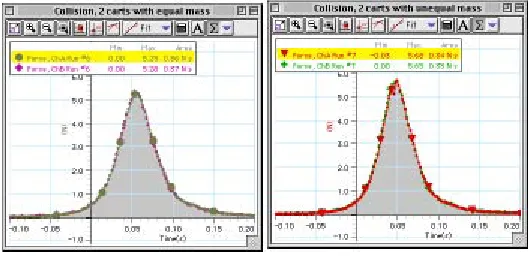
Figure 3. Results from an MBL-experiment with two colliding carts with equal and unequal masses respectively. Force sensors are mounted on top of each cart. The graphs show the forces measured by the sensors during the collision and the area below curves. Note the time scale. Most students are surprised to discover that the forces are equal when
the carts have different masses (see "3rd collision" pre-test in Figure 4).
Implementation of MBL laboratories
The physics department at Högskolan Dalarna started using MBL in 1994/95. Laboratories using MBL-technology have been introduced in most physics courses. Below will be described the results of implementations of MBL in "active engagement" mode (Cases 1 and 2) and in mainly "formula verification" mode (Cases 3 and 4).
Cases 1 and 2
Case 1: An early implementation of MBL laboratories (Preservice teachers 1995/96) in a course for preservice science teachers (preparing for teaching grades 4-9 in Swedish schools). Case 2: A full implementation of MBL laboratories (Mechanics I 1997/98 for Engineering students) and some other reforms (see Table 1). This curricular reform also included changes to the advanced mechanics course (Mechanics II). The reformed advanced mechanics course is described elsewhere (Bernhard 1998, 1999). In both cases 1 and 2 there were about 40 students in the course.
The educational approach (Bernhard 2000b) taken in both cases was inspired by, but not
identical to, the approach taken by Sokoloff et al. (1998) in RealTime Physics (see also Thornton 1997b, and references therein) and in case 2 also by the "New Mechanics" paper by Laws
(1997). Laboratories were written in Swedish by the author.
Case 1 had an early version of MBL laboratories and no laboratory on Newton's 3rd law.
Cooperation was encouraged.
Students preconceptions were addressed by asking the students to make predictions of the outcomes of all experiments (elicit [student ideas] - confront - resolve).
After making predictions, the students performed the experiment and compared the outcome with the prediction (elicit - confront - resolve) and discussed the result. At this point the rapid display of the results by the computer in graphical form is of crucial educational value.
Each laboratory group of 2-3 students was asked to submit a written report from each laboratory. This reinforces and strengthens student understanding, since they have to describe the laboratory in their own words.
Case 3: Preservice teachers 1998/99
(~ 30 students)
MBL-technology was used in the laboratories.
The original laboratories were transformed into formula verification laboratories and the number of laboratories was reduced for economical reasons.
The students were not usually asked to do predictions. No laboratory on kinematics.
Case 4: Preservice teachers 1999/2000
(~ 25 students)
Similar to case 3.
The Newton's 3rd law laboratory was changed from "formula verification" to "active engagement".
Motion This laboratory introduces kinematics concepts using MBL and also uses the tutorial software Graphs and Tracks I & II.
Analysis of motion using
Videopoint
Introduces two dimensional kinematics using Videopoint.
Force and motion I & Force and motion II
The force and motion laboratories use MBL-equipment to study dynamics (Newton's 1st and 2nd laws). Cases with friction and friction free cases are studied.
Ballistic pendulum
themselves.
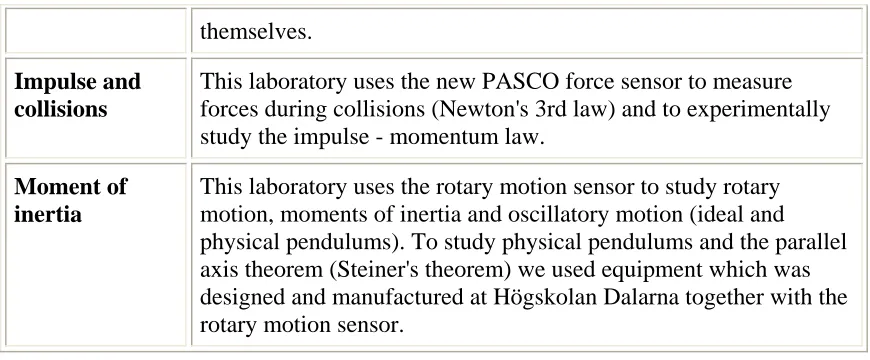
Impulse and collisions
This laboratory uses the new PASCO force sensor to measure forces during collisions (Newton's 3rd law) and to experimentally study the impulse - momentum law.
Moment of inertia
This laboratory uses the rotary motion sensor to study rotary motion, moments of inertia and oscillatory motion (ideal and physical pendulums). To study physical pendulums and the parallel axis theorem (Steiner's theorem) we used equipment which was designed and manufactured at Högskolan Dalarna together with the rotary motion sensor.
Table 1. Laboratories (4 hours) used in the Mechanics I course in 1997/98.
Evaluation instruments
The Force Concept Inventory (FCI) developed by Hestenes et al. (1992) and the Force and Motion Conceptual Evaluation (FMCE) developed by Thornton and Sokoloff (1998) were used as instruments for evaluating students' conceptual understanding. The data from the FMCE-test were analysed using the Conceptual Dynamics method developed by Thornton (1997a). Using this method, student views (for example force-follows-velocity view or physics view) can be assigned.
Results
Cases 1 and 2
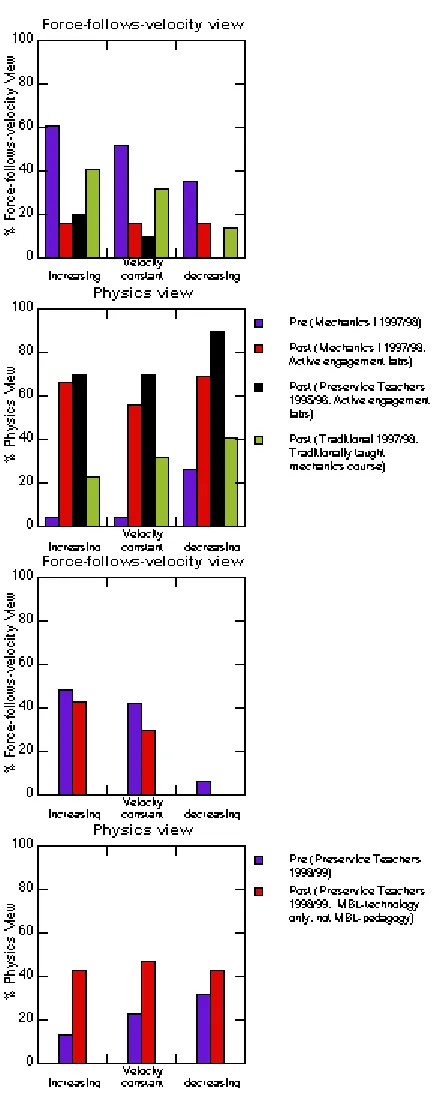
As can be seen in Tables 2 and 3 and in Figures 4 and 5 the students in cases 1 and 2 have gained a much better conceptual understanding of mechanics than students in traditionally taught
courses. A high fraction of the students have acquired a Newtonian view and a low fraction of students hold a force-follows-velocity view after instruction. The students in Mechanics I (case 2) performed significantly better on traditional problems in the final examination, than the students did in earlier similar courses.
In this course male and female students also had the same normalised gains.
Course Year Main student body Method Pre-test average Post-test average Gain (G) Normalised gain (g)
Preservice 95/96 Preservice science teachers (grades 4-9)
Mechanics I
97/98 Engineering Full MBL +
51% 73% 22% 45%
Preservice 98/99 Preservice science teachers (grades 4-9) MBL-technology Formula verification
49% 65% 16% 31%
Preservice 99/00 Preservice science teachers (grades 4-9) MBL-technology Some MBL pedagogy
35% 67% 32% 49%
Traditional 97/98 Engineering Traditional 50% 58% 8% 16%
Table 2. Results of pre- and post-testing using Force Concept Inventory (Hestenes et al. 1992) on different student groups.
Gain (G) = post-test - pre-test. Normalised gain (g) = gain / (maximum possible gain) (Hake 1997).
Course Year Main student body Method Pre-test average Post-test average Gain (G) Normalised gain (g) Mechanics I
97/98 Engineering Full MBL +
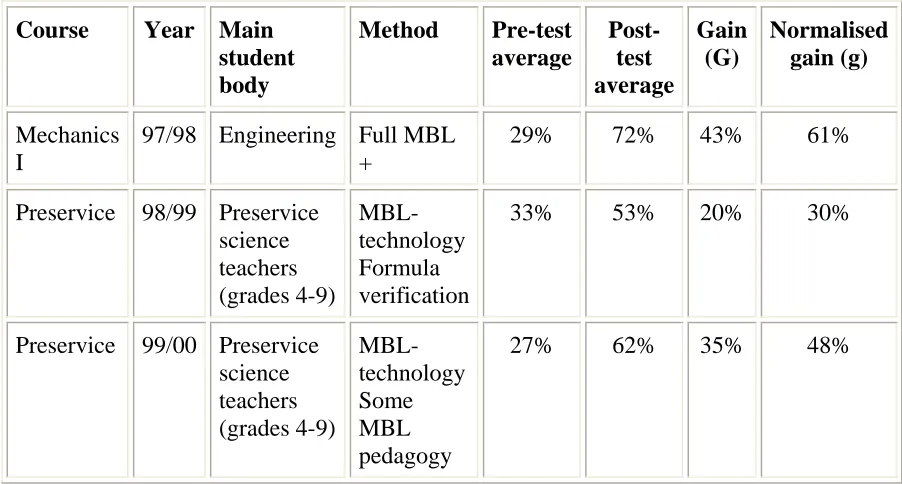
29% 72% 43% 61%
Preservice 98/99 Preservice science teachers (grades 4-9) MBL-technology Formula verification
33% 53% 20% 30%
Preservice 99/00 Preservice science teachers (grades 4-9) MBL-technology Some MBL pedagogy
27% 62% 35% 48%
Table 3. Results of pre- and post-testing using Force and Motion Conceptual Evaluation (Thornton and Sokoloff 1998) on different student groups. Gain and Normalised gain
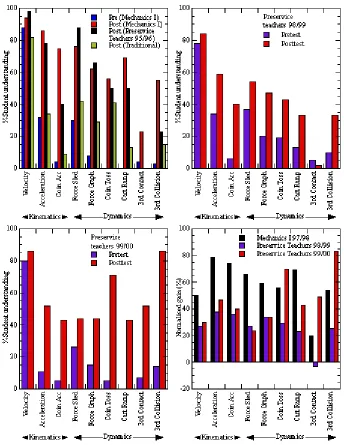
Figure 4. Conceptual understanding in mechanics as measured by the FMCE-test.
Case 3
The students in case 3 did not perform as well as in cases 1 and 2, but somewhat better than students in traditionally taught courses did. As can be seen in Figure 5 almost the same fraction of students hold the force-follows-velocity view after instruction as before instruction. By eliminating the active engagement part from the laboratories the preconceptions of the students believing in this view were not reached.
Case 4
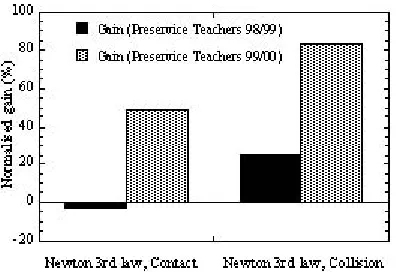
The students in case 4 performed similarly to the students in case 3, except for a much better performance in the Newton's 3rd law conceptual areas (see Figure 6 below). The difference in gains between male and female students was smaller than in case 3.
Discussion and conclusions
Microcomputer-Based Laboratories (MBL) in an active engagement approach is proven to be an effective way of fostering conceptual change in mechanics. The conceptual understanding is long-lived (Bernhard 2000c). MBL is good both for preservice teachers and engineering
students. The combination of hands-on experiments and the microcomputer-based measurement system is a very powerful educational tool and according to Euler and Müller (1999) one of the few educational approaches in physics using computers which is reported to have positive effects on student learning. Students need to make use of as many senses as possible in their meaning making and thus approaches which make use of both hands-on and high-technology tools seem to be very effective (see also Otero 2000). In a well implemented MBL-approach MBL is used as a technological tool and a cognitive tool.
However the MBL-approach can be misunderstood and implemented as a technology only approach. When implemented without sound pedagogy, MBL is only marginally better than "traditional" teaching. Pedagogy is more important than technology! The personal
preconceptions students hold before instruction must be addressed in some way during a course. Asking students to make predictions before an experiment is done is one way to both confront "misconceptions" and to reinforce scientific views.
It is also very important to focus on the teacher's pedagogical views since they can
Figure 6. A comparison of Newton's 3rd law data from the FMCE-test for Preservice Teachers 98/99 and 99/00. Both groups had a laboratory dealing with Newton's 3rd law of
the same length and with the same MBL-equipment. However the laboratory used by Preservice Teachers 98/99 was a formula verification laboratory and the 99/00 group
"active engagement".
References
Bernhard, J. (1998) Hands-on Experiments in Advanced Mechanics Courses. Proceedings of the International Conference Hands-on Experiments in Physics Education (ICPE/GIREP),
Duisburg, Germany.
Bernhard, J. (1999) Using active engagement labs in upper level mechanics courses. Presented at American Association of Physics Teachers (AAPT) Winter Meeting, 9-14 January, Anaheim, CA, USA.
Bernhard, J. (2000a) Improving engineering physics teaching - learning from physics education research, Proceedings of PTEE 2000, Budapest.
Bernhard, J. (2000b) Teaching engineering mechanics courses using active engagement methods, Proceedings of PTEE2000, Budapest.
Bernhard, J. (2000c) Does active engagement curricula give long-lived conceptual
understanding? Accepted for publication in the proceedings of GIREP2000 "Physics Teacher Education Beyond 2000" in Barcelona, 27 August - 1 September.
Euler, M. and Müller, A. (1999) Physics learning and the computer: A review, with a taste of meta-analysis, in Proceedings Second International Conference of the European Science Education Research Association (ESERA), eds Komorek et al., Kiel, and a presentation at the same conference.
Hake, R. R. (1997) Interactive-engagement vs traditional methods: A six-thousand-student survey of mechanics test data for introductory physics courses. Am. J. Phys, 66, 64-74.
Hestenes, D., Wells, M. and Swackhamer, G. (1992) Force Concept Inventory, Phys Teach, 30, 159-165, The FCI-test was translated into Swedish by J. Bernhard, 1997.
Hewson, P. W. and A'Beckett Hewson, M. G. (1984) The role of conceptual conflict in conceptual change and the design of science instruction, Instructional Science, 13, 1-13. Laws, P. L. (1997) A New order for Mechanics, in Proceedings Conference on Intro Physics Course, ed. Wilson, Wiley, NY, 125-136.
McDermott, L. C. (1998) Students' conceptions and problem solving in mechanics, in
Barojas, ICPE.
Otero, V. (2000) The Process of Learning Static Electricity and the Role of the Computer Simulator, AAPT Summer meeting, July 29 - August 2, Guelph, Ontario, Canada.
Sassi, E. (2000) Lab-work in physics education and informatic tools: advantages and problems, GIREP2000 "Physics Teacher Education Beyond 2000", Barcelona 27 August - 1 September. Saul, J. M. and Redish, E. F. (1998) A Comparison of Pre- and Post-FCI Results for Innovative and Traditional Introductory Calculus-Based Physics Classes. AAPT Announcer, 28, 80-81. Also in An Evaluation of the Workshop Physics Dissemination Project. Department of Physics, University of Maryland.
Sokoloff, D. R., Thornton, R. K. and Laws, P. W. (1998) RealTime Physics. Wiley, NY. Thornton, R. K. (1997a) Conceptual Dynamics: Following Changing Student Views of Force and Motion, in AIP Conference Proceedings, eds Redish, E. F. and Rigden, J. S., American Institute of Physics, 399, 913-934.
Thornton, R. K. (1997b) Learning Physics Concepts in the Introductory Course: Microcomputer-based Labs and Interactive Lecture Demonstrations, in Proceedings Conference on Intro Physics Course, ed. Wilson, 69-86, Wiley, NY.
Thornton, R. K. and Sokoloff, D. R. (1998) Assessing student learning of Newton's laws, The Force and Motion Conceptual Evaluation and the evaluation of active learning laboratory and lecture curricula. Am. J. Phys, 66, 338-352. The FMCE-test was translated into Swedish by J. Bernhard 1998.
Tinker, R. F. (ed.), (1996) Microcomputer-Based Labs: Educational Research and Standards. NATO ASI Series F vol 156, Springer, Berlin.
Jonte Bernhard
ITN, Campus Norrköping Linköping University S-60174 Norrköping Sweden