RESEARCH
Achieving sustainable development goals
on no poverty and zero hunger: Does technical
efficiency of Ghana’s maize farmers matter?
Camillus Abawiera Wongnaa
*and Dadson Awunyo‑Vitor
Abstract
Background: Whether or not maize farmers are technically efficient determines their choice of productivity improve‑ ment strategy and very important for achieving the sustainable development goals on no poverty and zero hunger. This study examined technical efficiency and its determinants of Ghana’s maize farmers. Analysis of the determinants is crucial to devising strategies aimed at improving technical efficiencies of the farmers as well as ensuring no poverty and zero hunger.
Methods: The study used cross‑sectional data collected from 576 maize farmers in the four main agro‑ecological zones of Ghana with the aid of structured questionnaire. Descriptive statistics and the stochastic frontier production function were the methods of analysis used.
Results: The results showed that the mean technical efficiency estimate for maize farmers in Ghana was 58.1%. They also revealed that an increase in educational level, maize farming experience, extension contact as well as uses of fertilizer and improved seeds would increase the technical efficiency of maize producers in Ghana. Similarly, male Ghanaian maize farmers were more technically efficient than female farmers. Furthermore, membership of a farmer association will increase their technical efficiencies. Finally, an increase in farm size and land fragmentation will decrease technical efficiency of the maize farmers.
Conclusion: Efficiency improvement programmes by stakeholders in the maize industry could target literate maize farmers since education enhances the managerial and technical skills of farmers and also increase farmers’ ability to utilize existing technologies. Ministry of Food and Agriculture (MOFA) could also liaise with Ministry of Education to provide maize farmers with no formal education with special training prior to introducing new efficiency enhancing programmes to them. MOFA should analyse the problems extension officers face in the discharge of their duties to pave the way for the provision of appropriate incentives to extension officers by stakeholders in the maize industry. Keywords: Determinants, Maize, Technical efficiency, Stochastic frontier analysis
© The Author(s) 2018. This article is distributed under the terms of the Creative Commons Attribution 4.0 International License (http://creat iveco mmons .org/licen ses/by/4.0/), which permits unrestricted use, distribution, and reproduction in any medium, provided you give appropriate credit to the original author(s) and the source, provide a link to the Creative Commons license, and indicate if changes were made. The Creative Commons Public Domain Dedication waiver (http://creat iveco mmons .org/ publi cdoma in/zero/1.0/) applies to the data made available in this article, unless otherwise stated.
Background
The importance of the contribution of maize production to economic growth, poverty alleviation, food security, gross domestic product, employment and incomes in Ghana cannot be overemphasized. For most rural house-holds in Ghana, maize is the main staple food and an ideal crop whose increased productivity has the potential
to support Ghana’s strive to meeting the sustainable development goals on no poverty and zero hunger. How-ever, there has been an unstable trend in the country’s maize production over the last two decades, which threatens household food security and income sources [27]. Because maize production is critical for the overall process of social and economic development of Ghana, it is crucial that the country takes steps, especially through research, to help grow and develop the maize sector. A very important factor that will help sustain an increase in maize production is an increase in its productivity driven
Open Access
*Correspondence: [email protected]
by increase in economic efficiency of its producers [6]. Economic efficiency is incomplete if technical efficiency is not studied [19]. The farmer’s ability to achieve maxi-mum output with available resources is referred to as technical efficiency. Whether or not maize farmers are technically efficient determines their choice of productiv-ity improvement strategy and very important for achiev-ing the sustainable development goals on no poverty and zero hunger. This is because, if they are technically effi-cient, then new inputs or production technologies will be required to shift the production curve or frontier upward. Conversely, if their productivities are below potential yields, then their technical efficiencies could be improved by dealing with the causes of technical inefficiency [32].
Various studies have analysed technical efficiency of Ghana’s maize farmers even though the scopes of these studies did not cover the entire nation like the current study and in most of these studies, the stochastic fron-tier analysis procedure was employed as the method of analysis. In spite of the drivers of technical efficiency identified in previous studies, maize farmers continue to experience low yields [27] depicting the failure of recommendations of previous studies to help address the productivity and efficiency challenges farmers have faced over the years. By way of literature review, [2] employed the stochastic frontier analysis procedure and estimated the technical efficiency of maize farmers in Northern Ghana to be 74%. The study concluded that their technical efficiencies were positively influenced by agricultural mechanization, experience and gen-der. Sienso et al. [38], studying the technical efficiency of maize production in Nkoranza district of Brong-Ahafo Region of Ghana using the stochastic frontier analysis procedure, found the technical efficiency of the farmers to be 91%. In this study, variety of maize cultivated, male gender, farming experience and num-ber of extension visits were found to influence techni-cal efficiency of the farmers. Also, using the stochastic frontier analysis procedure, [24] reported a technical efficiency of 51% for maize farmers in Ghana’s east-ern region. The findings from the inefficiency model of this study also showed that technical efficiencies of the farmers were determined by contact with agricul-tural extension workers, membership of a farmer asso-ciation, number of meetings held by assoasso-ciation, formal education and use of credit. Bempomaa and Acquah [13] also employed the stochastic frontier analysis pro-cedure and reported a mean technical efficiency of 67% for maize farmers in the Ejura/Sekyedumase district of Ashanti region of Ghana. According to the study, the technical efficiencies of the farmers were influenced by their ages, male gender as well as off-farm activities. In
addition, [3] estimated the technical efficiency of maize farmers across three agro-ecological zones of Ghana using the stochastic frontier analysis procedure to be 64.1%. The results of this study also revealed that their technical efficiencies were positively influenced by male gender, contact with agricultural extension officers, farmer’s age, access to credit, whether or not farmer owned land and mono-cropping. Furthermore, in ana-lysing the technical efficiency and production risk in Ghana’s maize production, [31] estimated the technical efficiency of the farmers to be 62% with the combined farm specific factors explaining technical efficiency variations. Finally, [20] obtained a mean technical effi-ciency of 58% for maize farmers in the Mfantseman Municipality of Ghana by the stochastic frontier analy-sis approach. According to the study, the mean techni-cal efficiency was influenced by size of household, male gender, years of schooling, off-farm income as well as farmer’s age.
In addition to the variables considered in the afore-mentioned studies, other variables including land frag-mentation, access to ready market, use of fertilizer, pesticides and improved seeds as well as farming in particular agro-ecological zones may also influence technical efficiency. This study analyses Ghana’s maize farm level technical efficiency variations caused by the aforementioned factors. The study provides a nation-wide analysis of technical efficiency of Ghana’s maize farmers by using data from the Northern Savannah, Transitional, Forest and Coastal Savannah zones. This is important because existing similar studies [2, 13, 20, 24, 31, 38] used data that were restricted to only certain districts, municipalities or agro-ecological zones which are not very representative of the nation. Also, it has been argued that technical efficiency of maize farmers might differ depending on their respective agro-ecolog-ical zones as they might be using different technologies. The current study provides evidence of same or simi-lar technologies used by maize farmers across Ghana’s agro-ecological zones and therefore employs the sto-chastic production frontier instead of the metafrontier.
Methods
Study area and data collection
Coastal Savannah zone comprises the coastal parts of Greater Accra, Central and Volta regions of Ghana.
The study used primary cross-sectional data which was collected from 576 maize farmers with the aid of a structured questionnaire. Generally, the questionnaire comprised four sections. The first section consisted of identification of the enumerator, the respondent as well as the district and operational area of the respondent. The second section included questions on maize pro-ducers’ personal and household characteristics. The third section dealt with questions on inputs or resources employed in maize production, while the fourth section posed questions on the output of maize and its market-ing. Basically, the study employed multi-stage sampling technique. In stage one (1) of the sampling design, two districts/municipalities were purposively selected from each zone based on the level of maize production [27]. The selected districts/municipalities were East Gonja and West Mamprusi (Northern Savannah zone), Nkoranza and Ejura Sekyedumase (Transitional zone), Fanteakwa and Sekyere South (Forest zone) and Gomoa and Ketu (Coastal Savannah zone). In the second stage, nine (9) vil-lages or communities were randomly selected from each district/municipality. Stage three involved random sam-pling of eight (8) maize farmers from lists of maize farm-ers obtained from agricultural extension agents operating in the various villages/communities.
Analytical framework
The study employed descriptive statistics in analysis of socio-economic characteristics of maize farmers in Ghana. The stochastic frontier analysis approach was also employed in analysing the technical efficiency of the farmers. The function was independently proposed and defined by [5, 26] as;
where yi is output of the ith farmer; f(xi;β) is a
suita-ble production function, xi is a vector of farm inputs, β
is a vector of parameters to be estimated, and N is the sample size. vi , which represents a random error, has zero mean and is assumed to be symmetric and inde-pendently distributed as N(0; σ2v,) and is particularly related to random factors which cannot be controlled by the farmer such as measurement errors and weather factors. ui , which is non-negative truncated half normal,
random variable, N
0; σ2v,
, is linked to the technical inefficiency of the farmer.
According to [37], technical efficiency of a farm firm is calculated using the ratio of observed output to the potential or frontier output. That is,
(1) yi =f(xi;β)expvi−ui wherei=1, 2,. . .,N
where yi is the highest or maximum predicted output for the ith farm and y∗
i is the potential or frontier output. In employing the stochastic frontier analysis approach, [16] present two estimation procedures. In the first pro-cedure, in the absence of a specified clear distribution of the efficiency component, stochastic corrected ordi-nary least squares (COLS) is appropriate. On the other hand, maximum likelihood estimation (MLE) technique is employed as the estimation procedure if a clear dis-tribution is specified. MLE is more efficient than COLS because it uses the specific distribution of the error term [22]. The stochastic frontier and the inefficiency model are jointly estimated using frontier computing packages such as FRONTIER, STATA and Limdep which apply MLE [11, 21]. This study used STATA.
The selection of functional form is essential in employ-ing the stochastic frontier analysis approach. The Cobb–Douglas production function introduces severe restriction on the technology employed in the farm by limiting the elasticities of production to be fixed and the input substitution elasticities to unity [43]. This is, however, not the case with the translog functional form. Diagnostically, to determine which functional form is more appropriate for the data collected, the generalized likelihood ratio test was employed as follows:
where L(H0)= value of the log-likelihood of the adopted model, L(H1)= value of the log-likelihood of the restricted model.
has a Chi-square distribution with degree of freedom equal to number of restrictions. The main hypothesis tested is whether or not the Cobb–Douglas functional form fits the data collected in the study, given the trans-log functional form. Cobb–Douglas functional form was rejected in favour of the translog functional form. After settling on the ideal functional form, separate stochastic production frontier (SPF) models were defined for maize farmers in different agro-ecological zones of Ghana. After the estimation of the separate stochastic production frontier (SPF) models, it was necessary to verify if maize farmers in the various agro-ecological zones shared the same technology. This was also done using a likelihood ratio (LR) test, where L(H0) is the value of the log-like-lihood function for a stochastic production frontier esti-mated by pooling the data for all agro-ecological zones
(2)
Technical efficiency=TEi=
yi
y∗ i
= f(xi;β)exp vi−ui
f(xi;β)expvi
=exp−ui
(3) = −2
lnL(H0) L(H1)
and L(HA) is the sum of the values of the log-likelihood functions from the individual stochastic production fron-tiers. The degree of freedom for the Chi-square statistic is the difference between the number of parameters esti-mated under HA and H0 . If the null hypothesis that the stochastic frontier for the pooled data exists is rejected in favour of the individual frontiers, then the data should not be pooled and in such a case, the metafrontier is the appropriate framework to estimate and compare techni-cal efficiency across agro-ecologitechni-cal zones [12]. Empiri-cally, the stochastic frontier translog production function is specified as:
where yi= total quantity of output (kg), xi= vector
of inputs which includes SED= quantity of seed (kg),
LANDSZ= farm size (ha), LAB= quantity of labour (Man-days), CAP= capital (depreciated charges on farm tools and implements), FET= quantity of fertilizer (kg),
MAN= quantity of manure (kg), PET= quantity of pes-ticides (litres), HEB= quantity of herbicides (litres), m= number of production inputs, ij= positive
inte-gers
i�=j
, β′s= vector of parameters to be estimated,
viandui have their usual meanings. Empirically, the inef-ficiency model is also specified as:
where zi=vector of farmer characteristics thought to influence technical efficiency which includes
ROAD= access to good roads, measured as a dummy (1 for access to good road and 0 otherwise), SEX= gender of maize farmer, measured as a dummy (1 for male and 0 for female), AGE= age of maize farmer, measured in years,
EDU= educational level of maize farmer, measured in years of schooling, HOSIZE= household size, meas-ured as number of family members living with maize farmer. EXP= maize farming experience, measured in number of years in maize farming, MGROUP= mem-bership of a farmer association, measured as a dummy (1 for membership of an association and 0 otherwise),
CREDIT= access to credit, measured as a dummy (1 for access to credit and 0 otherwise), INCOME= previ-ous year’s maize income, measured in Ghana Cedis,
NPLOTS= land fragmentation, measured as a dummy (1 for owning more than one plot and 0 otherwise), NOEX-TVI= extension contact, measured in number of meet-ings of maize farmer with agricultural extension agents,
(4)
lnyi=β0+ m
k=1
βklnxki+ 1 2
m
k=1 m
j=1
βkjlnxkilnxji+vi−ui
(5) ui=δ0+
N
m=1
δmzi
REDYMKT = access to ready maize market, measured as a dummy (1 for available maize market and 0 other-wise), FERTus= use of inorganic fertilizer, measured as a dummy (1 for use of inorganic fertilizer and 0 other-wise), PESTus= use of pesticides, measured as a dummy (1 for use of pesticides and 0 otherwise), SEDtyp= seed variety planted by maize farmer, measured as a dummy (1 for improved variety and 0 for traditional variety),
NOSAV= living in the Northern Savannah zone, meas-ured as a dummy (1 for living in Northern Savannah zone and 0 for living in the Coastal Savannah zone),
TRASIT= living in the Transitional zone, measured as a dummy (1 for living in Transitional zone and 0 for living in the Coastal Savannah zone), FOREST= living in the Forest zone, measured as a dummy (1 for living in For-est zone and 0 for living in the Coastal Savannah zone), δ= vector of parameters to be estimated. The param-eters in the stochastic frontier production function and those of the inefficiency model can be jointly estimated in STATA [21]. The joint model generates variance param-eters, i.e., =σu/σv , variance of the model, σ , variance of the stochastic model, σv2 , and variance of the inefficiency
model, σu2 . Breusch Pagan statistic and variance inflation
factor (VIF) were employed in testing for heteroscedas-ticity and multicollinearity, respectively. Also, the partial input elasticities can be calculated by taking the partial derivative of yi with respect to xki in Eq. (4) and substitut-ing the sample input means. This, accordsubstitut-ing to [1, 45], is specified as:
Results and discussion
Socio‑economic characteristics of the respondents
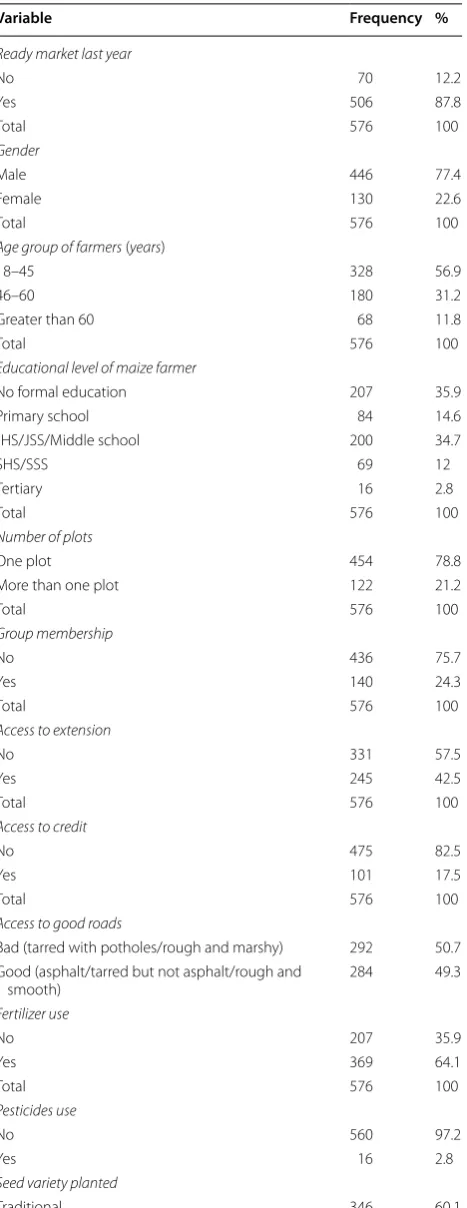
The results presented in Table 1 showed that most of the respondents (77.4%) were males, an indication of the popularity of males in Ghana’s maize production than females. It could also be inferred from this study that both men and women could take maize production as a business and a source of employment. With major-ity of the farmers with ages within 18–45 years’ bracket (56.9%), the mean age was 45.15 years (Table 2). The implication was that the farmers were old. According to studies conducted by [20], [13] as well as [3], old age of farmers could adversely affect their technical efficien-cies. The results in Tables 1 and 2 also showed that gener-ally, majority of the farmers who took part in the survey (64.1%) received at least six (6) years of formal education and this could help them operate close to the production frontier [20, 24, 31]
(6)
ej= ∂lnyi
∂xki
=βk+
m−1
j=1
With a high mean household size of 7.61 (Table 2), the labour available to the farmers could be enhanced, thereby making farmers carry out husbandry practices on time which could help improve their technical effi-ciencies [20]. Generally, the respondent maize farmers had 14 years of experience in maize farming. With high experience levels, it will not be surprising if farmers’ technical efficiencies are high given that such farmers are supplied with the required productivity enhancing tech-nologies [2, 38]. Also presented in Table 1 is that 57.5% of the farmers in the sample had no access to extension service, and for those who received extension service, extension officers visited them thrice (Table 2), indicating poor services received by the farmers. This could cause little or no use of productivity enhancing technologies since farmers will likely be unaware of these technolo-gies because those who are supposed to disseminate the technologies to them (i.e., extension agents) are far from them. The results could be that the technical efficiency of the farmers would be relatively low [24, 38]. Also worthy of note is the fact that as high as 75.7% of the respond-ents were not members of any farmer group (Table 1). This could increase technical inefficiency of the farm-ers since most extension agents disseminate agricultural technologies through farmer groups [7, 14, 28]. In fact, most of the respondents (82.5%) too received no credit Table 1 Socio-economic characteristics of respondents.
Source: Survey, 2015
Variable Frequency %
Ready market last year
No 70 12.2
Yes 506 87.8
Total 576 100
Gender
Male 446 77.4
Female 130 22.6
Total 576 100
Age group of farmers (years)
18–45 328 56.9
46–60 180 31.2
Greater than 60 68 11.8
Total 576 100
Educational level of maize farmer
No formal education 207 35.9
Primary school 84 14.6
JHS/JSS/Middle school 200 34.7
SHS/SSS 69 12
Tertiary 16 2.8
Total 576 100
Number of plots
One plot 454 78.8
More than one plot 122 21.2
Total 576 100
Group membership
No 436 75.7
Yes 140 24.3
Total 576 100
Access to extension
No 331 57.5
Yes 245 42.5
Total 576 100
Access to credit
No 475 82.5
Yes 101 17.5
Total 576 100
Access to good roads
Bad (tarred with potholes/rough and marshy) 292 50.7 Good (asphalt/tarred but not asphalt/rough and
smooth) 284 49.3
Fertilizer use
No 207 35.9
Yes 369 64.1
Total 576 100
Pesticides use
No 560 97.2
Yes 16 2.8
Seed variety planted
Traditional 346 60.1
Table 1 (continued)
Variable Frequency %
Improved 230 39.9
Total 576 100
Land fragmentation
Owned more than one plot 223 38.7
Owned only one plot 353 61.3
Total 576 100
Table 2 Descriptive statistics of quantities of inputs and output of respondents. Source: Survey, 2015
Variable Min Max Mean Std Dev
Size of farm (ha) 0.22 69.81 2.92 12.7
from any source and this could stop or delay application of key production inputs to crops since farmers will have no money to purchase the inputs, thereby making them technically inefficient [3, 24].
The findings of the current study show that Ghana’s maize production is basically on a small scale as the average farm size was estimated to be 2.86 ha (Table 2). Almost half of the sampled maize farmers (49.3%) remarked they have access to good roads (asphalt/ tarred but not asphalt/rough and smooth) as against 50.7% of them that reported dilapidated nature of their roads (tarred with potholes/rough and marshy) (Table 1). Okoboi [30] emphasized the importance of good roads in the agricultural production and marketing process. According to the study, roads are needed for regular access to inputs and output markets. The average yield of maize grain produced in Ghana according to the results is 1800 kg/ha (1.8 metric tonnes/ha) (Table 2). This is in line with MOFA’s that the average yield of maize was 1.9 metric tonnes/ha instead of a potential of 6.0 metric tonnes/ha [27], indicating that maize yield is still low.
The study revealed that 60.1% of the respondents used traditional maize seeds, while 39.9% used improved seeds (Table 1). Most improved seeds are relatively high yielding so most farmers using traditional seeds could pose a negative effect on their technical efficiencies [38]. The average quantity of seed used per hectare for all the sampled maize farmers is 18 kg (Table 2). This is quite low, even though most farmers use traditional varie-ties and seeds are not difficult to come by since they can get it from their previous season. The results also show a 64.1% use of fertilizer (Table 1). Fertilizer supplies the crops with the required plant nutrients, and therefore, its use in recommended quantities is expected to improve the farmers’ technical efficiencies [44]. The number of maize farmers using fertilizer is therefore quite high in the study only that the quantities applied by the farmers were lower than recommended rates. This corroborates the results obtained by [34] that use of fertilizer greatly
exceeds earlier reports, even though the extent of use was 50% of the recommended rate. Use of pesticides is not very common among maize farmers in the study area as 97.2% of the farmers did not apply pesticides (Table 1). Farmers could therefore be technically inefficient if steps are not taken to improve pesticide usage. The situation could be worse today, especially with the recent inva-sion of the fall army worms which are reported to have destroyed vast maize farms which has threatened Ghana’s ability to meet the sustainable development goals on no poverty and zero hunger.
Stochastic frontier production function analysis of maize production
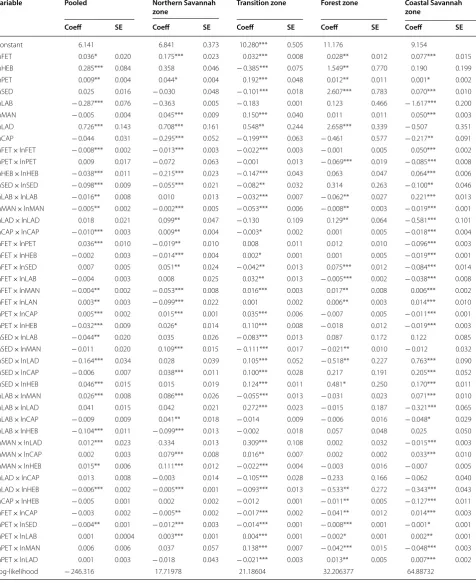
Two likelihood ratio tests were conducted in the study. The first test was to ascertain the appropriateness of either Cobb–Douglas or translog functional form for the data, and the second was to confirm whether or not maize farmers in the four agro-ecological zones shared same or similar technologies. The results of the general-ized likelihood ratio test rejected the stochastic frontier Cobb–Douglas production function in favour of the sto-chastic frontier translog production function as a fitting functional form for the data collected in all agro-ecolog-ical zones (Table 3). Table 5 presents the estimates of the stochastic production frontiers for the pooled and each agro-ecological zone from whose log-likelihoods the sec-ond likelihood ratio test was csec-onducted. The results of the second likelihood ratio test examining whether or not the agro-ecological zones shared the same technol-ogy revealed that they shared the same technoltechnol-ogy as is not significant (Table 3). The implication is that there would be no reason for estimating a metafrontier pro-duction model. This suggests that the stochastic frontiers for maize farms in the four agro-ecological zones are not different and that any efficiency comparison across these four subsamples should be undertaken with respect to the pooled stochastic frontier instead of the meta-frontier. The variance parameters for the chosen pooled
Table 3 Results of test of hypotheses
Agro‑ecological zones share same technology. Critical values are at 5% significance level and are obtained from χ2 distribution table
L(H0), Log‑likelihood function; λ, test statistic; D, decision on whether hypothesis accepted or rejected; R, hypothesis is rejected; NR, hypothesis is not rejected; βij ,
parameters in the square and cross terms; δm , parameters in the inefficiency term
Restriction Pooled Northern Savannah Transitional Forest Coastal Savannah
L(H0) λ χ2 D L(H0) λ χ2 D L(H0) λ χ2 D L(H0) λ χ2 D L(H0) λ χ2 D
H0:βij=0 − 98.2 38.2 23.3 R − 85.3 24.2 23.3 R − 99.4 52.5 23.3 R − 81.3 44.1 23.3 R − 112.2 62.8 23.3 R δm=0 − 148.7 28.4 10.1 R − 178.3 45.8 10.1 R − 83.4 31.2 10.1 R − 94.8 21.7 10.1 R − 138.7 34.4 10.1 R
Hypothesis (restriction) L(H0) λ χ2 Decision
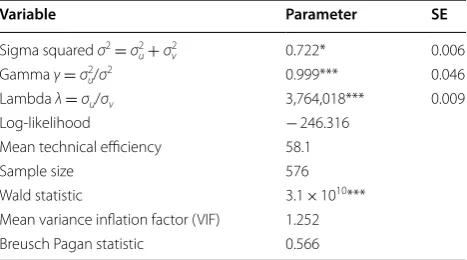
frontier model are also presented in Table 4. The gamma ( γ ) value calculated for the respondents was 0.999. The closeness of this value to one (1) and the high Lambda ( ) value imply inefficiencies in maize production in the study area. This also makes the stochastic frontier model appropriate for the study [33]. The results therefore sug-gest that about 0.1% of the variations in maize outputs for the maize farmers are as a result of the presence of ran-dom shocks outside the control of the farmer. Examples of these random shocks include bad weather, diseases, topology, bushfires as well as statistical errors in meas-uring data. The values of (p<0.01) and σ2(p<0.1) indicate a good fit of the model and correctness of the specified distributional assumptions.
Table 4 also presents statistically significant Wald Chi-square statistic of 3.1 × 10¹⁰ (p < 0.01), indicating joint significance of the model. The variables included in the model were tested for multicollinearity using variance inflation factor (VIF). The mean VIF calculated for the model is 1.252. This is small and implies that there was no problem of multicollinearity with the model [18]. In addition, the statistically insignificant Breusch Pagan (BP) statistic of 0.566 indicates homoscedasticity of the model.
The results of the production function analysis showed that whereas fertilizer (p < 0.1), herbicides (p < 0.01), pes-ticides (p < 0.05) and farm size (p < 0.01) positively influ-enced maize output, the effect of labour input (p < 0.01) was negative (Table 5). The production elasticities for fertilizer, herbicide, pesticide, farm size and labour inputs are 0.49, 0.18, 0.01, 1.15 and − 0.25, respectively (Table 6). Also, the return to scale of 3.327 (Table 6) sug-gests maize production activities in the study area exhibit increasing returns to scale implying that outputs of Gha-naian maize farmers, especially those in the study area, could be increased with increase in intensity of use of
herbicide, fertilizer, farm size and pesticides. This find-ing is in line with the results of similar work done by [31] which reported the influence of herbicide, seed, labour, cost of intermediate inputs and farm size on the output of maize. With maize being the main economic and sta-ple crop for Ghana’s rural households, the influence of the above variables on maize output is critical to devising strategies aimed at meeting the sustainable development goals on no poverty and zero hunger.
Technical efficiency of the farmers
The mean technical efficiency of the maize farmers was estimated to be 58.1%, with a standard deviation of 23.5% and 0.6% and 99.9% as the minimum and maximum, respectively, indicating that the farmers are inefficient with 41.9% of potential maximum output (6.0 metric tonnes per ha) lost to inefficiency. It could therefore be inferred that maize farmers in Ghana are on average 58.1% technically efficient in the use of the technologies available to them. The results imply that the outputs of Ghanaian maize farmers and more importantly those in the study area can be increased by 42% if they are able to use the resources available to them more efficiently. Since technical efficiency is key to enhancing farm incomes and ensuring food security, the finding presents a direc-tion for meeting the sustainable development goals on no poverty and zero hunger. The results corroborate those of previous similar studies in Ghana [2, 3, 13, 20, 24, 31, 38].
The distribution of technical efficiency scores among maize farmers is presented in Fig. 1. The figure shows that majority of maize farmers in the sample (71%) have technical efficiencies ranging from 41 to 60%. The impli-cation is that most maize farmers in Ghana have at least 40% of their potential output lost to inefficiency and this development is worrying as it presents an impression of Ghana struggling to meet the sustainable development goals on no poverty and zero hunger.
Sources of technical efficiency variations in Ghanaian maize farms
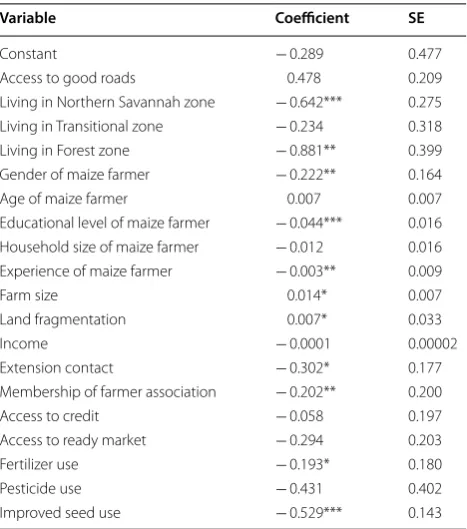
From the inefficiency model presented by Table 7, a negative coefficient implies an increase in the vari-able concerned would increase technical efficiency and productivity and vice versa. The coefficient of use of fertilizer by farmers in the sample has the expected negative sign and is statistically significant at the 10% level. This suggests that maize farmers who use ferti-lizer produce maize more efficiently. The implication is that fertilizer plays an important role in ensuring tech-nical efficiency of maize farmers in all the maize grow-ing areas of Ghana. This makes the results of [15] that found significant positive relationship between ferti-lizer use and technical efficiency in developing country Table 4 Variance parameters for the production function.
Source: Survey, 2015
The asterisks indicate levels of significance. *** is significant at 1%, ** is significant at 5%, and * is significant at 10%
Variable Parameter SE
Sigma squared σ2= σ
u
2+ σ
v
2 0.722* 0.006
Gamma γ = σu2/σ2 0.999*** 0.046
Lambda λ = σu/σv 3,764,018*** 0.009
Log‑likelihood − 246.316
Mean technical efficiency 58.1
Sample size 576
Wald statistic 3.1 × 10¹⁰***
Table 5 Maximum likelihood estimates of stochastic frontier production functions for pooled and separate ecological zones. Source: Survey, 2015
The asterisks indicate levels of significance. *** is significant at 1%, ** is significant at 5%, and * is significant at 10% Variable Pooled Northern Savannah
zone Transition zone Forest zone Coastal Savannah zone Coeff SE Coeff SE Coeff SE Coeff SE Coeff SE
Constant 6.141 6.841 0.373 10.280*** 0.505 11.176 9.154
lnFET 0.036* 0.020 0.175*** 0.023 0.032*** 0.008 0.028** 0.012 0.077*** 0.015 lnHEB 0.285*** 0.084 0.358 0.046 − 0.385*** 0.075 1.549** 0.770 0.190 0.199
lnPET 0.009** 0.004 0.044* 0.004 0.192*** 0.048 0.012** 0.011 0.001* 0.002
lnSED 0.025 0.016 − 0.030 0.048 − 0.101*** 0.018 2.607*** 0.783 0.070*** 0.010 lnLAB − 0.287*** 0.076 − 0.363 0.005 − 0.183 0.001 0.123 0.466 − 1.617*** 0.200 lnMAN − 0.005 0.004 0.045*** 0.009 0.150*** 0.040 0.011 0.011 0.050*** 0.003 lnLAD 0.726*** 0.143 0.708*** 0.161 0.548** 0.244 2.658*** 0.339 − 0.507 0.351 lnCAP − 0.044 0.031 − 0.295*** 0.052 − 0.199*** 0.063 − 0.461 0.577 − 0.217** 0.091 lnFET × lnFET − 0.008*** 0.002 − 0.013*** 0.003 − 0.022*** 0.003 − 0.001 0.005 0.050*** 0.002 lnPET × lnPET 0.009 0.017 − 0.072 0.063 − 0.001 0.013 − 0.069*** 0.019 − 0.085*** 0.008 lnHEB × lnHEB − 0.038*** 0.011 − 0.215*** 0.023 − 0.147*** 0.043 0.063 0.047 0.064*** 0.006 lnSED × lnSED − 0.098*** 0.009 − 0.055*** 0.021 − 0.082** 0.032 0.314 0.263 − 0.100** 0.046 lnLAB × lnLAB − 0.016** 0.008 0.010 0.013 − 0.032*** 0.007 − 0.062** 0.027 0.221*** 0.013 lnMAN × lnMAN − 0.005** 0.002 − 0.002*** 0.005 − 0.053*** 0.006 − 0.008** 0.003 − 0.019*** 0.001 lnLAD × lnLAD 0.018 0.021 0.099** 0.047 − 0.130 0.109 0.129** 0.064 − 0.581*** 0.101 lnCAP × lnCAP − 0.010*** 0.003 0.009** 0.004 − 0.003* 0.002 0.001 0.005 − 0.018*** 0.004 lnFET × lnPET 0.036*** 0.010 − 0.019** 0.010 0.008 0.011 0.012 0.010 − 0.096*** 0.003 lnFET × lnHEB − 0.002 0.003 − 0.014*** 0.004 0.002* 0.001 0.001 0.005 − 0.019*** 0.001 lnFET × lnSED 0.007 0.005 0.051** 0.024 − 0.042** 0.013 0.075*** 0.012 − 0.084*** 0.014 lnFET × lnLAB − 0.004 0.003 0.008 0.025 0.032** 0.013 − 0.005*** 0.002 − 0.038*** 0.008 lnFET × lnMAN − 0.004** 0.002 − 0.053*** 0.008 0.016*** 0.003 0.017** 0.008 0.006*** 0.002 lnFET × lnLAN 0.003** 0.003 − 0.099*** 0.022 0.001 0.002 0.006** 0.003 0.014*** 0.010 lnPET × lnCAP 0.005*** 0.002 0.015*** 0.001 0.035*** 0.006 − 0.007 0.005 − 0.011*** 0.001 lnPET × lnHEB − 0.032*** 0.009 0.026* 0.014 0.110*** 0.008 − 0.018 0.012 − 0.019*** 0.003 lnSED × lnLAB − 0.044** 0.020 0.035 0.026 − 0.083*** 0.013 0.087 0.172 0.122 0.085 lnSED × lnMAN − 0.011 0.020 0.109*** 0.015 − 0.111*** 0.017 − 0.021** 0.010 − 0.012 0.032 lnSED × lnLAD − 0.164*** 0.034 0.028 0.039 0.105*** 0.052 − 0.518** 0.227 0.763*** 0.090 lnSED × lnCAP − 0.006 0.007 0.038*** 0.011 0.100*** 0.028 0.217 0.191 0.205*** 0.052 lnSED × lnHEB 0.046*** 0.015 0.015 0.019 0.124*** 0.011 0.481* 0.250 0.170*** 0.011 lnLAB × lnMAN 0.026*** 0.008 0.086*** 0.026 − 0.055*** 0.013 − 0.031 0.023 0.071*** 0.010 lnLAB × lnLAD 0.041 0.015 0.042 0.021 0.272*** 0.023 − 0.015 0.187 − 0.321*** 0.065 lnLAB × lnCAP − 0.009 0.009 0.041** 0.018 − 0.014 0.009 − 0.006 0.016 − 0.048* 0.029 lnLAB × lnHEB − 0.104*** 0.011 − 0.099*** 0.013 − 0.002 0.018 0.057 0.048 0.025 0.050 lnMAN × lnLAD 0.012*** 0.023 0.334 0.013 0.309*** 0.108 0.002 0.032 − 0.015*** 0.003 lnMAN × lnCAP 0.002 0.003 0.079*** 0.008 0.016** 0.007 0.002 0.002 0.033*** 0.010 lnMAN × lnHEB 0.015** 0.006 0.111*** 0.012 − 0.022*** 0.004 − 0.003 0.016 − 0.007 0.005 lnLAD × lnCAP 0.013 0.008 − 0.003 0.014 − 0.105*** 0.028 − 0.233 0.166 − 0.062 0.040 lnLAD × lnHEB − 0.006*** 0.002 − 0.005*** 0.001 − 0.093*** 0.013 − 0.533** 0.272 − 0.343*** 0.043 lnCAP × lnHEB − 0.005 0.001 0.002 0.002 − 0.012 0.001 − 0.011** 0.005 − 0.127*** 0.011 lnFET × lnCAP − 0.003 0.002 − 0.005** 0.002 − 0.017*** 0.002 − 0.041** 0.012 0.014*** 0.003 lnPET × lnSED − 0.004** 0.001 − 0.012*** 0.003 − 0.014*** 0.001 − 0.008*** 0.001 − 0.001* 0.001 lnPET × lnLAB 0.001 0.0004 0.003*** 0.001 0.004*** 0.001 − 0.002* 0.001 0.002** 0.001 lnPET × lnMAN 0.006 0.006 0.037 0.057 0.138*** 0.007 − 0.042*** 0.015 − 0.048*** 0.003 lnPET × lnLAD 0.001 0.003 − 0.018 0.043 − 0.021*** 0.003 0.013** 0.005 0.007*** 0.002
agriculture still relevant. Therefore, for maize farmers’ incomes to be improved as well as being food secure, it is important that mechanisms are put in place to make it more attractive for them to use recommended doses of fertilizer in their farms. The effect of the dummy for improved seeds on technical inefficiency for maize farmers in the sample is negative and is expected. The variable is statistically significant at the 1% level. The implication is that maize farms with improved maize seeds are more technically efficient than farms using traditional seeds. This could be due to the fact that most improved seeds are high yielding. This finding on improved seed use, however, disagrees with the find-ing of [38] that suggest that technical inefficiency of maize farmers increases with use of improved seeds. According to [38], improved varieties of maize come along with certain agronomic practices which farm-ers must follow in order to get the maximum level of potential output. However, farmers ranked high cost of inputs as their most pressing problem, and therefore, most of them could not buy the recommended inputs that go with improved varieties. As Ghana strives to achieve the sustainable development goals on no pov-erty and zero hunger by especially mounting the plant-ing for food and jobs programme, the findplant-ings of this
study presents a word of caution to forcing farmers to use specified improved seeds which may present other production challenges to them.
The coefficient for maize farming experience with negative sign is expected and is statistically significant at the 5% level. The implication is that experience maize farmers are more technically efficient in the production of maize than inexperienced ones. This is because farm-ers with many years of maize farming experience will more likely be familiar with the required skills needed for maize production and therefore are more likely to have higher outputs and consequently more technically efficient. This agrees with the findings of [23] that found the number of years in maize farming to have a negative effect on technical inefficiency. The results of the current study also agree with the findings of [2] that concluded that farmers with many years of experience are more technically efficient than those with fewer years.
The coefficient of the dummy representing member-ship to a farmer association is negatively related to tech-nical inefficiency and statistically significant at 5%. This implies that maize farmers who belong to farmer associa-tions are more technically efficient than those who do not belong to any farmer group. This is because most agricul-tural technologies and new methods of farming are nor-mally disseminated through farmer-based organizations Table 6 Input elasticities. Source: Survey, 2015
Scale elasticity, 3.327
Input Elasticity
Quantity of fertilizer 0.49
Quantity of herbicide 0.18
Quantity of pesticide 0.01
Quantity of seed 0.73
Quantity of labour − 0.25
Quantity of manure − 0.05
Quantity of land 1.15
Quantity of capital − 0.49
9.5
3.8
71
8.7 7
0 10 20 30 40 50 60 70 80
0 – 20 21 – 40 41 – 60 61 – 80 81 – 100
Percentage of maize farmer
s
Technical efficiency
Fig. 1 Distribution of technical efficiency of maize farmers. Source: Survey, 2015
Table 7 Sources of technical efficiency among maize farmers. Source: Survey, 2015
The asterisks indicate levels of significance. *** is significant at 1%, ** is significant at 5%, and * is significant at 10%
Variable Coefficient SE
Constant − 0.289 0.477
Access to good roads 0.478 0.209
Living in Northern Savannah zone − 0.642*** 0.275 Living in Transitional zone − 0.234 0.318
Living in Forest zone − 0.881** 0.399
Gender of maize farmer − 0.222** 0.164
Age of maize farmer 0.007 0.007
Educational level of maize farmer − 0.044*** 0.016 Household size of maize farmer − 0.012 0.016 Experience of maize farmer − 0.003** 0.009
Farm size 0.014* 0.007
Land fragmentation 0.007* 0.033
Income − 0.0001 0.00002
Extension contact − 0.302* 0.177
Membership of farmer association − 0.202** 0.200
Access to credit − 0.058 0.197
Access to ready market − 0.294 0.203
Fertilizer use − 0.193* 0.180
Pesticide use − 0.431 0.402
so it is likely that it is only farmers who are members of such associations that will have access to improved tech-nological packages. This finding is in agreement with [29] that farmers who are members of farmer groups are more efficient and productive because they have more access to extension services even though it contradicts the find-ing of [24]. Such farmers will likely have higher average incomes and will not struggle having a three square meal on daily basis.
The effect of education on technical efficiency is posi-tive and significant at 1%. The results show that formally educated farmers produce maize more efficiently than those with no formal education. This is true since human capital represented by educational level enhances the managerial and technical skills of farmers. According to [11], education is hypothesized to increase farmers’ ability to utilize existing technologies and attain higher efficiency levels. The importance of education of farm-ers in their use of productivity enhancing technologies is discussed extensively in the literature. According to [25, 40], farmers with many years of education are thought to have greater ability to notice, explain the meaning and respond to new information about productivity enhanc-ing technologies than their counterparts with less num-ber of years of education. Farmers who have received formal education are therefore able to access informa-tion from extension agents, which affect their use of pro-duction technologies. Furthermore, [42] reported that educational level and the producer’s economic status, that influence ability to purchase and use productivity enhancing technologies, are to a larger extent positively related, most especially for farmers in less developed economies. The implication is that educated farmers are expected to be more efficient to understand and obtain new technologies in a shorter period of time than unedu-cated ones. Also, [36] notes that the complexity of a tech-nology often poses a negative effect on improved input use and that education is thought to reduce the amount of complexity perceived in a technology thereby increas-ing its use and consequently, makincreas-ing the farmer techni-cally efficient, receiving higher incomes and never going hungry. Djokoto and Gidiglo [17] also suggests that effi-ciency improving measures including training in farm management (a form of education), are required to make up for the mean technical efficiency difference of 38% experienced by agribusiness firms in Ghana.
The effect of male gender on technical inefficiency is negative for the maize farmers, and this is significant at 5%. The results show that males are more technically efficient in maize production than females. This corrob-orates the findings of [2, 38, 39] in technical efficiency studies that found negative relationships between gender and technical inefficiency. The negative effect of gender
on technical inefficiency can be attributed to the crucial roles women perform in the domestic and economic life of society which negatively affect their technical effi-ciency. This comprises the unmeasured non-economic activities such as child care, cooking, cleaning, etc., per-formed by females in the household.
The influence of farm size is positive and significant at the 10% level. This means that an increase in farm size by maize farmers will cause a decline in the technical efficiency of such farmers. The reason is that most farm-ers are poor and may not have the required resources to meet the production demands of large farms. This, how-ever, disagrees with the findings of [8, 9, 35] that reported a negative correlation between farm size and technical inefficiency.
The influence of land fragmentation on technical inef-ficiency is also positive and is statistically significant at 10%. This means that owning many farm plots by maize farmers in Ghana causes inefficiencies in maize produc-tion. The reasons may include but not limited to losses due to increased travel time, waste of border spaces, ineffective monitoring as well as inability to use farm machinery. This is in line with the results of [35] that reported an inverse correlation between land fragmen-tation and efficiency of agricultural production. Exist-ence of production inefficiency has the potential to make farmers poor and hungry, and this is a threat to meeting the first two sustainable development goals (no poverty and zero hunger).
Access to extension is positively related to techni-cal efficiency of maize farmers, and this is significant at 10%. The implication is that access to extension service will increase the technical efficiency of maize farmers in Ghana and contribute to achieving the sustainable development goals of no poverty and zero hunger. This is because agricultural production technologies devel-oped by research institutes reach farmers through agri-cultural extension officers. Extension therefore allows maize farmers to be abreast with the latest recommended farming methods and technologies that are believed will enhance agricultural productivity and efficiency. Several studies including [4, 8, 10], as well as [38, 41] among oth-ers have also reported a positive relationship between access to extension service and technical efficiency of farmers.
significant at the 5% significance level. The results suggest that maize producers in all agro-ecological zones have equal chances of increasing their technical efficiencies and that maize production can take place in every agro-ecological zone. The result is in line with the results of [3] in a study into the technical efficiency of maize farm-ers across various agro-ecological zones of Ghana that revealed positive relationships between variables repre-senting various agro-ecological zones and the technical efficiency of maize production in Ghana. Similar results were also obtained by [24, 31] whose studies revealed that whether or not a maize farmer is technically efficient is independent of growing location. The implication is that, as Ghana strives to achieve the first two sustainable development goals, steps can be taken to improve techni-cal efficiency of maize farmers in all four agro-ecologitechni-cal zones.
Conclusion
Whether or not maize farmers are technically efficient determines their choice of productivity improvement strategy and very important for achieving the sustainable development goals on no poverty and zero hunger. This study examines technical efficiency and its determinants of Ghana’s maize farmers. The study reveals that the mean technical efficiency estimate for maize farmers in Ghana is 58.1%, indicating that maize farmers in Ghana produce below the frontier with 41.9% of potential maxi-mum output lost to technical inefficiency. This develop-ment, if unchecked, could threaten Ghana’s achievement of the sustainable development goals on no poverty and zero hunger. It also reveals that an increase in educational level, maize farming experience, extension contact as well as uses of fertilizer and improved seeds would increase the technical efficiency of maize producers in Ghana. That is, human capital represented by educational level enhances the managerial and technical skills of farmers. Experience farmers will more likely be familiar with the required skills needed for maize production. Agricultural production technologies developed by research institutes also reach farmers through agricultural extension offic-ers. Fertilizer also enriches the fertility of the soil, and most improved seeds are high yielding. Similarly, male Ghanaian maize farmers are more technically efficient than female farmers. This can be attributed to the cru-cial roles women perform in the domestic and economic life of society which negatively affect their technical effi-ciency. Furthermore, membership of a farmer association will increase the technical efficiency of Ghanaian maize farmers because extension officers normally disseminate most efficiency enhancing technologies through farmer groups. Finally, an increase in farm size and land frag-mentation will decrease technical efficiency of Ghana’s
maize farmers. This is because farmers may find it diffi-cult meeting the requirements of maintaining large farms and land fragmentation may lead to losses because of increased travel time, waste of border spaces, ineffective monitoring as well as inability to use farm machinery.
Given that increase in formal education will increase technical efficiency, efficiency improvement programmes by stakeholders in the maize industry could target liter-ate maize farmers. Stakeholders, especially the Ministry of Food and Agriculture (MOFA) could also liaise with the Non-Formal Education Division of the Ministry of Edu-cation to provide maize farmers who do not have formal education with special training in at least reading, writing and numeracy prior to introducing new efficiency enhanc-ing programmes to such farmers. The findenhanc-ing on the poor number of maize farmers that had access to agricultural extension service suggests that policy makers through the Ministry of Food and Agriculture should analyse the prob-lems extension officers face in the discharge of their duties. This will pave the way for the provision of appropriate incentives to extension officers by government and other stakeholders in the maize industry that will help improve their commitment to delivery of agricultural extension ser-vices to the maize farmers. It is worthy of note that the cur-rent efficiency study dwelt on the fact that Ghana’s maize farmers use the same technology. However, the importance of the existence of possible technological heterogeneity among farmers in recent times cannot be overemphasized and therefore requires further investigation. Future effi-ciency and productivity researchers are therefore encour-aged to still consider the existence of specific technologies used by maize farmers in different agro-ecological zones to pave the way for analysing the effect of technology gaps across agro-ecological zones. There is no gainsaying the fact that paying attention to the above recommendations will help develop Ghana’s maize sector through increased technical efficiency of her maize farmers and consequently contribute to achieving her quest to meeting the sustain-able development goals on no poverty and zero hunger.
Abbreviations
BP: Breusch Pagan; JHS: Junior High School; JSS: Junior Secondary School; SSS: Senior Secondary School; SHS: Senior High School; MLE: maximum likelihood estimation; MOFA: Ministry of Food and Agriculture; SRID: Statistics, Research and Information Directorate; VIF: variance inflation factor; COLS: corrected ordinary least squares; NAADS: National Agricultural Advisory Services.
Authors’ contributions
CAW conceived the idea and was responsible for analysis of the data as well as preparation of the manuscript. DAV was responsible for designing the study and data collection. Both authors read and approved the final manuscript.
Acknowledgements
Sekyere South, Gomoa and Ketu districts/municipalities of Ghana for the information they provided about the maize crop and also assisting in the data collection. We are also grateful to the respondent maize farmers in the afore‑ mentioned districts/municipalities without whose co‑operation the study could not have taken place.
Competing interests
The authors declare that they have no competing interests.
Availability of data materials Not applicable.
Consent for publication Not applicable.
Ethics approval and consent to participate Not applicable.
Funding Not applicable.
Publisher’s Note
Springer Nature remains neutral with regard to jurisdictional claims in pub‑ lished maps and institutional affiliations.
Received: 20 February 2018 Accepted: 1 October 2018
References
1. Abdulai A, Eberlin R. Technical efficiency during economic reform in Nicaragua: evidence from farm household survey data. Econ Syst. 2001;25:113–25.
2. Abdulai S, Nkegbe PK, Donkoh SA. Technical efficiency of maize produc‑ tion in Northern Ghana. Afr J Agric Res. 2013;8(43):5251–9.
3. Addai KN, Owusu V. Technical efficiency of maize farmers across various agro ecological zones of Ghana. J Agric Environ Sci. 2014;3(1):149–72. 4. Ahmad MC, Ghulam M, Igbal M. Wheat productivity, efficiency, and
sustainability: a stochastic production frontier analysis. Pakistan Dev Rev. 2002;41:4.
5. Aigner DK, Lovell CK, Schmidt P. Formulation and estimation of stochastic frontier production function models. J Econom. 1977;6:21–37.
6. Ajao AO. Empirical analysis of agricultural productivity growth in Sub‑ Sahara Africa: 1961–2003. Libyan Agric Res Cent J Int. 2011;2(5):224–31. 7. Amaza P, Kwacha A, Kamara A. Farmers’ perceptions, profitability, and fac‑
tors influencing the adoption of improved maize varieties in the Guinea Savannas of Nigeria. Africa: IITA: Research to Nourish Africa; 2007. 8. Amos TT. Analysis of productivity and technical efficiency of smallholder
cocoa farmers in Nigeria. J Soc Sci. 2007;15:127–33.
9. Barnes A. Technical efficiency estimation of Scottish agriculture: a note. J Agric Econ. 2008;59:370–6.
10. Basnayake BMJK, Gunaratne LHP. Estimation of technical efficiency and it`s determinants in the tea small‑holding sector in the mid country Wet Zone of Sri Lanka. Sri Lanka J Agric Econ. 2002;4:137–50.
11. Battese GE, Coelli TJ. A model for technical efficiency effects in a stochas‑ tic frontier production for panel data. Empir Econ. 1995;20:325–32. 12. Battese GE, Prasada Rao DS, O’Donnell CJ. A metafrontier produc‑
tion function for estimation of technical efficiencies and technology gaps for firms operating under different technologies. J Prod Anal. 2004;21:91–103.
13. Bempomaa B, Acquah HDG. Technical efficiency analysis of maize pro‑ duction: evidence from Ghana. APSTRACT: Appl Stud Agribus Commer. 2014;8(2–3):73–9.
14. Bonabana‑Wabbi J. Assessing factors affecting adoption of agricultural technologies: the case of integrated pest management (IPM) in Kumi District, Eastern Uganda. Unpublished Masters Dissertation, Virginia Polytechnic Institute and State University, Blacksburg, Virginia; 2002.
15. Bravo‑ureta BE, Evenson RE. Efficiency in agricultural production: the case of peasant farmers in eastern Paraguay. J Int Assoc Agric Econ. 1994;10(1):27–8.
16. Bravo‑Ureta BE, Robert EE. Efficiency in agricultural production: a case of peasant farms in eastern Paraguay. Agric Econ. 1993;10:27–37. 17. Djokoto JG, Gidiglo KF. Technical efficiency in agribusiness: a meta‑analy‑
sis on Ghana. Agribusiness. 2016;32(3):397–415.
18. Edriss AK. A passport to research methods. Las Vegas: International Pub‑ lishers and Press; 2003.
19. Elsamma J, George MV. Technical efficiency in rice production: a frontier production function approach. Agric Econ Res Rev. 2002;15:50–5. 20. Essilfie FL, Asiamah MT, Nimoh F. Estimation of farm level technical effi‑
ciency in small scale maize production in the Mfantseman Municipality in the Central Region of Ghana: a stochastic frontier approach. J Dev Agric Econ. 2011;3(14):645–54.
21. Green WH. Limdep version 8.0: econometric modeling guide. New York: Econometric Software, Inc; 2002.
22. Greene WH. Econometric analysis. New York: Pearson Education; 2005. 23. Isaac O. Technical efficiency of maize production in Oyo state. J Econ Int
Finance. 2011;3(4):211–6.
24. Kuwornu JKM, Amoah E, Seini W. Technical efficiency analysis of maize farmers in the eastern region of Ghana. J Soc Dev Sci. 2013;4(2):84–99. 25. Langyintuo A, Mekuria M. Modeling agricultural technology adoption using the software STATA. CIMMYT‑ALP training manual no. 1/2005 (Part Two). International Maize and Wheat Improvement Center, Harare, Zimbabwe; 2005.
26. Meeusen W, van den Broeck J. Efficiency estimation from Cobb–Douglas production functions with composed error. Int Econ Rev. 1977;18:435–44. 27. MOFA (Ministry of Food and Agriculture). Agriculture in Ghana: facts and
figures Statistics, Research and Information Directorate (SRID); 2013. 28. Mohammed I, Wojciech JF, Shashidhara K. The determinants of farmer
adoption of improved peanut varieties and their impact on farm income: evidence from northern Ghana. In: Selected paper prepared for presenta‑ tion at the agricultural and applied economics association annual meet‑ ing, Seattle, WA, August 12–14; 2012.
29. NAADS. Proceedings of the mid‑term review of the National Agricultural Advisory Services. Kampala, Uganda: NAADS; 2005.
30. Okoboi G. Improved inputs use, productivity and commercialisation in Uganda maize production. Unpublished Doctoral Dissertation, Makerere University; 2011.
31. Oppong BA, Onumah EE, Asuming‑Brempong S. Technical efficiency and production risk of maize production: evidence from Ghana. Asian J Agric Ext Econ Soc. 2016;11(3):1–9.
32. Owuor G, Shem OA. What are the key constraints in technical efficiency of smallholder farmers in Africa? Empirical evidence from Kenya. In: A paper presented at 111 EAAE‑IAAE seminar ‘small farms: decline or persis‑ tence’. University of Kent, 26–27th June; 2009.
33. Piesse J, Thirtle C. A stochastic frontier approach to firm level efficiency, technological change and productivity during the early transition in Hungary. J Comp Econ. 2000;28:473–501.
34. Ragasa C, Dankyi A, Acheampong P, Wiredu AN, Chapoto A, Asamoah M, Tripp R. Patterns of adoption of improved maize technologies in Ghana. Ghana strategy support program. International Food Policy Research Institute (IFPRI) working paper 36; 2013.
35. Raghbendra J, Hari KN, Subbarayan DP. Land fragmentation and its impli‑ cations for productivity: evidence from Southern India. Australia South Asia Research Centre (ASARC) working paper 2005/01; 2005. 36. Rogers EM. Diffusion of innovations. 5th ed. New York: Free Press; 2003. 37. Sherlund SM, Barrett CB, Adesina AA. Smallholder technical efficiency
controlling for environmental production conditions. J Dev Econ. 2002;69(1):85–101.
38. Sienso G, Asuming‑Brempong S, Amegashie DPK. Estimating the efficiency of maize farmers in Ghana. In: Contributed paper prepared for presentation at the 4th international conference of the AAAE, Cape Town, Hammamet, Tunisia, 22–25 September, 2013.
•fast, convenient online submission
•
thorough peer review by experienced researchers in your field
• rapid publication on acceptance
• support for research data, including large and complex data types
•
gold Open Access which fosters wider collaboration and increased citations maximum visibility for your research: over 100M website views per year
•
At BMC, research is always in progress.
Learn more biomedcentral.com/submissions
Ready to submit your research? Choose BMC and benefit from: 40. Tabi AJ, Vabi MB, Malaa DK. Adoption of maize and cassava technologies
in the forest‑savannah zone of Cameroon: implications for poverty reduc‑ tion. World Appl Sci J. 2010;11(2):196–209.
41. Tchale H, Sauer J. The efficiency of maize farming in Malawi: a boot‑ strapped translog frontier. Cahiers d`économie et sociologie rurales. 2007;82–83:33–56.
42. UBoS. Uganda national household survey: socio‑economic module. Abridged report. Kampala, Uganda: UBoS; 2010.
43. Wilson P, Dave H, Stephen R, Loannis K. Measuring and explaining techni‑ cal efficiency in uk potato production. J Agric Econ. 1998;48(3):294–305. 44. World Bank. World development report 2008: agriculture for develop‑
ment. Washington, D.C.; 2007.