Issues
ISSN: 2146-4138
available at http: www.econjournals.com
International Journal of Economics and Financial Issues, 2016, 6(4), 1945-1955.
The Goal Setting of Internal Control in the System of Project
Financing
Anna V. Bodiako
1*, Svetlana V. Ponomareva
2, Tatyana M. Rogulenko
3, Marina Karp
4, Elena Kirova
5,
Viktor Gorlov
6, Anna Burdina
71State University of Management, 99, Ryazanskiy Prospect, Moscow 109542, Russia, 2Saint Petersburg State University of Economics,
21, Ul. Sadovaya, Saint Petersburg 191023, Russia, 3State University of Management, 99, Ryazanskiy Prospect, Moscow 109542,
Russia, 4State University of Management, 99 Ryazanskiy Prospect, Moscow, 109542, Russia, 5State University of Management, 99 Ryazanskiy Prospect, Moscow, 109542, Russia, 6Russian State University of Oil and Gas named I. M. Gubkin, Leninsky Prospect 65,
Moscow, Russia, 7Moscow Aviation Institute, National Research University, Moscow, Russia. *Email: [email protected]
ABSTRACT
The article deals with the problems of internal corporate control over the formation of financial resources for particular economic projects of technological re-equipment of expanded reproduction factors (tools and objects of labor, labor org and motivation). Two main objectives were stated in the article. The first one is to identify the dependency of the dynamics of the planned financial capacity of innovative projects, their actual coverage and results received upon
the completion of project works that are the subjects and objects of internal corporate control. The second one objective is to rationalize the effectiveness of internal corporate control methods, depending on the choice of control rules, established by the legislative acts of the Russian Federation.The methods of economic analysis - comparison, grouping and balance method of data systematization were used. The lack of motivation of control subjects to revealing
the risks of project financing was identified. The measures were offered to improve the efficiency of internal corporate control, providing innovative activity of business entities by optimizing the sources of projects financing and expansion of financial information in the notes to financial statements.
Keywords: Innovative Projects, Project Financing, Internal Corporate Control, Targeting of Internal Control, Financial Capacity of Projects
JEL Classifications: G30, G31
1. INTRODUCTION
Falling growth dynamics of the economy, regions and individual economic entities should be seen as an important prerequisite for mainstreaming of internal corporate control. Currently, project
financing is usually targeted under the Russian management and
business conditions, i.e. the most “problematic” reproduction factor is modernized most often - equipment. Focusing control efforts on the bottleneck of economic activity cannot be effective
in principle, as the state of such bottleneck is defined by the
state of the neighboring areas. The effectiveness of the internal corporate control will be the higher; the broader is the coverage of objects - a set of expanded reproduction factors and all the
information about their flow in the economic circulation (delivery,
maintenance, and disposal). In other words, in the system of project
financing the entire set of information is controlled, directly or
indirectly associated with the project tasks (accounting, analysis,
performance) (Bannikov and Tomilina, 2016; Kir’yanov, 2016; Kakurin and Zimin, 2011; Kuznetsov, 2016; Mamedov and Sazonov 2015; Musayev, 2016). The final results of projects
funded due to their continuous nature and involving various parties
(scientific, banking, leasing and engineering) are always in the zone
of unpredictability and risk. The stability of growth of various risks and uncertainties actualizes the search for new internal corporate control procedures (hereinafter referred to as ICCP), contributing
to timely identification of risks and therefore signaling about the need for corrective action in the project financing system.
In justifying investment decisions on modernizing the factors
of reproduction and selection of projects financing sources, it is
to achieve the intended result of the project(s). A great part of investment decisions can be focused on future success of the economic entity and its partners involved in investing in modernization projects. However, from the set of decisions, the
most efficient should be chosen. This is the most difficult problem of finding ways to balance the financial interests of the parties of
investment projects.
The practice of project financing requires a high-quality management, i.e., managers must possess not only theoretical
knowledge in various areas of financial, analytical, valuation,
accounting activities, but also knowledge of the situation in all market segments, as well as be able to quickly and correctly assess the situation and make positive administrative decisions. Making any investment decision requires the knowledge of the conceptual
foundations of financial management of the market value of
an economic entity and its business processes, evidence-based methods of implementation of investment intentions, general laws and the laws of development of the market economy.
The need for the formation in holding business entities of a strategically oriented market value management system is predetermined by the new trends of the global market, emerging
under the influence of structural changes of economic and financial systems at the global level (Hanush and Pyka, 2004; De Foville, 1987; Jovellanos, 1998; Kulloch, 1930). These changes alter the concept of project financing, and, consequently, the tasks and methods of ICCP.
The methods of economic analysis - comparison, grouping and balance method of data systematization were used. The methodology
of internal control and audit (scientific concepts and methodological and legal basics) was developed in works by Labyntsev, Melnik, Bulyga, Rogulenko, Skabara, Sotnikova, Ovsiychuk, etc., based on
which the authors of the article developed proposals for improving the effectiveness of internal corporate control.
2. RESULTS
In the new post-crisis development of the Russian market, the sustainability of even a medium business entity is more and more determined by how fully external factors having impact on growth rates are incorporated into its management system (The United States Environmental Protection Agency, 1995; United Nations
Economic Commission for Europe, 1994; Ernst Gekkel, n.d.; Eurostat, 2000). In this regard, the modern system of project financing management in holdings in continuous monitoring mode
needs to update its tools to maintain sustainable development of each of the business processes, in which holding specializes to
achieve the organic interrelation of technological and financial
parts of the project. Meantime, all the control procedures for
the implementation of projects should be oriented at the final
result, if it is planned to be achieved in 2-3 years (lasting
economic contracts in project financing mode). In this case, the
control procedures become an integral functional element of the performance management system. In other words, situational control becomes prognostic, when not only the facts of deviation from planned levels and indicators in the current reporting period
of implementation of project tasks and their causes are identified,
but also controllers develop their judgments about future threats to successful implementation of the project. Such properties of
internal control system of project financing are of even greater
relevance in the context of economic instability and volatility
of financial market, since they allow generating alternatives of
project implementation (change of parties, expanding structure
and number of financial sources, change of project management
method and motivation of project team).
Currently, performance management technology should be considered as a basis of the entire management system of an economic entity because it is able to detect not only the internal reserves, unused in the project, but the potential threats of the
external economic environment (price fluctuations, bankruptcy of
project co-founders, sharp changes in legislation and otherwise).
The project financing management system on the basis of
result-oriented continuous monitoring requires, among other things,
coordination of the functions of the holding’s structural divisions.
In other words, control processes and methods to make related investment decisions (to expand funding or not) in each structural unit should provide for the achievement of the ultimate strategic
goal - to increase the economic, financial, and human resource
potential of the holding even in times of economic instability of the external economic environment and aggressiveness of its factors.
Through the implementation of the investment potential of economic entities, not only their own revenue base of growth and development is formed, but also the base of the entire corporate economy. The current target of corporate entities to modernize the expanded reproduction factors is focused on investment projects
as a project can obtain additional state funding, seek tax benefit,
attract Russian and foreign investors, if the project works are
well illustrated in terms of future economic benefits upon their
completion.
Currently, large corporate entities (economic agents, united in informal holdings) seeking to carry out their production modernization programs are developing special targeted projects
and looking for financial sources to cover them. As part of these sources, the lion’s share is taken by shareholders’ equity (own
capital), the balance is covered by borrowings (credits and loans, reimbursable budgetary credits and subsidies for important
innovative projects). This type of project financing is one of the critical objects of ICCP, as the diversity of cash flows, their frequent
re-allocations by projects, missing methodology of accounting costs which ensure the implementation of different projects (so-called
project by project costs) make it difficult to identify inappropriate expenses and “dissipation” of financial resources.
The search for important principles, ICCP methods in project
financing and implementing tools to strengthen the financial
basis for sustainable development of corporate economy, and, in general, of the entire national economy of Russia, is of paramount importance not only in business practices, but in accounting and control methodology of the contemporary economic science.
control,” “internal financial control” “intra-corporate control”
notions. In the absence of a national legislative instrument on control (regardless of its dislocation at the level of control and
management), it will have as many definitions as may be offered by authors. The scope of financial control at the national level combines the public (state) and the corporate financial control. Public (state) financial control also combines administrative
measures of impact on a business entity associated with checking the execution of its functions and economic regulatory measures.
The legislation on public finance restricts the direct administrative
intervention of regulatory authorities in the economic life of the corporate level economic agents. Unfortunately, to date, despite the strong recommendations of scholars and practitioners, the act “on
national financial control” is not adopted; therefore, administrative
control bodies often freely determine the rules of behavior of economic agents, which is especially vividly demonstrated by the tax authorities, closing accounts, initiating bankruptcies and
implementing other sanctions. The corporate financial control
is also not uniform; at the upper management level, regulators of various associations, self-regulatory organizations, unions and associations are operating, and at the lower level numerous internal control bodies are operating, which, because of the
industry specifics of economic agents, are pursuing particular
goals, using their own methods to audit plans and the performance of the projects.
In special economic literature, highlighting the issues of information and analytical support for goals to manage a project
funding model, it is practically impossible to find a clear definition
of the term “internal control,” the characteristics of its place and
role in project finance management system.
In this article, the authors give the following definition of ICCP.
ICCP is an economically sound set of principles and methods of control checks on the entire spectrum of signals about the
deterioration of financial and economic activity, detected via analytical methods in the current and annual accounting (financial),
statistical, tax and management reports to identify the causes of deviations from planned results, to develop management proposals
for CEOs on their elimination. In the opinion of the authors, ICCP
in holdings is a set of interrelated integrated methodical actions to ensure timely and complete formation of accounting information and reporting, its reliability and usefulness for management
decisions on project financing (starting or closing a particular
project), as well as in-depth analysis of the appropriateness and effectiveness of project stages, their assessment for the compliance with regulations and internal economic and legal rules. A characteristic feature of ICCP is its organization and implementation in the interests of shareholders and under the auspices of the major owner. The authors believe that functioning
of internal control departments is aimed at timely identification and elimination as far as possible of project financing risks that
threaten the achievement of the expected shareholder return on closed projects (execution of acts of acceptance for operation of
the project’s object: New equipment, technology, organization of
labor, etc.). Parallel to this, the risk of unreliability (forgery) of
accounting (financial) statements if identified by controllers are
eliminated.
The subject of ICCP is the availability, status and/or action of the subject(s) of economic relations management, accompanying the development, coordination and implementation of the project
in all their diversity (financial, credit, insurance, tax, etc.). The kinds of material and financial resources required for the project
and consumed in the course of its implementation are the special
points of application of specific control actions (so-called reference
points). Establishment by reference points of the actual provision
of the project works with all the resources, causality of identified
deviations, other failures of resource support for the project are the main tasks of ICCP. It is advisable to distinguish between the control over the condition of the objects in general (the resource base of the entire holding), control over its subsystems (each of
the financial sources to cover the project costs) and control over
targeted use of resources as the project stages are completed. All that in general allows considering the entire control function in connection with the objects of any complexity and target.
It is characteristic that the abovementioned functional properties of ICCP - setting goals by key parameters (subject/object, stages,
etc.) - are inherent to the nationwide system of financial control,
implemented by the control authorities at all levels: Federal, regional and municipal. As all of the economies of these levels are linked, they should correlate with each other, ICCP and control
in the public finances, otherwise the task of strengthening the financial basis for sustainable development of economic agents
will remain a wishful thinking. Moreover, the results of the actions by controllers of regulatory institutions (the Bank of Russia, the Ministry of Finance of Russia, the Federal Tax Service, etc.) and internal controllers of corporate governance and management will be different, and lawsuits will multiply. This is acknowledged by the abovementioned point on the necessity of a national act “on
financial control.” This need is also confirmed by the slowdown in
the dynamics of economic processes at all levels of governance and management. The rules of this act will coordinate the supervisory procedures on the content and goals at the national and corporate levels.
The disadvantages of corporate management are dependent on macroeconomic regulation problems, in particular, on the weakness of the control subjects (the Ministry of Finance of Russia, the Auditing Chamber and other supervisory agencies) in
connection with the transition of the national economy’s agents to the concept of sustainable development. One of the specific
instruments to strengthen the financial basis for sustainable development of economic entities is the control over funds
flow at the macro/meso/micro levels. At the macroeconomic
level, the control mission lies primarily on the divisions of the Russian Auditing Chamber, the Ministry of Finance of Russia, the Federal Tax Service and other supervisory authorities. The principles, methods and implementation of such mission of state regulators are worked out and are generally successfully applied in practice. This cannot be said about the ICCP of economic agents,
checking project financing contracts at their development phase.
As the practice shows, such agreements contracts are signed upon
allocation of finance while the feasibility study of the project
works, if developed, is developed when the controllers detect any
the project with allocated financial resources is detected. In the
formal making of feasibility studies of projects, it is impossible to
identify in advance the financial instability of the entities involved in the project, especially because only the flow of funds as on a specific date is controlled (fact-checking). It is quite clear that the strategy development of financial models of a particular investment
project under such conditions is impossible. If the project is
long-term, financing breaks become a common practice.
The effectiveness of ICCP functioning is directly related to how
much the control activities of the holding’s divisions are subject
to the general regulations. Following this criterion potentially means to achieve success in solving the tasks put to the internal
controllers. Of course, everything cannot be foreseen, decisions
have to be made under the conditions of uncertainty, but where possible it is required to introduce formal rules governing the actions of controllers in all structural divisions of the holding, to document them and to adopt a binding order of control procedures. Control should be based on clear interaction of all divisions and services of the holding. Close coordination of their efforts, as a rule, contributes to the solution of tasks assigned to the controllers.
In today’s turbulent management and business practices, a clear coordination of controllers’ efforts on the final result means,
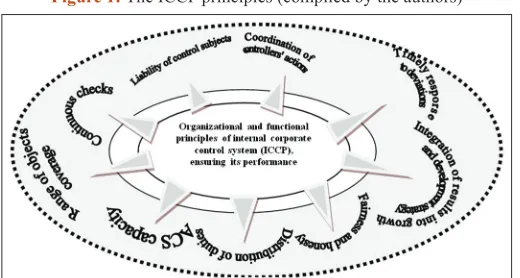
in addition to providing methodological uniformity, adequacy/ inadequacy of the control procedures with regard to the known ICCP principles. The aggregate of the following principles (Figure 1) is the basis of the functioning of ICCP; it can be called the key to its effectiveness. In compliance with these principles,
control procedures for cash flow for all types of ongoing projects
should be adjusted (technological, innovative, environmental, social, etc.). The availability of a methodologically sound system of principles is a documented part of information provision system for the control of project financing. In practice, the composition of such principles can be described in the annex to the accounting policies of the holding divisions. The authors
believe that the holding’s higher authorities should check the fact
of actual compliance of control procedures in the system of project
financing, carried out by controllers in divisional units, with the
ICCP principles.
For the business community, any management decision-making is associated primarily with answering the basic question - whether to expand the business or not, and if to expand, where to get
investments. In this case, we need a deep analysis of the resource potential of business owners at the moment and for the future. In such investment-oriented calculations, the future value of money is the only landmark in the making of a management decision. The indicator “future value of money” integrates many strategically
oriented parameters: It is the dynamics of the inflation index (both costs and demand), fluctuations in the price of such a specific
product as labor, the market value of knowledge and intelligence, and many others. Note that as long as the money will serve as a means of exchange and perform other important functions, the search of positive tools of ICCP for the formation of a new value (pricing on all kinds of reproduction factors: Equipment and amortization, stock, raw materials and price reduction, wages and bonuses. etc.).
When choosing the methods of cost accounting, costs classification,
documentation and control it is required to use the basics of the opportunity costs concept, referred to by scientists as the concept of the cost of missed opportunities. Its essence is that any decision
of a financial nature in most cases relates to the rejection of
some alternative, which could bring some income. This loss of income should be considered as possible when making investment decisions. For example, the formation and maintenance of the effectiveness of any control system is worth some money, i.e. there
is a cost, which, in principle, can be avoided. On the other hand,
the lack of continuous monitoring can lead to much greater losses
of economic benefits and financial risks. For good reason, in
large divisions of holdings type of business process management, internal control service should be always established, not to bring direct revenue, but to minimize direct and indirect losses from poor performance by various divisions of their duties to implement the
tasks of project works and full financial support.
From the standpoint of project financing system management, to ensure continuous cash flows for each of the implemented
projects is the basic task of ICCP as revenue, as particular stages
of project are closing, provides cash flows at subsequent stages. For these purposes, it is necessary to formalize the financial model
of the project manager, i.e., it is required to describe in detail
the distribution of cash flows between the holding divisions and
even their linear units, on the one hand, and between them and
the contractors of the external market, financial, tax, banking, insurance, pension systems. Recording and processing of financial,
production-related and other information for each investment
project is a presupposition of ICCP efficiency. Therefore, an important place in the financial model of any holding is given to the formalization of its payment system and the identification of
ICCP to sustain its balance.
Usually, the lack of full information and its transparency in relation to the project under control (control object) cannot allow to properly assess the abilities of controllers and, therefore, to build a system of motivation for their productive work. However, it should be stressed that the information transparency on the state
of the controlled project (object) and the related cash flow upon the checks are not identical with the planned finance (project costs).
Moreover, even the information on the actual state of controlled project (object) is not able to ensure the development and making
of decisions on the ultimate feasibility of the project. One reason for this is inflation and changes in the structure of suppliers,
engaged in delivery under the project, as well as changes in the
mission of the economic agent. On this basis, plan/fact analysis
should be updated with new information on the price dynamics, the situation of competitors, etc. at each closed stage of the project. Such information in large holdings is collected by specialized divisions of the bench marker.
The interrelations of all the controlled objects of project financing in holding type corporate entities form a single organizational and functional model, described, as a rule, not by special but general corporate mission of the holding. This
makes it difficult to conduct a full control of the contribution
of each structural unit of the holding in the implementation of modernization projects. It is required to do detailed missions of
each of the holding’s division involved in the project: Modeling
vertical/horizontal links, identifying functional responsibilities of line managers, setting responsibility for the control results
of the part of the project to be implemented by a division. On
the basis of the models, a summary model of organizational and
functional tool of projects management and financial coverage is
developed and embedded in the system of structural/functional,
production and social, financial, tax and other competencies of
the holding.
The challenges faced by ICCP practically do not differ depending on the scope and types of project, namely: To ensure the reliability and accuracy of information, protection of assets and
property; efficient use of all resources of the holding; ensuring
the compliance of operations with the accounting policies, procedures and regulations of the holding; methodological and legal, organizational and technical support to managers in the achievement of the mission (goals and objectives) of the holding.
Currently, the formulation and solution of the problems of ICCP
information support in the system of project financing face typical
problems of Russian economic entities:
• ‘Lack of transparency of cost accounting (charged at the end
of the reporting year to performance results and passed over
to the next reported year), which prevents the identification of
the real causes of instability and application of new economic technologies to optimize them;
• Still low level of professionalism of controllers of divisions
of the holding in order to adopt the latest IT to optimize costs
and maximize project profitability;
• Absence in many divisions of staff motivation systems to reduce costs and improve the performance of financial
and economic activities and liability of staff for the work performance. In this case, even any high-control procedures are not able to rectify the situation;
• Lack of high-tech communication systems, which is not
conducive to the rapid obtaining of factual information on the
results of the current financial, economic and administrative
activity of geographically remote divisions of the company. Here ICCP is also powerless;
• Undue level of financial discipline and the responsibility
of line managers, as evidenced by the lack of an internal document like “Procedure of Internal Corporate Control over the Results of Project Financing.” The use of outdated methods of the primary document turnover system, resulting in loss of the documents, delayed data input in the accounting records, distortion of accounting information. All this in general does not allow getting reliable information on the status of ongoing projects by the following parameters: Compliance/incompliance of planned and actual costs, resulting discrepancy between the expected and received
revenue (if the project is completed) and financial coverage by the stages of the projects. Failures of cash flows often occur due to missing internal reports in divisions on cash flows, the information which should be the first object of ICCP.
The complex object of ICCP is the information on the material flow
under the project in natural and monetary value. ICCP is inherent to all the stages of reproduction; it permeates all the elements of
project financing management system, ranging from organizational
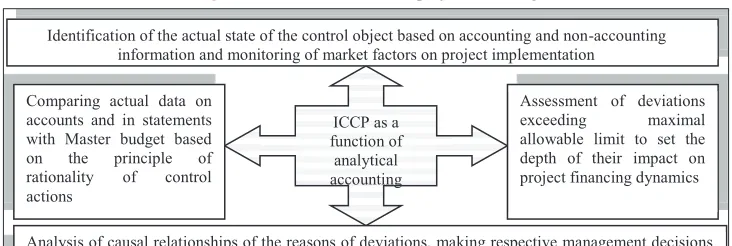
issues and ending with the analysis of indicators of reports and the adoption of respective management decisions on adjustment of value and property related elements of the new turnover of funds caused by the project stages. This is contributed by the implementation of ICCP potential as function of the accounting and analytical system (Figure 2), i.e., its methodology.
The control in project financing is needed for the implementation
of a coherent policy of the economic entity in respect of project financing (identification of sources, elements of accounting
policies for financial and tax purposes, formation of accounting
parameters of the project). An important property of this control is the complexity of its object - all directions (direct and reverse) of
cash flows and other values within the project. Therefore, at various
stages of project implementation, control methods must vary as the market factors change and regulations on accounting and other economic issues are adjusted. Control as a function of accounting and analytical system of economic entities is realized in practice by a set of interrelated activities through direct communication and feedback (Figure 2).
The formalized idea of the methodology of internal project-by-project control in Figure 2 gives the reason to clearly define its
purpose and methods to achieve it. The purpose of this control as an element of the accounting system is to ensure information transparency of information on the activities of the controlled
object in the context of the projects and their financial sources. It
allows developing and making positive decisions on the regulation of controlled environment (projects of economic entities). It should be emphasized that the data of the current statements, subject to
verification, as well as their analysis results, only partly form the
information base for adjustments of earlier decisions on project
financing. To make adjustments, the accounting information is
required, comparable for a number of years. This information will be compared with the management accounting and statements data. We emphasize that only the comprehensiveness of the information used by ICCP ensures the effectiveness of control procedures. It is understood that compilation of the entire array of data gives an idea
of the sustainable development of the holding’s economy or, on
the contrary, of the available instability problems and related risks.
In the economic space of the contemporary Russia, the influence
of uncertainties and risks enhances. This requires special attention
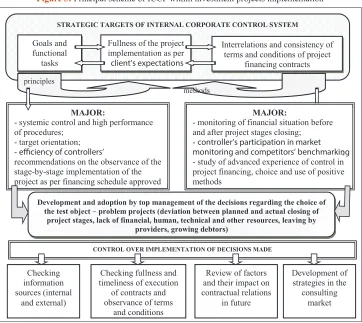
to such functional elements of the project financing management system as ICCP. Generally speaking, ICCP can be defined as a
target-oriented process of implementation of the strategic targets of the holding company and its structural units, in accordance with the methodological principles and effective methods (Figure 3).
Holding top management’s actions to assess this process are
multifaceted, including monitoring of the inspections by internal controllers of all the structures in the formation of business plans and budgets parameters, evaluation of the control results over the execution of schedules and development of motivational incentives
for more efficient internal control. Such an assessment requires, in
turn, an effective system of documenting and complex reporting
(a set of financial and non-financial indicators), separation of
powers and authorization of responsibility for the progress made during inspections.
3. DISCISSION OF RESULTS
The basis of any strategically focused business development plan
in the mode of project financing should be the relevant information
structured on the basis of “thingness.” This means that the contents of the information meet the needs of controllers, allowing them to
establish not only the fact of deviation from the plan of cash flows
under control, but also to identify the impact of economic factors,
of both external and internal economic environment on these
flows. Comprehensive actions by controllers just evidence their
new function - to justify the results of checks of the possibility/
impossibility to minimize the financial risks (breaks in projects financing), tax risks (changes in tax regimes), insurance risk
(increase of rates under insurance and reinsurance contracts).
In this case, the riskiness of the project financing strategies is “mitigated” by extended co-financing, that is, engagement in the
project of new investors (agents).
The agency concept (Krasnitskiy, 2008. p. 77) states that
“the activity of managers (agents) only then will focus on the
implementation of the main financial management objective, if it is additionally stimulated by their participation in the profit
and is effectively controlled by owners.” Such stimulation and monitoring costs are associated with additional resources, objectively determined by separation of ownership and investment projects management. Therefore, an additional object of
ICCP - agency costs, influencing the formation and allocation of resources (cost elements) by projects, making profit at the end
of project stages, dividend policy, and, consequently, the price
of company’s shares traded on the stock market. The conflicts of the financial interests of the agents and the lack of measures for their leveling, of course, turn to financial risks, and sometimes
loss of market niches.
As is known, operating risk and financial risk concept is determined
by the fact that any investor is always characterized by two main types of risk - operational (business and production-related) and
financial. The financial risk is associated with the capital structure
and should be taken into account when deciding on funding of the project. In a competitive market and under the instability of the
global economy, any business has an inherent specific feature - the lack of financial sources for the strategy, even growth strategy, not
the development (i.e., modernization of reproduction factors). In this case, the resource optimization target is enhanced, and so is the role of ICCP.
Own resources are always inadequate in comparison with a lot
of promising areas of project investment. In this regard, holding
structures, which entered into pools on project financing and
became legally independent market participants, periodically act as
borrowers, trying to get appropriate financial conditions to attract lenders’ funds on a long-term basis. This possibility of raising
funds is realizable only if the borrower is encumbered to serve
that financial source by way of interest in the long run. The main
requirement is that borrower provides regular payments regardless
of the sufficiency of profit from current operations for the regular
payment of money to creditors. Performing this task can also be seen as the emergence of a new ICCP function. In contrast to the owners of the economic entity responsible for the project, which can accept deferred payment of dividends if necessary, lenders do not accept delays; therefore, if the obligations to third-party
investors are not fulfilled, the latter may initiate bankruptcy
proceedings with some inevitable losses for owners and top
managers. This is the meaning of a financial risk. The purpose of
is directly related to the financial side of the holding’s activities, as the control system, by definition, it is not free from potential conflicts, and to overcome them owners have to bear so-called
agency costs. The existence of such costs is an objective factor, and their value should be taken into account in decision-making
in the management system of project financing, including both
own and borrowed resources.
In a competitive market and an unstable economic environment, according to the concept of agency relations, contradictions are inevitable between different groups of people interested in the implementation of projects under the terms of the collective
co-financing. Paradoxically, the most acute contradictions arise between
business owners and managers. The reason for contradictions is predetermined by the divergence of the perception of the values
of strategies (prospects) and business management tactics. On the
one hand, the choice of development strategy of any business is considered a key element in the exercising of ownership rights.
On the other hand, settling the issues of the current management
tasks and monitoring the status and changes in the resource base in the reporting period is considered as preferred by managers. If
a conflict of interest is not critical, it is a congruence of targets of all members of the project financing system. In a well-organized
and structured business, serious contradictions between targeting of the directorate, the owners and the managers usually do not occur. Therefore, the congruence of targets can be seen as an object of ICCP. We will consider this fact in more detail.
The provisions of the agency theory explain not only the essence of the above contradictions and their causes, but also disclose the
methods for their prevention and/or minimizing. One such a way is to identify at the pre-stage of control over financial coverage of projects, sufficient for the entire project period (lasting contracts).
Therefore, in the resolution of conflicts of agents extremely
high is the role of financial indicators and financial leverage, the
dynamics of which are continuously monitored by controllers under consulting agreements. It is believed to be one of the ways to manage congruence, often borrowed from the concept of traditional
external audit of financial and economic activities (provisions of the “Aсt on Audit”). The owners of the holding companies, hiring
auditors and based on their opinion, with reasonable certainty can
judge not only on the reliability of financial statements but whether
the ICCP specialists work effectively enough.
Studies show that the current state of ICCP is not adequate to new
economic and financial realities, in spite of permanent renewal of
its theoretical foundations (principles and concepts of practical
implementation) and applied methods used in the financial and
business practice. The update of the theoretical concept of ICCP involves the development of the principles of control activities consistent, on the one hand, with the accounting and economic analysis principles, and on the other hand, with the general principles of business process management. An important place in the development of the ICCP concept is taken by methodological tools that can have a positive regulatory effect on the results of the entire reproduction process of an economic agent and reveal the reserves of growth in order to achieve the strategic goals of development.
ICCP methods in commercial entities and methods of control in the state regulation system differ. However, as already stressed above,
control activities at all levels of governance and management are configured to meet the principles of the national financial control: Transparency, efficiency, resulting, etc. The particular results
of ICCP are evident from the budgets on the execution of the
holding’s mission, where plan/fact deviations are clearly visible for the projects financed. In addition, such information is contained in the financial statements and reports on the results of an in-depth analysis of the reported indicators. Despite the importance of
the information contained in the forms of the current budget and
financial statements, it is not enough to develop specific actions to eliminate the deviations from budget (planned) tasks identified
by analytical and control methods.
For the relevant information needed for management decisions to
rectify negative trends in project financing, accounting and control
system should be tuned for a particular project. This means that a set of targets for inspection and control to identify the causes and consequences of possible deviations from the originally adopted indicators for each of the projects should be approved in advance by the shareholders (owners). This is not only important, but necessary because, as practice shows, many of the projects are closed at the initial stage of implementation after lack of funding. This kind of strategy development allows shareholders to calculate their investment opportunities to receive dividends for consumption or re-investment in the ongoing project. Selecting
shareholders’ own investment behavior strategy plays a significant role in determining the financial strategy of the whole holding, as
the prevailing share of the capitalized dividend in the total dividend amount accrued to payment opens prospects for top managers to
finance existing and open new business projects.
To economically Feasibly determine the composition and structure
of the target business indicators under any financial or economic
projects, holding structures management must solve a whole range of important issues. First, identifying what is the state of the target market and what are the positions in it after successful implementation of prospect-related modernization projects.
Second, developing a management decision on the identification of financial sources to cover the project costs, while setting the ratio
of own, borrowed and raised funds. Third, predicting not only the
financial performance upon completion of all the project works,
but all of the obligations (credit, tax, payroll, etc.).
Configuration of accounting and control system of information management to ensure corporate business projects management goals characterized by the authors (forms of electronic documents,
their content, rules of filling and data output) easily integrates
with other management systems (e.g. Innovations) in a mode of
parallel automation. Here, the budget management system also fits (planning and financial analysis and other indicators), management
of relations with suppliers and project customers, governmental authorities, tax administrations, quality management system, tools of operational accounting and control.
Such configuration of the system is always preceded by large-scale preparatory work in respect of ICCP. Initially, the business processes of holding divisions are described by each of projects being implemented, their market and book value, the prospects for
completion as to the costs and effects are identified. These business
processes are called core and their composition varies by sectors and by type of projects: Technical, environmental innovation, etc.
Influences on the specifics of the projects under control is exerted
by so-called economy of scale, the larger the business, the more numerous the structure of the core business processes and the more carefully they should be selected and systemized for integration in the controlled environment.
To ensure the adequacy to the environmental conditions of the
choice of strategy and tactics of the project financing and its
implementation, control by the elements of the control system is also required: Planning, coordination, accounting, analysis, adjustment. Non-integration of control actions in the planning process could lead to errors in planning calculations that will be detected only at the stage of making statements and their subsequent audit. At the stages of organization and adjustment of the management decisions it is necessary to control the correctness of the implementation of planning decisions to achieve the necessary results. It is necessary to control the rationality of organization and adjustment of the decisions made.
Accounting data are the information database of control
procedures. On the other hand, the need to control the quality of
the accounting process is imperative. Accounting operations must be accompanied by control over:
1. Available property and its flows;
2. Efficient use of production resources in accordance with
approved norms, regulations and estimates; 3. State of liabilities assumed and due;
4. Feasibility and lawfulness of entity’s business operations, etc.
At the stage of the analysis, the information on the results of the implementation of management decisions on the basis of its division into different components for inter-correlation is assessed. Control and analysis are deeply integrated. Control data are often the basis for analysis. At the stage of analysis, the control functions are implemented as well, for example, control over the level of coverage of stocks and sources to form them. The methods of analysis applied at the stages of the implementation of control activities assess the degree of approximation of actual results to
the final performance of any management program, regardless of whether it is set out in general or specific terms. Quality control
of the analysis is a necessary step in the assessment of information on the implementation results of management decisions.
Thus, ICCP is, on the one hand, an integral part of every stage of the value creation process, and on the other hand, a separate stage, providing information transparency in order to identify
failures of the project financing control system. The control
coordination of individual control elements is achieved to solve any management problem or achieve a management goal. At vertical integration, the control function is implemented at different levels of management, but on the basis of the same information subject to aggregation (consolidation). Vertical integration is essential for the control of the parent unit (system) of management.
ICCP is implemented in the accounting and treasury, that is, in those structural units, which are directly related to the formation of statements, management of cash flows for each of the projects. Controlled business processes for projects, as a rule, are determined by experts. To do it, a special committee of leading experts of the company is formed, expressing opinions by scores
(from 1 to 10), to be summarized; the results are considered by the company’s management, in the absence of discrepancies the
structure of selected business processes is approved to be further controlled.
Further, the identification and classification of risks occurs,
finalized by working out the documents to implement ICCP procedures. The final stage of ICCP is to develop the guidelines to
testing and evaluation of the control procedures applied, when the whole system will be integrated into the operational process of the company. The main method of this test is considered ICCP quality testing. In our opinion, it is required not to be limited to testing only, because the answers to test questions are always very biased and do not give a complete picture of the quality of the control units of the internal control system (i.e., compliance of check results with the projected parameters). When the documentation on ICCP is approved, a calendar schedule of work is made out and a working group to create the control methods is formed. It is appropriate to include an internal auditor and an expert on the
analysis and identification of risks as well as to involve as experts
the leaders of the functional units, for which the control procedures are to be created.
The control functions should be distributed in an expedient way, and the applied methods must ensure the maximal effect of each control actions. To all ICCP applies the requirement of continuous development and improvement of its forms, methods
and performance evaluation. Over time, even the most advanced
management techniques become obsolete. ICCP should be built so
that it could be flexibly customized to the new challenges arising
from changes in the internal and external operational conditions and could enable expansion and modernization opportunities.
Like in the accounting methodology, in the internal control the
priority requirement should be observed in the course of control
over the compliance with the mode adopted for project financing.
Absolute control over common minor operations (for example, small costs) does not make sense and only takes up the resources from doing more important tasks. But if the top management believes that the company has any area of strategic importance, control is to be established in each such area, even if this area is
difficult to measure on cost-effectiveness basis. Control should
be organized rationally, i.e., excluding unnecessary steps/stages/ procedures in exercising control, as it involves additional costs of labor and resources.
For effective control, it is important to comply with the requirement of optimal centralization (or the adequacy of the organizational
structure). Dynamism, stability, and continuity of ICCP operation
is determined by the unity of ICCP and the optimal level of centralization of its organizational structure (the right to initial management impulse). The organizational structure of ICCP must
conform to the scale of business, but not to be cumbersome. Of
course, each type of organizational structure has its drawbacks,
for example, the slow flow of information and decision-making
in a line and staff structure or divergence of top and bottom interests in a multilevel hierarchy of a divisional structure. It is necessary to assess the strengths and weaknesses of each variant of organizational structure before transforming ICCP or improving its individual elements. Single liability requirement is important because each separate control function should be securing only at one center of responsibility. To avoid irresponsibility, securing a separate function at two or more centers of responsibility is not permissible. However, consolidation of several control functions at one center of responsibility is quite acceptable. For example, a separate control function of the chief accountant is the control over ongoing business operations for compliance with the regulations. He/she should also be responsible for non-advising the management of any violations. Control function of the internal auditor in this case is inspection of the quality of exercising his/ her control function by the accountant. The auditor assesses the legality of operations recorded, but he/she is liable for a failure to detect any negative transactions recorded by the accountant. This requirement does not apply to situations where a decision is taken collectively (e.g., adoption of sales policy decisions) in order to avoid errors and/or abuse of authority by individual
officials (responsibility centers). Temporary absence of individual
subjects of internal control should not interrupt the control procedures, so it is necessary to comply with the requirement of the potential functional replacement. To do this, each employee (a subject of internal controls) should be able to perform the control operations at the upper and lower levels and those of his/ her one or two colleagues in order to avoid any loss of adequate communication with the object of control within the time of their absence. This requirement also applies to all responsibility centers. The effectiveness of the internal control system is directly related
to how much the entity’s control activities are subject to the rules.
As far as those activities are subject to clear rules, one can expect
it to succeed. Of course, everything cannot be foreseen, decisions
have to be made under the conditions of uncertainty, but - where possible - it is imperative to formally establish the rules governing the procedures. Control should be based on a clear cooperation of all corporate departments and services. A clear coordination of their efforts is needed for solving the control tasks. The set of
the above principles and requirements is the basis for the efficient operation of the internal control system (Perovskiy, 2011).
The development and documentation of a new (corresponding to the changed economic conditions) business concept of the holding (the legal status of its units, mission, strategic-oriented goals,
resources and opportunities, region’s competitive advantages,
provisions on financial, production and technology, innovation,
logistics, sales, investment, accounting, and HR operation. These provisions should be developed based on a thorough analysis (with necessary calculations) of each element of the policy and selection out of available alternatives the most appropriate for the company.
Documentation of the company’s policy in various areas of its financial and economic operation allows deeper control over the
operation of all business processes.
To analyze the effectiveness of the current management structure and its adjustments, the provision on the organizational structure must be developed in which all organizational structures (business units or business processes) should be described including administrative, functional, methodical subordination, areas of activity, functions performed, regulation of their mutual relations, rights and responsibilities, resources distribution. The same applies to the provisions of various structural units (departments, bureaus and other groups), their work organization plans. It is required to develop (to specify) a plan of documentation and document
flow, staffing, job descriptions specifying the rights, duties and
responsibilities of each structural unit. Without such a rigorous approach, it is impossible to carry out good coordination of
functioning of all ICCP parts. Developing formalized standard control procedures may apply to specific financial transactions,
or general, so-called project businesses. In any case, the impact of ICCP can be higher if the relations of professionals
responsible for control over the entire financial activities and resource management in project financing and for the accuracy
of the information required for management decisions making in respect of each project are ordered. By ordering, we understand the availability in the holding of job descriptions for controllers and other groups of managers.
The value of ICCP performance indicator (cumulative result of individual procedures, for example, saving opportunities found, or, conversely, inappropriate funding), obtained on the basis of expert assessments and simple calculations, must be higher than the value on the ICCP maintenance costs. To summarize, we should say that effectively organized ICCP (i.e. corresponding to the methodological principles and the interests of shareholders) will:
• Ensure effective functioning, stability and maximum (according to the established goals) holding’s development
in a competitive environment;
• Save and effectively use the resource potential of the holding
company and its divisions;
• Promptly identify and minimize the commercial, financial
and internal corporate risks in the management of business processes;
• Create in compliance with the contemporary permanently
changing business environment the system of information support for all levels of management that allows adapting the operation of the company in a timely manner to changes in the internal and external environment.
In this regard, of particular relevance is the task to develop typical programs to improve ICCP of the entire holding and its structural divisions. In large holdings, it is advisable to structure control units
as well by individual profit-making business processes. Programs
are recommended to be developed taking into account production and technological conditions; one of the most important conditions is resource coverage of lasting projects, determined based on the
financial capacity of entities participating in project financing. Costs on ICCP differ in all project financing parties, so before
inspecting the implementation of project stages it is necessary to
calculate its resource-intensiveness. Often, the costs on inspection
are not worth their results. The most effective is so-called signal control, but inspection is expected upon radical changes in the
system of project financing, in the regulations. Practice has shown that economic agents often lose significant amounts of tax and financial risks, caused often by delayed changes in calculations
of tax, credit, social, insurance and other liabilities using outdated guidelines/methods and included in the statements upon the closing of projects or stages.
Recently, for the purpose of business performance enhancement, the corporate structures of holding type have become subject to
stricter disclosure requirements on non-financial information
(social, environmental indicators). For the Russian accounting practices, increased reporting requirements in accordance with
the Concept of GRI (The Global Reporting Initiative) (Guideline on the Reports in Sustainable Development, n. d.) are relatively new. In accordance with Rn Accounting Provisions 4/99, financial statements should give a true and complete view of the financial standing, financial results of operations and changes in financial standing. If in the preparation of financial statements a company it is identified that the data are insufficient to form a complete view of the financial standing, financial results of operations and changes in financial standing, appropriate additional indicators and explanations should be included in financial statements. Collection
and processing of information on costs on social/environmental programs and investment projects, recording such information in notes to the statements formed a new layer of indicators, which
are to be monitored and verified by internal control specialists.
In large companies of the natural resources sector, organized
in holdings, several reports are formed in accordance with GRI
(containing economic, environmental and social information). Each such report shall be monitored for not only compliance with the required standards of its performance, but also for mutual relationships between these reports. The issue in the economic literature is not enough highlighted.
The transparency of the information on the impact of the performance of a particular entity on the stability of the sectoral, regional and national economy is of interest to a wide range of stakeholders, including governmental structures of economic governance, shareholders, investors, regulatory bodies and others.
For this reason, GRI concept is based on a broad network of expert
organizations which, in the course of consulting, get managers
oriented at a consensus of financial interests. These consultations,
together with practical experience, have consistently improved
4. CONCLUSION
The study revealed that one of the positive factors of innovation activity of economic entities is to provide potential investors with
all the information on the realized projects with high efficiency (profitability of projects exceeding their financial capacity). As
part of such information to potential investors, a separate section should cover the results of internal corporate control, in particular,
the identified violations of project financing, and measures to
eliminate them.
However, the authors concluded on the influence of internal
corporate control on the performance of the project financing system. For the most part, these methods apply to all “sites” of financial and
economic activity of economic entities. Special methods for internal corporate control over the development and implementation of
innovative projects are specified neither in the controlling practice
nor in the current regulations. This situation reduces the ability to accurately calculate the cost parameters of control projects results by stages as they are completed. In order to identify the real effect of applying internal corporate control methods, conceptual offers are made on the development of the document “Procedure of Internal Corporate Control over the Results of Project Financing.”
REFERENCES
Bannikov, A.Y., Tomilina, N.S. (2016), Mezhdunarodnyy opyt proektnogo finansirovaniya [International experience in project financing].
Teoriya i Praktika Sovremennoy Nauki, 1(7), 23-26.
De Foville, A. (1987), La France Economique. Paris: Guillaumin. Ernst Gekkel [Ernst Haeckle]. (n.d.). Available from: http://www.vkyrse.
com/person/2282. [Last retrieved on 2016 Jan 21].
Eurostat. (2000), Classification of Environmental Protection Activities.
Available from: http://www.europa.eu.int/comm/eurostat/ramon.
[Last retrieved on 2016 Dec 09].
Hanush, H., Pyka, A., editors. (2004). Elgar Companion to
Neo-Schumpeterian Economics. Cheltenham: Edward Elgar.
Jovellanos, S.D. (1998), An antecedent to modern human capital theory. History of Political Economy, 20(2), 194-199.
Kakurin, A.T., Zimin, S.R. (2011), Kontseptual’nyy ekonomicheskiy mir nauchnykh issledovaniy [Conceptual Economic World of Scientific Research]. Georgia: In: SPbGU: Sbornik Nauchnykh Trudov [SPSU: Collection of Scientific Works]. p34.
Kiryanov, Y.O. (2016), Problemy i tendentsii ispol’zovaniya finansovykh instrumentov dlya finansirovaniya dolgosrochnoy investitsionnoy deyatel’nosti rossiyskikh predpriyatiy [Problems and trends of using financial instruments to finance long-term investment activity of Russian companies]. Fundamental’nye Issledovaniya, 5-1, 142-147. Krasnitskiy, T.A., editor. (2008), Teoriya Agentskikh Otnosheniy [Agency
Theory]. Tomsk: TSU.
Kulloch, J.R. (1930), The Principles of Political Economy. London:
Printed for William Tait.
Kuznetsov, S.V. (2016), Pravovye formy uchastiya institutov razvitiya v organizatsii proektnogo finansirovaniya v Rossii [Legal forms of participation of development institutions in project financing in Russia]. Law and Economics, 2(336), 16-21.
Mamedov, F.N., Sazonov, S.P. (2015), Metody upravleniya investitsionnymi riskami pri proektnom finansirovanii [Methods to control investment risks in project financing]. Upravlenie Biznes Vlast, 4(9), 103-108. Musayev, A.A. (2016), Perspektivy razvitiya proektnogo finansirovaniya
v Rossii [Prospects of development of project financing in Russia]. Sovremennye Nauchnye Issledovaniya i Innovatsii, 2(58), 290-294. Perovskiy, R.B. (2011), Problemy Avtomatizatsii Kontrolnykh Protsessov
v Kompaniyakh [Problems of Automation of Control Processes in Companies]. Saint Petersburg: Piter.
Rukovodstvo po Otchetnosti v Oblasti Ustoychivogo Razvitiya [Guideline on the Reports in Sustainable Development]. (n.d.). Available from: http://www.media.rspp.ru/document/1.pdf. [Last retrieved on 2016 Dec 09].
The United States Environmental Protection Agency. (1995). Available
from: https://www3.epa.gov. [Last retrieved on 2016 Jan 21].
United Nations Economic Commission for Europe. (1994), Single
European Standard Classification of Environmental Protection