Technologies for the functionalization of textile mats with
nanoparticles
Emilia VISILEANU*, Alexandra ENE, Razvan SCARLAT, Laura CHIRAC, Cornelia MITRAN
The National Research and Development Institute for Textiles and Leather, Bucharest, RomaniaPreliminary communication UDC 687.027.6
DOI: 10.31881/TLR.2019.25
Received 28 December 2018; Accepted 15 February 2019; Published Online 29 February 2019
ABSTRACT
Nanotechnology is the science of materials with extremely small dimensions (one nanometer is one billionth meter), but it is a major developing industry with an estimated annual market of about one trillion US dollars by 2017[1]. Nanoparticles are used or evaluated for use in many areas, which is currently demonstrated on the market for over 1,000 nano-products. The impact of nanotechnology extends from its medical, ethical, mental, legal and environmental applications to areas such as engineering, biology, chemistry, computer science, materials science and communications [2-3]. Potential risks include environmental, health and safety issues; transient effects, such as the reallocation of traditional industries as nanotechnology products, are becoming dominant and are a cause for concern for privacy lawyers [4-5].
Textile of 100% cotton, 55% polyester / 45% cotton and 100% polyester, white and dyed, were functionalized by spraying technology on a test device made at UT Dresden after oleofobization with Rucostar EEF6 or Nuva N 2114 and impregnation by applying oleophobic treatment simultaneously with the functionalization with Ag NP. Analysis of the size and form of Ag NP was achieved by using SEM electronic microscopy, TEM and dynamic light scattering (DLS) transmission microscopy. The uniformity, dispersion and migration of Ag NP from the surface of the textile materials for the initial samples compared with those tested for acid / alkaline perspiration, washing and wear (rubbing) revealed by AAS determinations that the acidic sweat test is the most aggressive leading to decreases in the amount of Ag NP of approx. 25% versus untreated sample.The amount of Ag NP deposited on the textile by the two technologies did not differ significantly. Compared to untreated knits with treated ones the size of the agglomerations does not change significantly; from the point of view of the uniform distribution of Ag NP on the surface of the knits after the acid / alkaline sweat tests, the best values (agglomeration distances) are highlighted in the case of 100% polyester knitted.
KEYWORDS
Textile, spraying, nanoparticles, functionalization, migration
INTRODUCTION
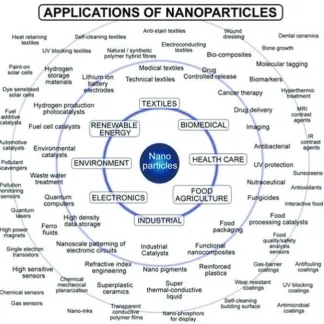
reactive to other molecules [3]. Nanoparticles are used or evaluated for use in many areas, which is currently demonstrated on the market with over 1,000 Nano-products. Today nanoparticles are used in medicine, electronics, environmental protection, food, solar cells, batteries, space (lighter spacecraft and cables for space elevators), artificial intelligence etc. (figure 1).
Figure 1. Application of nanoparticles
dominant and are a cause for concern for privacy lawyers [4-5]. These can be very important if the poten-tial negative effects of nanoparticles are neglected.
EXPERIMENTAL
Materials and methods
Knitted structures from yarns with following composition: 100% cotton, 55% polyester / 45% cotton and 100% polyester with interlock and pique structures with values of linear coverage factors between 21,22 (100% cotton) and 35,0 (100% polyester) and values of superficial coverage factors between 0,87 (45% cotton / 55% polyester) and 5,6 (100% polyester) were knitted on a Shima Seiki SIG 123 knitting machine of 12 gauge. The technological flow of finishing process for white knitted fabrics included the following phases: alkaline boiling, bleaching, softening and for dyed fabrics included: alkaline boiling, bleaching, dyeing, softening, and drying (figure 2). The physic-mechanical characteristics of knitted structures have showed: mass: 115,3 – 297,3 g/m2, thickness: 0,53 – 0,83 mm, water vapor permeability: 32,9 – 39,0% and air permeability: 1673,0 – 477,1 l/m2/s.
The Ag NP nanoparticle batch used in experiments is part of the NM-series materials intended only for testing as part of the research activity and is also included in the OECD WPMN International Test Program (OECD Paris 2009-ENV-JM-MONO-2009-20 ENG Manual). The analysis certificate no. 576832 of Ag NP shows that they are in the form of a powder with dimension under 100 nm, containing PVP (polyvinylpyrrolidone) as dispersant and 99.5% metal. The SEM analyzes of Ag NP (figure 3) were performed with the FEI-QUANTA 200 electronic microscope and showed their spherical and polyhedral form.
Analyses of NP sizes (43.2 nm, 22 nm, 10.4 nm, 14.7 nm, 28.1 nm, 35.6 nm, 138 nm, 34.3 nm, 27.3 nm) were performed and obtained an average diameter of 54.6 nm, which falls within the Ag NP class <100 nm. The transmission electron microscopy images were obtained using a Titan Themis 200-80-200 kV Scanning Transmission Electron.
Figure 2. Technological process
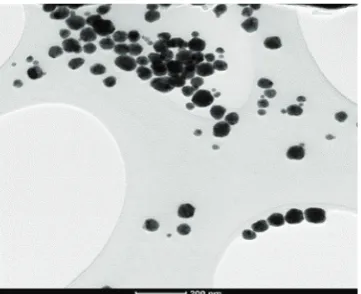
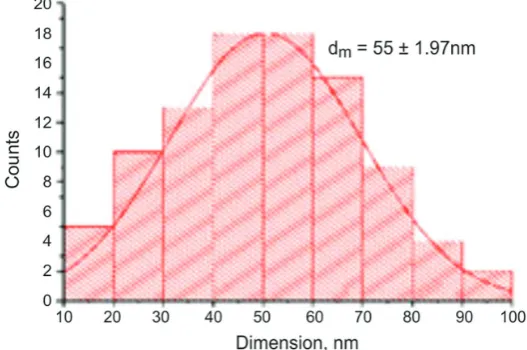
The TEM images in bright-field obtained on the Ag sample shown in figure 4 pointing out that the sample is composed from spherical and polyhedral particles with an average particle size of 57.55 ± 1.97 nm at the same level as SEM analyses (54.6 nm). Figure 5 shows the distribution diagram of the Ag NP dimension, pointing out that their size is evenly distributed.
Figure 5. Dispersion diagram for Ag NP
Figure 6(a). HR-TEM Figure 6(b). SAED image
The figure 6 presents: a) HR-TEM image and b) Electron diffraction on selected area – SAED, obtained on the Ag NP sample. The regular sequence of the crystalline planes indicates that the Nano crystallites are uniform in term of crystallinity, without amorphous phase and the only formed phase is of Ag.
The pre-prepared 100% cotton knitted fabrics were functionalized by:
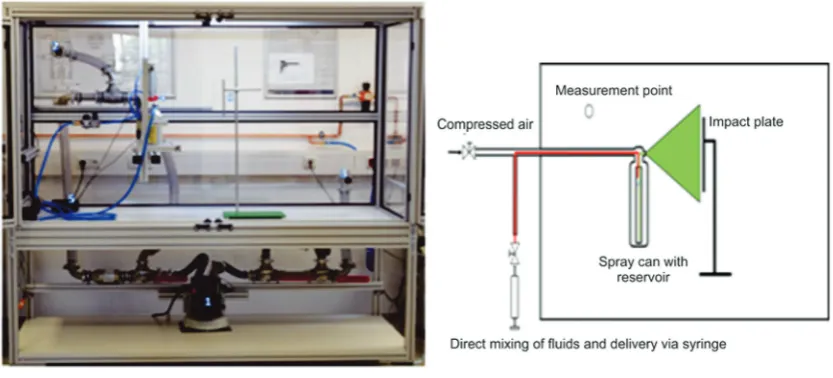
system(2), exit from the ventilation system (3), spraying and activator (4), tube refill system with spraying formulation and re-pressurization of the spraying tank without opening the spraying room (5), plate where the textile samples can be placed (6).
The room is equipped with an advanced ALI-VITROCELL-Cloud-System for in vitro exposure. Spraying of various Ag NP dispersions was done with 5 second spraying pulses. 5 and 10 minute test intervals were used between the spraying pulses and the totally different number of spraying pulses. Because the refilling and the re-pressurizing of the spraying tank was a manual process, the ranges vary and sometimes a spraying pulse has been omitted. For functionalization, Ag dispersions with UPW and various chemical auxiliaries: ethylene glycol, MEK (Methyl Ethyl Ketone), HCL, triethylamine, silanes were used. To obtain 2 liters of dispersion (2), 742 g of UPW (MilliPure) and 1026 g of ethanol (w> 99.9%) were mixed in a 2 liter glass flask; 14.40 g of 2-butanone (MEK, w = 99.5%), 10.80 g of HCl (w = 37%) and 7.20 g of triethanolamine (w = 100%), followed by sonication, 30 min.
• The padding technology included oleophobization treatments with Nuva N2114 and Rucostar EEE 6 and Ag NP in the same phase of the process, followed by wringing and drying/ condensation. The treatment formulations included: 70 g/l Nuva N2114 / Rucostar EEE6, 20 ml/l dispersion 5% Ag NP in ethylene glycol / water dispersion, 0.5 ml/l 60% acetic acid (1 ml/ for 100% polyester), 80% uptake level, drying at 110°C, condensation at 140°C for 2 min. For functionalization, dispersions of Ag with UPW and solvents obtained in the same way as in spraying technology were used.
RESULTS AND DISCUSSION
The concentration evaluation of Ag NP in aerosols was performed by using the Power Spectral Density (figure 8). It showed that: HCl and TEA dispersions generate higher concentrations of NP and peaks in PSD (Position Sensitive Detector) the results obtained with the formula: EtOH + MilliQ + HCL are similar to the formula UPW; peaks and suspension concentrations are influenced by the size of the NP; the humidity in the test room influences the monitored indicators.
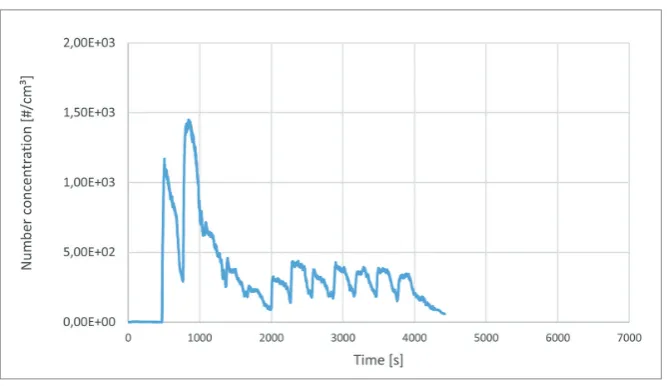
The CPC (Compass-Parabolic-Concentrator) measurements performed during the spraying experiments, in which the spraying ranges were different, revealed that the NP dispersion formulation has a large impact on the number of aerosol particles (figure 9). In particular, the UPW formulation has resulted in aerosols with a very low NP. This is most likely related to the spraying process and the influence of the compounds and additives on droplet formation. Differences between MEK and HCL formulations are much lower, and although particle numbers were lower for HCL formulation, these differences could also come from daily variations or from disassembly-reassembly processes.
Figure 8. PSD spectrogram and diagram
Figure 9. CPC spectrogram
Formulation 1, 12 spray pulses, 5 min intervals
Spraying technology
The treatment of 100% cotton knitted fabric with Ag NP and UPW dispersion and Nuva N 2114 oleophobi-zation agent produces the highest amount of Ag NP deposited on the knitted surface (95.7 μg/kg) followed by the solution consisting of: Ag NP dispersion with solvent and oleophobization agent Rucostar EEE 6 (73.8 μg/kg), Ag NP dispersion with UPW and oleophobization agent Rucostar EEE 6 (66.8 μg/kg) and dispersion of Ag NP with solvent and Nuva N 2114 oleophobization agent (66.6 μg/kg).
The resistance test to acid/ alkaline perspiration was performed at 30, 60 and 90 min and the wash test at 400°C and the results showed that:
a) Nuva N 2114 oleophobization agent
• The washing test of knitted fabric treated with Ag NP solution in UPW or solvent and oleophobization agent Nuva N 2114 is the most aggressive, causing a decrease of about 30% and about 5% of the Ag NP amount on the surface of the fabric;
• The resistance test to acid perspiration determines, in the case of Ag dispersion with UPW, a decrease in the amount of Ag NP of about 23%.;
• The comparison between dispersions, namely Ag with UPW and respectively Ag with solvent, reveals a better resistance in the case of fabrics treated with solution of: Ag in solvent and Nuva N2114 oleophobization agent.
b) Rucostar EEE6 oleophobization agent
• The washing of knitted fabric treated with Ag NP solution in the solvent and an oleophobization agent Rukostar EEE 6 is the most aggressive one causing a decrease of approx. 12% of the amount of Ag NP on the knitted surface;
• The comparison between dispersions, namely Ag with UPW and respectively Ag with solvent, reveals a better resistance in the case of the fabrics treated with solution of: Ag in UPW and Nuva N2114 oleophobization agent.
The comparative analysis of Ag NP solutions with UPW or solvent dispersions and Nuva N2114 oleoforbising agents with Rucostar EEE 6 shows a better resistance to acid/ alkaline perspiration and washing tests using Rucostar EEE6 oleophobization agent.
Impregnation (padding) technology
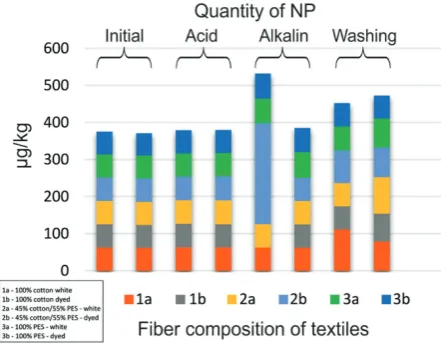
The analysis of the evolution of the quantity of Ag deposited on the surface of the knits by the technology of padding highlights the following aspects, differentiated by the type of oleophobic agent and Ag NP disper-sion (figure 10):
• The highest amount of Ag NP is recorded on 100% cotton knits, dyed and white treated with solu-tion of: Ag dispersion with UPW and Rucostar EEE 6 (82.3 μg/kg and 81.2 μg/kg), followed by: 100% cotton, white and dyed, treated with solution of: Ag NP and UPW and Nuva N2114 oleophobization agent (79.3 μg/kg and 78.2 μg/kg;
The resistance tests of the knits treated with the oleofobic agents Nuva N2114 and Rucostar EEE 6 were performed accordingly with SR EN ISO105-E04 / 2013 at 30, 60, 90 min;
The evolution of Ag NP on 100% cotton, white and dyed fabric, 45% cotton / 55% polyester, white and dyed and 100% polyester, white and dyed, treated with solutions of Ag NP dispersions in UPW and solvent and NUVA N2114 or Rucostar EEE6 oleofobic agent, highlights the following aspects (figure 11a and 11b):
Figure 10. Evolution of Ag NP
Figure 11. Evolution of Ag NP quantity a) Nuva 2114
The most aggressive test in terms of decreasing the amount of Ag NP on the surface of the knits is the acidic sweat test, both for knits treated with solutions of: Ag NP in UPW or solvent and oleophobic agent Nuva N 2114
In the case of the solution of: Ag NP and UPW dispersion, and the Rucostar EEE6 for the treatment of 100% cotton, white and dyed knits, alkaline and acid sweating, determines a decrease in the amount of Ag NP on the textile surface by 25% (acid);
Acid / alkaline sweat tests for 45% cotton / 55% polyester and 100% polyester, white and dyed treated with solutions of Ag NP dispersions with UPW or solvent and Rucostar EEE 6 are not so aggressive, in the sense that the decrease in the amount of Ag NP on the surface of the knits is not significant.
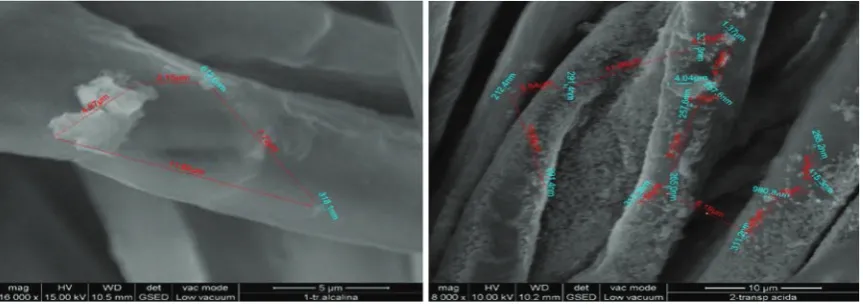
SEM images of 100% cotton, white and dyed, 45% cotton / 55% PES. white and painted and 100% PES treated with solution of: Ag NP dispersion in UPW and Nuva N2114 oleophobic agent were performed after acid / alkaline sweating tests and determinations of the size of agglomerations and distances between them were performed (figure 12).
Figure 12. SEM images
Figure 13 shows the evolution of the Ag NP dimensions on the surface of the untreated knits and after the acid / alkaline sweat tests.
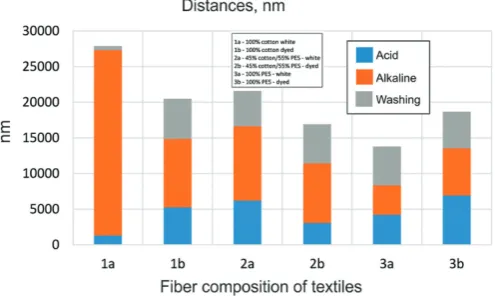
Compared to untreated knits in 100% cotton knits, the size of the agglomerations does not change signifi-cantly except for the white knit variant tested on alkaline sweat at which the initial level is 506.8 nm and the 2182 nm, respectively. In knits of 45% cotton / 55% PES, the white variants and the painted on alkaline perspiration show values below the baseline (326.3 and 506 nm co-ordinate with 2476 and 1374 nm). For 100% knits, the variations in the sizes initial to those tested for acid / alkaline perspiration, are not conclusive. Figure 14 shows the distances evolution of Ag NP agglomerations on the surface of untreated knits and after acid / alkaline sweat tests. From the point of view of the uniform distribution of Ag NP on the surface of the knits after the acid / alkaline sweat tests, the best values (agglomeration distances) are highlighted in the case of 100% polyester knitted, being at the same level as untreated knits (4217 -6919 nm and 4118-6630 nm respectively).
Figure 14. Distances evolution
For knitted fabrics of: 45% cotton / 55% polyester the difference between the knits tested and the original knits is not significant because the distribution uniformity of Ag NP is at the same level. In 100% cotton, white and dyed, tested for alkaline perspiration, the NP distance is over 25984nm (low density) and 9614nm respectively, and in the variants tested for acidic perspiration, the NP density remains at the same level as the original knits (596,5-5625nm versus 1310-5224 nm).
CONCLUSION
• Ag Nanoparticles in dispersions with various auxiliary chemicals were used for treating knits by spray and impregnation technology; oleophobization treatment with two compounds was provide in the same or different phase.
• TEM images in the light field obtained on Ag NP revealed that they are spherical and polyhedral, with a mean particle size of 50.55 nm ± 1.97 nm and a very uniform dispersion; the HR-TEM image high-lighted the crystalline planes with an interplanar spacing of 2.3 Å corresponding to the Ag NP families of crystalline planes (1 1 1); SEM images showed an average size of Ag NP of 54.6 nm at the same level as determined by TEM analysis.
• The CPC (Compass-Parabolic-Concentrator) measurements conducted in spraying experiments during which the spraying ranges were different have shown that the NP dispersion recipe itself has a large impact on the number of aerosol particles.
• Knits from 100% cotton treated by spraying technology with a solution: Ag NP and UPW dispersion and Nuva N 2114 oleophobic agent have the highest amount of Ag NP deposited on the surface (95.7 μg/ kg) compared to other solutions.
• Comparative analysis of Ag NP solutions with dispersions in UPW or solvent and oleophobic agents Nuva N2114 or Rucostar EEE 6 highlights a better resistance to acid / alkali sweating tests and scrub-bing when using the Rucostar EEE6.
• Compared to untreated knits with treated ones the conclusion is that the size of the agglomerations does not change significantly; from the point of view of the uniform distribution of Ag NP on the surface of the knits after the acid / alkaline sweat tests, the best values (agglomeration distances) are highlighted in the case of 100% polyester knitted, being at the same level as untreated knits (4217 -6919 nm and 4118-6630 nm respectively).
REFERENCES
[1] Ferreira AJ, Cemlyn-Jones J, Robalo Cordeiro C. Nanoparticles, nanotechnology and pulmonary nanotoxicology. Revista Portuguesa de Pneumologia. 2013 19(1):28-37.
[2] Levard C, Matt Hotze E, V Lowry G, E Brown G. Environmental Transformations of Silver Nanoparticles: Impact on Stability and Toxicity. Environmental Science & Technology. 2012 46(13):6900−6914. Available from: https://pubs.acs.org/doi/abs/10.1021/es2037405 doi: 10.1021/es2037405
[3] van Broekhuizen P, van Broekhuizen F, Cornelissen R, Reijnders L. Use of nanomaterials in the European construction industry and some occupational health aspects thereof. Journal of Nanoparticle Research. 2011 13(2):447-462.
[4] Nilsson N. Artificial Intelligence: A New Synthesis. San Francisco: Morgan Kaufmann, 1998.