An Extended Mathematical Programming Model to Optimize the
Cable Trench Route of Power Transmission in a Metro Depot
Amin Jamili1, Farshad Ramezankhani 2
Received: 23.01.2015 Accepted: 09.01.2016
Abstract
The necessary electricity of the workshops and buildings (W&Bs) located at the metro depot are provided by lighting power substation (LPS). To transmit electricity between LPS and W&Bs, some trenches should be dig and the requisite cables should be located in the trenches. This paper presents a new mixed integer linear programming (MILP) long-term decision model to find the best cable trench route between LPS and W&Bs and also the location of all W&Bs and LPS are fixed. In this problem, the objective is to minimize (1) used cables cost, and (2) trench digging cost. It should be considered that there exist many cases in which the minimum either used cables or trench digging does not result in minimum total cost. Therefore, in optimum solution, a tradeoff between these objectives should be achieved. Finally, the proposed model is applied to a real case study at the metro depot in Iran and the optimum solution is analyzed.
Keywords: Cable trench problem, lighting power substation, metro depot, optimization
Corresponding author E-mail: [email protected]
1. Assistant Professor, School of Industrial Engineering, University of Tehran, Tehran, Iran 2. MSc. Student, School of Industrial Engineering, University of Tehran, Tehran, Iran
1.
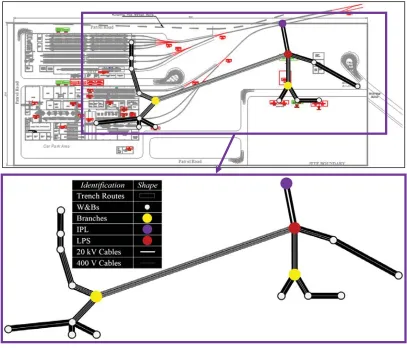
IntroductionAn LPS is a part of an electrical transmission system on a metro depot which transforms the electricity from high voltage to low voltage (20 kV to 400 V). The electricity enters from the related route cable loop and supplies the required electricity of the W&Bs located at the metro depot. In this system, there are two different cabling routes (1) between input power location (IPL) and LPS, and (2) between LPS and W&Bs. The outline of this system and the cabling routes are shown in Figure1. In fact, in the case that the total number of W&Bs and LPS is N, there exist one cable from IPL to LPS and N-1 cables which leave the LPS toward W&Bs. It is necessary to mention that, each W&Bs requires one cable which comes from LPS. Power transmission to depot requires two main activities including cabling and trench digging. Both cabling and trench digging impose substantial costs to the system. It should be noted that the trenches can be used for one or more than one cable. So, it is rational to find the best route for trench digging and cabling to use the trenches for more than one cable simultaneously.
Cable trench problem (CTP) is to find the best routes for trenching and cabling whit respect to the per unit cable cost (cc) and the per unit trench cost
(tc). An application of this problem is to determine the connections between W&Bs and IPL with the LPS at a metro depot. The cc and the tc as two important influencing parameters are specific. It is assumed that at the first stage the location of IPL, LPS and W&Bs are fixed disregarding the possible effects on the cable trenching costs. In the second stage and by considering the outputs of the first stage as the input data of the second stage, the cable trenching is optimized by the proposed model in this paper. Therefore, according to the fixed location of the IPL, LPS and W&Bs, all distances between (1) IPL and LPS, (2) LPS and W&Bs, and (3) W&Bs with each other are determined.With respect to these input parameters, the best cable trench route is achieved by the proposed mathematical programming model presented in section 3. In this paper, it is assumed that the voltage drop on AC network is computed after finding the optimum trench cabling routes. In the case that the voltage drop is more than permissible levels, the size of the cables are increased. Similarly, the headway affects the size of the cables as well. In other words as the headway reduces the size of cables will be increased.
2.
Literature ReviewThe CTP is considered as a combination of the shortest path (SP) and the minimum spanning tree (MST) problems. Also, both the SP and the MST problems are encompassed some subjects such as operational research and mathematical programming, integer programming, MILP, discrete mathematics, graph theory, combinatorial optimization and analysis of algorithms [Vasko et al, 2002][Jen g, Kim, and Watada, 2006]. MSTs have long been used in pattern recognition, machine learning and data mining [Zhong et al, 2015].
In this sake, Ralphs and Hartman [Ralphs and Hartman, 2001] presented several alternative integer programming formulation of the capacitated node routing problem. Capacitated node routing problem describes a branch, cut, and price algorithm for the solution of a class of network design problems with routing and packing constraints that can be shown to generalize a number of other important combinatorial models, including the vehicle routing problem (VRP), the capacitated spanning tree problem (CSTP), and the CTP. Marianov et al [Marianov et al, 2012] formulated an integer programming model of the p-cable-trench problem using multi-commodity flows that allows finding the solution to minimize the digging cost of the trenches, as well as the sum of the cable lengths between the customers and their assigned facilities for instances of up to 200 nodes. A linear algorithm for analyzing the MST and SP trees of planar graph was presented in a study by Booth and Westbrook [Booth and Westbrook, 1994]. Eppstein [Eppstein, 1999] surveyed results in geometric network design theory that include algorithms for constructing low-dilation graphs and MSTs. Verification under uncertainty for the MST problems for undirected weighted graphs, where each edge is associated with an uncertainty area and an assumed edge weight were considered in Erlebach and
Hoffmann’s work [Erlebach and Hoffmann, 2014]. In addition, Gouveia et al [Gouveia, Leitner, and Ljubi, 2014] provided a study of integer linear programming formulations for the diameter constrained MST problem in the natural space of edge design variables. Pérez-galarce et al [Pérez-galarce et al, 2014] considered uncertainty in the cost function of the MST problems. An SP tree
based algorithm for designing relay placement in a wireless sensor network was proposed [Bhattacharya and Kumar, 2014]. Khuller et al [Khuller, Raghavachari, and Young, 1995] gave a simple algorithm to find a spanning tree that simultaneously approximates an SP tree and an MST. The NP-hard problem of approximating a minimum routing cost spanning tree in the message passing model with limited bandwidth that find an SP tree of a graph G over n nodes that minimizes the sum of distances between all vertices was presented in study of Hochuli et al [Hochuli, Holzer, and Wattenhofer, 2014]. Application of MST algorithm for network reduction of distribution systems was proposed in
Nagarajan and Ayyanar’s work [Nagarajan and
Ayyanar, 2014]. Arkin et al [Arkin et al, 2014] gave approximation algorithm for minimizing the number of charging stations to facilitate almost SP. A hybrid optimized weighted MST for the shortest intrapath selection in wireless sensor network which consists of sensor nodes and storage resources was proposed by Saravanan and Madheswaran [Saravanan and Madheswaran, 2014].
As can be seen above, there are so many studies in the topics of CTP, MST, and SP in different cases. All previous studies have considered that the trenches can be only dig between two locations which require electricity or other requirements, but in reality, the trenches can be branched in the midway of two locations. The concept of branching the cables in the midway of two W&Bs (or LPS and W&Bs) is presented as the main contribution of this paper which lead to save money. The location of the candidate places for branching are determined by virtual vertices which are obtained from intersection of all x-coordinates and all y-coordinates of real vertices. In fact, the real vertices are the location of the LPS and the W&Bs. According to circumstances of the problem, the proposed model might opt some of the virtual vertices as branches in the final cable trench route. The importance of this contribution is clarified in section 4.1 by introducing a hypothetical case study.
The remainder of the paper is organized as follows: Section 3 represents a mathematical programing to minimize the total cost of cabling and trenching. In section 4, reliability and validity of the proposed model are investigated by two subsection that are (1) introducing a hypothetical case study which compare the results of proposed model with the model that Vasko et al [Vasko et al. 2002] introduced and (2) sensitivity analysis on the solution and the number of used virtual vertices. In section 5, the proposed model is implemented on a real case study at the depot of an Iranian urban railway. Results and discussions presents in section 6. The paper ends with main findings in the conclusion and future direction section which recaps our conclusions.
3.
An Extended Mathematical
Programming Model
3.1 Problem Description
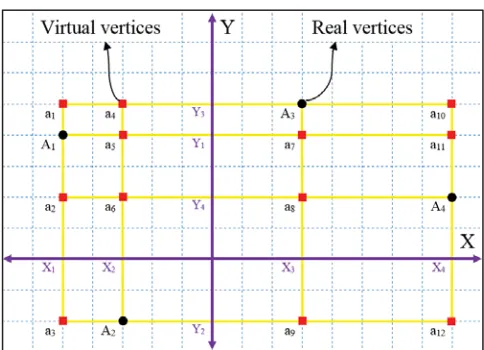
The area of the depot is depicted by imaginary Cartesian coordinate in Figure 2. The depot consists of some real vertices (location of LPS and W&Bs) and virtual vertices (location of the candidate places for branching). As mentioned in the previous section, virtual vertices are obtained from intersection of all x-coordinates and all y-coordinates of real vertices. Figure 2 is to illustrate the visual description for a better understanding of
intersecting. In Figure 2, the coordinates of real vertices are specified by A1=(x1, y1), A2=(x2, y2),
A3=(x3, y3) and A4=(x4, y4). By intersecting of all
x-coordinates and all y-coordinates of real vertices, the virtual vertices are generated which are specified by a1=(x1, y3), a2=(x1, y4), a3=(x1, y2),
a4=(x2, y3), a5=(x2, y1), a6=(x2, y4), a7=(x3, y1),
a8=(x3, y4), a9=(x3, y2), a10=(x4, y3), a11=(x4, y1) and
a12=(x4, y2).
3.2 Assumptions
Some assumptions are provided to extend the mathematical model as follows:
1. The location of all W&Bs and LPS are fixed. 2. LPS is located at real vertex 1 and other
W&Bs are located at real vertex 2 to the last real vertex.
3. To specify the route of trenching and cabling, four kinds of connections between the vertices are defined as: connection between (1) real vertex and real vertex, (2) real vertex and virtual vertex, (3) virtual vertex and real vertex, and (4) virtual vertex and virtual vertex.
4. All the distances between (1) real vertex and real vertex, (2) real vertex and virtual vertex, (3) virtual vertex and real vertex, (4) virtual vertex and virtual vertex, and (5) LPS and IPL are Euclidean and deterministic.
5. IPL and LPS connected by a straight trench belong its 20 kV cable. Also, LPS and W&Bs connected by 400 V cables.
6. The cc, tc, and input power cable cost (ipcc) are deterministic.
7. The number of real vertices and virtual vertices are specified.
8. Each W&Bs requires one cable to receive requisite electricity.
9. LPS supplies the required electricity of the W&Bs.
10. Trenches can be used for one or more than one cable.
3.3 Notations
Before bring forward to model, integer variables, binary variables, parameters of the proposed model are introduced as follows:
Indices
,
,
v w V
w V
virtual
vertices 9 «QY
Figure 2. Real vertices and virtual vertices
Parameters
ij
drr
the distance from real vertex i to real vertex jiv
drv
the distance from real vertex i to virtual vertex vvj
dvr
the distance from virtual vertex v to realvertex j
vw
dvv
the distance from virtual vertex v to virtualvertex w
dlip the distance between LPS and input power
vertex
cc
the per unit cable costtc
the per unit trench costipcc the per unit input power cable cost
nr
the number of real vertices (LPS and W&Bs)nv
the number of virtual verticesInteger Variables
ij
xrr
the number of cables from real vertex i to realvertex j
iv
xrv
the number of cables from real vertex i to virtual vertex vvj
xvr
the number of cables from virtual vertex v toreal vertex j
vw
xvv
he number of cables from virtual vertex v tovirtual vertex w Binary Variables
ij
yrr
1 if a trench is dug between real vertex i andreal vertex j
iv
yrv
1 if a trench is dug between real vertex i and virtual vertex vvj
yvr
1 if a trench is dug between virtual vertex vand real vertex j
vw
yvv
1 if a trench is dug between virtual vertex v and virtual vertex w3.4 Proposed Approach
In this section, a new MILP model is developed to optimize the cable trench route by considering the branching at the virtual vertices.
1 1 1 1
Z
nr nr nr nr
ij ij ij ij
j i j i
c
Min
c
¦¦
drr xrr
tc
¦¦
drr yrr
1 1 1 1
nv nr nv nr
iv iv iv iv v i v i
cc
drv xrv
tc
drv yrv
¦¦
¦¦
1 1 1 1
nv nr nv nr
vj vj vj vj v i v i
cc
dvr xvr
tc
dvr yvr
¦¦
¦¦
1 1 1 1
(
)
¦¦
nv nv vw vw¦¦
nv nv vw vww v w v
cc
dvv
xvv
tc
dvv
yvv
dlip ipcc
tc
Subject to:
1 1
2 1
1
nr nv
j v j v
xrr
xrv
nr
¦
¦
(2)1
iji j
yrr
nr
¦
i j
,
R
(3)1 1 1 1
1
nr nv nr nv
ij iv ji vi
j v j v
xrr
xrv
xrr
xvr
¦
¦
¦
¦
i
2,3,...,
nr
(4)1 1 1 1
nr nv nr nv
iv wv vj vw
i w j w
xrv
xvv
xvr
xvv
¦
¦
¦
¦
v V
(5)(
nr
1)
yrr
ijt
xrr
ijxrr
jii j
,
R
(6)(
nr
1)
yrv
ivt
xrv
iv
i
R v
,
V
(7)(
nr
1)
yvr
vjt
xvr
vj
j
R v V
,
(8)(
nr
1)
yvv
vwt
xvv
vwv w V
,
(9)1
iv vi
yvr
yvr
d
i
R v
,
V
(10)1
vw wv
yvv
yvv
d
v w V
,
(11)0
ij
xrr
t
i j
,
R
(12)0
iv
xrv
t
i
R v
,
V
(13)0
vj
xvr
t
j
R v V
,
(14)0
vw
xvv
t
v w V
,
(15)^ `
0,1
ij
yrr
i
j
R
(16)^ `
0,1
iv
yrv
i
R v
,
V
(17)^ `
0,1
vj
yvr
j
R v V
,
(18)^ `
0,1
vw
yvv
v w V
,
(19)Equation (1) represents the objective function and the remained ones, i.e. (2) - (19), are the constraints of the model.
The objective function shown in Eq. (1) consists of five parts and computes the total cost. The total cost includes used cables cost and trench digging cost between all four kinds of connections and
exactly dig. Eq. (4) ensures that each of the nr-1 W&Bs use one cable. Moreover, it indicates that each of the nr-1 W&Bs are connected by exactly one cable. The left and right side of this equation respectively specifies the total number of cables that leaves from each real vertices and the total number of cables that enter to each real vertices minus 1. Eq. (5) ensures that it is not necessary to assign trenches as well as cables between virtual vertices. In the other words, input and output cables of each virtual vertices must be equal. Inequality (6) ensures that cables between two real vertices are not laid unless a trench between them is dug. Moreover, it is an upper bound for the number of cables that might be laid. The concepts of inequalities (7) - (9) are the same as inequality (6). Inequality (10) determines that for one connection between real and virtual vertices only zero or one trench must be calculated. Also, the concept of inequality (11) is the same as inequality (10). Inequalities (12) – (15) guarantee that the number of cables between vertices could not be negative. At the end, constraints (16) – (19) specify that trench variables must be either zero or one.
4.
Reliability and Validity of the
Proposed Model
4.1. Computational Results
In this section, a numerical example of the model presents to clarify the applicability of the model.
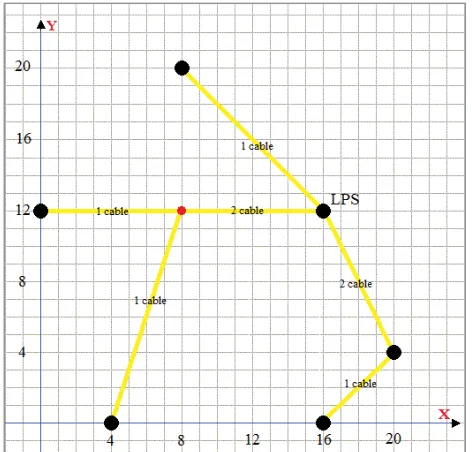
We consider hypothetical case study to validate the effectiveness of the proposed model in comparison with the model proposed by Vasko et al (Vasko et al. 2002). In this case, the tc and the cc are considered 200 US Dollar (USD). Also, the number of W&Bs is considered 5. The layout of this hypothetical case study is shown in figure 3. The LPS and W&Bs are specified by black solid circle in Figure 3. By intersecting of all x-coordinates and all y-x-coordinates of real vertices, the virtual vertices are generated which are specified by red solid circle in Figure 3.
This case is solved by the proposed model using the General Algebraic Modeling System (GAMS) software packages. The optimum results of cabling and trenching of hypothetical case study are shown in Figure 4.Total cost of proposed model in this study equals Z= 25214.433 USD.
Moreover, this case is solved by the method proposed by Vasko et al [Vasko et al. 2002] as the results are shown in Figure 5. Total cost of method proposed by Vasko et al [Vasko et al. 2002] equals Z= 25343.013 USD. By comparing the results, it is obtained that the proposed model results better solution in comparison with Vasko et al [Vasko et al. 2002] method.
Figure 4. Results of cabling and trenching of the proposed model
Figure 5. Results of cabling and trenching by the model proposed by Vasko et al [Vasko et al. 2002]
Sensitivity Analysis
In building the scenarios for a depot, we will analyze the impact on the solution and the number of used branches in three elements. The first element is the cc, the second element is the tc, and the third element is the ipcc. Due to (1) the input power cable only used between IPL and LPS, and (2) the IPL and LPS connected by a straight trench
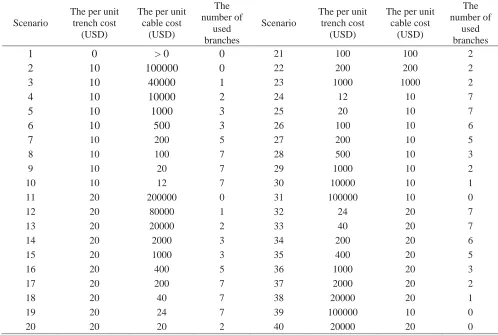
As it is clear in Table 1, whatever the differences between values of cc and tc be high, the number of branches became less and whatever the differences between values of cc and tc be low, the number of branches became more.
Finally, According to the two previous subsections, the reliability and validity of the proposed model in this study is proved.
5.
Case Study
The depot of studied Iranian urban railway lines shown in Figure 6. This depot contains thirteen substantial W&Bs which require electricity (depicted in Figure 6 by 3-15) and two places (IPL and LPS) which exchange electricity among the W&Bs (depicted in Figure 6 by 1 and 2). To
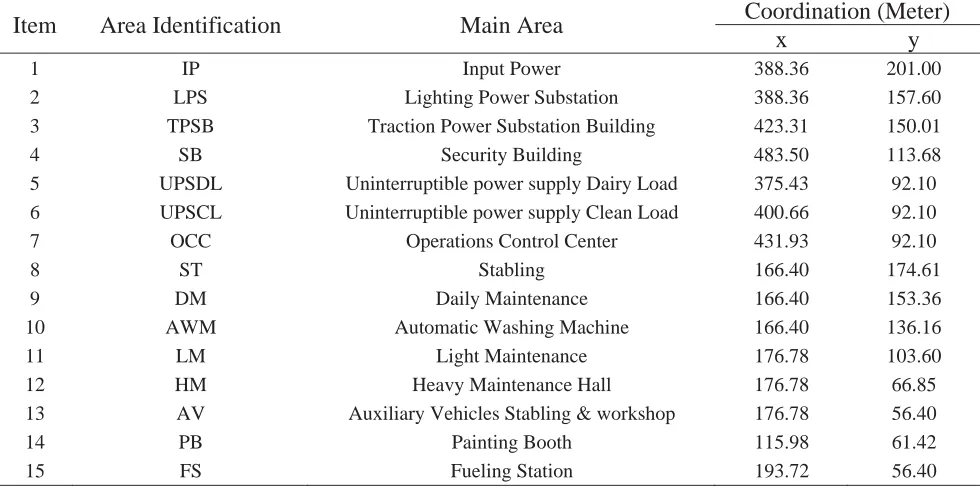
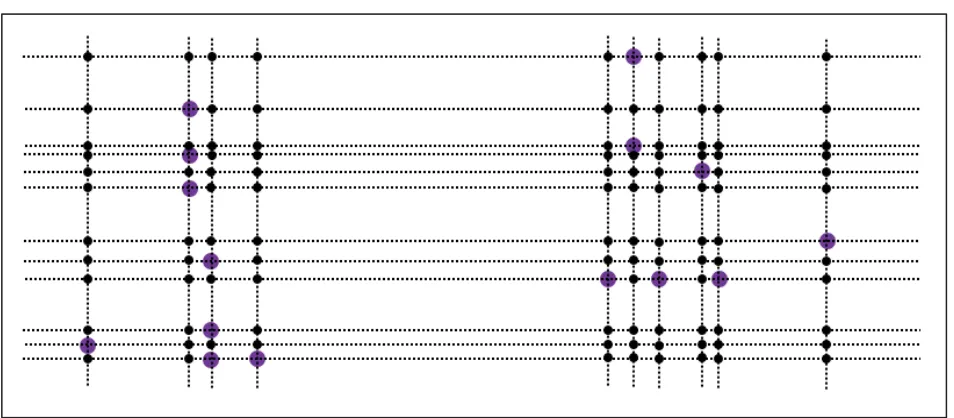
satisfy the demand of these W&Bs for electricity, required trenches must be dig among them. Each of the main areas (IPL, LPS and W&Bs) of the studied depot has not a specific coordination in the layout of Figure 6, but each of them has a specific point for entering power that shown in Figure 7. The coordination of main areas at the studied depot are shown in Table 2. The exact location of entering power for each W&Bs at the studied depot are separated to simplify the show of the exist vertices. Indeed, the vertices are shown in Figure 8 are the real vertices of the model. By intersecting of all x-coordinates and all y-coordinates of real vertices in Figure 8, the virtual vertices are generated which are specified by black solid circle in Figure. 9.
Table 1. The different scenarios for the studied depot
Scenario
The per unit trench cost
(USD)
The per unit cable cost
(USD)
The number of
used branches
Scenario
The per unit trench cost
(USD)
The per unit cable cost
(USD)
The number of
used branches
1 0 > 0 0 21 100 100 2
2 10 100000 0 22 200 200 2
3 10 40000 1 23 1000 1000 2
4 10 10000 2 24 12 10 7
5 10 1000 3 25 20 10 7
6 10 500 3 26 100 10 6
7 10 200 5 27 200 10 5
8 10 100 7 28 500 10 3
9 10 20 7 29 1000 10 2
10 10 12 7 30 10000 10 1
11 20 200000 0 31 100000 10 0
12 20 80000 1 32 24 20 7
13 20 20000 2 33 40 20 7
14 20 2000 3 34 200 20 6
15 20 1000 3 35 400 20 5
16 20 400 5 36 1000 20 3
17 20 200 7 37 2000 20 2
18 20 40 7 38 20000 20 1
19 20 24 7 39 100000 10 0
Figure 6. Depiction of W&Bs at the studied depot
Figure 7. Specify the exact location of entering power for each W&Bs at the studied depot
Table 2. Coordination of main areas at the studied depot
Item Area Identification Main Area Coordination (Meter)
x y
1 IP Input Power 388.36 201.00
2 LPS Lighting Power Substation 388.36 157.60
3 TPSB Traction Power Substation Building 423.31 150.01
4 SB Security Building 483.50 113.68
5 UPSDL Uninterruptible power supply Dairy Load 375.43 92.10
6 UPSCL Uninterruptible power supply Clean Load 400.66 92.10
7 OCC Operations Control Center 431.93 92.10
8 ST Stabling 166.40 174.61
9 DM Daily Maintenance 166.40 153.36
10 AWM Automatic Washing Machine 166.40 136.16
11 LM Light Maintenance 176.78 103.60
12 HM Heavy Maintenance Hall 176.78 66.85
13 AV Auxiliary Vehicles Stabling & workshop 176.78 56.40
14 PB Painting Booth 115.98 61.42
Figure 8. Separation of solid circles from the layout of studied depot
Figure 9. Specify the location of virtual vertices
In this case, all the distances between real to real (݀ݎݎ), real to virtual (݀ݎݒ௩), virtual to real (݀ݒݎ௩), and virtual to virtual (݀ݒݒ௩௪) vertices are
calculated by the coordination’s values of real and
virtual vertices. The number of real vertices (nr) and the number of virtual vertices (nv) are respectively 14 and 96. Also, the cc, the tc, and the
Figure 10. Results of cabling and trenching of the proposed model
Moreover, this case is solved by the method proposed by Vasko et al [Vasko et al. 2002] as the results are shown in Figure 11. Total cost of method proposed by Vasko et al [Vasko et al. 2002] equals Z= 183,812 USD. By comparing the results, it is obtained that the proposed model results better solution in comparison with Vasko et al [Vasko et al. 2002] method.
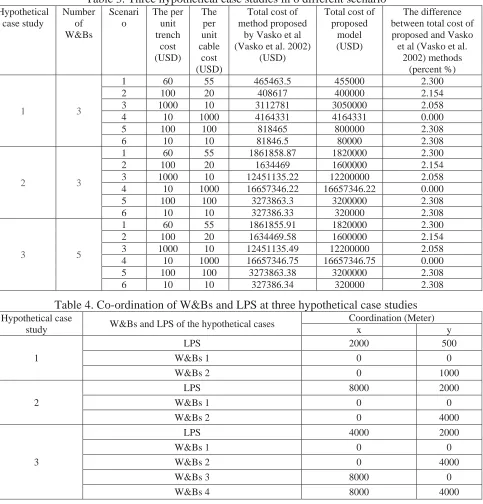
In this case, the difference between the total cost of proposed model and Vasko et al [Vasko et al. 2002] method is about 0.17%. Although, this difference is not considerable, but there are some cases in which the improvement of total cost is more considerable. To that end, some random examples are generated and analyzed. Table 3 depicts three hypothetical case studies in 6 different scenarios for each of them. Moreover, the coordination of W&Bs and LPS at three
hypothetical case studies are illustrated in Table 4. The results show that the difference between total costs varies on different case studies. It is illusterated that our proposed model always generates equal or better solutions in comparison with the model introduced by Vasko et al (Vasko et al. 2002) for any different kind of cases.
Figure 11. Results of cabling and trenching by the model proposed by [Vasko et al. 2002]
6. Results and Discussions
The concept of branching the cables in the midway of two W&Bs (or LPS and W&Bs) led to save money for cable trench problem. According to achieved values of Table 1, if the differences between values of cc and tc be very much, the proposed model became similar to the model proposed by Vasko et al [Vasko et al. 2002]. In some models which the values of cc and tc are almost the same, the proposed model in this study is more efficient than the model proposed by Vasko et al [Vasko et al. 2002].
6.1Conclusion and Future Direction
In this article, a new MILP long-term decision model has been presented to find the best cable trench route between LPS and W&Bs at the metro depot. The LPS provides the necessary electricity of the W&Bs located at the metro depot. The location of all W&Bs and LPS have been considered fixed. In this problem, the proposed
Table 3. Three hypothetical case studies in 6 different scenario Hypothetical case study Number of W&Bs Scenari o The per unit trench cost (USD) The per unit cable cost (USD)
Total cost of method proposed
by Vasko et al (Vasko et al. 2002)
(USD)
Total cost of proposed
model (USD)
The difference between total cost of proposed and Vasko et al (Vasko et al.
2002) methods (percent %)
1 3
1 60 55 465463.5 455000 2.300
2 100 20 408617 400000 2.154
3 1000 10 3112781 3050000 2.058
4 10 1000 4164331 4164331 0.000
5 100 100 818465 800000 2.308
6 10 10 81846.5 80000 2.308
2 3
1 60 55 1861858.87 1820000 2.300
2 100 20 1634469 1600000 2.154
3 1000 10 12451135.22 12200000 2.058
4 10 1000 16657346.22 16657346.22 0.000
5 100 100 3273863.3 3200000 2.308
6 10 10 327386.33 320000 2.308
3 5
1 60 55 1861855.91 1820000 2.300
2 100 20 1634469.58 1600000 2.154
3 1000 10 12451135.49 12200000 2.058
4 10 1000 16657346.75 16657346.75 0.000
5 100 100 3273863.38 3200000 2.308
6 10 10 327386.34 320000 2.308
[
Table 4. Co-ordination of W&Bs and LPS at three hypothetical case studies Hypothetical case
study W&Bs and LPS of the hypothetical cases
Coordination (Meter)
x y
1
LPS 2000 500
W&Bs 1 0 0
W&Bs 2 0 1000
2
LPS 8000 2000
W&Bs 1 0 0
W&Bs 2 0 4000
3
LPS 4000 2000
W&Bs 1 0 0
W&Bs 2 0 4000
W&Bs 3 8000 0
W&Bs 4 8000 4000
7. References
-Arkin, E. M., Carmi, P., Katz, M. J., Mitchell, J. S. B. and Segal, M. (2014) “Locating battery charging stations to facilitate almost shortest paths”, 14th Workshop on Algorithmic Approaches for Transportation Modelling,
Optimization, and Systems (ATMOS’14),
Vol. 42, pp. 25–33
-Baxter, M., Elgindy, T., Ernst, A. T., Kalinowski, T. and Savelsbergh, M. (2014)
“Incremental network design with shortest paths”, European Journal of Operational
Research
-Bhattacharya, A. and Kumar, A. (2014) “A
performance analysis”, Computer Networks,
Vol. 71, pp. 48–62
-Booth, H. and Westbrook, J. (1994) “A linear algorithm for analysis of minimum spanning and shortest-path trees of planar graphs”, Algorithmica, Vol. 11, No. 4, pp. 341–352
-Eppstein, D. (1999) “Spanning trees and spanners”, California, Elsevier.
-Erlebach, T. and Hoffmann, M. (2014)
“Minimum spanning tree verification under uncertainty”, Graph-Theoretic Concepts in Computer Science, pp. 164–175
-Gouveia, L., Leitner, M. and Ljubi, I. (2014) “A polyhedral study of the diameter constrained minimum spanning tree problem”
-Hochuli, A., Holzer, S. and Wattenhofer, R. (2014) “Distributed approximation of minimum routing cost trees”, arXiv preprint arXiv:1406.1244, pp. 1–18
-Jeng, D. J., Kim, I. and Watada, J. (2006)
“DNA-based evolutionary algorithm for cable trench problem”, Springer-Verlag Berlin Heidelberg Part III, Vol. 4253, No. 3, pp. 922–929
-Khuller, S., Raghavachari, B. and Young, N. (1995) “Balancing minimum spanning trees and shortest-path trees”, Algorithmica, Vol. 14, No. 4, pp. 305–321
-Kumar, V. and Kumar, S. (2014) “Spanning -tree-based position-based routing in WSNs”, Intelligent Computing, Networking, and Informatics, pp. 1267–1275
-Liu, G., Qiu, Z., Qu, H., Ji, L. and Takacs, A. (2014) “Computing k shortest paths from a source node to each other node”, Soft Computing, pp. 1–12
-Marianov, V., Gutiérrez-Jarpa, G., Obreque, C. and Cornejo, O. (2012) “Lagrangean relaxation heuristics for the p-cable-trench problem”, Computers & Operations Research, Vol. 39, No. 3, pp. 620–628
-Nagarajan, A. and Ayyanar, R. (2014)
“Application of minimum spanning tree
algorithm for network reduction of distribution systems”, North American Power Symposium (NAPS), IEEE, pp. 1–5
-Pérez-galarce, F., Álvarez-miranda, E., Candia-véjar, A. and Toth, P. (2014) “On exact solutions for the minmax regret spanning tree problem”, Computers & Operations Research, Vol. 47, pp. 114–122
-Ralphs, T. K., Saltzman, M. J. and Wiecek, M. M. (2004) “An improved algorithm for biobjective integer programming and its application to network routing problems”, Annals of Operations Research
-5DOSKV Ɍ Ʉ and Hartman, J. C. (2001)
“Capacitated Node Routing Problems
(Preliminary Progress Report)”
-Xiaoqiang, R. (2014) “Position prediction in mine personnel RFID positioning system based on shortest path principle”, Journal of Chemical and Pharmaceutical Research, Vol. 6, No. 6, pp. 2159–2162
-Saravanan, M. and Madheswaran, M. (2014) “A hybrid optimized weighted minimum spanning tree for the shortest intrapath selection in wireless sensor network”, Mathematical Problems in Engineering
-Trudeau, C. (2014) “Minimum cost spanning tree problems with indifferent agents”, Games and Economic Behavior, Vol. 84, pp. 137–151
-Vasko, F. J., Barbieri, R. S., Rieksts, B. Q., Reitmeyer, K. L. and Stott Jr, K. L. (2002)
“The cable trench problem: combining the
shortest path and minimum spanning tree problems”, Computers & Operations Research, Vol. 29, No. 5, pp. 441–458
-Zhong, C., Malinen, M., Miao, D. and Fränti, P. (2015) “A fast minimum spanning tree algorithm based on k-means” Information Sciences, Vol. 295, pp. 1–17
-Zhou, J., He, X. and Wang, K. (2014)

![Figure 11. Results of cabling and trenching by the model proposed by � [Vasko et al. 2002]](https://thumb-us.123doks.com/thumbv2/123dok_us/12927.2001193/13.612.108.495.71.415/figure-results-cabling-trenching-model-proposed-vasko-et.webp)