AUT J. Civil Eng., 1(2) (2017) 145-152 DOI: 10.22060/ceej.2017.12358.5184
Buckling Analysis of Functionally Graded Plates Based on Two-Variable Refined
Plate Theory Using the Bubble Finite Strip Method
Omid Kianian, Saeid Sarrami-Foroushani*, Mojtaba Azhari
Department of Civil Engineering, Isfahan University of Technology, Isfahan, 84156-83111, Iran
ABSTRACT: Functionally graded materials (FGMs) have been widely used in many structural
applications over the past decades. The rapid growth of the FGMs is due to their remarkable mechanical and thermal properties. The mechanical buckling analysis of functionally graded ceramic-metal rectangular plates is considered in this paper. The two-variable refined plate theory (RPT), in conjunction with the bubble finite strip method, is employed for the first time to evaluate the mechanical buckling loads of rectangular FGM plates. The theory, which has a strong similarity with the classical plate theory (CPT) in many aspects, accounts for a quadratic variation of transverse shear strains across the thickness of the plate and satisfies the zero traction boundary conditions on the top and bottom surfaces of the plate without using the shear correction factor. In comparison with the ordinary finite strip method, the convergence of the bubble finite strip method is very rapid due to using bubble shape functions. The mechanical properties of the FGM plate are assumed to vary according to a power law distribution of the volume fraction of constituents. The accuracy and efficiency of the present method are confirmed by comparing the present results with those available in the literature. Furthermore, the effects of power-law index, plate thickness, aspect ratio, loading types and various boundary conditions on the critical buckling load of the functionally graded rectangular plates are investigated.
Review History:
Received: 4 January 2017 Revised: 1 March 2017 Accepted: 5 August 2017
Available Online: 1 September 2017
Keywords:
Functionally graded plate Refined plate theory Buckling
Finite strip method Bubble function
1- Introduction
A large number of plate theories have been developed to analyze plate structures. The classical plate theory (CPT) is the most popular theory which neglects the transverse shear deformation effects. This theory provides rational results for the thin plate [1], however, it underestimates the deflections and overestimates the natural frequencies as well as buckling loads of moderately thick and thick plates. To overcome these defects, the shear deformation plate theories such as first-order shear deformation theory (FSDT) [2-5] and higher-order shear deformation theories (HSDT) [6-11] as well as the refined plate theory (RPT) [12] are proposed. In the RPT, it is assumed that the in-plane and transverse displacements consist of bending and shear components in which the bending components do not contribute toward shear forces and, likewise, the shear components do not contribute toward bending moments. Contrary to the FSDT which needs shear correction factor, the transverse shear strains across the thickness of the plate are quadratic in the RPT. Consequently, the zero traction boundary conditions on the top and bottom surfaces of the plate is satisfied. This is the most interesting feature of the RPT, while it uses fewer unknowns. This theory is successfully developed and used to analyze functionally graded plates [13, 14].
In this study, the mechanical buckling analysis of functionally graded ceramic-metal rectangular plates is considered. The two-variable refined plate theory, in conjunction with the bubble finite strip method, is employed in the current formulation. The bubble functions are used to increase the convergence of the finite strip method.
2- Mechanical properties of FG rectangular plate
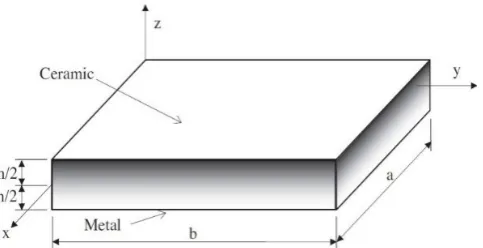
Consider a rectangular functionally graded plate of total thickness h, side length a in x-direction and b in y-direction as shown in Figure 1. A coordinate system (x, y, z) is established on the middle plane of the plate. The plate is made of isotropic material and the material properties are assumed to vary through the thickness according to the power law distribution [15]:
( ) ( c m) c m
P z = P P V− +P (1)
1
( 0)
2 ;
n c
z
V n
h
= + ≥
(2)
where Pm and Pc are the properties of the metal and ceramic, respectively. Vc is the volume fraction of the ceramic and n is the power law index. The Poisson’s ratio, V, is assumed to be a constant for convenience.
3- Displacement field
Based on the assumptions of RPT [12, 16], the displacement field is defined as:
0 0
( , , ) ( ) wb ( ) ws
u x y z z z F z z
x x
∂ ∂
= − − + −
∂ ∂ (3)
0 0
( , , ) ( ) wb ( ) ws
v x y z z z F z z
y y
∂ ∂
= − − + −
∂ ∂ (4)
( , , ) b( , ) s( , )
w x y z =w x y +w x y (5)
where aaaaaaaaaaaaaaaaaaa , and wb are ws the bending and shear components of transverse displacement, respectively and z0 is the position of the neutral surface which is defined as [16]: /2 /2 0 /2 /2 ( ) ( ) h h h h
E z zdz z
E z dz −
− =
∫
∫
(6)in which E(z) is the modulus of elasticity of FG plate and follows the power law distribution as introduced in Equation 1.
4- Stability equation
After calculating the strain energy and the potential energy of the external forces, Hamilton’s principle is used to derive the equations of motion appropriate to the displacement field and the constitutive equation. According to the RPT, the governing equations of the buckling analysis of FG plate can be written as [16, 17]:
2 2 2 2
2 2 2 2
2 2 2 2
b b bs s
b s b s
x y
D w D w
w w w w
n n
x x y y
∇ ∇ + ∇ ∇ = ∂ ∂ ∂ ∂ + + ∂ ∂ ∂ ∂ + (7a)
2 2 2 2 2
2 2 2 2
2 2 2 2
(1 ) 2
bs b s s
b s b s
x y
C
D w D w
w w w w
n n
x x y y
ν − ∇ ∇ + ∇ ∇ − ∇ = ∂ ∂ ∂ ∂ + + + ∂ ∂ ∂ ∂ (7b)
in which Db, Dbs, Ds and C are defined as follows:
/ 2
0
/ 2 ( )
h b h
D =
∫
− H × z z dz− (8a)/ 2
0 / 2 ( ) ( )
h bs h
D H F z z z dz
−
=
∫
× × − (8b)/ 2
/ 2 ( ) ( ( ) )
h s h
D H F z F z d dz
−
=
∫
× × − (8c)/ 2 2
/ 2 ( )
h h
C H F z dz
−
=
∫
× (8d)where aaaaaaaaa and aaaaaaaaaaaaaaaaaa.
5- Solution by refined finite strip method
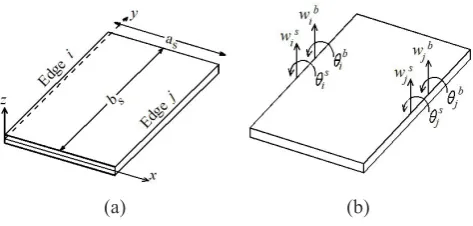
The bubble finite strip method (BFSM) is employed here to investigate the buckling behavior of FG rectangular plates with different boundary conditions. Figure 2a shows a single strip of length bs and width as in the rectangular coordinate system (x, y, z) with two nodal lines of i and j. The strip nodal degrees of freedom are shown in Figure 2b.
The bending and shear deflections of the strip are defined, respectively as:
r
q=1
( , ) b b
b q q
w x y =
∑
N δ (9a)r
q=1
( , ) s s
s q q
w x y =
∑
Nδ (9b)in which r is the number of harmonic modes and
(
)
2 3 2 3
2
2 2 3 2 3 ( )
[1- 3 2 ( 2 )
1 3 - 2 ( )]q
b s
q q s
s Y y
a a
ξ ξ ξ ξ ξ
ξ ξ ξ ξ ξ ξ
=
= + − +
− − +
N N
(10)
where ξ=x/as and Yq(y) is the qth mode of a trigonometric
function which are given in [17]. Yq(y) is chosen such that it satisfies the boundary conditions in one direction. δqb and
δqs which are the displacement vectors related to mode q, are
given by:
{
}
Tb b b b b b
q wi i wbub wj j q
δ = θ θ (11a)
{
}
Ts s s s s s
q wi i wbub wj j q
δ = θ θ (11b)
in which (wib)
q, (wjb)q, (θib)q and (θjb)q are bending degrees
of freedom of each nodal line, whereas (wis)
q, (wjs)q,
(θis)
q and (θjs)q are the shear degrees of freedom and θ=∂w/∂x.
(wbubb)
q and (wbubs)q are the degrees of freedom corresponding
to the third shape function in Equation 10 which is called bubble function. These bubble displacements belong to the middle line between the two nodal lines i and j. Assuming the bending and shear deflections of the nanoplate as expressed in Equations 9a and b, the method of weighted residuals is then applied to the Equations 7a and 7b which should be solved simultaneously. In the absence of the lateral load, the
2
1 5 ( )
4 3 z F z z
h = − 2 ( ) 1 E z H v = − /2 /2 ( ) ( ) ( ) h h
E z F z
d dz
E z −
=
∫
(a) (b)
buckling equations of a plate could be written as:
(K K− G)δ=0 (12)
in which δ is the eigenvector; K is the stiffness matrix of the plate and KG is the stability matrix. The stiffness matrix of a strip corresponding to mth and nth modes, (K)e
mn, which is a
10×10 matrix is defined as:
( )
( ) ( )
( ) ( )
( ) ( )
( ) ( )
e 0 0 0 0
mn
0 0 0 0
b a b a
T T
b b b b
m b n m bs n
b a b a
T T
b b s s
m bs n m s n
dx dy dx dy
dx dy dx dy
=
∫∫
∫∫
∫∫
∫∫
B D B B D B
K
B D B B D B
(13)
where
( ) ( ) ( ) ( )
( ) ( )
2
2 2 2
2 3 2 3 2 2 2 3 2 3
2 2 3 2
1 6 12 1 4 6 1(12 12 2) 1 6 12 1 2 6
(1- 3 2 ) ( 2 ) ( 1) (3 - 2 ) ( )
2 6 6 2 1 4 3 2(4 2 6 ) 2 6 6
q q q q q
s s
s s s
b
q q s q q q s q
q q q
s s s
Y Y Y Y Y
a a
a a a
Y a Y Y Y a Y
Y Y Y
a a a
ξ ξ ξ ξ ξ ξ
ξ ξ ξ ξ ξ ξ ξ ξ ξ ξ ξ ξ ξ ξ ξ ξ ξ ξ ξ ξ
− − + − − + − − + − − − − + ′′ ′′ ′′ ′′ ′′ = − + − − + − − − − − + ′ ′ ′ − − + − − + − + − − − B
( 2) ( 2)
3 5
2 2 3
q q
Y ξ ξ Y
× ′ − − + ′ (14) ( ) ( ) ( ) ( ) ( ) ( ) 2
2 2 2
2 3 2 3 2 2 2 3 2 3
2 2 3 2
1 6 12 1 4 6 1(12 12 2) 1 6 12 1 2 6
(1- 3 2 ) ( 2 ) ( 1) (3 - 2 ) ( )
2 6 6 2 1 4 3 2(4 2 6 ) 2 6 6
q q q q q
s s
s s s
q s q q q s q s
q q q
q
s s s
Y a Y Y Y a Y
a a a
Y a Y Y Y a Y
Y Y Y
a a a
ξ ξ ξ ξ ξ ξ
ξ ξ ξ ξ ξ ξ ξ ξ ξ ξ ξ ξ ξ ξ ξ ξ ξ ξ ξ ξ
− − + − − + − − + − − − − + ′′ ′′ ′′ ′′ ′′ − + − − + − − − − − + ′ ′ ′ − − + − − + − + − − − =
B ( ) ( )
( )
( ) ( ) ( ) ( )
2 2
2 3 2 3 2 2 2 3 2 3
2 2 3 2 2 2
5 5
2 2 3
1- 3 2 ( 2 ) ( 1) (3 - 2 ) ( )
1 6 6 1 4 3 1(4 2 6 ) 1 6 6 2 3
q q q s q q q s q
q q q q q
s s s
Y Y
Y a Y Y Y a Y
Y Y Y Y Y
a a a
ξ ξ ξ ξ ξ ξ ξ ξ ξ ξ ξ ξ ξ ξ ξ ξ ξ ξ ξ ξ ξ ξ ξ ξ
× ′ ′ − − + − + ′ − − + ′ − − ′ − ′ − − + ′ − − + − − + − + − − − − − + (15)
In these equations, Y'q and Y"q represent the first and second derivatives of Yq with respect to y, respectively; also
1 0 1 0
1 0 , 1 0
1 1
0 0 0 0
2 2
b Db bs Dbs
ν ν ν ν ν ν − −
D = D = (16)
and
(
)
(
)
0 0 0
0 0 0
(1 )
0 0 0 0
2
1
0 0 0 0
2
1
0 0 0 0
2 s s s s s s D D D D D C C ν ν ν ν ν − − −
D = (17)
(KGL)e
mn is also defined as:
( )
T T
Gm Gn Gm Gn
0 0 0 0
T T
Gm Gn Gm Gn
0 0 0 0 10 10
b a b a
L L
e L
G mn b a b a
L L
dx dy dx dy
dx dy dx dy
× =
∫∫
∫∫
∫∫
∫∫
B S B B S B K
B S B B S B
(18)
where
2 2 3
2 2 3
3 2 2 2
2 2 3
2 2 3
1 ( 6 6 ) (1-3 +2 )
(1 4 3 ) ( 2 + )
1 (4 2 6 ) ( 1)
1 (6 6 ) (3 -2 )
( 2 3 ) ( + )
q q
s
q s q
T q q Gq s q q s
q s q
Y Y
a
Y a Y
Y Y
a
Y Y
a
Y a Y
ξ ξ ξ ξ
ξ ξ ξ ξ ξ
ξ ξ ξ ξ ξ
ξ ξ ξ ξ
ξ ξ ξ ξ
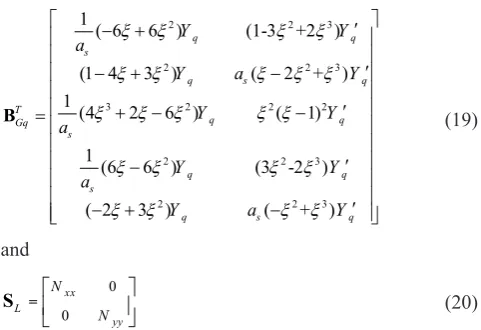
− + ′ ′ − + − + − − ′ = − ′ ′ − + − B (19) and 0 0 xx L yy N N = S (20)
It should be noted that Nxx = σxh and Nyy = σyh. σx and σy are stresses parallel to x-direction and y-direction, respectively. Having the finite strip formulation, a computer program is developed in the MATLAB environment to study the buckling of FGM plates. To obtain the total stiffness and stability matrices in Equation 12, the plate is first divided into a proper number of strips. Then, the stiffness and stability matrices of each strip are computed using Equations 13 and 18. The matrices are finally assembled using the equilibrium and compatibility equations along the nodal lines. The boundary conditions are then applied and finally the eigenvalue problem in Equation 12 is solved by vanishing the determinant of the coefficient matrix as:
0
G
− =
K K (21)
Equation 21 is solved to obtain the critical buckling stress of the FGM plate.
6- Results and discussion
In order to validate the accuracy and efficiency of the present formulation, several examples are presented and discussed. Table 1 shows the material properties of the FG plate.
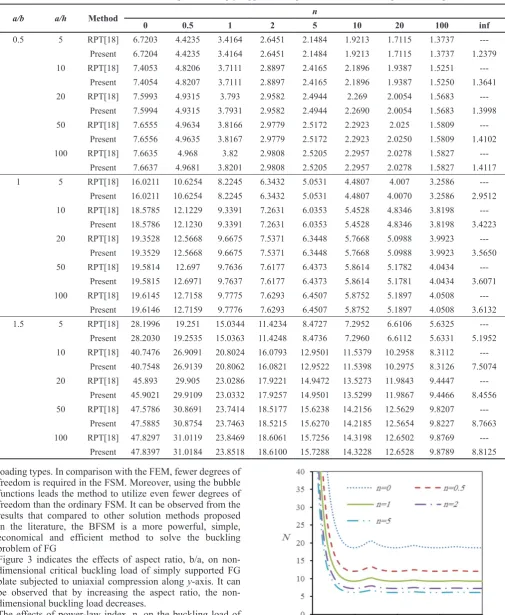
The comparison of non-dimensional critical buckling load, N=Ncra2/E
mh3, for a simply supported FG plate subjected to
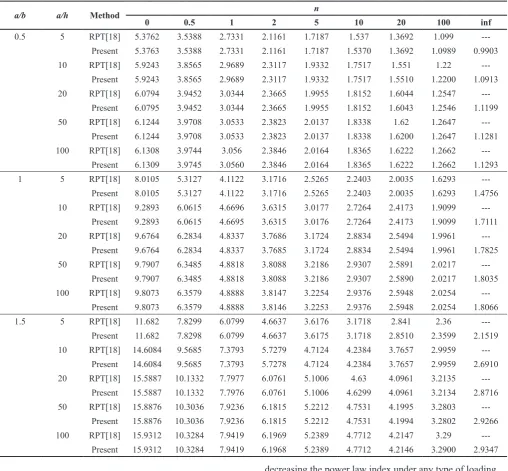
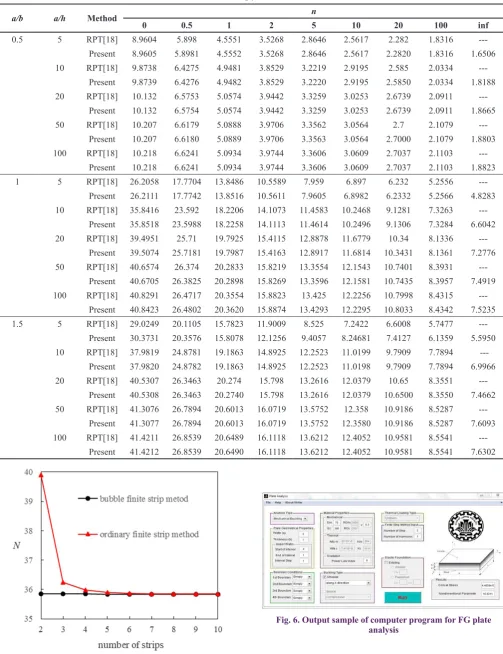
uniaxial compression along the x-axis, biaxial compression and biaxial compression (along x-axis) and tension (along y-axis) are presented in Table 2-4, respectively. Different width to thickness ratios, a/h, aspect ratios, b/a, and power law index, n, are considered in the results. It can be seen that the non-dimensional critical buckling loads obtained based on the present study are in an excellent agreement with those reported by Thai and Choi [18].
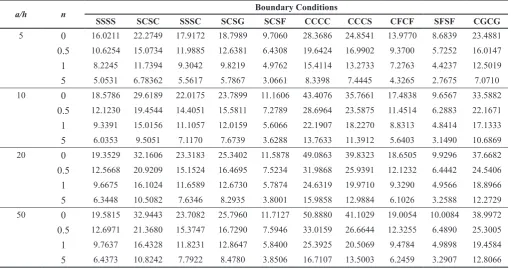
Table 5 shows non-dimensional buckling load, N, for square FG plate under uniaxial compression with different boundary conditions and several widths to thickness ratios, a/h. Different values of power law index, n, are also taken. In Table 5, S, C, F, and G simply refer to clamped, free and guided supports, respectively.
All the results presented in Tables 2-5 indicate that the proposed BFSM is a powerful method to solve the buckling of FGM plates with any boundary conditions and different
Material Em Ec v
Al / Al2O3 70 GPa 380 GPa 0.3
loading types. In comparison with the FEM, fewer degrees of freedom is required in the FSM. Moreover, using the bubble functions leads the method to utilize even fewer degrees of freedom than the ordinary FSM. It can be observed from the results that compared to other solution methods proposed in the literature, the BFSM is a more powerful, simple, economical and efficient method to solve the buckling problem of FG
Figure 3 indicates the effects of aspect ratio, b/a, on non-dimensional critical buckling load of simply supported FG plate subjected to uniaxial compression along y-axis. It can be observed that by increasing the aspect ratio, the non-dimensional buckling load decreases.
The effects of power-law index, n, on the buckling load of a simply supported square plate (a=b=10h) under various loading conditions are shown in Figure 4. Three loading conditions are uniaxial compression, biaxial compression (C & C), and biaxial tension and compression (T & C). It can be seen that the non-dimensional buckling load increases by
a/b a/h Method 0 0.5 1 2 n5 10 20 100 inf
0.5 5 RPT[18] 6.7203 4.4235 3.4164 2.6451 2.1484 1.9213 1.7115 1.3737
---Present 6.7204 4.4235 3.4164 2.6451 2.1484 1.9213 1.7115 1.3737 1.2379
10 RPT[18] 7.4053 4.8206 3.7111 2.8897 2.4165 2.1896 1.9387 1.5251
---Present 7.4054 4.8207 3.7111 2.8897 2.4165 2.1896 1.9387 1.5250 1.3641
20 RPT[18] 7.5993 4.9315 3.793 2.9582 2.4944 2.269 2.0054 1.5683
---Present 7.5994 4.9315 3.7931 2.9582 2.4944 2.2690 2.0054 1.5683 1.3998
50 RPT[18] 7.6555 4.9634 3.8166 2.9779 2.5172 2.2923 2.025 1.5809
---Present 7.6556 4.9635 3.8167 2.9779 2.5172 2.2923 2.0250 1.5809 1.4102
100 RPT[18] 7.6635 4.968 3.82 2.9808 2.5205 2.2957 2.0278 1.5827
---Present 7.6637 4.9681 3.8201 2.9808 2.5205 2.2957 2.0278 1.5827 1.4117
1 5 RPT[18] 16.0211 10.6254 8.2245 6.3432 5.0531 4.4807 4.007 3.2586
---Present 16.0211 10.6254 8.2245 6.3432 5.0531 4.4807 4.0070 3.2586 2.9512
10 RPT[18] 18.5785 12.1229 9.3391 7.2631 6.0353 5.4528 4.8346 3.8198
---Present 18.5786 12.1230 9.3391 7.2631 6.0353 5.4528 4.8346 3.8198 3.4223
20 RPT[18] 19.3528 12.5668 9.6675 7.5371 6.3448 5.7668 5.0988 3.9923
---Present 19.3529 12.5668 9.6675 7.5371 6.3448 5.7668 5.0988 3.9923 3.5650
50 RPT[18] 19.5814 12.697 9.7636 7.6177 6.4373 5.8614 5.1782 4.0434
---Present 19.5815 12.6971 9.7637 7.6177 6.4373 5.8614 5.1781 4.0434 3.6071
100 RPT[18] 19.6145 12.7158 9.7775 7.6293 6.4507 5.8752 5.1897 4.0508
---Present 19.6146 12.7159 9.7776 7.6293 6.4507 5.8752 5.1897 4.0508 3.6132
1.5 5 RPT[18] 28.1996 19.251 15.0344 11.4234 8.4727 7.2952 6.6106 5.6325
---Present 28.2030 19.2535 15.0363 11.4248 8.4736 7.2960 6.6112 5.6331 5.1952
10 RPT[18] 40.7476 26.9091 20.8024 16.0793 12.9501 11.5379 10.2958 8.3112
---Present 40.7548 26.9139 20.8062 16.0821 12.9522 11.5398 10.2975 8.3126 7.5074
20 RPT[18] 45.893 29.905 23.0286 17.9221 14.9472 13.5273 11.9843 9.4447
---Present 45.9021 29.9109 23.0332 17.9257 14.9501 13.5299 11.9867 9.4466 8.4556
50 RPT[18] 47.5786 30.8691 23.7414 18.5177 15.6238 14.2156 12.5629 9.8207
---Present 47.5885 30.8754 23.7463 18.5215 15.6270 14.2185 12.5654 9.8227 8.7663
100 RPT[18] 47.8297 31.0119 23.8469 18.6061 15.7256 14.3198 12.6502 9.8769
---Present 47.8397 31.0184 23.8518 18.6100 15.7288 14.3228 12.6528 9.8789 8.8125
Table 2. Non-dimensional critical buckling load of simply supported FG plate under uniaxial compression along the x-axis
Fig. 3. Effects of aspect ratio, b/a, on the non-dimensional critical buckling load of simply supported FG plate subjected to
decreasing the power law index under any type of loading. The convergence of the bubble finite strip method (BFSM) in comparison with the ordinary finite strip method (OFSM) is shown in Figure 5. BFSM converges very rapidly due to using the bubble functions. It can be seen that the results obtained from the BFSM with two strips are equal to those obtained from the OFSM using six strips. Therefore, it could be concluded that the degrees of freedom remarkably reduces due to using the bubble functions.
Figure 6 indicates the output sample of the developed computer program in the MATLAB environment for FG plate analysis in an especial case that a/h = 5, power low index, n = 0, and the number of strips equals to 3. The plate is square and simply supported.
a/b a/h Method 0 0.5 1 2 n5 10 20 100 inf
0.5 5 RPT[18] 5.3762 3.5388 2.7331 2.1161 1.7187 1.537 1.3692 1.099
---Present 5.3763 3.5388 2.7331 2.1161 1.7187 1.5370 1.3692 1.0989 0.9903
10 RPT[18] 5.9243 3.8565 2.9689 2.3117 1.9332 1.7517 1.551 1.22
---Present 5.9243 3.8565 2.9689 2.3117 1.9332 1.7517 1.5510 1.2200 1.0913
20 RPT[18] 6.0794 3.9452 3.0344 2.3665 1.9955 1.8152 1.6044 1.2547
---Present 6.0795 3.9452 3.0344 2.3665 1.9955 1.8152 1.6043 1.2546 1.1199
50 RPT[18] 6.1244 3.9708 3.0533 2.3823 2.0137 1.8338 1.62 1.2647
---Present 6.1244 3.9708 3.0533 2.3823 2.0137 1.8338 1.6200 1.2647 1.1281
100 RPT[18] 6.1308 3.9744 3.056 2.3846 2.0164 1.8365 1.6222 1.2662
---Present 6.1309 3.9745 3.0560 2.3846 2.0164 1.8365 1.6222 1.2662 1.1293
1 5 RPT[18] 8.0105 5.3127 4.1122 3.1716 2.5265 2.2403 2.0035 1.6293
---Present 8.0105 5.3127 4.1122 3.1716 2.5265 2.2403 2.0035 1.6293 1.4756
10 RPT[18] 9.2893 6.0615 4.6696 3.6315 3.0177 2.7264 2.4173 1.9099
---Present 9.2893 6.0615 4.6695 3.6315 3.0176 2.7264 2.4173 1.9099 1.7111
20 RPT[18] 9.6764 6.2834 4.8337 3.7686 3.1724 2.8834 2.5494 1.9961
---Present 9.6764 6.2834 4.8337 3.7685 3.1724 2.8834 2.5494 1.9961 1.7825
50 RPT[18] 9.7907 6.3485 4.8818 3.8088 3.2186 2.9307 2.5891 2.0217
---Present 9.7907 6.3485 4.8818 3.8088 3.2186 2.9307 2.5890 2.0217 1.8035
100 RPT[18] 9.8073 6.3579 4.8888 3.8147 3.2254 2.9376 2.5948 2.0254
---Present 9.8073 6.3579 4.8888 3.8146 3.2253 2.9376 2.5948 2.0254 1.8066
1.5 5 RPT[18] 11.682 7.8299 6.0799 4.6637 3.6176 3.1718 2.841 2.36
---Present 11.682 7.8298 6.0799 4.6637 3.6175 3.1718 2.8510 2.3599 2.1519
10 RPT[18] 14.6084 9.5685 7.3793 5.7279 4.7124 4.2384 3.7657 2.9959
---Present 14.6084 9.5685 7.3793 5.7278 4.7124 4.2384 3.7657 2.9959 2.6910
20 RPT[18] 15.5887 10.1332 7.7977 6.0761 5.1006 4.63 4.0961 3.2135
---Present 15.5887 10.1332 7.7976 6.0761 5.1006 4.6299 4.0961 3.2134 2.8716
50 RPT[18] 15.8876 10.3036 7.9236 6.1815 5.2212 4.7531 4.1995 3.2803
---Present 15.8876 10.3036 7.9236 6.1815 5.2212 4.7531 4.1994 3.2802 2.9266
100 RPT[18] 15.9312 10.3284 7.9419 6.1969 5.2389 4.7712 4.2147 3.29
---Present 15.9312 10.3284 7.9419 6.1968 5.2389 4.7712 4.2146 3.2900 2.9347
Table 3. Non-dimensional critical buckling load of simply supported FG plate under biaxial compression
Fig. 4. The effect of power-law index, n, on the buckling load of simply supported square plate (a=b=10h) under various loading
a/b a/h Method 0 0.5 1 2 n5 10 20 100 inf
0.5 5 RPT[18] 8.9604 5.898 4.5551 3.5268 2.8646 2.5617 2.282 1.8316
---Present 8.9605 5.8981 4.5552 3.5268 2.8646 2.5617 2.2820 1.8316 1.6506
10 RPT[18] 9.8738 6.4275 4.9481 3.8529 3.2219 2.9195 2.585 2.0334
---Present 9.8739 6.4276 4.9482 3.8529 3.2220 2.9195 2.5850 2.0334 1.8188
20 RPT[18] 10.132 6.5753 5.0574 3.9442 3.3259 3.0253 2.6739 2.0911
---Present 10.132 6.5754 5.0574 3.9442 3.3259 3.0253 2.6739 2.0911 1.8665
50 RPT[18] 10.207 6.6179 5.0888 3.9706 3.3562 3.0564 2.7 2.1079
---Present 10.207 6.6180 5.0889 3.9706 3.3563 3.0564 2.7000 2.1079 1.8803
100 RPT[18] 10.218 6.6241 5.0934 3.9744 3.3606 3.0609 2.7037 2.1103
---Present 10.218 6.6241 5.0934 3.9744 3.3606 3.0609 2.7037 2.1103 1.8823
1 5 RPT[18] 26.2058 17.7704 13.8486 10.5589 7.959 6.897 6.232 5.2556
---Present 26.2111 17.7742 13.8516 10.5611 7.9605 6.8982 6.2332 5.2566 4.8283
10 RPT[18] 35.8416 23.592 18.2206 14.1073 11.4583 10.2468 9.1281 7.3263
---Present 35.8518 23.5988 18.2258 14.1113 11.4614 10.2496 9.1306 7.3284 6.6042
20 RPT[18] 39.4951 25.71 19.7925 15.4115 12.8878 11.6779 10.34 8.1336
---Present 39.5074 25.7181 19.7987 15.4163 12.8917 11.6814 10.3431 8.1361 7.2776
50 RPT[18] 40.6574 26.374 20.2833 15.8219 13.3554 12.1543 10.7401 8.3931
---Present 40.6705 26.3825 20.2898 15.8269 13.3596 12.1581 10.7435 8.3957 7.4919
100 RPT[18] 40.8291 26.4717 20.3554 15.8823 13.425 12.2256 10.7998 8.4315
---Present 40.8423 26.4802 20.3620 15.8874 13.4293 12.2295 10.8033 8.4342 7.5235
1.5 5 RPT[18] 29.0249 20.1105 15.7823 11.9009 8.525 7.2422 6.6008 5.7477
---Present 30.3731 20.3576 15.8078 12.1256 9.4057 8.24681 7.4127 6.1359 5.5950
10 RPT[18] 37.9819 24.8781 19.1863 14.8925 12.2523 11.0199 9.7909 7.7894
---Present 37.9820 24.8782 19.1863 14.8925 12.2523 11.0198 9.7909 7.7894 6.9966
20 RPT[18] 40.5307 26.3463 20.274 15.798 13.2616 12.0379 10.65 8.3551
---Present 40.5308 26.3463 20.2740 15.798 13.2616 12.0379 10.6500 8.3550 7.4662
50 RPT[18] 41.3076 26.7894 20.6013 16.0719 13.5752 12.358 10.9186 8.5287
---Present 41.3077 26.7894 20.6013 16.0719 13.5752 12.3580 10.9186 8.5287 7.6093
100 RPT[18] 41.4211 26.8539 20.6489 16.1118 13.6212 12.4052 10.9581 8.5541
---Present 41.4212 26.8539 20.6490 16.1118 13.6212 12.4052 10.9581 8.5541 7.6302
Table 4. Non-dimensional critical buckling load of simply supported FG plate under biaxial compression (along x-axis) and tension (along y-axis)
Fig. 5. Convergence rate of BFSM in comparison with OFSM.
7- Conclusion
In this study, the two-variable refined plate theory, in conjunction with the bubble finite strip method is employed for the first time to study the buckling of functionally graded rectangular plates. To decouple governing equations, the equations are written based on neutral surface. In comparison with other shear deformation plate theories, the two-variable refined plate theory uses a lower number of unknowns and therefore decreases the degrees of freedom of the system. Moreover, using the bubble functions in the interpolation of the displacement field increases the efficiency and convergence of the finite strip method. In conclusion, the proposed method is a simple, efficient, accurate and economical method to analyze the buckling of FG rectangular plates.
References
[1] H.T. Thai, S.E. Kim, A review of theories for the modeling and analysis of functionally graded plates and shells, Composite Structures, 128 (2015) 70-86.
[2] E. Reissner, The effect of transverse shear deformation on the bending of elastic plates, J. appl. Mech., (1945) 69-77.
[3] R.D. Mindlin, Influence of rotatory inertia and shear on flexural motions of isotropic, elastic plates, J. appl. Mech., 18 (1951) 31-38.
[4] B. Shariat, M. Eslami, Buckling of functionally graded plates under in plane compressive loading based on the first order plate theory, in: Proceeding of the Fifth International Conference on Composite Science and Technology. Sharjah, UAE, 2005.
[5] M. Mohammadi, A. Saidi, E. Jomehzadeh, A novel analytical approach for the buckling analysis of moderately thick functionally graded rectangular plates with two simply-supported opposite edges, Proceedings
of the Institution of Mechanical Engineers, Part C: Journal of Mechanical Engineering Science, 224(9) (2010) 1831-1841.
[6] J. Reddy, D. Robbins, Theories and computational models for composite laminates, Applied mechanics reviews, 47(6) (1994) 147-169.
[7] B.S. Shariat, M. Eslami, Buckling of thick functionally graded plates under mechanical and thermal loads, Composite Structures, 78(3) (2007) 433-439.
[8] M. Najafizadeh, H. Heydari, Higher-Order Theory For Bucklng of Functionally Graded Circular Plates, AIAA journal, 45(6) (2007) 1153-1160.
[9] M. Bodaghi, A. Saidi, Levy-type solution for buckling analysis of thick functionally graded rectangular plates based on the higher-order shear deformation plate theory, Applied Mathematical Modelling, 34(11) (2010) 3659-3673.
[10] M. Najafizadeh, H. Heydari, An exact solution for buckling of functionally graded circular plates based on higher order shear deformation plate theory under uniform radial compression, International Journal of Mechanical Sciences, 50(3) (2008) 603-612.
[11] T. Kant, A critical review and some results of recently developed refined theories of fiber-reinforced laminated composites and sandwiches, Composite Structures, 23(4) (1993) 293-312.
[12] R.P. Shimpi, Refined plate theory and its variants, AIAA journal, 40(1) (2002) 137-146.
[13] M.S. Ahmed Houari, S. Benyoucef, I. Mechab, A. Tounsi, E.A. Adda Bedia, Two-variable refined plate theory for thermoelastic bending analysis of functionally graded sandwich plates, Journal of Thermal Stresses, 34(4) (2011) 315-334.
a/h n Boundary Conditions
SSSS SCSC SSSC SCSG SCSF CCCC CCCS CFCF SFSF CGCG
5 0 16.0211 22.2749 17.9172 18.7989 9.7060 28.3686 24.8541 13.9770 8.6839 23.4881
0.5 10.6254 15.0734 11.9885 12.6381 6.4308 19.6424 16.9902 9.3700 5.7252 16.0147
1 8.2245 11.7394 9.3042 9.8219 4.9762 15.4114 13.2733 7.2763 4.4237 12.5019
5 5.0531 6.78362 5.5617 5.7867 3.0661 8.3398 7.4445 4.3265 2.7675 7.0710
10 0 18.5786 29.6189 22.0175 23.7899 11.1606 43.4076 35.7661 17.4838 9.6567 33.5882
0.5 12.1230 19.4544 14.4051 15.5811 7.2789 28.6964 23.5875 11.4514 6.2883 22.1671
1 9.3391 15.0156 11.1057 12.0159 5.6066 22.1907 18.2270 8.8313 4.8414 17.1333
5 6.0353 9.5051 7.1170 7.6739 3.6288 13.7633 11.3912 5.6403 3.1490 10.6869
20 0 19.3529 32.1606 23.3183 25.3402 11.5878 49.0863 39.8323 18.6505 9.9296 37.6682
0.5 12.5668 20.9209 15.1524 16.4695 7.5234 31.9868 25.9391 12.1232 6.4442 24.5406
1 9.6675 16.1024 11.6589 12.6730 5.7874 24.6319 19.9710 9.3290 4.9566 18.8966
5 6.3448 10.5082 7.6346 8.2935 3.8001 15.9858 12.9884 6.1026 3.2588 12.2729
50 0 19.5815 32.9443 23.7082 25.7960 11.7127 50.8880 41.1029 19.0054 10.0084 38.9972
0.5 12.6971 21.3680 15.3747 16.7290 7.5946 33.0159 26.6644 12.3255 6.4890 25.3005
1 9.7637 16.4328 11.8231 12.8647 5.8400 25.3925 20.5069 9.4784 4.9898 19.4584
5 6.4373 10.8242 7.7922 8.4780 3.8506 16.7107 13.5003 6.2459 3.2907 12.8066
[14] S. Mirzaei, M. Azhari, H.A.R. Bondarabady, On the use of finite strip method for buckling analysis of moderately thick plate by refined plate theory and using new types of functions, Latin American Journal of Solids and Structures, 12(3) (2015) 561-582.
[15] K. Swaminathan, D. Sangeetha, Thermal analysis of FGM plates–A critical review of various modeling techniques and solution methods, Composite Structures, 160 (2017) 43-60.
[16] D.-G. Zhang, Y.-H. Zhou, A theoretical analysis of
FGM thin plates based on physical neutral surface, Computational Materials Science, 44(2) (2008) 716-720. [17] S. Sarrami-Foroushani, M. Azhari, Nonlocal buckling
and vibration analysis of thick rectangular nanoplates using finite strip method based on refined plate theory, Acta Mechanica, 227(3) (2016) 721-742.
[18] H.-T. Thai, D.-H. Choi, An efficient and simple refined theory for buckling analysis of functionally graded plates, Applied Mathematical Modelling, 36(3) (2012) 1008-1022.
Pleasecitethisarticleusing: