E. Canc`es, S. Faure, B. Graille, Editors
ANALYSIS OF A KRYLOV SUBSPACE ENHANCED PARAREAL
ALGORITHM FOR LINEAR PROBLEMS
M. Gander
1and M. Petcu
2Abstract. The parareal algorithm is a numerical method to integrate evolution prob-lems on parallel computers. The performance of the algorithm is well understood for diffusive problems, and it can have spectacular performance when applied to certain non-linear problems. Its convergence properties are however less favorable for hyperbolic problems. We present and analyze in this paper a variant of the parareal algorithm, re-cently proposed in the PITA framework for systems of second order ordinary differential equations.
1.
Introduction
The parareal algorithm is a time parallel time integration method for evolution problems intro-duced by Lions, Maday and Turinici in [6]. It can be used to compute in parallel an approximate solution of systems of ordinary differential equations (ODEs). The method was introduced in or-der to obtain a speed-up on parallel computers when solving evolution problems, which need to be solved in real time, which explains its name. The advantage of this method, as shown in [6], is that it approximates the solution later in time, before having fully accurate approximations at earlier times, while the global accuracy of the iterative process after few iterations is comparable to that given by a sequential method used on a fine discretization in time.
The method has received great attention over the last years, and it was used for different applications in financial mathematics (see e.g. [1]) in robotics, biology and engineering (see [2]), as well as in quantum chemistry (see [7]). The parareal algorithm was also written in different forms: by Farhat and Chandesris (see [2]) as an algorithm called PITA (Parallel Implicit Time Integrator), and by Gander and Vanderwalle (see [5]) as a multiple shooting method. Gander and Vandewalle showed in [5] that the parareal algorithm is a multiple shooting method for initial value problems with a coarse grid approximation for the Jacobian in Newtons method. They also proved that when the method is applied to linear, diffusive problems, it converges linearly on long time intervals and super-linearly on short time intervals. In [4], [1], [2], the authors showed that the parareal algorithm produces a speed-up for first order ODEs, but the method does not have the
1 Section de Math´ematiques, University of Geneva, Switzerland 2 Laboratoire de Math´ematiques, Universit´e de Poitiers, France
The Institute of Mathematics of the Romanian Academy, Bucharest, Romania c
EDP Sciences, SMAI 2008
same potential for second order ODEs, see also [5]. In [3], the authors proposed a method in order to adapt the existing PITA algorithm to second order differential equations.
This paper is structured in two parts: in the first part we introduce the parareal algorithm as a multiple shooting method and recall the existing convergence analysis for this method. In the second part, we introduce the modified algorithm, explain the reason for which this method gives better results for systems of linear ODEs, and prove convergence results similar to the ones for the original method.
2.
Parareal algorithm as a multiple shooting method
The parareal algorithm is a time parallel method to compute in parallel the solution of the system of ODEs
u0(t) =f(u(t)), t∈(0, T), u(0) =u
0, (2.1)
wheref :Rd→Rd andu:R→Rd.
The parareal algorithm is described by Gander and Vandewalle [5] as a multiple shooting method
with the use of two propagation operators. The inexpensive coarse propagatorG(Tn, Tn−1, x) gives
a rough approximation to u(Tn), where u is the solution of equation (2.1) having u(Tn−1) =x
as initial condition, while the expensive fine propagator F(Tn, Tn−1, x) gives a more accurate
approximation to the same u(Tn). Partitioning the time domain (0, T) intoN-time subdomains
Ωn= (Tn, Tn+1), the algorithm works as follows:
• Step 0: The algorithm starts with an initial approximationU0
n, n= 0, . . . , N, which can be found for example using the coarse propagator sequentially,
Un0+1=G(Tn+1, Tn, Un0), U00=u0. (2.2)
• Stepk+ 1: We perform a correction step, using both the coarse and fine propagator,
Uk+1
n+1=G(Tn+1, Tn, Unk+1) +F(Tn+1, Tn, Unk)−G(Tn+1, Tn, Unk). (2.3)
We note that the initial step (2.2) of the algorithm is sequential, but not expensive, since we use the
coarse and cheapG-propagator. In the iteration (2.3), the approximations can potentially become
better since we improve the accuracy with the aid of theF-propagator. A significant advantage
of the method is that since we already know the valuesUk
n, for alln, the expensive computations
forF(Tn+1, Tn, Unk) can be performed in parallel and (2.3) is reduced to a sequential computation
with cost comparable toG(Tn+1, Tn, Unk+1).
We now recall a convergence result proved in [4], where it was assumed for simplicity that
the fine propagatorF is the exact solution of the problem, and equal time subdomains are used,
Tn+1 −Tn = 4T. Furthermore, it was assumed that the difference between the approximate
solution given by the coarse propagatorGand the exact solution satisfies the relation
F(Tn, Tn−1, x)−G(Tn, Tn−1, x) =cp+1(x)∆Tp+1+cp+2(x)∆Tp+2+. . . , (2.4)
where the coefficientscjwithj=p+1, p+2, . . .are continuously differentiable, and thatGsatisfies
the Lipschitz condition
Theorem 2.1. Under the conditions above, the erroru(Tn)−Unkat stepkof the parareal algorithm
satisfies the convergence estimate
|u(Tn)−Unk| ≤C1
(∆Tp+1)k+1
(k+ 1)! (1 +C2∆T)
n−k−1
k
Y
j=0
(n−j)
≤C1 Tnk+1
(k+ 1)!expC2(Tn−Tk+1)4T
p(k+1),
(2.6)
whereC1 is a constant depending on the coefficients in (2.4), andC2 is the constant in (2.5).
3.
PITA algorithm and equivalence to the parareal algorithm
We now present the PITA algorithm introduced by Farhat et al. in [2], and prove that for linear problems the algorithm is equivalent to the multiple shooting method. We consider the linear system of first order ODEs
u0(t) =Au(t) +b(t), (3.1)
withA∈ Md(R) andb(·)∈Rd.
The time interval [0, T] is partitioned intoN time subdomains Ωnof constant size ∆T, obtaining
this way a coarse grid. Each time subdomain is then partitioned in turn intoJ subintervals of size
∆t, obtaining a fine grid. Then the PITA algorithm is given by
• Step 0: Provide an initial approximate solutionU0
n,n= 0, . . . , N by applying a sequential numerical method to problem (3.1) on the coarse grid.
• Stepk+ 1:
– Using the available approximate solution Uk
n as initial condition for problem (3.1)
considered on each time slice, apply a sequential numerical method on the decomposed fine grid,
(ukn)0(t) =Au
k
n(t) +b(t), on Ωn,
uk
n(Tn) =Unk.
(3.2)
Note that the computations (3.2) can be done in parallel for each time slice.
– Evaluate the jumps
Sk
n=u
k
n−1(Tn)−Unk, 1≤n≤N, (3.3)
on the coarse grid. If the jumps are small enough, the algorithm terminates.
– Solve, by the numerical method applied on the coarse grid, sequentially the correction
problem
(ck
n)
0(t) =Ack
n(t), c
k
0(T0) = 0, ckn(Tn) =ckn−1(Tn) +Snk, (3.4)
and compute the correctionCk
n=ckn−1(Tn).
– Update the approximate solution using the formula
Uk+1
n =u
k
n−1(Tn) +Cnk =U
k
n+S
k
n+C
k
Proposition 3.1. For the linear problem (3.1), the PITA algorithm described above is equivalent to the multiple shooting algorithm (2.2), (2.3).
Proof. We first note that the fine propagator of the multiple shooting method corresponds to applying a sequential numerical method on the fine grid, while the coarse propagator corresponds to applying a sequential numerical method on the coarse grid. Clearly the initial step is then the same for both methods. Rewriting the PITA method using the propagators, we find that the jumps are
Snk =F(Tn, Tn−1, Unk−1)−Unk. Since we propagate the jumps on the coarse grid, the corrections are
Ck
n+1=G(Tn+1, Tn, Cnk+S
k
n)−G(Tn+1, Tn,0). (3.6)
Using the updating formula (3.5), we obtain
Uk+1
n =u
k
n−1(Tn) +Cnk=U
k
n+S
k
n+C
k n,
which implies that
Sk
n+Cnk =Unk+1−Unk. (3.7)
Rewriting the updating formula (3.5) using the fine propagator, we find with the expression for the correction (3.6), relation (3.7), and using linearity
Unk+1+1=F(Tn+1, Tn, Unk) +C k
n+1
=F(Tn+1, Tn, Unk) +G(Tn+1, Tn, Cnk+S
k
n)−G(Tn+1, Tn,0)
=F(Tn+1, Tn, Unk) +G(Tn+1, Tn, Unk+1−U
k
n)−G(Tn+1, Tn,0)
=F(Tn+1, Tn, Unk) +G(Tn+1, Tn, Unk+1)−G(Tn+1, Tn, Unk),
which coincides with the updating formula (2.3) of the multiple shooting algorithm.
When the parareal algorithm is applied to the system of second order ODEs
M q00+Dq0+Kq=f(t), q(T
0) =q0, q0(T0) =q00, (3.8)
whereM, D, K ∈ Md,˜d˜(R) represent respectively the mass, the damping and the stiffness matrices,
the algorithm does not perform well, because of a beating phenomenon, see [3]. In order to understand this, we rewrite equation (3.8) in the homogeneous case as a system of first order ODEs, assuming that the mass matrix is invertible, and obtain
u0=Au, u(T0) =u0, (3.9)
where the matrixA∈ Md,d(R) is given by
−M−1D −M−1K
Id O
,
and u0 = (q00, q0)0 ∈Rd, with d= 2 ˜d. Now the exact solution of the problem can be expressed
system, i.e. the eigenvalues of matrixA, which are purely imaginary numbers. When we compute the approximate solution using formula (2.3), we can have a beating phenomenon caused by the interference of two modes not having the same frequencies,
F(Tn+1, Tn, φi) =eiαiφi,
withαi a constant depending on the eigenvalues of the matrixAand on the time-step ∆T, andφi
a natural mode of the problem. Suppose thatαandβ are two natural frequencies that appear in
Uk+1
n andUnk. Then, when we computeUnk+1−Unk we find that this difference is characterized by
the frequencies (α+β)/2 and (α−β)/2. Ifαandβ are frequencies close to each other, the order of
the new frequency (α−β)/2 becomes very small and the frequency (α+β)/2 becomes very close
to the natural frequenciesαandβ and while computingG(Tn+1, Tn, Unk+1)−G(Tn+1, Tn, Unk) the
result might not be accurate unless ∆T is very small.
4.
Krylov subspace enhanced parareal algorithm
In [1], [2] and [3], the authors showed that the parareal algorithm produces a speed-up for certain first order ODEs, but the method does not have the same potential when applied to systems of second order ODEs. It was also shown in [1], as well as in [8] that the parareal algorithm is not stable for certain second order ODEs (in fact the method is unstable when the system presents purely imaginary eigenvalues) or for most hyperbolic problems (since the situation of purely complex eigenvalues or complex eigenvalues with large imaginary part appears). We propose and analyze here a modified parareal algorithm, based on an idea presented in the PITA framework in [3] as a remedy for a beating phenomenon when the algorithm is applied to a system of second order ODEs. We consider the inhomogeneous linear system of first order ODEs
u0(t) =Au(t) +f(t), u(T
0) =u0, (4.1)
whereA∈ Md,d(R),f :R→Rd andu:R→Rd.
4.1.
Homogeneous case
We start by considering the homogeneous case; we will see later that the inhomogeneous case can also be treated in a similar manner. In the correction step (2.3) of the original parareal algorithm, the fine propagator is used for every time subdomain, and if the equation is linear and homogeneous, one knows by linearity rapidly the evolution of the solution for a larger and larger subspace of initial conditions. This information can be used to obtain a more accurate
approximation for the coarse propagatorGwhen we computeG(Tn+1, Tn, Unk+1−Unk) in (2.3) (we
used linearity), at no extra cost. The idea is to use the fine propagatorF for the part ofUk+1
n −Unk
in the subspace for which the evolution is already known from previous evaluations of the fine propagator, and to only propagate the rest with the coarse propagator. More formally, we define the space
Sk= span{Unl; 0≤l≤k, 0≤n≤N}, (4.2)
and replace in (2.3) the coarse propagation G(Tn+1, Tn, Y) by K(Tn+1, Tn, Y), where the new
propagatorKis defined by
andPk is the orthogonal projection onto the spaceSk,
Pk =Sk(Sk)T. (4.4)
Introducing this into (2.3), we obtain by linearity after simplification the modified update
Unk+1+1 =F(Tn+1, Tn, PkUnk+1) +G(Tn+1, Tn,(I−Pk)Unk+1). (4.5)
Note that if we formally takek→ ∞in (4.5), we have that the projectionPk tends to the identity
and soUk+1
n tends to the approximate solution given by the fine propagator. A rigorous explanation
for the fact thatPktends to the identity when the algorithm converges can be found in Remark 4.2
where we show that we converge when the spaces{Sk}k do not increase anymore.
The modified parareal algorithm computes this update performing the following steps:
• Step 0: As for the original parareal algorithm, we start with the initial approximationsU0
n
from (2.2), and the initial subspaceS−1is empty, since we have done no evaluation of the
fine propagatorF.
• Stepk+ 1:
– Compute in parallelF(Tn+1, Tn, Unk).
– We enhance the subspace of known fine evolution by
Sk= span(Sk−1∪ {Uk
n, n= 0, . . . , N}), (4.6)
since now the fine evolution for all initial conditionsUk
n is known. We also construct an
orthogonal basis forSk, whose columns we store in the matrixSk, and the associated
orthogonal projectorPk using (4.4).
– We perform the sequential updating step (4.5) forn= 0, . . . , N, at no extra evaluation
of the fine propagator, since the fine evolution on the subspaceSk is known.
4.2.
Properties of the subspaces
S
kInitially, the matrixS0 contains as columns the linearly independent vectors that generate
S0= span(U0
n; 0≤n≤N).
In the algorithm, the vectorsU0
n are found using the coarse propagatorG,
U0
n =G(Tn, Tn−1, Un0−1) =GUn0−1, U00=U0,
where we use the same symbol G for the matrix that defines the coarse propagator G in the
homogeneous linear case under consideration. We therefore obtain that
S0=KN+1(U0, G), (4.7)
whereKN+1(U0, G) is a Krylov space. Therefore, the dimension of S0 is given by
p:= dimKN+1(U0, G) = min(N+ 1,grade(U0)), (4.8)
where grade(U0) is the degree of the minimal polynomial ofGwith respect toU0. It is then well
known that
and hence the matrixS0 contains as columns the orthonormalized vectorsU
0, U10, . . . , Up0−1.
Proposition 4.1. If the matrix G has only simple eigenvalues, then the degree pof the matrix G with respect to the vectorU0 coincides with the number of natural modes excited by the initial condition.
Proof. Letφi, i= 1, . . . , N be the natural modes of the system (3.9), i.e. the eigenvectors of the
matrixA. One can easily see that the matricesA and Ghave the same eigenvectors. Let λi be
the eigenvalues of Gcorresponding to the eigenvectorsφi, and suppose that the initial condition
can be written in the form
U0=β1φ1+. . .+βlφl, withβi6= 0 fori= 1,2, . . . , l.
We know that the grade ofGwith respect toU0is the smallest degree of a polynomialpsuch that
p(G)U0= 0. Since
p(G)U0=β1p(G)φ1+. . .+βlp(G)φl=β1p(λ1)φ1+. . .+βlp(λl)φl= 0, (4.9)
and taking into account the linear independence of the eigenvectors and the fact that all the
coefficientsβi are nonzero, we must havep(λi) = 0 for alli= 1, . . . , l. Thus the smallest degree of
the polynomial isl, the number of natural modes excited by the initial conditionU0.
After this initial step, the algorithm enhances at each step the subspaceSk−1 with the vectors
obtained from the current step, Uk
0, . . . , UNk. If the matrix Sk−1 is known from the previous
iteration, we can construct the new matrix Sk for example by using modified Gram-Schmidt to
form the extended orthogonal basis, or QR factorization steps.
Remark 4.2. The structure of the spaceS0is quite simple, as we have seen before. Fork≥1 the
spacesSkare much more complicated. To see why, we just give a simple example: consider in what
follows that both the coarse and the fine propagators are obtained using the Euler method
respec-tively on a coarse and fine grid. Then, F = (I+ ∆tA)J and G=I+ ∆T A. The approximations
at Step 0 areU0
k = (1 + ∆T A)
k and the spaceS0 is:
S0= span{U00, . . . , UN0}= span{U0, AU0, . . . , ANU0}.
In order to find S1, we need to first compute the approximations at Step 1. It can be easily
seen that U1
0 = U0 and, since U0 ∈ S0, we find U11 = F(T1, T0, P0U01) = (I + ∆tA)JU0 and
U1
2 =F(T2, T1, P0U11) +G(T2, T1,(I −P0)U11). To further compute U21 we need to know ifU11 is
an element of S0. If so (case possible if for example J ≤dim(S0)) then U1
2 = (I+ ∆tA)2JU0; if
not, we need to project U1
1 into the space S0, use the fine projector for the part P0U11 and the
coarse projector for the remaining part. So, the approximations at Stepkare linear combinations
of vectors of the formAlU
0, butl will in general be from a non-contiguous subset ofN, and thus
form a “broken” Krylov space, in contrast to the case at Step 0.
4.3.
Inhomogeneous case
propagator for a linear inhomogeneous problem can be decomposed by linearity into
F(Tn+1, Tn, αX+βY) =FJ(αX+βY) +F(Tn+1, Tn,0)
=αFJX+βFJY +F(Tn+1, Tn,0)
=α(F(Tn+1, Tn, X)−F(Tn+1, Tn,0))
+β(F(Tn+1, Tn, Y)−F(Tn+1, Tn,0)) +F(Tn+1, Tn,0),
whereFis the matrix that defines the fine propagator. The affine computation forF(Tn+1, Tn, PkUnk+1),
and similarly forG(Tn+1, Tn, PkUnk+1), requires thus an additional preprocessing step, which leads
to the algorithm:
• Step -1: We start the algorithm by computing the quantitiesF(Tn+1, Tn,0) andG(Tn+1, Tn,0).
The utility of these terms is seen at Stepk+ 1 when we need to update the approximation.
• Step 0: At this step we are doing the same computations as for the homogeneous case, in
order to obtain initial approximationsU0
n. Also the initial subspaceS−1is empty.
• Step (k+ 1):
– Compute in parallelF(Tn+1, Tn, Unk).
– Enhance the subspace of known fine evolution by
Sk= span(Sk−1∪ {Uk
n, n= 0, . . . , N}),
as in the homogeneous case, and compute the matrixSk and the projectorPk.
– Update the approximate solution using the formula
Uk+1
n+1 =F(Tn+1, Tn, PkUnk+1) +G(Tn+1, Tn,(I−Pk)Unk+1)−G(Tn+1, Tn,0). (4.10)
Note here that if we formally takek→ ∞in (4.10), we find thatPk tends toI and soUnk+1+1 tends
to the fine solution. The last term in (4.10) was zero for the homogeneous case, here it is not zero
but it is a term that was computed at Step−1.
We also note that at Step k+ 1 the term F(Tn+1, Tn, PkUnk+1) can be computed at minimal
cost, since PkUnk+1 is a linear combination of approximations for which the evolution is known.
In fact,F(Tn+1, Tn, PkUnk+1) is computed as a linear combination of F(Tn+1, Tn,0) computed at
Step−1 and ofF(Tn+1, Tn, Sk),
F(Tn+1, Tn, PkUnk+1) = [F(Tn+1, Tn, Sk)−F(Tn+1, Tn,0)](Sk)TUnk+1+F(Tn+1, Tn,0),
where byF(Tn+1, Tn, Sk) we understand the matrix having as columns the evolution by the fine
propagator F of the column vectors of the matrix Sk, and F(T
n+1, Tn,0) is the matrix of the
same dimension asSk, having as columns the vectorF(T
n+1, Tn,0). The matrix F(Tn+1, Tn, Sk)
is known once we computed in parallel the evolution of Uk
n using the fine propagator: ifU is the
matrix of all the generators ofSk, we compute (or update) the QR factorization ofU (U =QR),
and we simply compute
4.4.
Modified PITA algorithm and equivalence with the Krylov enhanced parareal
algorithm
The idea of modifying the multiple shooting method in order to be effective for second order ODEs came from [3], where the authors proposed a modified PITA algorithm. In what follows, we describe the modified PITA algorithm and we show that the two methods are equivalent for linear problems. We denote for the new PITA method the amplification matrices of a given sequential
numerical method associated with the coarse and fine time-grids by GandF respectively. Then,
the new PITA method works as follows:
• Step 0: Provide an initial approximate solutionU0
nwith 0≤n≤Nby applying a numerical
method to problem (3.1) on the coarse grid.
• Stepk+ 1:
– Using the available approximate solution Uk
n, n = 0, . . . , N as initial condition for problem (3.1) considered on each time slice, apply a sequential numerical method on the decomposed fine grid:
(ukn) 0
(t) =Aukn(t) +b(t), on Ωn,
uk
n(Tn) =Unk.
(4.11)
We note that the computations (4.11) can be done in parallel for each time slice.
– Evaluate the jumps:
Snk=u k
n−1(Tn)−Unk, 1≤n≤N, (4.12)
on the coarse grid. If the jumps are small enough, we terminate the algorithm.
– Construct the space Sk and the corresponding projection Pk (same definition as in
(4.2) and (4.4)).
– Compute the correction propagating the jump on both the coarse and fine time-grids:
Ck
0 = 0, Cnk+1= (F
J
Pk+G(I−Pk))(Cnk+S k n),
(4.13)
with 0≤n≤N−1.
– Update the approximate solution:
Uk+1
n =u
k
n−1(Tn) +Cnk =U
k
n+S
k
n+C
k
n, for all 1≤n≤N. (4.14)
Proposition 4.3. For linear problems, the modified PITA algorithm described above is equivalent to the modified multiple shooting algorithm proposed.
Proof. We first note that for the linear case, the fine propagator of the multiple shooting method
can be written in terms of the amplification matrixF,
F(Tn, Tn−1, Y) =FJY +F(Tn, Tn−1,0),
and the coarse propagator can be written in terms of the amplification matrixG,
The corrections can therefore be written in the form
Ck
0 = 0, Ck
n+1= (FJPk+G(I−Pk))(Cnk+Snk)
=F(Tn+1, Tn, Pk(Cnk+S
k
n))−F(Tn, Tn−1,0)
+G(Tn+1, Tn,(I−Pk)(Cnk+Snk))−G(Tn, Tn−1,0).
Since we know that Sk
n+Cnk =Unk+1−Unk, we find that the updated solution is
Unk+1+1 =F(Tn+1, Tn, Unk) +F(Tn+1, Tn, Pk(Unk+1−U k
n))−F(Tn, Tn−1,0)
+G(Tn+1, Tn,(I−Pk)(Unk+1−U
k
n))−G(Tn, Tn−1,0)
=F(Tn+1, Tn, PkUnk+1) +G(Tn+1, Tn,(I−Pk)Unk+1),
where we used the fact that PkUk
n =Unk. We thus obtained the same formula for updating the
approximate solution in the PITA algorithm as for the modified multiple shooting method.
5.
Mathematical analysis
In [3], the authors have already shown for the modified PITA algorithm that when choosing two
p-th order sequential coarse and fine numerical methods, then the algorithm converges in a finite
number of steps and the algorithm preserves the accuracy of the fine numerical method. We present now a refined convergence analysis for the new parareal algorithm. For simplicity, we consider the homogeneous case only, the proofs for the inhomogeneous case follow the same ideas. In what
follows, we assume that the initial condition excitesl-natural modes, i.e. U0 =β1φ1+. . .+βlφl,
where all the coefficientsβi are non-zero. We can then prove the following convergence result:
Theorem 5.1. The new parareal algorithm converges as soon as Sk−1 =Sk
. Furthermore, we have that Sk ⊂span(φ
1, . . . , φl)for allk.
Proof. The relationSk−1=Sk means in fact that{Uk
n}n⊂ Sk−1. SinceUnk belongs toSk−1, the
projection ofUk
n onS
k−1 is just the identity. Now, recalling the way we update the approximate
solution,
Unk+1=F(Tn+1, Tn, Pk−1Unk) +G(Tn+1, Tn,(I−Pk−1)Unk)
=F(Tn+1, Tn, Unk),
we can see that {Uk
n}n is exactly the solution given by a sequential computation using the fine
propagator. In other words, the moment Sk−1 =Sk, we converged to the approximate solution
given byF(Tn+1, Tn, Unk).
It remains to prove thatSk ⊂span(φ
1, . . . , φl). The argument is inductive: Fork= 0 we know
that the spaceS0coincides withK
N(U0, G), whereKN(U0, G) is the Krylov space associated with
U0 and the matrix G of the coarse propagator. Since the matrices A, G and F have the same
eigenvectors, we obtain
S0⊂span(φ
1, . . . , φl).
We now suppose that Sk ⊂span(φ
1, . . . , φl) and we want to show that Sk+1 ⊂span(φ1, . . . , φl),
which is equivalent to proving thatUk+1
The proof is by induction, this time on the index n. For n = 0 the assumption holds since
U0k+1=U0and the initial condition is in span(φ1, . . . , φl) by definition. IfUnk+1∈span(φ1, . . . , φl),
then
PkUnk+1∈ S k
⊂span(φ1, . . . , φl).
Taking into account that the matricesA, GandF have the same eigenvectors, we find
Unk+1+1=F(Tn+1, Tn, PkUnk+1) +G(Tn+1, Tn,(I−Pk)Unk+1)∈span(φ1, . . . , φl),
which concludes the proof.
We now present a convergence estimate of the new method. In what follows, we denote by ˜Fthe
exact solution of the equation and we assume that the coarse propagatorGsatisfies the property
˜
F(Tn, Tn−1, x)−G(Tn, Tn−1, x) =cp+1(x)∆Tp+1+cp+2(x)∆Tp+2+. . . (5.1)
The fine propagator acts on a subdivision of each subdomain Ωn, the size of the subdivision being
∆t=tn−tn−1. We then assume thatF satisfies
˜
F(tn, tn−1, x)−F(tn, tn−1, x) =c0p+1(x)∆t
p+1+c0
p+2(x)∆t
p+2+. . . (5.2)
We also assume that both propagators satisfy the Lipschitz condition (2.5).
Theorem 5.2. Let|| · ||be the norm onRN. If the propagators F andGconsidered to solve the linear homogeneous system of ODEs are of order p, then the hybrid propagator K is also of order p.
Proof. We recall that the case considered here is the linear one. We evaluate the difference between
the exact solution and the approximation given byK. For an arbitrary vectorY fromRN and a
time step ∆T small enough, we obtain
||F˜(Tn+1, Tn, Y)−K(Tn+1, Tn, Y)||
=||F˜(Tn+1, Tn, Y)−F(Tn+1, Tn, PkY)−G(Tn+1, Tn,(I−Pk)Y)||
≤C||PkY||∆tp+1+C||(I−Pk)Y||∆Tp+1
≤C(∆tp+1+ ∆Tp+1)||Y||,
(5.3)
where C is a constant independent of the time-steps, related to the constants from (5.1) and
(5.2).
Theorem 5.3. If F and G are two propagators of order p, then the error of the new parareal algorithm satisfies at iteration kthe estimate
||u(Tn)−Unk|| ≤C1 Tnk+1
(k+ 1)!expC2(Tn−Tk+1)4T
p(k+1)+C
3TneC2∆T∆tp, (5.4)
Proof. Letu(Tn) = ˜F(Tn, Tn−1, u(Tn−1)) be the exact solution of the problem. We need to estimate
the error of the method at iterationk+ 1,
Ek+1
n =u(Tn)−Unk+1
= ˜F(Tn, Tn−1, u(Tn−1))−F(Tn, Tn−1, Unk−1)−K(Tn, Tn−1, Unk+1−1−U
k
n−1)
= ˜F(Tn, Tn−1, u(Tn−1)−Unk−1)−K(Tn, Tn−1, u(Tn−1)−Unk−1)
+ ˜F(Tn, Tn−1, Unk−1)−F(Tn, Tn−1, Unk−1) +K(Tn, Tn−1, u(Tn−1)−Unk−+11),
(5.5)
where in the last relation of (5.5) we added and subtractedK(Tn, Tn−1, u(Tn−1))+ ˜F(Tn, Tn−1, Unk−1).
Using (5.1), (5.2) and the fact that the propagatorsF and Gsatisfy the Lipschitz condition, we
find
||Ek+1
n || ≤α||u(Tn−1)−Unk−1||+ (1 +C2∆T)||u(Tn−1)−Unk+1−1||+C∆tp+1, (5.6)
withα=C(∆tp+1+ ∆Tp+1) given by relation (5.3). Initially, we have
||En0||=||u(Tn)−Un0||=||F˜(Tn, Tn−1, u(Tn−1))−G(Tn, Tn−1, Un0−1)||
≤ ||F˜(Tn, Tn−1, u(Tn−1))−G(Tn, Tn−1, u(Tn−1))||
+||G(Tn, Tn−1, u(Tn−1)−Un0−1)||
≤C∆Tp+1+ (1 +C
2∆T)||u(Tn−1)−Un0−1||.
(5.7)
Comparing (5.6) and (5.7) with the results obtained by Gander and Hairer in [4] for the original parareal algorithm, we see that the error of the new method satisfies a similar recurrence relation. Following the approach in [4], we study the recurrence relation
ekn+1=αe k
n−1+βekn+1−1+δ, e0n=γ+βe0n−1, (5.8)
whereα=C(∆tp+1+∆Tp+1),β= 1+C
2∆T,δ=C∆tp+1andγ=C∆Tp+1. We multiply relation
(5.8) byxn, and summing overn, we find that the generating functionρ
k(x) =Pn≥1eknxnsatisfies
the recurrence relation
ρk+1(x) =αxρk(x) +βxρk+1(x) +δ x
1−x;
ρ0(x) =βxρ0(x) +γ x
1−x.
(5.9)
Solving (5.9) by induction, we obtain
ρk+1(x) =γαkx
k+1
1−x
1
(1−βx)k+1 +δ
x
1−x
1
1−(α+β)x
1−αk x
k
(1−βx)k
, (5.10)
which we bound from above by
ρk+1(x)≤γαkxk+1 1
(1−βx)k+2 +δx
1
(1−(α+β)x)2. (5.11)
Using the polynomial series expansion
1
(1−βx)k+2 =
X
j≥0
(kj+1+j)β
j
0 2 4 6 8 10 12 14 16 18 20 −0.8
−0.6 −0.4 −0.2 0 0.2 0.4 0.6 0.8 1
t
Initial approximation First iteration Second iteration Fine solution
0 2 4 6 8 10 12 14 16 18 20
−0.8 −0.6 −0.4 −0.2 0 0.2 0.4 0.6 0.8 1
t
Initial approximation First iteration Second iteration Fine solution
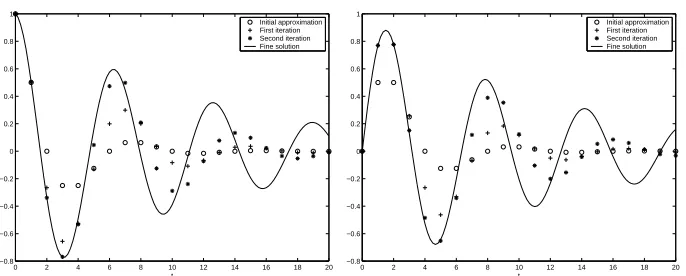
Figure 1. First few iterations of the original parareal algorithm for the model
problemu00=−u.
we find for the n-th coefficientek
n of the functionρk the bound
ek
n≤γα
kβn−k−1(n
k+1) +δ(nn−1)(α+β)n−1.
We thus obtain
||Enk|| ≤C
k+2(∆tp+1+ ∆Tp+1)k+1(1 +C
2∆T)n−k−1(nk+1)
+C∆tp+1n(1 +C2∆T)n−1
≤C1 T
k+1
n
(k+ 1)!e
C2(Tn−Tk+1)∆Tp(k+1)+C
3TneC2Tn∆tp,
(5.12)
which proves the theorem.
Remark 5.4. From Theorem 5.3 we see that at each iteration the accuracy of the method improves,
but it is limited by the accuracy of the method given by the fine propagatorF. More precisely,
the error is bounded by
||Enk|| ≤Ckmax(∆T(k+1)p,∆tp).
6.
Numerical Experiments
We first consider the simple model problem u00 = −u with initial conditions u(0) = 1 and
u0(0) = 0. We transform the equation into a first order system with two components, and perform
the simulations on the time interval [0,20]. We choose for the coarse time step ∆T = 1, and for
the fine time step ∆t= 1/6. In Figure 1, we show the first few iterations of the original parareal
0 2 4 6 8 10 12 14 16 18 20 −0.8 −0.6 −0.4 −0.2 0 0.2 0.4 0.6 0.8 1 t Initial approximation First iteration Fine solution
0 2 4 6 8 10 12 14 16 18 20
−0.8 −0.6 −0.4 −0.2 0 0.2 0.4 0.6 0.8 1 t Initial approximation First iteration Fine solution
Figure 2. Initial approximation and first iteration of the modified parareal
algo-rithm for the model problemu00=−u.
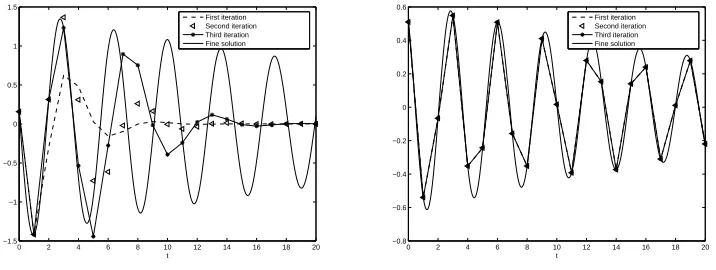
0 2 4 6 8 10 12 14 16 18 20 −1.5 −1 −0.5 0 0.5 1 1.5 t First iteration Second iteration Third iteration Fine solution
0 2 4 6 8 10 12 14 16 18 20 −0.8 −0.6 −0.4 −0.2 0 0.2 0.4 0.6 t First iteration Second iteration Third iteration Fine solution
Figure 3. The first component of the solution for u00+Ku = 0 after the first few iterations of the original parareal algorithm and of the modified algorithm.
In Figure 3, we consider the model problemu00+Ku= 0 withKa random matrix of dimension
100, for the time interval [0,20]. We compare the first component of the solution obtained with the
classical parareal algorithm and with the modified algorithm. We notice again that the classical parareal algorithm converges slowly, and the convergence is better for short time than for long time. In contrast, the modified parareal algorithm converges very rapidly.
In Figure 4, we show the error between the solutions of this system on the time interval [0,5],
obtained with the fine propagator and the parareal method, using first the original parareal algo-rithm and then the modified one, for the first three iterations. We can see that the convergence is significantly improved using the modified parareal algorithm.
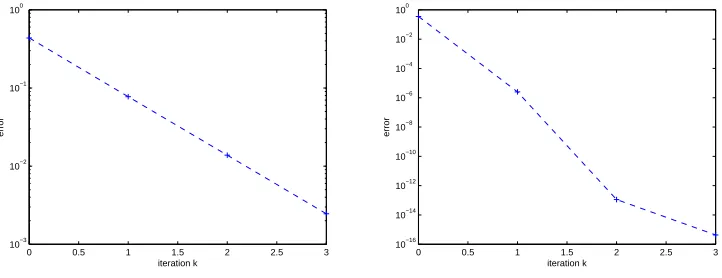
We finally show a comparison for the case of the heat equationut−uxx= 0 with homogeneous
Dirichlet conditions on the spatial domain [0,1], and with a random initial condition. The
time-interval is [0,1]. The modified parareal algorithm also converges faster, as one can see in Figure 5,
where we plotted the error measured in the L∞(0, T, L2)-norm between the fine solution and the
0 0.5 1 1.5 2 2.5 3 100.1
100.3 100.5 100.7
100.9
iteration k
error
0 0.5 1 1.5 2 2.5 3
10−14 10−12 10−10 10−8 10−6 10−4 10−2 100 102
iteration k
error
Figure 4. Error for the classical and the modified parareal algorithm foru00+Ku= 0.
0 0.5 1 1.5 2 2.5 3
10−3
10−2 10−1
100
iteration k
error
0 0.5 1 1.5 2 2.5 3
10−16
10−14
10−12
10−10
10−8
10−6
10−4
10−2
100
iteration k
error
Figure 5. Error for the classical and the modified parareal algorithm, applied to the heat equation.
References
[1] G. Bal,On the convergence and the stability of the parareal algorithm to solve partial differential equations, Domain decomposition methods in science and engineering, Lect. Notes Comput. Sci. Eng., 40, Springer-Verlag (2004), pp. 425–432.
[2] C. Farhat and M. Chandesris,Time-decomposed parallel time-integrators: theory and feasibility studies for fluid, structure, and fluid-structure applications, Internat. J. Numer. Methods Engrg., 58 (2003), pp. 1397–1434. [3] C. Farhat, J. Cortial, C. Dastillung, and H. Bavestrello,Time-parallel implicit integrators for the near-real-time prediction of linear structural dynamic responses, Internat. J. Numer. Methods Engrg., 67 (2006), pp. 697–724.
[4] M. J. Gander and E. Hairer,Nonlinear convergence analysis for the parareal algorithm. Lect. Notes Comput. Sci. Eng., 60, Springer-Verlag (2007), pp. 45–56.
[5] M. J. Gander and S. Vanderwalle,Analysis of the parareal time-parallel time-integration method, SIAM J. Sci. Comput. 29(2) (2007), pp. 556–578.
[6] J.-L. Lions, Y. Maday, and G. Turinici,R´esolution d’EDP par un sch´ema en temps “parar´eel”, C. R. Acad. Sci. Paris S´er. I Math., 332 (2001), pp. 661–668.