Postburn head and neck reconstruction using tissue expanders
Received: 30/4/2013 Accepted: 21/11/2013
Abstract
* Department of surgery, College of Medicine, Hawler Medical University, Erbil, Iraq. Introduction
Tissue expansion is a reliable method of providing additional cutaneous tissue, thereby optimizing contour and color match in a given reconstructive effort.1 In 1957,
Neuman first described the use of gradual tension, leading to the expansion of skin by an inflatable balloon, buried subcutane-ously above the ear.2 After Radovan's
publication in 1982, the technique was rapidly and widely applied to create new dimensions in reconstructive surgery, large studies subsequently confirmed the safety and effectiveness of this technique.3 The
head and neck area contains many specialized tissues that must be matched
appropriately to achieve optimal aesthetic reconstruction. Aesthetic reconstruction is
maximized by mobilization of adjacent local tissues rather than by transfer of distant tissues with poor match of color, texture, or hair-bearing capability.4 Tissue expansion represents one of the major advances in surgery and is particularly applicable to burn reconstruction. The technique provides tissue of similar texture and color to the defect to be covered and has the added advantage of minimal donor site morbidity. In fact, the few disadvantages of tissue expansion include being a two stage procedure, and requiring multiple hospital visits, in addition to the discomfort and period of increased deformity during the period of expansion. Expansion of the scalp is well tolerated and is the only procedure that allows development of Background and objective: Tissue expanders are useful adjuvant in reconstruction after burn. The technique provides tissue of similar texture and color to the defect to be covered and has the added advantage of minimal donor site morbidity. The study aimed to assess the outcome and complications of using tissue expansion for head and neck postburn reconstruction.
Methods: Thirty patients with head and neck burn scar, treated with thirty eight tissue expanders, were included in this prospective study at the Plastic Surgery Department in Rizgari Teaching Hospital in Erbil from April 2009 to November 2012, with the mean age of 14 years. Statistical package for social sciences (SPSS version 18) was used for data entry and analysis.
Results: The commonest use of tissue expander was for treating postburn scar alopecia (18 patients, 60%), followed by postburn cheek scar (six patients 20%). The scar size ranged from 4x10cm to 16x24cm. Complete burn scar excision was possible in 80% of cases with single or multiple sessions of expansion. Early exposure of the expander followed by infection occurred in three cases (10%), which led to interruption of the expansion and expander removal. Satisfactory results were achieved after reconstruction
in 90% of cases.
Conclusion: Tissue expansion, if carefully planned and conducted, is one of the treatments of choice for post-burn reconstruction of the head and neck, allowing an expanded flap suitable for versatile coverage.
normal hair-bearing tissue to cover the areas of alopecia. The lateral facial areas and neck contain essentially the same type of skin. Expansion of the neck can be accomplished to develop a large
Mustarde-type rotation flap for facial reconstruction.5
Expanders are silicon envelops that have self sealing injection ports. At weekly or twice weekly intervals, saline is progres-sively injected through the port and passes into the expander, which enlarges. As the volume inside the implant increases, tension placed on the overlying tissue increases. Expanded tissue arises from two sources: first is recruitment from adjacent tissue and second are two main biological changes in the skin: a- Tissue creep: is the time dependant plastic deformation of any material in response to constant stress, it gradually stretches the skin. b- Stress relaxation: as tissue stretches it relaxes and less force is required to maintain it stretched. The result will be increase in tissue volume through proliferation of epithelial cells, increased epidermal mitotic activity, expansion of the subdermal vascu-lar network, and increased synthesis of collagen by fibroblasts.6 The aim of this study was to assess the outcome and complications of using tissue expansion for head and neck postburn reconstruction.
medical or surgical treatments received by the patient. The outcomes and possible complications have been discussed with the patient. Informed consent was signed by each patient except in children for whom the consent was signed by their responsible adult person. Preoperative photos have been taken, along with measuring defect size, and assessment of remaining scalp or cheek and neck soft tissue, for donor selection. Multiple expanders were decided when the dimen-sions of the defect exceeded 25% of the total hair bearing scalp or combined forehead and cheek defect. All with remote valve system (except in two patients were self-inflating device was used) with differ-ent shapes (rectangular, rounded, helical, or cylindrical). Per-operative antibiotic (Ampiclox) was administered intravenously with induction of general anesthesia for all patients. Flap designed as simple advancement or rotation-advancement flap adjacent to the defect. Expanders were placed through para-lesional incisions in the normal scalp or normal skin 0.5 cm away from the defect. A sub-galeal pocket in scalp and subcutaneous pocket in cheek
and neck slightly larger than the base of the expander was dissected. After expander placement, it was injected with normal saline 10-20% of its actual volume, closed suction drains were put for some of the patients. After meticulous hemostasis, the wound was closed in two layers, galea sutured with 4/0 polyglactin, and the skin with simple interrupted suturing by 4/0 or 5/0 polypropylene. First post operative expansion started two weeks later, with small gauge 25 needle under aseptic conditions and the amount of normal saline injected was guided by tissue response and patient tolerance. The frequency of expansions was once weekly. The amount of expansion achieved was loosely esti-mated by the difference in distances between the base diameter and the over the top distance. When adequate expan-sion achieved, the patient was re-admitted for reconstruction after a period of four Methods
Thirty patients with head and neck burn scar, treated with 38 tissue expanders, were included in this prospective study at Plastic Surgery Department/ Rizgari Teach-ing Hospital in Erbil from April 2009 to November 2012. The age of the patients
ranged from five to 36 years with an average of 14 years. Twenty one patients
were female. The time period between burn injury and reconstruction ranged between
two and 18 years. A detailed history was recorded for each patient including
weeks past the last injection. The expander
was removed by means of the original incision. The flap was next advanced to
ensure adequacy of wound coverage. The scar was then excised and the wound edges were closed with two layer suturing. The Statistical Package for the Social Sciences (version 18) was used for data
entry and analysis. Chi square test of association was used to compare
propor-tions and frequencies. Fisher exact test was used when the expected count of more than 20% of the cells of the table was less than five. P value of ≤ 0.05 was considered a statistically significant.
Ethical considerations: The study proto-col was approved by Research Ethics Committee of the College of Medicine of Hawler Medical University. Informed con-sent was obtained from all adult patients prior to participation in the study. For children below 18 years old, the consent was taken from parents. The purpose of the study was carefully explained to each participant. All selected patients were cooperative and agreed to participate in the study.
Results
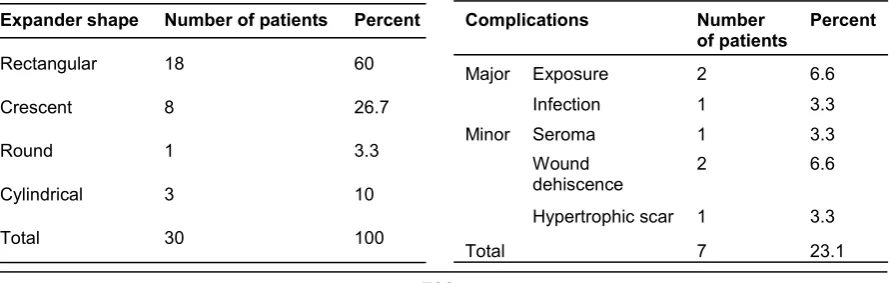
The mean age (±SD) of the patients was 14±6.04 years. Most of them were female (21 patients, 70%). The commonest use of tissue expander was for reconstructing postburn alopecia. Scald was the common-est aetiology of postburn scar (P <0.001) as shown in Table 1. Rectangular shape of expanders were used in 18 patients (60%) as shown in Table 2. Expanders with remote valve were used for 28 patients (93.3%), while self inflating expanders used in only two patients. Various sizes of ex-panders were used (four 100cc exex-panders, four 150cc expanders, twenty four 200cc expanders, and six 300cc expanders). We were able to completely reconstruct 80% of the total patients with single or multiple sessions of expansions. The remaining 20% of the patients have benefited from reduction in the percentage of scar and recreation of anterior hair line. The overall complication rate was 23.1% as shown in Table 3. Major complications occurred in three cases (10%), in which the expansion process was interrupted with removal of
Aetiology Location of the scarScalp Forehead Cheek Neck Diffuse Total p value
Scald 14 2 1 0 0 17 < 0.001
Flame 4 0 5 0 3 12
Hot object 0 0 0 1 0 1
Total 18 2 6 1 3 30
Table 1: Aetiology versus location of postburn scar
Table 2: Shapes of the expanders used
Expander shape Number of patients Percent
Rectangular 18 60
Crescent 8 26.7
Round 1 3.3
Cylindrical 3 10
Total 30 100
Complications Number
of patients
Percent
Major Exposure 2 6.6
Infection 1 3.3
Minor Seroma 1 3.3
Wound dehiscence
2 6.6
Hypertrophic scar 1 3.3
Total 7 23.1
the expander, while minor complications occurred in four cases (13.2%) which did not interrupt the expansion process.
Major comp.
Type of expander/Valve site
p value Subcutaneous
valve
External valve
Self-inflating expander
Total
N % N % N % N %
Yes 0 0 1 3.3 2 6.6 3 10 0.001
NO 23 76.7 4 13.4 0 0 27 90
Total 23 76.7 5 16.7 2 6.6 30 100
Complication% 0 20 100 10
Table 4: Major complications versus type of expander
Discussion
Burn scars often distort and restrict the mobile features of the face. Patients with such facial disfigurement present a consid-erable challenge to the plastic surgeons. To achieve an adequate functional out-come and an improvement in appearance, a large amount of soft tissue is needed.
Full thickness skin grafts and distant flaps are the usual method of coverage of
facial defects. However, the desired results are usually not achieved because of differences in the transplanted tissue, and there is often considerable morbidity at the donor sites. The use of tissue expansion in reconstruction of burns, particularly about the scalp and face, has revolutionized treatment of these patients by allowing
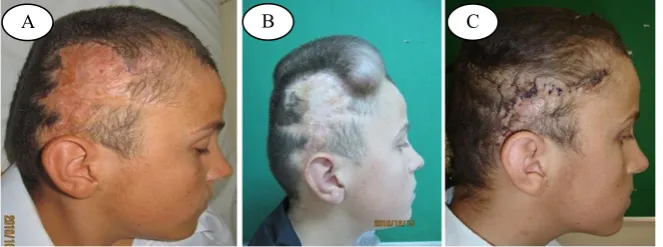
optimal aesthetic reconstruction by use of a similar adjacent tissue to reconstruct a defect without creation of a donor defect.7 Tissue expansion is the ideal procedure for reconstruction of scalp defects and is the only procedure that allows development of normal hair-bearing tissue to cover alope-cia area.8In our study, the commonest use of tissue expander was for reconstructing postburn alopecia, which is in agreement with other studies.9,10 The results of the present series have shown that by tissue expansion we were able to completely reconstruct 80% of the total patients with single or multiple sessions of expansion. The remaining 20% of the patients have benefited from reduction in the percentage of scar and recreation of anterior hair line. Most of these patients could not be easily managed by any of the other conventional reconstructive techniques (Figures 1 to 4).
Figure 1: A- Postburn alopecia B-Crescent expander under the normal scalp, C-Expander removal, scar excision and complete scalp reconstruction
Figure 2: A- Postburn scar of forehead with two expanders inserted on either side of the scar, B- The expanders removed, the scar excised, C- Forehead reconstruction, D- Result after scar maturation, E- Right eye brow reconstruction with hair graft.
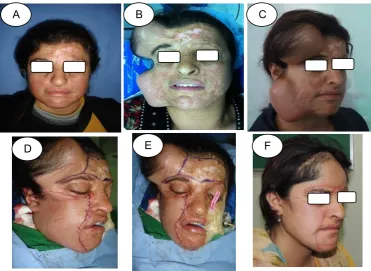
Figure 3: A- Diffuse facial postburn scar, B and C- Right side cheek and forehead expansion, D- Expander removal and right side cheek reconstruction with advancement
flap, E- Marking for excision of forehead scar, F- Tenth post operative day showing reconstruction of right side of cheek and forehead with expanded skin.
A B
C D E
A B C
A B C
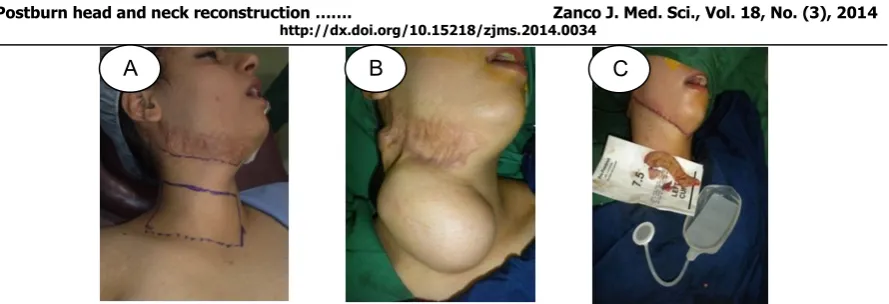
Figure 4: A- Post burn scar of upper neck, marking for expander insertion, B- Tissue expansion completed, C- Expander removal, scar excision, and neck reconstruction.
Our result is comparable to the results achieved by Hudson of 80%.5 It is higher
than that achieved by Bozkurt et al who had completely reconstructed 71.6% of their patients11 but lower than the results of
the study of Youssef Saleh 87.5%12 and
Farhad Hafezi et al which was 90%.13
In our study, rectangular shape of expand-ers were used in 18 patients (60%). Rectangular shaped tissue expanders are preferred in head and neck reconstruction because it provides 40% tissue gain which is much higher than that achieved by round expanders (25%) and crescent expanders (35%). So the added tissue gained by rectangular expanders may increase the
choices possible for flap design as compared to round hemispherical devices.5
The complication rate in our study was 23%; this rate was lower than that of Youssef Saleh (34.75%),12 and Farhad Hafezi et al (27%)13, however; similar result were found with Hudson (25%)5 and Tavares Filho et al (24%).14 Our failure rate (interruption of expansion process) was 10% (three cases). This is lower than that of Hudson (20%),5 comparable to that of Youssef Saleh (13.25%),12 but higher
than that of Farhad Hafezi et al (6%).13 There are different reasons for the above-mentioned complications. Shortage of a specific shape and size of expander for the patients resulted in selecting other available types. The use of self inflating expander was associated with uncontrolled rapid expansion beyond the tolerance of
the overlying soft tissue with resultant
exposure of the expander about one month after insertion in both patients that has been used. Therefore, we preferred the tissue expanders with remote valves for all other patients. Self inflating expanders have not achieved wide acceptance.3,5 Some patients who live very far from our hospital were not able to do all the injections under our supervision leading to increasing the complication rate. Placing the valve externally in five patients was associated with significant infection in one of them which was a mixed infection with staphylococcus aureus and streptococcus pyogenes according to the culture and sensitivity result, which led to interruption of expansion prematurely. This may be explained by entry of microorganism around the tube at its exit from the skin. More than 80% of prostheses with externalized ports were found to have colonized the expander capsule, with some degree of infection present.3 To lower the infection rate in tissue expansion, peroperative antibiotics are recommended, irrigation with an antibiotic solution at the time of placement, placing the valve subcu-taneously, and expansion should proceed with strict aseptic techniques.11,15,16
Conclusion
result and minimal donor site morbidity.
Conflicts of interest
The author reports no conflicts of interest. References
1. Bauer S, Margulis A. The expanded transposition flap: shifting paradigms based on experience gained from two decades of pediatric tissue. Plast Reconstr Surg 2004; 114:98-106.
2. Leighton W, Jhonson M, Frie J. Use of temporary tissue expansion in the treatment of post traumatic scalp alopecia, Plast Recon Surg 1986; 77:737-43.
3. Argenta L, Marks M. Principles of tissue expan-sion. Stephen J. Mathes. Plastic surgery. 2nd
edition. Philadelphia: Saunders-Elsevier; 2006. P. 539-66.
4. Argenta L,Watanabe M, Grabb W. The use of tissue expansion in head and neck reconstruc-tion. Ann Plast Surg 1983; 11:31.
5. Hudson A, Grob M. Optimizing results with tissue expansion:10 simple rules for successful tissue expander insertion. BURNS 2005; 31:1-4. 6. Bauer B. Tissue expansion.In: Beasley RW, Aston
S, Bartlatt S, Gurtner G, Spear S. Grabb and Smith`s plastic surgery. 6th edition. Philadelphia:
Wolters Kluwer/Lippincott Williams & Wilkins; 2007.
7. Foustanos A, Zavrides H. Reconstruction of facial burn sequelae utilizing tissue expanders with embodiment injection site: case report. Acta 2006; 48:5-8.
8. Motamed S, Niazi F, Atarian S, Motamed A. Post-burn head and neck reconstruction using tissue expanders. BURNS 2008; 34:878-84 9. Hudson D, Lazarus D, Silfen R. The use of tissue
expansion in pediatric plastic surgery.Ann Plast Surg 2000; 45(6):589-94.
10. Lasheen E, Saad K, Raslan M. External tissue expansion in head and neck reconstruction. J Plast Reconstr Aesthet Surg 2009; 62(8):251-4.
11. Bozkurt A, Gregor A, Dey D, Vogeler F. Retrospective analysis of tissue expansion in
reconstructive burn surgery: Evaluation of complication rates. BURNS 2008; 34:1113-8.
12. Saleh Y. Scalp reconstruction using tissue expander. Egypt J Plast Reconstr Surg 2004; 28:71-5.
13. Hafezi F, Naghibzadeh B, Pegahmer M. Use of overinflated tissue expanders in the surgical repair of head and neck scars. JPRAS 2008; 20:1-8.
14. Tavares M, Belerique M, Franco D, Porchat A, Franco T. Tissue expansion in burn sequelae repair. BURNS 2007; 33:246-51.
15. Hromadka M, Deschamps J, Sawan K, Elamm C. Delayed development of toxic shock syndrome following abdominal tissue expansion in a pediatric reconstruction patient: case report. Ann
Plast Surg 2010;64(2):254-7.
16. Kotb M, Soliman M. Guidelines to Minimize the
Complications of Tissue Expansion. Egypt J