Najmeh Khodabakhshi1 Gholamreza Soleimani Amiri2*
Abstract
Working capital should be available to any company to have the sufficient funds to cover short-term commitments and operating costs in the future. This guarantees the continuity of the company’s activities. Given the significance of the role of working capital management (WCM) in the companies, the study analyzed the content of texts and studies done in this field, presented three main hypotheses and examined the effect of most of the variables affecting WCM (both external and internal factors of the company), as well as the consequences of WCM in 161 companies listed in Tehran Stock Exchange (TSE) during a seven-year period from 2011 to 2017. The purpose of the study was to determine the most important factor affecting WCM and its consequences.
The hypotheses were tested using multivariate regression and Granger causality test. The hypothesis testing indicated that extra-organizational factors such as gross domestic product (GDP), inflation rate and exchange rate have the greatest effect on WCM. Moreover, hypothesis testing indicated that some intra-organizational factors, such as current ratio, capital expenditures, financial leverage, return on assets, operating cycle, operating profit return, institutional shareholders ownership-percentage, and independence of board of directors affect WCM. Finally, hypothesis testing showed that optimal capital management improves the firms’ performance.
Keywords: cash conversion cycle (CCC), extra-organizational factors, intra-organizational factors, Working Capital Management (WCM)
1 PhD student in accounting, Alzahra University and a lecturer at Payame Noor University
Introduction
WCM is a crucial part of corporate finance management, showing the financial health of the company, connected with profitability and liquidity as well (Sogner, 2014). WCM mostly has to do with current assets management and the development of current liabilities of a business entity. The corporate finance literature usually dwells on long-term financial decisions, mainly including company valuation, investment decisions, cash flow practices, and capital structure (Nazir & Afza, 2009).
Short-term assets and liabilities are significant components of the total assets, thus have to be carefully analyzed (Nazir & Afza, 2009). The concept of working capital includes current assets and current liabilities. Given the significance of current assets and liabilities, a careful and regular review of them is necessary, since they have a vital role in corporate profitability, risk and value (Smith, 1980). Moreover, during this period, when the competition between companies at the global level causes reduction in prices, the companies are in need of cash for development, both abroad and within the organization; their margins are low and have a growing need to invest in new products and technology and debt settlements, all of which shift their attention to WCM as a source of intra-organizational financing of cash as a powerful management tool (Atseye et al., 2015). Thus, efficient and affective WCM is considered as a real competitive advantage (Temtime, 2016). The benefits and significance of WCM are considered as a critical corporate strategy in creating value for shareholders (Deloof, 2003). Hence, companies try to maintain an ideal level of capital management to maximize value (Deloof, 2003; Temtime, 2016; Razid et al., 2018). Moreover, the relevance of WCM can be considered concerning the time spent by financial managers on managing current assets. This is possible by monitoring accounts receivable, cash flow control, negotiation of terms for obtaining credit and short-term financing (Razid et al., 2018). Working capital has to do with decisions made about the structure and the proper value of current assets and how these assets are financed. Thus, the great significance of WCM cannot be ignored (Wasiuzzaman et al, 2013, Hassanpour et al., 2017).
2018; Azim et al., 2015; Onaolapo et al., 2015, Dastgir et al., 2014; Younesi et al., 2013; Bahar Ali et al., 2017; Aaron Kumar, 2013; Hassanpour et al., 2017; Mohammad et al., 2013; Nazir & Afza 2009; Ziriavat, 2009; Rousso, 2013; Azami et al., 2016; Iskandarnejad et al., 2017; Hailou et al., 2016; Dulou et al., 2017; Temtime, 2016; Razid et al., 2018).
The purpose of the study is to determine the most important factor affecting WCM, as well as the most important component WCM affects. In other words, it is the result of WCM. Thus, using texts content analysis, we further divided the factors affecting, and the consequences, and tried to answer the following questions:
1. What are the most important factors affecting WCM? 2. What is the most important consequence of WCM?
In this study, besides the variables discussed in previous studies, the effect of the exchange rate on WCM is examined as well. This variable has not been examined in any of the previous studies.
Theoretical foundations
The concept of working capital includes current assets, as well as current liabilities (Talonpoika et.al, 2016). The difference between current assets and liabilities is known as net working capital; therefore, the main concern of WCM is ensuring a reasonable amount of working capital, so that it does not suffer from deficiencies or surpluses. Working capital is not only insufficient to cover current liabilities, but also a reasonable margin of confidence should be provided to some extent (Razid et al., 2018).
Factors affecting working capital
The working capital of each company is affected by certain factors. It is clear that the difference in the number of these factors in companies will change their working capital accordingly (Elbadry, 2017).
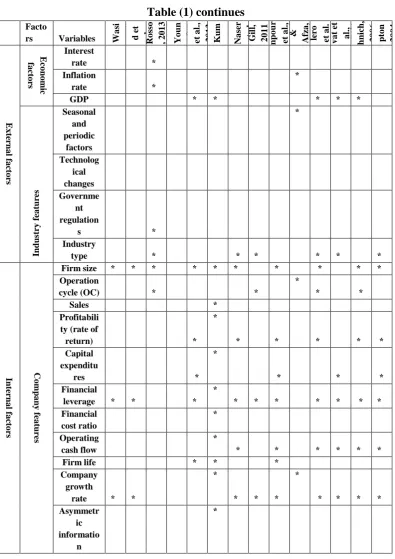
Many studies have been conducted on the factors affecting WCM. Using content analysis of the studies conducted in this regard, most of the factors affecting WCM have been extracted, with a summary of 27 studies conducted in this regard presented as the matrix of theory regarding the factors affecting WCM in Table (1).
Whenever the management of a business entity needs predicting working capital to advance control and management objectives, the above factors affect the amount of working capital of the business entity (Elbadri, 2018; Onaolapo et al. 2015; Hassanpour et al., 2017; Azim et al., 2015; Fatimatozara, 2016; Alipour et al., 2017). The evaluation of working capital should be done correctly, even in small business units whose volume of operations is low (Vazozamen, 2013; Nazir & Afza, 2009; Caballero et al., 2009). We know that working capital is closely connected with the daily operations of the business entity. Any failure in its precise and accurate evaluation can affect the types of business entity operations and may lead to a liquidity crisis and its dissolution (Razid et al., 2018). The inappropriate evaluation of working capital,i.e. overvaluation or undervaluation of working capital, involves some risks (Hailou et al., 2016).
Table 1: The matrix of theory on the factors affecting WCM
Fact ors Variables Elb a d ry 2 0 1 8 H a ss a n p o u r et a l. , 2 0 1 7 Ba h a r Ali et a l. , 2 0 1 7 Alip o u r et a l. 2 0 1 7 Fa tim a to za ra , 2 0 1 6 Az a m y e t a l. 2 0 1 6 O se if u a h (2 0 1 6 ) Ats ey e et a l 2 0 1 5 Ana lt o lepo et a l. , 2 0 1 5 Az im et a l. , 2 0 1 5 Q a li b a f As l et a l. , 2 0 1 4 Anv a ri et a l. , 2 0 1 4 H o ss e in i et a l. 2 0 1 4 Da stg ir e t a l. , 2 0 1 4 Ex tern al fa cto rs Eco n o m ic fa cto rs Interest rate * * Inflation rate *
GDP * * * * * *
Governm ent regulatio
ns
Industry type
* * * * * *
In
tern
al
fa
cto
rs
Co
m
p
an
y
fe
atu
re
s
Firm size * * * * * * * * Operatio
n cycle (OC)
*
Sales * *
Profitabil ity (rate of return)
* * * * * * * * *
Capital expenditu
res
* * * * * * *
Financial leverage
* * * * * * * *
Financial cost ratio
* *
Operatin g cash
flow
* * * * * * * * *
Firm life * *
Company growth
rate
* * * * * * * *
Asymmet ric informati
on Company
being internatio
nal
*
Current ratio
*
The structure
of the board
* * * *
Institutio nal ownershi
p
Separatio n of the post of
the chairman
of the board
* *
Governm ent influence
and ownershi
p
*
Board size
* *
Corporat e credit
policy
*
Productio n volume
Dividend policy
*
Amortiza tion policy
Credits of the banks
and credit institutio
ns
Table (1) continues
Facto
rs Variables Wa
si
u
zz
a
man 20
1 3 Mo h a m m a d e t a l. , 2 0 1 3 Ro ss o , 2 0 1 3 Yo u n
esi et al.
, 2 0 1 3 Va ez et a l. , 2 0 1 3 Aa ro n K u m a r 2 0 1 3 K a m a l Na se r et. a l 2 0 1 3 G il l, 2 0 1 1 H a ss a n p o u r et a l. , 2 0 1 1 Na
zir &
A fz a , 2 0 0 9 Ca b a l ler o et a l. 2 0 0 9 Ziry a v a t et a l. , 2 0 0 9 K ies c h n ich, 2 0 0 6 H a m p to n 2 0 0 4 Ex te rn a l fa cto rs Ec o n o m ic fa cto rs Interest rate * Inflation
rate *
*
GDP * * * * *
Ind u str y fe a tu re s Seasonal and periodic factors * Technolog ical changes Governme nt regulation
s *
Industry
type * * * * * *
Inter n a l fa cto rs Co m p a n y fe a tu re s
Firm size * * * * * * * * * *
Operation
cycle (OC) * *
*
* *
Sales *
Profitabili ty (rate of
return) *
*
* * * * *
Capital expenditu
res *
*
* * *
Financial
leverage * * *
* * * * * * * * Financial cost ratio * Operating cash flow * * * * * * *
Firm life * * *
Company growth
rate * *
Company being internatio
nal Current
ratio * The structure
of the board
*
*
* *
Institution al ownership
* *
Separatio n of the post of the
chairman of the board
* *
Governme nt influence
and ownership
*
Board size * *
Corporate credit
policy *
*
Productio
n volume *
Dividend policy
*
*
Amortizat
ion policy *
*
Credits of the banks and credit institution
s *
The consequences of WCM
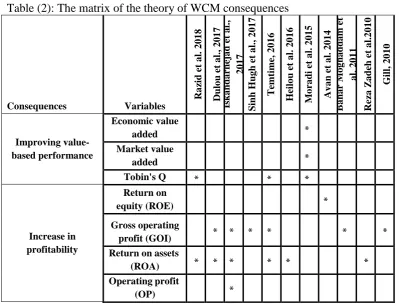
Many studies have been conducted on the consequences of WCM. Using the content analysis of studies conducted in this regard, we extracted the majority of the cases. A summary of the 10 studies conducted in this regard is given in table 2 as the matrix of the theory of the consequences of WCM.
Table (2): The matrix of the theory of WCM consequences
Consequences Variables
Ra zid et a l. 2 0 1 8 Dulo u e t a l. , 2 0 1 7 Is ka n da rnej a d e t a l., 2017 Sin h H ug h e t a l., 2 0 1 7 T emt ime, 2 0 1 6 H eilo u e t a l. 2 0 1 6 M o ra di et a l. 2 0 1 5 Av a n e t a l. 2 0 1 4 B a ha r M o g ha dd a m e t al . 2 0 1 1 Rez a Z a deh e t a l.2 0 1 0 G ill, 2 0 1 0 Improving value-based performance Economic value
added *
Market value
added *
Tobin's Q * * *
Increase in profitability
Return on
equity (ROE) *
Gross operating
profit (GOI) * * * * * *
Return on assets
(ROA) * * * * * *
Operating profit
(OP) *
Sagan theory (1955) on working capital supports the idea that WCM and liquidity and profitability goals must have an inextricable relationship with each other. He believes that the goal of WCM should be to support the growth and stability of the company, which stresses cash management and indicates that since liquidity power from other components of working capital is more important, it needs stronger and more effective management.
Smith (1980) found that WCM is a very important issue, as it profoundly affects profitability and risk, and subsequently the firm‟s value. He also found that WCM faces problems that exist in managing current assets, current liabilities and the relationship between them.
Deloof (2003) found that all studies done in small and large companies try to find the factors in these companies to identify the strong relationship between WCM and profitability. Moreover, he stated that companies with high profitability need less time to pay their debts, and vice versa. Thus, a weak management that reduces profits definitely takes more time to pay off debts. According to his results, the way the working capital is managed by and controlled greatly affects the company's profitability. These results show that to maximize returns and profits, a certain level of working capital is needed.
Previous thematic literature has concluded that a company can improve its ROI by shortening its CCC (e.g., Dilov, 2003; Viscari et al., 2011; Hailo et al., 2016; Doldo et al., 2017; Temtime, 2016).
Several major statistical studies have revealed a negative relationship between CCC and relative profitability (e.g., Dilov, 2003; Viskari et al., 2011; Hailou et al., 2016; Dulou et al., 2017; Temtime, 2016; Razid et al., 2018). Some studies have claimed that companies can increase their sales by acquiring heavy credits and increase their service levels with more inventories (Blinder and Machini, 1991; Dilov and Jegers, 1996; Shah, 2016). However, the positive effects of working capital in the high values are neglected in the traditional view, and it is claimed that working capital increases investment and reduces profitability.
cash leads to non-implementation of the obligations of the company in a timely manner, or the maintenance of inadequate inventory may lead to the loss of sales or customer satisfaction (Dilov, 2003). Thus, for many companies, WCM is one of the significant issues in financial management, and managers can maintain the value of the company by maintaining the optimal level of working capital (Mohammadi, 2009).
Background
Caballero et al. (2014) examined WCM, the firm's performance and the financial constraints of British companies from 2001 to 2007. The results showed a positive and significant relationship between working capital and the firm's performance. The results showed that managers create value for the stockholders by reducing their working capital. Moreover, companies maintain an optimal level of investment in working capital, which is a balance between the cost and benefits of maintaining working capital, which ultimately leads to maximizing the corporate's performance. Moreover, their results show that this optimal level is lower in companies with higher financial constraints.
Soykan and Ulucak (2016) tested the nonlinear relationship between the working capital and performance in Istanbul Stock Exchange (Borsa Istanbul). The sample of this study includes non-financial corporations and their time period from 2009 to 2014. The result showed that the working capital includes an optimal level that maximizes the firm's value.
Khan et al. (2016) studies the relationship between WCM and the financial constraints with performance of Pakistani companies from 2005 and 2014. Their results showed that the companies with more financial constraints have less net business cycle. Moreover, managers try to maintain an optimal level of working capital to optimize the company's performance, so that investing in working capital is higher than the optimal point has a negative effect on profitability.
capital compared to other companies. Furthermore, there is no significant relationship between the firm's size and the company's working capital.
Alipour et al. (2017) explained the factors related to WCM of companies listed in Tehran Stock Exchange during 2010-2015. The results showed a negative and significant relationship between the operating cash flow, total sales of the company, the financial leverage, and the firm's size with CCC.
Bahar Ali et al. (2017) studies the effect of corporate governance on the efficiency of WCM in Pakistani manufacturing companies, using a causal correlation research project and a sample of 62 manufacturing companies listed in Pakistan Stock Exchange in three years from 2014 to 2016. The results show that the audit committee, board size and gender effect improve working capital. Hassanpour et al. (2017) determined the factors effective in WCM in cement companies listed in Tehran Stock Exchange. The results showed a positive and significant relationship between corporate growth, liquidity and industry type. There are no signs to affect the accuracy, moderation, and GDP growth.
Elbadry (2018) investigated the main factors affecting WCM in small companies. He also examined the relationship between the main factors of WCM. In addition, he studied the effect of WCM and the profitability with capital structure of small and medium-sized enterprises (SMEs). The sample included information of 138 SMEs working in Egypt, funded by the Egyptian National Bank from 2010 to 2013. The results showed a negative and significant effect of the profitability and leverage of small companies on working capital.
Hypotheses:
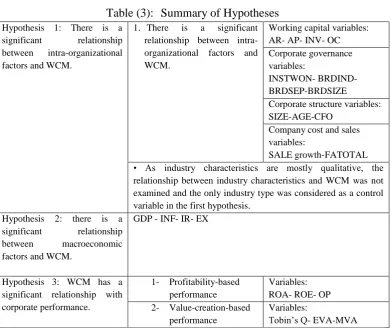
Hypothesis 1: There is a significant relationship between intra-organizational factors and WCM.
Hypothesis 2: there is a significant relationship between macroeconomic factors and WCM.
Table (3): Summary of Hypotheses
Working capital variables: AR- AP- INV- OC 1. There is a significant
relationship between intra-organizational factors and WCM.
Hypothesis 1: There is a significant relationship between intra-organizational factors and WCM.
Corporate governance variables:
INSTWON- BRDIND-BRDSEP-BRDSIZE
Corporate structure variables: SIZE-AGE-CFO
Company cost and sales variables:
SALE growth-FATOTAL • As industry characteristics are mostly qualitative, the relationship between industry characteristics and WCM was not examined and the only industry type was considered as a control variable in the first hypothesis.
GDP - INF- IR- EX Hypothesis 2: there is a
significant relationship
between macroeconomic
factors and WCM.
Variables: ROA- ROE- OP 1- Profitability-based
performance Hypothesis 3: WCM has a
significant relationship with
corporate performance. Variables:
Tobin‟s Q- EVA-MVA 2- Value-creation-based
performance
Methodology
The study was applied regarding the purpose; it was a correlation analysis in terms of subset methods, where multivariate regression model and Granger causality test were used to determine the relationship and select the variables affecting WCM and its outcomes.
Population and sample:
The population was the companies listed in Tehran Stock Exchange. Sampling was not done in this study, and only the companies with the following qualifications are selected as the sample:
• Investment companies and banks were excluded from the population given their special circumstances and structural differences with other companies (e.g., the impossibility of calculating the growth rate).
• The firms with fiscal years ending at a date other than March 20th
, as well as the ones changing their fiscal years during the years examined, were excluded. • The firms without appropriate data for analysis for reasons such as lack of trade throughout the year, temporary ticker closures, delisting from the stock exchange, and so on were excluded from the study.
According to the above points, 161 companies from 17 different industries were selected as the final sample.
Data collection method
When the subject of the study is selected and its type is determined according to the purpose, first the operational definition of the variables should be presented according to the literature and then the research variables should be measured. Data collection methods are divided into two categories: field and library. Library method was used for data collection regarding the literature, and field method for collecting information to confirm or reject the hypotheses.
The studied variables
Table (4): Research variables
Row Variable Abbreviation Measuring method
1 Duration of receipt
of the claims AR
(Accounts receivable * 365) divided by sales
2 Period of inventory
turnover INV
(Inventory of goods * 365) divided by the cost of the sold goods
3 Debt repayment
period AP
(Payable accounts * 365) divided by the cost of sold goods
4 Cash cycle CCC AR+INV-AP
5 GDP GDP Announced by the Central Bank
6 Inflation rate INF Announced by the Central Bank
7 Interest rate IR Announced by the Central Bank
8 Change in
exchange rate EX
Announced by the Central Bank
9 Institutional shareholders ownership-percentage
INSTOWN
The stock size of institutional investors divided by the total number of shares issued and sold by the company in the market
10 Independence of
board members BRDIND
The ratio of non-executive directors to the entire board of directors
11 Separation of the post of CEO and the head of the
board
BRDSEP
If the CEO is the head of board of directors, the variable gets 1, otherwise zero.
12 Board size BRDSIZE Number of board members
13 Firm size SIZE Natural logarithms of assets
14 Operation cycle OC AR+INV
15 Capital
expenditures CAPEX
The ratio of total fixed assets to sales
16 Financial leverage LEV Total debt to total assets
17 Operating cash flow CFO Operating cash flows to total sales 18 Company age AGE Natural logarithm of firm life 19
Company growth rate
GROWTH
The proportion of the current year's sales minus the previous year to the previous year
20 Current ratio CR Current assets divided by current liabilities 21 Financial cost ratio FATOTA Financial costs divided by total assets
22 Industry type INDUSTRY
23 Return on assets ROA Net profit to total assets 24 Return on equity ROE Net profit divided by equity
25 Operating profit OP Gross profit divided by non-financial assets
26 Tobin's Q
Row Variable Abbreviation Measuring method 27 Economic value
added EVA
Total capital used * (Average cost of capital - return on capital)
28
Market value added MVA
Total capital used - market value of the company
Table (5) shows the descriptive statistics of variables.
Table (5): Descriptive statistics of the variables
Row Abbreviating Mean Standard deviation
1 AR 158.67 138.15
2 INV 155.24 120.05
3 AP 131.85 193.13
4 CCC 159.64 663.21
5 GDP 1.434 1.274
6 INF 18.971 9.530
7 IR 17.428 3.065
8 EX 12595.56 3935
9 INSTOWN% 0.792 1.440
10 BRDIND% 0.696 0.852
11 BRDSEP% 0.658 0.918
12 BRDSIZE% 5.18 0.59
13 SIZE 0.214 0.671
14 OC 336.17 279.05
15 SEX 0.9054 1.925
16 LEV 0.604 0.229
17 CFO 0.819 3.291
18 AGE 27.313 15.748
19 SALE GROWTH 1.686 8.614
20 CR 1.402 0.797
21 FATOTA 0.814 1.036
22 INDUSTRY 9.683 5.025
23 ROA 10.428 14.294
24 ROE 26.25 35.22
25 OP 0.44 0.87
26 Tobin’s Q 0.29 0.41
27 EVA 10098.66 9120.15
Data analysis and description
The methodology used in the study was descriptive-analytic. The causal relationships between variables are examined using statistics and figures to adapt accounting theories to the community's realities. After matching with the theories, using the inferential statistics and the panel regression method in EViews software, the rejection or confirmation of the hypotheses are evaluated.
Empirical model - regression model
Given the theoretical discussion and considering the empirical studies on WCM, the factors affecting it and its consequences in this research, the extent and the existence of the effect of factors on WCM will be estimated in two separate parts considering intra-organizational and macroeconomic factors. Concerning the consequences of WCM, it is better to examine the mutual explanatory power between performance, profitability, and WCM within the framework of Granger causality test. However, given the type of data, it is needed that the future estimates be made according to the appropriate methods of this type of data. Thus, in the first stage, the needed tests should be done using panel data and then the regressions related to the first and second hypotheses should be estimated.
The results of F Limer and Hausman tests concerning the regressions related to the first and second hypotheses
F Limer test can be turned to for selecting the heterogeneity of units. If the heterogeneity of the units is verified, the model is estimated using panel data; otherwise, pooled OLS method is used. Firstly, the necessity of panel data was tested for model estimation by F statistic with the results showing the rejection of the null hypothesis and the necessity of using the panel data method for the model. Additionally, Hausman test was calculated for selecting the method of estimating the fixed effects or random effects, the results of which depict the use of the fixed effect method.
Table (6): F Limer test results: intra-organizational variables
4.098 F statistics
0.000 prob
Panel data Estimation status
Table (7): F Limer test results - macro variables
7.814 F statistics
0.000 prob
Panel data Estimation status
The table results showed the rejection of the null hypothesis in Limer test and the existence of inconsistency of the cross-sections at 5% significance level, showing the suitability of the data panel for estimating the model.
Hausman test:
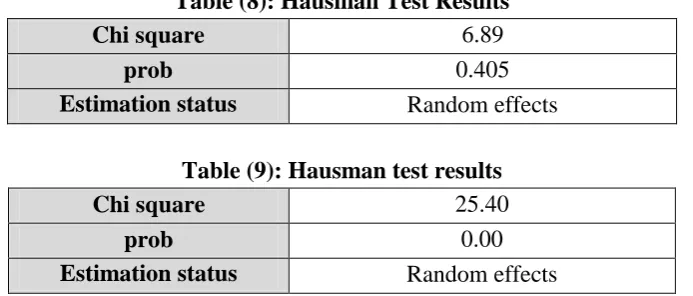
As stated, the main idea of Hausman test is to compare two effects of constant effects and random effects. The result of this test for the research data is presented in Tables (8) and (9):
Table (8): Hausman Test Results 6.89 Chi square
0.405 prob
Random effects Estimation status
Table (9): Hausman test results 25.40 Chi square
0.00 prob
Random effects Estimation status
Testing the first hypothesis
The regression of the intra-organizational variables is defined as follows, concerning the available literature and the removal of the variables showing a complete co-linearity relationship: ) Elbadry, 2018, Hassanpour et al.,2017, Fatimatozara, 2016, Atseye et al. ,2015, Azim et al., 2015, Onaolapo et al., 2015, Mohammad et al., 2013, Gill, 2011,)
Table (10) Dependent Variable: CCC
Method: Panel EGLS (Cross-section random effects) Sample: 2011-2017
Periods included: 7 Cross-sections included: 161
Total panel (unbalanced) observations: 1106
Swamy and Arora estimator of component variances
Variable Coefficient Std. Error t-Statistic Prob.
CFO 0.08 4.22 0.02 0.98
CR -46.31 23.38 -1.98 0.05
CAPEX -78.07 8.19 -9.53 0.00
LEV -170.90 89.29 -1.91 0.06
OC 1.69 0.09 18.56 0.00
ROA 0.52 1.31 2.39 0.00
SALEGROWTH 0.59 1.57 0.38 0.71
SIZE -36.16 23.70 -1.53 0.13
AGE 1.19 3.85 1.05 0.72
FATOTA 2.13 15.94 1.44 0.56
INDUSTRY -4.51 3.93 -1.15 0.25
OP 0.567 0.2207 2.235 0.025
INSTWON 0.11 0.03 1.93 0.04
BRDIND 0.20 0.01 2.25 0.01
BRDSEP -0.56 7.75 -1.07 0.44
BRDSIZE -5.44 15.26 -0.36 0.72
C 1287.53 4549.71 0.28 0.78
Effects Specification
S.D. Rho
Cross-section random 77.92219 0.0309
Idiosyncratic random 436.5898 0.9691
Weighted Statistics
R-squared 0.527276 Mean dependent var 144.0025
The result of testing hypothesis 1:
Among 16 variables concerned, only 8 variables are evaluated as significant on WCM. To describe precisely, current ratio, capital expenditures, financial leverage, return on assets, operating cycle, operating profit return, institutional shareholder ownership, and the independence of the board of directors were considered effective in WCM. However, the financial leverage was significant at 10% error level. The result of this part of the hypothesis testing is in line with the results of Vazozamen (2013), Hassanpour et al. (2017), Mohammad et al. (2013), Fatimatozara (2016), Atseye et al. (2015), Gill (2011), Elbadry (2018) Azim et al. (2015), Onaolapo et al. (2015) and Dastgir et al. (2014). The rest of intra-organizational variables were considered insignificant. Operating cash flow, the sales growth rate, the ratio of financial costs, firm's size, firm's life, the type of industry, the post of the head of the board, and the size of the board have no effect on CCC. The result of this part of hypothesis testing is in line with those of Vazozmen (2013), Fatimatozara (2016), Atseye et al. (2015), Elbadry (2018), Anaolpo et al. (2015), Dastgir et al. (2014), Younesi et al. (2013), And Bahar Ali et al. (2017).
The coefficient of determination of this regression is 52%, and concerning the type of panel data, this percentage of explanation is considered desirable .
Testing the second hypothesis:
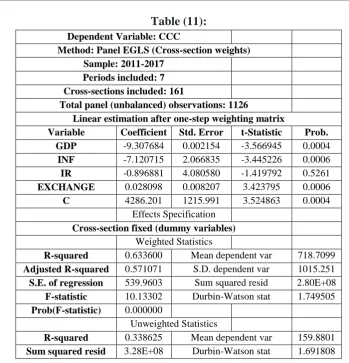
To distinguish the effect of macroeconomic variables on WCM, it was necessary to define another regression by assuming these variables as the explanatory variable. The following regression was defined to determine the second hypothesis: (Alipour et al., 2017, Oseifuah, 2016, Rosso, 2013, Aaron Kumar 2013, Ziryavat et al., 2009, Kieschnich, 2006)
Table (11): Dependent Variable: CCC
Method: Panel EGLS (Cross-section weights) Sample: 2011-2017
Periods included: 7 Cross-sections included: 161
Total panel (unbalanced) observations: 1126
Linear estimation after one-step weighting matrix
Variable Coefficient Std. Error t-Statistic Prob.
GDP -9.307684 0.002154 -3.566945 0.0004
INF -7.120715 2.066835 -3.445226 0.0006
IR -0.896881 4.080580 -1.419792 0.5261
EXCHANGE 0.028098 0.008207 3.423795 0.0006
C 4286.201 1215.991 3.524863 0.0004
Effects Specification Cross-section fixed (dummy variables)
Weighted Statistics
R-squared 0.633600 Mean dependent var 718.7099 Adjusted R-squared 0.571071 S.D. dependent var 1015.251 S.E. of regression 539.9603 Sum squared resid 2.80E+08 F-statistic 10.13302 Durbin-Watson stat 1.749505 Prob(F-statistic) 0.000000
Unweighted Statistics
R-squared 0.338625 Mean dependent var 159.8801 Sum squared resid 3.28E+08 Durbin-Watson stat 1.691808
Test result of testing the second hypothesis:
Three other variables are considered significant at error level of 1%. The coefficient of determination obtained in this regression means that three variables can account for 57% of the changes in WCM.
Testing the third hypothesis
The third hypothesis tries to examine the consequences of WCM on the profitability and improving corporate performance. In testing the third hypothesis, it should be noted that the profitability and performance variables in companies can explain and partly predict WCM (Razid et al., 2018). Thus, making unilateral regressions with WCM as an independent variable is not evaluated to be suitable. Given the existence of two-way relationship between the profitability and corporate performance with WCM, using Granger causality test was seen better to examine the existence of a causal and two-way causality relationship between the variables. The advantage of the above causality test is the ability to examine the existence of this two-way relationship. Granger causality test was done for the study variables and the results are presented in Table (12).
Table (12): Granger Test Results Pairwise Granger Causality Tests
Sample: 1390 1396 Lags: 3
H0:
Observatio n
F-Statstic Prob. CR is not the Granger causality of CCC 844 3.17299 0.0238 CCC is not the Granger causality of CR 4.0044 0.0077
OC does not Granger Cause CCC 644 575.91 0.0000
CCC does not Granger Cause OC 20.972 0.0138
ROA does not Granger Cause CCC 644 4.30885 0.0051
CCC does not Granger Cause ROA 4.22921 0.0436
ROE does not Granger Cause CCC 643 2.10835 0.0979
CCC does not Granger Cause ROE 1.0431 0.3729
EVA does not Granger Cause CCC 624 0.3104 0.9777
CCC does not Granger Cause EVA 77.358 0.002
MVA does not Granger Cause CCC 644 1.1675 0.1545
The result of testing hypothesis 3:
The results of the Granger causality test show that return on asset, operating cycle, and current ratio have a two-way
relationship with WCM. In other words, these variables have both the ability to affect the cash cycle and are affected by it. The
variable return on assets shows the two-way relationship between the time taken for receivables, and this two-way relationship can be attributed to the two-way relationship with WCM. The operation cycle has two-way relationship with the turnover period of the inventories, and finally the return on assets with the return on equity shows a two-way causal relationship. We must consider the variables that the working capital management is their Granger causation. In other words, variables with the probability of F statistics less than 5% are considered as variables influenced by WCM. Thus, current ratio, return on assets, operating cycle, economic value added, operating profit
OP does not Granger Cause CCC 642 1.0632 0.4182
CCC does not Granger Cause OP 9.5307 0.0438
Q-Tobin does not Granger Cause CCC 643 0.8168 0.7053
CCC does not Granger Cause Q-Tobin 9.4930 0.0414
ROE is not the Granger causality of AR 804 0.75126 0.4721 AR is not the Granger causality of ROE 0.03622 0.9644 OC is not the Granger causality of AR 805 4.10147 0.0169
AR is not the Granger causality of OC 1.78942 0.1677
and Tobin's Q are the variables that affect the cash cycle or WCM. This is consistent with the results of Iskandarnejad et al. (2017), Hailo et al. (2016), Dulou et al. (2017), Temtime (2016) and Razid et al. (2018).
Conclusion:
WCM results from an important concept in organizing, indicating that many financial managers try to identify the appropriate levels and drivers of working capital (Santano et al., 2004). According to the theoretical foundations and the significance of the role of WCM in companies, the study analyzed the content of the texts and studies done in this field, presented three main hypotheses and examined the effect of most of the variables affecting WCM (both external and internal factors of the company), as well as the consequences of WCM in 161 companies listed in Tehran Stock Exchange during a seven-year period from 2011 to 2017.
By analyzing the contents of the texts and studies done in this regard, the study divided the factors affecting WCM into two groups of external and internal factors. The external factors were macroeconomic factors and industry-specific characteristics, and internal factors were corporate governance mechanisms and some company-specific features, including financial ratios.
The first hypothesis examined the relationship between the internal factors of the company and industry type with WCM. The result of testing the first hypothesis showed that only 8 intra-organizational variables significantly affect WCM. More precisely, current ratio, capital expenditures, financial leverage, return on assets, operating cycle, operating profit return, institutional shareholder ownership, and the independence of the board of directors were considered effective in WCM. The result of testing the first hypothesis is in line with the results of Vazozamen (2013), Hassanpour et al. (2017), Mohammad et al. (2013), Fatimatozara (2016), Atseye et al. (2015), Gill (2011), Elbadry (2018) Azim et al. (2015), Onaolapo et al. (2015) and Dastgir et al. (2014). The rest of intra-organizational variables were considered insignificant. More precisely, operating cash flow, the sales growth rate, the ratio of financial costs, firm's size, firm's life, the type of industry, separation of the position of the chairman of the board, and the size of the board have no effect on CCC. The result of this part of hypothesis testing is in line with those of Vazozmen (2013), Fatimatozara (2016), Atseye et al. (2015), Elbadry (2018), Anaolpo et al. (2015), Dastgir et al. (2014), Younesi et al. (2013), And Bahar Ali et al. (2017).
and the rate of price growth (inflation) have a significant relationship with WCM. The symbol of the coefficient of both variables is estimated as negative showing the reduction effect of these two explanatory variables on WCM. The result of testing this hypothesis are in line with those of Aron Kumar (2013), Hassanpour et al. (2017), Mohammed et al. (2013), Nazir and Afza (2009), Ziryavat (2009), Rousseau (2013), Elbadry (2018), Azami et al. (2016), and Anaolpo et al. (2015). The exchange rate has a positive and significant effect. Only interest rate was insignificant that is in line with those of Anaolpo et al. (2015) and Rousseau (2013).
The third hypothesis tried to examine the consequences of WCM on the profitability and improvement of corporate performance, which was examined using Granger causality test. The results show that current ratio, return on assets, operating cycle, economic value added, operating profit return, and Tobin's Q are the variables affecting the cash cycle or WCM. This is in line with the results of the studies by Iskandarnejad et al. (2017), Hailo et al. (2016), Dulou et al. (2017), Temtime (2016) and Razid et al. (2018).
References:
Ali, S., & Khan, M. (2011). Searching for Internal and External Factors that Determine Working Capital Management for Manufacturing Firms in Pakistan. African Journal of Business Management, 5(7), 2942-2949.
Alipour, H.R., Nami, M. (2017), Factors Affecting WCM, Case Study of Listed Companies in the Stock Exchange, 9th International Conference on Economics and Management.
Anvari Rostami; A. A.; Sajadpoor , R. & yaballuei, M. (2014). An Investigation of the Determinants of Working Capital Management in Tehran Stock Exchange (TSE). Journal of Financial Accounting Research, 6(1), 15-26. [In Persian]
Arunkumar.O.N. and T. Radharamanan,(2013), Factors affecting working capital management of Indian manufacturing firms, Int. J. Managerial and Financial Accounting, Vol. 5, No. 4,
Atseye, Fidel Anake, Ugwu J.K. Takon S.M. .(2015), Determinants Of Working Capital Management, Theoretical Review, International Journal of Economics, Commerce and Management, Vol. III, Issue 2.
Awan, A.GH., Shahid P., Hassan J., Ahmad W., (2014), Impact Of Working Capital Management On Profatibility Of Cement Sector In Pakistan, International Journal of Business and Management Review, Vol.2, No.4, pp.1-20 .
Azami,Z.,Jeyhoon TABAR F.,(2016), Investigating the Factors Affecting Working Capital of Companies Using the Generalized Method of Moments, Bulletin de la Société Royale des Sciences de Liège, Vol. 85, p. 1402 - 1415 1402.
Azeem,M.M. & Akin Marsap,(2015), Determinant Factors and Working Capital Requirement, International Journal of Economics and Finance; Vol. 7, No. 2;
Bahar. Ali, Said .Shah (2017), The Impact Of Corporate Governance On Working Capital Management Efficincy, City University Research Journal ,Volume 07 Number 02 July 2017 PP 272-284
Bahar Moghaddam, M., Yazdi, Z., Yazdi, S. (2011). The Effects of WCM on Profitability of Companies Accepted in Tehran Stock Exchange, Management Accounting Magazine, 10, pp. 63-75. [In Persian]
Caballero, B.S., Garcia-Teruel, P. J., & Martinez-Solano, P. (2009). How do market imperfections affect working capital management?
Caballero, S., García-Teruel, P. J., & Martínez-Solano, P. (2012). How does working capital management affect the profitability of Spanish SMEs?. Small Business Economics, 3: 1-13
Caballero, S. B., Teruel, P. G., & Solano, P. M. (2014). Working capital management, corporate performance and financial constraints. Journal of Business Research, 67(3): 332-338
Dastgir, M., Honarmand, M. (2014). Investigating the Effect of Corporate Governance Mechanisms on the Efficiency of WCM, Journal of Science. Management Accounting Research, seventh year, number twenty-second, pp. 69-88. [In Persian]
Deloof, M. (2003). Does Working Capital Management Affect Profitability of Belgian Firm? Journal of Business, Finance and Accounting, 30, (3&4): 573- 587.
Dulou, M., Bastami, F., Tehrani, M.H. (2017). WCM and Profitability in the Economic Period, Monetary Economic Research, Financial Times New Year, Year 24, No. 14. [In Persian]
Elbadry, Ahmed, (2018), The Determinants of Working Capital Management in the Egyptian SMEs, Accounting and Finance Research Vol. 7, No. 2
Fatimatuzzahra.M,Retno Kusumastuti (2016), The Determinant of Working Capital Management of Manufacturing Companies, MIMBAR, Vol. 32, No. 2nd, pp. 276-281 Gill, A., Biger, N., & Mathur, N. (2010). The Relationship Between Working Capital Management And Profitability: Evidence From The United States. Business and Economics Journal, 1–9. http://astonjournals.com/manuscripts /Vol2010/BEJ-10 _Vol2010.pdf
Gill, A. (2011). Factors That Influence Working Capital Reqirment in Canada. Economics and Finance Review, 1 (3), 30-40.
Hailu A.Y., Venkateswarlu P.,(2016), Effect of working capital management on firms profitability evidence from manufacturing companies in eastern, Ethiopia, International Journal of Applied Research ; 2(1): 643-647
Hampton John; Warren (2004), Translation and Compilation of Hamid Reza Vakili Fard and Masoud Vakili Fard, Forest Publishing, Sixth Edition. [In Persian]
Hasanpor, A., Mohammad Zadeh, M., Mansoori, E., (2017), The Effective Factors on Working Capital Management of Accepted Companies in Tehran Stock Market (Case Study: Cement Industry), Palma Journal , V.16, I.3, 135-143.
Iskandarnejad,S., Hassanzadeh Baradaran,R., Taheri,H.,(2018), The impact of working capital management on Listed companies profitability in business cycles based on the output gap, Journal of Asset Management and Financing. [In Persian]
Kamal Naser, Rana Nuseibeh, Ahmed Al-hadeya, (2013), Factors Influencing Corporate Working Capital Management: Evidence From An Emerging Economy, Journal of Contemporary Issues in Business Research, Vol. 2, No. 1, 11-30.
Khan, N., Akbar, M., & Akbar, A. (2016). Does an optimal working capital exist? The role of financial constraints. Research Journal of Finance and Accounting, 7(9): 131-136
Kienschnick, R. LaPlante, M. & Moussawi, R. (2006). Corporate Working Capital Management: Determinants and Consequences. [Online] Available: http://www.fma.org/SLC/Papers/cwcmf_ fma.pdf
Mohamad, Nor Edi Azhar and Elias, Siti Balqis (2013) An Assesment on Determinant of Working Capital Management from Malaysian Public Listed Companies. International Journal of Academic Research Science, Vol. 3, No. 4. in Accounting, Finance, and Management.
Mohammadi, Mohammad (2009), Effect of Working Capital Management on Profitability in Companies Acquired in Tehran Stock Exchange, Management Quarterly, No. 14, 91-80. [In Persian]
Acquired in Tehran Stock Exchange, Journal of Management and Finance, Third Year, Second Issue. [In Persian]
Nazir, M., & Afza, T. (2009). Impact of Aggressive Working Capital Management Policy on Firms‟ Profitability. The IUP Journal of Applied Finance, 25(8), 19-30.
Onaolapo, A. A, Kajola, S.O. , (2015), What are the Determinants of Working Capital Requirements of Nigerian Firms?, Research Journal of Finance and Accounting, Vol.6, No.6,
Oseifuah, Emmanuel, (2016), Determinants of Working Capital Requirements: Evidence from Selected Non-financial Firms Listed on the Johannesburg Securities Exchange, Journal of Accounting and Management, vo.6,no.1.
Qalibaf Asl, Hassan; Shahram Sobolian, Mousavi Mosque, (2014), Advanced Financial Management, Al-Zahra University Press, First Edition. [In Persian]
Rasyid.R., Syukri Lukman, Tafdil Husni, Adrimas(2018), The Impact of Aggressive Working Capital Management Policy on Firm‟s Value: A Mediating Effect of Company‟s Profitability, Journal of Business and Management Sciences, Vol. 6, No. 1, 16-21
Reza Zadeh, J., Heidrian, J. (2010). The Effect of WCM on Profitability of Iranian Companies, Accounting and Audit Research, Volume 2, Issue 7, Pages 20-33.
[In Persian]
Russo, F.T.Batista(2013), The Working Capital Management: The Determinants And The Effect On Profitability, Project submitted as partial requirement for the conferral of Master in Finance.
Sagner, J.S. (2014), Working Capital Management: Applications and Cases, John Wiley & Sons, Hoboken, NJ.
Santanu, K. & Santi, G. (2004). Working Capital Management Efficiency. The Management Accounting, 363-367.
Shah, Said, (2016), Factors Affecting Working Capital Management Practices and Determining Firms‟ Performance: A Comparative Analysis of Listed Companies in Pakistan, A research thesis submitted to the Department of Management & Social Sciences, Capital University of Science and Technology, Islamabad in partial fulfillment of the requirements for the degree of Doceor Of Philosophy In Management Sciences.
Sin Huei Ng., Chen Ye, Tze San Ong, Boon Heng Teh,(2017), The Impact of Working Capital Management on Firm‟s Profitability: Evidence from Malaysian Listed Manufacturing Firms, International Journal of Economics and Financial Issues, 7(3), 662-670.
Smith, J. K. (1987). Trade Credit and Informational Asymmetry. Journal of Finance, 43(4): 863–872.
Smith K. (1980). “Profitability versus Liquidity Tradeoffs in Working Capital Management”, in Readings on the Management of Working Capital. Ed. K. V. Smith, St. Paul, West Publishing Company, pp. 549-562
Talonpoika A.M., Timo Kärri, Miia Pirttilä and Sari Monto,(2016), Defined strategies for financial working capital management, International Journal of Managerial Finance, Vol. 12 No. 3,pp. 277-294.
Temtime Z.T., (2016), Relationship between Working Capital Management, Policies, and Profitability of Small Manufacturing Firms, Walden Dissertations and Doctoral Studies Collection, Walden University, http://scholarworks.waldenu.edu/dissertations
Vaez, S.A., Galmir, M.H., Ghanvaei, N., Rahmani, F. (2014), A Study on the Relationship between the Ownership Structure and the Board's Structure and the Efficiency of WCM, Journal of Asset Management and Finance, Year II, No. 4, Pages 113-128. . [In Persian]
Vaez, S.A., Kalhori, Gholmir, M.H., Shakeri, F. (2013), Factors Affecting the WCM of Tehran Stock Exchange Companies, Journal of Financial Accounting, Vol. 5, No. 19, pp. 46-68. [In Persian]
Viskari, S., Pirttila, M. and Karri, T. (2011) „Improving profitability by managing working capital in the value chain of pulp and paper industry‟, International Journal of Managerial and Financial Accounting (IJMFA), Vol. 3, No. 4, pp.348–366.
Wasiuzzaman, S. & Arumugam, V.C. (2013). Determinants of Working Capital Investment: A Study of Malaysian Public Listed Firms. Australasian Accounting Business and Finance Journal, 7 (2): 49- 70.