The effect of direct and indirect written corrective
feedback on grammatical collocations in L2
writing
Masoud Rahimi Domakani
Assistant professors, Shahrekord University
Ali Roohani
Assistant professors, Shahrekord University
Zahra Abdollahian Dehkordi
MA Student, Shahrekord University
Abstract
Recent studies have demonstrated the effective role of direct and indirect written corrective feedback (WCF) in the use of grammar, but little research has investigated the role of WCF in the use of collocations. This study is an attempt to investigate the effect of both direct and indirect WCF on the use of grammatical collocations in L2 writing. The participants of this study included 90 EFL learners in Shahrekord University, randomly assigned into three groups: two experimental groups (i.e., direct and indirect groups) and one control group. To collect data, they were asked to write three distinct essays as pretests, posttests, and delayed posttests, in which they were given key words to make collocations with. Sheen’s (2007) techniques were employed to correct the grammatical collocation errors in the direct and indirect groups. The results of ANOVA showed that, first, both experimental groups performed better than the control group. Second, the indirect group outperformed the direct group on the posttests. Third, the effect of indirect WCF was retained in both immediate and delayed posttests.
1. Introduction
In educational settings, corrective feedback (CF) refers to “comments or information learners receive regarding their actions with the intent to assist them to either reinforce correct responses or to search for replacement for the incorrect ones” (Brooks, Crippen, & Schraw, 2002, p. 32). Brooks et al. (2002, p. 33) state, “successful instruction nearly always includes performance related to CF”, which can be provided in a variety of ways such as verbal expressions, facial signals or written comments. In other words, CF that is provided should include information about actions for the learner to take in order to determine the correct performance. In support of CF, Hattie, Biggs, and Purdue (1996) argue that it is one of the most powerful variables that impacts achievement and that it needs to be used extensively in education.
To move further, written comments or written corrective feedback (WCF) is, in Kepner's (1991, p. 308) terms, “an error feedback given by teachers as response to students’ errors in writing.” WCF, as Kern and Warschauer (2000) state, is the most important part of writing process and without individual attention and appropriate feedback on writing errors, improvement will not take place. However, not much attempt has been made for systematic classification of feedback, including the written one. As Black and Williams (1998) stated, in spite of the high value that researchers and instructors place on WCF and the role that good-quality feedback may play in helping students, it is surprising that little attempt has been made to classify systematically different types of teachers' comments that constitute feedback, hence little systematic analysis of feedback.
Probably, the most important dichotomy on WCF is between direct and indirect feedback (Ferris & Hedgcock, 2005). Although these terms are not always used consistently in the literature, it is generally believed that when an instructor provides the students with the correct linguistic forms such as word, morpheme, phrase, rewritten sentence, deleted words or morphemes, he deals with direct feedback. This kind of feedback "constitutes a traditional error correction strategy that consists of indicating the location of an
error on the student’s text and the provision of the correct form by deleting and/or replacing the error or by adding a linguistic element" (Sheen, 2007, p. 262). As Ferris and Roberts (2001) and Hyland and Hyland (2006) state, drawing a line through unnecessary parts (e.g., phrases, words or morphemes), inserting missing parts (e.g., phrases, words or morphemes) or writing the correct forms near the wrong forms (e.g., below them or in the margins) are different forms of direct feedback. Indirect feedback, on the other hand, takes place when a teacher uses some marks such as an underline, circle, coding symbol to indicate the location of an error or to show that an error has been made, but s/he does not write the correct form. His or her learner should solve the problem that has been brought to his or her attention.
Researchers do not agree which one (i.e., direct or indirect feedback) is more effective in language learning contexts. There is no strong consensus over the best approach to correct students’ errors in writing, which is the focus of this study. While some researchers (e.g., Ferris, 2003; Ferris & Roberts, 2001) prefer the direct WCF, since it can reduce the confusion, others (e.g., Chandler, 2003) prefer the indirect WCF, since it can help learners to become as independent self-editors. In contrast to these two camps, other researchers (e.g., Ferris, 2005; Ferris & Helt, 2000) state that different linguistic errors in writing should not be treated the same because they represent separate domains of knowledge that acquire different processes. Therefore, both direct and indirect WCF can be effective when given in an appropriate context.
types: lexical and grammatical ones. In his words, lexical collocations do not contain grammatical words, but consist of combinations of full lexical items (i.e., noun, verb, adjectives and adverbs). In contrast, grammatical collocations are those in which a noun, verb, adjective or verb frequently co-occurs with a grammatical item, usually a preposition.
The violations of word combinations or selections that constitute grammatical collocations are among frequent writing errors made by many EFL learners in Iran. As Zarei (2002) states, many Iranian EFL learners seem to have serious problems with the use of collocations in L2 writing. It is assumed that instruction such as providing WCF can help EFL learners with writing experience even though research on WCF is still imperfect and sometimes contradictory. Thus, there are good reasons to explore the effect of WCF on collocation use in L2 writing. This study is aimed at investigating the effect of direct and indirect WCF on the use of grammatical collocations in an EFL context in Iran.
2. Literature Review
learning’’. CF could provide such noticing and/or comprehensible output producing opportunities for learning.
According to Mackey (2007), there are two main types of CF which are oral corrective feedback (OCF) and written corrective feedback (WCF). Research into CF has been primarily concerned with OCF in relation to theoretical claims about the role of input and interaction, specific grammatical features and measures acquisition in terms of grammatical features. However, WCF studies have compared outcomes in terms of overall improvement across a number of different grammatical structures. There are also other differences between OCF and WCF. While WCF is delayed, OCF occurs immediately after an error has been committed. Besides, WCF imposes less cognitive load on memory than OCF. Attaching significance of CF to writing, several researchers (e.g., Ferris, 2003; Goldstein, 2001; Guenétte, 2007; Hyland & Hyland, 2006; Kern & Warschauer, 2000; Wiegle, 2002) claim that WCF is an important part of writing process that impacts improvement in writing skill.
Several studies have investigated the effect of direct and indirect WCF on syntactical features of language. For instance, Ferris and Helt (2000) conducted a study with 92 university ESL (English as a second language) learners in USA. They investigated the effect of direct and indirect WCF on errors in terms of grammatical features. The results of their study showed that university students made substantial progress over the course of a semester in reducing errors in verb tense and form, made slight progress in reducing lexical and noun ending errors, and regressed in the sentence structure and article errors categories. They claimed that direct WCF by the teacher led to more correct revision than indirect WCF.
reduced over one semester and significant gains in fluency (i.e., number of words written in a specified amount of time) were made.
In another study, Bitchener, Cameron, and Young (2005) examined the effect of different types of WCF, that is; direct and indirect, and no feedback on three types of errors which involved past tense, definite article ‘the’, and prepositions in writing in the English language department of a university in Auckland with three existing low-intermediate classes consisted of 52 students. Their study revealed that the direct WCF resulted in greater accuracy when treatable errors such as past tense, article ‘the’ and preposition were used.
Furthermore, Sheen (2007) examined the effects of direct WCF on the development of 91 adult ESL learners’ accuracy in the use of two types of articles (‘the’ and ‘a’). The study included a direct-only group, a direct-metalinguistic group, and a control group. In the direct-only group, the researcher indicated errors and provided correct forms. In the direct-metalinguistic group, the researcher indicated errors, provided correct forms, and supplied metalinguistic explanations. And, in the control group, the researcher administered tests but provided no WCF. The effectiveness of the WCF was measured on pretests, posttests, and delayed posttests which included a narrative task, a speeded dictation, a writing test, and an error correction test. The results showed that both direct CF groups outperformed the control group.
As to the collocation, Zhang (1993) investigated the use of collocations in the writings of native and non-native college freshmen. Samples of written essays were analyzed in order to examine any associations between collocational knowledge and writing quality, on the one hand, and the use of collocations in the students' essays and writing quality, on the other. The results showed that collocational knowledge was a source of fluency in written communication and the quality of collocations in terms of variety and accuracy was indicative of the quality of writing.
modified classification originally established by Benson, Benson and Ilson (1997). Findings revealed a total of 272 collocational errors consisting of 147 grammatical errors and 125 lexical collocational errors in the subjects' writing. Finally, Liu (2009) investigated the effect of collocational noticing upon learners' ability to produce collocations in writing. Findings showed that the EFL learners produced a greater number and variety of acceptable collocations in their writing after they received collocational feedback.
The above studies mostly investigated the role of direct and indirect WCF on syntactical features of language in writing, but there has been very little empirical research about the role of WCF in L2 collocations even though there are some theoretical supports on the positive role of WCF feedback in collocation use (e.g., Ellis, 1997; Fen, 2005; Hill & Laufer, 2000; Kennedy, 2003; Lewis, 1997; Liu, 2009; Nesselhauf, 2005; Schmidt, 1995). This was enough to encourage us to investigate the effect of direct and indirect WCF on the use of grammatical collocations in L2 writing in an EFL context such as Iran. To this end, the following research questions have been developed:
1. Does WCF make a significant difference on the use of grammatical collocations in L2 writing?
2. Is there a significant difference between the effect of direct and indirect WCF on the use of grammatical collocations in L2 Writing?
3. Is the effect of the direct or indirect WCF on the use of grammatical collocations in L2 writing retained over time?
3. Method
3.1 Participants
Farsi as their native language. Meanwhile, all the participants passed the Essay Writing and Application of Metaphors and Idiomatic Expressions in Translation courses in which they had developed a sense of familiarity with writing essays, different types of essays, collocations and different types of collocations.
3.2 Instrumentation
To collect data, this study made use of two instruments: OPT (Allen, 1992) and essay writings. The OPT consisted of 100 multiple-choice listening as well as 100 multiple-choice grammar items. This study used the grammar test part of the OPT to select a homogenous group of EFL learners. The listening part of the OPT was excluded since oral proficiency was not the concern of this study, which focused on the written mode of language (i.e., written corrective feedback). Also, nine expository and argumentative essays were used. The topics of essays were selected from the participants’ Academic Writing Course by Jordan (1990), which they had already studied. For example, three selected topics were: "Why do you select English as your major at the university?", "Discuss the advantages and disadvantages of watching TV", and "Explain some problems you face at the university." They were expected to write either argumentative or expository essays on the assigned topics respectively.
3.3 Data collection procedures
groups, each with six EFL students. Three different topics were given to each group in three distinct sessions during three weeks. Altogether, nine essays were written by the participants in the pilot study. The ten most frequent content words in each essay test which grammatically collocated with other words were selected as key words to be used later in the main trial. Fourth, the main trial was carried out. In order to assess the participants’ use of grammatical collocations in L2 writing, they were asked to write three 40-minute essays as the pretests in three distinct sessions. They were instructed to use the ten key words in their essays so that they could make grammatical collocations. Fifth, the classroom practice was employed based on short compositions so tasks and feedback could be manageable, meaningful, and constant. In the experimental groups (i.e., DG and IG), all their errors related to grammatical collocations were corrected according to techniques suggested by Sheen (2007). Following Sheen, in the DG, errors were corrected directly by using such techniques as deleting, inserting, or writing the correct form near the errors. In the IG, all grammatical collocation errors were corrected indirectly through underlining, circling, and coding (e.g., GC for grammatical collocation, PN for preposition + noun, VP for verb + preposition, AP for adjective + preposition). In the above groups, correction was done and feedback on the collocations was given to the participants before the next writing was assigned to them whereas in the CG, scoring was done with no WCF. The participants in the groups were asked to give the edited versions of essays back to the researcher to make sure that they had taken care of the grammatical collocations.
of type and difficulty, along with 10 key words for each, were given to the same participants. They were asked to write three essays as delayed posttests in three separate sessions.
Discrete point scoring procedures were used by the researcher in this study. That is, one point was given to the correct use of grammatical collocation, and zero point to the incorrect use of grammatical collocations. Meanwhile, the essays were photocopied and given to a native speaker of English to check the scoring and WCF. If there was any discrepancy, it was discussed so that a consensus could be reached.
4. Results
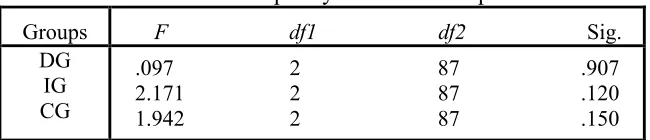
In order to address the research questions of the study, it was important to make sure that all the groups had normal distribution. Thus, the Levene's test of equality of error variance was used in order to demonstrate the normality of the groups in the pretests. The results are reported in Table 1. As this table displays, the significance values of pretests in the DG, IG and CG were 0.90, 0.12, and 0.15 respectively, indicating that none of them were significant at 0.05. Therefore, the assumption of the equality of variance is not rejected. That is, all the three groups had normal distribution.
Table 1:Test of equality of variance in pretests
Groups F df1 df2 Sig. DG
IG CG
.097 2 87 .907 2.171 2 87 .120 1.942 2 87 .150
Table 2:Descriptive statistics of DG, IG, and CG across test time Test Time Groups N
Pretest Posttest Delayed Posttest
M SD M SD M SD
DG IG CG 30 30 30 4.67 4.43 4.50 1.39 1.79 2.03 5.90 6.57 5.00 1.62 1.94 2.22 6.83 8.07 5.17 2.36 2.14 2.24
A mixed between-within ANOVA was run to find out whether there was a significant difference among the groups in terms of grammatical collocation scores in the essay writings. The collocation scores in the essays were considered as dependent variables and all three groups (i.e., DG, IG and CG) and time (i.e., pretests, posttests and delayed posttests) were considered as independent variables in the ANOVA. The results are reported in Tables 3, 4, and 5.
Table 3:Tests of between-subjects
Source M Square df F Sig. Intercept
Groups Error
8377.837 1 1006.853 .000
32.459 2 3.901 .024
8.321 87
As Table 3 illustrates, the F value for the intercept was significant, F(1, 87) = 1006.86,*p < 0.05), indicating a strong linear relationship among all three groups. Also, the effect of group as a between-subject variable was significant, F (2, 87) = 3.90,*p < 0.05), showing that there was a significant different among the three groups of study. Table 4 shows the results of the time as a within-subject variable across all three groups of study. Table 4:Tests of within-subjects Source M Square Eta Square df F Sig Partial Test Time Sphericity Assumed Greenhouse-Geisser Test Time* Sphericity Assumed Groups Greenhouse-Geisser Error Sphericity Assumed Greenhouse-Geisser 78.99 2 43.2 .000 .332
117.21 1.38 43.23 .000 .332
9.36 4 5.13 .001 .105
13.89 2.70 5.13 .003 .105
As Table 4 shows, pretests, posttests, and delayed posttests were significantly different in terms of collocation scores obtained from the essays, F (2, 174) = 43.24, (*p < 0.05), When the post hoc tests were conducted. The results indicated that the mean difference between the pretests and posttests were 1.29 at 0.05, which was significant (*p < 0.05); the mean difference between the pretests and delayed posttests were 1.82 at 0.05, which was significant (*p < 0.05); the mean difference between the posttests and delayed posttests were 0.53 at 0.05, which was significant (*p < 0.05). The above results mean that the participants’ mean scores significantly changed (i.e., increased) from the pretests to the posttests and from the posttests to the delayed posttests. Meanwhile, the eta square was found to be 0.33, indicating a very large effect size according to the guidelines proposed by Cohen (1988). Besides, the interaction of time and group variables were found to be significant, F (4, 174) = 5.13 (*p < 0.05). That is, there was a significant difference among groups across time. Meanwhile, the eta square was found to be 0.105, indicating a large effect size according to the guidelines proposed by Cohen (1988). Table 5 reports the results of Bonferroni post hoc tests of comparisons between the groups of the study.
Table 5:Post hoc tests
Groups Mean Differences Std. Error Sig
DG IG DG CG
-.22 .430 .047 .91 .430 .037 IG DG
IG CG
.22 .430 *.047 1.13 .430 *.010 CG DG
CG IG
-.91 .430 *.037 -1.13 .430 *.010
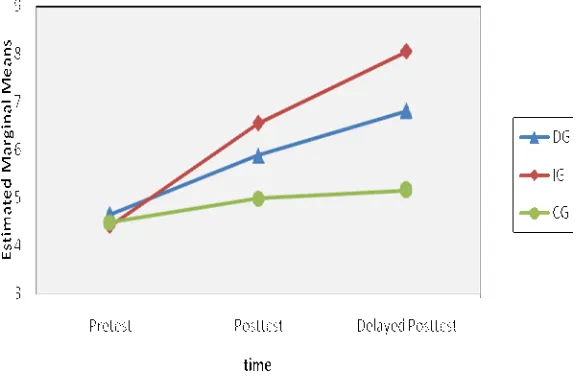
and from the CG in terms of collocation scores in the writings. Also, Figure 1 displays the mean score differences among the three groups of study across pretests, posttests and delayed posttests more clearly. As the figure demonstrates, the mean score differences were less for the CG and the mean score differences were greater for the IG. In addition, the mean scores in the IG were always higher than mean scores of the DG in the posttests and delayed posttests, which are always higher than mean scores of the CG.
Figure 1:Estimated marginal means of pretests, posttests, and delayed posttests for DG, IG, and CG.
5. Discussion
with ‘no feedback'. He found no significant differences between the effects of direct, indirect and 'no feedback' methods in written compositions. Although several studies have claimed that WCF is ineffective (Kepner, 1991; Truscott, 1996, 2004; Truscott & Hsu, 2008), the above finding of this study supports the results reported by Sheen (2007) about the effectiveness of WCF in improved accuracy as well as claims made by Ellis (1997), Schwartz (1993), and Chandler (2003) about the positive impact of WCF on features of writing and lexicon. For instance, Ellis (1997) states that the grammatical collocations are better learned in writing in the form of WCF. Besides, Schwartz (1993) claims that learning the lexicon involves item-by-item learning as well as the inventory of morphological forms for which WCF might be effective; Chandler (2003) also claims that WCF is helpful in solving complicated errors such as errors in word choice. Despite the fact that we cannot rule out the effect of individual differences (e.g. language aptitude and motivation) and different research methods employed by researchers in the area of feedback, which can result in inconsistency of findings, skill acquisition theory in L2 gives us confidence to support the above finding of the present study. According to this theory, declarative knowledge (i.e., what one knows) is required for the development of procedural knowledge (i.e., what one can do). In other words, procedural knowledge should be based on rules, feedback, numerous examples and deliberate practice, which can lead L2 learners towards automatic production. It is assumed that the WCF in the experimental groups of this study helped the L2 participants to better proceduralize knowledge of grammatical collocation use; it might have helped them to focus their attention on the area of collocation that required improvement. To use Schmidt's (1995) terms, the WCF might have promoted the participants' awareness with noticing and understanding. Thus, the corrective feedback that reflected what the participants needed most, as demonstrated by what they produced, would be considered to have a meaningful role in facilitating the development of L2 writing.
performance of two experimental groups (i.e., DG and IG) were significantly different in terms of type of WCF on the collocation use; the IG performed better than the DG on the collocation use in the posttests. The above finding does not support the results reported by Frantzen (1995), Ashwell (2000) and Ellis, Loewen, and Erlam (2006). Frantzen (1995) and Ashwell (2000) failed to find significant differences on the effect of direct and indirect WCF. Also, Ellis et al. (2006) reported that both direct and indirect types of WCF were equally effective in improving accuracy in writing. The results obtained in the current study also run counter to the claim made by Truscott (2004) and Sheen (2007). They state that indirect WCF runs the risk of overburdening learners; students ignore teachers' indirect WCF or do not utilize it effectively. Unlike the claim made by Truscott (2004) and Sheen (2007), it is assumed that the indirect WCF lowered the negative affective factors such as anxiety in the participants of this study. From psychological perspectives, as Kennedy (2003) argues, indirect WCF imposes less psychological force on the language learners. When learners encounter with a lot of direct WCF such as crossing out, deletion, or addition, they may lose their self-confidence in subsequent writing, but when teachers correct the learners’ grammatical mistakes, including violations of collocations in L2 writing, through indirect techniques such as underlining, circling, and coding, they may feel that they are given more opportunities to think and revise their writing. It is assumed that providing the L2 participants of this study with the indirect WCF on collocation helped them to focus more on the inaccuracy marked by their teacher. Consequently, they made their best to learn how to self-edit and finally overcome inaccuracy in the subsequent writings.
the significant role of direct feedback in the use of some language features, the indirect form of feedback might be more effective in the use of collocations. As Ferris and Roberts (2001) and Bitchener et al. (2005) argue, indirect WCF can be useful in correcting untreatable errors like collocations and result in greater accuracy in writing. To move further, studies are different in how they measured the effectiveness of WCF. Some studies assessed improvement in terms of whether subjects incorporated the corrections in a revision of their first draft (e.g., Ferris & Roberts, 2001); other studies assessed improvement in homework essay assignments or journal entries over a long period of time (e.g., Chandler, 2003; Kepner, 1991); a few studies assessed improvement in terms of gains in both linguistic accuracy and fluency (e.g. Ashwell, 2000). In Guenétte's (2007, p. 51) terms, differences in research design and methodology "are indeed at the root of the different results obtained". Thus, the variation makes us cautious about the generalization of the above findings. As Sheen (2007, p. 257) states, "the variation in how the effectiveness of CF was measured makes reaching any definite conclusion very difficult."
indirect WCF can induce deeper internal processing. It is assumed that the WCF, particularly the indirect WFC, pushed the L2 participants of the study to engage in hypothesis testing, leading to deeper internal processing. Thereby, the effect was enhanced over time. In addition, the indirect WCF might have had a positive impact on the self-efficacy of the L2 participants. Therefore, they were more likely to perform better when they believed they were capable of improvement and establishing criteria for evaluating their own writing skill. This seems to underscore the claim that how one makes use of WCF make a difference in the outcome.
6. Conclusion
result of the indirect way of correction might be the reason for a greater positive effect of indirect WCF over time. However, the generalization of the findings should await other related research including longitudinal studies.
References
Allen, D. (1992). Oxford placement test. Oxford: Oxford University Press.
Annett, J. (1969). Feedback and human behavior.
Hammondsworth: Penguin.
Ashwel, T. (2000). Patterns of teacher response to student writing in a multiple-draft composition classroom: Is content feedback followed by form feedback the best method? Journal of Second Language Writing, 9, 227-258.
Benson, M., Benson, E., & Ilson, R. (1997). The BBI dictionary of English word combinations (2nd Ed.). Amsterdam: John Benjamins.
Bitchener, J. (2008). Evidence in support of written corrective feedback. Journal of Second Language Writing, 17, 102-118.
Bitchener, J., Cameron, D., & Young, S. (2005). The effect of different types of corrective feedback on ESL student writing. Journal of Second Language Writing, 14, 191-205. Black, P., & Williams, D. (1998). Assessment and classroom
learning, Assessment in Education, 5, 17-74.
Brooks, D. W., Crippen K. J., & Schraw, G. P. (2002). Performance: The hallmark of efficient instruction. Retrieved June 18, 2010, from the World Wide Web: http://dwb4.unl.edu/dwb/Research/JCE-2002-0504.pdf Chandler, J. (2003). The efficacy of various kinds of error feedback
for improvement in the accuracy and fluency of L2 student writing. Journal of Second Language Writing, 12, 267-296. Chen, G.M. (2002). Intercultural communication via e-mail debate.
The Edge, 1, 27-39.
DeCarrico, J. (2001). Vocabulary learning and teaching. In M. Celcia-Murcia (Ed.), Teaching English as a second or foreign language (3rd ed.) (pp. 285-299). New York: Heinle & Heinle.
Ellis, R. (1997). Teaching and Research: Options in grammar teaching. TESOL Quarterly, 32, 39-60.
Ellis, R., Loewen, S., & Erlam, R. (2006). Implicit and explicit corrective feedback and the acquisition of L2 grammar. Studies in Second Language Acquisition, 28, 339-368.
Faghih, E., & Sharifi, H. (2006). The impact of collocations on Iranian EFL learners' interlanguage. Journal of Humanities, 16, 1-17.
Fanselow, J. (1977). The treatment of error in oral work. Foreign Language Annals, 10, 583-593.
Fen, Y. (2005). Differential effects of attention in second language acquisition of verb-noun collocations. Unpublished doctoral dissertation. Michigan State University, USA.
Ferris, D. R. (2002). Treatment of error in second language writing classes. Ann Arbor: University of Michigan Press.
Ferris, D. R. (2003). Responding to writing. In B. Kroll (Ed.), Exploring second language writing (pp. 119-140). Cambridge: Cambridge University Press.
Ferris, D. R. (2005). Treatment of error in second language student writing. Ann Arbor: University of Michigan Press.
Ferris, D. R., & Hedgcock, J. S. (2005). Teaching ESL composition: Purpose, process, and practice. Mahwah, NJ: Lawrence Erlbaum.
Ferris, D. R., & Helt, M. (2000). Was Truscott right? New evidence on the effects of error correction in L2 writing classes. Paper presented at the American Association of Applied Linguistics Conference, Vancouver, B.C.
Ferris, D. R., & Roberts, B. (2001). Error feedback in L2 writing classes: How explicit does it need to be? Journal of Second Language Writing, 10, 161-184.
Gabrielatos, C. (1994). Collocations:Pedagogical implications,and their treatment in pedagogical materials. Unpublished manuscript, Research center for English and applied linguistics, University of Cambridge.
Goldstein, L. (2001). For Kyla: What does the research say about responding to ESL writers? In T. Silva & P. Matsuda (Eds.), On second language writing (pp. 73-90). Mahwah, NJ: Lawrence Elbaum.
Guenétte, D. (2007). Is feedback pedagogically correct? Research design issues in studies of feedback on writing. Journal of Second Language Writing, 16, 40-53.
Hattie, J., Biggs, J., & Purdue, N. (1996). Effects of learning skills interventions on student learning: A meta-analysis. Review of Educational Research, 66, 99-136.
Hill, M. M., & Laufer, B. (2000). Type of task, time-on-task and electronic dictionaries in incidental vocabulary acquisition. International Review of Applied Linguistics, 41, 87-106. Hyland, K., & Hyland, F. (2006). Feedback in second language
writing: context and issues. Cambridge: Cambridge University Press.
Jordan, R. (1990). Academic writing course. London: Colling ELT. Kasper, L. (2000). New technologies, new literacies: Focus
discipline research and ESL learning communities. Language Learning and Technology, 4, 105-128.
Kennedy, G. (2003). Amplifier collocations in the British National
Corpus: Implications for English teaching. TESOL
Quarterly, 37,467-487.
Kepner, C. G. (1991). An experiment in the relationship of types of written feedback to the development of second-language writing skills. Modern Language Journal, 75, 305-313. Kern, R. & Warschauer, M. (2000). Introduction. In R. Kern & M.
Warschauer (Eds.), Network-based language teaching:
Corpus and practice (pp. 1-19). Cambridge: Cambridge University Press.
Laufer, B. (1991). The development of lexis in the production of advanced L2 learners. Modern Language Journal, 75, 440-448.
Lewis, M. (1997). Implementing the lexical approach: Putting theory into practice.Hove: Language Teaching Publications. Lightbown, P. (1998). The importance of timing in focus on form.
In C. Doughty & J. Williams (Eds.), Focus on form in classroom second language acquisition (pp. 177-196). Cambridge: Cambridge University Press.
Liu, C. P. (2009). Apologizing in English by Taiwanese university students. Paper presented at the 11th International Pragmatics Conference, Melbourne, Australia. NSC 93– 2411–H–034-011
Lizotte, R. (2001, Winter). Quantifying progress in an ESL writing class. MATSOL Currents, 27(1), 17.
Long, M. H. (2006). Problems in SLA. Mahwah, N.J.: Lawrence Erlbaum.
Mackey, A. (2007). Feedback, noticing and instructed second language learning.Applied Linguistics, 27, 405-30.
Nesselhauf, N. (2005). Collocations in a learner corpus. Amsterdam: John Benjamins.
Schachter, J. (1991). An error in error analysis. Language Learning, 27, 205-214.
Schmidt, R. (1995). Consciousness and foreign language learning: A tutorial on the role of attention and awareness in learning. In R. Schmidt (Ed.), Attention and awareness in foreign language learning (pp. 1-63). Honolulu: University of Hawaii Press.
Schwartz, G. (1993). Facilitated communication: History, autistic children, education. Applied Cognitive Psychology, 14, 64-72.
Sheen, Y. (2007). The effect of focused written corrective feedback and language aptitude on ESL learners’ acquisition of articles. TESOL Quarterly, 41, 225-283.
Truscott, J. (2004). The case for the case of grammar correction in L2 writing classes: A Response to Ferris. Journal of Second Language Writing, 8, 111-122.
Truscott, J., & Hsu, A. Y. (2008). Error correction, revision, and learning.Journal of Second Language Writing, 17, 292-305. Weigle, S. C. (2002). Assessing writing. Cambridge: Cambridge
University Press.
White, B. (1989). Gender differences in martial communication pattern. National Studies of Health, 28, 89-106.
Zarei, A. (2002). Patterns of the Iranian advanced learners problems with English collocations. Unpublished doctoral dissertation, University of Isfahan, Iran.