Interactional modifications in text-based online chat
and EFL question development
Jaleh Hassaskhah
Assistant Professor, University of Guilan
Seyedeh Marziyeh Chavoshi
M.A., University of Guilan
Abstract
The limited language exposure available to the learners of English as a foreign language (EFL) decreases their chance of utilizing two important practices- questions and interactional modifications- in their classrooms, which according to interaction hypothesis are influential in language development. This study thus explores the possibilities of Computer Assisted Language Learning (CALL), and in particular, text-based online chat in increasing these opportunities. To do so, a total of eighteen paired intermediate EFL students were assigned to use a synchronous chat program to complete a set of seven communicative tasks outside their classroom over a period of seven weeks’ time. Their performance was later compared with that of the control group members who completed the same tasks but through in-class written interaction. The results show that participants in the former environment not only outperformed those in the latter in terms of both type and frequency of the interactional modifications, but also manifested higher level questioning abilities. However, since this study focused on the forms of questions rather than their cognitive value, further research is required to seek ways in which questions which call for speculative, inferential and evaluative thinking can develop.
1. Introduction
Interaction in general, and classroom interaction in particular provides language learners with the opportunity to communicate in the target language (TL) and negotiate meaning (Pica, Young & Doughty, 1987); however, one of the greatest challenges that faces the foreign language (EFL) education is how to construct an interactive learning environment outside of the classroom in which learners can exchange information and communicate ideas in TL. As Campbell (2004) pointed out, unlike second language (ESL) learners who communicate in TL outside of the classroom, the EFL learners “re-enter a world” talking their mother tongue as soon as they leave the classroom and consequently are left with little or no opportunity to use the TL they have learned in the classroom.
Many researchers in the area of CALL suggest that text-based Synchronous Computer Mediated Communication (SCMC), where users can log on and chat at the same time, is capable of providing an ideal interactive learning environment for language learners because the communication takes place in real time (Beauvois, 1998; Chapelle, 2001; Pellettieri, 2000; Warschauer & Healey, 1998). Moreover, Pellettieri (2000) posited a logical relationship between language practice through SCMC and second language development and stated that:
Because oral interaction is considered by many to be important for second language development, and because Synchronous [CMC]. . . bears a striking resemblance to oral interaction, it seems logical to assume that language practice through CMC will reap some of the same benefits for second language development as practice through oral interaction.(p. 59)
modifications in CMC environment in relation to grammatical development.
2. Literature Review
This part reviews research literature supporting the study. It is divided into two main parts. The first part deals with the literature reporting studies which have addressed the issue of interactional modifications in CMC environment and the second part reviews the literature on the effectiveness of CMC medium in grammatical development.
2.1 Interactional Modifications in CMC Environment
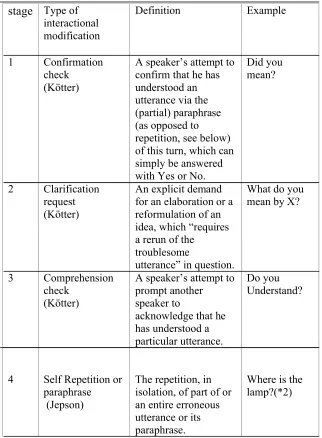
Interactional modifications such as comprehension and confirmation check, request for clarification, and self correction are “communication strategies or tactics that learners employ to adjust incomprehensible messages” (Lee, 2002, p. 3) in order to convey meaning.
The studies addressing the issue of interactional modifications in CMC environment abound (Isharyanti, 2008; Jepson 2005; Kö tter, 2003; Lee, 2001, 2002) and nearly all have shown that CMC technology is capable of providing a learning environment in which interactional modifications might be generated. However, looking more closely, we notice that the contexts in which most of the experiments were done were either inside the classrooms or in language laboratories and very few were carried out in naturalistic setting -- a direct opposition to the real potential of CMC technology which is beyond any formal, temporal and spatial constraints (Warschauer, 1997).
repetition/paraphrase, explicit correction and question as well. Still in a more recent study, Isharyanti (2008) located a more varied number of interactional modifications.
Nevertheless, although the findings as a whole were more or less similar, each made its own unique contribution to the field. Lee (2002) for example, through a comparison of the results of her study with the literature on face-to-face communication, admitted that just like in face-to face communication, learners not only used a variety of modification devices to negotiate with each other, but also used various types and distribution of them to do so. More specifically, the modification device “request” in its specific type of “request for help” appeared to have been the most frequent, followed by clarification checks, self- correction and comprehension check (Lee, 2001, p. 238; Lee, 2002, p.280). However, in contrast to Lee’s (ibid.) finding, Kö tter’s (2003) study indicated a “marked difference” between conversational repair moves in spoken interactions and in online exchanges (p. 145). He explained these differences in terms of a number of “medium-specific” factors such as written mode of communication and absence of nonverbal information (p.163). Furthermore, Isharyanti’s (2008) study uncovered that in order to understand and to be understood , the participants who engaged in online negotiation processes used a variety of interactional modifications, among which “confirmation check” (24%) was the most frequent followed by “overt indication of agreement” (21%) and “clarification request” (21%).
These similarities and differences aside, all the studies cited above suffer from certain drawbacks which prevent us from their generalization to many contexts, including this research context.
Having considered all these points, the researchers found that a study like this which can reap the benefits of the earlier studies and compensate for the drawbacks is timely. Hence, the researchers developed and employed an amalgamated system of the categorization of interactional modifications from a number of studies on internet chatting and at the same time accounted for factors such as proficiency level, time, and control group in this study (Isharyanti, 2008; Jepson, 2005; Kö tter, 2003; Lee, 2001, 2002).
In the following section we provide the required grounding for this study by presenting the literature on the effectiveness of CMC medium on grammatical development.
2.2 L2 Grammar Development and Text-based Computer-Mediated Communication
Despite the popularity of research on the role of negotiated interaction in L2 development (Gass and Varonis, 1989; Mackey, 1999; Pica, 1994), the results of the existing studies are unsatisfactory and controversial partly because of their design problems (Fiori, 2005).
A review of the literature available on the role of text-based computer mediated communication in L2 grammatical development indicates that there are three different positions at work:
First, studies which hypothesize that CMC is able to boost grammar development. As an example, Salaberry (2000) by qualitatively analyzing the discourse produced by four non-natives, compared the efficacy of two environments-SCMC environment versus face-to-face environment- in fostering L2 morphosyntactic development. The findings revealed that “with respect to the use of past-tense verbal morphology across tasks, some initial changes in the development of morphological endings were more evident in the CMC session than in oral session” (p. 17). According to Salaberry (2000), due to the characteristics of the medium represented in CMC (e.g. written mode of communication, absence of paralinguistic and nonverbal information), CMC provides a learning environment in which the learners’ attention will be drawn on both form and function (p. 19).
a result, she observed that engaging in online negotiation process is as facilitative as it is typical to oral interaction. She argued:
Because through negotiation, interlocutors can zero in on the exact source of communicative problem they are trying to resolve, and because often at the root of the problem is an aspect of the L2 form, be it lexical, syntactic, or semantic, L2 learners are even more likely to notice the problem and attend to these very aspects of form in their output while negotiating meaning. (p.61)
To conclude, the first position asserts that engaging in the process of negotiation of meaning in SCMC – as in oral negotiation-- helps grammatical development. More specifically, while negotiating meaning, the interlocutors notice the required linguistic form needed to approximate the target language. This process, known as “focus on form” has been claimed by many to be necessary for grammatical development (Gass &Varonis, 1994; Schmidt, 1990; Spada & Lightbown, 1993 as cited in Pellettieri, 2000).
Second, studies which contrary to the first position, postulate that SCMC does not help grammar development. Lee’s studies (2001, 2002), for instance, concluded that although the participants did engage in negotiation of meaning, negotiation of form rarely happened among them. She argued that due to the rapidity of the interaction occurring in SCMC, participants produced brief utterances using simple sentence structures and ignored linguistic errors (Lee, 2001, p. 239). Thus she claimed that interaction mediated via SCMC technology fostered fluency rather than accuracy. Calling for further studies on the effectiveness of CMC medium for the development of learners’ interlanguage, Lee (2001) suggested that “students need to be advised of the need to write correctly to maintain a balance between function, content, and accuracy” (p. 242).
her study exhibited fewer errors than those in the asynchronous group” (p. 569).
Third, there are those who have adopted an indeterminate position regarding the effectiveness of CMC medium for grammatical development. Blake (2000), for example, examined the online discourse of 50 Spanish learners at intermediate level of proficiency in terms of task type. Considering the potential of CMC environment for eliciting the negotiation of meaning, he concluded that “carefully crafted tasks stimulate L2 learners to negotiate meaning which. . . . appear to constitute ideal conditions for SLA, with the CMC medium being no exception” (p. 133). However, according to Blake (2000), “the predominance of incidental lexical negotiations, in contrast to the paucity of syntactic negotiations was either unsatisfactorily addressed or the issue of grammatical development was totally left unanswered”. (p. 120).
These mixed findings regarding the effect of SCMC medium on the grammatical development might be explained in terms of their choice of units to measure the grammatical development and their ambiguity in defining the construct itself. For instance, while in Sotillo’s (2000) study, the target feature was “Syntactic complexity” which was defined as “the ability to produce writing that uses subordination and embedded subordinate clauses” (p. 99), Lee (2001, 2002) used sentence structure (simple sentences versus complex ones) as a measure of development, and Salaberry (2000) considered “past tense verbal endings” as the target grammatical feature. Although we have had a changing for the better pattern in the aforementioned studies, we cannot deny that further research which can remove the remaining ambiguities is still needed.
3. Purpose of the Study
The present study; therefore, was designed to have its own contribution by addressing the effect of CMC environment on the development of question forms in English among Iranian EFL learners. More specifically, the study aimed to find the answers to the following research questions:
Is there a relationship between group membership (CMC environment vs. class environment) and the linguistic development of question forms in English as a foreign language?
The following “method” section explains how this research examined the questions and provided estimates in answers.
4. Method
Following a mixed methods approach, this study adopted both qualitative and quantitative (a pretest-posttest, delayed posttest design) techniques to provide an in-depth analysis of the types of interactional modifications employed by Iranian EFL learners, and to explain the relationships between group membership (CMC environment vs. class environment) and the linguistic development of question forms respectively.
4.1 Participants
Table 1:Summary of the participants’ characteristics Number of participants 36
Gender malefemale 630
Age 14-32 years
old
Native language Persian
English language proficiency
intermediate
Average hours spent on
online chatting/ week 2 hours
Having selected the sample, we asked the students to do seven communicative tasks (see an example in Appendix A) with their self-selected partners for one session per week and for seven weeks outside of the classroom. This experiment was carried out during the study period at the language school. To meet the local ethics requirements, the participants and their parents’ consent to contribute to this project were secured through two forms: a contract formwith an explanatory statement (Appendix B) according to which the researchers guaranteed that participants would receive some rewards (some English books on DVD) as an incentive or perhaps a token of gratitude if they accomplished the expected tasks, and a parental consent form (Appendix C), in Persian, signed by the parents of all the under 18 participants.
4.2 Instrumentation
The main technology used in this study was the Yahoo! Messenger Software, a free program available for public use which allows for real time SCMC in Internet chat rooms. To keep a record of all of the written transactions entered in a chat window, the “text mode” was suggested to enable the researchers to have an instantaneous transcript of all user exchanges sent by the students to the researchers’ email addresses for further analysis.
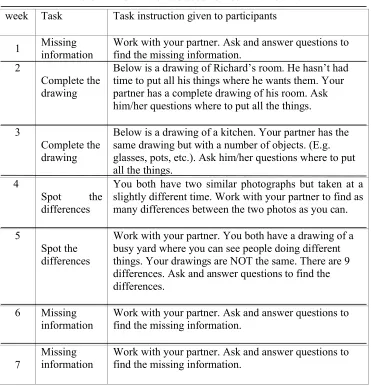
(1993), employed information gap tasks to make the participants exchange information in their endeavor to gain a single outcome. In addition, the selection of further communicative tasks such as “spot the difference” and “missing information” which were utilized for both treatment and tests was motivated by the recommendations made by earlier studies (Blake, 2000; Pellettieri, 2000). Table 2 presents a detailed description of each task.
Table 2:Task materials used for test and treatment
week Task Task instruction given to participants
1 Missing information Work with your partner. Ask and answer questions to find the missing information. 2
Complete the drawing
Below is a drawing of Richard’s room. He hasn’t had time to put all his things where he wants them. Your partner has a complete drawing of his room. Ask him/her questions where to put all the things.
3
Complete the drawing
Below is a drawing of a kitchen. Your partner has the same drawing but with a number of objects. (E.g. glasses, pots, etc.). Ask him/her questions where to put all the things.
4
Spot the differences
You both have two similar photographs but taken at a slightly different time. Work with your partner to find as many differences between the two photos as you can.
5
Spot the differences
Work with your partner. You both have a drawing of a busy yard where you can see people doing different things. Your drawings are NOT the same. There are 9 differences. Ask and answer questions to find the differences.
6 Missing information
Work with your partner. Ask and answer questions to find the missing information.
7
Missing information
4.3 Data Collection Procedure
At the beginning of the course, and prior to treatment, the researchers first oriented the students to the project and expressed the hope that they would choose to participate. After identifying the volunteers, they were put in two groups- the experimental and the control groups. The members of both groups (n=18 in each) were asked to form their own self-organized pairs (9 pairs), and complete seven tasks in total over the duration of the study, the transcripts of which had to be later sent to the researchers’ e-mail addresses for further data analysis. The tasks used in this study were all selected by the researchers according to a prior needs analysis and were the same for all the students in both groups. However, while there was no time limit imposed on tasks for the experimental group, the students in the control group had to complete the tasks in the classroom context within the limited time imposed by the institute. To approximate the condition present in the experimental setting, where the interlocutors had no access to non-language factors for understanding the intended meaning, and instead had to only rely on language to communicate, the students in the control group were asked to do the same and use the written language to interact- ask questions or call for any kind of modification via writing on paper. The data obtained accordingly are presented in the following section.
4.4 Data Analysis
obtained using Pearson product-moment correlation was found to be 0.85 (P<0.05) which was strong enough to show the consistency among the coders and as a result make it appropriate to build this study upon.
Table 3:Categories, definition, and example of interactional modifications
stage Type of interactional modification Definition Example 1 Confirmation check (Kö tter)
A speaker’s attempt to confirm that he has understood an utterance via the (partial) paraphrase (as opposed to repetition, see below) of this turn, which can simply be answered with Yes or No.
Did you mean?
2 Clarification request (Kö tter)
An explicit demand for an elaboration or a reformulation of an idea, which “requires a rerun of the
troublesome
utterance” in question.
What do you mean by X?
3 Comprehension check
(Kö tter)
A speaker’s attempt to prompt another speaker to
acknowledge that he has understood a particular utterance.
Do you Understand?
4 Self Repetition or paraphrase
(Jepson)
The repetition, in isolation, of part of or an entire erroneous utterance or its paraphrase.
5 Self-correction (Lee)
To correct errors made on lexical items or grammatical structure.
This has been bee, I mean been. 6 Recast (Kö tter) A form-focused
partner-related target-like reformulation of all or part of an incorrect utterance.
A: I live Iran. B: Do you really live in
Iran?
7 Explicit correction (Jepson)
Interlocutor corrects the speaker explicitly.
You should say X.
8 Overt indication of understanding (Kö tter)
An overt indication that a speaker has understood a particular message.
Ok, I got it thanks.
9 Over indication of agreement
(Kö tter)
An overt indication that a speaker agrees with what his partner said.
Yes, I agree, you’re right.
10 Overt indication of non-agreement (Kö tter)
An overt indication that a speaker does not agree with what his partner said.
No, I think choice B is better for him.
11 Use of Persian (adaptation, Lee)
To use Persian to substitute words or ideas in English.
second “tabagheh” instead of shelf 12 Use of keyboard
symbols as discourse markers (Lee)
To signal for uncertainty or to confirm an idea or agreement.
☺
13 Question (Jepson)
Interlocutor asks a question in order to prompt the speaker to make a question
Can you try that again?
Moreover, to examine whether there was a relationship between group membership (CMC environment vs. class environment) and development in question formation, we highlighted all the question forms produced by the participants during online negotiation and in- class interactions for detailed study. It should be mentioned that the question development in this study was examined from two perspectives: (1) accuracy perspective and (2) developmental stage perspective. In analyzing accuracy, the researchers converted the number of well-formed questions into
standardized scores by computing the ratio of each participant’s number of well-formed questions to the total number of questions he or she produced. These accuracy-based scores were saved for further investigation.
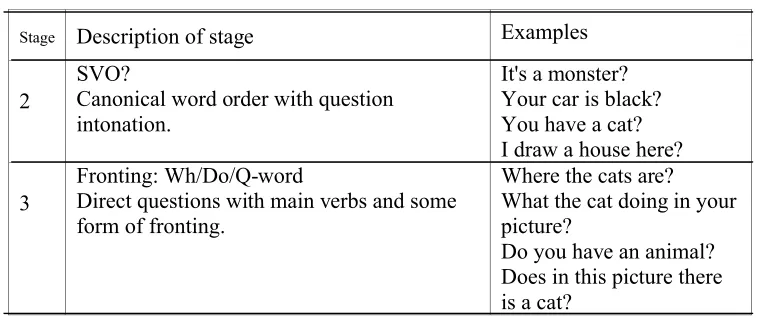
In addition to accuracy, we analyzed the questions for their developmental stages. Accordingly, the correctly formed questions were categorized based on the framework by Pienemann et al. (1988), shown in Table 4. The reason for using this classification is that it is the most extensive and reliable categorization. In addition, Pienemann et al. (1988) has been the most widely used classifications (Mackey & Philp, 1998) in a great number of studies. Accordingly, every student’s questions were studied individually and assigned to the appropriate stage category in each task. Stage assignment was based on the highest stage from which a participant produced two linguistically unique questions. Question development was operationalized as one stage increase on either posttest or delayed posttest. To have a wider understanding of question development, the data was analyzed both descriptively and qualitatively.
Table 4:Examples of question forms and developmental stages
Stage Description of stage Examples
2
SVO?
Canonical word order with question intonation.
It's a monster? Your car is black? You have a cat? I draw a house here?
3
Fronting: Wh/Do/Q-word
Direct questions with main verbs and some form of fronting.
Where the cats are?
What the cat doing in your picture?
4
Pseudo Inversion: Y/N, Cop.
In Y/N questions an auxiliary or modal is in sentence initial position.
In Wh-questions the copula and the subject change positions.
(Y/N) Have you got a dog?
(Y/N) Have you drawn the cat?
(Cop) Where is the cat in your picture?
5
Do/Aux 2nd
Q-word->Aux/modal ->subj (main verb, etc.) Auxiliary verbs and modals are placed in second position to Wh-Q's (& Q-words) and before subject
(Applies only in main clauses/direct Q's).
Why (Q) have (Aux) you (sub) left home?
What do you have? Where does your cat sit? What have you got in your picture?
6
Cancel Inv, Neg Q, Tag Qu
Cancel Inv: Wh-Q inversions are not present in relative clauses.
Neg Q: A negated form of Do/Aux is placed before the subject.
Tag Q: An Aux verb and pronoun are attached to end of main clause.
Can Inv) Can you see what the time is?
(Can Inv) Can you tell me where the cat is?
(Neg Q) Doesn't your cat look black?
(Neg Q) Haven't you seen a dog?
(Tag Q) It's on the wall, isn't it?
Note. This table is based on Pienemann and Johnston (1987) and Pienemann, Johnston, and Brindley (1988) as cited in Mackey, A., & Philp, J. (1998). Conversational interaction and second language development: Recasts, responses, and red herrings? Modern Language Journal, 82, 338– 356.
5. Results
In this section we discuss the findings in terms of the order of the research questions as appeared earlier in this paper.
5.1 Interactional Modifications in CMC and Classroom Environments
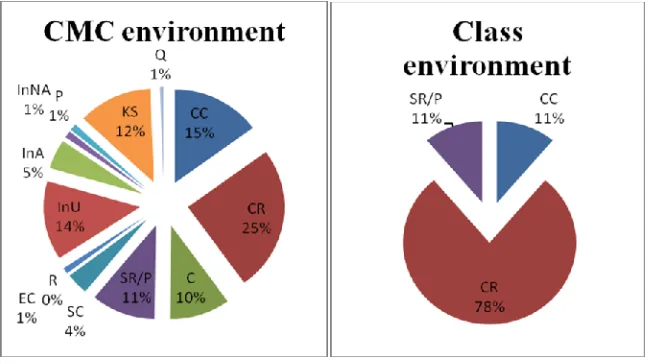
modifications. According to the percentage of each interactional modification presented in Figure1, the participants engaged in online negotiation employed a much greater variety of interactional modifications in comparison with the classroom interaction.
In the CMC environment, 12 types of interactional modifications occurred among which clarification request(25%), confirmation check(15%), overt indication of understanding (14%), use of keyboard symbols (12%) and self repetition/paraphrase (11%) were the most frequently used modifications for negotiation. However, just 3 types of interactional modifications occurred in the class environment. Clarification request (78%) was observed to be the most frequent, followed by confirmation checkand self repetition/paraphrase(11%).
Figure 1: Percentage of each interactional modification in CMC and class environments
Note. CC= confirmation check; CR= clarification request; C= comprehension check; SR/P= self repetition or paraphrase; SC= self correction; R= recast; EC= explicit correction; In U= overt indication of understanding; In A= overt indication of agreement; In NA= overt indication of non-agreement; P= use of Persian; KS= use of keyboard symbols; Q= question
The following unedited example shows how the participants during the online negotiation process used clarification request and comprehension checkin order to resolve the communicative problem.
Student A: where is the quilt?
Student A: it is the bed covering with soft material in it Student A: got it? [Comprehension check]
Student B: yes. It is under the rug.
The example above shows that not only did the participants use a variety of interactional modifications in order to understand and to be understood in the negotiation process but it also reveals that they collaborated and cooperated with each other to complete the communicative task.
5.2 Question Development in CMC and Class Environments
For the second research question which addressed the relationship between group membership (CMC environment vs. class environment) and the production and development of question forms in English as a foreign language, we found a total of 1915 questions, out of which 1667 were correct(952 questions in the CMC environment and 715 questions in the class environment). Table 5 presents the raw number of correct questions and erroneous questions in CMC and class environment.
Table 5:Number of correct and erroneous questions in CMC and class environments
Number of correct questions Number of
erroneous questions
Total
CMC 952 173 1125
Class 715 75 790
5.2.1 Accuracy Point of View
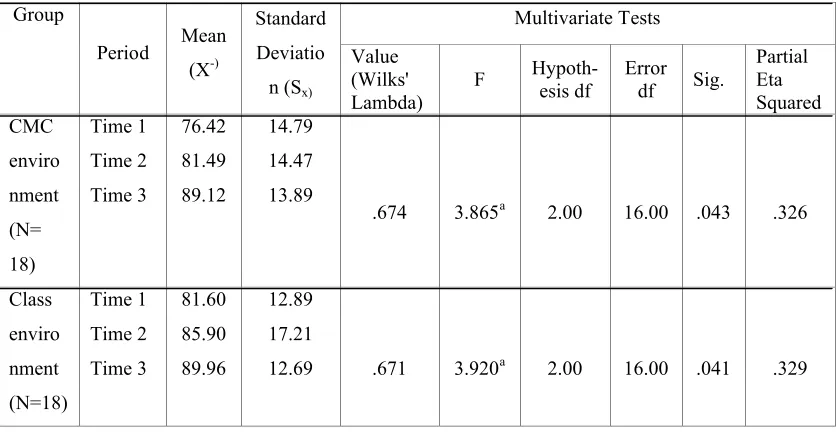
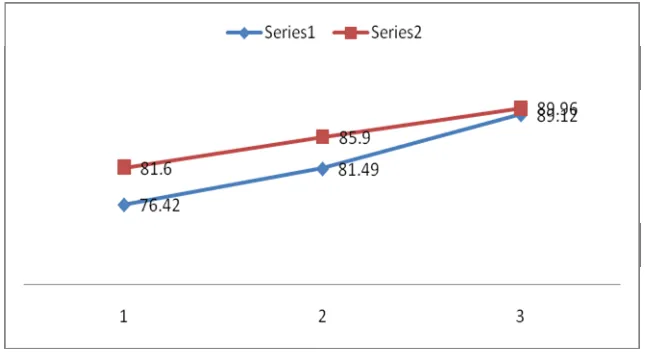
From the accuracy point of view, a one-way repeated measures ANOVA was conducted to compare scores on the accuracy(the ratio of each participant’s number of well-formed questions to the total number of questions he or she produced) at Time 1(pretest), Time 2(posttest) and Time 3(delayed posttest). The mean (X-), standard deviation (Sx) and their
Table 6:Mean of accuracy-based scores and multivariate tests in CMC and class environments
Group
Period Mean
(X-)
Standard Deviatio
n (Sx)
Multivariate Tests Value
(Wilks'
Lambda) F
Hypoth-esis df Error df Sig.
Partial Eta Squared CMC enviro nment (N= 18) Time 1 Time 2 Time 3 76.42 81.49 89.12 14.79 14.47 13.89
.674 3.865a 2.00 16.00 .043 .326
Class enviro nment (N=18) Time 1 Time 2 Time 3 81.60 85.90 89.96 12.89 17.21
12.69 .671 3.920a 2.00 16.00 .041 .329
Figure 2: Comparison of well-formed questions in CMC and class environments
5.2.2 Observed Developmental Stages in the Questions Formed in CMC and Class Environments
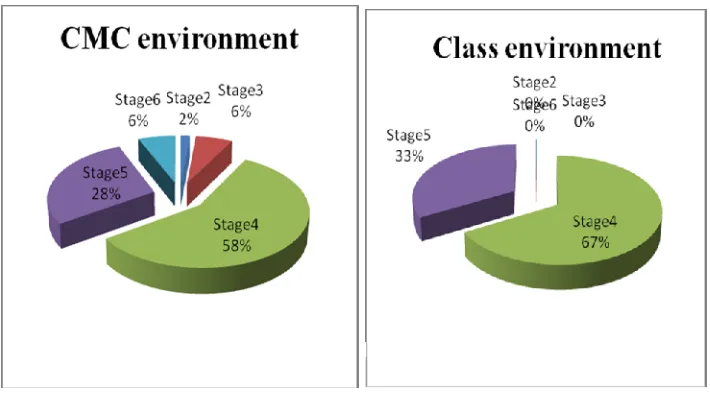
Figure 3:Percentage of questions in different stages in CMC and class environments
As Figure 3 indicates, questions in stage 4 were generated most frequently (58%), followed by stage 5 questions (28%), stage 3 questions (6%), stage 6 questions (6%) and finally stage 2 questions (2%). However, the class environment generated just 2 stages of questions: stage 4 questions (67%) were generated most frequently followed by stage 5 questions (33%).
the pretest: 3(17%) students stayed in stage 4 together with 9(50%) students staying in stage 5. According to the data from this study, it seemed that the participants in the CMC environment outperformed those in the class environment in generating more advanced questions.
Table 7:Developmental stages in pretest, posttest and delayed posttest in CMC and class environments
Pretest stage
Number of students
Posttest stage Delayed posttest stage
Up one
stage No change Down stage one Up one stage No change Down one stage CMC 2 3 4 5 1 0 4 13 1a (6%) 0 3 (17%) 2 (11%) 0 0 1(6%) 9 (50%) 0 0 0 2 (11%) 1b (6%) 0 4 (22%) 4 (22%) 0 0 0 9 (50%) 0 0 0 0 Class 2 3 4 5 0 0 5 13 0 0 4 (22%) 0 0 0 1(6%) 12 (67%) 0 0 0 1 (6%) 0 0 3(17%) 0 0 0 3(17%) 9(50 %) 0 0 0 3(17%)
a= one student (of 18) went up three stages, from stage 2 to stage 5. b= one student (of 18) went up two stages, from stage 2 to stage 4.
Finally, to statistically determine whether there was a significant relationship between group membership (CMC versus Class environment) and development in question formation, a Chi-square test for independence was conducted (See Tables 8 & 9).
Table 8:Type of environment * developmental stage cross tabulation Developmental Stage Total Not Developed Developed Type of environment
CMC 7 11 18
Class 14 4 18
Table 9:Chi-Square tests
Value Df Asymp. Sig. (2-sided) Exact Sig. (2-sided) Exact Sig. (1-sided)
Pearson Chi-Square 5.600a 1 .018
Continuity Correctionb 4.114 1 .043
Likelihood Ratio 5.776 1 .016
Fisher's Exact Test .041 .020
Linear-by-Linear
Association 5.444 1 .020
N of Valid Casesb 36
a. 0 cells (.0%) have expected count less than 5. The minimum expected count is 7.50. b. Computed only for a 2x2 table
Chi-square results (Continuity Correction=4.11, P <.05) showed that the CMC environment generated more developmentally advanced questions than did the class environment. In addition, the phi coefficient (=.39) in Table 10 shows that the association between the group membership and improvement in question formation was fairly strong.
Table 10:Symmetric measures
Value Approx. Sig. Nominal by
Nominal
Phi -.394 .018
Cramer's V .394 .018
N of Valid Cases 36
6. Discussion
The overall aim of this research was to advance an understanding of the potential of task based computer mediated communication to facilitate second language development (Here specifically, the development of question forms), particularly in relation to the role of interactional modifications during online chatting.
With regard to the effectiveness of CMC technology in generating interactional modifications, the results of this study supported the findings in literature and confirmed the potentials of CMC medium in providing a conductive learning environment for interactional modifications to occur. However, a comparison of the type and frequency of the interactional modifications in the two CMC and Classroom environments indicated a significant difference. This difference may, as Salaberry (2000, p.9) suggested, be due to the “inherent characteristics of the discourse of text-based CMC (e.g. written mode of communication, absence of paralinguistic and nonverbal information)” which put more pressure on people to "find the right words" than does engagement in face-to-face discourse. Similarly, Kö tter (2003) maintained that “Unlike spoken discourse, where pitch, smiles, laughter and other cues are often employed sub-consciously, people engaged in written CMC must put all their ideas and actions into words if they want to share them with their partners”(p. 148). Although we tried to control for this factor by asking the students in the control group to exercise written rather than oral interaction, the mere presence of both interlocutors in close proximity is a factor which might bring in the paralinguistic and nonverbal information handy. Moreover, the sufficient time during online communication made it possible for the participants to collaboratively produce more interactional modifications. These findings confirm the research by Warschauer (1997), which claims that CMC facilitates collaborative learning.
writing accurately while negotiating meaning in the CMC environment. In addition, despite the fact that the same communicative tasks were administered to both groups, the CMC environment encourages the production of a greater number of questions than did the class environment. This was not a surprising observation though, because due to the CMC medium-specific characteristics, such as the absence of nonverbal cues together with the absence of time limitation, learners would naturally feel more obliged to turn to language in the production of questions yielding a difference in the language production of the two groups.
Finally, the results indicated that in addition to the aforementioned differences, the quality of the questions in the two environments was not the same. In other words, the participants in the CMC environment produced more developed questions as classified by Pienemann et al. (1988). Although this was a valuable finding in its own right, unfortunately there is no work in literature tackling this. Thus, more studies to address this issue are yet required.
7. Conclusion
Based on findings of this study, we can conclude that Iranian EFL learners engaged in negotiation processes through SCMC were able to carry out a variety of communicative tasks cooperatively in the target language outside the classroom. In addition, the participants employed diverse interactional modifications to solve the communication problems they confronted in their interaction. Moreover, as the analysis of the data revealed under special conditions (when teacher indirectly directs the students to pay special attention to the grammaticality of their sentences), online negotiation is able to enhance accuracy as well.
if we looked at it as a supplement and not as a replacement to classroom instruction and interaction.
In conclusion, based on the results of this study, we strongly suggest that this technology be incorporated into ELT syllabi because it can certainly tackle some of the greatest challenges in foreign language education such as lack of sufficient practice time in the classroom and lack of exposure to the target language outside of the classroom. However, more research is needed in order to shed light on the significance of its contribution to the betterment of the other aspects of the foreign language education.
References
Beauvois, M. H. (1998). Conversations in slow motion: Computer-mediated communication in the foreign language classroom. Canadian Modern Language Review/La Revue Canadienne des Langues Vivantes, 54(2), 198-217.
Blake, R. J. (2000). Computer mediated communication: A window on L2 Spanish interlanguage. Language Learning and Technology, 4(1), 120-136.
Campbell, A.P. (2004). Using LiveJournal for authentic communication in EFL classes. The Internet TESL Journal, 10(9). Retrieved December 17, 2010 from http://iteslj.org/Techniques/Campbell-LiveJournal/ Chapelle, C. A. (2001). Computer applications in second language
acquisition. Cambridge: Cambridge University Press.
Fiori, M. L. (2005). The development of grammatical competence through synchronous computer-mediated communication. CALICO Journal, 22(3), 567-602.
Gass, S. M., & Varonis, E. M. (1994). Input, interaction, and second language production. Studies in Second Language Acquisition, 16, 283-302.
Gass, S., & Varonis, E. (1989). Incorporated repairs in nonnative discourse. In M. Eisenstein (Ed.), The dynamic interlanguage: Empirical studies in second language variation (pp. 71-86). New York: Plenum Press.
Isharyanti, N. (2008). Interactional modifications in internet chatting. In R.C.V. Marriott and P.L. Torres (Eds.), Handbook of research on e-learning methodologies for language acquisition (pp. 271-290). New York: Information Science Reference.
Jepson, K. (2005). Conversations and negotiated interaction in text and voice chat rooms. Language Learning & Technology, 9(3), 79-98. Kӧtter, M. (2003). Negotiation of meaning and code switching in online
tandems. Language Learning & Technology, 7(2), 145-172.
Lee, L. (2001). Online interaction: Negotiation of meaning and strategies used among learners of Spanish. ReCALL, 13, 232–244.
Lee, L. (2002). Synchronous online exchanges: A study of modification devices on non-native discourse. System, 30(3), 275–288.
Long, M. (1985). Input and second language acquisition theory. In S. Gass & C. Madden (Eds.), Input in second language acquisition (pp.
377-393). Rowley, MA: Newbury House.
Mackey, A. (1999). Input, interaction and second language development: An empirical study of question formation in ESL. Studies in Second Language Acquisition, 21, 557-587.
Mackey, A., & Philp, J. (1998). Conversational interaction and second language development: Recasts, responses, and red herrings? Modern Language Journal, 82, 338–356.
Pellettieri, J. (2000). Negotiation in cyberspace: The role of chatting in the development of grammatical competence. In M. Warschauer & R. Kern (Eds.), Network-based language teaching: Concepts and practice (pp. 59-86). Cambridge: Cambridge University Press.
Peterson, M. (2010). Task-based language teaching in network-based CALL: An analysis of research on learner interaction in synchronous CMC. In M. Thomas & H. Reinders (Eds.), Task-based language learning and teaching with technology (pp. 41-82). New York: Continuum.
Pica, T. (1994). Research on negotiation: What does it reveal about second-language learning conditions, processes, and outcomes? Language Learning, 44(3), 493-527.
Pica, T., Kanagy, R., & Falodun, J. (1993). Choosing and using communication tasks for second language instruction. In G. Crookes & S. Gass (Eds), Tasks and language learning: Integrating theory and practice (pp. 9-34). Clevedon: Multilingual Matters.
Pienemann, M., & Johnston, M. (1987). Factors influencing the development of language proficiency, In D. Nunan (Ed.), Applying second language acquisition research (pp. 45-141). Adelaide, Australia: National Curriculum Resource Centre, AMEP.
Pienemann, M., Johnston, M., & Brindley, G. (1988). Constructing an acquisition-based procedure for second language assessment. Studies in Second Language Acquisition, 10, 217-243.
Salaberry, R. (2000). L2 morphosyntactic development in text-based computer-mediated communication. Computer Assisted Language Learning, 13(1), 5-27.
Schmidt, R. (1990). The role of consciousness in second language acquisition. Applied Linguistics, 11, 219-258.
Sotillo, S. M. (2000). Discourse functions and syntactic complexity in synchronous and synchronous communication. Language Learning and Technology, 4(1), 82-119.
Spada, N., & Lightbown, P. (1993). Instruction and the development of questions in L2 classrooms, Studies in Second Language Acquisition, 15, 205-224.
Warschauer, M. (1997). Computer mediated collaborative learning: Theory and practice.The Modern Language Journal, 81, 470-481. Warschauer, M., & Healey, D. (1998). Computers and language learning:
(Appendix B: contract form)
Student /Teacher Contract
I, ………..………, agree to perform the following tasks to the best of my ability:
To solve a series of tasks using a synchronous chat program. (Yahoo messenger)
To save and send all the written transaction to my teacher’s e-mail.
And my English teacher guarantees that I will receive the following rewards if I accomplish the above tasks.
A DVD pack including the following items:
Oxford Picture Dictionary.( Interactive CD Rom)
Clear Speech( Book+ audio files)
Speak English Like an American (Book +Audio files)
Test Your English Vocabulary in Use Upper- Intermediate (Book)
Date Signed:………
(Appendix C: parental consent form)
زﻮﻣآ نﺎﺑز ﯽﻟو ﮫﺑ طﻮﺑﺮﻣ مﺮﻓ
ﺐﻧﺎﺠﻨﯾا ... زﻮﻣآ نﺎﺑز ﯽﻟو
... ﺖﮐﺮﺷ ﺎﺑ مراد ﯽﻣ مﻼﻋا ﮫﻠﯿﺳو ﻦﯾﺪﺑ
ﯽﻘﯿﻘﺤﺗ هژوﺮﭘ رد مﺪﻧزﺮﻓ
-یزﻮﻣآ نﺎﺑز ﺪﻨﯾاﺮﻓ رد ﺮﺗﻮﯿﭙﻣﺎﮐ ﺮﯿﺛﺎﺗ ناﻮﻨﻋ ﺖﺤﺗ
هﺎﮕﺷزﻮﻣآ فﺮﻃ زا ﮫﮐ
ﻓاﻮﻣ ﺖﺳا هﺪﺷ هداد ﺐﯿﺗﺮﺗ ﮫﻃﻮﺑﺮﻣ سرﺪﻣ ﻂﺳﻮﺗ ﯽﯾﺎﺒﻃﺎﺒﻃ ﮫﻣﻼﻋ
ﻢﻘ .
ﯽﮔداﻮﻧﺎﺧ مﺎﻧ و مﺎﻧ
زﻮﻣآ نﺎﺑز ﯽﻟو یﺎﻀﻣا