146
International Journal of Science and Business
Email: [email protected] Website: ijsab.comPublished By
Comparing Clustering Algorithms
using Financial Time-series data
Duangrux Tangsirisakul Abstract:
Data clustering is one of the most popular unsupervised machine learning approaches. Clustering data can help identify the pattern of what seems to be similar data and leads to the best solution for all commercial problems. For example, taxi booking application, customer’s data can be clustered to match supply with demand, to detect fraud pattern of an e-commerce transaction or clustering customers in dating application, etc. In order to carry out the best calculation of clustering certain requirement is needed in each method and approach such as the basic assumption of data. When analyzing data with a wrong assumption, it results in low-quality outcomes. So we would like to study and compare this type of data in an in-depth manner. Time-series analysis is used in many future prediction tasks based on previously observed values, mixing cluster analysis and time-series data to serve the initial purpose that researcher would like to share to the public for better understanding of the clustering, researcher would also like following researchers to refer to this work and develop this theory and apply in wider issues in future. In this paper, the focus is on comparing time-series clustering algorithm with financial time-series data, which is common data such as cryptocurrency, exchange rate currency, the Shanghai Stock Exchange (SSE50), and the stock exchange of Thailand 50 (SET50). The paper introduces the importance of data mining, machine learning, and time-series clustering and some related methods, which lays a theoretical foundation for the formal research of this paper. By analyzing the structure of time-series clustering, that consists of several parts, including distance measurement, time-series prototype, a clustering algorithm, and clustering evaluation. From research result, the hierarchical algorithm is the most efficient algorithm for unequal length of cryptocurrency series and SSE 50. In another hand, the partitional algorithm is the most efficient for an equal length of exchange rate currency and SET 50.
IJSB Accepted 27 March 2019 Published 31 March 2019
DOI: 10.5281/zenodo.2617341
Keywords:time-series clustering, machine learning, dynamic time warping, crypto-currency
Page: 146-166
2019
International Journal of Science and Business
Duangrux Tangsirisakul, Department of Mathematics, China University of Mining and Technology, Jiangsu, China.
147
International Journal of Science and Business
Email: [email protected] Website: ijsab.comPublished By
1. Introduction
Time-series data is a kind of data that was collected from the data points. It is a continuous sequence of time such as daily stock data, daily currency exchanged rate, daily temperature data or cancer growth rate etc. Current time-series data plays an important in research of various disciplines, such as bioinformatics, robotics, medicine, chemistry, gesture recognition, speech recognition, tracking, finance, biometrics, astronomy, manufacturing, etc. Data mining of time-series data is an interesting topic. To analyze and drilling the time-series data of the relationships, models or insights, which are hidden, useful information based on the principles of mathematics, statistics, database, recognition and learning of the machine (Machine Learning such as association rule, classification, prediction, clustering, anomaly detection, and visualization). This paper raises the clustering analysis to experiment by comparing 3 scenarios of clustering algorithm with various time-series data (crypto-currency, exchange rate (crypto-currency, the Shanghai Stock Exchange and the Stock Exchange of Thailand 50) using the principle of distance measurement which is Dynamic Time Warping techniques (DTW), however there are still problems caused by DTW techniques calculation that is very dynamic, so it would take time to calculate and could not speed up easily. After finished data clustering, clustering evaluation is used to deciding clustering algorithm scenarios quality and indicated the dataset that is fit and suitable to which clustering algorithm scenario.
2. Related work
Recently, the big data, machine learning and AI topic are interested in many industries. This increasing amount of digital data consequently effects to the role of data analysis as well. In which reflected in the continuously rising amount to researches related to the clustering algorithm in part years, (Liao T. W. (2005), Rokach, L. (2009), Ling H E et al. (2007), Nayak J, Naik B and Behera H S. (2015), Sasirekha, Sasirekha, K. and Baby, P. (2013) and Rui, X., and D. Wunsch. (2005)). Especially for time-series clustering which is reviewed in-depth on and processing detail of the theory by Aghabozorgi, S. et al. (2015). All process of time-series clustering which are distance measurement, time-series prototype, a clustering algorithm, and cluster evaluation. For distance measurement in time-series clustering, Berndt DJ and Clifford J proposed dynamic time warping (DTW) to find patterns in time-series data which time-series clustering by approximate prototypes are propose by Ville Hautamäki et al (2008) to decide cluster presenter. The other important point of this research is cluster validity indices (CVIs) that will be explained by Arbelaitz, O. et al. (2013). And in order to complete this research R software was applied using by Sardá-Espinosa (2018)’s manual. Due to much interesting in time-series clustering, therefore there are studies on this topic;Tsay, R. S. (2010) did cluster analysis with time-series data of American unemployment rate Niennattrakul, V. , & Ratanamahatana, C. A. . (2006) applied time series clustering to compare the efficiency of multimedia data using representation method and multimedia data using traditional processing, so this research has demonstrated the profit of time-series representation method. Saikhamwong N and Rimcharoen S. (2002)did cluster analysis applied with stock data.
3. Time-series clustering
non-148
International Journal of Science and Business
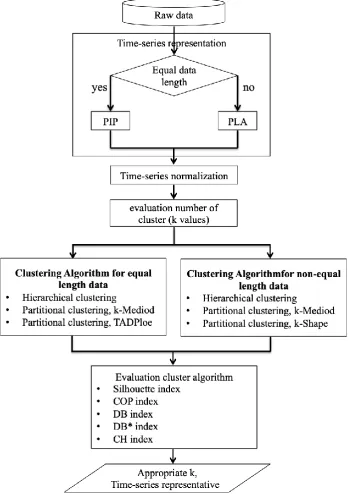
Email: [email protected] Website: ijsab.comPublished By equal length. Each type, we will compare the clustering algorithm in 3 scenarios. The cryptocurrency data and the Shanghai Stock Exchange (SSE 50) are non-equal lengths, so the algorithm which clustering time-series is hierarchical clustering, partitional clustering with k-medoid and partitional clustering with k-shape. In another data type which is exchange rate currency and the stock exchange of Thailand (SET 50) that use hierarchical clustering, partitional clustering with k-medoid and partitional clustering with TADPole. To compare these scenarios of cluster algorithm whether they are suitable for this dataset or not. We use clustering evaluation approaches such as Silhouette index, COP index, DB index, DB* index and CH index. The flow chart of this research framework shown in Figure 1.
Table 1. The overall each step of time-series clustering
Time-series representati ons Distance measuremen t Time-series
prototypes Clustering algorithm Clustering evaluation
Data adaptive Dynamic Time Warping (DTW) - Global DTW constraints - Lower bounds for DTW Mean and median Hierarchical clustering Internal evaluation Crisp partitions - Silhouette index - Dunn index - COP index
- Davies-Bouldin index - Modified Davies-Bouldin index
- Calinski-Harabasz index - Score Function
Fuzzy partitions - MPC index - K index - T index - SC index - PBMF index Non-data adaptive Global alignment kernel distance Partition around medoids (PAM) Partitional cluster - k-medoids - TADPole - k-Shape Model-based Soft-DTW DTW
barycenter averaging (DBA)
Fuzzy clustering
Data dictated Shape-based
distance (SBD) Soft-DTW centroid Shape extraction Fuzzy based
prototype External evaluation
Crisp partitions - Rand Index
- Adjusted Rand Index - Jaccard Index
- Fowlkes-Mallows - Variation of Information
Fuzzy partitions - Soft Rand Index.
- Soft Adjusted Rand Index - Soft Variation of
149
International Journal of Science and Business
Email: [email protected] Website: ijsab.comPublished By Figure 1. Flow chart of this research framework
3.1 Time-series representation
Time-series representation method is dimension reduction, which was the raw represented the raw time-series in another space by transforming data to the lower space dimension or by extracting features. Its advantages are decreasing of the time series dimensionality, emphasizing on essential shape characteristics, noise management, reduce mandatory memory and calculation complexity of machine learning reactions.
Definition: Time-series representation, given a time-series data ,
representation transformed the time-series to another dimensionality reduced vector
150
International Journal of Science and Business
Email: [email protected] Website: ijsab.comPublished By representations will be similar in the transformed spaces. Time-series representation methods are broken down to four groups (Saeed Aghabozorgi (2015)), such as data adaptive, non-data adaptive, model-based, and data dictated (clipped data). Data adaptive representation method is used to minimize the reconstruction error of time-series dataset using non-equal length segment. Non-data adaptive representation method is suited for time-series dataset that has equal length segment, while the comparison of representations of several time-series is very direct. Model-based representation is suitable with time-series with stochastic results, Statistical models, and Time-series models. Finally, the representation method is data dictated, the proposal that the condensation-ratio is described based on original time-series data like in the related work Ratanamahatana, C. (2005)
In this paper, we used the non-data adaptive representation method. Perceptually Important Point (PIP) (Aghabozorgi, S. et al. (2015) and Tak Chung Fu et al. (2001)) was used for SET50 and exchange rate currency dataset because time-series dataset is equal length segment. This data adaptive representation method, Piecewise Linear Approximation (PLA) was used for cryptocurrency and SSE 50 dataset, which each cryptocurrency born time is different so time-series length is also different.
3.2 Distance measurement Dynamic Time Warping (DTW)
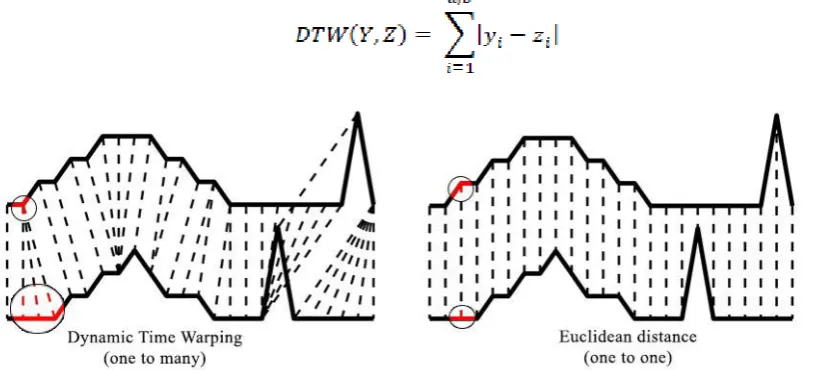
Dynamic Time Warping is the dynamic programming method, which used for measuring the similarity between the 2 time-series data. By the results, the distance and the alignment are the best value between two data, which can stretch and shrink for accommodating variations in the axis of time that is shown in Figure2. One point can calculate distance with many points. For example, we have two time-series, a series Y of length a, and series Z of length b. The gab of two time-series is defined as:
Figure 2. Comparing Dynamic Time Warping distance measurement and Euclidean distance measurement
The features of the time-series data that is different from generic data, causes many problems, which are very high dimensional indices (difficulty to identify the locations of data in high dimension) and other problems that cause by Dynamic Time Warping techniques that is dynamic leads to long–time of calculation and could not speed up.
Shape-based distance (SBD)
The Shape-Based Distance (SBD) was taken a component of K-Shape clustering algorithm. It
151
International Journal of Science and Business
Email: [email protected] Website: ijsab.comPublished By two series and is sensitive in scale, so normalized data is the suggestions; the distance formula is defined as:
3.3 Time-series prototype Partition Around Medoid (PAM)
The prototyping function could be called time-series averaging also. It is used for solidifying the concert or to perform series categorization. This step is very important for time-series clustering. Partition Around Medoid approach is the common type of time-time-series prototype. This approach is suitable with time-series data which structure is not altered. In the implementing process, k series data is randomly chosen as initial centroids. Then the initial centroids and other series calculate distance and series will be appointed to the cluster of its nearest centroid. And the total minimize distance of series is assigned to the new centroid. This iteratively calculates for new centroid until no series could change clusters.
Shape extraction
Another part of k-Shape clustering algorithm is shaping extraction. This centroid function should apply with z-score series data, furthermore, this centroid function can be done between series with the different length, the shape extraction also applied to multivariate series or each variable of all series.
3.4 Clustering algorithm Hierarchical clustering
Hierarchical clustering(Han, J. and Micheline Kamber (2012)) is an algorithm of cluster analysis. The approaches for hierarchical clustering fallen into 2 types, such as agglomerative and divisive. The agglomerative approach is a bottom to top direction, all observations start as one pair of clusters will be combined as together and moving to top hierarchy. The divisive approach is top to bottom direction, all observations start as single cluster and split. Then executed in circular moving up the hierarchy. This method can display the result as the “Dendrogram” graph. Hierarchical algorithm implementation shows as Table 2
Table 2. Hierarchical algorithm Hierarchical algorithm
Input: D is a dataset containing n objects.
Output: a set of k clusters Method:
1. Compute the distance of the object. Input data in the distance matrix.
2. Repeat
3. Examine for two most related clusters or objects.
4. Combine the two clusters or objects to create a cluster which has 2 objects at least.
5. Update the matrix recalculate the distances between this new cluster and all
other clusters again to until no change.
Partitional clustering, k-Medoid
152
International Journal of Science and Business
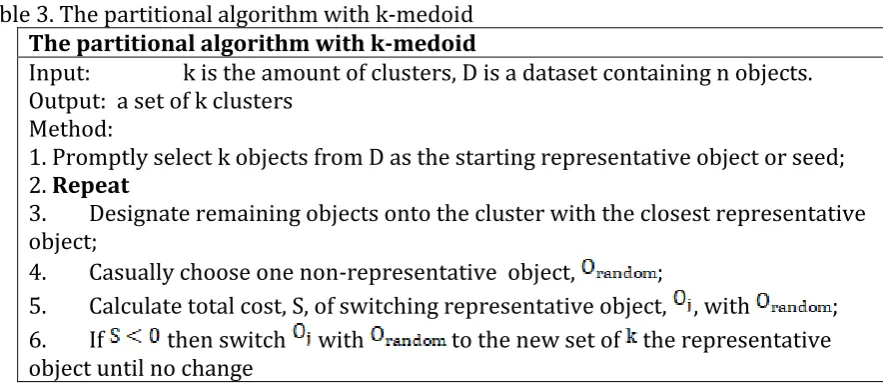
Email: [email protected] Website: ijsab.comPublished By Table 3. The partitional algorithm with k-medoid
The partitional algorithm with k-medoid
Input: k is the amount of clusters, D is a dataset containing n objects.
Output: a set of k clusters Method:
1. Promptly select k objects from D as the starting representative object or seed; 2. Repeat
3. Designate remaining objects onto the cluster with the closest representative object;
4. Casually choose one non-representative object, ;
5. Calculate total cost, S, of switching representative object, , with ;
6. If then switch with to the new set of the representative
object until no change
Partitional clustering, k-Shape
Paparrizos, J. , and Gravano, L. . (2016) researched the k-Shape clustering algorithm was by in 2016. This partitional algorithm needs the custom distance measure as SBD and the custom centroid function as shape extraction. It also requires z-normalization to default data. The partitional algorithm with k-shape implementation shows as .
Table 4.
Table 4. The partitional algorithm with k-shape
Partitioning algorithm with k-shape
Input: k is the number of clusters, D is a dataset containing n objects.
Output: a set of k clusters Method:
1. Promptly select choose k objects from D as the starting representative object or seed;
2. repeat
3. Base on the mean value of the objects in the cluster, designate remaining objects onto the cluster with a similar object
4. Recomputed the mean value of the objects in each cluster to update the cluster until no change
Partitional clustering, TADPole
The TADPole clustering was proposed by Begum, N. et al. (2015), this time-series clustering use DTW as the distance measurement and use PAM as the centroid. TADPole depends on the DTW bounds defining for time-series with equal length only.
3.5 Cluster evaluation
153
International Journal of Science and Business
Email: [email protected] Website: ijsab.comPublished By
Silhouette index
Silhouette index is the internal validation of consistency within cluster data. Some algorithm needs to know k-value before, therefore silhouette is used to measure k-value which control the amount of clusters in a dataset and relationship between objects in the dataset. The silhouette coefficient value should always be the maximum number after measurement.
Definition: The dataset , of n objects, suppose is segregated to k clusters, . For
each object , we compute as the average distance of and other objects in the
cluster where belongs. Likewise, is the minimum average distance from to call
clusters to where does not belongs. Formally, suppose ; then
and
The Silhouette coefficient (Han, J. (2005)) of is then defined as
COP index
It was first presented to adopted in the partnership of a cluster hierarchy post-processing algorithm, Traditional cluster validity indices could also adopt this. It is a ratio-type index, where the coherence is indicated by the distance from the position in a cluster to its centroid. The partition establish based on the furthest border width is defined as:
Davies-Bouldin index (DB)
This index is commonly used in cluster validity comparison studies. It assesses the coherence formed on the distance from the positions in a cluster to centroid and partition based on the distance of centroids. It is defined as
where
Davies-Bouldin star index (DB star)
This index is the variation of the Davies-Bouldin index. It is defined as
Calinshi-Harabasz index (CH)
154
International Journal of Science and Business
Email: [email protected] Website: ijsab.comPublished By
4. Experiment result
4.1 Dataset
This paper has 4 dataset experiments, which are cryptocurrency dataset, SSE 50 dataset, exchange rate currency dataset, and SET 50 dataset. Dataset structure detail shows as Table 5.
Table 5. Dataset structure detail
Dataset Length No.
Currency / Stock
No. Data Points
Cryptocurrency, Zone A (Unequal length) 1,866 154 234,949
Cryptocurrency, Zone B (Unequal length) 1,096 297 130,663
Cryptocurrency, Zone C (Unequal length) 522 1,192 265,547
SSE50 (Unequal length) 2,435 43 99,353
Exchange rate currency (Equal length) 92 146 13,432
SET50 (Equal length) 244 50 12,200
Cryptocurrency dataset
155
International Journal of Science and Business
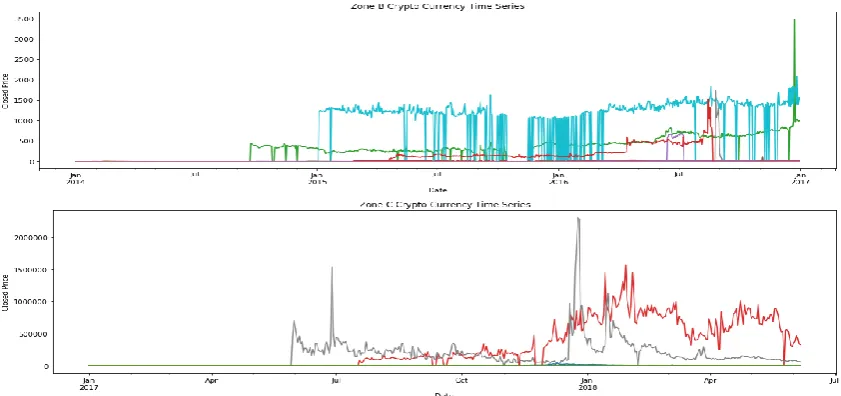
Email: [email protected] Website: ijsab.comPublished By Figure 3. Time-series of all cryptocurrency and breaking down as zone A, B, and C
Shanghai Stock Exchange 50 Index (SSE 50)
Shanghai Stock Exchange, SSE 50 Index, is a capitalization-weighted index based on the top 50 stocks listed in China SSE index. It has high market capitalization and high liquidity. SSE 50 dataset is the historical closing price for 50 stock indices from finance yahoo.com website (https://finance.yahoo.com). But some stock indices have too much of null value, so we cut 7 stock indices off. All datasets have the unequal length of 99,353 data points of 43 stock indices; the used variables are currency data, closing price and period of dataset between 15, December 2008 to 15, December 2018, shows as Figure 4.
Figure 4. Time-series of SSE 50 stock index
Exchange rate currency dataset
Exchange rate currency dataset is the historical closing price for all currencies in the world that has 92 currencies from finance yahoo.com website (https://finance.yahoo.com). All datasets have the same length of 13,432 data points; the used variables are currency, data, closing price, and period of dataset between 1, July 2018 to 30, September 2018, shows as Figure 5.
156
International Journal of Science and Business
Email: [email protected] Website: ijsab.comPublished By
The Stock Exchange of Thailand 50 (SET 50) dataset
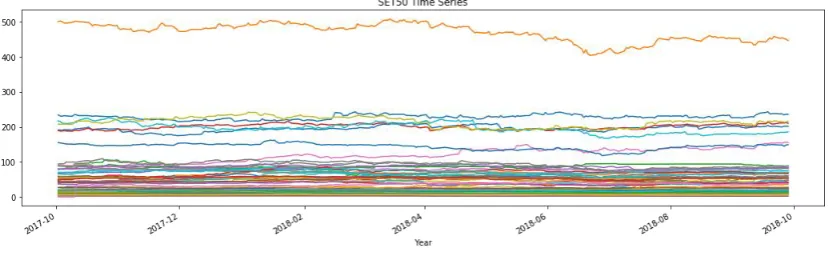
The stock exchange of Thailand, SET 50 Index, is a capitalization-weighted index based on the top 50 stocks listed in Bangkok. Thailand SET index has high market capitalization and high liquidity. SET 50 dataset is the historical closing price of 50 stock indices from investing website (www.investing.com). All dataset has the same length of 12,200 data points; the used variables are currency data, closing price and period of dataset between 1, October 2017 to 30, September 2018, shows as Figure 6.
Figure 6. Time-series of SET 50 index stock
4.2 Cluster algorithm
This paper will break down 3 scenarios for each data type of experiment. The scenario of the clustering algorithm detail describes in Table 6. The hierarchical and partitional algorithm was needed to normalize data and cluster evaluating to find the best number of cluster (k-value).
Table 6. The scenario of the clustering algorithm by a column of distance measurement and centroid
Scenario Distance measurement Centroid Clustering algorithm Data type
hc DTW PAM Hierarchical Equal or non equal length
pc_dtw DTW PAM Partitional with k-medoid Equal or non equal length
pc_sbd SBD Shape extraction Partitional with k-shape Non-equal length only
pc_tp DTW PAM Partitional with TADPole Equal length only
To evaluate the clustering algorithm, we compare 3 scenarios of the clustering algorithm, time series representation, a common image clustering algorithm, and clustering by the color of currency values.
4.3 The time-series clustering experiment result The cryptocurrency clustering result
157
International Journal of Science and Business
Email: [email protected] Website: ijsab.comPublished By resulted in for 2 clusters as best, while the partitional with k-shape is 4 clusters. The series and centroid result of the hierarchical scenario, the partitional with the k-medoid scenario, and the partitional with k-shape scenario are shown as Figure 10, Figure 11, and Figure 12 respectively.
Figure 7. Cryptocurrency, zone A of Silhouette index of each scenario algorithm and each k clusters
Figure 8. Cryptocurrency, zone B of Silhouette index of each scenario algorithm and each k clusters
Figure 9. Cryptocurrency, zone C of Silhouette index of each scenario algorithm and each k clusters
158
International Journal of Science and Business
Email: [email protected] Website: ijsab.comPublished By Figure 11. The series (left) and centroid (right) result of partitional with the k-medoid
scenario of cryptocurrency time-series, zone A
Figure 12. The series (left) and centroid (right) result of partition with the k-shape scenario of cryptocurrency time-series, zone A
In zone B, the k-value of hierarchical and partitional with k-shape scenario resulted in 2 clusters as best, while the partitional with k-medoid is 4 clusters. The series and centroid result of the hierarchical scenario, the partitional with the k-medoid scenario, and the partitional with k-shape scenario are shown as Figure 13, Figure 14, and Figure 15 respectively.
159
International Journal of Science and Business
Email: [email protected] Website: ijsab.comPublished By Figure 14. The series (left) and centroid (right) result of partitional with the k-medoid
scenario of cryptocurrency time-series, zone B
Figure 15. The series (left) and centroid (right) result of partitional with the k-shape scenario
of cryptocurrency time-series, zone B.
In zone C, The k-value of hierarchical, partitional with k-shape and partitional with k-medoid scenario resulted in 2 clusters as best. The series and centroid result of the hierarchical scenario, the partitional with the k-medoid scenario and the partitional with k-shape scenario are shown as Figure 16, Figure 17, and Figure 18 respectively.
Figure 16. The series (left) and centroid (right) result of the hierarchical scenario of cryptocurrency time-series, zone C
Figure 17. The series (left) and centroid (right) result of partitional with the k-medoid scenario of cryptocurrency time-series, zone C
Figure 18. the series (left) and centroid (right) result of partitional with the k-shape scenario of cryptocurrency time-series, zone C
The Shanghai Stock Exchange 50 Index (SSE 50) clustering result
160
International Journal of Science and Business
Email: [email protected] Website: ijsab.comPublished By partitional with the k-medoid scenario, and the partitional with k-shape scenario are shown as Figure 20, Figure 21, and Figure 22 respectively.
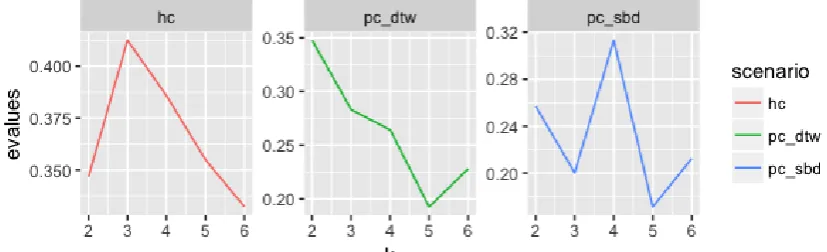
Figure 19. The Shanghai Stock Exchange 50 Index (SSE 50) of Silhouette index of each scenario algorithm and each k clusters
Figure 20. The series (left) and centroid (right) result of hierarchical scenario of SSE 50
Figure 21. The series (left) and centroid (right) result of partitional with k-medoid scenario of SSE 50
Figure 22. The series (left) and centroid (right) result of partition with the k-shape scenario of SSE 50
The exchange rate currency clustering result
161
International Journal of Science and Business
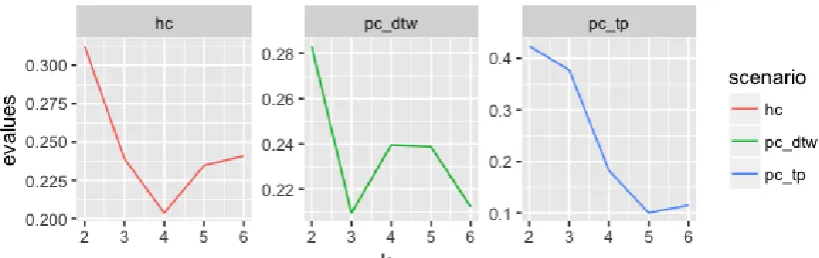
Email: [email protected] Website: ijsab.comPublished By Figure 23. The exchange rate currency of Silhouette index of each scenario algorithm and each k clusters
Figure 24. The series (left) and centroid (right) result of hierarchical scenario of the exchange rate currency
Figure 25. The series (left) and centroid (right) result of partitional with the k-medoid scenario of the exchange rate currency
Figure 26. The series (left) and centroid (right) result of partitional with TADPole scenario of the exchange rate currency
The Stock Exchange of Thailand 50 (SET 50) clustering result
162
International Journal of Science and Business
Email: [email protected] Website: ijsab.comPublished By Figure 27. SET 50 of Silhouette index of each scenario algorithm and each k clusters
Figure 28. The series (left) and centroid (right) result of the hierarchical scenario of SET 50
Figure 29. The series (left) and centroid (right) result of partitional with the k-medoid scenario of SET 50
Figure 30. The series (left) and centroid (right) result of partitional with TADPole scenario of SET 50
4.3 Comparing time-series clustering result
To evaluate our proposed method, we run 3 zones of cryptocurrency series using 3 clustering algorithms such as the hierarchical scenario, the partitional with the k-medoid scenario, and the partitional with k-shape which are evaluated by Silhouette index, COP index, DB index, DB star index, and CH index.
Table 7,
Sil (max)
COP (min)
DB (min)
DBStar (min)
CH (max)
HC 0.45 0.41 0.70 0.70 74.62
DTW 0.44 0.39 0.91 0.91 148.81
163
International Journal of Science and Business
Email: [email protected] Website: ijsab.comPublished By Table 8 8, 9 and 10 report the clustering evaluation value that represent in the same direction, the hierarchical scenario is the most effective for the unequal dataset; cryptocurrency and SSE 50 series. For exchange rate currency and SET 50 which are the equal length time-series, their evaluation values are shown as
Table 11 and
Table 12 respectively. The most effective algorithm with exchange rate currency and SET 50 is partitional with TADPole and partitional with k-medoid respectively.
Table 7. Cryptocurrency, zone A clustering evaluation of each scenario
Sil (max) COP (min) DB (min) DBStar (min) CH (max)
HC 0.45 0.41 0.70 0.70 74.62
DTW 0.44 0.39 0.91 0.91 148.81
PC_k-Shape 0.23 0.24 1.30 1.39 39.93
Table 8. Cryptocurrency, zone B clustering evaluation of each scenario Sil
(max) (min) COP (min) DB DBStar (min) (max) CH
HC 0.45 0.53 0.89 0.89 16.28
PC_DTW 0.18 0.28 1.96 2.20 103.47
PC_k-Shape 0.24 0.37 1.28 1.28 144.10
Table 9. Cryptocurrency, zone C clustering evaluation of each scenario Sil
(max) (min) COP (min) DB DBStar (min) (max) CH
HC 0.51 1.13 0.31 0.31 3.25
PC_DTW 0.35 0.35 1.51 1.51 1,075.66
PC_k-Shape 0.27 0.30 1.85 1.85 550.91
Table 10. SSE 50 clustering evaluation of each scenario Sil
(max) (min) COP (min) DB DBStar (min) (max) CH
HC 0.41 0.30 0.99 1.00 23.52
DTW 0.35 0.49 1.54 1.54 28.76
PC_k-Shape 0.10 0.59 2.42 2.88 11.56
Table 11. Exchange rate currency clustering evaluation of each scenario Sil (max) COP (min) DB (min) DBStar (min) CH (max)
HC 0.31 0.70 1.02 1.02 16.78
PC_DTW 0.28 0.46 1.15 1.15 111.73
PC_TADPole 0.42 0.98 0.72 0.72 13.38
Table 12. SET 50 clustering evaluation of each scenario Sil (max) COP (min) DB (min) DBStar (min) CH (max)
HC 0.36 0.43 1.33 1.33 26.59
PC_DTW 0.37 0.43 1.19 1.19 25.41
164
International Journal of Science and Business
Email: [email protected] Website: ijsab.comPublished By
5. Conclusion
According to Table 13, which we have demonstrated the clustering time-series of some kind of financial time-series. We use 4 time-series datasets, which can split into 2 data type (equal and unequal length). This experiment, comparing time-series clustering using 3 scenarios of cluster algorithm for each time-series data set and evaluating clustering algorithm using 5 indices to identify the validity of each clustering algorithm. From research result, the hierarchical algorithm is the most efficient algorithm for unequal length of cryptocurrency series and SSE 50. In another hand, the partitional algorithm is the most efficient for an equal length of exchange rate currency and SET 50.
Table 13. Conclusion of research
Dataset Data type The Best
Algorithm
No. of Cluster
Cryptocurrency, Zone A Unequal length Hierarchical 2
Cryptocurrency, Zone B Unequal length Hierarchical 2
Cryptocurrency, Zone C Unequal length Hierarchical 2
SSE50 Unequal length Hierarchical 3
Exchange rate currency Equal length Partitional with TADPole 2
SET50 Equal length Partitional with k-medoid 2
Exploring more on the source of the result, some element of the unequal length data might contribute to the result such as the fact that original data is very large in both the data period and type of currency dimensions. when we execute and cluster data, it is hard to do it in equal length manner, where SSE50, includes 50 stock indices and data period is 10 years while cryptocurrency, includes 643 currencies in 5 years. Therefore, the hierarchical algorithm is suitable with the larger and high dynamic variant datasets. On another hand, SET50 includes 50 stock indices with fixed data only period of 1 year while exchange rate currency in the study includes 92 currencies around the world within 3-month period. With these low amount and much less variant dataset, a partitional clustering algorithm is more suitable. We hope our research would be good motivation for researchers to study further on time-series clustering and its application in much wider area including biometric clustering, exchange rate currency and stock clustering to manage the trading portfolio.
Acknowledge
165
International Journal of Science and Business
Email: [email protected] Website: ijsab.comPublished By
this valuable opportunity to study in China. I would also like to acknowledge my senior apprentice Zhu Lin, Zhao Xing Wei, Xu Yuan Yuan, Chinese classmates, Wang Pei, Dong Min Jie, Yang Jia Hui, Cheng Li, Aommy, Jo Jo, Maylo, all my Chinese and International friends that gave
me long last friendship,and emotional support, take care and made my life in China
meaningful. Finally, I must express my very profound gratitude to my parents and older brothers, my grandma, and my aunt for providing me with unfailing support, give me freedom and continuous encouragement throughout my years of study and through the processes of researching and writing this thesis. This accomplishment would not have been possible without them. Thank you.
Reference
Ville Hautamäki, Pekka Nykänen, & Pasi Fränti. (2008). Time-series Clustering by Approximate Prototypes. International Conference on Pattern Recognition. IEEE.
Niennattrakul, V. , & Ratanamahatana, C. A. . (2006). Clustering Multimedia Data Using Time Series. International Conference on Hybrid Information Technology. IEEE.
Gullo, F. , Ponti, G. , Tagarelli, A. , Tradigo, G. , & Veltri, P. . (2012). A time series approach for clustering mass spectrometry data. Journal of Computational Science, 3(5), 344-355. Izakian H, Pedrycz W, Jamal I. (2015). Fuzzy clustering of time series data using dynamic time
warping distance. Engineering Applications of Artificial Intelligence, 39, 235-244.
Liao, T. W. . (2005). Clustering of time series data—a survey. Pattern Recognition, 38(11), 1857-1874.
PA Wang, W. , & Zhang, Y. . (2007). On fuzzy cluster validity indices. Fuzzy Sets and Systems, 158(19), 2095-2117.
Berndt DJ, Clifford J. (1994). Using dynamic time warping to find patterns in time series. In KKD workshop, 10(1), 359-370.
Rokach, Lior, and Oded Maimon.(2005). "Clustering methods." Data mining and knowledge discovery handbook. Springer US, 321-352.
Begum, N. , Ulanova, L. , Wang, J. , & Keogh, A. E. . (2015). Accelerating dynamic time warping clustering with a novel admissible pruning strategy.
Ratanamahatana, C., Keogh, E., Bagnall, A. J., & Lonardi, S. (2005). A Novel Bit Level Time Series Representation with Implication of Similarity Search and Clustering. Pacific-asia Conference on Advances in Knowledge Discovery & Data Mining.
HHan, J. (2005). Data Mining: Concepts and Techniques.
Paparrizos, J. , & Gravano, L. . (2016). K-shape: efficient and accurate clustering of time series. ACM SIGMOD Record, 45(1), 69-76.
Aghabozorgi, S. , Shirkhorshidi, A. S. , & Wah, T. Y. . (2015). Time-series clustering - A decade review. Elsevier Science Ltd.
Tak Chung Fu - F.L. Chung - Robert Wing Pong Luk - Vincent T. Y. NgVincent. (2001). Flexible time series pattern matching based on perceptually important points. JT Conference on Artificial Intelligence Workshop, 1-7
Arbelaitz, O. , Gurrutxaga, I. , Muguerza, J. , Jesús M. Pérez, & Iñigo Perona. (2013). An extensive comparative study of cluster validity indices. pattern recognit. Pattern Recognition, 46(1), 243-256.
Hubert, L., & Arabie, P. (1985). Comparing partitions. Journal of Classification, 2(1), 193-218. Sardá-Espinosa. (2018). Comparing Time-Series Clustering Algorithms in R using the
dtwclust Package - Retrieved from
166
International Journal of Science and Business
Email: [email protected] Website: ijsab.comPublished By Tsay, R. S. . (2010). Multivariate Time Series Analysis and Its Applications. Analysis of
Financial Time Series, Second Edition. John Wiley & Sons, Inc.
Rokach, L. . (2009). A survey of clustering algorithms. Data Mining & Knowledge Discovery Handbook, 16(3), 269-298.
Ling H E , Ling-Da W U , Yi-Chao C . (2007). Survey of Clustering Algorithms in Data Mining. Application Research of Computers, 24(1), 10-13.
Nayak J, Naik B, Behera H S. (2015). Fuzzy C-Means (FCM) Clustering Algorithm: A Decade Review from 2000 to 2014. Computational Intelligence in Data Mining, 2(1).
Sasirekha, K. , & Baby, P. . (2013). Agglomerative hierarchical clustering. Electronic Design, 17-17.
Rui, X., & D. Wunsch. (2005). Survey of clustering algorithms. IEEE Transactions on Neural Networks, 16(3), 645-678.
Saikhamwong N - Rimcharoen S.(2002).K-Mean Clustering of the Stock Exchange of Thailand 50 (SET50) for Portfolio Diversification. 11th International Conference on e-Business (iNCEB 2013).
Cite this article:
Tangsirisakul, D. (2019).Comparing Clustering Algorithms using Financial Time-series data.International Journal of Science and Business, 3(2), 146-166. doi:
https://doi.org/10.5281/zenodo.2617341
Retrieved from http://ijsab.com/wp-content/uploads/334.pdf