Available Online at www.aextj.com
Agricultural Extension Journal 2018; 2(2):125-131 RESEARCH ARTICLE
Performance, Egg Qualities, and Blood Parameters of Layers Fed Diets Containing
Graded Levels of Sundried Sweet Orange Fruit Peel Meal
Benjamin O. Oyewole, Bright Ojotule, Aminu Salihu
Department of Animal Production, Kogi State University, Anyigba, Kogi State, Nigeria Received: 20-04-2018; Revised: 25-05-2018; Accepted: 23-06-2018
ABSTRACT
A 10-week feeding trial was conducted to determine the performance, egg qualities, and hematology of layers fed diets containing sun-dried sweet orange peel meal (SOPM). A total of 140 Isa brown point of lay birds, aged 20 weeks were used for the experiment. SOPM was incorporated to replace 0, 10, 20, 30, and 40% maize. The birds were randomly assigned to the diets in a Completely Randomized Design; each diet group had 28 birds and 4 replicates with each replicate having 7 birds. Observed
results showed that SOPM did not significantly (NS) (p>0.05) affect final weight and egg number.
However, weight change, feed intake, feed conversion ratio, mortality, cost of 1 kg feed, and cost of feed
consumed were significantly different (P < 0.05) among treatments.Egg weight and egg length were
significantly (P < 0.05) different, which ranged from 56.18 to 58.73 g and 3.74–4.17 cm, respectively.
Shell thickness and egg width were NS (P > 0.05) influenced, and ranged from 0.80 to 0.84 and 2.63–
2.71 cm, respectively. Internal egg parameters, i.e., yolk width, yolk height, albumin weight, albumin
length, and yolk index were significantly (P < 0.05) affected. Hematological profile (packed cell volume,
hemoglobin, white blood cell, red blood cell, mean corpuscular volume, mean corpuscular hemoglobin
(MCH), MCH concentration, lymphocyte, and neutrophil) of birds showed significant differences (P
< 0.05). The study revealed that SOPM did not have an adverse effect on the performance of layers even at 40% replacement of maize while in lay. Its inclusion decreased the cost of feed linearly, did not compromise external and internal qualities of eggs or the health of the birds.
Key words: Hematology, performance, point of lay,serum
INTRODUCTION
The need to provide feed is basic to any livestock enterprise including poultry. However, making the feed cheaply available is more compelling
to profitability and sustainable livestock
development.[1] One approach to feed cost reduction is the use of cheaper sources of nutrients. The energy and protein components of a feed are usually high in cost, and a reduction in the cost of the energy and protein sources could translate to reduced cost of feeding livestock.[1]
Some of the major conventional sources of energy and protein in monogastric animal feeding are also the bulk of raw materials for the brewery
Address for correspondence:
Benjamin O. Oyewole,
E-mail: [email protected]
and flour milling industries, apart from being
sources of food for human consumption.[2,3] Their competitive demand has resulted in scarcity and high cost; thereby, raising the prices of animal products beyond the reach of the average populace. As a result of this, research efforts have been directed toward the increased use of agro-industrial by-products (AIBP) and farm residues as alternative feed resources.[4] These are cheaper and less competitive sources of livestock feed, and some have been reported to play an important role in the maintenance of normal structure and function of intestinal mucosa because of the high
Sweet orange (Citrus sinensis) by-products such as
peels and pulps are abundant in Nigeria especially in
the dry season which is the main harvest period.[11] The authors reported that heaps of the peels of sweet orange are usually noticed on streets and along major
roads in Nigeria because Government and orange
retailers have no strategic program for its disposal thus becoming an environmental problem. Sweet orange rind is comparable in energy and protein to maize.[9,10] Studies are still in progress to elucidate
the usefulness and profitability of citrus peel, which
is not subject to pest attacks, as an animal feed ingredient. Available reports include studies by Jong-Kyu et al.,[12] Oluremi et al.,[9] Hon et al.,[13] Agu et al.,[14] Ojabo et al.,[15] and Ojabo et al.[16]
Objectives of the study
The objectives of this study were as follows: To determine the performance of layers fed diets containing graded levels of sun-dried sweet orange fruit peel meal.
To determine the cost implication of including sweet orange fruit peel meal in the diet of layers.
To determine the hematological profile of layers
fed sweet orange (C. sinensis) fruit peel meal based diets.
To determine the external egg quality parameters of layers fed with sweet orange peel meal (SOPM) based diets.
Evaluate the internal egg qualities of eggs from chicken fed sweet orange fruit peel meal based diets.
MATERIALS AND METHODS Experimental location
The feeding trial was carried out at the Poultry Unit of the Livestock Teaching and Research Farm, Department of Animal Production, Kogi State University, Anyigba, which lies between Latitude
7°15’ and 7° 29’N of the equator and Longitudes 7°
111 and 7° 321 East of the Greenwich Meridian.[17]
Experimental birds and management
A total of 140 Isa Brown Point of lay birds, aged 20 weeks were used for the experiment. The birds were administered anti-stress on the day of arrival and equally administered coccidiostat before being assigned to the different diets. Sun-dried sweet
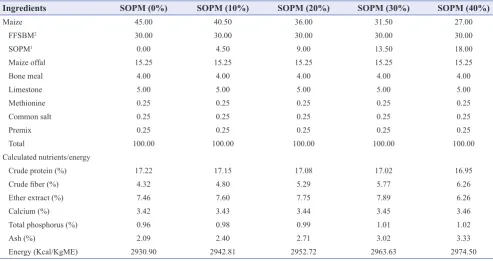
orange peel was incorporated to replace maize at 0, 10, 20, 30, and 40% [Table 1]. The birds were transferred to California type cage at 21 weeks of age and allowed an adjustment period of 1 week before the commencement of data collection.
The birds were randomly assigned to the five
experimental diets in a Completely Randomized Design. Each diet group had 28 birds and four replicates with each replicate having 7 birds. The proximate composition of each experimental diet was analyzed as described by AOAC.[18]
Performance parameters
The initial weight of birds was determined by weighing them per replicate at the beginning of the experiment and the end. Daily feed intake was determined by subtracting the leftover from the quantity of feed offered. Furthermore, feed conversion ratio was determined by calculating the quantity of feed required to produce a dozen of the egg.
Determination of the economics of feeding dry Sopm based diets to layers
The economics of feeding sun-dried SOPM based diets to laying birds was estimated using the prevailing market prices of the feedstuffs. Using the following formulae;
Cost of producing 100 kg of each feed was estimated and then used to compute consumed feed cost/bird and cost of 1 kg of feed.
i. Cost of 1 kg feed (₦)
ii. Cost of feed consumed/bird (₦)
iii.
( )
=×
No of dead birds 100 No of birds at the beginning of t
Percentage Mortal
he experiment
ity %
External egg quality parameters
breaking open the egg and emptying its content.
The shell was then washed under flowing water
to remove albumen remains, after which the shell thickness was measured using micrometer screw gauge. Egg length was measured using Vernier calipers.[10]
The internal egg quality parameters determined include egg yolk width, egg yolk weight, yolk height, albumen weight, albumen height, and egg yolk index. Two crack-free eggs per replicate were randomly sampled when the birds were 24, 25, 26, 27, and 28 weeks old for internal egg quality determination. All eggs sampled for egg quality determination were collected on the same day and before 12 noon. The eggs were carefully cleaned with tissue paper to remove fecal or litter materials before weighing. Egg quality determination was carried out within 12 h of egg collection. Each egg after weighing was broken at the equatorial
region, and the content gently poured into a flat
plate for internal egg quality determination. Egg yolk diameter was measured in centimeters (cm) with Vernier calipers, as the widest circumference of the yolk, while yolk height (cm) was measured from the highest point of the yolk to the base on
the flat plate, with the aid of Vernier calipers. Yolk
index was computed by dividing yolk height by yolk diameter. Albumen height was taken with the aid of Vernier calipers as the highest point just
close to the edge of the yolk to the base on the flat
plate.
Hematological parameters
At the end of the feeding trial which lasted 10 weeks, one bird per replicate was randomly chosen for blood collection. The blood samples of birds were collected into a labeled sample bottles treated with ethylenediaminetetraacetic acid (anti-coagulant) through the wing vein using new sterilized disposable needle and syringe. The following hematological parameters were determined as described by[20] Schalm et al. (1975); packed cell volume (PCV), red blood cell (RBC), hemoglobin (Hb), white blood cell (WBC), mean corpuscular hemoglobin (MCH), heterophils (Het.), MCH concentration (MCHC), eosinophils, lymphocyte
(LYMP), and mean corpuscular volume (MCV).
Statistical analysis
Data were collected, processed and analyzed using computer software package SPSS version 20. Means were separated using the same package
where found to be significantly different at 5%.
RESULTS
Results of the effect of SOPM on performance characteristics of laying birds are presented in Table 2. Final weight was not significantly (NS)
(P > 0.05) affected by the treatments, however
weight change, feed intake, feed conversion ratio,
Table 1: Composition of experimental diets (%)
Ingredients SOPM (0%) SOPM (10%) SOPM (20%) SOPM (30%) SOPM (40%)
Maize 45.00 40.50 36.00 31.50 27.00
FFSBM2 30.00 30.00 30.00 30.00 30.00
SOPM1 0.00 4.50 9.00 13.50 18.00
Maize offal 15.25 15.25 15.25 15.25 15.25
Bone meal 4.00 4.00 4.00 4.00 4.00
Limestone 5.00 5.00 5.00 5.00 5.00
Methionine 0.25 0.25 0.25 0.25 0.25
Common salt 0.25 0.25 0.25 0.25 0.25
Premix 0.25 0.25 0.25 0.25 0.25
Total 100.00 100.00 100.00 100.00 100.00
Calculated nutrients/energy
Crude protein (%) 17.22 17.15 17.08 17.02 16.95
Crude fiber (%) 4.32 4.80 5.29 5.77 6.26
Ether extract (%) 7.46 7.60 7.75 7.89 6.26
Calcium (%) 3.42 3.43 3.44 3.45 3.46
Total phosphorus (%) 0.96 0.98 0.99 1.01 1.02
Ash (%) 2.09 2.40 2.71 3.02 3.33
mortality, cost of 1 kg feed, and cost of feed
consumed were significantly different (P < 0.05) among treatments.
The external egg quality of the experimental birds shown in Table 3, egg weight and egg length
were significantly (P < 0.05) different across the treatments, which ranged from 56.18 to 58.73 g–3.74 to 4.17 cm, respectively. There was no
definite pattern of variation for the parameters. Shell thickness and egg width were NS (P > 0.05) influenced by the treatments. Observed values ranged
from 0.80 to 0.84–2.63 to 2.71 cm, respectively.
The internal egg characteristics of layers are shown in Table 4. All parameters measured, i.e., yolk width, yolk height, albumin weight,
Albumin length, and yolk index were significantly
(P < 0.05) affected by the treatments.
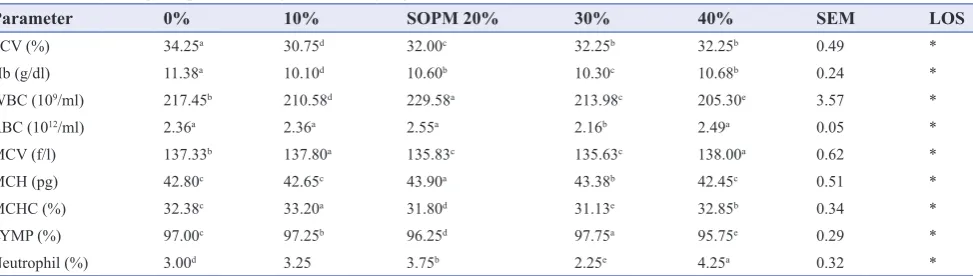
The hematological profile of the experimental birds
is shown in Table 5. The results of hematological
profile of laying birds fed varying levels of SOPM
showed significant differences (P < 0.05) in all hematological parameters, i.e., PCV, Hb, WBC,
RBC, MCV, MCH, MCHC, LYMP, and neutrophil.
DISCUSSION
Observed results show that feed intake, which varied from 131.88 g to 144.11 g/day, may indicate that substitution of maize by SOPM in the diets did not affect the appetite of birds as all the diets were equally palatable and acceptability to the
birds. Feed intake, though significantly (P < 0.05) different among the treatments was adequate. This observed value range is comparable with 128–148 g observed by Iheukwumere et al.[21] but higher than 103.97–110.49 g reported by Oyewole
et al.[22] for Nera black layers fed 48 h fermented SOPM based diets. This is an indication that SOPM inclusion did not affect the palatability of the diets adversely. Substitution of maize did not
Table 2: Effect of sun-dried SOPM on performance and production of laying birds
Parameter 0% 10% SOPM 20% 30% 40% SEM LOS
Initial weight (g) 1.43 1.42 1.42 1.41 1.45 0.21 NS
Final weight (g) 1.36 1.46 1.48 1.43 1.52 0.02 NS
Weight change (g) −67.50e 40.00c 60.00b 17.50d 92.50a 28.45 * Feed intake (g) 132.90d 131.88d 137.28c 144.11a 140.23b 1.52 *
Egg number/bird 33.31 33.30 33.32 33.56 33.31 0.15 NS
FCR (%) 3.99b 3.96a 4.12c 4.32e 4.21d 0.31 *
Mortality (%) 3.57b 3.57b 7.15a 3.57b 0.00c 1.42 *
Cost of 1 Kg feed (₦) 186.12a 179.77b 173.93c 168.57d 163.61e 1.83 *
Cost of feed consumed (₦) 1385.15a 1321.61d 1337.09c 1360.37b 1284.76e 13.43 *
abcdeMeans on the same row with different superscripts are significantly different (P < 0.05). NS: Not significant (P > 0.05), SEM: Standard error of mean, SOPM: Sweet orange peel meal, LOS: Level of significance, FCR: Feed conversion ratio
Table 3: External egg quality of layers fed SOPM
Parameter 0% 10% SOPM 20% 30% 40% SEM LOS
Egg weight (g) 56.18d 58.53a 57.63b 58.73a 57.35c 0.58 *
Egg length (cm) 4.15a 4.17a 4.01a 3.74b 4.04a 0.08 *
Shell thickness (mm) 0.80 0.80 0.80 0.84 0.80 0.03 NS
Egg width (cm) 2.67 2.63 2.70 2.71 2.71 0.02 NS
LOS: Level of significant, NS: Not significant (P > 0.05), *Values with different superscripts are significantly different P < 0.05, SEM: Standard error of mean, SOPM: Sweet orange peel meal
Table 4: Internal egg quality of layers fed SOPM
Parameter 0% 10% SOPM 20% 30% 40% SEM LOS
Yolk width (cm) 2.41b 2.38b 2.41b 2.32b 2.59a 0.05 *
Yolk weight (g) 12.95e 13.20c 13.10d 14.23b 14.75a 0.30 *
Yolk height (cm) 1.11c 1.23b 1.35a 1.30a 1.20b 0.03 *
Albumin weight (g) 30.10e 33.88b 31.95d 36.98a 32.55e 0.91 * Albumin length (cm) 5.80c 5.45e 6.15a 5.98b 5.75d 0.09 *
Yolk index (%) 51.53d 51.71c 56.16a 55.73b 46.62e 1.74 *
abcdeMeans on the same row with different superscripts are significantly different (P < 0.05). SEM: Standard error of mean, LOS: Level of significance, SOPM: Sweet orange
affect final weight gain significantly (P > 0.05),
which might indicate that the birds utilized the diets optimally.[23] All the weight of the birds on the various treatment falls within 1289– 1571 g reported by Tuleun et al.[24] but higher than 1237.74 g reported by Ojedapo et al.[25] for
20 weeks old Nera black pullets. Final weight of
birds ranged from 1.36 kg (0% SOPM) to 1.52 kg (40% SOPM), with no clear pattern of variation.
Weight change also varied from −67.50 g (0% SOPM) to 92.50 g (40% SOPM) with no definite pattern of variation. Observed final weight values
indicate that all birds on SOPM based diets increased in weight during production except those on the control diet. The stress and level of lay may have resulted in loss of weight for the birds on 0% SOPM, because they laid more eggs. Mortality was recorded in all treatments except for treatment 5, which suggest that SOPM is not-toxic to laying birds. This is because no bird died at 40% SOPM inclusion. SOPM resulted
in significant (P < 0.05) reductions in feed cost per kg and cost of feed consumed per bird. This could be because the SOPM used was obtained at lower cost relative to maize. Feed cost/kg gain of birds on SOPM based diets is comparable to the control. However, the highest cost was recorded with birds on diet 0% SOPM. Cost of production
of laying birds declined significantly (P < 0.05) as percent substitution level of maize increased. Thus, indicating that maize substitution by SOPM in laying bird diets is capable of reducing cost of production. This is because dietary SOPM was cheaper compared with maize. Consequently, the cost of the SOPM-based diets was lower than the control’s.
Average egg weight range of 56.18–58.73 g obtained in this study is lower than 59.50–64.50 g for European commercial strains and 63 g for
Olympic black layers in Akure, Nigeria,[26] and 59.47–62.87 g by Oyewole et al.[10] for Nera black layers on fermented SOPM based diets. The characteristically smaller eggs observed in this study might be due to differences in feed composition, strain of birds, and age of birds. The shell thickness recorded for all treatments is adequate to prevent the shell from crack during handling. The minimum recommended shell thickness for chicken egg is 0.33 mm.[27] Thick egg shells are preferred because they encourage the best use of the nutrients contained in the egg by the embryo, enables the eggs to pass through the market handling without breakage, there is less chance for the egg to become dehydrated and less chance of bacteria penetrating inside the egg and they offer the best protection from mechanical damage.[28] Hence, SOPM did not adversely affect shell quality of the egg. The birds were able to mobilize calcium and phosphorus for eggshell formation even in SOPM based diets.
Average yolk width observed ranged from 2.32 cm to 2.59 cm. It was higher in the SOPM
groups. Yolk weight obtained ranged from
12.95 g to 14.75 g, which was within the range of 12.31–17.91 g reported by Madubuike and Obidimma.[29] The control birds had the least value. The observed yolk height values fell between 1.11 cm and 1.35 cm. These values were lower than the values of 1.46–1.56 cm.[29] Albumin length of 5.45–6.15 cm was observed. Albumin length and yolk height are both indicators of the freshness and quality of an egg.[29] The yolk index is a measure of the standing-up quality of the yolk, observed values ranged from 46.62%
to 56.16%. Card and Neshiem[30] had reported 33% and 50% for yolk indices of fresh eggs. Ezieshi et al.[31] and Garba et al.[32] had observed 42–45% and 44–47%, respectively. Observed
Table 5: Hematological profile of layers fed varying levels of sun‑dried SOPM
Parameter 0% 10% SOPM 20% 30% 40% SEM LOS
PCV (%) 34.25a 30.75d 32.00c 32.25b 32.25b 0.49 *
Hb (g/dl) 11.38a 10.10d 10.60b 10.30c 10.68b 0.24 *
WBC (109/ml) 217.45b 210.58d 229.58a 213.98c 205.30e 3.57 *
RBC (1012/ml) 2.36a 2.36a 2.55a 2.16b 2.49a 0.05 *
MCV (f/l) 137.33b 137.80a 135.83c 135.63c 138.00a 0.62 *
MCH (pg) 42.80c 42.65c 43.90a 43.38b 42.45c 0.51 *
MCHC (%) 32.38c 33.20a 31.80d 31.13e 32.85b 0.34 *
LYMP (%) 97.00c 97.25b 96.25d 97.75a 95.75e 0.29 *
Neutrophil (%) 3.00d 3.25 3.75b 2.25e 4.25a 0.32 *
abcdeMeans on the same row with different superscripts are significantly different (P < 0.05). NS: Not significant (P > 0.05), LOS: Level of significance, SEM: Standard error
of mean, PCV: Packed cell volume, RBC: Red blood cell, MCV: Mean corpuscular value, MCH: Mean corpuscular hemoglobin, Hb: Hemoglobin, MCHC: Mean corpuscular
values of internal egg quality parameters seem to indicate that incorporation of SOPM in layer diet did not compromise the internal quality of egg. The observed values for albumin weight ranged from 30.10 g to 36.98 g were higher than 26.66 g observed by Madubuike and Obidimma.[29]
The PCV value range of 30.75–34.25% obtained in the study is within the range of 24.9–45.5% reported by Mitruka and Rawnsley[33] for healthy birds. This indicates that the birds were not ill. Hb values obtained in the study were
significantly higher in 0% SOPM (11.38 g/dl)
than other dietary groups. Observed Hb values of 10.10–11.38 g/dl are normal and within the range of 7.40–13.10 g/dl for healthy birds.[33] This indicates that inclusion of SOPM in the diets was not detrimental to the formation of Hb and hematopoiesis. WBC values obtained in this
study were significantly higher in 20% SOPM
(229.58) than in other dietary groups. This trend does not indicate any adverse effect of SOPM on the immune system of the birds. Observed RBC values range of 2.16–2.55 (1012/l) is <3.7–7.5 reported by Jain.[34] However, the observed value of 30% only is different from that of the control while others are similar. Thus, this indicates that SOPM promoted hematopoiesis, having furnished the birds with minerals and vitamins required for blood synthesis.
The MCV, MCH, and MCHC value ranges obtained in the study were 135.63–138.00 f/l, 42.45– 43.90 pg, and 31.13–33.20% were comparable to the ranges 104–135 f/l, 32–43.9 pg, and 30.2– 36.2 g/l for MCV, MCH, and MCHC, respectively, reported by Jain.[34] This indicates that the birds
were healthy and were not anemic. Neutrophil values obtained in the study were significantly different (2.25–4.25%) as they were influenced by
the treatment but were within the range of 0.5– 7.6% reported by Jain.[34] The observed LYMP
values were significantly different among the
treatments with 30% SOPM recording 97.75 which was highest. These observed parameters which disagreed with the works of some researchers might be due to genetic, age, breed, nutrition, and geographical location of the birds aside from the laboratory precision used for evaluation.
CONCLUSION
The study revealed that layers fed SOPM performed optimally even at 40% replacement of
maize while in lay. Inclusion of SOPM decreased the cost of feed linearly. The external and internal qualities were not compromised even at 40% replacement of dietary maize. More so, evaluated hematological parameters indicate that SOPM is not toxic and is capable of promoting good health when fed to birds.
RECOMMENDATIONS
It is recommended that farmers can replace 40% of dietary maize with sweet orange fruit meal to achieve a reduction in feed cost with increased
profitability while maintaining good external and
internal egg quality characteristics.
ACKNOWLEDGMENT
The authors hereby acknowledge the Nigerian tertiary Education Trust Fund (TETFUND) for
providing the funds to undertake this feeding trial.
REFERENCES
1. Adesehinwa AO. Utilization of palm kernel cake as an energy source by growing pigs: Effects on growth, serum matabolites, nutrient digestibility and cost of feed conversion. Belgium J Agric Sci 2007;13:593-600. 2. Adesehinwa AO, Ogunmodede BK. Performance and
serum metabolites of growing pigs fed diets containing ‘Dusa’ and cashew nut testa as protein sources. Indian J Anim Sci 2004;74:3-6.
3. Adesehinwa AO, Dafwang II, Ogunmodede BK, Tegbe TS. A review of utilization of some agro-industrial by‑ products in pig rations. Nigeria J Agric Extension 1998;11:50-64.
4. Agu PN, Oluremi OI, Tuleun CD. Nutritional evaluation of sweet of orange (Citrussinensis) fruit peel as feed resource in broiler production. Int J Poult Sci 2010;9:684-8.
5. AOAC. Association of Official Analytical Chemists. 15th ed. Richmond Virginia, USA: William Tryd Press;
1995.
6. Ayuk AA, Okun BI, Omoh EI, Wogar GS, Essien MI. The Effects of Urea and Corn Cob, Ash Treated Cocoa Pod Husk on Some Linear Body Parameters of Growing Pigs. Animal Science Association of Nigeria (ASAN). Oyo State, Nigeria: Proceedings of the 14th Annual
Conference; 2009. p. 234-45.
7. Card LE, Neisheim MC. Poultry Production. Philadelphia, PA, USA: Lea and Febiger; 1996.
8. Chineke CA. Internal relationship existing between body weight and egg producyion traits in Olympic black layers. Nigeria J Anim Prod 2001;48:10‑8. 9. Ezieshi EU, Omoregie A, Olomu JM. Performance
Laying Chickens Fed Palmkernel Cake Based Diets. Proceedings of the 26th Annual Conference of the
Nigerian Society for Animal Production (NSAP); 2001. p. 199-201.
10. Garba S, Jibir M, Omojola AB. Egg Quality of Commercial Laying Hens Fed Diets with Increasing Substitution Levels of Metabolizable Energy of Pearl Illet for Corn. Proc. 35th Conf., Nig. Soc. for Anim.
Prod.14‑17 March, 2010, Univ. of Ibadan, Nigeria; 2010. p. 308-1.
11. Hon FM, Oluremi OI, Anugwa FO. The effect of dried sweet orange (Citrus sinensis) Fruit pulp meal on the growth performance of Rabbits. Pak J Nutr 2009;8:1150-5.
12. Ifatimehin OO, Musa SD, Adeyemi JO. An analysis of the changing land use and its impact on the environment of Anyigba town, Nigeria. J Sustain Dev Afr 2009;10:22-9.
13. Iheukwumere FC, Ndubuisi EC, Mazi EA, Onyekwere MU. Growth, blood chemistry and carcass yield of broilers fed cassava leaf meal (Manihot esculenta Crantz). Int J Poult Sci 2007;6:555-9. 14. Jain NC. Schalms Veterinary Heamatology. 4th ed.
Philadelphia, PA: Lea and Febiger; 1986.
15. Jong‑Kyu HA, Kim SW, Kim WY. Use of Agro‑ Industrial by-Products as Animal Feed in Korea. Suweon: Animal Science and Technology College of Agriculture and Life Science, Seoul National University; 1996. p. 441-744.
16. Longe OG, Fagberno‑Byron JO. Beitr, trop. landwirtsch. Vet Med 1990;28:199-205.
17. Madubuike FN, Obidimma VN. Brewers’ Dried Grain as Energy Source on External and Internal Egg Qualities of Laying Hens. Vol. 34. Proceedings of the 34th Annual Conference of the Nigerian society of
Animal Production; 2009. p. 362-5.
18. Mitruka BM, Rawnsley HM. Clinical Biochemical and Haematological Reference Values in Normal Experimental Animals. New York: Masson; 1977. p. 42-5.
19. Narushin VG, Romanov VN. Egg physical characteristics and hatchability. Poult Sci J 2002;58:297-303.
20. Ojabo LD, Adenkola AY, Odaudu GI. The effect of dried sweet orange (Citrus sinensis) fruit peel meal on the growth performance and haematology of rabbits. Vet Res 2012;5:26-30.
21. Ojabo LD, Oluremi OI, Uza DV. Haematology and serum biochemistry of pullet grower chickens fed sweet orange (Citrus sinensis) fruit peel meal based diets. Res Opin Anim Vet Sci 2013;3:252-6.
22. Ojedapo LO, Akinokun O, Adedeji TA, Olayeni TB, Ameen SA, Ige AO, et al. Evaluation of growth traits and short-term layingperformance of three different
strains ofchicken in the Derived Savannah Zone of Nigeria. Int J Poult Sci 2008;7:92‑6.
23. Okai DB, Abora PK, Davids T, Martin A. Nutrient composition, availability, current and potential uses of “Dusa”: A cereal by-product obtained from “koko” (porridge) production. J Sci Technol 2005;25:33-8. 24. Oluremi OI, Ojighen VO, Ejembi EH. The nutritive
potential of sweet orange (Citrus sinensis) rind in broiler production. Int J Poult Sci 2006;5:613-7.
25. Oluremi OI, Ngi J, Andrew IA. Phytonutrients in Citrus Fruit Peel Meal and Nutritional Implication for Livestock Production. Livestock Research for Rural Development; 2007. p. 9 Article 89. Available from: http://www.cpav.org.collrrd/19/7.
26. Oluyemi JA, Roberts FA. Poultry Production in Warm Wet Climate. 2nd ed. London: Reprint Macmillan Press
Ltd; 2000. p. 9.
27. Oyewole BO, Oluremi OI, Aribido SO, Ayoade JA. Performance of Nera black Layer Chicken Fed Fermented Sweet Orange (Citrus sinensis) Peel Meal. 16th Annual Conference of Animal Science Association
of Nigeria at the Kogi State University, Anyigba, Kogi State, 12th September – 15th September; 2011.
p. 287-91.
28. Oyewole BO, Oluremi OI, Aribido SO, Ayoade JA. Effect of naturally fermented sweet orange (Citrus sinensis) peel meal on egg quality and blood constituents of nera black layers. Int J Agric Rural Dev 2012;15:1022-8.
29. Schalm OW, Jain NC, Carrol EJ. Veterinary Haematology. 3rd ed. Philadelphia, PA: Lea and Febiger;
1975. p. 254-5.
30. Sobamiwa O, Akinwale TO. Replacement value of cocoa husk meal for maize diets in growing pullets. Trop J Anim Sci 1992;1:111-6.
31. Stadelman WJ. Quality identification of shell eggs. In: Stadelman WJ, Cotterill OJ, editor. Egg Science and Technology. Westport, CN: Avi. Pub. Co., Westport, Conn; 1999. p. 444.
32. Tuleun CD, Njoku PC, Yaakugh ID. The performance of growing pullets fed Roxazyme® in rice offal based diets. In: Aduli-Malau AE, Adeyinka IA, editors. Strategies for Poverty Alleviation: Animal Production Option. Proceedings of the 26th Annual Conference of
the Nigerian Society for Animal Production (NSAP); 2001. p. 219-21.
33. Tuleun CD, Njike MC, Ikurior SA, Ehiobu NG. Laying performance and egg quality of hens fed cassava root meal/brewer’s yeast slurry based diets. Prod Anim Tech 2005;1:148-52.