Amirkabir University of Technology (Tehran Polytechnic)
Vol. 47, No. 1, Spring 2015, pp. 11- 16
Amirkabir International Journal of Science& Research (Electrical & Electronics Engineering)
AIJ-EEE) )
Improving the QoS in Intelligent Connected EVSE by
Using RPL
M. Alishahi
1, M. H. Yaghmaee
2*and G. Wu
31-Faculty Member, Department of Computer Engineering, Fariman Branch, Islamic Azad University, Fariman, Iran. 2- Professor, Department of Computer Engineering and Center of Excellence on Soft Computing and Intelligent Information
Processing, Ferdowsi University of Mashhad, Mashhad, Iran.
3- Professor, Department of Electrical Engineering & Information Technology, Tohoku Gakuin University, Tagajo, Japan.
ABSTRACT
Nowadays, a great portion of researches research and industrial innovation is about the electric vehicles
(EV) and also EV Supply Equipment (EVSE) that play an important role in this context. EVSE requires
standardization via effective communication protocols. In this paper, we propose to customize the existing
Internet standard Routing Protocol for Low Power and Lossy Networks (RPL) to facilitate the
communication among networked EVSEs. RPL is a flexible protocol that has special specifications to
support many low power and lossy nodes, which makes it self-healing and ideal to support the differing
traffic activity in EVSE systems. Our idea to improve the Quality of Service (QoS) in this vehicular network
is using classification of data type. Hence , we propose a Customized RPL which support supports
classification and also two different Objective Functions (OF) that the simulation results shows show ,
effectively reduce the end to end delay for special kind of data packets. We study our proposed method
under different scenarios to see how successful this idea is.
KEYWORDS
1- INTRODUCTION
Intelligent electric vehicle (EV) charging infrastructures will play a key role in the evolution of the next generation transportation systems [1]. As a result, much of the current research and industrial initiatives focus on various areas related to Electric Vehicle Supply Equipment (EVSE) systems such as forecasting charging loads [2], using new routing protocols for EVSE [3], a demand forecast of EVSE [4]. To facilitate the research in such varied, yet interrelated areas requires require standardizing the communication system of networked EVSE.
As a step towards standardization, we are optimizing a customized routing protocol called Routing Protocol for Low Power and Lossy Networks (RPL) for integration into EV charging infrastructures and improving the QoS in networked EVSE. The RPL protocol was developed in 2012 and based on IPv6 to provide a suitable routing method for low power and lossy networks, which consist of a large number of embedded devices with limited power, memory, and resources that connect to each other using various communication protocols, such as IEEE 802.15.4, Wi-Fi, and power-line communication (PLC) [3, 5]. The RPL protocol aims for cumulating networks and facilitate communication among these varied network communication protocols which are the same protocols typically used in EVSE systems.
Consequently, RPL can be extended to incorporate functions specific to the networked EVSE. In the section, we will explain the RPL protocol, in section 3 we will show how our proposed method works and in the last section, the new idea of this paper will be evaluated.
2- RPL
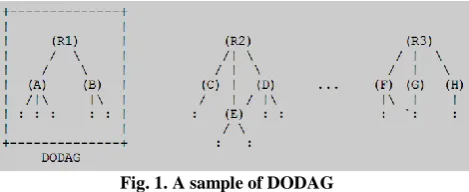
RPL is a distance-vector protocol that is based on the concept of a topological Directed Acyclic Graph (DAG). DAG uses a tree structure in which each node can have more than one parent. Specifically, RPL organizes these nodes into Destination Oriented DAGs (DODAG) whose roots are the destination nodes – e.g., sinks, concentrators, or network gateways. Figure 1 shows a sample DODAG with a similar structure to a tree that specifies the conventional route between the LLN nodes [6].
DODAG’s are created and managed based on the objective function (OF). The OF specifies routing metrics and optimization goals, and can construct routes to satisfy any requirements, such as quality of service (QoS). To construct a DODAG, the root sends the OF via a standard IPv6 message to neighbor’s nodes. The DODAG’s creation is finalized when the nodes decide, using a general algorithm, their preferred parent and rank. The rank of a node [7] is also computed by the OF, which expresses the distance of the node from its root in relation to the given metrics; nodes closer to the root should have the lower ranks.
The RPL protocol’s process helps to create a self-configuring, self-healing, loop detecting system that will be suitable for both EV and EVSE networks.
Fig. 1. A sample of DODAG
3- HOW WE IMPROVE QOS IN NETWORKED EVSE
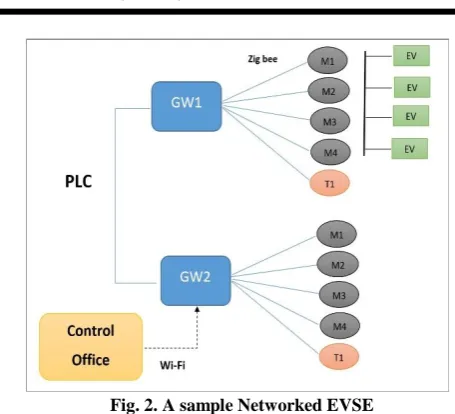
This paper is based on the real networked EVSE in which we need to reduce the end to end delay of some specific packets as important factor of QoS and also guaranty the scalability of the network. In our mentioned network, we have several parking lots that we equip them by charging stations for EV. Generally, in each parking, there could be some gateways that communicate with meters and sensors through Zigbee protocol, the gateways could communicate with each other through different communication protocols based on the situation of the parking such as PLC (Power Line Communication), Wi-Fi, 3G or even through wire. For example, in Fig. 2, we have a one of our parking structure that shows how the gateways, meters, temperature sensors and the control office are connected to each other. In fact, the condition of the parking force forces us to use a PLC connection between the gateways. The meters collect different data such as voltage and current from the charge stations and send them periodically to the server. Also we are also able to send the command to each gateway and control them. For now, each gateway include includes four meters although the component is designed in a way that can support up to 32 meters. Two of our major concerns in this these networks are transmitting control packets in a predefined delay and another one is about scalability of this network, it is so important for us to keep our high performance in a situation that the gateways are using their maximum capacity or when we add more gateways in each parking. These requirements are so general for any networked EVSE and our achievements based on a real network could be useful for the same networks.
Fig. 2. A sample Networked EVSE
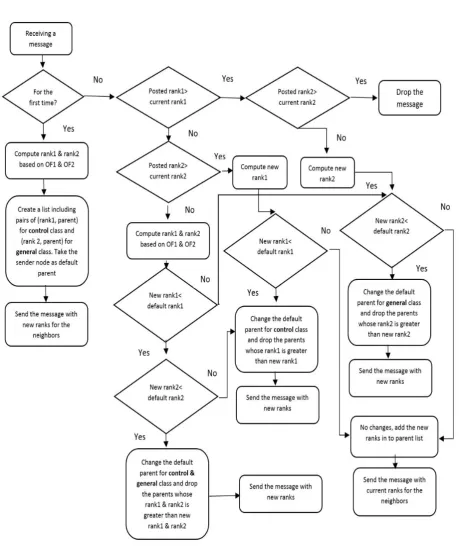
Also we also need a customized version of RPL which could be applicable for our classifying idea. Figure 3 shows the logical scheme of the proposed algorithm that let us to create our networked EVSE DODAG. When a node receives a message from a root for the first time, the algorithm calculates two ranks for the node based on two different OFs sent by the root and create a list which includes pairs of (rank1, parent) and (rank2, parent); of course , for the first time the root will be the parent. In fact, we use two OFs to make difference for control class and general class and of course, the first one is more important for us because they have low delay allowance. The algorithm then broadcasts a message with new routing information to its neighbors. Consequently, if it is not the first time a node receives a message, the algorithm performs steps to decide if the message comes from a better parent with lower rank. Note that in DODAG, each node can have several parents and each node could have two different preferred parent parents that one is suitable for control class and the other one for general class. The steps that the algorithm chooses the preferred parents is as follow follows: the receiving node check the posted rank for each class and if it is not greater than the current rank, then it is reasonable to find the new parents otherwise; it will drop the message. Then the receiving node will compute the new ranks based on new information to see if it is really from a more suited parent, if so , it will update the pairs of (ranki and parent) in its list and remove the parents with greater rank. When the DODAG is constructed, the upward route is clear because the nodes will send their packets based on their class to the preferred parents chosen during the DODAG’s construction process. In addition, the algorithm will be set to run periodically, depending on the network changes. We can also choose a small period for our algorithm to account for the dynamic network changes that could be caused by EVs’ high mobility rates.
Based on our classifying idea, we proposed two different OFs for each class type. Equation 1 computes a node’s rank for control class based on its parent’s rank and the node’s specification, which includes the ratio of
service to the arrival rate and the ratio of queue length to buffer length. Such parameters indicate the quality and desirability of a node; for instance, a node with a larger value indicates that it is not a good choice for transmitting the traffic to the root. In addition, the equation uses an impact factor to account for the role that the OF plays in the status of the network. Equation 2 is a common objective function [8] that we used it for our general class. It works based on Expected Transmission Time (ETX). The ETX measurement of a link (i, j) is based on a number s of successful network-layer transmissions of m data packets transmitted from node i to node j in the past τ seconds using (Equation 3). Table 1 shows the definitions of the parameters used in these equations. 1 ) ( )) ( ( )
( 1
L Q i p R i Rcontrol
(1)
i
R
2
p
i
X
i
,
p
i
1
R
general (2)(3)
In fact, the OF for the control class provide provides the best routes regarding the QoS factors and the second OF will balance the status of the networked EVSE. The simulation results in next section will show the effects of this classifying idea.
4- SIMULATION AND CONCLUSION
To evaluate our proposed modifications to the RPL protocol, a simulation was performed and studied based on a networked EVSE including 5 parking structures with 63 nodes under different scenarios. We used Riverbed Modeler 18.0 to implement our customized RPL and proposed algorithm; in order to do this, we should have create our control message which is proportional to our classifying idea. Figure 4 depict depicts the standard IPv6 control message that support supports two OFs and two different ranks.
TABLE 1. DEFINITION OF PARAMETERS USED IN OBJECTIVE FUNCTION
Parameters Definitions
Q Queue length
L Buffer length
λ Arrival rate
µ Service rate
α Impact factor
Rcontrol(i) The control rank of i’th node Rgeneral(i) The general rank of i’th node
R(p) Parent’s rank
X(i, j) The quality of link between node i, j
M data packets transmitted from node i to node j
S Number of successful network layer transmission
i j m sFig. 4. A Modified Standard Control Message Support Two Ranks
In order to evaluate our proposed method, we will discuss about three different scenarios. In the first scenario, we compare the end to end delay between an ordinary RPL with one OF and our proposed classifying method with two OFs. Note that the ordinary RPL uses just our first OF. Figure 5 shows this comparison, it is obvious that classifying the data significantly reduced the End to End delay in our case. Focusing more on the picture it seems that the end to end delay is reduced slightly for the general class. Ergo, the idea of classifying the data based on their importance could improve the end to end delay in networked EVSE. It is so important to reduce the delay time in such networks that need real time data transmission. In our case, if we cannot deliver the control packets in allowed time, it could badly affect the power grid.
Note that choosing a proper impact factor in OF is very important because it affects the simulation results.
Fig. 5. Comparing Average End to End Delay in First Scenario
Fig. 6 depicts the second scenario in which we compare the throughput. As we can observe, our proposed method has better throughput except some limited points in which the ordinary RPL act better.
We should study more to figure out why in some points our throughput is decreased. It could be related to the reconstruction process that temporarily construct constructs an improper DODAG.
Fig. 6. Comparing Throughput in Second Scenario
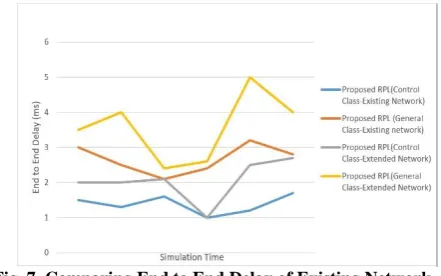
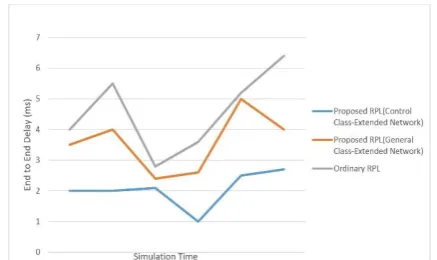
The third scenario will help us to discuss about our scalability concern. Fig. 7 and Fig. 8 show the results of this evaluation. At first in Fig.6, we compare the end to end delay of our existing network with sample networked EVSE like ours but with the full capacity, using the proposed method. In fact, we want to see the effects of increasing nodes regarding the customized RPL. As we mentioned earlier, each gateway can support up to 32 meter, so we change the existing network to its full capacity with 333 nodes. The picture shows that adding the new nodes increase the end to end delay for both control and general class which seems to be completely reasonable.
In the second case, you can see the end to end delay comparison of ordinary RPL and the Customized RPL in Fig. 8 using the extended network. Even in the situation that we extend the network and increase the nodes, the customized RPL with data classification has better performance. Although in general the end to end delay increase when we add extra nodes but still, the Proposed RPL is still better.
Fig. 7. Comparing End to End Delay of Existing Network and Extended Network
Also it is also possible to define lots of helpful scenarios and analyze them, which could lead in a better performance of networked EVSE. For example, by using different technologies in the networks and comparing the results, we can design the most suitable communication network.
which is an important factor in QoS. As future work, we can focus on different OFs with better performance and also use some optimization methods in order to use the best parameters in OF.
Fig. 8. Comparing End to End Delay of Proposed RPL and Ordinary RPL using Extended Network
REFRENCES
[1] N. Lu, N. Cheng, and N. Zhang, “Connected Vehicles: Solutions and Challenges,” Internet of Things Journal, IEEE, Vol. 1, pp. 289–299, Agust 2014.
[2] M. Majidpour, C. Qiu, P. Chu, R. Gadh, H. R. Pota, “Modified Pattern Sequence-based Forecasting for Electric Vehicle Charging Stations” IEEE International Conference on Smart Grid Communications (SmartGridComm '14), Venice, Italy, 3-6 Nov. 2014 (in press).
[3] M. Alishahi and M. Majidpour “ Proposing a RPL based Protocol for Intelligent Connected Vehicles” International Conferonce on Connected Vehicles and Expo, Vienna, Austria, 3-7 Nov, 2014.
[4] M. Majidpour, C. Qiu, C. Chung, P. Chu, R. Gadh and H. R. Pota, “Fast Demand Forecast of Electric Vehicle Charging Stations for Cell Phone Application” Proceedings of the 2014 IEEE PES General Meeting, 27-31 July. National Harbor, MD, USA. (in press).
[5] T. Winter, P. Thubert, A. Brandt, J. Hui, and R. Kelsey, “RPL: IPv6 Routing Protocol for Low Power and Lossy Networks,” IETF Request for Comments 6550, March 2012.
[6] O. Gaddour, A.Koubaa,”RPL in a nutshell: A survey”, ElSEVIER, Computer network, pp. 3163-3178, July 2012.
[7] P. Thubert, “Objective Function Zero for the Routing Protocol for Low-Power and Lossy Networks (RPL),” IETF RFC 6552, Mar. 2012