Please cite this article as: A. Shamekhi Amiri, S. Ali Torabi, R. Ghodsi, A Possibilistic Bi-Objective Mode l for A Competitive Supply Chain Network Design under Variable Coverage, International Journal of Engineering (IJE), IJE TRANSACTIONS C: Aspects Vol. 31, No. 9, (September 2018) 1575-1584
International Journal of Engineering
J o u r n a l H o m e p a g e : w w w . i j e . i r
A Possibilistic Bi-objective Mode l for A Competitive Supply Chain Network Design
under Variable Coverage
A. Shamekhi Amiri a, S. Ali Torabi*a, R. Ghodsi b
a School of Industrial Engineering, College of Engineering, University of Tehran, Tehran, Iran b Central Connecticut State University, Connecticut, USA
P A P E R I N F O
Paper history:
Received 15 November 2017 Received in revised form 17April 2018 Accepted 26April 2018
Keywords:
Facility location on the plane Chain-to-chain competition Radius of influence Cannibalization effect Capacity planning
Multi-objective possibilistic programming
A B S T R A C T
In this paper, the strategic planning of a supply chain under a static chain-to-chain competition on the plane is addressed. It is assumed that each retailer has a coverage area called the radius of influence. The demand of each demand zone is divided equally between the retailers which can cover that market. However, the demand of distant customers who are not in the retailers’ radius of influence, will be lost. This competition is modelled for a real case application of a super-market chain. It is assumed that the chain’s owner wants to expand retail outlets to improve its market share. Since this expansion could affect the current customers of existing retailers, the owner wants to avoid attacking the market share of its current retailers. A bi-objective fuzzy mixed integer nonlinear model is proposed. For solving the model, it is first reformulated to a mixed integer linear program and then an interactive approach is devised to handle the fuzzy bi-objective model. Four expansion strategies are analysed from which useful managerial insights are drawn.
doi: 10.5829/ije.2018.31.09c.14 NOMENCLATURE
I Set of current manufacturers i
1, , IL
. bk Annual buying power of demand zone kJ
Set of retailers in which j
1,, jc
are current retailers and j
jc 1, , JL
. are new candidate sitesd k
r Fuzzy radius that defines areas near a demand zone
K Set of demand zones k
1,, K
. Dk Fuzzy demand of demand zone kd d k k
x , y . Location coordinates of market points s
c Fixed cost of establishing a retailer
m m i i
x , y Location coordinates of manufacturers c dk The fuzzy extra fund (in percent) for locating the retailers in near the demand zones L U
x , x ,
L U y , y
Limits of the plane under consideration ctij The transportation cost between anufacturer i
and retailer j
max
r Maximum radius of influence of retailers cr Unit cost of improving of radius of influence Max
r
CAP Maximum capity of retailers ccapr Unit cost of improving of storage capacity
1 k
T Fixed marketing cost M Big M
2 k
T Variable marketing cost ε A very small value
0 j
z 1 for j
1, , jc
; otherwise 0 xrj yrjContinuous variable; the location of the retailer
L
c j j ,, J
0 j r
Radius of influence of existing retailers; rj00 for
c
j 1, , j ; otherwise 0
j
r Ctinuous variable; radius of influence of the retailer j.
r0 j
CAP Capacity of existing retailers; r0 j
cap 0 for j
1, , jc
; otherwise 0r j
cap Continuous variable; the storage capacity of the
retailer in location j
m i
CAP Storage capacity of manufacturer i sjk
Continuous variable; amount of market share allocated to retailer j from k th market
k
F Number of rival’s retailers which the demand zone k is
in their catchment area qij
Continuous variable; amount of goods transported from the manufacturer i to the retailer j
0 jk
S Market share of existing retailer j from the market point
k before expansion of SC zj
Binary variable; 1, if a retailer is established in location j , and 0 otherwise
0 jk
O 1 if the retailer had been serving the demand zone; otherwise 0. Ojk
Binary variable; 1, if the market point k is in the radius of influence of the retailer of location j
and 0 otherwise
B Total available budget gjk Binary variable; 1, if the new retailer j is
located near the demand zone k and 0 otherwise
1. INTRODUCTION
A major body of the literature on supply chain network design (SCND) and facility location (FL) problems investigate those situations where no other SC exists [1]. Nevertheless, in a real world market, there are often several players. Moreover, the competition in traditional markets were among corporations. However, it has evolved to competition among supply chains (SCs). In this new chain-to-chain competition, firms compete as dependent entities of SCs [2]. A competitive SCND problem includes considering the effects of strategic design of a supply chain (SC) in a competitive situation on its market share alongside the conventional long-term decisions.
One classical extension of the FL problem is the coverage problem that aims to ensure each demand zone is served by a set of facilities within reasonable distance. This threshold in the literature of competitive FL is called radius of influence [3]. In the real world, the customers may refuse to buy from distant retailers. The term ‘distant’ depends on the radius of influence of retailers. The radius of influence includes the region where the retailer remains attractive for customers. It is endogenously related to the service level of retailers [4]. By this definition, the demand of those customer zones, which are outside the covering radius of retailers are lost. Generally, retailers with larger size can construct more attractive facilities like parking area and food court [5]. Consequently, they have larger radius of influence and attract more distant customers.
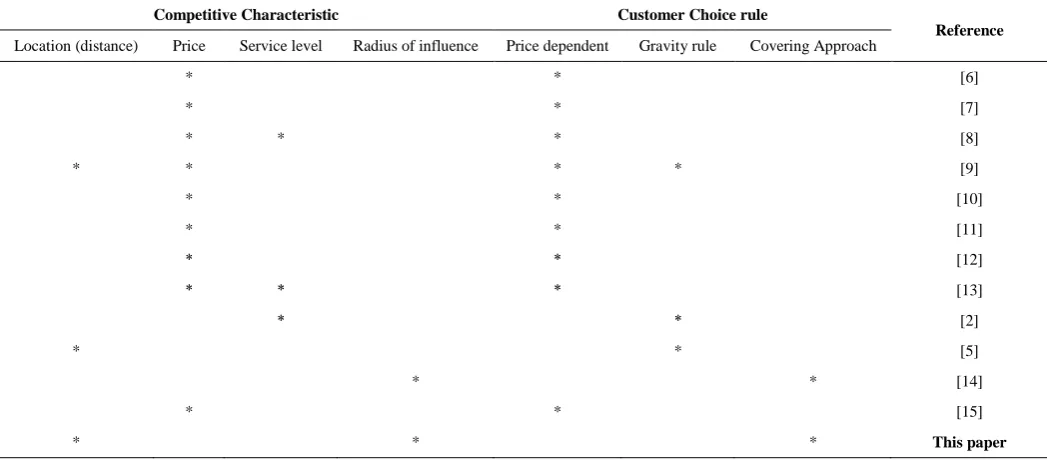
Consider a situation that a demand zone is in the coverage area of more than one retailer. There are various allocation rules to formulated the market share of the rival SCs like the price dependent rule, the gravity rule and covering approach. We have categorized the literature of the chain-to-chain competition in Table 1
based on these allocation rules. Unlike the price dependent rule that concentrates on a tactical decision in estaimating the market share of a rival, the second and third rules concentrate on the effect of location and service level which are strategic (i.e. long-term) decisions. In the gravity rule, the total demand of each market is split among the available facilities proportional to the utility they provide to that market. However, the covering approach equally splits it among the covering retailers.
One critical question is: which allocation rule can better estimate the market shares of rival SCs? Drezner et al. [3] analysed the sensitivity of the market shares to different allocation rules. They showed that the covering rule has significant effect on the market shares. However, there is no evidence to support that more sophisticated rules like the gravity rule necessarily yield more accurate results. Consequently, the simple equal division rule provides a reasonable estimation of market shares.
Suppose that there is a retail SC whose owner wants to expand its chain. Following the expansion, the customers can buy required goods from either the new retailers of this SC or the pre-existing retailers of each SC rival. Resulting from the complex competition, establishing new facilities may lead to the market reduction effect on pre-existing retailers [5]. Managers have to control the number of customers of current facilities who may switch to the new facilities after the expansion plan [16].
This research aims to develop a model for the competitive strategic planning of retail outlets for an expanding SC considering the variable coverage of retailers and the market reduction effect while retail outlets are scattered in the plane.
TABLE 1. The literature of SCND problems under chain-to-chain competition based on customer choice rules used
Competitive Characteristic Customer Choice rule
Reference Location (distance) Price Service level Radius of influence Price dependent Gravity rule Covering Approach
* * [6]
* * [7]
* * * [8]
* * * * [9]
* * [10]
* * [11]
* * [12]
* * * [13]
* * [2]
* * [5]
* * [14]
* * [15]
* * * This paper
Moreover, incorporating the radius of influence under covering approach is also a new development for this field. From the academic point of view, the motivations and contributions for this paper are as follows: 1) considering the effect of strategic decisions of SCND phase in the market share of a SC in the form of a chain-to-chain competition, 2) incorporating the variable coverage of facilities and the concept of lost demand which is a new approach for market share estimation, 3) considering market reduction effect as an objective function and 4) accounting for epistemic uncertainty in critical input data and providing a suite for trade-off analysis of two important objectives via formulating a bi-objective possibilistic model.
The rest of this paper is organized as follows. In the next section, the literature of chain-to-chain competition, market reduction effect and the covering approach in SCs are reviewed. In section 3, the problem addressed in this research is defined in detail and formulated. In section 4, the solution approach is provided. In section 5, some numerical experiments are conducted by which helpful managerial insights are concluded. Finally, section 6 concludes this paper and offers some directions for future research.
2. LITERATURE REVIEW
The literature of chain-to-chain competition in SCND problems can be categorized based on customer choice rules. A part of the literature used price dependent rule to formulate competitive SCND problem [6-13]. Also a part
of the literature used gravity rule [2, 5]. The covering approach that considers the concept of lost demand in competition is a new rule in the literature. Drezner [17] proposed a method for estimating the radius of influence of shopping malls. Drezner et al. [3, 18] considered competitive FL problem with the covering approach. Drezner et al. [19] proposed a leader–follower FL based on this rule. As it can be seen, there is a gap in the literature of SCND problem under chain-to-chain compeition for applying the covering rule to estimate the market shares of rivals.
Drezner [20] and Plastria [16] did the basic works in introducing the market reduction effect. Also, others expand it to the field of FL problems by analysing the interactions between the market expansion and market reduction effect [21, 22]. The literature shows a gap in addressing this effect in SCND problems under chain-to-chain compeition.
3. PROBLEM DEFINITION AND FORMULATION
The proposed model is as follows in which imprecise (fuzzy) parameters are associated with a tilde sign:
k 1
k K
1 2
k K
Z max b S
( )
t
jk ij ij
i j J
j
I j J
k k k
J
jk
c q
T F T O
(1)
c
0 0
2 k jk jk jk
j 1, , j k K
Z min b S O s
(2)jk ij k K i I
s q ; j
(3)
r ij j i I
q cap ; j
(4)m ij i j J
q CAP ; i
(5)
r d r d
j k j k j jk
x x y y r M 1 O ; j, k (6)
r d r d
j j k j k jk
r x x y y MO ; j, k (7)
jk
jk k
k j jk O
s D ; j, k
ε F O
(8)
r d r d d
j k j k k jk
x x y y r M 1 g ; j, k (9)
d r d r d
k j k j k jk
r x x y y Mg ; j, k (10)
0
k K
0 k K
c (1+ c )( ) (1+ c )( ) B
j
d
r r r
k jk j j
d s
k jk j
i I J
g cap cap
c g z z
(11)
r Max
j r j
cap CAP z ; j (12)
max
j j
r r z ; j (13)
0
j j
z z ; j (14)
0
j j
r r ; j (15)
r0 r
j j
cap cap ; j (16)
The first objective function is the maximization of revenue minus transportation and marketing costs. Also, marketing cost of a demand zone depends on the number of rival retailers there (i.e. Fk). The second objective
function minimizes the market reduction effect. For those markets that the expanding SC was not present before the expansion plan, 0
jk
O and s0jk are zero and consequently,
0 0
jk jk jk
s O s is zero. Nonetheless, in those markets that the expanding SC was attracting customers before the expansion plan, 0 1
jk
O and s0jk 0. In this case,
0 0
jk jk jk
s O s equals to the market reduction effect. Contraint (3) is the flow conservation constraint. Constraints (4) and (5) are capacity limitations. Constraints (6) and (7) ensure that if the facility j covers the demand zone k , Ojk equals to 1; otherwise, it is 0.
Constraint (8) ensures that the demand of a demand zone (i.e. Dk) is divided equally between the facilities that can cover that demand zone.
Typically, owners of SCs try to establish new facilities as close as possible to the center of demand zones that require higher investment. Constraints (9) and (10) determine that whether the retailer is located near the demand zone k or not. There is a normal cost cs for establishing a facility. If the facility is located near the demand zone k , an extra cost ckd % is charged to the SC. Constraint (11) is the budget constraint. Improving either the radius of influence or the capacity of current facilities requires a budget proportional to the improvement level. Establishing a new facility requires a fixed charge (i.e.
s
c ) plus a variable cost, which is related to its radius of influence (i.e. cr) and capacity of the retailer (i.e. ccapr).
Also, it can establish or improve a retailer near demand zones with ckd % more than the normal cost. Constraints (12) and (13) ensure that the radius of influence and capacity of a retailer are greater than zero, if and only if it is established. Constraints (14)-(16) ensure that downgrading or closing a facility is not allowed.
4. SOLUTION STRATEGY
The presented model in this paper consists of nonlinear terms. That is, constraints (6) -(7) and (9) -(10) involve absolute terms and constraint (8) includes fractional term with binary variables. Also, constraint (14) consists of nonlinear cost terms. Here, the nonlinear terms are linearized to reformulate the model to a mixed integer linear one. Then, the procedures used for deriving the crisp counterpart of the linear model are elaborated.
4. 1. Linearizing of Fractional Term Consider the auxiliary variable wk as follows:
k
k j jk 1
w ; k
ε F O
By incorporating wk in constraint (8), it is reformulated as follows:
jk k jk k
s w O D ; j, k (18)
By defining the continuous auxiliary variable jk k jk
w' w O , constraints (8), (17) and (18), are rewritten as follows:
jk jk k
s w D ; j J, k K (19)
jk
k jk
jk
kM O 1 w w M 1 O w ; j, k (20)
k k jk
j
w F ε
w' 1 ; k(21)
jk jk
w MO ; j, k (22)
jk
w 0 (23)
The resulted linear constraints (19) -(23) are replaced by nonlinear fragmental constraint (8) in the model.
4. 2. Linearizing of Absolute Terms For linearizing, constraints (6) -(7) and (9) -(10), new auxiliary continuous variables p1xjk and p2xjk are defined. The following constraints are defined:
r d 1x
j k jk
x x p ; j, k (24)
d r 1x
k j jk
x x p ; j,k (25)
1y
r d
j k jk
y y p ; j, k (26)
1y
d r
k j jk
y y p ; j, k (27)
1y 2y
1x 2x
jk jk ij ij
p , p , p , p 0 (28)
To force the auxiliary variables to take the right values, 1x
jk
p and p1yjk should be appeared in the objective function to take values as minimal as possible. To do so, an artificial cost is incorporated in the objective functions as follows: 1 2 k 1 k K 1 1 k K
Z max (b S ( ) )
(p p )
jk k k k jk
y x j J j j jk J k
T F T O
(29)
c
0 0
2 k jk jk jk
j 1, , j k K
1 1
k K
Z min b S O s (p p )
j j J y x jk k
(30)
By defining these auxiliary variables and incorporating constraints (24)-(28) in the model, constraints (6) -(7) and (9) -(10), should be replaced by the following constraints:
1y 1x
jk jk j jk
p p r M 1 O ; j, k (31)
1y 1x
j jk jk jk
r p p MO ; j, k (32)
1y
1x d
jk jk k jk
p p r M 1 g ; j, k (33)
1y
d 1x
k jk jk jk
r p p Mg ; j, k (34)
4. 3. Linearizing the Budget Constraint For linearizing the budget constraint, continuous variables
r jk
g and gcapjk and binary variables gsjk are defined and incorporated in the model as follows:
r
jk jk
g Mg ; j, k (35)
r
j jk jk
r g M 1 g ; j, k (36)
cap jk jk
g Mg ; j, k (37)
cap
j jk jk
r g M 1 g ; j, k (38)
s
jk jk j
2g g z ; j,k (39)
s
jk j jk
g z 1 g ; j,k (40)
The budget constraint is reformulated as follows:
0 0 k K 0 0 k K 0 0 k K
c (r r ) ( c (g g r ))
c (cap cap )
c ( (g ))
c (z ) ( c (g g )) B
r r r
j j jk jk j
capr r r
j j
d cap
capr r
k jk jk
d k
j J j J
j J j J d k j jk
s s s
j j jk jk j
J j J
c
c g cap
z c z
(41)objective function (29) and constraints (19), (33), (34)and (41) are defuzzified as follows:
1 2 2
k K
1
1 2 1
k K k K
Z max (1 ) ( ) S
( ) ) (p p )
k k j J j J b b jk y x
k k k jk j
J
j j
k k
E E
T F T O
(42)
Dk
Dkjk jk 2 1
s w 1 α E α E ; j,k
(43)
d
d
k k
r r
1y 1x
jk jk 2 1 jk
p p 1 α E α E M 1 g ; j,k
(44)
d
dk k
r r 1x 1y
jk jk
2 1 jk
1 α E α E p p Mg ; j,k
(45)
0 0 2 1 k K 0 0 2 1 k K 0 2 1 k K
c (r r )
( (1 ) ( ) (g g r )) c (cap cap )
c ( (1 ) ( ) (g ))
c (z )
( (1 ) ( )
d d k k d d k k d k k r j j
r c c r
jk jk j
capr r r
j j
cap
capr c c r
jk
jk jk
s
j j
s c c
j J j J j J j J j J j J
c E E
E E g cap
z
c E E
0
(g g )) B
d s
jk
jk zj
(46)
here, α denotes the minimum acceptable feasibility degree ensuring that each possibilistic constraint will be satisfied at least at level
.4. 5. Solution Approach for Multi-Objective Model
To solve the resulted bi-objective crisp counterpart, the solution procedure introduced by Pishvaee and Torabi [24] is adopted here. In this procedure, crisp counterpart is solved independently for each objective function to find the ideal solutions for each objective at α-level (called α-positive solution). The α-negative solution for the other objective function is then calculated according to the constructed pay-off table. The linear membership function is then defined for each minimization objective function as follows:
α PIS
h h
α NIS
h α PIS α NIS
h
h α NIS α PIS h h h
h h
α NIS h h
1 W W
W W
μ x W W W
W W
0 W W
(47)
where μh
x is the satisfaction degree of h-th objective function, α NISh
W and Whα PIS are α-negative and α
-positive solutions. For the maximization problems, they will be modified accordingly [25]. In order to convert the bi-objective crisp model into the single objective formulation, the TH aggregation function is applied [26]:
0
h hh
max λ x γλ 1 γ
θ μ (48)0 h
λ μ (49)
xF x (50)
0
λ , λ 0,1 (51)
where γ and θh are the compensation coefficient and the importance weigh of h -th objective function, respectively. Also, λ0 denotes the minimum satisfaction degree of objective functions, and F x is the feasible
region of the original model. By manipulating the above mentioned coefficients, a set of compromising solutions can be found through solving the above model for each set of parameters.5. CASE ILLUSTRATION
Due to high level of competition in retail industry, locating retail outlets depends on the location of rival retailers as well as the distribution of population (demand) in that area [27]. A case inspired by a real world application in a retail-chain is investigated. This sector in Iran is growing dramatically such that it could attract huge amount of investments in recent years. Five SCs supplying several products like foods, detergents, dairy products, etc. can be identified in Tehran. They are growing rapidly through their expansion plans. Due to severe competition, rivals have to adjust their price level in response to the price list of other rivals. As a consequence, accessibility of customers to retailers has a high impact on the market share of rival retailers. Here, the rivals are named in the abstract form as “H”, “SH”, “R”, “G” and “OF”. They can be categorized as follows:
Type 1: Three of the SCs including “H”, “SH” and “R” have focused on constructing large retail outlets to attract high distant customers. These retail outlets are capital intensive because of higher establishing costs (e.g. the costs for purchasing the land for providing parking areas).
Type 2: Two SCs including “OF” and “G” construct the retailers with enough shop space, but without parking space. They focus on those customers near to the location of retailers.
Strategy A: The owner of the SC focuses on the improvement of existing facilities via upgrading their radius of influence and/or capacities. So, the owner will plan to construct parking area for its existing retailers by providing required spaces.
Strategy B: The owner will focus on geographical expansion of the SC by establishing new retailers with current design policy of the “G” without parking space.
Strategy C: The owner will construct new facilities with higher radius of influence. The plan in strategy C will require more space in comparison to the basic plan such that the extra space will be allocated to the parking area.
Strategy D: The owner considers improvement of current facilities and construction of new facilities with higher radius of influence.
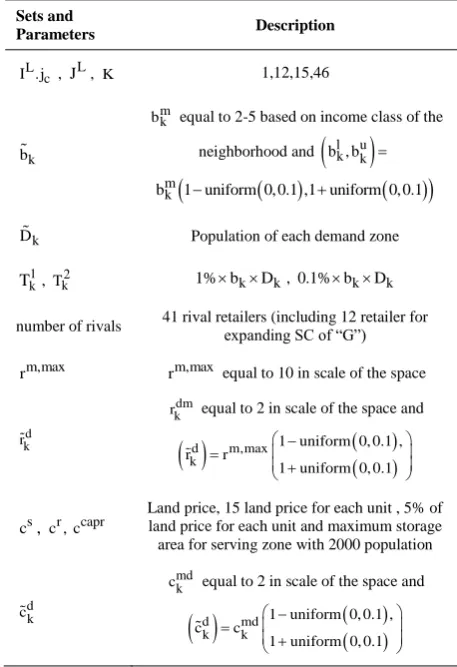
In none of the above strategies, downgrading is allowed. The important question is which strategy is the best for the owner regarding the revenue and market reduction effect? To answer these questions, the required information is first gathered. The neighborhoods of these regions according to the official classification are assumed as the demand zones whose annual buying powers are categorized in 4 classes starting from 2 to 5 based on their perceived social class. There are 12 existing retailers with basic design policy of “G”. Eight new retailers can be established anywhere in the region. There is a standard plan for the shop floor of the retailers. Also, there is one depot center (i.e. the manufacturer) for delivering the products to the retailers. One percent of the total demand multiplied by the annual buying power of each demand zone is set as the marketing cost of that zone. It is assumed that for supplying a zone with 20000 population requires a storage area of 300 m2. The details of the information are shown in Table 2.
The linear model is solved via GAMS 24.7.3 using CPLEX solver. The weight for the objective function Z1 , (i.e. θ1) is set as 0.8 with λ00.1 and γ 0.2 . To better analyze the case, MR is defined as k jk
j Jk K b s
. It shows
the total market share of the SC multiplied by the annual buying power.
c
0 0
k jk j 1, , j k K
MR b S
shows the initial
MR before the expansion plan. After solving the problem for obtaining the Whα PIS , this indicator is recorded as MR1. This shows that the maximum obtainable MR via solving a single objective problem regarding Z1. Then, by maximizing the TH aggregation function, this indicator is recorded as MR2.
Table 3 shows the results found with different strategies and values of α 0.2 and θ10.8. MR0 is the
same for all the strategies.
TABLE 2. Parameters of the real case problem Sets and
Parameters Description
L c
I .j , J ,L K 1,12,15,46
k b
m k
b equal to 2-5 based on income class of the neighborhood and
b , blk uk
m k
b 1 uniform 0, 0.1 ,1 uniform 0, 0.1
k
D Population of each demand zone
1 k
T , Tk2 1% b kDk, 0.1% b kDk number of rivals 41 rival retailers (including 12 retailer for expanding SC of “G”)
m,max
r rm,max equal to 10 in scale of the space
d k
r
dm k
r equal to 2 in scale of the space and
d m,max
k1 uniform 0, 0.1 , r r
1 uniform 0, 0.1
s
c , c , cr capr
Land price, 15 land price for each unit , 5% of land price for each unit and maximum storage area for serving zone with 2000 population
d k
c
md k
c equal to 2 in scale of the space and
d md
k k
1 uniform 0, 0.1 , c c
1 uniform 0, 0.1
Since in strategies B and C no modification for the current facilities is allowed, W2α PIS is assumed equal to zero for both. Also, W2α PIS for strategies A and D is similar. W1α NIS is the best solution obtained while maximizing the first objective function. W2α NIS shows the market reduction effect of this solution. As it is clear in Table 3, strategy D that includes all possible modifications is superior to the other strategies in Z1 and
1
MR . On the other hand, strategy A is superior to the strategies B and C in both objective function Z1 and
1
MR . This means that concentrating on improving the current facilities is more effective in comparison to geographical expansion. However, the market reduction effect of strategies A and D are more than other strategies. This means that although the geographical strategy will not yield higher revenue, but will avoid attacking the market share of the current facilities. The same analysis is done with α0.8 in Table 4.
γ is set to zero with the
α
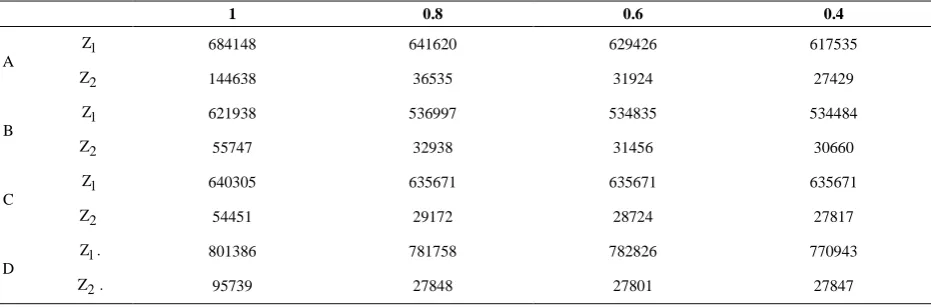
-level of 0.5. The results are shown in Table 5. It shows the relation between two objective functions. It is interesting that the second objective function Z2 is very sensitive to the value of θ1 when decreasing from θ11 to θ10.8.Consider a situation that there are more rival facilities owned by the competitors. Which of the strategies are more sensitive to the number of rival facilities? In other
words, which one is more resistant to the rival’s power in the market. For analyzing this question, sensitivity of Z1 is analyzed in comparison to increasing the number of rival retailers. Fk is increased by one unit and the value of Z1 is recorded. The results are shown in Figure 1. As it can be seen, strategy B is very sensitive to the attack of rivals.
TABLE 3. Numerical results for α 0.2, θ 10.8,λ00.1 and γ 0.2 0
MR Whα PIS MR 1 Whα NIS MR 2
415401
A 1
Z 695768 770989 370855 734559
2
Z 8919 416828 137404
B 1
Z 623432 660958 339085 656735
2
Z 0 372540 55761
C 1
Z 639486 677699 339085 675395
2
Z 0 372540 55420
D 1
Z 801753 853165 370855 858047
2
Z 8919 416828 93282
TABLE 4. Numerical results for α 0.8, θ 10.8,λ00.1 and γ 0.2 0
MR Whα PIS MR 1 Whα NIS MR 2
4
0
7
5
4
5
A 1
Z 682457 764537 366183 724549
2
Z 13591 403156 145029
B 1
Z 616990 659817 340126 677776
2
Z 0 382580 54293
C 1
Z 624590 662116 340126 657776
2
Z 0 382580 54750
D 1
Z 799351 845714 366178 854755
2
Z 13597 403156 95230
TABLE 5. Sensitivity of the Z and 1 Z to 2 θ1 (α 0.5, λ 00.1,γ 0 )
1 0.8 0.6 0.4
A 1
Z 684148 641620 629426 617535
2
Z 144638 36535 31924 27429
B 1
Z 621938 536997 534835 534484
2
Z 55747 32938 31456 30660
C 1
Z 640305 635671 635671 635671
2
Z 54451 29172 28724 27817
D 1
Z . 801386 781758 782826 770943
2
Figure 1. Sensitivity of the strategies to the number of rivals in demand zones
6. CONCLUSION
In this paper, strategic planning of retail outlets of a SC under a chain-to-chain competition is addressed. It consists of locating and planning of retailers with variable coverage on the plane. The customers may patronize to a retailer if and only if they are in the catchment area of retailers called the radius of influence. It is assumed that the demand of each market is divided equally between those retailers who can cover that market. The demands of those customer zones which are not in the catchment area of any retailer, is lost. Here, it is considered an existing retail SC wants to expand its network. Resulting from the complex competitive environment, customers can buy required goods from either the new retailers of this SC or the pre-existing retailers of any rival. This may result to market reduction of pre-existing retailers. The first objective is to increase the total market share of the SC. The second objective is to minimize the market reduction effect. A bi-objective fuzzy MINLP is proposed to formulate this problem. To solve this problem, it is first reformulated as an MILP. An interactive method is devised to solve the resulted bi-objective fuzzy problem. For numerical analysis, a real case inspired by a supermarket chain is analysed in different scenarios. Four expansion strategies are analysed. The results showed that improvement of current facilities beside the hybrid strategy can lead to higher market share. However they have higher levels of market reduction which means that they will capture part of current customers of the pre-existing retailers. The results showed that geographical expansion is more sensitive to the presence of rivals in the demand zones for this case. For the future research, the following directions can be proposed:
Foresight competition: In this research, it was considered that the rivals may not react in the near future. However, there may be a situation that the rivals can react to the expanding SC.
Downgrading strategy: The point for downgrading option is to consider an asymmetric cost function which can differentiate between the costs of upgrading and downgrading.
7. REFERENCES
1. Fernández, J., Pelegrı´n, B., Plastria, F., and Tóth, B., “Solving a Huff-like competitive location and design model for profit maximization in the plane”, European Journal of Operational
Research, Vol. 179, No. 3, (2007), 1274–1287.
2. Rezapour, S., Zanjirani Farahani, R., and Drezner, T., “Strategic design of competing supply chain networks for inelastic demand”,
Journal of the Operational Research Society, Vol. 62, No. 10,
(2011), 1784–1795.
3. Drezner, T., Drezner, Z., and Kalczynski, P., “A cover-based competitive location model”, Journal of the Operational
Research Society, Vol. 62, No. 1, (2011), 100–113.
4. Berman, O., Drezner, Z., and Krass, D., “Generalized coverage: New developments in covering location models”, Computers &
Operations Research, Vol. 37, No. 10, (2010), 1675–1687.
5. Farahani, R.Z., Rezapour, S., Drezner, T., Esfahani, A.M., and Amiri-Aref, M., “Locating and capacity planning for retailers of a new supply chain to compete on the plane”, Journal of the Operational Research Society, Vol. 66, No. 7, (2015), 1182– 1205.
6. Fallah, H., Eskandari, H., and Pishvaee, M.S., “Competitive closed-loop supply chain network design under uncertainty”, Journal of
Manufacturing Systems, Vol. 37, No. 37, (2015), 649–661.
7. Rezapour, S., Farahani, R.Z., Fahimnia, B., Govindan, K., and Mansouri, Y., “Competitive closed-loop supply chain network design with price-dependent demands”, Journal of Cleaner
Production, Vol. 93, No. 93, (2015), 251–272.
8. Rezapour, S., and Zanjirani Farahani, R., “Supply chain network design under oligopolistic price and service level competition with foresight”, Computers & Industrial Engineering, Vol. 72, No. 72, (2014), 129–142.
9. Rezapour, S., Farahani, R.Z., Dullaert, W., and De Borger, B., “Designing a new supply chain for competition against an existing supply chain”, Transportation Research Part E:
Logistics and Transportation Review, Vol. 67, No. 67, (2014),
124–140.
10. Rezapour, S., Farahani, R.Z., Ghodsipour, S.H., and Abdollahzadeh, S., “Strategic design of competing supply chain networks with foresight”, Advances in Engineering Software, Vol. 42, No. 4, (2011), 130–141.
11. Rezapour, S., Farahani, R.Z., and Pourakbar, M., “Resilient supply chain network design under competition: A case study”,
European Journal of Operational Research, Vol. 259, No. 3,
(2017), 1017–1035.
12. Rezapour, S., and Farahani, R.Z., “Strategic design of competing centralized supply chain networks for markets with deterministic demands”, Advances in Engineering Software, Vol. 41, No. 5, (2010), 810–822.
13. Hafezalkotob, A., Makui, A., and Sadjadi, S.J., “Strategic and Tactical Design of Competing Decentralized Supply Chain Networks with Risk-Averse Participants for Markets with Uncertain Demand”, Mathematical Problems in Engineering, Vol. 2011, , (2011), 1–27.
14. Shamekhi Amiri, A., Torabi, S.A., and Ghodsi, R., “An iterative approach for a bi-level competitive supply chain network design problem under foresight competition and variable coverage”,
0 100000 200000 300000 400000 500000 600000 700000 800000 900000
1 2 3 4 5
Ob
je
ct
iv
e
v
a
lu
e
Fk
Transportation Research Part E: Logistics and Transportation
Review, Vol. 109, No. November 2017, (2018), 99–114.
15. Nagurney, A., “Supply chain network design under profit maximization and oligopolistic competition”, Transportation
Research Part E: Logistics and Transportation Review, Vol. 46,
No. 3, (2010), 281–294.
16. Plastria, F., “Avoiding cannibalisation and/or competitor reaction in planar single facility location”, Journal of the Operations
Research Society of Japan, Vol. 48, No. 2, (2005), 148–157.
17. Drezner, T., “Derived attractiveness of shopping malls”, IMA
Journal of Management Mathematics, Vol. 17, No. 4, (2006),
349–358.
18. Drezner, T., Drezner, Z., and Kalczynski, P., “Strategic competitive location: improving existing and establishing new facilities”,
Journal of the Operational Research Society, Vol. 63, No. 12,
(2012), 1720–1730.
19. Drezner, T., Drezner, Z., and Kalczynski, P., “A leader–follower model for discrete competitive facility location”, Computers &
Operations Research, Vol. 64, No. 64, (2015), 51–59.
20. Drezner, T., “Cannibalization in a Competitive Environment”,
International Regional Science Review, Vol. 34, No. 3, (2011),
306–322.
21. Aboolian, R., Berman, O., and Krass, D., “Competitive facility location and design problem”, European Journal of Operational
Research, Vol. 182, No. 1, (2007), 40–62.
22. Pelegrín, B., Fernández, P., and Pérez, M.D.G., “Profit maximization and reduction of the cannibalization effect in chain expansion”, Annals of Operations Research, , (2014), 1–19. 23. Jiménez, M., Arenas, M., Bilbao, A., and Rodrı´guez, M.V., “Linear
programming with fuzzy parameters: An interactive method resolution”, European Journal of Operational Research, Vol. 177, No. 3, (2007), 1599–1609.
24. Pishvaee, M.S., and Torabi, S.A., “A possibilistic programming approach for closed-loop supply chain network design under uncertainty”, Fuzzy Sets and Systems, Vol. 161, No. 20, (2010), 2668–2683.
25. Torabi, S.A., and Madadi, M., “A Fuzzy Multi Objective Programming Model for Power Generation and Transmission Expansion Planning Problem”, International Journal of
Engineering, Vol. 23, No. 1, (2010), 29–39.
26. Torabi, S.A., and Hassini, E., “An interactive possibilistic programming approach for multiple objective supply chain master planning”, Fuzzy Sets and Systems, Vol. 159, No. 2, (2008), 193–214.
27. Hafezalkotob, A., Babaei, M.S., Rasulibaghban, A., and Noori-Daryan, M., “Distribution design of two rival decenteralized supply chains: A two-person nonzero sum game theory approach”, International Journal of Engineering, Transactions
B: Applications, Vol. 27, No. 8, (2014), 1233–1242.
A Possibilistic Bi-objective Mode l for A Competitive Supply Chain Network Design
under Variable Coverage
A. Shamekhi Amiri a, S. Ali Torabia, R. Ghodsi b
a School of Industrial Engineering, College of Engineering, University of Tehran, Tehran, Iran b Central Connecticut State University, Connecticut, USA
P A P E R I N F O
Paper history:
Received 15 November 2017 Received in revised form 17April 2018 Accepted 26April 2018
Keywords:
Facility location on the plane Chain-to-chain competition Radius of influence Cannibalization effect Capacity planning
Multi-objective possibilistic programming
هدیکچ
نیا رد همانرب ،هلاقم هریجنز کیتاتسا عون زا تباقر نتفرگ رظن رد اب نیمات هریجنز کی یدربهار یزیر –
لباقم رد رد هریجنز
یم ضرف .تسا هتفرگ رارق یسررب دروم هتسویپ یاضف کی هدرخ ره هک دوش
ششوپ یاضف کی یاراد هریجنز نیا رد شورف
یم هتفگ رثا عاعش نآ هب هک تسا تشم یاضاقت .دوش
هدرخ نیب هقطنم ره نایر یم ششوپ ار هقطنم نآ هک یناشورف
روط هب ،دنهد
یم میسقت یواسم نیا .تفر دهاوخ تسد زا ،دنتسه ناشورف هدرخ رثا عاعش زا رترود هک ینایرتشم یاضاقت ،نینچمه .دوش
ب تباقر رپوس تعنص رد یلمع دربراک کی یار تکرام
یجنز کی کلام هک هدش ضرف .تسا هدش لدم اه رد دوجوم نیمأت هر
نایرتشم یور رب تسا نکمم هعسوت همانرب هک اجنآ زا .دهد هعسوت رازاب مهس شیازفا یارب ار هریجنز راتخاس ات دراد رظن
هدرخ یلعف هدرخ رازاب مهس دیدهت زا ات دراد رظن رد هریجنز کلام ،دراذگب رثا زین هریجنز نیمه دوجوم ناشورف دوجوم ناشورف
بانتجا هریجنز رد ،لدم لح یارب .تسا هدش داهنشیپ هلئسم نیا یارب حیحص ددع یطخریغ یزاف هفده ود لدم کی .دنک
.تسا هدش هدافتسا هفده ود یزاف یطخ لدم لح یارب یلماعت دتم کی زا سپس و هدومن یطخ لدم کی هب لیدبت ار نآ ادتبا
هدش هتفرگ رارق لیلحت دروم هریجنز نیا یارب هعسوت همانرب راهچ نآ زا هک