Physics and Astronomy Publications
Physics and Astronomy
4-2009
Binding and Diffusion of Al Adatoms and Dimers
on the Si(100)-2 × 1 Reconstructed Surface: A
Hybrid QM/MM Embedded Cluster Study
Deborah Zorn
Marvin Argulla Albao
Iowa State University
James W. Evans
Iowa State University, [email protected]
Mark S. Gordon
Iowa State University, [email protected]
Follow this and additional works at:
http://lib.dr.iastate.edu/physastro_pubs
Part of the
Astrophysics and Astronomy Commons
,
Mathematics Commons
,
Physical Chemistry
Commons
, and the
Physics Commons
The complete bibliographic information for this item can be found athttp://lib.dr.iastate.edu/physastro_pubs/198. For information on how to cite this item, please visithttp://lib.dr.iastate.edu/howtocite.html.
Binding and Diffusion of Al Adatoms and Dimers on the Si(100)-2 × 1
Reconstructed Surface: A Hybrid QM/MM Embedded Cluster Study
Abstract
When group III metals are deposited onto the Si(100)-2 × 1 reconstructed surface they are observed to
self-assemble into chains of atoms that are one atom high by one atom wide. To better understand this
one-dimensional island growth, ab initio electronic structure calculations on the structures of Al atoms on silicon
clusters have been performed. Natural orbital occupation numbers show that these systems display significant
diradical character, suggesting that a multireference method is needed. A multiconfiguration self-consistent
field (MCSCF) calculation with a 6-31G(d) basis set and effective core potentials was used to optimize
geometries. The surface integrated molecular orbital molecular mechanics embedded cluster method was used
to take the surface chemistry into account, as well as the structure of an extended surface region. Potential
energy surfaces for binding of Al adatoms and Al−Al dimers on the surface were determined, and the former
was used to obtain a preliminary assessment of the surface diffusion of adatoms. Hessians were calculated to
characterize stationary points, and improved treatment of dynamic electron correlation was accomplished
using multireference second order perturbation theory (MRMP2) single-point energy calculations. Results
from the MRMP2//MCSCF embedded cluster calculations are compared with those from QM-only cluster
calculations, embedded cluster unrestricted density functional theory calculations, and previous
Car−Parrinello DFT studies.
Keywords
Ab-initio electronic structure calculations, basis sets, cluster calculations, density functional theory
calculations, DFT study, diradical, effective core potential, embedded cluster calculations, extended surfaces,
Hybrid QM/MM, Island growth, Multiconfiguration self-consistent fields, Multireference second order
perturbation theories, orbital molecular mechanics, adatoms
Disciplines
Astrophysics and Astronomy | Mathematics | Physical Chemistry | Physics
Comments
Reprinted (adapted) with permission from
Journal of Physical Chemistry C
113 (2009): 7277, doi:
10.1021/
jp8105937
. Copyright 2009 American Chemical Society.
Binding and Diffusion of Al Adatoms and Dimers on the Si(100)-2
×
1 Reconstructed
Surface: A Hybrid QM/MM Embedded Cluster Study
Deborah D. Zorn,†Marvin A. Albao,⊥,‡J. W. Evans,§ and Mark S. Gordon*,†
Ames Laboratory-USDOE and Departments of Chemistry, Physics & Astronomy, and Mathematics, Iowa State UniVersity, Ames, Iowa 50011
ReceiVed: December 2, 2008; ReVised Manuscript ReceiVed: March 10, 2009
When group III metals are deposited onto the Si(100)-2×1 reconstructed surface they are observed to self-assemble into chains of atoms that are one atom high by one atom wide. To better understand this one-dimensional island growth, ab initio electronic structure calculations on the structures of Al atoms on silicon clusters have been performed. Natural orbital occupation numbers show that these systems display significant diradical character, suggesting that a multireference method is needed. A multiconfiguration self-consistent field (MCSCF) calculation with a 6-31G(d) basis set and effective core potentials was used to optimize geometries. The surface integrated molecular orbital molecular mechanics embedded cluster method was used to take the surface chemistry into account, as well as the structure of an extended surface region. Potential energy surfaces for binding of Al adatoms and Al-Al dimers on the surface were determined, and the former was used to obtain a preliminary assessment of the surface diffusion of adatoms. Hessians were calculated to characterize stationary points, and improved treatment of dynamic electron correlation was accomplished using multireference second order perturbation theory (MRMP2) single-point energy calculations. Results from the MRMP2//MCSCF embedded cluster calculations are compared with those from QM-only cluster calculations, embedded cluster unrestricted density functional theory calculations, and previous Car-Parrinello DFT studies.
1. Introduction
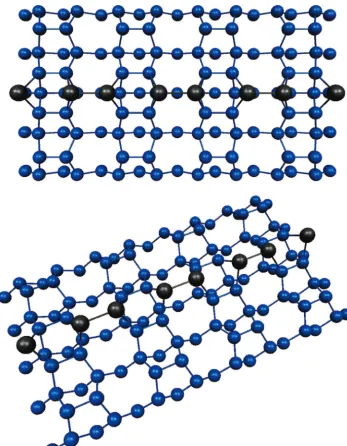
The “holy grail” of nanotechnology is the self-assembly or directed assembly of nanoscale structures with desired morphol-ogy and properties. For nanoscale electronic devices, connection of components via “molecular or atomic wires” will be needed. The potential exists to make wires on the molecular scale by epitaxial growth of metal atoms deposited on a metal or semiconductor surface.1One model system of interest is that of group III and IV metals on the Si(100)-2×1 reconstructed surface. It has been shown that when deposited on the Si(100)-2 ×1 surface, Al, Ga, and In are able to self-assemble into long chains.2-6 The metal chains run perpendicular to the silicon surface dimer rows and are one atom high by one atom wide. Scanning tunneling microscopy (STM) images along with theoretical calculations have shown that the metal rows consist of metal dimers with each metal adatom bonded to another metal adatom and two surface silicon atoms. This configuration, called the “parallel dimer structure” (Figure 1), has been confirmed by total energy calculations,2,7-9 a tensor LEED (low energy electron diffraction) study10and ion-scattering spectroscopy.11 Although self-assembly is a fundamental process, predictive modeling is a challenge, as behavior is often controlled by a combination of system-specific thermodynamics and kinetics. In particular, this is the case for deposition on silicon surfaces. However, theoretical electronic structure calculations together with atomistic modeling and kinetic Monte Carlo (KMC) simulation can provide insight into the underlying adsorption
and diffusion processes. Such KMC modeling has been per-formed to analyze the formation of atomic rows during deposition of group III metals (in particular, Ga) on Si(100).12,13 In that study, the Si(100) surface was represented by a square lattice of adsorption sites. In the KMC model, when pairs of diffusing atoms meet, they irreversibly nucleate new islands. However, sites adjacent to metal adatom rows were blocked to diffusing adatoms, and aggregation was limited by allowing only diffusing metal atoms to bond at sites at the ends of metal rows. The simulations were able to match the experimental mean island size and reproduce the monotonically decreasing island size distribution using strongly anisotropic barriers for diffusion (although nucleation at C-defects was not fully treated and could impact behavior).
Al on Si(100) has been studied in detail by Brocks, Kelly, and Car (BKC)7within the local density approximation level of density functional theory (DFT) using the Car-Parrinello (CP) method.14 The CP study by BKC predicted the global minimum for one Al adatom on the surface to have the Al sitting on a silicon dimer row, directly between two silicon dimers (Figure 2a). This structure resembles an Al atom coordinated to four neighboring Si atoms. Another Car-Parrinello study by Takeuchi15 found two binding sites for Al: an off-center binding site shown in Figure 2b and a pseudo-threefold binding site shown in Figure 2c. Takeuchi predicted that these two binding sites have the same total energy. He did not find the BKC site (Figure 2a), suggesting that this site was found because a smaller unit cell and lower energy cutoff was used by BKC. Takeuchi also suggested that the preferred binding site of a single atom is determined by the dimer and atomic row structure. This is discussed below.
The BKC study predicted barriers for diffusion of an Al adatom on the surface. The CP predicted barrier for an adatom
* Corresponding author. [email protected]. †Ames Laboratory-USDOE and Department of Chemistry. ‡Physics & Astronomy.
§Mathematics.
⊥Current Address: Institute of Mathematical Sciences and Physics,
University of the Philippines Los Banos, College, Laguna, Philippines 4031.
J. Phys. Chem. C2009,113,7277–7289 7277
moving in the direction perpendicular to the silicon dimer rows is 2.3 kcal/mol; the barrier for diffusion in the direction parallel to the silicon dimer rows is predicted to be 6.9 kcal/mol. The present work employs well-correlated ab initio electronic structure calculations to provide both quantitative and qualitative insight into the behavior of Al on the Si(100) surface.
When studying processes on surfaces, a model must be used that takes into account the chemistry of the surface atoms as well as the affect of the bulk. In particular, a wave function must be used that adequately accounts for the diradical character of the silicon surface-adsorbate configurations.16-23The CASS-CF (complete active space SCASS-CF) natural orbital occupation numbers (NOONs) indicate that for each surface dimer, nearly
one-third of an electron resides in an antibonding orbital.23 Because of the computational cost associated with the use of a multireference wave function, a slab model that employs a plane wave basis is not currently feasible for such a wave function, so a cluster model is usually the method of choice. One disadvantage to cluster models is that edge effects can potentially impact the predicted outcomes. On the other hand, an advantage is that high level ab initio methods can provide reliable structures and (especially) relative energies. Advanced embedded cluster models have been developed to treat the reactive part of the surface with accurate electronic structure methods while still including the bulk effects at some lower level of theory. The most successful form of these methods is a hybrid approach, in which the “action” region is treated with some level of quantum mechanics (QM) while the “bulk” region is treated with molecular mechanics (MM). These QM/MM embedded cluster methods diminish the edge effects of the cluster model24 by greatly expanding the size of the cluster.
[image:4.598.124.472.40.486.2]The embedded cluster method utilized in this study is the surface integrated molecular orbital/molecular mechanics (SI-MOMM) method.25 The “link region” that connects the QM
Figure 1. Schematics of the parallel dimer structure.
Figure 2. (a) Global minimum for one Al on the Si(100) surface predicted by BKC. (b, c) Binding sites for one Al predicted by Takeuchi.
[image:4.598.93.236.521.564.2]atoms with the MM atoms is treated by capping the cleaved Si-Si bonds in the QM region with hydrogens. The capping hydrogens are simply “place holders” during the QM calculation and are removed during the MM part of the calculation. The SIMOMM energy calculation is conceptually very simple. In the first step, the MM energy of the bulk model is calculated with the “action” region interactions zeroed out to avoid double counting. Next, the energy of the RSM, capped with hydrogens, is calculated with an appropriate level of quantum mechanics. Long-range interactions between the RSM and the bulk region are still accounted for with MM. The QM and MM energy differences are added together to give the total QM/MM energy difference for a process of interest. The SIMOMM method can be used to considerably increase the size of a cluster with only a small computational cost, thereby ameliorating edge effects. The SIMOMM method has been used successfully to study many different adsorbates on the Si(100)-2×1 surface,26-36as well as the Si(111)-7×7 reconstructed surface,37the SiC(100) surface,38and the diamond(100) surface.39
2. Computational Methods
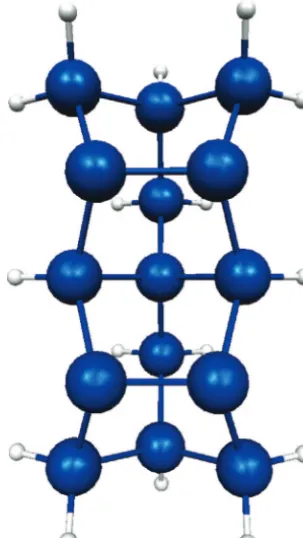
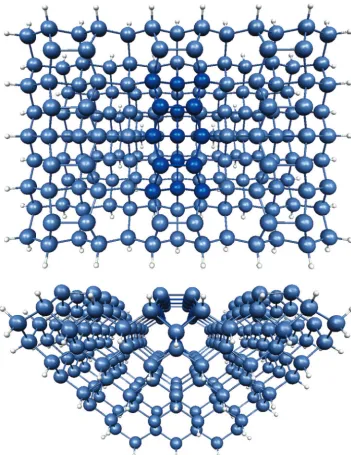
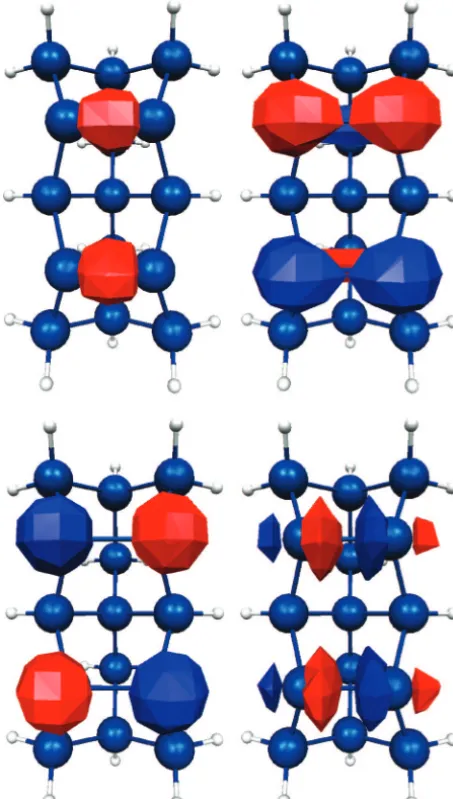
All results, unless specified otherwise, were obtained using the QM/MM SIMOMM method. Most of the figures show only the QM region to save space. The two-dimer, Si15H16, cluster shown in Figure 3, was used to represent the reactive part of the silicon surface. The combined QM and MM system (Figure 4) has 12 surface dimers, is 11 layers deep, and contains a total of 199 Si atoms. QM structures were optimized using a complete active space self-consistent field (CASSCF) wave function. The orbitals included in the CASSCF wave function are theσ,π,
π*, andσ* orbitals for each Si-Si dimer (Figure 5) and the 2s, 2px, 2pyand 2pzorbitals on Al. The Stevens-Basch-Krauss
-Jasien-Cundari effective core potential basis set augmented with d polarization functions was used for all Si and Al atoms,40 and the 6-31G basis set was used for H. Hessians (energy second derivatives) were used to characterize stationary points. Intrinsic
reaction coordinate (IRC) calculations41were used to connect transition states with reactants and products. The IRC calcula-tions were performed using the second-order method developed by Gonzalez and Schlegel42 using a step size of 0.3 (amu)1/2 bohr. At the final MCSCF geometries, improved relative energies were obtained using second-order multireference perturbation theory (MRMP2).43 The MCSCF method is able to give reliable geometries, but since it does not include dynamic correlation, the latter is included by employing MRMP2. Hence, the MCSCF values are referred to when discussing geometries, but discussion of the relative energies will focus on the MRMP2 values obtained at the MCSCF geometries (MRMP2//MCSCF). QM/MM unrestricted density functional theory calculations using the Becke three-parameter Lee-Yang-Parr (B3LYP)44-46 hybrid functional have also been performed and are compared with the multireference geometries and relative energies. The QM calculations were performed using the GAMESS electronic structure program.47,48The MM portion of the calculation was completely optimized using the MM349-51 parameters in the Tinker program.52,53 All SIMOMM calculations have been carried out using the GAMESS/Tinker interface, and all structures are visualized with MacMolPlt.54
3. Results and Discussion
3A. Adsorption Sites and Diffusion for a Single Al Adatom on Si(100).
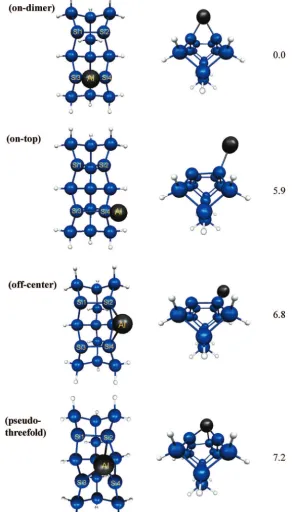
Potential Energy Surface for Adsorption. Four adsorption sites (i.e., local minima on the SIMOMM/MCSCF adsorption energy PES) are found when one Al is adsorbed on the Si15H16 embedded cluster (Figure 6). (Recall that the MM atoms are not shown, for clarity.) The off-center and pseudo-threefold sites are in agreement with the structures found by Takeuchi (Figure 2 b and c), but not with the Car-Parrinello study by Brocks, Kelly, and Car: the structure in Figure 2a was not found to be a minimum in the present work. In contrast with both previous studies, the on-dimer configuration is predicted here to be the preferred adsorption site.
The MRMP2 energies (see Figure 6) for the doublet sites are all within 7.2 kcal/mol of each other. The global minimum is the on-dimer site, which is 5.9 kcal/mol lower in energy than the on-top site. The off-center and pseudo-threefold sites are 6.8 and 7.2 kcal/mol higher in energy than the on-dimer site, respectively. This is in qualitative agreement with Takeuchi, who predicts that these two sites have the same total energy. Relative energies for the different binding sites for an Al adatom on the Si(100) surface were not given by BKC, so no comparison is possible.
[image:5.598.86.238.45.314.2]Bond lengths for the four minima are shown in Table 1. The Si-Al bond lengths range from 2.43 to 2.78 Å. An Al adatom sitting on the Si-Si dimer bond in the on-dimer structure breaks the weak siliconπ-bond, lengthening the Si-Si bond by 0.28 Å. The on-top structure lengthens the Si-Si dimer bond by only 0.15 Å. The off-center position also shortens the distance between the silicon dimers by 0.30 Å. The pseudo-threefold structure lengthens the dimer Si-Si bonds by 0.11 and 0.30 Å (Figure 6) relative to an isolated dimer. The pseudo-threefold structure also distorts the surrounding silicon dimers by shifting the dimer with the longer bond length (Figure 6, pseudo-threefold structure, Si3-Si4) out of the silicon dimer row and decreases the distance between the Si dimers by 0.32 Å. The length of the Si3-Si4 bond for the on-dimer and pseudo-threefold structures indicates that theσbond is partially broken. This is an excellent example of why the σ orbitals must be included in the active space. In fact, when theσ-space is not
Figure 3. Si15H16QM cluster.
included, the on-dimer structure is found to be a transition state connecting the two on-top sites on a Si-Si dimer.
Table 2 gives the NOONs of each minimum that display large amounts of multireference character. These NOON values indicate diradical character for each structure in this system, similar to the bare silicon surface. The highest amount of diradical character is found in the off-center isomer, with leading occupation numbers of 1.366 and 0.629 electrons. The NOONs for the singly occupied orbitals of the quartet structures are given in Table 3. These NOONs do not deviate significantly from the ROHF occupation numbers of 2, 1, and 0, suggesting that a multireference treatment is less critical for the quartet state.
Short- and Long-Range Adatom Diffusion.Now, consider
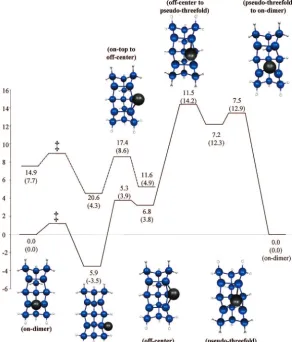
short-range diffusion among the four minima on the embedded Si15H16embedded cluster. The corresponding MCSCF minimum energy path and MRMP2 energies along this path are shown in Figure 7. When diffusing from the on-dimer to the on-top site, the Si3-Al bond (see Figure 6 for atom numbering) is broken, and the Si3-Si4-Al angle opens up from 59.6 to 113.8°. The Si3-Si4 bond length is also shortened by 0.13 Å as theσ-bond is reformed. A MCSCF transition state connecting the on-dimer
and on-top structures could not be found. Constrained optimiza-tions at points along a linear least motion path were carried out to approximate the path connecting the two minima. Such a path provides an upper bound to the classical barrier height. Based on this procedure, the MCSCF barrier is less than 1 kcal/ mol. MRMP2 single points along the MCSCF path predict diffusion to be continuously uphill from the on-dimer to the on-top site, suggesting that the on-top species may not be a local minimum on the MRMP2 potential energy surface. Starting at the on-dimer site, the adatom can also diffuse directly to the pseudo-threefold site by surmounting a MRMP2 barrier of 7.5 kcal/mol that is 0.3 kcal/mol higher in energy than the pseudo-threefold site. The energetics of various other short-range diffusion processes can be assessed from Figures 7 and 8.
[image:6.598.122.474.42.497.2]Next, consider long-rangediffusion along a Si dimer row. This process is relevant for analyzing aggregation of deposited adatoms into rows. An Al adatom can diffuse between two Si-Si dimers of the Si15H16embedded cluster by at least two pathways. In one possible pathway, the adatom first moves from its preferred on-dimer site through the on-top site to an off-center site; then to the on-top site on the adjacent dimer; and
Figure 4. Bulk silicon cluster top and side views.
finally, to the on-dimer site of the second dimer. The net barrier for this process is 6.8 kcal/mol (see Figure 8). This barrier is apparently in reasonable agreement with the BKC 6.9 kcal/mol diffusion barrier for diffusion along the Si dimer row; however, the two pathways are completely different, and importantly, the BKC analysis is not based on the correct on-dimer global minimum. In another pathway, again starting at the on-dimer site, the adatom can diffuse directly to the pseudo-threefold site, then to the off-center site, and then proceed to the second Si dimer. However, the activation barrier of 11.5 kcal/mol is much higher than the first pathway, so this second possibility should not contribute significantly to long-range diffusion.
MRMP2 energies calculated at the MCSCF geometries indicate that the transition state from on-top to off-center is lower in energy than both the on-top and off-center sites (Figure 7). To investigate this further, MRMP2 single-point energy calcula-tions were performed at two points along the MCSCF path near the transition state. These MRMP2 calculations suggest that the on-top and off-center structures are not local minima on the PES. The MCSCF transition state, shown in Figure 7 (referred to as “on-top to center”), connecting the on-top and off-center sites is near the apparent MRMP2 local minimum. The MCSCF “on-top to off-center” transition state structure is very similar in structure to the off-center MCSCF minimum. From this apparent MRMP2 minimum, there is a very low barrier (less than 1 kcal/mol) separating it from the on-dimer site.
Quartet Surface. The quartet surface was investigated to determine if there is surface crossing between the doublet and quartet surfaces. MCSCF optimizations to find quartet adsorption sites used the doublet structures as starting geometries. Quartet adsorption sites were found for the on-dimer, on-top, and off-center structures. Bond lengths for these structures are given in Table 1. The pseudo-threefold structure does not exist on the quartet surface. The NOONs for the quartet active orbitals are shown in Table 4.
The quartet structures are all higher in energy than the corresponding doublet structures by at least 4 kcal/mol, as shown in Figure 7. There is not a large difference in the Si3-Si4 and Si-Al bond lengths when comparing the doublet and quartet structures. For the quartet on-dimer and on-top structures, Si1-Si2 is elongated by 0.17 Å due to an increase in electron density in itsπ* orbital.
The red curve in Figure 7 illustrates diffusion processes that connect the three quartet minima. The on-top site is 5.7 kcal/ mol higher in energy than the on-dimer site. At the MRMP2 level of theory, diffusion from the on-dimer site to the on-top site is monotonically uphill. From the on-top site, the Al atom can diffuse off the silicon dimer into the off-center position. The off-center site is 9.0 kcal/mol lower in energy than the on-top site. The MCSCF barrier for diffusion from the on-on-top site to the off-center site is 3.7 kcal/mol higher in energy than the on-top site. Once dynamic correlation is included at the MRMP2 level of theory, the barrier disappears and the transition state is 3.2 kcal/mol lower in energy than the on-top site. As for the doublet case, MRMP2 single-point energy calculations were performed at two points along the MCSCF path near the transition state. These energies indicate that the on-top structure is near a transition state and that diffusion is downhill to both the on-dimer and on-top sites.
To illustrate the difference between the MRMP2 and MCSCF potential energy surfaces, approximate paths for MRMP2 diffusion on the doublet and quartet surfaces at the MCSCF geometries are shown in Figure 10. The on-dimer and pseudo-threefold structures are minima on both the MRMP2 and MCSCF doublet surface. On the MRMP2 doublet surface, the on-top structure is no longer a minimum, and the transition state structure connecting the on-top and off-center structures now appears to be near a minimum on the MRMP2 doublet PES. The on-dimer and off-center quartet structures are still minima on the MRMP2 quartet PES, which now appear to be connected by a transition state near the on-top structure.
Comparison of Methods. Unrestricted density functional
[image:7.598.50.277.45.445.2]theory geometry optimizations with the B3LYP functional (UB3LYP) were carried out on the four doublet minima for one Al on the Si(100) surface. This method predicts the energy differences between minima to be less than 7.7 kcal/mol, whereas the MRMP2 energy range is predicted to be less than 6.8 kcal/mol. However, the two methods predict different energy orders for the four minima. The relative MRMP2//MCSCF
Figure 5. σ,π,π*, andσ* orbitals for each Si-Si dimer.
TABLE 1: MCSCF Bond Lengths in Angstroms for Al
Doublet and Quartet Minimaa
Si1-Si2 Si3-Si4 Si2-Al Si3-Al Si4-Al
on-dimer doublet 2.31 2.60 2.57 2.57 on-top doublet 2.31 2.47 2.63 off-center doublet 2.46 2.42 2.65 2.70 pseudo-threefold doublet 2.43 2.62 2.78 2.61 2.43 on-dimer quartet 2.47 2.60 2.57 2.57 on-top quartet 2.47 2.47 2.63 off-center quartet 2.47 2.47 2.64 2.64
aStructures and atom numbering shown in Figure 6.
[image:7.598.307.546.64.143.2]energies are on-dimer<on-top<off-center<pseudo-threefold, whereas UB3LYP predicts off-center < on-dimer < pseudo-threefold < on-top. So, B3LYP does not capture the correct ordering, probably due to the varying multireference character
[image:8.598.154.447.51.564.2]of the four species. UB3LYP also consistently underestimates the bond lengths with a rms error of 0.05 Å when compared with MCSCF bond lengths. Bond lengths for the four UB3LYP minima are shown in Table 4. UB3LYP does an adequate job of reproducing bond angles. The only structures with any
[image:8.598.43.284.618.679.2]Figure 6. Binding sites for 1 Al. The QM region of the cluster is shown without the surrounding bulk cluster. Bond lengths are given in Table 1. MRMP2 relative energies (in kcal/mol) given adjacent to each structure.
TABLE 2: Doublet Structure NOON Values for Multireference Orbitalsa
NOON
on-dimer 1.717 1.003 0.283
on-top 1.874 1.715 1.001 0.285 off-center 1.366 1.003 0.629
pseudo-threefold 1.874 1.000 0.151
a
Structures shown in Figure 6.
TABLE 3: Quartet Structure NOON values for Singly Occupied Orbitalsa
NOON
on-dimer 1.003 1.002 0.999
on-top 1.002 1.000 1.000
off-center 1.001 1.000 0.998
a
Structures shown in Figure 6.
[image:8.598.306.548.621.671.2]significant amounts of distortion are the on-top and the pseudo-threefold structures. The on-top UB3LYP Si3-Si4-Al angle is 8.7°too small, and the Si2-Si4-Al angle is 5.2°too small. The pseudo-threefold Si2-Si4-Al angle is 3.1°too small.
3B. Al2on Si(100).It is thought that pairs of diffusing Al
adatoms will nucleate a new island when they meet in the same row. An Al-Al dimer can form in several positions on the
Si(100) surface. The formation, relative energies, and rotation of the Al-Al dimer on the Si15H16 embedded cluster are presented in the following sections.
(i) Potential Energy Surface for Adsorption. All minima
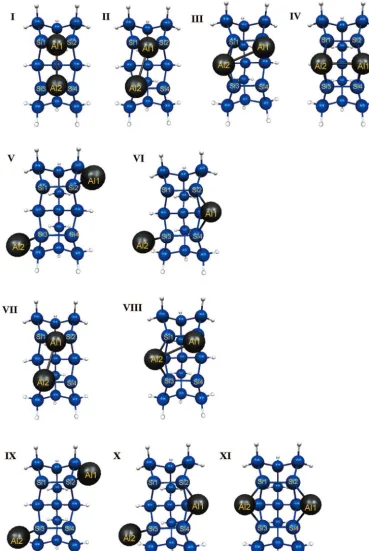
found for two Al adatoms on the Si15H16embedded cluster are shown in Figure 9. Table 5 lists the bond lengths for these structures. Four singlet minima (Figure 9-I,II,III, andIV)are found for an Al-Al dimer on the Si15H16cluster. The “bridge” (IV) structure is lowest in energy, with the “between” (I) structure 6.6 kcal/mol higher in energy. Structures I andIV correspond to the structures in Figure 2(c) and (d) that were reported by BKC. The relative energies of I and IV agree qualitatively with the BKC7 Car-Parrinello predictions. The other possible dimer structures presented by BKC were not investigated in this work.
[image:9.598.149.442.45.387.2]The Al-Al bond lengths for the bridge and between structures are 2.76 and 2.64 Å, respectively. The Si-Al bond lengths for the between structure are 0.09 Å shorter than for the on-dimer structure. The Si-Si bond distance in the between structure is
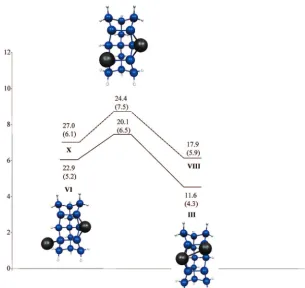
Figure 7. MRMP2//MCSCF diffusion of a single Al adatom. Doublet MCSCF minimum energy path represented by solid line, quartet MCSCF minimum energy pathway represented by dashed line. MCSCF energies in parentheses. (Note: The energies not in parentheses are from MRMP2 single-point energy calculations.) Energies in kcal/mol. Structures shown in figure are doublet minima and transition states. ‡ No barrier w/ MRMP2 (MCSCF barrier<1kcal/mol).
[image:9.598.44.286.445.615.2]Figure 8. MRMP2//MCSCF diffusion of a single Al adatom. Ap-proximate doublet MRMP2 minimum energy path represented by solid line, approximate quartet MRMP2 minimum energy path represented by dashed line. Energies in kcal/mol.
TABLE 4: UB3LYP Bond Lengths in Angstroms for Al
Doublet Minimaa
Si1-Si2 Si3-Si4 Si2-Al Si3-Al Si4-Al
on-dimer doublet 2.28 2.56 2.53 2.53 on-top doublet 2.29 2.43 2.60 off-center doublet 2.42 2.39 2.60 2.62 pseudo-threefold doublet 2.39 2.58 2.67 2.57 2.41
a
Atom numbering shown in Figure 6.
[image:9.598.306.548.463.519.2]also 0.07 Å shorter than the on-dimer structure, indicating that an Al-Al dimer does not break theσSi-Si bond to as great an extent as a single Al adatom. The NOONs of the HOMO and LUMO orbitals are given in Table 6. Both the bridge and between structures are single reference, with less than 0.1 electrons in an antibonding orbital.
The two cross structures (Figure 9-IIandIII) are 18.5 and 11.6 kcal/mol higher in energy than the bridge (IV) structure, respectively. These structures have not been previously reported. The Al-Al bond length of IIis 2.67 Å, and the Al-Al bond length ofIIIis 2.65 Å. The Si1-Si2-Al bond angle of structure
[image:10.598.111.480.45.595.2]II is 61.7°. The strain due to this small angle causes the decreased stability ofIIrelative toIII. The high energies ofII andIIIare most likely due to the inability of the Al-Al dimer to passivate the surface dimers in this position. Their NOONs indicate diradical character similar to the bare silicon surface. Two minima with no bond between the two Al atoms were found on the singlet potential energy surface (Figure 9-Vand VI). Both of these structures are significantly higher in energy than the bridge structure. V is a pure diradical and VI has diradical character similar to that of the bare silicon surface, as shown in Table 6.
Figure 9. Al2minima.I-VIsinglet minima,VII-XItriplet minima.
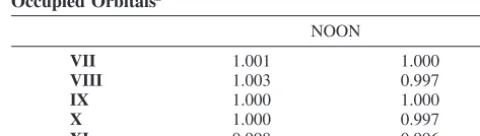
Only two Al-Al dimer minima were found on the triplet surface. These are the cross structures (Figure 9-VIIandVIII), which have geometries similar to the singlet cross structures Figure 9-IIandIII, but are 9.7 and 6.3 kcal/mol higher in energy respectively. The Al-Al bond length inVIIis similar to that in the singlet structure; however, inVIII, the Al-Al bond length is elongated by 0.13 Å. When the between (I) and the bridge (III) structures were optimized using a triplet wave function,
[image:11.598.143.449.46.337.2]their geometries distorted to the cross structure (Figure 9-II) and a dual-off-center structure (Figure 9-XI). The dual-off-center structure is 18.8 kcal/mol higher in energy than the bridge dimer. Two other separated structures were found on the triplet surface (Figure 9-IXandX). The structure IXis degenerate with the singlet structure V, and structureXis 4.1 kcal/mol higher in energy than the singlet structureVI. Some triplet structures are lower in energy than the corresponding singlet structures, indicating that a further investigation of the PES will be
TABLE 5: MCSCF Bond Lengths in Angstroms for Al2Minimaa
Si1-Si2 Si3-Si4 Al1-Al2 Si1-Al1 Si1-Al2 Si2-Al1 Si3-Al2 Si4-Al1 Si4-Al2
I 2.53 2.53 2.64 2.44 2.44 2.44 2.44
II 2.47 2.37 2.67 2.54 2.49 2.62
III 2.44 2.44 2.65 2.59 2.59 2.59 2.59
IV 2.42 2.37 2.76 2.76 2.52 2.68
V 2.43 2.43 2.63 2.63
VI 2.38 2.44 2.66 2.62 2.69
VII 2.50 2.43 2.68 2.46 2.48 2.53
VIII 2.42 2.42 2.78 2.73 2.53 2.66
IX 2.43 2.43 2.63 2.63
X 2.43 2.45 2.64 2.63 2.67
XI 2.44 2.44 2.63 2.63 2.63 2.63
[image:11.598.46.549.392.520.2]aStructures and atom numbering shown in Figure 9.
TABLE 6: Singlet Structure NOON Values for HOMO and LUMO Orbitals
NOON
I 1.931 0.092
II 1.399 0.599
III 1.410 0.588
IV 1.916 0.082
V 1.038 0.962
VI 1.318 0.678
[image:11.598.307.547.563.631.2]Structures shown in Figure 9.
TABLE 7: Triplet Structure NOON Values for Singly Occupied Orbitalsa
NOON
VII 1.001 1.000
VIII 1.003 0.997
IX 1.000 1.000
X 1.000 0.997
XI 0.998 0.996
a
Structures shown in Figure 9.
Figure 10. MRMP2//MCSCF diffusion of two separated Al adatoms. Singlet MCSCF minimum energy path represented by solid line, triplet MCSCF minimum energy path represented by dashed line. MCSCF energies in parentheses. (Note: The energies not in parentheses are from MRMP2 single-point energy calculations.) Energies in kcal/mol. The zero of energy corresponds to structureIV(Figure 8).
[image:11.598.43.282.564.642.2]necessary to determine if singlet-triplet crossings are likely for Al2on Si(100).
HOMO and LUMO orbitals for the singlet and triplet minima are given in Tables 6 and 7, respectively.IandIV are both single reference structures due to the saturation of the surface by the Al-Al dimer and the formation of the Al-Al bond. The singlet cross structures (II and III) are multireference, with NOONs of about 1.4 and 0.6 electrons. All singlet structures without an Al-Al bond display at least some multireference character. The dual-on-top (V) structure is almost a pure diradical; hence, the singlet and triplet spin states are nearly degenerate. The remaining Al2 separated structure is also multireference. The Al2triplet structures are single reference. Although the lowest energy Al2 dimer structures are single reference, when studying diffusion, it is important to take into account the multireference character of significant cross sections of the surface.
(ii) Dimer Formation. Figures 10 and 11 illustrate the
process of two initially separated Al adatoms diffusing together and forming a dimer on the Si15H16 embedded cluster. The highest energy position shown for two separated Al adatoms on the singlet surface is V, in which each Al is in an on-top position. Starting from structure V, one atom in an on-top position can diffuse to the off-center position, giving structure VI(Figures 10 and 11). This lowers the energy of the system by 11.4 kcal/mol, so the two adatoms interact significantly without yet forming a bond. At this point, the two Al atoms are 4.87 Å apart. As the two atoms on the singlet surface move closer together, they can bond to form a dimer with cross structure III, further lowering the energy. On the MCSCF surface, there is a barrier for diffusion between structuresVI andIII(Figure 9). However once dynamic correlation is added via MRMP2, the transition state is 2.9 kcal/mol lower in energy thanVI. This indicates that the dimer should form easily once
two Al atoms are on adjacent silicon dimers. Once the cross structure dimerIIIis formed, barrier-free rotation to form the most stable dimer structureIVis possible (see below).
On the triplet surface, again, one atom in an on-top position can diffuse to the off-center position to formX, and then a cross structure dimerVIIIcan form as the two adatoms move closer together, significantly lowering the energy. However, it should be noted that a similar energy decrease can be achieved if, instead, both atoms move to off-center sites to form structure XI. This feature reflects the preference for the off-center site on the triplet surface.
Takeuchi suggests that the orientation and position of stable ad-dimers on the surface are determined by the preferred binding site of the first adatom (which in the case of his DFT analysis was the off-center site). This claim might be based on either energetic arguments (both adatoms in the dimer are close to the preferred site for isolated adatoms) or kinetic arguments (the dimer grows by aggregation of a diffusing adatom with another adatom at its preferred site). However, the multireference calculations in this work show that the global minimum for an Al adatom on the embedded cluster is the on-dimer site. This implies that the selection of the location for the stable dimer is determined more by the optimum location for Al-Al ad-dimer binding rather than by the preferred adsorption site for single adatoms.
[image:12.598.145.450.40.327.2](iii) Dimer Rotation.This subsection addresses the rotational mobility of a dimer on the Si15H16embedded cluster. Figure 12 illustrates the path for rotation of an Al-Al dimer relative to the Si15H16embedded cluster. The singlet structureIcan rotate to the lowest energy position IV by traveling through local minimaIIandIII(see Figure 9). However, the height of the barrier for further rotation fromItoIIis 28.5 kcal/mol, making this step even more energy-intensive than breaking an Al-Al bond. On the other hand, dimers formed by diffusion of atoms
Figure 11. MRMP2//MCSCF formation of an Al-Al dimer. Singlet MCSCF minimum energy path represented by solid line, triplet MCSCF minimum energy path represented by dashed line. MCSCF energies in parentheses. (Note: The energies not in parentheses are from MRMP2 single-point energy calculations.) Energies in kcal/mol. The zero of energy corresponds to structureIV(Figure 8).
along a dimer row are first created with structureIII, as shown above, and these can readily rotate to the preferred structure, IV. Presumably, there is no significant diffusion-mediated formation of dimers with structureI, although these potentially could form by direct deposition of an atom at an on-dimer site directly above or below another on-dimer adatom. In the parallel dimer model (Figure 1), Al-Al dimers are parallel to the Si-Si surface dimers. Potentially, a dimerIVcould diffuse collectively into the appropriate location to form a parallel dimer chain.
On the MCSCF surface, there is a barrier connecting the two triplet cross structures (Figure 9-VIIandVIII). However, once dynamic correlation is added via MRMP2, the MCSCF transi-tion structure is 1.7 kcal/mol lower in energy thanVII.
3C. Importance of Bulk Atoms.To determine the impor-tance of including the surrounding bulk (MM) atoms, MCSCF calculations were carried out for QM-only AlSi15H16 and Al2Si15H16 clusters. As discussed below, bulk effects are important for determining relative energies and accurate geometries.
AlSi15H16.The MRMP2//MCSCF relative energies with no
MM bulk atoms are pseudo-threefold<on-dimer<off-center
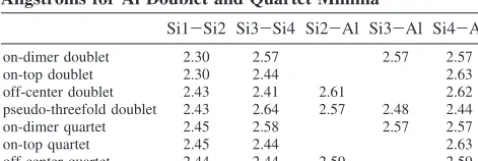
<on-top <center. The bond lengths for the QM-only cluster geometries are given in Table 8. Including the surrounding bulk is also important for determining accurate geometries. The rms error in bond lengths for the QM-only geometries is 0.20 Å. The rms error in angles is 2.8°. The most significantly distorted QM-only geometry is the pseudo-threefold structure (Figure 13a). In the QM/MM pseudo-threefold geometry, the Si1-Si2 dimer is shifted 0.26 Å out of the silicon dimer row, but without the MM part, this shift is 0.61 Å. The distance between Si2 and Si4 is also shortened by 0.10 Å, so the MM part of the structure imposes some constraints on the movements of the QM atoms, even though all atom positions are optimized in SIMOMM.
[image:13.598.133.456.42.427.2]The off-center doublet (Figure 13b) and quartet structures are also distorted. In both structures, the Si2-Si4 distance is shortened by 0.12 Å. In the on-dimer QM-only structure, the Si3-Si4 bond length is too short by 0.03 Å (Figure 13c). The
Figure 12. MRMP2//MCSCF rotation of an Al-Al dimer. Singlet MCSCF minimum energy path represented by solid line, triplet MCSCF minimum energy path represented by dashed line. MCSCF energies in parentheses. (Note: The energies not in parentheses are from MRMP2 single-point energy calculations.) Energies in kcal/mol.
TABLE 8: QM Cluster Model MCSCF Bond Lengths in
Angstroms for Al Doublet and Quartet Minimaa
Si1-Si2 Si3-Si4 Si2-Al Si3-Al Si4-Al
on-dimer doublet 2.30 2.57 2.57 2.57 on-top doublet 2.30 2.44 2.63 off-center doublet 2.43 2.41 2.61 2.62 pseudo-threefold doublet 2.43 2.64 2.57 2.48 2.44 on-dimer quartet 2.45 2.58 2.57 2.57 on-top quartet 2.45 2.44 2.63 off-center quartet 2.44 2.44 2.59 2.59
aAtom numbering shown in Figure 6.
[image:13.598.44.283.499.579.2]QM-only center structure does not even exist when the silicon bulk is included (Figure 13d).
Al2Si15H16.QM-only geometries were found for the bridge
and triplet structures. Both QM/MM and QM-only calculations find the singlet bridge structure to be lower in energy than the
singlet between structure. QM-only geometries for the doublet structures are in reasonable agreement with the SIMOMM results. The between triplet structure calculated without the surrounding bulk atoms is symmetric, but the between triplet structure distorts to a cross structure when the surrounding bulk silicon is included (Figure 14a). The QM-only triplet structure has a bond between the two Al atoms, but when the bulk silicon is included in the optimization, the Al-dimer bond disappears, forming a dual off-center structure (Figure 14b). The rms error in bond lengths for the four Al-Al dimer QM-only structures is 0.38 Å.
4. Conclusions
SIMOMM QM/MM multireference calculations reveal four minima for adsorption of an Al adatom on the Si15H16embedded cluster representing the Si(100)-2×1 surface. The four minima are the on-dimer, on-top, off-center, and pseudo 3-fold sites. The lowest energy site for a single Al adatom is the on-dimer structure. This is in contrast to the previous DFT-based studies by BKC and Takeuchi. Neither the Takeuchi nor BKC study addressed the chemistry of the quartet PES reported in this study. No minimum on the MCSCF surface was found for an adatom sitting in the center site on the Si15H16cluster, which is the global minimum found in the BKC CP study. Another CP study by Takeuchi found two binding sites for an Al adatom on the surface. These are the off-center and pseudo-threefold sites, in agreement with the multireference calculations in this work. The center structure was not found to be a minimum by Takeuchi. Takeuchi did find the off-center and pseudo-threefold sites to have the same energy.
[image:14.598.42.280.42.393.2]It is problematic to compare the multireference barrier heights for Al adatom diffusion found in this work to the CP barrier heights from the BKC study. This is partly because the CP barriers are quoted relative to the energy of the center structure; however, some general comparisons are possible. The BKC study found that the low energy pathway for diffusion perpen-dicular to the silicon dimer rows is between two silicon dimer rows. In contrast, both the MRMP2 and MCSCF PES in this work indicate that diffusion between the two silicon dimers of the Si15H16cluster is limited by the high barrier to the pseudo-threefold site. The MRMP2//MCSCF surface indicates that it is more likely for an adatom to diffuse across a silicon dimer when attempting to diffuse in the direction perpendicular to the silicon dimer surface. Diffusion across a Si-Si dimer was not specifically addressed in BKC. BKC found the barriers for diffusion parallel to the silicon dimer rows (between two dimer rows) to be higher in energy than diffusion perpendicular to the silicon dimer rows. The MRMP2 barrier for diffusion on the Si15H16cluster, parallel to the silicon dimer rows (from on-dimer to on-top to off-center, etc.) of 6.8 kcal/mol appears close to the BKC value, but corresponds to a quite different pathway. For the Al2dimer on the Si15H16embedded cluster, the lowest-energy structure based on the SIMOMM QM/MM multirefer-ence calculations is the bridge structure (IV). The lowest-energy Al2structures are those that can passivate the diradical nature of the surface. The more diradical character a minimum has, the higher in energy it is. When two Al adatoms are placed separately on the Si15H16, there is no barrier on the MRMP2 surface for dimer formation, indicating that two Al adatoms will spontaneously self-assemble into dimers when they meet on neighboring dimers in the same silicon dimer row. A driving force for dimerization exists even when the adatoms are sitting as far apart as possible on the Si15H16embedded cluster (Figure 9-V). In structure V, the two Al adatoms are over 6 Å apart,
Figure 13. Comparison of distorted QM-only geometries with QM/ MM geometries for singlet Al on Si(100).
Figure 14. Comparison of distorted QM-only geometries with QM/ MM geometries for triplet Al2on Si(100).
[image:14.598.79.245.434.663.2]indicating the importance of noncovalent interactions between the Al adatoms in the self-assembly process.
Analysis of QM-only (vs embedded cluster QM/MM) cal-culations suggest that it is necessary to include the surrounding bulk silicon atoms to obtain correct geometries and relative energies. An unrestricted hybrid DFT method does not predict the correct order of stability for the isomers. This can be explained by the inability of a single reference method, such as DFT to account for the varying multireference character of the surface.
It will be necessary to study larger clusters with more QM dimers to obtain a complete picture of the diffusion of Al adatoms and dimers between the silicon dimer rows. When larger embedded clusters are investigated, long-range diffusion could be investigated using molecular dynamics or dynamic reaction coordinate55calculations. The effect of neighboring QM dimer rows on the on-top and off-center structures will also be investigated. Future studies will also address surface features, such as steps and defects and their impact on the reactivity of the surface for better comparison with experiment. Unfortu-nately, MCSCF calculations on larger clusters are currently not manageable due to the large active spaces that are required. To reduce the time and memory requirements of these calculations while still including all the important configurations, the active space might be subdivided into multiple subspaces using the ORMAS method developed by Ivanic.56Calculations on large silicon clusters up to seven dimers57 are possible using the ORMAS code in GAMESS. Preliminary studies also show this method to be promising.
Acknowledgment.This work was supported by the SciDAC and Chemical Physics Computational Chemistry Programs and Division of Chemical Sciences, Basic Energy Sciences, U.S. Department of Energy (USDOE). The work was performed at Ames Laboratory, which is operated for the USDOE by Iowa State University under Contract no. DE-AC02-07CH11358. The authors also acknowledge Drs. Mike Schmidt and Jamie Rintelman and Professors Cheol Ho Choi and Tim Dudley for many helpful discussions.
References and Notes
(1) Joachim, C.; Roth, S., Eds.Atomic and Molecular Wires; NATO ASI Series E; Kluwer: Dordrecht, 1997.
(2) Nogami, J.; Baski, A. A.; Quate, C. F.Phys. ReV. B1991,44, 1415. (3) Nogami, J.; Park, S.-I.; Quate, C. F.Appl. Phys. Lett.1988,53, 2086.
(4) Nogami, J. InAtomic and Molecular Wires; Joachim, C.; Roth, S., Eds.; NATO ASI Series E; Kluwer: Dordrecht, 1997; Vol. 341, p 11.
(5) Evans, M. M. R.; Nogami, J. J.Phys. ReV. B1999,59, 7644. (6) Itoh, H.; Itoh, J.; Schmid, A.; Ichinokawa, T.Phys. ReV. B1993,
48, 14663.
(7) Brocks, G.; Kelly, P. J.; Car, R.Phys. ReV. B1993,70, 2786. (8) Northrup, J. E.; Schabel, M. C.; Karlsson, C. J.; Uhrberg, R. I. G.
Phys. ReV. B1991,44, 13799.
(9) Adams, B. G.; Sankey, O. F.J. Vac. Sci. Technol. A1992,10, 2046.
(10) Sakama, H.; Murakami, K.; Nishikata, K.; Kawazu, A.Phys. ReV. B1994,50, 14977.
(11) Steele, B. E.; Li, L.; Stevens, J. L.; Tsung, I. S. T.Phys. ReV. B 1993,47, 9925.
(12) Albao, M. A.; Evans, M. M. R.; Nogami, J.; Zorn, D.; Gordon, M. S.; Evans, J. W.Phys. ReV. B2005,72, 035426.
(13) Albao, M. A.; Evans, M. M. R.; Nogami, J.; Zorn, D.; Gordon, M. S.; Evans, J. W.Phys. ReV. B.2006,74, 037402.
(14) Car, R.; Parrinello, M.Phys. ReV. Lett.1985,55, 2471. (15) Takeuchi, N.Phys. ReV. B.2000,63, 035311.
(16) Redondo, A.; Goddard, W. A., IIIJ. Vac. Sci. Technol. B1982,
21, 344.
(17) Jung, Y.; Shao, Y.; Gordon, M. G.; Doren, D. J.; Head-Gordon, M.J. Chem. Phys.2003,19, 10917.
(18) Shoemaker, J.; Burggraf, L. W.; Gordon, M. S. J. Chem. Phys. 2000,112, 2994.
(19) Gordon, M. S.; Shoemaker, J. R.; Burggraf, L. W.J. Chem. Phys. 2000,113, 9355.
(20) Paulus, B.Surf. Sci.1998,408, 195.
(21) Choi, C. H.; Gordon, M. S.J. Am. Chem. Soc.1999,121, 11311. (22) Jung, Y.; Choi, C. H.; Gordon, M. S.J. Phys. Chem. B2001,105, 4039.
(23) Jung, Y.; Akinaga, Y.; Jordan, K. D.; Gordon, M. S.Theor. Chem. Acc.2003,109, 268.
(24) Choi, M. S.; Gordon, M. S. InThe Chemistry of Organic Silicon Compounds; Rappoport, Z., Apeloig, Y.; Eds; John Wiley and Sons: New York, 2001; Vol. 3, pp 821-852.
(25) Shoemaker, J. R.; Burggraf, L. W.; Gordon, M. S.J. Phys. Chem. A1999,103, 3245.
(26) Rintelman, J. M.; Gordon, M. S.J. Phys. Chem. B2004,108, 7820. (27) Jung, Y.; Gordon, M. S.J. Am. Chem. Soc.2005,127, 3131. (28) Choi, C. H.; Liu, D.; Evans, J. W.; Gordon, M. S.J. Am. Chem. Soc.2002,124, 8730.
(29) Choi, C. H.; Gordon, M. S.J. Am. Chem. Soc.2002,124, 6162. (30) Choi, C. H.; Gordon, M. S. Theoretical Studies of Silicon Surface Reactions with Main Group Adsorbates. In Computational Materials Chemistry: Methods and Applications, Curtiss, L. A. Gordon, M. S., Eds.; Kluwer: Dordrecht, 2004; pp. 125-190.
(31) Lee, H. S.; Choi, C. H.; Gordon, M. S.J. Phys. Chem. B2005,
109, 5067.
(32) Lee, H. S.; Choi, C. H.; Gordon, M. S.J. Am. Chem. Soc.2005,
127, 8485.
(33) Ghosh, M. K.; Choi, C. H.Chem. Phys. Lett.2008,457, 69. (34) Cho, J.; Choi, C. H.J. Phys. Chem. C2008,112, 6907. (35) Ghosh, M. K.; Choi, C. H.J. Phys. Chem. B2006,110, 11277. (36) Ghosh, M. K.; Sarker, M. I. M.; Choi, C. H.J. Phys. Chem. C 2008,112, 9327.
(37) Lee, H. S.; Choi, C. H.Theor. Chem. Acc.2008,120, 79. (38) Tamura, H.; Gordon, M. S.J. Chem. Phys.2003,119, 10318. (39) Zapol, P.; Curtiss, L. A.; Tamura H.; Gordon, M. S. Theoretical Studies of growth Reactions on Diamond Surfaces. In Computational Materials Chemistry: Methods and Applications; Curtiss, L. A.; Gordon, M. S., Eds.; Kluwer Academic Publishers: Dordrecht, Boston, 2004; pp 266-307.
(40) Stevens, W. J.; Krauss, M.; Basch, H.; Jasien, P. G.Can. J. Chem. 1991,70, 612.
(41) Garrett, B. C.; Redmon, M. J.; Steckler, R.; Truhlar, D. G.; Baldridge, K. K.; Bartol, D.; Schmidt, M. W.; Gordon, M. S.J. Phys. Chem. 1988,92, 1476.
(42) Gonzales, C.; Schelgel, H. B.J. Chem. Phys.1998,90, 2154. (43) Hirao, K.Chem. Phys. Lett.1992,190, 374.
(44) Becke, A. D.J. Chem. Phys.1993,98, 5648.
(45) Lee, C.; Yang, W; Parr, R. G.Phys. ReV. B1998,37, 785. (46) Vosko, S. H.; Wilk, L.; Nusair, M.Can. J. Phys.1980,58, 1200. (47) Schmidt, M. W.J. Comput. Chem.1993,14, 1347.
(48) Schmidt, M. W.; Gordon, M. S. InTheory and Applications of Computational Chemistry: The First Forty Years; Dykstra, C. E., Frenking, G., Kim, K. S., Scuseria, G. E., Eds.; Elsevier: Amsterdam, Boston, 2005; pp. 1167-1189.
(49) Lii, J. H.; Allinger, N. L.J. Am. Chem. Soc.1989,111, 8566. (50) Lii, J. H.; Allinger, N. L.J. Am. Chem. Soc.1989,111, 8576. (51) Allinger, N. L.; Yuh, Y. H.; Lii, J. H.J. Am. Chem. Soc.1989,
111, 8551.
(52) Kundrot, C. E.; Ponder, J. W.; Richards, F. M.J. Comput. Chem. 1991,12, 402.
(53) Ponder, J. W.; Richards, F. M.J. Comput. Chem.1987,8, 1016. (54) Bode, B. M.; Gordon, M. S.J. Mol. Graphics Model.1999,16, 133.
(55) Stewart, J. J. P.; Davis, L. P.; Burggraf, L. W.J. Comput. Chem. 1987,8, 1117.
(56) Ivanic, J.J. Chem. Phys.2003,119, 9364. (57) Roskop, L., Gordon, M. S. In preparation.
JP8105937