Copyright © 2017 (Yariv Tsfati & Lilach Nir). Licensed under the Creative Commons Attribution Non-commercial No Derivatives (by-nc-nd). Available at http://ijoc.org.
Frames and Reasoning:
Two Pathways From Selective Exposure to Affective
Polarization
YARIV TSFATI
University of Haifa, Israel
LILACH NIR
Hebrew University, Jerusalem, Israel
1Although an association between congruent exposure to ideological news and affective polarization is well documented, we know little about the mechanisms underlying it. This article explores two possible mechanisms: (1) acceptance of media frames and (2) the effects on the audience’s reasoning, specifically, their knowledge of claims supporting their and the other camp’s positions. Mediation hypotheses were tested on data collected using an online survey of users of ideological and mainstream Israeli news websites (N = 788). Op-eds from these websites (N = 259) were content-analyzed to determine the frames used by ideological and mainstream websites. Results demonstrate that acceptance of frames plays a more important role than audience reasoning in mediating the effect of selective exposure on political polarization.
Keywords: selective exposure, affective polarization, framing, political reasoning
The notion that exposure to likeminded communication results in stronger, more extreme attitudes has been embedded in communication research from its earliest days (Lazarsfeld, Berelson, & Gaudet, 1968). In the past decade, the proliferation and success of opinionated media outlets that present the news from the standpoint of a conservative or liberal perspective (Baum & Groeling, 2008) have renewed interest in the association between selective exposure (SE) and attitude reinforcement (e.g., Slater, 2007). As Jamieson and Cappella (2008) note, regular exposure “to a single, coherent, and consistent point of view” (p. 216) via ideological media tends to result in more extreme opinions and perceptions of out-groups (for qualitative evidence, see Berry & Sobieraj, 2013, Chapter 5).
Yariv Tsfati: [email protected] Lilach Nir: [email protected] Date submitted: 2016–05–02
The effect of ideologically consonant media consumption on political polarization has been deemed as one of the only avenues of media influence on the public in an era of limited effects (Bennett & Iyengar, 2008). The effect of SE on polarization has attracted not only theorization but also much empirical work, much of which provided evidence connecting the two (for correlational studies, see Jones, 2002; Lawrence, Sides, & Farrell, 2010; Stroud, 2010). In particular, congruent exposure impacts affective polarization, relating to partisans’ positive emotional reactions to their party and negative emotional reactions to the opposing party (Garrett et al., 2014). However, not much is known about the psychological processes underlying this association. In this article, we examine two types of cognitive processes as possible mediators of the SE–polarization nexus: framing and political reasoning. The notion of framing as a mediator suggests that alternative interpretations of events in ideological media influence audience interpretations of events, and, particularly, their attributions of responsibility, which consequently shape affective polarization. The notion of political reasoning as a mediator between SE and affective polarization suggests that ideological media shape the audience’s arsenal of claims, the reasons people use to justify their political positions, and their knowledge of the justifications of the opposite position. An imbalanced set of such reasons and justifications may underlie affective polarization.
Selective Exposure and Affective Polarization
Traditionally, political scientists conceptualized political polarization as the separation between partisans or elites on issue or policy spectrums, whereas recently, Iyengar, Sood, and Lelkes (2012) have advocated the use of social identity and social distance theories to study polarization. They argued that most people do not think about their party or the opposing party in ideological terms, and that citizens’ ties to the political world are often emotional. Therefore, they defined affective polarization as separation based on emotional reactions to opposing parties (see Garrett et al., 2014) and demonstrated that such polarization is more robust than polarization grounded in policy positions.
Recent empirical work has connected SE to ideologically congruent materials with various indicators of affective polarization (for correlational studies, see Garrett et al., 2014; Jones, 2002; see Allen & Moehler, 2013, for conflicting findings, and see Prior, 2013, for a critique). Stroud (2010) also demonstrated that SE promotes polarization over time, meaning that early ideological exposure predicts later affective polarization. Similar findings were obtained in laboratory studies (Knobloch-Westerwick, 2012; Levendusky, 2013a, 2013b; Taber & Lodge, 2006). For example, Levendusky (2013b) exposed experimental participants to crosscutting, congruent, and neutral political stimuli and found that congruent exposure resulted in increased polarization. However, Arceneaux and Johnson’s (2013) experiments demonstrated that ideological media polarized attitudes only when exposure was forced on respondents, not when they chose to expose themselves to congruent content.
confidence to the claim that the causal path is from exposure to affective polarization, not the other way around (see also Slater, 2007).
But how and why does likeminded SE promote affective polarization? Because the effect of SE on polarization is arguably one of the most important and interesting effects of media on politics in the current media landscape (Bennett & Iyengar, 2008), not much is known about the psychological process underlying the association. Most accounts for the association rely on motivated reasoning processes. Such explanations stress that humans are predisposed to strengthening preexisting opinions and that such directional motivation is amplified by the one-sided nature of partisan news. As Levendusky (2013b) put it, the absence of competing messages in partisan media increases the general tendency to accept proattitudinal information. However, most research using motivated reasoning as an explanation for the association between SE and polarization has not deciphered exactly how and what types of congruent information are retained, and have not theorized why exactly this retention make partisans polarize. The current research wishes to extend this literature and examine how the motivated processing of partisan information promotes affective polarization via two possible cognitive, knowledge-related mechanisms: acceptance of media frames and internalizing reasons.
Framing, Equivalence, and Information Processing
Framing is defined as a “dynamic, circumstantially-bound process of opinion formation in which the prevailing modes of presentations in elite rhetoric and news media coverage shape mass opinion” (Scheufele & Iyengar, 2014, p. 1). Focusing on framing effects, we refer in this article to “attitudinal outcomes that are not due to differences in what is being communicated, but rather to variations in how a given piece of information is being presented (or framed) in public discourse“ (Scheufele & Iyengar, 2014, p. 1, italics in original). A meta-analysis of 178 scholarly articles on framing reveals that this is one of the two most common definitions in the literature (Matthes, 2009). Variations in how a given piece of information is being presented or framed in public discourse include variations in problem definition and causal attributions (Entman, 1993). Thus, frames contain answers to questions such as, What is the problem? Who is responsible for it? What is his or her motivation?
Framing effects, then, are only those effects that owe to variations in the mode of presentation of a similar piece of information (Scheufele & Iyengar, 2014). The literature suggests that a particular mode of presentation evokes specific constructs in previously stored knowledge structures; the message is deemed applicable. A construct is “applicable, and is likely to be activated, when its key features correspond to the salient features of the stimulus” (Price & Tewksbury, 1997, p. 190). Framing is an “applicability effect . . . salient attributes of the message . . . affect the applicability of particular thoughts, resulting in their activation and use in evaluations” (Price & Tewksbury, 1997, p. 198).
Framing as a Mediator Between Selective Exposure and Polarization
applicability of perceived responsibility and motivations. Ideological media systematically and repetitively promote certain associations between constructs (Jamieson & Cappella, 2008). The frequent use of these associations by media leads audiences to use similar associations and makes them more applicable to future ideological judgments.
In their study of the conservative media establishment in the U.S., Jamieson and Cappella (2008) maintained that exposure to Rush Limbaugh’s framing of the political reality makes his audience more likely to interpret reality “in a way that is both systematic and consistent with Limbaugh’s rhetoric” (p. xiv). They contend that, “this creates for his listeners a polarized view of political phenomena” (Jamieson & Cappella, 2008, p. xiv). They indeed demonstrate that Limbaugh’s listeners share his interpretation of political issues, but they fail to show that these partisan interpretations are empirically or theoretically related to affective polarization. The current research argues that exposure to partisan frames applies either positive motivations or reduced responsibility for problems to the in-party (“our party”) or negative motivations or increased responsibility for problems to the out-party (“their party”) or its leaders. Such connotations naturally promote emotional reactions such as anger and disgust toward the out-group, reactions that constitute affective polarization (see Gross & D’Ambrosio, 2004; Levendusky, 2013a).
Therefore, our first set of hypotheses relates to the role of framing as a mediator:
H1a1: Congruent exposure to ideological media will be positively associated with audience acceptance of congruent political frames used by these media.
H1a2: Congruent exposure to ideological media will be negatively associated with acceptance of incongruent frames.
H1b1: Acceptance of the congruent frames of ideological media will be associated with the audience’s affective polarization.
H1b2: Acceptance of incongruent frames will be negatively associated with affective polarization.
H1c: Acceptance of the frames of ideological media will mediate the association between partisan SE and affective polarization.
Will congruent frames affect liking of one’s political camp or loathing of the opposing political camp, or both? Given that the literature is unclear regarding which of the two is affected by selective exposure, we ask,
Reasoning as a Mediator Between Selective Exposure and Polarization
Another possibility is that SE to partisan media promotes affective polarization through its effects on the audience’s reasoning. In our investigation, reasoning refers to an internal process in which people mentally organize their knowledge to consider possible reasons and justifications for their positions and those of others. Arguments, counterarguments, and refutations are used as part of this process. Together, they may serve as an indicator of a person’s organized knowledge of a particular domain, constituting an affirmative response to “Would you be able to prove this person wrong?” and “What could you say to show that your own view is the correct one?” Reasoning is the acquired skill of determining, justifying, and explaining one’s own position (first and foremost to oneself, but occasionally to the environment; Kuhn, 1991). Although some have suggested that frames package or imply argumentative content (e.g., Callaghan & Schnell 2001; Fryberg et al., 2012), recent scholarship distinguishes frames from reasoning (Entman, Matthes, & Pellicano, 2009).
Our investigation uses “argument repertoire”—a concept developed as an indicator of the quality of public opinion, operationalized as the number of reasons people cite for their positions on issues and those of others (Cappella, Price, & Nir, 2002)—as an indicator of participants’ political reasoning. Most research concerned with argument repertoire pertains to interpersonal communication and ordinary political talk, in a controlled experiment; however, Manosevitch (2009) found that those who read an article about Social Security could cite more reasons for and against their position than that of the control group that did not read any articles on the subject.
Past research by Manosevitch (2009) would lead us to expect a positive association between news exposure and audience reasoning. This research, however, has not dealt with explicitly partisan media. One specific feature of partisan media makes it less likely to ensure the democratic benefits of exposure to competing views. As discussed, partisan media is characterized by a relative asymmetry; there is an unequivocal preference for one view, not a balanced and impartial presentation of different sides. Asymmetry should affect political reasoning in several different ways. Similar to likeminded social networks (Price et al., 2002), exposure to likeminded media content should be associated with a broader own-argument repertoire and a narrower opposite-argument repertoire (as it makes such opposite arguments less accessible). Whether it is due to chronic access to reasons, temporary prime of them, or cognitive elaboration in anticipation of future political exchanges, the expectation is of asymmetry in reasoning following SE to mediated content.
It is possible to argue that an imbalanced repertoire of reasons containing more of “our party’s” arguments and fewer of “their party’s”2 may lead to the view that the opposing party’s positions are irrational and unfounded in considered deliberation. Viewing the opposing party supporters as advocating such an unreasonable set of positions may bring about affective negative responses, such as anger and frustration toward the out-party and its supporters, and positive emotional reactions such as pride toward the in-party and its supporters (see Mutz, 2007). These affective responses constitute affective polarization. In other words, an asymmetrical repertoire of arguments might promote affective polarization through the belief that the out-party positions make no sense and that people supporting such positions are unreasonable.
Empirically, one relevant piece of evidence has documented that a repertoire of one’s own arguments relative to opposing arguments is related to political intolerance (Mutz, 2007). Such intolerance could be viewed as an emotional reaction, given research demonstrating that the basis of tolerance lies not in considered cognitive processes such as attitudes toward liberties for different groups but rather in gut feelings and emotions toward these different groups (Kuklinski, Riggle, Ottati, Schwartz, & Wyre, 1991). If an imbalanced repertoire of reasons can lead to intolerance, it could elicit related emotional responses such as affective polarization.
Based on this discussion, we hypothesize:
H2a1: Congruent selective exposure will be associated with more reasons supporting the in-party position.
H2a2: Congruent selective exposure will be associated with fewer reasons supporting the opposite party position.
H2b: Participants’ political reasoning will be associated with polarization. Own-reason repertoire (H2b1) and opposite-reason repertoire (H2b2) will be associated with affective polarization.
H2c: The political reasoning constructs will mediate the effect of congruent exposure on polarization. Own-reason repertoire (H2c1) and opposite-reason repertoire (H2c2) will mediate the association between selective exposure and affective polarization.
Again, with the second RQ we want to explore whether this hypothesized mediated effect of SE via argumentation on affective polarization shapes liking of one’s political camp, disliking of the other camp, or both.
As noted, another possible mechanism underlying the association between congruent exposure and polarization is that exposure to ideological news distorts partisan audiences’ perceptions of the distribution of opinion in society, given that ideological media present more exemplars advocating the views of the in-party. Polarization is a potential result of comparison and adjustment to this distorted perceived norm. Exposure to ideological media has indeed been associated with perceptions about the climate of public opinion such that those who consume liberal media perceive that climate as more liberal and vice versa for those consuming conservative media (Tsfati, Stroud, & Chotiner, 2014). Given possible spuriousness and the fact that perceptions about the climate of public opinion were found to mediate the association between SE and polarization, we test our proposed mediators while controlling for perceptions about the opinion climate.
Method
The population for this study consists of Israeli news audiences. Given our focus on audiences of ideological media and how they polarize, it would not make sense to sample all Israelis. We recruited our sample using banner ads published in four online Hebrew language Israeli news outlets: the right-leaning Rotter.net and Arutz Sheva News, the left-leaning Haaretz website, and the mainstream news outlet Ynet. This recruitment strategy in effect compares users of ideological media to mainstream news users. The fact that our sample consists of relatively engaged respondents (and does not include nonusers) is a more conservative test of the hypotheses, because engaged participants are more likely to hold extreme and polarized views. Differences in the outcome—polarization—between respondents who are all politically engaged tend to be much smaller than the differences between engaged and disengaged ones, making this a conservative test.
Altogether, we recruited 2,117 respondents. A random subset of respondents was presented with the argument repertoire and the frame-acceptance questions, and hence complete data are available for 788 respondents. The other 1,329 respondents were asked instead about a different set of mediators, and results for these respondents are reported in detail by Tsfati and Chotiner (2016), where more details about the sample are provided. Given that we recruited respondents only on Hebrew-language outlets, overrepresented ideological media audience, used advertisements relating to political opinions, and recruited only from hard news sections, the sample contained more participants who were male (80.1%), Israeli born (88.3%), Jews (99.5%), ultra-Orthodox Jews (16.3%), and right-wing supporters (72.0%) and who were younger (mean age = 32.01 years, SD = 12.39) than the general population. The bivariate correlations between the main variables are presented in Online Appendix 1 (https://www.dropbox.com/s/j9evk7djk8ngwrc/supplementary%20materialsrr.docx?dl=0).
Measures
Respondents reporting incongruent exposure were set to zero on the appropriate scales (e.g., a right-wing respondent reporting exposure to left-right-wing outlets received a score of zero on the measure of selective left-wing exposure). Next, we combined both left-wing and right-wing media exposure scales (by subtracting own minus opposite scales and taking the absolute value) into a single scale tapping ideologically congruent exposure to either left-wing or right-wing channels varying between zero (no congruent exposure) and 5 (regular congruent exposure; M = 1.71, SD = 1.04).3
Affective polarization. The conventional strategy to tap affective polarization uses the difference between thermometer ratings directed at political objects from both ends of the political spectrum (Garrett et al., 2014; Stroud, 2010). A recent study determined that this strategy correlated with implicit measures of affective polarization, attesting to its convergent validity (Iyengar & Westwood, 2014). Following this strategy, respondents were asked to indicate on a scale of 1 (strong rejection) to 10 (strong support) how they felt about two political parties. The first party was the overtly right-wing National Union (HaIhud HaLeumi). The second party was the overtly left-wing Meretz. Following Stroud (2010), we used the absolute value of the difference between thermometer items as a measure of polarization (M = 5.48, SD = 2.92). To investigate RQ1 and RQ2, we also constructed measures tapping respondents’ liking for their political camp (M = 7.29, SD = 2.62) and rejection of the opposing political camp (M = 8.98, SD = 1.79).
Acceptance of ideological frames. This study focused on three different sets of competing frames prevalent in Israeli ideological media at the time of study. These topics were chosen because all three were presented by the media almost exclusively using either right-wing or left-wing frames with almost no alternatives to these dominant frames. The first issue dealt with the so-called Nakbah Law. Arab Israelis mark Israel’s Day of Independence as a day of mourning and remembrance of the Nakbah (Arabic for catastrophe), the term they use to refer to their national tragedy during the 1948 war. In 2011, the Netanyahu government passed a bill allowing the minister of the treasury to deduct from the budget of an institution supported by the state if that institution marked Israel’s Independence Day as a day of mourning. To examine the competing framing of the debate about this bill, we content analyzed all op-ed articles published in 2011 by right-wing Arutz Sheva, left-wing Haaretz, and mainstream Ynet that mentioned the Nakbah Law (n = 68). To calculate coding reliabilities, two trained coders coded 32 op-ed articles published in the same three outlets in 2012; ordinal Krippendorff’s α was .84. Results (presented in Online Appendix 2, https://www.dropbox.com/s/j9evk7djk8ngwrc/supplementary%20materialsrr.docx?dl=0) demonstrated that the left-wing Haaretz’s predominant interpretation was that the motivation of the government in passing the bill was to limit the free speech of left-wing supporters and the Arab-Israeli public (rather than merely to preserve Israel’s Jewish-Zionist identity), whereas this interpretation was far less predominant in the right-wing Arutz Sheva. This difference constitutes a set of competing frames because part of the definition of framing relates to the motivations of political actors (Entman, 1993). This is
different from reasoning in which people come up with claims supporting their position. The “framing” interpretations relate to the way people understand the motivation behind the politicians’ positions.
A second set of frames that we examined concerned the Israeli Supreme Court ruling regarding the dismantling of the so-called illegal outposts—small settlements built without government permits in the occupied West Bank. Petitions by left-wing organizations and Palestinian landowners to remove these outposts are discussed from time to time by the Israeli Supreme Court. The Court tends to rule that the government should dismantle these outposts. To examine the competing framing of these rulings, we content analyzed all op-ed articles published on this topic in 2011 by right-wing Arutz Sheva, left-wing Haaretz, and mainstream Ynet (n = 88). Ordinal Krippendorff’s α was .83. Results (presented in Online Appendix 2, https://www.dropbox.com/s/j9evk7djk8ngwrc/supplementary%20materialsrr.docx?dl=0) demonstrated that Haaretz’s predominant interpretation was that these Supreme Court rulings are purely professional, whereas Arutz Sheva’s predominant interpretation was that these rulings are the result of the political biases.
The third set of frames, used in this study concerned a wave of social protests that took place during the summer of 2011, when groups of young Israelis set up tent camps across the country to protest the rising cost of living. To examine the competing framing of these protests, we content analyzed all op-ed articles published on this topic in 2011 by the same outlets (n = 103). Ordinal Krippendorff’s α was .70. Arutz Sheva’s interpretation regarding the true motivation behind the protest was that it was designed to weaken the right-wing government, whereas Haaretz’s predominant interpretation was that the protest stemmed purely from the desire to promote a more egalitarian economic system in Israel. Again, this relates to motivations that are part of Entman’s (1993) definition of framing.
To tap the respondents’ acceptance of these frames, they were asked three questions concerning these three issues. The first question asked whether they thought the goal of the initiators of the Nakbah Law was “to preserve Israel’s character as a Jewish and Zionist State” or “to limit the free speech of left-wing supporters and the Arab public.” The second question was whether the Supreme Court rulings on the outposts were “professional” or “expressed the political attitudes of the Supreme Court justices.” The third question asked whether the leaders of the social protest “were driven by an aspiration to advance a more egalitarian economic system in Israel” or “their true motivation was to weaken the right-wing government, headed by Netanyahu.”
Right-wing respondents who accepted the right-wing interpretation for all three issues and left-wing respondents who accepted the left-left-wing interpretation for all three issues (67.0%) received a score of one, and all other respondents were coded zero. Another indicator was constructed for consistently accepting only the opposite camp’s interpretations (10.1%). This measure taps the extent to which the respondents rejected the frames of their political camp.
because of its centrality in Israeli media and the public agenda (Tsfati, Sheafer, & Weimann, 2011), which ensured that our respondents would be able to think of arguments justifying different positions. Respondents answering that Israel should accept a Palestinian state were then asked to list all of the reasons that came to their mind in favor of the establishment of a Palestinian state as an open-ended question. Then, they were asked, “And, in contrast, what claims do other people, opposing the establishment of a Palestinian state, have in support of their position? Please list all reasons that come to your mind against a Palestinian state.” Respondents answering that Israel should oppose the establishment of a Palestinian state were likewise asked to provide reasons that came to their mind against the establishment of a Palestinian state and in its favor. A few examples of open-ended comments are presented in Online Appendix 3 (https://www.dropbox.com/s/j9evk7djk8ngwrc/supplementary%20materialsrr.docx?dl=0).
All open-ended answers were content analyzed to determine whether these answers contained any statements that could be considered reasons, and if so, how many reasons were offered for the respondents’ own opinion and for the opposing opinion. Any piece of information substantiating a position or explaining it constituted a reason, even if that information was invalid in terms of its accuracy. A reason did not have to offer factual information, so statements such as “I do not trust the Palestinians” were counted as reasons. In contrast, statements that merely denigrated the other political camp (e.g., “they are naïve,” in response to the request to provide all the arguments of the other political camp) were not counted as reasons. Statements repeating the same claims several times were counted only once, so statements had to offer new information to count as reasons. Axiomatic statements (e.g., “there is no choice” or “because this is the only way”) were not counted as reasons. However, references to external authorities (e.g., “because this is the will of God” or “because of UN resolutions”) did count as reasons. Cause and effect were counted as two reasons. For example, “The world will like us and as a consequence support us militarily and economically” was counted as two reasons: (1) favorable world opinion and (2) military and economic support. These coding decisions follow those of Cappella et al. (2002) quite closely. Online Appendix 3 (https://www.dropbox.com/s/j9evk7djk8ngwrc/supplementary%20materialsrr.docx?dl=0) provides further examples for coding decisions.
Coding reliability was Krippendorff’s α = .81. For each respondent, we created variables for the number of reasons provided for their own opinions (M = 3.24, SD = 3.66) and those of others (M = 1.83, SD = 2.28). The correlations between these argument repertoire constructs and the acceptance of frames were modest in size (for reasons for own position: r = .10, p < .01, for reasons for the opposite position:
r = −.01, p > .10, ns), providing evidence for discriminant validity between these constructs.
Results
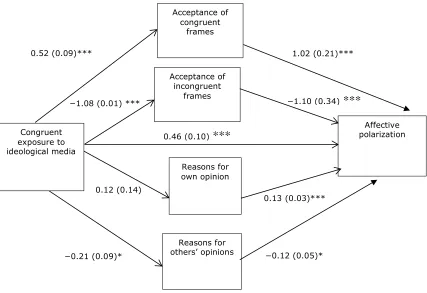
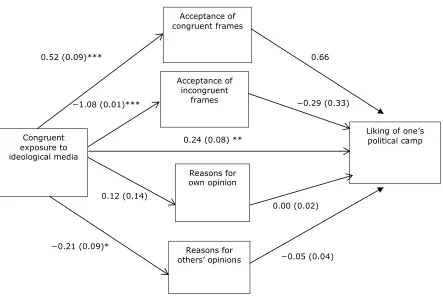
[image:11.612.92.519.258.551.2]We used ordinary least squares (OLS) regression (for the models predicting the reasoning and polarization constructs) and logistic regression (for the models predicting the dummy acceptance-of-frames constructs) to examine the hypotheses. The regression coefficients for the full models are reported in Online Appendixes 5 and 6 (https://www.dropbox.com/s/j9evk7djk8ngwrc/supplementary%20materialsrr.docx?dl=0). The coefficients testing the hypotheses are presented in Figures 1, 2, and 3.
Figure 1. Effects of congruent exposure to ideological media on affective polarization (unstandardized OLS and logistic regression estimates, N = 788).
Data are shown as b (SE). *p < .05. **p < .01. ***p < .001. 0.12 (0.14)
0.13 (0.03)***
−1.10 (0.34)
***
0.46 (0.10)
***
−0.21 (0.09)* −1.08 (0.01) ***
Reasons for own opinion
Affective polarization Acceptance of
incongruent frames
Reasons for
others’ opinions −0.12 (0.05)* Acceptance of
congruent frames
1.02 (0.21)*** 0.52 (0.09)***
Figure 2. Effects of congruent exposure to ideological media on liking of one’s side (unstandardized OLS and logistic regression estimates, N = 788).
Data are shown as b (SE). #p < .10. *p < .05. **p < .01. ***p < .001. 0.12 (0.14)
0.09 (0.03)*** −1.02 (0.45)*
0.24 (0.08)
**
−0.21 (0.09)*
−1.08 (0.01) ***
Reasons for own opinion
Disliking of the opposing political
camp Acceptance of
incongruent frames
Reasons for
others’ opinions −0.08 (0.05)# Acceptance of
congruent frames
1.00 (0.22)*** 0.52 (0.09)***
Figure 3. Effects of congruent exposure to ideological media on disliking of the opposing side (unstandardized OLS and logistic regression estimates, N = 788).
Data are shown as b (SE). *p < .05. **p < .01. ***p < .001.
Our first set of hypotheses tested the role of framing. H1a1 predicted that exposure to ideologically congruent media would be associated with the acceptance of congruent ideological frames. This hypothesis was supported (b = 0.52, SE = 0.09, p < .001; see Figure 1). H1a2 predicted that exposure to ideologically congruent media would be negatively associated with acceptance of incongruent frames. The coefficient for congruent exposure in the logistic regression model predicting acceptance of incongruent frames was negative and significant (b = −1.08, SE = 0.15, p < .001; see Figure 1), supporting H1a2.
The hypotheses connecting the mediators to affective polarization were tested using an OLS regression model predicting this construct, controlling for all covariates, mediators and the IV. The coefficients for these hypotheses are presented on the right side of Figure 1. H1b1 predicted that the acceptance of congruent ideological frames would be associated with affective polarization. This hypothesis was supported (b = 1.02, SE = 0.21, p < .001; see Figure 1). H1b2 predicted a negative association between accepting incongruent frames and affective polarization. As predicted, the coefficient the effect of acceptance of incongruent frames on affective polarization was negative and significant (b = −1.10, SE = 0.34, p < .001; see Figure 1, right side).
0.12 (0.14)
0.00 (0.02) −0.29 (0.33)
0.24 (0.08) **
−0.21 (0.09)* −1.08 (0.01)***
Reasons for own opinion
Liking of one’s political camp Acceptance of
incongruent frames
Reasons for
others’ opinions −0.05 (0.04) Acceptance of
congruent frames
0.66
(0.16)***
0.52 (0.09)***RQ1 asked whether acceptance of congruent or incongruent frames affected liking of one’s group or disliking of the opposing group. To examine this question OLS models with these dependent variables (DVs) were run. Results for liking one’s side are depicted in Figure 2 and results for disliking the opposing side are presented in Figure 3 (full models, which include the coefficients for all control variables, are presented in Online Appendix 6, https://www.dropbox.com/s/j9evk7djk8ngwrc/supplementary%20materialsrr.docx?dl=0). As the coefficients demonstrate, acceptance of congruent frames positively affected both liking of one’s group (b = 1.00, SE = 0.22, p < .001; see Figure 2) and disliking the opposition (b = 0.66, SE = 0.26, p < .001; see Figure 3). Acceptance of incongruent frames negatively affected liking of one’s group (b = −1.02, SE = 0.45, p < .05; see Figure 2). The association between acceptance of incongruent frames and disliking the opposition, however, was not statistically significant (b = 0.29, SE = 0.33, p > .05; see Figure 3).
The second set of hypotheses tested the political reasoning constructs. H2a1 predicted an association between congenial news exposure and the number of reasons participants offered in favor of their position. As Figure 1 shows, however, there was no significant association between these constructs. H2a2 predicted a negative association between congenial news exposure and the repertoire of reasons in favor of the other camp’s position. Indeed, more frequent exposure to congruent ideological outlets was associated with offering fewer reasons in favor of the other camp (b = −0.21, SE = 0.09, p < .05; see Figure 1).
H2b1 predicted that the repertoire of reasons in favor of one’s position would be associated with affective polarization. The results supported this hypothesis (b = 0.13, SE = 0.03, p < .001; see Figure 1). H2b2 predicted a negative association between reasons supporting the other camp’s position and affective polarization. As predicted, offering fewer such reasons was associated with a higher level of polarization (b = −0.12, SE = 0.05, p < .01; see Figure 1).
RQ2 inquired about the effects of these argument-repertoire constructs on either liking of one’s political camp or disliking of the opposing camp. OLS models in Figure 2 present the results for liking of one’s camp and in Figure 3 for disliking of the other camp (full models including coefficients for control variables are presented in Online Appendix 6, https://www.dropbox.com/s/j9evk7djk8ngwrc/supplementary%20materialsrr.docx?dl=0). As the models demonstrate, offering reasons in support of both one’s and the opposing opinions were related to liking of one’s political camp (for own opinion: b = 0.09, SE = 0.03, p < .01, for others’ opinions: b = −0.08, SE = 0.05, p < .10, the latter coefficient was only of borderline significance; see Figure 2), but did not significantly associate with disliking of the opposing camp (see Figure 3).
those who accepted only the opposite camp’s interpretations were coded zero. While not ideal, this measure taps the extent to which the respondents accepted their political camp’s frames.
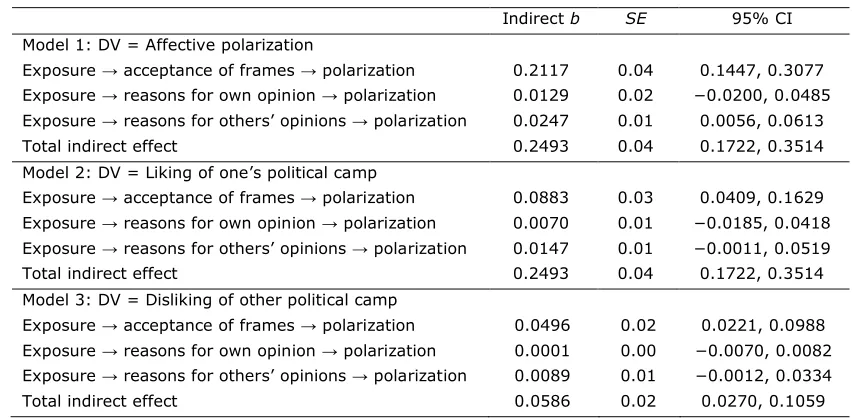
[image:15.612.84.510.236.445.2]Mediation hypotheses were tested using PROCESS (Hayes, 2013). We ran three PROCESS multiple mediation models with either affective polarization, liking of one’s camp, and disliking of the opposing camp as the DVs, and the ordinal acceptance-of-frames indicator, reasons for own opinion and for opposite opinions as the mediators. Results for the mediation tests are reported in Table 1.
Table 1. Significance Tests for Indirect Effects.
Indirect b SE 95% CI
Model 1: DV = Affective polarization
Exposure → acceptance of frames → polarization 0.2117 0.04 0.1447, 0.3077 Exposure → reasons for own opinion → polarization 0.0129 0.02 −0.0200, 0.0485 Exposure → reasons for others’ opinions → polarization 0.0247 0.01 0.0056, 0.0613
Total indirect effect 0.2493 0.04 0.1722, 0.3514
Model 2: DV = Liking of one’s political camp
Exposure → acceptance of frames → polarization 0.0883 0.03 0.0409, 0.1629 Exposure → reasons for own opinion → polarization 0.0070 0.01 −0.0185, 0.0418 Exposure → reasons for others’ opinions → polarization 0.0147 0.01 −0.0011, 0.0519
Total indirect effect 0.2493 0.04 0.1722, 0.3514
Model 3: DV = Disliking of other political camp
Exposure → acceptance of frames → polarization 0.0496 0.02 0.0221, 0.0988 Exposure → reasons for own opinion → polarization 0.0001 0.00 −0.0070, 0.0082 Exposure → reasons for others’ opinions → polarization 0.0089 0.01 −0.0012, 0.0334
Total indirect effect 0.0586 0.02 0.0270, 0.1059
H1c predicted a significant mediated effect of likeminded exposure on polarization through the acceptance of frames. In line with this hypothesis, this indirect effect of exposure to congruent media on affective polarization was indeed positive and significant, b = 0.21, SE = 0.04, p < .05, 95% CI [0.14, 0.31] (see Table 1). H2c1 predicted that reasons in favor of one’s own position would mediate the association between congruent exposure and affective polarization. This indirect effect was not significant, as the confidence interval for reasons for one’s own opinion included zero, 95% CI [−0.02, 0.0485] (see Table 1). H2c2 predicted that reasons in favor of the opposite position would mediate the effect of congenial exposure on affective polarization. This indirect effect was indeed significant, b = 0.02, SE = 0.01, p < .05, 95% CI [0.0056, 0.0613] (see Table 1). In other words, part of the effect of SE on polarization was accounted for by the fact that such exposure was associated with accepting congruent and rejecting incongruent frames, and with offering fewer reasons in favor of the other side.
p < .05, 95% CI [0.0221, 0.0988] (Table 1)—there were no significant mediated effects of the political reasoning variables on either liking one’s camp or disliking the opposition.
Effect size estimates. Absolute changes in affective polarization caused by SE, mediated through argument repertoire or the acceptance of frames, were small in size; however, the proportion of the effect of SE that was mediated by the mechanisms, calculated using PROCESS (see Hayes, 2013, pp. 188–191, for a detailed explanation of the calculation), was far from trivial. Our mediators accounted for 35% of the total effect of SE on affective polarization. The ratio of the indirect effects to the direct effect was .54 (see Hayes, 2013, for a discussion regarding these effect size estimates). Acceptance of frames accounted for 29.8% of the total effect, whereas reasons for others’ positions accounted for merely 3.5% of the total effect.
Discussion and Conclusions
The current investigation examined the mechanism behind the association between partisan media exposure and affective polarization, and led to a few conclusions. First, as proposed (but not fully demonstrated) by Jamieson and Cappella (2008), audiences of partisan media are more likely to accept the ideological interpretations propagated by such outlets and reject opposing interpretations. These patterns of interpretative sense making are associated with greater affective polarization. Second, partisan media exposure is associated with fewer reasons audiences cite in favor of the other political camp, which is associated with affective polarization. Perhaps this is due to the tendency of partisan outlets to criticize the out-group disproportionally rather than glorify the in-group (Budak, Goel, & Rao, 2016). This mechanism mediated the effect of SE on polarization, but not on liking of one’s group or disliking of the opposition on its own. When examining the substantive role of these indirect effects, however, the results demonstrated that framing, rather than reasoning, explained the majority of polarization, and the role of the framing constructs was much more consistent (accepting congruent frames was consistently predicted by SE, and consistently predicted the DVs in all three models). The indirect effect of both reasoning constructs was statistically null for the models predicting the liking of one’s camp and disliking of the opposing camp.
Several notable contributions of the current exploration should be highlighted. First, our results offer one of the first pieces of evidence demonstrating that the association between media and audience frames takes place in the context of partisan media. Our content data showed that partisan media offer interpretations of the political world that differ from those of mainstream media. Our survey data demonstrated that audiences of partisan media are more likely to accept these frames and to reject the opposing frames. Perhaps this is not particularly surprising, given what we know about the psychological mechanisms underlying framing (most likely, applicability heuristic). If the association between media and audience frames stems from human information processing biases, these associations should be inert to changes in the media map, because the only difference between differing media landscapes is the interpretations offered by media and accepted by the audience.
interpretations adds to our understanding of both the informational basis of affective polarization and the ramifications of framing effects, which were traditionally conceived as strong but limited effects, shaping merely how people think. Our results point out that how people think is statistically related to the extremity of their affect toward their political camp and the opposite political camp, aggravating their loathing of “them”—the political others. While only logical, the connection between interpretations and affective responses is an important addition to the literature on framing effects.
Third, the current research contributes significantly to our understanding of the alleged effect of ideologically congruent news exposure on affective polarization. It does not contradict the currently prevailing explanation—motivated information processing (Taber & Lodge, 2006)—but supplements it in a way that contributes to theoretical clarity. Furthermore, our results demonstrate that the role of the acceptance of frames in the effect of congruent exposure on affective polarization is robust and significant even when accounting statistically for the normative route, which is the major rival explanation of the effect of SE on polarization (Stroud, 2010), and a host of additional covariates.
There was no evidence that partisan exposure was associated with mastery of the reasons and claims supporting one’s political camp. This was the case despite the fact that partisan media are presumably rife with one-sided reasoning, claims, and arguments. Perhaps the partisan media were not associated with an increase in citing more reasons in favor of respondents’ opinions about Palestinian statehood, because the Israeli public is very familiar with this topic, and Israelis are able to provide ample arguments in favor of their opinions on Palestinian statehood regardless of their news media diets. Another possibility is that the argument-repertoire construct consists merely of the number of reasons, regardless of their factual accuracy, quality, or valence. It is possible that the actual content of the reasons cited by audiences of ideological media may be closer to that expressed in the ideological outlets that they consume.
In contrast, although the number of reasons cited in favor of one’s position was unrelated to ideological news exposure, the number of reasons in favor of the other camp was negatively associated with such ideologically congruent exposure. It is possible that consuming ideological media comes at the expense of attention to mainstream media,4 which presumably contain relatively more claims of the other side, given mainstream media’s balancing practices. According to this explanation, ideological media deny their audiences access to opposing reasons, and this imbalanced repertoire of arguments is polarizing.
Limitations
Although the current exploration provides these important advances, it is not without its limitations. First, effect sizes, while statistically significant, were rather small. As explained earlier, the effects documented in this investigation were not huge, but they (especially the framing effects) explain a sizeable proportion of the effect of congruent exposure on affective polarization. If we want to understand mechanisms, we should examine indirect effects, and these tend to be modest in size (Hayes, 2013). This
is particularly true when we want to understand the processes explaining the effect of a size that is not huge itself, such as the effect of congruent SE on affective polarization (note that the effect sizes documented, e.g., by Stroud, 2010, or Garrett et al., 2014, are not large). When discussing the strength of the mediating effects of the acceptance of frames, it is important to remember that what constitutes a strong or weak effect is context dependent (Hayes, 2013). It is also important to remember Gerbner, Gross, Morgan, and Signorielli’s (1980) argument that sometimes seemingly trivial statistical associations represent substantively meaningful effects.
A second limitation has to do with the opt-in recruitment strategy that resulted in a sample containing a larger proportion of religious, Jewish, and right-wing Israelis. It is important to note that, as argued earlier, the sample was not meant to represent the Israeli population but rather to compare audiences of mainstream and partisan media. While representativeness is critical when predicting population parameters, it is much less important when the aim is to understand theoretical processes (Shapiro, 2002). The comparison of congruent users of ideological media to involved and engaged users of online mainstream outlets and incongruent users of ideological media is actually a conservative test. The alternative option—a sample containing nonusers of news who are presumably less politically involved and hence less polarized—would make it much easier to detect an artificial association between affective polarization and ideological exposure.
Third, although our investigation statistically controlled for various alternate explanations, it is important to acknowledge that our proposed mediator at best explained only 35% of the effect of SE on affective polarization. This result does not allow us to preclude the possibility that other mechanisms underlie this effect in tandem with framing. This possibility should be addressed in future research.
The fourth and perhaps most important limitation has to do with causal inference. Establishing that SE is associated with the acceptance of congruent and incongruent frames and fewer reasons for the other side does not establish that exposure affected the acceptance of frames and the expression of fewer claims. Only experimental research can provide evidence that will substantiate causality, but such studies have proven extremely difficult to conduct in the context of SE research, given that it is hard to manipulate selection and choice (Clay, Barber, & Shook, 2013).
Because the evidence could not demonstrate an effect of SE on frames and reasoning, and of the latter on polarization, these causal mechanisms are theoretically sensible (e.g., given past research and theorizing on framing effects) and have been substantiated using experimental research (Jamieson & Cappella, 2008). Nevertheless, future research will have to offer more convincing evidence for causality, particularly in the case of political reasoning. Qualitative investigation of political reasoning will most likely add to our understanding of the processes described in this article.
without an understanding of the underlying psychological mechanisms, our findings are often theoretically futile. We still have a long way to go before we fully understand the process underlying the association between ideological exposure and polarization, but the current research has advanced us in this direction.
References
Allen, D. M., & Moehler, D. C. (2013, June). Loud and clear: Effects of homogeneous and extreme partisan media diets. Paper presented at the annual meeting of the International Communication Association, London, UK.
Arceneaux, K., & Johnson, M. (2013). Changing minds or changing channels? Partisan news in an age of choice. Chicago, IL: University of Chicago Press.
Baum, M. A., & Groeling, T. (2008). New media and the polarization of American political discourse. Political Communication, 25(4), 345–365. doi:10.1080/10584600802426965
Bennett, W. L., & Iyengar, S. (2008). A new era of minimal effects? The changing foundations of political communication. Journal of Communication, 58(4), 707–731.
doi:10.1111/j.1460-2466.2008.00410.x
Berry, J. M., & Sobieraj, S. (2013). The outrage industry: Political opinion media and the new incivility. New York, NY: Oxford University Press.
Budak, C., Goel, S., & Rao, J. M. (2016). Fair and balanced? Quantifying media bias through crowdsourced content analysis. Public Opinion Quarterly, 80(S1), 250–271.
Callaghan, K., & Schnell, F. (2001). Assessing the democratic debate: How the news media frame elite policy discourse. Political Communication, 18(2), 183–213.
Cappella, J. N., Price, V., & Nir, L. (2002). Argument repertoire as a reliable and valid measure of opinion quality: Electronic dialogue during campaign 2000. Political Communication, 19(1), 79–93. doi:10.1080/105846002317246498
Clay, R., Barber, J. M., & Shook, N. J. (2013). Techniques for measuring selective exposure: A critical review. Communication Methods and Measures, 7(3–4), 147–171.
doi:10.1080/19312458.2013.813925
Entman, R. M., Matthes, J., & Pellicano, L. (2009). Nature, sources, and effects of news framing. In K. Wahl-Jorgensen & T. Hanitzsch (Eds.), The handbook of journalism studies (pp. 175–190). New York, NY: Routledge.
Fryberg, S. A., Stephens, N. M., Covarrubias, R., Markus, H. R., Carter, E. D., Laiduc, G. A., & Salido, A. J. (2012). How the media frames the immigration debate. Analyses of Social Issues and Public Policy, 12(1), 96–112.
Garrett, K. R., Gvirsman, S. D., Johnson, B. K., Tsfati, Y., Neo, R., & Dal, A. (2014). Implications of pro- and counterattitudinal information exposure for affective polarization. Human Communication Research, 40(3), 309–332. doi:10.1111/hcre.12028
Gerbner, G., Gross, L., Morgan, D., & Signorielli, N. (1980). The “mainstreaming” of America: The violence profile no. 11. Journal of Communication, 30, 10–29. doi:10.1111/j.1460-2466.1980.tb01987
Gross, K., & D’Ambrosio, L. (2004). Framing emotional response. Political Psychology, 25(1), 1–29.
Hayes, A. F. (2013). Introduction to mediation, moderation, and conditional process analysis. New York, NY: Guilford Press.
Iyengar, S., Sood, G., & Lelkes, Y. (2012). Affect, not ideology: A social identity perspective on polarization. Public Opinion Quarterly, 76(3), 405–431.
Iyengar, S., & Westwood, S. J. (2014). Fear and loathing across party lines: New evidence on group polarization. American Journal of Political Science, 59(3), 690–707.
Jamieson, K. H., & Cappella, J. N. (2008). Echo chamber: Rush Limbaugh and the conservative media establishment. New York, NY: Oxford University Press.
Jones, D. A. (2002). The polarizing effect of new media messages. International Journal of Public Opinion Research, 14(2), 158–174. doi:10.1093/ijpor/14.2.158
Knobloch-Westerwick, S. (2012). Selective exposure and reinforcement of attitudes and partisanship before a presidential election. Journal of Communication, 62(4), 628–642. doi:10.1111/j.1460-2466.2012.01651.x
Kuhn, D. (1991). The skills of argument. New York, NY: Cambridge University Press.
Lang, A., Potter, R. F., & Bolls, P. (2009). Where psychophysiology meets the media: Taking the effects out of mass media research. In J. Bryant & M. B. Oliver (Eds.), Media effects: Advances in theory and research (pp. 185–206). New York, NY: Routledge.
Lawrence, E., Sides, J., & Farrell, H. (2010). Self-segregation or deliberation? Blog readership, participation, and polarization in American politics. Perspective on Politics, 8(1), 141–157. doi:10.1017/S1537592709992714
Lazarsfeld, P. F., Berelson, B., & Gaudet, H. (1968). The people’s choice: How the voter makes up his mind in a presidential campaign (3rd ed). New York, NY: Columbia University Press.
Lelkes, Y., Sood, G., & Iyengar, S. (2015). The hostile audience: Selective exposure to partisan sources and affective polarization (Working paper). Stanford, CA: Stanford University.
Levendusky, M. S. (2013a). Partisan media exposure and attitudes toward the opposition. Political Communication, 30(4), 565–581. doi:10.1080/10584609.2012.737435
Levendusky, M. S. (2013b). Why do partisan media polarize viewers? American Journal of Political Science, 57(3), 611–623. doi:10.1111/ajps.12008
Manosevitch, E. (2009). The reflective cue: Prompting citizens for greater consideration of reasons. International Journal of Public Opinion Research, 21(2), 187–203.
Matthes, J. (2009). What’s in a frame? A content analysis of media framing studies in the world’s leading communication journals, 1990–2005. Journalism & Mass Communication Quarterly, 86(2), 349– 367.
Mutz, D. C. (2007). Effects of “in-your-face” television discourse on perceptions of a legitimate opposition. American Political Science Review, 101(4), 621–635.
Price, V., Cappella, J. N., & Nir, L. (2002). Does disagreement contribute to more deliberative opinion? Political Communication, 19(1), 95–112. doi:10.1080/105846002317246506
Price, V., & Tewksbury, D. (1997). News values and public opinion: A theoretical account of media priming and framing. Progress in Communication Sciences, 13, 173–212.
Prior, M. (2013). Media and political polarization. Annual Review of Political Science, 16, 101–127. doi:10.1146/annurev-polisci-100711-135242
Scheufele, D. A., & Iyengar, S. (2014). The state of framing research: A call for new directions. In K. Kenski & K. H. Jamieson (Eds.), The Oxford handbook of political communication.
Shapiro, M. (2002). Generalizability in communication research. Human Communication Research, 28(4), 491–500. doi:10.1111/j.1468-2958.2002.tb00819.x
Slater, M. D. (2007). Reinforcing spirals: The mutual influence of media selectivity and media effects and their impact on individual behavior and social identity. Communication Theory, 17(3), 281–303. doi:10.1111/j.1468-2885.2007.00296.x
Stroud, N. J. (2010). Polarization and partisan selective exposure. Journal of Communication, 60(3), 536– 576. doi:10.1111/j.1460-2466.2010.01497.x
Taber, C. S., & Lodge, M. (2006). Motivated skepticism in the evaluation of political beliefs. American Journal of Political Science, 50(3), 755–769. doi:10.1111/j.1540-5907.2006.00214.x
Tsfati, Y. (2016). A new measure for the tendency to select ideologically congruent political information: Scale development and validation. International Journal of Communication, 10, 200–225. doi:1932–8036/20160005
Tsfati, Y., & Chotiner, A. (2016). Testing the selective exposure-polarization hypothesis using three indicators of ideological news exposure and testing for mediating mechanisms. International Journal of Public Opinion Research, 28(3), 1–24. doi:10.1093/ijpor/edv001
Tsfati, Y., Sheafer, T., & Weimann, G. (2010). War on the agenda: The Gaza conflict and communication in the 2009 elections. In A. Arian & M. Shamir (Eds.), The Elections in Israel—2009 (pp. 225– 250). New Brunswick, Canada: Transaction.