Ann. Geophys., 33, 671–686, 2015 www.ann-geophys.net/33/671/2015/ doi:10.5194/angeo-33-671-2015
© Author(s) 2015. CC Attribution 3.0 License.
Observation- and numerical-analysis-based dynamics of the
Uttarkashi cloudburst
C. Chaudhuri1, S. Tripathi1,2, R. Srivastava1, and A. Misra1
1Department of Civil Engineering, Indian Institute of Technology, Kanpur, India
2Centre for Environmental Science and Engineering, Indian Institute of Technology, Kanpur, India
Correspondence to: C. Chaudhuri ([email protected])
Received: 26 November 2014 – Revised: 9 March 2015 – Accepted: 5 May 2015 – Published: 3 June 2015
Abstract. A Himalayan cloudburst event, which occurred on 3 August 2012 in the Uttarkashi (30.73◦N, 78.45◦E) region of Uttarakhand, India, was analyzed. The near-surface atmo-spheric variables were analyzed to study the formation, evo-lution, and triggering mechanisms of this cloudburst. In or-der to improve upon the unor-derstanding provided by the ob-servations, numerical simulations were performed using the Weather Research and Forecasting (WRF) model, configured with a single domain at 18 km resolution. The model was tuned using variation of different parameterizations (convec-tive, microphysical, boundary layer, radiation, and land sur-face), and different model options (number of vertical levels, and spin-up time), which resulted in a combination of pa-rameters and options that best reproduced the observed diur-nal characteristics of the near-surface atmospheric variables. Our study demonstrates the ability of WRF in forecasting precipitation, and resolving synoptic-scale and mesoscale in-teractions. In order to better understand the cloudburst, we configured WRF with multiply nested two-way-interacting domains (18, 6, 2 km) centered on the location of interest, and simulated the event with the best configuration derived earlier. The results indicate that two mesoscale convective systems originating from Madhya Pradesh and Tibet inter-acted over Uttarkashi and, under orographic uplifting and in the presence of favorable moisture condition, resulted in this cloudburst event.
Keywords. Meteorology and atmospheric dynamics (con-vective processes; mesoscale meteorology; middle atmo-sphere dynamics)
1 Introduction
672 C. Chaudhuri et al.: Analysis-based dynamics of the Uttarkashi cloudburst observations such as automatic weather stations (AWSs),
ra-diosonde/radiowind (RSRW), and Doppler weather radar. Numerical weather prediction (NWP) is useful for short-or medium-range fshort-orecasting by downscaling either the large-scale observed field or the fields derived from a global circulation model (GCM). However, the highly nonlinear, and not yet fully understood, relationships between meteoro-logical variables and topography imply that obtaining an ac-curate prediction is a difficult task. The nested regional circu-lation model (RCM) is initialized with the coarse-resolution large-scale atmospheric fields from atmosphere–ocean gen-eral circulation models (AOGCMs) or from global reanaly-sis. The continuous time integration is done with frequent up-date of the lateral meteorological and surface boundary con-ditions (LBCs and SBCs). The RCM adds regional details to account for the regional-scale forcing (e.g., topography, coastline, and land use/land cover).
The resolution of the model is one of the most important factors affecting the accuracy of the forecast. Wang et al. (2004) showed that increasing the model resolution is im-portant to improve the quality of forecasting the micro- and mesoscale systems. However, the availability of computer re-sources and their capability greatly constrain the increment of resolution, and it can only be increased at key regions. In this study, we have used the nested domain formulation to overcome this problem, without a significant loss of accuracy (Cheng, 1994).
Heavy rainfall events, like over Uttarkashi on 3 Au-gust 2012, are documented for several mountain regions around the globe. One of the most devastating storms among them was the one that caused the Big Thompson flood of 1976 in Colorado. The Texas hill storm event (Caracena and Fritsch, 1983), near the town of Bluff, about 90 km north-west of San Antonio, had an unofficial record of a 79 cm accumulation of rain over 24 h. The meteorological condi-tions leading to the Big Thompson flood and the 1972 Black Hills flood near Rapid City, South Dakota, are documented by Caracena et al. (1979) and Nair et al. (1997). Various types of storms with different structures and synoptic condi-tions can originate from convective systems (Doswell, 1985; Doswell et al., 1996; Maddox et al., 1978). Identifying and understanding the key meteorological conditions that caused the heavy rainfall events around the world can shed some light on the mechanism of such events and improve their pre-diction over vulnerable regions like the Himalayas.
A detailed understanding of the interaction between oro-graphic dynamics and cloud dynamics is still lacking. Das et al. (2006) simulated the 6 July 2003 cloudburst that hit Shillagarh in Himachal Pradesh. Their study showed the ca-pability of high-resolution numerical models (nested MM5 with highest resolution of 3 km in the innermost domain) in simulating cloudburst-like systems. In his report on the Leh cloud burst (2010), Ashrit (2010) investigated the evo-lution and intensification of that storm using high-resoevo-lution Weather Research and Forecasting (WRF) simulation with
9 and 3 km nested domains. Ashrit (2010) observed move-ment of instabilities from the Tibetan Plateau and interac-tion of these instabilities with the moisture-rich air from west and northwest. His finding is similar to that of Rasmussen and Houze (2012), which was derived based on available ob-servations. These studies suggest that numerical simulation can provide useful insight into the physical process of cloud-bursts.
Mesoscale processes are influenced by surface inhomo-geneities in elevation, snow cover, vegetation, and surface roughness (Giorgi and Avissar, 2010). The near-surface moisture and temperature also have a major impact on the mesoscale circulations (Stefanon et al., 2014). The mesoscale weather events can be separated into two general categories on the basis of the triggering dynamics. First are the in-stabilities of the traveling system, which force some of the events like squall lines and mesoscale convective complexes. Second are surface inhomogeneities, which trigger some of the events like mountain or valley circulations. Many at-tempts have been made to explain the orographic mecha-nisms. Smith (1979) explained two of them: (i) stable as-cent induces and enhances the stratiform precipitation, and (ii) terrain triggers and enhances the convection. Bougeault et al. (2001) studied the variety of conditions that can cause orographic rainfalls. Chen and Lin (2001) suggested that an impinging low-level jet can cause a large amount of rainfall over the upwind slope.
Though cyclonic storms, thunderstorms, and squall lines, land/sea breezes have been widely simulated by mesoscale models, the predictability of terrain-induced mesocircula-tions and precipitation events is debatable. Pielke (1984) pointed out that the terrain-induced mesoscale systems, be-ing generated by a geographically fixed feature, are eas-ier to predict than instabilities of the traveling system like mesoscale convective complexes. The deterministic physical interactions between synoptic-scale motions and the underly-ing local topography may increase the mesoscale predictabil-ity over a region with a complex terrain (Mann and Kuo, 1998). However, the interactions between terrain and airflow, latent heating/cooling, and uncertainties in the cloud micro-physics make the simulation of precipitation over mountain areas a challenging task. The accuracy of the simulation quickly deteriorates as the integration time advances.
C. Chaudhuri et al.: Analysis-based dynamics of the Uttarkashi cloudburst 673 2 Description of the event
The Indian summer monsoon (June–September) has large spatial and intra-seasonal variations (Webster et al., 1998; Webster, 2006). Due to its agriculture-dominated socioeco-nomic infrastructure, India gives a high priority to the fore-casting of the dry and wet spells in the monsoon season (Webster et al., 2010). During the monsoon season, evapo-ration over Arabian Sea and Indian Ocean provides the latent heat flux and produces a large quantity of precipitable water (Medina et al., 2010). This water invigorates the mesoscale convective systems, which under favorable meteorological condition may lead to cloudbursts.
The cloudburst analyzed in this study occurred over Uttarkashi (30.73◦N, 78.45◦E), Uttarakhand, India, on 3 August 2012, during monsoon season. Uttarkashi is situated at the bank of river Bhagirathi and has an aver-age elevation of 1165 m. According to the 2001 census, Uttarkashi has an average population of 16 220 (CCI, 2004). However, due to its religious importance, a large number of pilgrims were present around Uttarkashi when the cloudburst occurred. According to IMD, the monthly accumulated rainfall amounts during monsoon season of 2012 were 45.6 mm during June, 345.7 mm during July, 514.5 mm during August, and 133.5 mm during September (http://www.imd.gov.in/section/hydro/distrainfall/webrain/ uttarakhand/uttarkashi.txt). A major portion (>100 mm) of this rainfall occurred on 3 August 2012. The heavy rain produced during the cloudburst caused a heavy flash flood that disrupted life in Uttarkashi and neighboring areas like Ukhimath and Jakholi, and resulted in the death of about 120 people (http://chimalaya.org/2013/06/19/ disaster-in-uttarakhand-india-huge-death-toll/).
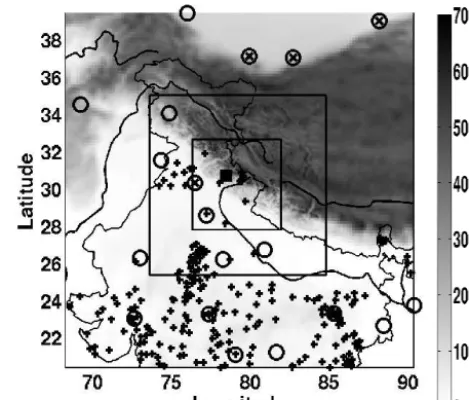
Figure 1 shows the input topography for simulation of the Uttarkashi cloudburst event. The three boxes are the three nested domains. The resolution of topography increases as we move towards the inner domains. The river Ganga flows close to Uttarkashi, and flows southeastward through the Indo-Gangetic Plain before flowing into the Bay of Bengal.
3 Data sets used
We used NCEP Global Final Analysis (NCEP et al., 2000) Final (FNL) reanalysis data to analyze the wind vector, temperature, relative humidity, and geopotential height at 500 hPa, observed over Northern India on 1, 2, and 3 Au-gust 2012. Meteosat-7 satellite cloud distribution over mon-soon Asia, on 1, 2, and 3 August 2012 at 06:00, 18:00, and 21:00 UTC was analyzed. Surface observations from AWSs and synoptic stations were used to analyze the spatial dis-tribution of near-surface atmospheric fields. Vertical sound-ing data are used to analyze the vertical stability of the
at-Figure 1. Terrain for simulation of the cloudburst over Uttarkashi.
The three boxes are the three nested domains. Notice that the res-olution of the topography increases towards the inner domain. The filled square denotes the location of where cloudburst had occurred, circles denote the location of the sounding stations, crosses denote the locations of the sounding stations for which the soundings are plotted, and plus symbols show the locations of the AWS stations against which the surface simulations are compared.
mosphere. Forty-eight-hour NOAA ARL HYSPLIT1 back trajectory was used to analyze the origin of the instabilities. The TRMM 3B42v7 daily data set was used to analyze the rainfall distribution on 3 August 2012. We also used TRMM 3B42v7 3 h data to analyze the accuracy of the simulated pre-cipitation.
4 Results and discussion 4.1 Observation analysis 4.1.1 Analysis of reanalysis data
Analysis of FNL data provides a description of spatiotempo-ral evolution of the synoptic-scale global atmosphere. There-fore, the atmosphere variables derived from the FNL data may shed some light on the processes involved in any atmo-spheric event. We looked into the wind vector, temperature, relative humidity, and geopotential height at 500 hPa derived from the FNL in order to understand the propagation of the Uttarkashi cloudburst.
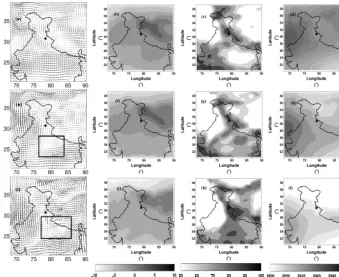
Figure 2 shows the wind vector, temperature, relative hu-midity, and geopotential height at 500 hPa, observed over Northern India on 1, 2, and 3 August 2012. On 1 August, the flow over Uttarkashi was predominantly northerly and 1See http://ready.arl.noaa.gov/HYSPLIT.php and http://ready.
[image:3.612.311.546.67.267.2]674 C. Chaudhuri et al.: Analysis-based dynamics of the Uttarkashi cloudburst
Figure 2. The diurnal average of atmospheric structure on 500 hPa during 1, 2, and 3 August 2012. Panels (a), (e), and (i) show the wind
vector (convergence and divergence zones are marked); (b), (f), and (j) show temperature; (c), (g), and (k) show the relative humidity; and
(d), (h), and (l) show the geopotential height. Panels (a)–(d) are for 1 August, (e)–(h) are for 2 August, and (i)–(l) are for 3 August 2012.
northeasterly. However, over the state of Madhya Pradesh, far south of Uttarkashi, a south-southeasterly disturbance is noticeable. On 2 August, a convergence (Fig. 2e) started to form over the Indo-Gangetic Plain on the southeast of Ut-tarkashi. This convergence moved over Uttarkashi on 3 Au-gust. A sharp divergence of flow (Fig. 2i) is observed along the foothills of Himalayas. Temperature maintained a sharp front over Uttarkashi for the entirety of 1, 2, and 3 August, though on 3 August the sharpness had decreased after trigger-ing of the event. The atmosphere to the north of Uttarkashi was relatively warmer. It is also seen that the atmospheric rel-ative humidity maintained a sharp front over Uttarkashi for the entire period. The geopotential height showed a sudden decrease on 3 August compared to the previous 2 days, which indicates a dynamic low or pressure dropping. The summer convection over Madhya Pradesh and Tibetan Plateau pro-vided the energy for instabilities over Uttarkashi, and the oro-graphic lifting at Himalayan foothills and presence of trans-ported moisture from the Bay of Bengal triggered the sudden condensation of the clouds.
Strong barotropic shear triggers the transient vortices and maintains them over the western Himalayan region during the monsoon onset (Krishnamurti et al., 1981). Also, regional circulations in the Himalayan region are affected by the sur-face heating of the Tibetan Plateau, and it becomes
appar-ent during premonsoon and monsoon seasons (Yanai and Li, 1994). Though the time of the cloudburst did not correspond to the monsoon onset, the easterly wind shear was still very strong. This shear also indicates that the mid-level cyclonic vortex of this storm is triggered and driven by the barotropic dynamics. The mid-level lows of these storms also enable strong moisture transfer to their eye.
Based on the analysis of synoptic-scale fields, and consid-ering the meteorological conditions, we hypothesize the fol-lowing dynamic mechanism of cloudbursts, which we con-firm by observational and numerical evidence:
– The atmosphere should have adequate moisture to be able to build a favorable situation for a cloudburst. The presence of a monsoon trough over the Indian landmass during the month of August enables moisture from the Arabian Sea and the Bay of Bengal to travel deep into the Himalayan foothills, which fuels the cloudburst. – Cloudburst occurs in a temperature and humidity front,
C. Chaudhuri et al.: Analysis-based dynamics of the Uttarkashi cloudburst 675
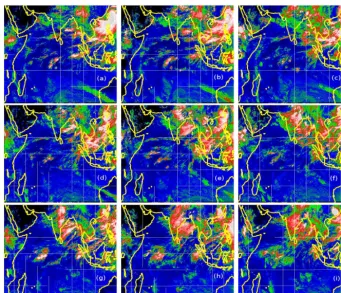
Figure 3. Meteosat-7 image of the clouds during 1 August (a, b, and c), 2 August (d, e, and f), and 3 August 2012 (g, h, and i) at 06:00,
12:00, and 18:00 UTC.
4.1.2 Analysis of satellite images
Meteosat-7 satellite images of clouds are useful to under-stand the propagation of convection in synoptic scale. Fig-ure 3 shows the cloud distribution over monsoon-Asia on 1, 2, and 3 August 2012 at 06:00, 18:00, and 21:00 UTC. On 1 August, a convection center is observed at the extreme east of India, and over Myanmar. Strong diurnality was prominent from the cloud distribution around the convection center. On 2 August, the convection began to disperse and clouds slowly accumulated over the Indian landmass. On 3 August, the con-centration of cloud over the Indian landmass peaked, indi-cating wide convection over central India, Madhya Pradesh, and adjacent regions. This widespread convection fueled the cloudburst storm, and the high concentration of clouds pro-vided the optimal meteorological condition.
4.1.3 Analysis of surface observations
We use topography-dependent Delaunay triangulation (Hu, 1995) to create the daily averaged gridded field using the available surface observations from AWS and synoptic sta-tions. These maps help us in analyzing the spatial distribu-tion of the atmospheric fields. The locadistribu-tions of the stadistribu-tions whose data are used in this study are shown in Fig. 1.
676 C. Chaudhuri et al.: Analysis-based dynamics of the Uttarkashi cloudburst
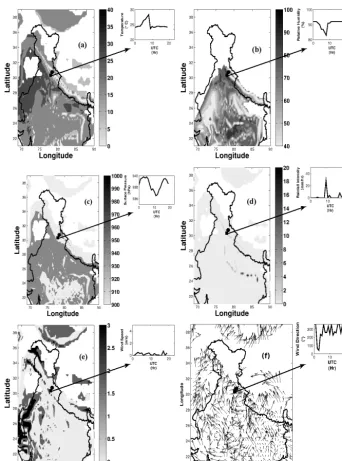
Figure 4. Plots of automatic weather station fields: (a) temperature, (b) relative humidity, (c) pressure, (d) rainfall intensity, (e) wind speed,
and (f) wind direction surface distribution for an automatic weather station located at Dehradun (30.34◦N, 78.04◦E) for 3 August 2012. The location of Dehradun is shown by a black square in the map.
from around 05:00 UTC, the second large one from 8:00 to 12:00 UTC, and the third intermediate one from 16:00 to 20:00 UTC. A peak rainfall of 25 mm h−1was indicative of a cloudburst-like system. Wind speed shows very little vari-ation in space and time. Wind speed was higher over the western part of the domain, and it facilitated the moisture transport from Arabian Sea. Wind speed over the Dehradun showed no diurnal variation, and was of very low magni-tude (∼1 m s−1). Wind in the northeast of Uttarkashi was northerly dominated and over the south of Uttarkashi the wind was southerly dominated, indicating the presence of a
convective system over Uttarkashi. The west of Uttarkashi was southwesterly dominated, which transported the mois-ture from the Arabian Sea to the system. In the southeast of Uttarkashi, the winds were southeasterly, which transported the moisture from the Bay of Bengal to the cloudburst sys-tem.
4.1.4 Vertical sounding analysis
C. Chaudhuri et al.: Analysis-based dynamics of the Uttarkashi cloudburst 677
Figure 5. Radiosonde data taken at 12:00 UTC on (a) 2 August, (b) 3 August, and (c) 4 August 2012 over Patiala (30.34◦N, 76.38◦E) near Uttarkashi (30.73◦N, 78.45◦E), plotted on a skew-T graph.
very high convective available potential energy (CAPE) (2399 J kg−1). In Fig. 5b, during 3 August 2012, the CAPE (convective available potential energy) magnitude declined (994 J kg−1), possibly fueling the storm, and a shallow cloud layer formed, indicated by a sudden drop in dew-point tem-perature at 500 hPa. In Fig. 5c, during 4 August 2012, after the cloudburst took place, CAPE further reduced to a value of 494.2 J kg−1and the cloud base moved to a height 200 hPa, indicated by the close separation of temperature and dew-point temperature at that height. During all these days the convective inhibition (CIN) remained very low (<0 J kg−1), indicating favorable conditions for a storm.
4.1.5 Precipitation
Figure 6a shows the daily accumulated TRMM 3B42v7 pre-cipitation on 3 August 2012 centered over Uttarkashi. The Uttarkashi rainfall was about 100 mm on 3 August 2012. The rainfall patch to the south of Uttarkashi indicates the insta-bilities starting from Madhya Pradesh, and that over Tibetan Plateau indicates the instabilities at that location. These two instabilities interacted with each other and, under orographic
forcing and optimal cloud cover over Uttarkashi, caused the cloudburst.
678 C. Chaudhuri et al.: Analysis-based dynamics of the Uttarkashi cloudburst
Figure 6. (a) TRMM 3B42v7 daily accumulated rainfall for 3 August 2012, (b) 48 h back trajectories towards Uttarkashi ending 18:00 UTC
on 3 August 2012, and (c) 96 h back trajectories towards Uttarkashi ending 00:00 UTC on 3 August 2012.
4.1.6 Back trajectory analysis
Back trajectories enable us to identify the location of con-vection source. We used NOAA ARL HYSPLIT model to locate the origin of convection which resulted in cloudburst. Forty-eight-hour back trajectories ending in Uttarkashi at 18:00 UTC on 3 August (Fig. 6b) show that, at 2 km above ground level, the environment over Uttarkashi was domi-nated by the convected surface air starting from Madhya Pradesh, and it interacted with the westerlies at the lower level (500 m–1 km). The presence of a mid-level low over Uttarkashi is clear in the trajectories as the air parcels moved from surface level to the height of 500 m–2 km over Ut-tarkashi. Considering the amount of moisture available, we
can say that the moisture came from the Bay of Bengal and Arabian Sea, the two prominent moisture sources for India. Figure 6c shows the 96 h back trajectories ending on Ut-tarkashi at 00:00 UTC on 3 August. It gives an indication of moisture and convection movement from the coast of Ara-bian Sea, the Tibetan Plateau, and the Kashmir region of north India.
4.2 Numerical analysis
4.2.1 Model description and experiment setup
[image:8.612.131.468.68.493.2]C. Chaudhuri et al.: Analysis-based dynamics of the Uttarkashi cloudburst 679 modeling system which is designed for both operational
fore-cast and to serve as a platform for atmospheric research. Our modeling strategy is broadly divided into three stages. First, we evaluate the ability of numerical model to simu-late the cloudburst event over the region of interest in a ba-sic (control) configuration. Next, we perform a series of nu-merical experiments, using different schemes in the suite of physical parameterizations, model vertical levels, and spin-up time, in order to identify the configuration of the model (at 18 km resolution) which best simulates the near-surface at-mospheric observations during the cloudburst event. We con-clude our study with high-resolution nested numerical simu-lations using the best configuration (18, 6, and 2 km) over selected region.
The initial and boundary conditions (ICs, BCs) for the large-scale atmospheric fields, and the initial conditions for different soil fields (e.g., moisture content, soil layer tem-perature) were interpolated from the 1◦×1◦ NCEP Global Final Analysis (FNL) using the WRF Preprocessing Sys-tem (WPS). The boundary conditions for the model simu-lations were created from temporal interpolation of the 6 h FNL data. The momentum budget at subgrid scale in NWP can be erroneous due to a missing subgrid-scale drag term in the momentum equation of the model. This can be sig-nificant when the domain has large variations in topography. To overcome this problem, we used gravity wave drag as a momentum-damping mechanism. The model vertical atmo-spheric structure strongly depends on the initialization of sur-face fields and model spin-up time (Wang et al., 2012). As mesoscale convective systems evolve due to specific vertical atmospheric structure, we performed sensitivity analysis of the spin-up time to properly calibrate the model.
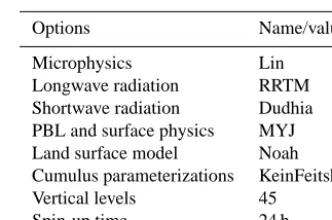
The initialization of the models was done using the 00:00 UTC reanalysis field of 2 August 2012. The simulation was carried out for a 48 h period – 00:00 UTC on 2 August to 00:00 UTC on 4 August 2012. The first 24 h were taken as the spin-up time of the model. Therefore, the results are valid from 00:00 UTC on 3 August 2012 to 00:00 UTC on 4 Au-gust 2012. Table 1 gives the model configuration used for these simulations, and Table 2 shows the physics and model options used for the control simulation.
[image:9.612.322.531.95.196.2]To investigate the sensitivity of different model configura-tions and find the suite of parameterizaconfigura-tions and model op-tions that best simulate the near-surface atmospheric fields (temperature, relative humidity, pressure, and rainfall inten-sity), we changed the model physics (microphysics, cumulus, land surface, long- and shortwave radiation, and planetary boundary layer) and options (vertical level and spin-up time) one at a time, keeping the other options the same as in the control experiment. We evaluated the performance of differ-ent sensitivity experimdiffer-ents and the best options are used in the high-resolution nested experiment. The use of best op-tions ensures improved quality of boundary condiop-tions for the inner nests.
Table 1. Different model configuration options used in the control
as well as sensitivity experiments.
Options Specifications
Domain center Uttarkashi (30.73◦N, 78.45◦E)
Resolution 18 km
Time step 9 s
Grid dimension 120×120 Model static fields USGS
IC and BC Final reanalysis (FNL) Gravity wave drag Yes
Table 2. Different physics and model options used in the control
experiments.
Options Name/value
Microphysics Lin
Longwave radiation RRTM
Shortwave radiation Dudhia PBL and surface physics MYJ
Land surface model Noah
Cumulus parameterizations KeinFeitsh
Vertical levels 45
Spin-up time 24 h
The high-resolution experiment involves three two-way nested domains centered at Uttarkashi. The outermost do-main has a resolution of 18 km and dimension of 120×120 grid points, the intermediate domain has a resolution of 6 km and dimension of 181×181 grid points, and the innermost domain has a resolution of 2 km and dimension of 271×271 grid points. Assuming that the cloud system that caused the cloudburst can be resolved by the innermost domain with 2 km resolution, the convective parameterization was not used. This also ensures that our analysis of the cloudburst process will not be affected by any artifact of the convective parameterization.
4.2.2 Sensitivity study
In order to arrive at the best parameterization, we com-bined the prediction errors for temperature, relative humid-ity, surface pressure, and rainfall intensity into a single index, termed the performance metric (PM). Hourly AWS observa-tions were used for calibration of WRF, and all the variables were given equal importance in the performance index. The PM is defined as
PMp= 1
Nv X
v
epv−infpepv suppepv−infpepv
, (1)
where PMp is performance metric for parametrization,Nv is the number of variable types (four for the present case),
[image:9.612.345.511.245.355.2]680 C. Chaudhuri et al.: Analysis-based dynamics of the Uttarkashi cloudburst
Table 3. The performances of different options in WRF simulation for Uttarkashi cloudburst.
Sensitivity type Options and performance metric
Cumulus KF BMJ CAM GRELL TIEDKE
0.08 0.63 0.33 0.38 0.50
Land surface NOAH RUC
0.67 0.33
Longwave RRTM GODDARD RRTMG
0.50 0.50 0.63
Shortwave DUDHIA GODDARD RRTMG
0.33 0.67 0.57
Microphysics LIN GODDARD MILBRANDT MORRISON THOMPSON WDM WSM
0.33 0.47 0.40 0.30 0.67 0.37 0.53
PBL MYJ MYNN QNSE
0.10 0.50 0.75
Vertical level NORMAL HIGH LOW
0.50 0.50 0.63
Spin-up 1 day 5 days
0.00 1.00
Figure 7. Comparison of automatic weather station fields and WRF-simulated temperature, relative humidity, pressure, and rainfall intensity,
[image:10.612.127.469.346.652.2]C. Chaudhuri et al.: Analysis-based dynamics of the Uttarkashi cloudburst 681
Figure 8. Model-simulated (a) CAPE and CIN, (b) LCL and LFC, (c) updraft and downdraft, (d) potential vorticity, and (e) microphysical
classes (cloud water, rainwater, graupel, and ice) for Uttarkashi during 3 August 2012.
intervals and stations, infpis the infimum across parameteri-zations, and suppis supremum across parameterizations.
Clearly, lower values of the PM indicate better perfor-mance of the corresponding suite of options.
For temperature, relative humidity, and pressure, which show a greater degree of spatial continuity, the simulated sur-face gridded fields were interpolated to the station location in order to compare them with the observations. However, the localized nature of rainfall may lead to the possibility of an event not being captured in the station data.
There-fore, the hourly precipitation observations at the AWS sta-tion were compared with the model predicsta-tions over a space– time window to choose the closest value of simulated pre-cipitation. The adopted window size was based on the cri-terion that it should not be greater than the resolution of input data (∼100 km), and the error should be reasonable (MARE∼0.1). A window size of 70 km and 3.5 h was found to be optimum.
simula-682 C. Chaudhuri et al.: Analysis-based dynamics of the Uttarkashi cloudburst
Figure 9. Model-simulated (a) longitudinally averaged vertical
ve-locity, and (b) latitudinally averaged vertical velocity for Uttarkashi during 3 August 2012.
tion which determine the configuration of the high-resolution experiments. Although a detailed discussion of these sensi-tivities is beyond the scope of this paper, a few points may be noted.
– In microphysical parameterization, the two best options (GODDARD and Morrison) have double-moment for-mulation with six microphysical classes.
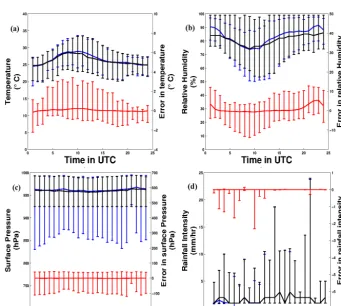
– Vertical level sensitivity shows that having too many vertical levels may not be a good option if simulation of near-surface fields is the only concern. However, as we are interested in altitude-dependent cloud processes, it is desirable to have large number of vertical levels at that height. Therefore, despite the fact that having more vertical levels does not lead to improvement in results for simulating near-surface fields, we chose that option. – Spin-up time sensitivities show that, as the difference between initialization time and the time of interest in-creases, the simulation of near-surface fields deterio-rates. Since the study of the cloudburst event is an initial-value problem, the prediction quality deteriorates as we move further into the past from the event of inter-est to initialize our model. This is due to the fact that only updating boundary conditions cannot provide the sufficient information to generate the regional pattern of different meteorological variables, and the errors in sim-ulation continue to increase as the integration advances. Near-surface atmospheric fields like temperature, relative humidity, surface pressure, and rainfall intensity from the best configuration simulation of the Uttarkashi cloudburst are compared against the hourly observations from AWSs dur-ing 3 August 2012. Figure 7 shows the simulated and ob-served values as well as the difference between them. Sim-ulated temperature, relative humidity, surface pressure, and
rainfall match well with the AWS observation, and show no bias in the median values.
4.2.3 Convective conditions
Deep, moist convection like cloudbursts form by a two-stage mechanism: conditional instabilities and a trigger mecha-nism. Conditional instabilities are the state of ambient atmo-sphere in which the storm forms. The trigger mechanism is the external influence on the atmosphere which initiates the storm. Further instabilities that are needed to maintain the storm evolve in the storm process itself.
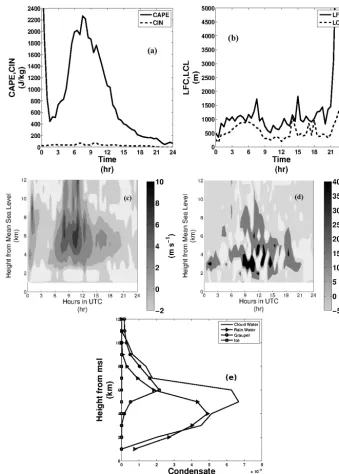
Figure 8a shows the time series of the maximum CAPE and maximum CIN observed over Uttarkashi. The CAPE started to increase around 02:00 UTC, achieved its peak value of 2200 J kg−1 around 09:00 UTC, and after that it dissipated until 21:00 UTC, when it became nearly zero. It is clear from the plot that the atmosphere over Uttarkashi during 3 August 2012 was very unstable, and the domi-nating CAPE fueled the storm. The high value of CAPE (> 1000 J kg−1) signifies the fact that CAPE was one of the most important factors in triggering the cloudburst. For Ut-tarkashi cloudburst, CIN had a peak magnitude of around 45 J kg−1. The low value of CIN made the atmosphere fa-vorable for convective storm throughout the day.
Figure 8b shows the time series of the lifted condensation level (LCL) and the level of free convection (LFC) observed over Uttarkashi. LCL remained less than 1 km throughout 3 August 2012, and at around 21:00 UTC it started to recover and reached a height of 2.6 km. LFC was also around 1 to 2 km during this day. These low heights of LCL and LFC in-dicate the presence of cloud and unstable atmosphere at very low altitude in the atmosphere, which favored the cloudburst. Figure 8c shows the updraft profile over Uttarkashi simu-lated by WRF. The model simulates an updraft event at 4 km height from mean sea level, between 06:00 and 18:00 UTC, indicating major convective activity at that height through-out the day. Downdrafts at ground level occurred during the entire day, implying a condition favorable for severe thunder-storms.
C. Chaudhuri et al.: Analysis-based dynamics of the Uttarkashi cloudburst 683
Figure 10. Comparison of TRMM 3B42v7 3 h rainfall (a–d and i–l) and WRF simulation using the best nested configuration (e–h and m–p)
for 3 August 2012 inside domain 3. The topography of the location is shown in grayscale in the background.
intensify and spread through the atmosphere up to a height of 10 km at 12:00 UTC. The instabilities dissipated at around 21:00 UTC. The vigorous activity of PV during the cloud-burst indicates that it played a major role in the process of this storm.
Figure 8e shows the vertical distribution of different con-densates, averaged for the innermost domain, in the case of the Uttarkashi cloudburst. Note that the region up to 6 km above mean sea level was dominated by rainwater, indicat-ing heavy rains. The atmosphere up to 10 km was dominated by cloud water, which indicates deep cloud. Hardly any ice crystals were present in the atmosphere or in the cloud. The cloud was dominated by graupel. However, there are no hy-drometry data against which these simulations could be val-idated. We can still hypothesize that the dominating grau-pel, in the presence of strong updraft, can generate charges to form thunderclouds. This formation of thunderclouds can enhance the possibility of cloudburst.
684 C. Chaudhuri et al.: Analysis-based dynamics of the Uttarkashi cloudburst
Figure 11. Conceptual model of the key meteorological elements
that led to the cloudburst over Uttarkashi on 3 August 2012.
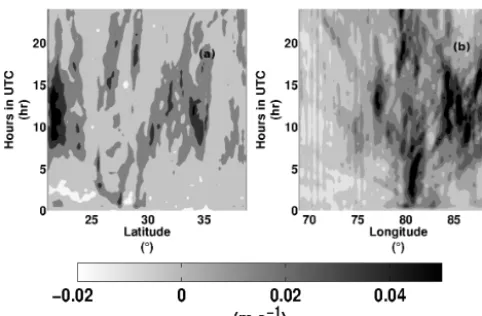
not entirely support our hypothesis of the origin of the con-vections over Madhya Pradesh and Tibet and their conse-quent interaction to burst the cloud, they do indicate that the convection over these two places could have played a major role in the cloudburst process.
4.2.4 Results of precipitation simulations
We compared the simulated 3 h accumulated rain-fall (2 km×2 km) with the TRMM 3B42v7 rainfall (0.25◦×0.25◦). We used a spatial window of 50 km to compare the TRMM observation values at any point with the simulated precipitation magnitude, and chose the closest magnitude as corresponding simulated precipitation at that grid point. We bilinearly interpolated the TRMM data to the model grid and searched for the closest precipitation magnitude for each grid point.
Figure 10 shows the comparison of simulated precipitation of innermost domain with the TRMM 3 h accumulated pre-cipitation estimate for 8 synoptic hours, centered on 00:00, 03:00, 06:00, 09:00, 12:00, 15:00, 18:00, and 21:00 UTC on 3 August 2012. The precipitation analysis reveals a distinct rainstorm episode on 3 August, during 12:00–21:00 UTC. The plot indicates that TRMM and WRF rainfall estimates are able to capture the rainstorm over Uttarkashi. The simu-lation is in agreement with the TRMM estimate. However, during 15:00–21:00 UTC, during the cloudburst event, the simulation shows an unrealistically high precipitation event in the southeast portion of the domain. Generation of exces-sive precipitation in simulation is a major problem in
numer-ical weather prediction (Lee et al., 2015). In our case, we speculate that this model artifact was generated due to the orographic effect and the presence of strong moisture diver-gence.
Thus, TRMM and WRF are able to locate the Uttarkashi cloudburst event geographically as well as by magnitude. The shutting down of convective parametrization in the inner two domains is able to bring out the topographic control over the convective rainstorm process as the convective clouds are well resolved by the innermost domain. As the cloudburst occurred in a relatively data-sparse region, the quality of the initialization field played a major role in the simulation pro-cess. Also, the cloudburst process involved rapid intensifica-tion and was isolated in nature; therefore an exact match in space and time between simulated and observed rainfall was very difficult. But our space window approach showed that, with a reasonable spatial relaxation, WRF is able to simulate the observed rainfall pattern.
5 Conclusions
We examined the meteorological context of a cloudburst event that occurred over Uttarkashi, India, on 3 August 2012. We found that this event is a result of the development of mesoscale convective systems (MCSs) which evolved from diurnally generated convective cells over the Tibetan Plateau and Madhya Pradesh. The persistent 500 hPa flow field di-rected the MCSs towards the cloudburst site, where they at-tracted the moisture from the southern part and forced the moisture to move up the slope of the Himalayan mountains. Figure 11 shows our proposed conceptual model of the mech-anism of the Uttarkashi cloudburst based on our analysis.
If we compare this cloudburst event with the Leh cloud-burst analysis from Rasmussen and Houze (2012), we find some inherent similarities between these two cloudbursts. Both are the result of instabilities that are diurnally generated over the Tibetan Plateau. The southern moisture movement invigorated these storms. The time of monsoon favoured them by providing the moisture-laden meteorological per-spective, and the orographic lifting of the unstable air played a major role. There are also differences: the Uttarkashi cloud-burst occurred on the wind side of the foothill of Himalayas, which is more natural in the presence of instabilities, whereas Leh is situated on the lee side of the mountain, where rain-storms such as cloudburst are very unlikely. The Leh cloud-burst was powered by the MCSs generated over the Tibetan Plateau, whereas the Uttarkashi cloudburst was generated by the interaction of instabilities formed over both Tibet and Madhya Pradesh.
ini-C. Chaudhuri et al.: Analysis-based dynamics of the Uttarkashi cloudburst 685 tial description of the system, its origination, propagation,
and dissipation, then it would improve the simulation re-sults. The measurement of non-assimilated fields will pro-vide a good basis for vigorous evaluation of simulation re-sults. More extensive studies are required to fully understand the cloudburst dynamics, quantify forecasting skill, and de-velop a strategy for real-time forecasting.
Acknowledgements. The data used in this study are obtained from
the Research Data Archive (RDA), which is maintained by the Computational and Information Systems Laboratory (CISL) at the National Center for Atmospheric Research (NCAR). NCAR is sponsored by the National Science Foundation (NSF). The Meteosat-7 satellite imageries are downloaded from the archive of the Cooperative Institute for Meteorological Satellite Studies, Space Science and Engineering Center/University of Wisconsin, Madison. The vertical sounding data are downloaded from Department of Atmospheric Science, University of Wyoming. The authors grate-fully acknowledge the NOAA Air Resources Laboratory (ARL) for the provision of the HYSPLIT transport and dispersion model and READY website (http://www.ready.noaa.gov) used in this publica-tion. TRMM data used in this study were acquired from NASA Goddard Earth Sciences (GES) Data and Information Services Cen-ter (DISC). We are thankful to Indian Space Research Organisa-tion (ISRO) for providing AWS observaOrganisa-tions. We want to thank P. Jish Prakash, King Abdullah University of Science and Tech-nology, for his valuable help in conceptualization of the problem addressed in this paper.
The topical editor V. Kotroni thanks two anonymous referees for help in evaluating this paper.
References
Ashrit, R.: Investigating the Leh “Cloudburst”, NCMRWF inter-nel report NMRF/RR/10/2010, Ministry of Earth Science, A-50, Sector-62, Noida-201307, India, 2010.
Borga, M., Stoffel, M., Marchi, L., Marra, F., and Jakob, M.: Hy-drogeomorphic response to extreme rainfall in headwater sys-tems: Flash floods and debris flows, J. Hydrol., 518, 194–205, doi:10.1016/j.jhydrol.2014.05.022, 2014.
Bougeault, P., Binder, P., Bizzi, A., Dirks, R., Houze, R., Kuettner, J., Smith, R. B., Steinacker, R., and Volkert, H.: The MAP spea-cial observing period, B. Am. Meteorol. Soc., 82, 433–462, 2001. Browning, K.: Structure, mechanism and prediction of orographi-cally enhanced rain in Britain, in: Orographic effects in planetary flows, GARP, 23, 85–114, 1980.
Caracena, F. and Fritsch, J. M.: Focusing Mechanisms in the Texas Hill Country Flash FIOMS of 1978, Mon. Weather Rev., 111, 2319–2332, 1983.
Caracena, F., Maddox, R. A., Hoxit, L. R., and Chappell, C. F.: Mesoanalysis of the Big Thompson Storm, Mon. Weather Rev., 107, 1–17, 1979.
CCI: Census of India 2001: Data from the 2001 Census, including cities, villages and towns (Provisional), Tech. rep., Office of the registrar General and Census Commissioner, India, 2004.
Chen, S.-H. and Lin, Y.-L.: Orographic effects on a conditionally unstable flow over and idealized three-dimensional mesoscale mountain, MAP Newsletters, 15, 246–249, 2001.
Cheng, L.: Mesoscale atmosphere numerical model and simulation, Meteorology Press, Beijing, China, 1994.
Das, S., Ashrit, R., and Moncrieff, M. W.: Simulation of a Hi-malayan cloudburst event, J. Earth Syst. Sci., 3, 299–313, 2006. Doswell, C. A.: The operational meteorology of convective weather,
NOAA Tech. Rep. ERL ESG-15, NOAA, National Severe Storms Forecast Center, Kansas City, Missouri, 1985.
Doswell, C. A., Brooks, H. E., and Maddox, R. A.: Flash flood fore-casting: An ingredients-based methodology, Weather Forecast., 11, 560–581, 1996.
Elliott, R. and Shaffer, R.: The development of quantitative relation-ships between orographic precipitation and air mass parameters for use in forecasting and cloud seeding evaluation, J. Appl. Me-teorol., 218–228, 1962.
Giorgi, F. and Avissar, R.: Representation of heterogeneity effects in earth system modeling: experience from land surface modeling, Rev. Geophys., 35, 413–437, 2010.
Hoskins, B., McIntyre, M., and Robertson, A.: On the use and sig-nificance of isentropic potential vorticity maps, Q. J. Roy. Me-teor. Soc., 111, 877–946, 1985.
Hu, J.: Methods of Generating Surfaces in Environmental GIS Ap-plications, in: International User Conference, ESRI (Environ-mental Systems Research Institute), ESRI (Environ(Environ-mental Sys-tems Research Institute), San Diego, Ca, USA, 22–26 May, 1995. Krishbaum, D. and Durran, D.: Factors governing of three dimen-sional convective storm dynamics, J. Atmos. Sci., 61, 682–698, 2004.
Krishnamurti, T. N., Ardanuy, P., Ramanathan, Y., and Pasch, R.: On the onset of the summer monsoon, Mon. Weather Rev, 109, 344–363, 1981.
Lee, J., Shin, H. H., Hong, S.-Y., Jimenez, P. A., Dudhia, J., and Hong, J.: Impacts of subgrid-scale orography parameterization on simulated surface layer wind and monsoonal precipitation in the high-resolution WRF model, J. Geophys. Res.-Atmos., 120, 644–653, doi:10.1002/2014JD022747, 2015.
Maddox, R. A., Hoxit, L. R., Chappell, C. F., and Caracena, F.: Comparison of meteorological aspects of the Big Thompson flood and Rapid City flash floods, Mon. Weather Rev., 106, 375– 389, 1978.
Mann, C. F. and Kuo, Y.-H.: Regional real time numerical weather prediction: Current status and future potential, B. Am. Meteorol. Soc., 79, 253–263, 1998.
Maraun, D., Wetterhall, F., Ireson, A. M., Chandler, R. E., Kendon, E. J., Widmann, M., Brienen, S., Rust, H. W., Sauter, T., Themeb, M., Venema, V. K. C., Chun, K. P., Goodess, C. M., Jones, R. G., Onof, C., Vrac, M., and Thiele-Eich, I.: Precipitation downscal-ing under climate change: Recent developments to bridge the gap between dynamical models and the end user, Rev. Geophys., 48, 1–38, 2010.
Medina, S., Houze, J. R. A., Kumar, A., and Niyogi, D.: Summer monsoon convection in the Himalayan region: Terrain and land cover effects, B. Am. Meteorol. Soc., 136, 593–616, 2010. Nair, U. S., Hjelmfelt, M. R., and Pielke, S. R. A.: Numerical
686 C. Chaudhuri et al.: Analysis-based dynamics of the Uttarkashi cloudburst
NCEP, NWS, NOAA, and USDC: NCEP FNL Operational Model Global Tropospheric Analyses, continuing from July 1999. search Data Archive at the National Center for Atmospheric Re-search, Computational and Information Systems Laboratory, up-dated daily, doi:10.5065/D6M043C6, 2000.
Pielke, S. R. A.: Mesoscale Meteorological Modeling, International Geophysics Series, Academic Press, Inc., 78, 1984.
Rasmussen, K. L. and Houze, J. R. A.: A Flash-Flooding Storm at the Steep Edge of High Terrain: Disaster in the Himalayas, B. Am. Meteorol. Soc, 93, 1713–1724, 2012.
Smith, R. B.: The influence of mountains on the atmosphere, Adv. Geophys., 21, 187–230, 1979.
Stefanon, M., Drobinski, P., D’Andrea, F., Lebeaupin-Brossier, C., and Bastin, S.: Soil moisture-temperature feedbacks at meso-scale during summer heat waves over Western Europe, Clim. Dy-nam., 42, 1309–1324, 2014.
Wang, C., Wang, Y., and Wu, R.: The effect of model horizontal resolution on quantitative precipitation forecast for Meiyu front torrential rainfall, J. Hydrodynam., 19, 71–83, 2004.
Wang, C., Wilson, D., Haack, T., Clark, P., Lean, H., and Marshall, R.: Effects of Initial and Boundary Conditions of Mesoscale Models on Simulated Atmospheric Refractivity, J. Appl. Meteor. Climatol., 51, 115–132, 2012.
Webster, P. J.: The Asian Monsoon, in: The coupled monsoon sys-tem, edited by: Wang, B., Praxis, Springer, Berlin, Heidelberg, Germany, 1–66, 2006.
Webster, P. J., Magana, V. O., Palmer, T. N., Shukla, J., Tomas, R. A., Yanai, M., and Yasunari, T.: Monsoons: Processes, pre-dictability, and the prospects for prediction., J. Geophys. Res., 103, 14451–14510, 1998.
Webster, P. J., Jian, J., Hopson, T. M., Hoyos, C. D., Agudelo, P. A., Chang, H.-R., Curry, J. A., Grossman, R. L., Palmer, T. L., and Subbiah, A. R.: Extended-range probabilistic forecasts of Ganges and Brahmaputra floods in Bangladesh, B. Am. Meteorol. Soc., 91, 1493–1514, 2010.
Wu, G.: Evolution of moist potential vorticity and slant wise poten-tial vorticity, J. Meteorol., 53, 387–405, 1995.