http://wrap.warwick.ac.uk/
Original citation:Sitthiworachart, Jirarat and Joy, Mike (2008) Is mobile learning a substitute for electronic learning? In: IADIS International Conference on e-Learning 2008, Amsterdam, The Netherlands, 22-25 Jul 2008 pp. 451-458.
Permanent WRAP url:
http://wrap.warwick.ac.uk/61724
Copyright and reuse:
The Warwick Research Archive Portal (WRAP) makes this work by researchers of the University of Warwick available open access under the following conditions. Copyright © and all moral rights to the version of the paper presented here belong to the individual author(s) and/or other copyright owners. To the extent reasonable and practicable the material made available in WRAP has been checked for eligibility before being made available.
Copies of full items can be used for personal research or study, educational, or not-for-profit purposes without prior permission or charge. Provided that the authors, title and full bibliographic details are credited, a hyperlink and/or URL is given for the original metadata page and the content is not changed in any way.
A note on versions:
The version presented in WRAP is the published version or, version of record, and may be cited as it appears here.For more information, please contact the WRAP Team at:
IS MOBILE LEARNING A SUBSTITUTE FOR
ELECTRONIC LEARNING?
Jirarat Sitthiworachart
Faculty of Information Technology
King Mongkut’s University of Technology North Bangkok, Thailand
Mike Joy
Department of Computer Science University of Warwick, United Kingdom
ABSTRACT
Mobile learning is widely regarded as the next generation of learning technologies, and refers to the use of mobile devices in education to enhance learning activities. The increasing use of mobile devices has encouraged research into the capabilities of mobile learning systems. Many questions arise about mobile learning, such as whether mobile learning can be a substitute for electronic learning, what the potential benefits and problems of utilizing mobile devices in education are, and what the student perspective on mobile learning is. Mobile learning in the near future is unavoidable, and we need a better understanding of the role of mobile technology in higher education. This paper compares mobile learning with more general electronic learning technologies and pedagogies, and reports the results of a student survey into the potential benefits of and the current problems with the mobile learning approach.
KEYWORDS
Mobile learning, e-Learning, Educational technology.
1. INTRODUCTION
The use of a student-centered learning approach (learner-focus) is considered to achieve better learning outcomes than an instructor-focused approach, and the use of the Internet as a means of communication has changed the role of the instructor to that of resource provider and motivator for Internet-based learning (Wegner et al., 1999). The use of technology in education motivates students by supporting learner-focused activities and creating new learning opportunities (Holzinger et al, 2005; Wegner et al., 1999). Much current research in education relates to the use of technology to deliver course material and support student-centered learning activities, such as collaborative learning, problem-based learning, peer/self assessment, adaptive learning, and life-long learning. Personal computers (PCs) and laptops are the devices typically used by learners to access the Internet and receive educational material and support, and this method of delivery – referred to as electronic learning (or e-learning) – is claimed to support flexible learning without the limitation of time and place, although the flexibility is limited by the size of the computers used (Holzinger
et al, 2005).
Mobile devices have become pervasive, and there is a tacit assumption that delivering educational material using such devices is (in principle, at least) a good idea. However, our experience with more mature e-learning systems is that many have fundamental problems associated with their deployment, and this suggests that m-learning may not yet be an appropriate approach to take. In this paper, we focus on the results of a survey of students at King Mongkut’s University of Technology North Bangkok, Thailand to explore students’ perceptions of the problems and future potential for mobile devices to support learning, and to investigate whether they have the potential to address the issues affecting e-learning systems identified by those students.
2. STUDENTS’ OPINIONS
Our emphasis on student-centered learning suggests that developments in m-learning (both technical and educational) should be informed by student experience, and in order to understand the student perspective we conducted a survey. Thirty four part-time postgraduate students (15 male, 19 female) in the first author’s school answered a detailed questionnaire.
The age range of the students was 23-46, with most in the 24-30 band. Most of them are PC/laptop and mobile phone owners, and only 8 students also have PDAs. Most of these PDA users spend time with their machines around 1-3 hours/day, to search for information on the Internet, write text documents, and communicate with other friends. Twenty six students are not PDA owners, and of these 15 have low incomes (less than 20,000 baht/month, approximately US $600) suggesting that the cost of PDAs may be prohibitively high. However, a price reduction and capacity increase (to match that of a PC) were identified as sufficient reasons for some of those students to purchase a PDA.
Through the questionnaire, we sought students’ opinions on the existing problems of the current e-learning system available to them, and the potential role of mobile devices in e-learning, via open-ended questions.
[image:3.595.164.457.434.652.2]2.1 Existing Problems of the Current e-Learning System
Figure 1. Students’ opinions on the technical problems of the current e-learning system
The class material problems relate to the content – static or dynamic – provided by the system, and include the following issues:
• the system is not attractive for students when engaging in learning activities;
• the amount of useful information is insufficient;
• much of the information provided by the system is obsolete; and
• there is no mechanism to receive timely feedback from instructors.
These issues all relate to the quality of the information provided by the e-learning system.
The main concerns of 34 students about the technical problems are displayed in Figure 1. Device portability is seen the main issue (25%), as students could only use the PCs or laptops at given times and locations. PCs are, of course, not easily portable, but laptops (which may also be large or heavy) rely on a network connection being available. However, lack of wireless accessibility or bandwidth both have a similar effect, namely that students are restricted as to where/when they can access the facilities.
[image:4.595.87.526.262.435.2]3. MOBILE LEARNING
Figure 2. Mobile Learning
Mobile learning (or m-learning) refers to the delivery of educational material through mobile devices, such as personal digital assistants (PDAs), iPods, mobile phones, and smartphones (combination of PDAs and mobile phones). M-learning can be thought of as mobile devices integrated with e-learning (see Figure 2), so that the mobile technology will provide benefits for students in studying both inside and outside the classroom, allowing access to course materials and interaction with their teachers and classmates through both websites and wapsites. Mobile learners can be continuously connected to the Internet using a variety of wireless technologies, and can engage in learning activities at a time and place of their choosing.
As mobile technologies have become pervasive, new business services have become available, some of which also have educational benefits include the following. For example, AvantGo is “a free mobile content service for smartphones and PDAs” (AvantGo, 2008). Users can download website content, including data such as news, restaurant reviews, and maps, and read this web content offline, without a continuous wireless connection (AvantGo, 2008)The development of the Mobile Web has given rise to new standards and technologies to enable the effective display and management of web data on small mobile devices without the requirement for a large display such as would be available to a desktop computer (True Move, 2008; WikiPedia, 2008).
• personalizing and adapting to the current user preferences, location and time;
• extending learning beyond the classroom and home to remote places like airports or trains;
• giving faculty flexible tools for complementing existing technologies; and
• increasing students’ motivation through innovative learning approaches.
Goh and Kinshuk (2004) note that mobile learning is still in the early stage, and that more research in this area is required.
[image:5.595.109.502.225.591.2]3.1 Mobile Learning Systems
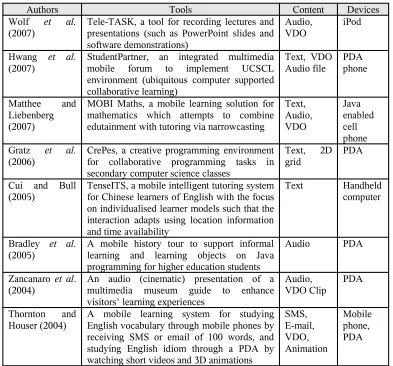
Table 1. Examples of mobile learning systems
Authors Tools Content Devices
Wolf et al.
(2007)
Tele-TASK, a tool for recording lectures and presentations (such as PowerPoint slides and software demonstrations)
Audio, VDO
iPod
Hwang et al.
(2007)
StudentPartner, an integrated multimedia mobile forum to implement UCSCL environment (ubiquitous computer supported collaborative learning)
Text, VDO Audio file
PDA phone
Matthee and Liebenberg (2007)
MOBI Maths, a mobile learning solution for mathematics which attempts to combine edutainment with tutoring via narrowcasting
Text, Audio, VDO Java enabled cell phone Gratz et al.
(2006)
CrePes, a creative programming environment for collaborative programming tasks in secondary computer science classes
Text, 2D grid
PDA
Cui and Bull
(2005) TenseITS, a mobile intelligent tutoring system for Chinese learners of English with the focus on individualised learner models such that the interaction adapts using location information and time availability
Text Handheld computer
Bradley et al.
(2005)
A mobile history tour to support informal learning and learning objects on Java programming for higher education students
Audio PDA
Zancanaro et al.
(2004) An audio (cinematic) presentation of a multimedia museum guide to enhance visitors’ learning experiences
Audio,
VDO Clip PDA
Thornton and
Houser (2004) A mobile learning system for studying English vocabulary through mobile phones by receiving SMS or email of 100 words, and studying English idiom through a PDA by watching short videos and 3D animations
SMS, E-mail, VDO, Animation Mobile phone, PDA
Although mobile devices are mainly used for communication, many researchers have been investigating ways of employing mobile devices in teaching and learning, and we present a selection of technologies in Table 1. A recent development is the use of the iPod (in addition to PDAs and mobile phones) as a multimedia device. With podcasting technology, learners can save pictures and videos of their lectures on an iPod and view them while they are away from their PCs (Wolf et al., 2007). Gratz et al. (2006), Cui and Bull (2005), Bradley et al. (2005), and Zancanaro et al. (2004) also suggest that mobile technology is very helpful for learning activities away from the classroom, such as:
• field trips, (since devices can be location aware);
• informal learning in leisure time;
• studying history in a museum; and
• learning in laboratories where there is not enough room for PCs or laptops.
3.2 Mobile Device Weaknesses
The restrictions of using handheld devices (compared with using PCs or laptops) in the learning process include the following (Gabrielli et al., 2005; Holzinger et al., 2005; Seong, 2006; Wikipedia, 2008):
• small screen displays and a variety of screen sizes;
• difficulty reading outdoors;
• difficulty inputting data;
• difficulty scrolling down the page;
• access to sites which can only be viewed effectively on a large screen;
• access to sites requiring technologies not always supported on current mobile devices (such as Flash, PDF, and sites requiring a secured connection);
• slow speed of service comparing with broadband Internet access available to fixed devices;
• limitations on the size of SMS or email messages that can be sent;
• limited processing power and memory resource; and
• diversity of operating systems (e.g. Palm, Symbian, Windows Mobile 5.0).
New technologies are being developed which will address some of the problems above. For example, it is possible to project an infrared (virtual) key board and a large screen display on the wall, and it has been suggested that speech recognition technology will be helpful for enhancing the user interface (Motiwalla, 2007). Applications written using Java 2 Micro Edition (J2ME) are platform-independent and should run under any mobile operating system (Holzinger et al., 2005)
In addition to the above hardware and software limitations, the high cost of effective mobile learning is an important issue, for example the cost of sending questions or instant feedback via short messaging service (SMS), or multimedia messaging service (MMS). Although students can use PDAs with WiFi, WiFi technology is not yet available for all mobile phones, and mobile phones are the most popular mobile devices for students (Zhang et al, 2006). In Thailand which is the first author's country, the rates for SMS, MMS, and GPRS services are currently 2 baht/message (6 US ¢), 5 baht/message (16 US ¢), and 1 baht/minute (3 US
¢), respectively (DTAC, 2008), and these rates are considered expensive. Leung and Chan (2003) propose that the successful of mobile learning activities depends on “cost, wireless infrastructure reliability, and learners’ level of comfort with the new technology”.
[image:6.595.92.517.539.673.2]3.3 A Comparison of E-learning with M-learning
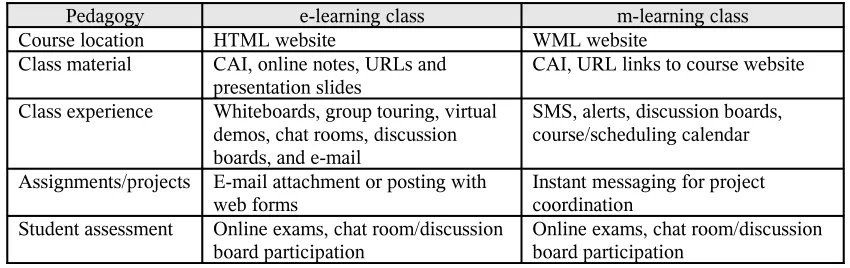
Table 2. A comparison of e-learning with m-learning (adapted from Motiwalla (2007))
Pedagogy e-learning class m-learning class Course location HTML website WML website
Class material CAI, online notes, URLs and
presentation slides CAI, URL links to course website Class experience Whiteboards, group touring, virtual
demos, chat rooms, discussion boards, and e-mail
SMS, alerts, discussion boards, course/scheduling calendar
Assignments/projects E-mail attachment or posting with
web forms Instant messaging for project coordination Student assessment Online exams, chat room/discussion
board participation Online exams, chat room/discussion board participation
rapid feedback from instructors or classmates is educationally desirable (O’Broin and Clarke, 2006). Furthermore, real-time sharing of learning content, such as messages and pictures, can enhance the learning experience. In Table 2 we summarize the main features of an e-learning system and the corresponding features which an m-learning system would offer.
4. POTENTIAL FOR MOBILE DEVICES IN LEARNING
Our review of m-learning technologies and applications suggests to us that there is a wide range of potential benefits in the use of such technologies, but these are offset by limitations inherent in either the devices themselves or our current understanding and implementation of the technology.
The final part of the questionnaire answered by our students addressed their perceptions of the possible use of mobile learning devices in educational delivery. We sought to identify the issues which appear important from the student perspective, and to consider how those reflected the more formal academic perspectives we identified in the review.
There was general agreement that, besides PCs and laptops, mobile devices (including PDAs, mobile phones and iPods) should be considered as empowering tools in learning. M-learning is seen as a potential positive development, and the following reasons were offered:
• they offer an alternative learning style in addition to traditional classroom learning;
• students can review lessons anytime, anywhere;
• PDAs have similar functions to PCs; and
• PDAs and mobile phones are cheap and easy to use.
However they noted that PDAs usually have a short battery life, and commented negatively on the small displays and on the slow speed for data upload and download.
The latter three of these reasons address directly the technical problems identified as negatively affecting the e-learning system, suggesting that the students perceive the infrastructure supporting mobile devices as being more robust and flexible.
4.1 Success Factors for Mobile Learning
Students suggested other factors which might support successful learning through mobile devices. Two of these were technical – stability of the wireless network and high connection speeds – and remind us of the importance students place on being able to concentrate on their learning activities without distractions or interruptions. Content-related factors were also identified, including:
• clear content on small displays;
• sufficient content to support their study;
• use of rich multimedia to present learning materials in an attractive way;
• provision of related links within the learning materials;
• provision of timely alert messages to remind and inform students about forthcoming important events;
• support for collaborative learning; and
• provision of useful help menus.
Some of these are enhancements offered by the mobile technologies and which would be inappropriate in an e-learning environment. The others are factors which have been identified as not addressed in the current e-learning system.
5. CONCLUSIONS
We have discussed the use of mobile devices in learning, both from technical and pedagogical angles, and have suggested how this new technology might enhance students’ learning experiences. Our student survey suggests that – in principle – m-learning is an approach which students value and which they perceive as appropriate when they have ubiquitous access to mobile devices. However, the problems identified by those students also suggest that the supporting infrastructure is not yet sufficiently advanced for students to reap the benefits of the approach. Whilst we have conducted our survey at just one higher education institution, there is no reason to expect a substantially different response elsewhere.
We can perhaps distill the students’ concerns, and identify two substantial requirements of an m-learning system for it to begin to provide effective educational support. First, the wireless infrastructure must be stable and support high connection speeds. Secondly, the material accessed via an m-learning system must be attractive, up to date and of high quality. Fulfilling those two requirements represents a substantial challenge. However mobile learning is not a substitute of e-learning, but it is another option for learning technology to enhance learning activities and provide innovative learning opportunities.
ACKNOWLEDGEMENT
This project was funded by the Faculty of Information Technology at King Mongkut’s University of Technology North Bangkok, Thailand.
REFERENCES
AvantGo, 2008: What is AvantGo? [Online] (http://my.avantgo.com/home/, accessed 1 March 2008).
Bradley, C., Haynes, R. and Boyle, T., “Adult Multimedia Learning with PDAs – The User Experience”, The 4th World
conference on mlearning 2005, [Online]. (http://www.mlearn.org.za/CD/papers/bradley-1.pdf , accessed 1 March 2008).
Cui, Y. and Bull, S., 2005. “Context and learner modeling for the mobile foreign language learner”, System 33(2) pp. 353-367.
DTAC, 2008. Package Detail [Online] (http://www.dtac.co.th/eng/package/compare.html , accessed 1 March 2008. Gabrielli, S., Mirabella, V. Kimani, S. And Catarci, T., 2005. “Supporting Cognitive Walkthrough with Video Data : A
Mobile Learning Evaluation Study”, MobileHCI’05, Salzburg, Austria, pp. 77-82.
Goh, T. and Kinshuk., 2004. “Getting Ready for Mobile Learning” In L. Cantoni and C. McLoughlin (Eds.). Proceeding of ED-MEDIA 2004 – World Conference on Educational Multimedia, Hypermedia & Telecommunications, Lugano, Switzerland, pp. 56-63.
Gratz, P., Rothkugel, S., Scholtes, I. and Sturm, P., 2006. “CrePes – towards a collaborative mlearning platform leveraging algorithmic understanding in schools”, IADIS International Conference Mobile Learning 2006, Dublin, Ireland.
Holzinger, A., Nishelwitzer, A. and Meisenberger, M., 2005. “Lifelong-learning support by m-learning: example scenarios“, ACM eLearn Magazine12(2).
Hwang, W-Y., Hsu, J-L. and Huang, H-J., 2007. “A study on ubiquitous computer supported collaborative learning with hybrid mobile discussion forum“, 6th Annual International Conference on Mobile Learning, Melbourne, Australia,
pp. 101-109.
Leung, C. and Chan, Y., 2003. “Mobile Learning: A New Paradigm in Electronic Learning”, Proceeding of the 3rd IEEE
International Conference on Advanced Learning Technologies (ICALT’03), Athens, Greece, pp. 76-80. Kravcik, M., Kaibel, A., Specht. M., and Terrenghi, L., 2004. “Mobile Collector for Field Trips“, Educational
Technology & Society, 7(2) pp. 25-33.
Martinez, D. and Garcia, F., 2006. “Analyzing mobile learning issues in a higher education context”, IADIS International Conference Mobile Learning 2006, Dublin, Ireland, July 14-16, pp. 41-48.
Matthee, M. and Liebenberg, J., 2007. “Mathematics on the move: supporting mathematics learners through mobile technology in South Africa“, 6th Annual International Conference on Mobile Learning, Melbourne, Australia,
Motiwalla, L., 2007. “Mobile learning: A framework and evaluation”, Computers and Education, Elsevier Science Ltd, 49(3), pp. 581-596.
O’Broin, D. and Clarke, S., 2006. “INKA: using flow to enhance the mobile learning experience”, IADIS International Conference Mobile Learning 2006, Dublin, Ireland pp. 139-146.
Seong, D., 2006. “Usability Guidelines for Designing Mobile Learning Portals”, The 3rd International Conference on
Mobile Technology, Applications and Systems – Mobility 2006, Bangkok, Thailand, pp. 25-33
Thornton, P. and Houser, C., 2004. “Using Mobile Phones in Education”, Proceedings of the 2nd IEEE International
Workshop on Wireless and Mobile Technologies in Education (WMTE’04) pp. 3-10.
True Move, 2008. Value Added Services [Online] (http://www.truemove.com/eng/product_vas.htm , accessed 1 March 2008).
Virvou, M. and Alepis, E., 2005. “Mobile educational features in authoring tools for personalized tutoring”, Computers and Education, 44, pp. 53-68.
Wegner, S., Holloway, K. and Garton, E., 1999. “The Effects of Internet-based Instruction on Student Learning”, Journal of Asynchronous Learning Networks3(2) pp. 98-106.
Wikipedia, 2008. Advertising on the Mobile Web [Online] (http://en.wikipedia.org/wiki/Mobile_web, accessed 1 March 2008).
Wolf, K., Linckels, S. and Meinel, C., 2007. “Teleteaching Anywhere Solution Kit (tele-TASK) Goes Mobile“, SIGUCCS’07, Orlando, Florida, pp. 366-371.
Virvou, M. and Alepis, E., 2005. “Mobile educational features in authoring tools for personalized tutoring”, Computers and Education, 44, pp. 53-68.
Zancanaro, M., Stock, O. and Alfaro, I., 2004. “Mobile cinematic presentations in a museum guide”, In J. Attewell and C. Savill-Smith, Learning with Mobile Devices: research and development, Learning and Skills Development Agency, London, pp. 193-196.