University of Warwick institutional repository
This paper is made available online in accordance with publisher policies. Please scroll down to view the document itself. Please refer to the repository record for this item and our policy information available from the repository home page for further information.
To see the final version of this paper please visit the publisher’s website. Access to the published version may require a subscription.
Authors: Friederike Schlaghecken, Stuart T Klapp and Elizabeth A Maylor
Article title: Either or neither, but not both: locating the effects of masked primes
Year of publication:
2009
Link to published version:
http://dx.doi.org/10.1098/rspb.2008.0933
Publisher statement:
Running head: LOCATING MASKED PRIMING EFFECTS
Either or Neither, But Not Both: Locating the Effects of Masked Primes
Friederike Schlaghecken
University of Warwick
Stuart T. Klapp
California State University, East Bay
Elizabeth A. Maylor
University of Warwick
Contact:
Friederike Schlaghecken Department of Psychology University of Warwick Coventry CV4 7AL UK
e-ma phone: (++44) (0)24 765 23178
Schlaghecken, F., Klapp, S., & Maylor, E. A. (2009). Either or neither, but not
both: Locating the effects of masked primes. Proceedings of the Royal Society B:
Summary
Execution of a response that has been primed by a backward-masked stimulus is
inhibited (negative compatibility effect; NCE). Three experiments investigated the locus
of this inhibition. Masked primes (left- or right-pointing arrows) were followed either
by an arrow or a circle target. Arrow targets always required a left- or right-hand
response but the experiments differed in the response required to circles: press neither,
either or both response keys (i.e., nogo, free-choice, and bimanual, respectively). Arrow
targets showed the usual NCEs. Circle targets showed NCEs in the form of a response
bias away from the primed response in the nogo and free choice tasks; primes and
targets differed on these trials, ruling out a perceptual explanation of the NCE. The
bimanual task showed no such bias, suggesting that the NCE is located at a level of
abstract response codes rather than specific muscle commands.
Either or Neither, But Not Both: Locating the Effects of Masked Primes
Stimuli that have not been consciously perceived can nevertheless affect our
responses to other, clearly visible stimuli. Although the existence of such subliminal
priming effects is well established (e.g., Dehaene et al., 1998; Eimer & Schlaghecken,
1998), their precise nature is as yet unknown. A traditional assumption was that
subliminal stimuli would only passively increase corresponding neural activation levels,
without being susceptible to inhibitory cognitive control. However, Schlaghecken and
Eimer (1997; Eimer & Schlaghecken, 1998) presented initial evidence of a low-level
inhibitory control mechanism. When a backward-masked prime is followed
immediately by an unmasked target, responses are facilitated when both stimuli are
associated with the same response, and hindered when they are associated with different
responses (positive compatibility effect, PCE), but when the interval between masked
prime and target is prolonged, this pattern reverses (negative compatibility effect,
NCE), indicating inhibition of the initial prime-related response and disinhibition of the
opposite response.
Schlaghecken and Eimer (1997; Eimer & Schlaghecken, 1998) suggested that this
was achieved by a self-inhibitory mechanism, which rapidly shuts down motor
activations that are no longer supported by sensory evidence. In contrast, others have
claimed that the NCE is driven by the perceptual properties of primes, mask and targets.
One version of this hypothesis is that the NCE reflects an inhibition process actively
triggered by the mask (e.g., Jaśkowski, Białuńska, Tomanek, & Verleger, 2008;
Jaśkowski & Przekoracka-Krawczyk, 2005). Another, more extreme version holds that
the NCE does not involve any inhibition, as perceptual interactions cause target-like
2004, 2006; Verleger, Jaśkowski, Aydemir, van der Lubbe, & Groen, 2004). This mask-triggered activation hypothesis has largely been refuted by evidence of NCEs with
masks that do not contain such features (Klapp, 2005; Schlaghecken & Eimer, 2006;
Schlaghecken, Rowley, Sembi, Simmons, & Whitcomb, 2007; Sumner, 2008).
Similarly, the finding that individuals with inhibitory deficits – both healthy older
participants (Schlaghecken & Maylor, 2005) and patients with micro-lesions of the
supplementary motor cortex (Sumner et al., 2007) – produce robust PCEs, but no NCEs,
can not be reconciled with the notion that the NCE merely reflects a second activation
process of opposite direction to the one induced by the prime.
It is therefore generally agreed that the NCE does indeed reflect inhibition, either in
the form of low-level self-inhibition (e.g., Schlaghecken & Eimer, 2000), or in the form
of mask-triggered inhibition, as proposed by Jaśkowski and colleagues. Although these accounts differ with respect to the mechanism underlying the inhibition process, they
agree that the relevant process is one of motor inhibition. There is, however, a different
possibility: As yet, it is not entirely clear to what extent perceptual interactions between
prime and target (irrespective of the mask) contribute to NCEs. In particular, one might
argue that repetition blindness (e.g., Kanwisher, 1987) or similar phenomena could
selectively impair the perception of prime-compatible targets (i.e., targets that are a
repetition of the prime). Such mechanisms would result in impaired performance on
compatible trials even in the absence of any motor inhibition.
It has been shown that this explanation can not account for priming effects with the
usual two-alternative forced-choice responses, which show NCEs even when targets are
perceptually dissimilar to the primes and appear at a different location (e.g.,
and free choice-responses. Such responses differ from the usual ‘standard’ responses in
that they are not tied by instruction to a particular target. In the case of nogo responses,
they are, in fact, errors (‘false alarms’), committed in response to a target that required
participants to withhold any overt response. In the case of free-choice responses, they
are subjectively free and randomly chosen responses to a target that does not require a
specific response. Like standard responses, however, both false alarms and free choices
exhibit a systematic bias away from the compatible and toward the incompatible
response (i.e., fewer and slower primed than unprimed false alarms and ‘free’ response
choices, respectively; Eimer & Schlaghecken, 1998; Klapp & Haas, 2005; Klapp &
Hinkley, 2002; Schlaghecken & Eimer, 2004). However, in those experiments the
non-standard (nogo and free choice) targets had features in common with non-standard targets
and primes (e.g., the latter were uni-directional arrows, such as ‘<<’, and the former
bi-directional arrows, ‘<>’). Consequently, effects akin to repetition blindness might have
‘blinded’ participants to the prime-compatible component of the target, leaving the
prime-incompatible component more salient and consequently more likely to elicit a
corresponding response. The observed effects could therefore be interpreted as being
perceptually induced rather than reflecting a genuine, subliminally induced response
bias.
The notion that subliminal stimuli might directly affect even seemingly voluntary
decisions to select or withhold a particular response is clearly more controversial than
the alternative perceptual explanation, and requires strong supporting evidence.
Already, the use of different locations for primes and targets by Schlaghecken and
Eimer (2004) rules out simple perceptual interactions of this type. A more definitive test
prime. The present experiments therefore employed arrow primes and targets in
combination with circle targets (on nogo and free-choice trials in Experiments 1 and 2,
respectively), again with different prime and target locations. If, as hypothesized, NCEs
reflect low-level motor activation and inhibition processes instead of perceptually
driven processes, then the response bias observed in the earlier experiments should be
replicated under these conditions.
However, confirming that NCEs originate in the motor rather than in the perceptual
system leaves open the issue of precisely where within the motor system they are
generated. Eimer, Schubö, and Schlaghecken (2002) demonstrated that when, for
example, the left hand is primed, no priming of the left foot can be obtained, and vice
versa. This was taken as evidence that priming effects are effector specific rather than
being generated at the level of an abstract directional code. On the other hand,
Schlaghecken, Münchau, Bloem, Rothwell, and Eimer (2003) found that priming effects
are not altered by repetitive transcranial magnetic stimulation (rTMS) of the primary
motor cortex, suggesting that masked primes affect processing stages that are upstream
from M1 and are thus more abstract than individual muscle commands.
The present study aimed to investigate whether the locus of the NCE within the
motor system could be determined with greater precision. Participants in Experiment 3
had to give the usual left or right unimanual response to arrow targets, but a bimanual
left-and-right response to circle targets. Behavioural evidence (e.g., Jagacinski,
Marshburn, Klapp, & Jones, 1988; Klapp, 1979; Klapp, Nelson, & Jagacinski, 1998),
supported by monkey single-cell data (e.g., Donchin, Gribova, Steinberg, Bergman, &
Vaadia, 1998) and human imaging studies (for a review, see Swinnen & Wenderoth,
rather than as coordinated but separate effector-specific codes. Nevertheless, stimuli
causing low-level automatic motor activations can speed up one effector relative to
another (e.g., in a Simon task, when unilaterally presented targets require bimanual
responses, the hand ipsilateral to the target location responds more quickly; Miller &
Franz, 2005). Thus if masked priming similarly affected individual muscle commands,
then on bimanual trials (as with false-alarm and free-choice responses), the hand
opposite to the prime direction should be favoured relative to the primed hand, and thus
lead the response (as it is nearly impossible to achieve perfect simultaneity of
key-presses). However, if masked priming (in contrast to stimulus location in the Simon
task) selectively operates on levels upstream from M1, then no such bias should be
observed.
Method
Except for the instructions pertaining to circle targets (see below), the three
experiments were identical. Each contained two-thirds of standard masked prime trials,
where left- and right-pointing arrow targets required a speeded left- or right-hand
response, respectively, and one third of circle-target trials. All targets were preceded by
masked arrow primes, and all trial types were randomly intermixed.
Participants. Fifty-four volunteers participated in Experiment 1. Because the main objective of this experiment was to investigate priming effects on false alarms
(responses to nogo circle targets), only those eighteen participants who produced more
than the overall average of 4.9 false alarms were included in the analysis (average
numbers of false alarms were 1.5 for the excluded and 11.6 for the included
and twenty volunteers (11 male), aged 18-46 years (M = 23.6), in Experiment 3. All participants received either payment of £5 or course credit. According to self-report, all
but four participants in Experiment 1, and three in Experiments 2 and 3, were
right-handed, and all had normal or corrected-to-normal vision.
Stimuli and apparatus. Left- and right-pointing double arrows (<< and >>) served as prime and target stimuli, subtending a visual angle of approximately 0.9º x 0.5º. Masks
were constructed from a 9 x 9 matrix, randomly filled with overlapping horizontal,
vertical and oblique lines of
different length, resulting in a
roughly rectangular array of
approximately 2.5º x 1.0º. A
circle (approximately 0.8º
diameter) served as an additional
target stimulus. All stimuli were
presented in black on a white
background on a 17-inch
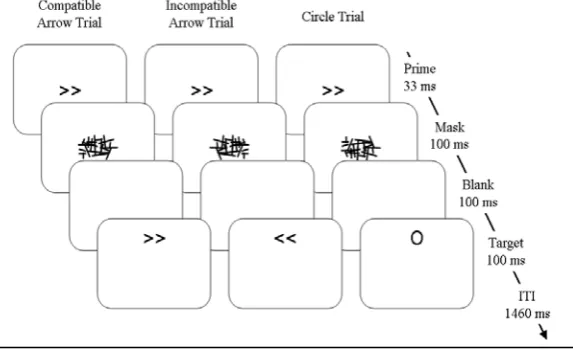
computer screen (see Figure 1).
Procedure. Participants were seated in a dimly lit, sound attenuated chamber in front of a computer screen (viewing distance = 1.2 m), with response buttons under their left
and right index fingers.
Experiments comprised 10 blocks of 60 trials each, preceded by one 20-trial practice
block. Each trial began with a 33-ms prime immediately followed by a 100-ms mask,
both presented at fixation. A new random mask was constructed on each trial in order to
avoid perceptual learning of the mask and correspondingly increased prime
[image:9.595.263.550.301.476.2]identification (Schlaghecken, Blagrove, & Maylor, 2008; Schubö, Schlaghecken, &
Meinecke, 2001). In a staircase procedure, prime identification performance under these
particular stimulus and timing conditions was at chance level (Schlaghecken, Refaat, &
Maylor, 2008). After a 100-ms blank screen,1 a 100-ms target was displayed randomly
and with equal probability 3.0º above or below fixation. ITI was 1460 ms.
Participants were instructed to respond as quickly and accurately as possible to the
direction of the target arrows (i.e., left-hand key-presses to left-pointing arrows,
right-hand key-presses to right-pointing arrows), maintaining central eye fixation.
Experiments differed only with respect to the instruction regarding circle targets.
Participants in Experiment 1 (Nogo) were instructed to withhold any response to circle
targets. Participants in Experiment 2 (Free Choice) were instructed to respond to them
randomly with either a left or a right key-press (it was stressed that they should respond
with whatever key they ‘felt like’ pressing at the time, without producing any
pre-planned patterns, e.g., without always giving a left-hand response to circles appearing
below fixation). Participants in Experiment 3 (Bimanual) were instructed to respond
with a simultaneous left and right key-press to circle targets.
All six conditions (two primes x three targets) were presented randomly and with
equal probability throughout each block.
Data analysis. Error rates and mean reaction times (RTs) on correct-response trials were calculated for compatible (prime and target pointing in the same direction) and
incompatible (prime and target pointing in different directions) arrow-target trials. For
circle-target trials, mean RTs were calculated separately for prime-compatible and
prime-incompatible responses (Nogo task: false alarm executed with the primed or the
unprimed hand; Bimanual task: primed or unprimed hand leading in the bimanual
response). Response bias was calculated as the difference between the relative
proportion of prime-incompatible responses and chance level (i.e., 50%, bias-free). RTs
and error rates on compatible and incompatible arrow trials and RTs on
prime-compatible and prime-inprime-compatible circle trials were analyzed using paired t-tests. Response bias was analyzed using one-sample t-tests. Finally, data from the Bimanual and the Free Choice experiments were compared directly (note that a meaningful
comparison can not be made with the Nogo experiment as here, responses to circle
targets are errors, whereas in the other two experiments, they are correct). RTs were
analysed using a repeated measures ANOVA with the within-subjects factors target type
(arrow/circle) and prime (compatible/incompatible relative to the leading response
hand), and the between-subjects factor experiment (Bimanual/Free Choice).
Results
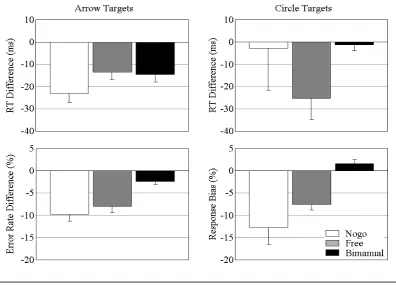
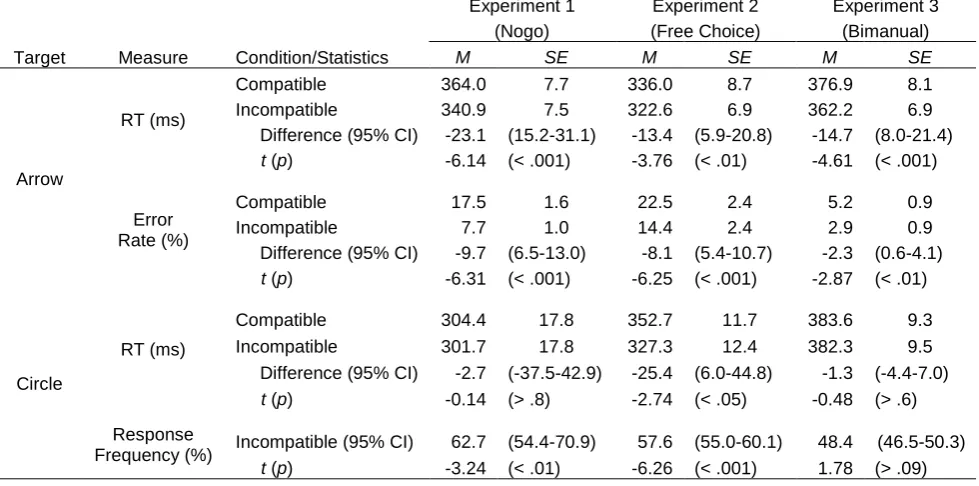
Mean RTs, error rates, and response frequencies, together with the relevant t-tests, are displayed in Table 1. Figure 2 shows the corresponding priming effects. For arrow
trials, all experiments produced significant NCEs, with faster responses and fewer errors
on incompatible than on compatible trials. For circle trials, however, the results differed
markedly between experiments. NCEs were obtained for nogo and free-choice trials, but
not for bimanual responses: False alarms and freely chosen responses were significantly
more likely to be executed with the unprimed than with the primed hand, and freely
chosen incompatible RTs were significantly shorter than freely chosen
prime-compatible ones.2
In marked contrast to these results, no bias toward the unprimed hand occurred for
the earlier of the two key presses (numerically, it was less likely to be the earlier one),
and prime-incompatible leading key-presses were not faster than prime-compatible
leading key-presses.
Direct comparison of the Free Choice and the Bimanual experiments confirmed
these results. For RTs, there was no interaction between target and prime or between
target and experiment (both Fs < 1), but the three-way interaction was significant, F(1, 38) = 6.88, MSE = 235.39, p = .012. As expected, follow-up ANOVAs showed that between-experiment differences in priming effects were not significant for arrow
[image:12.595.94.491.190.475.2]targets, F < 1, but were significant for circle targets, F(1, 38) = 6.23, MSE = 466.41, p =
.017. Similarly, the difference in circle-target response bias between experiments was
highly significant, t(38) = 6.08, p < .001.
Discussion
Results of Experiments 1 and 2 replicate and extend earlier findings (Eimer &
Schlaghecken, 1998; Klapp & Haas, 2005; Klapp & Hinkley, 2002; Schlaghecken &
Eimer, 2004): In Nogo and Free Choice masked prime tasks, a systematic response bias
away from the primed response occurred, resulting in a preference for (and faster
execution of) responses with the unprimed hand. Because this bias was observed in
responses to targets that did not share features with primes or masks, it cannot be
explained in terms of perceptual interactions between these stimuli, and thus strongly
supports the motor interpretation of masked priming effects.3
Importantly, no such bias was found for bimanual responses, where the primed hand
was as likely to be the one leading the response as the unprimed hand. This indicates
that masked primes – in contrast to, for example, stimulus location in a Simon task
(Miller & Franz, 2005) – do not affect individual muscle commands, but rather more
abstract response representations upstream from M1.
However, possible alternative explanations need to be considered. First, it might be
that participants simply favoured their preferred hand, which would have been primed
on half of the circle-target trials, and unprimed on the other half. This seems unlikely
for two reasons: a) even though most participants were right-handed, there was a small
overall tendency to respond with the left hand first, irrespective of prime direction; and
b) participants without any pronounced left- or right-hand bias (n = 12) still failed to show any prime-induced response bias (frequency of responses with leading unprimed
A second alternative explanation for the lack of response bias in bimanual responses
is that participants actively withheld the faster response in order to comply with the
explicit task instruction to respond with both hands simultaneously. Several factors
speak against this interpretation. First, the average delay between the two key presses
was 28 ms (range: 12–86 ms), approximately twice the size of the arrow-target NCE in
this experiment. Furthermore, if strategic delays played a role, then participants who
synchronized their hands more successfully should show less response bias, and
participants who failed to synchronize should show more bias. However, there was no
correlation between size of between-hand delay and size of response bias, r = .28, n = 20, p > .2, and the marginally significant correlation between size of between-hand delay and size of RT effect (i.e., difference between primed and unprimed leading-hand
RTs), r = .43, n = 20, p = .059, was in fact opposite to the expected direction: participants with larger delays tended to show smaller NCEs than participants with
shorter delays.4
Finally, it has to be noted that overall RTs were substantially longer in the Bimanual
experiment than in the other two experiments. Specifically, they were on average 48 ms
longer than in the Free Choice experiment. This is in line with the claim that there were
three separate response alternatives in the Bimanual experiment (left, right, and
bimanual), but only two (left and right) in the Free Choice experiment. Therefore, the
possibility needs to be considered that the increase in number of response alternatives
itself caused the lack of response bias for bimanual responses.
However, this notion is difficult to reconcile with the fact that there is no
corresponding reduction in NCE size for unimanual (arrow-target) responses – if
Choice experiment. Furthermore, in an earlier study (Klapp & Hinkley, 2002; Exp. 3)
increasing the number of response alternatives from two to three only caused a slight
decrease in NCE size (by approximately 11% rather than 100%).
On the other hand, the self-inhibition model does predict a reduction in NCE size
with increasing number of response alternatives, and increasing the number of
alternatives from two to four has been found to reduce the NCE by approximately 50%
(Schlaghecken, Bowman, & Eimer, 2006). Therefore, an additional analysis was
conducted to investigate whether a similar reduction could be found in the present data.
The size of the circle-target NCE with two response alternatives (i.e., in the Free Choice
experiment) was 25.4 ms. Comparing bimanual circle-target NCEs against 50% of this
value (12.7 ms) using an independent-sample t-test confirmed that the bimanual NCE was significantly smaller than this estimate, t(19) = 4.20, p < .001.
It thus has to be concluded that the absence of NCEs for bimanual responses
indicates that masked arrow primes do not selectively activate muscle commands
specifying one or the other hand; consequently, there is no subsequent inhibition of any
such partial response activation. This in turn can be explained by assuming that primes
affect motor representations at a relatively abstract level, that is, upstream from M1,5
where bimanual responses are represented as fully integrated codes. A possible neural
substrate might be reverberating activity in supplementary motor-anterior striatal loops,
which are assumed to mediate the preparation of instructed movements (e.g., Romo &
Schultz, 1992), as these structures have been implicated in masked prime-task
performance on the basis of fMRI results (Aron et al., 2003) and patient studies
Taken together, the present results suggest the following scenario: At least in
relatively simple choice RT tasks, participants prepare a number of direct
perceptuo-motor links (e.g., Neumann & Klotz, 1994), such that the perceptuo-perceptuo-motor system
becomes particularly sensitive to specific stimuli and particularly likely to activate
specific responses in their presence. In line with hierarchical models of motor control
(e.g., Tresilian, 1999), these links are formed between perceptual representations and
relatively abstract response codes (as opposed to low-level muscle commands), as
evidenced by the fact that primes associated with a specific response hand affect
unimanual responses, but fail to affect the same effectors in a bimanual response.
Perceiving a response-relevant stimulus in this context (even if only subliminally) will
cause activation of the corresponding response code, which under appropriate
conditions will be subsequently inhibited. Response-code activational levels will in turn
affect M1 activation, but are themselves unaffected by any influence (e.g., rTMS,
Schlaghecken et al., 2003) that directly impacts on M1. Thus in the present experiments,
an arrow prime will activate an abstract representation of the corresponding unimanual
motor code, thereby producing NCEs when responses are also unimanual (arrow-target
responses, nogo responses [false alarms], and free choice responses). However, an
arrow prime will not activate the abstract representation of a bimanual response, which
Footnotes
1
In earlier experiments, this interval was usually 50 ms. However, pilot tests indicated
that NCEs might be slightly larger and more robust with a 100-ms interval.
2
Numerically, though not statistically, the same was true for false alarms; however, the
average number of false alarms was very low – 4.3 and 7.3 for compatible and
incompatible responses, respectively, resulting in a total of approximately 5.5% of all
nogo trials – so that false-alarm RT values are unlikely to be reliable.
3
Note that results of the Nogo experiment were the same when all participants were
included in the analysis: RTs were 19 ms shorter and error rates 7.2% lower on
incompatible compared to compatible arrow trials, and false alarms on circle trials were
more likely with the unprimed than with the primed hand (59.2% of all false alarms).
All effects were statistically significant, all ts > 2.5, all ps < .02. 4
We conducted an additional experiment where the instruction to press both keys
simultaneously was less emphasized. Again, a normal NCE (14 ms) was obtained for
arrow trials, but no response bias was found in the circle trials responses (proportion of
responses with unprimed hand leading: 49.7%). However, the lag between leading and
trailing hand was only 5 ms larger in this than in the original experiment, and the range
of lags was actually smaller (13-66 ms). It thus seems safe to assume that despite the
difference in instruction, participants aimed just as much to produce a synchronous
response to circle targets as in the original experiment.
5
This interpretation also fits with the results of Eimer et al. (2002), which had been
taken to indicate that priming effects are effector specific: If in that study hand and foot
responses had separate response codes, then no transfer from a primed hand response to
Author Note
Friederike Schlaghecken and Elizabeth A. Maylor, Department of Psychology,
University of Warwick, Coventry, England; Stuart T. Klapp, Department of
Psychology, California State University, East Bay, USA.
This research was supported by a grant from the Economic and Social Research
Council of Great Britain (grant no. RES-000-22-1841).
We thank Malik Refaat, Daniella McNulty, and Jasmin Chahal for running the
experiments, and James Tresilian for helpful discussions.
Address correspondence to Friederike Schlaghecken at the Department of
Psychology, University of Warwick, Coventry, CV4 7AL, UK. E-mail:
References
Aron, A., Schlaghecken, F., Fletcher, P., Bullmore, E., Eimer, M., Barker, R., Sahakian,
B., & Robbins, T. 2003 Inhibition of subliminally primed responses is mediated
by the caudate and thalamus: evidence from fMRI and Huntington's disease. Brain
126, 713-723.
Dehaene, S., Naccache, L., Le Clec, H. G., Koechlin, E., Mueller, M.,
Dehaene-Lambertz, G., van de Moortele, P. F., & Le Bihan, D. 1998 Imaging unconscious
semantic priming. Nature395, 597–600.
Donchin, O., Gribova, A., Steinberg, O., Bergman, H., & Vaadia, E. 1998 Primary
motor cortex is involved in bimanual coordination. Nature 395, 17, 274.
Eimer, M. & Schlaghecken, F. 1998 Effects of masked stimuli on motor activation:
Behavioral and electrophysiological evidence. J Exp Psychol Human 24, 1737-1747.
Eimer, M., Schubö, A., & Schlaghecken, F. 2002 The locus of inhibition in the masked
priming of response alternatives. J Motor Behav34, 3-10
Jagacinski, R. J., Marshburn, E. A., Klapp, S. T., & Jones, M. R. 1988 Tests of streamed
vs. integrated structure in polyrhythmic tapping. J Motor Beh20, 416-442.
Jaśkowski, P., Białuńska, A., Tomanek, M. & Verleger, R. 2008 Mask- and
distractor-triggered inhibitory processes in the priming of motor responses: An EEG study.
Psychophysiology45, 70-85.
Jaśkowski, P. & Przekoracka-Krawczyk, A. 2005 On the role of mask structure in
subliminal priming. Acta Neurobiol Exp 65, 409-317.
Kanwisher, N. G. 1987 Repetition blindness: type recognition without token
Klapp, S. T. 1979 Doing two things at once: The role of temporal compatibility. Mem Cognition 7, 375-381.
Klapp, S. T. 2005 Two versions of negative compatibility have different properties: A
reply to Lleras and Enns (2004). J Exp Psychol Gen 134, 431-435.
Klapp, S. T., & Haas, B. W. 2005 The non-conscious influence of masked stimuli on
response selection is limited to concrete stimulus-response associations. J Exp Psychol Human31, 193-209.
Klapp, S.T., & Hinkley, L. B. 2002 The negative compatibility effect: Unconscious
inhibition influences reaction time and response selection. J Exp Psychol Gen 131, 255-269.
Klapp, S. T., Nelson, J. M., & Jagacinski, R. J. 1998 Can people tap concurrent
bimanual rhythms independently? J Motor Beh30, 301-322.
Lleras, A. & Enns, J. T. 2004 Negative compatibility or object updating? A cautionary
tale of mask-dependent priming. J Exp Psychol Gen 133, 475-493.
Lleras, A. & Enns, J. T. 2006 How much like a target can a mask be? Geometric,
spatial, and temporal similarity in priming – A reply to Schlaghecken and Eimer
(2006). J Exp Psychol Gen 135, 495-500.
Miller, J. O. & Franz, E. A. 2005 Dissociation of bimanual responses with the Simon
effect: On the nonunitization of bimanual responses. J Motor Behav 37, 146-156. Neumann, O. & Klotz, W. 1994 Motor responses to nonreportable, masked stimuli:
Where is the limit of direct parameter specification? In C. Umiltà & M.
Romo, R. & Schultz, W. 1992 Role of primate basal ganglia and frontal cortex in the
internal generation of movements III. Neuronal activity in the supplementary
motor area. Exp Brain Res91, 396-407.
Schlaghecken, F., Blagrove, E., & Maylor, E. A. 2008 No difference between conscious
and nonconscious visuomotor control: Evidence from perceptual learning in the
masked prime task. Conscious Cogn17, 84-93.
Schlaghecken, F., Bowman, & Eimer, M. 2006 Dissociating activation, inhibition, and
disinhibition in low-level motor control. J Exp Psychol Human 32, 618-632. Schlaghecken, F. & Eimer, M. 1997 The influence of subliminally presented primes on
response preparation. Sprache Kognit16, 166-175.
Schlaghecken, F. & Eimer, M. 2000 A central/peripheral asymmetry in subliminal
priming. Percept Psychophys 62, 1367-1382.
Schlaghecken, F. & Eimer, M. 2004 Masked prime stimuli can bias ‘free’ choices
between response alternatives. Psychonomic Bull Rev 11, 463-468.
Schlaghecken, F. & Eimer, M. 2006 Active masks and active inhibition: A comment on
Lleras and Enns (2004) and on Verleger, Jaskowski, Aydemir, van der Lubbe, and
Groen (2004). J Exp Psychol Gen135, 484-494.
Schlaghecken, F. & Maylor, E. A. 2005 Motor control in old age: Evidence of impaired
low-level inhibition. J Gerontol B Psychol Sci Soc Sci60, 158-161.
Schlaghecken, F., Münchau, A., Bloem, B., Rothwell, J. C., & Eimer, M. 2003 Slow
frequency repetitive transcranial magnetic stimulation affects reaction times, but
Schlaghecken, F., Refaat, M., & Maylor, E. A. 2008 Conflict and control: Differences between masked and unmasked priming as revealed by a hybrid Simon task.
Manuscript submitted for publication.
Schlaghecken, F., Rowley, L., Sembi, S., Simmons, R., & Whitcomb, D. 2007 The
negative compatibility effect: A case for inhibition. Advances in Cognitive Psychology 3, 227-240.
Schubö, A., Schlaghecken, F., & Meinecke, C. 2001 Learning to ignore the mask in
texture segmentation tasks. J Exp Psychol Human 27, 919-931.
Sumner, P. 2008 Mask-induced priming and the negative compatibility effect. Exp Psychol 55, 133-141.
Sumner, P., Nachev, P., Morris, P., Peters, A. M., Jackson, S. R., Kennard, C., &
Husain, M. 2007 Human Medial Frontal Cortex Mediates Unconscious Inhibition
of Voluntary Action. Neuron54, 697–711.
Swinnen, S. P. & Wenderoth, N. 2004 Two hands, one brain: Cognitive neuroscience of
bimanual skill. Trends Cogn Sci 8, 18-25.
Tresilian, J. R. 1999 Abstract levels of motor control in prehension: Normal and
pathological performance. Hum Movement Sci 18, 219-239.
Verleger, R., Jaśkowski, P., Aydemir, A., van der Lubbe, R. H. J., & Groen, M. 2004
Qualitative differences between conscious and non-conscious processing? On
Table 1. Mean RTs (ms) and error rates (%) on compatible and incompatible arrow-target trials for each experiment; and for circle arrow-targets, mean RT on compatible and
incompatible false alarms (Experiment 1), compatible and incompatible free choices
(Experiment 2), and compatible and incompatible leading hand on bimanual responses
(Experiment 3), and the corresponding frequency (%) of the incompatible false alarm,
free choice, and leading hand responses, respectively, together with the results of the
corresponding statistical analyses (mean difference, 95% confidence interval [CI], t- and p-value). RTs and error rates on compatible and incompatible trials were compared using paired t-tests; response frequencies were tested against chance level (50%) using one-sample t-tests.
Experiment 1 Experiment 2 Experiment 3
(Nogo) (Free Choice) (Bimanual)
Target Measure Condition/Statistics M SE M SE M SE
Arrow
RT (ms)
Compatible 364.0 7.7 336.0 8.7 376.9 8.1
Incompatible 340.9 7.5 322.6 6.9 362.2 6.9
Difference (95% CI) -23.1 (15.2-31.1) -13.4 (5.9-20.8) -14.7 (8.0-21.4)
t (p) -6.14 (< .001) -3.76 (< .01) -4.61 (< .001)
Error Rate (%)
Compatible 17.5 1.6 22.5 2.4 5.2 0.9
Incompatible 7.7 1.0 14.4 2.4 2.9 0.9
Difference (95% CI) -9.7 (6.5-13.0) -8.1 (5.4-10.7) -2.3 (0.6-4.1)
t (p) -6.31 (< .001) -6.25 (< .001) -2.87 (< .01)
Circle
RT (ms)
Compatible 304.4 17.8 352.7 11.7 383.6 9.3
Incompatible 301.7 17.8 327.3 12.4 382.3 9.5
Difference (95% CI) -2.7 (-37.5-42.9) -25.4 (6.0-44.8) -1.3 (-4.4-7.0)
t (p) -0.14 (> .8) -2.74 (< .05) -0.48 (> .6)
Response
Frequency (%) Incompatible (95% CI) 62.7 (54.4-70.9) 57.6 (55.0-60.1) 48.4 (46.5-50.3)