• No results found

Behavioural analysis of program intent using data origins, influence and context

N/A
N/A
Protected

Academic year: 2020

Share "Behavioural analysis of program intent using data origins, influence and context"

Copied!
85
0
0

Loading.... (view fulltext now)

Full text

(1)

MASTER THESIS

BEHAVIOURAL ANALYSIS

OF PROGRAM INTENT

USING DATA ORIGINS,

INFLUENCE AND

CONTEXT

Jelmer Verkleij

Faculty of Electrical Engineering, Mathematics and Computer Science (EEMCS) Chair of Services, Cybersecurity and Safety (SCS)

(2)
(3)

C

ONTENTS

1 Introduction 5

2 Background 7

2.1 Attack surface, vectors and impact . . . 7

2.2 Malware styles and implementations . . . 7

2.2.1 Spam . . . 7

2.2.2 Denial of service . . . 8

2.2.3 Phishing . . . 10

2.2.4 Gateway malware . . . 10

2.2.5 Polymorphism . . . 11

2.3 Mitigation techniques . . . 12

2.3.1 PHP configuration options . . . 12

2.3.2 PHP hardening . . . 13

2.4 Related work . . . 13

2.4.1 Static detection techniques . . . 14

2.4.2 Content scanner software . . . 14

2.4.3 Behavioural analysis . . . 15

2.4.4 Flow verification . . . 15

2.4.5 Implicit vs. explicit data flows . . . 16

3 Characterising software 17 3.1 Introducing graph descriptions . . . 17

3.1.1 Values and variables . . . 18

3.1.2 Comparisons . . . 20

3.1.3 User functions . . . 21

3.1.4 Conditional constructs . . . 21

3.1.5 Dynamic code evaluation constructs . . . 26

3.1.6 Scopes . . . 27

3.1.7 Whiteboxing and blackboxing function calls . . . 27

3.1.8 Data access control . . . 28

3.2 Graph optimizations . . . 28

3.2.1 Variable snapshotting . . . 28

3.2.2 Influence flattening . . . 29

3.3 Behavioural pattern recognition . . . 31

3.3.1 Patterns . . . 31

3.3.2 Heuristics and rules . . . 33

3.3.3 Matching graphs to patterns . . . 35

4 Characterising malware 39 4.1 Spam . . . 39

4.2 Phishing . . . 40

4.3 Denial-of-service . . . 40

4.4 Gateway malware . . . 42

4.4.1 Variations . . . 43

4.4.2 Whiteboxed function calls . . . 44

5 PHP internals 45 5.1 Overview of the PHP interpreter . . . 45

5.2 The PHP VM . . . 45

5.2.1 Oplines . . . 46

5.2.2 Opcode handlers . . . 46

5.2.3 Stack . . . 47

5.2.4 Variables . . . 47

5.2.5 Variable references . . . 48

(4)

5.2.10 Internal functions . . . 50

5.2.11 Object methods . . . 51

5.2.12 Dynamic code inclusion and execution . . . 51

5.2.13 Auto globals . . . 52

5.2.14 Symbol tables . . . 52

5.3 Built-in function definitions . . . 53

5.4 Optimized compilations . . . 53

5.4.1 Boolean logic operators . . . 53

5.4.2 Conditional blocks . . . 54

5.4.3 Loops . . . 56

6 Design 57 6.1 General architecture . . . 57

6.2 Interception and injection . . . 58

6.2.1 Data tracking . . . 59

6.2.2 Designation of fundamental data types . . . 59

6.2.3 Scope tracking . . . 59

6.3 Memory interfacing principles . . . 59

6.4 Heuristic testing . . . 60

6.5 Performance considerations . . . 61

7 Implementation 63 7.1 Instrumentation and hooks . . . 63

7.1.1 Setup and breakdown . . . 63

7.1.2 Logging executed instructions . . . 63

7.1.3 Opcode-specific instrumentation . . . 63

7.2 Data management . . . 63

7.2.1 Literals . . . 64

7.2.2 Constants . . . 64

7.2.3 Arrays . . . 64

7.2.4 Objects . . . 64

7.2.5 External input . . . 64

7.3 Language constructs . . . 65

7.3.1 Variable assignments and references . . . 65

7.3.2 Operators . . . 65

7.3.3 Value comparisons . . . 65

7.3.4 Internal function calls . . . 66

7.3.5 User function calls . . . 66

7.3.6 Variable variables . . . 66

7.3.7 Conditional blocks . . . 66

7.3.8 Boolean logic operators . . . 67

7.3.9 Serialization . . . 67

8 Testing and results 69 8.1 Goals . . . 69

8.2 Testing data set composition . . . 69

8.3 Test setup . . . 70

8.4 Results of matched heuristics . . . 70

8.4.1 Malware . . . 70

8.4.2 Legitimate code . . . 71

8.5 Performance overhead . . . 72

9 Discussion 75 9.1 Method of analysis . . . 75

9.2 Behavioural model . . . 75

9.3 Instrumentation in practice . . . 75

(5)

C

HAPTER

1

I

NTRODUCTION

In the past decade, dynamic websites have become more and more popular. Whereas in the past people with little technical knowledge would stick to static websites (if they created a website at all), creating dynamic websites has become easier and more accessible for this group in recent years. The increased availability of software frameworks, which provide an out-of-the-box graphical interface for website management, has been a major catalyst for this growth. Such software frameworks tend to be maintained as freely available open-source projects, relying on a community of volunteers for their maintenance. Their ease of use, free-of-charge distribution and the availability of automated installers offered by many web hosting providers in recent years have all helped make these software packages incredibly popular and a major component of the world wide web as a whole.

However, like all software, these packages do contain security vulnerabilities. Their large install base means that there is also a big attack surface for each vulnerability. Additionally, many of these software packages expose version information to the outside world, which hackers can use to build lists of websites running certain versions of particular applications. Every time a new vulnerability is discovered, hackers can immediately find out what websites are vulnerable and use that vulnerability to exploit millions of websites around the world. Each exploit thus automatically becomes a major attack vector, usually used as a stepping stone to upload malware onto all those websites and abuse the hosting servers for malicious purposes.

Although there are many detection tools available for such malware, they all employ methods of content-based detection which have proven to be either insufficient, inaccurate or infeasible. Since it is the behaviour that the detection tools are interested in, it seems a logical next step to ignore the source code altogether and purely look at the behaviour itself. All the different ways in which code can be written down will be translated into only a handful of unique execution paths during the interpreting process, which has a much lower entropy and thus is a far easier target for performing detection on. By instrumenting the interpreter and plugging into the actual execution layer, all the obfuscation allowed in the source code can be circumvented.

In this thesis, we explore the possibilities for implementing behavioural analysis through instrumen-tation in the PHP interpreter. By analysing what runtime behaviour can be used for distinguishing malware from legitimate code, and looking at similar techniques in related fields, we develop a method for tracking relevant actions taken by the interpreter during script execution and using that to determine whether the actions could be considered to have harmful effects. It also introduces a modelling method for behaviour and behavioural patterns which are used during analysis. After creating a relevant set of heuristics, the effectiveness of the instrumentation is put to the test by comparing its performance on datasets of both malicious and legitimate code.

(6)
(7)

C

HAPTER

2

B

ACKGROUND

This chapter discusses the current state of malware detection in the web hosting industry. First, we look at the scale of the problem we are trying to tackle, and put the role of malware into perspective. The second section takes an in-depth look at the most common forms of malware currently in use, to understand their common behaviour and what distinguishes malware scripts from legitimate code. In the final section, we look at available tools that already deal with this issue, how well they perform and what lessons can be taken away from them to develop our new method.

2.1

Attack surface, vectors and impact

Creating dynamic websites has become easier and more accessible for both experienced programmers and beginners in recent years. Although there is a variety of languages out there, PHP is by far the most popular and common language used for website purposes[3][24][28]. Just about every hosting provider offers PHP as part of its products and makes it easy for customers to use PHP-based software on their systems.

On top of the language being widely supported, the number of available applications written in PHP is at an all-time high. Examples include blogging software (WordPress, Joomla!), bulletin boards (phpBB, vBulletin), media galleries (Gallery, Piwigo) and e-commerce (Prestashop, Magento). Many hosting providers see significant portions of their customers’ websites based on such software packages, which amounts to an impressive install base worldwide. For example, WordPress alone is estimated to have a 27% market share across the entire web, as high as 60% among shared web hosting providers[5][29].

Although some web exploits are limited to the website in question (e.g. site scripting or cross-site request forgery) there are also exploits that allow using the server hosting the vulnerable webcross-site for other purposes. Vulnerabilities in upload mechanisms allow uploading arbitrary files to locations accessible by the webserver software, which generally (in the case of PHP scripts) means that they are readily executable. Hence the smallest vulnerability that exposes a file management or file upload method of a CMS to attackers can be used to bootstrap advanced scripts with a variety of purposes, such as hosting phishing websites, sending spam or launching DoS attacks. The combined impact makes attacks on the hosted websites considered to be the most time-consuming security problem of web hosting providers[1][20].

2.2

Malware styles and implementations

Although many sources will claim that web malware is continuously evolving, the major goals of all malware scripts are limited to three use cases: sending spam e-mails, launching denial-of-service attacks and intercepting personal data through phishing websites. On top of scripts that directly serve these use cases, there is a large variety of scripts available that are used as (indirect) stepping stones for the same purposes, which can best be labelled as gateway malware. There are occasionally exceptions to this rule (such as scripts specifically targeting a certain kernel vulnerability) but those only make up a minor segment of the scripts currently in wide use[19][20].

Various descriptions of functions, their signatures and their behaviour are included in this chapter. All of these descriptions apply to PHP 5 and PHP 7; they may not be accurate for other PHP versions.

2.2.1

Spam

(8)

1 bo o l ma i l ( s t r i n g $to , s t r i n g $ s u b j e c t , s t r i n g $ m e s s a g e [ , s t r i n g

$ a d d i t i o n a l _ h e a d e r s [ , s t r i n g $ a d d i t i o n a l _ p a r a m e t e r s ]] )

Listing 2.1: mail()function signature

E-mail addresses can be provided to this function call in either the$toargument (which will put it in theTo:SMTP header) or as part of the$additional_headersargument (specifyingCc:orBcc:SMTP headers). Generally, scripts will iterate over a list of addresses and call this function multiple times, or add batches of the addresses to a single call (usually in theBcc: header).

What subjects and e-mail bodies are typical for spam e-mails is beyond the scope of this research. Suffice to say spam filters are continuously improving to keep up with the latest developments in spam content, and this is a field in its own right. For now, we can safely say that the content of the arguments

$subjectand $messagecan be anything, and it may originate from either the script itself (in a hard-coded fashion) or from the request data (along with e-mail addresses).

Another tactic, sometimes used by scripts to fly a little more under the radar, is to swap out the built-inmail() function and operate on mail servers directly using the SMTP protocol. In that case, thefsockopen() function is the go-to function for basic socket functionality. Its signature is included below.[21]

1 r e s o u r c e f s o c k o p e n ( s t r i n g $ h o s t n a m e [ , int $ p o r t = -1 [ , int &$ e r r n o [ ,

s t r i n g &$ e r r s t r [ , f l o a t $ t i m e o u t = i n i _ g e t(" d e f a u l t _ s o c k e t _ t i m e o u t ") ] ] ] ] )

Listing 2.2:fsockopen()function signature

In this use case, the $portargument will usually be set to either25, 465or587: the standardized ports for SMTP. (Since the function has built-in SSL support if the OpenSSL module is compiled into PHP, it is also to communicate over the SSL-only port 465.)

1 <? php

2 $ r e c i p i e n t s = $ _ G E T[’ a d d r e s s e s ’];

3 $ s u b j e c t = $ _ G E T[’ s u b j e c t ’];

4 $ h e a d e r s = $ _ G E T[’ h e a d e r s ’];

5 $ m e s s a g e = $ _ G E T[’ m e s s a g e ’];

6

7 $ s o c k e t = f s o c k o p e n(" m a il . e x a m p l e . com ", 25 , $errno, $errstr, 30) ;

8

9 f w r i t e($socket, " E H L O l o c a l s e r v e r \ r \ n ") ;

10 f w r i t e($socket, " M A I L FR O M : < i m p e r s o n a t e d @ s e n d e r . com >\ r \ n ") ;

11

12 f o r e a c h ($ r e c i p i e n t s as $ e m a i l) {

13 f w r i t e($socket, " R C PT TO : <{ $ e m a i l } >\ r \ n ") ;

14 }

15

16 f w r i t e($socket, " D A T A \ r \ n ") ;

17 f w r i t e($socket, " S u b j e c t : { $ s u b j e c t }\ r \ n ") ;

18 f w r i t e($socket, " To : < ".i m p l o d e(" > , < ", $ r e c i p i e n t s) ." >\ r \ n ") ;

19 f w r i t e($socket, " { $ h e a d e r s }\ r \ n \ r \ n ") ;

20 f w r i t e($socket, " { $ m e s s a g e }\ r \ n ") ;

Listing 2.3: Example of malicious mailer code using socket communication

(9)

packet flooder in PHP is usually not enough to have serious impact. However, as is the case with ‘regular’ botnets, these scripts tend to be used in a distributed nature. Generally the attacker performs simultaneous requests with the attack information in the request body to several hundreds of installed malware across multiple servers in order to launch them simultaneously. Another popular approach has the scripts configured to listen in on a central command-and-control server from time to time (e.g. a webpage or an IRC channel) and started in a long-term sleeping mode before the attack itself.

1 r e s o u r c e f o p e n ( s t r i n g $ f i l e n a m e , s t r i n g $ m o d e [ , bo o l $ u s e _ i n c l u d e _ p a t h =

f a l s e [ , r e s o u r c e $ c o n t e x t ]] )

2 a r r a y fi l e ( s t r i n g $ f i l e n a m e [ , int $ f l a g s = 0 [ , r e s o u r c e $ c o n t e x t ]] )

3 s t r i n g f i l e _ g e t _ c o n t e n t s ( s t r i n g $ f i l e n a m e [ , b oo l $ u s e _ i n c l u d e _ p a t h = f a l s e

[ , r e s o u r c e $ c o n t e x t [ , int $ o f f s e t = 0 [ , int $ m a x l e n ] ] ]] )

Listing 2.4: File handling function signatures

The techniques utilized by these scripts are one of two major options. The first is mainly aimed at webservers, and might be labelled an ‘old’ approach to denial-of-service: sending a large volume of standard requests to a server to bring the service to its knees. For retrieving web pages, PHP offers a variety of functions. For example, basic file access functions have support for various URL formats, such as those for which the signatures are included in listing 2.4: fopen(), file() and file_get_-contents.[21]

In all of these functions, $filenamemay be set to a URL (with the "http://"prefix) to trigger a HTTP request1. Withfile_get_contents()you can even avoid having to load the full returned data by

simply setting$maxlento0, and withfopen()the returned handle can be closed immediately. These actions will cause the reading to be kept to a minimum, thus reducing the overhead and allowing more repeated calls per second.

Another method is to use built-in HTTP handlers, specifically the cURL library. This library is avail-able and PHP support for it is enavail-abled on most web hosting machines, so it is safe to assume these methods can be used in a malware script. When using this library however, multiple calls are required for performing the equivalent of a single call of one of the aforementioned functions. An illustrative ex-ample of basic web page access using cURL is included in listing 2.5 (signatures for the used functions included in listing??).

1 <? php

2 $ c u r l _ h a n d l e = c u r l _ i n i t(" ht t p :// www . target - w e b s i t e . com ") ;

3

4 // P r e v e n t l a r g e c h u n k s of d a ta fr o m b e i n g t r a n s m i t t e d 5 c u r l _ s e t o p t($ c u r l _ h a n d l e, C U R L O P T _ N O B O D Y, tr u e) ;

6

7 c u r l _ e x e c($ c u r l _ h a n d l e) ;

8

9 // C l e a n u p

10 c u r l _ c l o s e($ c u r l _ h a n d l e) ;

Listing 2.5: Example of web page access using PHP cURL functions

Even in the most minimal case, this requires calls to at least curl_init()andcurl_exec(). Ad-ditional logic can be added using the curl_setopt() function. The call to curl_close() frees up resources and thus makes it easier to repeat calls without running out of memory, but can be discarded to avoid the overhead (and take for granted the fact that the script will terminate with an error).[21]

1 r e s o u r c e c u r l _ i n i t ( [ s t r i n g $u r l = N UL L ] )

2 bo o l c u r l _ s e t o p t ( r e s o u r c e $ch , int $ o p t i o n , m i x e d $ v a l u e )

3 m i x e d c u r l _ e x e c ( r e s o u r c e $ch )

4 vo i d c u r l _ c l o s e ( r e s o u r c e $ch )

Listing 2.6: cURL function signatures

(10)

protect against. Especially using UDP, packets can be sent off in true ‘fire and forget’ fashion, with little overhead on the transmitting system regarding connection management or responses to keep track of. An example of such a UDP-based packet flooder is shown in listing 2.7.

1 <? php

2 for($i = 0; $i < $ _ G E T[’ i t e r a t i o n s ’]; $i++) {

3 f s o c k o p e n(" udp :/ / { $ t a r g e t } ", $ _ G E T[’ po r t ’]) ;

4 }

Listing 2.7: Example of an open packet flooder usingfsockopen()

This particular use case shows a call with two characteristics that in combination do not bode well: the$hostnameargument starts with "udp://"(indicating UDP connectivity) and is tainted with user-controlled data from the request body. Neither of these two aspects is enough to make it suspicious by itself, since UDP might be used for manual DNS or NTP queries, and it is reasonable that a script tries to connect to a user-supplied server for e.g. a basic HTTP download script. However, the combination of the two is something that does not have a (safe) legitimate use-case (all UDP protocols that might be expected to be used would require a predetermined ‘safe’ server to ensure proper behaviour, such as for DNS and NTP).

Note that although the script retrieves the port from the request body in the above example, there are other ways of handling the port which are not quite as obvious. It may be hardcoded to a certain port (such as 80, which for most web servers will be usable) or randomized throughout the iterations. Examples of both can be found in actual malware.

2.2.3

Phishing

Although it may seem like phishing is usually a problem pertaining to e-mail, most phishing tactics re-quire accompanying websites to link to from the e-mails in question. Often, such phishing websites are built to imitate official websites for banks, credit card companies or hosted e-mail services. When a phishing victim visits one of those imitation websites by following a link from the phishing e-mail, attack-ers trick them into entering their pattack-ersonal details, which are gathered by the website so the attacker can later use them for malicious purposes. It is the scripts that capture and gather these personal details that are relevant in this context.

The most basic way of saving captured login details is writing them to a form of local storage, such as a file or database. However, this would require the attacker to find some way of going back to a machine and retrieving the list of captured data. Moreover, once the script is discovered and deleted by the system administrator, any data the script has captured up to that point will also be lost. For this reason, most phishing scripts immediately send the captured data to the attacker by e-mail.

Since in this case there is usually no need for high-volume mailing capacity, some of the lower-level alternatives for sending e-mail as proposed in section 2.2.1 are not necessary here. Instead, these scripts just use the basicmail()built-in to send the e-mail quickly.

It is difficult to truly find a common factor in phishing scripts that sets them apart from e.g. contact forms. The target address is fixed (since that is the address owned by the hacker), and the only thing that is influenced by the request data—since it contains the captured details—is the message body.

2.2.4

Gateway malware

Most statistical analyses of malware list various kinds of malware over phishing in usage reports, such asweb shells,backdoorsandfile droppers. These names all describe one particular kind of malware

web shell backdoor

file dropper scripts that can be used for a multitude of purposes such as executing commands on a server’s shell,

(11)

page is not the end game. It might be that a defacement page also contains web shell capabilities and thus can be considered gateway malware by itself, but in other cases it is usually uploaded to a website alongside (or using) other malware.

Note that malware that is exclusively used for gateway purposes (such as file upload mechanisms) can be difficult to distinguish from legitimate software based on their behaviour. For example, when han-dling an uploaded file, it is impossible to tell whether that is with malicious intent without either knowing that the target directory is unusual for uploads, analysing the file contents, or otherwise determining that the request origin should not be trusted. It is, however, possible to determine other malicious intent of the uploaded files once they are executed on their own.

In the case of web shells, the potential for determining malicious behaviour using objective heuristics differs. In case of fully open shells (that will take any input with sanitation into for example a eval()

orsystem()call) it is possible to determine that it is accepting unsanitized input and thus consider its execution harmful on a general level. This changes however when the shell provides a list of predefined commands from which one should be selected. Suddenly the command itself cannot be directly linked to an untrustworthy source (i.e. user input) because it’s in the script source code, and analysis of the command itself is required to find out whether or not it makes sense to allow its execution.

2.2.5

Polymorphism

There are several ways in which malware can take on different forms without changing the actual be-haviour. The methods used in changing a script’s code usually point to one of two core reasons, but generally speaking, the reason does not matter as much as the fact that the changes are made in the first place. When a script is spotted in multiple functionally equivalent forms, it is said to be

polymor-phic: taking on multiple shapes. The concept of polymorphism is important when developing detection polymorphism

techniques because it tends to make detection more difficult.

The most basic form of polymorphism arises from basicreappropriationof existing scripts, usually malware reappropriation

by inexperienced and/or aspiring hackers who have not yet developed their own scripts for their attacks. The “Web Shell by oRb”[25] (commonly mislabelled as “FilesMan”[18]), one of the most popular shells over the past few years, is an excellent example of a frequently reappropriated script. There are thou-sands of permutations of the script being used, from full code scrambling to basic renaming actions (e.g. simply replacing “oRb” by their own handle). For a quick overview of the shell, refer to the analysis performed by Scott Miller[13] regarding a version of this shell he spotted in the wild2.

Beyond reappropriation, just about every case of polymorphism seems to arise from the desire to

avoid detection. When this is the case, it is considered a method ofobfuscation. It makes use of the obfuscation

fact that most detection tools use certain patterns to recognize a script, and by changing the contents to avoid using those common patterns, the tools will not recognize that script for the malware it still is. PHP offers a variety of easy methods to obfuscate a script; this section attempts to summarise the most common ones.

Dynamic code execution methods can be used to cause execution of code that is not actually exe-cutable code to the PHP lexer. One major method is to use PHP’seval()construct, which can be used to execute PHP code passed in through a variable. This method allows generating to-be-executed PHP code on-the-fly. An alternative to theeval()is to use a call topreg_replace(), a function that performs regular expression substitution in strings. Theemodifier causes this function to execute the resulting string rather than returning it, which is essentially an embedded call toeval()on the function result.

Building oneval(), preg_replace()and other similar functions, the second component in obfus-cation relies on hiding the code from plain view. The value that is passed to an execution indirection function is a simple string variable and can thus be subjected to a variety of string obfuscation tech-niques.

Some examples of popular string obfuscation techniques are:

rot13 encoding, reversible usingstr_rot13()

base64 encoding, reversible usingbase64_decode()

gzip deflate compression, reversible usinggzuncompress(),gzdecode()orgzinflate()

Hexadecimal character representation, e.g. replacing"a"with"\x61"

(12)

1 ev a l(b a s e 6 4 _ d e c o d e(

Listing 2.8: LMD rule for matching

eval(base64_decode(...));calls

1 p r e g _ r e p l a c e(" / . * / e ",

Listing 2.9: LMD rule for matching

preg_replace("/.*/e",...);calls

Many malware detection tools have attempted to build detection algorithms for malicious scripts based on the presence of such obfuscation code. Definition sets for tools like LMD include basic searches for listings 2.8 and 2.9. An obvious problem with this approach is that technically the code this detects is not malicious, and thus there is a risk of hitting benign code with these search strings (although admittedly it would be poorly written legitimate code). However, a much more pressing issue is that these detection methods are easily circumvented by changing the contents into random varia-tions. For example, listing 2.8 can be circumvented by the code in listing 2.10 and listing 2.9 can be circumvented by the code in listing 2.11. Both are easy to randomize, impossible to detect using the fixed string search method, yet are functionally equivalent to the original versions.

1 <? php

2 $ r a n d o m v a r i a b l e n a m e = b a s e 6 4 _ d e c o d e( . . . ) ; 3 e v a l($ r a n d o m v a r i a b l e n a m e) ;

Listing 2.10: Circumventing exact matching by randomizing variable names

1 <? php

2 p r e g _ r e p l a c e(" / ( ( . * ) |( f i l l e r ) ) / e ", . . . ) ; Listing 2.11: Circumventing exact matching by

adding random irrelevant data

An alternative approach is to perform a certain degree of automated de-obfuscation. For example, when abase64_decode()call is detected, it could be replaced by the actual decoded string before per-forming another pass. This way, the detection can focus on the actual malicious function calls contained within the obfuscated code. However, these detection methods are easily foiled as well, as soon as the input variables are more complicated than basic strings. Take the following functionally equivalent examples:

1 <? php

2 b a s e 6 4 _ d e c o d e(" a b c d e f ") ;

3 b a s e 6 4 _ d e c o d e(" abc " . " def ") ;

4 b a s e 6 4 _ d e c o d e(i m p l o d e(" ", a r r a y(" ab ", " c ", " def ") ) ) ;

5 b a s e 6 4 _ d e c o d e(s u b s t r(" 12 3 4 a b c d e f 5 6 7 8 ", 4 , 6) ) ;

Listing 2.12: Examples of equivalent lines of code with obfuscation applied

To properly deobfuscate this code, there are so many different language constructs that would need to be supported that it basically requires actual PHP interpretation. Once that is a requirement, it be-comes difficult to draw an objective line that determines to what extent the code should be interpreted (i.e. deobfuscated) before it is ready for analysis. Continuously performing searches after each step of deobfuscation would be impossible to scale, even if it is limited. A fixed number of passes is eas-ily bypassed by hackers (simply apply a couple of additional passes of obfuscation and it becomes undetectable), and the alternative of waiting for certain methods to appear in the deobfuscated code introduces assumptions about malicious use of PHP functions.

2.3

Mitigation techniques

(13)

they tend to be used only by malicious scripts. Many web server administrators thus prefer to disable these functions entirely, using thedisable_functionsdirective in the PHP configuration[21]. By offering the ability to disable built-in functions, this directive allows disabling any function that has no legitimate case on a server.

The applicability of disabling functions is limited because some of the major methods described in the previous section make use of functions that have legitimate use cases (mail()andfsockopen()in particular). A web hosting provider will not be able to disable these functions without also significantly detracting from the usability the hosting service. On top of that, it may very well be that multiple users would like to use thesystem()function in a perfectly safe and valid way, leading a hoster to not even disable that particular function. Since there is no fine-grained control over the conditions and uses of the functions, the controlling ability ofdisable_functionsis severely limited, if usable at all.

An interesting note is that disabling eval() is not possible using the disable_functions config-uration directive. eval() is a method that has such a small legitimate use case that many server administrators would be happy to disable it altogether, but the internals do not allow this. Instead of a function, eval()is actually a language construct and thus is not handled like other built-in functions. There are however examples of other methods with similar capabilities that could be disabled, such as

assert().

Other configuration options that are frequently named areallow_url_fopenandallow_url_include[21]. These functions control the ability of several functions to use remote files as well as local files. Disabling the former would prevent using e.g. file()orfopen()to open remote files. As described in section 2.2.2, the ability of those functions to access remote files is instrumental in performing denial-of-service attacks on webservers using these functions, so disabling it definitely has added value.

Again though, there are legitimate use cases that would be unjustly affected by this configuration option. Consider for example a script that retrieves an RSS feed or accesses a basic HTTP API: those would not be possible anymore using a basic function such asfile_get_contents(), which is a safe and convenient functions for these basic file retrieval purposes. Again, user experience would be severely impacted because there is simply no fine-grained control - it is either fully disabled, or fully enabled.

2.3.2

PHP hardening

There are several security packages and distributions available that aim to ‘harden’ PHP. The most commonly known example is the Suhosin Patch[16], which was specifically intended for server ad-ministrators who do not have any direct control over the code that is run on their servers. Beyond some important ‘under-the-hood’ security mechanisms such as buffer overflow prevention and destruc-tor protection, this package offers configuration options that are aimed at disabling some of the more exploitable functions in PHP that cannot be handled by the default configuration options. Some exam-ples include disabling of the eval()construct, and disabling of the eflag in preg_replace() (which takes the result of a regular expression replace operation as code and executes it in-line[21]).

Although Suhosin[16] in particular found widespread adoption and was shipped by many Linux dis-tributions in their default PHP versions, most users sooner or later have run into problems with these options, and have chosen to disable them. For many web hosting providers, the problem lies in popu-lar website frameworks, plugins or templates that make use of these techniques. Some examples are ezPHP for WordPress[27] and DirectPHP for Joomla![11]. When many customers want popular plugins, the commercial decision for a web hosting provider is to allow them to use these plugins rather than risk the customers leaving. Again, the control is not fine-grained enough to properly handle the distinction between legitimate and malicious use cases, leading to problems in usability.

Note that there are various distributions of PHP available that also use the ‘hardened’ label, but use that to mean they are always equipped with the latest security patches from upstream. This means that whenever a vulnerability is discovered and fixed by the PHP developers, the developers of the hardened distribution backport that security patch to their version and redistribute their PHP version with it. This allows users to support versions of PHP no longer maintained by the official PHP team, but still be sure that it is fully secure to do so. Since this concerns vulnerabilities in the PHP interpreter itself rather than any malicious PHP code being interpreted, this form of PHP hardening is not relevant to this case.

(14)

In discussing our scanning techniques we differentiate between two classes of analysis:

Static analysis: any method that classifies a script by looking at the script content, without

execut-static analysis

ing the script code. This is considered static because given a script and an analysis technique, the outcome of the analysis will always be the same. Tools using static analysis are often called content scanners, because they analyse the contents of the script files.

Dynamic analysis: any method that classifies a script by executing the script code and examining

dynamic analysis

aspects of the execution (output, memory values, performed system calls, etc.). This is considered dynamic because the outcome of the analysis may change depending on e.g. input values, script branching and other variables.

2.4.1

Static detection techniques

Exact matching is the most accurate mechanism for detecting files and ensures that no false positives will be detected, but the coverage of this detection technique is limited. With interpreted languages it’s easy to modify a script without affecting the behaviour, and this fact is used to circumvent exact matching detection mechanisms. Simple changes such as adding whitespace or modifying variable names will change the content of the script in a minimal way, but enough to fool exact matching.

The example script is a good example of such circumvention. It has been copied and re-appropriated countless times, with most of the shell content copied almost verbatim but the header simply changed to read “Web Shell by<someone else>”[10]. Sometimes the changes go further and also modify variable and function names, but in the end it is still functionally unchanged. Redistributing the script with such changes will ensure it goes unnoticed by full-file exact-match scanners.

Partial matching is the logical follow-up tactic, which looks at specific patterns. However, even partial matching has limits to its coverage. To allow matching code in which variable and function names are themselves variable, one would need regular expressions or a different dynamic pattern matching method. This drastically increases the processing power and time required for matching a certain rule to a certain file. When dealing with modern shared hosting servers which host millions of PHP files, applying thousands of different regular expressions to each file just is not feasible.

However, even if (for the sake of argument) we ignore the performance impact and requirements, there are still other problems to be found with partial matching. Since PHP supports dynamic code execution, the exact code which is interpreted and executed can be modified at runtime. Before it is passed to the interpreter, such code is handled as a regular string, and this opens up a whole world of possibilities for obfuscation. Every method available to obfuscate strings is now available for obfuscating code. Detecting what such obfuscated code is meant to do by basic string searches is complicated, not to mention incredibly inefficient.

2.4.2

Content scanner software

Since PHP is an interpreted language, all scripts that are executed are available in readable form on the webserver. This allows scanning scripts for certain pieces of source code by simply looking at the files on the server. Multiple content scanners are available, most notably the open source freely available Linux Malware Detect (LMD)[15] and the commercial solution ConfigServer eXploit Scanner (CXS)[6]. These and other similar solutions use roughly the same set of techniques, so this section discusses all of them as a whole.

The main scanning technique offered by content scanners is exact matching. Usually this is done based on hashes of the files to limit the size of the definition set to check files against. By taking e.g. an MD5 hash of each file that is being scanned, and performing a search of that hash within a provided set (the list of definitions) a scanner is quickly able to find out if a file has content that was marked as malicious by the definition provider. As a way of dealing with the low hit rate of exact matching the tools also provide methods for partial matching. This usually consists of a list of byte sequences which are in turn searched for within each file.

(15)

perfor-be used. LMD offers integration with ClamAV to speed up the scanning process - since LMD’s own scanning process is implemented in a Bash script, speed improvements are easily gained by offloading this to a binary executable in ClamAV.

One tool that aims to take away a lot of complexity overhead is YARA[26], a tool currently being developed by VirusTotal. Among other file analysis features, it provides various regular expression-based methods of searching for string components. The overhead inherent in that is reduced greatly by compiling a ruleset as a whole rather than each rule separately, which allows it to generate an advanced state machine that can be used when searching files. This compilation process means that only a single pass is required to test a file for all the rules in a given ruleset, incurring significant performance improvements.

2.4.3

Behavioural analysis

Tools such as ClamAV and YARA offer more insight into the general methodology of virus scanners. Since they are not solely focused on interpreted scripts but also handle binary executables, they are equipped with more advanced techniques that analyse a file’s behaviour rather than the direct descrip-tion of that behaviour. Of course binaries to a certain extent allow exact matching and searching for specific byte sequences, but the widely available techniques for obfuscating and masquerading virus contents in files has made those approaches so complicated that other tools were developed. An exam-ple is the open source sandbox software Cuckoo[7] which has been used by Sokol et al.[17]. For these tools, static analysis has limitations that can not be easily compensated for or overcome, and thus they employ different techniques.

The core concept used by many virus scanning engines is based on the concept of executing a file in a sandbox, providing it with the right environment and input, and analyse the actions the file takes (which can be captured by the sandbox). This is combined with a heuristic engine that compares the actions with action descriptions in a provided collection (the definition set) and determines the kind of virus based on that. Although this approach requires much more meticulous definition development (the actions need to be properly described, and the right circumstances need to be simulated in the sandbox to trigger those actions), it is much more accurate and a lot easier to develop rules for without false positives. Additionally, when the heuristics are developed in the right way, it is possible to avoid dealing with the obfuscation; by focusing only on the lowest-level actions, all the intermediate obfuscation logic can be ignored without ignoring its resulting actions. This method can best be described as behavioural analysis, a form of dynamic analysis.

Some products do comprehensive analysis for web hosting purposes at the system level, such as Imunify360[4]. Its sandboxing feature consists of analyzing patterns in system calls and spotting odd sequences that may point toward foreign and untrusted code being executed on your server. Some basic actions such as unwanted file uploads or replacements (e.g. for website defacements) can be easily caught, but it is not possible to detect things like spam e-mail transmission. It might be able to detect that a system call is performed for opening the socket, and certain write operations may follow containing the data stream sent to the mail server. Without advanced analysis of the data that is actually being written however, it is not possible to determine whether or not the e-mail is legitimate. Such analysis even becomes impossible when using TLS-enabled connections, because the data written to the socket will be encrypted.

For PHP itself, no direct dynamic analysis methods seem to exist yet. However, when looking at other interpreted languages, there are some notable implementations for Javascript that use similar concepts. The tool ZOZZLE[8] analyses malware by creating heuristics based on certain language constructs or function sequences appearing in particular contexts. Because this approach is based on the AST of the Javascript code being executed, an additional step is required for deobfuscation where applicable, so that the AST for the underlying code is analysed rather than the AST for the deobfuscation command. This is done by hooking functions instrumental in obfuscated malware, such as eval() (functionally equivalent to its PHP counterpart). A similar approach was taken by Likarish et al.[12].

2.4.4

Flow verification

(16)

le-surface becomes limited because runtime validation of the executable against the graph ensures that only a select group of functions may be called from any location in the code.

Although not directly applicable to malware and more to the exploitation of vulnerable legitimate software, the core concept is interesting because it looks at the system-level actions performed by a script or program at runtime, and attempts to draw conclusions regarding its behaviour from it. Although the implementations so far have focused on limiting the potential impact of exploiting the execution environment, the same idea can be applied on a different level. For example, when executing code from theeval()construct in PHP, it is probably desirable to block calls to themail()function. By considering the circumstances under which a function is called, and the scope within which a function is executed, it is possible to assess fine-grained control over allowed flows of a program.

2.4.5

Implicit vs. explicit data flows

Within computer programs, data can be passed in explicit and implicit ways. The explicit flow is the easi-est to describe and spot, because it uses mechanisms in the programming language that were designed for the purpose of passing data from one part of memory to the other. This concerns scenarios such as variable assignments (which explicitly copy data) and mathematical operators (which explicitly take two inputs and assign the output to a variable) but also passing-by-reference of variables to functions that perform in-place modification of the referenced variable. All of these operations are dedicated to modifying data, which means they can be specified to include that behaviour and thus are easy to point out when tracking data modifications in a program during execution.

Implicit flows are more complicated because it regards operations that, when specifying their in-tended behaviour, would not be said to affect the data that an implicit flow makes them affect. This is particularly easy in languages without memory management, where it is possible to use buffer over-flows, pointer casting or other methods to read data in a different form than in which it was originally written. These methods of passing data within an application are much more complicated to track us-ing ‘data taintus-ing’ mechanisms, because most taintus-ing relies on blocks of memory while free memory access allows for much more specific byte-level access.

Consider the example where 10 variables, each 10 bytes in size in memory, are stored in memory. The first variable is considered tainted by a certain function call. When a single byte is copied from the first block to the second block, and we rely on block-based tainting, the entire second block (and thus the second variable) would be considered tainted by that first function call. If after that a different byte from the second block is copied to the third, the third block will also be marked as tainted. By moving around random bytes, a program can then appear to have 10 variables all fully tainted by a function call when in fact only two (the first and second ones) will be affected.

Essentially, block-level data tainting is too coarse-grained to deal with fine-grained memory access. Tracking implicit flows would seemingly require a per-byte tracking of all data that passes through mem-ory to create an accurate view of which operations were responsible for the current state of data.

PHP has very limited capabilities for implicit data flows because it is a completely memory-managed language. To date, the only attacks that are known to abuse implicit data flows abuse a vulnerability in the interpreter itself; the most prominent example is a use-after-free vulnerability that was exploited through Joomla!3 in two remote code execution attack waves against millions of websites in December 20154and June 20165.

Analysis of the available dataset of malware files6 shows that all scripts exclusively rely on explicit

(17)

C

HAPTER

3

C

HARACTERISING SOFTWARE

Instead of the current methods that focus on static analysis, we want to switch to dynamic analysis, specifically to examine a script’s behaviour. Rather than look at the step-by-step instructions of how to achieve certain behaviour (i.e. the source code) and trying to figure out what the resulting behaviour will be, this method will look at the behaviour itself and analyse a script as it is being executed. Such behavioural analysis requires defining patterns that describe what we are looking for. In this chapter we introduce a model for describing a script’s behaviour using a graph representation, as well as a method to translate any script to that graph representation. We then show how this graph representation can be used for defining patterns in behaviour, and how we can test whether a graph matches a provided pattern.

3.1

Introducing graph descriptions

By creating a way of modelling script behaviour, we are looking to create a simplified representation of scripts that removes any aspects of the execution we are not interested in. When analysing a script’s behaviour, we are focused on how the script handles data during execution, but that doesn’t mean we need to know the exact value of every variable at any point during the script’s execution. Similarly, we care more about the fact that a certain value ‘influenced’ another value, rather than the exact nature of how it did that. These requirements resulted in the following core principles for the modelling method:

Every script should be translatable to a graph description; the translation process should be a total function.

Every script should have a single graph description; the translation process should be determinis-tic.

Multiple scripts may result in the same graph description; the translation process is not injective, and thus not reversible. The model and translation process should be designed in such a way that scripts resulting in the same graph descriptions should not have any differences in data handling that are considered relevant to distinguish between.

The model should emphasize the flow of data, and the way in which valuesinfluenceother values; data influence

that is, whether or not the script performs operations that establish a causational relationship between an influencing value and an influenced value. This also allows losing information about operation commutativity or associativity.

(18)

3.1.1

Values and variables

A core distinction we need to make here is between thevalues, which are the actual data being handled,

value

and thevariables, which serve only to temporarily store the data in. We further distinguish between three

variable

types of data, which we will classify asfundamental data typesto avoid confusion with any data types as

fundamental data type

defined in PHP itself. Whereas the PHP types explain how the interpreter should handle the value (e.g. as a string or as an integer), the fundamental types explain where the instrumentation should consider the value to have come from (i.e. itsorigin).

data origin

Compile-time constantsare any values that are fixed prior to the virtual machine starting execution of

compile-time constant

the script. This is essentially every value that can be determined from the source code without requiring any execution or interpretation. The most obvious examples are fixed values which are declared in the script, such as literal strings or integers. Additionally, any string used for naming a function, class or variable is also handled as a constant. The example script in listing 3.3 converts to the graph shown in figure 3.2. Every double-bounded oval is a compile-time constant, with the contents of each oval showing the PHP declaration of the contained value.

1 <? php

2 1;

3 " f o o b a r ";

Listing 3.1: Examples of compile-time constants

Figure 3.2: Graph description of compile-time constants

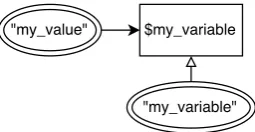
In case a value is stored in a variable, they are represented by simple rectangles, containing the name of the variable. In this example we also introduce two forms of data flow, represented by arrows. A solid arrowhead represents data being retrieved from the outgoing value or variable, and data being stored in the incoming variable. An open arrowhead represents the data in the outgoing value or variable being used as the name for the incoming variable or built-in function call (discussed below). The former describes data influence, the latter describes name influence.

This aspect of the graphs also immediately shows the difference between a fundamentally typed value and a variable: the former is an indivisible element that is always a leaf node of the graph, while the latter is alwaysderivedand is thus never a leaf node (it always has incoming edges describing how

derived variable

the variable is influenced). In other words, when looking at a graph, one can trace back the origins of certain data by tracing the edgesthroughvariables andtofundamental values.

1 <? php

2 $ m y _ v a r i a b l e = " m y _ v a l u e ";

[image:18.595.340.468.487.553.2]

Listing 3.3: Example of a variable

Figure 3.4: Graph description of a variable

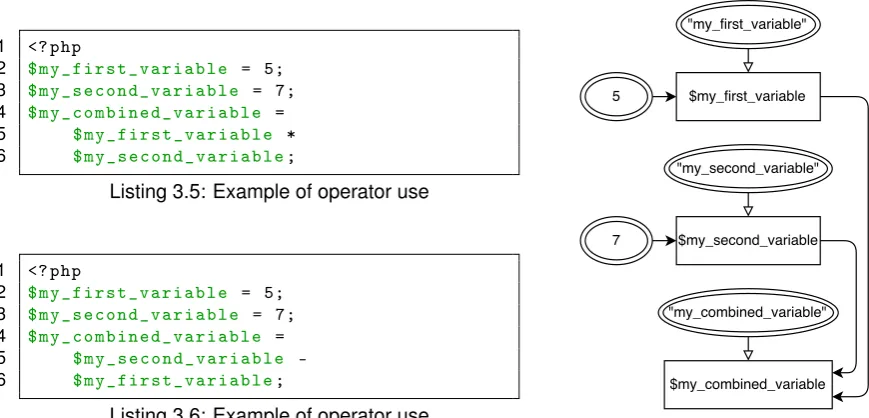
Note that for solid arrowheads the data being retrieved and stored is not necessarily the same. Any PHP operator1is simplified in the graph representation, because we don’t care about the exact resulting

value but more the fact that a value (the operator output) is derived from one or multiple other values (the operator inputs). This simplification means that all operator inputs have an outgoing solid-headed arrow going to the operator output. See for example listing 3.5 and figure 3.7, describing multiplication. This simplification is one of the reasons the translation process is not injective, because it loses information about the type of operator and the input ordering. That information loss is illustrated by listing 3.6, which describes a different script with another operator and different input ordering, but nevertheless translates into the same graph.

(19)

1 <? php

2 $ m y _ f i r s t _ v a r i a b l e = 5;

3 $ m y _ s e c o n d _ v a r i a b l e = 7;

4 $ m y _ c o m b i n e d _ v a r i a b l e =

5 $ m y _ f i r s t _ v a r i a b l e *

6 $ m y _ s e c o n d _ v a r i a b l e;

Listing 3.5: Example of operator use

1 <? php

2 $ m y _ f i r s t _ v a r i a b l e = 5;

3 $ m y _ s e c o n d _ v a r i a b l e = 7;

4 $ m y _ c o m b i n e d _ v a r i a b l e =

5 $ m y _ s e c o n d _ v a r i a b l e

-6 $ m y _ f i r s t _ v a r i a b l e;

[image:19.595.77.512.54.263.2]

Listing 3.6: Example of operator use

Figure 3.7: Graph description of operator use

Abuilt-in functionis any function that cannot be further dissected into more PHP code, and whose built-in function

execution is atomic to the interpreter. This is any function made available by the standard modules or any PHP extension. Built-in function call outputsare result values from any such built-in function. See built-in

function call

listing 3.8 and its graph description in figure 3.9; the double-bounded rounded rectangle is a built-in function call, with the contents showing the function name. Note that this example also shows the name of the built-in function being derived from a compile-time constant.

1 <? php

2 ra n d() ;

Listing 3.8: Example of a built-in function call Figure 3.9: Graph description of a built-in function call

If a function accepts arguments, they are represented by single-bounded rounded rectangles con-tained by the double-bounded rectangles representing their function call. Each rectangle contains the name of the argument as named in its documentation. If an argument isn’t supplied but does have default value defined, that value is shown within the argument’s rectangle in the graph on the second line. This is done to distinguish between multiple function signatures in case of overloaded functions (such as therand()function). Multiple examples are shown in listing 3.10 and figure 3.11.

1 <? php

2 ra n d(1 , 2) ;

3 s t r p o s(" foo ", " bar ") ;

4 s t r p o s(" foo ", " bar ", 2) ;

Listing 3.10: Examples of built-in function calls with arguments

(20)

External input is the third and final type, describing any values that are provided to the script through

external input

external interfaces. The comprehensive list of interfaces which we define as external input is as follows:

Command-line arguments: $argcand$argv

HTTP request input:$_GET,$_POST,$_REQUEST,$_COOKIE,$_FILES

Server information: $_SERVER

Environment variables: $_ENV

For the command-line arguments, $argv is an indexed array of arguments and $argc an integer representing the number of arguments. All other variables are associative arrays. While arrays can be handled in their entirety, they can also be used for per-element access. To describe such element access, we need to add a specialised version of the data influence arrow, which allows specifying the element key. This is done by annotating the arrow with a diamond element, which doesn’t contain any data but will always have one or multiple incoming data influence arrows. In the following example, we show how the element of an external input value is accessed, parallel to the entire array being accessed.

1 <? php

2 $ a l l _ e x t e r n a l _ v a l u e s = $ _ G E T;

3 $ m y _ e x t e r n a l _ v a l u e =

4 $ _ G E T[’ m y _ e x t e r n a l _ k e y ’];

Listing 3.12: Examples of external input access

Figure 3.13: Graph description of external input access methods

The strategy of showing each variable and function name including its originating constant is a very verbose method, and it clutters the graphs significantly. In order to reduce this clutter, we make the name influence optional if the name is solely and directly influenced by a constant. Any block that does not show another block influencing its name is thus implicitly stated to be directly influenced by a constant.

3.1.2

Comparisons

When comparisons between two variables are made, those variables only have an indirect influence on the result. For example, when comparing two integers to see if one is greater than the other, the result will be a boolean. Not only does the type change, there is a loss of information in that type change, and the influence of any variable over the resulting value is not so much in value but more a condition for deciding the outcome to be either true or false.

All comparisons are displayed by diamond symbols. The exact comparison can be added as a label, but it does not change the relationship; any two diamonds with the same inputs are considered to be equivalent regardless of the comparison type. In the same way, the ordering of the comparison operands does not matter for the influence relationships.

1 <? php

2 $ c o m p a r i s o n _ o n e = (1 < 2) ;

3 $ c o m p a r i s o n _ t w o = (" foo " == " bar ") ;

(21)

3.1.3

User functions

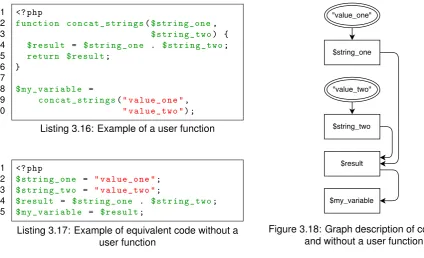
The only kind of functions discussed so far is that of built-in functions. User-defined functions, which are declared and defined within a script, have so far not been considered. To explain why they do not need to be considered separately, we can go back to a key phrase in the definition of built-in functions: “any function that cannot be further dissected into more PHP code”. Contrarily, a user function can be considered a simple wrapping layer around a block of PHP code which oversees the transfer of data going into the function (its arguments) and out of it (the return value). When translating a script to a graph description, we remove this wrapping layer and establish direct relationships between the parts of the script inside and outside the function body. Due to this logic, the scripts in listings 3.16 and 3.17 both translate to the graph in figure 3.18.

1 <? php

2 f u n c t i o n c o n c a t _ s t r i n g s($ s t r i n g _ o n e,

3 $ s t r i n g _ t w o) {

4 $ r e s u l t = $ s t r i n g _ o n e . $ s t r i n g _ t w o;

5 r e t u r n $ r e s u l t;

6 }

7

8 $ m y _ v a r i a b l e =

9 c o n c a t _ s t r i n g s(" v a l u e _ o n e ",

10 " v a l u e _ t w o ") ;

Listing 3.16: Example of a user function

1 <? php

2 $ s t r i n g _ o n e = " v a l u e _ o n e ";

3 $ s t r i n g _ t w o = " v a l u e _ t w o ";

4 $ r e s u l t = $ s t r i n g _ o n e . $ s t r i n g _ t w o;

5 $ m y _ v a r i a b l e = $ r e s u l t;

[image:21.595.75.500.202.460.2]

Listing 3.17: Example of equivalent code without a user function

Figure 3.18: Graph description of code with and without a user function

Note that in our graph description, there is no mention of the string"concat_strings"even though the interpreter will handle this as a compile-time constant (similar to names for built-in functions). Since we don’t consider the user function as a relevant construct for our tracking, it is irrelevant for our graph description and is thus left out.

3.1.4

Conditional constructs

(22)

1 <? php

2 $ c o n d i t i o n = t r u e;

3 $ r e s u l t = 0;

4

5 if ($ c o n d i t i o n) {

6 $ r e s u l t = 1;

7 }

[image:22.595.318.469.51.168.2]

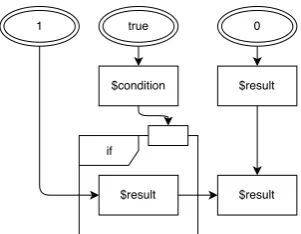
Listing 3.19: Example of a basicifconstruct

Figure 3.20: Graph description of anifconstruct

Note that the$resultvariable occurs multiple times as it is being assigned to on separate occasions. The two writes of constants are visible, as is the relationship between those two variable instances and a resulting instance which seemingly aggregates the other two. The graph shows that its resulting data is influenced by both constants0and1, with the exact value depending indirectly on the condition. (The concept of multiple instances of the same variable is further explained in section 3.2.1).

1 <? php

2 $ c o n d i t i o n = t r u e;

3

4 if ($ c o n d i t i o n) {

5 $ r e s u l t = 1;

6 } el s e {

7 $ r e s u l t = 2;

8 }

Listing 3.21: Example of anif-elseconstruct

1 <? php

2 $ c o n d i t i o n = t r u e;

3

4 if ($ c o n d i t i o n) {

5 $ r e s u l t = 1;

6 }

7

8 if (!$ c o n d i t i o n) {

9 $ r e s u l t = 2;

10 }

Listing 3.22: Equivalent code using two mutually exclusiveifconstructs

Figure 3.23: Graph description of anif-else

construct

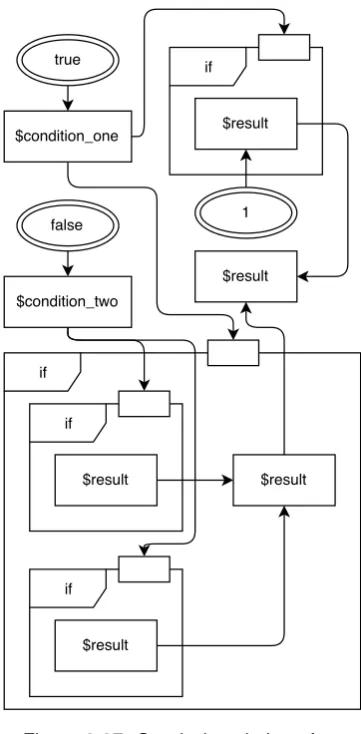
When the construct is extended with an else or elseif block, the same condition applies to those blocks. Remember that we don’t care the value of the condition is different for this block to execute, but only about the fact that the condition influences the decision of whether or not to execute this block. The

(23)

1 <? php

2 $ c o n d i t i o n _ o n e = t r ue;

3 $ c o n d i t i o n _ t w o = f a l s e;

4

5 if ($ c o n d i t i o n _ o n e) {

6 $ r e s u l t = 1;

7 } el s e if ($ c o n d i t i o n _ t w o) ) {

8 $ r e s u l t = 2;

9 } el s e {

10 $ r e s u l t = 3;

11 }

Listing 3.24: Example of aif-elseif-else

construct

1 <? php

2 $ c o n d i t i o n _ o n e = t r ue;

3 $ c o n d i t i o n _ t w o = f a l s e;

4

5 if ($ c o n d i t i o n _ o n e) {

6 $ r e s u l t = 1;

7 } el s e {

8 if ($ c o n d i t i o n _ t w o) ) {

9 $ r e s u l t = 2;

10 } el s e {

11 $ r e s u l t = 3;

12 }

13 }

Listing 3.25:if-elseif-elserewritten als a double if-else

1 <? php

2 $ c o n d i t i o n _ o n e = t r ue;

3 $ c o n d i t i o n _ t w o = f a l s e;

4

5 if ($ c o n d i t i o n _ o n e) {

6 $ r e s u l t = 1;

7 }

8

9 if (!$ c o n d i t i o n _ o n e) {

10 if ($ c o n d i t i o n _ t w o) ) {

11 $ r e s u l t = 2;

12 }

13

14 if (!$ c o n d i t i o n _ t w o) {

15 $ r e s u l t = 3;

16 }

17 }

[image:23.595.337.518.170.538.2]

Listing 3.26:if-elseconstructs rewritten as mutually exclusiveifconstructs

Figure 3.27: Graph description of an

(24)

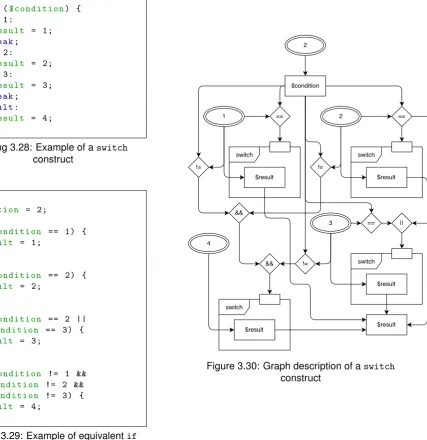
We can perform similar rewriting on the other conditional constructs. Aswitchconstruct is essen-tially a set of chainedif-elseif-elseblocks, as is made visible by rewriting the code in listing 3.28 into listing 3.29. The associated graph is included in figure 3.30.

1 <? php

2 $ c o n d i t i o n = 2;

3

4 s w i t c h ($ c o n d i t i o n) {

5 ca s e 1:

6 $ r e s u l t = 1;

7 b r e a k;

8 ca s e 2:

9 $ r e s u l t = 2;

10 ca s e 3:

11 $ r e s u l t = 3;

12 b r e a k;

13 d e f a u l t:

14 $ r e s u l t = 4;

15 }

Listing 3.28: Example of aswitch

construct

1 <? php

2 $ c o n d i t i o n = 2;

3

4 if ($ c o n d i t i o n == 1) {

5 $ r e s u l t = 1;

6 }

7

8 if ($ c o n d i t i o n == 2) {

9 $ r e s u l t = 2;

10 }

11

12 if ($ c o n d i t i o n == 2 ||

$ c o n d i t i o n == 3) {

13 $ r e s u l t = 3;

14 }

15

16 if ($ c o n d i t i o n != 1 &&

$ c o n d i t i o n != 2 &&

$ c o n d i t i o n != 3) {

17 $ r e s u l t = 4;

18 }

Listing 3.29: Example of equivalentif

[image:24.595.91.519.147.588.2]

constructs

Figure 3.30: Graph description of aswitch

construct

(25)

1 <? php

2 $ c o n d i t i o n = 3;

3 $ r e s u l t = -1;

4

5 w h i l e ($ c o n d i t i o n > 0) {

6 $ r e s u l t = $ c o n d i t i o n;

7 $ c o n d i t i o n- -;

8 }

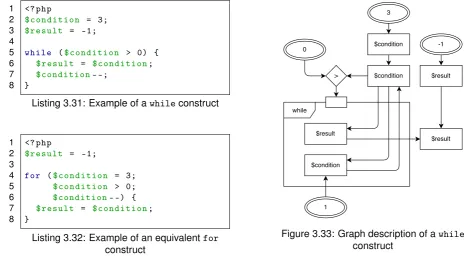
Listing 3.31: Example of awhileconstruct

1 <? php

2 $ r e s u l t = -1;

3

4 for ($ c o n d i t i o n = 3;

5 $ c o n d i t i o n > 0;

6 $ c o n d i t i o n- -) {

7 $ r e s u l t = $ c o n d i t i o n;

8 }

Listing 3.32: Example of an equivalentfor

construct

Figure 3.33: Graph description of awhile

construct

One notable exception is the foreach construct, which is a looping construct but doesn’t at first glance appear to be conditional. However, the construct is purely syntactic sugar for an iterator wrapped in awhileconstruct. The PHP Manual contains two examples which are functionally equivalent2, which

we’ve added here in listings 3.34 and 3.35. We will use the second example to generate our graph description, shown in figure 3.36.

1 <? php

2 $ a r r a y _ o n e = [" one ", " two ", " t h r e e "];

3 $ a r r a y _ t w o = [" one ", " two ", " t h r e e "];

4

5 f o r e a c h ($ a r r a y _ o n e as $ v a l u e) {

6 ec h o $ v a l u e;

7 }

8 f o r e a c h ($ a r r a y _ t w o as $ k ey = > $ v a l u e) {

9 ec h o $ v a l u e;

10 }

Listing 3.34: Example of aforeachconstruct

1 <? php

2 $ a r r a y _ o n e = [" one ", " two ", " t h r e e "];

3 $ a r r a y _ t w o = [" one ", " two ", " t h r e e "];

4

5 w h i l e (l i s t( , $ v a l u e) = ea c h($ a r r a y _ o n e) ) {

6 ec h o $ v a l u e;

7 }

8 w h i l e (l i s t($key, $ v a l u e) = ea c h($ a r r a y _ t w o) ) {

9 ec h o $ v a l u e;

10 }

Listing 3.35: Example of an equivalentwhileconstruct Figure 3.36: Graph description of a

[image:25.595.66.531.65.325.2]
(26)

Note that botheach andlist are PHP language constructs which in this case cover iteration over the elements and assigning the iterator result (an array) to multiple variables, respectively. The graph displays this as retrieving elements from the iterated array and having the element key being influenced by the array itself (an iterator retrieves all contained elements and so decides which elements to retrieve based on the iterated array). The result is then used as a condition forwhile, which works as expected because each returns false when the iterator has reached the end of the array, thus causing the condition to be untrue and subsequently breaks out of thewhileloop.

3.1.5

Dynamic code evaluation constructs

There are two other constructs in the PHP language which have a significant effect on the data flow, and they both allow for dynamic code evaluation. The includeconstruct is commonly used in large applications to separate code across multiple files and include that code where required. The argument supplied to this construct may be a variable. In graph descriptions, it is represented by a double-bounded construct frame, which (similar to that of conditional constructs) is annotated by its type and input.

1 <? php

2 $ i n c l u d e d _ v a l u e = 1;

Listing 3.37: Example file to be included

1 <? php

2 i n c l u d e " f i l e . php ";

3 $ r e s u l t = $ i n c l u d e d _ v a l u e;

Listing 3.38: Example of code being loaded

from a file Figure 3.39: Graph description of aninclude construct

Note that the constructsinclude_once,requireandrequire_onceperform similar duties toinclude

but differ in whether or not they allow multiple evaluations of the same file and/or whether or not they accept files not being found. These changes in behaviour are not considered relevant for this graph, although we will be annotating the constructs depending on which call is being used.

Another construct which is significant in code evaluation takes not a filename but the actual PHP code as its argument: eval. Its graph representation is similar to that ofinclude. The example code shown in listing 3.40 has its associated graph description included in figure 3.41.

1 <? php

2 $ c o d e = ’ $ e v a l _ v a l u e = 1; ’;

3 ev a l($ c o d e) ;

4 $ r e s u l t = $ e v a l _ v a l u e;

Listing 3.40: Example of code being loaded from a string

Figure 3.41: Graph description of aneval

Figure

Figure 3.4: Graph description of a variable
Figure 3.7: Graph description of operator use
Figure 3.18: Graph description of code withand without a user function
Figure 3.20: Graph description of an if construct
+7

References

Related documents

I understand and agree that the granting of this license requires my compliance with all applicable City of Birmingham Tax Code provisions, and state laws, as well as with

These include work requirements, number and duration of exposures, heat exchange components, rest area conditions, and worker clothing (Clayton, 1978). Actions to control heat

there was no reason to think that Hadrian's Wall had been abandoned before the general collapse of Roman rule in Britain in the early.. years of the

I understand and acknowledge that the institutions that comprise the South Dakota system of higher education are also permitted to share such academic, enrollment and financial

Thank you for your interest in Hillsborough Community College Health Sciences Programs. Acceptance to the Health Sciences Programs is selective, a complete

Hence, if an independence model is true and a misrounded treatment is carried out for the MAFF data, the second misleading effect in relation to the changing age-at-onset

Applicants are responsible for verifying that final official high school (regular or dual enrolled students) transcripts or GED scores have been received by the Hillsborough

Thank you for your interest in Hillsborough Community College Health Sciences Programs. Acceptance to the Nursing Program is selective, a complete application packet must be