http://go.warwick.ac.uk/lib-publications
Original citation:Vukotic, Marija and Pancrazi, Roberto (2012) TFP persistence and monetary policy.
Permanent WRAP url:
http://wrap.warwick.ac.uk/51403
Copyright and reuse:
The Warwick Research Archive Portal (WRAP) makes the work of researchers of the University of Warwick available open access under the following conditions. Copyright © and all moral rights to the version of the paper presented here belong to the individual author(s) and/or other copyright owners. To the extent reasonable and practicable the material made available in WRAP has been checked for eligibility before being made available.
Copies of full items can be used for personal research or study, educational, or not-for-profit purposes without prior permission or charge. Provided that the authors, title and full bibliographic details are credited, a hyperlink and/or URL is given for the original metadata page and the content is not changed in any way.
A note on versions:
The version presented here is a working paper or pre-print that may be later published elsewhere. If a published version is known of, the above WRAP url will contain details on finding it.
TFP Persistence and Monetary Policy
Roberto Pancrazi
Marija Vukoti´c
yToulouse School of Economics
Banque de France
First Draft: September, 2011
PRELIMINARY AND INCOMPLETE
Abstract
In this paper, by using several statistical tools, we provide evidence of an increase in the
persistence of the U.S. total factor productivity. In a forward looking model, agents’
opti-mal behavior depends on the autocorrelation structure of the exogenous shocks. Since many
monetary models are driven by exogenous TFP shocks, we study the interaction between
monetary policy and TFP persistence. Considering a New-Keynesian model, …rst, we
analyt-ically derive the interaction between the TFP persistence, monetary policy parameters, and
output gap and in‡ation. Second, we show that TFP persistence a¤ects the optimal behavior
of the monetary policy.
Toulouse School of Economics. E-mail: [email protected]
1
Introduction
The rational expectation hypothesis is the cornerstone of the vast majority of recent macroeco-nomic models. This hypothesis implies that the optimal behavior of the agents depends on their predictions about future relevant state variables, given the forward-looking nature of these models. Therefore, a change in the autocorrelation structure of those state variables leads to di¤erent opti-mal choices and, as a consequence, a di¤erent equilibrium outcome. In this paper, we …rst document that the autocorrelation structure of the one of the main driving forces of up-to-date macroeco-nomic models, namely the total factor productivity (TFP henceforth), has changed throughout the last decades, and second, by considering a fairly standard New Keynesian model, we investigate the relationship between the TFP autocorrelation structure and monetary policy.
Carefully identifying the statistical properties of the stochastic processes that drive economic models is a key step to linking the theoretical model to the data. Intuitively, a successful model should predict an equilibrium path for macroeconomic variables that resembles their data counter-part; this ability depends also on the assumed speci…cation of the exogenous processes driving the model. Eventually, these exogenous processes might be associated with an observable time series. For example, considering a neoclassical growth model driven by stochastic total factor productiv-ity, Solow (1957) showed how to derive a time series for the empirical counterpart of TFP, the so-called Solow residuals. During the last two decades the large literature on Real Business Cycle models showed that models driven by the TFP, whose statistical process was calibrated using the Solow residuals, were able to match the properties of the economic cycle.
However, the parameters describing the process of TFP might change throughout the years. Many economists have intensively studied changes in the variance of the error terms of the exoge-nous processes. In fact, the literature on the Great Moderation, the term describing the reduction of the volatility of the macroeconomic variables after the early 1980s, has investigated whether a reduction of the magnitude of the shock hitting the driving forces of the economy was the main source of the moderation. This hypothesis, de…ned as the Good-Luck hypothesis, was endorsed by several authors1, who documented a decline in the variance of the exogenous processes driving
the models, in particular of the TFP. Their analysis uses rigorous statistical tools as well as the
estimation of rich macroeconomic models.
What are the consequences of a decline in the variance of the shock for the equilibrium of a rational expectations macroeconomic model? The policy functions that describe the relationship between control variables and state variables of the model depend on the set of the parameters of the model, including the variances of the shocks. However, a common procedure to solve macroeconomic models is to linearize the equilibrium conditions and to …nd a linear approximation of the true policy functions. In this case, however, a change in the variance of an exogenous shock does not alter the relationship between the control variables and the state variables, since the magnitude of the shock is only a scale-factor in a linearized equilibrium.
Unlike changes in the variance of its innovation, changes in the autocorrelation structure of an exogenous process have …rst-order e¤ects on the equilibrium of a rational expectations model. Intuitively, a change in the persistence of an exogenous process a¤ects the way agents compute expectations about the future state of the economy. This is a natural consequence of the forward-looking nature of the models. Moreover, the equilibrium outcome of the macroeconomic models is used by policy makers when deciding their policies. For example, in the optimal monetary literature, the policy parameters chosen by the monetary authority are those that minimize a given loss function, taking into account that the loss function depends on the equilibrium dynamics of the model, which depends on the parameters of the exogenous processes. It is therefore obvious that if the autocorrelation structure of the exogenous process a¤ects the equilibrium, then it also a¤ects the optimal policy decisions. Hence, in this paper we also thoroughly analyze the interaction between the autocorrelation structure of TFP, the monetary policy parameters, the equilibrium outcome of a model, and optimal monetary policy.
In particular, to gain some intuition, we …rst consider a simple monetary model, where the monetary authority solely chooses the nominal interest rate as a function of in‡ation. Since in this setting money is neutral, the monetary authority does not a¤ect the equilibrium dynamics of real variables, but only that one of nominal variables, such as in‡ation. Nevertheless, this model is useful for understanding the interaction between monetary policy parameters and the persistence of TFP. This interaction is generated by the nature of the real interest rate, which in equilibrium is a function of the TFP persistence given the forward-looking nature of the model, by the assumed Taylor rule, which assumes the nominal interest rate to be a function of in‡ation, and by the Fisherian equation, which relates the nominal interest rate to the real interest rate and in‡ation. As a result, in equilibrium in‡ation is a non-linear function of the policy parameters and the TFP persistence. In this model, if the monetary authority responds more aggressively to in‡ation, the variance of in‡ation declines. However, the e¤ectiveness of the monetary policy, measured by the change in in‡ation variance for a marginal change in the monetary policy parameters, is a non-linear function of the TFP persistence. We can easily pin down the value of the TFP persistence that maximizes this e¤ectiveness for each value of the monetary policy parameter.
price settings and imperfect competition. The monetary policy is assumed to follow a standard Taylor rule. We focus on the equilibrium dynamics of two variables, output gap and in‡ation, since they are the two variables relevant for the welfare calculation. Considering a …rst-order approxima-tion, we analytically derive the instantaneous response of these two variables to a technology shock. These responses are non-linear functions of the TFP persistence and monetary policy parameters. In particular, an increase in the response to in‡ation decreases the responses of both output gap and in‡ation to the shocks. This is the well-known Taylor principle: when the monetary authority responds more strongly to in‡ation, it guarantees that the real interest rate eventually rises with in‡ation. The increase in the real interest rate creates a counter-e¤ect on in‡ation, since a higher real interest rate causes a fall in the output gap and in deviations of the marginal cost from the steady state. Moreover, we show that this e¤ect depends on the TFP persistence. In particular, when the persistence of TFP is larger, its predictability increases, thus implying that the natural interest rate is closer to its steady state value. When the natural interest rate is stable around its steady state value, the output gap is less a¤ected by a technology shock. However, the relationship between in‡ation response to a technology shock and TFP persistence is non-monotone. In fact, for the lower values of the monetary policy response to in‡ation, an increase in TFP persistence implies a larger e¤ect of a technology shock on in‡ation, which, equivalently, implies a larger in‡a-tion variance. Given the tractability of the model, we can analytically pin down this interacin‡a-tion, as well as the relationship between TFP persistence and monetary policy e¤ectiveness. We check the robustness of our results using a medium-scale dynamic stochastic general equilibrium model as in Smets and Wouters (2007) and show that our results carry over even when capital is added into our model.
the TFP persistence. We …nd that, ceteris paribus (monetary policy parameters included), an increased persistence of TFP generates a larger welfare loss. However, by responding strongly to in‡ation, monetary authority mitigates the negative welfare e¤ect of the increased persistence. Finally, we consider a model better suited for computing the optimal monetary policy, introducing cost-push shocks, as in Galí (2008). We conclude that the optimal monetary policy implies a stronger response to in‡ation, as well as output gap, as the persistence of technology rises. A drawback of this procedure is that for high values of the persistence, this method does not produce equilibrium since the determinacy condition is not satis…ed for large values of the persistence, as also showed by Giannoni (2010).
The structure of the paper is as follows. In Section 2, we provide the evidence of the increased TFP persistence. Then we explore the relationship between monetary policy, TFP persistence and in‡ation dynamics using a simple monetary model in Section 3, and using a basic New Keynesian model in Section 4. In Section 5, we establish the link between the increased persistence of technology, monetary policy, and output gap and in‡ation dynamics. Finally, in Section 6 we study the optimal monetary policy decision as a function of TFP persistence. Section 7 concludes.
2
Total Factor Productivity Persistence
The overall volatility of macroeconomic variables declined after the early 1980s. While this phe-nomenon has been greatly investigated in the literature (see Giannone, Lenza and Reichlin (2008) for the summary of the literature), the behavior of the volatility at di¤erent frequencies was ne-glected. However, Pancrazi (2011a) investigates macroeconomic volatility dynamics of a large set of macroeconomic variables at di¤erent intervals of frequencies and shows that their higher-frequency volatility has dropped signi…cantly, but the volatility at medium frequencies2 has remained roughly constant. This redistribution of the variance towards lower frequencies can be interpreted as an increase in the persistence of macroeconomic variables. As an illustrative exercise, by using simple parametric models, we formally estimate an increase in the persistence of real per-capita output and consumption in the U.S. Output is measured as Gross Domestic Product, and consumption is measured as non-durable consumption and services. As in Pancrazi (2011b), we assume that the
stationary component of these variables, de…ned as the deviation from a non-linear trend3, follows an AR(4) process. The rich autoregressive structure allows for a better characterization of the spectral density. We then estimate the persistence of the process by computing the largest root of the lag polynomial. Table 1 displays the point estimates of the largest root of the forth order lag polynomial and the standard deviation of its innovation, for output and consumption, before (Sample 1 from 1950:1 to 1982:4) and after (Sample 2 from 1983:1 to 2009:4) the early 1980s4.
The estimates con…rm increased persistence of the two variables during the last three decades and a reduction of the variance of the error terms.
A branch of the macroeconomic literature on time-varying volatility of the economic cycle has explained the reduction in the higher-frequency variance with a structural change of the magnitude of the shocks. For example, Stock and Watson (2002, 2003), Ahmed, Levin and Wilson (2004), Primiceri (2005), Galí and Gambetti (2009), Liu, Waggoner and Zha (2009) show that the standard deviation of the innovation of the shocks that drive macroeconomic dynamics shrank after the mid-80s, thus providing support for the Good luck hypothesis to explain Great Moderation. However, this hypothesis fails to explain the di¤erent dynamics of the volatility at di¤erent frequencies. In fact, a change of the magnitude of the innovation of a process implies a proportional shift of the spectral density at all frequencies, which is at odds with the stylized facts presented above. Therefore, in this section we investigate the dynamics of the autocorrelation structure of the shocks, namely the productivity shock, as a possible driver of this increased persistence of macroeconomic variables.
2.1
The Increased Persistence of Total Factor Productivity
Since the beginning of the real business cycle analysis, macroeconomists have recognized the im-portance of the TFP as one the main driving forces of the dynamics of macroeconomic variables (see for example Kydland and Prescott (1982, 1991), Long and Plosser (1983), Prescott(1986), King, Plosser and Rebelo (1988), Cogley and Nason (1995)). The contribution of technology to
capturing the movements and comovements among economic variables is large even when we al-low for additional exogenous disturbances, as predicted by medium-scale DSGE models (Smets and Wouters (2007)). As a consequence, the literature on macroeconomic volatility dynamics has focused on exogenous disturbances, TFP in particular, and its role in explaining a change in the volatility dynamics. In fact, one branch of the literature suggests that the decrease of the variance of the technology shock accounts for a large fraction of the total decline of the volatility of macro-economic variables (Stock and Watson (2002, 2003), Ahmed, Levin and Wilson (2004), Primiceri (2005), Galí and Gambetti (2009), Liu, Waggoner and Zha (2009)). Given these considerations, it is natural to use a similar approach to study whether a change of the autocorrelation structure of TFP can explain the additional dimensions of the volatility dynamics described above, namely the increased persistence of real variables and the uneven decline of the volatility at di¤erent frequencies.
In order to study whether the technology process has changed, we …rst construct the series of the TFP. Our de…nition of TFP accounts for a time-varying capacity utilization by constructing a measure of TFP as:
T F Pt =
Yt
L1t (UtKt)
: (1)
This measure is consistent with the measure used in the medium-scale DSGE models, largely used in the recent macroeconomic literature. Greenwood, Hercowitz and Hu¤man (1988), Burnside and Eichenbaum (1996), Basu and Kimpball (1997), Altig, Christiano, Eichenbaum and Lindé (2005), among others, point out that accounting for a time-varying capacity utilization is important for obtaining a stronger propagation of the series in response to the shocks.
We set the labor share,1 , equal to0:64, which is the average value of the labor share series recovered from the Bureau of Labor Statistics (BLS). From the same source we recover annual data on capital services, Kt. We interpolate the capital services series to obtain quarterly series,
assuming constant growth within the quarters of the same year. Non-farm business measures of hours, Ht; and output, Yt; are also retrieved from the BLS: The series of capacity utilization, Ut;
is retrieved from the Federal Reserve Board, and is based on the manufacturing data.
are described in detail below.
2.2
Split Sample Statistics
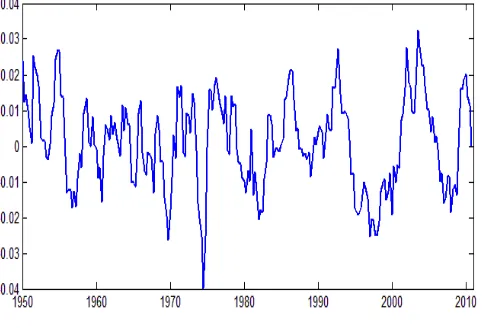
As an initial exercise we study the behavior of the persistence of TFP in two subsamples, be-fore and during the Great Moderation. However, there is no particular reason to assume that a change in the autocorrelation structure of productivity took place in the early eighties, when many macroeconomists have dated a break in the variance of the shock. We use this assumption only for convenience and it will be relaxed in the following exercises. We assume that the stationary component of the total factor productivity, T F Pt; obtained by eliminating a non-linear trend and
displayed in Figure 1, follows a …rst order-autoregressive process, i.e.:
T F Pt= T F Pt 1+ ""t "t iid
N(0;1): (2)
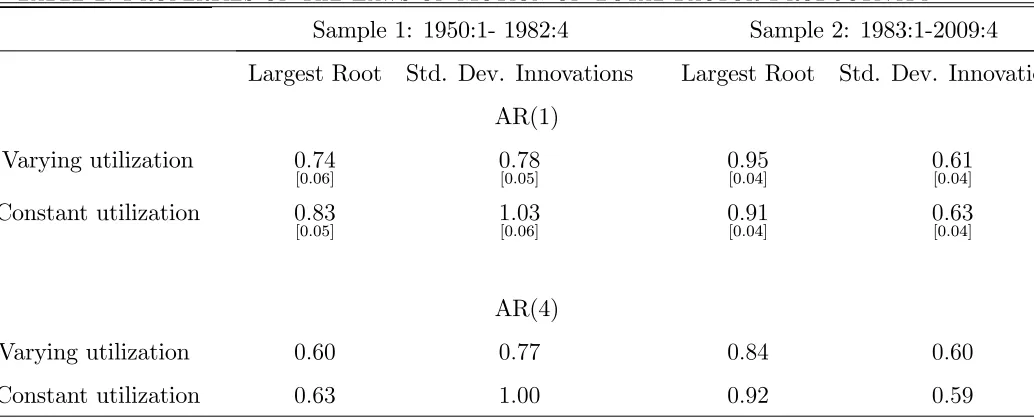
Table 2 shows the estimates of ;the largest and unique root of the lag polynomial, and of ";
the standard deviation of the innovation, in the two subsamples. The top panel of the table shows two important …ndings. First, the variance of the innovation of technology has largely decreased in the last thirty years. Second, the persistence of the TFP has increased instead. These results hold also in the case we consider a constant capacity utilization, i.e. Ut= 1:
subsample. However, the reduction is smaller when lower frequencies are considered. This e¤ect is driven by the higher persistence of the process in the second subsample, as visualized by the shift of density towards lower frequencies in the second subsample. In order to highlight the larger relative importance of the lower frequencies in explaining the volatility of TFP in the second sub-sample, Figure 3 plots the normalized-spectrum of the estimated AR(4) process for the TFP in the two subsamples. The area below the normalized spectrum in a given interval of frequencies is equivalent to the fraction of the variance attributable to those frequencies. It is evident that a portion of the total variance captured by the lower frequencies is much larger in the second than in the …rst subsample.
2.3
Rolling Windows Estimates
As mentioned above, there is no particular reason to date a possible increase of the persistence of TFP in the early eighties. Therefore, we now analyze the TFP persistence dynamics with no references to a particular date. Assuming that the stationary component T F Pt follows a …rst
order autoregressive process as in (2); we can visualize the evolution of the persistence of TFP over time by constructing a rolling window estimates as follows:
^t= ^ T F P tj=t k fort =k+ 1; :::; T;
where ^t (xt) indicates the point estimate of the …rst order autoregressive parameter for the time
series xt, k indicates the length of the window, T is the length of the time series, and fxtgtt21
represents the subset of observations of the time seriesxtbetween the periodst1andt2:Accordingly,
^t is the value of the persistence of TFP when k observations of the series T F Pt prior to time t
are considered: Analogously, we compute the rolling windows estimate of the standard deviation of the innovations, as:
^";t = ^" T F P t
j=t k f ort=k+ 1; :::; T;
where ^";t(xt) indicates the point estimate of the standard deviation of the error term when xt
follows a …rst order autoregressive process.
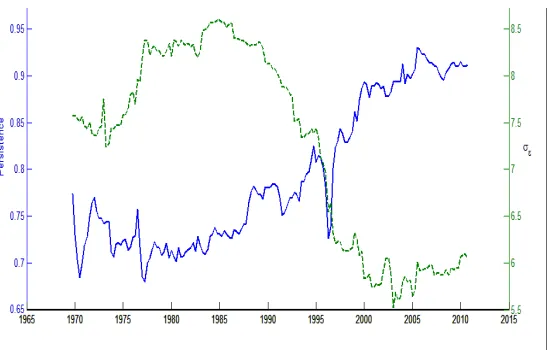
right axes). We observe that the persistence of TFP has gradually increased throughout the sample. On the other hand, the standard deviation of the innovations has declined, which is consistent with the change of the volatility dynamics described in the previous section. Interestingly, the increasing in persistence seems to match the timing of the declining of the variance of the shocks.
In order to assess whether our …ndings depend on the assumed statistical process, we compute similar rolling windows statistics by estimating sequences of forth-order autoregressive process. In this case, a measure of persistence is given by the largest root of the forth order lag polynomial. We still observe a noticeable increase in the TFP persistence. Therefore, this outcome is not an artifact of the assumed stochastic process.
2.4
Recursive Estimate Statistics
In the recursive least squares we repeatedly estimate the statistical model in (2), using a larger subset of the sample data of TFP for each repetition. For example, the …rst estimate ^RE1 is obtained by using the …rst k =16 observations of T F Pt: Then the next observation is added to
the data set and k+ 1 observations are used to compute the second estimate ^RE2 . This process is repeated until all the T sample points have been used, yielding T k+ 1 estimates of the^RE:
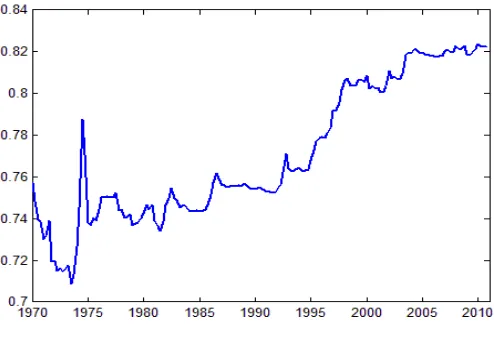
Figure 5 plots the recursive estimate ^REt : Since the number of observations used to obtain initial estimates ^REt is relatively small, the estimates might be imprecise, we cut the …rst twenty years of estimates and report, thus, the estimates starting from 1970, which is the starting date of the rolling-window statistics as well. Also this method suggests that the persistence of technology has increased in the second part of the sample.
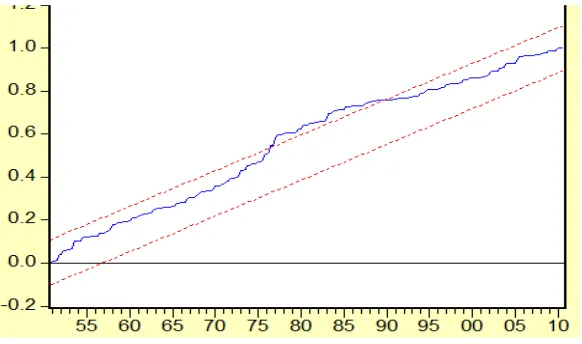
Finally, we use a CUSUM of squares test (Brown, Durbin, and Evans, 1975). The expected value of this statistics under the hypothesis of parameter constancy is a straight line that goes from zero att=k, to unity att =T:A signi…cant departure of the test statistics from its expected value is assessed by reference to a pair of parallel straight lines around the expected value.5 Figure
8 displays the CUSUM of squares test against t and the pair of 5 percent critical lines. Since the CUSUM test moves outside the band approximately in the middle part of the sample, the diagnostic suggests the presence of a change in the autocorrelation structure of TFP.
2.5
Time-Varying Parameters Estimation
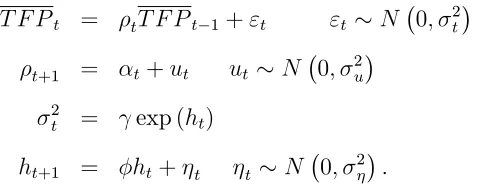
The statistical analysis presented in this section suggests a slow change in the persistence of TFP. It is then natural to estimate a time-varying parameter model for TFP. In addition, since Figures 4 and 5 suggest a decline of the variance of the error term in the regression, we include stochastic volatility in the model (TVP-SV) as well. In particular, we assume that the model is given by the following equations:
T F Pt = tT F Pt 1+"t "t N 0; 2t
t+1 = t+ut ut N 0; 2u
2
t = exp (ht)
ht+1 = ht+ t t N 0;
2
:
[image:13.612.187.426.399.491.2]We follow Nakajima’s (2011) Markov Chain Monte Carlo approach to estimate the parameters of the model. Appendix A reports the technical detail of the estimation procedure, as well as the outcome of the MCMC estimation.
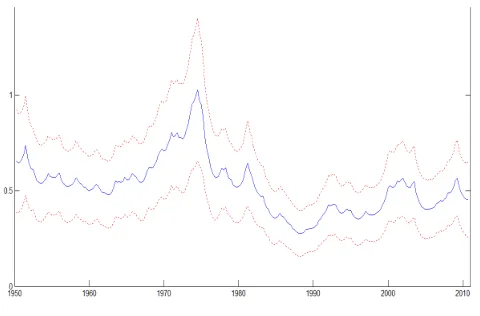
Figure 9 and Figure 10 show that also a TVP-SV model estimate the increased persistence of TFP as well a decline of the variance of its innovations.
3
A Simple Monetary Model and TFP persistence
The persistence of the exogenous shocks has a crucial role in de…ning the equilibrium dynamics of the macroeconomic variables in general equilibrium models. In fact, since these models are in general forward looking, the ability of the agents to forecast the future values of the exogenous variables a¤ects their contemporaneous decisions. In general, the equilibrium dynamics of the model can be represented by the policy functions:
yt = g(xt; ; )
xt+1 = h(xt; ; )
where, yt denotes the vector of control variables of the model, xt denotes the vector of state
variables, is the set of structural parameters of the model, and is the set of parameters describing the stochastic processes of the exogenous variables. It is evident that a change in the persistence of an exogenous process a¤ects the equilibrium dynamics of the model.
Since the true policy functions h( ; ) and g( ; ) are usually hard to compute analytically, a linear approximation of the two functions is often a convenient way to represent the dynamics of the model. In this case, we have:
yt ' ~g( ; %)xt
xt+1 ' ~h( ; %)xt
where now g~ and h~ are reduced form parameters that depend both on the structural parameters of the model, ; and the set of parameters % that describe the autocorrelation structure of the exogenous processes. It is important to notice that parameters that a¤ect the variance of the exogenous processes but not their autocorrelation structure (for example the variance of the in-novation of the process) do not have any impact on the equilibrium dynamics of the model. This is a trivial consequence of the …rst-order approximation. On the other hand, a change in the autoregressive component of the exogenous shocks, which is contained in the%, alters the reduced form parametersg~and h~, thus a¤ecting the equilibrium path of the control variables.
total factor productivity, which is an important exogenous driving force of a large family of macro-economic models, and, in particular, of monetary models. Since monetary authorities construct their policy based on the equilibrium dynamics of the economy, understanding the interaction be-tween monetary tools and a change in the persistence of TFP is an important question to address. We will make use of standard monetary models to illustrate this relationship.
3.1
A Simple Monetary Model (Neutrality of Money)
In order to study the interaction between the persistence of total factor productivity and mone-tary policy, we …rst consider a very simple stylized model of classical monemone-tary economy. Since the model is standard (see Galí, p.16) we present the formal equations in Appendix B and here we only describe its key features. The representative agent maximizes the lifetime utility function. The instantaneous utility function depends upon consumption and leisure. The agent can trade one-period nominally risk-less bonds. A representative …rm produces output by employing labor. The productivity of labor evolves exogenously according to a …rst order autoregressive process. The model features perfect competition and fully ‡exible prices in all markets. In addition, the monetary authority follows an in‡ation-based interest rate rule. As a consequence of these assump-tions, the real variables are determined independently of monetary policy. However, in this section we are interested in the dynamics of in‡ation, which will depend on the interaction between the monetary policy and the statistical properties of the technology shock.
The central bank adjusts the nominal interest rate, it, according to:
it= + t (3)
where t denotes in‡ation, log ( ) is the steady-state value of the real interest rate, with
being a discount factor, and with 0:Given the Fisherian equation:
it =Et t+1+rt;
where rt is the real interest rate, Et indicates the expectations operator conditional to the
in‡ation:
t= 1
X
k=0
(k+1)E
tr^t+k; (4)
where r^t=rt :
In equilibrium the real interest rate is given by:
rt = + Etf at+1g (5)
where = (1 1+)+''+ ; is the inverse of intertemporal elasticity of substitution, 1 is the labor share in the Cobb-Douglas production function, and ' is the inverse of the Frisch elasticity of labor supply. Assuming that the technologyat evolves as a …rst order autoregressive stochastic
process:
at+1 = aat+ a"t+1 (6)
then, in‡ation dynamics in equilibrium is given by:
t= aat:
with
a =
(1 a)
a
: (7)
It follows that the variance of in‡ation, 2, is given by:
2 = 2
a 2 a (1 2 a) (8)
The two equations above display two important implications. First, as well known in monetary economics, the monetary policy can alter the volatility of in‡ation by increasing the monetary policy parameter : Second, as previously described, the autocorrelation structure of the exoge-nous process, driven by a; alters the equilibrium dynamics of in‡ation and its variance. In fact,
the reduced form parameter a, which measures the instantaneous e¤ect of a technology shock
on in‡ation, is a non-linear function of a: These two features imply that the e¤ectiveness of the
actually changed throughout the sample, it is interesting to study how the e¤ectiveness of the monetary policy varies with a:
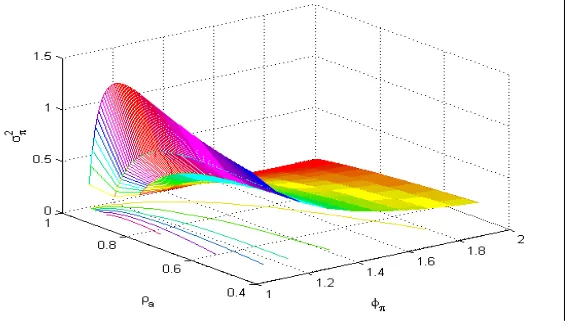
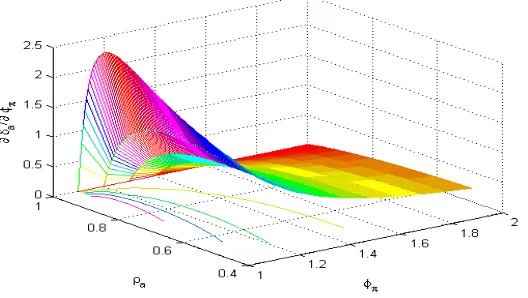
In order to graphically illustrate the connection between these two parameters, we …rst assign some values to the parameters of the model, using a standard calibration. In particular, following Galí (2008), we set = 0:99; = 1, ' = 1, = 13, a = 1: Figure 11 and Figure 12 display this
interaction. In Figure 11 the z-axes reports the instantaneous response of in‡ation to a technology shock, a: The plot shows two relevant features. First, for any value of a, by responding more
aggressively to in‡ation (higher ) monetary policy can lower the e¤ect of a technology shock on in‡ation. This, once again, is a well known result in monetary economics and comes directly from(7). Second, the magnitude of this e¤ect drastically depends on the persistence of technology,
a: For example, …xing close to 1.1, the lower value on the x-axis, a marginal change of the
monetary policy parameter has the largest e¤ect on a when a takes values around 0.9 and
smallest when a takes values at the extremes (0.99 and 0.5). This insight is con…rmed when we
plot the variance of in‡ation in Figure 12. The non-monotone shape of the surface is due to the interactions between the reduced form parameter a and the unconditional variance of technology
a
(1 2
a); when a varies. Interestingly, there is a value of the TFP persistence that maximizes the
variance, when the monetary policy parameter is particularly low. Moreover, the stabilizing e¤ect of a small change of largely varies in the space( a; ). Therefore, by using a very simple model, we showed that the variance of in‡ation, and the e¤ectiveness of a given change of the monetary policy parameters varies non-linearly with the autocorrelation structure of the exogenous shock.
We can analytically investigate the properties of the relationship between the instantaneous response of in‡ation to a technology shock, a;the monetary policy parameter, ;and the
persis-tence of TFP, a; by studying how the variance of in‡ation and the e¤ectiveness of the monetary
policy, measured by the derivative of a with respect to monetary policy parameter ; varies
with a: Figure 12 shows that the relationship between variance of in‡ation, TFP persistence and
monetary policy parameters is non-monotone for low values of . The tractability of this simple model allows us to compute analytically the locus of pairs ( a; ) that maximize the in‡ation variance. We can then express this relationship, as showed in the following Proposition.
Proposition 1 Consider a monetary policy model characterized by the in‡ation dynamics in (4);
process for the total factor productivity as in (6): Then, the variance of in‡ation is non-monotone in a and the value of the monetary policy response to in‡ation that maximizes the variance
of in‡ation in (8) is given by:
= 1 + a 2a (9)
See Appendix C for the proof.
Next, we compute the level of for which the e¤ectiveness of monetary policy is maximized. We de…ne the e¤ectiveness of the monetary policy as the e¤ect of a marginal change in the monetary policy parameter on the instantaneous response of in‡ation to a technology shock, captured by
a: From(7); we obtain:
@ a
@ =
(1 a)
( a)2 : (10)
Figure 13 plots how this e¤ect varies with the current level of and the persistence of TFP; a:
It is evident that a marginal increase in the monetary policy parameter has larger e¤ect when is small (close to one) and when a assumes values around 0.9. When a is very close to unity,
the monetary policy does not have much e¤ect on the overall variance of in‡ation. The reason is that in this model in‡ation is a consequence of the departure of the real interest rate from its steady state value. When the persistence of TFP approaches one, the interest rate is always close to its steady state value and therefore the in‡ation is particularly small. As an obvious consequence, the monetary policy has no e¤ect on the variance of in‡ation. Another interesting feature illustrated by the function in (7); is the non-linearity of the monetary policy e¤ect on a
for di¤erent values of TFP persistence. This non-linearity is due to the term in the denominator
( a); which results from the assumed Taylor rule and the law of motion of the exogenous process. This term highlights the deep interaction between the autocorrelation structure of TFP and the e¤ectiveness of monetary policy. Finally, an additional implication of Figure 13, is that the role of the persistence a on @ a
@ diminishes when is larger.
Using this illustrative model, it is trivial to derive the value of for which the e¤ect of monetary policy on the response a is maximized:To do that, we simply take the second derivative
@2 a
maximizes the e¤ect of the monetary policy is simply:
= 2 a:
Proposition 2 Consider a monetary policy model characterized by the in‡ation dynamics in (4);
by the monetary policy rule in (3); the equilibrium interest rate as in (5); and by the stochastic process for the total factor productivity as in(6):Then, the value of the monetary policy response to in‡ation for which the e¤ect of a change in the monetary policy parameter on the instantaneous
response of in‡ation to a technology shock, @ a
@ ; with a de…ned in(7); is maximized is given by:
= 2 a: (11)
See Appendix C for the proof.
In summary, this trivial model clearly illustrates the relationship between monetary policy parameters, technology persistence, and their e¤ect on in‡ation. Next, we will study the same relationship in a model in which money is not anymore neutral as to allow for the real variables to depend on monetary policy parameters as well.
4
A New Keynesian Model and TFP Persistence
4.1
Equilibrium
The model is characterized by two rigidities. First, the perfect competition assumption is aban-doned by assuming that each …rm produces a di¤erentiated good and sets its price. Therefore, households must decide how to allocate its consumption expenditures among the di¤erentiated goods in addition to making the usual consumption/savings and labor supply decision. Second, …rms set their prices a lá Calvo (1983) and Yun (1996), i.e. in any given period, only a fraction of randomly picked …rms is allowed to reset their prices. These assumptions imply that monetary variables are not neutral, since they a¤ect the equilibrium path of real variables. As a consequence, we can also study how the interaction between monetary policy and TFP persistence a¤ects the real block of the model. Since the model is fairly standard, we present only its equilibrium condi-tions. A complete representation of the model is provided in Appendix B. The non-policy block of the model is composed of the New Keynesian Phillips Curve:
t= Et t+1+ ~yt, (12)
and the dynamic IS equation, given by
~
yt=
1
(it Et t+1 rtn) +Et(~yt+1): (13)
Here, Et denotes expectation conditional on the information at time t, t denotes the in‡ation
rate at timet; it is the nominal interest rate at timet, rtn is the natural real interest rate,y~tis the
output gap de…ned as the deviation of output from its ‡exible-price counterpart, is the discount factor, = + '1+ with = (1 (1)(1 +)(1") ); is the inverse of intertemporal elasticity of substitution, 1 is the labor share in the production function, ' is the inverse of the Frisch elasticity of labor supply, is the price stickiness parameter, and" is the elasticity of substitution among the di¤erentiated goods. The dynamics of the model are governed by two exogenous processes. First, the level of technology, which we denote as at, follows a …rst order autoregressive,
AR(1); process6:
6The technology a¤ects the logarithm of output: y
at= aat 1+ a"at; where " a
t N(0;1): (14)
Second, the monetary policy shock, denoted as vt; follows a similar …rst order autoregressive
process:
vt= vvt 1+ v"vt; where " v
t N(0;1): (15)
The monetary policy shock is considered to be the exogenous component of the nominal interest rate rule:
it= + t+ yy~t+vt; (16)
where it is the nominal interest rate at time t, and is the household’s discount rate, with =
log ( ).
Up to a …rst-order approximation, the output gap can be written as the following function of the two exogenous processes:
~
yt= v ; y; v; vt+ a ; y; a; at; (17)
where v and a are functions of the Taylor rule parameters ; y ; the persistence parameters
of the exogenous processes ( aor v), and all the other structural parameters of the model gathered in the vector :In particular, by using the methods of undetermined coe¢ cients, we can compute the reduced form parameters v ; y; v; and a ; y; a; :
v ; y; v; =
(1 v)
(1 v) (1 v) + y + ( v) (18)
a ; y; a; =
(1 a) (1 a)
(1 a) (1 a) + y + ( a); (19)
where = (1 1+)+''+ and is de…ned as above. Notice that these expressions imply that the relationship between the persistence of the exogenous shocks and the level of output gap is non-linear in the monetary policy parameters.
Assuming that "a
t and "vt are independent, it is trivial to obtain the variance of output gap:
V ar(yt) = v ; y; v;
2 2v
1 2
v
+ a ; y; a;
2 2a
1 2
a
We can compute the equilibrium equation also for in‡ation, which is:
t = v ; y; v; vt+ a ; y; a; at (21)
with
v ; y; v; =
(1 v) (1 v) + y + ( v) (22)
a ; y; a; =
(1 a)
(1 a) (1 a) + y + ( a) !
: (23)
4.2
The E¤ects of Monetary Policy
The basic New Keynesian model has been a workhorse model for studying monetary policy. In fact, a lot of attention in the last decade has been devoted to understanding the stabilizing e¤ects of the monetary authority on macroeconomic variables. When the monetary authority responds more strongly to in‡ation (higher ), it guarantees that the real interest rate eventually rises with in‡ation. The increase in the real interest rate creates a counter-e¤ect to in‡ation, since a higher real interest rate causes a fall in the output gap and in deviations of the marginal cost from the steady state. This is a well known intuition behind the Taylor Principle. Therefore, an increase in diminishes the exposure of output gap and in‡ation to monetary shocks, since they are smoothed out by the “lean-against-the-wind” strategy adopted by the monetary authority. This intuition explains why an increase of lowers both v ; y; v; and v ; y; v; . In
other words, a more aggressive monetary policy reduces the impact of monetary shocks both on in‡ation and on output gap.
However, an increase of has also a secondary e¤ect, which has drawn much less attention in the literature. In fact, as displayed in equations (17); and (21);the reduced form parameters
a ; y; a; and a ; y; a; also depend on the monetary policy parameters. Therefore,
@ a ; y; a;
@ =
(1 a) (1 a)
(1 a) (1 a) + y + ( a) 2 (24)
@ a ; y; a;
@ =
2 (1
a)
(1 a) (1 a) + y + ( a) 2: (25)
Notice that both derivatives are positive. Since a ; y; a; and a ; y; a; are negative, a more aggressive monetary policy reduces the instantaneous response of in‡ation and output gap to a technology shock. This e¤ect goes in the same direction as the Taylor-principle e¤ects, which reduces the variance of in‡ation by eliminating both the technology-shock and the monetary-shock e¤ect. Moreover, the e¤ects of monetary policy on the instantaneous responses of output gap and in‡ation to a technology shock are also a¤ected by the TFP persistence. We will explore this interaction in the next subsection.
4.3
TFP Persistence and Monetary Policy
In order to illustrate the relationship between monetary policy, technology persistence and instan-taneous responses of in‡ation and output gap to a technology shock, we …rst use a fairly standard calibration of the New Keynesian model. We calibrate preference and technology parameters fol-lowing Galí’s baseline calibration: = 0:99; = 1, = 1=3, "= 6, and = 2=3. We assume that the parameter of the Taylor rule with output gap is equal to y = 0:125:We then plot the values of
the instantaneous responses a ; y; a; and a ; y; a; ;as a function of the monetary
policy response to in‡ation, with 2[1:1;2] and the persistence of TFP, with a2[0:5;0:99]:
Figure 14 plots the instantaneous response of output gap to a technology shock, a ; y; v; :
Two e¤ects are evident from the …gure. First, …xing a;the instantaneous response of output gap
is an increasing function of the Taylor rule parameter with in‡ation, : Similarly, …xing ; the instantaneous response of output gap is an increasing function of the TFP persistence a: This
result is general and does not depend on particular values of the structural parameters, but only on the conventional restrictions on their values, as proved in the following Proposition.
Proposition 3 Consider the instantaneous response of output gap to a technology shock in the
<1; >0; " >0; >0, and >1: Then
@ a ; y; a;
@ >0 (26)
and
@ a ; y; a;
@ a >0 (27)
for any structural parameter vector :
See Appendix C for the proof. We now study the instantaneous response of in‡ation to a technology shocks, a ; y; v; ; plotted in Figure 15. The …gure shows that whereas an increase in the monetary policy parameters always decreases in absolute value the response of output gap due to the partial derivative in(26) being always negative, the e¤ect of a change in the TFP persistence on a ; y; v; is non-monotone, as it was for the output-gap response.
In fact, when is particularly low, higher TFP persistence …rst increases the magnitude of the in‡ation-response to a technology shock and then it decreases it. This feature is important for the monetary policy authority: assume that the monetary authority measures welfare as a linear combination of in‡ation variance and output gap variance (as rationalized in the next session). An increase in the persistence of TFP has two opposite e¤ect: it lowers the output gap variance (welfare improving) and it increases the in‡ation variance (welfare decreasing).
As in case of the simpler model, we can compute the value the monetary policy parameter for which the instantaneous response of in‡ation to a technology shock is maximized, as stated in the following Proposition.
Proposition 4 Consider the instantaneous response of output gap to a technology shock in the New
Keynesian model presented above, as in (23): Assume that the structural parameters satisfy the restriction of Proposition 3. Then there exists a value that maximizes instantaneous response
a ; y; a; : This value is:
= + (1 a)
2
(1 ) y
See Appendix C for the proof.
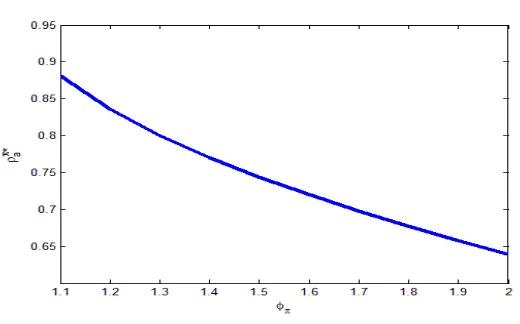
Figure 16 displays the TFP persistence a that maximizes the instantaneous impact ; y; a;
as a function of :
An additional feature of the model is that the e¤ectiveness of monetary policy, de…ned as the e¤ect of a marginal change in on the instantaneous response of a variable to a technology shock, also varies with a;as showed by equations(24);and(25):Figure 17 and Figure 18 display the proposed measure of e¤ectiveness for output gap and in‡ation respectively: In particular, the …gures show what is the e¤ect of a marginal change of the monetary policy parameter on a ; y; a; and a ; y; a; : Hence, a large value in the z-axes means that the
instantaneous responses are particularly sensitive to small changes in the monetary policy for the corresponding values of and a:
These …gures show that e¤ectiveness of the monetary policy is particularly sensitive to the persistence of technology when the in‡ation-Taylor rule coe¢ cient is particularly low. However, this relationship is non-monotone, since there exist values of the monetary policy parameter that maximize the e¤ectiveness for a given value of a: The next Proposition pins down these values.
Proposition 5 Consider e¤ectiveness of the monetary policy on the instantaneous responses of
output gap and in‡ation to a technology shock, as de…ned in (24) and (25). Assume that the structural parameters satisfy the restrictions of Proposition 4. Then there exist values ef f(~y)
and ef f( ) that maximize respectively the e¤ectiveness @ a( ; y; a; )
@ and
@ a( ; y; a; )
@ :For any
structural parameter vector ; these values are:
ef f(~y)
= y(1 ) (1 a) (2 a a) (1 a) 1 + 3 a
2
a(1 2 a)
( (2 a 1) 1)
(28)
ef f( )
= (2 a) y(1 (2 a)) (1 a) (2 a 1 2 ): (29)
The equations (28) and (29) can be used to derive the level of TFP persistence for which a marginal change in the monetary policy parameter, a¤ects the output gap and in‡ation response to a technology shock the most, given the structural parameters. Figure 19 plots ef fa (~y) (dashed
5
Output Gap and In‡ation Variance
In the previous section, we documented that the persistence of technology plays a key role in shaping the instantaneous response of output gap and in‡ation to the technology shock. Although it is crucial to understand the mechanism behind this relationship, we are ultimately interested in the behavior of the total variance of output gap and in‡ation since up to the second order, the objective function of monetary policy is a function of the two variances. Therefore, as can be seen from (17) and (21), in order to understand the behavior of the total variances of output gap and in‡ation we also need to consider instantaneous response of these two variables to the monetary policy shock ( v and v). In this section, using a reasonable calibration, we quantify the e¤ects of
a change in on the total variance of output gap and in‡ation which will in turn help us quantify the e¤ects on welfare.
Recall that the variance of output gap can be written as:
var(~yt) = a ; y; a;
2 2a
1 2
a
+ v ; y; v;
2 2v
1 2
v
;
The role of a in shaping this expression is twofold: …rst, it a¤ects the reduced form parameter a
as extensively discusses in the previous section;and second, it a¤ects the unconditional variance of the technology shock 2a
1 2
a:Since we want to isolate only the …rst e¤ect, we keep the unconditional
variance of technology shock constant as a varies, by adjusting the variance of innovations 2
a: In
addition, we keep the ratio between the unconditional variance of monetary shock and technology shock constant in order to eliminate the e¤ect of the change in the relative importance of the two shocks. To do so, we adjust the variance of the innovation 2v as a varies: We calibrate the ratio
between the unconditional variances of the two shocks using point estimates of the shock processes from Smets and Wouters (2007). In particular, we use the mean of the posterior distribution of
a, a; v and v which are 0:95, 0:45, 0:15 and 0:24 respectively. 7 The rest of the structural
parameters is calibrated as in the previous section.
Figure 20 displays the variance of output gap as a function of technology shock persistence a
and monetary policy parameter : In particular, the variance is given on the z-axis, while the values of a and are given on the x-axis and y-axis respectively. Notice that the shape of the surface is monotone and that it resembles the inverse of the shape of the instantaneous e¤ect of technology shock on output gap, given by a. This is because the technology shock explains larger
part of the total variance, and therefore the total variance inherits the behavior of athrough 2a.
In fact, variations in output gap will be the smallest for high values of a and high values of , which is in line with the intuition that monetary policy needs to increase in order to stabilize output gap.
Since we want to explore the total welfare in the economy and its dependence on changes in and a, we perform the same analysis for the case of in‡ation, as its variance is one of the components of the total welfare. From(21) it is trivial to obtain the variance of in‡ation:
var( t) = a ; y; a;
2 2a
1 2
a
+ v ; y; v;
2
v
1 2
v
(30)
Figure 21 plots the variance of in‡ation as a function of technology shock persistence a and
monetary policy parameter : Notice that the shape of the surface is rather di¤erent than that of the surface of the variance of output gap. In particular, variance of in‡ation exhibits highly non-monotone behavior. Again, as in the case of output gap, this was to be expected considering that the part of the variance due to the technology shock accounts for the most of the variance. Therefore, the total variance would inherit the properties of a ; y; a; discussed in the previous section. There are two things worth noticing here. First, monetary policy stabilizes variance of in‡ation as it increases , which follows from the Taylor principle. However, more interestingly, the change of a largely in‡uences the total variance of in‡ation. In particular, for
low values of and values of technology persistence around 0:85 variance of in‡ation will be the highest. Therefore, given this value of a monetary authority would have to respond much
5.1
Robustness Check: Medium-Scale DSGE Model
So far we have used a simple monetary model and a fairly simple New Keynesian model to convey the message of a nonlinear relationship among technology persistence, monetary policy response to in‡ation and variances of output gap and in‡ation. However, one might think that our results are speci…c to these models and do not carry over when more features are considered. To address these concerns, here we consider a medium-scale dynamic stochastic general equilibrium model as in Smets and Wouters (2007). The most distinctive additional feature is the introduction of capital and investment that are subject to convex adjustment costs. We also add habit persistence in consumption and the indexation of wages and prices.
We calibrate the model using the posterior mean of the estimates obtained by Smets and Wouters (2007, Tables 1A and 1B). Then we vary a and and for each combination of the two we calculate the variance of output gap and of in‡ation. Notice that the model of Smets and Wouters includes seven shocks. However, to make our exercises comparable we allow technology shock and the monetary policy shock to explain almost all the variations of output gap and in‡ation by lowering the variances of other …ve shocks. As before, we keep the unconditional variance of the technology shock constant as we vary the persistence. The results are shown in Figure 23. It is clear that the relationship remains highly nonlinear both in case of output gap and in‡ation. As in a simpler model, the in‡ation variance is much higher for the low values of and also highly dependent on the value of the technology persistence, as was the case in simpler models considered above. Therefore, we con…rm that our results are not speci…c to simple models and are robust to the introduction of additional and rather standard features.
6
Optimal Monetary Policy and TFP persistence
6.1
No Trade-o¤ Monetary Policy and TFP persistence
We documented that a change in technology persistence has di¤erent e¤ects on the total variance of output and in‡ation: while the surface of the variance of output gap is monotone, the surface of the variance of in‡ation is rather non-monotone. This means that for di¤erent values of and
implications on welfare. Therefore, it would be interesting to examine net e¤ect on the total welfare, which is straightforward once we have the values of the total variance of output gap and in‡ation.
In particular, we assess the performance of a policy rule by using a welfare-based criterion, as in Rotemberg and Woodford (1999), which relies on a second-order approximation of the utility losses experienced by a representative consumer as a consequence of the deviations from the e¢ -cient allocation. The resulting welfare loss function, expressed in terms of equivalent permanent consumption decline, is given by:
W L= 1 2E0
1
X
t=0
+'+ 1 y~
2
t +
" 2
t ; (31)
which leads to the following average welfare loss function per period:
AW L= 1
2 +
'+
1 var(~yt) +
"
var( t) : (32)
The average welfare function is a linear combination of the variances of the output gap and in‡ation. As in Taylor (1993), we consider the Taylor rule:
it= + t+ yy^t
where y^t = log YYt is the log deviation of output from the steady state. We can rewrite this
equation as
it = + t+ yy~t+vt
where vt = yy^tn: In this scenario only the technology shock drives the dynamics of the model
and vt is an additional driving force of the nominal interest rate proportional to the deviations of
natural output from the steady state.
e¤ect depends on the persistence of the technology, we can study how changes in monetary policy a¤ect the welfare loss for di¤erent values of a. Notice that in this setting there is no trade-o¤ between output-gap and in‡ation stabilization: the optimal monetary policy trivially calls for an in…nitely large response to in‡ation. However, in this section we explore the shape of the welfare loss function to understand its relationship with the TFP persistence. In the next sub-section we will study the optimal monetary policy in a setting with trade-o¤.
Figure 24 plots the average welfare loss as a function of and a: The …gure shows some
important results. First, an increase in the response to in‡ation improves the welfare of the agent. This is an intuitive …nding since, as suggested by the Taylor principle, a larger stabilizes the total variance of output gap and in‡ation. Second, the persistence of the technology has a large impact on welfare, in particular when the monetary authority does not respond strongly to in‡ation. This is due to the fact that in this region the variance of in‡ation is high, which contributes to the high welfare loss. Notice that these e¤ects are only driven by the changes in the reduced form parameters, a and v, since we are …xing the unconditional variance of at to be constant, as in
the previous section. Therefore, for low values of , the welfare loss is directly related with the persistence of technology. Finally, as can be seen in Figure 25, when technology becomes more persistent, an increase in the response to in‡ation implies a larger change in welfare. In fact, for values of aaround 0.9 a marginal increase in reduces welfare loss more signi…cantly. However, when is close to 2, the welfare loss is the similar regardless the persistence of the technology. In conclusion, if the response of the monetary policy to in‡ation is too weak, an increase in persistence of the TFP brings a larger welfare loss, if the monetary policy does not update its parameters.
This analysis of the welfare loss function is illustrative, but it is silent about the optimal monetary policy. Without the presence of cost-push shocks, the monetary authority does not face any trade-o¤ between stabilizing output gap variance and in‡ation variance. Therefore the optimal monetary policy, in this setting, suggests simply responding to in‡ation as strongly as possible. The optimal monetary policy in this setup is addressed in the next section.
6.2
Trade-o¤ Monetary Policy and TFP persistence
level. In order to isolate the distortive e¤ect of the price adjustment setting, we can eliminate the …rst source of ine¢ ciency by introducing an employment subsidy …nanced with a lump-sum tax. To eliminate the second distortion the markups should be identical across …rms and goods at all time and equal to the frictionless markup on average. To achieve this outcome it is necessary to have a policy that stabilizes marginal costs to the “optimal level”. In this case, no …rm has an incentive to adjust her price, thus resulting in a zero-in‡ation scenario. Therefore, the price distortion disappears and the level of output equals its natural level, thus implying a zero output gap as well. Consequently, in the optimal case we have t= 0, y~t= 0, and it =rtn:
Therefore, to study the e¤ect of an increased persistence of technology on the optimal monetary policy, we add cost-push shock in our model, as in Woodford (2003). We rationalize it by assuming that the elasticity of substitution among goods varies over time according to some stationary process "t:The associated desired mark-up is given by
n
t =
"t
"t 1
: (33)
The resulting in‡ation equation (Galí, p.113) is then given by:
t= Etf t+1g+ (yt ytn) + ( n
t ) (34)
whereynt denotes the equilibrium level of output under ‡exible prices and a constant price markup
:De…ning y~t= (yt ytn) and ut= ( nt ), we obtain
t= Etf t+1g+ xt+ut (35)
Therefore, the presence of cost-push shock modi…es the New Keynesian Philips-Curve in (12);
where ut follows a …rst order autoregressive process:
ut= uvu 1+ u"tu; where "ut N(0;1): (36)
We proceed as in Giannoni (2010) to determine the optimal Taylor Rule under commitment. The monetary authority is assumed to commit to the rule (16); in which the parameters ; y
Philips-Curve (12) and the Euler equation (13); and to the evolution of the exogenous shocks (14) and
(36):The strategy is to …rst determine the optimal equilibrium consistent with the Taylor rule and second, to determine the policy coe¢ cients that attain that equilibrium. The welfare function is assumed to depend on the present and future deviation of in‡ation, output gap, and nominal interest rate from their optimal level:
E(W L) =E
(
(1 )
1
X
t=0
t 2
t + y(~yt y ) + i(it i )
)
: (37)
We assume that the optimal level of the output gap y is zero, and that the optimal value of the nominal interest ratei is its steady state value. The expectation operatorE is conditional on the state of the economy at the time the policy is evaluated, before the realization of the shocks in that period. The weights y and i are the weights associated to the stabilization of output gap and
nominal interest rate. The welfare relevance of the nominal interest rate stabilization is motivated by re‡ecting welfare costs of transactions and an approximation to the zero lower bound.8
In this setting we can compute the optimal values of and y as functions of the persistence
of the technology a. It is important to notice that Giannoni (2010) points out the sensitivity of
the determinacy region for this problem to the statistical properties of the exogenous processes. In particular, restricting to the case in which the Taylor rule parameters are positive, the policy rule (16) implies a determinate equilibrium if and only if
+ 1 y >1:
This relation is dependent on the persistence of exogenous shocks, since they a¤ect the optimal monetary parameters. In order to study this relationship, we calibrate the model as described in section 3, assuming in addition that u = 0:5 and a = u = 0:01. We then compute the
deter-minacy region as function of the persistence of the technology shock a and the persistence of the cost-push shock u:Figure 26 displays the determinacy region. The sensitivity of the determinacy
of the optimal monetary policy problem, particularly to the persistence of the productivity, is evident; when its process becomes highly persistent, the problem displays indeterminacy.
theless, in Figure 27 we plot the optimal policy parameters and y as functions of the persistence
of the technology a in the determinacy region. We observe that higher TFP persistence calls for a stronger response for both in‡ation targeting and output gap targeting. This result con…rms our …nding that a higher persistent technology implies a lower ability of the monetary policy to smooth the volatility of macroeconomic variables, thus leading to a need for stronger actions by the monetary authority to achieve stabilization. Notice that when the persistence of TFP is partic-ularly large and close to the boundary of the determinacy region, the monetary policy is required to react very strongly to in‡ation.
In order to study the robustness of this result to di¤erent calibrations of the model that might result in a di¤erent determinacy region, we conduct the same analysis with di¤erent preference parameters. In particular, we assume a higher curvature of the utility function, by setting = 6: It turns out that this parameter plays a key role in shaping the determinacy region of the optimal problem. Figure 28 displays the determinacy region with this calibration: in this case, the indeterminacy is achieved for larger values of a with respect to the benchmark case in which
= 1: However, as Figure 29 shows, the optimal monetary policy implications are quite similar to those from the previous calibration: an increase in the TFP persistence requires a stronger response of the monetary authority in order to o¤set the loss in its ability to a¤ect the variance of macroeconomic variables.
7
Conclusion
References
[1] Ahmed, Shaghil, Andrew Levin and Beth Anne Wilson, “Recent U.S. Macroeconomic Stabil-ity: Good Policies, Good Practices, or Good Luck?,”The Review of Economics and Statistics
86(3), (2004), pp. 824-832.
[2] Altig, David, Lawrence Christiano, Martin Eichenbaum and Jesper Lindé, “Firm-Speci…c Cap-ital, Nominal Rigidities and the Business Cycle,” NBER Working Paper 11034, Cambridge, MA, (2005).
[3] Basu, Susanto and Miles S. Kimball, “Cyclical Productivity with Unobserved Input Varia-tion,” NBER Working Papers 5915, 1995.
[4] Boivin, Jean, "Has U.S. Monetary Policy Changed? Evidence from Drifting Coe¢ cients and Real-Time Data,"Journal of Money, Credit and Banking 38(5), (2006), pp. 1149-1173.
[5] Boivin, Jean, and Marc P. Giannoni, “Has Monetary Policy Become More E¤ective,”The Review of Economics and Statistics 88, (2006), pp. 445-462.
[6] Brown, R. L. , J. Durbin and J. M. Evans “Techniques for Testing the Constancy of Regres-sion Relationships over Time,”Journal of the Royal Statistical Society. Series B (Methodolog-ical)37, (1975), pp. 149-192
[7] Burnside, Craig and Martin Eichenbaum, “Factor-Hoarding and the Propagation of Business-Cycle Shocks,”American Economic Review 86(5), (1996), pp. 1154-74.
[8] Calvo, Guillermo A., “Staggered prices in a utility-maximizing framework,”Journal of Mon-etary Economics 12, (1983), pp. 383-98.
[9] Clarida, Richard, Jordi Galí, and Mark Gertler, “Monetary Policy Rules and Macroeconomic Stability: Evidence and Some Theory,”Quarterly Journal of Economics 115:1, (2000), pp. 147–180.
[10] Cogley, Timothy and James M. Nason “Output Dynamics in Real-Business-Cycle Models,”
[11] Cogley, Timothy, and Thomas J. Sargent, “Evolving Post-World War II U.S. In‡ation Dy-namics,”NBER Macroeconomics Annual 16, (2001), pp. 332–373.
[12] Cogley, Timothy, and Thomas J. Sargent, “Drifts and Volatilities: Monetary Policies and Outcomes in the Post-WWII US,”Review of Economic Dynamics 8, (2005), pp. 262–302.
[13] Galí, Jordi, Monetary Policy, In‡ation, and the Business Cycle: An Introduction to the New Keynesian Framework, Princeton University Press, (2008).
[14] Galí, Jordi, and Luca Gambetti, “On the Sources of the Great Moderation,”American Eco-nomic Journal: MacroecoEco-nomics 1, (2009), pp. 26–57.
[15] Giannone, Domenico, Michele Lenza, and Letizia Reichlin, “Explaining the great moderation: it is not the shocks,”Journal of the European Economic Association 6, (2008), pp. 621–633.
[16] Giannoni, Marc P., “Optimal Interest-Rate Rules in a Forward-Looking Model, and In‡ation Stabilization versus Price-Level Stabilization,” NBER Working Paper no. 15986, May 2010.
[17] Greenwood, Jeremy, Zvi Hercowitz and Gregory W. Hu¤man, “Investment, Capacity Utiliza-tion, and the Real Business Cycle,”American Economic Review 78(3), (1988), pp. 402-17.
[18] Johnston, John and John DiNardoEconometric Methods, McGraw-Hill, (1996).
[19] Kim, Chang-Jin, and Charles R. Nelson, “Has the U.S. economy become more stable? A Bayesian approach based on a Markov switching model of business cycle,”The Review of Economics and Statistics 81(4), (1999), pp.608-616.
[20] King, Robert G., Charles I. Plosser and Sergio T. Rebelo, “Production, growth and business cycles : II. New directions,”Journal of Monetary Economics 21(2-3), (1988), pp. 309-341.
[21] Kydlannd, Finn E. and Edward C. Prescott, “Time to Build and Aggregate Fluctuations,”
Econometrica 50, (1982), pp. 1345-1370.
[23] Liu, Zheng, Daniel Waggoner and Tao Zha, “Asymmetric Expectation E¤ects of Regime Shifts in Monetary Policy,”Review of Economic Dynamics 12(2), (2009), pp. 284-303.
[24] Long, John B, Jr and Charles I. Plosser, “Real Business Cycles,”Journal of Political Economy
91(1), (1983), pp. 39-69.
[25] Nakajima, Jouchi “Time-Varying Parameter VAR Model with Stochastic Volatility: An Overview of Methodology and Empirical Applications,” IMES Discussion Paper Series 11-E-09, (2011)
[26] Pancrazi, Roberto, “Spectral Covariance Instability Test: An Application to the Great Mod-eration,” Mimeo, (2011a).
[27] Pancrazi, Roberto, “How Bene…cial was the Great Moderation After All?,” Mimeo, (2011b).
[28] Prescott, Edward C., "Theory ahead of business cycle measurement,"Quarterly Review, Fed-eral Reserve Bank of Minneapolis, (1986), pp. 9-22
[29] Primiceri, Giorgio, “Time varying structural vector autoregressions and monetary policy,”
Review of Economic Studies 72, (2005), pp. 821–852.
[30] Rotemberg, Julio J. and Michael Woodford, “Interest Rate Rules in an Estimated Sticky Price Model,”in John B. Taylor (ed.), Monetary Policy Rules, University of Chicago Press, (1999).
[31] Smets, Frank and Rafael Wouters, “Shocks and Frictions in US Business Cycles: A Bayesian DSGE Approach,”American Economic Review 97(3), (2007), pp. 586-606.
[32] Solow, Robert M., “Technical Change and the Aggregate Production Function,”Review of Economics and Statistics 39, pp. 312-320.
[33] Stock, James, and Mark W. Watson, “Has the Business Cycle Changed and Why?,”NBER Macroeconomics Annual 2002 (2002), pp. 159-218.
[35] Taylor, John B., “Discretion versus Policy Rules in Practice,”Carnegie-Rochester Conference Series on Public Policy 39, (1993), pp. 195-214.
[36] Woodford, Michael,Interest and Prices: Foundations of a Theory of Monetary Policy, Prince-ton University Press, (2003).
8
TABLES
Table 1: Properties of the Laws of Motion of Output and Consumption
Sample 1: 1950:1- 1982:4 Sample 2: 1983:1-2009:4
Largest Root Std. Dev. Innovations Largest Root Std. Dev. Innovations
Output 0.75 1.00 0.85 0.49
Consumption 0.80 0.52 0.91 0.29
[image:39.612.69.586.309.518.2]Note: The process of the stationary component of consumption and output is assumed to follow anAR(4) process. Standard deviations are in percent
Table 2: Properties of the Laws of Motion of Total Factor Productivity
Sample 1: 1950:1- 1982:4 Sample 2: 1983:1-2009:4
Largest Root Std. Dev. Innovations Largest Root Std. Dev. Innovations AR(1)
Varying utilization 0:74
[0:06]
0:78
[0:05]
0:95
[0:04]
0:61
[0:04]
Constant utilization 0:83
[0:05] 1[0::0306] 0[0::9104] 0[0::6304]
AR(4)
Varying utilization 0:60 0:77 0:84 0:60
Constant utilization 0:63 1:00 0:92 0:59
9
Figures
Figure 1: Total Factor Productivity
Note: The total factor productivity time series are computed accounting time-varying capacity utilization
[image:40.612.187.428.147.311.2]The sample includes quarterly observations from 1950:1 to 20010:4. The labor share is equal to 0.64.
Figure 2: Log-Spectrum of the AR(4) process of Total Factor Productivity
Note: The …gure shows the log-spectral density of AR(4) processes of total factor productivity with time-varying capacity utilization within the frequencies 0 and 2. The solid line is the log-spectrum of
the process estimated in the …rst subsample (1950:1-1982:4), the dashed line is the log-spectrum of the
Figure 3: Normalized Spectrum of the AR(4) process of Total Factor
Productivity
Note: The …gure shows the normalized spectral density of AR(4) processes of total factor productivity
with time-varying capacity utilization within the frequencies 0 and 2. The solid line is the normalized
spectrum of the process estimated in the …rst subsample (1950:1-1982:4), the dashed line is the normalized
spectrum of the process estimated in the second subsample (1983:1-2010:4).
Figure 4: Rolling window estimate for the largest root and standard
deviation of innovations of tfp: AR(1) model
Note: The …gure shows the rolling window estimates of the persistence of TFP (solid line) and the
[image:41.612.173.450.461.636.2]