University of Warwick institutional repository: http://go.warwick.ac.uk/wrap
This paper is made available online in accordance with
publisher policies. Please scroll down to view the document
itself. Please refer to the repository record for this item and our
policy information available from the repository home page for
further information.
To see the final version of this paper please visit the publisher’s website.
Access to the published version may require a subscription.
Author(s): Ellák Somfai, Robin C. Ball, Jason P. DeVita and Leonard
M. Sander
Article Title: Diffusion-limited aggregation in channel geometry
Year of publication: 2003
Link to published article:
http://dx.doi.org/10.1103/PhysRevE.68.020401
arXiv:cond-mat/0304458v2 [cond-mat.stat-mech] 12 Aug 2003
Ell´ak Somfai∗ and Robin C. Ball
Department of Physics, University of Warwick, Coventry CV4 7AL, United Kingdom
Jason P. DeVita and Leonard M. Sander
Michigan Center for Theoretical Physics, Department of Physics, University of Michigan, Ann Arbor, Michigan, 48109-1120
(Dated: February 2, 2008)
We performed extensive numerical simulation of diffusion-limited aggregation in two dimensional channel geometry. Contrary to earlier claims, the measured fractal dimension D = 1.712±0.002 and its leading correction to scaling are the same as in the radial case. The average cluster, defined as the average conformal map, is similar but not identical to Saffman-Taylor fingers.
PACS numbers: 61.43.Hv
Diffusion-limited aggregation (DLA) has attracted considerable attention since its introduction by Witten and Sander in 1981 [1]. In this model an aggregate or cluster grows by capturing diffusing particles which irre-versibly attach to it on first contact. This is the discrete model of a wide variety of physical systems in the Lapla-cian growth class. This class can be modeled with a field, satisfying the Laplace equation outside of a growing clus-ter, where the cluster grows in proportion to the gradient of the field at the boundary. A generalization of DLA, known as the dielectric breakdown model (DBM) [2], al-lows growth proportional to the field gradient to the ex-ponentη. DLA is regained forη= 1. The majority of our current knowledge about DLA is numerical (mostly in two dimensions and radial geometry), although progress has been made in the theoretical front as well (see eg. [3, 4]).
One of the controversies surrounding DLA in channel geometry has been that the fractal dimension might differ from that in the radial case. This claim has been based on small size simulations [5, 6, 7] or small size calcula-tions [8, 9]. In this paper, based on extensive numerical simulations of off-lattice DLA in channel, we show that the fractal dimension is asymptotically the same in the two geometries.
One of the most important differences between the two geometries is that for the channel the continuum version of the problem (Laplacian growth) has a stable solution without tip splitting instability and finger competition. These stationary translating solutions —called Saffman-Taylor fingers [10]— have been studied in viscous finger-ing experiments in Hele–Shaw cells [11]. In this paper we compare them with average profiles of DLA clusters.
Our first method for generating DBM in a channel is to use iterated conformal maps. The conformal mapping method for the radial case is described in [12] and [13]. For radial DLA, a map is created from the unit circle in the w (“mathematical”) plane to the unit circle with a bump at a randomly chosen angle in the physical plane; the composition of such maps is a map from the unit
cir-cle the DLA cluster. To produce DBM clusters, instead of choosing the angles at random, we use a monte-carlo method to select bump sites with the correct distribution [13].
To adapt this method to a channel, we modify the map of Stepanov and Levitov [14] for both periodic and reflective boundary conditions by requiring the map to be symmetric about the real axis. The map is given by
fΛ,θ(w) =lng−1( ˜fΛ(g(w))), (1)
whereg(w) = w−1
w+1 is a map from the unit circle to the imaginary axis, and from the exterior of the unit circle to the positive-real half-plane. The function
˜
fΛ(w) =
w +γp
(w−xi)2+ Λ2 +γp
(w+xi)2+ Λ2 1 + γp
(1−xi)2+ Λ2 + γp
(1 +xi)2+ Λ2 (2) adds two bumps at symmetric pointsx′
iand −x′i. The denominator in Eq. (2) forces ˜fΛ(w) to mapw= 1 to 1, so thatfΛ,θ(w) maps infinity to infinity. The parameter Λ controls the size of the bump, andγcontrols the aspect ratio of the bump. Since g(w) maps −1 to infinity, we choose θ at random between 0 and π; and for θ > π2,
fΛ,θ(w) becomes
fΛ,θ(w) =−g−1( ˜fΛ(g(−w¯))) (3)
where the bar denotes complex conjugation.
2
the higher order derivatives are negligible, which is not true deep inside a fjord. Thus particles added in a fjord can end up being very large, and sometimes can partially fill the channel. To combat this effect, we measure the bump area at each step, and iteratively correct the size parameter Λ if the area is outside of a preset tolerance (10% for the results in this paper); compare [14].
While conformal mapping allows one to grow DBM for any η, and directly produces a conformal map for the cluster boundary, it is computationally intensive. A more efficient numerical algorithm for generating off-lattice DLA (that is, η = 1) is a simple adaptation of hierarchical maps [15] to channel geometry. This method enables close to linear dependence of computing resources on cluster size. We used in total 1.7×10¹¹particles for the dimension calculations, and (including probes) 4×10¹¹ particles for the average profile.
Both periodic and reflective boundary conditions have been implemented on the sides of the channel (the pe-riodic boundary condition is sometimes referred to as “cylindrical”). The reflective boundary conditions is achieved as above: the cluster is grown in a channel of double width and periodic boundary conditions, and for each deposited particle we deposit also its mirror image. At the end one of the images was discarded. By the con-ventions used in this paper the channel is given by the range −w/2 < y < w/2 and the clusters grow (macro-scopically) in the positivexdirection.
Fractal dimension of channel DLA.The fractal dimen-sion is measured through the density. The average den-sity scales with the widthwof the channel, with exponent given by the co-dimension:
ρ(w)∼wD−2 (4) To avoid transients, we discarded the first and last 3w
long section of the clusters, and measured the density (number of particle centers per area) on the remaining middle section.
We generated clusters of 8×10⁶to 32×106particles in channels of width w = 50,100,200,500,1000,2000,5000 particle diameters. For each width the number of clusters grown ranged from a few hundred to a few thousand, with more and larger clusters necessary for large widths, to achieve comparable statistical confidence in the average density.
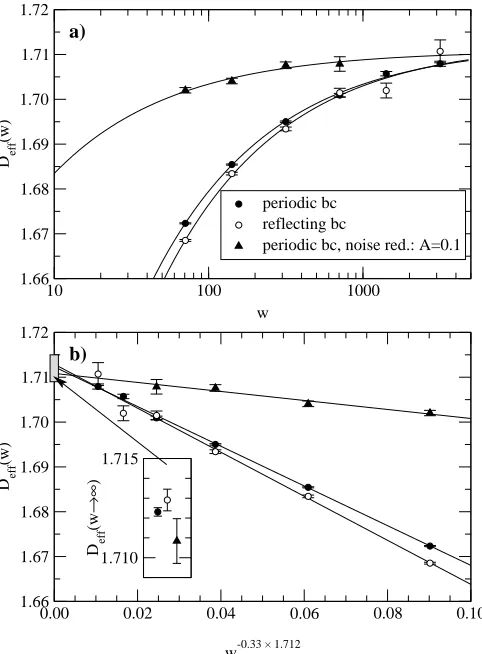
Figure 1 shows the width (w) dependence of the ef-fective fractal dimension Deff = 2 +dlnρ/dlnw. The fractal dimension tends to D = 1.712±0.002, indepen-dent of the choice of boundary conditions. Off-lattice noise reduction [16] does not change the dimension, but accelerates the convergence to its asymptotic value.
Average profile. Analytical solutions for unbranched Laplacian growth in a channel with reflective boundary conditions have been known for a long time. One can find solutions which translate a fixed profile along the channel in time. In the absence of surface tension, these
10 100 1000
w 1.66
1.67 1.68 1.69 1.70 1.71 1.72
Deff
(w)
periodic bc reflecting bc
periodic bc, noise red.: A=0.1
0.00 0.02 0.04 0.06 0.08 0.10
w-0.33 × 1.712 1.66
1.67 1.68 1.69 1.70 1.71 1.72
Deff
(w)
1.710 1.715
Deff
(w
→∞
)
a)
[image:3.612.319.560.51.378.2]b)
FIG. 1: a) The (effective) fractal dimension as a function of channel widthw. Circles correspond to the original model with periodic or reflecting boundary conditions, the triangles are made with off-lattice noise reduction [16]. For the three cases the ensemble size (and therefore the statistical uncer-tainty) was different. The curves correspond to the fitted lines in the b) panel. b)The finite size scaling plot of the same quantities, see Ref. [17]. Inset: All data is consistent in the
w→ ∞extrapolation with the dimensionD= 1.712±0.002. (In the inset the data is shifted horizontally for clarity.)
solutions form a one-parameter family, called Saffman-Taylor (ST) fingers [10]. They are parametrized by the asymptotic ratio λ of the widths of the finger (wfinger) and the channel (w), and have the profile:
x(y) = w(1−λ) 2π log
1 2
1 + cos2πy
λw
(5)
Of these solutionsλ= 1/2 is the most important, because in related experiments [10] this profile has been observed in the limit of vanishing surface tension. Analytical cal-culations [18, 19, 20] show that surface tension—a singu-lar perturbation—selects a discrete set of finger solutions (only one of which is linearly stable), which all converge to theλ= 1/2 ST-finger in the limit of zero surface ten-sion.
un-stable (highly branched) Hele–Shaw fingering and of the DLA growth in a channel with the corresponding reflec-tive boundary conditions. The profile was defined as a level set of the ensemble averaged mass density, and for the experimental Hele–Shaw profiles half the maximum level was used. For DLA growth it was later shown [22] that the level set at 0.5 maximum matches the width of
λ = 0.56, whilst the best match to theλ = 1/2 profile came from the level set at 0.6 maximum. Outside that range the authors of Ref. [22] concluded they could match level sets only to finger widths but not to the full shape of any ST-finger.
Here we use a different kind of finger averaging, which does not have any fitting parameter (eg. height of level set), as follows. In the conformal map method, we di-rectly average the map. That is, we choose a set of points on the unit circle in the mathematical plane, and repeat-edly map to the physical plane. The position of the image points averaged over the different maps, that is, over the different clusters that we have generated, is a reasonable alternative to the ensemble average of [21, 22].
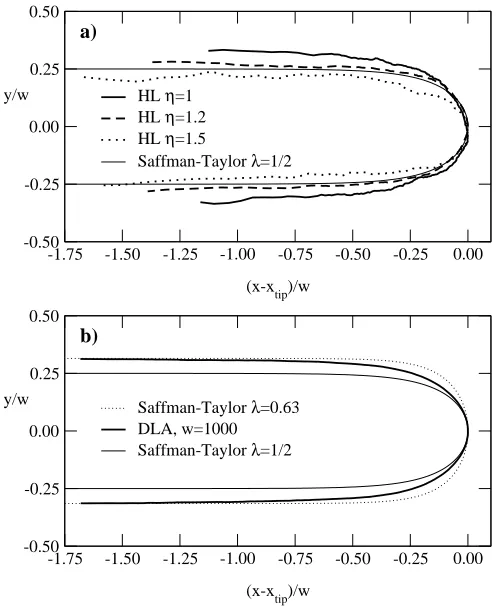
In Fig. 2(a) we show the average conformal map gen-erated this way. We see that the average map for DLA,
η= 1, does not correspond to the ST result forλ= 1/2, but we get a good match to it for the DBM growth at η = 1.2. This is an interesting result, especially in the context of recently proposed equivalences between DBM models with generalized local spatial cutoff. In that framework [3, 4] a higly ramified viscous finger with sim-ple surface tension cutoff corresponds to standard (fixed size cutoff) DBM withη≈1.2. Here we observe that the
non-branching ST-finger solution is very similar to the conformal average of DBM clusters of the sameη.
To use DLA grown with random walking particles in a channel, we need only construct the conformal map from the complex unit circle to the perimeter of each cluster, and take the average of these maps, as above. The confor-mal map is obtained numerically by the following method [17]. We send M probe particles to the frozen cluster, record their impact position, and discard them. These points correspond toM uniformly distributed points on the unit circle. The landing positions of the probe par-ticles are labeled topologically as one encounters them when tracking the perimeter of the cluster. Finally the
m-th point is assigned to the angle 2πm/M of the unit circle. This angle has an error of the order of M−1/2, which vanishes for largeM.
We measured the average conformal map on channels with reflective boundary conditions, widths ranging from 10 to 2000 particle diameters. For each width, we grew 105short clusters (only about 10wlong), and probed each with 105 test particles. In addition, for a few selected widths we probed 104clusters with 106 probes each.
The average map for a wide channel generated this way is shown in Fig. 2(b). The curvature of the tip is consistent with that of the λ= 1/2 ST-finger (the
mea--1.75 -1.50 -1.25 -1.00 -0.75 -0.50 -0.25 0.00
(x-xtip)/w -0.50
-0.25 0.00 0.25 0.50
y/w HL η=1
HL η=1.2 HL η=1.5
Saffman-Taylor λ=1/2
-1.75 -1.50 -1.25 -1.00 -0.75 -0.50 -0.25 0.00
(x-xtip)/w -0.50
-0.25 0.00 0.25 0.50
y/w Saffman-Taylor λ=0.63
DLA, w=1000 Saffman-Taylor λ=1/2
a)
[image:4.612.316.564.50.353.2]b)
FIG. 2: a)The average conformal map, generated with it-erated conformal maps for η = 1, 1.2 and 1.5. The profile for η = 1.2 comes the closest to the ST-finger solution for
λ= 1/2. b) The average map of DLA clusters grown with random walking particles in a 1000 particle-diameter wide re-flective channel. The profile does not follow any ST-finger solution.
sured curvature of the DLA profile forw= 1000 or 2000 corresponds toλ= 0.51±0.03). The asymptotic width, however, is larger. The average map significantly differs also from the ST-finger of matching asymptotic width.
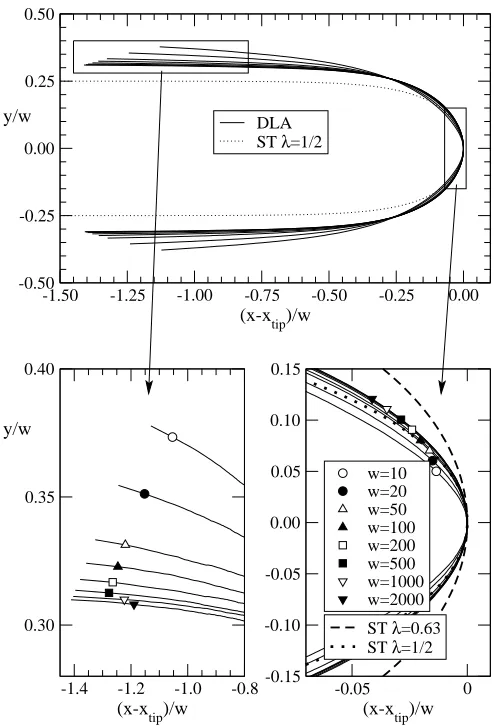
The average conformal map, rescaled onto a unit wide channel, shows strong dependence on the channel width. This is shown on Fig. 3 as a function of reducedxposition relative to the tip, ξ = (x−xtip)/w. Details of the tip and tail regions show that these are clearly not consistent with a common asymptotic ST-finger shape.
We performed a finite size scaling on the w depen-dence of the finger width. The filling ratio of the finger
wfinger/w= [y+(x)−y−(x)]/wwas measured at selected
ξ values: ξ = −0.5, −1, and −1.5, and is plotted on Fig. 4. The finite size scaling exponent was found to be
ν= 0.33, same as for other quantities [16, 17]. The most interesting is the second extrapolation: ξ → −∞. We only have 3 points for this, so it is only reasonable to give a lower bound: wfinger/w >∼0.62.
4
-1.50 -1.25 -1.00 -0.75 -0.50 -0.25 0.00
(x-xtip)/w
-0.50 -0.25 0.00 0.25 0.50
y/w DLA
ST λ=1/2
-0.05 0
(x-xtip)/w
-0.15 -0.10 -0.05 0.00 0.05 0.10 0.15
ST λ=0.63 ST λ=1/2
-1.4 -1.2 -1.0 -0.8
(x-xtip)/w
0.30 0.35 0.40
y/w
[image:5.612.53.300.49.412.2]w=10 w=20 w=50 w=100 w=200 w=500 w=1000 w=2000
FIG. 3: The w dependence of the average conformal map, rescaled onto a unit wide channel. The tip and the tail are magnified on the bottom panels.
0.00 0.02 0.04 0.06 0.08 0.10 0.12
w-0.33 × 1.712 0.58
0.60 0.62 0.64 0.66
wfinger
/ w
ξ = −1
ξ = −0.5 ξ = −1.5
FIG. 4: Finite size scaling of the finger filling ratio
wfinger(ξ)/w, measured at a few fixedξvalues. Only channels
50≤w≤2000 were included in the fits. The finite size scaling gives the extrapolationw→ ∞. For the second extrapolation,
ξ→ −∞, we can only state thatwfinger/w >∼0.62.
boundary conditions—is the same as in radial geometry. This is a great simplification compared to earlier claims of boundary condition (geometry) dependent fractal di-mension. Second, using both iterated conformal maps and random walker based simulations, we measured the average profile of the clusters, defined by the average con-formal map, and compared them to ST-finger solutions of the corresponding continuum problem. The averaged DLA profile is reminiscent but distinct from the ST-fingers, while the average profile of DBM clusters with
η= 1.2 are rather similar to the ST-finger withλ= 1/2. We are indebted to Dave Kessler for the suggestion of measuring the average conformal map. This research has been supported by the EC under Contract No. HPMF-CT-2000-00800. The computing facilities were provided by the Centre for Scientific Computing of the University of Warwick, with support from the JREI.
∗ Electronic address: [email protected]
[1] T. A. Witten and L. M. Sander, Phys. Rev. Lett. 47, 1400 (1981).
[2] L. Niemeyer, L. Pietronero, and H. J. Wiesmann, Phys. Rev. Lett.52, 1033 (1984).
[3] R. C. Ball and E. Somfai, Phys. Rev. Lett. 89, 135503 (2002), cond-mat/0205660.
[4] R. C. Ball and E. Somfai, Phys. Rev. E 67, 021401 (2003), cond-mat/0210598.
[5] P. Meakin and F. Family, Phys. Rev. A34, 2558 (1986). [6] F. Argoul, A. Arneodo, G. Grasseau, and H. L. Swinney,
Phys. Rev. Lett.61, 2558 (1988).
[7] C. Evertsz, Phys. Rev. A41, 1830 (1990).
[8] B. Kol and A. Aharony, Phys. Rev. E62, 2531 (2000). [9] B. Kol and A. Aharony, Phys. Rev. E63, 046117 (2001). [10] P. G. Saffman and G. Taylor, Proc. R. Soc. Lond. A245,
312 (1958).
[11] H. Thome, M. Rabaud, V. Hakim, and Y. Couder, Phys. Fluids A1, 224 (1989).
[12] M. B. Hastings and L. S. Levitov, Physica D 116, 244 (1998).
[13] M. B. Hastings, Phys. Rev. Lett. 87, 175502 (2001), cond-mat/0103312.
[14] M. G. Stepanov and L. S. Levitov, Phys. Rev. E 63, 061102 (2001), cond-mat/0005456.
[15] R. C. Ball and R. M. Brady, J. Phys. A18, L809 (1985). [16] R. C. Ball, N. E. Bowler, L. M. Sander, and E. Somfai,
Phys. Rev. E66, 026109 (2002), cond-mat/0108252. [17] E. Somfai, L. M. Sander, and R. C. Ball, Phys. Rev. Lett.
83, 5523 (1999), cond-mat/9909040.
[18] R. Combescot, T. Dombre, V. Hakim, Y. Pomeau, and A. Pumir, Phys. Rev. Lett.56, 2036 (1986).
[19] B. I. Shraiman, Phys. Rev. Lett.56, 2028 (1986). [20] D. C. Hong and J. S. Langer, Phys. Rev. Lett.56, 2032
(1986).
[21] A. Arneodo, Y. Couder, G. Grasseau, V. Hakim, and M. Rabaud, Phys. Rev. Lett.63, 984 (1989).
[image:5.612.55.298.464.644.2]