This paper is made available online in accordance with publisher policies. Please scroll down to view the document itself. Please refer to the repository record for this item and our policy information available from the repository home page for further information.
To see the final version of this paper please visit the publisher’s website. Access to the published version may require a subscription.
Author(s): Scott E. J. Watson; Natalie Vannini; Sarah Woods; Kerstin Dautenhahn; Maria Sapouna; Sibylle Enz; Wolfgang Schneider; Dieter Wolke; Lynne Hall; Ana Paiva; Elizabeth Andr; Ruth Aylett
Article Title: Inter-cultural differences in response to a computer-based anti-bullying intervention
Year of publication: 2010
http://dx.doi.org/ 10.1080/00131881003588261
Publisher statement: ‘This is an electronic version of an article published in Scott, E.J. etal. (2010). Inter-cultural differences in
response to a computer-based anti-bullying intervention. Educational Research, Vol. 52(1). pp. 61-80. Educational Research is available online at:
Inter-cultural differences in response to a computer based anti-bullying
intervention
Scott. E.J. Watson
a, Natalie Vannini
b, Sarah Woods
c, Kerstin Dautenhahn
a*,
Maria Sapouna
d, Sibylle Enz
e, Wolfgang Schneider
b, Dieter Wolke
d, Lynne
Hall
f, Ana Paiva
g, Elizabeth André
h, Ruth Aylett
i.
*Corresponding author.
aAdaptive Systems research group, School of Computer Science, University of Hertfordshire,
Hatfield, Hertfordshire, UK;
bUniversität Würzburg, Lehrstuhl für Psychologie IV, Würzburg, Germany; cSchool of Psychology, University of Hertfordshire, Hatfield, Hertfordshire, UK; dDepartment of Psychology, The University of Warwick, Coventry, UK;
eOtto-Friedrich-Universität-Bamberg, Bamberg, Germany;
fDepartment of Computing, Engineering, and Technology, University of Sunderland,
Sunderland, UK;
gINESC-ID, Instituto Superior Técnico, Lisboa, Portugal;
hInstitut für Informatik, Universität Augsburg, Augsburg, Germany;
Background and purpose: Many holistic anti-bullying interventions have been attempted, with mixed success, while little work has been done to promote a ‘self-help’ approach to victimization. The rise of theICT curriculum and computer support in schools now allows for approaches which benefit from technology to be implemented. This study evaluates the cross cultural effects of a computer based anti-bullying intervention on primary school aged children’s knowledge about bullying and relevant coping strategies.
Programme description: FearNot! is an interactive computer based virtual learning environment designed for use as an anti-bullying intervention. It includes interactive virtual agents who assume the most common participant roles found in episodes of bullying. FearNot! was used by children over three consecutive weeks to allow its effectiveness to be evaluated in a longitudinal in-situ programme.
Sample: Two comparable samples were drawn from the UK and Germany. In the UK, 651 participants (aged 8-11) were recruited from primary schools in Hertfordshire, Coventry, and Warwickshire; while the 535 German participants (aged 7-10) were sourced from Grundschulen in the Bayern and Hessen regions. Due to lack of parental consent, late joiners and absences/ missing responses, data from 908 participants (UK 493; Germany 415) were analysed.
Design and methods: A quasi-experimental, pre/post-tests control group design employed pre-published and bespoke questionnaires to collect data. Descriptive and inferential analyses were conducted.
Results: UK students possessed higher coping strategy knowledge scores than German participants, but German children’s scores improved over time and as a result of the FearNot! intervention.
Conclusions: Overall, while not effective at increasing children’s coping strategy knowledge in this study, the FearNot! intervention could prove a useful classroom tool to approach the issue of bullying as part of a wider initiative. Cultural differences at baseline, and reactions to the intervention are discussed.
Introduction
Bullying is commonly defined as a repeated act, which continues regularly over time, in
which the victim is the target of negative action on the part of one or more others (Olweus
1995), and which often relies on a perceived imbalance of power (Whitney and Smith 1993).
Rather than the traditional dyadic bully-victim relationship, recent conceptions acknowledge
the importance of the social arena in which bullying occurs. Six main roles have been
confirmed in a number of studies (e.g. Salmivalli et al. 1996; Sutton and Smith 1999): the
‘pure’ bully, the ‘pure’ victim, the bully-assistant (who joins in with bullying, but does not
initiate it), the bully-reinforcer (who provides positive feedback to the bully, but does not
actively take part), the defender, and the outsider/bystander. Wolke et al (2001b) also
identified bully-victims – who both bully and are bullied by others.
Bullying is, unfortunately, a common issue in most European countries, though
prevalence does vary. Estimates of victimisation across Europe often vary between 8-46%
(Wolke et al 2001a). Specifically, Germany has a low prevalence at around 10% (Hanewinkel
2004) while England shows a moderate prevalence at around 24% (Wolke et al 2001b).
Bullying is a serious issue: victimisation can lead to long lasting interpersonal and self-esteem
issues (Ledley et al. 2006), physical illness (Fekkes et al. 2006) and mental health problems
(Wilkins-Shurmer et al. 2003). There are also negative consequences for bullies and the
surrounding peer group (c.f. Berger 2007).
Previous interventions that have taken a holistic approach have demonstrated mixed
success (Eslea and Smith 1998; Smith, Ananiadou, and Cowie 2003; Lodge and Frydenberg
2005), while peer-based support groups (such as befriending schemes, conflict-resolution
schemes, and counselling-based schemes) seem to be effective for those children that choose
number of other drawbacks including difficulties in setting up and maintaining the scheme,
and hostility towards the peer supporters themselves.
Left to their own devices, most children respond to bullying with strategies that are
either ineffective, or which actually encourage continued victimization (Craig, Pepler, and
Blais 2007). This is especially true of boys, who often believe that their aggressive/
confrontational responses to bullying are more effective than they actually are
(Mahady-Wilton, Craig, and Pepler 2000).
While some studies show that victimisation only changes in form, a number of studies
have reported that victimisation does decrease between the ages of 8 and 16 years (c.f.
Whitney and Smith 1993; O’Moore, Kirkham, and Smith 1997; Rigby 1997). Smith, Madsen,
and Moody (1999) suggest an explanation: Through experiencing harassment at a younger
age, older children become more socially skilled and thus develop more and better coping
strategies. In addition, Smith and Shu (2000) demonstrate that, while most children know of
many different responses to bullying, older children often choose more effective ways of
coping than younger children, and that the most helpful strategies include telling peers rather
than adults.
It follows, then, that a progressive avenue of research would be to equip children with
effective responses to bullying at a younger age with the eventual aim of developing a
‘self-help’ approach, to be used alongside existing interventions, to reducing victimisation.
This is the approach taken by the eCIRCUS1 consortium (of which the authors were
members, acting as experts in psychology and education), which has created FearNot!2 – an
interactive Virtual Learning Environment (VLE) which can be used in schools as part of both
Information and Communication Technology (ICT) and Personal and Social Health Education
(PSHE) curriculum. Further details of the FearNot! software are presented in the
1 Education through Characters with emotional-Intelligence and Role-playing Capabilities that Understand
Social interaction
method/materials section. Extensive pilot studies with FearNot! have shown that the
characters are believable (Woods et al. 2003) and can elicit a range of emotions in users (Hall
et al. 2005; Watson et al. 2007), but this is the first time that FearNot! has been evaluated in a
longitudinal intervention.
While other studies are investigating various implications of the FearNot! software
(Enz et al. In preparation; Sapouna et al. In press; Vannini et al. Submitted), this paper
focuses on FearNot!’s ability to affect younger (7-11 year old) children’s Knowledge About
Bullying (KAB) and respective Coping Strategy Knowledge (CSK). KAB refers to how much
children know about bullying from a relatively objective and impersonal point of view; while
CSK refers to how much children know about coping with bullying – i.e. which responses
they believe are the most effective to counteract different kinds of bullying. New
questionnaires to measure these concepts were developed within the eCIRCUS project. The
study investigated the following research questions.
At baseline, do KAB and/or CSK scores vary across involvement in bullying, gender,
age group, or country?
Do KAB and/or CSK change as a result of the FearNot! intervention?
Method
Design
The intervention evaluation employed a quasi-experimental, pre/post-test control group
utilising a battery of adapted pre-published (Moral Disengagement [adapted from Hymel et al.
2005], and Social Norms [adapted from Salmivalli and Voeten. 2004] questionnaires) and
bespoke questionnaires (Participant Roles, Knowledge About Bullying, and Coping Strategy
The experimental group received two questionnaire administration sessions,
which enclosed a three week period during which children used the FearNot! software
intervention, and a further follow-up questionnaire administration that was conducted five
weeks after the intervention. The control group followed the same schedule, but did not use
the FearNot! software – rather they continued with their standard school lessons, which
included no specific reference to bullying other than usually encountered in standard PSHE
curriculum. The control group received the FearNot! Software after the evaluation had been
completed.
Knowledge About Bullying analysis
We considered an analysis plan to evaluate the difference between experimental and control
groups, differences between countries, and whether there was any change over time.
However, preliminary analysis revealed a ceiling effect (details given in the results section),
so further analysis was not undertaken.
Coping Strategy Knowledge analysis
A series of mixed ANOVAs with CSK scores at each of the three measurement points
(baseline vs post-test vs follow-up [time]) included experimental group (experimental vs
control [group]) as a consistent between groups factor were run in order to investigate
whether CSK scores change between the three assessment sessions. Further between groups
factors included age (7/8 year olds vs 9 year olds vs 10/11 year olds), participant role (not
involved vs victim vs bully, bully/victim), and country.
Participants
Overall sample
26 Key Stage 2 (7-11 year old children)primary school classes from the UK (from the Local
grade (7-10 year old children) Grundschulen classes (from the Bayern and Hessen
Bundesländer [federal states]) from Germany took part in the FearNot! longitudinal
evaluation, leading to a sampling framework of 1186 children. Each location received ethical
approval from their relevant body3. Parents were given information sheets and were allowed
to withdraw their children before the study began. Furthermore, both children and parents
were allowed to withdraw from the study at any time thereafter, though none did.
It was not possible to randomly allocate participants to experimental conditions due to
the technical requirements of the FearNot! software. Instead, participants were allocated to the
intervention group on a class-by-class basis if FearNot! ran well on their school’s computers,
and to the control group if not. This allowed for FearNot! to be correctly implemented in the
experimental group.
Such allocation, while unavoidable, could be open to the possibility of some selection
bias – the argument could be made that schools with better equipment are more actively
funded, and will therefore give rise to more able pupils. Due to the already large battery of
questionnaires administered to participants it was not possible to test rigorously for
equivalency of ability, but the areas from which schools were recruited were similar in terms
of Socio-Economic Status and it is expected that any variation in ability should become
normalised in a sample of this size.
All children completed both the KAB and CSK questionnaires, with differences in
sample size accounted for by lack of consent, late joiners, or absenteeism.
Knowledge About Bullying sample
At baseline (excluding children who were refused parental consent or who joined the study
after the first questionnaire administration), a total of 931 children completed all 10
3 University of Hertfordshire Faculty of Engineering and Information Sciences Ethics Committee; University of
component items of the KAB questionnaire. This included 446 (48%) children in the
intervention group and 485 (52%) in the control group, 484 (52%) males and 447 (48%)
females, 516 (55%) children from the UK and 415 (45%) from Germany, with an overall
mean age of 8.9 (sd.74)years
Coping Strategy Knowledge sample
After accounting for children who were refused parental consent (Non-consent), joined the
study after the first questionnaire administration (Late Joiners), or failed to complete all three
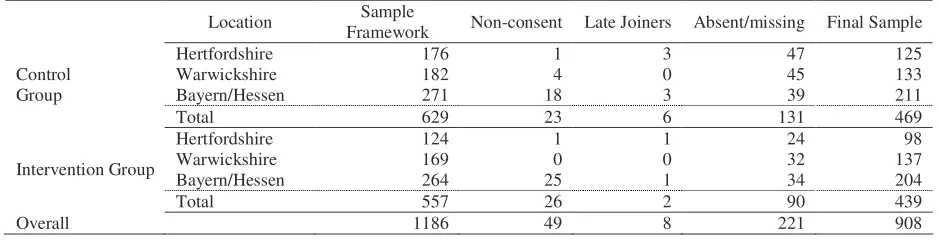
[image:9.595.63.532.363.483.2]assessments (Absent/Missing), the final sample for the CSK analysis included 908 children
(Table 1).
Table 1. Overview of the sampling process for the CSK sample
Location Framework Sample Non-consent Late Joiners Absent/missing Final Sample
Hertfordshire 176 1 3 47 125
Warwickshire 182 4 0 45 133
Bayern/Hessen 271 18 3 39 211
Control Group
Total 629 23 6 131 469
Hertfordshire 124 1 1 24 98
Warwickshire 169 0 0 32 137
Bayern/Hessen 264 25 1 34 204
Intervention Group
Total 557 26 2 90 439
Overall 1186 49 8 221 908
The intervention group includes fewer participants (439, 48%) than the control group
(469, 52%) overall. While there are no significant age differences between the experimental
groups, there are statistically significant differences in age between the three evaluation
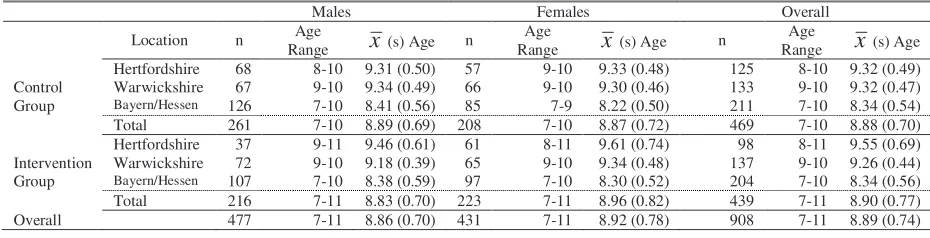
locations: F(2, 905) 404.74, p< .001, with the Hertfordshire sample being the oldest (x= 9.42
[0.55]) followed by Warwick (x= 9.29 [0.45]), and Bayern/Hessen (x = 8.34 [0.55]) having
the youngest sample (Table 2). In terms of gender there are no apparent differences between
location, but the intervention group includes fewer males (216, 45%) and more females (223,
52%), than the control group (261 [55%], and 208 [48%], respectively) – a pattern which is
Table 2. Genderand age of sample by condition and location for the CSK sample
Males Females Overall
Location n Age
Range x (s) Age n Range Age x (s) Age n Range Age x (s) Age Hertfordshire 68 8-10 9.31 (0.50) 57 9-10 9.33 (0.48) 125 8-10 9.32 (0.49) Warwickshire 67 9-10 9.34 (0.49) 66 9-10 9.30 (0.46) 133 9-10 9.32 (0.47) Bayern/Hessen 126 7-10 8.41 (0.56) 85 7-9 8.22 (0.50) 211 7-10 8.34 (0.54) Control
Group
Total 261 7-10 8.89 (0.69) 208 7-10 8.87 (0.72) 469 7-10 8.88 (0.70) Hertfordshire 37 9-11 9.46 (0.61) 61 8-11 9.61 (0.74) 98 8-11 9.55 (0.69) Warwickshire 72 9-10 9.18 (0.39) 65 9-10 9.34 (0.48) 137 9-10 9.26 (0.44) Bayern/Hessen 107 7-10 8.38 (0.59) 97 7-10 8.30 (0.52) 204 7-10 8.34 (0.56) Intervention
Group
Total 216 7-11 8.83 (0.70) 223 7-11 8.96 (0.82) 439 7-11 8.90 (0.77) Overall 477 7-11 8.86 (0.70) 431 7-11 8.92 (0.78) 908 7-11 8.89 (0.74)
It is to be noted, that while the data collected here is clustered, the current analysis
does not take this into account. A further study would be recommended to use a multi-level
regression approach to rectify this.
Materials
Questionnaires
The FearNot! intervention evaluation employed a battery of questionnaires to measure
bullying behaviour, moral disengagement, and knowledge about bullying and coping
strategies. This paper describes only results concerning the knowledge and copying strategies
outcomes; findings from others will be reported elsewhere (Enz et al. In preparation; Vannini
et al. Submitted; and Sapouna et al. In preparation)
Two new questionnaires were developed, piloted, and modified to measure KAB and
CSK. A full description of the scale construction process and final scale norms will be found
in Watson et al. (In Press). There were two gender-specific versions of each of the KAB-Q
and CSK-Q, though they do not differ in terms of plot. Both KAB-Q and CSK-Q were
available in German and English, and were back and forward translated (van de Vijver and
The Knowledge About Bullying questionnaire
The KAB-Q begins with a 7 panel storyboard4 showing a bullying incident which: 1) includes
the bullies’ intention of performing a harmful act, 2) includes an imbalance of power between
bullies and victim, 3) includes an impassive audience, and 4) emphasises the repetitive nature
of this incident. Following the story, 10 statements are provided with respondents asked to
state whether they believed the statement to be ‘right’ or ‘wrong’. The statements refer to
elements of the definition of bullying (e.g. “Power imbalance”: “Marcia cannot defend
herself against Sally and Jasmine on her own.”) and acquire information about whether the
correspondents have understood the picture story and identified it as a bullying incident. Each
item is scored as zero for an incorrect response or 10 for a correct response leading to a range
of scores between zero to 100, where a higher score indicates a greater understanding of the
story.
The Coping Strategy Knowledge questionnaire
Since relational/indirect and physical/direct bullying are generally considered to be separate
(though related) forms of bullying, the CSK-Q reflects this separation in comprising two
sections. In each, respondents read a short (6 panel) storyboard which shows an episode of
bullying take place. After reading the story, respondents are presented with 13 common
coping strategies and are asked to indicate those strategies that they would recommend the
victim (in the story) uses to reduce future episodes of bullying. Respondents may select as
many strategies as they wish, and are also offered the opportunity to provide their own ideas
in a single open-ended question “Are there any other things <the victim> could do? Please
write them in the box if you can think of any”.
4 Storyboards were created using the Kar2ouche Composer software and Bullying add-on pack from Immersive
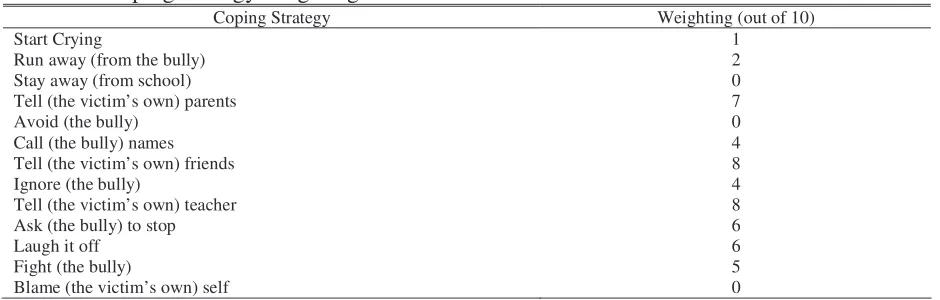
Unknown to respondents, each of the coping strategies has a numerical weighting
scored out of 10, to represent how effective the strategy is in real life. These weightings were
assigned by researchers, based upon evidence from previous studies which describe how
effective certain coping strategies are in a natural school environment (e.g. Salmivalli,
Karhunen, and Lagerspetz 1996; Kochenderfer and Ladd 1997; Hodges and Perry 1999). For
the purposes of scoring the CSK questionnaire, the weighting of all selected strategies are
added together and then divided by the total number of strategies selected. This division is
necessary to ensure that respondents can not score highly simply by ticking all the strategies –
but will obtain high scores only by selecting the most effective strategies. The final range of
potential scores is between zero to eight where higher scores represent a more sophisticated
[image:12.595.64.534.414.564.2]knowledge of coping strategies (see Table 3).
Table 3. Coping strategy weightings.
Coping Strategy Weighting (out of 10)
Start Crying 1
Run away (from the bully) 2
Stay away (from school) 0
Tell (the victim’s own) parents 7
Avoid (the bully) 0
Call (the bully) names 4
Tell (the victim’s own) friends 8
Ignore (the bully) 4
Tell (the victim’s own) teacher 8
Ask (the bully) to stop 6
Laugh it off 6
Fight (the bully) 5
Blame (the victim’s own) self 0
Intervention software
FearNot! version 2.0 (see Figure 1) is a virtual learning environment designed to reflect a
typical primary school environment, complete with virtual actors who take on the roles
normally associated with bullying. The characters play out emergent cartoon-like episodes of
bullying (Aylett and Louchart 2003; Aylett et al. 2005), in which sequences of bullying
the interaction situations and the characters’ goals and mental states. These cartoon-like
episodes are connected by interactive episodes where the user can ‘talk to’ the victim
character via an instant messenger inspired interface i.e. by typing into a text box and reading
the character’s responses on screen. Here, the user can recommend coping strategies for the
[image:13.595.75.524.236.411.2]victim character to attempt in the following emergent episode.
Figure 1. Screenshots of cartoon-like and interaction episodes within FearNot!.
The characters choose for themselves whether to follow the user’s advice or not – this
decision being based on their previous experience, current mental states, and goals. The
consortium made the decision that the characters should not always follow the advice of the
users in order to make the story and user-character interactions more believable and ‘life-like’
– in real life advice given to e.g. friends is not always taken on board depending on the
context, situation and persons involved. The various coping strategies that characters can
employ are assigned a rating on a ten-point scale to reflect their real life success. More
detailed descriptions of the technical framework of FearNot!, and the agents’ decision making
processes, can be found in Dias (2005), Dias and Paiva (2005) and Dias et al. (2007). By
observing the outcomes of the use of coping strategies, children can vicariously learn the best
The user can select to play either the male or female scenarios (with male episodes
including more physical bullying and female episodes more relational bullying). In the current
intervention, most children were able to play both scenarios, but all had been instructed to
begin with the scenario that matched their own gender. English and German language
versions are available.
Procedure
Intervention administration
The intervention required the use of the FearNot! software for one 30 minute session per
week (equivalent to around five cartoon-like episodes per session), for three consecutive
weeks. Children worked individually (to allow children to answer honestly and privately, and
to avoid social facilitation effects), and returned to the same computer each session to allow
their particular story to continue. The intervention was conducted during normal teaching
hours and was supervised by teachers. No researchers were involved in the administration of
the FearNot! intervention sessions, but teachers were thoroughly briefed and provided with
explicit guidelines before the intervention began. Teachers were instructed to refrain from
pro-active assistance unless children encountered comprehension difficulties, or were finding
it too challenging to think of new suggestions.
Questionnaire administration
The KAB-Q and CSK-Q were presented to respondents as part of a larger battery used in the
FearNot! intervention evaluation. The other questionnaires in the pack were the Participant
Roles Questionnaire (with sections adapted from Olweus 1991; Salmivalli et al. 1996; and
Wolke and Samara 2004), and Classroom Norms Questionnaire (adapted from Salmivalli and
Rocke-Henderson, and Bonanno 2005). There were separate versions of the questionnaire pack for
boys and girls, and there were three versions of the pack with the questionnaires in different
orders. In each pack, however, the KAB-Q immediately preceded the CSK-Q questionnaire.
At the beginning of the first questionnaire administration only, an educational session
consisting of a presentation and discussion (question & answer) sections was delivered by a
researcher to each class. These sessions described to children exactly how bullying is defined
and what constitutes relational and physical bullying; and ensured that every child was
equipped with at least the same basic knowledge of the terminology used in the questionnaire.
Educational sessions were delivered by only one researcher at each location to minimize any
discrepancies between delivery styles and, though there was no fixed script, each researcher
delivering the educational session presented the same material and provided equivalent
definitions of the various aspects of bullying. Children were free to ask whatever questions
they wished concerning the educational session, and researchers only concluded the session
once they were satisfied that all children in the class had understood the content.
Questionnaires were administered on a class by class basis, at a time convenient to the
teacher and school. All children present were seated in their usual classroom places, and were
instructed to work individually and quietly. Children with special educational needs were
aided by teachers or their usual carer/assistant and all children present were allowed to ask
questions at any time during the administration. Teachers/assistants were permitted to help
researchers in the administration, but were limited to aiding children with reading/writing
difficulties – only researchers could offer advice on how to complete the questionnaire pack.
Once children had completed the questionnaire pack they were required to continue with their
usual schooling (primarily reading tasks) until all the class had finished, at which time the
whole class was thanked for their participation. Administration sessions took around 40
Results
Data coding.
Before any analyses were run, the obtained data were coded into meaningful grouping
variables. As there were only ten each of 7 and 11 year old children, these participants were
joined with the 8 and 10 year olds respectively to form three categories of age: 7/8 year olds,
9 year olds, and 10/11 year olds.
Children also provided self-nomination data (in another questionnaire of the battery)
regarding their participant roles. Using this data, children could be coded as bullies, victims,
bully/victims, or not involved for both relational and physical bullying. Children were
classified as bully or victim if they stated that they bullied others or were bullied themselves
at least four times in the last month; a bully/victim if they admitted to both; and not involved
if they admitted to neither.
In addition, these data allowed us to categorise each child’s overall involvement in
bullying, irrespective of participant role – not involved, only relationally involved, only
physically involved, or involved in both relational and physical bullying.
This paper uses the participant role and overall involvement categorisations from the
baseline assessment.
Knowledge about Bullying results
Preliminary analysis of the KAB-Q revealed a ceiling effect (x = 84.9 [13.85]), with no
significant differences between participant role, age group, gender, or country.
This ceiling effect demonstrates that the majority of children in this study found the
storyboard/question format simple to understand and to complete, and that the KAB measures
this high baseline ceiling effect, improvement in KAB scores was highly unlikely and no
analysis of the intervention was performed in terms of KAB.
Coping Strategy Knowledgeresults
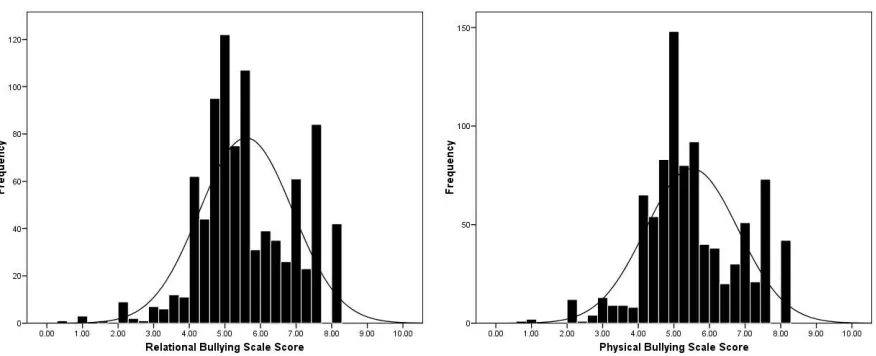
Descriptive analysis. Both relational5 and physical6 CSK are normally distributed. The
distributions are bi-model – suggesting that while most participants score just above half way,
there is a second group who score very highly (see Figure 2). This implies that while most
children have an average CSK, some children already possess a strong knowledge of how to
[image:17.595.80.518.319.497.2]cope with bullying.
Figure 2. Frequency (n children) distributions for relational and physical CSK scales.
A demographic breakdown of the children who score seven or more on the CSK scales
reveals that high scorers are more likely to be: not involved in bullying, male, nine years of
age, and from the UK (Table 4).
Regarding the whole dataset, there are no statistically significant differences between
participant roles on either relational or physical CSK scales, though it should be noted that no
child nominated themselves as a pure bully in this sample (see Table 5). There are also no
significant differences in terms of overall involvement or gender.
Table 4. Demographic details of high scorers on relational and physical CSK scales.
Relational Scale Physical Scale
Not Relationally Involved 152 (72.4%) 154 (73.3%)
Relational Bully N/A N/A
Relational Victim 26 (12.4%) 32 (15.2%)
Relational Participant Role*
Relational Bully/Victim 10 (4.8%) 8 (3.8%)
Not Physically Involved 145 (77.5%) 143 (76.5%)
Physical Bully N/A N/A
Physical Victim 18 (9.6%) 27 (14.4%)
Physical Participant Role*
Physical Bully/Victim 9 (4.8%) 6 (3.2%)
Not Involved In Bullying 138 (65.7%) 132 (70.6%)
Involved Relationally 10 (4.8%) 8 (4.3%)
Involved Physically 11 (5.2%) 11 (5.9%)
Involvement in Bullying
Involved in Both 26 (12.4%) 19 (10.2%)
Male 111 (52.9%) 104 (55.6%)
Gender Female 99 (47.1%) 83 (44.4%)
7/8 Years 37 (17.6%) 29 (15.5%)
Age 9 Years 112 (53.3%) 104 (55.6%)
10/11 Years 61 (29%) 54 (28.9%)
Country UK 159 (75.7%) 145 (77.5%)
Germany 51 (24.3%) 42 (22.5%)
* Missing cases omitted from table
Table 5. Descriptive statistics of relational and physical CSK by participant role, overall involvement, gender, age, and country.
Relational CSK Physical CSK
n Range x(s) n Range x(s)
Not Relationally Involved 696 .5-8 5.56 (1.30) 694 1-8 5.50 (1.29)
Relational Bully 0 N/A N/A 0 N/A N/A
Relational Victim 119 2-8 5.53 (1.28) 119 2-8 5.42 (1.25) Relational Participant Role
Relational Bully/Victim 33 3.88-8 5.99 (1.26) 33 2.71-8 5.53 (1.41) Not Physically Involved 694 .5-8 5.60 (1.28) 691 1-8 5.50 (1.29)
Physical Bully 0 N/A N/A 0 N/A N/A
Physical Victim 134 1.67-8 5.48 (1.35) 134 2-8 5.49 (1.30) Physical Participant Role
Physical Bully/Victim 30 2-8 5.51 (1.63) 30 2-8 5.50 (1.29) Not Involved In Bullying 623 .5-8 5.60 (1.28) 621 1-8 5.51 (1.29) Involved Relationally 53 3-8 5.58 (1.20) 53 2-8 5.35 (1.24) Involved Physically 63 1.67-8 5.16 (1.40) 63 2-8 5.32 (1.28) Overall Involvement
Involved in Both 95 2-8 5.67 (1.35) 95 1-8 5.50 (1.32)
Male 471 .5-8 5.57 (1.33) 470 1-8 5.51 (1.35)
Gender Female 428 1-8 5.62 (1.28) 426 .67-8 5.50 (1.25)
7/8 Years 271 1-8 5.30 (115) 270 1-8 5.21 (1.12)
9 Years 461 .5-8 5.62 (1.36) 457 1-8 5.53 (1.31)
Age
10/11 Years 167 1-8 6.03 (1.30) 169 .67-8 5.90 (1.44)
UK 485 1-8 5.93 (1.34) 486 .67-8 5.80 (1.37)
Country Germany 414 .5-8 5.21 (1.15) 410 1-8 5.15 (1.11)
There are significant differences between age groups on both relational (F[2, 899]
16.73, p< .001) and physical (F[2, 893] 15.25, p< .001) CSK scales. Post hoc comparisons
Table 6. Post-hoc comparisons for the main effect of age.
Age 1 Age 2 Mean Difference p
7/8 9 -.16 .071
7/8 10/11 -.44 <.001
Relational Bullying CSK
9 10/11 -.28 .003
7/8 9 -.11 .330
7/8 10/11 -.39 <.001
Physical Bullying CSK
9 10/11 -.28 .001
Children from the UK score significantly higher on both relational (t[896.61] 8.66, p<
.001) and physical (t[892.67] 7.87, p< .001) CSK scales than the German sample, with
medium effect sizes for both (relational CSK: d=.58; and physical CSK: d=.53)7. Since it has
already been shown, however, that the German sample is significantly younger than the UK
sample, it is likely that these age and country effects are linked.
Including age and country together as between subjects factors in two-way ANOVAs
demonstrate that the main effect of age disappears, but country remains significant for the
relational CSK scale (F[1, 893] 7.24, p= .007), and marginally so for the physical CSK scale
(F[1, 890] 3.11, p= .078). In addition, a series of ANCOVAs showed that country remains a
significant main effect when controlling for age, but age remains significant when controlling
for country only for the relational CSK scale. The pervasiveness of country and the
marginalisation of age as main effects leads to the conclusion that that any age-CSK
relationships are spurious, but the finding that the UK sample scores more highly than the
German sample is well supported by the data.
Evaluation analysis. It was expected that the FearNot! anti-bullying intervention would affect
participant’s CSK scores. To evaluate this, a series of mixed ANOVAs with CSK scores at
each measurement point (baseline vs post-test vs follow-up [time]) as a within subjects factor,
and experimental group (intervention vs control intervention [group]) as a consistent between
groups factor was employed. Further between groups factors, each tested independently,
included participant role (not involved vs victim vs bully vs bully/victim [role]), overall
involvement (not involved vs involved relationally vs involved physically vs involved in both
[involvement]), gender (males vs females [gender]), and country (UK vs Germany [country]).
Age was omitted as a factor due to the spurious relationship with country. ANOVAs were run
separately for relational and physical CSK scales.
As might be expected after the descriptive analysis, there were no significant main
effects or interaction effects with role, involvement, or gender on either CSK scale.
Furthermore, there were no significant main effects or interaction effects including group,
suggesting that the FearNot! intervention had had little impact on children’s CSK.
There were, however, significant main effects of time for both relational (F[1, 879]
50.99, p< .001) and physical (F[1, 870] 35.17, p< .001) CSK scales; and significant
country*time interactions for relational (F[2, 1758] 11.75, p< .001) and physical (F[2, 1740]
13.32, p< .001) CSK scales. To investigate these effects more carefully further group*time
ANOVAs were conducted separately within each country.
Within the UK sub-sample, there are main effects of time for both relational (F[2, 946]
5.41, p= .005) and physical (F[2, 934] 5.53, p= .004) CSK scales, though there are no main
effects of, or interactions with, group. Post hoc comparisons (Table 7) show that relational
CSK scores decreasebetween baseline and post-test, while physical CSK scores decrease
between post-test and follow-up.
While unexpected, this pattern of decreasing CSK scores occurs within both
experimental and control conditions, indicating that the FearNot! intervention is not
responsible for this finding.
Within the German sub-sample there are main effects of time (F[2, 812] 6.82, p< .001)
scale. The physical scale yields significant main effects of time (F[2, 806] 9.94, p< .001) and
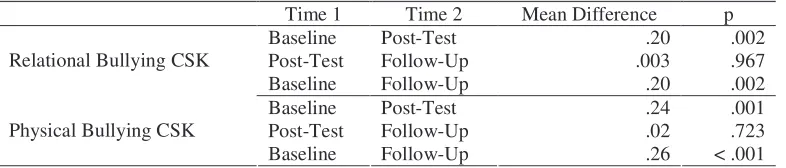
group (F[1, 403] 4.41, p= .036) but no interaction effect. The intervention group scores more
highly overall than the control intervention group on both relational and physical CSK scales,
and post hoc comparisons of time show that CSK scores increase between baseline and
[image:21.595.104.494.259.344.2]post-test on both relational and physical scales (Table 8).
Table 7. Post hoc t-tests on time main effects for UK group*time ANOVA.
Time 1 Time 2 Mean Difference p Baseline Post-Test - .16 .020 Post-Test Follow-Up - .04 .417 Relational Bullying CSK
Baseline Follow-Up - .21 .003 Baseline Post-Test - .09 .226 Post-Test Follow-Up - .15 .028 Physical Bullying CSK
Baseline Follow-Up - .24 .001
Table 8. Post hoc t-tests on time main effects for German group*time ANOVA.
Time 1 Time 2 Mean Difference p Baseline Post-Test .20 .002 Post-Test Follow-Up .003 .967 Relational Bullying CSK
Baseline Follow-Up .20 .002 Baseline Post-Test .24 .001 Post-Test Follow-Up .02 .723 Physical Bullying CSK
Baseline Follow-Up .26 < .001
While there are no statistically significant interaction effects, profile plots (available
on request from corresponding author) do indicate that, as CSK scores increase for both
experimental and control conditions after baseline measurement, they increase more in the
intervention group than in the control group for both relational and physical CSK scales.
Discussion
This study has evaluated the potential educational impact of a new virtual learning
environment, designed as an anti-bullying intervention. Specifically, we were interested in
FearNot!’s ability to improve children’s knowledge about the best and worst ways to cope
[image:21.595.104.497.394.478.2]Data from the FearNot! anti-bullying intervention has shown that most children
already possess an average knowledge of how to cope with bullying, with some children able
to identify the best strategies rather well. This goes some way to support Camodeca and
Goossens’ (2005) finding that children favour effective coping strategies when presented with
a list of alternatives. The demographic details of the highest scorers have been identified, but
there is little overall difference in coping strategy knowledge in terms of participant role,
bullying involvement, or gender.
This is somewhat surprising as one might expect, for example, that boys would know
more about coping with physical bullying and less about relational bullying than girls since
these groups encounter these respective bullying styles more often (Bjorkqvist 1994; Crick
and Grotpeter 1995, 1996). One might also expect that uninvolved children would know more
about coping as they have successfully escaped or avoided victimisation, though it would
appear that other predictors of bullying avoidance are stronger than coping strategy
knowledge. These predictors include: social inclusion (Salmivalli, Huttunen, and Lagerspetz
1997), strong friendships (Bollmer et al. 2005), more positive self esteem (O’Moore and
Kirkham 2001), being well adjusted (Smith et al. 2004), lower moral disengagement (Hymel,
Rocke-Henderson, and Bonanno 2005), better social and moral cognition (Gini 2006), and
higher empathic ability (Joliffe and Farrington 2006).
There were age differences in that younger children had lower CSK scores than older
children. It was concluded, however, that this was likely an artefact of the age difference
between the UK and German samples as country showed a stronger effect under further
scrutiny. The UK sample scored significantly more highly than the German sample on both
prevalent and commonplace in the UK (Wolke et al 2001b) – greater prevalence would
naturally lead to a greater awareness8.
There appeared to be no overall effect of the FearNot! intervention software itself, as
any observable patterns occurred simultaneously in both experimental and control conditions.
These patterns showed the UK sample’s CSK to decrease between baseline and post test,
while an increase was witnessed in the German sample. Therefore, while there is no apparent
effect caused by the FearNot! intervention software, it does appear that children in the two
countries responded to the overall research programme in different ways.
Such cultural differences could be due to idiosyncrasies in language (Smith et al.
2002). For example, while the English term ‘bullying’ is used colloquially by children, the
German equivalent ‘Schikanieren’ is not (Wolke et al. 2001b). While this issue was addressed
by using the more idiomatic term ‘Mobbing’ in Germany, and also by providing educational
sessions, everyday understanding of the concepts of ‘bullying’ and ‘Mobbing’ may have
overridden these efforts (c.f. Arora 1996).
The German sample did respond positively to the FearNot! intervention. Had
the intervention lasted for a longer period of time, it is possible that this effect would have
become significant, as lengthier interventions achieve greater success (Limber et al. 2004;
Olweus 2004; Smith et al. 2004). Therefore, we hypothesise that FearNot! may be educational
for children who begin with low CSK scores, if used for longer than in the current study. In
addition, we would suggest that FearNot! be employed by schools as part of a wider initiative
– i.e. to generate discussion within the classroom and to address a serious issue in a novel,
fun, and engaging way.
Future work employing the current Coping Strategy Knowledge scale would be to
identify the coping strategies most often selected to counter each type of bullying. It would be
8 Note, greater awareness may also lead to greater prevalence – an intricate relationship between how we
beneficial to learn, for example, whether children prefer different strategies to counter
different forms of bullying, as suggested by Kanetsuna, Smith, and Morita (2006).
While forced response options were employed for ease of completion, open-ended
questions might have elicited more natural responses from children. With that said, very few
children took the opportunity to add their own alternative coping strategies (and hence no
analyses of the open ended questions was performed), suggesting that either our response
options are quite exhaustive or that other means of inquiry (e.g. verbal) might have been more
suitable for eliciting more natural responses.
The phraseology of the CSK question “What do you think <the victim> should do...”
may have led the respondents in two ways. Firstly, it requires that the children place
themselves in the role of the victim, rather than responding from their own personal view. As
Camodeca and Goossens (2005) have shown, children tend to choose different ‘effective
interventions’ when asked to take on alternative perspectives. Secondly, the question may
provoke socially desirable ‘correct’ responses as it asks what the victim should do as opposed
to what the victim could or would do.
Baseline scores from the KAB-Q demonstrated a ceiling effect (whereby maximum
scores are achieved by a large proportion of the sample), which unfortunately made any
potential effect of the FearNot! intervention on this construct unlikely. This demonstrates that
the KAB-Q did not measure knowledge about bullying but also shows that the
storyboard/question format is easily understood and responded to.
Conclusion
Our study has not shown an overall effect of the FearNot! intervention on either relational or
decreased during the research programme in the UK sample, while both increased in the
German sample. This pattern occurred in both experimental conditions – with or without the
FearNot! intervention. The German sample did respond to the FearNot! intervention to some
extent, though the witnessed improvement was not statistically significant. This suggests that
a longer intervention period may prove beneficial in improving low scoring children’s CSK
scores. Finally, we recommend that FearNot! be implemented as part of a wider and longer
initiative.
Acknowledgements
We would like to thank all the schools, teachers, and children who have taken part in this
study. In addition we would like to thank the following researchers, without whom this study
would not have been possible: Stefanie Brosch, Rafal Dawidowicz, Megan Davis, Joao Dias,
Rui Figueiredo, Adrian Gordon, Marc Hall, Wan Ching Ho, Michael Kriegel, Karin
Leichtenstern, Mey Yii Lim, Patricia Lippeck, Sandy Louchart, Asad Nazir, Chystopher
Nehaniv, Luis Oliveira, Malcolm Padmore, Matthias Rehm, Paola Rizzo, Harald Schaub, Tim
Tisdale, Isabel Transoco, Marco Vala, Thurid Vogt, Marc Webster, and Carsten Zoll. Many
thanks also to Nimrita Bahia, Sophie Birch, Daniel Cox, and Sunil Sthanakiya for their
assistance with data collection and entry.
This work was partially supported by the European Community (EC) and was funded
by the eCIRCUS project IST-4-027656-STP with university partners Heriot-Watt,
Hertfordshire, Sunderland, Warwick, Bamberg, Augsburg, Würzburg plus INESC-ID and
Interagens. The authors are solely responsible for the content of this publication. It does not
represent the opinion of the EC, and the EC is not responsible for any use that might be made
of data appearing therein.
Correspondence to
Prof. Kerstin Dautenhahn, Adaptive Systems research group, School of Computer Science,
University of Hertfordshire, Hatfield, Hertfordshire, UK; Tel: +44 1707 284333; email:
References
Arora, T. 1996. Defining bullying. School Psychology International, 17: 317-329.
Aylett, R. S., S. Louchart. 2003. Towards a narrative theory of virtual reality. Virtual Reality, 7: 2-9.
Aylett, R.S., S. Louchart, J. Dias, A.Paiva, and M. Vala. 2005. FearNot! An experiment in emergent narrative. Paper presented at Intelligent Virtual Agents (IVA), September 12-14, in Kos, Greece.
Becker, L.A. Effect size calculators. University of Colorado at Colorado Springs. http://web.uccs.edu/lbecker/Psy590/escalc3.htm.
Berger, K.S. 2007. Update on bullying at school: Science forgotten? Developmental Review, 27: 90-126.
Björkqvist, K. 1994. Sex differences in physical, verbal, and indirect aggression: A review of recent research. Sex Roles, 30, nos. 3/4: 177-188.
Bollmer, J.M., R. Milich, M.J. Harris, and M.A. Maras. 2005. A friend in need: The role of friendship quality as a protective factor in peer victimzation and bullying. Journal of Interpersonal Violence, 20, no. 6: 701-712.
Camodeca, M., and F.A. Goossens. 2005. Children’s opinions on effective strategies to cope with bullying: The importance of bullying role and perspective. Educational Research, 47, no. 1: 93-105.
Cowie, H. 2000. Bystanding or standing by: Gender issues in coping with bullying in English schools. Aggressive Behavior 26: 85-97.
Craig, W., D. Pepler, and J. Blais. 2007. Responding to bullying. School Psychology International, 28, no. 4: 465-477.
Crick, N.R., and J.K. Grotpeter. 1995. Relational aggression, gender, and social-psychological adjustment. Child Development, 66: 710-722.
Crick, N.R., and J.K. Grotpeter. 1996. Children’s treatment by peers: Victims of relational and overt aggression. Development and Psychopathology, 8: 367-380.
Dias, J. 2005. FearNot! Creating emotional autonomous synthetic characters for emphatic interaction. PhD diss., Instituto Superior Técnico.
Dias, J., and A. Paiva. 2005. Feeling and reasoning: a computational model for emotional agents. Paper presented at 12th Portuguese Conference on Artificial Intelligence (EPIA), December 5-8, in Covilhã, Portugal.
Dias, J., W.C. Ho, T. Vogt, N. Beeckman, A. Paiva, and E. André. 2007. I know what I did last summer: Autobiographic memory in synthetic characters. Paper presented at Affective Computing and Intelligent Interaction (ACII), September 12-14, in Lisbon, Portugal.
Eslea, M., and P.K. Smith. 1998. The long-term effectiveness of anti-bullying work in primary schools. Educational Research 40, no. 2: 203-218.
Fekkes, M., F.I.M, Pijpers, A.M. Fredriks, T. Vogels, and S.P. Verloove-Vanhorick. 2006. Do bullied children get Ill, or do Ill children get bullied? A prospective cohort study on the relationship between bullying and health-related symptoms. Pediatrics 117, no. 5:1568-1574.
Gini, G. 2006. Social cognition and moral cognition in bullying: What’s wrong? Aggressive Behavior, 32: 528-539.
Hall, L., S. Woods, R. Aylett, L. Newall, and A. Paiva. 2005. Achieving empathic
engagement through affective interaction with synthetic characters. Paper presented at Affective Computing and Intelligent Interaction (ACII), October 22-24, in Beijing, China.
Hanewinkel, Reiner. 2004. Prevention of bullying in German schools: An evaluation of an anti-bullying approach. In Bullying in schools: How successful can interventions be?, ed. P.K. Smith, D. Pepler, and K. Rigby., 81-97. Cambridge: Cambridge University Press.
Hodges, E.V.E., and D.G. Perry. 1999. Personal and interpersonal antecedents and
consequences of victimisation in peers. Journal of Personality and Social Psychology
76, no. 4: 677-685.
Hymel, S., N. Rocke-Henderson, and R.A. Bonanno. 2005. Moral disengagement: A
framework for understanding bullying among adolescents. Journal of Social Sciences, Special Issue, 8:1-11.
Joliffe, D., and D.P. Farrington. 2006. Examining the relationship between low empathy and bullying. Aggressive Behavior, 32: 540-550.
Kanetsuna, T., P.K. Smith, and Y. Morita. 2006. Coping with bullying at schools: Children’s recommended strategies and attitudes to school-based interventions in England and Japan. Aggressive Behavior, 32: 570-580.
Kochenderfer, B.J., and G.W. Ladd. 1997. Victimized children’s responses to peers’ aggression: Behaviors associated with reduced versus continued victimization.
Development and Pathology, 9: 59-73.
Ledley, D.R., E.A. Storch, M.E. Coles, R.G. Haimberg, J. Moser, and E.A. Bravata. 2006. The relationship between childhood teasing and late interpersonal functioning. Journal of Psychopathology and Behavioral Assessment 28, no. 1: 33-40.
Limber, S.P., M. Nation, A.J. Tracy, G.B. Melton, and V. Vlerx. 2004. Implementation of the Olweus bullying prevention program in the Southeastern United States. In Bullying in schools: How successful can interventions be?, ed. P.K. Smith, D. Pepler, and K. Rigby., 55-79. Cambridge: Cambridge University Press.
Lodge, J., and E. Frydenberg. 2005. The role of peer bystanders in school bullying: Positive steps toward promoting peaceful schools. Theory into Practice 44, no. 4: 329-336. Mahady-Wilton, M., W.M. Craig, and D.J. Pepler. 2000. Emotional regulation and display in
classroom bullying: Characteristic expressions of affect, coping styles, and relevant contextual factors. Social Development, 2: 226-244.
Olweus, D. 1991. Bully/victim problems among schoolchildren: Basic facts and effects of a school based intervention program. In The development and treatment of childhood aggression, ed. D.Pepler and K. Rubin., 441-448. Hillsdale, NJ: Erlbaum.
Olweus, D. 1995. Bullying or peer abuse at school: Facts and intervention. Current Directions in Psychological Science 4, no. 6: 196-200.
can interventions be?, ed. P.K. Smith, D. Pepler, and K. Rigby., 13-36. Cambridge: Cambridge University Press.
O’Moore, M., and C. Kirkham. (2001). Self-esteem and its relationship to bullying behaviour.
Aggressive Behavior, 27: 269-283.
Salmivalli, C., A. Huttunen, and K.M.J. Lagerspetz. 1997. Peer networks and bullying in schools. Scandinavian Journal of Psychology, 38: 305-312.
Salmivalli, C., J. Karhunen, and K.M.J. Lagerspetz. 1996. How do the victims respond to bullying? Aggressive Behavior, 22: 99-109.
Salmivalli, C., K. Lagerspetz, K. Björkqvist, K. Österman, and A. Kaukiainen. 1996. Bullying as a group process: Participants roles and their relations to social status. Aggressive Behavior 22: 1-15.
Salmivalli, C., and M. Voeten. 2004. Connections between attitudes, groups norms, and behaviour in bullying situations. International Journal of Behavioral Development,
28, no. 3: 246-258.
Sapouna, M., D. Wolke, N. Vannini, S. Watson, S. Woods, W. Schneider, S. Enz, L. Hall, A. Paiva, E. Andre, K. Dautenhahn, and R. Aylett. In press. Virtual learning intervention to reduce bullying victimization in primary school: A controlled trial. Journal of Child Psychology and Psychiatry, in press.
Smith, P.K., K. Ananiadou, and H. Cowie. 2003. Interventions to reduce bullying. Canadian Journal of Psychiatry, 48: 591-599.
Smith, P.K., H. Cowie, R. F. Olafsson, and A.P.D. Liefooghe. 2002. Definitions in bullying: A comparison of terms used, and age and gender differences, in a fourteen-country international comparison. Child Development, 73, no. 4: 1119-1133.
Smith, P.K., S. Sharp, M. Eslea, and D. Thompson. 2004. England: The Sheffield Project. In
Bullying in schools: How successful can interventions be?, ed. P.K. Smith, D. Pepler, and K. Rigby., 99-124. Cambridge: Cambridge University Press.
Smith, P.K., and S. Shu. 2000. What good schools can do about bullying: Findings from a survey in English schools after a decade of research and action. Childhood 7 no. 2: 193-212.
Smith, P.K., L. Talamelli, H. Cowie, P. Naylor, and P. Chauhan. 2004. Profiles of non-victims, escaped non-victims, continuing victims and new victims of school bullying.
British Journal of Educational Psychology, 74: 565-581.
Sutton, J., and P.K. Smith. 1999. Bullying as a group process: An adaptation of the participants role approach. Aggressive Behavior 25, 97-111.
Vannini, N., S. Enz, M. Sapouna, D. Wolke, S. Watson, S.Woods, K. Dautenhahn, L. Hall, A. Paiva, E. André, R. Aylett8, and W. Schneider. (Submitted). “FearNot!” A computer-based Anti-bullying-program designed to foster peer Intervention”.
van de Vijver, F.J.R. and R.K. Hambleton. 1996. Translating tests: Some practical guidelines.
European Psychologist, 1, no. 2: 89-99.
Watson, S., N. Vannini, M. Davis, S. Woods, M. Hall, L. Hall, and K. Dautenhahn. 2007. FearNot! an anti-bullying intervention: Evaluation of an interactive virtual learning environment. Paper presented at Artificial Intelligence and Simulation of Behaviour (AISB), April 2-4. Newcastle, UK.
Watson, S.E.J. , N. Vannini, S. Woods, K. Dautenhahn, M. Sapouna, S. Enz, W. Schneider, D. Wolke, L. Hall, A. Paiva, E. André, and R. Aylett. In Press. Construction of a bullying-specific Coping Strategy Knowledge questionnaire for use with primary school children. Technical Report, University of Hertfordshire.
Wilkins-Shurmer, A., M.J. O’Callaghan, J.M. Najman, W. Bor, G.M. Williams, and M.J. Anderson. 2003. Association of bullying with adolescent health-related quality of life.
Journal of Pediatrics and Child Health 39, no. 6: 436-441.
Wolke, D., and M.M. Samara. 2004. Bullied by siblings: associations with peer victimisation and behaviour problems in Israeli lower secondary school children. Journal of Child Psychology and Psychiatry 45, no. 5: 1015-1029.
Wolke, D., S. Woods, L. Bloomfield, L. Karstadt. 2001a. Bullying involvement in primary schools and common health problems. Archives of Disease in Childhood 85: 197-201. Wolke, D., S. Woods, K. Stanford, and H. Schulz. 2001b. Bullying and victimization of
primary and secondary school children in England and Germany: Prevalence and school factors. British Journal of Psychology 92, no. 4: 673-696.