University of Warwick institutional repository: http://go.warwick.ac.uk/wrap
A Thesis Submitted for the Degree of PhD at the University of Warwick
http://go.warwick.ac.uk/wrap/51647
This thesis is made available online and is protected by original copyright. Please scroll down to view the document itself.
Context and Decision:
Three approaches to representing preferences
by
Patrick Haralabos Desmond O’Callaghan
Thesis
Submitted to the University of Warwick
for the degree of Doctor of Philosophy
Doctor of Philosophy
Warwick Mathematics Institute
Contents
Acknowledgments iv
Declarations vi
Abstract vii
Chapter 1 Introduction 1
1.1 Context and decision: the general case . . . 1
1.1.1 The role of context . . . 1
1.1.2 Preferences and utility: the classical approach . . . 4
1.1.3 Context preferences . . . 15
1.2 Context and decision under uncertainty . . . 21
1.2.1 Notation for the canonical setting . . . 21
1.2.2 Motivation for the canonical setting . . . 25
1.3 Expected utility for context preferences . . . 29
1.3.1 The function-space approach to expected utility . . . . 30
1.3.2 EU for context preferences . . . 33
1.3.3 Incomparability across states . . . 34
1.3.4 vNM representation of context preferences . . . 35
1.A Measurability and comparability . . . 40
1.B Embedding ∆ in Rn and Rn´1 . . . 45
Chapter 2 A geometric approach to representing context pref-erences 49 2.1 Motivation . . . 49
2.2 Conditions on pairs of alternatives across contexts . . . 52
2.3 Conditions on triples of alternatives and separability across al-ternatives. . . 65
2.4 Distinguishing the present model from that of Gilboa and Schmei-dler (2003) . . . 108
2.5 Discussion of results . . . 112
Chapter 3 A topological approach to representing context pref-erences 116 3.1 Motivation . . . 116
3.2 A continuous representation of preferences for perfectly normal context spaces . . . 121
3.3 The topological approach to uncertainty . . . 136
3.4 Summary of results . . . 162
3.5 Appendix . . . 163
Chapter 4 Extending preferences to contexts 167 4.1 Introduction . . . 167
4.1.1 Two motivating examples . . . 169
4.1.2 Synopsis and outline . . . 175
4.3 Mixture preserving utility . . . 184
4.4 Applications . . . 208
4.4.1 Separating comparability from state-dependence . . . . 210
4.4.2 Incompletely defined preferences and the Allais Paradox 213
Acknowledgments
First of all, I would like to thank the people who put the time into reading my
work and advising me on the subject matter of this thesis. Especially, my
pri-mary supervisor Robert S. Mackay who believed in my abilities to research and
provided much needed encouragement, enthusiasm, guidance and interest in
my ideas and interests at the crucial early stages. He also played a major role
in coordinating numerous administrative matters throughout the last three
years and before that it was the clarity of his lectures that lead me to join the
mathematics department. I am also indebted to my secondary supervisor
Pe-ter J. Hammond whose knowledge of the liPe-terature and innovative approach to
decision theory have been respectively instrumental and inspiring. I especially
thank Saul D. Jacka who stood in as my primary supervisor whilst Robert was
away during my last year. It is his unwillingness to believe anything I said
or wrote until it was stated clearly and correctly, and his unrivalled attention
to detail in our weekly meetings that has made all the difference. I thank my
PhD thesis examiners Horst Zank and Simon French for reading the original,
unpolished thesis, providing me with valuable feedback and encouragement to
carry on in Academia. I thank Sebastian van Strien for overseeing the thesis
examination and for offering good advice at various points in time. I also
thank my colleague Aron Toth who provided sound advice on many occasions
It has been a pleasure to be a part of the University of Warwick, first at
the Economics department and then at the Warwick Mathematics Institute.
It has providing a truly wonderful place to work and socialise with so many
inspiring, interesting and friendly people. I acknowledge the Engineering and
Physical Sciences Research council (EPSRC) for funding both my fees and
maintenance for three and a half years. In so far as the practical matter of
administering my study at Warwick I sincerely thank the Graduate School,
in particular Rory McIntyre and Martin Mik and my Directors of Graduate
Studies Mark Pollicott and Dmitriy Rumynin for understanding my situation
and allowing me to extend my period of study.
Most of all, I am indebted to my family and friends. In particular to my
wife Aliandra Nasif for her kindness, patience and personal support, to my
son Dennis P. O’Callaghan who during this time has grown from being a
tod-dler to being a boy and more recently to my daughter Vassiliki T. O’Callaghan
who was born two weeks after the date I submitted my thesis for examination
(she has been a wonderful sleeper). They have all provided me with the very
best form of entertainment and motivation along the way. Finally, I am ever
grateful to my father James D. O’Callaghan for his encouragement, advice
and high standards of achievement, to my mother Vassiliki Tsoukala for her
endless support and care and for being there whenever I needed her, to my
godmother Muriel Davies who provided a perfect model of how to be a good
learner as well as to my extended family in Greece, so many of whom work in
education and have inspired me to do the same.
This thesis is dedicated to the memory of my beloved mother, who in more
Declarations
This research is wholly and solely my responsibility and, with the exception of
quoted results that are accompanied by the relevant citation, all results and
Abstract
We present three approaches to representing families of preference relations
indexed by context over a set of alternatives. Our main motivation is that
existing models of preferences typically assume that there is a unique order
that ranks alternatives and contexts alike, that is preferences are context-free.
We argue that this is often an unnecessary and unrealistic burden on the
decision-maker’s capacity to decide. The first chapter is a geometric approach
that improves upon the model of Gilboa and Schmeidler (2003) and
case-based decision theory. The second is a general, topological approach with
applications to choice under uncertainty; for context preferences it emulates
the classical representation of Debreu (1954) and (1964). Finally, as a practical
alternative the previous two models we extend the model of Herstein and
Milnor (1953) and hence von Neumann and Morgernstern (1944) to obtain a
Chapter 1
Introduction
1.1
Context and decision: the general case
1.1.1
The role of context
It is hard to imagine a decision problem that is completely absent of context.
Context may be either implicit and in the background, or explicit and
cen-tral to the problem. Examples of explicit contexts that fill the literature are
decision making under risk or uncertainty, where a decision-maker has
cer-tain beliefs, conjectures or simply information about what will happen in the
future, and given this knowledge she wishes to make a decision. Examples
of background contexts include the observable socio-economic and biological
characteristics of the decision-maker which are the focus of models in
econo-metrics. Such “background variables” are often slow to change and for a given
decision-maker are taken as given for a particular decision problem. Yet other
examples that may rapidly change include those where the decision-maker may
there are subconscious psychological states of mind or physically observable
(via magnetic resonance imaging say) neuronal configurations that have a
di-rect impact upon the decision-making at hand.
A broad definition of context would therefore include all sorts of context:
conscious and subconscious, observable and otherwise, as well as both central
and ancillary. Indeed at first glance, there is no reason why context might not
simply refer to a complete description of the universe including its quantum
states. Of course a modeler and indeed a decision-maker will tend to exclude
from the decision problem matters that are either superfluous or beyond the
control of the decision maker. However, as with the analysis of markets,
hold-ing the prices of all other markets fixed is only a partial analysis of equilibrium,
we believe that the equivalent of a “general equilibrium” analysis of a decision
problem requires identifying the space of contexts that may vary within the
decision problem and impact upon the outcome.
This leads to the fundamental question of whether there are any limitations
to what we may call a space of contexts for the purposes of a decision
prob-lem. For the benefit of those that are familiar with the subject matter, an
affirmative answer is provided in chapter 3 in so far as we wish to consider
preferences that are represented by a utility function that is continuous on the
context space. These concepts will of course be defined below.
As with other fields, it serves well to first gain a good understanding of how
the present model works by considering a straightforward, canonical context
given set of states of the world. A particularly simple yet fruitful example of
which is the following.
Example 1.1 (Based on exercise 6.B.4 of Mas-Colell, Whinston and Green
(1995) [MWG). p208] Consider a decision maker, Val, who faces the future
threat of a flood. At the time when the threat becomes imminent, two states
of nature are anticipated to be of concern: “flood” and “no-flood”. Suppose
that at such a time, Val will know the chances of each state obtaining. The
response will be one of the following two courses of action: “evacuate” or
“do nothing”. At present, Val seeks to define a complete, contingent plan
of action. Crucially, the contingencies she considers are the set of possible
probability distributions over states that she may face when the threat becomes
imminent, not the states that may subsequently obtain. In particular, given
there are two states, the present context space may be identified with the one
dimensional simplex tpPR: 0ďpď1u where p is the probability of a flood.
This canonical class of context spaces is the one that is considered in the paper
“A derivation of expected utility maximization in the context of a game” by
Gilboa and Schmeidler (2003) [GS03]; a paper we will frequently refer to below.
Indeed, the majority of the results in this thesis are most readily understood
by considering a context space that is either a one or two dimensional simplex
of probability measures: respectively the case when there are either 2 or 3
states. (We formally define a simplex of probability distributions and state
some useful results concerning the ambient space in which we can consider
them in the appendix of this chapter.)
(Cartesian) product of the non-negative integers, where a context is given the
interpretation of a database or memory (the integers signify the frequency
with which a case has been observed. This is the setting for the model of
case-based decision-making by Gilboa and Schmeidler (1995, 2002), a model that
is mathematically and methodologically close to both [GS03] and the present
exposition. Indeed, the present work is intended to provide further motivation
for and some substantive generalizations of the existing work of Gilboa and
Schmeidler amongst others on role of context in decision theory.
Before discussing the directly relevant literature further we will introduce the
essential concepts of preferences and utility in the form that is most commonly
found in the literature and motivate the concept of context preferences.
1.1.2
Preferences and utility: the classical approach
It is standard in decision theory to characterize preferences with a relation
ą (or Á) on some set, which is here denoted by D. The preference relation
has the property that for all a and b in D, a ą b if and only if the decision-maker is willing to make the following statement: “a is strictly preferred to
b”. Mathematically ąis simply subset of DˆD. The alternative approach is to define a choice function on the set of subsets of D. The advantage of this
approach is that the choice function is, in principle at least, observable from
the choice behaviour of the agent. The advantage of the latter, is that it can
be understood as the psychological preference of the individual and is perhaps
because in general, the set D need not be actual alternatives available to the
For instance, a decision-maker may be willing to state “I would strictly prefer
that candidate x beats candidate y in the next elections.” Such statements
may be represented by a preference relation in the following way: define a to
be the statement “candidatexbeats candidate yin the next elections”, and b
to be the statement with xand y interchanged. Of course the decision-maker
can “choose” a over b, but it seems more natural to say that a is strictly
pre-ferred tob. We adopt the view that the model should allow for this possibility
whilst simultaneously striving not to extend the domain of preferences beyond
what is absolutely necessary, for doing so may fundamentally alter the nature
of the decision problem. We return to this point below.
In our common use of language, it is understood that by making the statement
thata is strictly preferred tob, the decision-maker also means b is not strictly
preferred to a. A condition on the preference relation ą called asymmetry that captures this idea is found either implicitly or explicitly–see for instance
Fishburn (1979) and Kreps (1988))–in almost all models of preferences. When
we impose such conditions (more often referred to as axioms) on preferences,
we inevitably exclude entire classes of preferences from the subsequent analysis
in the hope that we may say more about the smaller class that remains.
Whilst preference relations and the conditions we impose upon them are useful
in their own right as we can evaluate and test them directly, they also provide
a stepping stone to a myriad of mathematical tool-kits. In particular, it is
common to characterize preferences by a real-valued function, f mapping D
or utility representation. This characterization then allows us to model and
analyze our decision-maker using tools from calculus and probability theory,
to derive other functions (eg. demand functions), to aggregate and look at
the economic behaviour of markets and economies in ways that are otherwise
impossible or the very least less tractable. Importantly, it is the conditions
we impose on preferences that determine the kind of function we can use to
represent an agent.
It is worthwhile bearing in mind that long before preferences explicitly
mod-eled in decision theory, utility and the tools of calculus and probability were
used to study one of the oldest challenges in decision theory: a resolution to
the famous St. Petersburg paradox. Indeed, Daniel Bernoulli’s solution
us-ing an expected utility function (with diminishus-ing utility of wealth) preceded
the axiomatic foundations obtained by von Neumann and Morgernstern (1944)
[vNM] by over two hundred years. Thus it is often the case that the conditions
we impose on preferences are driven by the desire to give an already successful
utility model an appropriate decision theoretic foundation.
This especially popular model of expected utility identifies the utility
func-tion up to a positive affine transformafunc-tion (also known as a “cardinal scale”).
That is two utility functions u, v characterize the same preferences provided
v “κ`λuforκP Randλą0. This scale is the same as that with which
tem-perature was measured before knowledge of the existence of an absolute zero
. Indeed [vNM] provides a detailed and convincing discussion of the historical
and physical parallels between attempts to accurately measure temperature
They propose that if an individual strictly prefers “a glass of tea” to “no
drink” and “a cup of coffee” to “a glass of tea”,
up“no drink”q ăup“glass of tea”q ăup“cup of coffee”q,
then, letting up“no drink”q “κ, there should exist a number 0ăpă1, such
that
p up“cup of coffee”q ` p1´pqκ“up“glass of tea”q
or equivalently ppup“cup of coffee”q ´κq “ up“glass of tea”q ´κ. From this
they conclude that the ratio of these two differences is equal to p and utility
may thus be measured provided we define preferences on lotteries rather than
the underlying objects and use the convexity properties of the space of
lotter-ies as a yard stick.1
Whilst it is easy to see how this approach might fail (for instance there will
presumably be a range ofpwhere the individual has no strict preference in
ei-ther direction between the lottery and the sure thing), ei-there is a basic message
that was novel in the 1940s: it is possible to make more precise measurements
of preference than is the case if preferences only satisfy the conditions for an
ordinal utility representation. For such preferences, v and u are equivalent
representations whenever v “ f ˝u for some f : R Ñ R strictly increasing
(s ăt implies fpsq ă fptq), and in this case the sum that forms the above
ex-pected utility is completely arbitrary and meaningless. Indeed, even strength
1
In this sense the above tea and coffee example is a slight abuse of notation: upxqshould really beupδxq, whereδx is the probability distribution that assigns mass one to outcome
of preference measurements are implied by the [vNM] model–for if p ą 1 2 in
the tea-coffee example, this indicates a stronger preference for tea over nothing
than coffee over tea, whilst the converse is true ifpă 1 2.
Herstein and Milnor (1953) [HM] observed that to measure utility up to a
cardinal scale, it is not necessary to define preferences on a simplex of
proba-bility distributions. Rather, one needs preferences to be defined on a “mixture
space”. (We define this space and work with it in chapter 4, whilst a more
detailed discussion of expected utility is provided in section (1.3.2).) In
seek-ing a foundation for measurement theory Krantz, Luce, Suppes and Tversky
(1971) [KLST] obtained alternative foundations for expected utility amongst
a variety of other models. This approach places specific conditions on the set
on which preferences are defined that generalize the convexity property that
sets such as a simplex of probability measures satisfy. Instead, they require
richness (also known as solvability) conditions. The weakest of these implies
amongst other things that for a finite set the elements must be equally spaced.
A set that satisfies these conditions is for instance the numbers 1,2, . . . ,10.
The plethora of criticisms of expected utility theory that flourished in the
literature on decision theory and eventually beyond started with the paradox
of Allais (1953). (We discuss this paradox in more detail in chapter 4 where
a possible resolution is offered.) Inspired by the apparent shortcomings of
expected utility, mathematical psychologists such as Kahneman and Tversky
(1979) [KT] introduced concepts from empirical literature on the psychology
of behaviour to decision theory, thereby unifying hitherto largely separate and
Prospect theory [KT] and its later version, cumulative prospect theory, by
the same authors (1992) is perhaps the first model of decision-making to give
a central role to context. They seek to explain, for instance, how an investor
who has made losses and who has yet to come to terms with this fact will
be-have in a different way to one who is investing for the first time. The concept
that plays the role of context in their model is the reference point which is
usually taken to be some value of wealth. The idea is that preferences over
changes in wealth give rise to a representation that amongst other things
be-haves differently either side of the reference point. Thus, relative to the new
investor, the investor who has incurred a loss will behave in a risk seeking
manner in order to recoup the losses simply because she is far below her
ref-erence point.
However, the preference model that underpins the function [KT] proposed
to represent the agent entails minor changes to a result from [KLST] and must
therefore hold for a fixed reference point. This is also pointed out by Schmidt
(2003) and Bleichrodt (2007) en route to addressing this particular drawback.
That is to say their model is silent on how the preference relation, and hence
utility, varies with the reference point. Note that the authors are clearly aware
of the importance of this question; as is apparent in the following quote from
[KT] p.277, which also appears in Schmidt (2003):
The emphasis on changes as the carriers of value should not be
taken to imply that the value of a particular change is independent
function in two arguments: the asset position that serves as
refer-ence point, and the magnitude of the change (positive or negative)
from that reference point. An individuals attitude towards money,
say, could be described by a book, where each page presents the
value function for changes at a particular asset position. Clearly,
the value functions described on different pages are not identical:
they are likely to become more linear with increases in assets.
In the above models, and the vast majority of others, a single preference
re-lation is defined over alternatives and treated as the primitive of the model.
The situation is less clearcut for dynamic choice where preferences are often
modeled as evolving with time, but nonetheless, the primacy of the initial
(single) preference relation is still standard (see Hammond (1976) for a just
such a model of changing tastes).
We will refer to such models as context-free even though it is clear that, for
any given model, this property must attributed to one of the following two
underlying assumptions. The first is that preferences are defined on a much
larger set of statements than the set of alternatives (or mixtures thereof). That
is, preferences consist of all possible statements concerning context,
context-alternative pairs, mixtures thereof etc, etc. The second is that the context is
simply suppressed, and we then understand the preference relation in terms
of the decision-maker defining preferences over a subset of the objects of the
universe whilst holding the remainder fixed on the grounds that they will not
change during the course of the decision at hand. It seems natural to call these
respectively.
Depending on the application, models like [vNM] may fall into either of the
two categories. If, as in example (1.1), the agent is making a plan for a future
set of contingencies then there are clearly a whole host of possible present
con-texts that, depending on which one holds at the time the plan is made, may
give rise to a whole host of different plans. In this case [vNM] relies on the
sec-ond assumption. On the other hand, if we assume the agent’s present context
is identified with an element of the set on which preferences are defined, then
provided the domain of preferences is suitably large, preferences are globally
defined. The agent’s actual decision will still depend on the present context,
but preferences do not. Indeed, a special case of this situation is typical in
game theory. (The discussion of the [vNM] model section (1.3.2) in section
below is related to this point.)
This plurality of possibilities is not possible for instance with the Savage (1972;
original edition 1954) model of subjective expected utility.2
This is because
the present context is identified (implicitly) to be the subjective knowledge
that gives rise, through the structure of the domain of preferences and the
conditions thereon, to the probability distribution on the set of future states
that appears in the utility representation. For a different context, a different
probability distribution would appear in the representation, for in this model
utility itself is dependent only on the outcomes. To us it seems that this is the
reason Savage (and for different reasons Binmore (2009)) suggests his model
2
only applies to “small worlds”. Since there is only a single preference relation
to which the conditions apply, the model is silent on how preferences might
vary with subjective knowledge, even though the representation suggests that
the subjective probability distribution might fully capture this variation in
context. Indeed, even if the current subjective knowledge was somehow
in-cluded in the domain of preferences, the latter would still be defined from
that vantage point. Thus the Savage model of expected utility employs local
preferences.
The question of why Savage chose to suppress context is important for the
present discussion. Indeed, in the model of Savage, there is a another form of
context that is modeled, but only indirectly. Being a model of choice under
uncertainty about future states, with a single preference relation defined on
the set of “acts” (the set ofall functions from states to consequences), Savage
isolates functions that differ only at a given state or event and is hence able to
impose conditions on state-preferences. The rationale for doing so is to relate
current preferences to what preferences would be given the knowledge that a
future state or event will obtain. By taking this approach, Savage chose to
substantially extend the domain of preferences rather than work with context
preferences. As we will now argue, this choice is typical in the classical
deci-sion theory literature.
Although the following passage from Mertens (2003; first version 1987) does
not address the literature on decision theory per se, it provides one of the
most candid articulations of a key motivation of classical decision theory. In
in game theory that had come about through “pressure from applications”,
has resolved to put game theory back on normatively solid ground.
It is a challenging task to put those new developments on as solid a
foundation as classical theory, and to show that all those intuitive
and context-dependent arguments can be rationalised in a purely
decision theoretic, context independent way. . .
Then, in referring to a proposal to address this challenge, Mertens continues:
This concept has a number of satisfactory properties, and yields
typically in the above mentioned applications the same equilibria
we would have selected by the intuitive, context depending
argu-ments.. . . It follows that all those new developments in economic
theory are at least mutually consistent, and based on essential
de-cision theoretic aspects i.e., not only is it true that we did not
select different solutions in different contexts for games that were
ordinally identical, but there is a single, fully ordinal theory, that
has reasonable properties over the space of all games, and that
underpins all those developments.
This quote epitomizes the normative motivation for the classical approach to
modeling decision-makers and the apparent aversion to “non-ordinal”
foun-dations and context-dependence. This aversion is perhaps due to
Samuel-son (1938) and the revealed preference approach to decision theory he helped
found. The idea that preferences may be revealed through actual choices is
ex-tremely appealing, and the difficulty with what Mertens might call non-ordinal
features of a decision model is that they can surely never be revealed or
empirical data and tools available today are very different to those available at
the time when the revealed preference approach was initiated, and they ensure
that observations on choice are only one part of the set of observations.
For instance, today econometricians have an abundance of data on the
indi-vidual characteristics of decision-makers, and indeed do try to explain choices
conditional upon observable background data. Indeed in models of discrete
choice, the objective is to try and obtain estimates of the parameters that
determine how preferences change across a population that is sampled from
a range of contexts. One interpretation of this methodology is that, up to
the unobservable context (which is modeled as noise) it is the observable
con-text that is determining decisions. Indeed the approach suggests that, noise
aside, this is what we would all do if we were in the same (observable) context.3
Today it is common for empirical psychologists and experimental economists
to aggregate data across individuals and seek to measure the typical response
to a given stimulus. Often, the agent will be unaware of the stimulus, and in
such circumstances it is difficult to imagine that the decision-maker is
rank-ing not only the alternatives before her, but also the stimuli. Thus the fact
that there is a behavioural response to stimulus will, in general, tell us
noth-ing about whether a given agent has preferences for one kind of stimulus or
another. Similarly, neuroscientists have the possibility of scanning neural
ac-3
tivity, thereby gathering information that may be non-ordinal (and thus
con-textual) by its very nature.
Similar to the way expected utility was used long before [vNM], it appears as
if the preference foundations are lagging behind the applications. We believe
that there is therefore much room for modern decision theory to cautiously
embrace context-dependence, and moreover to do so on a firm theoretical
ba-sis. One of the objectives of the present thesis is to help lay the foundations
for such a transition.
1.1.3
Context preferences
With the arguable exception of the literature on dynamic choice, models in
decision theory that take as primitive a family of preference relations on some
set and indexed by another rare. Such models are more commonly associated
with the literature on social choice, where a collection of agents are modeled
as a collection of preference relations. Indeed, the decision theory model of
[GS03] which is closest to the present work and in particular to the model
of chapter 2 is mathematically similar to the work of Young (1975), Myerson
(1995), Ashkenazy and Lehrer (2001) and Azrieli (2011) all of which form part
of the literature on social choice.
In general context preferences are defined in the following way.4
For a given
set of contexts X, upon which preferences are not defined and another set D,
4
we define context preferences to be
tąx ĂDˆD:xPXu. (1.1)
For a particular context x we will refer to ąx as the preference relation at
x. Note that at this stage, prior to imposing any conditions on preferences,
this notation is general enough to include the case where for some x and y
in X, the relations ąx and ąy are defined on Dx and Dy respectively where
Dx ‰Dy. This is because we may defineD:“
Ť
zPXDz, and both ąx and ąy
are subsets of DˆD.
In the above definition, the set Dis not identified with the set of alternatives
A, for in general, a context preference relation ą¨ (this notation is intended
to denote a generaląx for some xPX) may contain not only certain pairs of alternatives but also pairs of contexts, pairs of alternative-context pairs, and
even higher order concepts. Reconsider the flood example, where the context
space is the set possible chances of a flood. We would surely agree that the
statement “I strictly prefer the situation where there the chances of a flood are
roughly 1
4 to that where it is roughly 3
4 ” will be a part of the typical agent’s
preferences.
Should statements of the form “I would prefer to evacuate when the chances
of a flood are 1
50 over staying at home when the chances of a flood are 1 10”
be assumed to be a part of the agent’s preferences? If the agent is willing
to make such statements, then the domain of preferences, D, should perhaps
context pairs. What the setX will then be is dependent upon the problem at
hand. We consider this kind of extension in chapter 4.
The case of prospect theory, where a level of wealth is often taken to be
the context, the situation is similar to the one just described: it seems
some-what unnatural to altogether exclude statements such as “I strictly prefer more
wealth to less” from the set of preference statements of an agent. This seems
a fair criticism of Schmidt (2003). He defines context preferences as follows:
the set D is taken to be the set of probability distributions on R that have
finite support (assign positive measure to a finite number of points); the
el-ements in the support of the probability distributions are understood to be
changes in wealth; finally, the set of contexts is composed of the possible levels
of wealth the agent might treat as her reference point and this too is equated
with set of real numbers. The context preferences are of the same form as (1.1).
Indeed the same criticism may be leveled at [GS03], where the context space
is probability distributions as well as the theory of case-based decisions where
it is memories, for surely there are memories that the agent likes more than
others. On the other hand, it is also likely that an agent’s preferences will
be incomplete over the set of memories. (Incomplete context-free preferences
arise when the weak preference relation Á is not complete. That is, there exists a and b in D such that neither a Á b nor b Á a.) Indeed, the context preferences approach can be seen as a constructive and structured approach
(“bottom up”) to dealing with incomplete context-free preferences.
an obvious direction for future research on context preferences. Suppose a
modeler is seeking a comprehensive representation of the agent’s preferences
(for the purposes of a general equilibrium type analysis say). One approach
is to identify a set Xc of statements about the world for which, the agent
is able to say that “conditional upon the truth of [any such statement], my
preferences are . . . ”. Call this the set of contexts about which the agent is
conscious.5
The remaining contexts, of which the agent is either unaware or
unable to distinguish as a context in its own right, but which the modeler
deems to be relevant to the decision, might be denoted asXu.6 The Cartesian
product of these two sets would then define the context spaceX.
Due to time constraints and in order to facilitate easy comparison with the
existing literature, the present thesis will work in the same setting as, Schmidt
(2003), Bleichrodt (2006), and in particular [GS03]. Indeed as they do we will
identify the set D with the set of alternatives, and with the exception of the
first part of chapter 3 and chapter 4, we will let X be the set of probability
distributions over a given set of states. We discuss the notation in the next
section.
Utility representation of context preferences
A utility representation of context preferences is a family of classical utility
functions, one for each context. Thus, a utility representation or
characteriza-tion of context preferences is a funccharacteriza-tionf :XˆDÑR such that for anya, b
5
This approach appears to fit well with the literature on epistemic logic–see Kaneko (2002) for an introduction to this literature and its use in game theory.
6
inD and x inX we have
aąx b iff fpa, xq ą fpb, xq (1.2) If for a given representation f, fp¨, xq ą fp¨, yq for some x and y in X, this
ought to be incidental and particular tof. That is, we should be able to find
another function g satisfying (1.2) such that gp¨, yq ą gp¨, xq. So whilst the
main preoccupation will concern the existence of a utility representation, the
extent to which the representation is unique is still central to the discussion,
just as it is in the setting of [vNM] and [HM].
Without extending preferences to include contexts, utility representations of
context preferences contain less information and are therefore unique up to
a larger class of transformations than the single positive affine one that
dis-tinguishes the [vNM] and [HM] models. In the general model we present in
chapter 3, far less may be said. But if as in chapter 2, heuristically speaking,
the following two properties hold (i) the information that context preferences
provide is rich enough, and (ii) the representation preserves the natural
math-ematical operation for the given space of contexts (eg. mixtures on convex
set; positive combinations on the positive integers), then utility will be
cardi-nally measurable and unit comparable (CUC)–see the appendix of the present
chapter for a detailed discussion of measurability and comparability.
Conditions across contexts
Once the context space and domain of preferences has been identified, the next
family of preference relations. Conditions such as asymmetry (discussed above
for the case of context-free preferences), may of course be imposed upon any
given preference relationąx, for any contextx. In contrast to the context-free case, conditions may also be imposed that restrict how preferences vary across
contexts. We may refer to this as aninter-context condition.
An important example of such a condition is the “combination” condition
of [GS03]. The more natural part of this condition states that for any a, b
in D, if a Áx b and a Áy b, then for every context z that is a strict convex combination of x and y, a Áz b. This condition is clearly enough to ensure that the set of contextsxfor which aÁx b is convex. In turn, this is necessary for the existence of a utility function that is mixture preserving across the
context space that [GS03] work with.7
It is worth mentioning that the sure-thing principle of Savage (1954) is, in
essence, an inter-context condition. As we have discussed above, Savage,
us-ing context-free preferences defined on the set of all functions from states
to outcomes, is able to indirectly impose consistency conditions that relate
preferences given current knowledge to preferences conditional upon events
obtaining. He introduces the condition as follows:
If the person would not preferf tog, either knowing that the event
Bobtained, or knowing that„B [interpreted as “notB”] obtained,
then he does not prefer f to g. Moreover, (provided he does not
regardB as virtually impossible) if he would definitely preferg to
7
f, knowing that B obtained, and, if he would not prefer f to g,
knowing B did not obtain, then he definitely prefers g tof.
In other words, this condition implies firstly that if, given any event has
ob-tained, g is weakly preferred to f, then it is also weakly preferred given the
current information. Secondly, if this is true for all events and for some event
preference is strict, then the first act is strictly preferred given the current
in-formation. Skiadas (1997) adopting the context preferences approach, holding
the current information fixed throughout, formulates the condition in this way.
Note that the first part of Savage’s sure-thing principle is similar to what we
called the more natural part of the [GS03] convexity condition above. What
is not often appreciated is the strength of the second part. A similarly strong
form of “breaking the tie” constitutes the second part of [GS03]. We will look
at the implications of relaxing this condition in the second part of chapter 3.
1.2
Context and decision under uncertainty
1.2.1
Notation for the canonical setting
As we have already mentioned, in what follows, with the exception of the first
part of chapter 3 and chapter 4, we will work with a canonical context space
that is the set of probability distributions over a set of states and for each
context, define a preference relation over the set of alternatives. Thus the
canonical model applies to decisions under risk or uncertainty.
Let S :“ ts, t, u, . . .u, 1 ă |S| “ n, denote an abstract set of future states
ele-ments denoted byp,q, andr. For allpP∆, letA:“ ta, b, c, . . .u, 1ă|A|“m,
be the set of alternatives on which the agent’s strict preference relation,ąp, is defined.8
For a givenp,ąp is a binary relation over A. The following notation for a family of preference relations
tąpĂAˆA:pP∆u, tpA,ąpq:pP∆u, and pA,ąpqpP∆,
will refer to the same object: the context preferences or, simply, preferences
of the individual agent.
Each strict preference relation is therefore a subset of the collection ordered
pairs of elements of A satisfying: at context p, for any alternatives a and b in
A, a is strictly preferred to b if and only if a ąp b. When no strict preference holds in either direction for some pairpa, bq(that is neitheraąp bnorb ąp a), we write a „p b. Note that by definition, „p is reflexive and symmetric, but
not necessarily an equivalence relation as transitivity (a „p b and b „p c
to-gether imply a„p c)may fail to hold.
This notation (for context-free preferences) is used by both Fishburn (1970)
and Kreps (1988) in their classic textbooks on decision theory. Our choice of
strict as opposed to weak preference as primitive is partly due the appeal of
the asymmetry condition discussed in section (1.1.2) and partly due to the fact
that a statement of strict preference by an agent is more concrete and readily
observable than its weak counterpart.
8
This approach also allows us to distinguish transitivity of ą. from that of
„.. The latter is widely recognized as failing to hold in simple examples:
con-sider an agent who strictly prefers no sugar at all to a single sugar cube in her
glass of tea, but who is unable to distinguish between two glasses of tea, one
of which contains a single granule more than the other. Transitivity of strict
preference appears much more natural and mathematically useful than than
that of „. which may also capture more general kinds of incomparability as
the following example shows.
Example 1.2. Let A be a collection of points in R2
and let ą. denote a
preference relation over A corresponding to some context for which we
sup-press notation. If ą. coincides with the strict order on R2
, then x ą. y iff both x1 ą y1 and x2 ą y2 are true (where ą is the standard order on R and
the subscripts on x and y denote the first and second axes).That is to say, c
is strictly preferred to a if and only if it lies strictly to the north-east of a.
Clearly, by transitivity of ą on R, ą. is transitive.
✻
✲
x2
x1
r
c
r
a
r
b
Any pair of points that lie to the south-east or north-west of one another are
incom-parable under ą., as are b and c. In such cases, as no strict preference holds
in either direction, and we may write a „. b „. c. However since c ą. a, we
see that „. fails to be transitive.
Although we do not relax the condition that „. be transitive in the present
thesis, our approach is the natural starting point from which to do so.
Set notation for context space
For any subset E of A, the set of p in ∆ satisfying a ąp b for every b P E is denoted by BapEq, thus a is (strictly) better than every element of E for all
p P BapEq. Similarly, for any subset E of A, the set of p in ∆ for which b is
strictly preferred to a for all b P E is denoted WapEq, so that a is (strictly)
worse than every element ofE for eachpPWpEq. We will make extensive use
of the shorthand Bab for Baptbuq and similarly Wab :“Waptbuq ” Bbptauq “:
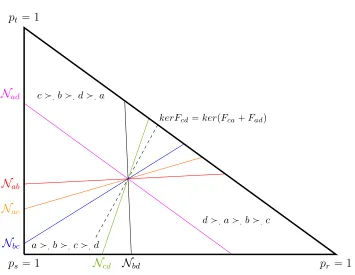
Bba. Finally, the set of pP∆ for which a„p b will be called Nab, and the set
Nabc is defined astpP∆ : a„p b„p c„p au.
We make use of the fact that S has n elements to identify ∆ with the n´1
dimensional simplex inRn, tpP Rn
` :p1 ` ¨ ¨ ¨ `pn“1u, whereRn` is the set
of vectors inRn for which every element of the vector is strictly positive, and
s
Rn
` will denote the closure of this set in Rn, that is
s
Rn
`:“ tpP Rn:pi ě0 for all i“1, . . . , nu.9
9
We prefer this notation on the grounds that it is more in line with modern notation used in the mathematical community outside economics. The standard notation in economics beingRn
`` for the strictly positive vectors andR
n
Where useful, we will consider ∆ as a subset of Rsn´1
` , that is we will identify
each probability distribution in ∆ with a point in the set tp P Rsn´1
` : p1 ` ¨ ¨ ¨ `pn´1 ď1u. In appendix (1.B) of this chapter, we provide some essential
results that justify the relationships between these spaces.
1.2.2
Motivation for the canonical setting
In this thesis we will look at how and when it is possible to use a real-valued
function to characterize and represent the preferences over a set of alternatives
of a decision-maker facing variety of contexts in which the decision problem
may arise. In the canonical decision problems upon which the following
expo-sition predominantly focuses, one way to view the decision problem is in terms
of a decision-maker with the following knowledge:
i. she knows she will face a decision in the presence of uncertainty about
the future state of nature;
ii. she knows, that when the situation arises, she will have sufficient
infor-mation to be able to identify the likelihood of any given state of nature;
iii. given any probability distribution over states, she knows whether or not
she has a strict preference for one course of action, in response to the
uncertainty, over another.
The flood example we have discussed above is an instance of this situation.
We also introduce the next example where there are three states and three
alternatives.
Example 1.3(Getting to and from University). Val lives near her university
university. Thus A :“ ta, b, cu with a:=“walk”, b:=“bus” and c:=“cycle”.
Suppose that the following conditions hold:
(i) bicycles are not allowed on the bus;
(ii) the bike may be stolen if it is left on campus overnight; and
(iii) the cost of return bus ticket is significantly cheaper than two singles.
These conditions contribute to Val’s strict preference for traveling by the same
means to and from university on any given day. This means that her decision
to buy a bus ticket or ride the bicycle to university in the morning amounts to
a commitment to a single means of travel for the whole day. Of course if she
walks to university, she can catch the bus back, but if she knows that conditions
will be such that in the afternoon she would certainly not want to be walking
home, then she would always buy the ticket, say, in the morning.
As is typical in Autumn, the weather may vary substantially during the day,
and Val knows that it may be raining, sunny or snowing/icey when she returns
that day: soS :“ tr, s, tuwithr:=“raining”,s:=“sunny” andt:=snowing/icy.
Before setting off each morning, the radio weather forecast gives her the chances,
p“ ppsqsPS, of each of the states obtaining.
Fed up with deciding each day, Val decides, once and for all, to devise a
com-plete, contingent plan of what to do. At the time she makes her plan, the set of
contingencies is the set ∆. (Here ∆ is isomorphic to the 2-dimensional, unit
simplex in R3
Suppose that if she were certain it would be sunny in the evening, Val would
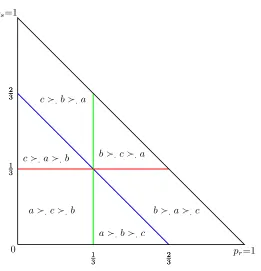
strictly prefer walking to cycling to going by bus, ie. a ąs cąs b.10
When it
will rain for sure, her preferences are cąr bąr a and when it will snow or be icey for sure, her preferences areb ątaąt c.
It seems plausible that Val’s preferences conditional uponp, tpA,ąpq:pP ∆u,
will vary with the probability she face on any given day: the question is how.
Suppose that at the probability p “ p1 3,
1 3,
1
3q, Val’s strict preferences are the
same as they are when statet occurs for sure. Is it then plausible for instance
that, for all probabilities qpλq such that qpλq “λδt` p1´λqp and 0ăλă1,
Val’s strict preferences are unchanged? That is, if we start at a given context
qp0q ” p and increase the probability of state t in such a way that the ratio
of the probabilities of state r and s remain unchanged, does strict preference
remain the same? If so then we conclude that the setconvpδt, pqis a subset of
tpP ∆ :b ąt aątcu ”BbaXBac.
Whilst context preferences of the canonical form presented above are well
suited to modeling the above example, which might be viewed as a game
against nature where nature presumably does not respond to Val’s choices:
they are arguably inadequate for the analysis of strategic game
rock-paper-scissors, where a player is penalized for being predictable or where preferences
may be defined over correlated strategies. We discuss this matter further in
chapter 4.
10
Remark 1.1. The time-line of the example above has three obvious stages: the
final stage, after both the action has been taken and the uncertainty is resolved;
the penultimate stage, when the agent must act; and the first stage, when the
problem is contemplated and a complete, contingent plan of which action is to
be taken in the penultimate stage is laid out by the decision-maker.
Our focus is on behaviour in the first stage. In the language of Hammond
(1981) we are taking the “ex-ante” approach to choice under uncertainty /
risk. In this thesis no considerations will be given to the optimal time to act.
Similarly, the related question of what constitutes “sufficient information to be
able to identify the likelihood of any given state of nature”, as stipulated in (ii.)
above, is also avoided. That is to say, we model neither the process, nor the
assumptions on behaviour that are involved in the decision-maker converting
information about the uncertainty into beliefs and deciding whether or not to
act.
Of the three basic assumptions on the knowledge held by the decision-maker
(iii.) is the strongest and most questionable; although it is not as strong as
it may at first seem. This is because the decision-maker is free to have
no-strict-preference for one action over another: for every possible probability
distribution over states, and such preferences would not necessarily indicate
indifference.
It is a central tenet of this thesis that even when precise information regarding
the uncertainty is available, choosing between courses of action may still be the
to understand and weigh-up the differences between the alternatives available
to her. So all other things being equal, a model in which the domain of
pref-erences is minimal and observable to the modeler ought to dominate others.
Not enlarging the domain of preferences comes at the price of requiring that
the agent is able to imagine, or recall from past experience, what her
prefer-ences are in situations different from the present context. That is, we place
greater demands on her ability to imagine variations in the circumstances she
may face in the second stage. Whilst there is no denying that this is the main
drawback of this approach, it is a weaker assumption than to assume
prefer-ences over contexts and alternative-context pairs.
Finally, defining preferences on an observable domain such as actions rather
than the much more abstract concept of outcomes or consequences, that may
or may not be dependent upon states or other factors, brings the model closer
to those that deal with choice functions and observed behaviour. As is the case
in that literature, it may well turn out that the decision-maker behaves as if
she were contemplating all the outcomes and/or consequences of her actions.
If so, this will be an output of the model rather than a starting point.
1.3
Expected utility for context preferences
Given that our canonical example is a model of decision-making under risk or
uncertainty, it is necessary to discuss in more detail the variety of approaches
that already exist. This section provides an exposition of the different models
really only one candidate for context preferences.
1.3.1
The function-space approach to expected utility
A initial demonstration of why the standard approaches will not work and
why new inter-context conditions are necessary is provided by the following
discussion. We consider a theorem for finite alternative and state spaces by
Adams (1965) and Fishburn (1979). It will show that in our setting, where
a complete contingent plan for each p is the objective, the theorem of
Fish-burn gives a family of additive representations, one for each p. However, as
the condition has nothing to say about how preferences vary with p, it is not
sufficient to ensure linearity inp.
Let As denote the set of outcomes in state s of each of actions in A. The
next theorem defines preferences on ˆn s“1As.
Example 1.4. In example 1.3 recall that
A:“ twalk, bike, busu ” ta, b, cu, and
S:“ train, sun, snow{iceu ” tr, s, tu.
It is not only arrays of outcomes such as par, as, atq (which may be identified
with the alternative “walk” lie in Ar ˆ As ˆAt) that lie in the domain of
preferences; the idealistic but unfeasible array pcr, as, btq is also there. As a
result even in a simple problem such as this the cardinality of the space Arˆ
AsˆAt is 27, whereas AˆS “9.
pα1
, . . . , αJqE
Jpβ1. . . βJq if and only if J ą 1, αj, βj P ˆns“1As for j “
1. . . , J, and it is true for eachs thatα1
s, . . . , αJs is a permutation ofβ
1
s, . . . βsJ.
For a fixed, suppressed context we have the following result.
Theorem 1.1 (Scott and Suppes (1958), Fishburn (1979)). The relation ą.
onˆn
s“1As satisfies the following condition: for all J-sequences,tαjuandtβju
in ˆn
s“1As, and all J “2,3, . . .
(F) if pα1
, . . . , αJqE
Jpβ1, . . . , βJq and pβj ą.αjq for j “1, . . . , J´1,
then pαJ ą .βJq,
if and only if there exist real valued functions u1, . . . , un onA1, . . . , An
respec-tively such that, for all α, β P ˆn s“1As,
p4q αą.β ô ÿ
sPS
`
uspαsq ´uspβsq
˘
ą0.
One problem with the condition (F) in the above theorem is that it is somewhat
difficult to evaluate without case by case verification. Moreover verification is
by no means an easy task: in example (1.3) where there are three alternatives
and three states, in order to verify the condition, we have to make `272
˘
“351
comparisons.
Another problem with the above representation is that it gives us no
informa-tion about how preferences vary with the context that is the current belief.
Presumably, for context preferencespąp, pP∆pSqq, the theorem holds for any given p, and the representation is as follows:
p5q αąp β ô ÿ
sPS
`
uspαs, pq ´uspβs, pq
˘
If we seek a representation that has more structure, and thereby resembles a
plan of action we need more conditions on how preferences vary with context.
Chapters 2 and 3 provide two approaches to dealing with this problem.
By contrast, the classical approach to adding more structure has been to
sup-press reference topand focus on state-preferences. In the Anscombe-Aumann
(1963) approach, the first step is to restrict the space of outcomes to be the
same in each state and define lotteries over these outcomes.11
The second step
is to impose that the ordering of the set of outcomes in each state is the same
across states. This state-independence allows us to identify the actual
proba-bility measurep that represents the information context (beliefs) of the agent
at decision time. Thus the Anscombe-Aumann approach says nothing about
how preferences vary with the information context, and hencep. Perhaps it is
best to view this model as capturing behaviour at stage two in the time-line
we describe in remark (1.1) above.
The same may be said of the models of Savage (1954), Scott and Suppes
(1958), and Debreu (1959). They seem to be more appropriate for addressing
the problem of an agent making a decision in the heat of the moment and at a
particular information set. By contrast, the present approach is closer in this
sense to [vNM] where a complete, contingent plan of action is outlined in the
first stage.
11
1.3.2
EU for context preferences
Let us consider the form of an expected utility (EU) function representing
the preferences of an agent over a set A given the knowledge of a probability
distribution, p, over the state space S.
Definition 1.2 (EU function representation of context preferences).
U :Aˆ∆ is an EU representation of context preferences if both the following
are true:
i) there exists u:AÑRn such for all p in ∆ and a in A,
Upa, pq “Epupaq:“
ż
S
upa, sqdppsq `or ÿ
sPS
psuspaq
˘
;
ii) U is said to represent context preferences,tpA,ąpq:pP∆u, if, for every
pP ∆and a, bPA we have
a ąp b ô Upa, pq ąUpa, pq.
From the above definition, it is clear that the vector-valued functionu :AÑ
Rn characterizes the representation. Indeed, the set N
ab is contained in the
hyperplane perpendicular to this vector. As we describe in appendix (1.A),
the elements of this vector-valued function are called state utility functions.
The rationale is simply that if ps “ 0 for all s ‰ t then the decision maker
would face statet with certainty, so that the expected utility Epu“ut which
represents state preferencesąt. The essence of this EU representation is that preferences atp are represented by the weighted average of the state-utilities,
s.
1.3.3
Incomparability across states
Suppose context preferences give rise to a representation that is cardinally
measurable but non-comparable across states (CNC across states). In this
case, as the following discussion shows, it is not clear whether probability
plays any role at all. First we define thesupport and null-sets of a probability
measure.
Definition 1.3 (Support of p). For countable S, the support of a probability
measure p, denoted suppppq, is the set of elements of S for which p assigns
positive measure. Thus, suppppq:“ tsPS :psą0u.
Definition 1.4 (Null-sets ofp). The null sets of a probability measure p, are
these for which p assigns zero probability. That is, if T Ă S and ppTq “ 0,
then T is a null set.
Let preferences be represented byU and fix pP∆. LetT be set of states such
thatpt“0. As preferences are CNC, any other functionV :Aˆ∆ÑRthat
is also and EU representation satisfies the property that there existsv :AÑR
such that for each s PS, vs “λsus`κs for some λs ą0 and κs PR. For all
sPT let qs “0. Then for all sPSzT, let 0 ăqs ă1 and letλs :“qs{ps, then
we have
ÿ
s
psuspaq ą
ÿ
s
psuspbq ô
ÿ
s
psλs
`
vspaq ´vspbq
˘ ą0 ôÿ s qs `
vspaq ´vspbq
˘
so that if the qs sum to 1, the latter is an equivalent representation indexed
by the probability q. In particular this means that for all a and b in A, the
relative interior, ri ∆, of ∆ is a subset of one (and only one) of the sets Bab,
Nab and Wab. This rather extreme property of preferences fact has lead many
authors in the literature to suppress the probability altogether (see Fishburn
(1970) Ch.4 and 5, Debreu (1959)), so that the representation takes the form
ř
sws, with ws :“ psus for each s. Indeed, it seems reasonable to say that
pws, s P Sq characterizes the representation of preferences ąp. This kind of
representation, contrary to what one might think, is in fact overly restrictive
in that it rules out whole classes of preferences without any clear reason.
1.3.4
vNM representation of context preferences
CNC preferences are in contrast to the class of state independent models of
[vNM] and Anscombe and Aumann (1963). Now suppose the context
prefer-ences give rise to a [vNM] type representation on consequprefer-encesY “AˆS. The
resulting utility function is characterized by a single utility functionu:Y ÑR
and for every π and ρ in ∆Y we have
πąρ ô ÿ
xPY
πxupxq ą
ÿ
xPY
ρxupxq. (1.3)
Recall that if v also satisfies the above equivalence then we should have
v “ k `lu for some k P R and l ą 0.That is, preferences are cardinally
measurable and fully comparable (CFC–again see the appendix to this
chap-ter for more on these concepts). As k and l do not vary with s, for given
preferences, the vNM axioms define a much smaller invariance class of
In seeking to retrieve “response” or context preferences from a vNM
repre-sentation,12
we restrict attention to elements π of ∆Y such thatπ “pˆµ for
somepP∆S and µP ∆A that is elements of ∆Sˆ∆A (where ∆A is the set of
probability distributions on A). Preferences over ∆Y restricted to pˆµ and
pˆν in ∆S ˆ∆A, lead to the representation characterized by u: Y ÑR in
the following way. For each b and c inA:
δb ąp δc ô
ÿ
pa,sqPY
psupa, sq
`
δb´δc
˘
ą0
ô ÿ
sPS
ps
`
upb, sq ´upc, sq˘ą0.
In contrast with CNC preferences, there are now far fewer restrictions on the
sets Bab, Nab and Wab. Of course, each of these sets must be convex, and if
either ofBab and Wab is nonempty, then Nab is thin (empty interior relative to
∆).
Consider the special case where, for all a and b, either a dominates b for
all s P S or the reverse holds for all s P S, then for every a and b, convexity
implies that ∆ is equal to eitherBab orWab. In this case, ∆ lies in a “chamber”
defined as the interior of an intersection of the`n2
˘
open half-spaces defined by
the hyperplanes tIab :a, bPAu.
This in turn implies that we may rotate, by a suitably small amount, the
12
vectorsupaq ´upbq, keeping ∆ in the corresponding chamber, to obtain a new
functionv :AˆS ÑRthat characterizes some expected utility representation
V and such thatv ‰l u`k for any lą0 and k PR.
Thus a vNM representation, to borrow from the language used in the social
choice literature13
,may imply a good deal more information regarding the
de-cision maker’s preferences than can be observed from context preferences alone.
Even in the case where for every a, b in A, the sets Nab of full dimension
and the hyperplanes Iab are fully identified, the appropriate degree of
com-parability for an EU representation of context preferences will turn out to be
“unit comparability” and the resulting representation is referred to as CUC. It
is characterized by an EU function with the property that the state utilitiesus
in the vector-valued function u:AÑRn, are unique up to a common scalel,
but independent origink. That is, if v corresponds to another representation
of the same preferences, then vs “ l us`ks. We derive such a representation
in chapter 2.
More generally, there appear to be no conditions one can meaningfully impose
on preferences that ensure the existence of an expected utility representation of
context preferences. This means that by insisting upon such a representation
we are excluding perfectly reasonable preferences from the analysis without
any real justification. This provides motivation for the third and fourth
chap-ters.
13
1.4
Synopsis
Chapter 2 presents a model that is closely related to Gilboa and Schmeidler
(2003) (GS03). In this paper, the authors provide a re-interpretation of their
model ofcase-based decision theory and work in the same context space as we
do in this thesis. That is, where states play the role of cases and probabilities
or beliefs play the role of context. We improve upon their model in two
re-spects.
Firstly, we weaken the diversity condition in an important way. Secondly,
we provide an alternative to the “combination” condition of GS03 that gives
rise the linear form of the representation. The resulting conditions are weaker
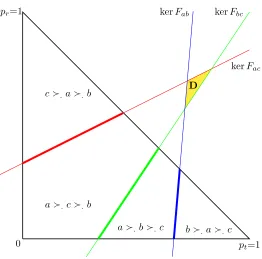
and we argue more intuitive.In addition, this chapter also sheds light on the
role of expected preference representations (similar to those of Vind (1991))
for context preferences. Expected preference representations are inseparable
across pairs of alternatives, but still linear in probabilities. They can be used
to model intransitive preferences just as well as transitive preferences. As such
it provides way of axiomatizing of the Loomes and Sugden (1982) model of
intransitive regret. This is in the presence of much simpler axioms than
Fish-burn’s skew-symmetric bilinear model.
Chapter 3 proposes a model that gives rise to a utility representation that
is simply order-preserving over alternatives and continuous over contexts. We
identify the most general type of context space for which we can hope to
guarantee a continuous representation. The mathematics of this approach is
In due course we intent to extend this model to provide a link between decision
theory and the discrete choice models of econometrics on the one hand and
neuroscience on the other.
In the fourth and final chapter we suppose that the decision-maker is
will-ing to extend the domain of preferences to include the space of contexts. That
is, the decision-maker is willing to make statements of the form: “I prefer to
be in context p and choose alternative b than to be in context q and choose
alternativec”. Despite this extension, the domain of preferences is still much
smaller than the [vNM] model of expected utility requires.
As a result, rather than a single mixture space–as defined in Herstein and
Milnor (1953)–we work with a collection of mixture spaces indexed by the
al-ternatives. This leads us to introduce a condition that “bridges” the gaps in
the order between the mixture spaces. The resulting representation resembles
that of [vNM] in that it is both state and context independent, but is
distin-guished by the fact that the uniqueness of the representation depends on the
number of components preferences generate. Methodologically speaking, the
closest models in the literature to the model of this chapter is that of Karni
and Safra (2000) as well as Fishburn’s multilinear utility model.
Our main conclusion is that when preferences vary with context, unless the
decision-maker is willing to extend the domain of preferences to include the
context space, we should only hope for preferences to have a linear utility
representation (as in expected utility) in mathematically interesting but