The influence of variable and prolonged Response Time Interval on
associative learning and motor chunking
Bachelor thesis by Wouter J. Dronkers, S1230182 Supervisor1 Prof. Dr. Ing. Verwey
Supervisor2 Jonathan Barnhoorn, Msc
Abstract
Sequential motor skills involve rapid execution of movement sequences without external guidance. The execution of fast and smooth movement sequences relies on representations using motor chunks. The use of motor chunks help bypass limitations in information processing so that short movement series can be selected, prepared and executed as if they constitute a single response. The aim of this randomized study was to find out whether associations were formed between stimuli with a longer and variable Response Time Interval (RSI). This study was divided in a practice and a test phase. Participants were randomly assigned during the practice phase to a RSI-0 milliseconds group or a group where RSI was longer and variable from 500 up to 2000 milliseconds. During the test phase, response time was significantly faster in the RSI-0 group compared to the long-RSI group. One explanation for this longer response time in the long-RSI group could be that associations between stimuli were absent, so that motor chunks were not developed and used by participants during the task.
Introduction
Sequenced based learning has proven its benefits. Performance of sequential motor skills sometimes involves rapid execution of a movement series without much need for external guidance (Verwey, 2007; Verwey, 2015). Taking the surgeons knot for example: trained surgeons will rapidly and correctly make a surgeons’ knot without thinking over every single step in the process of knot tying. Making a surgeons’ knot becomes an automated movement sequence for the trained surgeon. For a less trained surgeon these skills remain largely externally guided and require more time, practice and mental effort (Vidoni & Boyd, 2007). When single movements are becoming automated sequences, like knot tying, the trained surgeon is allowed to devote most of his processing resources and time to other, more difficult tasks during surgery or the surgeon could prepare himself for upcoming events in the OR while he is executing this movement pattern of knot tying, which has become familiar to the surgeon (Verwey, 2015). Fitts (1964) and Anderson (1982) proposed that when movements become automated, this process could be described as a transition from the declarative phase to the procedural phase. A typical characteristic of the latter phase is a relatively fast sequence of movements. These tasks involve small and relatively easy tasks like writing one’s signature as well as complicated, skilled movements like suturing a surgeons knot in the operating room. Various studies (Bapi, Doya & Harner, 2000; Koch & Hoffmann 2000; Mayr 1996) show that skilled movement sequences make use of spatial and non-spatial information.
Motor chunks
Fast and smooth execution of movement sequence like the earlier mentioned surgeons knot is dependent especially on representations using movement related codes called motor chunks (Verwey, 2001). The use of motor chunks help bypass limitations in information processing so that short movement series can be selected, prepared and executed as if they constitute a single response (Verwey, 1999). These chunks are characterized by a relatively slow first key-press, followed by series of key-presses that can be executed fast and smoothly (Ruitenberg, Verwey & Abrahamse, 2015). Motor chunks rely on Response-Response (R-R) associations rather than Stimulus-Response (S-R) associations. S-R associations involve movements where responses are given as reactions on stimuli. R-R associations involve movements where responses are giving as a reaction on the previous response rather than a stimulus. The initial, slower first key-press is caused by time uncertainty. A motor chunk codes successive
times where slow reaction times were attributed to responding to key-specific stimuli, indicating performance in reaction mode. Cohen, Ivry & Keele (1990), Curran & Keele (1993) and Reed & Johnson (1994) all concluded that reaction times tend to decrease
progressively during practice and increase dramatically when repeating patterns are modified in any of several ways. Based on these findings the overall conclusions were that subjects have learned the pattern and were able to prepare for their responses relying on their knowledge of the sequence. Familiar, unchanged sequences are executed faster than unfamiliar sequences (Destrebecqz & Cleeremans, 2001).
Implicit vs. explicit knowledge
Implicit learning of skills involves the process in which movements are learned in an unaware fashion (Berry & Dienes, 1991). Although people do not consciously know what they are doing, Reber (1967) found that people are capable of distinguishing stimuli without knowing how they actually do this. Explicit knowledge on the other hand involves knowledge which one can easily write down or explain to one other.
Decay of activation
Learning and the formation of memory can only be conducted by the formation of new neural networks in the brain. Three major cell types are involved in this process to form there neural networks: excitatory neurons, inhibitory neurons and glial cells (Kennedy, 2005; Kennedy, 2016). The average human brain contains about 86 billion neurons (Herculano-Houzel, 2009). Transmission between neurons goes via synapses. Information is stored when individual synapses that connect a particular group of neurons become more able to generate an action potential in the postsynaptic neuron in response to environmental signals (Kennedy, 2016). So if one sequence will be repeated, a stronger connection between particular neurons will be formed and so, an association will be formed. Activation of neurons in a simultaneous way increases the strength of synapses, connecting those neurons (Kennedy, 2016; Lisman, 1989). Based on this theory it is likely that after some practice, synapses will form a stronger
Furthermore, associative learning can be seen as a form of conditioning. In this way behaviour can be learned and modified based on S-R associations.
Hommel (1994) found that the Simon effect (where participants tend to respond faster and more accurate when stimuli are displayed at the same location as a previous stimulus) decreased when stimulus formation was delayed. These findings are consistent with the notion of gradual decay of location-induced response-code activation. Hommel furthermore argued that this decay was an automatic process, not a result of a strategy.
The Discrete Sequence Production task
If movement sequences are limited to about 5-8 elements, they can be planned before being executed because of the use of motor chunking. A Discrete Sequencing Production (DSP) task forms movement sequences with limited key presses per sequence (Verwey, Groen & Wright, 2015). In this task, subjects initially respond to a fixed series of position stimuli by pressing the spatially corresponding key following presentation of each stimulus. Furthermore, DSP tasks are suitable to study sequence segmentation (Rhodes, Bullock, Verwey, Averbaeck & Page, 2004). It is assumed that, with practice, execution in de DSP task becomes internally controlled, not requiring element-specific stimuli anymore, due the development of motor chunks. Response Time Interval (RSI) can be described as the time interval between stimuli. RSI can be manipulated in the DSP task. By this setting, the interval between stimuli can range from 0 up to 2000 milliseconds. Furthermore, it is possible to make this interval fix or variable.
Present objective
The aim of this randomized study, with two groups, was to determine whether RSI between stimuli on a DSP task influenced the development of motor chunks. One group involved a DSP Task without RSI (RSI-0 group), where the other group involved a DSP Task with a variable and prolonged RSI from 500 up to 2000 milliseconds (long-RSI group). Research showed that performance of the RSI-0 group induces the development on the use of motor chunks. Our hypothesis was that if the RSI is variable and long (from 500 to 2000
not fully aware of what they are doing. In other words, motor chunking and task performance will rely heavily on implicit knowledge.
Method Participants
A total of 24 participants (16 male) were included in this study. The mean age of the
participants was 20.96 years with a standard deviation of 2.70 years. 10 Participants received 5 euro for participation. The study was approved by the ethics committee of Faculty of
Behavioural Sciences of the University of Twente, Enschede, the Netherlands. This study was performed in accordance with the ethical standards described in the Declaration of Helsinki. All participants filled out an informed consent, which was obtained prior to the experimental phase. Only healthy participants who were naive with respect to the DSP task were included to avoid bias.
Apparatus and experimental setup
Presentation of stimulus and registration of responses by participants were controlled and registered by E-Prime 2.0 on a Toshiba laptop, running under Windows XP. Unnecessary Windows services were removed to improve response time measurement accuracy and to avoid interference during the experiment such as updates. The experiment took place in a quiet and light room with only a desk and a chair. The described laptop was put on the desk.
Stimulus, task and sequence
A total of four square boxes of 2x2 cm were presented on a white background. The green filling stimulus was presented in one of the four boxes. The DSP task was divided in eight blocks. Seven blocks were practice blocks in which motor chunks were assumed to develop by having participants train the DSP task. The actual test phase was in the eighth block. Between the practice- and test phase, participants took an awareness test. In the practice- and test phase, participants held their left index and middle finger at the C and V keys where the right index and middle finger were located at the B and N keys. Participants reacted with a response, corresponding to the location of the green stimulus, presented on the screen.
Practice phase
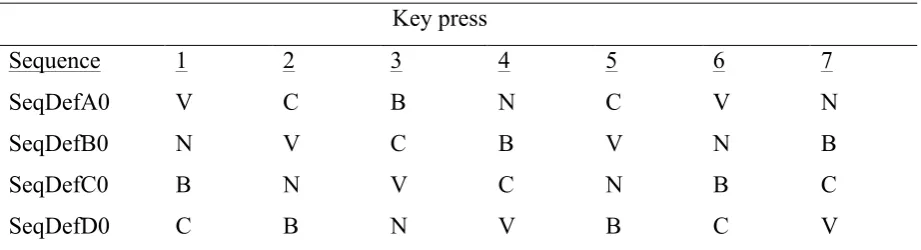
Furthermore, each block was divided in two equal sub blocks with a break of 20 seconds in between. After each block, participants were given a break of 180 seconds. During the breaks, between and after each sub block, the participants received performance scores consisting of the error rate and the average response time in milliseconds. Participants were urged to make errors not more than 6%. Furthermore, when a false key was pressed, the sequence was stopped and a new sequence was started. The total set of DSP sequences contained four different, counterbalanced sequences of 7 fixed key presses (Table 1). The initial key differed from time to time. The study consisted of two groups. In the control group (RSI-0, n=12), RSI was 0 milliseconds during all of the seven blocks. In the experimental group (long-RSI, n=12), RSI was variable with a range from 500 milliseconds up to 2000 milliseconds during all of the seven blocks.
[image:7.595.67.528.353.478.2]Table 1
Four counterbalanced sequences for seven key presses.
Key press
Sequence 1 2 3 4 5 6 7
SeqDefA0 V C B N C V N
SeqDefB0 N V C B V N B
SeqDefC0 B N V C N B C
SeqDefD0 C B N V B C V
Note. The initial key differed from time tot time during the test and between participants. Participants used all four counterbalanced sequences during the experiment. Two different sequences were used during the practice phase, where the other two sequences were used during the test phase.
Awareness test
Test phase
Directly after the awareness test, the actual testing phase of the experiment took place. A 2 (RSI: 0 vs. 500-2000 ms) x 2 (Familiarity) x 7 (Key) factorial design was used for the experimental procedure. A total of four conditions were tested after each other for both groups. One condition contained the two familiar sequences, as practiced during the first seven blocks, here with a fast RSI of 0 milliseconds. Another condition contained the two familiar sequences with a slow RSI, variable from 500 to 2000 milliseconds. Another condition contained unfamiliar, new sequences with a fast RSI of 0 milliseconds. Another condition contained unfamiliar sequences with a long RSI, variable up to 500 milliseconds where the order was balanced across participants. Per condition, 24 repetitions of 2 sequences were tested. All conditions were equal in terms of numbers of repetitions and numbers of different sequences; sequences in the testing phase were in a random order.
Results
Practice phase
A repeated measures analysis of variance (ANOVA) on the 2 (RSI: 0 vs. 500-2000 milliseconds) x 2 (Familiarity) x 7 (Key) factorial design was performed to determine
differences between response time between the RSI-0 group and the long-RSI group. With-in subjects variables were the test blocks (Block, 1 - 7) and key press in sequence (Key, 1 - 7). Overall response time was significantly faster in the RSI-0 group compared with the long-RSI group, F(1,22) = 11.966, p = .002.
Figure 1. Response time as a function of RSI, during the seven practice blocks, compares the RSI-0 group and the long-RSI group. Response time during the seven practice blocks decreased in both groups, indicating that participants were learning throughout the practice phase.
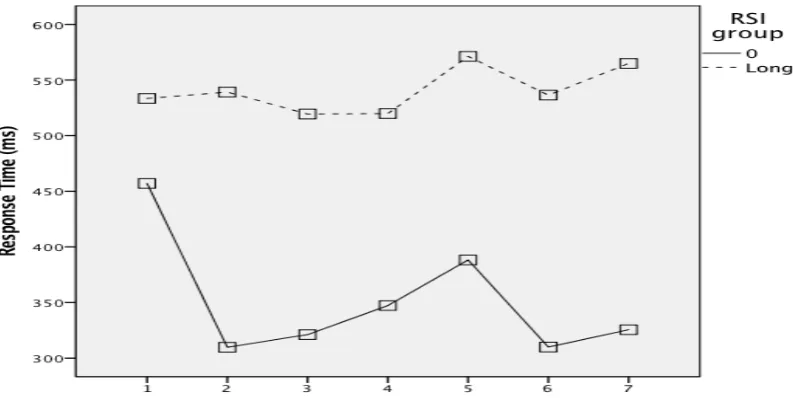
Figure 2. Response time as a function of RSI, during the seven key press actions, compares the RSI-0 group and the long-RSI group. Characteristic for the RSI-0 group is that faster key presses followed a relatively slow first press. For the long-RSI group, the response time on different key presses throughout sequences stayed relatively stable.
[image:9.595.85.482.335.534.2]Test phase
A repeated measures analysis of variance (ANOVA) on the 2 (RSI: 0 vs. 500-2000 milliseconds) x 2 (Familiarity) x 7 (Key) factorial design was performed to determine
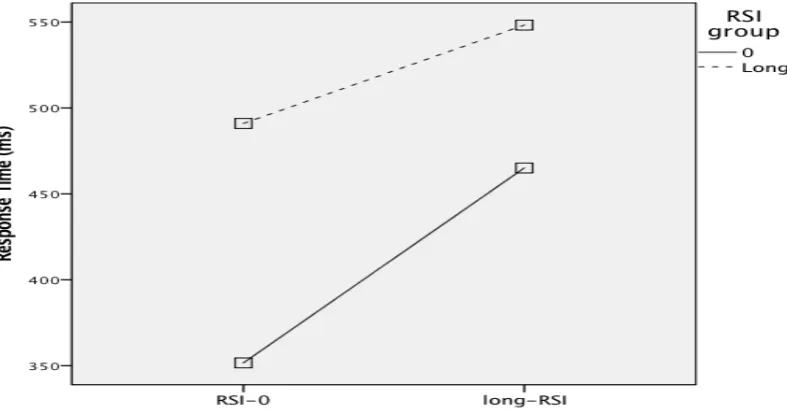
[image:10.595.87.481.303.510.2]differences in response time between the RSI-0 group and the long-RSI group. During the test phase between-subjects effect on the RSI groups was significant, F(1,22) = 5.721, p = .026, indicating an overall faster performance from the RSI-0 group compared with the long-RSI group. Figure 3 clearly shows that participants who were assigned to the RSI-0 group during the practicing phase were responding faster in both conditions (RSI=0 and RSI=500-2000 milliseconds) during the test phase. Within-subjects effect, grouping (RSI=0 VS. RSI=500-2000 MS), F(1,22) = 17.771, p<.001) was significant.
Figure 3. Response time as a function of RSI, during the test phase, compares the RSI-0 group and the long-RSI group. Participants who were assigned to the RSI-0 group during the practicing phase were responding faster in both conditions (RSI-0 and long-RSI) during the test phase.
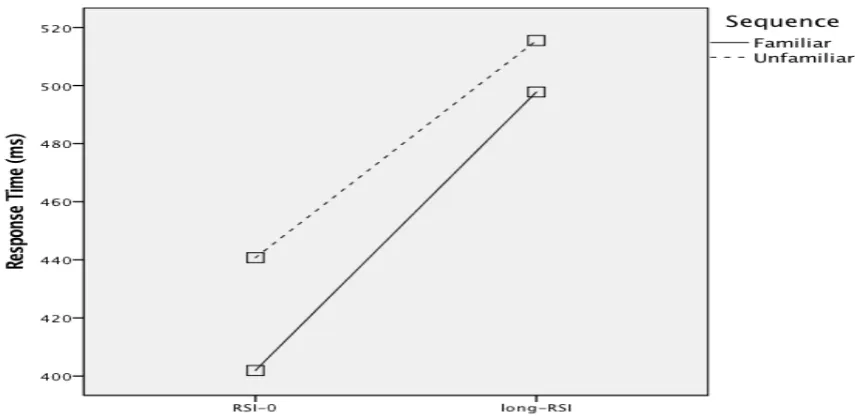
Furthermore familiarity of sequence (familiar versus unfamiliar) F(1,22) = 9.888, p = .005 and key press, F(6,132) = 12.872, p<.001 were significant. Interaction between key press and the different conditions was significant, F(6,132) = 4.778, p<.001. Figure 4 shows that participants in the RSI-0 group responded faster on both the familiar and unfamiliar
Figure 4. Response time as a function of RSI, during the test phase, comperes the RSI-0 group and the long-RSI group. Lines represent the two different sequences that had to be repeated during the test phase. Participants performed shorter response times when familiar and unfamiliar sequences had to be repeated in a RSI-0 group compared with the situation in which participants had to repeat the same sequences but now in the long-RSI group.
The same design was used for the errors in the test phase; repeated measures analysis of variance (ANOVA) was performed after an arcsine transformation. Like in the practice phase, the RSI-0 group, performing both familiar and unfamiliar sequences, involved significantly more errors than the long-RSI group, F(1,22) = 4.517, p = .045. Furthermore Key was significant, F(6,132) = 12.536, p<.001. Participants made more key press errors on the fifth number in the sequence compared to the other 6 key presses (4.5% versus <3.5%).
Discussion
The objective of this randomized study was to determine whether motor chunks are developed and used in a condition with a long and variable RSI between stimuli. The overall hypothesis was that that if the RSI is variable and long (from 500 up to 2000 milliseconds), so-called motor chunks will not be developed. Processing would then take longer because no coherent associations between stimuli could be formed and therefore response time of the long-RSI group will be longer compared with the RSI-0 group.
In both groups, response times decreased during all of the seven blocks, however a significant difference in the degree of decrease was found between the two conditions. The overall response of the RSI-0 group during the practice phase was faster (shorter response time) compared to the long-RSI group. It is likely to say that the faster performance by the RSI-0 group indicates the use of motor chunks. Although the long-RSI group became faster during the practice phase, there was no indication for the use of motor chunks by this group. Another finding was that response times during the sixth block of the practice phase by the long-RSI group was slower compared to previous blocks. One reason for these slower response times could be fatiguing during the test.
Key pressing during sequences had a typical pattern. The first key press of a sequence was relatively slow compared with the second and following key presses. This finding is in line with Ruitenberg, Verwey & Abrahamse (2015), stating that a movement sequence is coded into a motor chunk after a relatively slow, but successful first key press, followed by faster key presses during the remaining sequence. The long-RSI group showed no significant effect on key pressing during sequences. Instead of a decrease in response time, the response time remained relatively stable throughout a sequence. This finding could be explained by the fact that S-R associations were not modified into R-R associations because of time uncertainty and the variable and longer RSI. Participants in the long-RSI group used S-R associations for every key press instead of R-R association.
that participants not only learned in a sequence-based fashion but also in a general task learning way.
Response time decreased significantly as mentioned above. With this increase of speed, the amount of errors increased as well. However this increase was not significant overall. Another finding during the practicing phase was that both groups involved significantly more errors on the fifth key press compared to any other key press in the sequence. When the two groups are compared, it is clear that the RSI-0 group made more errors on the fifth key press compared with the long-RSI group. Characteristics of errors during the test phase were in line with the findings during the practice phase. The RSI-0 group, performing both familiar and unfamiliar sequences, made significant more errors compared with the long-RSI group. Like in the practice phase, participants made significantly more key press errors on the fifth key press in a sequence compared to the other six key presses.
Due a lack of time because the experiment had to take place in a fix period, which was a shortcoming of this experiment, the awareness test could not be analysed. Our
recommendation for future research on this topic is to implement and analyse an awareness test to determine whether the participants’ learning is based on implicit, explicit or a
combination of these two types of knowledge.
The overall conclusion, based on this experiment, is that when there is no response time interval (RSI = 0), participants develop R-R associations, resulting in the use of motor chunks to perform faster during tasks. When response time interval is prolonged and variable, S-R association are not being modified into R-R associations and therefore motor chunks would not be developed.
References
Abrahamse E. L., Duthoo W., Notebaert W., & Risko E. F. (2013). Attention modulation by proportion congruency: the asymmetrical list shifting effect. Journal of Experimental Psychology: Learning, Memory and Cognition, 39, 1552–1562.
Abrahamse E. L., Ruitenberg M. F. L., De Kleine E., & Verwey W. B. (2013) Control of automated behaviour: insights from the discrete sequence production task. Frontiers in Human Neuroscience, 82, 1–16.
Anderson J. R. (1982). Acquisition of cognitive skill. Psychological Review, 89, 369–406.
Bapi R. S., Doya K., & Harner A. M. (2000). Evidence for effector-independent and dependent representations and their differential time course of acquisition during motor sequence learning. Experimental Brain Research, 132, 149–162.
Berry D. C., & Dienes Z. (1991). The relationship between implicit memory and implicit learning. British Journal of Psychology, 82, 359-373.
Carlisle H. J., Kennedy M. B. (2005). Spine architecture and synaptic plasticity. Trends Neuroscience, 28, 182–187.
Cohen A., Ivry R., & Keele S. W. (1990) Attention and structure in sequence learning. Journal of Experimental Psychology: Learning, Memory, and Cognition, 16, 17-30.
Curran T., & Keele S.W. (1993). Attentional and non- attentional forms of sequence learning.
Journal of Experimental Psychology: Learning, Memory, and Cognition, 19, 189-202.
Destrebecqz A., Cleeremans A. (2001) Can sequence learning be implicit? New evidence with the process dissociation procedure. Psychonomic Bulletin & Review, 8, 343–350.
Fitts P. M. (1964). Perceptual-motor skill learning. Categories of human learning. 243–285.
Hommel B. (1994). Spontaneous decay of response code activation. Psychological Research, 56, 261-268.
Kennedy M. B. (2016) Synaptic Signaling in Learning and Memory. Cold Spring Harbor Perspectives in Biology, 2, 1-16.
Koch I., & Hoffmann J. (2000). The role of stimulus-based and response-based spatial information in sequence learning. Journal of Experimental Psychology: Learning, Memory and Cognition, 26, 863–882.
Lisman J. A. (1989). A mechanism for the Hebb and the anti-Hebb process underlying
learning and memory. National Academy of Science, 86, 9574–9578.
Mayr U. (1996). Spatial attention and implicit sequence learning: Evidence for independent learning of spatial and nonspatial sequences. Journal of Experimental Psychology: Learning, Memory and Cognition, 22, 350–364.
Reber A.S. (1967). Implicit learning of artificial grammars. Journal of Verbal Learning and Verbal Behaviour, 5, 855-863.
Reed J., & Johnson, P. (1994). New evidence of implicit sequence learning. Behavioral and Brain Sciences, 17, 419-420.
Rhodes B. J., Bullock, D., Verwey, W. B., Averbaeck, B. B., & Page, M. P. A. (2004). Learning and production of movement sequences: Behavioral, neurophysiological, and modeling perspectives. Human Movement Science, 23, 699–746
Ruitenberg M.F.L. and Verwey, W.B. and Abrahamse, E.L. (2015) What determines the impact of context on sequential action? Human movement science, 40, 298 - 314.
Verwey, W. B. (2001). Concatenating familiar movement sequences: the versatile cognitive
processor. Acta Psychologica,106, 69-95.
Verwey W. B., Abrahamse E. L. (2012) Distinct modes of executing movement sequences: reacting, associating, and chunking. Acta Psychologica, 140, 274–282.
Verwey W. B., Groen C. G., & Wright D. L. (2015). The stuff that motor chunks are made of: Spatial instead of motor representations? Experimental Brain Research, 234, 353 – 366.