(EEMCS)
Master Thesis
Behavioral Analysis of
Obfuscated Code
Federico Scrinzi
1610481
[email protected]
Graduation Committee:
Prof. Dr. Sandro Etalle (1
stsupervisor)
Dr. Emmanuele Zambon
Abstract
Classically, the procedure for reverse engineering binary code is to use a disassembler and to manually reconstruct the logic of the original program. Unfortunately, this is not always practi-cal as obfuscation can make the binary extremely large by over-complicating the program logic or adding bogus code.
We present a novel approach, based on extracting semantic infor-mation by analyzing the behavior of the execution of a program. As obfuscation consists in manipulating the program while keep-ing its functionality, we argue that there are some characteristics of the execution that are strictly correlated with the underlying logic of the code and are invariant after applying obfuscation.
We aim at highlighting these patterns, by introducing different techniques for processing memory and execution traces.
Our goal is to identify interesting portions of the traces by finding patterns that depend on the original semantics of the program. Using this approach the high-level information about the business logic is revealed and the amount of binary code to be analyze is considerable reduced.
Contents
1 Introduction 6
1.1 Research objectives . . . 8
1.2 Outline . . . 8
2 State of the art 9 2.1 Classification of Obfuscation Techniques . . . 9
2.1.1 Control-based Obfuscation . . . 9
2.1.2 Data-based Obfuscation . . . 11
2.1.3 Hybrid techniques . . . 11
2.2 Obfuscators in the real world . . . 14
2.3 Advances in De-obfuscation . . . 15
3 Behavior analysis of memory and execution traces 20 3.1 Data-flow analysis methods . . . 22
3.1.1 Visualizing the memory trace . . . 23
3.1.2 Data-flow tainting and diff of memory traces . . . 26
3.1.3 Entropy and randomness of the data-flow . . . 27
3.1.4 Auto-correlation of memory accesses . . . 29
3.2 Control-flow analysis methods . . . 31
3.2.1 Visualizing the execution trace . . . 32
3.2.2 Analysis of the execution graph for countering control-flow flattening . . . 32
3.3 Implementation . . . 37
4 Evaluation 39 4.1 Introduction of the benchmarks . . . 39
4.1.2 Data-flow analysis evaluation benchmark . . . 41 4.1.3 Control-flow unflattening evaluation benchmark . . . . 42 4.2 Data-flow recovery results . . . 43 4.3 Control-flow recovery results . . . 52 4.4 Analysis of shortcomings . . . 54
5 Conclusions 56
CHAPTER
1
Introduction
In the last years, obfuscation techniques became popular and widely used in many commercial products. Namely, they are methods to create a program
P0 that is semantically equivalent to the original program P, but “unintel-ligible” in some way and more difficult to interpret by a reverse engineer. There are different reasons why a software engineer would prefer to protect the result of his or her work against adversaries, some examples include the following:
• Protecting intellectual property (IP): as algorithms and protocols are difficult to protect with legal measures [1], also technical ones needs to be employed to ensure unauthorized creation of program clones. Examples of software that include additional protection are iTunes, Skype, Dropbox or Spotify.
• Digital Rights Management (DRM): DRM are employed to ensure a controlled spreading of media content after sale. Using this kind of technologies, the data is usually offered encrypted and the distribu-tion of the key for decrypting is controlled by the selling entity (e.g.: the movie distributor or the pay-tv company). Sometimes the usage of proprietary hardware solutions that implement DRM technologies is possible but often it is not. In these situations there is the need of implementing everything in software. Nevertheless, in both cases tech-nical measures for protecting against reverse engineering are employed, in order to protect algorithm implementations and cryptographic keys.
their expertise on the development of surveillance software, need to protect their products against reversing. This is important in order to keep being effective, undetected by anti-viruses and act undisturbed.
These use-cases have all a common interest: research and invention of more and more powerful techniques to prevent reverse engineering.
The job of understanding what a binary, output of a common compiler, does is not always a trivial task. When additional measures to harden the process are in place this could become a nightmare. Reverse engineers strive to find new and easier ways of achieving their final goal: understanding every or most of the details of what a program is doing when is running on our CPUs. In the last years, an arms race has been going on between developers, willing to protect their software, and analysts, willing to unveil the algorithm behind the binary code.
There are different reasons why it would be interesting or useful to un-derstand how effective these techniques are and how it would be possible to break them and somehow retrieve an understandable pseudocode from an obfuscated binary. The most obvious one is in the case of malware: as security researchers the public safety is important and we want to protect Internet users from criminals that illegally take control of other people’s machines. Understanding how a malware works means also preventing its spreading.
Chapter 1: Introduction
1.1
Research objectives
State-of-the-art obfuscators can add various layers of transformations and heavily complicate the process of reverse engineering the semantics of binary code. In most cases it is unpractical to obtain a complete understanding of the underlying logic of a program. For an analyst, there is often the need to first collect high-level information and identify interesting parts, in order to restrict the scope of the analysis.
From our experiments we observed that there are distinctive high-level patterns in the execution that are strictly bounded to the underlying logic of the program and are invariant after most transformation that preserve semantic equivalency, such as obfuscation. We argue that it is possible to highlight these patterns by analyzing the behavior of an execution.
The objective of this thesis is to develop a novel methodology for reverse engineering obfuscated binary code, based on the analysis of the behavior of the program. As a program can be defined as a sequence of instructions that perform computation using memory, we can describe its behavior by recording in which sequence the instructions are executed and which memory accesses are performed. These traces can be collected using dynamic analysis methods. Thus, we aim at processing these traces and extract insightful information for the analyst.
Analysis of the behavior of obfuscated code is a new method for extract-ing information from the output of dynamic analysis, therefore to under-stand the strength of this approach we test its effectiveness against sample programs. Next, to show the invariance after obfuscation: we compare the observed behavior of state-of-the-art obfuscated samples with the one of the same samples in a non-obfuscated form.
1.2
Outline
State of the art
2.1
Classification of Obfuscation Techniques
Even though an ideal obfuscator is proven by Barak et al. not to exist [4], many techniques were developed to try to make the reversing process ex-tremely costly and economically challenging. Informally speaking we can say that a program is difficult to analyze if it performs a lot of instructions for a simple operation or it’s flow it’s not logical for a human. These de-scriptions however lack of rigorousness and are dubious. For these reasons many theoreticians tried to categorize these techniques and several models were proposed to describe both an obfuscator and a de-obfuscator [5, 6].
For our purposes we will base our categorization on the work of Collberg et al. from 1997 [6], augmenting it with more recent developments in the field [7, 8, 9, 10]. First we will introducecontrol-basedanddata-based obfuscation. Later more advancedhybrid techniques will be presented.
2.1.1 Control-based Obfuscation
Chapter 2: State of the art
end of a function, acallinstruction will generally invoke a function while a
ret will most likely return to the caller.
Control flow obfuscation is defined as altering “the flow of control within the code, e.g. reordering statements, methods, loops and hiding the actual control flow behind irrelevant conditional statements” [11], therefore the assumptions mentioned earlier do not hold anymore.
The following are examples of control-based obfuscation techniques.
Ordering transformations Compiled code follows the principle of spa-tial locality of logically related basic blocks. Also, blocks that are usually executed near in time are placed adjacent in the code. Even though this is good for performance reasons thanks to caching, it can also provide useful clues to a reverse engineer. Transformations that involve reordering and unconditional branches break these properties.
Clearly this does not provide any change in the semantics of the program, however the analysis performed by a human would be slowed down.
Opaque predicates An opaque predicate is a special conditional expres-sion whose value is known to the obfuscator, but is difficult for an adversary to deduce statically. Ideally its value should be only known at obfusca-tion time. This construct can be used in combinaobfusca-tion with a condiobfusca-tional jump: the correct branch will lead to semantically relevant code, the other one to junk code, a dead end or uselessly complicated cycles in the control graph. In practice, a conditional jump with an opaque predicate looks like a conditional jump but in practice it acts as an unconditional jump. For implementing these predicates, complex mathematical operations or values that are fixed, but are only known at runtime, can be used.
Functions In/Out-lining As from a call graph it is possible to infer some information on the underlying logic of the program, it is sometimes desirable to confuse the reverse engineer with an apparently illogic and unmeaningful graph. Functions inlining is the process of including a subroutine into the code of its caller. On the other hand function outlining means separating a function into smaller independent parts.
Control indirection Using control flow constructs in an uncommon way is an effective way for making a control graph not very meaningful to an analyst. For example instead of using a call instruction it is possible to dynamically compute the address at runtime and jump there, also ret in-structions can be used as branches instead of returns from functions.
program and perform some computation, or simply redirect the instruction pointer somewhere else or change the registers.
It is also possible to further exploit these features: Bangert et al. devel-oped a Turing-complete machine using the page faults handling mechanisms, switching from MMU to CPU computation using control indirection tech-niques [12].
2.1.2 Data-based Obfuscation
This category of techniques deals with the obfuscation of data structures used by the program. The following are examples of data-based obfuscation techniques.
Encoding For many common data types we can think of “natural” en-codings: for example for strings we would use arrays of bytes using ASCII as a mapping between the actual byte and a character, on the other hand for an integer we would interpret 101010 as 42. Of course these are mere conventions that can be broken to confuse the reverse engineer. Another approach is to use a custom mapping between the actual values and the values processed by the program. It is also possible to use homomorphic
mappings, so we can perform computation on the encoded data and decode it later [13].
Constant unfolding While compilers, for efficiency purposes, substitute calculations whose result is known at compile time with the actual result, we can use the very same technique in the reverse way for obfuscation. Instead of using constants we can substitute them with a possibly overcomplicated operation whose result is the constant itself.
Identities For every instruction we can find other semantically equivalent code that makes them look less “natural” and more difficult to understand. Some examples include the use of “push addr; ret” instead of a “jmp addr”, “xor reg, 0xFFFFFFFF” instead of “not reg” or arithmetic identities such as “∼ −x” instead of “x+ 1”
2.1.3 Hybrid techniques
For clarity and orderliness first control-based and data-based obfuscation techniques were presented. In practice these techniques are combined to reach higher levels of obfuscation and make the reversing process more and more difficult.
Chapter 2: State of the art
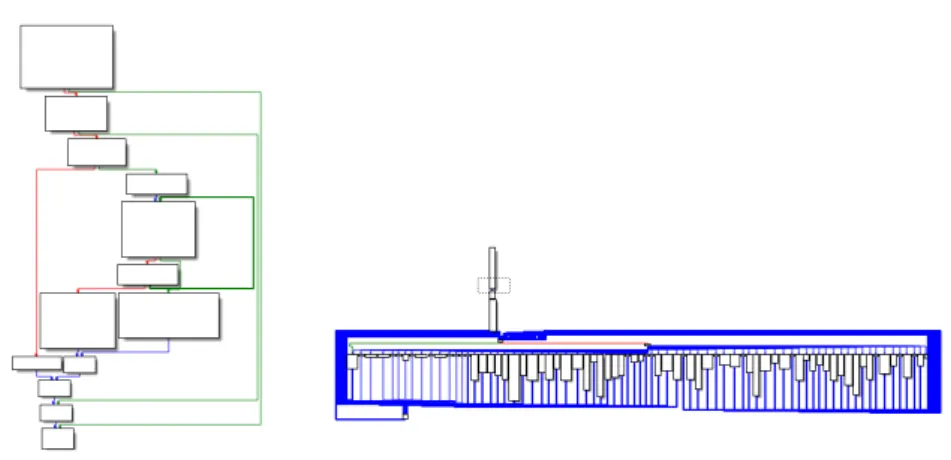
Figure 2.1: A control flow graph before and after code flattening
Source: N. Eyrolles et al. (Quarkslab)
Control-flow flattening Control-flow flattening (or code flattening) is an advanced control-flow obfuscation technique that is usually applied at function-level. The function is modified such that, basically, every branch-ing construct is replaced with a bigswitchstatement (different implementa-tions useif-else constructs, calling of sub-functions, etc. but the underlying principle remains unaltered). All edges between basic blocks are redirected to a dispatcher node and before every branch an artificial variable (i.e. the dispatcher context) needs to be set. This variable is used by the dispatcher to decide which is the next block where to jump.
Clearly, by applying this technique any relationship between basic blocks is hidden in the dispatcher context. The control flow graph doesn’t help much in understanding the logic behind the program as all basic blocks have the same set of ancestors and children. To harden even more the program other techniques can be included: complex operations or opaque predicates to generate the context, junk states or dependencies between the different basic blocks.
This technique was first introduced by C. Wang [14] and later improved by other researchers and especially by the industry. Figure 2.1 shows an example of the control flow graphs of a program before and after the code flattening obfuscation. This transformation is used in many commercial products, some examples include Apple FairPlay or Adobe Flash.
Virtual machines An even more advanced transformation consists in the implementation of a custom virtual machine. In practice, an ad-hoc instruc-tion set is defined and selected parts of the program are converted to opcodes for this VM. At runtime the newly created bytecode will be interpreted by the virtual machine, achieving a semantically equivalent program.
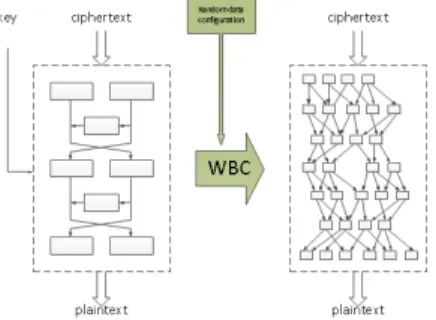
Figure 2.2: An overview of white-box cryptography
Source: Wyseur et al.
in obfuscating the program. In fact, an adversary needs to first reverse engineer the virtual machine implementation and understand the behavior of each opcode. Only after these operations it will be possible to decompile the bytecode to actual machine code.
White-Box Cryptography Cryptography is constantly deployed in many products where there is no secure element or other trusted hardware, a typi-cal example are software DRM. In these contexts the adversaries control the environment where the program runs, therefore, if no protection is in place, it is trivial to extract the secret key used by the algorithm. A possible ap-proach is for instance setting a breakpoint just before the invocation of the cryptographic function and intercept its parameters. Implementing crypto-graphic algorithms in a white-box attack context, namely a context where the software implementation is visible and alterable and even the execution platform is controlled by an adversary, is definitely a challenge. There the implementation itself is the only line of defense and needs to well protect the confidentiality of the secret key.
White-box cryptography (WBC) tries to propose a solution to this prob-lem. In a nutshell, B. Wyseur describes it as following: “The challenge that white-box cryptography aims to address is to implement a cryptographic algorithm in software in such a way that cryptographic assets remain secure even when subject to white-box attacks” [15]. In practice, the main idea is to perform cryptographic operations without revealing any secret by merg-ing the algorithm with the key and random data, in such a way that the random data cannot be distinguished from the confidential data (see Figure 2.2).
Chapter 2: State of the art
though it was broken in 2007 by Wyseur et al. [18] and Goubin et al. [19], it laid the foundation for research in this field.
In the real world WBC is implemented in different commercial prod-ucts by many companies such as Microsoft, Apple, Sony or NAGRA. They deployed state-of-the-art obfuscation techniques by creating software imple-mentations that embody the cryptographic key.
2.2
Obfuscators in the real world
Even though, for economic reasons, the most research in the area of obfus-cation is carried out by companies and is often kept private, we can find in literature different examples of obfuscators. Those are mainly used as proof of concepts for validating research hypothesis and rarely used in practice, also because the fact that the obfuscator is public poses a threat in the security-by-obscurity of this protection mechanism.
Some of the most interesting approaches to this problem that can be found in literature are based on LLVM. It is one of the most popular compi-lation frameworks thanks to the plethora of supported languages and archi-tectures. Additionally, its Intermediate Representation (IR) allows to have a common language that is independent from the starting code and the target architecture. This enables researchers to develop obfuscators that just manipulate the IR code and consequently obtain support for all lan-guages and platforms that are supported by LLVM, without any additional effort. Confuse [20] is one simple attempt to build an obfuscator based on LLVM implementing different widespread techniques. This tool offers ba-sic functionalities like data obfuscation, insertion of irrelevant code, opaque predicates and control flow indirection. An interesting description about how LLVM works and how it is possible to exploit its features for software protection are explained in detail in the white paper by A. Souchet [21]. He developed Kryptonite, a proof-of-concept obfuscator for showing the poten-tiality of LLVM IR.
One of the most interesting advances in open source obfuscation tools is given byObfuscator-LLVM (OLLVM) [22], an open implementation based on the LLVM compilation suite developed by the information security group of the University of Applied Sciences and Arts Western Switzerland of Yverdon-les-Bains (HEIG-VD). The goal of this project is to provide soft-ware security through code obfuscation and experiment with tamper-proof binaries. It currently implements instructions substitution, bogus control, control flow flattening and functions annotations. Additional features are under development while others are planned for the future.
technology is similar to the one employed in commercial obfuscators, such as Cloakware/IRDETO’s Transcoder. Features offered by Tigress include virtualization with a randomly-generated instruction set, control flow flat-tening with different dispatching techniques, function splitting and merging, data encoding and countermeasures against data tainting and alias analysis. On the market there are many commercial obfuscation solutions. The most famous include Morpher [24], Arxan [25] and Whitecryption [26]. Purely considering technical aspects, the availability of open source solu-tions is of great significance not only for academics but also for companies. Firstly, the fact of having access to the code makes it much easier to spot the injection of backdoors or security vulnerabilities in the final binary. Sec-ondly, such a tool allows to experiment with new techniques, benchmark them against reverse engineering and develop more sophisticated protection mechanisms. Lastly, obfuscation tools can be used as a mitigation for ex-ploitation: if each obfuscation is randomized it will be possible to easily and cheaply produce customized binaries, one for each customer, making the development of mass exploits very difficult. Clearly, as stated earlier closed source implementations might provide better protection as the obfus-cation process is unknown. Nevertheless there are many advantages in open source solutions as well and probably a combination of these two different approaches can lead to higher quality results.
2.3
Advances in De-obfuscation
In the previous chapter we presented some widely deployed as well as effec-tive techniques for software obfuscation. Now we can start asking ourselves different questions, in particular Udupa et al. [7] in their work addressed the following: “What sorts of techniques are useful for understanding ob-fuscated code?” and “What are the weaknesses of current code obfuscation techniques, and how can we address them?”. The answers to those questions are important for different reasons. Firstly it is useful to know more about what the code we run on our machines is actually doing (e.g.: it could be a malware), secondly obfuscation techniques that are not really effective are not only useless but actually worse than useless: they increase the size of the program, decrease performance and also offer a false sense of security.
Chapter 2: State of the art
that require running a program (often in a debugger, sandbox or other con-trolled environment) for the purpose of extracting information about it. In practice, dynamic and static techniques are combined together, their syn-ergy enhances the precision of static approaches and the coverage of dynamic ones.
The following paragraphs will briefly present various approaches to the de-obfuscation problem, introducing state-of-the-art general-purpose tech-niques that can help the reverse engineering process. Many attempts were made to develop automatic de-obfuscators [28, 29], however there is no “sil-ver bullet” for solving this problem and currently most of the work needs to be carried out manually by the analyst. Nevertheless, the following tech-niques propose a defined methodology and basic tools to tackle an obfuscated binary.
Constants identification and pattern matching A simple static anal-ysis technique consists in finding known patterns in the code. If the target binary implements some cryptographic primitive like SHA-1, MD5 or AES we can try to identify strings, numbers or structures that are peculiar of those algorithms. For a block cipher based on substitution-permutation networks it could be easy to recognize S-Boxes while for instance for public key cryptography it might be possible to find unique headers (e.g.: “BEGIN PUBLIC KEY”).
Also in the case of function inlining it is possible to use pattern match-ing techniques in order to identify similar blocks and therefore unveil the replication of the same subroutine. Replacing each occurrence if the pattern with the call of a function will hopefully lead to a more understandable code. The same can be applied against opaque predicates and constants unfolding: once a pattern is found and its final value is known we can substitute it with the obfuscated code.
Another similar technique that we can leverage isslicing. Introduced by Weiser [30], it consists in finding parts of the program that correspond to the mental abstraction that people make when they are debugging it.
Data tainting and slicing Dynamic analysis allows us to monitor code as it executes and thus perform analysis on information available only at run-time. As defined by Schwartz et al., “dynamic taint analysis runs a program and observes which computations are affected by predefined taint sources such as user input” [31]. In other words the purpose of taint analysis is to track the flow of specific data, from its source to its sink. We can decide totaint some parts of the memory, then any computation performed on that data will be also considered tainted, all the rest of the data is considered
interesting in the case of malware analysis as we can for instance taint per-sonal data present on our system and see if it is processed by the program and maybe exfiltrated to a “Command & Control” server.
To give an example, an implementation of this technique is present in
Anubis, a popular malware analysis platform developed by the “Interna-tional Secure Systems Lab” [32]. In the case of Android applications the system taints sensitive information such as the IMEI, phone number, Google account and so on, and runs the program in a sandbox, checking if tainted data is processed.
Data slicing is a similar technique. While tainting attempts to find all derivations of a selected piece of information and their flow, slicing works backwards: starting from an output we try to find all elements that influ-enced it [33].
Symbolic and concolic execution A simple approach for dynamic anal-ysis is the generation of test-cases, execute the program with those inputs and check its output. This naive technique is not very effective and the coverage of all possible execution paths is usually not very high. A better approach is given bysymbolic execution, a means of analyzing which inputs of a program lead to each possible execution path [34]. The binary is instru-mented and, instead of actual input, symbolic values are assigned to each data that depends on external input. From constraints posed by conditional branches in the program an expression in terms of those symbols is derived. At each step of the execution is then possible to use a constraint solver to determine which concrete input satisfies all the constraints and thus allows to reach that specific program instruction.
Unfortunately symbolic execution is not always an option: there are many cases in which there are too many possible paths and we will reach a
state explosion or the constraints are too complex to be solved, that makes the computation infeasible. For avoiding this problem we can applyconcolic execution [35]. The idea is to combine symbolic and concrete execution of a program to solve a constraint path, maximizing the code coverage. Basically, concrete information is used to simplify the constraint, replacing symbolic values with real values.
Chapter 2: State of the art
control-flow graphs or dead code, thus the reverse engineering process can be easier. Of course, we need to take into account that the trace might not include all the needed information.
Qira by George Hotz offers an implementation of this technique. It is introduced by the author as a “timeless debugger” [36] as it allows to go navigate the execution trace and see the computation performed by each instruction and how it modifies the memory. A different approach is offered by PANDA [37] which among other features allows to record an execution of a full system and replay it. The advantage of it is that it is possible to first record a trace with minor overhead, later we can run computationally intensive analysis on the recording without incurring in network timeouts or anti-debugging checks caused by a very slow execution.
Statistical analysis of I/O An alternative and innovative approach for automatically bypassing DRM protection in streaming services is introduced by Wang et al. [38]. They analyzed input and outputs from memory dur-ing the execution of a cryptographic process and determined the followdur-ing assumptions:
• An encoded media file (e.g.: an MP3 music file) has high entropy but low randomness
• An encrypted stream has high entropy and high randomness
• Other data has low entropy and low randomness
Using these guidelines it is possible to identify cryptographic functions and intercepting its plaintext output by just analyzing I/O and treating the program as a black-box. There is no need of reversing the cryptographic algorithm nor knowing which is the decryption key, the only requirement is being able to instrument the binary and intercept the data read and written at each instruction in RAM. Their approach was shown to automatically break the DRM protection and get the high quality decrypted stream of dif-ferent commercial applications such as Amazon Instant Video, Hulu, Spotify, and Netflix.
This work was later improved by Dolan-Gavitt et al. by showing how PANDA (Platform for Architecture-Neutral Dynamic Analysis) can be used to automatically and efficiently determine interesting memory location to monitor (i.e.: tap-points) [39, 40].
It is interesting to notice that this approach allows the completely au-tomatic extraction of decrypted content from a binary employing different obfuscation techniques, only by leveraging statistical properties of I/O.
find-ing vulnerabilities by craftfind-ing peculiar inputs. These could have been un-expected by the developer of the program and could lead to unintended behavior. More advanced fuzzers leverage symbolic execution and advances in artificial intelligence to automatically understand which inputs trigger different conditions and follow different execution paths. M. Zalewsky de-veloped american fuzzy lop (afl), “a security-oriented fuzzer that employs a novel type of compile-time instrumentation and genetic algorithms to au-tomatically discover clean, interesting test cases that trigger new internal states in the targeted binary”. He showed how it is possible to use afl
against djpeg, an utility processing a JPEG image as input. His tool was able to create a valid image without knowing anything about the JPEG format but by only fuzzing the program and analyzing its internal states [41].
Decompilers Instead of dealing with assembly it is sometimes preferable to have a higher abstraction and handle pseudo-code. In the last years new tools were released to allow to obtain readable code from a binary: some examples areHopper,IDA Pro HexRayswhich supports Intel x86 32bit and 64bit and ARM orJD-GUI for Java decompilation.
Unfortunately these tools rely on common translations of high-level con-structs, thus some simple obfuscation techniques or the usage of packers
CHAPTER
3
Behavior analysis of memory and execution
traces
Reverse engineering obfuscated binaries is a very difficult and time consum-ing operation. Analysts need to be highly skilled and the learnconsum-ing curve is very steep. Moreover, in the common case of reversing of large binaries, it is unpractical to analyze the whole program. There is the need to identify interesting parts in order to narrow down the analysis. On top of this, ob-fuscation can heavily complicate the situation by adding spurious code and additional complexity.
As the amount of information collected using static and dynamic analysis can be overwhelming, we need effective techniques to gather high-level in-formation on the program. Especially in the case of DRM implementations, it is important to understand which cryptographic algorithms are used and which parts of the code deal with the encryption process. This is needed, for instance, to collect information about the intermediate values to infer infor-mation on the secret key or to successfully perform fault injection attacks on the cryptographic implementation.
pur-pose of reverse engineering, exploring side effects of the execution to gather insightful information.
A program is formed by a sequence of instructions that are executed by the processor, these instructions operate on the memory. Following from this, we derive the observation that the behavior of a program is well de-scribed by recording executed instructions and memory operations over time. We can collect this data through dynamic analysis, the extraction of useful information from these traces will be the focus of this report.
In summary, the underlying hypothesis of this project is that distinctive patterns in the logic of the program are reflected in the output of dynamic analysis, regardless of the complexity of the implementation or possible ob-fuscation transformations.
Continuing on these lines, from the side-channel analysis world we know that interesting information can be extracted from the analysis of differ-ent phenomenons, such as power consumption, electromagnetic emissions or even the sound produced during a computation. These methods are mostly not dependent on a specific implementation of the target algorithm and are not bounded to strong assumptions on the underlying logic, thus are appli-cable in a black-box context. We inspired our work to these techniques and we adapted them to reverse engineering of software. Compared to physical side channels, we can collect perfect traces of memory accesses and executed instructions. As we can completely control the execution environment, we do not have to to deal with imprecise data or issues due to the recording setups, like noise. On the other hand, the targets are usually much more complex and possibly obfuscated.
The main advantage of the proposed approach is that we can infer in-formation about the target program without manually looking at the code. This fact highly simplifies the reverse engineering and allows the extraction of the semantics of almost arbitrary complex binaries. Also, the process is not bounded to a specific architecture, the same methods can be applied to any target. The main problem remains how to effectively process and show the collected data, in such a way that patterns are identifiable and are beneficial for the purpose of reverse engineering.
Chapter 3: Behavior analysis of memory and execution traces
et al. used visualization of execution traces for better understanding the behavior of packed malware samples [43]. Trinius et al. instead focused on the visualization of library calls performed by the target program in order to infer information about the semantics of the code [44]. Also in the forensics world we can find attempts to use visual techniques, for example to identify rootkits [45] or to collect digital forensics evidence [46].
As these results show, visualization is a powerful companion for the analyst. Compared to other possible solutions, such as pattern recognition based on machine learning or other automatic approaches, it is generally applicable, it does not require fine tuning or ad-hoc training and the result of the analysis can be quickly interpreted by the analyst and enhanced with other findings.
Following from these premises, in our work we want to address the fol-lowing research questions:
• Which information is inferable from memory and execution traces that is attributable to the behavior of the program and reveals information on its semantics, regardless of obfuscation?
• Which techniques are effective in highlighting this information and give useful insights in the business logic of the target program?
For this research project we developed different methods to extract in-formation about the semantics of a program by analyzing its behavior. This section will introduce these techniques, divided in two categories: data-flow analysis and control-flow analysis. The former is focused on visualization of memory accesses, the discovery of repeating or distinctive patterns in the data-flow and the analysis of statistical properties of the data. The latter aims at giving information about the logic of the program by visualizing an execution graph, loops or repetitions of basic blocks and by using graph analysis to counter obfuscations of the control-flow.
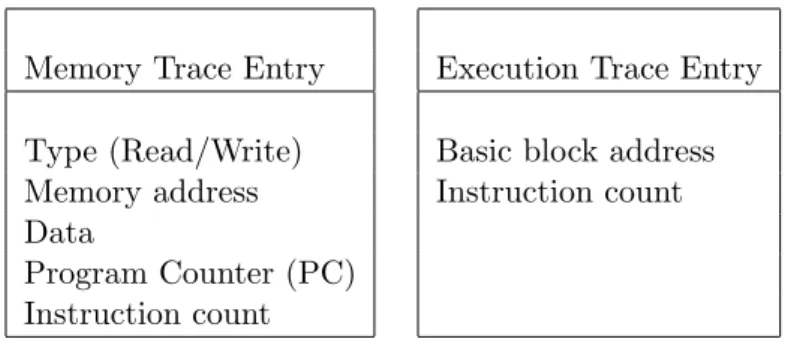
In our work we recorded every memory access and every execution of basic blocks produced by target binary during one concrete execution. For the instruction trace we only record basic blocks addresses in order to keep the trace smaller and more manageable, it is implicit that every instruction in the basic block was executed. Table 3.1 shows the data that is recorded for every entry in the traces.
3.1
Data-flow analysis methods
Memory Trace Entry
Type (Read/Write) Memory address Data
Program Counter (PC) Instruction count
Execution Trace Entry
Basic block address Instruction count
Table 3.1: Description of the data recorded for each entry of the memory and execution traces.
ones or by tweaking the control-flow. However, distinctive patterns in the memory accesses remain unvaried and part of the data that flows to and from the memory is also unchanged. Moreover, when dealing with pro-grams that process confidential data (e.g. cryptographic algorithms), we can use memory traces to extract secret information.
For all these reasons, we explored different possibilities in the analysis of the memory trace. The most simple technique is the visualization of memory accesses on an interactive chart. As the information showed by this method can be overwhelming, we present possible solutions to this problem. Different techniques will be discussed to reduce the scope of the analysis by focusing on parts of the execution that depend on user input.
Later, we move deeper in the analysis of the actual data that flows to and from the memory. We exploit statistical properties of the content of memory accesses, in terms of entropy and randomness, to unveil information from the execution. Next, we analyze the trace in terms of location of memory accesses, instead of their content. By applying auto-correlation analysis we aim at identifying repeated patterns in the accesses. These two techniques allow to take into account two diametrically opposed types of data, content and location of memory accesses, and thus gather a more complete picture of the behavior of the target program.
3.1.1 Visualizing the memory trace
As a first step, the memory trace is displayed in an interactive chart, where the x-axis represents the instruction count while the y-axis the address space. Every memory access performed by the target program is represented as a point in this 2D space.
Chapter 3: Behavior analysis of memory and execution traces
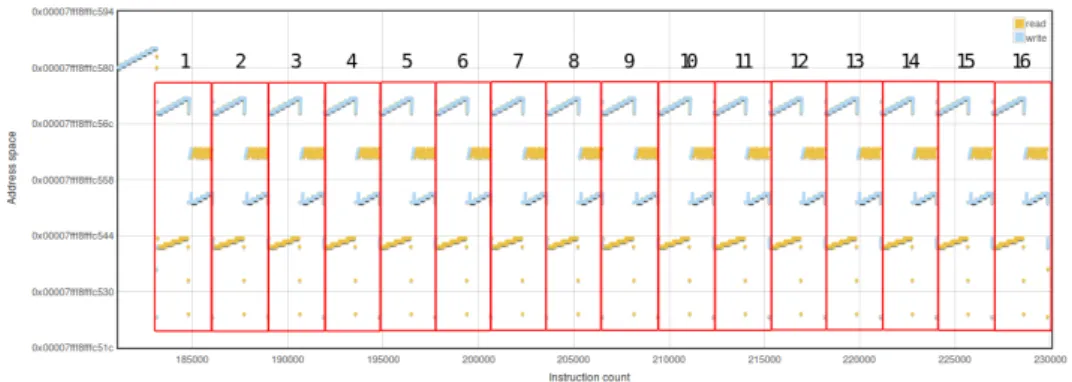
Figure 3.1: Memory reads and writes on the stack during a DES encryption. The 16 repeated patterns that represent the encryption rounds are highlighted.
Analysis (SPA).
A straightforward example is given by Figure 3.1, the plot of memory accesses during a DES encryption1. By interactively navigating the trace is possible to easily identify the part of the execution that performs the encryp-tion operaencryp-tion. From the chart we can notice 16 similar patterns, composed by read and writes in different buffers. Only by using this information we can elaborate accurate hypotheses on the semantics of the code: each one of the 16 patterns probably represents one encryption round, buffers that are read and written are for the left and right halves of the Feistel Network or temporary arrays for the F function. Later, an analysis of the code can confirm these hypotheses.
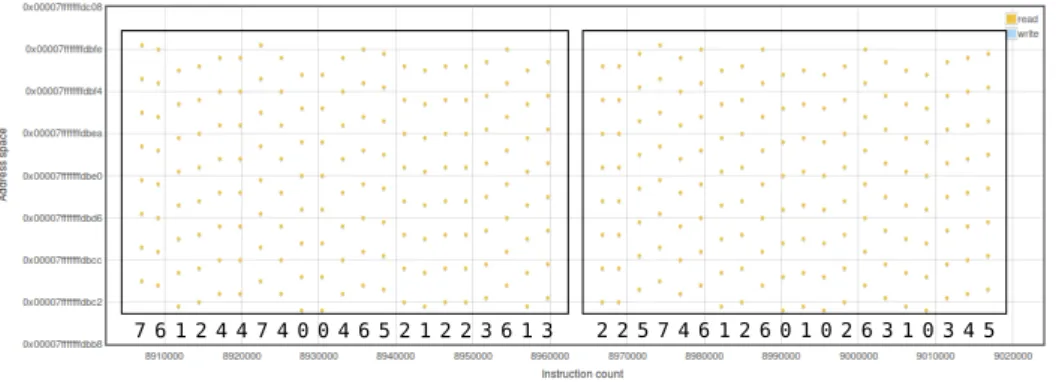
Recovering an RSA key from OpenSSL A more complex practical application of this technique is given by the following example. We analyzed the memory accesses of OpenSSL while encrypting data using RSA. As we will show, the RSA implementation offered by OpenSSL (version 1.0.2a -latest at the moment of writing) reads from an array where the index is key-dependent. By simply visualizing these accesses we can recover the key. OpenSSL uses by default a constant-time sliding-window exponentiation algorithm2, an optimization of the square-and-multiply algorithm. Briefly, the exponent is divided in chunks ofkbits, wherekis the size of the window. At each iteration one chunk is processed, so, instead of considering one bit at a time as in the square-and-multiply, several bits are processed at once.
This algorithm requires the pre-computation of a table, that is later used for calculating the result. Indexes to access this table are chunks of the exponent. The pseudocode in Listing 3.1 describes a simplified version
1
The target program used for this test is available athttps://github.com/tarequeh/ DES
2For additional details refer to the implementation of the
BN mod exp mont consttime
of the sliding-window algorithm that we analyzed. Furthermore, OpenSSL uses as default the Chinese Remainder Theorem (CRT) to compute the result modulop and q separately, to later combine them for obtaining the final result. For this reason we aim at finding two exponentiation operations during one encryption.
The result of the attack is shown in Figure 3.2. As a countermeasure against cache timing attacks discovered by C. Percival [47] is implemented, the precomputed values are not placed sequentially in the table. Basically, the table contains the first byte of every value one after each other, then the second byte and so on. Thus, for reading theithbyte of thejthprecomputed value we need to accesstable[i∗window size+j]. As we are interested in getting the index of the value that is being accessed we can just consider the offset of the first byte of the value, as highlighted in the picture. For ease of demonstration we used a very short RSA key (128 bits). In this case the window size is 3, so we leak 3 bits of the key at every access of the array. If we convert these indexes in binary and concatenate them, we obtain the private exponentsdp and dq which in our example are 0x7c549e013545278b
and 0x4af98ac085990e5.
def e x p o n e n t i a t e ( a , p , n ): # c o m p u t e a ^ p mod n
w i n s i z e = g e t _ w i n s i z e () # in our t e s t it is 3
# P r e c o m p u t a t i o n
val = [1 , a , a * a ]
for i = 3 .. 2^ w i n s i z e - 1: val [ i ] = a * val [ i -1]
# d i v i d e p in c h u n k s of w i n s i z e b i t s
w i n d o w _ v a l u e s = g e t _ c h u n k s ( p , w i n s i z e )
# l e n g t h of p in bytes , d i v i d e d by w i n s i z e and # r o u n d e d up to the n e x t i n t e g e r
l = c e i l i n g ( b y t e _ l e n ( p ) / w i n s i z e )
# S q u a r e and m u l t i p l y
tmp = val [ l -1] for i = l -2 .. 0:
for j = 1 .. w i n s i z e : tmp = tmp * tmp % n
tmp = tmp * val [ w i n d o w _ v a l u e s [ i ]] % n r e t u r n tmp
Listing 3.1: OpenSSL’s implementation of the sliding-window exponentiation.
Chapter 3: Behavior analysis of memory and execution traces
7 6 1 2 4 4 7 4 0 0 4 6 5 2 1 2 2 3 6 1 3 2 2 5 7 4 6 1 2 6 0 1 0 2 6 3 1 0 3 4 5
Figure 3.2: Memory accesses in the pre-computed tables used by OpenSSL during one RSA encryption. Locations of reads from this memory area leak the secret key. For demonstration purposes a very short key (128 bits) was used.
it is done with SPA in order to extract secret keys.
3.1.2 Data-flow tainting and diff of memory traces
Identifying which parts of the execution depend on our input can be helpful in order to isolate smaller parts of the code that will later be analyzed in detail. For achieving this goal we used two different techniques: data-flow tainting anddiff of memory traces.
We based our work on tools offered by PANDA. It implements a tainting engine [48] that can be applied during replays of executions. It is architec-ture independent, thanks to the fact that it relies first on QEMU for bi-nary translation and later on LLVM as an intermediate representation upon which the actual analysis is performed. Information-flow tainting offered by PANDA works at a byte level, it can be applied to different ISAs and does not require source code. As the literature regarding taint analysis is ample we will not present details here, we refer the reader to consult the work of Schwartz at al. [31].
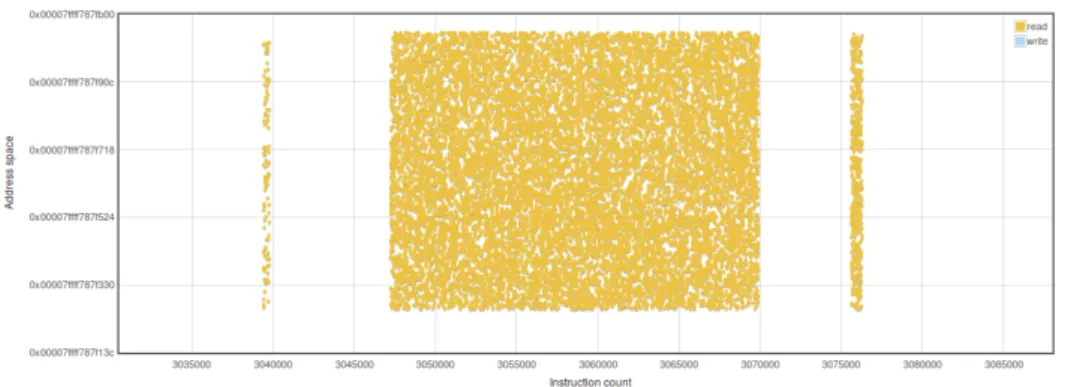
Figure 3.3: Identification of OpenSSL AES T-Tables by using diff of memory traces during encryption with different plaintexts.
other processes, operations in kernel space and I/O operations with variable time. We use a shadow instruction counter to normalize the trace and have it aligned. Also, when recording traces, the address space layout randomiza-tion (ASLR) features of the kernel need to be switched off, on the contrary the accessed memory locations would not match. For more details on the implementation refer to section 3.3. We experimented with different diff
algorithms: visualizing accesses where the data differs, where the memory location differs or both.
An application of this technique is shown in Figure 3.3, obtained from the difference of two traces recorded during an AES encryption with OpenSSL with different plaintexts of the same length. In this case, by plotting memory accesses that differ in location, we clearly identify theT-Tables used in this AES implementation [49]. These tables are used for efficiency, they allow to perform and AES encryption by only leveraging XOR, shift and lookup operations. As indexes of these lookups are data-dependent and the rest of the computation does not differ in memory location the result is accurate.
By focusing on differences in the data content, it is possible to calcu-late the Hamming distance between the data-flow of two memory traces. This can be helpful, for instance, in detecting cryptographic operations and buffers containing ciphertext-related data. Two ciphertexts with different plaintexts and their intermediate values during the computation should be unrelated, thus their Hamming distance should be, on average, half of the bit-length of the data.
3.1.3 Entropy and randomness of the data-flow
Chapter 3: Behavior analysis of memory and execution traces
involve cryptographic operations, such as DRM implementations. However, there are other possible use-cases for this approach, for example compression algorithms.
Entropy expresses the average amount of information that is contained in a specific data stream. We can conclude that encrypted or compressed data has very high entropy. On the contrary, a BMP image, a text or pointers to memory have lower entropy. We can then use this property to effectively locate parts of the code that deal with high-entropy data. In our experiments, we group the memory accesses in chunks of selectable length. For each chunk the probability distribution of each possible byte value, from 0x00 to 0xF F, is computed. Later the entropy levelHis calculated with the following formula, whereP(xi) is the frequency of each byte in the observed
data.
H(X) =−X i
P(xi) logP(xi).
One important property of encrypted data is that it is indistinguishable from random data, on the other hand compressed streams or other kind of data have bad randomness [50]. The Chi-Square test (χ2) is one example of test that gives us an indication of how much the byte distribution in our data-stream is similar to a another distribution, in our case the uniform distribution. It is computed as follows, whereOi is the observed frequency
and Ei the expected frequency of each byte:
χ2 =
n
X
i=1
(Oi−Ei)2 Ei
It is worth noticing that other randomness tests can be used, the Chi-Square is just one possible solution. For our work we chose this algorithm as it was previously used for similar purposes, among others also by Wang et al. Moreover, it is a common and validated choice for randomness testing, its effectiveness was presented by L’Ecuyer in his research [51].
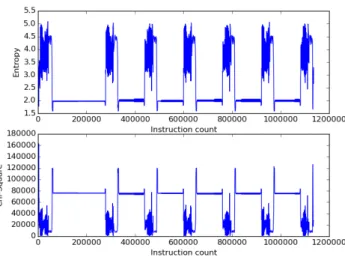
According to our observations, values of entropy of the data-flow during cryptographic algorithms have usually values close to 4.0 while the Chi-Square test returns values that are close to 1.0. On the other hand, while performing general purpose computations the values of entropy are usually around 2.0 while the Chi-Square test returns values in the range of thou-sands.
Figure 3.4: Data-flow entropy and randomness of the memory trace of acrackme
from Nuit du Hack Quals CTF 2015. From the graph we can see that a crypto-graphic operation is performed 7 times.
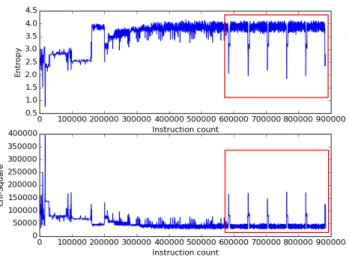
In many cases, the visualization of entropy and randomness of the data flow can reveal patterns that enable the identification of distinctive opera-tions performed by the code. We thus extend the observaopera-tions of Wang et al. by using statistical properties of I/O, not only to identify peaks that could indicate the presence of cryptographic operations, but also to infer semantics of the code by using an SPA-like approach. An example is pro-vided by Figure 3.5, which shows the entropy and randomness plots of the execution of the K-Means++ algorithm 3. K-Means++ is a probabilistic clustering algorithm that is executed multiple times until a good solution is found. We run the test with 100 randomly generated points, in this case the function was executed 5 times, as it is possible to infer from the chart.
3.1.4 Auto-correlation of memory accesses
Auto-correlation, i.e. the cross-correlation of a sequence with itself at differ-ent points in time, is a common technique used in side-channel analysis of power traces. It is used to identify repeating patterns in time series of power consumption. In our project we adapted the same technique to work in the context of reverse engineering, in particular we applied auto-correlation to locations of memory accesses.
First of all, the memory trace needs to be transformed in a time series, on which we can apply the analysis. As we are interested in finding re-peating patterns in the memory accesses, we consider locations that were
3
Chapter 3: Behavior analysis of memory and execution traces
Figure 3.5: Data-flow entropy and randomness of memory accesses during an execution of the K-Means++ algorithm. The 5 iterations of the algorithm are highlighted in the graph.
accessed over time. This can reveal if computations with distinctive memory operations are performed multiple times. For distinctive operations we in-tend specific sequences of read or writes: an example could be a part of the program that sequentially accesses a buffer on the stack, then reads a word from the heap and eventually writes on the buffer on the stack. If this oper-ation is repeated multiple times we would be able to identify patterns in the auto-correlation matrix computed from this sequence of memory accesses.
We compute the auto-correlation matrixP as follows:
Pij =
Cij
p
Cii∗Cjj
whereC is the covariance matrix. EveryCij indicates the level to which
two variables xi and xj vary together. In our case every variable xi is a
chunk of the time series of adjustable length. Covarianceσ(X, Y) is defined as follows, where E[X] is the expected value of X.
σ(X, Y) = E
(X−E[X])(Y −E[Y])
We later display the auto-correlation matrix in a chart, where each value is represented by a dot with a color that varies from white (1.0, positive correlation) to black (−1.0, negative correlation).
Figure 3.6: Auto-correlation matrix of memory accesses during one AES128 en-cryption. White corresponds to a correlation of 1.0 while black to -1.0.
3.2
Control-flow analysis methods
After obfuscation transformations, the control flow is often heavily modified in order to make static analysis more difficult. By recording concrete traces of the execution we intrinsically filter out all the dead/junk code and can only focus on the parts of the program that were actually executed, at the expense of not reaching complete coverage of the possible execution paths. We also don’t have to deal with deductions of values of opaque predicates as they are computed during the execution. Even though for the general case we should perform multiple recordings in order to achieve a reasonable degree of coverage, when analyzing cryptographic implementations one or very few traces are often enough as the control-flow of a cryptographic function should not depend on the input data (i.e.: there should not be conditional branches that depend on confidential data), as this would leak information.
Chapter 3: Behavior analysis of memory and execution traces
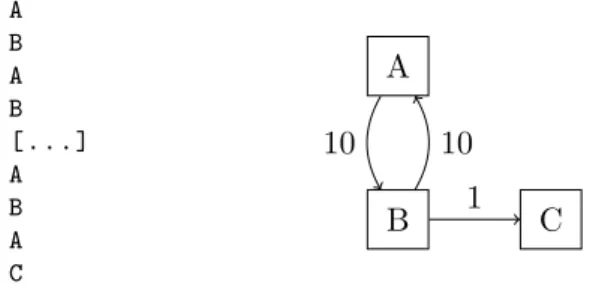
A B A B [ . . . ] A B A C
A
B 1 C
10 10
Figure 3.7: Example of visualization of the execution trace. Labels on the edges represent the number of edges between the two blocks.
3.2.1 Visualizing the execution trace
In order to visualize the collected data for the analyst, a graph is built from the execution trace. This graph is a subset of the control-flow graph (CFG) of the original binary, considering only executed parts of it. This directed graph G(V, E) is such that the nodes are the basic blocks in the execution trace while edges represent a transition from one basic block to another (i.e.: if there is an edge from blocka toblockb it means that blockb was executed
afterblocka). More formally, the graph is composed as follows:
V ={basic block |basic block ∈ execution trace}
E ={{blocka, blockb} |blockb f ollows blocka in the execution trace}
This allows us to visualize sequentiality of basic blocks. Moreover the number of edges between two blocks highlights which parts of the binary are executed multiple times and thus allows to identify loops.
Figure 3.7 shows an example of visualizing a sequence of blocks that were executed one after the other. It is possible to notice that blocksAand
B are part of a loop that was executed 10 times whileC is the block that is executed after the loop.
3.2.2 Analysis of the execution graph for countering control-flow flattening
A
C
D B
E
S
C B
A D E
T
Figure 3.8: Original and flattened control-flow graph.
functions in the original code, however this can be defeated with dynamic analysis. On the other hand, control-flow flattening makes the execution graph completely different from the one of the original code: sequentiality of basic blocks is obfuscated by the state variable and it is really difficult to statically get information about the original semantics.
The rationales behind our decision to counter control-flow flattening are diverse: firstly, it is a widespread technique in commercial tools, secondly, it is effective in obfuscating the CFG and, thirdly, it is computationally lighter than other other transformations, such as virtualization, and thus it is applicable in different contexts. Furthermore, in literature it is possible to find various efforts in de-obfuscation of control-flow flattening [7, 52]. Our work differs from other proposed techniques as it is only based on graph analysis and does not require processing of the program code.
An example of control-flow flattening is given by Figure 3.8: as it is pos-sible to notice, from the obfuscated graph only it is not pospos-sible to obtain any information of the original program flow. Instead, the logic and sequen-tiality of execution is hidden in the ”artificial” blocks S and T and in the last instructions of blocks A to E.
Through the rest of the document we will refer to block S as the dis-patcher block, block T as the pre-dispatcher block while A to E as relevant blocks. For our goals we focus, first of all, in categorizing each block us-ing graph analysis. Later we reconstruct the original flow graph with the support of the execution trace.
Types of control-flow flattening
Control-flow flattening can be implemented in different ways and we need to adjust our techniques in order to better support different cases. In this section we will present common solutions implemented in the obfuscators we analyzed.
Chapter 3: Behavior analysis of memory and execution traces
Figure 3.9: The same program obfuscated with two different implementations of control-flow flattening. The graph on the left shows a switch-based flattening while the one on the right is if-else-based.
compiled in the dispatcher block. A register is used as index in a jump table to reach the correct relevant block. All relevant blocks would then set this register to point to the location in the table with the address of the following relevant block to execute. Relevant blocks point to the pre-dispatcher that would redirect the execution flow according to the jump table. A variation of this technique consists in the creation of a function for each relevant block and an array of pointers to these functions, a register is used as index for this array. However, after compilation the switch statement gets converted in code similar to the one based on indirect calls. Also, instead of using a register, a variable in main memory can be used.
This technique (switch-based or indirect call-based) is implemented in Tigress as well as in other commercial obfuscators.
Another possibility is to use if-else constructs and a local variable or a register as state. A cascade of if-else performs multiple checks on the state variable and leads to the correct relevant block. This technique is available in the OLLVM obfuscator.
Optimizations or different implementations of this technique can lead to binaries with a slightly different structure. For example, as the pre-dispatcher always directly jumps to the pre-dispatcher sometimes these two blocks are merged. Also, if multiple relevant blocks set the state variable to the same value, these logic can be isolated in a different block and make the multiple relevant blocks to point there before reaching the pre-dispatcher.
Un-flattening the CFG
The first step in the un-flattening technique that we developed is to identify the dispatchers and the relevant blocks. For achieving this goal techniques of graph analysis are used. Different algorithms were implemented according to the type of obfuscation that was applied to the binary. In case of variations or custom implementations of control-flow flattening the analysis needs to be adjusted, for this reason these algorithms are included as plugins to the project. For handling special corner cases, new ones can be developed and applied to the analysis.
The key observations for identifying interesting blocks are the following:
• The dispatcher block has a high number of outgoing edges (high out-degree)
• The pre-dispatcher block has a high number of incoming edges (high in-degree)
• The pre-dispatcher has only one outgoing edge to the dispatcher (un-less they are merged in the same block)
• In the case of a switch-based flattening, relevant blocks are all blocks in between the dispatcher and the pre-dispatcher. In the case of an if-else-based flattening, relevant blocks are only the parents of the pre-dispatcher (the depth in the parent search can depend on the ob-fuscation, we might need to consider more than the direct parent of the pre-dispatcher)
Using this remarks we developed different algorithms for supporting var-ious kinds of obfuscations. Example pseudocode is presented in Listing 3.2.
Once the basic blocks are categorized, our approach consists in filtering the execution trace by removing the entries related to the dispatching in-troduced by the obfuscation. In this way only relevant blocks remain and the original execution flow is reconstructed. In summary, the de-obfuscation algorithm works as follows:
• Generate a graph from the execution trace as presented in 3.2.1
• Apply graph analysis to find dispatcher and relevant blocks (the anal-ysis depends on the flattening technique)
• Filter the trace by considering only relevant blocks when executing blocks between the dispatcher and the pre-dispatcher
Chapter 3: Behavior analysis of memory and execution traces
def c a t e g o r i z e _ b l o c k s _ i f e l s e ( g r a p h ):
p r e d i s p a t c h e r = n o d e w i t h h i g h e s t i n d e g r e e d i s p a t c h e r = n o d e w i t h h i g h e s t o u t d e g r e e r e l e v a n t _ b l o c k s = set ()
# c o n s i d e r as r e l e v a n t o n l y p a r e n t s of the p r e d i s p a t c h e r
for b l o c k in p r e d i s p a t c h e r . p a r e n t s (): r e l e v a n t _ b l o c k s . add ( b l o c k )
r e t u r n d i s p a t c h e r , p r e d i s p a t c h e r , r e l e v a n t _ b l o c k s
def c a t e g o r i z e _ b l o c k s _ s w i t c h ( g r a p h ):
p r e d i s p a t c h e r = n o d e w i t h h i g h e s t i n d e g r e e d i s p a t c h e r = n o d e w i t h h i g h e s t o u t d e g r e e
r e l e v a n t _ b l o c k s = set ()
# c o n s i d e r as r e l e v a n t all the b l o c k s b e t w e e n the # d i s p a t c h e r and the p r e d i s p a t c h e r
for p a t h in p a t h s ( f r o m = d i s p a t c h e r , to = p r e d i s p a t c h e r ): for b l o c k in p a t h :
r e l e v a n t _ b l o c k s . add ( b l o c k )
r e t u r n d i s p a t c h e r , p r e d i s p a t c h e r , r e l e v a n t _ b l o c k s
Listing 3.2: Pseudocode for identifying dispatcher, pre-dispatcher and relevant blocks with different control-flow flattening implementations.
It is worth remarking that only techniques of graph analysis were em-ployed, without the need to actually understand the semantics of the code. This is a great advantage as the code for manipulating the control flow can be arbitrarily complex, however once again the side-channel information leaked by the sequence of blocks executed one after the other reveals information of the original semantics of the code.
Clearly, we cannot obtain the same basic blocks of the original CFG as other transformations in the binary code or computations of the state variable might remain. Nevertheless, with this technique it is possible to reconstruct sequentiality of basic blocks, loops and branches. Moreover, our implementation also offers integration with static analysis tools such asIDA Pro to help analysts in better understanding the semantics of the code.
(a) Original (b)Obfuscated (c)Recovered
Figure 3.10: Example of control-flow flattening and recovery of the original CFG of a Base64 encoding implementation.
3.3
Implementation
The software developed for this research project can be decoupled in different parts: firstly, of all traces of memory accesses and executed instructions need to be recorded. Secondly, those traces need to be stored in such a way that it is possible to query them efficiently and apply filtering or aggregation. Thirdly, we need an interface to enable the analyst to interactively browse the collected data, filter it and use it in combination with other tools. Lastly, an analysis framework accessible from the interface is essential to apply transformations on the data, process it and extract insightful information.
Acquisition of memory and execution traces For our research we based the acquisition of memory and execution traces on PANDA (Platform for Architecture-Neutral Dynamic Analysis) [37], a project resulted from the collaboration of MIT Lincoln Laboratory, Georgia Tech and Northeastern University. PANDA is built on top of the QEMU system emulator and it consists of a framework that allows to instrument it with custom plugins. It supports different architectures: i386, x86 64 and ARM (also with Android support).
When analyzing protected software we need to often face anti-debugging techniques. Those can help the binary detect if it is running in a sandbox or a debugging environment and act differently, or even refuse to execute. If there are just few simple checks we can patch the code to skip them, however if integrity checks or thousands of anti-debugging conditions are in place this can be particularly tedious. For these reasons it would be very helpful to create controlled execution environments that are indistinguish-able from a normal execution for the program itself. PANDA, by offering instrumentation at the emulator level, allows us to not interfere with the userland and evade common anti-debugging tricks like checks forptrace on Unix systems or IsDebuggerPresent on Windows.
Chapter 3: Behavior analysis of memory and execution traces
which on ARM architectures are separated. If the host is running on an Intel architecture they are unified and thus the emulated caches behave dif-ferently compared to the real ones. Moreover, system-level instrumentation is more challenging as we need to isolate the process that we want to ana-lyze from the others and detect and handle context switches from kernel and user spaces. However, we consider this approach as a reasonable trade-off between resilience to anti-debugging and complexity.
Even though PANDA supports record and replay of executions, only non deterministic input/output is recorded in order to optimize traces for size. Furthermore, it records at a system level, without having the notion of processes. As we are interested in all memory accesses and instructions that are executed by one single process, we developed ad-hoc plugins for our goals: one for recording memory traces and one for execution traces. In order to isolate the target process from others running on the same system we use the ASID (Address-Space Identifier) register, as it determines the location of the page table associated to a process and it is univocally corresponding to it. To handle jumps to kernel space correctly, recording is paused whenever the user-space of our target program is left and resumed afterwards. For performance and interoperability reasons we chose to store the output of the plugins in the Google Protobuf format.
It is worth remarking that the recording tools are not coupled with other parts of the project. As long as the traces are in the correct format they can be recorded with other platforms as well, if desired also with tools that operate at a user-level.
Datastore In order to efficiently query the traces, they are moved in a Postgresql database. Each trace is saved in a different table. Common data that is present in every trace and needs to be indexed (e.g.: instruction count, current pc, etc.) is saved in a normal column. Other attributes, whose schema could change from trace to trace, the JSON datatype offered by Postgresql is used. As data does not need to be modified after import in the database, every column is indexed to make querying more efficient.
Evaluation
4.1
Introduction of the benchmarks
The evaluation of the techniques proposed in this report is based on tests carried out on sample programs, obfuscated with publicly available obfusca-tors. We decided to rely on publicly available obfuscators for reproducibility of our work and for the unrestricted access to these tools.
For our experiments we employed OLLVM by HEIG-VD and Tigress by the University of Arizona. This choice was guided by the fact that these two obfuscators were recently released and thus implement state-of-the-art and modern techniques, they are highly configurable and flexible. Furthermore, in recent literature we can find other research outcomes based on these two tools, such as [53, 54].
Regarding the target programs, our tests were carried out on implemen-tations of common cryptographic algorithms. This is due to the fact that the main application of our research is the analysis of heavily obfuscated DRM solutions, which are often based on widely tested algorithms such as AES or DES. Moreover, we target programs of which we also have the original source code, in order to have the possibility to compare the original behavior of the program with the obfuscated one. This is essential to evaluate how much information is leaked from the side-channels that we are considering and how well the techniques we propose reveal this information.
The programs used in our experiments are the following:
• An implementation of AES128 that encrypts 4 blocks of data.
Chapter 4: Evaluation
• An HMAC-SHA1 implementation that computes one message authen-tication code.
4.1.1 Obfuscators configuration
OLLVM
Obfuscator-LLVM offers three main features for the obfuscation of a target binary:
• Instruction Substitution: replaces standard binary operations (e.g.: addition, division, bitwise operations, etc.) with semantically equiva-lent but more complicated sequences of instructions. This feature adds diversity in the resulting binary thanks to random constants added to the code.
• Bogus Control Flow: when applied to a basic block, it modifies the control flow by adding a spurious block that conditionally jumps either to the legitimate basic block or to junk code. The condition is an opaque predicate that always results in a jump to the original block, but its result is difficult to determine statically. It applies by default to 30% of basic blocks. It also adds diversity to the binary as the dead code is randomly generated.
• Control-flow flattening: it fully flattens the control flow graph by using a sequence of conditional statements.
OLLVM integrates withclang and works at the LLVM intermediate rep-resentation level. For this reason the output of the obfuscator is either LLVM bitcode or a binary. For our experiments, OLLVM version 3.5 was used. The command used to compile the test programs, that enables all the available obfuscation techniques, is the following:
$ O L L V M / bin / c l a n g - m l l v m - sub - m l l v m - fla - m l l v m - bcf s o u r c e . c - o o b f u s c a t e d _ b i n
Tigress
Tigress offers a wide variety of obfuscation techniques, for our experiments we apply common general-purpose features. In detail, the following trans-formations are employed:
• EncodeLiterals: substitutes integer and string literals with opaque expressions that evaluate to the original value at run-time.
multiple encodings available, one of them is selected randomly creat-ing diversity in the output.
• AddOpaque: splits the control-flow by adding conditional jumps based on opaque predicates. At run-time the evaluation of the predicate will always result in a jump to the original code, however dead code is added to make static analysis more complex. Tigress offers different possibilities for generating junk code: generation of a buggified ver-sion of the original code, calls to random or non-existing functions or insertion of randomly generated assembly.
• AntiTaintAnalysis: disrupts taint analysis tools that rely on dynamic analysis. It uses two different methods to copy a value, such that it is more complex for the engine to detect the taint propagation. The first method is to use a for-loop and increment the destination variable according to the original value, while the second consists in a bit-by-bit copy of the original value using if-constructs.
• Flatten: control-flow flattening using different techniques. Switch-based and indirect call-Switch-based flattening methods are used in our tests. Tigress also offers a goto-based flattening transformation, however in that case the code is flattened only at the source code level. When compiled, gotos are converted to unconditional jumps so the shape of the CFG stays unchanged. This obfuscation is only effective in thwarting decompilers, so it was not considered in our tests.
Tigress is a code-to-code obfuscator. For this reason, the output is still C source code that needs to be compiled. For our tests we usegcc 4.8.2 on
Ubuntu Linux with Tigress version 2 (Purple Nuple). The command used to obfuscate the target source code is the following:
t i g r e s s - - T r a n s f o r m = I n i t E n t r o p y - - F u n c t i o n s = m a i n - - T r a n s f o r m = I n i t O p a q u e - - F u n c t i o n s = m a i n - - T r a n s f o r m = E n c o d e L i t e r a l s - - F u n c t i o n s =* - - T r a n s f o r m = E n c o d e A r i t h m e t i c - - F u n c t i o n s =* - - T r a n s f o r m = A d d O p a q u e - - F u n c t i o n s =*
- - T r a n s f o r m = A n t i T a i n t A n a l y s i s - - F u n c t i o n s =* - - T r a n s f o r m = F l a t t e n - - F u n c t i o n s =*
- - T r a n s f o r m = C l e a n U p
- - out = o b f u s c a t e d _ s o u r c e . c s o u r c e . c
4.1.2 Data-flow analysis evaluation benchmark