University of Warwick institutional repository: http://go.warwick.ac.uk/wrap
This paper is made available online in accordance with
publisher policies. Please scroll down to view the document
itself. Please refer to the repository record for this item and our
policy information available from the repository home page for
further information.
To see the final version of this paper please visit the publisher’s website.
Access to the published version may require a subscription.
Author(s): David Hobson & Martin Klimmek
Article Title: Constructing time-homogeneous generalized diffusions
consistent with optimal stopping values
Year of publication: 2011
Link to published article:
http://link.aps.org/doi/10.1080/17442508.2010.522237
Publisher statement: This is an electronic version of an article
published in Hobson, D. and Klimmek, M. (2011). Constructing
time-homogeneous generalized diffusions consistent with optimal stopping
values. Stochastics An International Journal of Probability and
Stochastic Processes, Vol. 83, No. 4-6, pp. 477-503. Stochastics An
International Journal of Probability and Stochastic Processes is
available online at:
Constructing Time-Homogeneous Generalised Diffusions
Consistent with Optimal Stopping Values
David Hobson∗ and Martin Klimmek† Department of Statistics, University of Warwick
May 4, 2010
Abstract
Consider a set of discounted optimal stopping problems for a one-parameter family of objective functions and a fixed diffusion process, started at a fixed point. A standard problem in stochastic control/optimal stopping is to solve for the problem value in this setting.
In this article we consider an inverse problem; given the set of problem values for a family of objective functions, we aim to recover the diffusion. Under a natural assumption on the family of objective functions we can characterise existence and uniqueness of a diffusion for which the optimal stopping problems have the specified values. The solution of the problem relies on techniques from generalised convexity theory.
Keywords: optimal stopping, generalised convexity, generalised diffusions, inverse American option problem
1
Introduction
Consider a classical optimal stopping problem in which we are given a discount parameter, an objective function and a time-homogeneous diffusion process started at a fixed point, and we are asked to maximise the expected discounted payoff. Here the payoff is the objective function evaluated at the value of the diffusion at a suitably chosen stopping time. We call this problem the forward optimal stopping problem, and the expected payoff under the optimal stopping rule the (forward) problem value.
The set-up can be generalised to a parameter family of objective functions to give a one-parameter family of problem values. In this article we are interested in an associated inverse problem. The inverse problem is, given a one-parameter family of objective functions and associated optimal values, to recover the underlying diffusion, or family of diffusions, for which the family of forward stopping problems yield the given values.
The approach of this article is to exploit the structure of the optimal control problem and the theory of generalised convexity from convex analysis to obtain a duality relation between the Laplace transform of the first hitting time and the set of problem values. The Laplace transform can then be inverted to give the diffusion process.
∗
Corresponding author, [email protected]
†
The generalised convexity approach sets this article apart from previous work on this problem, see [2, 1, 6]. All these papers are set in the realm of mathematical finance where the values of the stopping problems can be identified with the prices of perpetual American options, and the diffusion process is the underlying stock process. In that context, it is a natural question to ask: Given a set of perpetual American option prices from the market, parameterised by the strike, is it possible to identify a model consistent with all those prices simultaneously? In this article we abstract from the finance setting and ask a more general question: When can we identify a time-homogeneous diffusion for which the values of a parameterised family of optimal stopping problems coincide with a pre-specified function of the parameter.
Under restrictive smoothness assumptions on the volatility coefficients, Alfonsi and Jourdain [2] develop a ‘put-call parity’ which relates the prices of perpetual American puts (as a function of strike) under one model to the prices of perpetual American calls (as a function of the initial value of the underlying asset) under another model. This correspondence is extended to other payoffs in [1]. The result is then applied to solve the inverse problem described above. In both papers the idea is to find a coupled pair of free-boundary problems, the solutions of which can be used to give a relationship between the pair of model volatilities.
In contrast, in Ekstr¨om and Hobson [6] the idea is to solve the inverse problem by exploiting a duality between the put price and the Laplace transform of the first hitting time. This duality gives a direct approach to the inverse problem. It is based on a convex duality which requires no smoothness on the volatilities or option prices.
In this article we consider a general inverse problem of how to recover a diffusion which is consis-tent with a given set of values for a family of optimal stopping problems. The solution requires the use of generalised, or u-convexity (Carlier [4], Villani [14], Rachev and R¨uschendorf [11]). The log-value function is theu-convex dual of the log-eigenfunction of the generator (and vice-versa) and the u-subdifferential corresponds to the optimal stopping threshold. These simple concepts give a direct and probabilistic approach to the inverse problem which contrasts with the involved calculations in [2, 1] in which pdes play a key role.
A major advantage of the dual approach is that there are no smoothness conditions on the value function or on the diffusion. In particular, it is convenient to work with generalised diffusions which are specified by the speed measure (which may have atoms, and intervals which have zero mass).
Acknowledgement: DGH would like to thank Nizar Touzi for suggesting generalised convexity as an approach for this problem.
2
The Forward and the Inverse Problems
LetX be a class of diffusion processes, letρ be a discount parameter, and letG={G(x, θ);θ∈
Θ}be a family of non-negative objective functions, parameterised by a real parameterθ which lies in an interval Θ. The forward problem, which is standard in optimal stopping, is for a given
X∈ X, to calculate for eachθ∈Θ, the problem value
V(θ)≡VX(θ) = sup τ E0
[e−ρτG(Xτ, θ)], (2.1)
where the supremum is taken over finite stopping timesτ, andE0denotes the fact thatX0 = 0.
The inverse problem is, given a fixedρand the familyG, to determine whetherV ≡ {V(θ) :θ∈
elements X ∈ X which would lead to the value functionV. The inverse problem, which is the main object of our analysis, is much less standard than the forward problem, but has recently been the subject of some studies ([2, 1, 6]) in the context of perpetual American options. In these papers the space of candidate diffusions isXstock, whereXstockis the set of price processes which, when discounted, are martingales andG(x, θ) = (θ−x)+is the put option payoff (slightly more general payoffs are considered in [1]). The aim is to find a stochastic model which is consistent with an observed continuum of perpetual put prices.
In fact it will be convenient in this article to extend the set X to include the set of generalised diffusions in the sense of Itˆo and McKean [8]. These diffusions are generalised in the sense that the speed measure may include atoms, or regions with zero or infinite mass. Generalised diffusions can be constructed as time changes of Brownian Motion, see Section 5.1 below, and also [8], [10], [13], and for a setup related to the one considered here, [6].
We will concentrate on the set of generalised diffusions started and reflected at 0, which are local martingales (at least when away from zero). We denote this class X0. (Alternatively we
can think of an element X as the modulus of a local martingale Y whose characteristics are symmetric about the initial point zero.) The twin reasons for focusing onX0 rather thanX, are that the optimal stopping problem is guaranteed to become one-sided rather than two-sided, and that withinX0there is some hope of finding a unique solution to the inverse problem. The former
reason is more fundamental (we will comment in Section 6.2 below on other plausible choices of subsets of X for which a similar approach is equally fruitful). For X ∈ X0, 0 is a reflecting
boundary and we assume a natural right boundary but we do not exclude the possibility that it is absorbing. Away from zero the process is in natural scale and can be characterised by its speed measure, and in the case of a classical diffusion by the diffusion coefficientσ. In that case we may considerX ∈ X0 to be a solution of the SDE (with reflection)
dXt=σ(Xt)dBt+dLt X0 = 0,
whereL is the local time at zero.
We return to the (forward) optimal stopping problem: For fixed X define ϕ(x) = ϕX(x) =
E0[e−ρHx]−1, where Hx is the first hitting time of levelx. Let
ˆ
V(θ) = sup
x:ϕ(x)<∞
G(x, θ)E0[e−ρHx]
= sup
x:ϕ(x)<∞
G(x, θ)
ϕ(x)
. (2.2)
Clearly V ≥ Vˆ. Indeed, as the following lemma shows, there is equality and for the forward problem (2.1), the search over all stopping times can be reduced to a search over first hitting times.
Lemma 2.1. V andVˆ coincide.
Proof. See Appendix.
The first step in our approach will be to take logarithms which converts a multiplicative problem into an additive one. Introduce the notation
v(θ) = log(V(θ)),
g(x, θ) = log(G(x, θ)),
Then the equivalent log-transformed problem (compare (2.2)) is
v(θ) = sup
x
[g(x, θ)−ψ(x)], (2.3)
where the supremum is taken over those xfor which ψ(x) is finite. To each of these quantities we may attach the superscriptX if we wish to associate the solution of the forward problem to a particular diffusion. For reasons which will become apparent, see Equation (2.5) below, we callϕX the eigenfunction (and ψX the log-eigenfunction) associated with X.
In the case where g(x, θ) = θx, v and ψ are convex duals. More generally the relationship between v and ψ is that of u-convexity ([4], [14], [11]). (In Section 3 we give the definition of the u-convex dual fu of a function f, and derive those properties that we will need.) For our setting, and under mild regularity assumptions on the functionsg, see Assumption 3.6 below, we will show that there is a duality relation betweenvandψvia the log-payoff functiongwhich can be exploited to solve both the forward and inverse problems. In particular our main results (see Proposition 4.4 and Theorems 5.1 and 5.4 for precise statements) include:
Forward Problem: Given a diffusion X ∈ X0, let ϕX(x) = (E0[e−ρHx])−1 and ψX(x) =
log(ϕX(x)). Set ψg(θ) = supx{g(x, θ)−ψ(x)}. Then the solution to the forward problem is
given by V(θ) = exp(ψg(θ)), at least for those θ for which there is an optimal, finite stopping rule. We also find thatV is locally Lipschitz over the same range of θ.
Inverse Problem: For v ={v(θ) :θ ∈Θ = [θ−, θ+]} to be logarithm of the solution of (2.1)
for someX ∈ X0 it is sufficient that theg-convex dual (given byvg(x) = supθ{g(x, θ)−v(θ)}) satisfies vg(0) = 0, evg(x) is convex and increasing, and vg(x) > {g(x, θ−)−g(0, θ−)} for all
x >0.
Note that in stating the result for the inverse problem we have assumed that Θ contains its endpoints, but this is not necessary, and our theory will allow for Θ to be open and/or unbounded at either end.
IfXis a solution of the inverse problem then we will say thatXis consistent with{V(θ);θ∈Θ}. By abuse of notation we will say that ϕX (or ψX) is consistent withV (orv= logV) if, when
solving the optimal stopping problem (2.1) for the diffusion with eigenfunction ϕX, we obtain
the problem values V(θ) for each θ∈Θ.
The main technique in the proofs of these results is to exploit (2.3) to relate the fundamental solutionϕwithV. Then there is a second part of the problem which is to relateϕto an element of X. In the case where we restrict attention toX0, each increasing convexϕ withϕ(0) = 1 is
associated with a unique generalised diffusionX∈ X0. Other choices of subclasses ofX may or may not have this uniqueness property. See the discussion in Section 5.6.
The following examples give an idea of the scope of the problem:
Example 2.2. Forward Problem: SupposeG(x, θ) =exθ. Let m >1 and suppose that X ∈ X0
solves dX =σ(X)dW +dL for σ(x)−2 = (x2(m−1)+ (m−1)xm−2)/(2ρ). For such a diffusion ϕ(x) = exp(m1xm), x≥0. Then for θ∈Θ = (0,∞), V(θ) = exp(mm−1θmm−1).
Example 2.3. Forward Problem: LetX be reflecting Brownian Motion on the positive half-line with a natural boundary at ∞. Then ϕ(x) = cosh(x√2ρ). Letg(x, θ) =θx so thatg-convexity is standard convexity, and suppose Θ = (0,∞). Then
v(θ) = sup
x
It is easy to ascertain that the supremum is attained at x=x∗(θ) where
x∗(θ) = √1
2ρtanh
−1 θ √ 2ρ (2.4)
for θ∈[0,√2ρ). Hence, for θ∈(0,√2ρ)
v(θ) = √θ
2ρtanh
−1 θ √ 2ρ −log
cosh tanh−1
θ
√
2ρ
= √θ
2ρtanh
−1 θ √ 2ρ +1 2log
1− θ
2
2ρ
,
with limits v(0) = 0and v(√2ρ) = log 2. For θ >√2ρ we have v(θ) =∞.
Example 2.4. Inverse Problem: Suppose that g(x, θ) = θx and Θ = (0,√2ρ). Suppose also that for θ∈Θ
V(θ) = exp
θ
√
2ρtanh
−1 θ √ 2ρ +1 2log
1− θ
2
2ρ
.
Then X is reflecting Brownian Motion.
Note that X ∈ X0 is uniquely determined, and its diffusion coefficient is specified on R+. In
particular, if we expand the domain of definition of Θ to (0,∞) then for consistency we must have V(Θ) =∞ for θ >√2ρ.
Example 2.5. Inverse Problem: Suppose G(x, θ) =xθ and V(θ) = {θ θ
2(2−θ)2−2θ
2 :θ ∈(1,2)}.
Thenϕ(x) = 1+x2 forx >1and, at least whilstXt>1,X solves the SDEdX =ρ(1+X)2dW.
In particular,V does not contain enough information to determine a unique consistent diffusion in X0 since there is some indeterminacy of the diffusion co-efficient on (0,1).
Example 2.6. Inverse Problem: Suppose g(x, θ) = −θ2/(2{1 +x}), Θ = [1,∞) and v(θ) =
{−1/2−logθ:θ≥1}. Then the g-dual of v is given by vg(x) = log(1 +x)/2, x≥0 and is a candidate forψ. Howeverevg(x)=√1 +x is not convex. There is no diffusion in X0 consistent
with V.
Example 2.7. Forward and Inverse Problem: In special cases, the optimal strategy in the for-ward problem may be to ‘stop at the first hitting time of infinity’ or to ‘wait forever’. Nonetheless, it is possible to solve the forward and inverse problems.
Lethbe an increasing, differentiable function on[0,∞)withh(0) = 1, such thatehis convex; let f be a positive, increasing, differentiable function on [0,∞) such that limx→∞f(x) = 1; and let
w(θ) be a non-negative, increasing and differentiable function onΘ = [θ−, θ+] withw(θ−) = 0. Suppose that
g(x, θ) =h(x) +f(x)w(θ).
Note that the cross-derivative gxθ(x, θ) =f0(x)w0(θ) is non-negative.
Consider the forward problem. Suppose we are given a diffusion in X0 with log-eigenfunction ψ=h. Then the log-problem value v is given by
v(θ) =ψg(θ) = sup
x≥0
{g(x, θ)−ψ(x)}= lim sup
x→∞
{f(x)w(θ)}=w(θ).
Conversely, suppose we are given the value function V =ew on Θ. Then wg(x) = sup
θ∈Θ
{g(x, θ)−w(θ)}= sup
θ∈Θ
{h(x) + (f(x)−1)w(θ)}=h(x)
A generalised diffusion X ∈ X0 can be identified by its speed measure m. Let m be a non-negative, non-decreasing and right-continuous function which defines a measure onR+, and let m be identically zero on R−. We call x a point of growth of m if m(x1) < m(x2) whenever
x1 < x < x2 and denote the closed set of points of growth by E. Then m may assign mass to
0 or not, but in either case we assume 0∈E. We also assume that if ξ = sup{x:x ∈E} then
ξ+m(ξ+) = ∞. If ξ <∞ then either ξ is an absorbing endpoint, or X does not reach ξ in finite time.
The diffusionX with speed measurem is defined on [0, ξ) and is constructed via a time-change of Brownian motion as follows.
LetFB= (FuB)u≥0be a filtration supporting a Brownian MotionB started at 0 with a local time
process{Lzu;u≥0, z∈R}. Define Γ to be the left-continuous, increasing, additive functional Γu =
Z
R
Lzum(dz),
and define its right-continuous inverse by
At= inf{u: Γu> t}.
If we set Xt=B(At) then Xt is a generalised diffusion which is a local martingale away from
0, and which is absorbed the first time that B hits ξ.
For a given diffusionX∈ X0 recall thatϕ(x)≡ϕX(x) is defined viaϕX(x) = (E0[e−ρHx])−1. It
is well known (see for example [13, V.50] and [5, pp 147-152]) thatϕX is the unique increasing,
convex solution to the differential equation
1 2
d2f
dmdx =ρf; f(0) = 1, f
0(0−) = 0. (2.5)
Conversely, given an increasing convex function ϕ with ϕ(0) = 1 and ϕ0(0+) ≥ 0, (2.5) can be used to define a measure m which in turn is the speed measure of a generalised diffusion
X∈ X0.
Ifm({x})>0 then the processX spends a positive amount of time atx. Ifx∈E is an isolated point, then there is a positive holding time atx, conversely, if for each neighbourhoodNx ofx,
m also assigns positive mass toNx\ {x}, then xis a sticky point.
If X ∈ X0 and m has a density, then m(dx) =σ(x)−2dx whereσ is the diffusion coefficient of
X and the differential equation (2.5) becomes
1 2σ(x)
2f00
(x)−ρf(x) = 0. (2.6)
In this case, depending on the smoothness of g, v will also inherit smoothness properties. Conversely, ‘nice’ v will be associated with processes solving (2.6) for a smooth σ. However, rather than pursuing issues of regularity, we prefer to work with generalised diffusions.
3
u-convex Analysis
In the following we will consider u-convex functions foru =u(y, z) a function of two variables
discuss u-convexity for functions of y, the same ideas apply immediately tou-convexity in the variablez. Then, in the sequel we will apply these results for the functiong, and we will apply them for g-convex functions of both x and θ.
For a more detailed development of u-convexity, see [11], [14], [4] and the references therein. Proofs of the results below are included in the Appendix.
LetDy andDz be sub-intervals ofR. We suppose thatu:Dy×Dz7→R¯ is well defined, though possibly infinite valued.
Definition 3.1. f :Dy → R+ is u-convex iff there exists a non-emptyS ⊂Dz×R such that for all y∈Dy
f(y) = sup
(z,a)∈S
[u(y, z) +a].
Definition 3.2. Theu-dual off is the u-convex function on Dz given by
fu(z) = sup
y∈Dy
[u(y, z)−f(y)].
A fundamental fact from the theory ofu-convexity is the following:
Lemma 3.3. A function f isu-convex iff (fu)u=f.
The function (fu)u (theu-convexification off) is the greatest u-convex minorant off (see the Appendix). The condition (fu)u =f provides an alternative definition of a u-convex function, and is often preferred; checking whether (fu)u = f is usually more natural than trying to identify the setS.
Diagrammatically (see Figure 1.), we can think of−(fu)(z) = infy[f(y)−u(y, z)] as the vertical
distance between f and u(., z). Thusfu(z)≤0 when f(y)≥u(y, z) for all y∈Dy.
The following description due to Villani [14] is helpful in visualising what is going on: f is
u-convex if at every pointy we can find a parameterzso that we cancaressf from below with
u(., z).
The definition of theu-dual implies a generalised version of the Young inequality (familiar from convex analysis, e.g [12]),
f(y) +fu(z)≥u(y, z)
for all (y, z)∈Dy×Dz. Equality holds at pairs (y, z) where the supremum
sup
z
[u(y, z)−fu(z)] is achieved.
Definition 3.4. Theu-subdifferential off aty is defined by
∂uf(y) ={z∈Dz :f(y) +fu(z) =u(y, z)},
or equivalently
∂uf(y) ={z∈Dz:u(y, z)−f(y)≥u(ˆy, z)−f(ˆy),∀yˆ∈Dy}.
IfU is a subset ofDy then we define ∂uf(U) to be the union ofu-subdifferentials off over all
Figure 1: f isu-subdifferentiable. ∂uf(y1) =z∗(y1) and ∂u(y2) =z∗(y2) fory2 ∈(y2l, yr2). The
distance between u(., z) and f is equal to -fu(z). Note that the u-subdifferential is constant
over the interval (yl2, y2r)
Definition 3.5. f isu-subdifferentiable aty if ∂uf(y) 6=∅. f is u-subdifferentiable on U if it is u-subdifferentiable for all y ∈ U, and f is u-subdifferentiable if it is u-subdifferentiable on
U =Dy.
In what follows it will be assumed that the function u(y, z) is satisfies the following ‘regularity conditions’.
Assumption 3.6. (a) u(y, z) is continuously twice differentiable.
(b) uy(y, z) = ∂y∂ u(y, z) as a function of z, and uz(y, z) = ∂z∂u(y, z) as a function of y, are
strictly increasing.
Remark 3.7. We will see below that by assuming 3.6(a) irregularities in the value function (2.1) can be identified with extremal behaviour of the diffusion.
Remark 3.8. Condition 3.6(b) is known as the single crossing property and as the Spence-Mirrlees condition ([4]). If instead we have the ‘Reverse Spence-Spence-Mirrlees condition’:
(bb)uy(y, z) as a function ofz, and uz(y, z) as a function of y, are strictly decreasing,
then there is a parallel theory, see Remark 3.12.
The following results fromu-convex analysis will be fundamental in our application ofu-convex analysis to finding the solutions of the forward and inverse problems.
Lemma 3.9. Suppose f is u-subdifferentiable, and u satisfies Assumption 3.6. Then ∂uf is monotone in the following sense:
Let y,yˆ∈Dy, y > yˆ . Suppose ˆz∈∂uf(ˆy) and z∈∂uf(y). Then zˆ≥z.
Proposition 3.11. Suppose that u satisfies Assumption 3.6.
Suppose f is a.e differentiable and u-subdifferentiable. Then there exists a map z∗ :Dy →Dz
such that if f is differentiable at y thenf(y) =u(y, z∗(y))−fu(z∗(y)) and
f0(y) =uy(y, z∗(y)). (3.1)
Moreover, z∗ is such that z∗(y) is non-decreasing.
Conversely, suppose that f is a.e differentiable and equal to the integral of its derivative. If (3.1) holds for a non-decreasing function z∗(y), thenf isu-convex and u-subdifferentiable with f(y) =u(y, z∗(y))−fu(z∗(y)).
Note that the subdifferential∂uf(y) may be an interval in which casez∗(y) may be taken to be any element in that interval. Under Assumption 3.6, z∗(y) is non-decreasing
We observe that since u(y, z∗(y)) = f(y) +fu(z∗(y)) we have u(y∗(z), z) = f(y∗(z)) +f(z) and y∗(z)∈∂ufu(z) so that y∗ may be defined directly as an element of ∂ufu. If z∗ is strictly increasing then y∗ is just the inverse of z∗.
Remark 3.12. Ifusatisfies the ‘Reverse Spence-Mirrlees’ condition, the conclusion of Lemma 3.9 is unchanged except that now ‘z ≥ zˆ’. Similarly, Proposition 3.11 remains true, except that
z∗(y) and y∗(z) are non-increasing.
Proposition 3.13. Suppose that u satisfies Assumption 3.6.
Suppose f is u-subdifferentiable in a neighbourhood of y. Then f is continuously differentiable at y if and only if z∗ is continuous aty.
4
Application of
u-convex analysis to the Forward Problems
Now we return to the context of the family of optimal control problems (2.1) and the represen-tation (2.3).
Lemma 4.1. Let X ∈ X0 be a diffusion in natural scale reflected at the origin with a finite or
infinite right boundary pointξ. Then the increasing log-eigenfunction of the generator
ψX(x) =−log(E[e−ρHx]−1)
is locally Lipschitz continuous on(0, ξ).
Proof. ϕX(x) is increasing, convex and finite and therefore locally Lipschitz on (0, ξ). ϕ(0) = 1,
and since log is locally Lipschitz on [1,∞),ψ= log(ϕ) is locally Lipschitz on (0, ξ).
Henceforth we assume that g satisfies Assumption 3.6, so that g is twice differentiable and satisfies the Spence-Mirrlees condition. We assume further that G(x, θ) is non-decreasing inx. Note that this is without loss of generality since it can never be optimal to stop at x0 > x if
G(x0, θ) < G(x, θ), since to wait until the first hitting time of x0 involves greater discounting and a lower payoff.
{G(x, θ) : θ ∈Θ}. Here Θ is assumed to be an interval with endpoints θ− and θ+, such that
Θ⊆Dθ.
Now let
v(θ) = sup
x:ψ(x)<∞
[g(x, θ)−ψ(x).] (4.1) Then v=ψg is the g-convex dual ofψ.
By definition∂gv(θ) ={x:v(θ) =g(x, θ)−ψ(x)}is the (set of) level(s) at which it is optimal to stop for the problem parameterised by θ. If∂gv(θ) is empty then there is no optimal stopping strategy in the sense that for any finite stopping rule there is another which involves waiting longer and gives a higher problem value.
LetθR be the infimum of those values ofθ∈Θ such that
∂gv(θ) =∅. Ifv is nowhere g-subdifferentiable then we set θR=θ−.
Lemma 4.2. The set where v is g-subdifferentiable forms an interval with endpoints θ− and
θR.
Proof. Suppose v is g-subdifferentiable at ˆθ, and suppose θ ∈ (θ−,θˆ). We claim that v is
g-subdifferentiable at θ.
Fix ˆx∈∂gv(ˆθ). Thenv(ˆθ) =g(ˆx,θˆ)−ψ(ˆx) and
g(ˆx,θˆ)−ψ(ˆx)≥g(x,θˆ)−ψ(x), ∀x < ξ, (4.2) and for x =ξ if ξ <∞. We write the remainder of the proof as if we are in the case ξ < ∞; the case ξ=∞involves replacing x≤ξ with x < ξ.
Fixθ <θˆ. We want to show
g(ˆx, θ)−ψ(ˆx)≥g(x, θ)−ψ(x), ∀x∈(ˆx, ξ], (4.3) for then
sup
x≤ξ
{g(x, θ)−ψ(x)}= sup
x≤xˆ
{g(x, θ)−ψ(x)},
and since g(x, θ)−ψ(x) is continuous inx the supremum is attained. By assumption, gθ(x, t) is increasing inx, and so forx∈(ˆx, ξ]
Z θˆ θ
[gθ(ˆx, t)−gθ(x, t)]dt≤0
or equivalently,
g(ˆx,θˆ)−g(ˆx, θ)≤g(x,θˆ)−g(x, θ). (4.4) Subtracting (4.4) from (4.2) gives (4.3).
Lemma 4.3. v is locally Lipschitz on (θ−, θR).
Proof. On (θ−, θR)v(θ) is g-convex, g-subdifferentiable and x∗(θ) is monotone increasing.
Fix θ0, θ00 such that θ− < θ00 < θ0 < θR. Choose x0 ∈ ∂gv(θ0) andx00 ∈∂gv(θ00) and suppose g
Then v(θ0) =g(x0, θ0)−ψ(x0) andv(θ00)≥g(x0, θ00)−ψ(x0) so that
v(θ0)−v(θ00)≤g(x0, θ0)−g(x0, θ00)≤K0(θ0−θ00) and a reverse inequality follows from consideringv(θ00) =g(x00, θ00)−ψ(x00).
Note that it is not possible under our assumptions to date (g satisfying Assumption 3.6, andg
monotonic inx) to conclude thatvis continuous atθ−, or even thatv(θ−) exists. Monotonicity
guarantees that even ifθ−∈/ Θ we can still definex∗(θ−) := limθ↓θ−x
∗(θ). For example, suppose
Θ = (0,∞) and for ∈(0,1) let g(x, θ) =g(x, θ) +f(θ). Then if v(θ) is the g-convex dual
of ψ we have v(θ) = v(θ) +f(θ), where v(θ) = v0(θ). If g and ψ are such that limθ↓0v(θ)
exists and is finite, then choosing any bounded f for which limθ↓0f(θ) does not exist gives an
example for which limθ↓0v(θ) does not exist. It is even easier to construct modified examples
such thatv(θ−) is infinite.
Denote Σ(θ, ξ) = lim supx↑ξ{g(x, θ)−ψ(x)}. Then for θR< θ < θ+,ψg(θ) = Σ(θ, ξ). We have
shown:
Proposition 4.4. If g satisfies Assumption 3.6, g is increasing in x and if X is a reflecting diffusion in natural scale then the solution to the forward problem is V(θ) = exp(ψg(θ)).
Remark 4.5. Suppose now that gx(x, .) is strictly decreasing (the reverse Spence-Mirrlees
con-dition). The arguments above apply with the obvious modifications. Let θL be the supremum
of those values θ ∈Θ such that x∗(θ) = ∅. Then the analogues to Lemmas 4.2 and 4.3 show thatv is g-subdifferentiable and locally Lipschitz on (θL, θ+) and that forθ−< θ < θL
V(θ) = exp(Σ(θ, ξ)).
We close this section with some examples.
Example 4.6. Recall Example 2.5, but note that in that exampleθwas restricted to take values in Θ = (1,2). Suppose Θ = [0,∞), g(x, θ) =θlogx and ψ(x) = log(1 +x2). ThenθR= 2 and
for θ < θR, x∗(θ) = (θ/(2−θ))1/2. Further, for θ≤2
v(θ) = θ
2log(θ) + 2−θ
2 log(2−θ)−log 2,
and v(θ) =∞ for θ >2.
Note that v is continuous on [0, θR], but not on Θ.
Example 4.7. Suppose g(x, θ) =xθ and Θ = (0,∞). Suppose X is a diffusion on [0,1), with
1 a natural boundary and diffusion coefficient σ(x)2= ρ(11+−xx22)2. Then ϕ(x) = 1−1x2 and
v(θ) = sup
x<1
[θx+ log(1−x2)].
It is straightforward to calculate that x∗(θ) = √1 +θ−2−1/θ and then that v(θ) : (0,∞) →
R
is given by
v(θ) =p1 +θ2−1−log
θ2
2(√1 +θ2−1)
5
Application of
u-convex analysis to the Inverse Problem
Given an interval Θ ⊆R with endpoints θ− and θ+ and a value function V defined on Θ we
now discuss how to determine whether or not there exists a diffusion in X0 that solves the inverse problem for V. Theorem 5.1 gives a necessary and sufficient condition for existence. This condition is rather indirect, so in Theorem 5.4 we give some sufficient conditions in terms of the g-convex dual vg and associated objects.
Then, given existence, a supplementary question is whether {V(θ) : θ ∈ Θ} contains enough information to determine the diffusion uniquely. In Sections 5.3, 5.4 and 5.5 we consider three different phenomena which lead to non-uniqueness. Finally in Section 5.6 we give a simple sufficient condition for uniqueness.
Two key quantities in this section are the lower and upper bound for the range of the g -subdifferential ofv on Θ. Recall that we are assuming that the Spence-Mirrlees condition holds so thatx∗ is increasing on Θ. Then, ifv is somewhereg-subdifferentiable we setx−= sup{x∈
∂gv(θ−)}, or ifθ− ∈/ Θ, x− = limθ↓θ−x
∗(θ). Similarly, we define x
+ = inf{x∈ ∂gv(θ+)}, or if
θ+ ∈/ Θ, x+ = limθ↑θ+x
∗(θ), and x
R = limθ↑θRx
∗(θ). If v is nowhere g-subdifferentiable then
we set x−=xR=x+ =∞.
5.1 Existence
In the following we assume that v isg-convex onR+×Θ, which means that for all θ∈Θ,
v(θ) =vg g(θ) = sup
x≥0
{g(x, θ)−vg(x)}.
Trivially this is a necessary condition for the existence of a diffusion such that the solution of the optimal stopping problems are given by V. Recall that we are also assuming that g is increasing in xand that it satisfies Assumption 3.6.
The following fundamental theorem provides necessary and sufficient conditions for existence of a consistent diffusion.
Theorem 5.1. There exists X ∈ X0 such that VX =V if and only if there exists φ: [0,∞) →
[1,∞] such thatφ(0) = 1, φ is increasing and convex and φis such that (logφ)g =v on Θ.
Proof. IfX∈ X0 thenφX(0) = 1 andφX is increasing and convex. SetψX = logφX. IfVX =V
then
v(θ) =vX(θ) = sup x
{g(x, θ)−ψX(x)}=ψXg.
Conversely, supposeφsatisfies the conditions of the theorem, and setψ= logφ. Letξ= sup{x:
φ(x)<∞}. Note that if ξ <∞ then (logφ)g(θ) = sup
x≥0
{g(x, θ)−ψ(x)}= sup
x≤ξ
{g(x, θ)−ψ(x)}
and the maximiser x∗(θ) satisfiesx∗(θ)≤ξ. For 0≤x≤ξ define a measure mvia
m(dx) = 1 2ρ
φ00(x)
φ dx=
ψ00(x) + (ψ0(x))2
Let m(dx) = ∞ for x < 0, and, if ξ is finite m(dx) = ∞ for x > ξ. We interpret (5.1) in a distributional sense whenever φ has a discontinuous derivative. In the language of strings ξ is the length of the string with mass distribution m. We assume that ξ >0. The case ξ = 0 is a degenerate case which can be covered by a direct argument.
LetB be a Brownian motion started at 0 with local time process Lzu and define (Γu)u≥0 via
Γu = Z
R
m(dz)Lzu =
Z t
0
1 2ρ
ψ00(Bs) + (ψ0(Bs))2
ψ(Bs)
ds.
Let A be the right-continuous inverse to Γ. Now setXt =BAt. Then X is a local martingale
(whilst away from zero) such that dhXit/dt = dAt/dt = (dm/dx|x=Xt)
−1. When m(dx) =
σ(x)−2dx, we have dhXit=σ(Xt)2dt.
We want to conclude that E[e−ρHx] = exp(−ψ(x)). Now, ϕ
X(x) = (E[e−ρHx])−1 is the unique increasing solution to
1 2
d2f dmdx =ρf
with the boundary conditions f0(0−) = 0 andf(0) = 1. Equivalently, for all x, y∈(0, ξ) with
x < y,ϕX solves
f0(y−)−f0(x−) =
Z
[x,y)
2ρf(z)m(dz).
By the definition of m above it is easily verified that exp(ψ(x)) is a solution to this equation. Hence φ=ϕX and our candidate process solves the inverse problem.
Remark 5.2. Sincev isg-convex a natural candidate forφisevg(x), at least if vg(0) = 0 andevg
is convex. Thenφis the eigenfunctionϕX of a diffusionX∈ X0.
Our next example is one where φ(x) = evg(x) is convex but not twice differentiable, and in consequence the consistent diffusion has a sticky point. This illustrates the need to work with generalised diffusions. For related examples in a different context see Ekstr¨om and Hobson [6].
Example 5.3. Let Θ =R+ and let the objective function beg(x, θ) = exp(θx). Suppose
V(θ) =
exp(14θ2) 0≤θ≤2,
exp(θ−1) 2< θ≤3,
exp(3√2
3θ
3/2) 3< θ.
Writing ϕ=evg we calculate
ϕ(x) =
exp(x2) 0≤x≤1,
exp(x3) 1< x.
Note that ϕis increasing and convex, and ϕ(0) = 1. Then ϕ0 jumps at 1 and since
ϕ(1) =ϕ0(1+)−ϕ0(1−) = 2ρϕ(1)m({1})
we conclude that m({1}) = 21ρ. Then Γu includes a multiple of the local time at 1 and the
diffusion X is sticky there.
like to have conditions which apply more directly to the value functionV(·). The conditions we derive depend on the value of x−.
As stated in Remark 5.2, a natural candidate forφis evg(x). As we prove below, if x− = 0 this
candidate leads to a consistent diffusion provided vg(0) = 0 and evg(x) is convex and strictly increasing. If x− >0 then the sufficient conditions are slightly different, and ev
g
need not be globally convex.
Theorem 5.4. Assume v isg-convex. Each of the following is a sufficient condition for there to exist a consistent diffusion:
1. x−= 0, vg(0) = 0and ev g(x)
is convex and increasing on [0, x+).
2. 0 < x− < ∞, vg(x−) > 0, ev g(x)
is convex and increasing on [x−, x+), and on [0, x−),
vg(x)≤f(x) = log(F(x)) where
F(x) = 1 +xexp(v
g(x
−))−1
x−
is the straight line connecting the points (0,1)and (x−, ev g(x
−)).
3. x− = ∞ and there exists a convex, increasing function F with log(F(0)) = 0 such that
f(x)≥vg(x) for all x≥0 and
lim
x→∞{f(x)−v
g(x) = 0},
where f = logF.
Proof. We treat each of the conditions in turn. If x− = 0 then Theorem 5.1 applies directly
on taking φ(x) =evg(x), with φ(x) = ∞ forx > x+ (we use the fact that v isg-convex and so
vg g =v).
Suppose 0 < x− < ∞. The condition ev g(x)
≤ F(x) on [0, x−) implies F0(x) = (ev g(x
−)− 1)/ x− ≤(ev
g(x
−−))0. Although the left-derivative vg(x−)0 need not equal the right-derivative
vg(x+)0 the arguments in the proof of Proposition 3.11 show that vg(x−)0 ≤ vg(x+)0. This
implies that the function
φF(x) =
F(x) x < x−
exp(vg(x)) x
−≤x < x+
is convex atx− and hence convex and increasing on [0, x+).
SettingφF(x+) = limx↑x+φF(x) and φF =∞ forx > x+ we have a candidate for the function
in Theorem 5.1.
It remains to show that (logφF)g =v on Θ. We now check that φF is consistent withV on Θ,
which follows if the g-convex dual ofψ= log(φF) is equal to v on Θ.
Since ψ ≥vg we have ψg ≤v. We aim to prove the reverse inequality. By definition, we have forθ∈Θ
ψg(θ) =
sup
x<x−
{g(x, θ)−f(x)}
∨ sup
x−≤x≤x+
{g(x, θ)−vg(x)}
!
Now fixx∈[0, x−). Forθ < θR we have by the definition of theg-subdifferential
g(x∗(θ), θ)−vg(x∗(θ))≥g(x, θ)−vg(x).
Hence v(θ) = supx≥0{g(x, θ)−vg(x)}= supx≥x−{g(x, θ)−v
g(x)} ≤ψg(θ).
Similarly, if θ≥θR we have for all x0 ∈[0, x−),
lim sup
x→∞ g(x, θ)
−vg(x)≥g(x0, θ)−vg(x0).
and v(θ) = lim supx{g(x, θ)−vg(x)}= supx≥x−{g(x, θ)−v
g(x)} ≤ψg(θ).
Finally, supposex−=∞. By the definition offg and the condition f ≥vg we get
fg(θ) = sup
x≥0
{g(x, θ)−f(x)} ≤ sup
x≥0
{g(x, θ)−vg(x)}
= v(θ).
On the other hand
v(θ) = lim sup
x→∞
{g(x, θ)−f(x) +f(x)−vg(x)} ≤ lim sup
x→∞
{g(x, θ)−f(x)}+ lim
x→∞{f(x)−v
g(x)} ≤ fg(θ).
Hence v(θ) =fg(θ) on Θ.
Remark 5.5. Case 1 of the Theorem gives the sufficient condition mentioned in the paragraph headed Inverse Problem in Section 2. If θ− ∈ Θ then x− = 0 if and only if for all x > 0,
g(x, θ−)−vg(x)< g(0, θ−), where we use the fact that, by supposition, vg(0) = 0.
5.2 Non-Uniqueness
Given existence of a diffusion X which is consistent with the valuesV(θ), the aim of the next few sections is to determine whether such a diffusion is unique.
Fundamentally, there are two natural ways in which uniqueness may fail. Firstly, the domain Θ may be too small (in extreme cases Θ might contain a single element). Roughly speaking the
g-convex duality is only sufficient to determine vg (and hence the candidate φ) over (x−, x+)
and there can be many different convex extensions of φ to the real line, for each of which
ψg =v. Secondly, even whenx− = 0 and x+ =∞, ifx∗(θ) is discontinuous then there can be
circumstances in which there are a multitude of convex functions φwith (logφ)g =v. In that case, if there are noθfor which it is optimal to stop in an interval I, then it is only possible to infer a limited amount about the speed measure of the diffusion over that interval.
In the following lemma we do not assume thatψ is g-convex.
Proof. Note that ifψ is any function, withψg =v thenψ≥ψgg=vg. If ˆx∈A(θ) then
ψg(θ) =g(ˆx, θ)−ψ(ˆx)≤g(ˆx, θ)−vg(ˆx)≤v(θ).
Hence there is equality throughout, so ˆx∈∂gv(θ) andψ(ˆx) =vg(ˆx) =ψgg(ˆx).
For the final part, suppose θ < θR and fix ˜θ∈ (θ, θR). From the Spence-Mirrlees condition, if
x >x˜:=x∗(˜θ),
g(x, θ)−g(˜x, θ)< g(x,θ˜)−g(˜x,θ˜),
and hence
{g(x, θ)−ψ(x)} − {g(˜x, θ)−ψ(˜x)}<{g(x,θ˜)−ψ(x)} − {g(˜x,θ˜)−ψ(˜x)} ≤0.
In particular, for x >x˜,g(x, θ)−ψ(x)< g(˜x, θ)−ψ(˜x) and sup
x≥0
g(x, θ)−ψ(x) = sup
0≤x≤x˜
g(x, θ)−ψ(x).
This last supremum is attained so that A(θ) is non-empty.
5.3 Left extensions
In the case where x− > 0 and there exists a diffusion consistent with V then it is generally
possible to construct many diffusions consistent with V. Typically V contains insufficient in-formation to characterise the behaviour of the diffusion near zero.
Suppose that 0< x−<∞. Recall the definition of the straight lineF from Theorem 5.4.
Lemma 5.7. Suppose that 0< x−<∞ and that there exists X∈ X0 consistent withV.
Suppose that θR > θ− and that vg and is continuous and differentiable to the right at x−. Suppose further that x∗(θ)> x− for eachθ > θ−.
Then, unless either vg(x) =f(x) for somex∈[0, x−) or (vg)0(x−+) =f0(x−), there are many diffusions consistent with V.
Proof. Let φbe the log-eigenfunction of a diffusionX ∈ X0 which is consistent with V
Ifθ−∈Θ thenvg(x−) =ψ(x−) by Lemma 5.6. Otherwise the same conclusion holds on taking
limits, since the convexity of φnecessitates continuity ofψ.
Moreover, taking a sequenceθn↓θ−, and using ˆx(θn)> x∗(θn−)> x− we have
ψ0(x−+) = lim
θn↓θ−
ψ(ˆx(θn))−ψ(x−)
ˆ
x(θn)−x−
= lim
θn↓θ−
vg(ˆx(θn))−vg(x−)
ˆ
x(θn)−x−
= (vg)0(x−+)
In particular, the conditions on vg translate directly into conditions aboutφ.
Since the straight line F is the largest convex function with F(0) = 1 and F(x−) =ev g(x
−) we must haveφ≤F.
Then ifφ(x) =F(x) for somex∈(0, x−) orφ0(x−+) =F0(x−), then convexity ofφguarantees
Otherwise there is a family of convex, increasing ˜φ with ˜φ(0) = 1 and such that vg(x) ≤
log ˜φ(x)≤F(x) for x < x− and ˜φ(x) =φ(x) for x≥x−.
For such a ˜φ, then by the arguments of Case 2 of Theorem 5.1 we have (logφF)g =v and then
vg≤log ˜φ≤φF impliesv≥(log ˜φ)g ≥(logφF)g =v.
Hence each of ˜φis the eigenfunction of a diffusion which is consistent withV.
Example 5.8. Recall Example 2.5, in which we havex− = 1, ϕ0(1) = 2 andϕ(1) = 2. We can extendϕtox∈[0,1)by (for example) drawing the straight line between(0,1)and(1,2)(so that for x ≤1, ϕ(x) = 1 +x). With this choice the resulting extended function will be convex, thus defining a consistent diffusion onR+. Note that any convex extension ofϕ(i.e. any functionϕˆ
such that ϕˆ(0) = 1 and ϕˆ0(0−) = 0, ϕˆ(x) = ϕ(x) for x >1) solves the inverse problem, (since necessarily ϕˆ(x) ≥2x =evg(x) on (0,1)). The most natural choice is, perhaps, ϕ(x) = 1 +x2 for x∈(0,1).
Our next lemma covers the degenerate case where there is no optimal stopping rule, and for all θ it is never optimal to stop. Nevertheless, as Example 5.10 below shows, the theory of
u-convexity as developed in the article still applies.
Lemma 5.9. Suppose x− = ∞, and that there exists a convex increasing function F with
F(0) = 1 and such thatlogF(x)≥vg(x) and limx→∞{logF(x)−vg(x)}= 0. Suppose that limx→∞ev
g(x)
/x exists in (0,∞] and write κ = limx→∞ev g(x)
/x. If κ <∞ then X is the unique diffusion consistent with V if and only if evg(x0) = 1 +κx0 for some x0 > 0
or lim supx↑∞(1 +κx)−evg(x) = 0. If κ = ∞ then there exist uncountably many diffusions consistent with V.
Proof. The first case follows similar reasoning as Lemma 5.7 above. Note that x 7→ 1 +κx is the largest convex function F on [0,∞) such thatF(0) = 1 and limx→∞ F(xx) =κ.
Ifevg(x0)= 1 +κx0 for anyx0 >0, or if lim supx↑∞(1 +κx)−evg(x) = 0 then there does not exist any convex function lying between 1 +κx and evg(x) on [0,∞). In particularφ(x) = 1 +κx is the unique eigenfunction consistent withV.
Conversely, ifevg lies strictly below the straight line 1+κx, and if lim supx↑∞(1+κx)−ev g(x)
>0 then it is easy to verify that we can find other increasing convex functions with initial value 1, satisfying the same limit condition and lying betweenevg and the line.
In the second case define Fα(x) =F(x) +αxfor α >0. Then since limx→∞ev g(x)
/x=∞ we have
lim
x→∞
Fα(x)
evg(x) = F(x)
evg(x) = 1
Hence Fα is the eigenfunction of another diffusion which is consistent with V. We conclude
that there exist uncountably many consistent diffusions.
Example 5.10. Suppose g(x, θ) =x2+θtanhx and v(θ) = θ on Θ = R+. For this example
we have that v is nowhere g-subdifferentiable and x− = ∞. Then vg(x) = x2 and each of
ϕ(x) =ex2,
¯
ϕ(x) =
1 + (e−1)x 0≤x <1
ex2 1≤x,
5.4 Right extensions
The case ofx+<∞is very similar to the casex−>0, and typically if there exists one diffusion
X ∈ X0 which is consistent with V, then there exist many such diffusions. GivenX consistent
with V, the idea is to produce modifications of the eigenfunctionϕX which agree with ϕX on
[0, x+], but which are different on (x+,∞).
Lemma 5.11. Suppose x+<∞. Suppose there exists a diffusion X∈ X0 such thatVX agrees
withV onΘ. Ifvg(x+) + (vg)0(x++)<∞then there are infinitely many diffusions inX0 which
are consistent withV.
Proof. It is sufficient to prove that given convex increasing ˆφdefined on [0, x+) with ˆφ(0) = 1
and (log ˆφ)g =v on Θ, then there are many increasing, convex φ with defined on [0,∞) with
φ(0) = 1 for which (logφ)g =v.
The proof is similar to that of Lemma 5.7.
Example 5.12. Let G(x, θ) =θx/(θ+x), and Θ = (0,∞).
Consider the forward problem whenX is a reflecting Brownian motion, so that the eigenfunction is given by ϕ(x) = cosh(x√2ρ). Supposeρ= 1/2.
Then {g(x, θ)−log(coshx)} attains its maximum at the solution x=x∗(θ) to θ= x
2tanhx
1−xtanhx. (5.3)
It follows that x−= 0 but x+ = limθ↑∞x∗(θ) = ˆλ where λˆ is the positive root of L(λ) = 0 and L(λ) = 1−λtanhλ.
Now consider an inverse problem. LetGand Θbe as above, and suppose ρ= 1/2. Let x∗(θ) be the solution to (5.3) and let v(θ) =g(x∗(θ), θ)−log(coshx∗(θ)). Then the diffusion with speed measure m(dx) = dx (reflecting Brownian motion), is an element of X0 which is consistent with {V(θ) :θ∈(0,∞)}. However, this solution of the inverse problem is not unique, and any convex function ϕ with ϕ(x) = coshx for x ≤λˆ is the eigenfunction of a consistent diffusion. To see this note that forx > x+,vg(x) = limθ↑∞{g(x, θ)−v(θ)}= log(xcosh(x+)/ x+) so that
any convex ϕ withϕ(x) = coshx for x≤x+ satisfiesϕ≥ev
g .
Remark 5.13. If x++vg(x+) + (vg)0(x++)<∞ then one admissible choice is to take φ=∞.
This was the implicit choice in the proof of Theorem 5.1.
Example 5.14. The following example is ‘dual’ to Example 2.3.
Suppose ρ= 1/2, g(x, θ) =θx,Θ = (0,∞)andv(θ) = log(coshθ). Then vg(x) =xtanh−1(x) +
1
2log(1−x
2), for x≤1. For x >1 we have that vg is infinite. Since v is convex, and g-duality
is convex duality, we conclude that v is g-convex. Moreover, vg is convex. Setting ψ =vg we have that ψ(0) = 0, ϕ=eψ is convex and ψg =vgg=v. Henceψ is associated with a diffusion consistent with V, and this diffusion has an absorbing boundary at ξ≡1.
For this example we have x+ = 1 and vg(x+) = log 2, but the left-derivative of vg is infinite
at x+ and vg is infinite to the right of x+. Thus there is a unique diffusion in X0 which is
5.5 Non-Uniqueness on [x−, x+)
Even if [x−, x+) is the positive real line, then ifx∗(θ) fails to be continuous it is possible that
there are multiple diffusions consistent withV.
Lemma 5.15. Suppose there exists a diffusionX ∈ X0 which is consistent with{V(θ) :θ∈Θ}. Suppose the g-subdifferential ofv is multivalued, or more generally that x∗(θ) is not continuous on Θ. Then there exists an interval I ⊂ (x−, x+) where the g-subdifferential of ψ = vg is
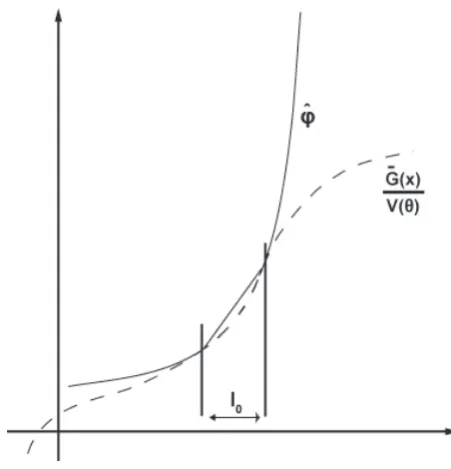
constant, so that θ∗(x) = ¯θ, ∀x ∈ I. If G(x,θ¯) = eg(x,θ¯) is strictly convex in x on some subinterval of I0 of I then the diffusion X is not the unique element of X0 which is consistent
with V.
Proof. First note that if x∗(θ), is continuous then θ∗ = x∗−1 is nowhere constant and hence strictly monotone and thusψ=vg is strictly g-convex (recall 3.10).
Suppose ¯G(x) :=G(x,θ¯) is strictly convex on I0 ⊆I. Then we can choose ˆG such that
• Gˆ = ¯G onI0c,
• Gˆ is linear on I0,
• Gˆ is continuous. Then ˆG(x)≥G(x,θ¯). By definition we have
ψ(x) =g(x,θ¯)−ψg(¯θ) x∈I.
Then ϕX(x) =G(x,θ¯)/V(¯θ) onI, see Figure 2.
Let ˆϕbe given by
ˆ
ϕ(x) =
(
ϕX(x) on I0c, ˆ
G(x)
V(¯θ) on I0
Then ˆϕ is convex and ˆϕ ≥ ϕ, so that they are associated with different elements of X0. Let
ˆ
ψ= ln ˆϕ.
It remains to show that ˆv:= ˆψg =ψg =v. It is immediate from ˆψ≥ψthat ˆψg ≤ψg. For the converse, observe that
v(θ) =
sup
x∈I0
{g(x, θ)−ψ(x)}
∨ sup
x∈Ic 0
{g(x, θ)−ψ(x)}
!
= sup
x∈Ic 0
{g(x, θ)−ψ(x)}
= sup
x∈Ic 0
{g(x, θ)−ψˆ(x)} ≤ ˆv(θ).
Example 5.16. Suppose G(x, θ) = eθx, and Θ = (0,∞). Suppose that X is such that ψ is given by
ψ(x) =
x2
4 x <2
(x−1) 2≤x <3
x2
6 +
1
Figure 2: The dashed line represents a functioneg(x,θ)+cfor some θ∈Θ and somec. ϕis given by the solid line onIc
0 and the dashed line onI0. Thenψ= logφhas ag-section overI0 andG
is convex there. ˆϕ, given by the solid line is another eigenfunction consistent withV.
It follows that
v(θ) =
θ2 θ≤1
3θ2
2 −
1
2 1< θ
Then ∂gv(1) is multivalued, and there are a family of diffusions X˜ ∈ X0 which give the same
value functions as X. In particular we can take
ˆ
ψ(x) =
x2
4 x <2
log((e2−e)x+ 3e−2e2) 2≤x <3
x2
6 +
1
2 3≤x
Then ψˆg =v(θ) and ψˆ is a log-eigenfunction.
5.6 Uniqueness of diffusions consistent with V
Proposition 5.17. Suppose V is such that x∗(θ) is continuous on Θ, with range the positive real line.
Then there exists at most one diffusion X∈ X0 consistent with V.
Proof. The idea is to show that vg(x) is the only function withg-convex dual v. Suppose ψ is such that ψg =v on Θ. For each x there is a θ with x∗(θ) =x, and moreover∂gv(θ) = {x}. Then by Lemma 5.6, A(θ) ={x} and ψ(x) =vg(x).
Theorem 5.18. Suppose V is such that v is continuously differentiable on (θ−, θR) and that
x− = 0 and xR=∞.
Then there exists at most one diffusion X∈ X0 consistent with V.
Proof. The condition on the range ofx∗(θ) translates into the conditions onx− andxR, so it is
sufficient to show thatx∗(θ) is continuous atθ∈(θ−, θR) if and only ifv is differentiable there.
This follows from Proposition 3.13.
Corollary 5.19. If the conditions of the Theorem hold but eitherevg(x)is not convex orvg(0)6= 0, then there is no diffusion X∈ X0 which is consistent with {V(θ), θ∈Θ}.
Example 5.20. Recall Example 2.6. For this example we have x∗(θ) = θ2 −1, which on
Θ = (1,∞) is continuous and strictly increasing. Then evg(x) = √1 +x and by the above corollary there is no diffusion consistent withv.
Remark 5.21. More general but less succinct sufficient conditions for uniqueness can be deduced from Lemma 5.7 or Lemma 5.11. For example, if 0 < x− < x+ = ∞, but (vg)0(x−) =
(1−e−vg(x−))/ x
− then there is at most one X∈ X0 which is consistent withV.
6
Further examples and remarks
6.1 Birth-Death processes
We now return to X0 and consider the case whenE is made up of isolated points only; whence
X is a birth-death process on points xn ∈ E indexed by n∈ N0, with associated exponential
holding times λn. We assumex0= 0, xn is increasing, and writex∞= limnxn.
For a birth-death process the transition probabilities are given by
Pn,n+1(t) =pnλnt+o(t),
Pn,n−1(t) =qnλnt+o(t),
where of course qn= 1−pn, with p0 = 1. By our assumption that, away from zero, (Xt)t≥0 is
a martingale, we must havepn= xn+1xn+1−−xxnn−1. Then we can writexn=xn−1+
Qn−1 i=1 qi
Qn−1
i=0 pi. Let
m(xn) =
1
λn
p0p1...pn−1
q1q2...qn
.
Then it is easy to verify, but see [7], that (2.5) can be expressed in terms of a second-order difference operator
1
m(xn)
f(xn+1)−f(xn)
xn+1−xn
−f(xn)−f(xn−1)
xn−xn−1
−ρf(xn) = 0, (6.1)
with boundary conditionsf(0) = 1 andf0(0−) = 0. Let M(x) = P
xn<xm(x). In the language of strings, the pair (M,[0, x∞)) is known as the
Stieltjes String. If x∞+M(x∞)<∞the string is called regular and x∞ is a regular boundary
point, while otherwise the string is called singular, in which case we assume that x∞ is natural
In this section we consider the call option payoff,G(x, θ) = (x−θ)+defined forθ∈Θ = [θ0,∞).
This objective function is straight-forward to analyse since theg-duality corresponds to straight lines in the original coordinates. It follows that for the forward problem V is decreasing and convex in θ. V is easily seen to be piecewise linear.
Our focus is on the inverse problem. Note that the solution of this problem involves finding the spaceE and the jump ratesλn. Suppose thatV is decreasing, convex and piecewise linear.
Let (θn)n∈N0 be a sequence of increasing real valued parameters withθ0 <0 and θn increasing
to infinity, and suppose that V has negative slope si on each interval (θi, θi+1). Then si is
increasing in iand
V(θ) =V(θn) + (θ−θn)sn forθn≤θ < θn+1. (6.2)
We assume thats0= Vθ(θ00) <0.
Since V is convex, v is log((x−θ)+) convex. Let ϕ(x) = exp(vg(x)). By Proposition 3.11, for
θ∈[θn, θn+1)
−1
x∗(θ)−θ =gθ(x
∗(θ), θ) = sn
V(θn) + (θ−θn)sn
so that xn:=x∗(θn) =θn−V(θn)/sn. Note thatx∗(θ) is constant on [θn, θn+1). We find that
forθ∈[θn, θn+1)
ψ(x∗(θ)) = log(θn−θ−V(θn)/sn)−v(θ),
and henceϕ(x∗(θ)) = −s1
n. Then, forx∈[x ∗(θ
n), x∗(θn+1)),
ψ(x) = log(x−θn)−v(θn). (6.3)
We proceed by determining the Q-matrix for the process on [x∗(0) = 0, ξ). For each n, let pn
denote the probability of jumping to statexn+1andqnthe probability of jumping toxn−1. Then
pn and qn are determined by the martingale property (and p0 = 1). Furtherλn is determined
either through (6.1) or from a standard recurrence relation for first hitting times of birth-death processes:
λn=
ρϕ(xn)
pnϕ(xn+1) + (1−pn)ϕ(xn−1)−ϕ(xn)
, n≥1.
Example 6.1. Suppose thatθn=n+ 2−n−2so thatθ0=−1, andV(θn) = 2−n. It follows that
sn=−(2n+1−1)−1. We findxn=n(this example has been crafted to ensure that the birth-death
process has the integers as state space, and this is not a general result). Also ϕ(n) = 2n+1−1
(ϕis piecewise linear with kinks at the integers) and the holding time atxn is exponential with
rate λn= 4ρ(1−2−(n+1)).
6.2 Subsets of X and uniqueness
So far in this article we have concentrated on the class X0. However, the methods and ideas translate to other classes of diffusions.
LetXm,s denote the set of all diffusions reflected at 0. Heremdenotes the speed measure, and
sthe scale function. With the boundary conditions as in (2.5),ϕ(x)≡ϕX(x) is the increasing,
but not necessarily convex solution to
1 2
d2f
In the smooth case, when m has a density m(dx) = ν(x)dx and s00 is continuous, (6.4) is equivalent to
1 2σ
2(x)f00
(x) +µ(x)f0(x) =ρf(x), (6.5) where
ν(x) =σ−2(x)eM(x), s0(x) =e−M(x), M(x) =
Z x
0−
2σ−2(z)µ(z)dz,
see [3].
Now supposeV ≡ {V(θ) :θ∈Θ}is given such thatvu(0) = 0, (vu)0(0) = 0 andvu is increasing, then we will be able to find several pairs (σ, µ) such that exp(vu) solves (6.5) so that there is a family of diffusions rather than a unique diffusion inXm,s consistent withv.
It is only by considering subsets of Xm,s, such as taking s(x) = 0 as in the majority of this
article, or perhaps by setting the diffusion co-efficient equal to unity, that we can hope to find a uniquesolution to the inverse problem.
Example 6.2. Consider Example 2.6 where we found ψ(x) = √1 +x. Let X1,s be the set of
diffusions with unit variance and scale function s (which are reflected at 0). Then there exists a unique diffusion in X1,s consistent with V. The drift is given by
µ(x) = 1/4 + 2ρ(1 +x)
2
1 +x .
7
Applications to Finance
7.1 Applications to Finance
LetXstock be the set of diffusions with the representation
dXt= (ρ−δ)Xtdt+η(Xt)XtdWt.
In finance this SDE is often used to model a stock price process, with the interpretation thatρ
is the interest rate, δ is the proportional dividend, and η is the level dependent volatility. Let
x0 denote the starting level of the diffusion and suppose that 0 is an absorbing barrier.
Our aspiration is to recover the underlying model, assumed to be an element of Xstock, given a set of perpetual American option prices, parameterised by θ. The canonical example is when
θ is the strike, and G(x, θ) = (θ−x)+, and then, as discussed in Section 6.2, the fundamental ideas pass over fromX0 toXstock. We supposeρandδ are given and aim to recover the volatility
η.
Letϕbe the convex and decreasing solution to the differential equation
1 2η(x)
2x2f
xx+ (ρ−δ)xfx−ρf = 0. (7.1)
(The fact that we now work with decreasingϕdoes not invalidate the method, though it is now appropriate to use payoffs G which are monotonic decreasing in x.) Then η is determined by the Black-Scholes equation
η(x)2 = 2ρϕ(x)−(ρ−δ)xϕ
0(x)
LetG≡G(x, θ) be a family of payoff functions satisfying assumption 3.6. Under the additional assumption thatG is decreasing inx (for example, the put payoff) Lemma 2.1 shows that the optimal stopping problem reduces to searching over first hitting times of levelsx < x0. Suppose
that{V(θ);θ∈Θ}is used to determine a smooth, convexϕ= exp(ψ) on [0, ξ) via theg-convex duality
ψ(x) =vg(x) = sup
θ∈Θ
[g(x, θ)−v(θ)].
Then the inverse problem is solved by the diffusion with volatility given by the solution of (7.2) above. Similarly, given a diffusion X ∈ Xstock such that ψ= log(ϕ) is g-convex on [0, ξ), then the value function for the optimal stopping problem is given exactly as in Proposition 4.4. See Ekstr¨om and Hobson [6] for more details.
Remark 7.1. The irregular case of a generalised diffusion requires the introduction of a scale function, see Ekstr¨om and Hobson [6]. That article restricts itself to the case of the put/call payoffs for diffusionsXstock, using arguments from regular convex analysis to develop the duality
relation. However, the construction of the scale function is independent of the form of the payoff function and is wholly transferable to the setting of g-convexity used in this paper.
7.2 The Put-Call Duality; g-dual Processes
In [2], Alfonsi and Jourdain successfully obtain what they term an American Put-Call duality (see below) and in doing so, they solve forward and inverse problems for diffusionsX∈ Xstock.
They consider objective functions corresponding to calls and puts: G(x, θ) = (x−θ)+ and
G(x, θ) = (θ −x)+. In [1] the procedure is generalised slightly to payoff functions sharing ‘global properties’ with the put/call payoff. In our notation the assumptions they make are the following: [1, (1.4)]
LetG:R+×R+→R+be a continuous function such that on the space Φ ={(x, θ) :G(x, θ)> 0} 6=∅,G isC2 and further for allx, θ ∈Φ
Gx(x, θ)<0, Gθ(x, θ)>0, Gxx(x, θ)≤0 Gθθ(x, θ)≤0.
Subsequently, they assume [1, (3.4)]
GGxθ > GxGθ on Φ. (7.3)
Condition (7.3) is precisely the Spence-Mirrlees condition applied to g = log(G). Note that unlike Alfonsi and Jourdain [1] we make no concavity assumptions on G. We also treat the case of the reverse Spence-Mirrlees condition, and we consider classes of diffusions other than
Xstock. Further, as in Ekstr¨om and Hobson [6] we allow for generalised diffusions. This is
important if we are to construct solutions to the inverse problem when the value functions are not smooth. Moreover, even when v is smooth, if it contains ag-section, the diffusion which is consistent withvexists only in the generalised sense. Whenvcontains ag-section we are able to address the question of uniqueness. Uniqueness is automatic under the additional monotonicity assumptions of [1].
an option for all values of the underlying stock simultaneously, even though only one of those values is relevant. Conversely, on a given date, options with several strikes may be traded.
The calculations given in [2] are most impressive, especially given the complicated and implicit nature of the results (see for example, [1, Theorem 3.2]; typically the diffusion coefficients are only specified up to the solution of one or more differential equations). In contrast, our results on the inverse problem are often fully explicit. We find progress easier since theg-convex method does not require the solution of an intermediate differential equation. Furthermore, the main duality ([1, Theorem 3.1]) is nothing but the observation that theg-subdifferentials (respectively
x∗ andθ∗) are inverses of each other, which is immediate in the generalised convexity framework developed in this article. Coupled with the identity, gx(x∗(θ), θ) = ψ0(x∗(θ)) the main duality
result of [2] follows after algebraic manipulations, at least in the smooth case where x∗ and θ∗
are strictly increasing and differentiable, which is the setting of [2] and [1].
A
Proofs
A.1 The Forward and Inverse Problems
Proof of Lemma 2.1ClearlyV ≥Vˆ, since the supremum over first hitting times must be less than or equal to the supremum over all stopping times.
Conversely, by (2.2), ϕ(x) ≥ Gˆ(x,θ)
V(θ) . Moreover, (2.5) implies thate
−ρtϕ(X
t) is a non-negative
local martingale and hence a supermartingale. Thus for stopping timesτ we have
1≥E0[e−ρτϕ(Xτ)]≥E0[e−ρτG(Xτ, θ)/Vˆ(θ)]
and hence ˆV(θ)≥supτE0[e−ρτG(xτ, θ)].
A.2 u-convexity
The methods and many of the results we use in this section are to be found in [11] and [4].
Lemma A.1. For every function f :Dz →R, (fu)u is the largest u-convex minorant of f.
Proof. Note that f∗ ≡ −∞ is always a u-convex minorant and by Definition 3.1 a function defined as the supremum of a collection of u-convex functions isu-convex.
Hence we can definefm, the largestu-convex minorant off by
fm(z) = sup
ζ
{ζ(x);ζ ≤f, ζ ∈U(Dz)},
whereU(Dz) is the set ofu-convex functions onDz. Then by the Fenchel Inequality,f ≥(fu)u
and since (fu)u is u-convex, it follows thatfm≥(fu)u. Since fm isu-convex there existsS0 ⊂Dz×Rsuch that
fm(y) = sup
(z,a)∈S0
[u(y, z) +a]
For fixed (z, a)∈S0,l(y) =u(y, z) +aisu-convex and it is easy to check that (lu)u(y) =l(y). We note that if f ≤ fˆ, then fu ≥ fˆu. Since u(y, z) +a ≤ fm(y) ≤ f(y), we therefore have
Proof of Lemma 3.3If f isu-convex then f is its greatestu-convex minorant, sof = (fu)u. On the other hand if (fu)u=f then since (fu)u is u-convex, so isf.
Proof of Lemma 3.9 Let y <yˆ. For any z∈∂uf(y) and any ˆz ∈∂uf(ˆy), the following pair of inequalities follow from u-convexity (see especially the second part of Definition 3.4):
f(y)−f(ˆy) ≥ u(y,zˆ)−u(ˆy,zˆ), f(ˆy)−f(y) ≥ u(ˆy, z)−u(y, z).
Adding and re-arranging we get,
u(y,zˆ)−u(ˆy,zˆ) +u(ˆy, z)−u(y, z)≤0,
and hence,
Z yˆ y
[uy(v, z)−uy(v,zˆ)]dv ≤0. (A.1)
Since (by Assumption 3.6(b)) uy(v, w) is strictly increasing in the second argument it follows
that ˆz≥z.
Proof of Proposition 3.11Supposef isu-convex andu-subdifferentiable. Letybe a point of differentiability offandz∈∂uf(y). Then forh >0, we have bothf(y+h)−f(y) =f0(y)h+o(h) and
f(¯y)−f(y)≥u(¯y, z)−u(y, z) ∀y¯∈Dy.
From the definition ofu-convexityf(y) =u(y, z)−fu(z) andf(y+h)≥u(y+h, z)−fu(z), so taking ¯y =y+h and putting all this together,
f(y+h)−f(y)≥u(y+h, z)−u(y, z) =uy(y, z) +o(h).
Dividing byh >0 on both sides and lettingh→0 we get
f0(y)≥uy(y, z).
If instead we takeh <0 above then we get the reverse inequality and hence
f0(y) =uy(y, z). (A.2)
By the Spence-Mirrlees conditionuy(y, z) is injective with respect toz. Hence, the last equation
determineszuniquely; thus wheneverf is differentiable the sub-differential∂uf(y) is a singleton set. We set∂uf(y) ={z∗(y)}. Then, sincez∗(y)∈∂uf(y) we havef(y)+fu(z∗(y)) =u(y, z∗(y)) as required.
To prove the converse statement, suppose that for any point of differentiabilityy of f,
f0(y) =uy(y, z∗(y))
wherez∗ non-decreasing. Define
ζ(y) = sup
v
[f(v) +u(y, z∗(v))−u(v, z∗(v))].
Then ζ isu-convex: to see this define
and then
ζ(y) = sup
(θ,a)∈S
[u(y, θ) +a].
Clearly ζ ≥f. We want to show thatζ =f. By the assumptions onf we have
f(y) =
Z y
v
uy(w, z∗(w))dw+f(v).
Hence
f(y)−(f(v) +u(y, z∗(v))−u(v, z∗(v))) =
Z y
v
[uy(w, z∗(w))−uy(w, z∗(w))]dw≥0.
Thusζ =f and so f isu-convex.
The following Corollary is immediate from 3.11.
Corollary A.2. Suppose f is differentiable aty. Thenf is twice-differentiable at y if and only if z∗ is differentiable at y.
Proof of Proposition 3.13
Supposef is u-subdifferentiable in a neighbourhood ofy. Then for small enough ,
f(y+)−f(y)≥f(y+, z∗(y))−f(y, z∗(y)) and lim↓0{f(y+)−f(y)}/≥fy(y, z∗(y)).
For the reverse inequality, ifz∗is continuous atythen forsmall enough thatz∗(y+)< z∗(y)+δ
we have
f(y+)−f(y)≤f(y+, z∗(y+))−f(y, z∗(y+))≤f(y+, z∗(y) +δ)−f(y, z∗(y) +δ) and lim↓0{f(y+)−f(y)}/≤limδ↓0fy(y, z∗(y) +δ) =fy(y, z∗(y)).
Inequalities for the left-derivative follow similarly, and then f0(y) =uy(y, z∗(y)) which is
con-tinuous.
Conversely, if∂uf is multi-valued aty so that z∗ is discontinuous at y, then
lim
↓0{f(y+)−f(y)}/≥fy(y, z
∗(y)+)> f
y(y, z∗(y)−)≥lim
↓0{f(y)−f(y−)}/
where the strict middle inequality follows immediately from Assumption 3.6.
References
[1] A. Alfonsi and B. Jourdain. General duality for perpetual American options. International Journal of Theoretical and Applied Finance, 11(6):545–566, 2008.
[3] A.N. Borodin and P. Salminen. Handbook of Brownian Motion - Facts and Formulae. Birkh¨auser, 2nd edition, 2002.
[4] G. Carlier. Duality and existence for a class of mass transportation problems and economic applications. Adv. in Mathematical economy, 5:1–22, 2003.
[5] H. Dym and H.P. McKean. Gaussian Processes, Function Theory, and the Inverse Spectral Problem. Academic Press, Inc., 1976.
[6] E. Ekstr¨om and D. Hobson. Recovering a time-homogeneous stock price process from perpetual option prices. Preprint, 2009. http://arxiv.org/abs/0903.4833.
[7] W. Feller. The birth and death processes as diffusion processes. J. Math. Pures Appl., 38:301–345, 1959.
[8] K. Itˆo and H.P McKean. Diffusion Processes and their Sample Paths. Springer-Verlag, 1974.
[9] I.S. Kac. Pathological Birth-and-Death Processes and the Spectral Theory of Strings.
Functional Analysis and Its Applications, 39(2):144–147, 2005.
[10] S. Kotani and S. Watanabe. Krein’s spectral theory of strings and generalized diffusion processes. Functional Analysis in Markov Processes, (ed. M. Fukushima), Lecture Notes in Math., 923:235–259, 1982.
[11] S.T Rachev and L. R¨uschendorf.Mass Transportation Problems, volume 1. Springer-Verlag, 1998.
[12] R.T. Rockafellar. Convex Analysis. Princeton University Press, 1970.
[13] L.C.G. Rogers and D. Williams. Diffusions, Markov Processes and Martingales, volume 2. Cambridge University Press, 2000.