DEVELOPMENT OF A 2D HYDRAULIC MODEL FOR
THE RHINE VALLEY USING OPEN DATA
AUTHOR:
MARTIJN KRIEBEL
BSc Thesis – Martijn Kriebel ii
Development of a 2D hydraulic model for the Rhine valley
using open data
BSc thesis for the bachelor’s programme Civil Engineering at the Faculty of Engineering Technology of the University of Twente, combined with an internship at Deltares.
Author: Martijn Kriebel s1441043
Completion date: June 24th 2016
Supervisors:
Deltares: Prof. dr. J.C.J. Kwadijk Ir. M. Hegnauer University of Twente: Ir. K.D. Berends
Figure on the front page:
Post-processed illustration of flooding in the Upper Rhine (seen from Frankfurt am Main, Germany), as simulated by the two-dimensional hydraulic model that is created during this study.
Development of a 2D hydraulic model for the Rhine valley using open data iii
ABSTRACT
For current Dutch river management, flood waves are predicted using the Generator of Rainfall and Discharge Extremes for the Rhine and Meuse basins (GRADE). One of the components of GRADE is a one-dimensional hydraulic model that is made with the SOBEK modelling software. However, this could be replaced by a two-dimensional hydraulic model, which has a more continuous representation of the area’s topography.
Furthermore, a 2D model can calculate both longitudinal and transversal movements, making it more accurate in simulating floodplains. This could yield different results than the current calculations for the maximum flood wave. This report describes the development of such a 2D model for the Rhine valley in Delft3D Flexible Mesh, and discusses its performance compared to the 1D hydraulic model that is currently implemented in GRADE. The development of the two-dimensional hydraulic model started with finding the minimum required model extent. This is done by calculating the probable extent of flooding of the river’s floodplains in combination with the backwater adaptation length in each of the tributaries that could occur in the case of an extreme discharge event. Then, an estimation of the basic bathymetry of the Rhine is made, which is then incorporated in the digital elevation model (DEM) that is created by the Shuttle Radar Topography Mission (SRTM). After this, a computational grid is created and assessed on characteristics such as orthogonality and smoothness. Lastly, initial and boundary conditions have been extracted from the 1D model where possible, or made as similar to the 1D model as possible to be able to make a good comparison. Different possibilities in these components have resulted in the development of several slightly different models. These models have been compared to each other first so that the effects of different model properties could be evaluated, after which the two-dimensional model has been compared to the one-two-dimensional hydraulic model of GRADE.
Comparison of the two-dimensional models with varying properties resulted in three main findings: - The minimum required model extent for an extreme discharge event in the Rhine valley can be
accurately determined by calculating the probable extent of flooding of the river’s floodplains in combination with calculations on the probable tributary backwater adaptation length.
- A two-dimensional hydraulic model that uses a relative fine computational grid simulates less flooding in terms of volume compared to a coarser model, resulting in more discharge at Lobith. Despite this difference, the coarse grid model in this study can be appointed as the most optimal solution since its computational time is almost four times lower.
- Changes in the initial water depth only influence the simulated discharges at the start of the simulation, and cause relatively little difference. The use of a so-called restart file as a starting point for the two-dimensional model appears to have a significant effect on the simulated discharges. Comparison of the one-dimensional model with the two-dimensional model resulted in three main findings:
- Discharge peaks that are simulated by the two-dimensional model arrive later compared to the peaks in the one-dimensional model.
- The discharges that are simulated by the two-dimensional model are, generally speaking, lower than those that are simulated by the one-dimensional model.
- In general, the hydrographs of the one- and two-dimensional models at Maxau and Bonn share the most similarities, while their hydrographs at Mainz and Lobith differ the most.
BSc Thesis – Martijn Kriebel iv
PREFACE
The thesis that lies before you is the result of an internship from April to June 2016 at Deltares, and is submitted in partial fulfilment of the requirements for a Bachelor’s Degree in Civil Engineering at the University of Twente. This report describes the development of a two-dimensional hydraulic model for the Rhine valley, and discusses its performance compared to the one-dimensional hydraulic model that is currently in use.
During this short, but interesting period I had the opportunity to develop my academic skills as well as my knowledge of this field of civil engineering. I am grateful to everyone who helped me completing this study and thesis. I would like to express my appreciation to Jaap Kwadijk, who gave me the opportunity to work on this subject in the first place, and to Mark Hegnauer, who provided me with guidance and advice during the internship. I am also thankful to Koen Berends, who gave me valuable feedback on both my research proposal and thesis and who guided me through the process of writing them. Furthermore, I would like to thank Anke Becker who was always available for help when modelling problems arose. Lastly, I want to thank all the other interns at Deltares who provided me with useful advice and feedback, and with whom I had a pleasant time at the office.
Development of a 2D hydraulic model for the Rhine valley using open data v
TABLE OF CONTENTS
Abstract ... iii
Preface ... iv
1. Introduction ... 1
1.1. Background information and problem definition ... 1
1.2. Study area ... 2
1.3. Research questions ... 2
1.4. Thesis outline ... 3
1.5. Software and open data ... 3
2. Theoretical background ... 4
3. Methodology ... 6
3.1. Model extent ... 6
3.1.1. Floodplains ... 6
3.1.2. Tributary backwater ... 9
3.1.3. Final model extent ... 11
3.2. Model geometry ... 12
3.2.1. DEM interpolation ... 12
3.2.2. Bathymetry ... 13
3.3. Computational grid ... 13
3.3.1. Main channel and floodplain grid ... 14
3.3.2. Tributary grid ... 15
3.3.3. Irregularities ... 16
3.3.4. Grid characteristics... 17
3.3.5. Final grid ... 17
3.4. Initial conditions ... 18
3.5. Boundary conditions ... 18
3.5.1. Upstream boundary condition ... 18
3.5.2. Downstream boundary condition ... 19
3.6. Numerical properties ... 21
3.6.1. Conveyance and cell elevation ... 21
3.6.2. Courant number ... 21
4. Results ... 22
4.1. Model domain ... 23
4.2. Grid ... 24
4.3. Initial water depth ... 27
BSc Thesis – Martijn Kriebel vi
4.5. 2D Delft3D FM model vs. 1D SOBEK model ... 28
5. Discussion ... 32
6. Conclusions ... 33
7. Recommendations ... 34
References ... 35
Appendices ... 37
A. Study area ... 37
B. Rhine sections based on slope linearity ... 38
C. Indicative floodplains Upper Rhine ... 39
D. Indicative floodplains Middle Rhine ... 40
E. Indicative floodplains Lower Rhine ... 41
F. Tributary slopes ... 42
G. Model extent ... 45
H. Orthogonality of coarse grid ... 46
I. Orthogonality of fine grid ... 47
J. Smoothness of coarse grid ... 48
K. Smoothness of fine grid ... 49
L. Average water depth in the Rhine ... 50
M. Downstream boundary conditions ... 51
Development of a 2D hydraulic model for the Rhine valley using open data 1
1. INTRODUCTION
1.1. BACKGROUND INFO RMATION AND PROBLEM DEFINITION
The Netherlands is a country that is inextricably connected to water, and has a history of many flooding events. As much of the country covers the estuaries of the rivers Rhine, Meuse and Scheldt, 29% of its territory is susceptible to river flooding (Reuters, 2010). Even though the Dutch Ministry of Infrastructure and the Environment tries to lower the risk of river floods (with projects like “Ruimte voor de Rivier”), dykes are still crucial for protecting the part of the population that lives near rivers. These dykes are designed to withstand extreme discharges. For the Netherlands, river dykes should be able to withstand discharges that occur once every 1250 years. For the river Rhine this would correspond to a discharge of 16050 m3/s at Lobith (Chbab, 1995).
Modifying and improving these dykes is a very costly operation. It is estimated that in order to raise a dyke 50 centimeter over a length of 1 kilometer, an investment of 2 million euro is needed. Furthermore, an estimated total investment over the period 2015-2050 of 3.5 billion euro is needed to improve dyke safety (Kind, 2008). This shows that investing in more accurate discharge estimations is justified given the costs of raising a dyke. There is an ongoing debate about the maximum discharge that can arrive at the gauging station of Lobith, where the Rhine exits Germany and enters the Netherlands. An underestimation of the discharge in the case of such flood wave could lead to a disaster with many victims, but an overestimation on the other hand could result in raising the dykes and thus unnecessary expenses.
For current Dutch river management, flood waves are predicted using the Generator of Rainfall and Discharge Extremes for the Rhine and Meuse basins (GRADE), which has been developed by the Royal Netherlands Meteorological Institute (KNMI) and Deltares. GRADE consists of three major components:
1. Stochastic weather generator: a generator which has been developed by KNMI. It produces daily rainfall and temperature series which are based on historical data.
2. Hydrologiska Byråns Vattenbalansavdelning (HBV) model: a hydrological model that calculates the runoff that occurs as a consequence of the simulated precipitation and temperature series.
3. 1D SOBEK model: a 1D hydraulic model of the Rhine, made with the river/estuary version of the SOBEK modelling software (SOBEK-RE). By selecting the annual maximum discharges (which are the consequence of the runoff that has been calculated with the HBV model), annual maximum flood waves can be simulated. Using these flood waves, possible flooding of the area surrounding the Rhine can be simulated. For the Rhine, a SOBEK model from Maxau (Germany) to Lobith is used.
(Hegnauer, Beersma, van den Boogaard, Buishand, & Passchier, 2014)
A one-dimensional model such as the SOBEK model in GRADE describes the river geometry using several cross-sections that are perpendicular to the flow. Furthermore, the model’s boundary conditions consist of hydrographs that are supplied by the HBV model and a downstream water level time series at Lobith. At each cross-section and for each time step, the model computes water levels and discharges using the flow equations for mass and momentum. This gives an indication of how the flood wave propagates through the Rhine river and eventually how high the discharges are that arrive at Lobith. However, there are two problems with this method. A first complication is the fact that calculated data (like water level surface) needs to be interpolated between cross-sections, which leads to uncertainties in between them. Additionally, this information is highly dependent on the chosen location of the cross-sections, as Bates and De Roo (2000) remark.
one-BSc Thesis – Martijn Kriebel 2 dimensional model is only able to provide flow properties in the downstream direction, while in- and outflows between the river and floodplains are also caused by transversal movements. As a consequence of this, one-dimensional models are known to consider low-lying floodplain areas that are not connected to the main channel as flooded, because the elevation of these areas is lower than the interpolated water level surface (Werner, 2000).
These problems could be solved by using a two-dimensional model, since such a model has a more continuous representation of the area’s topography. Furthermore, a 2D model can simulate both longitudinal and transversal movements, and is therefore able to simulate floodplains more accurate than one-dimensional models. This could yield different calculation results for the maximum flood wave.
In order to create such a 2D model, a Digital Elevation Model (DEM) is needed. In the beginning of the year 2000 NASA started publishing high-resolution topographic data of the Earth between 60° north and 56° south latitude, which is approximately 80% of the Earth’s total landmass (Jet Propulsion Laboratory, 2015). This data was collected during the Shuttle Radar Topography Mission (SRTM). Initially the highest resolution data (1-arc second, or circa 30 meter) was only available for the United States while the data for the rest of the world had a lower resolution of 3-arc second (circa 90 meter). However, at the end of 2014 and beginning of 2015, global 1-arc second elevation data became publically accessible (Jet Propulsion Laboratory, 2014). The fact that this kind of accurate, topographic data of the whole world is publically accessible, combined with the increase of computer power the last decades opens the door to more comprehensive hydraulic models.
This report describes how a two-dimensional hydraulic model of the Rhine has been created using the SRTM DEM data. Furthermore, it analyses the impact of several model aspects on the results, and discusses the differences between this 2D model and the 1D SOBEK model of GRADE when an extreme discharge event is simulated.
1.2. STUDY AREA
The study area of this study is the valley of the Rhine from Basel (Switzerland, located along the Rhine) up to Arnhem, Nijmegen and Doesburg (the Netherlands, respectively located along the Nederrijn, Waal and IJssel). Also, the lower parts of the same main tributaries of the Rhine that have been used in GRADE will be included. These are the Neckar, Main, Nahe, Lahn, Moselle, Sieg, Ruhr and Lippe. An overview of this area can be found in appendix A. This map also shows the location of Lobith, where the first Dutch gauging station along the Rhine is located.
1.3. RESEARCH Q UESTIONS
The main research question which will be answered in this thesis is as follows:
What are the differences in flood event discharges of the Rhine between an open data based two-dimensional hydraulic model and the one-dimensional hydraulic model implemented in GRADE?
To be able to answer this question, the two-dimensional hydraulic model needed to be built after which its output is compared to the results of GRADE. Therefore, the following three sub-questions are formulated:
1. What should be the minimum domain that needs to be taken into account in the model? 2. What should be the cell size and cell shape of the computational grid?
Development of a 2D hydraulic model for the Rhine valley using open data 3 1.4. THESIS OUTLINE
Chapter 2 gives a general introduction to the concept of hydraulic modelling, to the Delft3D Flexible Mesh software and explains some terminology that is used in this thesis. Chapter 3 discusses the methodology that is used to create the two-dimensional hydraulic model, with its sections being the building blocks of the model. After this, chapter 4 displays and discusses the results of the different simulation runs of the 2D model, and discusses the differences between the 1D and 2D model. Chapter 5 reflects on the methodology that is used in this study, and discusses the uncertainties. Lastly, chapter 6 gives the conclusions of this study followed by recommendations for future research in chapter 7.
Figure 1: overview of chapters in this thesis.
1.5. SOFTWARE AND OPEN DATA
Both pre- and post-processing of the DEM data and the output of the 2D hydraulic model has been done using the Geographic Information System (GIS) software ArcGIS version 10.2.1 and QGIS version 2.14.0. The software that is used to create the two-dimensional hydraulic model is the most recent, stable version of Delft3D Flexible Mesh. At the time of writing, this is Delft3D FM 2016 HM version 1.0.3.32933. Data that needed to be extracted from the one-dimensional hydraulic model of GRADE has been obtained using SOBEK-RE 2.52.009C. Furthermore, required elevation data for the model has been obtained from the most recent version of the digital elevation model that has been created by NASA during its Shuttle Radar Topography Mission, which is the 1 arc-second SRTM DEM v3.0. This data is publically available through the United States Geological Survey “EarthExplorer” tool (United States Geological Survey, 2016).
Recommendations Conclusions Discussion of results
Results Numerical properties
Describes some of the model's numerical properties Boundary conditions
Describes how the up- and downstream boundary conditions have been determined
Initial conditions
Describes how the initial conditions have been determined Computational grid
Describes the cell sizes, shapes and characteristics of the computational grid
Model geometry
Describes the geometry that is used in the model Model extent
Describes how the model domain has been determined Theoretical background
Introduction to hydraulic modelling, Delft3D FM and used terminology
Me
th
o
d
o
BSc Thesis – Martijn Kriebel 4
2. THEORETICAL BACKGROUND
The fundamental task of a hydraulic model is to solve the shallow water equations, which are based on mass and momentum conservation. This applies to both one- and two-dimensional models. The difference is that a 2D model can calculate this in both longitudinal and transversal direction (i.e. it solves the 2D shallow water equations) as opposed to a one-dimensional model which only calculates the equations for the longitudinal direction (Horritt & Bates, 2002).
For this study the hydrodynamic modelling software Delft3D Flexible Mesh is used, which is developed by Deltares. It solves the following 2D depth-averaged continuity equation for incompressible fluids:
𝛿ℎ 𝛿𝑡+
𝛿𝑈ℎ 𝛿𝑥 +
𝛿𝑉ℎ
𝛿𝑦 = 𝑄 (2.1)
𝑄 = ∫ (𝑞𝑖𝑛− 𝑞𝑜𝑢𝑡)𝑑𝑧 + 𝑃 − 𝐸 ℎ
0
(2.2) In which:
ℎ = water depth [m]
𝑈 and 𝑉 = depth-averaged velocity components [m·s-1]
𝑄 = contributions per unit area due to discharge/withdrawal of water, precipitation and evaporation [m·s-1]
𝑞𝑖𝑛 and 𝑞𝑜𝑢𝑡 = local sources/local sinks of water per unit of volume [1·s-1]
𝑃 and 𝐸 = non-local source/non-local sink terms due to precipitation/evaporation [m·s-1]
(Deltares, 2016a)
The depth-averaged 2D momentum equation in x- and y-direction that the software solves is as follows:
∂u ∂t+ 𝑢
∂u ∂x+ 𝑣
∂u ∂y+ 𝑤
∂u
𝑑𝑧− 𝑓𝑣 = − 1 𝜌0
∂P ∂x+ 𝐹𝑥+
∂ ∂z(𝛶𝑉
∂u
∂z) + 𝑀𝑥 (2.3) ∂v
∂t+ 𝑢 ∂v ∂x+ 𝑣
∂v ∂y+ 𝑤
∂v
𝑑𝑧− 𝑓𝑢 = − 1 𝜌0
∂P ∂y+ 𝐹𝑦+
∂ ∂z(𝛶𝑉
∂v
∂z) + 𝑀𝑦 (2.4) In which:
𝑢 and 𝑣 = depth-averaged velocity in the x- and y-direction respectively [m·s-1]
𝑤 = vertical velocity [m·s-1]
𝑧 = water depth [m] 𝑓 = Coriolis parameter [s-1]
𝜌0 = reference density of water [kg·m-3] 𝑃 = pressure [kg·m-1·s-2]
𝐹𝑥 and 𝐹𝑦 = forces per unit of mass in the x- and y-direction respectively that represent the unbalance of horizontal Reynolds stresses [m/s2]
𝑀𝑥 and 𝑀𝑦 = represent the contributions due to external sources or sinks of momentum such as external forces by hydraulic structures and discharge or withdrawal of water [m·s-2]
𝛶𝑉 = vertical eddy viscosity coefficient [m2·s-1] (Deltares, 2016a)
Development of a 2D hydraulic model for the Rhine valley using open data 5 The main component of Delft3D FM is the D-Flow FM engine, which simulates the hydrodynamical processes for unstructured grids. To describe the calculations of the engine in this report, the following topological conventions have been used:
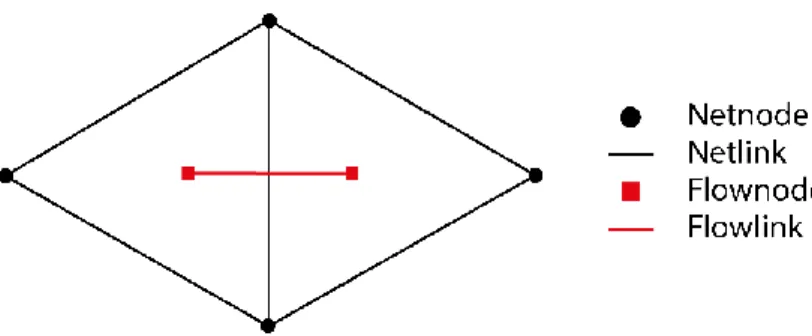
- Netnodes: the corners of a computational cell. - Netlinks: line segments connecting the netnodes. - Flownodes: the circumcentre of the computational cell. - Flowlinks: line segments connecting flownodes. (Deltares, 2016a)
These conventions are visualized in figure 3. For a two-dimensional model the D-Flow FM engine defines the flow velocities at the middle of the netlinks, whereas the water levels are defined at the circumcentres (i.e. at the flownodes).
Figure 2: (a) uniform rectilinear grid (b) curvilinear grid (c) unstructured grid (d) flexible mesh: combination of curvilinear and unstructured grid
Figure 3: topological conventions of unstructured grids in Delft3D Flexible Mesh.
BSc Thesis – Martijn Kriebel 6
3. METHODOLOGY
3.1. MODEL EXTENT
An important, basic aspect regarding the development of a hydraulic model is the size of the domain that should be taken into account (the model extent). One can decide to only include, for example, the Rhine with a buffer of 50 meter around it. Although this model would require relatively few grid cells (and will consequently have a low computation time), it is likely that in reality, the water will exceed the model domain in the case of an extreme event. On the other hand, choosing a very large domain such as the Rhine with a buffer of 50 kilometer results in many (unnecessary) grid cells and a higher computation time. Therefore, the model domain should be made as large as the (maximum expected) spatial extent of the flooding during an extreme event.
In this methodology section an estimation of the minimum required domain is given. The process of defining this domain consists of two major parts: estimating the probable extent of flooding of the river’s floodplains that could occur in the case of an extreme discharge event, and estimating to what extent the tributaries should be taken into account by looking at the backwater effect. When combined, an indication of the minimum required domain is obtained.
3.1.1. FLOODPLAIN S
Before looking at the possible floodplains in the case of an extreme discharge event, it is good to define the term “floodplain” first. Loucks and van Beek (2005) define two types of floodplains: a hydrological floodplain, which is inundated about two years out of three, and a topographic floodplain that is flooded by a flood peak of a given frequency. The goal of the two-dimensional hydraulic model is to simulate extreme high discharges with high return periods. Hegnauer, Kwadijk and Klijn (2015) estimate that the maximum plausible flood wave that can arrive at Lobith has a discharge of 18 000 m3/s, with a corresponding return period of 100 000 years. Higher
discharges cannot be conveyed by the Niederrhein without embankment overtopping. In that case, the water will enter the Netherlands over land and flows into e.g. the IJssel valley. However, it is likely that this will already happen for lower discharges, since a discharge capacity of 18 000 m3/s in the Niederrhein is considered to be a
very high upper end estimation. This means that this scenario with a return period of 100 000 years can be used as an indication of the maximal floodplain extent in the Rhine valley. Therefore, whenever the word “floodplain” is used in this report, the topographic floodplain for an extreme discharge event with a return period of 100 000 years is meant.
The method that is used to get an indication of flooding of these floodplains can be summarized as follows: 1. The river is divided into sections, based on the slope. This slope should be roughly linear per section. 2. Using a modified version of the Chézy equation and known river properties the water level that occurs
during an extreme discharge event can be estimated.
3. These water levels have been linearly interpolated over all the other river cells.
4. The water levels of all the points on the river are interpolated over the DEM using the inverse distance weighting method, and all the DEM cells that are below the corresponding water level are marked as “flooded”.
5. All the flooded DEM cells that are not connected to the Rhine are removed.
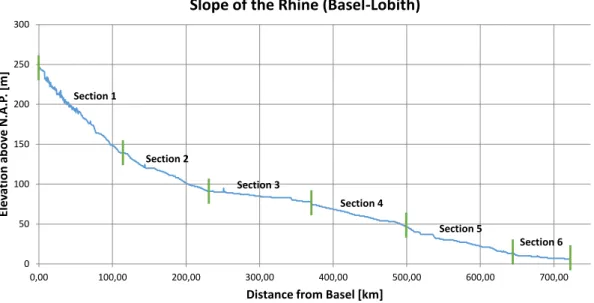
Development of a 2D hydraulic model for the Rhine valley using open data 7 Figure 4 shows the slope of the Rhine from Basel to Lobith, wherein seven linear sections can be distinguished. Note that this is not the bottom slope, but the slope of the water surface since the signal that is used to create the SRTM DEM cannot penetrate water. An overview map of these sections can be found in appendix B. The green lines in both the graph and the appendix are the locations where one section ends and the other starts. Furthermore, note that the elevations of the SRTM DEM correspond to the WGS84/EGM96 geoid (Jet Propulsion Laboratory, 2015). This corresponds to the elevations of the Normaal Amsterdams Peil (NAP, or Amsterdam Ordnance Datum) (de Bruijne, van Buren, Kösters, & van der Marel, 2005). Since Germany also uses the NAP, the study area is almost fully covered by the NAP system and all elevations in this report are therefore denoted as elevations above NAP.
Figure 4: slope of the Rhine from Basel to Lobith. The green lines indicate the start/end of the defined sections.
To define the expected water levels for each section, the Chézy equation can be used (equation 2.5). When the Chézy coefficient is replaced with the Manning coefficient, this equation can be rewritten to equation 2.6:
𝑢 = 𝐶√ℎ𝑖 (2.5)
ℎ = (𝑢
2𝑛2
𝑖 ) 3/4
(2.6) In which:
𝑢 = flow velocity [m·s-1]
𝐶 = Chézy coefficient [m1/2·s-1]
ℎ = water depth [m] 𝑖 = slope [m·m-1]
𝑛 = Manning coefficient [s·m1/3]
Note that these equations apply to steady uniform flow, and that therefore the Rhine is assumed to be just that. In other words: the water depth and flow velocity do not vary in time (steady) or in space (uniform) (Ribberink & Hulscher, 2015). To conform to the uniformity criterion of these equations, the Rhine is assumed to be a rectangular channel with its width being much larger than its height. Under this assumption, the equation for the hydraulic radius (𝑅 = 𝐴 · 𝑃−1 with A being the cross-sectional area and P being the wetted perimeter) becomes 𝑅 = (𝑤𝑖𝑑𝑡ℎ · 𝑑𝑒𝑝𝑡ℎ)(𝑤𝑖𝑑𝑡ℎ + 2 · 𝑑𝑒𝑝𝑡ℎ)−1. If the width of the channel is much larger than its depth, this equation can be written as 𝑅 = (𝑤𝑖𝑑𝑡ℎ · 𝑑𝑒𝑝𝑡ℎ) · 𝑤𝑖𝑑𝑡ℎ−1, thus 𝑅 = 𝑑𝑒𝑝𝑡ℎ. Consequently, the hydraulic radius which appears in both the original Chézy equation and in the conversion from the Manning coefficient to the Chézy coefficient (𝐶 = 𝑅1/6· 𝑛−1) is assumed to be equal to the water depth.
0 50 100 150 200 250 300
0,00 100,00 200,00 300,00 400,00 500,00 600,00 700,00
El ev at ion a b ov e N. A .P . [m]
Distance from Basel [km]
Slope of the Rhine (Basel-Lobith)
BSc Thesis – Martijn Kriebel 8 Table 1 gives an overview of the calculated water levels for each location.
Location Assumed flow velocity [m·s-1]
Manning coefficient [s·m1/3]
Slope [m·m-1]
Water depth [m]
Elevation above N.A.P. [m]
Water level above N.A.P. [m]
Start section 1 4.4 0.05 0.001 18 247 265
Start section 2 2.2 0.05 0.0004 13 139 152
Start section 3 1.1 0.05 0.0001 13 91 104
Start section 4 1.4 0.05 0.0002 12 78 90
Start section 5 1.4 0.05 0.0002 12 49 61
Start section 6 1.1 0.05 0.00009 13 13 26
End section 6 1.1 0.05 0.00009 13 7 20
Table 1: calculation of probable water levels for the sections with linear slopes during an extreme discharge event.
The locations in this table correspond to the green markers that denote the start/end of an interpolation section in figure 4 and in appendix B. According to the Wasserstraßen- und Schiffahrtsverwaltung des Bundes (2011) the flow velocity in the Rhine lies between 0.7 m·s-1 and 2.9 m·s-1, depending on the location. Two assumptions have
been made for this variable. Firstly, the flow velocity during a flood will be higher than in a normal situation. This is why the velocities have been multiplied by an arbitrary chosen factor of 1.5. Secondly, the flow velocity of a river generally increases when the slope increases. Therefore, the assumption has been made that the steepest slope corresponds to the highest flow velocity, while the lowest slope corresponds to the lowest flow velocity. The value for the Manning friction coefficient is assumed to be 0.05 s·m1/3 everywhere. This value is an educated
guess, based on the fact that the floodplains will mostly consist of both areas with a low Manning coefficient (e.g. cultivated areas a value around 𝑛 = 0.02), but will also include areas with a high Manning coefficient (e.g. forests with a value up to 𝑛 = 0.12) (Corvallis Forestry Research Community, 2006).
The water levels have first been interpolated for each point on the river, after which water levels for all the points of the DEM have been calculated with the inverse distance weighting method using the following equations:
𝑊𝐿𝐼𝐷𝑊=
∑ 𝑊𝐿𝑟𝑖𝑣𝑒𝑟 𝑐𝑒𝑙𝑙∗ 𝑊
𝑛𝑟𝑖𝑣𝑒𝑟 𝑐𝑒𝑙𝑙𝑠 1
∑𝑛𝑟𝑖𝑣𝑒𝑟 𝑐𝑒𝑙𝑙𝑠𝑊 1
(2.7)
𝑊 = 1
(√𝑥2+ 𝑦2)2 (2.8)
In which:
𝑊𝐿𝐼𝐷𝑊 = calculated water level using the inverse distance weighting method [m]
𝑊𝐿𝑟𝑖𝑣𝑒𝑟 𝑐𝑒𝑙𝑙 = water level in the river cell [m]
𝑊= weighting factor [-]
𝑛𝑟𝑖𝑣𝑒𝑟 𝑐𝑒𝑙𝑙𝑠 = number of river cells [-]
𝑥 = horizontal distance from DEM cell to river cell [m] 𝑦 = vertical distance from DEM cell to river [m]
Development of a 2D hydraulic model for the Rhine valley using open data 9 3.1.2. TRIBUTARY BACKWATER
Appendices C, D and E include flooding that could occur at the lower parts of the tributaries of the Rhine. However, the extent to which the valleys of the tributaries would flood will be less in reality since the method from the previous paragraph only takes the effects of the water from the Rhine into account, and not the opposing force of the water from the tributaries. Besides this, the tributaries are often situated perpendicular to the flow direction in the Rhine, making it hard for the water to enter the tributary. To get a better idea how much of the tributaries should be included in the model, one can look at the backwater adaptation length.
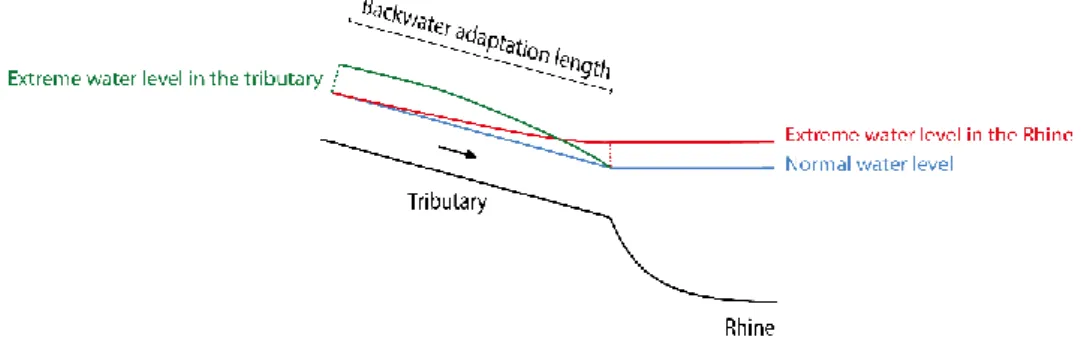
Backwater occurs when the water level is forced to be higher or lower than its equilibrium depth due to the downstream water level. In the case of an extreme discharge event, the water level in the tributaries can be higher than normal while the water level in the Rhine is unchanged, or the water level in the tributaries can be unchanged while the water level in the Rhine is higher. Both cases are visualized in figure 5.
Figure 5: backwater effect at the location where a tributary flows into the Rhine.
The red curve in the figure shows that the water level in the tributary needs to adapt to the higher water level in the Rhine (hence the term “adaptation length”), while the green curve shows that adaptation is needed due to the higher water level of the tributary while the Rhine has a “normal” water level. Since this backwater can cause flooding upstream of the tributary, each tributary should be at least included in the hydraulic model up to the point where the backwater effect ends. The equation which is used to calculate the backwater adaptation length is as follows:
𝐿 ≈ℎ𝑒
𝑖 (2.9)
ℎ𝑒= √( 𝑞𝑛 √𝑖)
6 10
(2.10)
In which:
𝐿 = backwater adaptation length [m] ℎ𝑒 = equilibrium depth [m]
𝑖 = slope [m·m-1]
𝑞 = discharge per unit width [m2·s-1]
𝑛 = Manning coefficient [s·m1/3]
BSc Thesis – Martijn Kriebel 10 Equation 2.9 is true for small values of the Froude number (Fr < 1, i.e. for subcritical flow). A flow is subcritical when its slope is lower than the critical slope 𝑖𝑐:
𝑖𝑐= 𝑔𝑛2
√ℎ
3 (2.11)
In which:
𝑖𝑐 = critical slope [m·m-1]
𝑔 = gravitational acceleration [m·s-2]
𝑛 = Manning coefficient [s·m1/3]
ℎ = water depth [m] (Ribberink & Hulscher, 2015)
Since the gravitational acceleration and the Manning coefficient in this equation are assumed to be constant (𝑔 = 9.81m·s-2 and 𝑛 = 0.05 s·m1/3), the critical slope can only be reached by varying the water depth, which is
calculated in table 1. These calculations result in the conclusion that all slopes are below the critical slope, meaning that all flows are subcritical and equation 2.9 can be used.
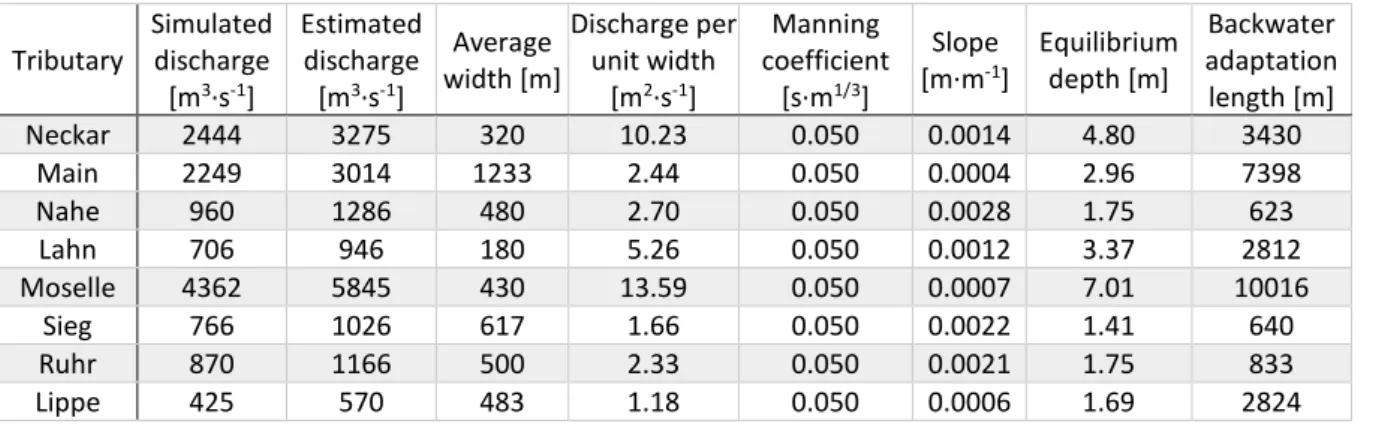
The values for the variables of equations 2.9 and 2.10 can be found in table 2, as well as the resulting backwater adaptation length. To determine the discharge per unit width, the discharge and width of the tributaries should be known for an extreme event. This discharge has been obtained by running the GRADE model with measured meteorological data from January 1st 1950 up to December 31st 2006, and selecting the highest number for each
tributary. This has been done separately for Lobith, which had a maximum value of 13461 m3/s. Since the
maximum plausible discharge at Lobith is estimated at 18000 m3/s (Hegnauer, Kwadijk, & Klijn, 2015), all
simulated tributary discharges have been multiplied with a factor of 18000/13461 = 1.34 to get the estimated discharges. Note that this is done under the assumption that the discharge in the Rhine is correlated with the discharges in the tributaries, giving an extreme discharge event. In reality, this this might not always be the case, since extreme precipitation in the Alps does not necessarily mean that there is also extreme precipitation in the downstream catchments.
The width is obtained by extracting three cross-sections from the DEM (one at the location of the simulated discharges and the other two equally spaced from that location down to where the tributary reaches the Rhine), and taking the average of the width of the river at these three cross-sections in the case of the extreme event. Furthermore, the same Manning coefficient has been used as for the Rhine (𝑛 = 0.05). Lastly, the average slopes of the tributaries have been determined using trendlines, as can be seen in appendix F. Again, note that these slopes are not the bottom slopes but the slopes of the water surface.
Tributary
Simulated discharge [m3·s-1]
Estimated discharge [m3·s-1]
Average width [m]
Discharge per unit width
[m2·s-1]
Manning coefficient
[s·m1/3]
Slope [m·m-1]
Equilibrium depth [m]
Backwater adaptation length [m]
Neckar 2444 3275 320 10.23 0.050 0.0014 4.80 3430
Main 2249 3014 1233 2.44 0.050 0.0004 2.96 7398
Nahe 960 1286 480 2.70 0.050 0.0028 1.75 623
Lahn 706 946 180 5.26 0.050 0.0012 3.37 2812
Moselle 4362 5845 430 13.59 0.050 0.0007 7.01 10016
Sieg 766 1026 617 1.66 0.050 0.0022 1.41 640
Ruhr 870 1166 500 2.33 0.050 0.0021 1.75 833
Lippe 425 570 483 1.18 0.050 0.0006 1.69 2824
Table 2: calculation of the tributary backwater adaptation length for each tributary.
Development of a 2D hydraulic model for the Rhine valley using open data 11 Overall, these backwater adaptation lengths just under or almost the same as the indicative floodplains which have been determined in section 3.1.1.
Backwater will not only occur at the tributaries, but also up- and downstream of the Middle Rhine. This is caused by the higher water level in the narrow valley. This will result in a so-called M1-type curve at the transition from Upper Rhine to the Middle Rhine (since the water depth will become higher than both the equilibrium depth and critical depth), and a M2-type curve at the transition from Middle Rhine to Lower Rhine (since the water depth will become lower than the equilibrium depth, but still higher than the critical depth) (Ribberink & Hulscher, 2015). These situations are visualized in figure 6. These backwater events do not require any calculations, since the model is assumed to be wide enough around the Rhine to include any flooding which is caused by this backwater.
Figure 6: visualization of the M1 and M2 backwater curves that will occur respectively just up- and downstream of the Middle Rhine.
3.1.3. FINAL MODEL EXTENT
By combining the findings of the previous two paragraphs a model domain can be defined. However, attention must also be paid to the one-dimensional SOBEK model of GRADE since the results of the 2D model should be compared to this model. The extent of the final domain is therefore a combination of the results from the floodplain and backwater calculations, and of the locations of the most suitable gauging stations from the SOBEK model. Preferably, gauging stations from the SOBEK model are chosen that are closest to the model domain border that is calculated.
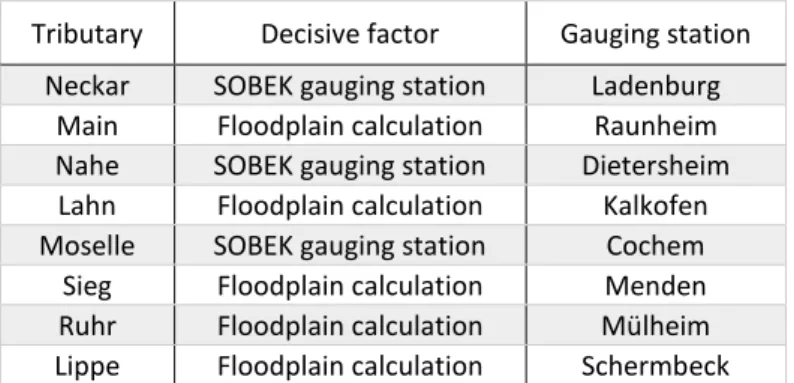
Table 3 lists the decisive factor for the chosen extent of each of the tributaries, together with the gauging station from SOBEK that is chosen for each tributary. These gauging stations are later used to extract discharge data from the SOBEK model. An overview of the final model extent is shown in appendix G. There are two cases regarding the chosen tributary extent:
1. A gauging station is located close to the calculated floodplain extent, but the floodplain calculation extents farther upstream the tributary. In this case, the floodplain calculation is the decisive factor. 2. A gauging station is located close to the calculated floodplain extent, but the station is located farther
upstream the tributary. In this case, the SOBEK gauging station is the decisive factor. An exception to this is the Lahn, since its domain extent is based on the floodplain calculation, while its gauging station is located farther upstream. This is done because it is improbable that water from a flood wave in the Rhine valley will flow this far upstream, and the SOBEK model does not contain a more suitable gauging station.
Note that the backwater calculations are not listed as decisive factors, because the backwater adaptation lengths never exceeded either the floodplain calculations or the distance to the chosen SOBEK gauging station.
BSc Thesis – Martijn Kriebel 12 boundary follows the eastern side of the higher lying grounds as can be seen in the DEM. The northern boundary of the domain starts at Arnhem and follows the southern side of the Veluwe up to Doesburg. From this point onwards it follows the valley of the Oude IJssel until Wesel (at the Lippe). Note that the Oude IJssel is also included in the domain. This river is chosen as a boundary since water that flows into its valley will be transported to the IJssel and consequently to the Ketelmeer and IJsselmeer.
Tributary Decisive factor Gauging station Neckar SOBEK gauging station Ladenburg
Main Floodplain calculation Raunheim Nahe SOBEK gauging station Dietersheim
Lahn Floodplain calculation Kalkofen Moselle SOBEK gauging station Cochem Sieg Floodplain calculation Menden Ruhr Floodplain calculation Mülheim Lippe Floodplain calculation Schermbeck Table 3: decisive factors that are used to determine the model extent for each tributary.
3.2. MODEL GEOMETRY
Delft3D FM uses a digital elevation model (in this case the SRTM DEM) to get geometric information of the terrain. It is one of the largest data sets which can be used as input in the hydraulic model, and is of importance for the model’s calculations. Before the SRTM DEM became publically available, a DEM was often created using airborne Light Detecting and Ranging (LiDAR) technology. This technology is accurate, but the data is very costly to collect. Another disadvantage is that LiDAR data is only available for certain areas, whereas the SRTM collected data of most parts of the world.
Schumann et al. (2008) compared both LiDAR and SRTM data sets, and concluded that, although the LiDAR DEM was more accurate, SRTM DEMs are precise enough to derive hydraulic information from it for large, homogenous floodplains. The 1-arc second SRTM data has been studied by Rodríguez et al. (2005), who found that there was an absolute height error of 6.2 meter at 90% probability for Eurasia. Ludwig and Schneider (2006) found that for more rugged, mountainous areas elevation errors in the SRTM DEM were more common and much higher, especially for places that were affected by radar shadow. Furthermore, the researchers conclude that the elevation error is strongly dependent on the incidence angle of the radar. The error is at its minimum for flat terrain, but as the incidence angle deviates more (in the case of e.g. steep slopes, mountains) the error gets larger.
These studies indicate that the SRTM DEM should not be implemented in the model without careful consideration. Therefore, the DEM has been examined and certain modifications have been carried out, which are discussed in this section.
3.2.1. DEM INTERPOLATION
The original SRTM DEM files that were downloaded and have been used during this study for processing in the GIS software were TIF raster images. However, Delft3D FM was not able to import this file format, meaning that the DEM had to be converted to the XYZ file format which the software could process. This file format stores Cartesian coordinates for each raster cell, and is created by converting each cell to a single point (located at the centre of the raster cell), and assigning the value of the raster cell to that point.
Development of a 2D hydraulic model for the Rhine valley using open data 13 the model does not use the original raster DEM, this modification makes sure that elevation changes occur gradually instead of abruptly, making the DEM more realistic.
Another modification which involves interpolation concerns the tributaries. These are all relatively narrow, which causes misrepresentation of the elevations of the tributaries in the DEM. As a consequence, the tributary elevation increases when going downstream in some cases, which is not realistic. To solve this, the elevation has been linearly interpolated between the model boundary at that tributary and the location where the tributary meets the Rhine. Note that none of the models include actual tributary bathymetry. Rather, smoothing of the DEM (i.e. the water surface) is carried out.
3.2.2. BATHYMETRY
Another modification that is carried out on the DEM is the incorporation of the bathymetry of the Rhine. Since the hydraulic model is initially a basic model, basic bathymetry is used. This means that the Rhine is assumed to be a rectangular channel that has a constant depth along its length. This bathymetry needs to be “burned” into the DEM, since it does not include elevations below the water surface. It is assumed that the channel depth is equal to the initial water depth in the Rhine (which is 3 meter, as described in chapter 3.4). This means that at the location of the main channel the DEM cells have been lowered by 3 meter. Note that this is an overestimation, since the mean water depth will, in reality, most likely not result in a completely filled channel. Also, since this channel depth is an average, it is an overestimation at some areas (mostly upstream) and an underestimation at other locations (mostly downstream).
The part of the Upper Rhine where the Great Alsace Canal is located is a special case. Here, most of the water is located in the Great Alsace canal, while the “actual” Rhine conveys less water (which is supported by the DEM, since values at this part of the Rhine are lower than in the Great Alsace canal). This is done so that the hydroelectric power stations at Kembs, Ottmarsheim, Fessenheim and Vogelgrün are provided with enough water (Becker, Schwanenberg, Hatz, & Schruff, 2012). However, satellite pictures show that there is still water located in the “actual” Rhine. Therefore, 3-meter-deep bathymetry is burnt at both locations. Note that this is most certainly an overestimation, and that this should be changed if more detailed information is obtained. Note that none of the models include tributary bathymetry, as mentioned in the previous section.
3.3. COMPUTATIONAL GRID
This methodology section describes the process of how the computational grid has been created. As explained in chapter 2 a hydraulic model solves continuity and mass equations. However, this cannot simply be done for the full model domain at once. Instead, the domain should be divided into several volume elements: computational cells (Loucks & van Beek, 2005). The model then solves the continuity and mass equations for each cell, resulting in detailed output. All the computational cells combined form the computational grid. Bates and De Roo (2000) studied the possible grid cell sizes as they propose a simple raster-based (2D) flood inundation model. As expected, smaller cells give the most accurate result in both studies. However, smaller grid cells have some drawbacks. One of those is that it increases the required computation time significantly. This corresponds to the findings of Werner (2000) on his DEM based 1D model.
BSc Thesis – Martijn Kriebel 14 should be made than the minimum that is required. The best grid cell size is therefore the one which balances accuracy and computation time best (i.e. the most optimal grid cell size).
Another characteristic that can influence the performance of a model, the shape of the computational cells. If, for example, a rectilinear grid would be laid over of the area of interest, troubles can arise at parts where the river is highly sinuous. If interpolation of cross-sections is needed to obtain the bathymetry at that location, the model would give wrong results since it assumes the river to be continually straight instead of sinuous (Merwade, Cook, & Coonrod, 2008). Of course, this can be solved in the Delft3D FM software by creating a curvilinear grid that follows the curves of the river. The creation and application of this grid together with other types are described in the following subsections.
3.3.1. MAIN CHANNEL AND FLOODPLAIN GRID
Two major parts of the computational grid can be distinguished: the main channel grid and the floodplain grid. This is easy to see since the main channel grid is curvilinear, while the floodplain grid is unstructured. Despite these differences, they form one integral grid because of the flexible mesh feature of Delft3D FM.
The main reason for a curvilinear grid at the Rhine is because it is computationally less intensive compared to an unstructured grid. A straight part of the river can easily be covered by one curvilinear cell, since it is unlikely that variables like water depth and velocity will change much there. When this part would be covered by unstructured cells, much more cells would be needed, thus increasing the required computation time.
For this study, two grids with different levels of detail have been created: a coarse and a fine grid. Both grids consist of a curvilinear grid for the Rhine with mainly four cells along the width of the river. Since the Rhine is roughly 140 meter wide at Basel and 400 meter at Lobith, this corresponds to cell widths of 35-100 meter. The difference between the two grids can be found in the length of the river cells. The river cells of the coarse grid are mostly 800–900 meter long, while the river cells of the fine grid are mostly 400-500 meter long. This means that the calculation method of the fine grid model corresponds most to the SOBEK model, since the 1D model has a distance of circa 550 meter in between cross-sections. This decrease in river cell length does not only make the curvilinear river grid finer, but also the floodplain grid. This is because the floodplain cells need to be attached to the river cells through their cell nodes, and the measurements of the triangles therefore depend on the length of the river cells. Figure 7 shows these two grids. In total, the coarse grid contains 83878 cells whereas the fine grid contains 124825 cells (49% more than the coarse grid). The results of the simulations with the two different grids can be found in chapter 4.
Development of a 2D hydraulic model for the Rhine valley using open data 15 3.3.2. TRIBUTARY GRID
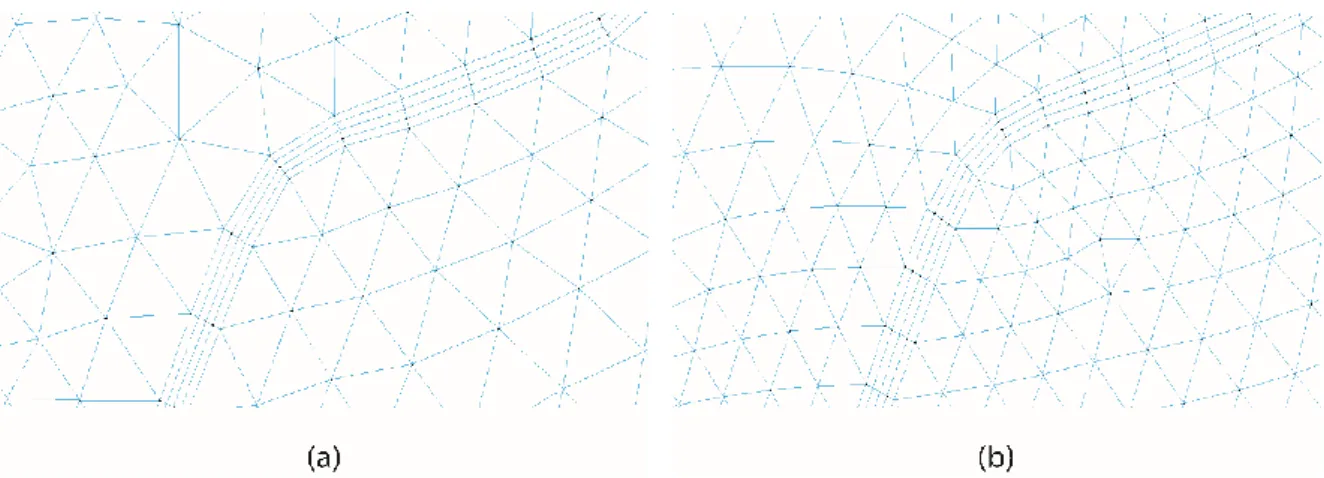
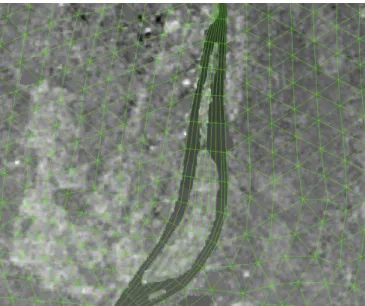
The tributaries of the Rhine are treated differently than the rest of the domain regarding the computational grid. One could argue that, since the tributaries are rivers like the Rhine, they can be covered by a curvilinear grid. However, these curvilinear cells should also be attached at the nodes to the unstructured floodplain grid in order to form one, integral grid. Combined with the sinuous nature of most of the tributaries, this poses a problem in the coarse grid. The curvilinear grid cells should be as long as the sides of the triangular unstructured floodplain cells, which makes it hard to follow the curves of the tributary (as is visualized in figure 8). This is a problem, since the nodes of the curvilinear river grid can fall on the floodplain, which can cause the software to calculate wrong cell elevations. Besides this, it results in bad orthogonality values, thus making a curvilinear grid unsuitable. It is for these reasons that no curvilinear grid has been applied to the tributaries in the coarse grid. Instead, the unstructured triangular grid is used. Note that this is why the sources of the discharges from the tributaries are located in the curvilinear channel grid of the Rhine, at the location where the tributary joins the Rhine.
However, in the fine grid these problems are of much less impact (since the unstructured grid cells are much smaller). Therefore, the three main tributaries (Neckar, Main and Moselle) have been covered by curvilinear cells in this grid, while the other tributaries have been covered by the unstructured grid. The latter is because the effect of a curvilinear grid at the other tributaries is expected to be negligible due to their much smaller discharge.
Figure 8: screenshot of the fine grid at the Lippe.
BSc Thesis – Martijn Kriebel 16 3.3.3. IRREGULARITIES
The Rhine contains some irregularities, especially in the Upper Rhine. One of the biggest irregularities is caused by the Grand Canal d’Alsace (Great Alsace Canal). This canal is 50 kilometer long and runs parallel to the Rhine, starting just downstream of Basel and ending at Breisach am Rhein (Germany). Because of this, a large island is formed which is bounded by the Rhine and the channel. Furthermore, significant islands can be found at:
- Marckolsheim
- Schoenau (the Réserve Naturelle de l’Île de Rhinau) - Schwanau
- Strasbourg (the Réserve Naturelle de l’Île du Rohrschollen) - Rheinau
- Iffezheim
- Between Mainz and Bingen am Rhein (This area contains multiple islands, and if therefore also called the Inselrhein, or “island Rhine”)
- Lorch (the Lorcher Werth)
- Niederwerth (including the Graswerth island) - Weißenthurm (the Weißenthurmer Werth)
Some of these islands are formed naturally, while others are river locks or hydroelectric power plants (note that the effect of the constructions themselves are not taken into account in the model).
The islands can be seen as separate floodplains. However, this would require a lot of small unstructured grids (which causes high smoothness values and requires more computation time). On the other hand, including them in the four cell wide curvilinear river grid could yield unrealistic bed level values, causing the model to have non-physical obstructions over the full width of the river. To solve this problem, the river grid has been modified at the islands so that it has between 7 and 23 cells along the width of the river (depending on the width of the island and the river). This way the islands are included in the calculations, while the elevation of both the river and the islands are still accurately determined. Figure 9 gives an example of this.
Development of a 2D hydraulic model for the Rhine valley using open data 17 3.3.4. GRID CHARACTERISTICS
Two important properties of the computational grid are the orthogonality and the smoothness. The orthogonality is defined as the cosine of the angle between a flowlink and a netlink. The smoothness is defined as the ratio of the areas of two adjacent cells (Deltares, 2016a). In an ideal situation the orthogonality is 0 (i.e. the angle between the flow- and netlink is 90°), while the smoothness is equal to 1. If a grid is orthogonal, computationally expensive transformation terms do not have to be executed, which saves computation time. Furthermore, a smooth grid minimizes the errors in the finite difference approximations (Deltares, 2016b). However, it is hard to create a perfect grid in reality. Therefore, an orthogonality of 0.01 or lower is also acceptable (Deltares, 2016a). Furthermore, experience shows that a smoothness of between 1-1.2 is sufficient (Anke Becker, personal communication, May 17, 2016).
The orthogonality and smoothness of both the coarse and fine grid are shown in appendices H, I, J and K. It is clear that the majority of the cells of all four pictures are dark blue. This means that most cells have an orthogonality between 0 and 0.042, and a smoothness between 1 and 2.350. Closer examination of the grid show that the majority of the cells has orthogonality and smoothness values that correspond to the advised values. Slightly higher values can be found where the grid of the river is attached to the grid of the floodplain. The higher orthogonality values can be explained by the curves of the rivers. Higher values for the smoothness at those locations occur because the triangular cells are almost always larger than the river cells. The legends of the figures show also much higher values. These cells are not immediately visible in the figures. They are all single cells which are simply positioned in an unfortunate way. The effects of these cells can be neglected compared to the total amount of cells.
3.3.5. FINAL GRID
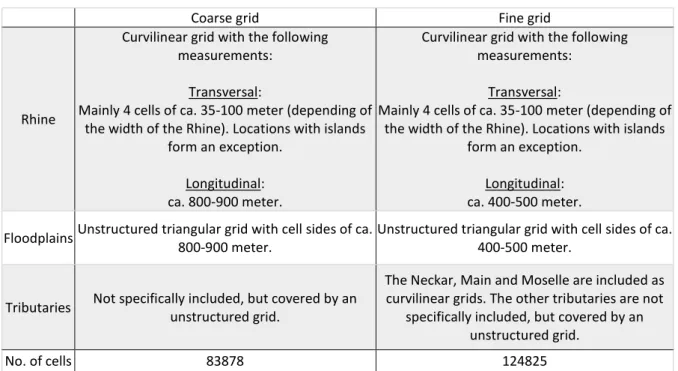
To sum up, two grid versions have been made: a coarse grid and a fine grid. The specifications of each grid are summarized in the table below.
Table 4: summary of the two computational grids that have been created.
Coarse grid Fine grid
Rhine
Curvilinear grid with the following measurements:
Transversal:
Mainly 4 cells of ca. 35-100 meter (depending of the width of the Rhine). Locations with islands
form an exception. Longitudinal: ca. 800-900 meter.
Curvilinear grid with the following measurements:
Transversal:
Mainly 4 cells of ca. 35-100 meter (depending of the width of the Rhine). Locations with islands
form an exception. Longitudinal: ca. 400-500 meter. Floodplains Unstructured triangular grid with cell sides of ca.
800-900 meter.
Unstructured triangular grid with cell sides of ca. 400-500 meter.
Tributaries Not specifically included, but covered by an unstructured grid.
The Neckar, Main and Moselle are included as curvilinear grids. The other tributaries are not
specifically included, but covered by an unstructured grid.
BSc Thesis – Martijn Kriebel 18 3.4. INITIAL CONDITIONS
Before a model can be run, initial conditions need to be specified which are used by the model as a starting point. These initial conditions are water surface elevation and flow velocity (Maddock, Harby, Kemp, & Wood, 2013). There are two possibilities for specifying these conditions: a cold start and a hot start. A cold start means that the conditions are simply estimated. When applying a hot start, these elevations are specified from either previous simulations or from measurements. The cold start method is the most common, since flood waves are mostly the results from the inflows that are specified in the hydrographs. If a sufficiently long warm-up time is being applied when using a cold start, the simulated flood wave will not have been influenced much by the initial conditions (Engineers Australia, 2012).
For the Rhine, the average water depths at its major gauging stations over a period of ten years have been collected and averaged. These average water depths can be found in appendix L. As a result, the initial water depth in the Rhine has been set to 3 meter. To get the initial water surface elevation one simply adds this value to the elevation of corresponding DEM cell in the main channel. As mentioned in chapter 3.2.2, the part of the Upper Rhine where the Great Alsace Canal is located is a special case. Here, all the water is assumed to be located in the Great Alsace canal, while the “actual” Rhine is assumed to be empty. Also note that the 3 meter channel depth is an overestimation at some areas (mostly upstream) and an underestimation at other locations (mostly downstream).
An initial condition that is used in the one-dimensional SOBEK model is initial discharge. This discharge is specified for each of the model’s branches, causing initial flow velocities. Although this is not possible in Delft3D FM, a so-called restart file can be used which makes it possible to use the flow velocities of a previously run simulation in a new simulation. This restart file also contains other variables like the initial water depth which is mentioned above. However, to make an accurate comparison between the SOBEK and Delft3D FM model, the same initial velocities should be used. The 1D model contains varying initial velocities since the initial discharges are varying from 1440-2300 m3/s. This varying flow velocity field is more difficult to create Delft3D FM, since it is not possible
to set an initial discharge for each computational cell (while in SOBEK one can specify one initial discharge per branch). In order to recreate the initial discharges of the 1D model as good as possible, initial flow velocities are obtained from the steady state results of a 2D model (to prevent a warm-up period from occurring) with a constant discharge of 1870 m3/s at Basel (i.e. the average of the initial discharges of the 1D model). The
simulation run with the 1870 m3/s discharge is an example of a cold start, while the other simulations that use
the restart files are examples of a hot start.
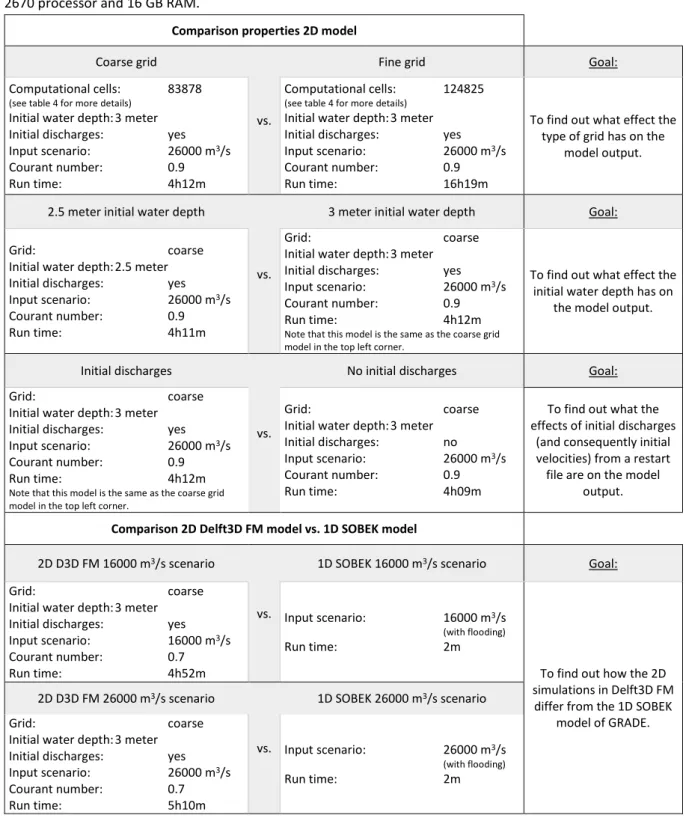
The initial conditions that are chosen can influence the results of the model. Loucks and Van Beek (2005) group this uncertainty under the “informational uncertainties” of a model. To get an idea of how much the model output is influenced by the initial conditions, models with and without initial discharges have been run. Furthermore, models with 3 meter initial water depth and 2.5 meter have been run to see if this has any effect on the output. The results of these simulations can be found in chapter 4.
3.5. BOUNDARY CONDITIONS
There are two types of boundary conditions that can be distinguished in the hydraulic model: an upstream boundary condition and a downstream boundary condition. The upstream boundary condition acts as the source of the water, while the downstream boundary condition acts as a sink, so that the water that reaches it can be removed from the model. This section describes both conditions that have been used for this study.
3.5.1. UPSTREAM BOUN DARY CONDITION
Development of a 2D hydraulic model for the Rhine valley using open data 19 should be run with the same input. Hegnauer et al. (2015) describe a genesis of flood waves in the Rhine basin that have been simulated in GRADE. The results of these cases are illustrated in figure 10. Note that the graphs are discharges that occur when flooding is included, while the values in the legend are the discharges that occur at Lobith when flooding is ignored.
The lowest flood wave is selected from the results of GRADE simulations under the assumption of current climate conditions, while the three highest flood waves are the results of GRADE simulations when assuming a climatic change according to the so-called KNMI’14 Wh scenario. This scenario assumes that the global temperature will
have increased by 2 °C in 2050 (relative to the period 1981-2010), and that the influence of changes in the air circulation pattern is high (Royal Netherlands Meteorological Institute, 2015).
Figure 10: genesis of maximum flood peaks between Basel and Lobith. The lines include flooding, while the reference discharges mentioned in the legend ignore flooding (Hegnauer, Kwadijk, & Klijn, 2015).
In chapter 4 the results of the 2D simulations that have used the 16000 m3/s and 26000 m3/s scenarios with
flooding are discussed. Despite the fact that these scenarios will not reach such discharges in the SOBEK model (due to the flooding), they are referred to as “16000 m3/s scenario” and “26000 m3/s scenario”. The time series
discharges that belong to these scenarios have been extracted from the SOBEK model for each of the discharge stations that are listed in table 3 plus Basel. This last station is not included in the SOBEK model, so the most upstream station (Maxau) is used. Since there are no tributaries between Basel and Maxau, it is assumed that these discharges are roughly the same and that therefore this decision is justified. Each scenario contains data for 112 consecutive days for each of the stations, which is used as input for the two-dimensional model. Note that for the fine grid the input discharges for the Neckar, Main and Moselle are inserted at the location of the gauging station inside their curvilinear grid, while the discharges for the other tributaries are inserted inside the curvilinear grid of the Rhine (at the location where the tributary flows into the Rhine). The latter is also true for all the tributaries of the coarse model.
3.5.2. DOWNSTREAM BO UNDARY CONDITION
BSc Thesis – Martijn Kriebel 20 Since the area that is modelled is sloping and mostly bounded on the sides by high-lying land, not many boundary conditions need to be specified. The exception to this is the downstream boundary at Nijmegen, Arnhem and Doesburg. This boundary can be divided in two types: the rivers (Waal, Nederrijn and IJssel) and the boundary that lies in between these rivers. The boundary condition type that is the easiest to use is a Q-h relation. However, these relations are only derived for these three rivers and not for the land that lies in between them. Therefore, the fixed water level boundary condition is chosen.
The fixed water level boundary condition essentially assumes that the water level at the boundary is always the same (a certain water level which is specified by the user). If a flood wave is travelling towards the boundary, the model will make sure that at the location of the boundary condition the discharge is removed from the model while keeping the water level at that point at the user specified water level. This can only be done by increasing the flow velocity, since the discharge is the product of the cross-sectional area (which is fixed) and the flow velocity. This process is illustrated in figure 11.
It is important to realize that this means that there will already be flooding during the first time step of the model in the area located near the boundary condition. This flooding can actually be seen as a special initial condition. This fixed water level should therefore be neither too high nor too low, since this will both yield unrealistic results in the area near the boundary condition.
Figure 11: schematization of the boundary condition. (a) boundary condition at t=0, resulting in initial flooding. (b) Boundary condition at t>0 with discharge from a flood wave. The model makes sure that the extra discharge is distributed so that the water level at the boundary
is conform the specified boundary condition, creating a backwater curve.
To determine the fixed water level that should be set, the profile of the terrain at the border has been examined. It turns out that the border can be divided into two parts, based on their elevation: the western boundary, starting just south of Nijmegen and ending just north of Arnhem (at the Veluwe), and the northern boundary, starting west of Doesburg (at the Veluwe) and ending just east of it where the Oude IJssel flows into the IJssel. The part from Doesburg up to the Lippe is a long boundary of the model, but since the Oude IJssel is included in the model domain (which directs any water that flows into its valley to Doesburg) there is no need for a boundary condition here.
The elevations of both boundaries are shown as graphs in appendix M, including the chosen fixed water level boundary conditions. For the western boundary condition a fixed water level of 9 meter above NAP has been chosen, while the fixed water level for the northern boundary condition is set to 10 meter above NAP. The average water depth at these boundaries can be seen as the equilibrium height. Using a slope of 0.00009 m·m-1
Development of a 2D hydraulic model for the Rhine valley using open data 21 3.6. NUMERICAL PROPERTIES
The last components of the model that need to be mentioned are the numerical properties of the model. These are discussed in this section because they affect the model’s output, since they influence the way the software processes the input data or the way it carries out its calculations. Hence, it is important to have a good overview of the model properties that have been used.
3.6.1. CONVEYANCE AND CELL ELEVATION
One of the numerical properties of the model is the way the software calculates the elevation of the cell. The approach that is used partly depends on the selected conveyance setting in Delft3D FM. This setting defines the way the software treats changes in bed elevation. There are two types: uniform bed representation and sloping bed representation, as visualized in figure 12. The leftmost and rightmost cells in the figure are not yet wet in the uniform bed representation, but are partly wet in the sloping bed representation. This gives a more accurate result, since this is more realistic (Deltares, 2016a).
Figure 12: (a) uniform bed representation (b) sloping bed representation (based on Deltares (2016a)).
By selecting this conveyance option, the software automatically chooses how it determines the elevation of each cell. For the cell centre elevation, the cell’s netnode with the lowest elevation is chosen, while for the netlinks a linearly varying elevation of one netnode to the other is used to enable the sloping bed representation (Deltares, 2016a).
3.6.2. COURANT NUMBER
The Courant number is a dimensionless quantity that is used in the so-called explicit upwind scheme for solving the partial differential equation of the advection problem (Roos, 2015). The Courant number is given by the following equation:
𝐶 = 𝛾∆𝑡
∆𝑥 (2.12)
In which γ is the advection velocity (in m·s-1). The Courant number can be used as an indicator of the stability of
a model. Using the Courant-Friedrichs-Lewy condition, one can state that a model is stable if C < 1, and unstable if C > 1 (Roos, 2015). Since a stable model is required, the Courant number should be kept below 1.
Small grid cells make a model’s results spatially more accurate. However, since this means that Δx is low, it will increase the Courant number. Since the maximum Courant number needs to be respected, the time step Δt can be decreased to still result in a stable simulation. The downside is that this results in high computation times. One could choose to increase the maximum Courant number to prevent this from happening, but this option is limited since it should be lower than 1. In the end, there will always be a trade-off between the level of detail of the grid and the time steps, and the required computation time.
The default setting in Delft3D FM is Cmax = 0.7. This has been increased to 0.9 for most of the models, to prevent