Reverse supply chain performance in
the online free return environment
L.V. Koers*, S1735535
University of Twente,
P.O. Box 217,
7500 AE Enschede,
The Netherlands
*corresponding author [email protected]
ABSTRACT: Online retailers offer free shipping and/or returns to bind customers to them.
When a customer decides to return a product, the reverse supply chain comes into play. The
increasing stream of returns does not only influence companies internally, but also externally,
namely the supply chain partners. Free return policies can help to maximize profitability, that
is why those policies should not be abandoned, but optimized. The purpose of this research
is to give an indication of the change in workload throughout the supply chain. Supply chain
specialists of the biggest online retailers operating in the Netherlands were asked to assess
the amount of returns that pass each of their reverse supply chain partners. Logically, the
online retailer has the highest increase in workload, followed up by the transport services
and drop-off points. Increasing streams of returned goods make it hard for online retailers to
check everything in-house. An upcoming market therefore, is to become an outsourced (or
sometimes, in-house) partner for checking and repairing returned goods.
Key words: Online retailer, free returns, returned products, reverse supply chain, supply
chain partners
Graduation Committee member(s): Dr. M. de Visser
Dr. M.L. Ehrenhard
Permission to make digital or hard copies of all or part of this work for personal or classroom use is granted without fee provided that copies are not made or distributed for profit or commercial advantage and that copies bear this notice and the full citation on the first page. To copy otherwise or republish, to post on servers or to redistribute to lists, requires prior specific permission and/or a fee.
11thIBA Bachelor Thesis Conference, July 10th, 2018. Enschede, The Netherlands.
1
INTRODUCTION
For almost a decade now both product prolifera-tion and customer demands have been increasing (Mendelson and Parlakt ¨urk, 2008). More goods are offered via online platforms, and more people order online. Free delivery and returns are offered as a marketing tool for customer experience optimization (Brill, J. 2015). Lenient return policies can increase the amount of goods ordered by customers (Janaki-raman, Syrdal and Freling, 2015) but inevitably increase the amount of goods that are sent back, which can be costly. Those returned goods go through a ’reverse supply chain’. They need to be announced by the customer (possibly brought to a pick-up point), picked up by a transportation service and checked by the online retailer before they can go back into stock, if they even make it this far into the process. Part of the returns can not get back into stock because of certain damage like stains, fabric damage or smell. Some products go even further back into the reverse supply chain, to suppliers or producers. Free return policies undoubtedly cause extra work for supply chain partners, but who are they, what exactly do they do and what percentage of returns pass each partner? Those are all subques-tions to help us answer the research question:
What is the impact of free return policies offered by online retailers, operating in the Netherlands, on the workload of reverse supply chain partners?
It is important to know what the reverse supply chain of an online retailer looks like in order for them to prepare and enter into the right relationships with supply chain partners. Next to this, it is also important to look at the workload of each supply chain partner, caused by returns, to make sure enough effort is put in the relationships. Smooth functioning of the whole reverse supply chain helps to optimize the return pro-cess and service offered to the customer.
2
LITERATURE REVIEW
Returns always start at the customer. In this sec-tion we look for reasons why people return; and if returns cause extra work, why do online retailers not just eliminate them at all? Then we are going to take a look at the reasons why people return products and in the second part we discuss why online retailers would offer free returns and what theoretically speak-ing, are the advantages and disadvantages.
2.1
RETURN REASONS
In 2017 about 75% of the online customers claims to have returned products, an increase of 7% in com-parison to 2016 (Ivory and Barker, 2017). This in-crease in returns has inin-creased over the last few years, partially caused by an increase of free return policies offered.
The main reason for product return is because there is a lack of information, this is twofold according to Ram (2016). Intentional returns are made when the customer orders multiple comparable products with the intention to send back a part of the order. The other option is unintentional returns, which are caused by a difference between expectation and re-ality that can’t be discovered by seeing the product online. The actual product differs from the website or catalog, for example size, color or touch don’t meet up to expectations. This lack of information is the main reason that the percentage of online returns is higher than offline returns (Su, 2009). The high-est percentages of returns are in the fashion sector, with an average of 25%, followed up by consumer electronics ranging from 11 to 20% (Ardeshirilajimi & Azadivar, 2015) and sports and health and beauty products on a shared third place, with an average of 15% each (Ram, 2016), making multi-category online retailers an interesting subject.
Secondly, products are being returned because at the time of arrival, the product is no longer wanted or needed. This is often the case for online retailers with longer lead-times, the customer has time to change his/her mind or buy a substitute product. When free shipping and return is offered, people tend to make impulse purchases, regretting it afterwards.
Thirdly, the fault can be at the retailer, when the wrong product or size is shipped. Especially in those cases, when the product is not returned because of personal taste, customers must be given the oppor-tunity to return the product for free. In a research done by Hamilton (2015), it is stated that 54% of cus-tomers return products because they have received an incorrect item.
Fourthly, the product can be defective, meaning that it’s broken or damaged and therefore the cus-tomer does not want to keep it. This is only the case in about 5% of returns (Kumar & Petersen 2010).
2.2
ADVANTAGES OF OFFERING FREE
RETURNS
Offering free returns has some advantages and disadvantages, we will first discuss the biggest ad-vantages.
Firstly, lenient return policies help online retailers to gain a competitive advantage. Competition between online retailers is increasing, mainly because of low entry barriers for the online retail industry i.e. rela-tively low set-up costs for websites and shopping ap-plications. Next to this, search and switching costs for customers have decreased, meaning that online retailers now have to offer more (also in the long-tail and customized sections) to stand out from the rest and win the customer. A way to gain this com-petitive advantage is through using reverse logistics services as a strategic weapon (Chattarjee & Kumar, 2011). That is why some players offer free shipping and returns as an extra service. About 80% of online buyers deems free return policies a must, if they are not in place, they won’t order (Ivory & Barker, 2017). When free return policies are correctly implemented and marketed, it can lead to higher profitability by increasing customer loyalty and differentiation from competition (Johansson, 2017).
Secondly, handling loose return policies can per-suade customers into ordering more at once and more frequently, it removes the barrier to order (Frel-ing, Janakiraman & Syrdal, 2015). Free returns have a big influence on customer loyalty, customers tend to come back to retailers that handle returns with less hassle. Some researches show that offering free re-turns has been too generous and failed to optimize supply chain performance (Su, 2009), which is true on the short-term, but in the current market, leniency of return policies can help maximize profitability on the long term (Minnema, 2017; Kumar & Petersen, 2009). ”A moderate degree of product returns by a customer could not only lead to greater future pur-chases but also maximize profits” (Kumar & Petersen, 2010). The distribution centers and forward supply chain of the online retailer must be ready for an in-crease in goods sold and therefore an inin-crease of stock. The spending after free returns was 158% to 457% higher than prereturn, whereas the spending after paid returns decreased by 75 to 100% (Bower & Maxham, 2012). Increased customer loyalty is a competitive advantage that leads to a stable online selling platform, increasing survival chances.
Thirdly, offering free returns signals confidence to the customers. ”Return policies are a signal to the customer of convenience and an assurance of qual-ity” (Bryant, Richey & Skinner 2008). You guarantee a good product and if the customer does not agree there is no problem with returning it. The perceived risk of the customer decreases and this helps to per-suade the customer to order.
2.3
DISADVANTAGES
OF
OFFERING
FREE RETURNS
Disadvantages to offering free returns are numer-ous and often costly, but do not necessarily have a bigger impact than the advantages, if handled well.
Firstly, because returns are free, returns increase, especially in the fashion sector. Normally, returns for high fashion apparel lie around 35% and return percentages are typically higher for Internet sales (Guide, Souza, Van Wassenhove & Blackburn, 2006; Bernon, Cullen & Gorst, 2015). The online retailer must make sure that it is prepared for an increase in returns and have proper policies in place on how to handle those returns. Returns are time consuming, passing a lot of steps on their way back: they have to be returned to the distribution center, checked and if necessary repacked and put back into the warehouse (Ram, 2016). Agreements with supply chain partners must be made, making the reverse flow of goods as smooth as possible.
Secondly, free returns cause a higher number of orders, meaning the online retailer has to keep a higher number of products in stock, often unaware of the number of returns. This increasing the risk that the online retailer bears and also increases the costs of warehousing.
Thirdly, the online retailer bears a risk of product value loss, especially for fashion products, that lose value faster than other products. Some products can still be returned after a long period, depending on the return policies, and sometimes this means that the product is out of fashion and the online retailer can’t put it back in stock and has to bear the loss of value of the product as well. Consumer moral haz-ard (consumers abusing return policies), for example wardrobing, should also be taken into account when regarding product value loss (Che, 1996). Fourthly, research done by Brylla and Walsh (2016) shows that product returns negatively affect customer satisfac-tion and word-of-mouth advertising for the online re-tailers, but it is not clear if returns were free in this case. Offering free returns as a service (instead of paid returns) could increase customer satisfaction. Next to this, the research focuses on the short-term only, whereas other researchers, like Kumar & Pe-tersen (2009 & 2010) have shown that long term ef-fects of free return policies can maximize profitability.
3
THE (REVERSE) SUPPLY CHAIN
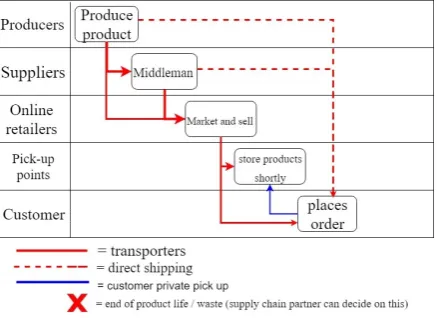
[image:4.595.62.281.204.363.2]”A supply chain consists of all parties involved, di-rectly or indidi-rectly, in fulfilling a customer request” (Chopra and Meindl, 2009, p.13). In a forward sup-ply chain, there are often six supsup-ply chain partners (See figure 1), starting with the producer, suppliers, the online retailer, transportation, pick-up points and the customer, but this can deviate from company to company.
Fig. 1: The forward supply chain
Producers are in this case solely producing prod-ucts and use the online retailer as a platform for sales, they do not sell to individuals. Suppliers also offer their products on the online retailers’ platform, but they differ from producers in two ways. First, sup-pliers can offer their products to individuals through their own online or offline platform, but don’t have such a big customer pool as the online retailers. Sec-ond, suppliers don’t make the product themselves, they often have the knowledge and ability to fix or as-semble products themselves but do not manufacture them. The online retailer offers its platform to market goods, its distribution centers to store them and of-ten have transportation services at hand for the most efficient shipping towards the customer. Producers and suppliers pay fees for storage and handling of the goods. Pick-up points (or in the reverse supply chain, drop-off points) are third parties like super-markets, gas stations and other central points where products can be stalled, waiting to be picked up by the customer, or in case of the reverse supply chain, by transport service to go back to a distribution cen-ter.
Although reverse supply chain is a relatively new term, it has been around just as long as the original (forward) supply chain. When a customer decides to return products, that is where the reverse supply chain comes into play. Reverse supply chain starts when the resource goes at least one step back in the supply chain (Chattarjee & Kumar, 2011). It is impor-tant to know the path that returned products take on
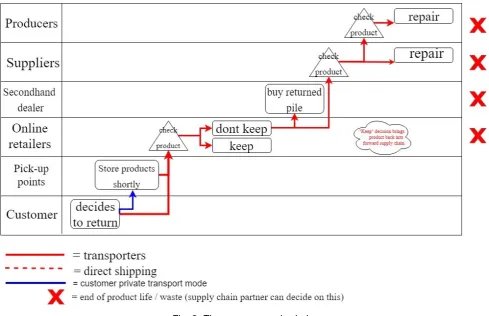
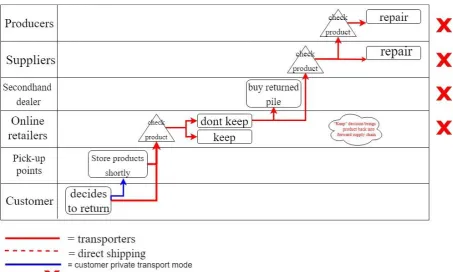
their way back, and the work that each supply chain partner performs, in order to optimize this backward loop or minimize the costs and time that come with the increasing number of returns. A well planned out supply chain of the online retailer, including clear contracts on return policies, can be beneficial to all partners. A reverse supply chain consists mainly of the same partners as the ’forward’ supply chain, but often adds an extra partner, the secondhand dealer (See figure 2).
The secondhand dealer buys the pile of returned goods that could not directly be returned into the stock of the online retailer. As you can see in figure 2, the X indicates the end of a product’s life, mean-ing that the product will be destroyed. The increas-ing amount of returns ask for a high-performance re-verse supply chain and engaged supply chain part-ners, to make sure this stock does not pile up and becomes unusable. Since free returns are becoming the standard, there should be more attention given on the effect that this stream has throughout the sup-ply chain. When there are more returns than a com-pany can handle, or when it’s expensive to check re-turned goods, companies sometimes decide to have the product destroyed, rather than making sure it finds its way back to the forward supply chain.
The objective of a supply chain is to maximize over-all value. In the forward supply chain this means cooperative coordination of partners which will lead to higher customer value of the good/service. The higher the integration, the easier it will be for the cus-tomer to receive and/or return a product. Integration of supply chain partners can also help in the reversed supply chain. ”Emphasis needs to be placed on re-lationship management in order to deal with the un-certainty, dynamic market structures and total infor-mation visibility that the environment brings” (Davis, Golicici, McCarthy & Mentzer, 2002). The better the integration of the partners (through increased com-munication and joint planning) the lower the loss of product value on the way back through the supply chain. In this paper, we focus on the effect of free return policies offered by the online retailer on the rest of the supply chain partners. The reverse sup-ply chain has a bit more complex structure than the forward one, pushing online retailers into the role of conductor. Not only will they need to control the cus-tomer relationship, but also numerous supply chain interactions in a web of suppliers, partners and cus-tomers (Chaturvedi, Martich, Ruwadi & Ulker).
4
METHODOLOGY
In this research we are trying to answer the ques-tion:
Fig. 2: The reverse supply chain
workload of reverse supply chain partners?”
We have already looked at two sub-questions, namely, the reasons why customers return and the reasons why online retailers offer free return policies (both advantages and disadvantages), using books, literature from the University of Twente online library, Scopus, Elsevier, websites from online retailers, daily paper and non-academic trade magazines and web-sites (like LogistiekProfs.nl). For the academic pa-pers, keywords searched for are among others: re-verse supply chain, rere-verse logistics, rere-verse loop, closed loop, free returns, supply chain partners or a mixture of those. Using this information, a forward supply chain and reverse supply chain model have been set up.
We assume that our model of supply chain part-ners is generalizable with the biggest online retailers, while keeping in mind that there might be individual differences per company, for instance additional part-ners or shorter lines to the customer through specific contracts. We also assume that offering free returns increased the amount of returns, and that the com-panies in question have found a way to sufficiently handle this stream of returns (i.e. set up of supply chain is stable and company is able to handle returns in a sufficient way).
Keep in mind that the reverse supply chain is a se-ries of activities required to retrieve a used product from customers and either dispose of it or reuse it
(Guide & Van Wassenhove, 2002). There is a differ-ence between ”end of life reverse supply chain” which is post-consumption, and the reverse supply chain for returns within 90 days, which is pre-consumption. In this research, we focus on the latter and most litera-ture used is concerned with the pconsumption re-verse supply chain.
Questionnaires were needed because this informa-tion can’t be found online. They were sent by mail or via LinkedIn. Personal meetings were not considered mainly to prevent rejection of managers regarding a time constraint. The main goal of the research was to get a deeper understanding of the companies re-verse supply chain and the relationship between sup-ply chain partners and the online retailers.
The questionnaire consisted out of three distinctive parts. Which we will shortly discuss.
First, those surveyed were asked to describe the forward and reverse supply chain of their company, in comparison with general models for both (See figure 1 and 2). This question is necessary to make sure all supply chain partners were mentioned in the general model and to reassure the person surveyed knows what is meant with the reverse supply chain concept. The second part of the questionnaire is about the different supply chain partners, divided over seven sub-questions in which we made sure to get a deeper understanding of the function of each partner.
Lastly, we asked the supply chain specialists to in-dicate what percentage of returns pass each supply chain partner. This last question is an important sig-nal for the amount of work that each partner has, caused by free returns of the online retailer. With the results of this question we plan to make boxplots to display the median of percentages for each supply chain partner. Using boxplots, it will be easy to see the spread of workload per supply chain partner and possible outliers. When it is clear what percentage of work goes to which partner, the online retailer can focus on which relationships are more important to improve.
It is important for online retailers to know the work free returns impose on themselves and supply chain partners in order to decide how much effort to put into each relationship. Only when the reverse sup-ply chain functions smoothly, the return process and service offered to the customer can be optimized. An optimized return process can increase customer loy-alty and therefore profitability.
Potential limitations to the research could be low response rate or incomplete questionnaires, another possibility is that the supply chain specialist is part of a team and does not have complete answers to the questions asked or is not allowed to share all infor-mation asked for. Therefore, the opportunity to hand in the questionnaire anonymously was given.
5
THE MODEL
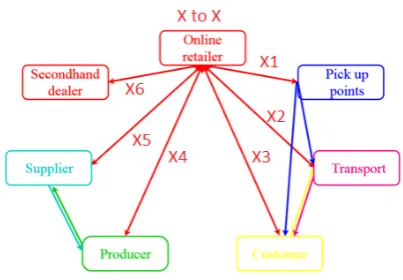
To answer the research question, the following framework was set up. It shows the relationships be-tween the online retailers and its supply chain part-ners as X-1,2,3,4,5 and 6 (see figure 3).
[image:6.595.325.527.78.218.2]The model also shows the relationship between
Fig. 3: Relationship model reverse supply chain part-ners
some other supply chain partners that might be influ-enced by the increased returns caused by free return policies, like supplier and producers or closer links between customer and transport services.
The model breaks down the general reverse supply chain into a heptagon with seven different partners. Every line represents a certain relationship; red lines are relationships between online retailer and partners involved in their supply chain. The other lines are re-lationships that can also occur in the reverse supply chain and are possibly affected by free return poli-cies. What we want to achieve using this model is to establish the percentage of returned goods that flow from the customer to all the supply chain partners.
6
RESULTS
integrated deeper into their system.
The first striking result is that the estimation of re-turns in theory is different than in practice. In theory, fashion retailers get 25% of their products back, and electronic retailers somewhere between 11 and 20% (Ardeshirilajimi & Azadivar, 2015). The indication of returns given by supply chain specialists of fashion and multi category online retailers were on average around 6%, with outliers around 60%. For electron-ics this estimation was around 6%. Reasons for the difference in percentages from theory and practice could be that in the past three years, theory should have been revised because of an increased focus on reverse supply chain management that drastically re-duced this number. Another, more feasible reason could be that supply chain specialists are not com-pletely aware of the number of returns. There is cer-tainly room for improvement here. Not being aware of the stream of returns is a potential danger and should therefore be closely monitored. Not handling returns well, through either a stagnating supply chain or in-ternal problems with returns can directly influence the customers return experience and his/her loyalty.
Now, we will discuss the impact on the supply chain partners, beginning at the customer, where the reverse supply chain starts, all the way through the drop-off points, transport services and secondhand dealer to the suppliers and producers.
Firstly, the relationship between the online retailer and the customer (X1). The reverse supply chain starts when the customer decides to return the prod-uct. Returns are the highest in online fashion (es-pecially for women) and electronics. When free re-turns are offered, customers tend to order more and more often. Through free return policies, service is increased, taking a certain workload of off customers. On the other hand, customers are often asked to in-tegrate deeper into the supply chain, for example by giving reasons for returns or some other type of feed-back. The most popular way of returns is through use of a drop-off point, in which customers takeover part of the role of transporter by bringing back the prod-uct to a drop-off point (or brick-and-mortar store from retailer). The deeper the integration of the customer, the higher his/her workload for the online retailer, but the higher the personalized service.
Secondly, the pick-up points, or in the reverse sup-ply chain rather drop-off points; which are oftentimes PostNL, DHL, DPD or UPS service points, are impor-tant (X2). For the former, because of the increased number of returns (increased workload, but not very labor intensive), those points will have a higher num-ber of visitors picking up packages. Monetary re-wards for drop-off points can be direct, getting a fee per package handled, or indirect, the monetary re-wards of the increased clientle. On average, more than 50% of returned products are sent back via
obliged to do so (Grandiek, Laak, Stouwe, Wokke 2018). Online retailers must also consider the impact free return policies have throughout the supply chain, and how it will change their relationships with supply chain partners. Free returns mean increased com-munication and deeper integration with supply chain partners. Before offering free return policies, the on-line retailer must be sure that partners are aware. Fifthly, the secondhand dealers, whose workload is determined by the stream of rejected goods (X6). Some online retailers put products aside when check-ing or repaircheck-ing takes too much time, and occasion-ally, the dealer comes to pick up all those products for a reduced price, even if the products only need small adjustments to be as good as new. On aver-age, 12% of returns is sold to secondhand dealers, with outliers up to 60%. The reason this number is so divergent is because of the different companies’ in-tentions. Some companies put aside all returns that can’t go back into stock directly and sell it to second-hand dealers simply because it is not profitable to put in much effort. Other online retailers offer returned products on their platform, describing in detail why it has been returned and giving an appropriate dis-count. Next to this, some companies mention that they work with a third party for checking and repair-ing returned products, which is a growrepair-ing business with the amount of returned goods. We will discuss this type of business in the last section ’other supply chain partners’. Sixthly, the combination of suppliers and producers (X4 and X5), because they both have the purpose of selling their goods and increasing their span to reach customers via the online retailers’ plat-form. Again, the number of products sent back to ei-ther supplier or producer is very divergent, from very low averages (0 to 5%) up to 55% in outliers, depend-ing on the contract made and value of the product. Producers that sell via online retailers must handle returns or perform reparations when the online re-tailer is not capable of doing so, especially in elec-tronics this is often the case (Groothuis & Welsem, 2012). Sometimes, it is cheaper to send a new prod-uct instead of shipping it back to producer/supplier, repair it (if possible) and return it to the online cus-tomer. In this business to business relationship it is difficult to forecast exact demand. Lower sales than projected cause a return to supplier/producer (buy-back clauses). Although buy-(buy-back clauses help align the interests of both parties (production and forecast of goods sold is equal) (Su, 2009), it shifts the risk to suppliers or producers, which can harm the rela-tionship. Higher sales than projected lead to a loss in profitability for both supplier/producer and online re-tailer. Next to this, the relationship might be harmed because the online retailer deals with a loss in good-will. The better suppliers and producers are inte-grated, the smoother the supply chain will function. This integration can be measured through
informa-tion exchange, trust, joint partnership management, partnership specific assets and partner asymmetry (Sodhi & Son, 2009). Also, they can easily get feed-back on their products using the online retailers’ plat-form, making it easier to improve their goods and/or services. Lastly, some online retailers have extended their reverse supply chain with specific partners. For electronics, it is common to work with third parties that manage all returns and repairs, think about data wiping specialists or specific repair services. Fash-ion or multi-category online retailers often deal with third parties to handle all returns for them. Also, when companies decide that it is not profitable to check or repair certain products, another partner comes into play. Products are than either sold to a secondhand dealer or picked up by another party to be destroyed. As mentioned by one supply chain specialist ”Some-times the cost of sending goods back outweigh the value of the product, so we destroy the goods and get compensated by the supplier/producer”. Although this sounds cruel, and like a major way of money loss, it is often the case. This ”supply chain scandal” as Frontal21 (Amazon destroys massive quantities. 2018) calls it, is actively debated in Germany. Ama-zon was found to be one of the biggest destroyers in the country, even getting paid by other retailers to destroy goods. In conclusion, the online retailer has the highest increase of workload but has the oppor-tunity to outsource the extra work that comes with re-turns relatively easy. The top three of most impacted supply chain partners (excluding the online retailer itself) is as follows. First, the workload of the trans-port services is the highest. In more than 50% of the cases they carry returned goods back to the dis-tribution center of online retailers. In second place, the drop-off points. They dedicate an extra service of taking in and storing packages, also in more than 50% of the cases. The reason why this partner is in second place, with the same percentage of increase in workload, is because their job is less time consum-ing. In third place, the secondhand dealer, which job is dedicated to returned goods that don’t go back into the online retailers forward supply chain. This per-centage is not as high as for the other two partners, around 20% on average.
7
DISCUSSION
7.1
Optimal Number of Returns
re-ferrals and in the profit they yield for the company.” Returns can be brought to the most optimal num-ber. For online retailers to decrease their current amount of returns, it is important to give customers a clearer, realistic view of their products, in order to avoid disappointments. In fashion, this would mean accurate pictures and size guides. In electronics, this means correct description of function, size and fea-tures. Research by Janakiraman et al. (2016) shows that longer time to return decreases the amount of returns, because people get attached to the prod-uct. Albrecht, Hofacker, Kunz and Walsh (2016) have found that the reputation of online retailers is a pow-erful tool to reduce product return rates. Benlian, Hinz and Zhou (2017) found that ”a well-considered package design, including colorful packaging and ex-tra gifts, significantly lowers consumers’ intentions to return”. These are a few possibilities for companies to lower the amount of returns. Some online retail-ers dedicate an internal department to check, repair and/or repack returned goods, where others make the decision to outsource, because it is too time con-suming and therefore not profitable. The percentage of goods sent to ’other supply chain partners’ that can help to restore a part of the value lost in the return process is low, but can become increasingly popular over the following years. This handling of returned goods is a growing market. Companies in this mar-ket try to increase the residual value of the goods up to 75% of the new value. This is profitable be-cause some online retailers sell returns to second-hand dealers for prices as low as 15% of the new value (Ouwerkerk, 2018). It is important to make the process of checking returns more efficient, for exam-ple by automating the checking of returns (Retour-plaza lanceert SaaS, 2018). Some online retailers have picked up the idea of selling secondhand or rather second chance products on their platform for a reduced price, often found in a subsection, clearly describing the state of the product. Altogether, it is important for online retailers to have a close look at their own reverse supply chain and the amount of re-turns. As mentioned before, there are multiple tactics to reduce returns, mainly giving the customer a most realistic view of the product online. From practice it seems like most supply chain specialists of online re-tailers know their reverse supply chain, but are not specifically focused on the number and the amount of returns. When free returns are offered, it is impor-tant to make sure that the return value of products is as high as possible. Supply chain partners are a means of safeguarding this value. One trend that is seen in the online retail section with free returns is the need to bring back returned products into the for-ward supply chain. Specialist third parties help the online retailer to repair and value the product, to sell them on a ’second-hand’ section on the online retail-ers’ platform later on.
7.2
Further research
REFERENCES
1. Albrecht, A., Hofacker, F., Kunz, W. & Walsh, G. (2016). Relationship between online retailers reputa-tion and product returns. British journal of manage-ment, 27, 3-20. https://doi.org/10.1111/1467-8551.12120
2. Amazon destroys massive quantities of returned and as-new goods (2018). ZDF-magazin ”frontal 21”. https://presseportal. zdf.de/pressemitteilung/mitteilung/zdf- magazin-frontal-21-amazon-destroys-massi\-quantities-of-returned-and-as-new-goods/
3. Ardeshirilajimi, A., Azadivar, F. (2015). Re-verse supply chain plan for remanufacturing com-mercial returns. The International journal of ad-vanced manufacturing technology, 77(9-12),1767-1779. https://doi-org/10.1007/s00170-014-6509-9
4. Barker, S., Ivory, A. (2017). Retail funda-mentals. UPS Pulse of the Online Shopper, 5, 1-17. https://solutions.ups.com/rs/935-KKE- 240/images/UPS-Pulse-of-the-Online-Shopper-2017-Volume-5_Retail_Fundamentals.pdf
5. Benlian, A., Hinz, O., Zhou, W. (2017). The impact of the package opening process on prod-uct returns. Springer International publishing, 1-30. https://doi.org/10.1007/s40685-017-0055-x
6. Blackburn, J., Guide, D., Souza, G., & Van Wassenhove, L. (2006). Time Value of Commercial Product Returns. Management Science 52(8), 1200-1214.https://doi.org/10.1287/mnsc.1060.0522
7. Bower, A., Maxham, G. (2012). Return shipping policies of online retailers: Normative assumptions and the long-term consequences of fee and free re-turns. American marketing association, 76(5), 110-124.https://doi.org/10.1509/jm.10.0419
8. Brill, J. (2015). Rethinking Online Returns: Comparing the Return Policies and Processes of Top Online Retailers to Shopper Preferences. UPS ex-ecutive summary, 1-8. https://solvers.ups.com/ assets/UPS_ReturnsExecutiveSummary.pdf
9. Bryant, P., Richey, R. & Skinner, L. (2008). Examining the impact of reverse logistics disposi-tion strategies. Internadisposi-tional Journal of Physical Dis-tribution & Logistics Management, 38(7), 518-539.
https://doi.org/10.1108/09600030810900932
10. Brylla, D., Walsh, G. (2016). Do product re-turns hurt relational outcomes? Some evidence from online retailing. Electron Markets 27(4), 329-339.
https://doi.org/10.1007/s12525-016-0240-3
11. Chattarjee, A., Kumar, N. (2011). Reverse supply chain: completing the supply chain loop. Cognizant 20-20 Insights.https://www.cognizant. com/whitepapers/reverse-supply-chain.pdf
12. Chaturvedi, N., Martic, M., Ruwadi, B., Ulker, N. (2011). The future of retail sup-ply chains. McKinsey & Company Operations Report.
https://www.mckinsey.com/business-functions/operations/our-insights
13. Che, Y. (1996). Customer return policies for ex-perience goods. The Journal of industrial economics 44(1), 17-23. http://www.columbia.edu/~yc2271/ files/papers/return.pdf
14. Chopra, S., Meindl, P. (2016). Supply chain management: strategy, planning and operation. Eng-land: Pearson.
15. Davis, D., Golicic, S., McCarthy, T., Mentzer, J. (2002). The impact of e-commerce on supply chain relationships. International journal of physical dis-tribution & logistics management, 32(10), 851-871.
https://doi.org/10.1108/09600030210455447
16. D ¨uren, K. (2014). Nederlanders maken zich amper schuldig aan Wardrobing. https: //www.nu.nl/lifestyle/3907955/nederlanders-maken-zich-amper-schuldig-wardrobing.html
17. Freling, R., Janakiraman, N., & Syrdal, H. (2015). The effect of return policy leniency on consumer purchase and return decisions: A Meta-analytic review. Journal of retailing, 92(2), 226-235.
https://doi.org/10.1016/j.jretai.2015.11.002
18. Grandiek, D., Laak, van de R., Stouwe, van de S., Wokke, T. (2018). Juridisch advies / recht van retour / herroepingsrecht. ICTrecht advies-bureau. https://ictrecht.nl/juridisch-advies/ recht-van-retour/
19. Groothuis, A., Van Welsem, M. (2012). How product brands integrate online sales in their supply chain: The effects of ecommerce on the supply chain. Eurogroep consulting, 1-22. https://www.magnus. nl/wp-content/uploads/2012/02/Eurogroup- Consulting-The-effects-of-Ecommerce-on-the-Electronics-supply-chain.pdf
20. Guide, D., Van Wassenhove, L. (2002). The Reverse Supply chain. Harvard Business Review (February 2002). https://hbr.org/2002/02/the-reverse-supply-chain
21. Hamilton, N. J. (2015). Voxware research indicates that most online purchases are returned due to retailer error. Voxware, 1. https://www. voxware.com/press-releases/voxware-research- indicates-that-most-online-purchases-are-returned-due-to-retailer-error/
22. Johansson, A. (2017). The pros and cons of offering money-back guarantees. Business.com.
https://www.business.com/articles/the-pros-and-cons-of-offering-money-back-guarantees/
23. Kumar, V., & Petersen, A. (2009). Are product returns a necessary evil? Antecedents and conse-quences. Journal of Marketing, 73(3), 35-51.https: //doi.org/10.1509/jmkg.73.3.35
24. Kumar, V., & Petersen, A. (2010). Can product returns make you money? MIT Sloan management review,51(3), 85-89.
https://sloanreview.mit.edu/article/can-product-returns-make-you-money/
Product-line competition: Customization vs. Proliferation. Management Science, 54(12), 2039-2053. https: //doi.org/10.1287/mnsc.1080.0935
26. Minnema, A. (2017). Managing pur-chases and returns for retailers. SOM research school. Via: http://hdl.handle.net/11370/ 69bf7f80-54a0-445a-ae2d-c3d281377bcd
27. Ouwerkerk, G. (2018). BuyBay helpt online winkeliers aan meer rendement: Tweede Kans voor Retouren. Telegraaf xxxxx Woensdag 12 Juni 2018 p.27https://www.telegraaf.nl/
28. PostNL boekt minder winst, maar is goed op weg met e-commerce (2018). LogistiekProfs.
https://www.logistiekprofs.nl/nieuws/postnl- boekt-minder-winst-maar-is-goed-op-weg-met-e-commerce
29. Ram, A. (2016). UK retailers count the cost of returns. Financial times, 1.
https://www.ft.com/content/52d26de8-c0e6-11e5-846f-79b0e3d20eaf
30. Retourplaza lanceert SaaS oplossing voor beoordelen retouren (2018). LogistiekProfs. https: //www.logistiekprofs.nl/nieuws/retourplaza- lanceert-saas-oplossing-voor-beoordelen-retouren
31. Shang, G., Ghosh, B., Galbreth, M. (2017). Optimal retail return policies with wardrobing. Production and operations management [POMS].
https://doi.org/10.1111/poms.12690
32. Sodhi, M., Son, B. (2009). Supply-chain part-nership performance. Transportation research part E: Logistics and transportation review, 45(6), 937-945.
https://doi.org/10.1016/j.tre.2009.05.004
33. Su, X. (2009). Consumer returns policies and supply chain performance. Manufacturing and service operations management, 11(4), 595-612.
https://doi.org/10.1287/msom.1080.0240
Lisanne Koers
–
Questionnaire Online Retailers / Free returns
This is a survey set up by Lisanne Koers, a student at the University of Twente. The goal of the research is to successfully finish the bachelor thesis answering the main question: “What is the impact of free return policies on (reverse) supply chain performance of Dutch online retailers”. Reminder: Keep in mind that answering questions below is not compulsory. If you do not feel comfortable answering a certain question, please only state the reason why.
Name:______________________________________
Job position: ________________________________
Years of experience in this position: _____________
This survey consists of three parts: the (reverse) supply chain figures, a questionnaire about supply
chain partners and a proportional indication of influence on supply chain partners.
Part 1:
[image:12.595.69.464.362.761.2]Figure 1 and 2 display the forward supply chain and the reverse supply chain respectively. Note that
this is a general model. Please state whether this is a feasible model regarding the supply chain of your
company. Elaborate on differences using the remark section below (i.e. outsourcing of certain steps
for product acquiring/returns).
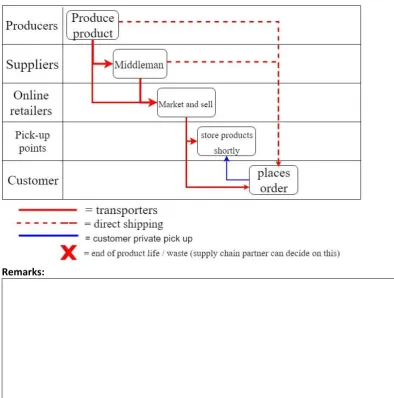
Figure 1. The forward supply chain
Lisanne Koers
–
Questionnaire Online Retailers / Free returns
Figure 2. The reverse supply chain
Lisanne Koers
–
Questionnaire Online Retailers / Free returns
Part 2
The following questions are categorized per supply chain partner. If you added supply chain partners
in the figures above, please add information about the partner(s) in category seven. If the question
considers a partner that is not in your supply chain, please state why the question is left unanswered.
Keep in mind answers should be focused on the reverse supply chain, used to bring the product back
from customer to retailer (Figure 2
–
Reverse supply chain > for returns).
1. Customer
a. How many (and which) different return possibilities are offered to the customer and how often is each option used (%)? (for example: home pickup 30%, drop-off points 60%, store drop-off 10%) b. Are there any demographics on returns available? (for example: what type of customer returns the
most)
2. Pick up / drop-off points
a. In terms of pick-up or drop-off points, who are your partners? (supermarket, post office, gas station)
b. What are the requirements for pick-up or drop-off points? (central, opening hours, popularity) c. What would be a reason for companies to in-house your pick-up points? (for example: increased
number of customers, monetary reward)
3. Transport services
a. Is the transport service outsourced to a third party?
b. Do you work together with one or multiple transport service(s)?
c. Do you offer equal payment to the transporter for shipping from as well as towards the company?
4. Online retailer
a. What is/are the reason(s) for your company to offer free returns? b. What percentage of goods is returned?
c. Did the amount of returns increase when you changed from paid to free returns? If yes, are there exact number/percentages available?
d. What percentage of returns is put back into stock after a check?
e. What are the main reasons products can’t go back into stock? (worn, dirty, broken)
f. What happens with the other percentage that can’t go back into stock directly? (sale, repair, outlet,
thrift shop, send back to supplier or manufacturer, sell to secondhand dealer, charity, throw away) g. Is there anything done to minimize returns or the costs that come with it?
h. Did you integrate supply chain partners further when deciding to offer free returns? If yes: how? (higher levels of communication, interactive control of stock)
i. Can you point out major changes caused by offering free returns (intern as well as external, between partners)
5. Secondhand dealer
a. Which type of products go to a (bulk) secondhand dealer?
b. What do you offer to the secondhand dealer? (for example: reduced prices)
6. Suppliers and producers
a. Do returns go back to suppliers or producers? And if so, in what cases?
b. To what extent are suppliers and producers integrated into stock-keeping of your company? (for example: not integrated, we share information about product improvements, they keep their own products up to a certain stock level)