Creating Value by Coopetitive Supply Based
Knowledge Sharing
Author: Tim Kuijper
University of Twente P.O. Box 217, 7500AE Enschede
The Netherlands
Abstract:
Coopetition, a phenomenon which occurs when firms cooperate and
compete at the same time, received growing attention in the past decades. Coopetitive
firms can share knowledge with each other, but will only do so if it creates a return;
value. In this literature study, the focus lies on the value creation caused by
coopetitive supply based knowledge sharing. A distinction will be made between
supply based operational knowledge sharing and supply based innovation knowledge
sharing. For both types of sharing, the possible value creation, risk and risk mitigation
strategies will be analyzed to construct a framework, explaining the relationship
between coopetitive supply based knowledge sharing and value creation. This paper
shows that supply based operational knowledge sharing results in lowering inventory
and reducing the bullwhip effect and supply based operational knowledge sharing
results in standard setting and improving innovative outcomes. The framework can be
used by firms to assess their coopetitive supply based knowledge sharing to enlarge
their value creation while mitigating risks.
Supervisors: Dr. Niels Pulles
MSc. Frederik Vos
Keywords
coopetition, value creation, supply base, supply based knowledge sharing, knowledge sharing, operational knowledge sharing, innovation knowledge sharing
Permission to make digital or hard copies of all or part of this work for personal or classroom use is granted without fee provided that copies are not made or distributed for profit or commercial advantage and that copies bear this notice and the full citation on the first page. To copy otherwise, or republish, to post on servers or to redistribute to lists, requires prior specific permission and/or a fee.
5th IBA Bachelor Thesis Conference, July 2nd, 2015, Enschede, The Netherlands.
1.
INTRODUCTION
1.1
Introducing the topic
Inside markets, firms are competing with each other to gain and maintain a competitive advantage by creating value (Sirmon, Hitt, & Ireland, 2007).These competing firms can also decide to start cooperating to create more value together. This is the starting point of the concept of coopetition.
In the past 20 years, the concept of coopetition received growing attention in practice and literature (Bengtsson & Kock, 2014). Research has been conducted on value creation in coopetition (Eriksson, 2008; Ritala, Golnam, & Wegmann, 2014), on supply based knowledge sharing with coopetitive partners (among others, Gnyawali & Park, 2011) and on the concept of coopetition (Bengtsson & Kock, 2000; Walley, 2007). Although there is growing attention for coopetition, a link between knowledge sharing and value creation in coopetitive relationships is missing in the current literature. Also for firms, there is no clear framework available which explains the link between knowledge sharing and value creation in coopetitive relationships and firms are thus unknowingly in the possible value creation which knowledge sharing with coopetitive partners persists.
This topic is important to study, because without understanding which knowledge to share, it would be difficult for firms to determine the value which can be generated from sharing this knowledge. Hence it is important to gain an understanding and create more value using a coopetitive strategy. Researchers perceive it as a gap in the literature. For example, Ritala (2009, p. 52) mentioned that “in particular, it should be interesting to study what types of resources and knowledge contribute negatively and what positively to value creation in coopetition” as a suggestion for future research. Also Bengtsson and Kock (2014, p. 184) mention the understanding of “coopetition’s impact on business models and strategies” as a direction for future research. Although a small number of case studies gave a little attention to value creation by knowledge sharing (e.g. Ritala et al., 2014), this topic has not been addressed well in literature and thus can be considered as a gap in the current literature. Because a firm possesses knowledge in too many different fields to research (e.g. marketing based, finance based and supply based knowledge), the focus in this paper solely lies on supply based knowledge. This knowledge is selected because significant amounts of research in supply based knowledge sharing has been conducted, although this has not been done in coopetitive contexts and it is expected that firms create value when supply based knowledge is being shared with coopetitive partners.
This paper provides a bridge between two different types of coopetition research; supply based knowledge sharing in coopetitive relationships and its resulting value creation. In this way, a gap in the current literature will be addressed, which can be further addressed in future research.
By providing a framework (see chapter 5), which explains the relationship between coopetitive supply based knowledge sharing and value creation, firms get a good understanding of what types of supply based knowledge to share to create value in coopetitive relationships. Strategic supply managers can use the outcomes of this paper to analyze their supply based knowledge sharing and optimize the value creation in coopetitive relationships by expanding or reducing the amount of supply based knowledge being shared.
1.2
Defining concepts
Different concepts will be used throughout this paper. In this section, the most important concepts will be explained.
A coopetitive relationship can be considered as a paradoxical horizontal or vertical relationship between two or more actors who simultaneously cooperate and compete (Bengtsson & Kock, 2014; Gnyawali & Park, 2009).
In a coopetitive relationship, knowledge can be shared. Knowledge is one of the most important assets a firm possesses (Liebeskind, 1996). Knowledge can consist of different types: Facts, information (streams), data or skills and thus can be considered intangible (Hult, Ketchen, Cavusgil, & Calantone, 2006). Sharing different types of knowledge are also being used in supply management to create value (Cachon & Fisher, 2000; Shockley & Fetter, 2014; Yu, Yan, & Cheng, 2001). Knowledge sharing can be considered as behavior in which knowledge is being transferred between two or more actors using a knowledge transfer channel (Lee and Al-Hawamdeh, 2002, Yang and Chen, 2007, as in Ghobadi & D’Ambra, 2011). We will further divide and define the different types of supply based knowledge sharing in chapter 2.
Firms are expected to share supply based knowledge only when a certain return, or value, can be gained. The main goal of a business is to create and maintain value (Conner, 1991). Value creation in business relationships can be described as: “the collaborative activity in an alliance, which leads to an increase in benefits and outcomes that are pursued in the alliance” (as cited from Ritala, 2009, pp. 40-41). Examples of value creation are lowering the costs of supplying products and raising the customer’s willingness to pay for these products (Brandenburger & Stuart, 1996).
Although firms are expected to create value by sharing supply based knowledge, also risks persists. A widely used definition of risk can be considered; ‘‘the extent to which there is uncertainty about whether potentially significant and/or disappointing outcomes of decisions will be realized’’ (as cited from Sitkin & Pablo, 1992, p. 10). Specific risks of sharing information in coopetitive relationships will be discussed in section 4.1.
1.3
Research aim & methodology
This literature study seeks to explore the potential value creation which supply based knowledge sharing induces.
To explore the potential value creation, the following question needs to be answered:
How to create value by sharing supply based knowledge in a coopetitive relationship?
Although it is expected that coopetitive supply based knowledge sharing creates value, it is also expected to generate risks due to the partial competitive nature of the relationship.
Therefore two sub questions will be addressed in chapter 4:
1) ”What risks are caused by coopetitive supply based knowledge sharing and what are its impacts?”
2) ”How can firms manage risks caused by coopetitive supply based knowledge sharing?”
Different types of coopetitive risks and risk mitigation strategies will be discussed whereafter a framework can be constructed using the different types of supply based knowledge sharing in coopetitive relationships, the value such sharing creates and the risks which are involved in coopetitive knowledge sharing.
2.
SUPPLY BASED KNOWLEDGE
SHARING
In this chapter, supply based knowledge sharing will be discussed; which is divided into supply based operational knowledge and supply based innovation knowledge. In section 2.4, supply based knowledge sharing in coopetitive relationships is being discussed. At the end of this chapter, the theoretical perspective on coopetitive supply based knowledge sharing will be explained.
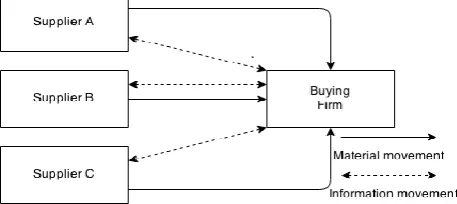
Figure 1. Material and information movement inside the supply base.
2.1
Supply based knowledge
Supply based knowledge can be considered as information being hold by different actors in the supply base of a firm (including the buying firm itself). A supply base can be considered as a ‘portion of the supply network’, directly connected to and managed by the buying firm (Choi & Krause, 2006, p. 638). The supply network consists of a certain degree of complexity, meaning differentiation among the firm’s suppliers. In the supply base (as can be seen in figure 1), one- way material (solid arrow) and two-way information (dashed arrow) movement takes places to connect the buying firm to a supplier and vice versa.
In an organization, different departments hold different supply based knowledge (e.g. the sales department holds customer demand knowledge) (Blythe, 2009), while the purchasing department holds supplier relationship knowledge (Monczka, Handfield, Giunipero, & Patterson, 2010) and the logistics department holds logistics stock-level knowledge and logistics in-/outbound knowledge (Simchi-Levi, 2005).
It can be safely assumed that an organization holds a large amount of supply based knowledge in its business processes. To analyze this amount of knowledge, a clear distinction between two types of supply based knowledge will be made; supply based operational knowledge (section 2.2) and supply based innovation knowledge (section 2.3). This division has been made on the apparent separation in supply based knowledge sharing (case) studies; supply based operational knowledge
(among others, Cachon & Fisher, 2000; Croson & Donohue, 2003; Kotzab & Teller, 2003; Lee & Whang, 2000)and supply based innovation knowledge (among others, Christ & Slowak, 2009; Gnyawali & Park, 2011; Vanhaverbeke & Noorderhaven, 2001).Although a more broadly division might be possible, in this paper the division mentioned above will be used.
In sections 2.2 and 2.3, it is assumed that knowledge is being shared between cooperation partners. Coopetitive supply based knowledge sharing between will be discussed in section 2.4.
2.2
Supply based operational knowledge
Operational knowledge can be considered a subset of different types of information, which are needed to perform regular supply based activities. Operational knowledge can be subdivided in resource planning knowledge, customer demand knowledge and contract status knowledge (Simatupang, Wright, & Sridharan, 2002);
1) Resource planning knowledge is a collection of (mostly) quantitative data, which is being used to allocate and plan the resources in the supply processes of a firm.
2) Customer demand knowledge is a collection of qualitative and quantitative data about the current customer and its demands.
3) Contract status knowledge describes the administrative information linkages between two or more actors in the supply base. In literature, no proof could be found that contract status information sharing leads to value creation. We assume that this is caused by the administrative nature of the data. As a result, we will not take contract status information sharing into account in this paper. Examples of these broadly used supply based operational knowledge sharing types can be found in table 1 below.
Table 1. Examples of supply based knowledge sharing, derived from Simatupang et al. (2002, p. 296).
Resource planning
Customer demand
Contract status
Inventory levels Customer profiles Prices
Forecasts Demand Patterns (POS)
Invoicing
Schedules Geographic data Payment
Capacity Products Automatic
ordering
Why share supply based operational knowledge?
In literature (among others, Chatfield, Kim, Harrison, & Hayya, 2004; Drezner, Chen, Ryan, & Simchi-Levi, 2000) a distinction is made between two outcomes of value creation by sharing supply based operational knowledge with another actor inside the supply base:
[image:3.595.54.283.342.444.2] [image:3.595.309.539.441.548.2]effect is a lack of information sharing across the supply chain (Lee, Padmanabhan, & Whang, 2004; Sahin & Robinson, 2002).
When information sharing takes places, in this case supply based operational knowledge, the bullwhip effect can be reduced. Using resource planning data (Fiala, 2005), customer demand data (Croson & Donohue, 2003) or a combination of both (Lee & Whang, 2000; Yu et al., 2001) it can be concluded that sharing supply based operational knowledge can lead to better forecasting and a reduction of the bullwhip effect.
Second, highly associated with reducing the bullwhip effect, sharing supply based knowledge can lead to a lower level of inventory and its (holding) costs (Grahovac & Chakravarty, 2001). When supply based operational knowledge is being shared in the supply base, more actors ‘know’ which levels of inventory are available in the supply base and can respond to this information, (e.g. by altering batch sizes) (Cachon & Fisher, 2000).
Reducing inventory is mostly done by sharing resource planning data (Cachon & Fisher, 2000; Lee, So, & Tang, 2000) or a combination of resource planning data and customer demand data (Lee & Whang, 2000; Yu et al., 2001). It can be concluded that sharing supply based operational data can lead to a reduction in the inventory being hold by the buying firm, the supply base and the rest of the supply chain(s).
2.3
Supply based innovation knowledge
Supply based innovation knowledge can be considered knowledge which is needed to explore (and exploit) new ways to improve the supply based activities of a firm. Firms try to establish partnerships to develop and share new knowledge to increase their innovation outcomes (Sampson, 2007).
The most widely used resources being shared in supply based innovation knowledge sharing are patents, which occurs in the form of licensing (Poltorak & Lerner, 2011). Frequently used methods of patent sharing are one-sided patent sharing (firm X licenses a patent to firm Y) and two-sided patent sharing (firm X licenses a patent to firm Y and firm Y licenses a patent to firm X), this phenomenon is better known as cross-licensing (Shapiro, 2001).
Another ‘open’ innovation (Chesbrough, 2006) method of supply based innovation knowledge sharing is the transfer of R&D employees’ knowledge (Ramirez & Li, 2009), meaning that R&D employees from firm X are sharing supply based innovative knowledge with R&D employees working at firm Y or working (part time) at the cooperating firm.
Why share supply based innovation knowledge?
In literature, one main example of benefits retrieved via licensing sharing supply based innovation knowledge can be found; the setting of (technology) standards inside an industry (among others, Feldman, Rees, & Townshend, 2000; Shapiro, 2001). When a supplier in the supply base is using a standard it can also be used for other buying firms from that supplier (more about this in section 2.4). By setting standards, competitors and other firms in the industry are inclined to use this standard to develop complementary and compatible products.
When supply based innovation knowledge is being intra-organizational shared between R&D employees, it positively influences innovation in an organization (Ramirez & Li, 2009).
Although R&D employees obtain knowledge from other cooperative firms, R&D employees are more inclined to share the obtained information solely with their own R&D team instead of spreading the knowledge organization-wide (Ramirez & Li, 2009). Assuming that the supply based innovation
knowledge is being used to increase their innovation outcomes, this can lead to an improvement in the firms’ competitive position.
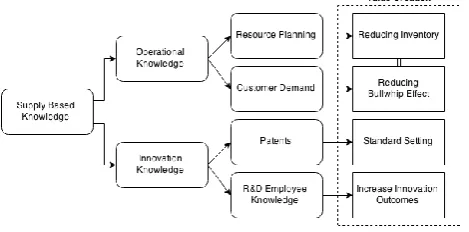
[image:4.595.309.544.240.356.2]Combining the motives of sharing supply based knowledge in cooperative relationships, a model can be created (see figure 2 below). This model shows the distinction of supply based knowledge into supply based innovation knowledge and supply based operational knowledge. Operational knowledge can be subdivided into resource planning data and customer demand data. Innovation knowledge can be subdivided into patents and employee knowledge. Although reducing inventory can be considered a direct result from sharing resource planning data and reducing the bullwhip effect a direct result from customer demand data, both types of value creation can be considered interwoven (as discussed above).
Figure 2. Motives to share supply based knowledge
2.4
Supply based knowledge sharing in
coopetitive relationships
Supply based knowledge can be a source of competitive advantage (Drucker, 1992; Simon, 1992). Although it can also leverage the knowledge base of the coopetitive partner when the supply based knowledge is being shared (Lorange, 1996). In order to share the knowledge, the total value for both partners must outweigh the total losses from sharing the knowledge (Appleyard, 1996, as in Loebecke, Van Fenema, & Powell, 1999). This is a common decision for firms who are operating in partnerships where competition and cooperation exist at the same time, which is coopetition.
As in cooperative, non-competition relationships, also in coopetitive relationships, a clear division can be seen in supply based knowledge sharing (as in section 2.1); operational and innovation knowledge (among others, Eriksson, 2008; Kotzab & Teller, 2003; Wilhelm, 2011). To analyze coopetitive supply based knowledge sharing, the same division is used in this section.
Coopetitive supply based operational knowledge
Although the theory behind coopetitive supply based operational knowledge sharing has not been given much attention in literature, Shockley and Fetter (2014) showed that coopetitive strategies can improve inventory management when there is a higher degree of competition in the marketplace. In most Western economies sharing resources or information to improve inventory management is seen as a violation of the anti-trust law, thus a firm needs to be sure its coopetitive activities are allowed to leverage efficiency among coopetitive partners (Shockley & Fetter, 2014).
Shockley and Fetter (2014) discuss different improvements in inventory management when supply based operational knowledge is shared with coopetitive partners:
of inventory being hold was lower, resulting in lower inventory costs. Especially holding costs (20% reduction) were a substantial portion of the significant cost savings, besides out-of-stock costs (1-2% reduction).
Although the research was focused on inventory, also the effect on the bullwhip effect was measured; here a decrease of 8.6% was found, resulting in substantial lower order amplification in the supply base as well as in the entire supply chain.
Coopetitive supply based innovation knowledge
As mentioned in section 2.3, cross-licensing is a way to share innovation based supply based knowledge. Also in coopetitive relationships innovation cross-licensing takes places (among others, Gnyawali & Park, 2011; Vanhaverbeke & Noorderhaven, 2001). Vanhaverbeke and Noorderhaven (2001) mention that cross-licensing is a good fitting strategy to develop standards agreements and bidding consortia. Both standards agreements and bidding consortia promotes (world-wide) standard setting, which often occurs in joint ventures or industry alliances (Vanhaverbeke & Noorderhaven, 2001). Building on the assumption that competing firms use similar resources (Chen, 1996), competing firms can decide to pool their resources via a shared supplier. When a supplier is being shared between coopetitive partners, investments can be made in the supplier (Qi, Ahn, & Sinha, 2015). When the coopetitive partners decide to invest in a shared supplier, they may also decide create a standard to work more efficient with their resources by cross-licensing their patents (e.g. electronics with a similar chipset but a different exterior design).
2.5
Theoretical perspective on coopetitive
knowledge sharing
In this section, the theoretical view on coopetitive knowledge sharing and its value creation will be discussed. This will be done using the game-theoretical approach (Ghobadi & D’Ambra, 2011). The game-theoretical approach is the only complete and widely used model to explain value being created by coopetitive knowledge sharing fitting the purpose of this paper.
The game theoretic approach for coopetitive knowledge sharing was first being explored by Von Hippel (1994) and Schrader (1990, as mentioned in Loebecke et al., 1999), which was based on the prisoners dilemma paradox (Axelrod, 1984). Schrader (1990, as mentioned in Loebecke et al., 1999) mentioned that both firms only share their knowledge (cooperate) when the cooperation is focused on a long term perspective and a proper way level of trust.
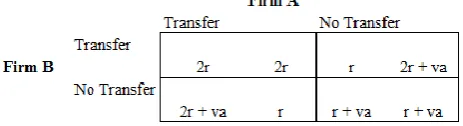
Following the game theoretic perspective, two firms (A and B) have to decide whether to transfer (share) knowledge or not. Loebecke et al. (1999) constructed a ‘basic’ game theoretic matrix, which was derived from the work of Von Hippel (1994) and Schrader (1990, as mentioned in Loebecke et al., 1999), this matrix can be found in figure 3. In the matrix, it is assumed that both firms hold knowledge which creates value. This value is being expressed in two ways; ‘r’ meaning the basic value of the knowledge and ‘va’ meaning the value added of monopolistic knowledge (Loebecke et al., 1999). The value added can be better explained as ‘the advantage that results from having knowledge of which the other is not aware. This is lost by knowledge sharing’ (as cited from Loebecke et al., 1999, p. 17). When both firms decide to transfer knowledge (cooperation), the highest value is being created (on the condition that r > va). The worst scenario occurs when one firm transfers knowledge while the other firm does not. This creates the prisoners dilemma paradox (Axelrod, 1984); 2r + va is higher than 2r and r + va is higher than r (assuming va > 0),
[image:5.595.308.540.154.217.2]leading to a situation that firm A and firm B are not transferring knowledge and arrive in the ´r + va quadrant´ instead of the ´2r + 2r’ quadrant where the value creation is expected to be the highest. Schrader (1990, as mentioned in Loebecke et al., 1999) mentions that both firms only transfer their knowledge (cooperate) when it is focused on a long term perspective and a proper level of trust.
Figure 3. Coopetitive knowledge sharing in a game theoretic perspective (Loebecke et al., 1999, p. 17).
We can conclude that firms create most value when both share their knowledge. The different ways of value creation in coopetitive relationships will be discussed in chapter 3 using coopetitive business models.
3.
COOPETITIVE VALUE CREATION
In this chapter different ways to create value in coopetitive relationships will be discussed (section 3.1). Afterwards, in section 3.2, two cases will be used in which coopetitive supply based information sharing takes place and aims to link the different kinds of supply based knowledge sharing to the coopetitive business models.
3.1
Overview of coopetitive business models
To differentiate between different methods to create value by sharing supply based knowledge in coopetitive relationships, the coopetitive business model categorization by Ritala et al. (2014) will be used. This categorization is being used because it covers different areas of value creation and is a very up-to-date categorization (2014). The categorization consists of the following four value creation coopetitive business models:
3.1.1
Increasing size of current markets
3.1.2
Creating new markets
By creating new markets, completely new value can be created, over which can be competed (Ritala et al., 2014). Ritala et al. (2014) mentioned four main explanations for new market creation: First, competitors operate in the same market and possess knowledge that supports the development of radical innovations and recognize opportunities (Quantana-García & Benavidas-velasco, 2004; Ritala & Hurmelinna- Laukkanen,2009 as mentioned in Ritala et al., 2014). Second, it is assumed that an individual is not capable of capturing all value being created by new business models. When the business model is adopted by competitors, it can create an appealing end market where customers are valuing the product more positively (Wang & Xie, 2011). Third, coopetition can be a favorable mechanism in the creation of industries. For example, when other users are using similar products, it influences the value perception of other possible customers (Katz & Shapiro, 1985). For creating new markets standard setting across competitors seems very important; customers want products which are compatible with other products, also in cases where products supplement each other, (smartphones and PCs). Fourth, creating new markets by developing radical innovations comes with a price tag. Cooperating with competitors can help by bundling knowledge to reduce market uncertainty (Gnyawali & Park, 2009; Möller & Rajala, 2007).
Using these four main explanations, creating new markets in coopetitive relationships can be explained. Although it must be kept in mind that coopetitive partners are competitors and are inclined to gain as much market share as possible when a new market is created.
3.1.3
Efficiency in resource utilization
While other coopetitive business models address sharing risks and costs, efficiency in resource utilization solely addresses cost reduction in supply networks. Using this coopetitive business model, creating and capturing value can be done in a more efficient way (Ritala et al., 2014). When bundling analogous resources, like (supply based) knowledge, (far) away from the customer, efficiency benefits and cost sharing can be reached (Bengtsson & Kock, 2000; Dussauge, Garrette, & Mitchell, 2000; Walley, 2007). These efficiency benefits and cost sharing benefits can be observed, for example by lowering the amount of resources needed to produce a larger quantity of outputs than in competitive relationships or more value can be captured by bringing qualitative better products to the marketplace.
3.1.4
Improving the firms’ competitive position
The focus in this coopetitive business model lies on the creation of coopetitive networks. In a coopetitive network, multiple (>2) competitors are cooperating (following the definition in section 1.2). A coopetitive network is assumed to compete against other (coopetitive) networks (Gueguen, 2009). According to Lado, Boyd and Hanlon (1997, as mentioned in Ritala et al., 2014), firms in coopetitive networks are showing ‘syncretic rent seeking behavior’, meaning that firms apply a different combination of competition and cooperation for every competitor, leading to more severe competition with competitor X than competitor Y. Horizontal actors in coopetitive networks can possess unique products, (supply based) knowledge and supply bases. These resources support the improvement of the competitive position of the coopetitive network as a whole when these resources are shared with coopetitive partners inside the coopetitive network (Möller & Rajala, 2007).
3.2
Value analysis
The coopetitive business models from Ritala et al. (2014) mentioned above are related to a broad area of coopetitive
activities. In this paper, only the value being created by coopetitive supply based knowledge sharing will be discussed. To classify which coopetitive business models are being created by supply based operational knowledge sharing and supply based innovation knowledge sharing, a set of two cases will be used which were conducted by other researchers. The two cases will be discussed below by determining what supply based knowledge sharing took place and what value this sharing yielded. The first case (section 3.2.1) will discuss coopetitive supply based operational knowledge sharing, whereas the second case (section 3.2.2) discusses coopetitive supply based innovation knowledge sharing.
3.2.1
Case 1: Kotzab and Teller (2003): Austrian
Grocery stores
This case describes the coopetitive relationships in the (Austrian) grocery industry; producers, retailers and consumers. These actors can be classified into vertical relationships (customers and suppliers) and horizontal relationships (complementors and competitors);
The role of a retailer can be either competitive (provide similar offerings) or complementary (provide different trade functions).
The role of a producer can also be either competitive (marketing-role) or complementary (e.g. logistics) (Nalebuff & Brandenburger, 1996).
In the 90’s, a supply based initiative started in the grocery industry; Efficient Consumer Response (ECR). ECR is a collaboration program started between several producers and retailers which and is focused on value-adding activities in the supply chain by being more customer-oriented (Kotzab & Teller, 2003). According to Svensson (2002, as mentioned in Kotzab & Teller, 2003), supply chain partners (producer, retailer, end user) create a win-win-win situation where profitability is gained by doing more with less resources and can be considered one of the best initiatives within the grocery industry (Kotzab, 1999). The application of ECR initiatives resulted in significant cost savings; US$30 billion in the US market and €25 billion on the European markets. These costs savings are mostly a result from total-chain reduction of inventory by speeding up cycle-time.
The goal of ECR is to create a consumer driven supply chain where production and movement of resources is guided by consumer’s POS data (see also section 2.2) (Salmon, 1993, as mentioned in Kotzab & Teller, 2003) and can be achieved by focusing on four pillars;
- Efficient store assortment, meaning that there is a demand for the products in the supply chain, the assortment is complete and ‘easy-to-shop’ (Kotzab & Teller, 2003, p. 271).
- Efficient promotion, meaning good communication about the benefits and value being captured between the retailer and the producer.
- Efficient new product introduction refers to addressing the current (and future) customer wants and needs by developing introducing fitting products to these wants and needs.
- Efficient replenishment by maintaining the right amount of inventory at the right time.
Example of ECR: Austrian supermarkets
The Austrian grocery industry consists of several firms, from which two firms are considerably larger than its competitors. Although the average spending on food has declined, there is severe competition between the different firms in the grocery industry (Kotzab & Teller, 2003).
The Austrian ECR initiative started in 1996, which contained 70 members (producers and retailers). This group constructed a basic ECR business model which can be subdivided in 4 areas; supply side, demand side, processes and standards (ECRA, 1997, as mentioned in Kotzab & Teller, 2003).
Members of an ECR initiative make agreements, which are based on the four pillars mentioned above. The ECR standards in the Austrian initiative are: First, Efficient Unit Load (e.g. standardized packaging and labeling).
- EDI, transferring supply based operational knowledge, like order information, stock levels and POS data.
- Efficient replenishment (e.g. forecast information exchange, cross docking and continuous replenishment).
- Category management, by jointly planning the assortment with retailers, producers can lower lead times and both parties are expected to increase inventory turnovers.
The Austrian ‘pillars’ can be combined with the ECR business model subdivision mentioned above (see appendix A).
The potential savings resulting from the Austrian ECR initiative were estimated at €73 million, which can be translated to 0.67% lower consumer prices (Franzmair, 1999, as in Kotzab & Teller, 2003). This price reduction is a motivation for other (Austrian) grocery firms to join an ECR initiative because it creates value by lowering supply base costs (see definition of value creation in section 1.2). Although it is assumed that it is impossible to gain market share via expansion or price reductions, it seems that via the ECR initiative, the Austrian grocery industry can operate more efficiently. Kotzab and Teller (2003) mention that, when compared with other ECR initiatives, the Austrian ECR initiative is a very holistic one, including many different firms in the value chain.
According to Kotzab and Teller (2003), a significant amount of the companies inside the Austrian ECR initiative stated that they used the ECR standards and processes (most EDI), which led to a higher efficiency of resources in the supply base.
Other firms are planning to implement ECR standards. According to Kotzab and Teller (2003), in the Austrian grocery industry, all coopetitive partners gain benefits by adapting collaborative logistics techniques, leading to economies of scale, while competing on the marketing side. This led to lower prices in the ECR supply market for coopeting firms.
Because in coopetitive environments horizontal and vertical relationships need to be managed at the same time, trust and commitment issues are expected to be play a large role in the launch of an ECR initiative (Meffert, 2001, as mentioned in Kotzab & Teller, 2003). According to Bengtsson and Kock (2000), information and social exchange is the most important to start coopetitive relationships, which is being recognized by Kotzab and Teller (2003).
Case conclusion
In this case, different supply based operational knowledge is being shared between coopetitive partners in ECR initiatives; forecasting information, POS data and order information are explicitly mentioned by Kotzab and Teller (2003). The value
being created by sharing supply based operational knowledge is mostly related to EDI and efficient replenishment; here, actual information sharing takes place to lower inventory. When linked to a coopetitive business model from Ritala et al. (2014), supply based operational sharing in this case shows the most overlap with the business model efficiency in resource utilization because lower inventory can be hold due to efficient replenishment and by the application of EDI (e.g. to reduce the bullwhip effect, see also Shockley & Fetter, 2014). Besides efficiency in resource utilization, also the firm’s competitive position (fourth coopetitive business model in Ritala et al., 2014) can be improved by sharing supply based operational knowledge; by lowering consumer prices (see above), consumers are inclined to switch to similar offerings for a lower price, thus improving the competitive position of the firm.
Also in other European grocery industries ECR initiatives take place; for example, in the supply chain of the Dutch supermarket Albert Heijn, actual stock levels and expected demand from warehouses are being transferred to producers to achieve efficient replenishment (Van Helvoort, 2014) while individual store (POS) data can only be used by Albert Heijn itself.
3.2.2
Case 2: Gnyawali and Park (2011): Samsung
& Sony
In this case, the coopetitive relationship between the Korean Samsung Electronics (hereafter Samsung) and the Japanese Sony Corporation (hereafter, Sony) will be discussed which held place in the period of 2003 until 2009.
Before starting the coopetitive relationship, Samsung had a turnover of $54.1 billion and Sony had a turnover of $67.2 billion. In different markets where Samsung and Sony operated, both were competing severely and wanted to become the world’s highest ranked electronic manufacturer (Dvorak & Ramstad, 2006, as mentioned in Gnyawali & Park, 2011). They wanted to achieve this by being very progressive in the development and marketing new products. Competition between Samsung and Sony took place in product markets (TV, computer, video, audio, mobile phone) and in geographical markets (US, Europe and Asia).
Both companies had motives to start looking for partners to solve problems; Sony was a leader in the outdated CRT television market but lied far behind its competitors in the flat-panel television market, making a major loss in 2003.
Samsung was no big player in the LCD market and needed a partner to achieve economies of scale and create a new technological standard.
The problems of Samsung and Sony mentioned above are typical problems for firms inside the high tech industry (Gnyawali & Park, 2009);
- A shorter product life cycle; other technologies, in this case (O) LED technology, might discontinue current LCD/TFT technologies very quickly.
- Increasing R&D and capital expenditures are needed to maintain at the forefront of the market.
Recognizing that competing firms inside the high tech industry also face these difficult challenges and that these competing firms possess similar resources and knowledge, coopetition can be a strategy to gain and create technological knowledge to be more innovative (Ritala, Hurmelinna-Laukkanen, & Blomqvist, 2009).
would otherwise be unavailable. This is important, because innovation has been long seen as a source of competitive advantage (among others, Schumpeter, 1942, as mentioned in Gnyawali & Park, 2011).
The joint venture
In 2004, a joint venture (50/50%) was established by Samsung and Sony, which was named S-LCD. The goal of this joint venture was to develop and manufacture the 7th generation of
liquid crystal display (LCD) for flat screen televisions. In this joint venture Sony could apply its precise and high standards on quality issues and could better market new technologies with its brand name and increasing demand (Dvorak & Ramstad, 2006, as mentioned in Gnyawali & Park, 2011). Samsung, on the other side, could help Sony by offering a strong capability in LCD manufacturing and its broad resource base. By using each other’s expertise, it was aimed to create a win-win situation (Gnyawali & Park, 2011). Both firms also wanted a higher market share than the other party and were benchmarking against each other (Tsai, 2002, as mentioned in Gnyawali & Park, 2011).
Supply based innovation knowledge sharing
To develop the 7th and 8th generation of LCD panels, a major
investment of $6 billion was needed, brought up by both parties. It is assumed that these technologies could not have been developed by each of the parties on their own.
Besides monetary resource sharing, also supply based innovation knowledge has been shared between the coopetitive partners, in this case cross-licensing. A total of 24,000 patents were cross-licensed; 11,000 from Samsung to Sony and 13,000 from Sony to Samsung. This cross-licensing happened in the early start of the joint venture (2004), creating a basis for knowledge sharing and product development (Gnyawali & Park, 2011). It has to be noted that there were also specific patents which were not being shared; the so-called ‘differentiated technology patents’ (e.g. TFT and OLED display patents) (Gnyawali & Park, 2011). By cross-licensing, value was created for LCD products, while maintaining core knowledge (e.g. Sony Playstation infrastructure). For the ‘differentiated technology patents’, the value added of monopolistic knowledge can be considered higher than the basic value of the supply based innovation knowledge (Loebecke et al., 1999, see also section 2.5).
Samsung and Sony jointly build a research and production facility where most of the activities took place (Gnyawali & Park, 2011). It is therefore assumed that R&D personnel from both companies interacted with each other by transferring knowledge, resulting in increased innovative outcomes (e.g. can result in faster time to market).
One year after the S-LCD joint venture was established, Sony marketed their Bravia series and Samsung their Bordeaux series, leading to intense competition inside the market, although both product series were very successful and both firms experienced a significant increase in its market share in the growing LCD market (see figure 5).
In 2004, Sony and Samsung had a combined market share of 18.4%, which rose to 40.9% in 2008 (Gnyawali & Park, 2011), although during this period both firms were heavily competing with each other.
Due to economies of scale being created by the joint venture, competitor response and the power of retail stores, the prices of LCD televisions decreased very quickly. Economies of scale resulted in lower costs per LCD panel.
Figure 5. Market share inside the LCD market during the S-LCD joint venture (Displaysearch, as extracted from Gnyawali & Park, 2011, p. 655).
Case conclusion
Gnyawali and Park (2011) conclude that the S-LCD joint venture (coopetition) led to positive impact in the LCD market, by developing better products with reasonable prices and setting standards. When linked to the coopetitive business models from Ritala et al. (2014), supply based innovation knowledge sharing in this case shows the most overlap with the ‘increasing size of current markets’ and ‘efficiency in resource utilization’ business models. The LCD market has grown, partly because the S-LCD joint venture developed new technologies, through increased innovative outcomes, which were a success (e.g. better products, lower prices) for both parties. Efficiency in resource utilization has been reached by economies of scale which is the result of standard setting in the coopetitive relationship.
Although the focus lies on the business models mentioned above, the result from these business models is an increased market share (improving firms’ competitive position) for both Samsung and Sony, which both firms remain to hold during the time they operated in the S-LCD joint venture.
3.2.3
Conclusion of cases
In both cases, value has been created by coopetitive supply based knowledge sharing. The Austrian supermarkets in the ECR initiative (case 1) experienced an efficiency in resource utilization due to a reduction in inventory and the bullwhip effect, which was the result from EDI and efficient replenishment. These reductions led to price reductions for price-sensitive consumers, leading to an improvement of the firms’ competitive position.
Samsung and Sony (case 2) experienced an efficiency in resource utilization, resulting from economies of scale, an increasing market share in an increasing market and increasing innovative outcomes. This led for both firms to an improvement of the firms’ competitive position.
4.
KNOWLEDGE SHARING RISKS
[image:8.595.311.542.75.176.2]4.1.1
Opportunistic behavior
Opportunistic behavior can be considered as taking egoistic decisions to create more value alone instead of fully cooperating. It is therefore assumed that opportunistic behavior takes places in situations where the value created solely by the firm showing opportunistic behavior is higher than the value created (for the opportunistic firm) when cooperating.
Opportunistic behavior also occurs in coopetitive relationships where (supply based) knowledge is being shared (Loebecke et al., 1999; Ritala, 2009). An example of opportunistic can be found in contracts;
Not all activities which take place in a coopetitive relationship can be (fully) included in contracts. This incompleteness leaves room for the opportunistic behaving firm to decide what to do with knowledge not being captured by the contract (e.g. slightly altered new patents) and benefit from it (Williamson, 1979, as mentioned in Loebecke et al., 1999).
The impact of opportunistic behavior of a coopetitive partner is expected to be severe, meaning that when more opportunistic behavior is being shown in a coopetitive relationship, significant less value is being created (e.g. lower efficiency in resource utilization than expected).
4.1.2
Insufficient transfer
When firms are not able (or not willing) to transfer their supply based knowledge with their coopetitive partners, insufficient knowledge transfer occurs. A firm might not have the (IT) systems to support such sharing (e.g. via EDI standards, see case 1) (Levy, Loebbecke, & Powell, 2003). Also other scenarios are plausible; a firm might wait for the other firm to start sharing in order to start sharing their own supply based knowledge or a firm might not share their knowledge at all, although the other coopetitive partner is sharing theirs. In these scenarios, a typical coopetitive risk is mentioned (Levy et al., 2003).
Using the game-theoretic approach (Loebecke et al., 1999), the situation where unfair transferring takes place will be shortly analyzed: When one firm decides not to share their knowledge, the sharing firm loses value (its value added of monopolistic knowledge) and only holds ‘r’ (the basic value), while the non-sharing firm gets ‘2r + va’ (Loebecke et al., 1999). This gives the non-sharing firm an unfair (competitive) advantage in the coopetitive relationship. The coopetitive relationship creates most value when both firms transfer (share) their knowledge: 2r + 2r = 4r. When insufficient transfer takes place, the value created is 2r + va + r = 3r + va, which is smaller than the cooperative 4r (on the condition that r > va).
Addressing the first risk sub question, it can be concluded that both opportunistic behavior and insufficient transfer contribute negatively to value creation and can be seen as a risk in coopetitive relationships.
4.2
Risk Mitigation
To reduce the impact or occurrence of coopetitive supply based knowledge sharing risks, risk mitigation strategies can be applied. To mitigate the coopetitive risks mentioned above, two coopetitive risk mitigation ‘strategies’ will be shortly discussed. Although more risk mitigation strategies exist, the mentioned coopetitive risk mitigation strategies are frequently discussed in literature (Lavie, 2007; Williamson 1975, 1985, as mentioned in Loebecke et al., 1999).
Contracts: Although coopetitive contracts are subject to opportunistic behavior (Loebecke et al., 1999), they might reduce insufficient transfer. By making agreements how and on what time interval information is being shared, there is clarity
for all firms involved in the coopetitive partnership. In this contract, benefits and risks can be allocated (Harland, Brenchley, & Walker, 2003), but also penalties can be taken into account, where insufficient sharing or opportunistic behavior can lead to exclusion of coopetitive alliances, settling with other partners or sharing benefits being retrieved from opportunistic behavior.
Equity joint venture: To address the opportunistic behavior risk, coopetitive partners can adopt an equity joint venture structure to align incentives (Oxley, 1997; Sampson, 2004). By aligning incentives, all coopetitive partners are expected to be satisfied with the expected outcome and can start sharing their supply based knowledge without being afraid another partner will behave opportunistic.
Addressing the second risk sub question, it can be concluded that risks in coopetitive relationships can be managed by making coopetitive contracts to define in which manner supply based knowledge is being shared and by establishing equity joint ventures to align incentives. The risks and risk mitigation strategies mentioned in this chapter will be used to construct a coopetitive value creation framework in chapter 5.
5.
CREATING VALUE: A FRAMEWORK
In this chapter, a framework will be constructed and discussed which explains how a firm can create value by coopetitive supply based knowledge sharing. As explained in the methodology (section 1.3), this will be done using the outcomes of the previous sections.
5.1
Construction of the framework
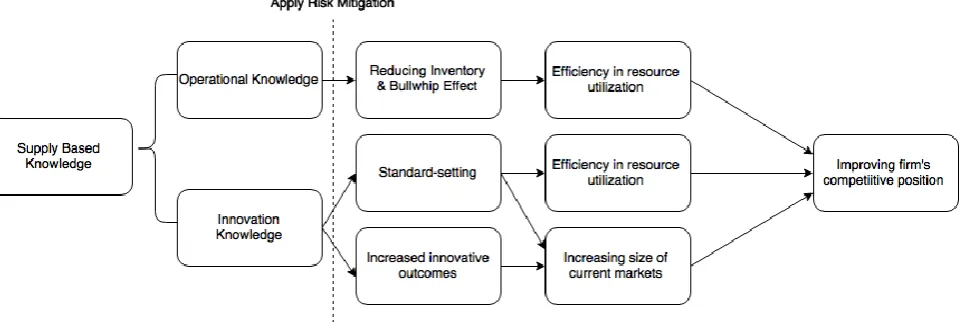
The framework we construct and discuss in this chapter can be found in figure 6 below. A larger version of figure 6 can be found in appendix B. Sections 5.1.1 until 5.1.6 will explain the 6 elements of the framework.
5.1.1
Supply based knowledge
The first element comprises all supply based knowledge being possessed by a firm, which can be either stored inside information systems or been stored inside the heads of the employees. Supply based knowledge forms the basis of this framework, although other knowledge can be shared with coopetitive partners besides supply based knowledge.
5.1.2
Division of supply based knowledge sharing
The supply based knowledge, which can be shared, is divided into supply based operational knowledge and supply based innovation knowledge (see section 2.1). Although supply based operational knowledge and supply based innovation knowledge sharing have been found in the two cases (see section 3.2), for supply based operational knowledge sharing, no separate division has been found in resource planning data and customer demand data (operational). Concerning supply based innovation knowledge sharing, only patents were mentioned explicitly by Gnyawali and Park (2011), although it can be safely assumed that R&D employees of both Samsung and Sony interacted with each other, because they held a joint research and production facility in the S-LCD joint venture (Gnyawali & Park, 2011).
5.1.3
Application of risk mitigation strategies
Figure 6. Creating value by coopetitive supply based knowledge sharing.
venture (align incentives if opportunistic behavior is expected) (see section 4.2).
5.1.4
Supply based knowledge value creation
When coopetitive firms start sharing supply based knowledge, value starts to generate; assuming a shift from the ‘r + va’ quadrant to the ‘2r’ quadrant occurs (see also section 2.4 and Loebecke et al., 1999). As discussed in sections 2.4 and 3.2.1, when supply based operational knowledge is being shared with coopetitive partners, the gained knowledge can be used to cause a reduction in inventory and the bullwhip effect (Kotzab & Teller, 2003; Shockley & Fetter, 2014).
As discussed in section 2.4 and 3.1.2, the knowledge gained by coopetitive supply based innovation knowledge sharing can be used to set standards in an industry by sharing patents (Gnyawali & Park, 2011; Vanhaverbeke & Noorderhaven, 2001) and increase innovative outcomes by sharing knowledge between (R&D) employees (Gnyawali & Park, 2011).
5.1.5
Coopetitive business models
The different kinds of value creation mentioned in section 5.1.4 can be linked to the coopetitive business models from Ritala et al. (2014).
Operational knowledge: Lowering inventory and reducing the bullwhip effect lead to a lower need of resources in the supply base. When less resources are needed, a higher degree of efficiency in resource utilization can be reached, resulting in lower prices for the buying firm.
Innovation knowledge: By setting industry standards, economies of scale can occur leading to higher efficiency in resource utilization; monetary and materialistic. By setting standards and increasing the innovative outcomes, better products can be developed, resulting in higher market shares in current markets while the size of the market is expanding.
5.1.6
Improving firms’ competitive position
Besides the coopetitive business models mentioned above, a firm aims to get a competitive advantage over its competitors (Sirmon et al., 2007). This can be done by sharing either supply based operational knowledge as supply based innovation knowledge:
Operational knowledge:By gaining a higher efficiency in the utilization of resources, cost savings can be generated by lowering inventories and reducing the bullwhip effect in the supply base. These cost savings can be translated to lower end-user purchasing prices, leading to an improvement of the firms’ competitive position.
Innovation knowledge: When industry standards are set and a firm starts to gain a higher efficiency in resource utilization, this
can result in costs saving (economies of scale). Again, these cost savings can be translated to lower end-user purchasing prices, leading to an improvement of the firms’ competitive position. Also the size of the current market plays an important role in sharing supply based innovation knowledge; When employees of coopeting firms are sharing supply based knowledge, improved technologies and products can be developed, which is being supported by industry standard setting. Developing, and subsequently market improved products, lead to an improvement of the firms’ competitive position.
5.2
Conclusion of framework
Using the framework discussed above, it is made clear how different types of coopetitive supply based knowledge sharing contribute to the value creation of a firm. Using the coopetitive business models of Ritala et al. (2014) it can be concluded that supply based operational knowledge sharing leads to efficiency in resource utilization and supply based innovation knowledge sharing lead to efficiency in resource utilization and an increase of the size of the current market. Both types of coopetitive supply based knowledge sharing result in an improvement of the firms’ competitive position.
6.
DISCUSSION & CONCLUSION
Throughout this paper, it is shown that supply based knowledge can be shared with coopetitive partners, creates value and causes risks. In this chapter, the results will be discussed by comparing the results with literature. Afterwards, a conclusion will be stated and the limitations and recommendations for future research will be raised. We will finish this paper by posing the managerial implications.
Main results
In this paper, it is found that supply based knowledge can be subdivided into supply based operational knowledge and supply based innovation knowledge. Although this division has not been used in literature before and might be extended, it is expected to cover most of supply based knowledge. Using the Austrian grocery industry case (section 3.2.1) it is found that coopetitive supply based operational knowledge sharing leads to lower inventory and a reduction of the bullwhip effect, which can be translated to the ‘efficiency in resource utilization’ coopetitive business model. These outcomes correspond with the outcomes of cooperative supply based operational knowledge sharing studies (among others, Croson & Donohue, 2003; Fiala, 2005), in which a lower inventory and a reduction of the bullwhip effect was observed.
[image:10.595.59.542.64.225.2]supply based operational knowledge sharing is higher in coopetitive relationships than in cooperative relationships; a lower inventory and higher reduction of the bullwhip effect can be observed in coopetitive relationships (Shockley & Fetter, 2014).
Using the S-LCD joint venture case (section 3.2.2), it is found that coopetitive supply based innovation knowledge sharing leads to standard setting and increased innovative outcomes. This can be translated to the ‘efficiency in resource utilization’ and ‘increasing size of current market’ coopetitive business models. These outcomes match with cooperation literature (among others, Feldman et al., 2000; Shapiro, 2001). In coopetition literature (Vanhaverbeke & Noorderhaven, 2001), it is found that patent sharing leads to standard setting. Although no evidence is found that supply based innovation knowledge sharing leads to the creation of new markets and an increase of innovative outcomes, it is most likely to occur, for example in Gnyawali and Park (2011). Also for supply based knowledge sharing, it is considered that the value being created by sharing is higher in coopetitive relationships than in cooperative relationships because it gains more (industry) knowledge (Quintana-Garcia & Benavides-Velasco, 2004) and absorptive capacity (Dussauge, Garrette and Mitchell, 2000; Lane & Lubatkin, 1998; Ritala & Hurmellina-Laukkanen, 2009, as mentioned in Ritala et al., 2014).
Although the focus of this paper lies on the value being created by coopetitive supply based knowledge sharing, also risks (and its related risk mitigation strategies), have been taken into account. These risks are expected to occur due to the partly competitive nature of the coopetitive relationship. Although it is assumed that the mentioned risk mitigation strategies are not able to cover all different varieties of risks, managers should assess risks (Ritala, 2009) to apply the best fitting risk mitigation strategy.
As can be seen in figure 6 (see chapter 5), the final outcome of coopetitive supply based knowledge sharing is an improvement of the firms’ competitive position; an outcome which corresponds with findings in literature (Levy et al., 2003).The mentioned improvement refers to the competitors who are not part of a coopetitive relationship.
Conclusion
In the introduction, three questions were raised concerning coopetitive supply based knowledge sharing. The main research question addresses how value can be created by supply based knowledge sharing. It has been shown that value, lowering the costs of supplying products and raising the customer’s willingness to pay for these products (Brandenburger & Stuart, 1996), can be created by coopetitive supply based knowledge sharing through lowering inventories, reducing the bullwhip effect, establishing economies of scale and an improvement of innovative outcomes. As stated above, these value creation resulted in an improvement of the firms’ competitive position.
Also two sub questions concerning risk (mitigation) were raised in the introduction. In this paper, the risks of opportunistic behavior and insufficient transfer have been discussed (see section 4.1.1 and 4.1.2). It is considered that these risks have an impact on the value being created by coopetitive supply based knowledge sharing. To reduce the impact of these risks, setting up contracts and establishing an equity joint venture can be used as risk mitigation strategies (see section 4.2).
Limitations & Recommendations
Due to the complexity of the subject and the usage of only two cases, this literature study has certain limitations. Although the focus in this paper lies on how coopetitive supply based knowledge sharing contributes to value creation, it has only touched the surface of this topic. By presenting five limitations of this study, also recommendations are given for further research.
First, in this paper, it has been studied which types of supply based knowledge sharing led to value creation. Further research can study which amount of knowledge to share. Second, a more complete subdivision of supply based knowledge might be possible. In this paper only supply based operational knowledge and supply based innovation knowledge have been taken into account. This subdivision might be even more subdivided or new varieties of supply based knowledge sharing might be found. Third, although a literature study has been conducted on risk (mitigation) in coopetitive supply based knowledge sharing, more risks and risk mitigation strategies might be found and suited for coopetitive knowledge sharing. Fourth, although three coopetitive business models from Ritala et al. (2014) have been used in the analysis and figure 6, the coopetitive business model ‘creating new markets’ has not been found in the selected cases. Because supply based innovation knowledge sharing leads to higher innovative outcomes, it is expected that further research can find evidence for the occurrence of this coopetitive business model in coopetitive supply based innovation knowledge sharing. Finally, fifth, due to time restrictions, only two cases have been used. To increase the generalizability of the outcomes, more (empirical) case studies can be analyzed in further research to confirm and/or enlarge the framework.
Managerial implications
As discussed in the introduction, firms lack a clear understanding of the possible value creation on coopetitive supply based knowledge sharing. When a firm wants to enlarge their value creation by coopetitive supply based knowledge sharing, an analysis can be performed using the constructed framework (see figure 6). Firms can use the framework in two ways; either they look what supply based knowledge they possess and how they can use it to create value, or they look what value they want to create and what type of supply based knowledge is needed to create such value. Although this paper focused on the value creation resulting from sufficient knowledge sharing, firms should keep in mind that other types of value creation and risks can occur (which are not mentioned in this paper). Firms should also understand that in some situations less value is being created than expected (e.g. coopetitive partner doesn’t share their knowledge).
7.
REFERENCES
Axelrod, R. (1984). The Evolution of Cooperation. New York.
Bengtsson, M., & Kock, S. (2000). ” Coopetition” in business Networks—to cooperate and compete simultaneously. Industrial marketing management, 29(5), 411-426.
Bengtsson, M., & Kock, S. (2014). Coopetition—Quo vadis? Past accomplishments and future challenges.
Industrial marketing management, 43(2), 180-188. Blythe, J. (2009). Principles and practice of marketing: Sage.
Brandenburger, A., & Stuart, H. W. (1996). Value‐based business strategy. Journal of Economics & Management Strategy, 5(1), 5-24.
Cachon, G. P., & Fisher, M. (2000). Supply chain inventory management and the value of shared information.
Management science, 46(8), 1032-1048.
Chatfield, D. C., Kim, J. G., Harrison, T. P., & Hayya, J. C. (2004). The bullwhip effect—impact of stochastic lead time, information quality, and information sharing: a simulation study. Production and Operations Management, 13(4), 340-353.
Chen, M. J. (1996). Competitor analysis and interfirm rivalry: Toward a theoretical integration. Academy of management review, 21(1), 100-134.
Chesbrough, H. (2006). Open innovation: a new paradigm for understanding industrial innovation. Open innovation: Researching a new paradigm, 1-12.
Choi, T. Y., & Krause, D. R. (2006). The supply base and its complexity: Implications for transaction costs, risks, responsiveness, and innovation. Journal of operations management, 24(5), 637-652.
Christ, J. P., & Slowak, A. (2009). Why Blu-ray vs. HD-DVD is not VHS vs. Betamax: The co-evolution of standard-setting consortia. 1-36.
Conner, K. R. (1991). A historical comparison of resource-based theory and five schools of thought within industrial organization economics: do we have a new theory of the firm? Journal of management, 17(1), 121-154.
Croson, R., & Donohue, K. (2003). Impact of POS data sharing on supply chain management: an experimental study. Production and Operations Management, 12(1), 1-11.
Drezner, Z., Chen, F., Ryan, J., & Simchi-Levi, D. (2000). Quantifying the bullwhip effect in a simple supply chain: The impact of forecasting, lead times, and information. Management science, 46(3), 436-443. Drucker, P. (1992). The society of organizations. Harvard business review, 95-104.
Dussauge, P., Garrette, B., & Mitchell, W. (2000). Learning from competing partners: Outcomes and durations of scale and link alliances in Europe, North America and Asia. Strategic management journal, 21(2), 99-126.
Eriksson, P. E. (2008). Achieving suitable coopetition in buyer–supplier relationships: the case of AstraZeneca.
Journal of Business-to-Business Marketing, 15(4), 425-454.
Feldman, R. P., Rees, M. L., & Townshend, B. (2000). The effect of industry standard setting on patent licensing and enforcement. Communications Magazine, IEEE, 38(7), 112-116.
Fiala, P. (2005). Information sharing in supply chains. Omega, 33(5), 419-423.
Forrester, J. W. (1958). Industrial dynamics: a major breakthrough for decision makers. Harvard business review, 36(4), 37-66.
Garrette, B., Castañer, X., & Dussauge, P. (2009). Horizontal alliances as an alternative to autonomous production: Product expansion mode choice in the worldwide aircraft industry 1945–2000. Strategic management journal, 30(8), 885-894.
Ghobadi, S., & D’Ambra, J. (2011). Coopetitive knowledge sharing: An analytical review of literature. The Electronic Journal of Knowledge Management, 9(4), 307-317.
Gnyawali, D. R., & Park, B.-J. R. (2009). Co‐opetition and technological innovation in small and medium‐sized enterprises: A multilevel conceptual model. Journal of Small Business Management, 47(3), 308-330. Gnyawali, D. R., & Park, B.-J. R. (2011). Co-opetition between giants: Collaboration with competitors for
technological innovation. Research Policy, 40(5), 650-663.
Grahovac, J., & Chakravarty, A. (2001). Sharing and lateral transshipment of inventory in a supply chain with expensive low-demand items. Management science, 47(4), 579-594.
Gueguen, G. (2009). Coopetition and business ecosystems in the information technology sector: the example of Intelligent Mobile Terminals. International journal of entrepreneurship and small business, 8(1), 135-153.
Harland, C., Brenchley, R., & Walker, H. (2003). Risk in supply networks. Journal of Purchasing and Supply Management, 9(2), 51-62.
Hult, G. T. M., Ketchen, D. J., Cavusgil, S. T., & Calantone, R. J. (2006). Knowledge as a strategic resource in supply chains. Journal of operations management, 24(5), 458-475.
Katz, M. L., & Shapiro, C. (1985). Network externalities, competition, and compatibility. The American economic review, 424-440.
Kotzab, H. (1999). Improving supply chain performance by efficient consumer response? A critical comparison of existing ECR approaches. Journal of Business & Industrial Marketing, 14(5/6), 364-377.
Kotzab, H., & Teller, C. (2003). Value-adding partnerships and co-opetition models in the grocery industry.
International Journal of Physical Distribution & Logistics Management, 33(3), 268-281.