The effect of Post Type in Facebook Content Marketing
Author: Ronja Hüsgen University of Twente P.O. Box 217, 7500AE Enschede
The Netherlands
Abstract. Social media marketing has been a rising star on the marketing horizon, in the last decade, but determining its effectiveness and added value has posed a challenge for striving marketers and researchers. This study aims at finding guidelines for companies who engage in Facebook marketing to effectively select content to publish, which helps to achieve the corporate goal. The existing literature on the topic is carefully considered and a relevant case is tested empirically in the following. First, a distinction is made between awareness content and conversion content and metrics to measure the performance of content are introduced. Six content characteristics are explained, on which posts can be evaluated. Furthermore, the different interaction possibilities for companies with Facebook users are made acquainted with the reader. A conceptual framework showing the relationships and effects to be tested is depicted and hypotheses are posed. The study is conducted by accessing recorded social media data of a digital marketing agency’s client operating in the telecommunication industry. The empirical testing begins with the performance of a hierarchical multiple regression, testing the main effect between post type and marketing performance and the controlling effect of budget. Afterwards a moderator analysis is performed to test the influence of Valuable Entertainment and Social Emotion on the main effect. It is found that awareness posts generate a larger amount of likes, comments and shares and therefore increase engagement. Conversion posts generate a higher number of link clicks and impressions and therewith increase information search and purchase intention. The budget does not have a controlling effect on likes, but a large effect on reach. This finding implies that you can buy eyeballs, but you cannot buy likes. The paper concludes with the introduction of five guidelines for effective Facebook content marketing.
Supervisors:
Dr. Sjoerd de Vries (1st supervisor)
Dr. Efthymios Constantinides (2nd supervisor)
Keywords
1. Introduction
Marketing is defined by the American Marketing Association (2013) as “the activity, set of institutions, and processes for creating, communicating, delivering, and exchanging offerings that have value for customers, clients, partners, and society at large.” Digital marketing, more specifically, enables marketers a two-way conversation with customers, to not only give customers information, but gain information, listen and build a relationship. It is defined by the Digital Marketing Institute as “the use of digital technologies to create an integrated, targeted and measurable communication which helps to acquire and retain customers while building deeper relationships with them” (Smith, 2007). The digital opportunities move marketing from a one-to-many communication approach as described by the American Marketing Association (2013) to a many-to-many approach as defined by the Digital Marketing Institute (Smith, 2007). Especially social media offer many new opportunities for marketing professionals to reach potential customers, communicate values and receive reactions on published content at high efficiency and lower cost than traditional media (Kaplan & Haenlein, 2010). Customers can directly react to content and products offered on social media. The measurement of reactions and effectiveness of social media marketing is very diverse. This is due to the heterogeneity of network characteristics, the dynamics which reflect the immediate and multi-way nature of communication (Peters, Chen, Kaplan, Ognibeni & Pauwels, 2013). Furthermore, the contingency aspect of information which is exchanged, the characteristics of the social medium, characteristics of respondents, time, and scope have an influence on the diversity in social media (Peters et al., 2013).
therefore, have unused potential of increasing their brand equity if social media data is not measured or analyzed effectively.
Next to the many opportunities that social media marketing offers, there is also criticism. Fournier and Avery (2011) state that the risk of professional social media use for a company’s reputation is that everything that can be exposed, will be exposed. Public relations are an important part of professional social media use, because corporate reputations are at stake if practices are not managed right. Companies must walk the line between secrecy and transparency (Fournier & Avery, 2011). Blanchard (2011) argues that corporate social media presence allows fast reactions to negative attitudes and therefore labels the possible threat as an opportunity. Another criticism on social media marketing is, the non-existence of a universal measurement of return on investment (ROI) or effectiveness in general. Duboff and Wilkerson (2010) have tried to introduce such an approach, but it remains to be based on comparative values instead of actual values. The underlying problem in finding a universal solution is that social media marketing and users’ reactions are different in every case and should not be generalized without careful consideration. An approach is needed in which all determining factors are comparable, meaning that measurements need to be broken down to the basic level. If tracked and managed right, the opportunities in digital marketing entail helping companies to trigger (re-) buys or win-backs and therefore increase customer loyalty (Merisavo, 2006). Gaining brand awareness of potential customers to be considered as an option in the next purchase decision is another aim of social media marketing (Shocker, Ben-Akiva, Boccara, & Nedungadi, 1991). Hoyer and Brown (1990) already stated that brand awareness has a high influence on choice heuristics in purchases. It needs to be thoroughly researched, which Post Types help companies to increase consumer interaction and which factors exactly animate social media users the most to interact.
investment. Hoffman and Fodor (2010) point out that as marketing managers become more and more interested in investing in social media marketing strategies; the need for measuring the performance of these efforts becomes greater as well. With growing professional use of social media there is an increasing need for easily applicable guidelines on measurement and effectiveness of different content to exhaust the social media marketing’s full potential.
Two research questions are answered in the scope of this study to provide marketers with a clearer understanding of the reactions of their Facebook audience and develop guidelines for professional Facebook content marketing:
RQ1: What are effects of Post Type of corporate Facebook posts on Marketing Performance? RQ2: What is the moderating effect of Valuable Entertainment and Social Emotions on the main effect?
The outcomes of this study will give organizations which are trying to improve their social media practices guidelines to include in their tactics for effective Facebook marketing. Furthermore, the results will give insights into the reasons why certain Post Types gain more interaction, a wider reach or animate users more to search for further information than others. Current research is mainly management-oriented and does not provide a strong theoretical background. This study therefore brings practice and theory together to build a foundation in scientific research on Facebook content marketing and therewith provide a useful contribution to the existing body of literature future research can build on. It furthermore makes an unprecedented connection between the specific content characteristics discussed and post effectiveness.
then discussed. The paper concludes with five guidelines for marketers, which emerge from the discussed outcomes.
2. Literature Review
a. Awareness and Conversion Content
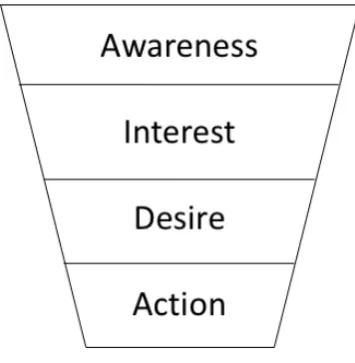
[image:5.595.206.384.512.694.2]Facebook marketing posts can be very diverse and yet, they can be categorized by their common purpose. The following section explains the nature of different content and the marketing aim behind it. Numerous models have been developed by researchers which describe the responses of viewers to advertisement. Fennis and Stroebe (2016) discuss different hierarchy-of-effects models in their book on The Psychology of Advertising. Hierarchy-of-effects models propose that several intermediate steps are needed between the exposure to an ad and a response by a consumer. In their book Fennis and Stroebe (2016) state that these models propose that consumers go through a set of three learning stages, the cognitive stage, the affective stage and the conative stage. One of these models is the AIDA model which was first introduced in 1898 by Elias St. Elmo Lewis (Strong, 1925, as cited by Fennis & Stroebe, 2016). The first stage in the AIDA funnel model is attention or awareness (cognitive stage), followed by interest, desire (affective stage), and action (behavioral stage). The model depicts the two basic functions of advertising: to inform (creating awareness) and to persuade (increasing conversion) (Fennis & Stroebe, 2016). If a consumer does not know the brand, the function of advertising is to create awareness of the brand, whereas if a consumer is aware of the brand but does not have knowledge of its attributes, advertising’s task is to educate the consumer about its features.
Figure 1 AIDA Model (Lewis, 1898)
not aware of the brand yet and gain their attention or to address consumers who are aware of the brand, but do not have knowledge of the product features yet.
Brand awareness can be gained by communicating the companies’ values or positioning in the market, by posting humorous or emotional appealing content that might be viewed and shared by many users or similar content which triggers attention (Kardes, Cronley & Cline, 2014). When users come across the content they might interact and place a bookmark or become a fan of the brand fan page to view similar content in the future, or show it to friends later and therewith engage with the brand. Brand awareness does not have to directly trigger purchase intentions, but it can help to let the brand appear in a customer’s awareness (or knowledge) set of brands as described in the “model of individual choice” by Shocker et al. (1991). The awareness (or knowledge) set of brands stores brands in the long-term memory from which information is retrieved in situations of decision-making (Shocker et al., 1991). Brands can then be moved from the awareness (or knowledge) set of brands to the consideration set of brands, from which one brand is chosen for purchase (Shocker et al., 1991). The complete model of individual choice by Shocker et al. (1991) is presented in Appendix A.
Conversion Content is directly focused on the conversion of leads to customers. It is a direct advertisement of an offer with specializations of a product and a given price as it can be found in offline marketing as well. Direct product offerings aim straight at the choice set of a potential customer to compete against other products, which might be options to choose from (see Appendix A). Conversion Content aims at picking up the customer at a later stage of the customer journey, as for example in the Consideration stage of the funnel model by Rowley (2014) in Appendix B. An offering is published on social media, a user sees the offering and is already aware of the brand, he/she considers the offering amongst all alternatives and is then converted from a lead to a customer with a purchase. Conversion Content is solemnly aimed at leading to the final stage of the customer journey, while Awareness Content may lead to conversion, but may also lead to an increase in brand equity instead of direct conversion.
The two kinds of social media content reviewed in this paper can be further explained by the push and pull strategy of marketing communication. Originally the push and pull strategy has its roots in supply chain management (Slack, Chambers, & Johnston, 2010), but has been adapted to a marketing communication context to further explain the nature of a target audience (Fill, 2009). A pull strategy aims at pulling consumers into the trade channel by communicating information about the brand (Fill, 2009). This strategy corresponds with the concept of
pushing information down the communication channel towards a consumer (Fill, 2009). This strategy corresponds with Conversion Content by naming specific product or service features to compete against other brands in a direct purchase decision of the consumer.
b. Performance Measures in Social Media
c. Content Characteristics in Social Media
the essential factor around all other aspects of the STEPPS model, which help to make the information easy to remember and easy to spread. Berger (2013) argues that a story makes information easy to share, but that it is important to make the information core of the story. The author advises to “make sure your desired information is so embedded into the plot that people can’t tell the story without it” (Berger, 2013, p.201). If the information is only a subplot of the story it is likely to get lost when the story is shared.
Figure 2Contagious STEPPS (Berger, 2013)
Contagious gives valuable insights into the psychology and behaviour behind information sharing, which marketers can implement in their strategies. The different STEPPS can also be transferred to social media marketing by finding the right content to share, stories to tell or deciding on how to address readers to make content contagious while transmitting the core information to the user.
d. Interaction with Facebook Users
sharing posts with friends. Corporate Facebook sites are also often used for customer support questions. In this paper four interaction possibilities serve as metrics to determine the marketing performance. Likes, Comments, Shares and Link Clicks of posted content are analyzed, as well as the number of impressions that content has.
e. The effect of Post Type on Marketing Performance
[image:10.595.140.443.560.730.2]To answer the research questions, the variables should be further examined. The independent variable Post Type is a dichotomous variable with the categories Awareness Posts and Conversion Posts. Facebook Posts can be clearly distinguished as one of the two categories by different characteristics. All posts which have a strong link to a product offering, namely describing features and prices or including a link to the online shop with a call-to-action, are labeled as Conversion Posts. All posts which do not have a direct link to a product or service offering and are therefore aiming at spreading non-product related content, may it be informational or entertaining, are labeled as Awareness Posts. The dependent variable Marketing Performance consists out of five categories which are measured separately for each post in the dataset. The categories likes, comments, shares, impressions and link clicks are measured as counts and describe the level of user interaction. The main effect is assumed to be controlled by the Budget, which was available for the specific posts. The effect between the independent and dependent variable is moderated by two variables, the first of which is Valuable Entertainment. This variable is derived from the STEPPS model by Berger (2013). Valuable Entertainment consists of the factors Practical Value and Stories. The remaining four factors of the STEPPS model, Social Currency, Public, Triggers and Emotion, form the moderator variable Social Emotions. The following framework results from the relationships between the variables to be tested:
The following Hypotheses derive from the framework:
H1: Awareness posts are assumed to generate more (a) likes, (b) comments, (c) shares, (d) Impressions, (e) link clicks than conversion posts.
H2: Valuable Entertainment moderates the effect between Post Type and (a) likes, (b) comments, (c) shares, (d) Impressions, (e) link clicks.
H3: Social Emotion moderates the effect between Post Type and (a) likes, (b) comments, (c) shares, (d) Impressions, (e) link clicks.
The following research design will explain how the hypotheses are tested. A differentiation is made between the effect of Post Type, including the control variable Budget, and the moderating effects of Valuable Entertainment and Social Emotion.
3. Research Design
a. Effect of Post Type
b. Effect of Moderators
[image:12.595.70.525.216.498.2]In a second step of the analysis the second research question will be answered based on a Moderator Analysis. All posts are coded on their content characteristics using the 6 STEPPS model of Jonah Berger (2013, Figure 2) and evaluated accordingly. The STEPPS are defined according to the following criteria:
Table 1 Post categorization according to the 6 STEPPS (Berger, 2013) and Post Type
Awareness Post Conversion Post
Social Currency Reactions by users bring them positive attention
Reactions to a product offering bring users positive attention
Triggers A non-related item is involved in the post which reminds users of the brand from now on
A trigger sparks interest in the product offering
Emotion High arousal emotion (positive or negative) lets users make associations with the brand and cause reactions
High arousal emotion (positive or negative) is caused by a surprising product offering
Public Reactions allow users to openly display opinions or even make private matters public (share private information or pictures)
Reactions allow users to discuss questions/concerns on product offerings publicly
Practical Value Posts give advice on certain issues and are useful for users or their network
Pure practical information on product offerings or service posts
Stories Let brand information stick, by embedding it in stories which cannot be told without the information
Embeds specific product information in a story, which cannot be told without the information
mean of all components, what makes the values for the factors comparable, no matter how many variables are part of the factor.
The PROCESS macro by Hayes (2013) in SPSS is used to test the effect of the moderators. Post Type remains to be the independent variable and the Marketing Performance metrics function as dependent variables again. Valuable Entertainment and Social Emotion are tested as moderators in the model. The moderators are tested simultaneously to avoid a Type One Error. In Type One Error the null hypotheses are rejected although they are true. Accordingly, H2 or H3 would not be rejected, even though they are false in a model where both moderators are depicted together. Model 2 by Hayes (2013) is therefore used for the analysis. The results of the analysis are evaluated and conclusions are drawn from significant effects. The analysis will lead towards conclusions on the effectiveness of specific content in the specific industry and target group of the company. The results of both analyses will be presented in the following section.
4. Results
a. Effect of Post Type
Before the main effect was tested, some general descriptive statistics were investigated and showed the following results: of the 153 posts in the dataset, 40 were conversion posts and 113 were awareness posts. A first frequency plot per month (Appendix C) showed that the distribution of awareness and conversion posts was very different during the regarded tracking period. There was a total of 96263 likes (𝑦 = 633.31, 𝑠) = 479.108) within the 152
posts which were liked. The 150 posts which were commented, revealed a total of 15052 comments (𝑦 = 100.35, 𝑠) = 215.492). 146 posts were shared a total amount of 2655 times (𝑦 = 18.18, 𝑠) = 19.443) and 152 posts reached a total number of 9470026 impressions (𝑦 = 62302.803, 𝑠) = 73543.5105).
this case is deleted from the dataset for all following analyses. The dataset contains 152 posts, of which 39 are conversion posts and 113 are awareness posts, after the outlier is deleted.
The hierarchical multiple regression analysis of the dependent variable Marketing Performance, the independent variable Post Type, and the control variable Budget reveals that the number of likes for awareness posts is significantly higher than for conversion posts (b = 0.619, t (152) = 9.513, p < 0.001). Budget has no significant influence on the effect (b = -0.017, t (152) = -0.267, p = 0.790). The Budget only accounts for 1,4% (𝑟/ = 0.014) of the variability
in the model, whereas the Post Type accounts for 37.3% (𝑟/ = 0.373). The complete model
therefore explains 38,7% (𝑟/ = 0.387) of the variability in this specific relationship. A similar
result is found for the effect of Post Type on comments (b = 0.309, t (150) = 3.964, p < 0.001). In this model Budget shows a significant influence on the effect (b = 0.247, t (152) = 3.166, p = 0.002). The Budget still only accounts for 3.2% (𝑟/ = 0.032) of the variability in the model,
but Post Type also only accounts for 9.8% (𝑟/ =0.098). The whole model explains 11,9% (𝑟/
= 0.119) of the variability. The model for shares as the dependent variable is significant (b = 0.516, t (146) = 7.097, p < 0,001). Budget shows a significant influence on the effect in the complete model (b = 0.147, t (146) = 2.019, p = 0.045), but is not significant as an individual independent variable (𝑝12345678= 0.458). Budget therefore does not significantly account for variability in the model (𝑟/ = 0.004). Post Type accounts for 26% (𝑟/ = 0.260) of the variability
and the complete model can explain 26.3% (𝑟/ = 0.263). The positive beta values for the three
dependent variables above show that awareness posts generate more likes, comments and shares. The hypotheses H1a, H1b and H1c are therefore supported. Budget influences this relationship in the cases of comments and shares. Link Clicks reveal different results than the aforementioned and show a significant, negative relationship between the variables (b = -0.437, t (140) = -5.860, p < 0.001). This implies that Conversion Posts generate more Link Clicks than Awareness Posts. Budget has a significant, positive influence on the relationship (b = 0.198, t (152) = 2.651, p = 0.009). In this case, Post Type accounts for 18.6% (𝑟/ = 0.186) of the
variability, whereas Budget accounts for only 7.3% (𝑟/ = 0.073). The whole model can explain
25.9% (𝑟/ = 0.259) of the variability. The analysis for the last dependent variable, Impressions,
reveals that there is a significant, negative relationship between Post Type and Impressions (b = -0.144, t (152) = -2.211, p = 0.029), after the effect of Budget. The Budget therefore has a positive, significant influence on the relationship. This analysis is the only one of the five performed, where Budget accounts for a larger part of the variability (𝑟/ = 0.362), than Post
Type (𝑟/ = 0.020). The complete model accounts for 38.2% (𝑟/ = 0.382) of the variability. The
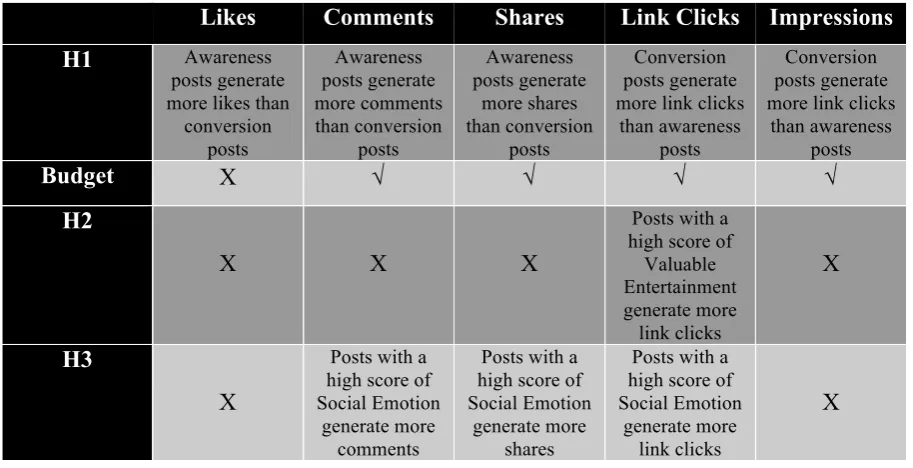
significantly higher effect than awareness posts. The hypotheses H1d and H1e are therefore rejected. Budget shows a significant influence on both relationships and is especially influential on the number of impressions of posts. A summary of the results can be found in Table 2.
b. Effect of Moderators
The factor analysis, which preceded the moderator analysis, reveals that the post characteristics load on two factors. The first factor, Social Emotion, consists of Social Currency, Triggers Emotion, and Public. The second factor, Valuable Entertainment, consists of Practical Value and Stories. The Cronbach’s Alpha for both factors lies at almost 0.7 (Social Emotion = 0.682 and Valuable Entertainment = 0.684). Even though recent literature has argued that an acceptable alpha is > 0.8, Cronbach introduced a rule of thumb for an acceptable alpha of > 0.7 originally (Peterson, 1994). George and Mallery (2003) state in their own rule of thumb, that > 0.7 is acceptable and > 0.6 is questionable (as cited by Gilem & Gilem, 2003). The alpha values in this study are therefore almost acceptable, but in any case, are questionable. The contextual relationship between variables in the factors explain that the internal consistency inclines acceptance.
significant effect for Valuable Entertainment is found, next to other significant outcomes. Valuable Entertainment has a positive effect on link clicks (b = 0.2650, t (140) = 4.5084, p < 0.001). This means that posts with a higher score on Valuable Entertainment generate a higher amount of link clicks. The outcome of the main effect analysis is confirmed as well (b = -0.5587, t (140) = - 4.5468, p < 0.001). Conversion posts generate more link clicks than awareness posts. Social Emotion shows a significant positive effect on link clicks (b = 0.1860, t (140) = 2.0757, p = 0.0398). Posts with a higher score on Social Emotion generate a larger number of link clicks. No significant interaction effects can be found in this analysis. Impressions as a dependent variable in the moderator analysis does not reveal any significant effects. In the following the results and their reasoning will be discussed, as well as possible additional influences on the effects found.
Table 2 Summary of the Test Results
Likes Comments Shares Link Clicks Impressions
H1 Awareness
posts generate more likes than
conversion posts Awareness posts generate more comments than conversion posts Awareness posts generate more shares than conversion posts Conversion posts generate more link clicks
than awareness posts
Conversion posts generate more link clicks
than awareness posts
Budget C Ö Ö Ö Ö
H2
C C C
Posts with a high score of
Valuable Entertainment generate more link clicks C H3 C
Posts with a high score of Social Emotion
generate more comments
Posts with a high score of Social Emotion
generate more shares
Posts with a high score of Social Emotion
generate more link clicks
C
5. Conclusion
6. Discussion
The results of a first data description showed variation in the distribution of awareness and conversion content over the tracking period. The largest development was seen in December 2016/January 2017, which might be explained by the introduction of a corporate blog in November 2016. Due to the characteristics of blog posts, the company mainly posted content, which was coded as awareness content in this study, during that time which led to a decrease of conversion posts. The differences in the distribution of content creation could also be influenced by the seasons, since holidays seemed to encourage awareness posts. Popular hardware product releases like the new Apple iPhone in September 2016 might also have influenced the content which is published by the company and the corresponding reactions by users.
a. Effect of Post Type
The first research question that was posed was, what the effects of Post Type in corporate Facebook posts were on marketing performance. After careful consideration of existing literature, it was hypothesized, that awareness posts would generate more likes, comments, shares, link clicks and impressions. It was further tested, whether the budget that the company in this case determined for each post, had an influence on the main effect. The regression analysis for the main effect showed that the number of likes, comments and shares is indeed higher for awareness posts, as expected in the hypotheses. It is described in the literature review that awareness posts will trigger users to interact, which will then lead to engagement with the brand. Hoffman and Fodor (2010) suggest that brand engagement can be measured by the number of likes, the number of comments, the number of user-generated items (which also appear as comments on Facebook and are measured as such in this study), usage metrics of applications and widgets, impressions-to-interactions ratio and the rate of activity. Likes and comments are very applicable in this study, as well as the addition of user-generated items incorporated in the comments counts, due to the specifications of Facebook. Shares is a measure of word-of-mouth in Hoffman and Fodor (2010), but Bonsón and Ratkai (2012) argue that stakeholder engagement can be measured by looking at the popularity, commitment and virality of posts. The corresponding measures they suggest are likes, comments and shares (Bonsón & Ratkai, 2012). The hierarchical multiple regression therefore revealed that awareness posts have significantly positive effect on brand engagement metrics.
post links lead to the web shop of the company, this outcome gives an indication towards information search and purchase intention by Facebook users. The larger number of impressions of conversion posts might be confusing at first, since it might be expected that awareness posts, which increase shares, also have more impressions. This relationship can be explained by the nature of marketing practices, though. The impressions of a post are partly a paid Facebook service used by companies. In this study, impressions are a combined measure of paid impressions and organic impressions. The control variable, Budget, gives indications towards this conclusion. Budget does not have any significant influence on the amount of likes a post gains, but has a significant positive effect on all other dependent variables. For impressions it is especially conspicuous that the budget (𝑟/ = 0.362 ), explains far more of the
variability of the model than the Post Type (𝑟/ = 0.020 ). To summarize awareness posts
generate more likes, comments and shares, as measures of brand engagement. Conversion posts generate more link clicks and impressions, as a measure of information search, purchase intention and reach, while impressions are highly influenced by the budget.
b. Effect of Moderators
The second research question inquired what the moderating effect of Valuable Entertainment and Social Emotion was on the effect between Post Type and Marketing Performance. After the theoretical relationship of the STEPPS model by Berger (2013) and the Marketing Performance was discussed, it was hypothesized that both Valuable Entertainment and Social Emotion would moderate the relationship of the main effect.
The moderator analysis reveals that there is no significant moderating effect for likes. This might be explained by the nature of likes. Hitting the like button on Facebook for posts is an action which requires little effort and therefore there is no clear pattern which characteristics are likes more. The result of the regression analysis, that budget does not have an effect on the relationship of Post Type and likes, give another indication that the content, scope and elaborateness of a post is not decisive for its effectiveness. Likes cannot be bought, as this analysis reveals. The type of the post (awareness or conversion) is the only significant trigger for likes found in this study.
Compared to likes, commenting or sharing a post of a company, takes a lot more effort and consideration by the user. Regarding the components of the two moderators, this effect can be explained. Social Emotion consists of Social Currency, Public, Triggers and Emotion. All of these components animate users to state their opinion and openly display their reaction to a post. Users who expect to gain Social Currency by reacting to a post, will have to put more effort into it than liking the content. They will have to comment on or share the post to gain the added value of social currency. Making private matters public presupposes a reaction like commenting or sharing. Triggers do not necessarily require commenting or sharing, but Emotion with high arousal, as explained by Berger (2013), animates people to communicate their reaction and share content. The nature of Social Emotion therefore explains its moderating effect to a large extent.
Valuable Entertainment on the other hand has a moderating effect only on link clicks. Its components Practical Value and Stories also give some indication on the reason behind the moderating effect. A lot of the links posted by the company either lead to the web shop or the corporate blog. Links to the web shop have high practical value, as do many of the blog entries which provide useful information. The blog also contains information which is embedded in stories and therefore has high scores on Stories. The total number of blog links is relatively low compared to the other posts (27 out of 152), due to the introduction of the blog towards the end of the tracking period. This fact also gives an indication why link clicks are still higher for conversion posts. There are 33 posts containing a link within the total of 39 conversion posts, and only one blog entry within the conversion posts. In the near future, the relationship between Post Type and Link Clicks might change, if more blog posts are published on the corporate Facebook page, because the blog posts are awareness posts to a large extend. The moderating effect could change as well, if more stories and practically valuable content is published through the blog and users feel the urge to comment or share this Valuable Entertainment with their network, the moderating effect of Social Emotion could lose meaning. As expected due to the insights gained through the results of the main effect, impressions are neither moderated by Social Emotion, nor by Valuable Entertainment. The crucial factor influencing impressions seems to be the budget.
c. Recommendation
media marketing, are relevant for this specific case, but must be carefully considered for the specific case of other companies that wish to use them. A generalization for the guidelines is assumed in this paper, but they might deviate for a larger dataset.
Table 3 Guidelines for effective Facebook Content Marketing
Guideline #1
Use awareness posts to generate a high number of likes, comments or shares, and therewith increase brand engagement.
Guideline #2
Use conversion posts to generate a high number of link clicks and impressions, and therewith increase the reach, information search and purchase intention.
Guideline #3
Increase the budget for a post if a wide reach is important in the corporate Facebook marketing tactic.
Guideline #4
Make sure the awareness content appeals to Social Emotion factors to generate more comments, shares and link clicks.
Guideline #5
Make sure the awareness content appeals to Valuable Entertainment factors to generate more link clicks.
d. Limitations and Implications for Future Research
that were measured, even though it can be explained with theoretical insights. It would therefore be a very interesting implication for further research to use the insights gained in this study and conduct a similar study again at a later point of time, after the corporate blog has been fully incorporated into the Facebook marketing tactics of the company and fully accepted by the users.
7. Acknowledgements
References
American Marketing Association (2017). Definition of Marketing. Retrieved from https://www.ama.org/AboutAMA/Pages/Definition-of-Marketing.aspx
Babbie, E. R. (2013). The practice of social research (Thirteenth edition. ed.). Belmont, Calif.: Wadsworth Cengage Learning.
Berger, J. (2013). Contagious : why things catch on. London: Simon & Schuster.
Blanchard, O. (2011). Social Media ROI: Managing and Measuring Social Media Efforts in Your Organization: Pearson Education.
Boddy, D. (2011). Management: An Introduction (Fifth Edition ed.): Pearson Education, Limited.
Bonsón, E., & Ratkai, M. (2013). A set of metrics to assess stakeholder engagement and social legitimacy on a corporate Facebook page. Online Information Review, 37(5), 787-803. doi:doi:10.1108/OIR-03-2012-0054
de Vries, L., Gensler, S., & Leeflang, P. S. H. (2012). Popularity of Brand Posts on Brand Fan Pages: An Investigation of the Effects of Social Media Marketing. Journal of
Interactive Marketing, 26(2), 83-91. doi:10.1016/j.intmar.2012.01.003 Dholakia, U. M., Bagozzi, R. P., & Pearo, L. K. (2004). A social influence model of
consumer participation in network- and small-group-based virtual communities. International Journal of Research in Marketing, 21(3), 241-263.
doi:10.1016/j.ijresmar.2003.12.004
Dholakia, U. M., & Durham, E. (2010). One Cafe Chain's Facebook Experiment. Harvard business review, 88(3), 26-26.
Duboff, R., & Wilkerson, S. (2010). Social Media ROI Marketers are seeking to answer the" greatest question.". Marketing Management, 19(4), 32.
Facebook. (2017). Facebook-Hilfebereich. Retrieved from
https://www.facebook.com/help/794890670645072/?helpref=hc_fnav
Fennis, B. M., & Stroebe, W. (2015). The Psychology of Advertising: Taylor & Francis. Fill, C. (2009). Marketing Communications: Interactivity, Communities and Content: Prentice
Hall/Financial Times.
Fisher, T. (2009). ROI in social media: A look at the arguments. Journal of Database Marketing and Customer Strategy Management, 16(3), 189-195.
doi:10.1057/dbm.2009.16
Gandomi, A., & Haider, M. (2015). Beyond the hype: Big data concepts, methods, and analytics. International Journal of Information Management, 35(2), 137-144. doi:http://dx.doi.org/10.1016/j.ijinfomgt.2014.10.007
Gliem, J. A., & Gliem, R. R. (2003). Calculating, interpreting, and reporting Cronbach’s alpha reliability coefficient for Likert-type scales.
Hayes, A. F. (2013). Introduction to Mediation, Moderation, and Conditional Process Analysis: A Regression-Based Approach: Guilford Press.
Hoffman, D. L., & Fodor, M. (2010). Can you measure the ROI of your social media marketing? MIT Sloan Management Review, 52(1), 41.
Hoyer, W. D., & Brown, S. P. (1990). Effects of Brand Awareness on Choice for a Common, Repeat-Purchase Product. Journal of Consumer Research, 17(2), 141-148.
doi:10.1086/208544
Kaplan, A. M., & Haenlein, M. (2010). Users of the world, unite! The challenges and opportunities of Social Media. Business Horizons, 53(1), 59-68.
doi:10.1016/j.bushor.2009.09.003
Kardes, F., Cronley, M., & Cline, T. (2014). Consumer behavior: Cengage Learning.
Merisavo, M. (2007). The Effects of Digital Marketing Communication on Customer Loyalty: An integrative Model and research Propositions Master Thesis. Helsinki School of Economics. Helsinki, Finland.
Owyang, J. (2007). Web Strategy: How to Measure your Social Media Program | Web Strategy by Jeremiah Owyang | Digital Business. Retrieved from http://www.web- strategist.com/blog/2007/06/07/web-strategy-how-to-measure-your-social-media-program/
Peters, K., Chen, Y., Kaplan, A. M., Ognibeni, B., & Pauwels, K. (2013). Social media metrics - A framework and guidelines for managing social media. Journal of Interactive Marketing, 27(4), 281-298. doi:10.1016/j.intmar.2013.09.007 Peterson, R. A. (1994). A Meta-analysis of Cronbach's Coefficient Alpha. Journal of
Consumer Research, 21(2), 381-391. doi:10.1086/209405
Rachlin, R. (1997). Return on Investment Manual: Tools and Applications for Managing Financial Results: Sharpe Professional.
Ramsaran-Fowdar, R. R., & Fowdar, S. (2013). The implications of Facebook marketing for organizations. Contemporary Management Research, 9(1), 73.
Rowley, J. A. (2014, 2014-06-25). Measuring customer journey success | John Alexander Rowley. Retrieved from http://www.johnalexanderrowley.com/measuring-customer-journey-success/
Shocker, A. D., Ben-Akiva, M., Boccara, B., & Nedungadi, P. (1991). Consideration set influences on consumer decision-making and choice: Issues, models, and suggestions. Marketing letters, 2(3), 181-197.
Slack, N., Chambers, S., & Johnston, R. (2010). Operations Management: Financial Times Prentice Hall.
Smith, K. L. (2007). New Marketing - What is digital marketing? Retrieved from http://digitalmarketing101.blogspot.com/2007_09_30_archive.html
Sterne, J., & Scott, D. M. (2010). Social Media Metrics: How to Measure and Optimize Your Marketing Investment: Wiley.
Trusov, M., Bucklin, R. E., & Pauwels, K. (2009). Effects of Word-of-Mouth Versus
Appendix
A. A model of individual choice (Shocker et al., 1991)