COLOPHON
M.E. BRINKHUIS
Business Information Technology MASTER THESIS
DATE
August 3, 2015
VERSION 1.0 STATUS Final version PROJECT
IMPROVING THE MEDICAID ELIGIBILITY DETERMINATION PROCESS USING BIG DATA
AUTHOR M.E. Brinkhuis PHONE
+316 389 77 674 E-MAIL
SUPERVISORS
PREFACE
When I was in high school I saw advertisements from the University of Twente, displaying the slogan: ‘Do you want to become the next Bill Gates? Choose Business & IT’. A message that sounded tempting. Now, 7 years later, I must conclude that I only partially succeeded. I made it to the United States, and learned a lot about the field of business and IT. However: we have our differences. Bill Gates dropped out of a university study, whereas I just try to finish it. And that’s why this thesis is written: hopefully the last few miles to a new milestone on the road of success.
When starting with this thesis, I expected the opportunity to apply the knowledge I gathered during the years of studying Business Information Technology at the University of Twente. Surprisingly, next to applying knowledge, working on this thesis turned out to be an opportunity to learn much more. From getting to know the workings of mainframe database systems to applying machine learning algorithms on large datasets. From creating dashboards in Qlikview to getting to know the playing field of managing government IT systems. And to finish it all: getting to know the United States of America.
I got the chance to write my thesis at Clemson Computing and Information Technology. For making this possible I want to thank Dallas Thornton. However, next to having a place to do research, also people who monitor the scientific quality are needed. Therefore I want to thank Chintan Amrit and Robin Aly, who provided me with lots of feedback on how to improve this thesis.
Hopefully this thesis brings valuable insights to you.
ABSTRACT
The United States spend a lot of money on their healthcare systems. The program Medicaid is part of the healthcare system. In this research the Medicaid application process is analyzed. A literature review on the state of art of this process is conducted, as well as a review on healthcare fraud. The topics are selected based on a classification of healthcare waste by (Hackbarth 2012). There is little literature available on the Medicaid application process and implications itself. The available literature mentions the language, method of application and evidence that citizens need to provide as the factors influencing this process. A 24 factor classification of healthcare fraud is provided based on existing literature. The application data from the Medicaid program in the state of South Carolina is analyzed using machine learning technologies in order to find stages in the application process where waste occurs. Based on this analysis the author recommends to use more external data sources for the validation of information, and to create better tools to monitor the Medicaid application process.
Keywords:
MANAGEMENT SUMMARY
Context
Health care spending contributes to a significant part of the U.S. government spending. One of the government-run programs is Medicaid, on which the spending in 2012 was 415 billion U.S. Dollars on a national level. Since this is taxpayer’s money being spent, taxpayers demand from the government that it is spent well. So, the question arises: is it spend well? Do the people who need Medicaid really have access to it? In this thesis the focus is on the eligibility determination process, which from a citizen perspective is also known as the Medicaid application process. This research is conducted at Clemson Computing and Information Technology (CCIT), which manages the IT systems for South Carolina Department of Health and Human Services (SCDHHS). SCDHHS manages the Medicaid program for the state of South Carolina.
Objectives
The objective of this research is to improve the Medicaid application process. CCIT/SCDHHS know that often applications take a long time to process, and for some applications the eligibility is determined the same day as the application date. In this research the objective is to find out why these differences exist, based on a dataset of Medicaid applications. The central research question that this research answers is:
How can the Medicaid eligibility determination process be optimized?
Methods
Based on a classification of waste in healthcare by (Hackbarth 2012) two important areas are identified: administrative complexity and fraud. The research starts by performing a literature study into those two topics. Secondly three machine learning technologies (Support Vector Machines, Random Forests and Neural Networks) are applied on a dataset containing Medicaid application information. Based on the knowledge from literature, and the findings of the data mining approach, conclusions will be drawn.
Results
with their application. 24 Areas of healthcare fraud are identified, of which two are related to the Medicaid application process: identity fraud and misrepresenting one’s eligibility.
Of all ‘hard case’ applications processed by case workers, online applications take the longest time to complete. ‘Hard cases’ are defined as follows:
An application submitted online, that needs a caseworker to be completed
Applications submitted on paper, by phone and in person, that need at least one evidence item to be verified by a caseworker.
Total ‘Hard cases’ On time Too late
Online 28493 2137 482 1655
Paper 10408 9513 8634 879
Phone 40 37 30 7
In person 453 424 421 3
The online process is further analyzed. Of all applications that are handled too late, the majority is processed after 75 days after submission. A set of characteristics of an application is selected (independent variables) and correlations between those characteristics and the processing time are calculated. No strong correlations are found.
Secondly three machine learning algorithms are trained on the dataset. The selected algorithms are Support Vector Machines, Random Forests and a Neural Network. All executed tests had unsatisfying accuracies, all below 50% accuracy. Of the excluded variables the Method of Application seems to have the biggest influence: the accuracy is lowest when this variable is excluded from the dataset. The best performing data mining method are neural networks. Even though accuracies are low in general in this case, neural networks tend to give the ‘highest’ accuracy. However, the difference between the three algorithms was small in most cases. This algorithm is able to predict with an accuracy of 47,92 percent if an application would be handled on time. However, based on this result it turns out that even the best performing method used in this research does not provide sufficient performance to be usable.
Conclusions
Medicaid application process. Data analysis shows that a high percentage of online applications that are handled by caseworkers are completed after 45 days: over 77 percent.
CONTENTS
List of figures X
List of tables XI
Acronyms XII
1 Introduction 1
1.1 Context 1
1.2 Research motivation 3
1.3 Research questions & objectives 3
1.4 Relevance of this study 5
1.4.1 Scientific relevance 5
1.4.2 Relevance for CCIT 5
1.5 Stakeholder analysis 6
1.6 Structure of this report 7
2 An introduction to medicaid 8
2.1 Medicaid versus Medicare 8
2.2 Healthcare fraud schemes 9
3 Theoretical framework 11
3.1 Methodology 11
3.2 The Medicaid application process 14
3.3 Fraud types described in literature 16
3.4 Data mining methods 21
3.4.1 Clustering 22
3.4.2 Outlier detection 23
3.4.3 Classification & Decision trees 24
3.5 Conclusion 25
4 Research method 27
4.1 Selection of the research method 27
5 Artifact description 30
5.1 Current systems 30
5.1.1 Cúram 32
5.1.2 MMIS 32
5.1.3 Interfaces 32
5.1.4 Reporting 32
5.1.5 From Cúram and MEDS to MMIS 33
5.2 Selecting the data 35
5.3 Selecting data mining methods 41
6 Data analysis 44
6.1 Exploratory data analysis & data mining 44
6.2 Predicting the number of days 49
6.3 Discussion of results 50
7 Conclusion 52
7.1 Medicaid enrollment 52
7.2 Healthcare fraud 53
7.3 Data involved in the Medicaid application process 53
7.4 Data mining method 54
7.5 Evaluation 55
7.6 Conclusion of this research 56
8 Recommendations 57
8.1 Recommendations for science 57
8.2 Recommendations for practice 58
8.2.1 Incorporation of more external data sources 58
8.2.2 Process monitoring 60
References 62
Appendix A – Literature 70
Appendix B – Query used for dataset creation 75
LIST OF FIGURES
Figure 1 - Stakeholder categories related to ccit ... 6
Figure 2 – Managed care fraud types (National Medicaid Fraud and Abuse Initiative 2000) ... 9
Figure 3 - Search query to find medicaid enrollment literature ...11
Figure 4 - Search query used for this literature review ...12
Figure 5 - literature study topics ...13
Figure 6 - Incidence of health insurance fraud types in literature ...21
Figure 7 - Fraud detection methods in literature ...22
Figure 8 - MEDS, MMIS, Cúram relationship ...33
Figure 9 - From MEDS and MMIS to MMIS ...34
Figure 10 - Basic MEDS datastructure ...35
Figure 11 - Cúram enrollment homepage ...36
Figure 12 - eligibility decision workflow ...37
LIST OF TABLES
Table 1 - Six categories of waste ... 2
Table 2 - Medicaid and Medicare eligibility requirements ... 8
Table 3 - Mapping of chapters to the research method ...29
Table 4 - MAGI versus non MAGI groups ...31
Table 5 - Tables used to create dataset ...38
Table 6 - Elements of the created dataset ...40
Table 7 - Spread of application processing times ...44
Table 8 - TImeliness of applications by method ...45
Table 9 - Correlation between variables and number of days, by application method ...47
Table 10 - Crámers V-values for categorical correlations by application method ...48
Table 11 – Percentage of applications that require a certain type of evidence to be validated ...48
Table 12 - performance of machine learning algorithms on dataset. percentages...50
ACRONYMS
ADR Action Design Research
BENDEX Beneficiary and Earnings Data Exchange
BI Business Intelligence
CCIT Clemson University Computing & Information Technology
DM Data Mining
DMV Department of Motor Vehicles
DRA Deficit Reduction Act
DSM Design Science Methodology
DSRM Design Science Research Methodology
FPL Federal Poverty Line
KD Knowledge Discovery
KDD Knowledge Discovery in Databases
KDP Knowledge Discovery Process
MAGI Modified Adjusted Gross Income
MCO Managed Care Organization
SCDHHS South Carolina Department of Health and Human Services
SC South Carolina
SSN Social Security Number
USCIS United States Citizenship and Immigration Services
1
INTRODUCTION
Health care spending contributes to a significant part of the U.S. government spending. One of the government-run programs is Medicaid, on which the spending in 2012 was 415 billion U.S. Dollar on a national level. Since this is taxpayer’s money being spent, taxpayers demand from the government it is spent well. The question arises: is it spend well? Do the people who need Medicaid really have access to it?
Approaches for monitoring and analyzing the processes that accompany the Medicaid program are needed. This research aims at improving the methods. In this chapter the context of this research will be introduced, as well as the research objectives and questions. Furthermore, an outline is provided for the rest of this document.
1.1 Context
Medicaid is a social health care program for U.S. citizens with low income and limited resources. The program is managed by individual states, and funded by a combination of government and state funding. All U.S. Citizens having an income up to 133% of the poverty line qualify for enrollment in the Medicaid program. On the state level the program is managed by the South Carolina Department of Health and Human Services (SCDHHS). SCDHHS has outsourced their IT operations to CCIT: The Clemson University Computing & Information Technology department.
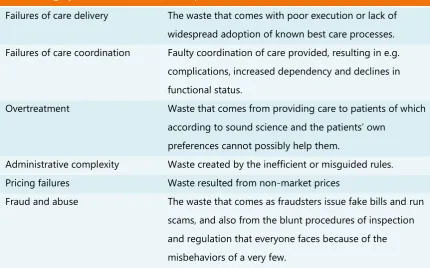
In the fiscal year 2012 the total spending on the Medicaid program summed up to 415 billion U.S. dollar. 4,8 Billion U.S. dollar of this total was spent in the state of South Carolina (The Henry J. Kaiser Family Foundation 2015). Since this is taxpayer’s money people demand from the government that it is spent well. However, even low estimates show that in six categories of waste 20% of the total health care expenditures is lost (Hackbarth 2012). The six categories of waste are shown in Table 1.
Waste category Description
Failures of care delivery The waste that comes with poor execution or lack of widespread adoption of known best care processes. Failures of care coordination Faulty coordination of care provided, resulting in e.g.
complications, increased dependency and declines in functional status.
Overtreatment Waste that comes from providing care to patients of which according to sound science and the patients’ own
preferences cannot possibly help them.
Administrative complexity Waste created by the inefficient or misguided rules. Pricing failures Waste resulted from non-market prices
[image:14.595.86.517.126.394.2]Fraud and abuse The waste that comes as fraudsters issue fake bills and run scams, and also from the blunt procedures of inspection and regulation that everyone faces because of the misbehaviors of a very few.
TABLE 1 - SIX CATEGORIES OF WASTE (HACKBARTH 2012)
The enrollment process is one of the administrative processes. Citizens can apply for Medicaid using several methods: there is an online portal, a phone number, people can apply by paper forms or visit an office. Applications are processed by a computer system, called an eligibility determination system. If the system is not able to process the application, for example because some information cannot be automatically validated, a SCDHHS employee will look into the case and resolve the issues. These employees are called case workers.
On one side South Carolina has very strict rules compared to some other states when it comes to eligibility, while on the other side the state tries to actively find people who are eligible but are not enrolled yet (Galewitz 2013). Therefore, having an optimized enrollment process is important. However: the processing time for applications submitted by citizens varies significantly. For one citizen it might take just 2 days before his or her eligibility has been determined, while another citizen that applies on the same day might have to wait 50 days before a final eligibility decision is made.
make it easier for people to get falsely enrolled. These people can wrongly declare money from the Medicaid program. This is an example of ‘Fraud and abuse’ in Hackbarth’s classification, where the application process in general might suffer from ‘Administrative complexity’.
1.2 Research motivation
The healthcare domain is a complex setting. There are many different actors involved, and the number of entities is enormous. Data can be noisy due to the fact that all information is entered by humans and processed by humans. Furthermore Medicaid data is stored fragmented in several systems, as explained before.
This introduces the problem this research focuses on. How can we find ways to optimize the enrollment process? A lot of money is spent on the Medicaid program, and it is important its spent well. Linking the classification of (Hackbarth 2012) to the Medicaid enrollment process creates a presumption there is room for improvement. Bottlenecks in the enrollment process can be identified and removed. And if there are ways to optimize the enrollment process, the processing time for applications will go down. Case workers can then spend more time on individual cases that really need attention, resulting in a smaller chance of fraud taking place and taking more time to help the people that really need the Medicaid program.
1.3 Research questions & objectives
Based on the identified problem a research goal can be formulated. Since the problem can be addressed by designing a solution, this research is structured according to the Design Science Methodology (DSM) approach (Wieringa 2014). Wieringa provides a template for design problems, which helps to clarify the relation between the problem context, artifact, requirements and goals. The research goal can be structured according to the following template:
Improve the problem context
By treating it with a (re)designed artifact Such that artifact requirements
In order to stakeholder goals
applied and compared. This artifact interacts with a certain context, which is in this case the enrollment process itself. The interaction of the artifact with the context introduces the requirements. The requirement is to reduce the processing time of Medicaid applications, in order to reduce waste in the Medicaid application process.
Together these elements result in the following research goal:
Improving the Medicaid application process By developing an approach to identify bottlenecks Such that the application processing time can be reduced In order to reduce waste in the application process
This research goal can be translated to the following research question:
How can the Medicaid eligibility determination process be optimized?
A number of sub questions will help answering the research question. The research starts with getting insights in literature on the Medicaid enrollment process and healthcare fraud in general. Medicaid enrollment is program-specific. Fraud however is a broader topic, and therefore healthcare fraud in general will be discussed. This answers the first sub question:
SQ1. What is the state-of-art in literature regarding Medicaid enrollment processes? SQ2. How can Medicaid enrollment fraud types be classified?
The available systems contain a lot of data, stored in extended structures. There are multiple systems in use, and each of them contains over 300 tables. A selection has to be made to these data sets in order to create a data model only including the right and relevant information to analyze the Medicaid application process. The second sub question reads as:
SQ3. What data is needed to analyze the Medicaid application process?
SQ4. What is the best suitable data mining approach to analyze the Medicaid application process?
Finally, the performance of the selected data mining method on the created dataset will be evaluated:
SQ5. What do the results of the data analysis tell about the Medicaid application process?
1.4 Relevance of this study
The research will be conducted at CCIT. This introduces a need for both a scientific relevance as well relevance for CCIT.
1.4.1 Scientific relevance
This research contributes on multiple aspects to the scientific field. Firstly it will provide a classification of health care fraud types. Using an extensive literature study an overview of the field will be created. Second contribution is the application of machine learning methods on the Medicaid enrollment dataset, providing insights in the Medicaid enrollment process. Third, the literature study on Medicaid enrollment processes will provide an overview of the most discussed items related to the enrollment process.
1.4.2 Relevance for CCIT
CCIT wants to provide SCDHHS with insights in the Medicaid application process from a data perspective. Currently there are no real BI implementations in use. This research introduces the first steps in the field of data mining aimed at process optimization. This research contributes to this project by both developing the data model to analyze the application process, as well as by providing information based on that analysis.
1.5 Stakeholder analysis
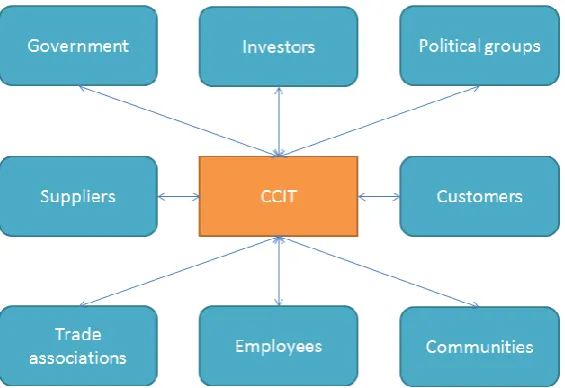
[image:18.595.165.448.263.457.2]It might sound a bit confusing: Medicaid is managed by individual states. In the case of South Carolina it is managed by SCDHHS. The IT operations are managed by Clemson University’s CCIT. To start with a good understanding of the playing field a stakeholder analysis is conducted. The approach designed by (Clements and Bass 2010) is followed. They identify several groups of stakeholders related to a company. The company in this case is CCIT, and its relationship with other entities is depicted in Figure 1.
FIGURE 1 - STAKEHOLDER CATEGORIES RELATED TO CCIT
Each of the groups will be discussed. Some of them turn out not to be relevant to this project, while other groups might consists of several stakeholders, each having their own interests. Trade associations and communities are not relevant in this particular project, from the perspective of CCIT, and they will therefore not be discussed.
Government CCIT is maintaining the system for the government. This makes the government a stakeholder. The government is also a stakeholder in a non-customer way. When working with personal identifiable data (PII) and personal healthcare information (PHI), legislation exists. An example is HIPAA: the Health Insurance Portability and Accountability Act which prescribes how sensible data should be treated.
groups that come up for privacy and spending taxpayers’ money well might have interests that need to be taken into account. There is however no direct relation between CCIT and political groups.
Suppliers Software from several vendors is used. Mainframe systems use IBM software, linked with database software from CA (Computer Associates). Mainframes are migrated to IBM Cúram software, which uses Oracle database technology to store data.
Customers CCIT manages the IT systems for SCDHHS. SCDHHS is therefore the customer. When taking end users also into account more customers exist: citizens, caseworkers and SCDHHS management use the IT applications to apply for Medicaid and manage the Medicaid program.
Employees Employees are a stakeholder because they develop the system, and they maintain the relationship with the customer. Business analysts work with SCDHHS to design a system which fits the needs of SCDHHS. Programmers develop the system, and the quality assurance department verifies the work.
Investors CCIT works on the Medicaid project having one customer: SCDHHS. SCDHHS is therefore the one and only investor in the project. Based on the money SCDHHS invests in the Medicaid project, CCIT can hire more employees and invest more time in the project.
1.6 Structure of this report
2
AN INTRODUCTION TO MEDICAID
This chapter introduces the Medicaid and Medicare programs and explains the differences between them (2.1). Furthermore, in anticipation of the structured literature study of chapter 3, section 2.2 describes the current vision on Medicaid fraud from a government perspective.
2.1 Medicaid versus Medicare
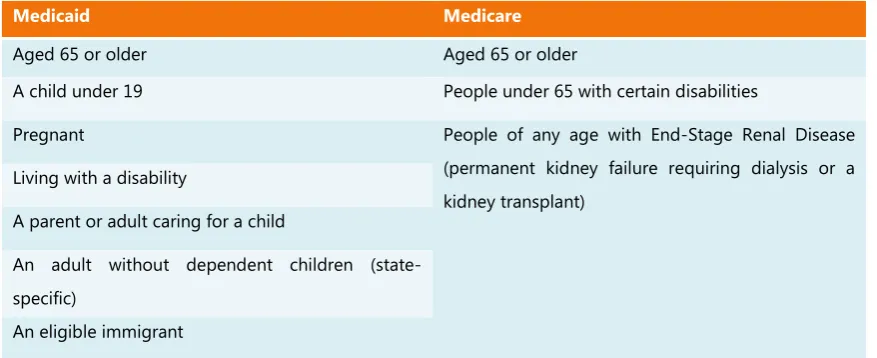
In the United States two government-run health insurance programs are available for specific groups of citizens: Medicare and Medicaid (Department of Health and Human Services 2015). Medicare is health insurance for people ages 65 or older, people under 65 with certain disabilities and people of any age with End-Stage Renal Disease (permanent kidney failure requiring dialysis or a kidney transplant).
The Medicaid program is a health insurance program for people U.S. citizens with low income and limited resources or people with disabilities. The program is funded by both the federal government and the individual states. Medicaid is managed on a state-level. The precise requirements for citizens to be eligible differ on state-level too, because federal guidelines can be implemented in different ways. Approaches for handling the Medicaid program are thus unique to all states. The specifics of both Medicare and Medicaid are shown in Table 2. Related to the Medicaid program is CHIP: Children’s Health Insurance Program. This provides health coverage to children, both under Medicaid and separate CHIP programs (Medicaid.gov 2015). The enrollment systems used in South Carolina are used for both Medicaid and CHIP eligibility determination.
Medicaid Medicare
Aged 65 or older Aged 65 or older
A child under 19 People under 65 with certain disabilities
Pregnant People of any age with End-Stage Renal Disease
(permanent kidney failure requiring dialysis or a kidney transplant)
Living with a disability
A parent or adult caring for a child
An adult without dependent children (state-specific)
[image:20.595.85.524.575.754.2]In the state of South Carolina Medicaid is managed by SCDHHS. The IT-systems are outsourced to CCIT, as explained earlier on. The IT operations include several parts of the Medicaid program, of which the two most important are the systems for eligibility determination and claim handling. Claim handling consists of processing the claims and paying the claims. All systems also generates reports, that are used within SCDHHS but also sent to other government instances. The Centers for Medicare and Medicaid Services (CMS) for example require reports from SCDHHS.
2.2 Healthcare fraud schemes
As stated in chapter 1 one of the focus areas of this research is healthcare fraud. This can be analyzed not only from a scientific perspective, but also by analyzing what the government has published about this topic. In this sub chapter this will be done. The sources analyzed include publications from the U.S. government, which is fighting health care fraud, and the National Medical Fraud and Abuse Initiative (NMFAI), which helps organizations ‘in the field’ combat fraud and abuse.
[image:21.595.95.514.634.703.2]First we will discuss the ways of fraud as identified by the U.S. government and NMFAI, followed by the literature study. The National Medicaid Fraud and Abuse Initiative makes a distinction between fraud and abuse (National Medicaid Fraud and Abuse Initiative 2000). They identify the terms as follows. Fraud is an intentional deception or misrepresentation made by a person with the knowledge that the deception could result in some unauthorized benefit to himself or some other person. Abuse on the other hand is provider practices that are inconsistent with sound fiscal, business or medical practices and result in unnecessary cost to the Medicaid program, or in reimbursement for services that are not medically necessary, or that fail to meet professionally recognized standards for health care. It also includes beneficiary practices that result in unnecessary costs to the Medicaid program. The Initiative identifies six fraud and abuse risk areas. These are shown in Figure 2.
The Office of the Inspector General of DHHS (OIG) publishes a yearly compendium (OIG US DHHS 2014a), in which they give recommendations that are unimplemented and would most positively impact Health and Human services programs. Medicaid is one of these programs. They identify the problem of citizens who have been wrongly determined eligible too. With respect to Medicaid and Medicare the OIG identifies three groups of people that shouldn’t be eligible:
Incarcerated beneficiaries
Unlawfully present beneficiaries
Deceased beneficiaries
3
THEORETICAL FRAMEWORK
A structured literature review is performed to identify the concepts related to Medicaid enrollment, health insurance fraud and the detection of these fraud types. By following a structured approach the quality of the work can be safeguarded. We follow the approach described by (Webster and Watson 2002). Section 3.1 will explain the methodology, whereas in section 3.2 the literature on Medicaid enrollment process will be discussed. Section 3.3 describes the results in the field of health insurance fraud. Section 3.4 focusses on the use of machine learning for the detection of fraud. Conclusions will be drawn in 3.5.
3.1 Methodology
(Webster and Watson 2002) describe the concept matrix as one of the approaches to a literature study. In this review this matrix is used to identify fraud types, and generate an overview of which authors discuss which types of health insurance fraud. To get to know the current state of literature on Medicaid enrollment processes the selected articles have been read, and the relevant concepts found in the papers are discussed.
For the general identification of papers, a five-step approach has been taken:
1. Identify the set of keywords
2. Refine keywords based on result set
3. Filter results by title, filter out non-supported languages and clearly non-related articles 4. Filter results by reading abstracts
5. Identify concepts by reading resulting articles in more detail
The search for work related to Medicaid enrollment (Q1) the query in Figure 3 is used. The aim is
to find literature related to the Medicaid application process, which is an enrollment process. After executing the query, the result set included a lot of irrelevant results which contained the keyword ‘enrollees’. Therefore articles containing that keyword in their title are not included.
Due to the relation between health care fraud, and ways of detecting it, it is not inconceivable that some papers describe concepts related to both topics. One can imagine an article Q1: TITLE ( Medicaid AND (eligible OR eligibility OR application OR enroll*) AND NOT enrollees
introducing some type of health insurance fraud, and subsequently describing an approach how to detect this type of fraud using a specific data mining approach.
Both concepts can be captured in one search query, which is shown in Figure 4 (Q2). A paper discussing ways to detect fraud is likely to use the word fraud in its title, as so is a paper purely describing health fraud types. Fraud related to or the health insurance programs, or the Medicaid program specifically is interesting for this research. The terms “health”, “healthcare”, “medical insurance” cover the whole spectrum of potential interesting articles. Even though the focus of this research is on enrollment fraud, searching for fraud in a broader scope helps to put this type of fraud in the right perspective. The broad search provides insight in how different types of fraud might relate together.
The combination of eligibility and the healthcare related topics results in enormous result sets, containing a variety of unrelated topics. In the other way, the combination of fraud and eligibility returns a result set that has to be narrowed down with one of the healthcare related keywords that is in the query below already. Thus the query in Figure 4 covers also the topic of eligibility in
relation to fraud.
Two scientific search engines are used to find articles: Scopus and Web of Science. Both have a good coverage of technical articles (related to data mining for fraud detection for example), as well as medical coverage. Web of Science also searches through PubMed, a primary database containing citations of biomedical literature. Only articles written in English will be included in the search. Furthermore, citations and patents are excluded. Only journal articles and scientific papers are included. In the case of enrollment only articles published after 1994 are taken into account, in order to not have to go through outdated articles.
Exclusion criteria are as follows for Q1. Articles have been selected if they were about the enrollment process and characteristics of that process. A lot of articles discussed the influence of Medicaid enrollment on access to healthcare, or on the treatment of specific diseases. These articles are not relevant, since our aim is to identify articles that might explain why might not enroll for Medicaid and what aspects of the enrollment process have been discussed in literature.
Q2: TITLE ( ( Medicaid OR "health" OR “healthcare” OR "medical insurance" ) AND fraud )
For Q2 the following exclusion criteria are used. Results were excluded from the initial listings if the articles discussed only specific fraud cases (e.g. an analysis of a fraud case that was in the news). Even though filters were in place, some results were not in English and had thus to be removed. Also, news articles have been removed. The included articles discuss types of healthcare fraud as a phenomenon, or are scientific publications about the detection of such fraud types using data mining methods.
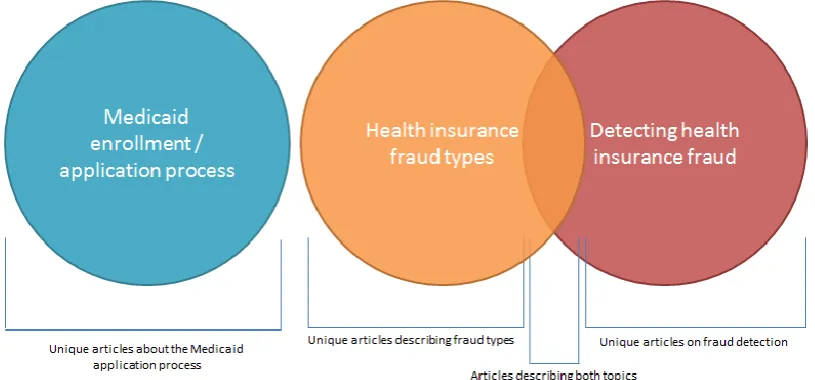
[image:25.595.107.515.307.497.2]Figure 5 shows that some papers might belong only to one of the two topics, while other papers might touch on both fraud descriptions and methods for detecting the fraud.
FIGURE 5 - LITERATURE STUDY TOPICS
Q1 resulted in over 600 search results, which after filtering out duplicated, and assessing them on solely the title resulted in a list of 114 articles. Of those 114 articles the abstract is assessed, resulting in a final set of 12 papers that were really about the topic we are researching.
3.2 The Medicaid application process
There is little literature available in the area of the Medicaid enrollment process from a more technical perspective. Most search results, which were deemed irrelevant for this research, describe the enrollment policies. A small number of authors however examined the enrollment process itself., with the majority of papers focusing on the enrollment of children into Medicaid/CHIP. (Hansen et al. 2011) examined the readability of Spanish Medicaid application forms. They conclude that most application forms use small font sizes and lack adequate white space. Furthermore, the language used is too complex, and they recommend following low-literacy guidelines to improve the accessibility for eligible Spanish speaking families.
When a citizen applies for Medicaid the citizen needs to provide information about his personal situation and his income. (Lessner 2006) describes the implications when more years of evidence are required to assess eligibility. For long-term care local Medicaid agencies need to assess eligibility information for several years. Lessner states that it is harder for families to gather all required information if the number of years they need to provide information on increases, but also this will lead to increased processing times at local Medicaid offices.
Another finding mentioned by (Hatch et al. 2014)is that there are no significant differences because of race, nationality or parental language when it comes to a right eligibility decision. (Kenney et al. 2012) also discussed the issue of language, and finds that parents not being a citizen and being unable to speak English is associated with lower Medicaid participation. It is suggested that this is possibly due to problems navigating enrollment systems or a lack of knowledge about the program.
Simplification of the enrollment process is an important topic. (Priest n.d.) describes the application for CHIP in California in 1999: at that time 443 items of information had to be provided, and a college reading level was needed to understand the application form. He also mentions that verification of income can be hard for people who get their income paid in cash, or who do not want to ask their employers to write letters of income verification. Simplification si also mentioned as an important factor in order to reduce the percentage of people misinformed about Medicaid enrollment, research by (Stuber and Bradley 2005) shows.
There is high interest in enrolling children in Medicaid, shows research by (Kenney et al. 2015). Many families however perceived difficulties with enrolling their children in the program. 5.4 Million children in the U.S. are uninsured, and 68.4% (3.693.600) of them are eligible for Medicaid, but not enrolled. The authors mention some children cannot enroll because of their immigration status, and for others their family income exceeds the eligibility thresholds. The majority of low-income parents with uninsured children that had experience with Medicaid/CHIP enrollment (60.2%) believes enrolling their child is going to be difficult. Of Parents without enrollment experience 43% believes it will be difficult to enroll their child.. The authors also looked into language, and found that children in immigrant families and non-English-speaking Hispanic families are less families with the possibilities, and are more confused about eligibility requirements. (Avruch et al. 1998) drew similar conclusions many years ago, the author also found that low income families may find enrolling their children in Medicaid difficult.
workers might be able to align the dates, in order to align annual reviews for each of the programs. Computerized systems need to support such tasks.
Citizens do not specifically have to apply for Medicaid/CHIP in order to enroll. (DeLeire et al. 2012) describes the advantages ‘auto-enrollment’ can bring. The state of Wisconsin applied this concept and enrolled 44.000 individuals using an auto-enrollment system. This system involves electronic database matching, which applies program eligibility criteria to existing citizen data that is already yin state databases, and automatically converts eligible persons to coverage. The authors state that automatic enrollment takes away the application burden from potential eligible citizens. However, auto-enrollment seems an ineffective strategy for Medicaid eligible populations who are subject to premium payments.
3.3 Fraud types described in literature
In this subsection we will discuss the 24 fraud types identified in literature. Appendix 1 provides the complete table linking all identified literature to the identified methods of healthcare fraud. A summary of the article counts for each fraud type can be found in Figure 6Figure 7.
Kickback schemes
One of the most discussed types of fraud is fraud involving kickbacks. Kickbacks exist in different forms. For example, pharmacists can fill a prescription with a specific brand of medicines instead of another that yields a bonus from the pharmaceutical company (Rabecs 2006). Beyond financial implications, this might also be detrimental to the patient’s health. Physicians themselves can fraudulently write prescriptions for money, essentially a kickback from the downstream illegal sale of these drugs (Morris 2009). (Bennett and Medearis 2003) point to the importance of complying with kickback legislation, and states that deals that seem too good to be true can be illegal.
Self-referral
Doctor shopping
If bribing a doctor does not work, a drug-seeking person might want to look for another doctor who wants to provide the desired prescriptions. One patient can register himself at multiple doctors, to get prescriptions multiple times, or can cherry-pick a doctor that is able (be it by means of a kickback) to fulfill the patient’s regulatory needs. The latter is called ‘doctor shopping’. (Carlson 2013) refers to a study by the Government Accountability Office that found out that in 2011 there were about 600 patients in the Medicare program that got prescriptions from more than 20 doctors each.
Identity fraud
Identity fraud may happen where an uninsured individual assumes the identity of a person with insurance coverages to obtain services or to hide a certain illness (Plomp and Grijpink 2011). They mention that in the end the personal health record of the person ‘lending’ their identity might be affected, since this will contain health information that is not related to the actual identities’ owner. Identity theft might also happen without the owner of the identity knowing. (Dube 2011) mentions identity theft conducted by foreign gangs, that have scammed federal authorities for millions of dollars. The latter might be called identity theft, while if all actors are aware of the scam, it might be called abuse of an insurance card.
Fraud by pharmaceutical companies
(Sparrow 2008) describes pharmaceutical abuses beyond the kickbacks schemes are mentioned above. Specifically, off-label promotion of drugs involves the marketing of drugs for uses which are not approved by the Food and Drug Administration. Illegal price manipulation in collusion with downstream data providers or other pharmaceutical companies has been shown on multiple occasions.
Price manipulation of devices and services
Providers of medical equipment or health services can manipulate prices for certain groups of clients (Sparrow 2008). If they know Medicaid will pay varying rates for services, the may increases prices directly. Or, they may move across the street to the next zip code from which they can bill a higher rate.
Improper coding and upcoding
or procedure than the one performed (Agrawal et al. 2013). However, improper coding might also happen because of an administrative error. (Agrawal et al. 2013) also mention ‘incorrect coding’ as an error, while upcoding might be a form of abuse.
Unbundling
Unbundling means creating separate claims for services or supplies that should be grouped together (Cady 2007). Unbundling can maybe be seen as a part of improper coding, but multiple authors mention unbundling as a separate form of fraud.
Submitting double bills
When it comes to submitting claims not only improper coding practices can be fraudulent, but also care providers can try to submit the same claim multiple times, in order to get paid two times for performing one action. (Byrd et al. 2013) name double-billing as billing multiple times for the same service. Automatic acceptance of claims is mostly done to improve processing speed, however Benzio (Benzio 2009) rightly mentions that for true efficiency not only speed matters. Tests for legitimacy are just as important.
Billing for services not provided
In the case of double billing at least care is provided to a patient. In the situation of billing for services not provided, claims are submitted for health care that has not been provided, or for medicines or medical devices that have not been delivered to the patient. This concept is also referred to as phantom billing (Rashidian et al. 2012). One of the examples mentioned of this is the one of health care providers that submit so many claims on one day that is not physically possible (or at least highly unlikable) to help so many patients (Stanton 2001) (Lubao 2008).
Related to this method of fraud is submitting false claims to the systems, and finding out how to pass a claim. Since claims are mostly automatically processed, finding the thresholds of the claim handling systems lead to submitting claims for services not provided, that do not trigger the monitoring systems (Morris 2009).
not eligible, as so are people who have been banished from the country and are prohibited from returning (Sparrow 2008).
Not only claims can be submitted stating care was provided to patients that passed away already, the other way around is also described in literature: claims that rely on the identifiers of deceased physicians (Morris 2009). Research on a population in Ontario (Canada) showed that for 1 per 3000 deaths providers submitted claims for medication more than one year after a patient deceased (Stelfox and Redelmeier 2003). Another example are ghost employees: employees on the health providers’ payroll that do not actually exist (Brooks et al. 2012). (Evans and Porche 2005) show evidence of practices submitting bills for group sessions, while only one patient was treated.
Providing unnecessary care and maximizing care
It may also happen that more healthcare is provided than was actually needed to heal the patient; thus providing unnecessary care. Sometimes certificates are falsified (Rashidian et al. 2012) to show the medical necessity of certain actions in order to justify payments. (Morris 2009) also describes maximizing the number of claims, and claiming the most complex services, because of the so-called fee-for-service system that is in use. This model means that physicians get paid based on the services they provided; maximizing the number of services means maximizing their pay.
Other examples of unnecessary care include ‘Rolling labs’; which are test provided by health care providers that temporary visit shopping centers or retirement houses. These are simple test, but billed as expensive tests to insurance programs. Furthermore sometimes care providers use unproven treatments, which might not work in the end and thus result in unnecessary care provided.
False negation cases
False negotiation cases are mentioned by (Doan 2011) as cases that arise from situation in which a health care provider makes false statements to induce the government ot enter into a contract for services or supplies. Sometimes this is also referred to as frauds-in-the-inducement.
Using the wrong diagnosis
diagnosis while that is diagnosis is not actually true (Ogunbanjo and Knapp van Bogaert 2014). This type of fraud can be done to falsely prescribe certain medicines to a patient, for example. (Van Der Spoel et al. 2013) tried to predict cash flows in hospitals, using process mining methods, in processes that include human errors. Using the wrong diagnosis, but also ‘providing unnecessary care’, are seen as ‘human noise’. This is one of the three factors that influences the power to predict cash flows most.
Billing for services rendered by unqualified personnel
Care can be provided by people who do not have the license to actually perform that kind of care (Byrd et al. 2013). An example of this is when an intern is providing a form of care, which he/she actually is unqualified for.
Lying about eligibility
Patients can lie about their situation when they visit a pharmacist or a physician. They can for example claim exemption from prescription charges, when they are not exempt (Rashidian et al. 2012) or they can misrepresent information about their dependents to get insurance coverage for them (Byrd et al. 2013).
Reverse false claim cases
False claims that are accepted by an insurance program result in receiving money from the insurer (in the case of Medicaid: receiving money from the government). The other way around is called reverse false claims. In these situations a care provider owes money to the government, and doesn’t pay it back on time (Doan 2011).
Managed care fraud
Managed care is a part of the Medicaid program. This type of care is not provided on a fee-for-service basis. This provides new areas of fraud, as mentioned by (Sparrow 2008). This type of fraud includes denial of services to patients, providing substandard care and creating logistical and/or administrative obstacles for patients in order to receive the care they need.
Waiving co-payments
FIGURE 6 - INCIDENCE OF HEALTH INSURANCE FRAUD TYPES IN LITERATURE
3.4 Data mining methods
The search for papers about the detection of fraud using data mining resulted in a set of 22 papers discussing the topic. The papers have been classified in two categories: the data mining method used, and the purpose of the data mining method: which type of fraud did they aim to detect.
Some papers contain a literature review on data mining to detect fraud. However, since these overviews tend not to include all papers identified by our own literature search, a new overview has been created. This overview extends the existing literature review done by (Joudaki et al. 2014) with additional research in the field, creating one extensive overview of methods and their designated purposes consisting of 36 articles.
0 2 4 6 8 10 12 14 16 18
Improper coding Phantom billing Kickback schemes Using wrong diagnosis Providing unnecessary care Using unauthorized personnel Identity / EMR fraud Price manipulation Unbundling Service maximization and complexization Using ghost employees / deceased employees Falsifying documents Billing twice for the same service provided Misrepresentng eligibility Claims for deceased/uneligible members Pinging the system Waiving patient deductibles Doctor shopping Submitting too many claims MC fraud Off-label promotion of drugs
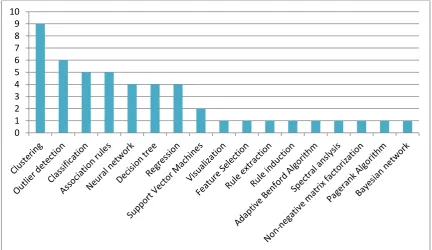
This part of the literature review shows that all data mining methods used are unsupervised data mining methods. Clustering, in different forms, is the most used. Other popular methods are outlier detection and classification. Classification is however closely linked to decision trees, therefore these two methods will be discussed together. In this sub section we start with describing the most popular fraud detection methods, and how they have been used in the literature. Figure 7 gives an overview of the number of articles in which each fraud detection method is discussed.
FIGURE 7 - FRAUD DETECTION METHODS IN LITERATURE
3.4.1 Clustering
The concept of clustering data is the method most used for the detection of health care data. As (Liu and Vasarhelyi 2013) explain, clustering in an unsupervised data mining method. The advantage of unsupervised methods over supervised methods is that there is no need for training data. Supervised algorithms require a set of data to be labeled (e.g. a training set of claims marked as fraudulent and non-fraudulent). The authors used geo-location information of patients and health care providers to find out people that get care from providers that are on a long distance. This might indicate fraudulent behavior. Their model is capable of both detecting long distance claims, claims with high payment amounts, as well as a detecting claims with relatively long distances and large amounts of payment. They don’t provide information about the accuracy of the model, to provide insights to what extent this approach leads to finding
positives. (Ekina et al. 2013) developed a co-clustering method, looking at the memberships of both providers and beneficiaries (eligible people) to unusual groups. They state that using their approach it would be possible in the future to predict the possible behavior of new providers and beneficiaries, based on their characteristics.
Clustering can also be part of a more extensive fraud detection model. (Tang et al. 2011) used clustering as one of the preparation steps, to finally perform the detection of fraud using outlier detection. Their ‘cluster builder’ was used to examine data and label it based on certain criteria (frequency of drug prescriptions, or the similarity of temporal prescription sequences). Since these criteria are manually entered, this method is not an unsupervised clustering method. (Musal 2010) used clustering to flag health care providers that are potential frauds. They also combined clustering with several other methods, including regression analysis and various descriptive statistical models. Clustering was used to group zip code areas in combination with socioeconomic factors.
(Williams 1999) defined a clustering approach to highlight importance or interesting areas in large datasets, called hot spot data mining. However, a general clustering algorithm (k-means based clustering) is used. They don’t have any claims about the usefulness of their method however. The approach described is more used to explore large data sets, instead of really identifying frauds in claims data for example.
A comparison of two clustering methods, SAS EM and CLUTO, was done by (Peng et al. 2006). SAS EM is an commercial enterprise mining solution developed by the company SAS, while CLUTO is a software package developed by the University of Minnesota. Their conclusion is that CLUTO is faster, while SAS EM provides more useful clusters. They suggest that clustering is mainly useful for labeling data, which in turn can serve as input for other algorithms. Clustering is more or less seen as a data preprocessing step. (Zhu et al. 2011) propose a solution using non-negative matrix factorization. They create a matrix with on one dimension patients, and on the other dimension their medicines used. They authors are unsure however if non-negative matrix factorization performs better than other clustering methods.
3.4.2 Outlier detection
succeed as fraud classification technology. One of the conclusions is that fraud detection predictors should be seen within a program of multiple fraud detection methodologies. (Ngufor and Wojtusiak 2013) also looked into medical claims data. They place an interesting note on the use of outlier detection. According to the authors outlier detection methods are not suitable to handle drifts in data over time. Drifts are changes in data, and in the case of labeling: when the same example receives different labels at two different times. To clarify: what is considered an appropriate payment for a service at one point in time, may not be appropriate five years later (because prices rise over time). They propose however a modification to their outlier detection algorithms in order to handle this case, and are able to show an increase in detected outliers using the modified method.
Detecting prescription fraud in Turkey using outlier detection is described in a paper by (Aral et al. 2012). They propose a model which has a true positive rate of 77.4% and a false positive rate of only 6%. Based on the claims they created index matrices of combinations of claim characteristics. These include type of medicine and {age, sex, diagnosis, medicine} and diagnosis and cost and try to find outliers in these datasets. (Shan et al. 2009) tried to detect fraudulent optometrists claims in Australia by finding claims with unusual distances (between patient and clinic). They used outlier detection to do this. Their Local Outlier Factor was ‘significantly better than randomly sampling, and at least as good as crude univariate method.’ They propose to integrate this detection method in an application that includes multiple fraud detection methods.
Such an integrative system is proposed by (Major and Riedinger 2002), which combined behavioral heuristics with outlier detection and selection rules. Outlier detection was used to detect care providers that did not fit the pattern when compared with their peers.
Most detection methods are focused on finding claims fraud. (Konijn and Kowalczyk 2011) state that when searching for fraud it is more important to look on the level of single patients, pharmacies of GP’s. They created a two-layer outlier detection approach. The first layer is an analysis on claim level, and the measurements of the first level are aggregated to detect outliers in the ‘higher level’ entities mentioned before.
3.4.3 Classification & Decision trees
done using decision trees. On the other hand, when clustering claims, there are no labels. The clusters are created based on how close the claims are to each other. This approach is used to identify structure in data, and it is a type of unsupervised learning (MIT OpenCourseWare 2008).
Even though classification is introduced as a form of supervised learning, some authors have tried to perform unsupervised classification. (Ngufor and Wojtusiak 2013) describe an approach to label a dataset, and add ‘normal’ or ‘abnormal’ as a label to claims based on the amount paid. Another method of classification is executed by (Williams and Huang 1997), they used a C4.5 algorithm. This algorithm is able to generate decision trees and rule sets. These decision trees are in turn used for classifying a data set. They used the method on a case study containing Medicare claims, looking at claim amounts. Identified (potential fraudulent) segments need to be assessed by humans after classification in order to identify if this is a real fraud case.
Several classification methods can also be used together, as shown by (Phua et al. 2004). They used both a naïve Bayesian, C4.5 and Backpropagation algorithm. The authors got their inspiration from the movie Minority Report, in which crimes are predicted by Precogs (Precognitive Elements). In the movie these are mutant humans, while in the solution proposed by Phua et al. each precog is a classifier trained with one of the three classification algorithms. The authors describe an approach for selecting the best set of classifiers given a dataset. (Bonchi et al. 1999) also described the concept of combining classifiers. They describe conjunction (taking all cases marked as fraudulent by all classifiers used) and disjunction (taking all cases market as fraudulent by only one of the classifiers). Furthermore they explain the voting concept, as also used by Phua et al. A last method of combining classifiers described is taking all cases that have been selected as fraudulent by at least 3 of the 4 classifiers used. (Yang 2003) developed two algorithms for the classification of claims. These algorithms serve as a step in a more complex fraud detection system.
3.5 Conclusion
In this section literature regarding Medicaid application processes has been studies, as well as literature on health care fraud. Based on the identified articles about the application process some related factors to this process can be identified. These are:
- Language,
Evidence requirements (such as income or citizenship)
Also fraud types in the field of Medicaid have been identified. The fraud types can be classified into several categories. Some types of fraud are related to claims submitted to the healthcare insurance system (in this case Medicaid). This is fraud committed by the health care provider, since they are the parties that submit claims to Medicaid. Other fraud involves kickbacks, and requires not only involvement of the health care provider (which is the party receiving money), but requires also involvement of a party that is providing the financial benefit. Patients can also fraud the system on their own, while their health care provider doesn’t have to be aware of this. This can be the case when committing identity fraud, or when performing doctor shopping.
As the literature analysis shows there are many ways fraud can be committed. It happens at all stages of the process, and multiple actors tend to be involved. Fraud can both be committed by patients, by health care providers and by a combination of them. Furthermore, using identity fraud it is even possible for fraud to be committed without the care providers even knowing.
There is a lot of literature describing fraud related to claims. For example: phantom billing, providing fraudulent information on the claims, and sending in too many claims. A topic less discussed is committed at the enrollment stage. The only identified topics related to this practice are identity fraud and misrepresenting eligibility.
4
RESEARCH METHOD
This chapter introduces the research method applied in this research. It starts with a justification for the chosen method in section 4.1, followed by a description of the steps the chosen method consists of in section 4.2.
4.1 Selection of the research method
In this research data analysis plays an important role. The aim is to optimize a process by looking at the historical data generated during that process. Based on the historic data we want to predict the processing time of future applications. This introduces the topic of predictive analytics. Predictive analytics are defined by (Shmueli and Koppius 2010) as the empirical methods that generate data predictions as well as methods for assessing predictive power. According to the authors predictive analytics can play an important role when it comes to explanatory modeling in theory building and testing. The authors define an eight step model for research projects in the field of predictive analytics. The model is extended by (Van der Spoel and Amrit 2015) with an additional step after the first step. The paper introduces system analysis as the additional step
4.2 Explanation of the research method
1. Goal definition In this step it is made clear what exactly needs predicting. 2. System analysis: Determine whether the system at hand is complex or simple.
3. Data collection and study design: In this step the actual data collection takes place. Four elements are important:
a. Data collection instrument: ideally the same variables are in the training data set, as well as in the dataset that is used for prediction.
b. Sample size: the size of the training data set
c. Data dimension: explain which variables are included in the dataset
d. Hierarchical designs: Increasing group sizes are needed when the number of groups increases
4. Data preparation: In this step the data is prepared for the analysis. Several factors have to be taken into account
a. How to handle missing values
b. Data partitioning: creating a training set, and a dataset to evaluate the trained model
5. Exploratory data analysis: During this stage the initial dataset is analyzed, in order to detect and remove outliers. This can be done using visualization, and it might lead to dimension reduction: narrowing down on the set of input variables.
6. Choice of variables: for the predictive models variables need to be selected. These variables need to be available at the time of prediction and their measurement qualities need to be sufficient.
7. Choice of potential methods: In this step the potential methods are selected.
8. Evaluation and model selection: the selected models are applied on a dataset ,and the best model is selected.
[image:40.595.88.522.652.767.2]9. Model use and reporting: this is the final step of the analysis. Report the results of using the selected model.
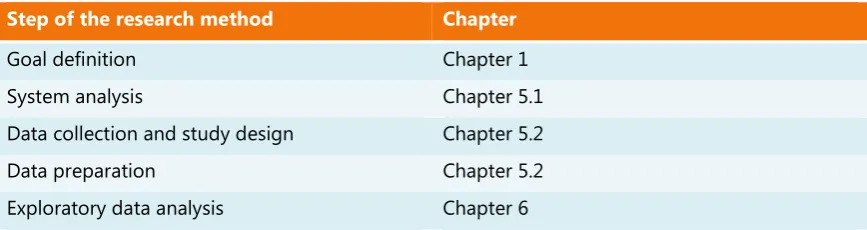
Table 3 depicts how the individual elements of the methodology relate to the chapters in this thesis.
Step of the research method Chapter
Goal definition Chapter 1
System analysis Chapter 5.1
Data collection and study design Chapter 5.2
Choice of variables Chapter 5.2
Choice of potential methods Chapter 5.3
Evaluation and model selection Chapter 6.3
[image:41.595.87.523.113.187.2]Model use and reporting Chapter 6.3
5
ARTIFACT DESCRIPTION
In this section the designed artifact will be introduced. The artifact is a combination of both a data model and a data mining methodology to analyze the application process. The section starts with a description of the current systems and data structure in section 5.1. From this current structure we can derive what useful information is available, resulting in a new data model, described in section 5.2. This will provide an answer to SQ2: What data is needed to analyze the Medicaid application process? Based on the designed dataset suitable data mining algorithms can be selected which will be applied, which is done in 5.3.
5.1 Current systems
There are multiple systems in use for managing Medicaid in South Carolina. Separate systems for claim handling and eligibility determination exist. And within the eligibility determination there are multiple systems. Currently there are two applications used for the determination of eligibility of Medicaid applicants: MEDS and Cúram. MEDS stands for Medicaid Eligibility Determination System. This is a mainframe system, that is in use for a long time already. CTIT is working towards an ‘end-of-life’ moment for this system, and migrating all its functionality and data to Cúram. In the past MEDS was the only system in use for the eligibility decisions. Cúram is a software package from IBM aimed at supporting governments in their health and human services processes.
MAGI Eligibility Groups Non-MAGI Eligibility Groups
Pregnant women SSI
- SSI recipients
- State Supplement only Infants and children under 19 years old SSI-related Medically needy
- Aged - Blind - Disabled New adults (childless adults, which include
individuals:
- Are not pregnant
- Are age 19 – 64 (19&20 living alone) - Do not have Medicare
- Could be certified disabled but do not have Medicare yet
ADC-related Medically Needy - Under 21 years old
- For reasons other than income, would meet the eligibility requirements of the aid to Dependent Children program as it existed on the 16th day
of July 1996.
Parents/Caretaker relatives Foster Care (IV-E or Non-IV-E)
19&20 year olds living with parents Medicaid Buy-In for working people with disabilities (Basic Group and Medical Improvement Group)
Family Planning Benefit Program Medicaid Cancer Treatment Program Childs in Foster Care (Chaffee) Individual under 26 years who was in Foster
Care and in receipt of Medicaid on 18th
birthday
Resident of Home for Adults run by LDSS, OMH Residential Care Centers/Community Residences
Medicare Saving Program
Individuals applying for Cobra continuation of premium payments
[image:43.595.87.522.124.695.2]5.1.1 Cúram
Cúram is the name of an off-the-shelve product by IBM, that offers full lifecycle support for managing health and social programs from need to outcome (IBM 2015). The system is used to handle more and more eligibility decisions, to in the end be the successor of the MEDS system. In contrast to MEDS, which is a mainframe system, Cúram is a web-based system built in Java.
5.1.2 MMIS
MMIS is the Medicaid Management Information System. Both MEDS and Cúram applications are connected to MMIS, and provide information with MMIS. Where the first two systems are focused solely on handling eligibility decisions, MMIS is solely processing Medicaid claims. Furthermore, the system is used to generate reports to submit to several authorities that require periodical reports.
5.1.3 Interfaces
MEDS and Cúram are connected to several external data sources. These sources are called interfaces. These interfaces provide information for the validation of enrollment information. This includes income information, information about someone’s imprisonment and information about enrollment in Medicaid programs. We will provide some examples of interfaces the system is connected to, to give an impression of this functionality:
State Data Exchange (SDX): Receive data from the Social Security Administration for individuals receiving SSI payments (Supplementary Security Income). Data is exchanged on a weekly based. Individuals receiving SSI payments are also eligible for the Medical program.
Coordination of Benefits (COB): A data exchange with the Centers for Medicare and Medicaid Services (CMS) to exchange information about enrollment in the Medicare program.
Enumeration Verification System (EVS): A data exchange with the Social Security Administration for their South Carolina Retirement System (SRS): Receive income data from the South Carolina State Retirement System. The verification of primarily SSN and identification data.
5.1.4 Reporting
Truven: MMIS sends MEDS data to load into a Decision Support System (of which Truven is a vendor). From this system, reports may be run. The data is also provided for research from this system.
Management Administrative Reporting Subsystem (MARS): This system generated federally mandated reports
Expenditures (EXP): This is a monthly financial reporting of money spent on Medicaid services.
[image:45.595.127.471.319.503.2]The relation between the systems explained above is depicted in Figure 8.
FIGURE 8 - MEDS, MMIS, CÚRAM RELATIONSHIP
5.1.5 From Cúram and MEDS to MMIS
FIGURE 9 - FROM MEDS AND MMIS TO MMIS
Cúram and MEDS store eligibility data different. The data needs to be converted to a format that MMIS understands, so there is a conversion layer between MMIS and MEDS and Cúram. This conversion layer is a system called RECON. RECON is short for reconciliation. In this sub section we will discuss the way the eligibility information is stored in MEDS and Cúram, before it enters the RECON system. The relations between the systems are shown in Figure 9.