Differential Evolution Immunized Ant Colony
Optimization Technique in Solving Economic Load
Dispatch Problem
N. A. Rahmat, I. Musirin
Universiti Teknologi MARA, Malaysia
Email: [email protected], [email protected]
Received 2013
Abstract
Since the introduction of Ant Colony Optimization (ACO) technique in 1992, the algorithm starts to gain popularity due to its attractive features. However, several shortcomings such as slow convergence and stagnation motivate many re-searchers to stop further implementation of ACO. Therefore, in order to overcome these drawbacks, ACO is proposed to be combined with Differential Evolution (DE) and cloning process. This paper presents Differential Evolution Im-munized Ant Colony Optimization (DEIANT) technique in solving economic load dispatch problem. The combination creates a new algorithm that will be termed as Differential Evolution Immunized Ant Colony Optimization (DEIANT). DEIANT was utilized to optimize economic load dispatch problem. A comparison was made between DEIANT and classical ACO to evaluate the performance of the new algorithm. In realizing the effectiveness of the proposed tech-nique, IEEE 57-Bus Reliable Test System (RTS) has been used as the test specimen. Results obtained from the study revealed that the proposed DEIANT has superior computation time.
Keywords: Ant Colony Optimization (ACO), Differential Evolution (DE), Differential Evolution Immunized Ant Colony Opti-mization (DEIANT)
1.
Introduction
In 1992, Marco Dorigo introduced a probabilistic algo-rithm known as Ant Colony Optimization (ACO) tech-nique. In his PhD thesis, he described that ACO resem-bles the natural behavior of a colony of ant during their random expedition to find the best path between their nest and food source. The ant will deposit a chemical trace known as pheromone. The pheromone will act as the stimulant to attract more ants to utilize on the same path. Any less-traveled paths will be forgotten since their pheromone traces has been evaporated. Marco Dorigo employed this behavior into his research to solve the travelling salesmen problem (TSP) [1]. Since, ACO has attracted many researchers to employ the algorithm into their research. Mohd Rozeli Kalil et. al successfully im-plements ACO to gain maximum loadability in voltage control study [2]. Ashish Ahuja and Anil Pahwa [3] stated in their research that ACO significantly minimized the loss in a distribution system. Moreover, D. Nualhong et. al utilizes ACO in his research to solve the unit com-mitment problems [4]. However, further research on the algorithm indicates that ACO suffers from several
short-comings. H. B. Duan, et al stated in his research that ACO may experience stagnation due to its positive feed-back strategy. The researcher also highlighted that the random selection strategy of ACO makes the algorithm sluggish [5]. Another researcher claimed that ACO has slow convergence rate [6-7].
Evolution Immunized Ant Colony Optimization (DEIANT) technique in solving economic load dispatch problem. The aim of the proposed technique is to alle-viate the slow convergence, and stagnation experienced in the traditional ACO through the application of DE. The performance of DEIANT will be evaluated by using the algorithm to solve and optimize economic load dis-patch problems. Performance evaluation of the proposed DEIANT revealed that the proposed technique is supe-rior than the traditional ACO in terms of achieving op-timal solution and computation time.
2.
Differential Evolution Immunized Ant
Colony Optimization Formulation
The capability to achieve fast convergence has been iden-tified as the attractive feature of DE [10]. This feature will be used to compensate the stagnation of ACO algo-rithm. The modification of ACO algorithm will be focus-ing on the pheromone updatfocus-ing rule which is subjected to cloning, mutation, crossover, and selection process. Fig-ure 1 depicts the overall structFig-ure and processes of Diffe-rential Evolution Immunized Ant Colony Optimization (DEIANT) algorithm. DEIANT is configured from the combination of original ACO, combined with DE and cloning process. ACO search agent will initialize random tours and deposit pheromone layers. The algorithm will update the pheromone level at each iteration. Cloning process will increase the pheromone amount by generat-ing the exact copies of the pheromone layer. To enhance the pheromone layer, DE will mutate and crossover the pheromone layer, thus increasing the diversity of the pheromone. ACO will evaluate the fitness of the phero-mone layer.
ACO
Cloning process
DE
Ant colony deposit pheromone layer
Increases pheromone quantity
Mutation and crossover process enhance pheromone
diversity
DEIANT
[image:2.595.348.498.492.550.2]∑
Figure 1. Structural diagram of DEIANT
2.1.
Initialization
DEIANT consist of several classical ACO parameters. Therefore, similar to ACO technique, the initial num-ber of ant, nodes, pheromone decay parameter, α, and the initial pheromone level, τ0 will be heuristically
in-itialized. The maximum distance travelled by each ant, dmax, is subjected to a constraint in order to avoid large
computation time. dmax is obtained by calculating the
longest distance travelled by the ants. Each ant will tour and select the next unvisited node until all nodes have been visited.
2.2.
Apply State Transition Rule
The next unvisited node is chosen according to the state transition rule, s. Each node can only be visited once. The ant that was positioned at node(r) will go to the next node(s).
[
]
[
]
[
]
[
]
⋅ ⋅ =
∑
ββ
η τ
µε
η τ
) u . r ( ) u , r ( J
) s . r ( ) s , r ( )
s , r ( P
) r ( k k
(1)
2.3.
Apply Local Updating Rule
Altering the level of pheromone deposition is done dur-ing the construction of solution. The amount of phero-mone is either increased or decreased to vary the attrac-tiveness of the route via the evaporation rate, ρ. Dorigo stated that parameter ρ is needed to avoid the algorithm converge pre-maturely. The parameter ρ act as a multip-lier and is set between 0 to 1. In this research, the evapo-ration rate is set to 0.7, meaning that at every iteevapo-ration; the pheromone will be reduced by 0.7.
2.4.
Pheromone Cloning
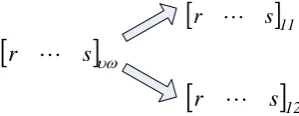
The cloning process from Artificial Immune System is implemented into DEIANT. The pheromone level will be duplicated to increase pheromone population and diver-sity. Figure 2 below depicts the cloning of the original pheromone level.
Where υ represents the set of pheromone that will be cloned, and ω represents the cloned pheromone set. Both υ and ω can be written as υ = 1,…,V and ω = 1,…W, respectively.
2.5.
Pheromone Mutation
The pheromone mutation process is used to enhance the pheromone layer over the visited node during ant exploration. The Gaussian Distribution Equation was utilized to mutate the pheromone level as in (2):
[
r
s
]
υω[
r
s
]
12 [image:2.595.60.285.501.589.2][
r
s
]
11(
)
⋅ − ⋅ + = + max i min j max j j , i j , m i f f X X , 0 N XX β (2)
Where
j , m i
X + : Pheromone mutation function
min j
X : Smallest visited node
max j
X : Largest visited node
i
f : Distance travelled by ant
max
f : Longest distance travelled by ant
2.6.
Crossover
Crossover operation is implemented to emphasize the diversification vector of the pheromone trail. The mutated pheromone trail and the original one will merge together by applying a binomial distribution known as the crossover operation. In this algorithm, the original and mutated pheromone level will be resorted within the same matrix. The crossover matrix, Xgi is sorted in
des-cending order, as shown below:
Where
n
is the highest pheromone level for the tour,
and
n-m
is the lowest pheromone level.
2.8 Selection
Trial pheromone trail, ρt is the product of the crossover
process. The algorithm will now select the required trail according to this rule:
≤ = otherwise , level, pheromone if , t t ρ α ρ ρ ρ
Where α is the pheromone decay parameter.
Basically, the selection process will specify the accepta-ble condition to accept the pheromone level. The trail with a higher pheromone level will be selected. The trail with fewer pheromone levels will be discarded.
2.9 Control Variable Calculation
The control variable x, is computed by applying the fol-lowing equation:
Where:
d : distance for every ants tour
dmax : maximum distance for every ants tour
xmax : maximum of x
Variable x will become the multiplier to calculate the objective function. In this research, variable x is multip-lied with the cost function (7).
2.10 Global Updating Rule
After all ants have finished performing their random ex-ploration, the best ant of the colony will be selected. The best ant is carrying the data of the best tour, and thus, the data will be stored. The following equation is applied to update the pheromone level globally:
( ) (
r,s 1α
) ( )
τ
r,sα
.∆
τ
(r,s)τ
← − + (6)The globally best tour will be selected as the first node of the next iteration.
2.11 End Condition
The DEACO algorithm will halt the iteration when the maximum number of iteration (tmax) has been reached
and all ants have completed their tours. If a better path is discovered, it will be used as the reference. Only one ant will find the optimal path.
3.
Economic Load Dispatch Formulation
Economic load dispatch is the operation of determining the optimal output that must be produced by the genera-tion facilities to feasibly satisfy the load demand [12]. Therefore, the key objective of economic load dispatch is to reduce the operating cost of each generating unit in the power system. The operation cost can be calculated by utilizing equation (7):
∑
= Ng
i i i(P ) F
cost (7)
Where Ng is the number of generating unit. Fi(Pi) is the
cost function, and Pi is the real power output of the unit I,
measured in MW. Fi(Pi) is usually approximated by a
quadratic function: c P b P a ) P (
Fi i = i i2+ i i+ (8)
max max
x d
d
x= ⋅ (5)
Where ai, bi, and ci are the cost coefficients of generator i.
The above equation is subjected to both the equality and inequality constraints.
The system power loss can be calculated by using the power flow equation below (19):
∑∑
N∑
i N
j
N
i
oo i oi j
ij i
L PB P B P B
P = + + (9)
Where Bij, Boi, and Booare the B-loss coefficient.
The cost function is given by equation (26):
2 n n n a bP cP
C = + + (10)
The followings are the generators’ operating costs for IEEE 57-Bus System. These equations are derived from equation (10):
2 1 1
1 400 7.0P 0.0070P
C = + +
2 2 2
2 200 10.0P 0.0095P
C = + +
2 3 3
3 220 8.5P 0.0090P
C = + +
2 6 6
6 200 11.0P 0.0090P
C = + +
2 8 8
8 240 10.5P 0.0080P
C = + +
2 9 9
9 200 12.0P 0.0075P
C = + +
2 12 12
12 180 10.0P 0.0068P
C = + + (11)
Where C1, C2, C3, C6, C8, C9 and C12 are the operating cost
functions for generator 1, generator 2, generator 3, gene-rator 6, genegene-rator 8, genegene-rator 9, and genegene-rator 12 re-spectively.
The total operating cost, CT can be formulated as:
12 9 8 6 3 2 1
T C C C C C C C
C = + + + + + + (12)
The total operating cost is the objective function for this research. The objective is to cut-down the total operating cost, while preserving the system constraints within the permissible limits. While minimizing the operating cost, it was initially estimated that the power loss will be re-duced as well. Power loss is the marginal difference be-tween the power produced, and the power sold to the consumer [13].
4.
Results and Discussion
The DEIANT algorithm was developed by using MATLAB. The algorithm was used to optimize eco-nomic load dispatch problem. The research was con-ducted on IEEE-57 bus system. The system contains seven generating units. The load was varied to assess the performance of the proposed algorithm. The objectives are to minimize the total generating cost, to reduce transmission loss, and to reduce the computation time. Comparisons were made between DEIANT and the original ACO. Table 1 tabulates the simulation results of classical ACO algorithm. Table 2 tabulates the simula-tion results of the newly developed DEIANT algorithm. Note that the load, designated by Qd at Bus 10 was
va-ried between 0 to 25MVAR to see the performance of DEIANT in solving economic load dispatch problem. The comparison of DEIANT and classical ACO un-doubtedly points out that the new algorithm successfully outperforms the classical ACO. Varying the load gives less impact to the performance of DEIANT. For example, when Qd is set to 20MVAR, DEIANT generates the total
operating cost of 41855 $/h. The cost is economical than the one calculated by classical ACO (41862 $/h), giving a price drop of 0.0167%. If the load was set to 15MVAR, the idea is the same; DEIANT only generates lower power loss.
Table 1. Simulation results of classical ACO
Qd (MVAR) P1 (MW) P2 (MW) P3 (MW) P6 (MW) P8 (MW) P9 (MW) P12 (MW) Ploss (MW)
Total Cost
($/h) Time (s)
0 137.1095 89.8488 45.1114 75.8669 463.3333 100 358.7308 19.2007 41842 30.63371
5 138.5126 96.3783 45.3754 74.8029 458.1759 96.2979 360.593 19.336 41856 70.29794
10 138.4993 96.3443 45.3752 74.7286 458.1097 96.6145 360.495 19.3666 41858 52.4811
15 138.4077 96.3373 45.377 74.6806 458.0548 96.9501 360.4142 19.4217 41860 67.40478
20 138.4437 96.2948 45.3759 74.5882 457.9824 97.268 360.3066 19.4597 41862 34.64456
[image:4.595.56.545.542.710.2]25 138.4127 96.2995 45.366 74.7954 457.8748 97.4865 360.121 19.5559 41866 53.20833
Qd
(MVAR) P1 (MW) P2 (MW) P3 (MW) P6 (MW) P8 (MW) P9 (MW) P12 (MW) Ploss (MW)
Total Cost
($/h) Time (s)
0 137.3725 90.9657 45.045 74.2499 463.3627 100 358.7523 18.9481 41832 4.317901
5 137.349 91.0764 45.0431 74.2626 463.3531 100 358.6874 18.9716 41832 4.539834
10 138.7015 97.2722 45.324 73.6004 458.3919 96.009 360.6952 19.1941 41851 4.854118
15 138.6771 97.2475 45.3171 73.5275 458.3209 96.3482 360.5982 19.2362 41853 4.778885
20 138.6519 97.2263 45.31 73.4555 458.25 96.6919 360.5016 19.2872 41855 5.184511
25 138.626 97.2089 45.3028 73.3846 458.1796 97.04 360.4055 19.3474 41857 5.328133
Moreover, at 20MVAR load adjustment, the classical ACO computed power loss of 19.4597MW. However, DEIANT effectively reduces it to 19.2872MW, with a significant difference of 172.5kW. Furthermore, DEIANT possesses faster computation time than the classical ACO. For instance, classical ACO requires about 35 seconds to optimize the objective function, but DEIANT optimize the objective function in just five seconds. This implies that DEIANT can achieve optimal solution at a faster rate, although the algorithm is more complex and sophisticated than the classical ACO.
5.
Conclusion
This study demonstrates the development of a new algo-rithm termed as Differential Evolution Immunized Ant Colony Optimization (DEIANT). Through the combina-tion of DE, ACO and cloning process, this new algorithm has successfully overcome the drawbacks of classical ACO algorithm. The good performance of DEIANT was verified by optimizing economic load dispatch problem. Comparisons with classical ACO imply that DEIANT effectively cuts-down the operating cost while reducing the power loss. The optimization process was performed with a faster speed than the classical ACO. Future de-velopment will be focusing on the modification to in-crease the convergence speed of the algorithm.
6.
Acknowledgement
The authors would like to acknowledge The Research Management Institute (RMI) UiTM, Shah Alam and Ministry of Higher Education Malaysia (MOHE) for the financial support of this research. This research is supported MOHE under the Fundamental Research
Grant Scheme (FRGS) with project code: 600-RMI/ST/FRGS 5/3/Fst (163/2010).
REFERENCES
[1] Ying-Tung Hsiao, Cheng-LongChuang and Cheng- Chih Chien, “Ant Colony Optimization for Best Path Planning,” International Symposium on Communications and Information Technologies 2004 (ISCIT 2004), Sapporo, Japan, 26-29 October 2004, pp. 109-113.
[2] Mohd Rozely Kalil, Ismail Musirin, Muhammad Murtadha Othman, “Maximum Loadability in Voltage Control Study Using Ant Colony Optimization Technique”, IEEE First International Power and Energy Conference (PECon2007), 28-29 Nov. 2006, pp. 240-245.
[3] Ashish Ahuja and Anil Pahwa, “Using Ant Colony Optimization for Loss Minimization in Distribution Networks”, 37th Annual North American Power Symposium, 2005, 23-25 Oct. 2005, pp. 470- 474.
[4] D. Nualhong, et al., "Diversity Control Approach to Ant Colony Optimization for Unit Commitment Problem," in TENCON 2004. 2004 IEEE Region 10 Conference, 2004, pp. 488-491 Vol. 3.
[5] H.B. Duan and D.B. Wang, “a novel improved ant colony algo-rithm with fast global optimization and its simulation,” Informa-tion and Control, vol.33, pp. 241-244, April 2004.
[6] Linda Slimani and Tarek Bouktir, “Economic Power Dispatch of Power System with Pollution Control using Multiobjective Ant Colony Optimization”, International Journal of Computational
Intelligence Research (IJCIR) 2007, Vol. 3, No. 2, pp. 145-153.
[7] R. Bhavani, G. Sudha Sadasivam, and R. Kumaran, "A novel parallel hybrid K-means-DE-ACO clustering approach for ge-nomic clustering using MapReduce," in Information and Com-munication Technologies (WICT), 2011 World Congress on, 2011, pp. 132-137.
[8] R. Storn and K. Price, “Differential Evolution – A Simple and Efficient Adaptive Scheme for Global Optimization Over Continuous Spaces”, Technical Report TR-95-012, ICSI, March 1995.
Intelligent Optimization and Control for Power Systems, IEEE Publishing, invited chapter, Nov. 2005.
[10] Storn R., Price K.: ‘Differential Evolution – A Simple and Effi-cient Adaptive Scheme For Global Optimization Over Continu-ous Space”, Journal of Global Optimization, 1997.
[11] N. A. Rahmat, I. Musirin (2012). Differential Evolution Ant Colony Optimization Technique (DEACO) In Solving Economic Load Dispatch Problem. IEEE Internation Power Engineering and Optimization.
[12] S. M. V. Pandian and K. Thanushkodi, "Solving Economic Load Dispatch Problem Considering Transmission Losses by Hybrid EP-EPSO Algorithm for Solving Both Smooth and Non-Smooth Cost Function," International Journal of Computer and Electric-al Engineering, vol. 2, 2010