Munich Personal RePEc Archive
Strategic delegation in procurement
Alonso-Pauli, Eduard and Bru, Lluís
Universitat de les Illes Balears
30 January 2018
Online at
https://mpra.ub.uni-muenchen.de/84293/
Strategic delegation in procurement
Eduard Alonso-Paulí and Lluís Bru
yzThis Version: February 2018
Abstract
In a …rm organized into business units, we show when pro…tability increases if procurement is delegated to the division in charge of production. We highlight that our results are driven by the business unit having a di¤erent objective function than Headquarters. The pro…tability of procurement delegation is a¤ected by the essen-tiality of production facilities to the activities of the …rm, and by strategic distortions in both transfer and input prices. We also look at vertical separation of activities as an alternative to procurement delegation.
Keywords: strategic delegation, transfer pricing, procurement JEL classi…cation: D24, D43, M11
1
Introduction
In multinational …rms, the mix of centralized and delegated activities varies from one …rm to another, and this is also the case for procurement. Procter and Gamble, for instance, centralises product development or accounting while business units are responsible for sales and procurement, whereas in General Electric business units are also in charge of
sales but procurement is centralised.1 In a KPMG survey (2008) 75% of respondents
consider procurement of a high strategic priority, and nearly half of …rms in the survey use some form of decentralized procurement. Most importantly for our purposes, the survey also highlights that the internal organization of procurement may a¤ect prices charged by suppliers.
A transfer pricing system for internal transactions lets a multinational company to transform its divisions into business units or pro…t centers. Because divisional managers tend to be evaluated according to how well the division they are in charge of performs, the introduction of a transfer price system is a powerful incentive mechanism that a¤ects their
Corresponding author. Universitat de les Illes Balears. Email: [email protected]
yUniversitat de les Illes Balears
zWe would like to thank to seminar participants at the internal seminar at UIB, and di¤erent conferences
such as 1st CESC (Barcelona) XXXII Jornadas de Economia Industrial (Pamplona) and 42nd Simposio de Análisi Económico (Barcelona). Lluís Bru and Eduard Alonso-Paulí also gratefully acknowledges …nancial support from grant ECO2017-86305-C4-1-R
decision making.2 This paper analyses the decision of a …rm to delegate or centralize the
procurement of essential inputs to business units in charge of production. We show under which circumstances delegation of procurement may increase …rm’s clout when bargaining with suppliers. When there is an increase in bargaining power, it comes from the use of a delegated agent (namely the manager of the business unit in charge of production) in bargaining with a di¤erent objective function from Headquarters. Crucially, we show that the transfer price system can be set in a way that there are no distortions in production decisions but still lead to discounts in the price of inputs.
We model the following …rm’s problem. In order to produce …rm’s good, the …rm must acquire an input. The input can be obtained from two di¤erent sources: an e¢cient supplier or an alternative (for instance, a fringe of standard suppliers or internally). The implementation of a transfer price scheme allows the …rm to decentralize production de-cisions to business units. Before production starts, the Headquarters chooses who leads procurement negotiations: it may keep procurement centralized, or it may delegate it to the factory manager.
Regardless of who negotiates procurement, we show that, when a two part tari¤ is allowed, the agreement between the …rm and the supplier leads to e¢cient production
levels. To achieve e¢ciency, the HQadjusts the transfer price depending on the outcome
of the bargaining stage. Still, announcing the HQ delegates procurement negotiations to
the factory manager has an impact over the rents the supplier can reap in the bargaining
stage. We show that delegating bargaining negotiations to a di¤erent agent from HQ, in
this case the factory manager, allows the …rm to shift pro…ts away from the bargaining stage which in turn lowers the willingness to pay to the e¢cient supplier. Thus, announcing how the …rm is organized is what provides an strategic edge, serving as a commiment device, and not the speci…cs of the transfer price. As pointed out by Gimeno (2012) observability and irreversability of delegation instruments are essential for using delegation strategically. Several instruments are public, at least partially. One example is compensation schemes for CEO of public limited companies, but another instance, closer to our model, is the creation of autonomous divisions such as pro…t centers.
To check the robustness of our result, we …rst study whether other organizational arrangements rather than delegating procurement to the factory manager may increase …rm’s bargaining strenght. We show that vertically separating the company allows the company to divert rents from bargaining through a di¤erent channel, but it is not always a superior way of organizing procurement activities. By vertically separating the company the supplier becomes a less determinant player to achieve the rents to be bargained.
Sec-ondly, we also extend our basic result by assuming that the HQ can announce at which
transfer price the …rm is internally trading. When procurement is delegated to the factory,
and the HQ can credibly announce a transfer price, the …rm …nds optimal to distort the
internal price at the cost of producing ine¢ciently. Setting the internal price arti…cially low lets the …rm shift even more pro…ts from the bargaining stage. However and unlike
2Using transfer pricing is a common practice for multinational …rms (see for instance Tang, 2002 where
the existing literature, it is not always in the HQ’s best interest: the use of this strategic transfer price does not allow the …rm to adapt to the outcome of the negotiation stage.
In the second part of the paper, we analyze some economic forces that may moderate our main result over delegation. To this end, we consider …rst whether the factory is not essential for the company and can be replaced by an external alternative. In this case, the …rm only centralizes procurement when the external alternative is highly attractive other-wise the …rm prefers delegating procurement to take advantage of an improvement in the negotiations. Second, we study a situation in which the supplier may behave strategically and may announce a tari¤ at which the …rm and the supplier trade. We show that when theHQdelegates procurement negotiations to the business unit, both the factory and the supplier may …nd pro…table to negotiate an input price di¤erent from the e¢cient one.
This intended high input price fosters the HQ to set a transfer price di¤erent from the
e¢cient one. Eventually, this increases both supplier’s and factory’s pro…t at the cost of
a lower …rm’s pro…t. As a consequence, HQ’s tends to centralize both procurement and
production to avoid this undesirable outcome.
Our paper is related to two main strands of the literature. First, our paper can be seen as an illustration of the use of delegated agents in bargaining …rstly initiated by Schelling (1960). Delegating decisions may serve as a commitment device; using a third agent may allow the player to obtain some strategic advantage, since the agent playing the game can commit to a certain behavior. However, as noted by Katz (1991), delegation might not be useful if binding contracts are not observable. Although observability of contracts is an important feature to make commitments valid, Fershtman and Kalai (1997) …nds out conditions under which the delegation to an agent has still some impact. In particular, they show that an incentive contract even if the speci…c details of the contract are unknown may
have a commitment e¤ect.3 More recently and from an experimental perspective, several
authors pointed out that delegating to an agent might help the …rm to act tougher when bargaining (Fershtman and Gneezy, 2001 or Hamman et al, 2010).
Second, our paper relates to the literature on transfer pricing iniciated in the seminal paper of Hirshlei¤er (1956). Our paper is not the …rst attempt at analyzing the strategic impact of using transfer pricing. Since Alles and Datar (1998) a very important strand of the literature has focused on the strategic use of transfer pricing, i.e., setting the transfer price away from e¢cient considerations, in order to gain some competitive advantage (see Baldenius and Reichelstein, 2006 and Arya and Mittendorf, 2008 and Arya et al. 2008 as a more recent examples focused on buyer-seller relationships).4 However, as fas as we
know, there is no research analyzing the impact of this type of strategic delegation on procurement activities. An exception and the closer paper to ours is Arya et al (2007). The authors analyze the interaction between procurement activities and decentralization of production activities through a TP scheme. The authors obtain that divisionalization of the …rm improve …rm’s pro…t through a reduction of the supplier’s bill. This improvement is obtained because the …rm is able to credibly commit to the use of strategic T P greatly reducing pro…ts of the division (through a double marginalization e¤ect). The supplier must then reduce his demands, lowering the price that can be imposed to the division. Although
3More recently, Kockesen and Ok (2004), Gerratana and Kockesen (2012) (2015) further generalyze
these results obtaining that renegotiation of contracts does limit the e¤ect of strategic delegation but it does not completely break it down.
4See Gox and Schiller (2007) for a survey on the use of transfer prices, and in particular, as an strategic
we also focus on how internal organization a¤ect procurement outcomes, initially we do not allow the …rm to use transfer prices statregically and second we allow the …rm and the supplier to use more complex contracts, a two part tari¤ rather than a linear one, when negotiating for the input. Thus, delegation result is not merely based on the interaction of the e¢ciency distortions created by the contract and the transfer price, but a consequence of how the …rm is internally designed.
The paper is organized as follows. First, we present the main characteristics of the model. In Section 3, we show when delegation of procurement improves …rm’s bargaining clout and compare it to other organizational arrangements. We also show in this Section which conditions are needed for the …rm to implement an strategic transfer price. Finally, in Section 4, we present two di¤erent situations in which the …rm may prefer to keep procurement centralized: when the factory is not an essential input and when the supplier may behave strategically. Section 5 concludes. All proofs are left in an Appendix.
2
The model
The …rm, composed by a factory and a sales division, organizes its production activity as a business unit.
Costs and revenues. Revenues R(q) satisfyR0 >0; R" 0. Production costs are given
by C(q), with C0 > 0; C" > 0. To produce the good the …rm must acquire an essential input on a one-to-one basis for each unit of output produced. There exists two sources for the input, one more e¢cient than the other. The e¢cient one features marginal costs of production c1 whereas the less e¢cient procures the input at a higher unit cost c2 > c1.
We will name the e¢cient source as the e¢cient supplier or simply the supplier whereas the ine¢cient source will be named the alternative.5
We assume that the parties in the negotiation can use a two-part tari¤T(q) = F +wq
where w is the marginal wholesale price and F is the …xed component. Thus pro…ts of
the …rm areR(q) C(q) T(q). The quantity q that maximize …rm’s pro…ts satis…es the …rst-order condition R0(q ) C0(q ) w= 0.6 De…ne
(w) = max
q fR(q) C(q) wqg (1)
as the level of pro…ts that can be achieved (gross of any fee paid to suppliers). Our assumptions on revenues and cost guarantees the existence of a unique solution q(w) to this maximization problem, strictly decreasing in the input cost, q0(w) = R"1C" <0; and that the pro…t is decreasing in the input cost, 0(w) = q(w)<0.
It is clear that under our technological assumptions optimality involves the use of the e¢cient supplier. Assume that the …rm and this supplier are indeed one entity; in this
5One interpretation of the source of inputc
2 is that the …rm can alternatively obtain the input from
a less e¢cient competitive fringe. In this case, payments to the competitive suppliers becomeT(q) =c2q.
An alternative interpretation is that the …rm produces the input internally rather than buying it from the market. Still another interpretation of this industry structure is that the …rm is in negotiations with a labour union to implement new production methods. The old way of producing the output leads to a marginal costc2whereas the introduction of the new method leads to a new marginal costc1. The labour
union and the …rm bargain over wages,w, and other bene…ts,F (see Zhao, 1998, 2001 and Chongvilaivan
et al, 2013 for a related discussion on internal organization and labor unions)
6FOC are necessary and su¢cient for a unique global maximum since the problem is strictly concave.
case, the …rm produces q(c1) which leads to (c1) as the maximum rents that the …rm
can achieve. If, instead, the …rm produces using the alternative, both the quantity, q(c2),
and the rents generated, (c2), are lower. The di¤erence of pro…ts between choosing the
supplier or the alternative, (c1) (c2), can be shared between the …rm and the supplier.
The aim of this paper is to study how the allocation of authority over procurement may a¤ect whether this increase in rents is achieved, and its e¤ect on the distribution of these rents.
Timing. The whole interaction between the HQ, the factory and the supplier is as
follows: First, the HQ allocates authority over procurement decisions (to be discussed
below). Then the …rm must produce the good, which involves two stages: …rst, to negotiate with the supplier the terms of the contract T(q), and second, after reaching (or not) an agreement, production of the good.
Note that this timing allows the …rm to adjust production decisions to the outcome of the negotiation stage, that is, to adjust production in accordance to the real marginal cost. This ‡exibility assumption is crucial to our analysis. If production decisions were taken before the bargaining stage, and could not be modi…ed afterwards, the supplier would take advantage of this situation capturing larger rents at the negotiation stage;7 foreseeing what
would happen in the bargaining stage, the …rm would presumably reduce its production in the …rst place, leading to lower total pro…ts.
Firm organization over production. The …rm organizes its production activity as a business unit. In charge of the business unit there will be a manager that must maximize the pro…ts of the factory. The HQ sets a transfer price p and the business unit will have pro…ts pq C(q) T(q). Given a unit price of the input w and a transfer pricep, de…ne
q(p; w) = arg max
q fpq C(q) wqg (2)
as production that maximizes the business unit’s pro…ts,
f(p; w) = max
q fpq C(q) wqg, (3)
as the pro…ts then achieved by the business unit (gross of any fee paid to suppliers) and …nally
(p; w) =R(q(p; w) C(q(p; w)) wq(p; w) (4)
as those achieved by the whole …rm (also gross of any fee paid to suppliers). As we know since Hirschleifer (1956), pro…ts in (1) can be achieved in a decentralized way ifHQ
set a transfer price p(w) = R0(q(w)), since then the factory fully internalizes the impact of production in …rm’s pro…ts. Thus the business unit produces the optimal quantity,
q(p(w); w) =q(w) and we have (p(w); w) = (w). De…ne then
f(w) = f(p(w); w) (5)
as the pro…ts of the business unit when the transfer price is set optimally.
7Assume for instance that the …rm commits toq=q(c
1)then there are no e¢cient distortions with the
e¢cient supplier. It is easy to see that Fq = 1
2(c2 c1)q(c1)> F C = 1
2( (c1) (c2)). By a revealed
preference argument(c2 c1)q(c1)>( (c1) (c2))() (c2)> (c1) (c2 c1)q(c1)() (c2)>
R(q(c1)) C(q(c1)) c2q(c1)and the last inequality holds since (c2)maximizes pro…ts when the input
Procurement. The HQ must allocate authority over procurement decisions. Under
Centralized procurement (or C), it is the HQ who bargains with the supplier, whereas underDelegated procurement (orD) the business unit manager is in charge of negotiations. In either case, the …rm and the supplier bargain over a two-part tari¤ T(q) =F +wq, and furthermore we assume all agents involved have equal bargaining power.8
Regardless of …rm’s organization, the supplier has pro…ts s = T(q) c1q in case
of agreement whereas its outside option is to achieve zero pro…ts. If there is Centralized procurement, the alternative forHQis to achieve pro…ts (c2). Hence, if there is agreement
the joint pro…ts of the …rm and the supplier increase fromJ PC
of f = (c2)toJ PC = + s=
R(q) C(q) c1q.
With Delegated procurement, the alternative for the manager of the business unit is to achieve f(p; c2). If there is agreement the joint pro…ts of the business unit and the
supplier increase fromJ PD
of f = f(p; c2) to
J PD = f + s =pq C(q) c1q: (6)
Given our assumptions of equal bargaining power by those involved in negotiations, the payment will cover costs of productionc1qand assign half of the extra rentsJ P J Pof f
to the supplier. The assignment of those rents depends on who is actually bargaining with the supplier, theHQand the factory manager, and whether parties involved in bargaining can alter strategically the transfer pricep or the input pricew.
3
Organization as an strategic device
In this section we analyze the strategic role of the allocation of procurement decisions. First, we show that e¢ciency over production can be achieved by means of e¢cient bargaining and then we show that the …rm gains clout over the supplier by assigning procurement decisions to the business unit manager. The details of the Nash bargaining program both under centralized and delegated procurement are left in Appendix A.
When there is Centralized procurement, it is straightforward to see that q(c1) is the
quantity that maximizesJ PC. This can be achieved by settingw=c1 and, at the
produc-tion stage, setting a transfer price p(c1) = R0(q(c1)). Thus, total surplus J PC = (c1) is
achieved and rents are redistributed through a …xed payment
FC = 1
2( (c1) (c2)): (7)
In the presence ofDelegated procurement, to represent the interaction that lead to
non-strategic contracts is more convoluted. HQ cannot commit to a particular transfer price
p, and the factory and the supplier can renegotiate the tari¤ at any moment. We can
represent their interaction as follows: …rst, the business unit and the supplier negotiate the
terms of the contract. Then, the business unit communicates to HQ the outcome of the
negotiation stage, that is, whether there is agreement and the details of the contract; but those details have no strategic e¤ect on the transfer price that HQ sets, since the tari¤
can be modi…ed. In case of disagreement, the HQ sets the optimal transfer price that
8Our results are not sensitive, at least qualitatively, to this assumption as long as parties always retain
maximizes pro…ts when marginal cost of the input is c2 , the …rm achieves pro…ts (c2)
and the factory have pro…ts f(c2).
When there is agreement between the factory and the supplier, they choose the tari¤ that maximize joint pro…ts in (6) given their expectation about the transfer price p. For any such expectation onp, in order to produce the quantity that maximizes (6), the tari¤ must feature a marginal paymentw equal to the marginal cost of the input,c1. Therefore,
what matters is whether there is agreement or not in the negotiation; HQ knows that
any announced tari¤ featuring w 6= c1 would be renegotiated afterwards. Whenever an
agreement is announced, since the HQ expects w =c1, it sets the optimal transfer price
p(c1) = R0(q(c1)). The joint pro…ts of the factory and the supplier in (6) when the transfer
price is p(c1) become f(c1) and the fee in the tari¤ will split equally the extra surplus
created through the agreement,
FD = 1
2( f(c1) f(c2)): (8)
Thus, no matter who negotiates the contract with the supplier, there is e¢cient pro-duction q(c1) when there is a deal with the supplier, and production q(c2) in case of no
deal. Hence, any preference HQ have for one structure or the other must come from a
di¤erent distribution of the surplus between the …rm and the supplier; in other words, the
HQ should choose the allocation of authority that minimizes the …xed payment to the
supplier.
The following Proposition states the main result of the paper.
Proposition 1 If R" < 0, then payments under Delegated procurement are lower than under Centralized procurement, FD < FC.
According to Proposition 1, allocating authority over procurement to the factory man-ager reduces the fee paid to the supplier (FD < FC) without changes in total surplus.
Crucially this reduction of payments is not obtained because the factory makes di¤er-ent production decisions but because the amount of pro…ts to be bargained are di¤erdi¤er-ent depending on who is negotiating the terms of the agreement. Rewrite …rm’s pro…t as:
(w) = R(q(w)) R0(q(w))q(w) +R0(q(w))q(w) C(q(w)) wq(w)
| {z }
f(w)
where R0(q(w))q(w) is the transfer payment to the factory. Delegation of procurement is pro…table whenever R(q(w)) R0(q(w))q(w)>0is increasing in the e¢ciency of the …rm
(R(q(c1)) R0(q(c1))q(c1)> R(q(c2)) R0(q(c2))q(c2)whenc1 < c2).9 In words,Delegated
procurement is the best way to organize procurement not because the rents to be obtained in case of agreement are lower (not because f(c1) < (c1)) but because the increase in
rents for the factory in case of agreement f(c1) f(c2) is lower than the increase for
the whole …rm (c1) (c2). This requires revenues to be strictly concave (R"<0), since
otherwise both increases f(c1) f(c2) and (c1) (c2) become equal.
The strategic e¤ect of delegation is not driven by using strategically transfer prices since theHQsets the transfer price that maximizes …rm’s pro…t, given the marginal cost of pro-duction. The organization itself serves as a commitment device, or, in other words, the
9We are of course assuming that production optimally adapts to the real marginal costc
strategic delegation in procurement activities is e¤ective as long as the organization itself cannot be easily modi…ed. Thus, our result requires observability of internal organization, but structural arrangements such pro…t centers or autonomous divisions are potentially public unlike internal transfer prices which requires further conditions to assume observ-ability and irreversibility.
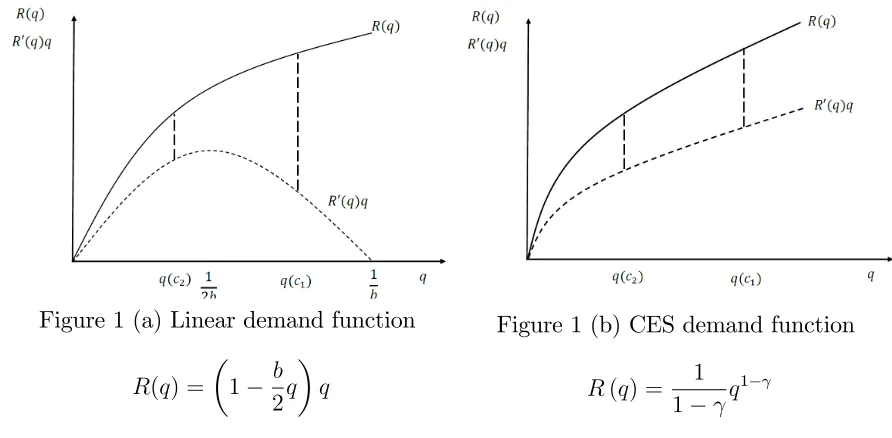
The following …gure graphically represents the di¤erence between …rm’s revenues (R(q)) and transfer payment (R0(q)q) for two frequently used demand functions (linear and CES).
Figure 1 (a) Linear demand function
R(q) = 1 b 2q q
Figure 1 (b) CES demand function
R(q) = 1
1 q
1
A linear demand quadratic cost case can illustrate Proposition 1. With revenuesR(q) = 1 bq2 q, quadratic costC(q) = mq22 and input costsT(q) =F+wq, optimal production, namely, the one solving (1), is q(w) = 1 w
b+m and gross pro…ts (i.e. not taking into account
the fee) are (w) = (12(b+m)w)2. At the production stage, the factory producesq(p; w) = p wm . Optimal production can be decentralized with a transfer price p(w) = R0(q(w)) = m+bw b+m
and the factory achieves gross pro…ts (again, not taking into account the fee) f(w) = m
2 1 w b+m
2
.
In this linear example, the way pro…ts are shifted between divisions can be captured
by the parameter = m
b+m 2 (0;1), that is, factory’s pro…ts are a share of …rm’s pro…ts f(w) = (w). Interestingly, the input cost plays no role in the way those pro…ts are
split between divisions. What matters exclusively is the relative steepness of …rm’s cost
and revenue function. For instance, if b = m = 1, = 12 meaning that factory’s pro…t
accounts for half of the whole company.10 Delegating procurement becomes less appealing
when the rents the factory manager and the HQ bargain with the supplier are similar,
that is, when revenues are less concave (blow) and/or costs are more convex (high m). To
see this facts in more detail, normalize input costs as 0 =c1 c2 =c 1. When theHQ
10The way pro…ts are shifted from one division to the other is still the same, that is, = m
b+m when the
revenue and cost function areR(q) = v bq
s
1+s q, andC(q) =m
q1+s
[image:9.612.72.518.224.443.2]centralizes procurement, the fee in (7) becomes
FC = 1
2( (c1) (c2)) =
(2 c)c
4m (9)
and net pro…ts are
C = (c
1) FC =
1
2( (c1) + (c2)) =
(2 (2 c)c)
4m (10)
If the …rm decentralizes procurement, the fee in (8) becomes
FD = f(c1) f(c2)
2 =
( (c1) (c2))
2 =
2(2 c)c
4m . (11)
and net pro…ts are
D = (c
1) FD = (c1)
1
2( f(c1) f(c2)) =
(2 (2 c)c)
4m (12)
Direct comparison of equations (9) and (11) show that the fee paid to the supplier is lower under Delegated procurement, FC > FD, whenever < 1 and similarly comparing
equations (10) and (12) show that pro…ts under Delegated procurement are higher, C >
D, whenever <1.
The HQ could introduce a contract that links manager’s payment to …rm’s
perfor-mance and not only to factory’s success. That is, factory’s manager incentives could be a combination of both corporate and divisional performance, that is,
+ (1 ) f;
with weights chosen by HQ. If = 1, the manager just tries to maximize …rm’s pro…ts;
when 0 <1, the objective function of the manager is not perfectly aligned with …rm’s
interests. It is clear that Proposition 1 extends to any that satis…es 0 < 1. And,
moreover, the optimal incentive contract, in terms of minimizing payments to the supplier, is = 0.
One might consider other organizational arrangements rather than delegated
procure-ment to gain clout over the supplier. For instance, the HQ could vertically split the
company in two di¤erent entities: one owning the retail store being able to obtain revenues
R(q) and the other entity owning the factory with costsC(q). UnderVertical Separation, or simply V S, theHQ of the former company plays no further role in production and the
manager of the factory becomes HQ of the new company, taking over both procurement
and production decisions. When theHQchooses to create two companies assume theHQ
cares about total pro…ts of the …rm, that is (c1) TV S(q) where TV S(q) is the payment
to the supplier in the vertical separation case. In other words, assume perfectly capital
markets that allows theHQ from the sale of the factory obtaining a payment that covers
exactly the pro…ts of the separated entity.
We use the Shapley Value as a solution concept of the negotiation with three players involved in sharing the rents, the sales company, the factory company and the supplier.11
In this simple case, the rents of the grand coalition are (c1). The supplier is not needed to
achieve (c2)but it becomes as essential as the factory and the sales division to generate the
extra rents (c1) (c2). Therefore, the pro…ts of the supplier will be 13( (c1) (c2)).
The allocation of pro…ts can be achieved by a two part tari¤ with an input price equal to the marginal cost of production c1 and a fee:
FV S = 1
3( (c1) (c2)) (13)
It is immediate from equations (9) and (13)) that payments under vertical separation are lower than under centralized procurement, FV S < FC. The intuition for this result
is that under centralized procurement, the …rm and the supplier equally share the rents generated, (c1) (c2) whereas in the separating case, the supplier needs to agree with
two other companies making the supplier less determinant to achieve the extra rents. Then, when comparing delegated procurement and vertical separation, we observe that both organizational structures reduce the …xed payment as compared to the centralized procurement case. Under delegated procurement, some rents are transferred out of the negotiation through a transfer price scheme, whereas, under separation, some of the rents are outside the negotiation since the company is split into two di¤erent entities. While under delegated procurement the share of factory’s pro…ts with respect the total company’s
pro…t depends on the optimal transfer price, that is, FD = 1
2( f(c1) f(c2)), under
vertical separation, the share retained by the factory remains constant, that is, the supplier always retains FV S = 1
3( (c1) (c2)). Therefore, the preference of one structure over
the other depends crucially on the cost/revenue structure.
In the linear demand and quadratic cost case, we can explicitly compare both orga-nizational arrangements. In particular, from equation (11) and (13) we see that which organizational arrangement is more pro…table depends on the convexity of the revenue and cost functions: payments are lower under delegation, FV S > FD if and only if 2 0;23
(and FV S < FD if and only if
2 23;1 .
3.1
Transfer Price Commitment
The previous section shows that delegation of procurement when the …rm is organized through business units allows the …rm to set aside some rents from negotiation. The result is obtained even if the choice of internal pricing is nonstrategic. Could the …rm improve this situation by credibly announcing to an observable transfer price? By credibly committing to an observable transfer price, the …rm may deviate from e¢cient considerations (can set
p 6= R0(q(c1))) trying to a¤ect supplier’s behavior. However, committing to a transfer
processes. Formally the approach used here to share rents is a cooperative game in which we haveN = 3
players (the grand coalition) and a characteristic functionv:S!Rfrom the set of all possible coalitions of players to a set of payments that satis…esv(?) = 0. The Shapley value gives any playerihis (average)
contribution to a coalition, where the contribution is taken over all possible coalitions to which a playeri
might belong. More formally, a player’si’s share of the rents are given by
V S
i =
X
S Nnfig
jSj!jn jSj 1j!
n! (v(S[i) v(S));
price also implies the …rm cannot adapt its transfer price to the outcome of the negotiation stage.12
Thus, we can slightly modify the timing on our set-up to account for the possibility that the HQ sets transfer prices strategically: …rst, HQ announces the allocation of authority over procurement decisions. If the …rm centralizes procurement, the game is the same as
previously stated but in case the …rm delegates procurement, the HQ publicly announces
one particular transfer price at which divisions trade. Afterwards, the factory manager bargains with the supplier, and …nally produces according to the preciously announced
transfer price and the outcome of the bargaining stage. We use H to denote actions and
payo¤s when the HQdelegates procurement and uses the transfer price strategically. Under delegated procurement, the level of production is chosen optimally according to
(2), and the bargaining process leads to e¢cient production, w = c1. The argument is
similar to the one in the nonstrategic situation in Section 2: the supplier prefers to reduce the marginal wholesale price to increase total rents and grab some of those rents through
the …xed component, being FH(p) = 1
2f f(p; c
1) f(p; c2)g. Thus, when setting the
transfer price, HQchooses p to maximize,
H
(p) = (p; c1) FH(p); (14)
where (p; c1) are the operating pro…ts for a given transfer price p and an input price c1.
The optimal strategic transfer price pH solves the following …rst order condition:
[R0(q(p; c1)) p]
@q(p; c1)
@p
| {z }
Direct ef f ect on operative prof its (p;c1)
1
2fq(p; c1) q(p; c2)g
| {z }
Strategic ef f ect on the f ee FH(p)
= 0. (15)
In words, the …rst term in (15) is the direct e¤ect on rents when transfer price is changed, whereas the second term is the strategic e¤ect of the transfer price on the outcome of the negotiation. The strategic e¤ect is always negative, higher transfer prices a¤ects negatively pro…ts through higher fees since pro…ts of the factory increase at a higher rate when the …rm works with the e¢cient source of the input. The sign of the direct e¤ect depends on the choice of the strategic transfer price: it is positive if p < R0(q(p; c1)) whereas it is
negative otherwise. Therefore, the following Proposition states whether it is convenient to distort or not (and how) transfer prices.
Proposition 2 IfHQcan commit to a transfer pricepH before bargaining takes place, then
the optimal transfer price satis…es pH < R0(q(c
1))and pro…ts under Delegated procurement
are higher than in Centralized procurement, C < H pH .
12First, note that in this section we take observability of the transfer price for granted. Existing
Proposition 2 extends Proposition 1 when transfer prices are strategic; delegating pro-curement activities to business units provides larger pro…ts than keeping them at the HQ
level. In both strategic and nonstrategic transfer pricing, the relevant feature of delegating
procurement to the business unit manager is that the factory has more clout than HQ
when negotiating the fee with the supplier, because an increase in production costs have less impact on factory pro…ts than on those of the company as a whole. In the strategic situation, committing to a transfer price allows the …rm to further reduce the relevance of an agreement in factory pro…ts. Against intuition, however, commitment to a transfer price does not guarantee the …rm larger pro…ts (not even to pay a lower fee to the supplier) than in the absence of commitment. The reason is that committing to a transfer price, the …rm cannot adapt to the outcome of the negotiation stage.
To see this, note that pro…ts under nonstrategic transfer pricing are those in (12) whereas equation (14) evaluated at p=R0(q(c1)) leads to
H
(p(c1)) = (c1)
1
2( f(c1) f(p(c1); c2)) (16) and therefore D > H(p(c
1)), that is, pro…ts under strategic transfer price jump down,
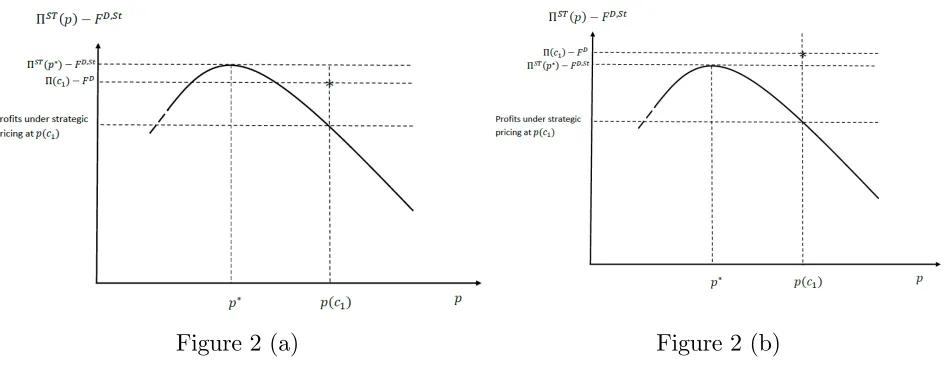
not because reduced e¢ciency in equilibrium but because the alternative becomes less valu-able when transfer prices cannot adapt to the true marginal cost of the factory ( f(c2)> f(p(c1); c2)).13 In Figures 2 (a) and (b), when the …rm commits to the e¢cient transfer
pricep=p(c1), pro…ts jump down from D = (c1) FD in (12) to H(p(c1))as de…ned
in (16). The …rm can improve this situation by distorting the transfer price fromp(c1)to
ps, the one solving (2). There are cases in which the jump down in pro…ts is compensated
by distorting the transfer price (case (a)) whereas other cases in which the distortion is unable to do so (case (b)).
Figure 2 (a) Figure 2 (b)
We …rst show a case when the distortion of the transfer price can never compensate this (discrete) fall in pro…ts. Moreover, we show that not only pro…ts decrease but the
13It should be clear here that if the …rm could commit to a menu of transfer prices, there would be
[image:13.612.79.551.476.660.2]lack of adaptability also increases fees to be paid to the supplier. To see these e¤ects, we analyze the marginal change of fees when the cost of the alternative changes marginally both under strategic and nonstrategic transfer price. When the price is strategically set
@FH
@c2
=q(pH; c2) + q(pH; c1) q(pH; c2)
@pH
@c2
where pH solves (15). First, an increase in the cost of the alternative raises the fee due to
a reduction on …rm’s bargaining (…rst element of the rhs of the previous equation). The …rm can reduce the impact of this e¤ect by modifying the transfer price (i.e., by reducing it, @p@cH
2 < 0), which in turn reduces the quantity to be produced and eventually the fee.
Note crucially that the positive impact of the strategic transfer prices on the fee depends on the (di¤erent) quantity produced with the supplier and the alternative.
Instead, when prices are nonstrategic, an increase in the cost of the alternative has a di¤erent e¤ect on fees:
@FD @c2
=q(c2) q(c2)
@p(c2)
@c2
where p(c2) =R0(q(c2))is the nonstrategic transfer price. The …rst e¤ect accounts for the
loss in …rm’s bargaining power while the second e¤ect is an adaptive e¤ect: the …rm modi…es the transfer price according to the real marginal cost in case negotiations fail reducing the impact of this increase. The following Lemma compares fees when the alternative is highly e¢cient, c2 =c1+" with " small.
Lemma 1 Fees under strategic transfer prices are larger than under nonstrategic transfer pricing when the alternative cost is in a neighborhood of c1.
When the alternative is as e¢cient as the supplier, that is, when c1 =c2, the strategic
and the nonstrategic transfer prices are identical, and the fees paid to the supplier, as well. However, when the cost of the alternative increases (marginally) nonstrategic transfer price adapts the price to the real marginal cost under the alternative. The impact on fees when the …rm uses strategic transfer price depends crucially on the quantity produced in equilibrium and under the alternative. When the alternative is as e¢cient as the supplier this e¤ect is negligible and therefore fees are larger than under nonstrategic transfer pricing. Therefore, since distorting the optimal transfer price leads to lower operating pro…ts (immediate consequence from Lemma 2) the result in Lemma 1 has immediate consequences on pro…ts under both strategic and nonstrategic transfer pricing
Proposition 3 Pro…ts under strategic transfer price are lower than under nonstrategic transfer price when the alternative cost is in a neighborhood of c1.
In words, committing to a transfer price does not allow the …rm to adapt the transfer price to the real marginal cost reducing pro…ts in the alternative (theHQloses the adaptive e¤ect). The bene…t of a transfer price consists in distorting it to reduce the fees and improve pro…ts. When the alternative is highly e¢cient, it makes no sense to distort transfer prices since there are no gains at the fee level and pro…ts are strictly lower than the nonstrategic case.
When the alternative worsens (when the alternative is not in the neighborhood of c1),
transfer price is lower and second distorting the transfer prices has an impact over fees (since
q(pH; c1) q(pH; c2)>0). We analyze this possibility by means of the linear demand and
quadratic cost case and we obtain that committing to a price is pro…table in cases in which is crucial to gain leverage at the negotiation stage. The use of strategic transfer prices makes sense when the cost of the alternative is high and/or when …rm’s cost/revenue structure makes di¢cult for the …rm to reduce factory’s pro…ts through nonstrategic transfer prices, that is, for large.
We can compare pro…ts and fees both under the strategic and under the nonstrategic transfer pricing when demand is linear generating revenues R(q) = 1 2bq q costs are quadratic C(q) = m
2q
2 and supplier’s cost is normalized to cero, c
1 = 0 and rewrite
c2 = c < 1. We know from Section 3 that delegation under nonstrategic transfer prices
leads to feesFD in (11) and pro…ts D in (12). Under strategic transfer prices, the optimal
transfer price is14
pH =
( (2 c)
2 if c 2 2+ 2
2+ otherwise
which leads to fees
FH = 8 < :
c (24mc) c if c 2+2
2
m(2+ )2 otherwise
(17)
and pro…ts
H
(pH) =
( (2 c)2
8m + c2 4m if c
2 2+ m(2+ ) otherwise
(18)
Comparing equations (12) and (18) for pro…ts and equations (11) and (17) for fees lead to the following Proposition
Proposition 4 In the linear demand and quadratic cost case, fees are lower under strategic transfer prices, FH < FD, i¤ c g( ), and pro…ts are higher under strategic transfer
prices, H(pH)> D, i¤ c f( ), where
g( ) = (
1
r
( +4)
(2+ )2 if0< < 1 2 2 (1 )
1+ (1 ) if 1 2< <1
, f( ) = 1 q
2+ if0< < 2 3 4 (1 )
2(1 2)+ if 23< <1
and g( )< f( ).
The solid line in Figure 3 represents the combinations of parameters such that above the solid line the …rm prefers using strategic transfer prices, while the dashed line represents the combination of parameters such that the fee paid is the same both under strategic and under nonstrategic transfer price. Therefore three regions are obtained, one in which fees and pro…ts are larger under nonstrategic (below the dashed function), the second in which both fees and pro…ts are larger under strategic transfer price (above the solid function) and …nally a third region of parameters in which fees are lower under strategic but the …rm gets larger pro…ts under nonstrategic. In this last region the reduction of fees does not o¤set the distortions generated at the production level.
14By distorting the transfer price, pro…ts under the alternative may become zero or even negative. We
Figure 3: strategic vs nonstrategic transfer prices. E¤ect on Fees and Pro…ts
We …nish this section by studying the linear revenue case: R(q) = vq being v > 0. Note that Proposition 1 does not apply for this case, since the result requires revenues to be strictly concave. It is immediate, though, to see that delegation does not improve
…rm’s pro…t by any means, that is, D = C. When revenues are linear, and prices are
nonstrategically set, transfer pricing is constant over negotiating scenarios (p = v both when the factory manager reaches an agreement or not), then the …rm is unable to shift pro…ts outside the factory (R(q) R0(q)q= 0 at all scenarios). Thus, it is irrelevant who bargains with the supplier, since the rents at the bargaining stage are always the same. Therefore, the …rm cannot take rents away from the negotiation stage and delegation procurement has no impact.
This is not the case when the HQ can use transfer prices strategically. First of all, compared to …gures 2a and 2b there is no jump down in pro…ts at p(c1), that is, D =
H(p(c
1)). In other words, committing to the e¢cient transfer price does not worsen
pro…ts under the alternative ( f(c2) = f(p(c1); c2)), and therefore, the …rm can always
replicate the outcome of the nonstrategic situation. But note that Lemma 2 still applies and thereforeHQshould optimally set a transfer price below the e¢cient, that is,pH < v,
thus shifting pro…ts from the factory to the sales division and taking away some rents from the bargaining stage. The following Proposition summarizes this …nding.
Proposition 5 When revenues are linear, R(q) = vq being v > 0, commitment to a transfer price leads always to higher pro…ts, that is, H(pH)> D = C
4
Economic forces that go against delegation of
pro-curement
moderate this result about the preference for delegation. The …rst one analyzes a case where the factory is not essential for the …rm since its activities can be replaced through an external alternative. The second caveat arises when the …rm is facing a supplier that may behave strategically, that is, a supplier that may announce and commit to a contract, and therefore may in‡uence …rm’s behavior.
4.1
Optimal organization when the factory is not essential
In this extension, the …rm can shut down the factory and still produce the output externally,
achieving pro…ts ext that are below those that can be achieved with the e¢cient use of
the factory, ext < (c
1).15 We analyze a set-up where bargaining is e¢cient and as a
consequence in equilibrium the factory is in operation; but we show that the existence of an alternative may have consequences in the organization of procurement.
If procurement iscentralized the alternative forHQwhen it bargains with the supplier is to achieve pro…ts b = maxf (c2); extg in case of disagreement; and the increase in
total pro…ts from an agreement is minf (c1) (c2); (c1) extg. The Nash bargaining
agreement in which theHQand the supplier share equally the increase in joint pro…ts can be implemented through a tari¤ that features a marginal price w=c1 and a fee
FC = minf (c1) (c2)
2 ;
(c1) ext
2 g: (19)
Therefore whenever ext> (c
2)the external alternative improves the bargaining position
of HQ under centralized procurement and end up paying a lower fee than the one in (7).
Under delegated procurement, the business unit is in charge of negotiations; but HQ
must approve the agreement and we assume they are still in time to shut down the factory
and produce the output externally. Therefore the fee FD that the business unit and the
supplier agree on must satisfy (c1) FD ext for the agreement to be approved by
HQ. The outcome of the negotiation between the business unit and the supplier is a tari¤ that features a marginal price w=c1 and a fee
FD = minf f(c1) f(c2)
2 ; (c1)
ext
g: (20)
When using external production does not bring much bene…t, ext < (c
2), the
bargain-ing clout of HQdoes not improve at all and the fee paid when procurement is centralized is the same as in Section 3,FC = (c1) (c2)
2 . Therefore the result in Proposition 1 directly
applies when ext < (c
2): Delegation is then the best way to organize procurement. An
attractive external production ext > (c
2) will tend to be more useful under centralized
procurement, however, since in delegated procurement it only works as an upper limit in the fee that the supplier can charge. As a consequence, the manager of the factory sometimes plays a softer hand thanHQin negotiations. Indeed, whenever the restriction on the fee is binding, f(c1) f(c2)
2 > (c1)
ext and thusFD = (c
1) ext, centralized procurement
would allow the …rm to pay a lower feeFC = (c1) ext
2 < F
D = (c
1) ext. For
interme-diate values of the external alternative, i.e. when (c2)< ext < (c1) f(c1)2 f(c2), the
possibility of external production increase the bargaining clout of HQ whereas it doesn’t
15We consider this alternative to be exogenous and hence we do not model how the …rm achieves that
a¤ect the fee that a business unit is charged. If we express the pro…ts under external
production as ext = (c
1); where 2 (0;1) measures its value, then we can write the
fee FC under centralized procurement as
FC =
1
2( (c1) (c2)) if 2 0; C 1
2(1 ) (c1) if 2( C;1)
where C = (c2)
(c1); and the fee F
D under delegated procurement as
FD =
1
2( f(c1) f(c2))if 2 0; D
(1 ) (c1) if 2( D;1)
where D = 1 f(c1) f(c2)
2 (c1) . It is immediate to see that a strictly concave revenue function
(R00 <0) implies C < D. We then obtain the following result:
Proposition 6 The fee paid in centralized procurement is below the one paid in delegated procurement, FC < FD, whenever
2( ;1), where = 1 f(c1) f(c2)
(c1) 2
C; D .
According to this Proposition, we obtain that centralized procurement is the optimal organization when the external alternative is su¢ciently attractive, 2( ;1). Delegated
procurement is still chosen for values of the alternative 2 C; for which the external
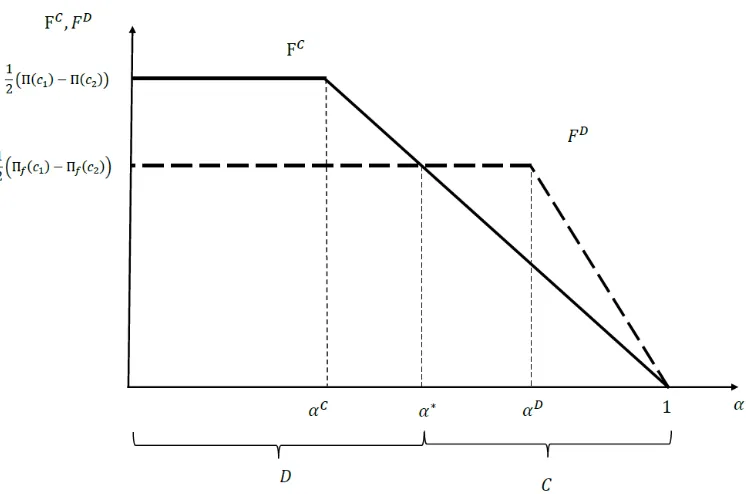
[image:18.612.114.487.462.709.2]alternative improves the bargaining clout ofHQ in centralized bargaining; only when this external alternative is su¢ciently attractive (and therefore HQ can ask for a low fee) is centralized procurement chosen. Figure 4 illustrates this result by plotting fees obtained under centralized procurement (solid line) and fees obtained under delegated procurement (dashed line) as a function of the external alternative, measured by .
As an example of this Proposition, consider the linear demand and quadratic cost
function case. The pro…ts of a business unit can be written as f(w) = (w), where
= b+mm 2(0;1). And pro…ts when the factory is used with the ine¢cient technology are (c2) = (c1), where = (11 cc21)2 2 (0;1) measures the di¤erences in e¢ciency of the
available suppliers.
We can write the fee under centralized procurement as
FC =
1
2(1 ) (c1) if 2(0; ) 1
2(1 ) (c1)if 2( ;1)
and the fee under delegated procurement as
FD =
(1
2 (1 ) (c1) if 2 0; 2
2 + 2
(1 ) (c1) if 2 22 +2 ;1
For any given values of parameters ; 2 (0;1) we see that fees are lower under cen-tralized procurement, FC < FD, when the external alternative is good enough, that is,
whenever
= + (1 ) (1 );
and keeps delegating procurement otherwise. Thus, there are values of the external
pro-duction 2 ( ; ) such that HQ improve their bargaining position against the e¢cient
suppliers but still prefer to delegate procurement.
4.2
Strategic supplier
The …rm is facing a supplier that may behave strategically, that is, a supplier that may announce and commit to a contract, and potentially in‡uencing …rm’s behavior. A rationale for this case may arise if the supplier is selling the product externally to the …rm and internally to other supplier’s divisions through the use of transfer pricing (see Arya et al, 2008).
The timing is similar to the benchmark case with the exception that the tari¤ may play
an strategic role. The HQ states who negotiates with the supplier, then either the HQ
or the factory bargains with the supplier and announces a particular tari¤ T(q)that will not be renegotiated afterwards, and …nally the …rm starts production needs. During this
section we will use the term S when the HQ delegates procurement and the supplier may
behave strategically.
Undercentralized procurement, the supplier improves nothing by announcing a di¤erent tari¤ from TC(q) = FC +c
1q(c1). An input price di¤erent from the marginal cost of
production, that is setting w6=c1, reduces the quantity to be produced and therefore the
rents to bargain with. However, under delegated procurement, this is not necessarily the case: by credibly committing toT(q)6=TD(q) =FD+c
1q(c1), the supplier may in‡uence
the transfer price by setting an input pricew6=c1.
and in case negotiations fail, the input price rises up toc2 and the factory obtains f(c2).
When the factory and the supplier bargain, they choose the tari¤ T(q) = F +wq that
maximize joint pro…ts in (6). Since this is simply a two-part tari¤ any agreement between the supplier and the factory manager should feature the restriction that the marginal wholesale price cannot be set above c2. Because otherwise, if the input price is set above
c2, then the factory manager could always trade with the alternative paying a lower per
unit price.16
When this constraint is not binding (w < c2), the optimal input price wS solves the
following …rst-order condition,
(w c1)
@q(p(w); w)
@w +
@p
@wq(p(w); w) = 0: (21)
The …rst element,the direct e¤ect, is the e¤ect of the input price on the quantity produced by the factory while the second element, the strategic e¤ect, is the e¤ect that the input
price has on the internal price set by the HQ. The sign of the direct e¤ect depends on
the choice of the input price: it is negative if w > c1 and positive otherwise. Instead, the
strategic e¤ect is always positive, since theHQshould optimally increase the transfer price to respond to higher marginal costs (in this case, the input cost).
The following Lemma speci…es the tari¤, production decisions and …rm’s pro…ts under
S. It is instructive to de…ne the following threshold (c1) c1 R"(q(wS))q(wS) 0where
wS solves (21),17 since the exact shape of the contract depends on the relative e¢ciency
of the supplier and the alternative. We say that the alternative is e¢cient when when
c2 2(c1; (c1))and ine¢cient otherwise.
Lemma 2 Under S, the optimal contract displays the following characteristics:
(a) When c2 2(c1; (c1)), the contract is FS = 12(c2 c1)q(c2) and wS =c2, production
q=q(c2), and …rm’s pro…ts are S = (c2) + 12(c2 c1)q(c2)
(b) When c2 > (c1), the contract is FS = 12 f(wS) f(c2) 12(wS c1)q(wS) and
wS
2(c1; c2), production q=q(wS)< q(c1), and …rm’s pro…ts are S = (wS) FS
First of all, the tari¤ between the factory and the supplier always leads to ine¢cient
production, w > c1. When the strategic e¤ect was absent setting w = c1 was indeed
optimal. Now, in this framework, when w = c1, the …rst order condition in (21) is still
positive, @c@p
1q(p(c1); c1)>0. Thus, both the supplier and the factory bene…t by distorting
input prices so as to in‡uence transfer prices even though this comes at the cost of producing ine¢ciently. By increasing the input price, the transfer price is set according to the real marginal cost, and joint pro…ts increase. The supplier reaps some of those extra pro…ts through the bargaining process.
The exact value of the distortion depends on the relative e¢ciency of the alternative and the supplier. When the alternative is e¢cient (case (a) in Lemma 2) the input price
16In other words, the contract between the factory manager and the supplier is a non-exclusive dealing.
We could assume theHQ delegates to the factory manager the decision to sign an exclusive dealing with
the supplier, that is, a two-part tari¤ including an exclusivity clause; a clause forcing the …rm to buy the input at the supplier. Including this clause into contracts implies that agreements featuring an input
w > c2 may be perfectly the solution of factory and manager’s joint pro…ts. By the end of this section we
brie‡y discuss the consequences of allowing the factory manager to sign exclusive contracts. We do so by
assuming two cases: one in which exclusive dealing is subject to the approval of theHQand a second one
in which the decision to sign exclusive dealing is completely delegated.
17For instance, for a linear demand case in whichR(q) = (1 b
2q)q andC(q) = m
2q 2 (c
is set at its maximum level, w = c2, and the …rm thus produces at its lowest level of
production, q(c2). Instead, when the alternative is more ine¢cient (case (b) in Lemma 2),
the input price is set at an intermediate unit price, w2(c1; c2), but still the production is
ine¢ciently low.
It is worth mentioning that the …x component FD may take negative values; it is the supplier who pays the …rm (the factory, indeed) for accepting the terms of the contract. The intuition of this negative …x component may be seen in the following way. When the alternative is ine¢cient, both the factory and the manager agrees on setting the largest marginal wholesale price possible, w=c2. Net of …xed payments, the factory gets exactly f(c2)(the same amount obtained under the alternative). Since the rents generated under
this agreement rises up to (c2 c1)q(c2), the factory reaps half of those rents; rents that
can only be satis…ed through the …x component.18
We now focus on supplier’s pro…ts when the supplier can commit to the contract stated
in Lemma 2, and we relate supplier’s pro…ts to the ones obtained under D and under
C. Let us de…ne by the subscript i
sup the pro…ts of the supplier for a speci…c way of
organizing procurement activitiesi2 fC; S; Dg. It is immediate to see from Proposition 1
that C
sup =FC > Dsup =FD. The following result allows us to state that supplier’s pro…t
under S remain between pro…ts of D and S.
Lemma 3 When the supplier behaves strategically, if R00<0 then S
sup 2 Dsup; Csup
First, as compared to the delegated procurement case, the supplier gets larger pro…ts by setting a distorted input price wS > c1. Note that, unlike the HQ behaving strategically,
the supplier can always replicate the e¢cient contract, setting w= c1 and grabbing rents
through the fee FD. By distorting the input price, the supplier can manage to e¤ectively
in‡uence the transfer pricing, increasing joint pro…ts and eventually grabbing some of those extra pro…ts. Second, as compared to the centralized procurement case, the supplier achieves lower pro…ts than the centralized situation: the loss of e¢ciency caused by the distortion of the input price,wS > c
1;is always larger than the increase in supplier’s pro…ts
due to the commitment e¤ect.
Given this potential unwanted production levels, the HQmay prefer to centralize pro-curement activities. Centralizing it raises production up to its e¢cient level, q(c1), and
hence pro…ts (net of …xed payment) increases, as well. However, centralizing does re-duce …rm’s bargaining strength increasing the …x component and reducing …rm’s pro…ts (see Proposition 1). The next proposition shows a case where the …rm always centralizes procurement.
Proposition 7 When …rm’s alternative is e¢cient that is, when c2 2 (c1; (c1)), HQ
centralizes procurement.
This result states that, anticipating supplier’s strategic behavior, the …rm should cen-tralize procurement if there are no substantial di¤erences between the two sources of the input. The distortions generated by delegating activities, i.e., producing q(c2) instead of
q(c1), cannot be compensated by the positive fee paid by the supplier. This cuto¤ (c1)
18This could be seen potentially as an slot allowance or even as a bribe from the supplier to the factory
should be seen as lower bound since, as long as w =c2 > c1, pro…ts under centralized are
strictly larger than delegated procurement when the supplier behaves strategically.
When the alternative is ine¢cient (the optimal solution of the contract is an interior so-lution) distortions are not so pronounced and the …rm may prefer to delegate procurement. The di¤erence of pro…ts between centralized and delegated procurement can be rearranged in the following way:
C D = 1
2 (c1) (w
S) + 1
2 f(w
S) 1
2(w
S c
1)q(wS) +
1
2( (c2) f(c2)): First, centralizing procurement provides more pro…ts than delegating it because pro…ts obtained under the alternative are always larger, 1
2( (c2) f(c2)) >0 but this e¤ect is
reduced the lower the e¢ciency of the alternative, that is, @( (c2) f(c2))
@c2 0. In the limiting
case when there is no alternative, i.e., the best case scenario for delegated procurement, the …rm may still centralize procurement. To be this true, the …rst element of the former equation should be positive, that is, delegation never takes place if, after rearranging,
(c1) (wS) + (wS c1)q(wS) (wS) f(wS);
the gains of producing e¢ciently are larger than the gains of paying less at the bargaining stage.
The sign of this inequality is not conclusive for general functions but we can compare di¤erent organizational structures when the demand is linear generating revenues R(q) = 1 bq2 q and cost are quadratic C(q) = mq22. We know from Section 3 that centralized procurement leads to w = c1 and a fee FC in (9) and pro…ts C in (10). Under S, the
optimal contract leads to a two part tari¤ with the following fee FS and unit price wS:
FS = 8 < :
(c2 c1)(1 c2)
2m if c2 2(c1; (c1)) (3 2)(1 c1)2
4m(2 )2
2(1 c 2)2
4m if c2 2( (c1);1)
and wS = (
c2 if c2 2c2 2(c1; (c1)) (1 )+c1
2 if c2 2( (c1);1)
Then the supplier’s pro…ts are
S =
8 < :
(1 c1)(1 c2)
2m if c2 2c2 2(c1; (c1)) (4 3 )(1 c1)2
4m(2 )2 +
2(1 c 2)2
4m if c2 2( (c1);1)
(22)
where the exact shape of the contract depends on the constraint w c2 being binding
or not (see Lemma (2)) where the cuto¤ (c1) = (12 )+c1 2 (c1;1) when the demand is
linear and costs are quadratic. Comparing equations (22) and (10) for pro…ts leads to the following result.
Proposition 8 HQcentralizes procurement ifc2 2(c1; (c1)), where (c1) =
2 ( +p )+p c1
2 ,
and delegates otherwise.
are larger than potential gains at the bargaining stage. Moreover, it is easy to see that (c1)> (c1): HQcentralizes procurement beyond stated in proposition 7, con…rming the
idea that the cuto¤ (c1) is a lower bound on centralizing procurement activities. When
the e¢ciency of the alternative worsens, the …rm is in a weaker position and being tougher at the bargaining stage becomes more relevant than e¢ciency considerations.
A …nal comment concerns the assumption on the characteristics of the contract signed between the supplier and the factory manager. We have imposed a restriction on the input price w; a restriction well justi…ed if the contract is a non-exclusive deal. Assume though that the factory manager and the supplier may sign a two part tari¤ including an exclusive
clause and assume the HQ delegates such decision to the factory manager. The basic
di¤erence between these two cases arises when the restrictionw c2 under non-exclusive
deals is active. Under exclusive deals, the optimal tari¤ avoid the restriction w c2; the
tari¤ is simply the solution to (21), implying an input price featuring wS > c
2 if c2 2
(c1; (c1)). It is immediate to see that the unconstrained joint pro…t maximization leads to
higher pro…ts to both the supplier and the factory, but sincew > c2 > c1then overall pro…ts
generated by this agreement are even lower, S wS + S
sup wS < S(c2) + Ssup(c2).
Given these two observations, …rm’s pro…ts under non-exclusive are always larger than under exclusive deals (or the same level of pro…ts when the restriction is not active). Anticipating this, the HQ centralizes procurement if wS > c
2. by a similar argument
provided in Proposition 7.
Another possibility would be to allow the factory manager to sign contracts subject to
HQ’s approval. In this case the factory manager and the supplier maximize joint pro…ts
subject to the constraint that the agreement must be at least as good as the alternative,
that is, S wS F S(c
2). Even if we add this restriction, the agreement obtained
can never provide larger pro…ts than under non-exclusive deals. When it is optimal to set wS > c2 either the HQ would block the agreement and the supplier and the factory
manager set preciselywS =c
2 or it does not block the agreement and the …rm sets a larger
input price. In either case, pro…ts the HQanticipates this ine¢cient behavior and prefers to centralize procurement.
Finally, given that S
sup 2 Dsup; Csup as stated in Lemma 3 and the fact that the
…rm may recover procurement decisions (as discussed in Propositions 7 and 8), the sup-plier always improves pro…ts as compared to the delegated situation (Section 3). This
improvement comes from two di¤erent channels: (a) if the HQdelegates procurement the
supplier distorts the input price, setting wS > c
1, thus increasing pro…ts. The second
mechanism arises when the HQ, anticipating a high distortion of input prices, may take
control over procurement decisions leading to an improvement of supplier’s pro…t (since
C
sup =FC > Dsup =FD).
Proposition 9 Committing to a contract always improves supplier’s pro…t. When the alternative is e¢cient, announcing a distorting contract deters delegation of procurement.
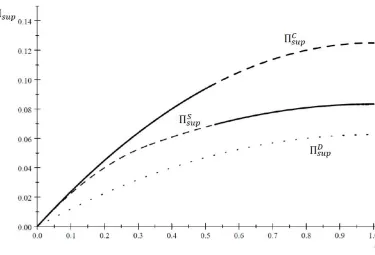
The next …gure graphically represents the former result. We graphically represent sup-plier’s pro…ts as a function of the alternative e¢ciencyc2. First, the dotted line represents
supplier’s pro…ts underD, the benchmark case; the dashed line represents supplier’s pro…ts underC, that is, when the supplier bargains with the HQand …nally the light dashed line represents supplier’s pro…ts under S, that is, pro…ts obtained if the contract signed was
the one de…ned in Lemma 2. The solid line represents supplier’s pro…ts when HQ’s
considerations were absent, it was optimal to delegate decisions to the factory manager (Proposition 1), leading to low supplier’s pro…ts (the dotted line). When the supplier be-haves strategically, it may happen that theHQis forced to take over procurement decisions leading to an increase of supplier’s pro…ts (from dotted to dashed) or it allows the factory to bargain even if it leads to ine¢cient production choices. Still, the supplier improves pro…ts by distorting input prices since it is able to in‡uence transfer price (from dotted to light dashed line)
Figure 5. Supplier’s pro…ts linear demand, quadratic cost example = 12
5
Concluding remarks
The model presented in this paper aims to characterize an industry structure in which the …rm needs to acquire an input from an external source to produce a good, and then the sales division markets the good. This industry structure naturally captures situations in which a divisionalized …rm needs to interact with key suppliers or engages negotiations with union labours at the factory level. As a consequence, the agent in charge of leading procurement negotiations must be the one with the adequate expertise, that is, the agent in charge of production decisions or the HQ. Our result on delegation is not necessarily restricted to this particular industry structure and can be extended to other industries in which production decisions fall on the agent in charge of marketing the product and where our results remain essentially unchanged. A potential example of this industry structure can be captured by the broadband industry. In this industry, the …rm owns a technology able to send content at a high speed but it also need to distribute content in order to satisfy its …nal consumer. In this case, the sales division, having a superior knowledge of consumer’s preferences, should be the one leading procurement negotiations with content producers, deciding which set of products are of interest.
Finally, there are at least two natural extensions. First, the multiplant case: note that in this case, the …rm can use the organizational structure to increase …rm’s bargaining positioning, but it can also shift production to increase its positioning. When the …rm owns several factories, it may not always be optimal to keep decentralization at the factory level, and the …rm partly centralize …rm’s procurement by building a new layer, namely, a central purchasing. Second, the introduction of uncertainty at the demand’s side. In that framework, the sales manager knows the true realization of the demand but cannot communicate it to theHQor to the factory (following Weitzman, 1974). Thus, the problem faced by the HQ is to whom provide authority over quantity; to the sales division and taking advantage of the local information knowledge or to the factory and reinforce the bargaining position against the supplier.
References
Alles, M., & Datar, S. (1998). Strategic transfer pricing.Management Science, 44(4), 451-461.
Arya, A., & Mittendorf, B. (2007). Interacting supply chain distortions: The pricing of internal transfers and external procurement. The Accounting Review, 82(3), 551-580.
Arya A. and B. Mittendorf. Pricing Internal Trade to Get a Leg up on External Rivals
(2008) Journal of Economics and Management Strategy 709-731
Arya, A., Mittendorf, B., & Yoon, D. H. (2008). Friction in related-party trade when a rival is also a customer. Management Science, 54(11), 1850-1860.
Baldenius, T., Melumad, N. & Reichelstein, S. Integrating managerial and tax objectives in transfer pricing (2004).Accounting Review, 79, 591–615.
Baldenius, T. & Reichelstein, S. External and internal pricing in multi-divisional …rms (2006).Journal of Accounting Research, 44, 1–28.