Proceedings of the 57th Annual Meeting of the Association for Computational Linguistics, pages 1282–1292 1282
Dynamically Composing Domain-Data Selection with Clean-Data
Selection by “Co-Curricular Learning” for Neural Machine Translation
Wei Wang and Isaac Caswell and Ciprian Chelba Google Research
{wangwe,icaswell,ciprianchelba}@google.com
Abstract
Noise and domain are important aspects of data quality for neural machine translation. Existing research focus separately on domain-data selection, clean-domain-data selection, or their static combination, leaving the dynamic in-teraction across them not explicitly examined. This paper introduces a “co-curricular learn-ing” method to compose dynamic domain-data selection with dynamic clean-data selection, for transfer learning across both capabilities. We apply an EM-style optimization procedure to further refine the “co-curriculum”. Exper-iment results and analysis with two domains demonstrate the effectiveness of the method and the properties of data scheduled by the co-curriculum.
1 Introduction
Significant advancement has been witnessed in neural machine translation (NMT), thanks to bet-ter modeling and data. As a result, NMT has found successful use cases in, for example, domain trans-lation and helping other NLP applications, e.g., (Buck et al.,2018;McCann et al.,2017). As these tasks start to scale to more domains, a challenge starts to surface: Given a source monolingual cor-pus, how to use it to improve an NMT model to translate same-domain sentences well? Data se-lection plays an important role in this context.
[image:1.595.315.518.226.355.2]In machine translation, data selection has been a fundamental research topic. One idea (van der Wees et al., 2017; Axelrod et al., 2011) for this problem is to use language models to select par-allel data out of a background parpar-allel corpus, seeded by the source monolingual sentences. This approach, however, performs poorly on noisy data, such as large-scale, web-crawled datasets, because data noise hurts NMT performance (Khayrallah and Koehn, 2018). The lower learning curve in
Figure 1: BLEUcurves over NMT training steps: domain-data selection on Paracrawl English→French data (lower curve) vs. clean-data selection on the same data (upper curve). Setup available in the experiment section.
Figure1shows the effect of noise on domain-data selection.
NMT community has realized the harm of data noise to translation quality, leading to efforts in data denoising (Koehn et al., 2018), as has been popular in computer vision (Hendrycks et al.,
2018). The upper curve in Figure1shows the ef-fect of clean-data selection on the same noisy data. These denoising methods, however, cannot be di-rectly used for the problem in question as they re-quire trusted parallel data as input.
We introduce a method to dynamically com-bine clean-data selection and domain-data selec-tion. We treat them as independent curricula, and compose them into a “co-curriculum”. We sum-marize our contributions as:
1. “Co-curricular learning”, for transfer learn-ing across data quality. It extends the slearn-ingle curriculum learning work in NMT and makes the existing domain-data selection method work better with noisy data.
improvement with deep models, it surpris-ingly improves shallow model by 8-10 BLEU points – We find that bootstrapping seems to “regularize” the curriculum and make it eas-ier for a small model to learn on.
3. We wish our work contributed towards bet-ter understanding of data, such as noise, do-main, or “easy to learn”, and its interaction with NMT network.
2 Related Work
2.1 Measuring Domain and Noise in Data
Data selection for MT usually uses a scoring func-tion to rank sentence pairs. Cross entropy differ-ence (Moore and Lewis,2010) between two lan-guage models is usually used for selecting domain sentences, e.g., (van der Wees et al.,2017; Axel-rod et al.,2011). For a source sentencexof length
|x|, with a general-domain language model (LM), parameterized asϑ, and an in-domain LM,e ϑ, theb
domain-relevance ofxis calculated as:1
ϕ
x;ϑ,e ϑb
= logP
x;ϑb
−logP
x;ϑe
|x| (1)
Alternative measures (Wang et al.,2017;Chen and Huang,2016;Chen et al.,2016) also show effec-tiveness. With Eq.1to select data, the data distri-bution (domain quality) in the in-domain monolin-gual data used to trainP(x;ϑb)is transferred into
the selected data through the scoring.
Data selection has also been used for data de-noising (Junczys-Dowmunt, 2018; Wang et al.,
2018b), by using NMT models and trusted data to measure the noise level in a sentence pair. One such a scoring function uses a baseline NMT, θ,e
trained on noisy data and a cleaner NMT,θ, ob-b
tained by fine-tuningeθon a small trusted parallel
dataset, and measures quality in a sentence pair
(x, y):
φ
x, y;θ,eθb
= logP
y|x;θb
−logP
y|x;θe
|y| (2)
Using NMT models for selection can also lead to faster convergence (Wang et al.,2018a). With Eq.2, the distribution (data quality) in the trusted parallel data is transferred into the selected data. These scoring functions usually use smaller net-works.
1We can use both source and target LMs, but we study the
problem where only a source in-domain corpus is available..
2.2 Curriculum Learning for NMT
Curriculum learning (CL) (Bengio et al.,2009) has been used to further improve traditional static se-lection. In CL, a curriculum,C, is a sequence of training criteria over training steps. A training cri-terion,Qt(y|x), at steptis associated with a set of weights, Wt(x, y), over training examples (x, y)
in a dataset D, where y is the translation for x. Qt(y|x)is a re-weighting of the training distribu-tionP(y|x):
Qt(y|x)∝Wt(x, y)P(y|x),∀(x, y)∈D (3)
Hence, for a training withT maximum steps,Cis a sequence:
C=hQ1, ..., Qt, ..., QTi (4)
At t, an online learner samples data from Qt
to train on, resulting in a task (or model), mt.
Therefore, C corresponds to a sequence of tasks,
M = hm1, ..., mt..., mfi, where mf is the final
task of interest. Intermediate tasks,mt, are sorted
in increasing relevance tomf as a series of
“step-ping stones” tomf, making curriculum learning a
form of transfer learning that transfers knowledge throughMto benefitmf. A performance metric P(C, mf)is used to evaluatemf.
There has already been rich research in CL for NMT. Fine-tuning a baseline on in-domain paral-lel data is a good strategy (Thompson et al.,2018;
Sajjad et al.,2017;Freitag and Al-Onaizan,2016).
van der Wees et al.(2017) introduce a domain cur-riculum. Wang et al. (2018b) define noise level and introduce a denoising curriculum.Kocmi and Bojar(2017) use linguistically-motivated features to classify examples into bins for scheduling. Ku-mar et al. (2019) use reinforcement learning to learn a denoising curriculum based on noise level of examples. Zhang et al. (2018) explore CL in general for NMT and observe faster training con-vergence. Zhang et al. (2019) use CL to adapt generic NMT models to a specific domain. Pla-tanios et al. (2019) propose a CL framework to simplify and speed up training and achieve bet-ter results; a nice study in sampling schedules was carried out.
domain curriculum, denoted by Cdomain. The later uses the NMT-based scoring function (Eq.2), which we call denoising curriculum, denoted by Cdenoise. Ideally, we would have in-domain, trusted parallel data to design atrue curriculum,
Ctrue, as an assessment oracle: with trusted
in-domain parallel data, Cdenoise is expected to si-multaneously perform domain-data selection and clean-data selection, becomingCtrue.
Mini-batch sampling is important for CL. Sev-eral alternatives have been introduced to evolve the training criteria Qt over time (Zhang et al., 2018; Wang et al., 2018b; van der Wees et al.,
2017; Kocmi and Bojar, 2017; Platanios et al.,
2019). In these curricula, tasks in M are se-quenced in order of increasing relevance. Earlier tasks are exposed to a diversity of examples and later tasks progressively concentrate on data sub-sets more relevant to the final task.
2.3 More Related Work
Junczys-Dowmunt (2018) introduces a practical and effective method to combine (static) features for data filtering. Mansour et al. (2011) com-bine an n-gram LM and IBM translation Model 1 (Brown et al.,1993) for domain data filtering. We compose different types of dynamic online selec-tion rather than combining static features.
Back translation (BT), e.g., (Sennrich et al.,
2016), is another important approach to using monolingual data for NMT. Here we use monolin-gual data to seed data selection, rather than gener-ating parallel data directly from it. Furthermore, we study the use of source-language monolingual data, in which case BT cannot be applied directly.
3 Problem Setting
]
DXY is a background parallel dataset between
languages X andY. It may be crawled from the web: large (hundreds of millions of pairs), diverse and noisy.
DIDX is an in-domain monolingual corpus in source languageX. It contains thousands to mil-lions of sentences and specifies the testing domain. WithDIDX, we can trainϕ(Eq.1) to sort data by domain relevance into a domain curriculum. DID
X
can be small because we can use it to fine-tuneϑe
intoϑ.b [
DODXY is a small, trusted, out-of-domain (OD) parallel dataset. It contains several thousands of
pairs or fewer. With D[OD
XY, we can train the φ
3 en→zh sentence pairs: 1 (en) Where is the train station?
(zh-gloss) TRAIN STATION IS WHERE?
2 (en) I’d like to have two window seats.
(zh-gloss) PLS. BOOK ME TWO WINDOW SEATS.
3 (en) It usually infects people older than 60. (zh-gloss) PEOPLE OLDER THAN 60 USUALLY ARE INFECTED BY IT.
W1 → W2 → W3 → W4 Travel domain curri.
ϕ(3)< ϕ(2)< ϕ(1)
1/3 1/3 1/3
1/3 1/3 1/3
1/2 1/2
0.0
1.0
0.0 0.0
Denoising curri.
φ(2)< φ(1)< φ(3)
1/3 1/3 1/3
1/2
0.0
1/2
1/2
0.0
1/2
1/2
0.0
1/2 Co-curriculum (Our goal) 1/3 1/3 1/3
1/2
0.0
1/2
1.0
0.0 0.0
1.0
0.0 0.0
[image:3.595.314.521.152.263.2]
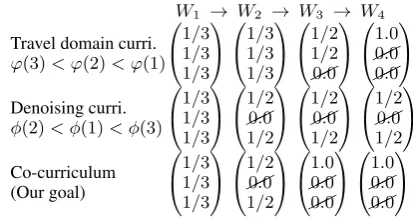
Table 1:Curriculum and co-curriculum examples generated from a toy dataset. Each is characterized by its re-weighting,
Wt, over four steps, to stochastically order data to benefit a final task. ϕ: the domain scoring function (Eq.1). φ: the denoising scoring function (Eq.2). Strikethrough marks dis-carded examples.
(Eq.2) to sort data by noise level into a denois-ing curriculum.
The setup, however, assumes that the in-domain, trusted parallel data, D[ID
XY, does not
ex-ist – Our goal is to use an easily available mono-lingual corpus and recycle existing trusted parallel data to reduce the cost of curating in-domain par-allel data.
We are interested in a composed curriculum,
Cco, to improve either original curriculum:
P(Cco, mf) > P(Cdenoise, mf) (5)
P(Cco, mf) > P(Cdomain, mf) (6)
We hopeP(Cco, mf)≈ P(Ctrue, mf)as if a small
in-domain, trusted parallel dataset were available.
4 Co-Curricular Learning
Table 1 illustrates the idea with a toy dataset of three examples. Source sentences (en) of exam-ples 1 and 2 are in the travel domain. Example 2 is a noisy translation. Example 3 is well-translated but belongs to the medicine domain. A travel-domain curriculum follows its data re-weighting, Wt, and gradually discards (strikethrough) less
domain. We want to “fuse” these two partial cur-ricula into a co-curriculum to train models pro-gressively on both in-domain and clean examples. We call this co-curricular learning.
4.1 Curriculum Mini-Batching
To facilitate the definition of co-curricular learn-ing and followlearn-ing (Platanios et al., 2019; Wang et al.,2018b), we define a dynamic data selection function, Dφλ(t, D), to return the top λ(t) of ex-amples in a dataset D sorted by a scoring func-tionφat a training stept. We useλ(t) = 0.5t/H, (0 < λ≤1), as apace functionto return a selec-tion ratio value that decays over time controlled by a hyper-parameterH.2 During training,Dφλ(t, D)
progressively evolves into smaller subdatasets that are more relevant to the final task using the scoring function. In practice,Dφλ(t, D0)can be applied on a small buffer D0 of random examples from the much bigger D, for efficient online training. It may also be desirable to set a floor value onλ(t)
to avoid potential data selection bias. This is how we implement a curriculum in experiments. We introduce two different co-curricula below.
4.2 Mixed Co-Curriculum (Ccomix)
Mixed co-curriculum, Ccomix, simply adds up the domain scoring function (Eq.1) and the denoising function (Eq.2). For a sentence pair(x, y),
ψ(x, y) =φ(x, y) +ϕ(x).
We then can constrain the re-weighting,Wt(x, y), to assign non-zero weights only to examples in Dψλ(t,D]XY) at a training step. We use uniform
sampling. The co-curriculum is thereby fully in-stantiated based on Eq.3and Eq.4. However, val-ues of φandϕmay not be on the same scale or even from the same family of distributions. There-fore, despite its simplicity,Ccomixmay not be able to enforce either curriculum sufficiently.
4.3 Cascaded Co-Curriculum (Ccocascade)
Cascaded co-curriculum,Ccocascade, defines two se-lection functions and nests them. Let β(t) = 0.5t/F and γ(t) = 0.5t/G be two pace func-tions, implemented similarly to above λ(t), with different hyper-parameters F andG.3 They
con-2This is inspired by the exponential learning rate
sched-ule. In the following notations, we omitHfor brevity, but the function name implies it.
3 We will omitF, Gfor brevity, but the function names
can indicate them.
trol the data-discarding paces for clean-data se-lection and domain-data sese-lection, respectively. At step t, Dβφt,D]XY
retains the top β(t) of
background data D]XY, sorted by scoring
func-tion φ(x, y). Dγϕ
t,Dβφt,D]XY
retains the
top γ(t) of Dφβt,D]XY
, re-sorted by scoring functionϕ(x). That is,
Dγϕ◦ Dφβ t,D]XY
=Dϕγt,Dφβt,D]XY
Then Eq. 3 is redefined into Eq. 4 with uniform sampling:4
Wt(x, y) =
1
|Dϕγ◦Dβφ|
if (x, y)∈ Dγϕ◦ Dφβ
0 otherwise
(7)
Compared toCmix
co ,CcocascadecascadesCdenoise and
Cdomainper step.
At a time step, both pace functions, in their re-spective paces, discard examples that become less relevant to their own tasks. All surviving exam-ples then have an equal opportunity to be sam-pled. Even though uniformly sampled, examples that are more relevant are retained longer in train-ing and thus weighed more over time.
Table 1 shows a toy example of how two cur-ricula are composed. At step 1, no example is discarded yet, and all examples have equal sam-pling opportunity (W1’s). At step 2, the
denois-ing curriculum discards the noisiest example 2, but the domain curriculum still keeps all; So only 1 and 3 are retained in the co-curriculum (W2). In
step 3, the domain curriculum discards the least in-domain example 3, so only 1 is left in the co-curriculum now (W3). The denoising curriculum
has a slower pace than the domain curriculum. Over the four steps, example 1 is kept longer thus weighed more.
4.4 Curriculum Optimization
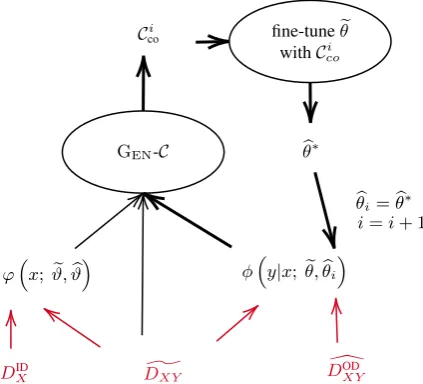
We further improve the co-curriculum using an EM (Dempster et al.,1977) style optimization pro-cedure in training, as shown in Figure2. It aims specifically to iteratively improve the denoising selection, without losing quality on the domain se-lection.
4Function nesting is asymmetrical, but the uniform
0
0
]
DXY ϕx;ϑ,eϑb
GEN-C Ci
co fine-tuneθe withCi
co
b
θ∗
b
θi=bθ
∗
i=i+ 1
φy|x; eθ,bθi
DID
X D[
[image:5.595.75.287.63.255.2]OD XY
Figure 2:Co-curricular learning with an EM-style optimiza-tion procedure. Thicker arrows form the bootstrapping loop.
With D]XY and DIDX, we train a domain
scor-ing function, ϕ(x;ϑ,e ϑb). With D]XY and D[ODXY,
we train a denoising scoring function,φ(y|x;θ,e θb).
The in-domain component ϑb of ϕ or the clean
component ϑbof φare obtained by fine-tuning ϑe
orθeon the respective seed data. Theseinitialize
the procedure (iteration 0).
At iteration i, we generate a concrete co-curriculum using the dynamic re-weighting, Wt,
as defined in Section4. Let GEN-Cdenote the
cur-riculum generationprocess:
Cco =GEN-C
]
DXY, φi, ϕ
(8)
Then, we fine-tune the original noisy NMT component,θ, ofe φonCco:
b
θ∗ = arg max
b
θ
P(Cco, mf) (9)
b
θ∗is used to replace the clean component ofφ
b
θi = θb∗
i = i+ 1
b
θiis then compared against the originalθefor
scor-ing. The updatedφ and the constant ϕwork to-gether to generate a new co-curriculum in the next iteration going back to Eq.8. In this process, only the denoising function φ is iteratively updated, made more aware of the domain.
We call the procedure EM-style because D]XY
is treated as incomplete without the (hidden) data order. The generated Cco in each iteration sorts
the data and thus is viewed as complete. It is then used to trainθbby maximizing the performance of
the final task. θbandCcobootstrap each other. The
process finishes after a pre-defined number of iter-ations. We use shallow parameterization for scor-ing functions but we can train a deep model on the finalCco. The process also uses fine-tuning, so it can be run efficiently.
In principle, the domain-data scoring function ϕcan be updated in a similar manner, too, by up-dating its in-domain component,ϑ. This may helpb
when the in-domain monolingual corpus is very small. An alternating optimization process can be used to bootstrap both. We, however, do not inves-tigate this.
5 Experiments
5.1 Setup
We consider two background datasets and two test domains, so we have four experiment configura-tions. Each configuration has as inputs a back-ground dataset, an in-domain source-language corpus and a (small) trusted parallel dataset that is out-of-domain. The inputs of a configuration are shown in Figure2.
As alternative background datasets, we use the English→French Paracrawl data,5 (300 million pairs), and the WMT14 training data (40 million pairs). The former is severely noisier than the later. We adopt sentence-piece model and apply open-source implementation (Kudo,2018) to seg-ment data into sub-word units with a source-target shared 32000 sub-word vocabulary.
We use two test domains: the English→French IWSLT15 test set, in spoken language domain; and the English→French WMT14 test set, in news do-main. For IWSLT15, we use the English side of its provided parallel training data (220 thousand examples) asDID
X , but use the parallel version as [
DXYOD for the WMT14 domain. The IWSLT14 test set is used for validation. For the WMT14 domain, the provided 28 million English sentences are used as DXID. WMT 2010-2011 test sets are
concate-nated asD[XYID for news6, or asD[ODXY for the above
5https://paracrawl.eu 6
IWSLT15 test domain. So, the trusted data are re-versely shared across the two test domains. Addi-tionally, WMT 2012-2013 are used as the valida-tion set for the WMT14 test domain. Our method does not require the in-domain trusted data, but we use it to construct bounds in evaluation.
We use RNN-based NMT (Wu et al.,2016) to train models. Model parameterization for θ’s of φ (Eq 2) or ϑ’s ϕ (Eq 1) is 512 dimensions by 3 layers – NLMs are realized using NMT mod-els with dummy source sentences (Sennrich et al.,
2016). Deep models are 1024 dimensions by 8 layers. Unless specified, results are reported for deep models. We compute truecased, detokenized BLEUwithmteval-v14.pl.
Training on Paracrawl uses Adam in warmup and then SGD for a total of 3 million steps us-ing batch size 128, learnus-ing rate 0.5 annealed, at step 2 million, down to 0.05. Training on WMT 2014 uses batch size 96, dropout probability 0.2 for a total of 2 million steps, with learning rate 0.5 annealed, at step 1.2 million, down to 0.05, too. No dropout is used in Paracrawl training due to its large data volume.
For the pace hyper-parameters (Section 4), we empirically use H = F = 400k, G = 900k. Floor values set forλ, β, γare top0.1,0.2,0.5 se-lection ratios, respectively, such that in the cas-caded co-curriculum case, the tightest effective percentile value would be the same 0.1 = 0.2× 0.5, too. All single curriculum experiments use the same pace setting asCmix.
5.2 Baselines and Oracles
We build various systems below as baselines and oracles. Oracle systems use in-domain trusted par-allel data.
Baselines:
1. Crandom : Baseline model trained on back-ground data with random data sampling. 2. Cdomain: Dynamically fine-tunesCrandomwith
a domain curriculum (van der Wees et al.,
2017).
3. Cdenoise: Dynamically fine-tunesCrandomwith a denoising curriculum (Wang et al.,2018b).
Oracles:
4. Ctrue: Dynamically fine-tunesCrandomwith the true curriculum.
5. ID fine-tune Crandom: Simply fine-tunes
Crandomwith in-domain (ID) parallel data.
Models Test BLEU IWSLT15 WMT14 (P)aracrawl
P1:Crandom 34.6 31.6
P2:Cdomain 35.7 32.4
P3:Cdenoise 36.6 33.6
P4:Ctrue 37.2 34.2
P5: ID fine-tune P1 38.5 34.0 (W)MT
W1:Crandom 36.5 35.0
W2:Cdomain 37.6 35.9
W3:Cdenoise 37.4 36.0
W4:Ctrue 38.5 36.3
[image:6.595.322.510.61.205.2]W5: ID fine-tune W1 39.7 35.9
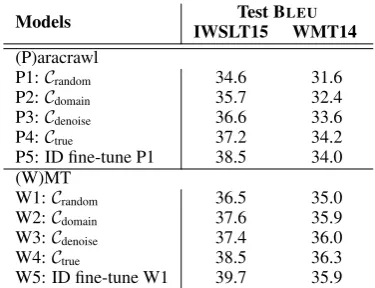
Table 2: Baseline and oracle models trained on Paracrawl data and WMT data, respectively. ID: in-domain. P2,3,4 (or W2,3,4) each dynamically fine-tunes P1 (or W1) with the re-spective curriculum. Except for P1 and W1, the two BLEU
scores in each row are fortwo differenttraining runs, each focusing on its own test domain (configuration).
We’ll see if our method is better than either origi-nal curriculum and how close it is to the true cur-riculum oracle. In most experiments, we fine-tune a warmed-up (baseline) model to compare curric-ula, for quicker experiment cycles.
Baseline and oracle BLEUscores are shown in Table 2. Note that, except for P1 and W1, the two BLEU scores in a row are for two different
training runs, each focusing on its own test do-main. On either training dataset, domain curricu-lum,Cdomain, improves baseline,Crandom, by 0.8-1.1 BLEU(P3 vs P1, W3 vs W1). Cdomainfalls
be-hind ofCdenoiseon the noisy Paracrawl dataset (P2
vs P3), but delivers matched performance on the cleaner WMT dataset (W2 vs W3) – noise com-promises the domain capability. On the WMT training data,Cdenoiseimproves baselines by about +1.0 BLEUon either test domain (W3 vs W1), and more on the noisier Paracrawl data: +2.0 on ei-ther test domain (P3 vs P1). The true curriculum (P4, W4) bounds the performance ofCdomain and
Cdenoise. Simple in-domain fine-tuning gives good
improvements (P5 vs P1, W5 vs W1).
5.3 Co-Curricular Learning
Cascading vs. mixing. Table 3 shows per-step cascaded filtering can work better than flat mixing (P7 vs P6). So we useCcocascade for the remaining experiments.
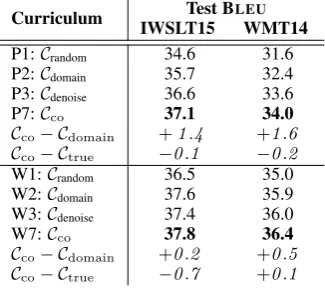
Curriculum BLEUcomparisons. Table4shows the effectiveness of co-curricular learning. On Paracrawl, co-curriculum (P7) gives more than +2 BLEUon top of no CL (P1). It improvesCdomain
Co-Curriculum
Test BLEU
IWSLT15 WMT14
P6:Cmix
co 36.2 33.8
P7:Ccascade
[image:7.595.347.489.61.177.2]co 37.1 34.0
Table 3: Per-step cascading works better than mixing on Paracrawl data.
Curriculum Test BLEU IWSLT15 WMT14
P1:Crandom 34.6 31.6
P2:Cdomain 35.7 32.4
P3:Cdenoise 36.6 33.6
P7:Cco 37.1 34.0
Cco− Cdomain +1.4 +1.6
Cco− Ctrue −0.1 −0.2
W1:Crandom 36.5 35.0
W2:Cdomain 37.6 35.9
W3:Cdenoise 37.4 36.0
W7:Cco 37.8 36.4
Cco− Cdomain +0.2 +0.5
Cco− Ctrue −0.7 +0.1
Table 4:Co-curriculum improves either constituent curricu-lum and no CL, can be close to the true curricucurricu-lum on noisy data.
BLEU on WMT14. It is better than either con-stituent curriculum (P2 or P3), close to the true curriculum (P4).
On the cleaner WMT training data, co-curriculum (W7) improves either constituent cur-ricula (W2 and W3) by smaller gains than Paracrawl: +0.2 BLEUon IWSLT15 and +0.4 on WMT14. Compared to Ctrue W5, co-curriculum
W7 falls behind (-0.7 BLEU) on IWSLT15 and matches (+0.1 BLEU) on WMT14.
So Cco outperforms either constituent curricu-lum, as we target in Section3. In both background data cases, using in-domain trusted parallel data to build oracles (P5, W5) are more effective than selecting data in our setup.
5.4 Effect of Curriculum Optimization
We further bootstrap the co-curriculum with the EM-style optimization procedure (Figure 2) for three iterations for all four configurations.
Shallow models. We use the translation perfor-mance of the clean componentP(y|x;θb)in
scor-ing functionφ(Eq.2) as an indicator to the qual-ity of Cco per iteration. Figure 3 shows that the BLEU scores ofP(y|x;θb)steadily become better
by iterations.7 θbhas 512 dimensions and 3
lay-7
They also include two initialization points: the noisyθe, and the initial cleanbθobtained by fine-tuningθeon the clean data.
baseline clean EM-1 EM-2 EM-3
22 24 26 28 30 32 34
Iteration
B
L
E
U
[image:7.595.103.259.62.108.2]IWSLT15 WMT14
Figure 3: The EM-style optimization has a big impact on small-capacity models, measured in BLEU. Experiments were carried out on Paracrawl data.
Curriculum Test BLEU IWSLT15 WMT14
P2:Cdomain 35.7 32.4
P7:Cco 37.1 34.0
P8: P7+Optimization 37.3 34.6 P8 -Cdomain +1.6 +2.0
W2:Cdomain 37.6 35.9
W7:Cco 37.8 36.4
W8: W7+Optimization 37.8 36.5 W8 -Cdomain +0.2 +0.6
Table 5: EM-style optimization further improves domain curriculum. But, overall, it has a small impact on deep mod-els.
ers. Surprisingly, EM-3improves baseline by +10 BLEU on IWSLT15, +8.2 BLEU on WMT14 and performs better than fine-tuning baseline with the clean, out-of-domain parallel data we have. They even reach the performance of Crandom (P1) that uses a much deeper model (1024 dimensions x 8 layers) trained on the vanilla data.
Deep models. Table5shows the BLEUs of deep models (1024 dimensions x 8 layers) trained on the final co-curriculum. P8 performs slightly better than the non-bootstrapped version P7 on Paracrawl: +0.6 BLEU on WMT14 test and +0.2 on IWSLT15 test. The differences on the WMT data appear to be smaller (W8 vs. W7). So, cur-riculum bootstrapping has a small impact overall on deep models.
Why the difference? Why is there such a dif-ference? We analyze the properties of the co-curriculum.
[image:7.595.100.263.156.300.2] [image:7.595.319.513.240.345.2]0 20 40 60 80 1.00
2.00 3.00 4.00
Filtering Percentage (%)
((1- Selection Ratio)*100)
Per
-w
ord
Loss
baseline clean
EM-1
EM-2
[image:8.595.345.489.63.187.2]EM-3
Figure 4: Curriculum learning and optimization push “easier-to-learn” (lower per-word loss) examples to late cur-riculum (right) and harder examples (higher per-word loss) to early curriculum (left).
0 20 40 60 80
2.00 2.50 3.00 3.50
Filtering Percentage (%)
((1- Selection Ratio)*100)
Standard
De
viation
baseline clean
EM-1
EM-2
[image:8.595.111.253.63.187.2]EM-3
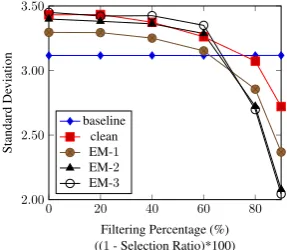
Figure 5: Curriculum learning and optimization push “reg-ularized” (lower variance) examples to late curriculum and higher-variance examples to early curriculum.
baseline) to the early curriculum phase (for explo-ration), and “easier-to-learn” examples with lower per-word loss to the late curriculum phase (for ex-ploitation). Over iterations, a later-iteration cur-riculum schedules even easier examples than a previous iteration at late curriculum. The story happens reversely at early curriculum due to prob-ability mass conservation. Figure5 shows a sim-ilar story regarding per-word loss variance. So, curriculum optimization “regularizes” the curricu-lum and makes it easier-to-learn towards the end of CL.
These may be important for a small-capacity model to learn efficiently. The fact that the deep model is not improved as much means that ‘clean’ may have taken most of the headroom for deep models.
Meanwhile, according to Figure 6, each indi-vidual curriculum concentrates more on news in-domain examples as training progresses. Over it-erations, bootstrapping makes the co-curriculum more news-domain aware. Due to the use of the
20 40 60 80
−2.00
−1.50
−1.00
−0.50 0.00 0.50
Filtering Percentage (%)
((1- Selection Ratio)*100)
Ne
ws-Domain
Rele
v
ance
baseline clean
EM-1
EM-2
EM-3
Figure 6: The denoising curriculum is made more aware of news-domain after iterations. Figure drawn for the (Paracrawl, news) configuration. Within a single curriculum, ‘baseline’ randomly shuffles data, thus flat curve. ‘clean’ uses the out-of-domain clean parallel data, thus not that much news relevance. All curves show negative news-domain rele-vance, indicating lack of news data in Paracrawl data.
[image:8.595.110.254.266.391.2]Curriculum Test BLEU IWSLT15 WMT14 P8: Fine-tune withCco 37.3 34.6 P9: Retrain withCco 37.9 35.6 W8: Fine-tune withCco 37.8 36.5 W9: Retrain withCco 38.1 36.3
Table 6:Retraining with a curriculum may work better than fine-tuning with it, on a large, noisy dataset.
denoising curriculum, data in curriculum becomes cleaner, too. So, although the co-curriculum schedules data from hard to easier-to-learn, which seems opposite to the general CL, it also sched-ules data from less in-domain to cleaner and more in-domain, which captures the spirit of CL.
5.5 Retraining
On Paracrawl, retraining NMT with co-curriculum improves dynamic fine-tuning, as shown in Ta-ble6 (P9 vs. P8): +0.6 BLEU on IWSLT15 and +1.0 BLEU on WMT14. On WMT14 training data, retraining (W9) seems to perform similarly to fine-tuning on a warmed-up model (W8): +0.3 on IWSLT15 but -0.2 on WMT14; We speculate that this may be due to the smaller WMT training data size.
5.6 Dynamic vs. Static Data Selection
Co-curricular learning is dynamic. How does be-ing dynamic matter? Table 7 shows that fine-tuning on the top 10% data8static selection (P10, W10) gives good improvements over baselines P1, W1, but co-curriculum (P9, W9) may do better.
8This is the ratio where the pace function reaches the floor
[image:8.595.320.514.291.356.2]Model Test BLEU IWSLT15 WMT14
P1:Crandom 34.6 31.6
P9: Curriculum (Dynamic) 37.9 35.6 P10: Static selection 36.8 34.6
W1:Crandom 36.5 35.0
[image:9.595.346.489.61.186.2]W9: Curriculum (Dynamic) 38.1 36.3 W10: Static selection 37.4 36.2
Table 7:Curriculum learning works slightly better than fine-tuning a warmed-up model with a top static selection.
[image:9.595.74.289.62.147.2]Model Test BLEU IWSLT15 WMT14 P9: Retrain with curriclum 37.9 35.6 P11: Retrain with static sel. 37.1 34.6 W9: Retrain with curriculum 38.1 36.3 W11: Retrain on static sel. 34.0 31.7
Table 8: Curriculum learning works better than retrain-ing with a static, top selection, especially when the trainretrain-ing dataset is small.
This confirms findings by (van der Wees et al.,
2017).
What if we retrain on the static data, too? In Table8, W11 vs. W9 shows that retrained mod-els on the static data is far behind for the WMT14 training – top 10% selection has only 4 million ex-amples. On Paracrawl, P11 vs. P9 are closer, but retraining on co-curriculum performs still better. In all cases, co-curricular learning gives the best results. We may tune the static selection for bet-ter results, but then it is the exact point of CL, to evolve the data re-weighting without the need of a hard cutoff on selection ratio.
5.7 Discussion
Evidence of data-quality transfer. Figure 7 vi-sualizes that CL in one domain (e.g., web) may enable CL in another. This is the foundation of our proposed method. To draw the figure, using a random sample of 2000 pairs from WMT training data and some additional in-domain parallel data, we sort examples by tightening the selection ra-tio according to a true web curriculum. The web curve shows the co-relation between selection ra-tio and data relevance to web. The same data order appears to yield increasing relevance to other do-mains, too, with bigger effect on a closer ‘news’ domain, but smaller effect on ‘patent’ and ‘short’ (sentences).
Regularizing data without a teacher. The anal-ysis in Section5.4shows that the denoising scor-ing function and its bootstrapped versions tend to
20 40 60 80
−0.04
−0.02 0.00 0.02 0.04 0.06
Filtering Percentage (%)
((1- Selection Ratio)*100)
Domain
Rele
v
ance
news patent short web
Figure 7: Curriculum learning in one domain may enable curriculum learning in another.
regularize the late curriculum and make the sched-uled data easier for small models to learn on. One potential further application of this data property may be in learning a multitask curriculum where regular data may be helpful for multiple task distri-butions to work together in the same model. This has been achieved by knowledge distillation in ex-isting research (Tan et al., 2019), by regularizing data with a teacher – We could instead regularize data by example selection, without a teacher. We leave this examination for future research.
Pace function hyper-parameters. In experi-ments, we found that data-discarding pace func-tions seem to work best when they simultaneously decay down to their respective floors. Adaptively adjusting them seems an interesting future work.
6 Conclusion
We present a co-curricular learning method to make domain-data selection work better on noisy data, by dynamically composing it with clean-data selection. We show that the method improves over either constituent selection and their static combi-nation. We further refine the co-curriculum with an EM-style optimization procedure and show its effectiveness, in particular on small-capacity mod-els. In future, we would like to extend the method to handle more than two curricula objectives.
Acknowledgments
[image:9.595.72.288.193.258.2]References
Amittai Axelrod, Xiaodong He, and Jianfeng Gao. 2011. Domain adaptation via pseudo in-domain data selection. InProceedings of the 2011 Conference on Empirical Methods in Natural Language Process-ing, pages 355–362.
Yoshua Bengio, J´erˆome Louradour, Ronan Collobert, and Jason Weston. 2009. Curriculum learning. In Proceedings of the 26 th International Confer-ence on Machine Learning, page 8696, Montreal, Canada.
Peter F. Brown, Vincent J. Della Pietra, Stephen A. Della Pietra, and Robert L. Mercer. 1993. The mathematics of statistical machine translation: Pa-rameter estimation. Comput. Linguist., 19(2):263– 311.
Christian Buck, Jannis Bulian, Massimiliano Cia-ramita, Wojciech Pawe Gajewski, Andrea Ges-mundo, Neil Houlsby, and Wei Wang. 2018. Ask the right questions: Active question reformulation with reinforcement learning.
Boxing Chen and Fei Huang. 2016. Semi-supervised convolutional networks for translation adaptation with tiny amount of in-domain data. In Proceed-ings of the 20th SIGNLL Conference on Computa-tional Natural Language Learning (CoNLL), pages 314–323.
Boxing Chen, Roland Kuhn, George Foster, Colin Cherry, and Fei Huang. 2016. Bilingual methods for adaptive training data selection for machine transla-tion. InAMTA.
A. P. Dempster, N. M. Laird, and D. B. Rubin. 1977. Maximum likelihood from incomplete data via the em algorithm. JOURNAL OF THE ROYAL STATIS-TICAL SOCIETY, SERIES B, 39(1):1–38.
Markus Freitag and Yaser Al-Onaizan. 2016. Fast domain adaptation for neural machine translation. CoRR, abs/1612.06897.
Dan Hendrycks, Mantas Mazeika, Duncan Wilson, and Kevin Gimpel. 2018. Using trusted data to train deep networks on labels corrupted by severe noise. In S. Bengio, H. Wallach, H. Larochelle, K. Grau-man, N. Cesa-Bianchi, and R. Garnett, editors, Ad-vances in Neural Information Processing Systems 31, pages 10456–10465. Curran Associates, Inc.
Marcin Junczys-Dowmunt. 2018. Dual conditional cross-entropy filtering of noisy parallel corpora. In Proceedings of the Third Conference on Machine Translation, Volume 2: Shared Task Papers, pages 901–908, Belgium, Brussels. Association for Com-putational Linguistics.
Huda Khayrallah and Philipp Koehn. 2018. On the impact of various types of noise on neural machine translation. CoRR, abs/1805.12282.
Tom Kocmi and Ondˇrej Bojar. 2017. Curriculum learning and minibatch bucketing in neural ma-chine translation. In Proceedings of the Interna-tional Conference Recent Advances in Natural Lan-guage Processing, RANLP 2017, pages 379–386. INCOMA Ltd.
Philipp Koehn, Huda Khayrallah, Kenneth Heafield, and Mikel L. Forcada. 2018. Findings of the wmt 2018 shared task on parallel corpus filtering. In Pro-ceedings of the Third Conference on Machine Trans-lation, Belgium, Brussels. Association for Computa-tional Linguistics.
Taku Kudo. 2018. Subword regularization: Improv-ing neural network translation models with multiple subword candidates. InProceedings of the 56th An-nual Meeting of the Association for Computational Linguistics (Volume 1: Long Papers), pages 66–75. Association for Computational Linguistics.
Gaurav Kumar, George Foster, Colin Cherry, and Maxim Krikun. 2019. Reinforcement learning based curriculum optimization for neural machine translation. In2019 Annual Conference of the North American Chapter of the Association for Compu-tational Linguistics. Association for Computational Linguistics.
Saab Mansour, Joern Wuebker, and Hermann Ney. 2011. Combining translation and language model scoring for domain-specific data filtering. In In-ternational Workshop on Spoken Language Trans-lation, pages 222–229.
Bryan McCann, James Bradbury, Caiming Xiong, and Richard Socher. 2017. Learned in translation: Con-textualized word vectors. In I. Guyon, U. V. Luxburg, S. Bengio, H. Wallach, R. Fergus, S. Vish-wanathan, and R. Garnett, editors,Advances in Neu-ral Information Processing Systems 30, pages 6294– 6305. Curran Associates, Inc.
Robert C. Moore and William Lewis. 2010. Intelligent selection of language model training data. In Pro-ceedings of the ACL 2010 Conference, pages 220– 224.
Emmanouil Antonios Platanios, Otilia Stretcu, Graham Neubig, Barnab´as P´oczos, and Tom M. Mitchell. 2019. Competence-based curriculum learning for neural machine translation. In2019 Annual Confer-ence of the North American Chapter of the Associa-tion for ComputaAssocia-tional Linguistics. Association for Computational Linguistics.
Hassan Sajjad, Nadir Durrani, Fahim Dalvi, Yonatan Belinkov, and Stephan Vogel. 2017. Neural ma-chine translation training in a multi-domain sce-nario. arXiv preprint arXiv:1708.08712v2.
86–96, Berlin, Germany. Association for Computa-tional Linguistics.
Xu Tan, Yi Ren, Di He, Tao Qin, and Tie-Yan Liu. 2019. Multilingual neural machine translation with knowledge distillation. InInternational Conference on Learning Representations.
Brian Thompson, Huda Khayrallah, Antonios Anasta-sopoulos, Arya D. McCarthy, Kevin Duh, Rebecca Marvin, Paul McNamee, Jeremy Gwinnup, Tim An-derson, and Philipp Koehn. 2018. Freezing subnet-works to analyze domain adaptation in neural ma-chine translation. InProceedings of the Third Con-ference on Machine Translation: Research Papers, pages 124–132. Association for Computational Lin-guistics.
Rui Wang, Masao Utiyama, Lemao Liu, Kehai Chen, and Eiichiro Sumita. 2017. Instance weighting for neural machine translation domain adaptation. In Proceedings of the 2017 Conference on Empirical Methods in Natural Language Processing, pages 1482–1488. Association for Computational Linguis-tics.
Rui Wang, Masao Utiyama, and Eiichiro Sumita. 2018a. Dynamic sentence sampling for efficient training of neural machine translation. In Proceed-ings of the 56th Annual Meeting of the Association for Computational Linguistics (Volume 2: Short Pa-pers), pages 298–304, Melbourne, Australia. Asso-ciation for Computational Linguistics.
Wei Wang, Taro Watanabe, Macduff Hughes, Tetsuji Nakagawa, and Ciprian Chelba. 2018b. Denois-ing neural machine translation trainDenois-ing with trusted data and online data selection. In Proceedings of the Third Conference on Machine Translation: Research Papers, pages 133–143. Association for Computational Linguistics.
Marlies van der Wees, Arianna Bisazza, and Christof Monz. 2017. Dynamic data selection for neural ma-chine transaltion. InProceedings of the 2017 Con-ference on Empirical Methods in Natural Language Processing, pages 1400–1410.
Yonghui Wu, Mike Schuster, Zhifeng Chen, Quoc V Le, Mohammad Norouzi, Wolfgang Macherey, Maxim Krikun, Yuan Cao, Qin Gao, Klaus Macherey, Jeff Klingner, Apurva Shah, Melvin Johnson, Xiaobing Liu, ukasz Kaiser, Stephan Gouws, Yoshikiyo Kato, Taku Kudo, Hideto Kazawa, Keith Stevens, George Kurian, Nishant Patil, Wei Wang, Cliff Young, Jason Smith, Jason Riesa, Alex Rudnick, Oriol Vinyals, Greg Corrado, Macduff Hughes, and Jeffrey Dean. 2016. Google’s neural machine translation system: Bridging the gap between human and machine translation. arXiv preprint arXiv:1609.08144.
Xuan Zhang, Gaurav Kumar, Huda Khayrallah, Ken-ton Murray, Jeremy Gwinnup, Marianna J. Mar-tindale, Paul McNamee, Kevin Duh, and Marine
Carpuat. 2018. An empirical exploration of curricu-lum learning for neural machine translation. CoRR, abs/1811.00739.