660
End-to-end Deep Reinforcement Learning Based Coreference Resolution
Hongliang Fei, Xu Li, Dingcheng Li, Ping Li
Cognitive Computing Lab, Baidu Research
{hongliangfei,lixu13,lidingcheng,liping11}@baidu.com
Abstract
Recent neural network models have signifi-cantly advanced the task of coreference res-olution. However, current neural coreference models are typically trained with heuristic loss functions that are computed over a sequence of local decisions. In this paper, we introduce an end-to-end reinforcement learning based coreference resolution model to directly opti-mize coreference evaluation metrics. Specif-ically, we modify the state-of-the-art higher-order mention ranking approach inLee et al. (2018) to a reinforced policy gradient model by incorporating the reward associated with a sequence of coreference linking actions. Fur-thermore, we introduce maximum entropy reg-ularization for adequate exploration to pre-vent the model from prematurely converging to a bad local optimum. Our proposed model achieves new state-of-the-art performance on the English OntoNotes v5.0 benchmark.
1 Introduction
Coreference resolution is one of the most fun-damental tasks in natural language processing (NLP), which has a significant impact on many downstream applications including information extraction (Dai et al., 2019), question answer-ing (Weston et al.,2015), and entity linking ( Ha-jishirzi et al.,2013). Given an input text, corefer-ence resolution aims to identify and group all the mentions that refer to the same entity.
In recent years, deep neural network models for coreference resolution have been prevalent ( Wise-man et al., 2016; Clark and Manning, 2016b). These models, however, either assumed mentions were given and only developed a coreference link-ing model (Clark and Manning, 2016b) or built a pipeline system to detect mention first then re-solved coreferences (Haghighi and Klein, 2010). In either case, they depend on hand-crafted
fea-tures and syntactic parsers that may not generalize well or may even propagate errors.
To avoid the cascading errors of pipeline sys-tems, recent NLP researchers have developed end-to-end approaches (Lee et al., 2017;Luan et al.,
2018;Lee et al.,2018;Zhang et al.,2018), which directly consider all text spans, jointly identify entity mentions and cluster them. The core of those end-to-end models are vector embeddings to represent text spans in the document and scor-ing functions to compute the mention scores for text spans and antecedent scores for pairs of spans. Depending on how the span embeddings are com-puted, the end-to-end coreference models could be further divided into first order methods (Lee et al.,
2017; Luan et al., 2018; Zhang et al., 2018) or higher order methods (Lee et al.,2018).
Although recent end-to-end neural coreference models have advanced the state-of-the-art perfor-mance for coreference resolution, they are still trained with heuristic loss functions and make a sequence of local decisions for each pair of men-tions. However as studied inClark and Manning
(2016a);Yin et al.(2018), most coreference reso-lution evaluation measures are not accessible over local decisions, but can only be known until all other decisions have been made. Therefore, the next key research question is how to integrate and directly optimize coreference evaluation metrics in an end-to-end manner.
Policy network
Environment
State Next state Trajectory Reward function
Exploration Gradient Action
a
tNext State St+1
St p R(
a
1:T)θ(
a
t|St) [image:2.595.81.507.67.153.2]Reward
r
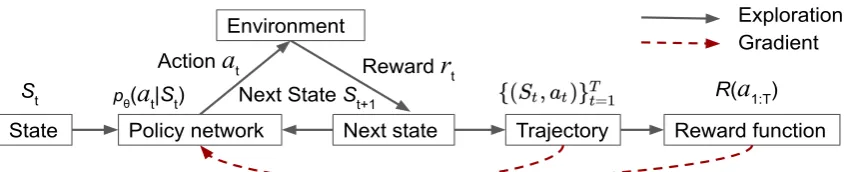
tFigure 1: The basic framework of our policy gradient model for one trajectory. The policy network is an end-to-end neural module that can generate probability distributions over actions of coreference linking. The reward function computes a reward given a trajectory of actions based on coreference evaluation metrics. Solid line indicates the model exploration and (red) dashed line indicates the gradient update.
reward function is used to measure how good the generated coreference clusters are, which is di-rectly related to coreference evaluation metrics. Besides, we introduce an entropy regularization term to encourage exploration and prevent the pol-icy from prematurely converging to a bad local op-timum. Finally, we update the regularized policy network parameters based on the rewards associ-ated with sequences of sampled actions, which are computed on the whole input document.
We evaluate our end-to-end reinforced corefer-ence resolution model on the English OntoNotes v5.0 benchmark. Our model achieves the new state-of-the-art F1-score of 73.8%, which out-performs previous best-published result (73.0%) ofLee et al.(2018) with statistical significance.
2 Related Work
Closely related to our work are the end-to-end coreference models developed byLee et al.(2017) and Lee et al. (2018). Different from previous pipeline approaches, Lee et al. used neural net-works to learn mention representations and cal-culate mention and antecedent scores without us-ing syntactic parsers. However, their models op-timize a heuristic loss based on local decisions rather than the actual coreference evaluation met-rics, while our reinforcement model directly opti-mizes the evaluation metrics based on the rewards calculated from sequences of actions.
Our work is also inspired byClark and Manning
(2016a) andYin et al.(2018), which resolve coref-erences with reinforcement learning techniques. They view the mention-ranking model as an agent taking a series of actions, where each action links each mention to a candidate antecedent. They also use pretraining for initialization. Nevertheless, their models assume mentions are given while our work is end-to-end. Furthermore, we add
entropy regularization to encourage more explo-ration (Mnih et al.; Eysenbach et al., 2019) and prevent our model from prematurely converging to a sub-optimal (or bad) local optimum.
3 Methodology
3.1 Task definition
Given a document, the task of end-to-end corefer-ence resolution aims to identify a set of mention clusters, each of which refers to the same entity. FollowingLee et al.(2017), we formulate the task as a sequence of linking decisions for each span
ito the set of its possible antecedents, denoted as Y(i) = {,1,· · ·, i−1}, a dummy antecedent
and all preceding spans. In particular, the use of dummy antecedent for a span is to handle two possible scenarios: (i) the span is not an entity mention or (ii) the span is an entity mention but it is not coreferent with any previous spans. The final coreference clusters can be recovered with a backtracking step on the antecedent predictions.
3.2 Our Model
Figure 2 illustrates a demonstration of our itera-tive coreference resolution model on a document. Given a document, our model first identifies top scored mentions, and then conducts a sequence of actions a1:T = {a1, a2,· · · , aT} over them,
whereT is the number of mentions and each ac-tionatassigns mentiontto a candidate antecedent ytinYt = {,1,· · · , t−1}. The state at timet
is defined asSt={g1,· · · ,gt−1,gt}, wheregiis
the mentioni’s representation.
Once our model has finished all the actions, it observes a rewardR(a1:T). The calculated
(1) (2)
(3) (4)
(5) Observe Sample
(2) Act
(1) (2)
(3) (4)
(5) Env update
(1) (2)
(3) (4) (5)
(a) State: St (b) Policy network: pθ(at|St) (c) Action (e) Update env and compute reward (d) Execute action
Observe Sample Act Env update Stop:1
Reward: r
Stop:0
(1) (2)
(3) (4) (5)
(6)
(1) (2)
(3) (4) (5)
(6)
(1) (2)
(3) (4) (5)
[image:3.595.89.516.69.211.2](6)
Figure 2: A demonstration of our reinforced coreference resolution method on a document with 6 mentions. The upper and lower rows correspond to step 5 and 6 respectively, in which the policy network selects mention (2) as the antecedent of mention (5) and leaves mention (6) as a singleton mention. The red (gray) nodes represent processed (current) mentions and edges between them indicate current predicted coreferential relations. The gray rectangles around circles are span embeddings and the reward is calculated at the trajectory end.
Char & word emb encoder: BiLSTM Head-Finding Attention Span Representation (g)
Mention Score (sm) Antecedent Score (sa) Coreference Score (s)
Masked softmax (pθ)
Self Attention
Gate Gate
Iterative refinement
FFNNm FFNNa
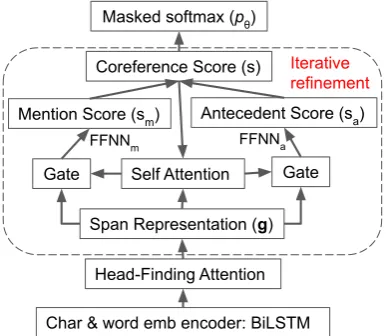
Figure 3: Architecture of the policy network. The com-ponents in dashed square iteratively refine span repre-sentations. The last layer is a masked softmax layer that computes probability distribution only over the candi-date antecedents for each mention. We omit the span generation and pruning component for simplicity.
Strube,2010) as the reward. FollowingClark and Manning(2016a), we assume actions are indepen-dent and the next stateSt+1 is generated based on
the natural order of the starting position and then the end position of mentions regardless of action
at.
Policy Network: We adopt the state-of-the-art end-to-end neural coreferene scoring architecture fromLee et al.(2018) and add a masked softmax layer to compute the probability distribution over actions, as illustrated in Figure3. The success of their approach lies in two aspects: (i) a coarse-to-fine pruning to reduce the search space, and (ii) an iterative procedure to refine the span represen-tation with an self-attention mechanism that
av-erages over the previous round’s representations weighted by the normalized coreference scores.
Given the stateStand current network
parame-tersθ, the probability of actionatchoosingytis:
pθ(at=yt|St) =
exp (s(t, yt)) P
y0∈Y
texp (s(t, y
0)) (1)
wheres(i, j)is the pairwise coreference score be-tween spaniand spanjdefined as following:
s(i, j) =sm(i) +sm(j) +sc(i, j) +sa(i, j) (2)
For the dummy antecedent, the score s(i, ) is fixed to 0. Heresm(.) is the mention score
func-tion, sc(., .) is a bilinear score function used to
prune antecedents, and sa(., .) is the antecedent
score function. Letgidenote the refined
represen-tation for span iafter gating, the three functions aresm(i) = θTmFFNNm(gi),sc(i, j) = gTi Θcgj,
andsa(i, j)is:
sa(i, j) =θaTFFNNa([gi,gj,gi◦gj, φ(i, j)])
where FFNN denotes a feed-forward neural net-work and◦denotes the element-wise product. θm,
Θcandθa are network parameters. φ(i, j) is the
feature vector encoding speaker and genre infor-mation from metadata.
The Reinforced Algorithm: We explore using the policy gradient algorithm to maximize the ex-pected reward:
J(θ) =Ea1:T∼pθ(a)R(a1:T) (3)
[image:3.595.84.279.297.465.2]Model MUC B
3
CEAFφ4
Prec. Rec. F1 Prec. Rec. F1 Prec. Rec. F1 Avg. F1
Wiseman et al.(2016) 77.5 69.8 73.4 66.8 57.0 61.5 62.1 53.9 57.7 64.2
Clark and Manning(2016a) 79.2 70.4 74.6 69.9 58.0 63.4 63.5 55.5 59.2 65.7
Clark and Manning(2016b) 79.9 69.3 74.2 71.0 56.5 63.0 63.8 54.3 58.7 65.3
Lee et al.(2017) 78.4 73.4 75.8 68.6 61.8 65.0 62.7 59.0 60.8 67.2
Zhang et al.(2018) 79.4 73.8 76.5 69.0 62.3 65.5 64.9 58.3 61.4 67.8
Luan et al.(2018)* 78.6 77.1 77.9 66.3 65.4 65.9 66.0 63.1 64.5 69.4
Lee et al.(2018)* 81.4 79.5 80.4 72.2 69.5 70.8 68.2 67.1 67.6 73.0
[image:4.595.93.505.63.185.2]Our base reinforced model 79.0 76.9 77.9 66.8 64.9 65.8 66.5 63.0 64.7 69.5 + Entropy Regularization 79.6 77.2 78.4 70.7 65.1 67.8 67.6 63.4 65.4 70.5 + ELMo embedding* 85.4 77.9 81.4 77.9 66.4 71.7 70.6 66.3 68.4 73.8
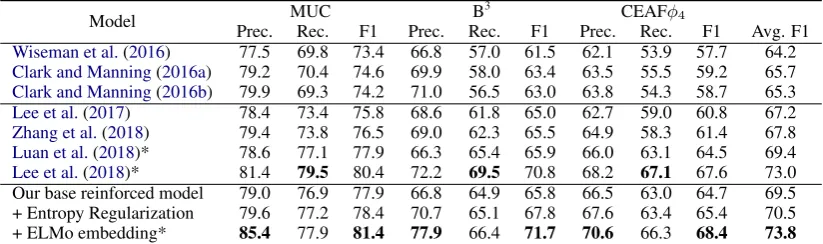
Table 1: Experimental results with MUC, B3 and CEAFφ4 metrics on the test set of English OntoNotes. The models marked with * utilized word embedding from deep language model ELMo (Peters et al.,2018). The F1 improvement is statistically significant under t-test withp <0.05, compared withLee et al.(2018).
to approximate the actual gradient by randomly samplingNstrajectories according topθand
com-pute the gradient only over the sampled trajecto-ries. Meanwhile, following Clark and Manning
(2016a), we subtract a baseline value from the re-ward to reduce the variance of gradient estimation. The gradient estimate is as follows:
∇θJ(θ)≈ 1
Ns Ns X
i=1 T X
t=1
∇θlogpθ(ait|Sit)(Rτi−b)
where Ns is the number of sampled trajectories, τi = {ai1,· · ·aiT} is the ith sampled trajectory
andb=PNs
i=1R(τi)/Nsis the baseline reward.
The Entropy Regularization: To prevent our model from being stuck in highly-peaked polices towards a few actions, an entropy regularization term is added to encourage exploration. The final regularized policy gradient estimate is as follows:
∇θJ(θ)≈
1
Ns Ns X
i=1 T X
t=1 ∇θ
logpθ(ait|Sit) +λexpr
pθ(ait|Sit) logpθ(ait|Sit)
(Rτi−b)
where λexpr ≥ 0 is the regularization parameter
that controls how diverse our model can explore. The larger theλexpris, the more diverse our model
can explore. If λexpr → ∞, all actions will be
sampled uniformly regardless of current policies. To the contrary, if λexpr = 0, all actions will be
sampled based on current polices.
Pretraining: We pretrain the policy network pa-rameterized byθusing the loss function below:
L(θ) =−
N X
i=1
X
j∈Yi
I(i, j) log (p(j|i;θ)) (4)
whereN is the number of mentions,I(i, j) = 1
if mentioniandjare coreferred, and 0 otherwise. Yiis the set of candidate antecedents of mentioni.
4 Experiments
We evaluate our model on the English OntoNotes v5.0 (Pradhan et al.,2011), which contains 2,802 training documents, 343 development documents, and 348 test documents. We reuse the hyperpa-rameters and evaluation metrics from Lee et al.
(2018) with a few exceptions. First, we pretrain our model using Eq. (4) for around 200K steps and use the learned parameters for initialization. Besides, we set the number of sampled trajecto-riesNs = 100, tune the regularization parameter λexpr in {10−5,10−4,0.001,0.01,0.1,1} and set
it to10−4based on the development set.
We use three standard metrics: MUC ( Grish-man and Sundheim, 1995), B3 (Recasens and Hovy,2011) and CEAFφ4(Cai and Strube,2010).
For each metric, we report the precision, recall and F1 score. The final evaluation is the average F1 of the above three metrics.
4.1 Results
with Lee et al. (2017); Zhang et al. (2018). Be-sides, it is even comparable with the end-to-end multi-task coreference model that has ELMo sup-port (Luan et al., 2018), which demonstrates the power of reinforcement learning combined with the state-of-the-art end-to-end model inLee et al.
(2018). Regarding our model, using entropy reg-ularization to encourage exploration can improve the result by 1 point. Moreover, introducing the context-dependent ELMo embedding to our base model can further boosts the performance, which is consistent with the results inLee et al.(2018). We also notice that our full model’s improvement is mainly from higher precision scores and reason-ably good recall scores, which indicates that our reinforced model combined with more active ex-ploration produces better coreference scores to re-duce false positive coreference links.
Overall, our full model achieves the state-of-the-art performance of 73.8% F1-score when us-ing ELMo and entropy regularization (compared to models marked with * in Table1), and our ap-proach simultaneously obtains the best F1-score of 70.5% when using fixed word embeddingonly.
Model Prec. Rec. F1
[image:5.595.325.506.61.148.2]Our full model 89.6 82.2 85.7 Lee et al.(2018) 86.2 83.7 84.9
Table 2: The overall mention detection results on the test set of OntoNotes. The F1 improvement is statisti-cally significant under t-test withp <0.05.
Since mention detection is a subtask of corefer-ence resolution, it is worthwhile to study the per-formance. Table 2 shows the mention detection results on the test set. Similar to coreference link-ing results, our model achieves higher precision and F1 score, which indicates that our model can significantly reduce false positive mentions while it can still find a reasonable number of mentions.
4.2 Analysis and Discussion
Ablation Study: To understand the effect of dif-ferent components, we conduct an ablation study on the development set as illustrated in Table 3. Clearly, removing entropy regularization deterio-rates the average F1 score by1%. Also, disabling coarse-to-fine pruning or second-order inference decreases 0.3/0.5 F1 score. Among all the com-ponents, ELMo embedding makes the most con-tribution and improves the result by3.1%.
Model Avg. F1
Full Model 74.1
w/o entropy regularization 73.1 w/o coarse-to-fine pruning 73.8 w/o second-order inference 73.6
w/o ELMo embedding 71.0
Table 3: Ablation study on the development set. “Coarse-to-fine pruning” and “second-order inference” are adopted fromLee et al.(2018)
Impact of the parameterλexpr:Since the
param-eterλexpr directly controls how diverse the model
is explored during training, it is necessary to study its effect on the model performance. Figure 4
shows the avg. F1 score on the development set for our full model andLee et al.(2018). We ob-serve thatλexpr does have a strong effect on the
performance and the best value is around 10−4. Besides, our full model consistently outperforms
Lee et al.(2018) over a wide range ofλexpr.
1e-5 1e-4 0.001 0.01 0.1 1
72 72.5 73 73.5 74 74.5 75
Avg. F1
Our model Lee et al. (2018)
Figure 4: Avg. F1 score on the development set with different regularization parameterλexpr. The result of Lee et al.(2018) is also plotted for comparison, which is a flat line since it does not depend onλexpr.
5 Conclusion
We present the first end-to-end reinforcement learning based coreference resolution model. Our model transforms the supervised higher order coreference model to a policy gradient model that can directly optimizes coreference evaluation metrics. Experiments on the English OntoNotes benchmark demonstrate that our full model in-tegrated with entropy regularization significantly outperforms previous coreference systems.
[image:5.595.314.505.348.477.2]References
Jie Cai and Michael Strube. 2010. Evaluation metrics for end-to-end coreference resolution systems. In Proceedings the 11th Annual Meeting of the Special Interest Group on Discourse and Dialogue (SIG-DIAL), pages 28–36, Tokyo, Japan.
Kevin Clark and Christopher D. Manning. 2016a. Deep reinforcement learning for mention-ranking coreference models. In Proceedings of the 2016 Conference on Empirical Methods in Natural Lan-guage Processing (EMNLP), pages 2256–2262, Austin, TX.
Kevin Clark and Christopher D Manning. 2016b. Im-proving coreference resolution by learning entity-level distributed representations. In Proceedings of the 54th Annual Meeting of the Association for Computational Linguistics (ACL), pages 643–653, Berlin, Germany.
Zeyu Dai, Hongliang Fei, and Ping Li. 2019. Corefer-ence aware representation learning for neural named entity recognition. In Proceedings of the Interna-tional Joint Conference on Artificial Intelligence (IJ-CAI), Macau.
Benjamin Eysenbach, Abhishek Gupta, Julian Ibarz, and Sergey Levine. 2019. Diversity is all you need: Learning skills without a reward function. In Sev-enth International Conference on Learning Repre-sentations (ICLR), New Orleans, LA.
Ralph Grishman and Beth Sundheim. 1995. Design of the muc-6 evaluation. InProceedings of the 6th con-ference on Message understanding (MUC), pages 1– 11, Columbia, MD.
Aria Haghighi and Dan Klein. 2010. Coreference res-olution in a modular, entity-centered model. In Pro-ceedings of Human Language Technologies: Con-ference of the North American Chapter of the As-sociation of Computational Linguistics (NAACL), pages 385–393, Los Angeles, CA.
Hannaneh Hajishirzi, Leila Zilles, Daniel S. Weld, and Luke S. Zettlemoyer. 2013. Joint coreference res-olution and named-entity linking with multi-pass sieves. In Proceedings of the 2013 Conference on Empirical Methods in Natural Language Processing (EMNLP), pages 289–299, Seattle, WA.
Kenton Lee, Luheng He, Mike Lewis, and Luke Zettle-moyer. 2017. End-to-end neural coreference reso-lution. InProceedings of the 2017 Conference on Empirical Methods in Natural Language Processing (EMNLP), pages 188–197, Copenhagen, Denmark.
Kenton Lee, Luheng He, and Luke Zettlemoyer. 2018. Higher-order coreference resolution with coarse-to-fine inference. In Proceedings of the 2018 Confer-ence of the North American Chapter of the Associ-ation for ComputAssoci-ational Linguistics: Human Lan-guage Technologies (NAACL-HLT), pages 687–692, New Orleans, LA.
Yi Luan, Luheng He, Mari Ostendorf, and Hannaneh Hajishirzi. 2018. Multi-task identification of enti-ties, relations, and coreference for scientific knowl-edge graph construction. In Proceedings of the 2018 Conference on Empirical Methods in Natural Language Processing (EMNLP), pages 3219–3232, Brussels, Belgium.
Volodymyr Mnih, Adri`a Puigdom`enech Badia, Mehdi Mirza, Alex Graves, Timothy P. Lillicrap, Tim Harley, David Silver, and Koray Kavukcuoglu. Asynchronous methods for deep reinforcement learning. In Proceedings of the 33nd Interna-tional Conference on Machine Learning (ICML), New York, NY.
Matthew Peters, Mark Neumann, Mohit Iyyer, Matt Gardner, Christopher Clark, Kenton Lee, and Luke Zettlemoyer. 2018. Deep contextualized word rep-resentations. In Proceedings of the 2018 Confer-ence of the North American Chapter of the Associ-ation for ComputAssoci-ational Linguistics: Human Lan-guage Technologies (NAACL-HLT), pages 2227– 2237, New Orleans, LA.
Sameer Pradhan, Lance Ramshaw, Mitchell Marcus, Martha Palmer, Ralph Weischedel, and Nianwen Xue. 2011. Conll-2011 shared task: Modeling un-restricted coreference in ontonotes. InProceedings of the Fifteenth Conference on Computational Nat-ural Language Learning: Shared Task, pages 1–27, Portland, OR.
Marta Recasens and Eduard Hovy. 2011. Blanc: Im-plementing the rand index for coreference evalua-tion. Natural Language Engineering, 17(4):485– 510.
Jason Weston, Antoine Bordes, Sumit Chopra, and Tomas Mikolov. 2015. Towards ai-complete ques-tion answering: A set of prerequisite toy tasks. CoRR, abs/1502.05698.
Sam Wiseman, Alexander M. Rush, and Stuart M. Shieber. 2016. Learning global features for coref-erence resolution. InProceedings of the 2016 Con-ference of the North American Chapter of the As-sociation for Computational Linguistics: Human Language Technologies (NAACL-HLT), pages 994– 1004, San Diego, CA.
Qingyu Yin, Yu Zhang, Weinan Zhang, Ting Liu, and William Yang Wang. 2018. Deep reinforcement learning for chinese zero pronoun resolution. In Proceedings of the 56th Annual Meeting of the Asso-ciation for Computational Linguistics (ACL), pages 569–578, Melbourne, Australia.