1371
Extracting Multiple-Relations in One-Pass
with Pre-Trained Transformers
Haoyu Wang∗† Ming Tan∗† Mo Yu∗‡ Shiyu Chang‡ Dakuo Wang‡ Kun Xu§ Xiaoxiao Guo‡ Saloni Potdar†
†IBM Watson ‡IBM Research §Tencent AI Lab
Abstract
The state-of-the-art solutions for extracting multiple entity-relations from an input para-graph always require a multiple-pass encoding on the input. This paper proposes a new so-lution that can complete the multiple entity-relations extraction task with only one-pass encodingon the input corpus, and achieve a new state-of-the-art accuracy performance, as demonstrated in the ACE 2005 benchmark. Our solution is built on top of the pre-trained self-attentive models (Transformer). Since our method uses a single-pass to compute all rela-tions at once, it scales to larger datasets easily; which makes it more usable in real-world ap-plications.1
1 Introduction
Relation extraction (RE) aims to find the semantic relation between a pair of entity mentions from an input paragraph. A solution to this task is essential for many downstream NLP applications such as automatic knowledge-base completion (Surdeanu et al., 2012; Riedel et al., 2013; Verga et al.,
2016), knowledge base question answering (Yih et al.,2015;Xu et al.,2016;Yu et al.,2017), and symbolic approaches for visual question answer-ing (Mao et al.,2019;Hu et al.,2019),etc.
One particular type of the RE task is multiple-relations extraction (MRE)that aims to recognize relations of multiple pairs of entity mentions from an input paragraph. Because in real-world appli-cations, whose input paragraphs dominantly con-tain multiple pairs of entities, an efficient and ef-fective solution for MRE has more important and more practical implications. However, nearly all existing approaches for MRE tasks (Qu et al.,
∗
Equal contributions from the corresponding authors:
{wanghaoy,mingtan,yum}@us.ibm.com. Part of work was done when Kun was at IBM.
1
https://github.com/helloeve/mre-in-one-pass.
×12
… …
Entity-aware Self-attention+ Feed-forward
… in south suburbs of Bagh #dad and Iraqi artillery fired …
Linear
PART-WHOLE(e1,e2) ART(e1,e2)
Pool Pool
[image:1.595.310.507.223.340.2]Linear
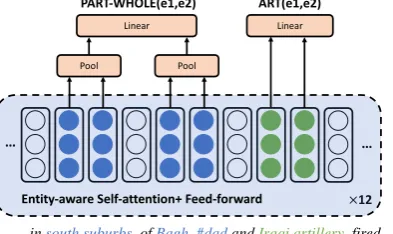
Figure 1: Model Architecture. Different pairs of entities, e.g., (Iraqiandartillery), (southern suburbs, Baghdad) are predicted simultaneously.
2014; Gormley et al., 2015; Nguyen and Grish-man, 2015) adopt some variations of the single-relation extraction (SRE) approach, which treats each pair of entity mentions as an independent in-stance, and requires multiple passes of encoding for the multiple pairs of entities. The drawback of this approach is obvious – it is computationally ex-pensive and this issue becomes more severe when the input paragraph is large, making this solution impossible to implement when the encoding step involves deep models.
This work presents a solution that can resolve the inefficient multiple-passes issue of existing so-lutions for MRE by encoding the input only once, which significantly increases the efficiency and scalability. Specifically, the proposed solution is built on top of the existing transformer-based, pre-trained general-purposed language encoders. In this paper we useBidirectional Encoder Represen-tations from Transformers (BERT) (Devlin et al.,
en-tities in the input paragraph. To the best of our knowledge, this work is the first promising solu-tion that can solve MRE tasks with such high ficiency (encoding the input in one-pass) and ef-fectiveness (achieve a new state-of-the-art perfor-mance), as proved on the ACE 2005 benchmark.
2 Background
MRE is an important task as it is an essential prior step for many downstream tasks such as au-tomatic knowledge-base completion and question-answering. Popular MRE benchmarks include ACE (Walker et al., 2006) and ERE (Linguistic Data Consortium,2013). In MRE, given as a text paragraph x = {x1, . . . , xN} and M mentions
e = {e1, . . . , eM}as input, the goal is to predict
the relation rij for each mention pair(ei, ej)
ei-ther belongs to one class of a list of pre-defined relationsRor falls into a special classNA indicat-ing no relation. This paper uses “entity mention”, “mention” and “entity” interchangeably.
Existing MRE approaches are based on ei-ther feature and model architecture selection tech-niques (Xu et al., 2015; Gormley et al., 2015;
Nguyen and Grishman, 2015; F. Petroni and Gemulla, 2015; Sorokin and Gurevych, 2017;
Song et al., 2018b), or domain adaptations ap-proaches (Fu et al., 2017; Shi et al., 2018). But these approaches require multiple passes of encod-ing over the paragraph, as they treat a MRE task as multiple passes of a SRE task.
3 Proposed Approach
This section describes the proposed one-pass en-coding MRE solution. The solution is built upon BERT with a structured prediction layer to en-able BERT to predict multiple relations with one-pass encoding, and an entity-aware self-attention mechanism to infuse the relational information with regard to multiple entities at each layer of hidden states. The framework is illustrated in Fig-ure 1. It is worth mentioning that our solution can easily use other transformer-based encoders besides BERT,e.g.(Radford et al.,2018).
3.1 Structured Prediction with BERT for MRE
The BERT model has been successfully applied to various NLP tasks. However, the final prediction layers used in the original model is not applicable to MRE tasks. The MRE task essentially requires
to perform edge predictions over a graph with en-tities as nodes. Inspired by (Dozat and Manning,
2018; Ahmad et al., 2018), we propose that we can first encode the input paragraph using BERT. Thus, the representation for a pair of entity men-tions(ei, ej)can be denoted asoi andoj
respec-tively. In the case of a mentionei consist of
mul-tiple hidden states (due to the byte pair encoding),
oi is aggregated via average-pooling over the
hid-den states of the corresponding tokens in the last BERT layer. We then concatenate oi andoj
de-noted as[oi :oj], and pass it to a linear classifier2
to predict the relation
P(rij|x, ei, ej) =softmax(WL[oi:oj] +b), (1)
where WL ∈ R2dz×l. d
z is the dimension of
BERT embedding at each token position, andlis the number of relation labels.
3.2 Entity-Aware Self-Attention based on Relative Distance
This section describes how we encode multiple-relations information into the model. The key concept is to use the relative distances between words and entities to encode the positional infor-mation for each entity. This inforinfor-mation is prop-agated through different layers via attention com-putations. Following (Shaw et al.,2018), for each pair of word tokens(xi, xj)with the input
repre-sentations from the previous layer as hi andhj,
we extend the computation of self-attentionzias:
zi= N
X
j=1
expeij
PN
k=1expeik
(hjWV +aVij), (2)
where eij=hiWQ(hjWK+aKij)/
√
dz. (3)
WQ,WK,WV ∈Rdz×dz are the parameters of the model, anddz is the dimension of the output
from the self-attention layer.
Compared to standard BERT’s self-attention,
aVij,aKij ∈Rdz are extra, which could be viewed as the edge representation between the input element
xi and xj . Specifically, we devise aVij and aKij
to encourage each token to be aware of the rela-tive distance to different entity mentions, and vice versa.
2
in of subu
rbs Bagh and fir ed ar
till ery Iraqi ##dad
in
suburbs
of Bagh
##dad
and Iraqi
artillery
fired
Zero Vector
!"($%&) !"(&%$) south
[image:3.595.102.248.63.214.2]sou th
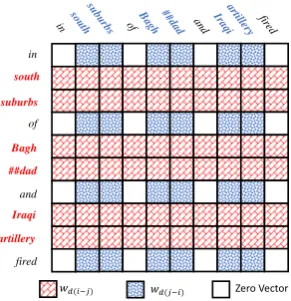
Figure 2:Illustration of the tensor{aKij}introduced in self-attention computation. Each red cell embedding is defined by wd(i−j), as the distance from entityxito tokenxj. Each blue cell embedding is defined bywd(j−i), as the distance from the entityxjto tokenxi. White cells are zero embeddings since neitherxinorxjis entity. The{aVij}follows the same pattern with independent parameters.
Adapted from (Shaw et al.,2018), we argue that the relative distance information will not help if the distance is beyond a certain threshold. Hence we first define the distance function as:
d(i, j) =min(max(−k,(i−j)), k). (4)
This distance definition clips all distances to a re-gion [−k, k]. k is a hyper-parameter to be tuned on the development set. We can now define aVij
andaKij formally as:
aVij,a K ij=
wV d(i,j), w
K
d(i,j), ifxi∈e
wV d(j,i), w
K
d(j,i), ifxj∈e
0, else.
(5)
As defined above, if either token xi or xj
be-longs to an entity, we will introduce a relative po-sitional representation according to their distance. The distance is defined in an entity-centric way as we always compute the distance from the entity mention to the other token. If neitherxinorxjare
entity mentions, we explicitly assign a zero vector to aK
ij and aVij. When both xi and xj are inside
entity mentions, we take the distance asd(i, j)to make row-wise attention computation coherent as depicted in Figure2.
During the model fine-tuning, the newly introduced parameters {w−kK , ..., wKk} and
{wV−k, ..., wkV}are trained from scratch.
4 Experiments
We demonstrate the advantage of our method on a popular MRE benchmark, ACE 2005 (Walker
et al.,2006), and a more recent MRE benchmark, SemEval 2018 Task 7 (G´abor et al., 2018). We also evaluate on a commonly used SRE bench-mark SemEval 2010 task 8 (Hendrickx et al.,
2009), and achieve state-of-the-art performance.
4.1 Settings
Data ForACE 2005, we adopt the multi-domain setting and split the data following (Gormley et al.,
2015): we train on the union of news domain (nw and bn), tune hyperparameters on half of the broadcast conversation (bc) domain, and evalu-ate on the remainder of broadcast conversation (bc), the telephone speech (cts), usenet news-groups (un), and weblogs (wl) domains. For Se-mEval 2018 Task 7, we evaluate on its sub-task 1.1. We use the same data split in the shared task. The passages in this task is usually much longer compared to ACE. Therefore we adopt the follow-ing pre-processfollow-ing step – for the entity pair in each relation, we assume the tokens related to their re-lation labeling are always within a range from the fifth token ahead of the pair to the fifth token af-ter it. Therefore, the tokens in the original passage that are not covered by the range of ANY input relations, will be removed from the input.
Methods We compare our solution with pre-vious works that predict a single relation per pass (Gormley et al.,2015;Nguyen and Grishman,
2015;Fu et al.,2017;Shi et al.,2018), our model that predicts single relation per pass for MRE, and with the following naive modifications of BERT that could achieve MRE in one-pass.
•BERTSP: BERT with structured prediction only,
which includes proposed improvement in3.1. •Entity-Aware BERTSP: our full model, which
includes both improvements in§3.1and§3.2. •BERTSPwith position embedding on the final
attention layer. This is a more straightforward way to achieve MRE in one-pass derived from pre-vious works using position embeddings (Nguyen and Grishman, 2015; Fu et al., 2017; Shi et al.,
2018). In this method, the BERT model encode the paragraph to the last attention-layer. Then, for each entity pair, it takes the hidden states, adds the relative position embeddings corresponding to the target entities, and finally makes the relation pre-diction for this pair.
•BERTSPwith entity indicators on input layer:
Method dev bc cts wl avg
Baselines w/o Domain Adaptation (Single-Relation per Pass)
Hybrid FCM (Gormley et al.,2015) - 63.48 56.12 55.17 58.26
Best published results w/o DA (from Fu et al.) - 64.44 54.58 57.02 58.68
BERT fine-tuning out-of-box 3.66 5.56 5.53 1.67 4.25
Baselines w/ Domain Adaptation (Single-Relation per Pass)
Domain Adversarial Network (Fu et al.,2017) - 65.16 55.55 57.19 59.30 Genre Separation Network (Shi et al.,2018) - 66.38 57.92 56.84 60.38
Multi-Relation per Pass
BERTSP(our model in§3.1) 64.42 67.09 53.20 52.73 57.67
Entity-Aware BERTSP(our full model) 67.46 69.25 61.70 58.48 63.14
BERTSPw/ entity-indicator on input-layer 65.32 66.86 57.65 53.56 59.36
BERTSPw/ pos-emb on final att-layer 67.23 69.13 58.68 55.04 60.95
Single-Relation per Pass
BERTSP(our model in§3.1) 65.13 66.95 55.43 54.39 58.92
Entity-Aware BERTSP(our full model) 68.90 68.52 63.71 57.20 63.14
[image:4.595.127.468.61.264.2]BERTSPw/ entity-indicator on input-layer 67.12 69.76 58.05 56.27 61.36
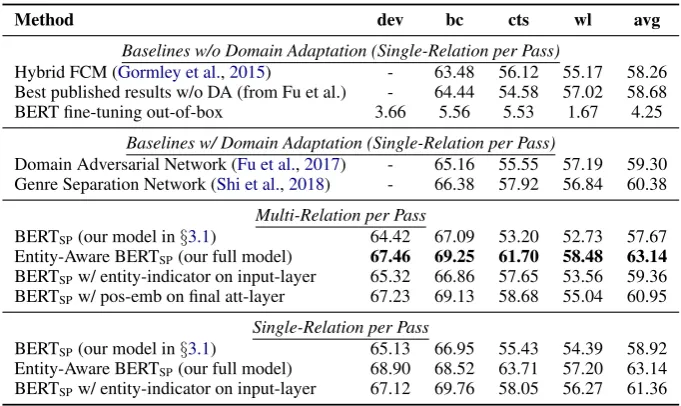
Table 1: Main Results on ACE 2005.
directly to each token’s word embedding3. This method is an extension of (Verga et al., 2018) to the MRE scenario.
Hyperparameters For our experiments, most model hyperparameters are the same as in pre-training. We tune the training epochs and the new hyperparameterk(in Eq. 4) on the development set of ACE 2005. Since the SemEval task has no development set, we use the best hyperparam-eters selected on ACE. For the number of training epochs, we make the model pass similar number of training instances as in ACE 2005.
4.2 Results on ACE 2005
Main Results Table 1 gives the overall results on ACE 2005. The first observation is that our model architecture achieves much better results compared to the previous state-of-the-art methods. Note that our method was not designed for do-main adaptation, it still outperforms those meth-ods with domain adaptation. This result further demonstrates its effectiveness.
Among all the BERT-based approaches, fine-tuning the off-the-shelf BERT does not give a sat-isfying result, because the sentence embeddings cannot distinguish different entity pairs. The sim-pler version of our approach, BERTSP, can
suc-cessfully adapt the pre-trained BERT to the MRE task, and achieves comparable performance at the
3
Note the usage of relative position embeddings does not work for one-pass MRE, since each word corresponds to a varying number of position embedding vectors. Summing up the vectors confuses this information. It works for the single-relation per pass setting, but the performance lags behind us-ing only indicators of the two target entities.
prior state-of-the-art level of the methods without domain adaptation.
Our full model, with the structured fine-tuning of attention layers, brings further improvement of about 5.5%, in the MRE one-pass setting, and achieves a new state-of-the-art performance when compared to the methods with domain adaptation. It also beats the other two methods on BERT in Multi-Relation per Pass.
Performance Gap between MRE in One-Pass and Multi-Pass The MRE-in-one-pass models can also be used to train and test with one entity pair per pass (Single-Relation per Pass results in Table1). Therefore, we compare the same meth-ods when applied to the multi-relation and single-relation settings. For BERTSP with entity
indica-tors on inputs, it is expected to perform slightly better in the single-relation setting, because of the mixture of information from multiple pairs. A 2% gap is observed as expected. By comparison, our full model has a much smaller performance gap between two different settings (and no consistent performance drop over different domains).
The BERTSP is not expected to have a gap as
shown in the table.For BERTSP with position
em-beddings on the final attention layer, we train the model in the single-relation setting and test with two different settings, so the results are the same.
Training and Inference Time Through our ex-periment,4we verify that the full model with MRE is significantly faster compared to all other meth-ods for both training and inference. The training
Method dev bc cts wl avg
Linear 67.46 69.25 61.70 58.48 63.14
MLP 67.16 68.52 61.16 54.72 61.47
Biaff 67.06 68.22 60.39 55.60 61.40
Table 2:Our model with different prediction modules.
time for full model with MRE is 3.5x faster than it with SRE. As for inference speed, the former could reach 126 relation per second compared the later at 23 relation per second. It is also much faster when compared to the second best perform-ing approach, BERTSP w/ pos-emb on final
att-layer, which is at 76 relation per second, as it runs the last layer for every entity pair.
Prediction Module Selection Table2evaluates the usage of different prediction layers, including replacing our linear layer in Eq.(1) with MLP or Biaff. Results show that the usage of the linear predictor gives better results. This is consistent with the motivation of the pre-trained encoders: by unsupervised pre-training the encoders are ex-pected to be sufficiently powerful thus adding more complex layers on top does not improve the capacity but leads to more free parameters and higher risk of over-fitting.
4.3 Results on SemEval 2018 Task 7
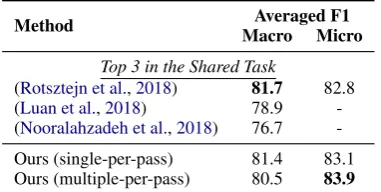
The results on SemEval 2018 Task 7 are shown in Table 3. Our Entity-Aware BERTSP gives
com-parable results to the top-ranked system ( Rot-sztejn et al.,2018) in the shared task, with slightly lower Macro-F1, which is the official metric of the task, and slightly higher Micro-F1. When predict-ing multiple relations in one-pass, we have 0.9% drop on Macro-F1, but a further 0.8% improve-ment on Micro-F1. Note that the system ( Rot-sztejn et al., 2018) integrates many techniques like feature-engineering, model combination, pre-training embeddings on in-domain data, and arti-ficial data generation, while our model is almost a direct adaption from the ACE architecture.
On the other hand, compared to the top single-model result (Luan et al., 2018), which makes use of additional word and entity embeddings pre-trained on in-domain data, our methods demon-strate clear advantage as a single model.
4.4 Additional SRE Results
We conduct additional experiments on the relation classification task, SemEval 2010 Task 8, to
com-Method Averaged F1
Macro Micro
Top 3 in the Shared Task
(Rotsztejn et al.,2018) 81.7 82.8
(Luan et al.,2018) 78.9
-(Nooralahzadeh et al.,2018) 76.7
-Ours (single-per-pass) 81.4 83.1
[image:5.595.322.513.63.159.2]Ours (multiple-per-pass) 80.5 83.9
Table 3:Results on SemEval 2018 Task 7, Sub-Task 1.1.
Method Macro-F1
Best published result (Wang et al.,2016) 88.0
BERT out-of-box 80.9
Entity-Aware BERT 88.8
BERTSP 88.8
Entity-Aware BERTSP 89.0
Table 4:Additional Results on SemEval 2010 Task 8.
pare with models developed on this benchmark. From the results in Table 4, our proposed tech-niques also outperforms the state-of-the-art on this single-relation benchmark.
On this single relation task, the out-of-box BERT achieves a reasonable result after fine-tuning. Adding the entity-aware attention gives about 8% improvement, due to the availability of the entity information during encoding. Adding structured prediction layer to BERT (i.e., BERTSP)
also leads to a similar amount of improvement. However, the gap between BERTSP method with
and without entity-aware attention is small. This is likely because of the bias of data distribution: the assumption that only two target entities exist, makes the two techniques have similar effects.
5 Conclusion
In summary, we propose a first-of-its-kind solution that can simultaneously extract multiple relations with one-pass encoding of an input paragraph for MRE tasks. With the proposed structured predic-tion and entity-aware self-attenpredic-tion layers on top of BERT, we achieve a new state-of-the-art results with high efficiency on the ACE 2005 benchmark. Our idea of encoding a passage regarding mul-tiple entities has potentially broader applications beyond relation extraction, e.g., entity-centric pas-sage encoding in question answering (Song et al.,
[image:5.595.313.521.197.275.2]References
Wasi Uddin Ahmad, Zhisong Zhang, Xuezhe Ma, Eduard Hovy, Kai-Wei Chang, and Nanyun Peng. 2018. Near or far, wide range zero-shot cross-lingual dependency parsing. arXiv preprint arXiv:1811.00570.
Jacob Devlin, Ming-Wei Chang, Kenton Lee, and Kristina Toutanova. 2018. Bert: Pre-training of deep bidirectional transformers for language understand-ing. arXiv preprint arXiv:1810.04805.
Timothy Dozat and Christopher D Manning. 2018. Simpler but more accurate semantic dependency parsing. InProceedings of the 56th Annual Meet-ing of the Association for Computational LMeet-inguistics (Volume 2: Short Papers), volume 2, pages 484–490.
L. Del Corro F. Petroni and R. Gemulla. 2015. Core: Context-aware open relation extraction with factor-ization machines. InProceedings of the 2015 Con-ference on Empirical Methods in Natural Language Processing (EMNLP).
Lisheng Fu, Thien Huu Nguyen, Bonan Min, and Ralph Grishman. 2017. Domain adaptation for re-lation extraction with domain adversarial neural net-work. In Proceedings of the Eighth International Joint Conference on Natural Language Processing (Volume 2: Short Papers), volume 2, pages 425–429.
Kata G´abor, Davide Buscaldi, Anne-Kathrin Schu-mann, Behrang QasemiZadeh, Haifa Zargayouna, and Thierry Charnois. 2018. Semeval-2018 task 7: Semantic relation extraction and classification in sci-entific papers. In Proceedings of The 12th Inter-national Workshop on Semantic Evaluation, pages 679–688.
Matthew R Gormley, Mo Yu, and Mark Dredze. 2015. Improved relation extraction with feature-rich com-positional embedding models. InProceedings of the 2015 Conference on Empirical Methods in Natural Language Processing, pages 1774–1784.
Iris Hendrickx, Su Nam Kim, Zornitsa Kozareva, Preslav Nakov, Diarmuid ´O S´eaghdha, Sebastian Pad´o, Marco Pennacchiotti, Lorenza Romano, and Stan Szpakowicz. 2009. Semeval-2010 task 8: Multi-way classification of semantic relations be-tween pairs of nominals. In Proceedings of the Workshop on Semantic Evaluations: Recent Achievements and Future Directions, pages 94–99. Association for Computational Linguistics.
Ronghang Hu, Anna Rohrbach, Trevor Darrell, and Kate Saenko. 2019. Language-conditioned graph networks for relational reasoning. arXiv preprint arXiv:1905.04405.
Linguistic Data Consortium. 2013. Deft ere annotation guidelines: Relations v1.1. 05.17.2013.
Yi Luan, Mari Ostendorf, and Hannaneh Hajishirzi. 2018. The UWNLP system at SemEval-2018 task 7:
Neural relation extraction model with selectively in-corporated concept embeddings. InProceedings of The 12th International Workshop on Semantic Eval-uation, pages 788–792, New Orleans, Louisiana. Association for Computational Linguistics.
Jiayuan Mao, Chuang Gan, Pushmeet Kohli, Joshua B Tenenbaum, and Jiajun Wu. 2019. The neuro-symbolic concept learner: Interpreting scenes, words, and sentences from natural supervision.
arXiv preprint arXiv:1904.12584.
Thien Huu Nguyen and Ralph Grishman. 2015. Combining neural networks and log-linear mod-els to improve relation extraction. arXiv preprint arXiv:1511.05926.
Farhad Nooralahzadeh, Lilja Øvrelid, and Jan Tore Lønning. 2018. SIRIUS-LTG-UiO at SemEval-2018 task 7: Convolutional neural networks with shortest dependency paths for semantic relation ex-traction and classification in scientific papers. In
Proceedings of The 12th International Workshop on Semantic Evaluation, New Orleans, Louisiana. As-sociation for Computational Linguistics.
Lizhen Qu, Yi Zhang, Rui Wang, Lili Jiang, Rainer Gemulla, and Gerhard Weikum. 2014. Senti-lssvm: Sentiment-oriented multi-relation extraction with la-tent structural svm. Transactions of the Association for Computational Linguistics, 2:155–168.
Alec Radford, Karthik Narasimhan, Tim Salimans, and Ilya Sutskever. 2018. Improving language under-standing by generative pre-training. URL https://s3-us-west-2. amazonaws. com/openai-assets/research-covers/languageunsupervised/language under-standing paper. pdf.
Sebastian Riedel, Limin Yao, Andrew McCallum, and Benjamin M Marlin. 2013. Relation extraction with matrix factorization and universal schemas. In Pro-ceedings of the 2013 Conference of the North Amer-ican Chapter of the Association for Computational Linguistics: Human Language Technologies, pages 74–84.
Jonathan Rotsztejn, Nora Hollenstein, and Ce Zhang. 2018. ETH-DS3Lab at SemEval-2018 task 7: Effec-tively combining recurrent and convolutional neural networks for relation classification and extraction. InProceedings of The 12th International Workshop on Semantic Evaluation, New Orleans, Louisiana. Association for Computational Linguistics.
Peter Shaw, Jakob Uszkoreit, and Ashish Vaswani. 2018. Self-attention with relative position represen-tations. InNAACL-HLT, page 464468.
Linfeng Song, Zhiguo Wang, Mo Yu, Yue Zhang, Radu Florian, and Daniel Gildea. 2018a. Exploring graph-structured passage representation for multi-hop reading comprehension with graph neural net-works. arXiv preprint arXiv:1809.02040.
Linfeng Song, Yue Zhang, Zhiguo Wang, and Daniel Gildea. 2018b. N-ary relation extraction using graph-state lstm. InProceedings of the 2018 Con-ference on Empirical Methods in Natural Language Processing, pages 2226–2235.
Daniil Sorokin and Iryna Gurevych. 2017. Context-Aware Representations for Knowledge Base Rela-tion ExtracRela-tion. InProceedings of the 2017 Con-ference on Empirical Methods in Natural Language Processing (EMNLP), pages 1784–1789. Associa-tion for ComputaAssocia-tional Linguistics.
Mihai Surdeanu, Julie Tibshirani, Ramesh Nallapati, and Christopher D Manning. 2012. Multi-instance multi-label learning for relation extraction. In Pro-ceedings of the 2012 joint conference on empirical methods in natural language processing and compu-tational natural language learning, pages 455–465.
Patrick Verga, David Belanger, Emma Strubell, Ben-jamin Roth, and Andrew McCallum. 2016. Multi-lingual relation extraction using compositional uni-versal schema. InProceedings of the 2016 Confer-ence of the North American Chapter of the Associ-ation for ComputAssoci-ational Linguistics: Human Lan-guage Technologies, pages 886–896.
Patrick Verga, Emma Strubell, and Andrew McCallum. 2018. Simultaneously self-attending to all mentions for full-abstract biological relation extraction. In
NAACL 2018, pages 872–884.
Christopher Walker, Stephanie Strassel, Julie Medero, and Kazuaki Maeda. 2006. Ace 2005 multilin-gual training corpus. Linguistic Data Consortium, Philadelphia, 57.
Linlin Wang, Zhu Cao, Gerard de Melo, and Zhiyuan Liu. 2016. Relation classification via multi-level at-tention cnns. In Proceedings of the 54th Annual Meeting of the Association for Computational Lin-guistics (Volume 1: Long Papers), volume 1, pages 1298–1307.
Kun Xu, Yansong Feng, Songfang Huang, and Dongyan Zhao. 2015. Semantic relation clas-sification via convolutional neural networks with simple negative sampling. arXiv preprint arXiv:1506.07650.
Kun Xu, Siva Reddy, Yansong Feng, Songfang Huang, and Dongyan Zhao. 2016. Question answering on freebase via relation extraction and textual evidence. In Proceedings of the 54th Annual Meeting of the Association for Computational Linguistics (Volume 1: Long Papers), volume 1, pages 2326–2336.
Wen-tau Yih, Ming-Wei Chang, Xiaodong He, and Jianfeng Gao. 2015. Semantic parsing via staged query graph generation: Question answering with knowledge base. InProceedings of the 53rd Annual Meeting of the Association for Computational Lin-guistics and the 7th International Joint Conference on Natural Language Processing (Volume 1: Long Papers), volume 1, pages 1321–1331.