38
Boosting Dialog Response Generation
Wenchao Du
Language Technologies Institute Carnegie Mellon University [email protected]
Alan W Black
Language Technologies Institute Carnegie Mellon University
Abstract
Neural models have become one of the most important approaches to dialog response gen-eration. However, they still tend to generate the most common and generic responses in the corpus all the time. To address this prob-lem, we designed an iterative training process and ensemble method based on boosting. We combined our method with different training and decoding paradigms as the base model, including mutual-information-based decoding and reward-augmented maximum likelihood learning. Empirical results show that our ap-proach can significantly improve the diversity and relevance of the responses generated by all base models, backed by objective measure-ments and human evaluation.
1 Introduction
Sequence-to-sequence models (Sutskever et al., 2014) has become one of the most popular ap-proaches to dialog systems, for it provides a high degree of automation and flexibility. On the other hand, they are known to suffer from the “dull-response” problem (Li et al., 2015). Various re-search attempts have been made to improve the diversity of responses generated by sequence-to-sequence models. One line of research investigate alternatives to maximum likelihood learning and decoding, which is believed to be the main cause of monotonicity. (Li et al.,2015) employed a de-coding objective based on mutual information be-tween contexts and responses; (Li et al., 2017a) used reinforcement learning techniques for train-ing the decoder to generate responses that max-imize pre-defined rewards instead of perplexities; (Li et al.,2017b;Xu et al.,2017) adopted adversar-ial learning, in which a generator is trained to de-ceive a discriminator that tries to differentiate be-tween generated responses and human responses. Beside changing training and decoding objectives,
(Liu et al.,2018;Lison and Bibauw,2017) consid-ered reweighting data points by penalizing those with overly frequent responses or by emphasizing high-quality responses. (Serban et al.,2017;Zhao et al.,2017) introduced stochastic latent variables into their models to capture discourse information on an inter-utterance level. (Shao et al.,2017) ex-perimented with a novel segment-based training and decoding paradigm to help mitigate the prob-lem of redundancy and contradiction.
Yet another type of approach has not been in-vestigated in the literature in the context of re-sponse generation – boosting and ensembling, de-spite having been studied for machine translation (Xiao et al., 2010;Zhang et al., 2017). Being a long established machine learning method (Freund and Schapire,1997), the process typically involves iteratively training multiple models on reweighted instances according to the error of the previous models and combining these models. The idea has been recently revived and extended to generative models and image generation, which also suffers from diversity problem (Tolstikhin et al., 2017; Grover and Ermon,2018). In computer vision, the state-of-the-art models tend to generate a few cat-egories of objects all the time and ignore the rest, known as the problem of “missing modes”. Boost-ing has been shown to significantly improve the coverage of image generation models.
qualitative evaluation.
2 Preliminaries
For standard sequence-to-sequence approaches, training of models and decoding for generations are done through maximum likelihood estimation:
logp(y|x) =
n
X
i=1
logp(yi |y1. . . yi−1, x) (1)
wherexis the source (or context) andyis the tar-get (or response). (Li et al.,2015) proposed a de-coding objective based on mutual information of xandyto improve diversity:
M M I(x, y) = logp(y|x)−λp(y) (2)
The conditional probability of y given x is esti-mated from sequence-to-sequence models, and the marginal probability ofyfrom a separately trained language model.
Reward-augmented maximum likelihood learn-ing (RAML) (Norouzi et al., 2016) incorporates task rewards into maximum likelihood training. An exponential payoff distribution is defined:
s(y|y∗;τ) = 1
Z(y∗, τ)exp{r(y, y
∗
)/τ} (3)
where y∗ is the true target, r is a pre-defined reward function, and τ is temperature parame-ter. The model is trained to minimize the KL-divergence of the conditional distribution ofyand the payoff distribution:
X
x,y∗
DKL(s(y |y∗)||p(y|x)) =
−X
x,y∗
X
y
s(y|y∗) logp(y|x) +const
(4) In multiplicative boosting, the density estimate of at each iterationT is given by:
qT =hαTTqT−1 =
QT
t=1h
αt
t
ZT
(5)
wherehtis tth model’s estimate, and αt is
mod-els’ weights. The goal of boosting is to approx-imate better the true distribution, P. It is shown in (Grover and Ermon, 2018) that if the model at each iteration can optimize for a re-weighted dis-tribution of the following form perfectly:
dt∝(
p qt
)βt (6)
the distance of models’ density estimate and the true distribution is decreasing, that is,
DKL(P ||Qt)≤DKL(P ||Qt−1) (7)
In equation (5) - (7), the density estimates are for the joint distribution of x and y. We make an additional assumption that the sources are uni-formly distributed so that p(x, y) = n1p(y | x), for the ease of applying the boosting algorithm to sequence-to-sequence training.
The true distributionP is usually set to be uni-form to boost the coverage of generative mod-els. One of our innovations in this work is ex-tending it to the exponential payoff distribution in RAML setting. The decreasing property of KL-divergence still holds, as the theoretical analysis is very much similar to that in (Grover and Ermon, 2018).
3 Design
We discuss some practical considerations when applying boosting framework to response gener-ation problem.
3.1 Data Reweighting
In the generative boosting method of (6), the weights of data are inversely proportional to the perplexities of the responses. However, it is ob-served in experiments that the generic responses do not always have low perplexities. If not handled properly, such responses end up being boosted, and become the frequently generated responses at the next iteration.
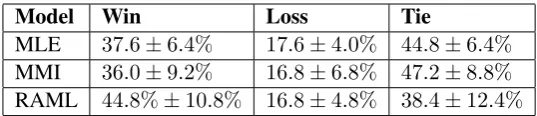
Model Win Loss Tie
[image:3.595.164.433.61.119.2]MLE 37.6±6.4% 17.6±4.0% 44.8±6.4% MMI 36.0±9.2% 16.8±6.8% 47.2±8.8% RAML 44.8%±10.8% 16.8±4.8% 38.4±12.4%
Table 1: Human evaluation results. “Win” stands for the boosted model winning.
too small to train a discriminator to obtain good decision boundaries and generalization.
Instead, we resort to a simple rule-based dis-criminator. At each iteration, we maintain a list of most frequently generated responses, Ct. We
choose a binary function to decide whether two responses,y, z, are similar, denoted bysim(y, z). The discriminator is defined as
Dt(y) =
(
c if ∃y0 ∈
S
tCt, sim(y, y0) = 1 0.5 otherwise
(8) And the weights of data at roundtis given by
dt(x, y)∝(
p(x, y) qt(x, y)
)βt Dt(y)
1−Dt(y)
(9)
In our experiments, the similarity function is cho-sen to be a predicate of whether there is an n-gram overlap withn≥4. We chose to be aggressive and set c = 0, so responses that are similar to those generated by previous models are excluded. The sizes ofCt is chosen to be around 20 so that the
amount of training data reduces by about 10 per-cent at each iteration.
In our experiments, we include bootstrapping as an additional baseline. At each iteration,80% of the data are randomly sampled for training and validation.
3.2 Model Combination
At decoding time, due to the discrete nature of text data, the optimization for the response that has highest probability (or mutual information) is in-tractable, so we use the following heuristics. Can-didate responses are generated from the single best model using beam search. The candidates are then scored by all models, and the one with the highest average score is chosen. The model weightsαtare
set to be uniform.
Since each model are trained on data with different weights, their un-normalized probabil-ity densprobabil-ity estimates may have different scales. Hence, at decoding time, scores of each model are z-normalized with mean and standard devia-tion calculated from the training data.
3.3 Other Details
For RAML, the reward function is based on tf-idf matching – that is, the sum of products of term fre-quency and inverse document frefre-quency of each word, divided by lengths. The rationale is to en-courage models to include key content words in their generations. Empirically, we observed that RAML with aforementioned reward can generate better responses than MLE baseline even without boosting. The temperature parameter τ is set to be 0.1. To approximate the expectation term in the objective of RAML, three additional responses with highest rewards are selected from training data for each message-response pair in the begin-ning. We do not sample new responses at the fol-lowing iterations for the sake of fair comparison. We setβt in equation (6) to be bt1 where bis
be-tween10and20, and is tuned on validation set.
4 Experiments
We evaluate our algorithm on single-turn conver-sations from Persona Dataset (Zhang et al.,2018). Participants are instructed to converse according to their given personalized background. In the preparation of training data, persona descriptions are prepended to the sources, and all trailing punc-tuations are truncated from the responses.
We use a standard sequence-to-sequence archi-tecture with attention mechanism. Both encoder and decoder are LSTMs with hidden size of 512 and input size of 300. Attentional contexts are weighted sums of hidden states of words in per-sonas. We use Adam optimizer to train the model with learning rate of0.001. All model parameters including word embeddings are randomly initial-ized between−0.1and0.1.
(a) BLEU (b) ROUGE-L (c) Cosine Similarity
[image:4.595.96.495.70.299.2](d) Inertia (e) Number of unigrams (f) Number of trigrams
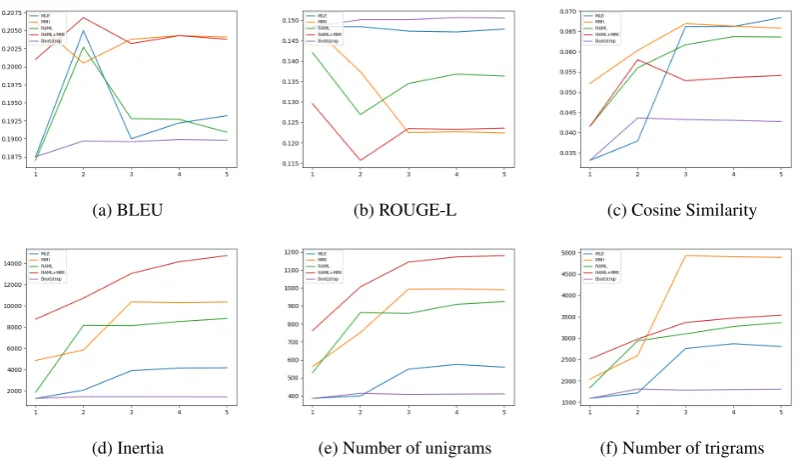
Figure 1: Quantitative results. X-axis is for iteration and y-axis for metrics. The numbers at iteration 1 represent the base models.
4.1 Quantitative Evaluation
We employ two standard word-overlap-based met-rics, BLEU (Papineni et al., 2002) and ROUGE (Lin,2004). We also performed embedding-based evaluation. We embed the responses using the word averaging approach by (Arora et al.,2016), and measure the cosine similarity of the embed-dings of generated responses and true responses. To measure the diversity of the responses, we per-form k-means clustering on their embeddings with 10 clusters, and measure the inertia. The larger in-ertia indicates more diversity. We also show statis-tics on number of distinct n-grams.
As can be seen in Figure 1, the general trend of boosting is that performance drastically improves up to the third model, then it slowly gets bet-ter or stays the same. Boosting is far betbet-ter than bootstrapping. Boosting can improve lexical-level semantic similarity between generate responses and true responses, measured by cosine similarity. While BLEU scores only fluctuate in a tight range, ROUGE-L suffered from boosting a little, when used on base models that can generate more diver-sified responses. But we do not consider BLEU and ROUGE the most important metrics. Diver-sity measures, including count of distinct n-grams and inertia of clusters, are significantly improved by boosting. Combining RAML and MMI seems to give an advantage in BLEU (mainly because generated responses are longer), inertia, and
num-ber of unigrams.
4.2 Qualitative Evaluation
To ensure the diversified responses are as relevant as before boosting, we ask 5 annotators to eval-uate a randomly sampled subset of 100 examples from each base model against its boosted counter-part. Each context are paired with two responses – one from the base model and one from the boosted model. The annotators are asked to choose the most appropriate response, or tie if they are equal. The results are shown in Table 1. On average, about 38 to 47 percent of the time the annota-tors showed no preferences, and boosted models beat base models for 36 to 45 percent of the trials. Note that all individual tests show annotators pre-ferred the boosted model over the base model, ex-cept for one case, where the annotator chose MMI base model over the boosted model slightly more often. We also provide an example of generated responses in Table2.
5 Conclusion
Context my family lives in alaska . it is freezing down there .
Human i bet it is oh i could not
Baseline what do you do for a living
[image:5.595.153.447.62.119.2]Boosted do you live near the beach ? i live in canada
Table 2: Examples of generated responses from baseline sequence-to-sequence model and its boosted counterpart.
with MMI gives some of the most diversified re-sults. Quantitative evaluation shows our method can substantially improve the diversity without harming the quality of generated responses. Our human evaluation provides evidence that diversi-fied responses by boosting are even more appro-priate than those generated from baseline models.
Acknowledgments
This material is based upon work supported by the National Science Foundation (Award No. 1722822). Any opinions, findings, and conclu-sions or recommendations expressed in this ma-terial are those of the author(s) and do not neces-sarily reflect the views of National Science Foun-dation, and no official endorsement should be in-ferred.
References
Sanjeev Arora, Yingyu Liang, and Tengyu Ma. 2016. A simple but tough-to-beat baseline for sentence em-beddings.
Yoav Freund and Robert E Schapire. 1997. A decision-theoretic generalization of on-line learning and an application to boosting. Journal of computer and system sciences, 55(1):119–139.
Ian Goodfellow, Jean Pouget-Abadie, Mehdi Mirza, Bing Xu, David Warde-Farley, Sherjil Ozair, Aaron Courville, and Yoshua Bengio. 2014. Generative ad-versarial nets. In Advances in neural information processing systems, pages 2672–2680.
Aditya Grover and Stefano Ermon. 2018. Boosted gen-erative models. InThirty-Second AAAI Conference on Artificial Intelligence.
Jiwei Li, Michel Galley, Chris Brockett, Jianfeng Gao, and Bill Dolan. 2015. A diversity-promoting objec-tive function for neural conversation models. arXiv preprint arXiv:1510.03055.
Jiwei Li, Will Monroe, and Dan Jurafsky. 2017a. Learning to decode for future success. arXiv preprint arXiv:1701.06549.
Jiwei Li, Will Monroe, Tianlin Shi, S˙ebastien Jean, Alan Ritter, and Dan Jurafsky. 2017b. Adversarial
learning for neural dialogue generation. In Proceed-ings of the 2017 Conference on Empirical Methods in Natural Language Processing, pages 2157–2169.
Chin-Yew Lin. 2004. Rouge: A package for auto-matic evaluation of summaries. Text Summarization Branches Out.
Pierre Lison and Serge Bibauw. 2017. Not all di-alogues are created equal: Instance weighting for neural conversational models. InProceedings of the 18th Annual SIGdial Meeting on Discourse and Di-alogue, pages 384–394. Association for Computa-tional Linguistics; Stroudsburg, PA.
Yahui Liu, Wei Bi, Jun Gao, Xiaojiang Liu, Jian Yao, and Shuming Shi. 2018. Towards less generic re-sponses in neural conversation models: A statistical re-weighting method. In Proceedings of the 2018 Conference on Empirical Methods in Natural Lan-guage Processing, pages 2769–2774.
Mohammad Norouzi, Samy Bengio, Navdeep Jaitly, Mike Schuster, Yonghui Wu, Dale Schuurmans, et al. 2016. Reward augmented maximum likeli-hood for neural structured prediction. InAdvances In Neural Information Processing Systems, pages 1723–1731.
Kishore Papineni, Salim Roukos, Todd Ward, and Wei-Jing Zhu. 2002. Bleu: a method for automatic eval-uation of machine translation. In Proceedings of the 40th annual meeting on association for compu-tational linguistics, pages 311–318. Association for Computational Linguistics.
Iulian Vlad Serban, Alessandro Sordoni, Ryan Lowe, Laurent Charlin, Joelle Pineau, Aaron Courville, and Yoshua Bengio. 2017. A hierarchical latent variable encoder-decoder model for generating dialogues. In
Thirty-First AAAI Conference on Artificial Intelli-gence.
Yuanlong Shao, Stephan Gouws, Denny Britz, Anna Goldie, Brian Strope, and Ray Kurzweil. 2017. Generating high-quality and informative conversa-tion responses with sequence-to-sequence models. In Proceedings of the 2017 Conference on Empiri-cal Methods in Natural Language Processing, pages 2210–2219.
Ilya O Tolstikhin, Sylvain Gelly, Olivier Bous-quet, Carl-Johann Simon-Gabriel, and Bernhard Sch¨olkopf. 2017. Adagan: Boosting generative models. In Advances in Neural Information Pro-cessing Systems, pages 5424–5433.
Tong Xiao, Jingbo Zhu, Muhua Zhu, and Huizhen Wang. 2010. Boosting-based system combination for machine translation. InProceedings of the 48th Annual Meeting of the Association for Computa-tional Linguistics, pages 739–748. Association for Computational Linguistics.
Zhen Xu, Bingquan Liu, Baoxun Wang, SUN Chengjie, Xiaolong Wang, Zhuoran Wang, and Chao Qi. 2017. Neural response generation via gan with an approximate embedding layer. In Proceed-ings of the 2017 Conference on Empirical Methods in Natural Language Processing, pages 617–626.
Dakun Zhang, Jungi Kim, Josep Crego, and Jean Senel-lart. 2017. Boosting neural machine translation. In
Proceedings of the Eighth International Joint Con-ference on Natural Language Processing (Volume 2: Short Papers), volume 2, pages 271–276.
Saizheng Zhang, Emily Dinan, Jack Urbanek, Arthur Szlam, Douwe Kiela, and Jason Weston. 2018. Per-sonalizing dialogue agents: I have a dog, do you have pets too? InProceedings of the 56th Annual Meeting of the Association for Computational Lin-guistics (Volume 1: Long Papers), volume 1, pages 2204–2213.