747
Errudite: Scalable, Reproducible, and Testable Error Analysis
Tongshuang Wu1,Marco Tulio Ribeiro2,Jeffrey Heer1, andDaniel S. Weld1
1Paul G. Allen School of Computer Science & Engineering, University of Washington 2Microsoft Research
{wtshuang,jheer,weld}@cs.washington.edu [email protected]
Abstract
Though error analysis is crucial to understand-ing and improvunderstand-ing NLP models, the common practice of manual, subjective categorization of a small sample of errors can yield biased and incomplete conclusions. This paper cod-ifies model and task agnostic principles for informative error analysis, and presents Er-rudite, an interactive tool for better support-ing this process. First, error groups should be precisely defined for reproducibility; Erru-dite supports this with an expressive domain-specific language. Second, to avoid spurious conclusions, a large set of instances should be analyzed, including both positive and neg-ative examples; Errudite enables systematic grouping of relevant instances with filtering queries. Third, hypotheses about the cause of errors should be explicitly tested; Errudite sup-ports this via automated counterfactual rewrit-ing. We validate our approach with a user study, finding that Errudite (1) enables users to perform high quality and reproducible error analyses with less effort, (2) reveals substan-tial ambiguities in prior published error analy-ses practices, and (3) enhances the error anal-ysis experience by allowing users to test and revise prior beliefs.
1 Introduction
The attempt to analyze when, how, and why mod-els fail (error analysis) is a crucial part of the development cycle. Understanding model short-comings helps NLP developers revise their mod-els, uncover bugs, make deployment decisions, and communicate model performance. Two com-mon forms of error analysis are (1)data grouping, where aggregate metrics are computed for partic-ular slices of interest (e.g., accuracy over question types in machine comprehension, per-label perfor-mance in semantic role labeling) (Liu et al.,2017;
He et al.,2017), and (2)counterfactual error anal-ysis, where one modifies the input data to assess
if expectations are met, such as adding irrelevant data to see if new errors are introduced (Jia and Liang,2017;Ribeiro et al.,2018).
In practice, however, groupings and counter-factual tests are very coarse or limited. The in-put to most NLP tasks is unstructured text, which makes systematic in-depth error analysis challeng-ing. Even answering simple questions such as
“how accurate is my model when person names are involved?” requires extensive coding, and the use of additional tools such as NER or POS tag-gers. Due to such difficulties, a common alter-native is to group a subset of error samples with manual labels on potential error causes.
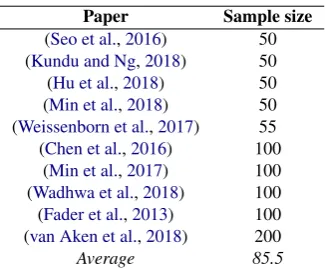
While useful, the high cost of manual labeling limits analyses to small samples. We surveyed 10 papers with error analyses that examine a sam-ple of incorrect predictions, e.g., (Wadhwa et al.,
2018; Min et al., 2017)1, and found the sample sizes ranged from 50 to 200 model errors (µ =
85.5, a range corroborated by our user study sur-vey) — frequently covering less than 5% of the to-tal errors. Such small samples are likely unrepre-sentative of the true error distribution, resulting in high sampling error in the analysis. Furthermore, due to subjectivity, the labels themselves are not precisely defined (Chang et al.,2017). Indeed, our user study (§5) reveals that inter-researcher agree-ment is very low even for simple labels, an incon-sistency that greatly harms reproducibility.
Focusing exclusively on errors — while over-looking successful predictions for instances with similar attributes — may also lead researchers to make biased conclusions, and mistakenly priori-tize groups that are in fact well-handled on aver-age (Rondeau and Hazen, 2018). Finally, there may be multiple plausible explanations for an er-ror, with the true cause not immediately apparent.
A
B
C
D
E
[image:2.595.72.524.67.262.2]F
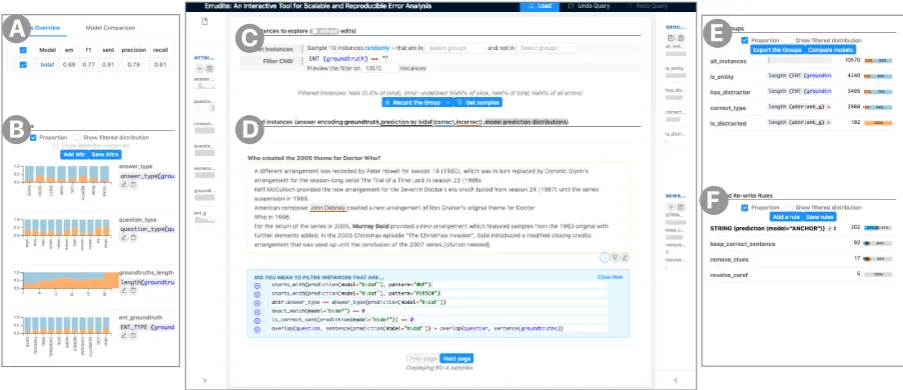
Figure 1: The Errudite interface, with (A) model overview; (B) attribute histograms (§4, enlarged version in Figure5); (C) filtering panel for users to specify DSL queries (§3.1), (D) instance list displaying filtered examples; (E) list of saved groups (§3.2and Figure3) and (F) rewrite rules (§3.3). See§4for more details.2
Q: Who created the 2005 theme for Doctor Who? ...John Debney created a new arrangement of Ron Grainer’s original theme for Doctor Who in 1996. For the return of the series in 2005, Murray Gold provided a new arrangement... featured sampled from the 1963 original. Figure 2: An example MC error with theground truth and the prediction both being “PERSON” entities.
Figure2illustrates an incorrect prediction from a machine comprehension (MC) model that could be caused by the presence of a distractor entity with the same type as the ground truth (PERSON), the need to perform multi-sentence reasoning, a combination of both, or something else altogether. In a manual analysis, researchers may gravitate to the first or most salient explanation, without veri-fying them via counterfactual analysis (e.g., by re-moving thedistractor).
We present an error analysis methodology grounded in three principles: hypothesized error causes should be (1) formalized in a precise and reproducible manner, (2) applied to all instances rather than a small sample of errors, and (3) tested explicitly via counterfactual analysis. We instanti-ate these principles in the design of an interactive system called Errudite. At the core of Errudite is an expressive domain-specific language (DSL) for precisely querying instances based on linguis-tic features. The DSL concretizes unambiguous error hypotheses, allows grouping to scale to all instances, and enables rewriting for counterfactual testing. For example, it makes it easy to create a precise group containing all instances where the ground truth and the prediction share entity type (which would include the example in Figure 2),
verify how often the model gets distracted, and check if the model turns to the correct entity when the distractor is removed. This sequence is pre-cisely what we use to illustrate the design of Er-rudite (§3). At each step in the sequence, Errudite helps users inspect and refine their hypotheses in real time with interactive visualizations (Figure1) and query suggestions based on programming-by-demonstration (§4). We validate our methodology and Errudite via a user study (§5), where MC ex-perts applied it to gain valuable and reproducible insights into model behavior. The same users, when given identical descriptions of an error type from a prior published analysis and asked to re-produce it, re-produced groups that vary in size from 13.8% to 45.2% of all errors — which illustrates the ambiguity in subjective manual labeling.
In summary, we contribute: (1) an enumeration of key challenges for NLP error analysis: man-ual, subjective inspection of a small sample of er-rors can be ambiguous, biased, and miss the root cause of errors; (2) principles for informative er-ror analysis: precise and reproducible, scalable, and testable; (3) the design of Errudite, an inter-active graphical tool that instantiates these princi-ples by systematically grouping and rewriting in-stances using a domain-specific language; and (4) a user study and case studies comparing Errudite withstatus quoerror analysis practices. Errudite is available as an open source resource athttps://
github.com/uwdata/errudite, together with
all analyses in this paper for easy replication.
2 Task, Dataset, and Model
While our proposed error analysis principles and tool are model and task agnostic, we describe and evaluate them in the context of Machine Compre-hension (MC). MC systems aim to answer ques-tions about facts in some reference text (context), potentially requiring complex reasoning (Joshi et al., 2017). Error analysis for MC is challeng-ing by virtue of the fact that both inputs (ques-tion and context) and output (answer) are unstruc-tured text, which makes it ideal for our purpose. Furthermore, various prior analyses with particu-lar semantic groups are available for comparison and replication (e.g., cases that involve paraphras-ing or coreference (Chen et al.,2016;Weissenborn et al.,2017;Wadhwa et al.,2018)).
Specifically, we analyze Bi-Directional Atten-tion Flow (BiDAF) (Seo et al.,2016) on SQuAD v1.1 (Rajpurkar et al., 2016) in the rest of the paper. SQuAD contains 100,000+ crowdsourced question-answer pairs about Wikipedia articles. Each question refers to one paragraph of an article, and the corresponding answer is guaranteed to be a span in that paragraph context. BiDAF3 is a hi-erarchical multi-stage end-to-end neural network. It has been widely referenced as a strong base-line model (Wang et al., 2018; Clark and Gard-ner,2017). Because both SQuAD and BiDAF are common in MC, experts can test and verify prior beliefs about model strengths and weaknesses.
3 Error Analysis Principles & Errudite
We identify three principles (abbreviated to the three subsection titles) for effective and unbiased error analysis, and describe tactics in Errudite that instantiate them.4
3.1 Precise and Reproducible Hypotheses
Manual labeling of errors involves forming qual-itative descriptions that implicitly refer to char-acteristics of the input and/or model output, of-ten in an ambiguous form. For example, “the model is bad on long questions” refers to ques-tions that have more than N tokens, with N left open to interpretation. In order to make error anal-ysis scalable (not dependent on manual labels) and reproducible (unambiguous), our first principle is
3
We used the implementation from Allennlp (Gardner et al.,2017):https://allennlp.org/models.
4Additional use cases on Machine Comprehension (MC) and Visual Question Answering (VQA) are in AppendixA.
therefore P1: error hypotheses should be de-fined precisely with concrete descriptions, e.g., describing questions as “longer than 20 tokens” rather than “long.” Errudite enables this through a domain-specific language (DSL) with targets,
attribute extractorsandoperators, in increasing order of abstraction.
Targetsare primitives which allow users to ac-cess inputs and outputs at different levels of gran-ularity, such as the question (q), passage context (c), ground truth (g), the prediction of a model m (denoted byp(m)),sentenceandtoken. Targets can be composed, e.g.,sentence(g)extracts the sentence that contains the ground truth span.
Attribute extractors act on targets to extract fundamental instance metadata (e.g., length(q)
returns the length of a question). These include (1) basic extractors likelength, (2) general purpose linguistic features like tokenLEMMA,POStags, and entity (ENT) annotations, (3) standard prediction performance metrics such as f1 or accuracy, (4) between-target relations such asoverlap(t1, t2), and (5) domain-specific attributes (e.g., for MC or VQA) such as question type and answer type(Wadhwa et al.,2018;Shen et al.,
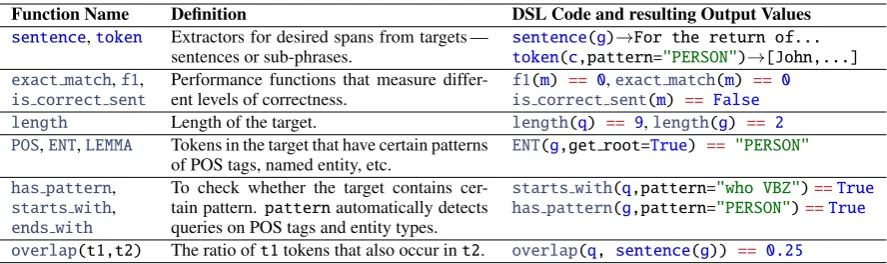
2017). Table1provides an abridged listing of ex-tractors, with example values from Figure2.5
Finally, extractors are composable through standard logical and numerical operators, serv-ing as buildserv-ing blocks for more complex at-tributes. For example, to create a boolean at-tribute that checks if the ground truth span con-tains an entity, the != operator is used, yielding ENT(g)!="". A more complex example is count-ing the number of times the ground truth entity ap-pears in the passage context: count(token(c, pattern=ENT(g))). Being reusable and com-posable makes extractors much more expressive than predefined attributes, and helps formulate much richer hypotheses.
Errudite’s data grouping and rewriting (intro-duced below) are both supported by these abstrac-tions in the DSL. Precise hypotheses and queries enable reproducible analyses that can be shared between research groups, and automatically ap-plied to new datasets and models.
3.2 Analyze All Relevant Instances
Random spot checking of errors can lead to con-firmation bias and spurious conclusions (Rondeau
Function Name Definition DSL Code and resulting Output Values
sentence,token Extractors for desired spans from targets — sentences or sub-phrases.
sentence(g)→For the return of...
token(c,pattern="PERSON")→[John,...]
exact match,f1, is correct sent
Performance functions that measure differ-ent levels of correctness.
f1(m) == 0,exact match(m) == 0
is correct sent(m) == False
length Length of the target. length(q) == 9,length(g) == 2
POS,ENT,LEMMA Tokens in the target that have certain patterns of POS tags, named entity, etc.
ENT(g,get root=True) == "PERSON"
has pattern, starts with, ends with
To check whether the target contains cer-tain pattern. patternautomatically detects queries on POS tags and entity types.
starts with(q,pattern="who VBZ")==True
has pattern(g,pattern="PERSON")==True
overlap(t1,t2) The ratio oft1tokens that also occur int2. overlap(q, sentence(g)) == 0.25
Table 1: Definitions for a subset of attribute extractors, including sample values from the example in Figure2.
and Hazen, 2018). To avoid these, we propose
P2: error prevalence should be assessed over the entire dataset.Grouping queries created with the DSL can scale the analysis to cover not only errors that are otherwise missed by small sam-ples, but alsocorrect casesthat are typically over-looked. We now provide an example that illus-trates the pitfalls of not following this principle, and how including all of the relevant successes and failures can lead to different insights than looking at a small sample of mistakes.
Distractor Example.Thedistractor hypothesis
states that BiDAF is good at matching questions to entity types (e.g., knowing when a PERSON is expected as an answer), but is often distracted by other spans with the same entity type (e.g., other PERSONs), leading to wrong predictions as the in Figure2. This is a hypothesis independently raised by four out of ten user study participants (§5).6
Consider the groupis distracted, defined by the following query:
ENT(g) != ""
and count(token(c, pattern=ENT(g))) >
count(token(g, pattern=ENT(g)))
and ENT(g) == ENT(p(m))
and f1(m) == 0
1 2 3 4 5
The query can be broken down into the fol-lowing conditions: the ground truth is an entity (line 1); there are potential distractors – i.e., there are more tokens matching the ground truth en-tity type (ENT(g)) in the whole context than in theground truth (lines 2-3); the prediction entity type matches the ground truth one (line 4); and the prediction is incorrect (line 5). Starting from all instances, we can subset groups by applying these conditions successively in order. Errudite conveys useful statistics about the groups via vi-sualizations, as in Figure3.
6Participants tested the hypothesis for a specific entity type (numbers). We present a more general case here.
Line 1
(a) (b) (c)
[image:4.595.76.520.61.193.2]Lines 1-3 Lines 1-4 Lines 1-5 N/A
Figure 3: Saved groups with their (a) manually created and semantically meaningful names, (b) query defini-tions, and (3) sizes and error rates (orange indicates er-rors, blue indicates correct predictions.)
If we only consider is distracted, without also considering correct predictions, we might conclude that the distractor hypothesis is correct: the 192 instances in the group are all cases where BiDAF predicts a wrong span that has the same entity type as the ground truth, and the group ac-counts for 5.7% of all BiDAF errors. However, looking at the groups in succession reveals a dif-ferent, and more complete story: BiDAF predicts the exact correct span (exact match) 68% of the time overall, which rises to 80% when the ground truth is an entity. When other entities with the same type are present in the passage, BiDAF is still 79% accurate (i.e., it is not particularly worse when there are potential distractors), and condi-tioned on having matched the question to the right entity type, it is quite accurate (88% exact match). The user study participants who previously be-lieved the distractor hypothesis either rejected or revised it after creating similar groups.
3.3 Explicitly Test Error Hypotheses
[image:4.595.309.528.228.314.2]re-quires answers to counterfactual questions, such as “If the predicted distractor was not there, would the model predict correctly?”
Errudite allows manual editing of individual examples (i.e., changing the input arbitrarily), a common practice to verify if the suspected error causes are really causes. While useful for quick spot tests on single instances, manual editing does not scale. For scalable counterfactual analysis, Er-rudite uses rulesto rewrite all relevant instances within a group – similar to search and replace but with the flexibility and power of the Errudite DSL. A rewrite rule is specified using the syntax rewrite(target,from→to), where target in-dicates the part of the instance that should be rewritten by replacing from with to. Bothfrom
andtocan include linguistic annotations, in ALL CAPS. A rule to replace “Who” followed by a verb with “What person” followed by the same verb is written as rewrite(q,"who VERB"→"what person VERB"). For convenience, Errudite also includes default rules suggested in formative in-terviews with MC experts, such as “remove all sentences except the one that contains the ground truth”, and “replace pronouns (he) with raw ref-erences (John Smith) from a coreference model.”
Returning to our distractor example, we can verify whether distractors are causing mistakes by using a rewrite rule on the is distracted
group, replacing the predicted distractor with a non-entity, placeholder token "#": rewrite(c, STRING(p(m))→"#").
Prediction span remains fixed, 45 instances (23%)
How many of Jacksonville’s city residents are younger than 18? ... with 23.9% under the age of 18, 10.5%# from 18 to 24...
How many kilometers is Warsaw from the Carpathian Mountains? Warsaw lies in east-central Poland about 300 km (190 #mi) from...
Prediction changes to correct, 91 instances (48%)
Prediction changes but remains incorrect, 56 instances (29%)
A Q: C:
Q: C: Q: C:
Who created the 2005 theme for Doctor Who?
...John Debney # created a new arrangement of Ron Grainer’s ...
Murray Gold provided a new arrangement... #
B
C
Figure 4: Updated prediction in response to the rewrite rulerewrite(c,STRING(p(m))→"#").
The results from the rewrite rule are presented in Figure 4. The model predicts the same span (now containing the meaningless token"#") 23% of the time (A), changes to the correct span 48% (B) of the time and predicts a different wrong span 29% of the time (C). While case B indicates that the distractor was indeed causing a misprediction,
Count
DA
TE PERSON ORG CARDINAL GPE NORP MONEY PERCENT QUANTITY LOC other
0 20 40 0 500
Count
Group:is_entity
Group:is_distracted
(a)
Ground truth entity types
[image:5.595.308.523.66.179.2](b)
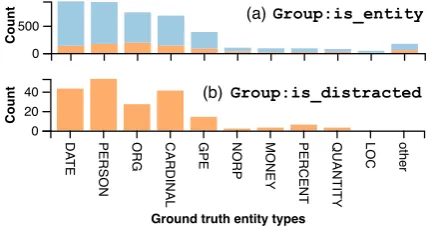
Figure 5: The distribution of ENT(g) in group (a)
is entity and (b)is distracted. The histogram shows the absolute frequency and incorrect/correct ra-tio for each attribute value.
in case A it seems other factors are at play. In case C, further analysis indicates that the predicted span is almost always a different distractor (i.e., has the same entity type). Thus, while BiDAF is fairly accurate when the distractors are present and the entity type is matched (88%),when it is incor-rect, it seems distractors are indeed confusing the model. This kind of analysis is rarely seen (if at all) in the literature; yet it helps users develop in-sights not available through data grouping.
4 Interactive User Interface
We now walk through the interactive interface of Errudite in more detail. The interface not only in-tegrates the entire analysis process, but also pro-vides additional exploration support such as vi-sualizing data distributions, suggesting potential queries, and presenting the grouping and rewriting results. While not strictly necessary for the error analysis principles previously outlined, it makes their application much more straightforward by helping users formulate and inspect their hypothe-ses in real time, and at scale (P2).
Attribute distribution. To guide the explo-ration, group creation and refinement, Errudite supports defining complex attributes and inspect-ing their distributions. An example in Figure 5
is distracted. We note that the frequency of “distraction” mistakes for PERSON and CARDI-NAL are higher, while lower for ORG, relative to the base frequencies in Figure5(a), an insight that may warrant further investigation.
Programming-by-Demonstration. To make it easier for users to formulate group queries and rewrite rules, interactive selections can trigger suggestions for related DSL statements. If a user selects any text span in an instance in the cen-tral browser, she is shown suggestions for related queries. For example, selecting “John” in Figure1
(or Figure2) triggers the following suggestions:
starts with(p(m), pattern="NNP")
starts with(p(m), pattern="PERSON")
answer type(g) == answer type(p(m))
exact match(m) == 0
is correct sent(m) == False
overlap(q, sentence(p(m))) >
overlap(q, sentence(g))
1 2 3 4 5 6 7
These suggestions cover pattern searches (lines 1-2) ranked by their occurrence frequency and er-ror rate, and target comparisons (lines 4-7), which are particularly relevant when the prediction or ground truth is selected. Selecting a different text span yields different suggestions, heuristi-cally ranked and filtered with the goal of surfacing queries likely to be of interest.
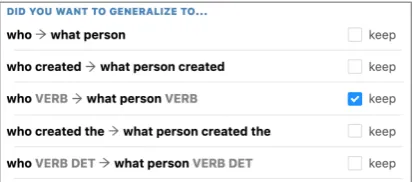
[image:6.595.79.286.466.557.2]Who What person created the 2005 theme for Doctor Who?
Figure 6: Rewrite rules inferred from an edit to an in-dividual instance.
For rewrite rules, we use a technique inspired by Ribeiro et al.(2018) to generalize manual ed-its into suggested rewrite rules: including context, POS tags and named entities, attempting to maxi-mize coverage and relevance without redundancy. Figure6shows an example in which various sug-gestions are displayed after a user rewrites an in-stance by changing “Who” to “What person.” Ap-pendixBprovides a more detailed description of our searching and ranking criteria.
Layout. The UI (Figure1) contains three main components. The central component contains a
fil-ter panel (C) and an instance browser (D), which help examine the results of data groupings or rewrite rules for iterative refinement. The collapsi-ble sidebar on the left contains a list of differ-ent models being analyzed with summary statis-tics (A) and customizable attribute histograms (B). The one on the right contains a list of saved data groups (E) and rewrite rules (F); these can be loaded into the central component via mouse click. All groups and rewrite rules can be saved and loaded through the interface, so the analysis can be easily shared and reproduced.
5 User Study
We conducted user studies to evaluate Errudite. Though less common in NLP, this type of eval-uation is widely used in fields like Human-Computer Interaction for understanding how cer-tain methods or systems impact the intended user group (Nielsen,1994;Olsen Jr,2007) — precisely our objective here. We recruited ten participants with prior Machine Comprehension experience (developed 1-6 models each, µ = 3.1, σ = 2.02) for a 90-minute study: four NLP graduate students and six researchers or QA engineers from industry. Participants analyzed BiDAF on SQuAD v1.1.
User studies can take various forms, ranging from experiments that quantitatively compare hu-man perforhu-mance, to interviews or observational studies that qualitatively inspect users’ behaviors and perspectives. We take a more qualitative ap-proach, as we are primarily interested in how Erru-dite shapes participants’ error analysis experience. The study started with a background survey about users’ prior experience in MC and error analysis. After a walk-through tour of Errudite (described in AppendixA.3), participants were asked to per-form two tasks:Replication(§5.1), in which they attempted to reproduce the error analysis fromSeo et al. (2016); and Exploration (§5.2), in which they freely explored the model and reported their findings. We collected multiple subjective mea-sures from participants in the form of five-point Likert scale ratings (Likert, 1932), with 5 being strongly positive and 1 strongly negative. Partici-pants were compensated at a rate of $25/hr.
5.1 Task 1: Replication
0% 10% 20% 30% 40% 50%
Error Coverage
Boundary Multi-sentence
[image:7.595.79.288.65.122.2]Group
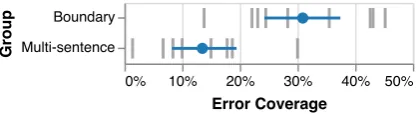
Figure 7: Percentage of errors covered by user-defined groups:Boundary(µ= 30.9%,σ= 10.5%) and Multi-sentence(µ = 13.5%,σ= 8.29%). The dispersion of grey ticks shows that users come up with different def-initions for groups described bySeo et al.(2016), even when they think they replicated the group faithfully.
(2) to assess the reproducibility of current ad-hoc error analysis methods. Seo et al. (2016) manu-ally labeled 50 instances predicted incorrectly by BiDAF into different error groups. We asked par-ticipants to generalize these groups to the whole validation set after reading the relevant section in
Seo et al.(2016). For learning purposes, we first asked users to inspect two data groups that we created using Errudite, and evaluate if they cap-tured the same semantics as the original group: in-correct preprocessing (Preprocess) and paraphrase problems (Paraphrase). Users then created their own groups to replicate two others fromSeo et al.
(2016): imprecise answer boundaries (Boundary) and multi-sentence issues (Multi-sentence).
Results. Participants rated the accuracy of the replication of each group after seeing a variety of examples, i.e., “how close the approximation matches the paper definition.” For the groups we wrote queries for, participants were confident thatPreprocess was accurate (µ= 4.3,σ = 0.64), but ambivalent towardsParaphrase(µ= 3.1,σ = 0.54). Participants’ comments indicated the am-bivalence did not come from Errudite: 6 partic-ipants disagreed with the example given by Seo et al.(2016), and participants who gave low rat-ings found Paraphrase itself too fuzzy and con-fusing to formalize. Despite being used widely as an error group (Kundu and Ng,2018;Chen et al.,
2016), participants had conflicting understandings of Paraphrase, either as “the question and the ground truth sentence are semantically similar but with great lexical variations”, or “the predicted an-swer is a paraphrased version of the ground truth.” When replicating groups themselves, partici-pants were able to express the queries they wanted. Participants were not very confident in the accu-racy of their producedMulti-sentence group (µ= 2.8,σ= 1.32), for reasons similar toParaphrase: they thought the group was under-specified in the
D1 D2 D1 D2
...commercial, scientific, and cultural growth...
... the polynomial time hierarchy collapses. ...believed that the polynomial hierarchy does...
...from Karakorum in Mongolia to Khanbaliq... (a)
(b) (c) D1D2
Figure 8: Example instances that fall into different user-definedBoundarygroups.
original analysis. More interestingly, users were the most confident in the fidelity of an apparently “easy” groupBoundary(µ= 4.8,σ= 0.60), yet the groups they produced were wildly different (Fig-ure7). While users were able to express what they thought was meant by “imprecise error bound-aries”, they applied different definitions.
For example, one user defined the group as (D1) “the predicted span can be off by at most two to-kens both on the left and right” (yielding 22.1%
of all BiDAF errors), while another defined it as (D2) “there is no exact match but high overlap —
F1is higher than 0.7” (yielding 13.8%of all er-rors). Figure8shows samples that fit the two def-initions or just one of them. Errudite makes the different interpretations explicit. The author of D2 observed examples like Figure8(c) in his samples, but decided ultimately that what mattered was just the returned short text, not the span index. In con-trast, D1’s author carefully refined his initial query precisely to rule out cases like Figure8(c).
In summary, users were able to express their in-tended groups well with Errudite, but they were unable to consistently replicate the analysis ofSeo et al.(2016) — even when they thought they did — due to the ambiguity inherent in manual grouping.
5.2 Task 2: Exploration
To assess the usefulness of Errudite, we let par-ticipants freely analyze BiDAF. We asked them to “think aloud” in real time, vocalizing their hy-potheses, intriguing observations, objectives, and expectations. At the end of the session, subjects rated each of their discovered insights in terms of (1) importance (very trivial to very helpful), (2) confidence in insight correctness, and (3) relative ease of discovery compared to existing methods.
1 2 3 4 5
Rate
Attribute Suggestion Rewrite Query
[image:8.595.78.288.65.154.2]Usefulness
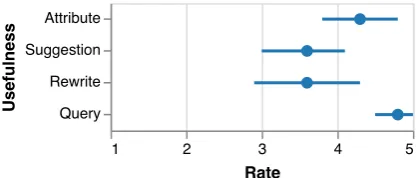
Figure 9: Usefulness of function modules in the tool.
occur when there is significant overlap between the question and a sentence that does not contain the ground truth. Indeed, that group accounts for about 18% of BiDAF errors. Other insights ex-tended previous knowledge, such as explorations by two users who examined low performance on “why” questions (Appendix A.4). They also re-jected some prior hypothesesafter using Errudite, such as the distractor case in§3. Participants rated their findings to be important (µ= 3.7,σ= 1.12), were confident that their findings were valid (µ= 4.0, σ = 1.05), and consistently agreed that Er-rudite made finding insights easier (µ = 4.9, σ = 0.35). Participants agreed that theylearned more about the model (µ = 3.9, σ= 0.94), and valued Errudite’s support for assessing their hypotheses.
5.3 Usability and User Feedback
When rating the usefulness of different compo-nents of the tool (Figure 9), users rated the DSL (µ = 4.8, σ = 0.40) and the attribute distribution (µ= 4.3,σ= 0.78) as very useful, and rated query suggestions (µ= 3.6,σ= 0.91) and rewrite rules (µ
= 3.6,σ = 1.11) as potentially useful. We hypoth-esize that rewrite rules pose a learning curve that makes them difficult to evaluate in a single ses-sion. This kind of counterfactual analysis is not common and a few participants were concerned about possible unintended side effects of edits.
We also asked participants to describe their im-pressions with free-form comments, which were very positive for all of them – all thought Erru-dite enhanced their error analysis experience. In particular, four users stated that they felt it sys-tematically scaled upthe analysis, making it more precise and thus inspiring more confidence. Five users noted how much faster exploration became
with Errudite, and how having a good set of build-ing blocks and visualizations let them bypass the large coding overhead needed to otherwise test a single hypothesis about a model.
6 Related Work
6.1 Data Grouping
Non-manual data grouping typically follows one of two extremes. Most of the literature relies on data groups that are very coarse and easy to pro-gram (e.g., based on question length and answer types (Kafle and Kanan, 2017; Agrawal et al.,
2016;Shen et al., 2017)). While useful and ac-cessible, they do not allow more semantically meaningful observations (likedistractorsor para-phrases). In contrast, some define groups that are highly specific to a particular dataset or model, such as hand-crafting factors to quantify MC in-stance difficulties (Rondeau and Hazen, 2018). While often insightful, these suffer from poten-tial pitfalls similar to labeling individual instances: they are laborious, often subjective, and hard to reproduce. In other words, just as in manual error labeling mentioned in§1, typical automatic group-ing also struggles with the trade-off between be-ing reproducible/scalable, and bebe-ing in-depth and meaningful. In contrast, Errudite addresses the challenge with an expressive domain-specific lan-guage, which helps users build filters that can slice the entire dataset, and thereby build scalable and semantically meaningful groups.
Chung et al. (2018) made a similar attempt to balance the trade-off in Slice Finder, a framework that uses statistical techniques to identify large and interpretable slices that models perform poorly on. However, their purely automated data slicing does not allow users to customize groups based on their own hypotheses. Furthermore, Slice Finder only uses predefined attributes. While this is reason-able in the context of structured data classifier that they tested (with features explicitly defined), it is not flexible enough for unstructured text in NLP. Other interactive error analysis tools tend to face similar customization issues. QADiver (Lee et al.,
before-hand, and thus it is to be expected that users would revert to coarse and easy-to-program groups. Erru-dite emphasizes customization: it allows users to define extractors for rich instance attributes, and helps them adjust their groups in real-time with quick trial and error, visualizations, and sugges-tions based on programming-by-demonstration.
6.2 Counterfactual Analysis
Counterfactual attacks to models have taken var-ious forms, e.g., by adding distracting sentences to the context in MC (Jia and Liang, 2017), or feeding partial questions or wrong images into models (Agrawal et al., 2016;Mudrakarta et al.,
2018; Feng et al., 2018). Slightly closer to our work is SEARs (Ribeiro et al., 2018) (also in-corporated into QADiver), which also takes the form of rewrite rules: it generates semantic-preserving rules that cause models to change pre-dictions. However, these focus on robustness, i.e., counterfactual perturbations are mainly for the purpose of detecting stability or over-sensitivity. In contrast, our counterfactual analy-sis is for the purpose of understandingwhy mod-els fail in certain groups. Furthermore, our DSL allows for more complex counterfactual rules and for applying rules only to certain groups, such as “delete the predicted distractor for instances in the
is distractedgroup.” As far as we know, such analysis is novel, and a promising direction for more in-depth error analysis.
7 Conclusion and Future Work
In this paper, we characterize deficiencies with current error analysis methods used in NLP: they are laborious and subjective, which can lead to high variance and low reproducibility. Moreover, by focusing on error cases independent of situa-tions where the model is correct, they can yield biased results. Finally, since it is difficult to pform counterfactual analysis, the root cause of er-rors can easily be overlooked.
In response, we identify three principles re-quired for successful error analysis, and present an interactive tool called Errudite to enable their application: (1) building precise instances groups with composable building blocks in a domain-specific language; (2) scaling the analysis to cover all the relevant successes and failures by automat-ically building large groups with filtering queries, and providing visual summaries for them; and (3)
testing error hypotheses using counterfactual anal-ysis by rewriting the instances with rules. Data groups and rewrite rules can be easily saved and shared for replication or for analysis of different models with the same groups and rules.
We conduct a detailed user study with NLP ex-perts, confirming that Errudite makes hypothesis definitions both concrete and apparent, reduces sampling bias, and helps researchers verify the true causes of errors. We find that Errudite signif-icantly lowers the barrier for insightful error anal-ysis, hopefully leading to a more in-depth under-standing of current models, and to safeguard de-ployments and improve the state of the art.
While our primary experiments are on Machine Comprehension, the DSL primitives in Errudite are general enough to make extensions to other tasks and domains straightforward. For example, we have extended Errudite to Visual Question An-swering with only minor adjustments to the per-formance metrics and the instance browser (to in-clude images). We share case studies in Appen-dicesA.1andA.2, together with further analysis on SQuAD (AppendixA.4). Similar adjustments could be done to extend Errudite to other tasks such as Machine Translation, Natural Language Inference, and text classification, along with cus-tomization of domain-specific attributes.
In the future, we hope to design and evaluate more sophisticated query and attribute suggestions to guide exploration by less expert users, as well as social features that facilitate collaboration within an organization to promote sharing, review, reuse, and extension of error analyses.
Acknowledgements
References
Aishwarya Agrawal, Dhruv Batra, and Devi Parikh. 2016. Analyzing the behavior of visual question an-swering models. arXiv preprint arXiv:1606.07356.
Betty van Aken, Julian Risch, Ralf Krestel, and Alexander L¨oser. 2018. Challenges for toxic com-ment classification: An in-depth error analysis.
arXiv preprint arXiv:1809.07572.
Stanislaw Antol, Aishwarya Agrawal, Jiasen Lu, Mar-garet Mitchell, Dhruv Batra, C Lawrence Zitnick, and Devi Parikh. 2015. Vqa: Visual question an-swering. In Proceedings of the IEEE international conference on computer vision, pages 2425–2433.
Joseph Chee Chang, Saleema Amershi, and Ece Ka-mar. 2017. Revolt: Collaborative crowdsourcing for labeling machine learning datasets. InProceedings of the 2017 CHI Conference on Human Factors in Computing Systems, pages 2334–2346. ACM.
Danqi Chen, Jason Bolton, and Christopher D Man-ning. 2016. A thorough examination of the cnn/daily mail reading comprehension task. arXiv preprint arXiv:1606.02858.
Nan-Chen Chen and Been Kim. 2017. Qsanglyzer: Vi-sual analytics for prismatic analysis of question an-swering system evaluations. InProceedings of the IEEE Conference on Visual Analytics Science and Technology.
Yeounoh Chung, Tim Kraska, Neoklis Polyzotis, Ki Hyun Tae, and Steven Euijong Whang. 2018.
Automated data slicing for model validation:a big data - ai integration approach.
Christopher Clark and Matt Gardner. 2017. Simple and effective multi-paragraph reading comprehen-sion.arXiv preprint arXiv:1710.10723.
Anthony Fader, Luke Zettlemoyer, and Oren Etzioni. 2013. Paraphrase-driven learning for open question answering. InProceedings of the 51st Annual Meet-ing of the Association for Computational LMeet-inguistics (Volume 1: Long Papers), volume 1, pages 1608– 1618.
Shi Feng, Eric Wallace, Alvin Grissom II, Pedro Rodriguez, Mohit Iyyer, and Jordan Boyd-Graber. 2018. Pathologies of neural models make interpreta-tion difficult. InEmpirical Methods in Natural Lan-guage Processing.
Matt Gardner, Joel Grus, Mark Neumann, Oyvind Tafjord, Pradeep Dasigi, Nelson F. Liu, Matthew Peters, Michael Schmitz, and Luke S. Zettlemoyer. 2017. Allennlp: A deep semantic natural language processing platform.
Sumit Gulwani and Prateek Jain. 2017. Programming by examples: Pl meets ml. InAsian Symposium on Programming Languages and Systems, pages 3–20. Springer.
Luheng He, Kenton Lee, Mike Lewis, and Luke Zettle-moyer. 2017. Deep semantic role labeling: What works and what’s next. InProceedings of the 55th Annual Meeting of the Association for Computa-tional Linguistics (Volume 1: Long Papers), vol-ume 1, pages 473–483.
Minghao Hu, Yuxing Peng, Zhen Huang, Nan Yang, Ming Zhou, et al. 2018. Read+ verify: Machine reading comprehension with unanswerable ques-tions.arXiv preprint arXiv:1808.05759.
Robin Jia and Percy Liang. 2017. Adversarial exam-ples for evaluating reading comprehension systems.
arXiv preprint arXiv:1707.07328.
Mandar Joshi, Eunsol Choi, Daniel S Weld, and Luke Zettlemoyer. 2017. Triviaqa: A large scale distantly supervised challenge dataset for reading comprehen-sion.arXiv preprint arXiv:1705.03551.
Kushal Kafle and Christopher Kanan. 2017. An anal-ysis of visual question answering algorithms. In
Computer Vision (ICCV), 2017 IEEE International Conference on, pages 1983–1991. IEEE.
Minsuk Kahng, Pierre Y Andrews, Aditya Kalro, and Duen Horng Polo Chau. 2018. Activis: Visual exploration of industry-scale deep neural network models. IEEE transactions on visualization and computer graphics, 24(1):88–97.
Sean Kandel, Andreas Paepcke, Joseph Hellerstein, and Jeffrey Heer. 2011. Wrangler: Interactive vi-sual specification of data transformation scripts. In
Proceedings of the SIGCHI Conference on Human Factors in Computing Systems, pages 3363–3372. ACM.
Vahid Kazemi and Ali Elqursh. 2017. Show, ask, at-tend, and answer: A strong baseline for visual ques-tion answering. arXiv preprint arXiv:1704.03162.
Souvik Kundu and Hwee Tou Ng. 2018. A question-focused multi-factor attention network for question answering. InThirty-Second AAAI Conference on Artificial Intelligence.
Tessa A. Lau, Steven A. Wolfman, Pedro M. Domin-gos, and Daniel S. Weld. 2003. Programming by demonstration using version space algebra. Ma-chine Learning, 53:111–156.
Gyeongbok Lee, Sungdong Kim, and Seung-won Hwang. 2018. Qadiver: Interactive frame-work for diagnosing qa models. arXiv preprint arXiv:1812.00161.
Xin Li and Dan Roth. 2002. Learning question clas-sifiers. In Proceedings of the 19th international conference on Computational linguistics-Volume 1, pages 1–7. Association for Computational Linguis-tics.
Xiaodong Liu, Yelong Shen, Kevin Duh, and Jian-feng Gao. 2017. Stochastic answer networks for machine reading comprehension. arXiv preprint arXiv:1712.03556.
Sewon Min, Minjoon Seo, and Hannaneh Hajishirzi. 2017. Question answering through transfer learn-ing from large fine-grained supervision data. arXiv preprint arXiv:1702.02171.
Sewon Min, Victor Zhong, Richard Socher, and Caim-ing Xiong. 2018. Efficient and robust question answering from minimal context over documents.
arXiv preprint arXiv:1805.08092.
Pramod Kaushik Mudrakarta, Ankur Taly, Mukund Sundararajan, and Kedar Dhamdhere. 2018. Did the model understand the question? arXiv preprint arXiv:1805.05492.
Jakob Nielsen. 1994. Usability engineering. Elsevier.
Dan R Olsen Jr. 2007. Evaluating user interface sys-tems research. In Proceedings of the 20th annual ACM symposium on User interface software and technology, pages 251–258. ACM.
Pranav Rajpurkar, Jian Zhang, Konstantin Lopyrev, and Percy Liang. 2016. Squad: 100,000+ questions for machine comprehension of text. arXiv preprint arXiv:1606.05250.
Marco Tulio Ribeiro, Sameer Singh, and Carlos Guestrin. 2018. Semantically equivalent adversar-ial rules for debugging nlp models. In Proceed-ings of the 56th Annual Meeting of the Association for Computational Linguistics (Volume 1: Long Pa-pers), volume 1, pages 856–865.
Marc-Antoine Rondeau and Timothy J Hazen. 2018. Systematic error analysis of the stanford question answering dataset. InProceedings of the Workshop on Machine Reading for Question Answering, pages 12–20.
Minjoon Seo, Aniruddha Kembhavi, Ali Farhadi, and Hannaneh Hajishirzi. 2016. Bidirectional attention flow for machine comprehension. arXiv preprint arXiv:1611.01603.
Yelong Shen, Xiaodong Liu, Kevin Duh, and Jianfeng Gao. 2017. An empirical analysis of multiple-turn reasoning strategies in reading comprehension tasks.
arXiv preprint arXiv:1711.03230.
Soumya Wadhwa, Khyathi Raghavi Chandu, and Eric Nyberg. 2018. Comparative analysis of neural qa models on squad. InProceedings of the Workshop on Machine Reading for Question Answering.
Yizhong Wang, Kai Liu, Jing Liu, Wei He, Yajuan Lyu, Hua Wu, Sujian Li, and Haifeng Wang. 2018. Multi-passage machine reading comprehension with cross-passage answer verification. arXiv preprint arXiv:1805.02220.
Dirk Weissenborn, Georg Wiese, and Laura Seiffe. 2017. Making neural qa as simple as possible but not simpler.arXiv preprint arXiv:1703.04816.
A Additional Use Cases
We use case studies in Visual Question Answering and Machine Comprehension to further demon-strate the usefulness of Errudite. A video demo is available athttps://youtu.be/Dil5i0AYyu8.
A.1 VQA: Breaking down “How many”
(a)
(b)
[image:12.595.308.524.66.121.2]A
Figure 10: Two “how many” examples: VQACount-ing improves on SAAA for instance (a), but predicts an even higher count in (b). Highlighting “how many brownish”, we create groups based on the suggested queryA.
We demonstrate Errudite’s power on comparing multiple models in the context of Visual Question Answering (VQA). We analyze SAAA (Kazemi and Elqursh, 2017) and VQACounting (Zhang et al., 2018) concurrently on the validation set of VQA v1 (Antol et al., 2015), which con-tains 21,512 instances. VQACounting is built on top of SAAA, with increased performance on counting questions. Querying “how many” ques-tions, we notice two interesting cases in Fig-ure10: VQACounting correctly predicts the “how many people” question in (a), but is worse than SAAA (also wrong) in (b). We suspect the to-ken following “how many” can make a differ-ence. Highlighting “how many brownish”, we fol-low the first returned suggestion (Figure 10A) to build a how many ADJ group (starts with(q, pattern="how many ADJ")), and similarly, a
how many noungroup.
Per-group comparison shows VQACounting improves SAAA more on "how many NOUN" than"how many ADJ"(Figure11) questions: the former has an increase of accuracy from 38% to 49%, whereas the latter only shows 3% improve-ment. However, note the group size difference: the
[image:12.595.72.290.175.327.2]NOUN group is 14 times larger than ADJ. In fact,
Figure 11: VQACounting improves much more on
how many NOUN, compared tohow many ADJ, though many fewer instances follow the latter pattern.
ADJ ADP ADV NOUN NUM PROPN PUNCT SP
ACE VERB
0 5,000 10,000
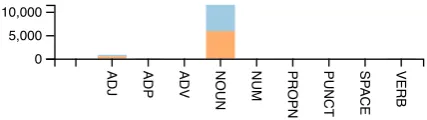
Figure 12: Extracting the POS tag for the token im-mediately after “how many”, we notice most instances follow a"how many NOUN"pattern.
extracting the POS tags following “how many” into an attribute, we see"NOUN"drastically stands out, suggesting a very imbalanced data distribu-tion (Figure12).
A.2 VQA: Ambiguous Questions
With groups and attributes independent of mod-els or predictions, Errudite can help analyze the consistencies and ambiguities of the datasets. In this case, we use Errudite to group all the “am-biguous VQA questions”, or questions where the answers exhibit high human annotator disagree-ment. If humans cannot agree on the answer, it is to be expected that machine learning models will not be accurate. In the annotations for the VQA v1 dataset, each question collects up to 10 human answers, while in evaluation an answer is consid-ered fully accurate if it matches the answer of at least three humans. We count the unique ground truth annotations for each instance (count(g)), which results in the distribution shown in Fig-ure 13: instances with more ground truth labels are more poorly predicted. Querying for instances with count(g)>5, we find many instances like the ones in Figure14, covering 29.9% of all the errors. This means the dataset is far from “clean” and that 30% of the model’s mistakes should prob-ably not be considered mistakes.
A.3 MC: Incorrect Pre-processing
[image:12.595.307.521.184.244.2]1 2 3 4 5 6 7 8 9 10 0.0
0.5 1.0 0 20,000 40,000
1 2 3 4 5 6 7 8 9 10
(a)
[image:13.595.73.290.53.151.2](b)
[image:13.595.307.524.63.123.2]Figure 13: The VQACounting model becomes worse as the count of distinct ground truth annotations (i.e., human disagreement) grows: (a) shows instance counts in each ground truth count bin; (b) with the counts nor-malized, emphasizing the incorrect proportions.
Figure 14: An instance with 8 distinct ground truth an-notations, and neglible inter-annotator agreement.
treats “1641-1679” as one token, and its mismatch with the ground truth “1679” evaluation (which is token-wise) will result inF1= 0. We simulate the above tokenization issue with a query that states (a) even though at the character level the ground truth answer is a substring of the prediction, (b) the two don’t have token level overlap:
STRING(g) in STRING(p(m)) and f1(m) == 0 1
Among the 26 instances returned (0.8% of all incorrect instances), we find multiple instances like the ones in Figure15(a), and also unexpected cases like Figure15(b).
It is unclear from these examples if tokeniza-tion is the only issue. To further assess, we define a rewrite rule that separates dashes from nearby words:rewrite(sentence(g),"-"→" - "). The rewritten instances are then queryable using a wrapper function: apply(func, rewrite="rule name")runs the query function func on the new instances generated by rule "rule name". We use the queries in Figure16to further divide the 13 instances rewritten (the rule cannot edit additional cases like in Figure15(b)):
John Mayow died in what year?
English chemist John Mayow (1641-1679) ...
Q: C:
A
In what year did Good Company Player open?
...also opened nearby in 1987,[citation needed]
Q: C:
[image:13.595.73.291.232.383.2]B
Figure 15: Two instances suspected to be wrong due to tokenization.
4 were predicted correctly after the rewrite, 5 remained the same (with spaces added), and 4 returned a different incorrect span after the rewrite. This counterfactual analysis confirms that these errors are not solely due to preprocessing errors.
apply(exact_match(m),"add_space") == 1
When did the Jin dynasty begin?
...newly established Jin dynasty (1919-1980) (1115 - 1234)...
apply(length(p(m)),"add_space") > 1
apply(exact_match(m),"add_space") == 0 and apply(length(p(m)),"add_space") == 1
A Q: C:
Q: C:
Q: C: B
C
When was John Gallagher born?
...John Gallagher (1919-1980) (1919 - 1980)... When did the Jin dynasty end?
...newly established Jin dynasty (1115-1234) (1115 - 1234)...
Figure 16: Three types of changed predictions on in-stances generated withadd space.
A.4 MC: “Why” Questions
question_type(q) == "why"
question_type(q) == "what"
(b) (a)
1 3 5 7 9 11 13 20 50
0 2,000
1 3 5 7 9 11 13 20 50
0 20
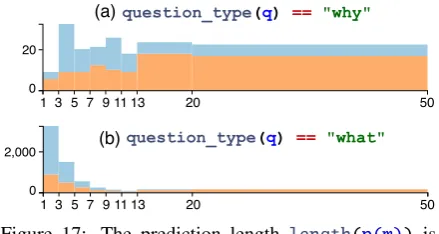
Figure 17: The prediction length length(p(m)) is much longer for (a) only “why” questions than for (b) only “what” questions.
We merge two cases from our user study in§5to demonstrate how participants P1 and P2 can start with similar attributes and then diverge and dis-cover complementary insights.
[image:13.595.312.525.268.396.2] [image:13.595.307.527.483.600.2]Q:Why is Priestley usually given credit for being first to discover oxygen?
...Because he published his findings first, Prestley is usually given priority in the discover.
Figure 18: A “why” question where the model ignored the apparent hint “because.”
small substring of the prediction (with multiple unnecessary tokens on both ends). Meanwhile, “what” questions have relatively shorter predic-tions. He hypothesized that reframing “why” to “what” questions could result in reasonable pre-diction lengths, and created a rule rewrite(q,
"Why VERB"→"What is the reason that")
to confirm it. Out of 151 rewritten instances, 46 had shorter predictions, and 6 had longer ones; the remaining instances had unchanged predictions. Out of the 19 instances where
F1 improved after the rewrite (apply(f1(m), rewrite="why to what") > f1(m)), 13 had the prediction shortened to approximately the correct ground truth answer.
P2 found the example in Figure 18 and chose a different angle. He was surprised to see the incorrect prediction, when the ground truth con-tained the word “because”, which should make the prediction easier for BiDAF. Grouping all “why” questions with a"because"in their context:
question type(q) == "why"
and has pattern(c, pattern="because")
1 2
he found most instances still had a predic-tion following "because", and that removing "because" from the context made predictions worse. He confirmed that “because” was indeed an essential signal. The prediction in Figure18 re-mained the same, and P2 therefore hypothesized that aggressive pattern matching affected this in-stance, as all the words surrounding the predic-tion “priority” were in the quespredic-tion. He was also surprised that there were only 40 instances in thebecausegroup, and suggested more labeling might easily help bump up the performance.
The two participants explored complementary angles on “why” question, suggesting the value of collaborative sharing among Errudite users.
B Programming-by-Demonstration
To help users express their intent, Errudite sup-ports programming by demonstration (PBD) ( Gul-wani and Jain,2017), a well-recognized technique
Q: Who created the 2005 theme for Doctor Who?
...John Debney created a new arrangement of Ron Grainer’s original theme for Doctor Who in 1996. For the
return of the series in 2005, Murray Gold provided a new
arrangement... featured sampled from the 1963 original.
Figure 19: The illustrating example we used in the pa-per; we repeat it here to explain our programming-by-demonstration heuristics. The scenario here assumes “John” is selected by a user.
for synthesizing targeted programs from specific examples. It has been widely applied to tasks like data wrangling (Kandel et al.,2011) and text edit-ing (Lau et al.,2003). Here, we explain the heuris-tics used for ranking query suggestions and ex-tracting rewrite rules.
B.1 Query Ranking
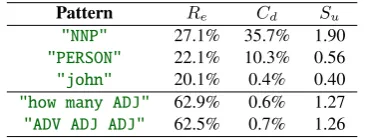
Pattern Re Cd Su
[image:14.595.324.507.299.368.2]"NNP" 27.1% 35.7% 1.90 "PERSON" 22.1% 10.3% 0.56 "john" 20.1% 0.4% 0.40 "how many ADJ" 62.9% 0.6% 1.27 "ADV ADJ ADJ" 62.5% 0.7% 1.26
Table 2: Patterns and their associated usefulness in Fig-ure19(top 3 lines) and Figure10(bottom 2 lines)
.
As users interact with instances, Errudite de-tects and returns potential queries that can as-sist generalization from a single observation to a larger set. As running examples, we explain our query ranking methods assuming “John” is se-lected in Figure19, and “How many brownish” is selected in Figure10. There are three broad types of suggestions with different granularity. To en-sure diversity, our suggestions cover at least one query from each type, and the inter-type sugges-tion ranking will always be as the following:
Span-related suggestions closely relate to the specific token(s) selected (“John” in Figure 19). The most typical span-related suggestions are pat-tern searches. We generate a list of possible lin-guistic patterns from the cross-product of raw to-ken text with POS tags (coarse for multiple toto-kens, and fine-grained for single tokens), as well as the entity type (if any). The resulting possible pat-terns for “John” are"John", "NNP", "PERSON". Similarly, in Figure 10, “how many brownish” results in "how many brownish", "how many ADJ","ADV ADJ ADJ", etc. The functional pred-icate used differs if the selected span lies at the be-ginning, middle, or end of a target (start with, has pattern, andend with).
target under inspection. For instance, we return question type when a user interacts with the question (q) in Figure 10. A prediction (p) as in Figure 19 will instead trigger different levels of comparisons with the ground truth, including accuracy checks (exact match and is correct sent), answer type comparisons (ENT(p) == ENT(q)), answer offsets (answer offset delta) and sentence level comparisons (overlap):
answer type(g) == answer type(p(m))
exact match(m) == 0
is correct sent(m) == False
overlap(q, sentence(p(m))) >
overlap(q, sentence(g))
1 2 3 4 5
Instance-level suggestions are conventional at-tributes that domain experts often find useful. For example, performance, question type, and answer type are considered the most important “instance” suggestions if they are not triggered by the target-related suggestions. In addition, lengths of inputs also belong to this suggestion type.
To perform intra-group ranking, we precompute the resulting groups for each candidate suggestion, and rank their in-group error rateRe and dataset
coverageCd, maximizing a usefulness score:
Su =
Re |Cd−50%|
(1)
Intuitively, Re measures group difficulty. We
would like to prioritize patterns that will return subsets that are not well-handled on average, re-sulting in high in-group error rate. The|Cd−50%|
term, on the other hand, ensures reasonable cover-age. We prioritize groups that lean towards50%
coverage of the entire validation set, so to penalize patterns that cover too few instances to be signif-icant, or those covering too many instances that essentially return the entire dataset. Taking the ranking of span-related suggestions as an example, candidate patterns for Figure 19 and Figure 10, and their scoresSu, are shown in Table2.
B.2 Rewrite Rule Extraction
When a sourcexis edited tox0, we propose a set of rulesR = {r1, ..., rm} in the same manner as Ribeiro et al.(2018): we test the exact matching, and select the minimal contiguous sequence that turns x to x0, with their immediate contexts and linguistic features. WhileRibeiro et al.(2018) use only text and POS tags, we further extend to in-clude entity types.
Who What person created the 2005 theme for Doctor Who?
Figure 20: Rewrite rules inferred from an edit on an individual instance.
Then, we apply every rule in the candidate set onto a random subset of instances S =
{s1, ..., sn}, n = 100. Similar to Ribeiro et al.
(2018), we prioritize rules that have (1) high coverage and (2) low redundancy, while loos-ening their constraint on semantic equivalence: rules resulting in different semantics are still valid in our error cause testing context. In addition, we heuristically score the linguistic features used based on their specificity: we consider raw text the most specific, POS tag the least, and penal-ize rules that are too general and abstract (as they are likely to result in unexpected changes). For example, in addition to the rules reported in Figure 20, an additional rule found in the can-didate set from “Who” to “What person” was "NOUN"→"What person". By editing random
NOUNs, this rule will have high coverage, but our specificity score weights it down enough that "Who"→"What person" is ranked more highly. We then report the five highest-ranked candidate rules to the user.
C Survey: Error Analysis Sample Sizes
Table3lists the 10 papers we surveyed to inspect the scale of thestatus quoerror analysis practice. Papers are randomly selected from top tier confer-ences, and either develop novel MC models (our primary test case), or focus on error analysis.
Paper Sample size
(Seo et al.,2016) 50 (Kundu and Ng,2018) 50 (Hu et al.,2018) 50 (Min et al.,2018) 50 (Weissenborn et al.,2017) 55 (Chen et al.,2016) 100
(Min et al.,2017) 100 (Wadhwa et al.,2018) 100 (Fader et al.,2013) 100 (van Aken et al.,2018) 200
Average 85.5
[image:15.595.334.497.616.750.2]D DSL Documentation
Here we list the functions defined in our domain-specific language for MC and VQA.
Converters and Targets
Get targets: These targets contain text spans post-processed with state-of-the-art POS taggers, lemma-tizers and NER models, along with metadata such as example id, or (in the answer case) the model that generated it. When additional metadata is not used,Targetcan be treated just asSpanin a function, or a piece of text with its linguistic features.
1. question|context|groundtruth→Target: Automatically query the target object (Question
andAnswerin VQA and MC, as well asContextin MC).
2. prediction(model:str)→Target: Get the prediction object of a given model.
Convertersthat extract sub-spans, short phrases, or sentences from targets.
1. token(span:Span,idxes:int|int[],pattern:str)→Token|Token[]: Get a list of tokens from the target based on idxes (sub-list) and pattern (in the form of, for example, "(what, which) NOUN)". patternautomatically detects queries on POS tags and entity types.
2. sentence(target:Target,shift:int|int[])→Span: [MC only]Get the sentence that con-tains a given answer. Shift indicates if neighboring sentences should be included. Ifshift==0, then the actual sentence is returned; ifshift==[-2,-1,1,2], then the four sentences surrounding the answer sentence are returned.
General Computation
1. apply(func:Callable,rewrite:str)→any: Applies query functions to instances rewritten by the named rulerewrite.
2. abs(num:float|int)→float|int: Returns the absolute value.
3. truncate(num:float|int, min value:float|int, max value::float|int)→float|int: Clamps a given number to a given domain.
4. is digit(input:any)→bool: Determines if an input is a number, or – in the case of a string input – if it can be parsed into a number.
5. digitize(input:any)→float|int: Parses an input into a number ifis digit(input) ==
True; Otherwise returnsNone.
6. length(span:Span)→int: The length of a given span, in tokens.
7. [has any|has all](container:Span,contained:Span)→int: Determines whether one list
containercontains any (or all) of the members present in another lists. 8. count(vars:list)→int: Count the number of members in the input list.
9. freq(target:Target,target type:str)→str: Returns the frequency of a token occurring in the training data, given a target type ("question"or"answer"in MC; However,freqcan be on other targets given other tasks).
Linguistic Attributes
1. [LEMMA|POS|TAG|ENT](span:Span,get root:bool,pattern:str)→str|str[]: Return the specified linguistic feature of a span with one more more tokens. If pattern is specified (the same as intoken), gets the sub-list of spans in the span list. Ifget root==True, gets the single linguistic feature of the “primary” token, or the one within the ground truth span that is highest in the dependency parsing tree.
2. STRING(span:Span)→str: Get the raw string from a given span.
3. [has pattern|starts with|ends with](span:Span,pattern:str)→bool: To determine whether the targeted span contains a certain pattern.
Performance Metrics
both QA and VQA, which is usually the model prediction probability. Accuracy is for VQA, and the others are for QA.
2. is correct sent(model:str)→bool:[MC only]Determine if the given model locates the sen-tence with the ground truth, regardless of span-level correctness.
Between-target Relations
1. overlap(span1:Span,span2:Span,pattern:str)→float: A directional overlapping: re-turns the ratio of tokens inspan1that also occur intarget2. If patternis provided, it is used to filter to matching tokens inspan1andtarget2. For example, ifpattern=="NOUN", then the overlap will only be on tokens with a NOUN tag.
Domain-Specific Attributes
1. question type(question:Target)→str: Returns the question type: either the WH-word or the first word in a sentence.
2. answer type(answer:Answer)→str: Returns the answer type, computed based on TREC (Li and Roth,2002) and the named entities of the answer. Returns one of the following: ABBR, DESC, ENTY, HUM, LOC, NUM.
3. answer offset delta(prediction:Answer, direction:str)→int: [MC only] Compute the offset between prediction and ground truth in the left or right direction. Returns the position difference.
4. answer offset span(prediction:Answer, direction:str)→Span: [MC only] Compute the offset between prediction and ground truth in the left or right direction. Returns the actual span(s).