Semantically Smooth Knowledge Graph Embedding
Shu Guo†, Quan Wang†∗, Bin Wang†, Lihong Wang‡, Li Guo††Institute of Information Engineering, Chinese Academy of Sciences, Beijing 100093, China
{guoshu,wangquan,wangbin,guoli}@iie.ac.cn
‡National Computer Network Emergency Response Technical Team
Coordination Center of China, Beijing 100029, China
Abstract
This paper considers the problem of em-bedding Knowledge Graphs (KGs) con-sisting of entities and relations into low-dimensional vector spaces. Most of the existing methods perform this task based solely on observed facts. The only re-quirement is that the learned embeddings should be compatible within each individ-ual fact. In this paper, aiming at further discovering the intrinsic geometric struc-ture of the embedding space, we propose
Semantically Smooth Embedding (SSE). The key idea of SSE is to take full ad-vantage of additional semantic informa-tion and enforce the embedding space to be semantically smooth, i.e., entities be-longing to the same semantic category will lie close to each other in the embedding s-pace. Two manifold learning algorithms Laplacian Eigenmaps and Locally Linear Embedding are used to model the smooth-ness assumption. Both are formulated as geometrically based regularization terms to constrain the embedding task. We em-pirically evaluate SSE in two benchmark tasks of link prediction and triple classi-fication, and achieve significant and con-sistent improvements over state-of-the-art methods. Furthermore, SSE is a general framework. The smoothness assumption can be imposed to a wide variety of em-bedding models, and it can also be con-structed using other information besides entities’ semantic categories.
1 Introduction
Knowledge Graphs (KGs) like WordNet (Miller, 1995), Freebase (Bollacker et al., 2008), and
DB-∗Corresponding author: Quan Wang.
pedia (Lehmann et al., 2014) have become ex-tremely useful resources for many NLP relat-ed applications, such as word sense disambigua-tion (Agirre et al., 2014), named entity recogni-tion (Magnini et al., 2002), and informarecogni-tion ex-traction (Hoffmann et al., 2011). A KG is a multi-relational directed graph composed of entities as nodes and relations as edges. Each edge is repre-sented as a triple of fact⟨ei,rk,ej⟩, indicating that
head entityeiand tail entityejare connected by
re-lationrk. Although powerful in representing
struc-tured data, the underlying symbolic nature makes KGs hard to manipulate.
Recently a new research direction called knowl-edge graph embedding has attracted much atten-tion (Socher et al., 2013; Bordes et al., 2013; Bor-des et al., 2014; Lin et al., 2015). It attempts to embed components of a KG into continuous vector spaces, so as to simplify the manipulation while preserving the inherent structure of the original graph. Specifically, given a KG, entities and re-lations are first represented in a low-dimensional vector space, and for each triple, a scoring func-tion is defined to measure its plausibility in that space. Then the representations of entities and re-lations (i.e. embeddings) are learned by maximiz-ing the total plausibility of observed triples. The learned embeddings can further be used to benefit all kinds of tasks, such as KG completion (Socher et al., 2013; Bordes et al., 2013), relation extrac-tion (Riedel et al., 2013; Weston et al., 2013), and entity resolution (Bordes et al., 2014).
To our knowledge, most of existing KG embed-ding methods perform the embedembed-ding task based solely on observed facts. The only requiremen-t is requiremen-tharequiremen-t requiremen-the learned embeddings should be com-patible within each individual fact. In this pa-per we proposeSemantically Smooth Embedding
(SSE), a new approach which further imposes con-straints on the geometric structure of the embed-ding space. The key idea of SSE is to make
l use of additional semantic information (i.e. se-mantic categories of entities) and enforce the em-bedding space to be semantically smooth—entities belonging to the same semantic category should lie close to each other in the embedding space. This smoothness assumption is closely related to the local invariance assumption exploited in mani-fold learning theory, which requires nearby points to have similar embeddings or labels (Belkin and Niyogi, 2001). Thus we employ two manifold learning algorithms Laplacian Eigenmaps (Belkin and Niyogi, 2001) and Locally Linear Embed-ding (Roweis and Saul, 2000) to model the s-moothness assumption. The former requires an entity to lie close to every other entity in the same category, while the latter represents that entity as a linear combination of its nearest neighbors (i.e. entities within the same category). Both are for-mulated as manifold regularization terms to con-strain the KG embedding objective function. As such, SSE obtains an embedding space which is semantically smooth and at the same time com-patible with observed facts.
The advantages of SSE are two-fold: 1) By im-posing the smoothness assumption, SSE success-fully captures the semantic correlation between entities, which exists intrinsically but is over-looked in previous work on KG embedding. 2) KGs are typically very sparse, containing a rela-tively small number of facts compared to the large number of entities and relations. SSE can eff ec-tively deal with data sparsity by leveraging ad-ditional semantic information. Both aspects lead to more accurate embeddings in SSE. Moreover, our approach is quite general. The smoothness as-sumption can actually be imposed to a wide va-riety of KG embedding models. Besides seman-tic categories, other information (e.g. entity sim-ilarities specified by users or derived from auxil-iary data sources) can also be used to construc-t construc-the manifold regularizaconstruc-tion construc-terms. And besides KG embedding, similar smoothness assumptions can also be applied in other embedding tasks (e.g. word embedding and sentence embedding).
Our main contributions can be summarized as follows. First, we devise a novel KG embedding framework that naturally requires the embedding space to be semantically smooth. As far as we know, it is the first work that imposes constraints on the geometric structure of the embedding space during KG embedding. By leveraging
addition-al semantic information, our approach can addition-also deal with the data sparsity issue that commonly exists in typical KGs. Second, we evaluate our approach in two benchmark tasks of link predic-tion and triple classificapredic-tion, and achieve signif-icant and consistent improvements over state-of-the-art models.
In the remainder of this paper, we first provide a brief review of existing KG embedding model-s in Section 2, and then detail the propomodel-sed SSE framework in Section 3. Experiments and results are reported in Section 4. Then in Section 5 we discuss related work, followed by the conclusion and future work in Section 6.
2 A Brief Review of KG Embedding KG embedding aims to embed entities and rela-tions into a continuous vector space and model the plausibility of each fact in that space. In general, it consists of three steps: 1) representing entities and relations, 2) specifying a scoring function, and 3) learning the latent representations. In the first step, given a KG, entities are represented as points (i.e. vectors) in a continuous vector space, and relation-s arelation-s operatorrelation-s in that relation-space, which can be charac-terized by vectors (Bordes et al., 2013; Bordes et al., 2014; Wang et al., 2014b), matrices (Bordes et al., 2011; Jenatton et al., 2012), or tensors (Socher et al., 2013). In the second step, for each candi-date fact⟨ei,rk,ej⟩, an energy function f(ei,rk,ej)
is further defined to measure its plausibility, with the corresponding entity and relation representa-tions as variables. Plausible triples are assumed to have low energies. Then in the third step, to obtain the entity and relation representations, a margin-based ranking loss, i.e.,
L=∑
t+∈O
∑
t−∈Nt+ [
γ+f(ei,rk,ej)−f(e′i,rk,e′j)
] +, (1)
is minimized. Here,Ois the set of observed (i.e. positive) triples, andt+ = ⟨ei,rk,ej⟩ ∈ O;Nt+ de-notes the set of negative triples constructed by re-placing entities int+, and t− = ⟨e′
i,rk,e′j⟩ ∈ Nt+; γ > 0 is a margin separating positive and nega-tive triples; and [x]+ = max(0,x). The ranking loss favors lower energies for positive triples than for negative ones. Stochastic gradient descent (in batch mode) is adopted to solve the mini-mization problem. For details please refer to (Bor-des et al., 2013) and references therein.
Method Entity/Relation embeddings Energy function TransE (Bordes et al., 2013) e,r∈Rd f(e
i,rk,ej)=∥ei+rk−ej∥ℓ1/ℓ2
SME (lin) (Bordes et al., 2014) e,r∈Rd f(ei,rk,ej)=(Wu1rk+Wu2ei+bu)T(W
v1rk+Wv2ej+bv )
SME (bilin) (Bordes et al., 2014) e,r∈Rd f(e
i,rk,ej)= ((
Wuׯ3rk )
ei+bu )T((
Wvׯ3rk )
ej+bv )
SE (Bordes et al., 2011) e∈Rd,Ru,Rv∈Rd×d f(e
[image:3.595.70.528.63.134.2]i,rk,ej)=∥Rkuei−Rvkej∥ℓ1
Table 1: Existing KG embedding models.
function definition. Three state-of-the-art embed-ding models, namely TransE (Bordes et al., 2013), SME (Bordes et al., 2014), and SE (Bordes et al., 2011), are detailed below. Please refer to (Jenat-ton et al., 2012; Socher et al., 2013; Wang et al., 2014b; Lin et al., 2015) for other methods.
TransE (Bordes et al., 2013) represents both en-tities and relations as vectors in the embedding s-pace. For a given triple ⟨ei,rk,ej⟩, the relation is
interpreted as a translation vector rk so that the
embedded entities ei andej can be connected by rk with low error. The energy function is defined
as f(ei,rk,ej) = ∥ei+rk−ej∥ℓ1/ℓ2, where ∥·∥ℓ1/ℓ2
denotes theℓ1-norm orℓ2-norm.
SME (Bordes et al., 2014) also represents enti-ties and relations as vectors, but models triples in a more expressive way. Given a triple ⟨ei,rk,ej⟩,
it first employs a function gu(·,·) to combine rk
and ei, and gv(·,·) to combine rk andej. Then,
the energy function is defined as matchinggu(·,·)
andgv(·,·) by their dot product, i.e., f(ei,rk,ej)= gu(rk,ei)Tgv(rk,ej). There are two versions of
SME, linear and bilinear (denoted as SME (lin) and SME (bilin) respectively), obtained by defin-ing differentgu(·,·) andgv(·,·).
SE (Bordes et al., 2011) represents entities as vectors but relations as matrices. Each relation is modeled by a left matrixRu
k and a right matrixRvk,
acting as independent projections to head and tail entities respectively. If a triple ⟨ei,rk,ej⟩ holds, Ru
kei andRvkej should be close to each other. The
energy function is f(ei,rk,ej) = ∥Rukei −Rvkej∥ℓ1.
Table 1 summarizes the entity/relation representa-tions and energy funcrepresenta-tions used in these models.
3 Semantically Smooth Embedding The methods introduced above perform the em-bedding task based solely on observed facts. The only requirement is that the learned embeddings should be compatible within each individual fact. However, they fail to discover the intrinsic geo-metric structure of the embedding space. To deal with this limitation, we introduceSemantically
S-mooth Embedding(SSE) which constrains the em-bedding task by incorporating geometrically based regularization terms, constructed by using addi-tional semantic categories of entities.
3.1 Problem Formulation
Suppose we are given a KG consisting ofnentities andmrelations. The facts observed are stored as a set of triplesO={⟨ei,rk,ej⟩}. A triple⟨ei,rk,ej⟩
indicates that entityeiand entityej are connected
by relationrk. In addition, the entities are
classi-fied into multiple semantic categories. Each entity
eis associated with a labelceindicating the
cate-gory to which it belongs. SSE aims to embed the entities and relations into a continuous vector s-pace which is compatible with the observed facts, and at the same time semantically smooth.
To make the embedding space compatible with the observed facts, we make use of the triple setO and follow the same strategy adopted in previous methods. That is, we define an energy function on each candidate triple (e.g. the energy functions listed in Table 1), and require observed triples to have lower energies than unobserved ones (i.e. the margin-based ranking loss defined in Eq. (1)).
To make the embedding space semantically s-mooth, we further leverage the entity category in-formation{ce}, and assume that entities within the
same semantic category should lie close to each other in the embedding space. This smoothness assumption is similar to the local invariance as-sumption exploited in manifold learning theory (i.e. nearby points are likely to have similar em-beddings or labels). So we employ two manifold learning algorithms Laplacian Eigenmaps (Belkin and Niyogi, 2001) and Locally Linear Embed-ding (Roweis and Saul, 2000) to model such se-mantic smoothness, termed as LE and LLE for short respectively.
3.2 Modeling Semantic Smoothness by LE
each two data points (Belkin and Niyogi, 2001). We borrow the idea of LE and enforce semantic smoothness by assuming:
Smoothness Assumption 1 If two entities ei and ejbelong to the same semantic category, they will have embeddingseiandej close to each other.
To encode the semantic information, we construct an adjacency matrix W1 ∈ Rn×n among the
enti-ties, with thei j-th entry defined as:
w(1)i j =1, ifcei =cej, 0, otherwise,
where cei/cej is the category label of entity ei/ej.
Then, we use the following term to measure the smoothness of the embedding space:
R1= 12
n
∑
i=1
n
∑
j=1
∥ei−ej∥22w(1)i j ,
whereei andej are the embeddings of entities ei
andejrespectively. By minimizingR1, we expect
Smoothness Assumption 1: if two entitieseiandej
belong to the same semantic category (i.e. w(1)i j = 1), the distance betweenei andej (i.e. ∥ei−ej∥22)
should be small.
We further incorporate R1 as a regularization
term into the margin-based ranking loss (i.e. Eq. (1)) adopted in previous KG embedding methods, and propose our first SSE model. The new mod-el performs the embedding task by minimizing the following objective function:
L1=N1
∑
t+∈O
∑
t−∈N
t+
ℓ(t+,t−)+λ21∑n
i=1
n
∑
j=1
∥ei−ej∥22w(1)i j ,
whereℓ(t+,t−)=[γ+f(ei,rk,ej)−f(e′
i,rk,e′j)
] +is the ranking loss on the positive-negative triple pair (t+,t−), and N is the total number of such triple pairs. The first term inL1 enforces the resultant
embedding space compatible with all the observed triples, and the second term further requires that space to be semantically smooth. Hyperparameter
λ1makes a trade-offbetween the two cases.
The minimization is carried out by stochastic gradient descent. Given a randomly sampled posi-tive triplet+= ⟨ei,rk,ej⟩and the associated nega-tive triplet− =⟨e′
i,rk,e′j⟩,1the stochastic gradient
w.r.t.es(s∈ {i,j,i′,j′}) can be calculated as:
∇esL1=∇esℓ
(t+,t−)+2λ
1E(D−W1)1s, 1The negative triple is constructed by replacing one of the entities in the positive triple.
whereE=[e1,e2,· · ·,en]∈Rd×nis a matrix
con-sisting of entity embeddings; D ∈ Rn×n is a
di-agonal matrix with thei-th entry on the diagonal being dii = ∑nj=1w(1)i j ; and 1s ∈ Rn is a column
vector where thes-th entry is 1 and the others are 0. Other parameters are not included in R1, and
their gradients remain the same as defined in pre-vious work.
3.3 Modeling Semantic Smoothness by LLE
As opposed to LE which preserves local invari-ance within data pairs, Locally Linear Embedding (LLE) expects each data point to be roughly re-constructed by a linear combination of its nearest neighbors (Roweis and Saul, 2000). We borrow the idea of LLE and enforce semantic smoothness by assuming:
Smoothness Assumption 2 Each entity eican be roughly reconstructed by a linear combination of its nearest neighbors in the embedding space, i.e., ei ≈ ∑ej∈N(ei)αjej. Here nearest neighbors refer to entities belonging to the same semantic catego-ry with ei.
To model this assumption, for each entity ei, we
randomly sample K entities uniformly from the category to which ei belongs, denoted as the
n-earest neighbor setN(ei). We construct a weight
matrixW2∈Rn×nby defining:
w(2)i j =1, ifej ∈ N(ei), 0, otherwise,
and normalize the rows so that∑n
j=1w(2)i j = 1 for
each rowi. Note thatW2is no longer a symmetric
matrix. The smoothness of the embedding space can be measured by the reconstruction error:
R2 =
n
∑
i=1
ei−
∑
ej∈N(ei) w(2)i j ej
2
2 .
Minimizing R2 results in Smoothness
Assump-tion 2: each entity can be linearly reconstructed from its nearest neighbors with low error.
By incorporatingR2as a regularization term
in-to the margin-based ranking loss defined in Eq. (1), we obtain our second SSE model, which per-forms the embedding task by minimizing:
L2=N1
∑
t+∈O
∑
t−∈Nt+
ℓ(t+,t−)+λ
2
n
∑
i=1
ei−
∑
ej∈N(ei) w(2)i j ej
2
The resultant embedding space is also semanti-cally smooth and compatible with the observed triples. Hyperparameterλ2 makes a trade-off
be-tween the two cases.
Similar to the first model, stochastic gradien-t descengradien-t is used gradien-to solve gradien-the minimizagradien-tion prob-lem. Given a positive triple t+ = ⟨e
i,rk,ej⟩ and
the associated negative triplet− = ⟨e′
i,rk,e′j⟩, the
gradient w.r.t.es(s∈ {i,j,i′,j′}) is calculated as:
∇esL2=∇esℓ
(t+,t−)+2λ
2E(I−W2)T(I−W2)1s,
whereI ∈ Rn×n is the identity matrix. Other
pa-rameters are not included in R2, and their
gradi-ents remain the same as defined in previous work. To better capture the cohesion within each cate-gory, during each stochastic step we resample the nearest neighbors for each entity, uniformly from the category to which it belongs.
3.4 Advantages and Extensions
The advantages of our approach can be summa-rized as follows: 1) By incorporating geometri-cally based regularization terms, the SSE mod-els are able to capture the semantic correlation between entities, which exists intrinsically but is overlooked in previous work. 2) By leveraging ad-ditional entity category information, the SSE mod-els can deal with the data sparsity issue that com-monly exists in most KGs. Both aspects lead to more accurate embeddings.
Entity category information has also been inves-tigated in (Nickel et al., 2012; Chang et al., 2014; Wang et al., 2015), but in different manners. Nick-el et al. (2012) take categories as pseudo entities and introduce a specific relation to link entities to categories. Chang et al. (2014) and Wang et al. (2015) use entity categories to specify relation-s’ argument expectations, removing invalid triples during training and reasoning respectively. None of them considers the intrinsic geometric structure of the embedding space.
Actually, our approach is quite general. 1) The smoothness assumptions can be imposed to a wide variety of KG embedding models, not only the ones introduced in Section 2, but also those based on matrix/tensor factorization (Nickel et al., 2011; Chang et al., 2013). 2) Besides semantic cate-gories, other information (e.g. entity similarities specified by users or derived from auxiliary data sources) can also be used to construct the mani-fold regularization terms. 3) Besides KG embed-ding, similar smoothness assumptions can also be
Location Sport CityCapitalOfCountry AthleteLedSportTeam CityLocatedInCountry AthletePlaysForTeam CityLocatedInGeopoliticallocation AthletePlaysInLeague CityLocatedInState AthletePlaysSport CountryLocatedInGeopoliticallocation CoachesInLeague
StateHasCapital CoachesTeam
[image:5.595.308.528.62.187.2]StateLocatedInCountry TeamPlaysInLeague StateLocatedInGeopoliticallocation TeamPlaysSport
Table 2: Relations in Locationand Sport.
applied in other embedding tasks (e.g. word em-bedding and sentence emem-bedding).
4 Experiments
We empirically evaluate the proposed SSE models in two tasks: link prediction (Bordes et al., 2013) and triple classification (Socher et al., 2013).
4.1 Data Sets
We create three data sets with different sizes using NELL (Carlson et al., 2010): Location, Sport, and Nell186. Locationand Sportare two small-scale data sets, both containing 8 relations on the topics of “location” and “sport” respectively. The corre-sponding relations are listed in Table 2. Nell186 is a larger data set containing the most frequent 186 relations. On all the data sets, entities appearing only once are removed. We extract the entity cat-egory information from a specific relation called
Generalization, and keep non-overlapping cat-egories.2 Categories containing less than 5 entities
on Locationand Sportas well as categories con-taining less than 50 entities on Nell186 are fur-ther removed. Table 3 gives some statistics of the three data sets, where # Rel./# Ent./# Trip./# Cat. denotes the number of relations/entities/observed triples/categories respectively, and # c-Ent. de-notes the number of entities that have category la-bels. Note that our SSE models do not require ev-ery entity to have a category label. From the statis-tics, we can see that all the three data sets suffer from the data sparsity issue, containing a relative-ly small number of observed triples compared to the number of entities.
On the two small-scale data sets Location and Sport, triples are split into training/validation/test sets, with the ratio of 3:1:1. The first set is used for modeling training, the second for hyperparam-eter tuning, and the third for evaluation. All ex-periments are repeated 5 times by drawing new
# Rel. # Ent. # Trip. # Cat. # c-Ent. Location 8 380 718 5 358
Sport 8 1,520 3,826 4 1,506
Nell186 186 14,463 41,134 35 8,590
Table 3: Statistics of data sets.
training/validation/test splits, and results averaged over the 5 rounds are reported. On Nell186 ex-periments are conducted only once, using a train-ing/validation/test split with 31,134/5,000/5,000 triples respectively. We will release the data up-on request.
4.2 Link Prediction
This task is to complete a triple⟨ei,rk,ej⟩withei
orej missing, i.e., predictei given (rk,ej) or
pre-dictejgiven (ei,rk).
Baseline methods. We take TransE, SME (lin), SME (bilin), and SE as our baselines. We then in-corporate manifold regularization terms into these methods to obtain the SSE models. A model with the LE/LLE regularization term is denoted as TransE-LE/TransE-LLE for example. We fur-ther compare our SSE models with the setting pro-posed by Nickel et al. (2012), which also takes in-to account the entity category information, but in a more direct manner. That is, given an entity e
with its category label ce, we create a new triple
⟨e,Generalization,ce⟩and add it into the
train-ing set. Such a method is denoted as TransE-Cat for example.
Evaluation protocol. For evaluation, we adopt the same ranking procedure proposed by Bordes et al. (2013). For each test triple⟨ei,rk,ej⟩, the head
entityei is replaced by every entitye′i in the KG,
and the energy is calculated for the corrupted triple ⟨e′
i,rk,ej⟩. Ranking the energies in ascending
or-der, we get the rank of the correct entityei.
Sim-ilarly, we can get another rank by corrupting the tail entityej. Aggregated over all test triples, we
report three metrics: 1) the averaged rank, denoted as Mean (the smaller, the better); 2) the median of the ranks, denoted as Median (the smaller, the bet-ter); and 3) the proportion of ranks no larger than 10, denoted as Hits@10 (the higher, the better).
Implementation details. We implement the
methods based on the code provided by Bordes et al. (2013)3. For all the methods, we create 100
mini-batches on each data set. On Location and Sport, the dimension of the embedding spacedis
3https://github.com/glorotxa/SME
set in the range of{10,20,50,100}, the margin γ
is set in the range of{1,2,5,10}, and the learning rate is fixed to 0.1. On Nell186, the hyperparame-tersdandγare fixed to 50 and 1 respectively, and the learning rate is fixed to 10. In LE and LLE, the regularization hyperparametersλ1 andλ2 are
tuned in {10−4,10−5,10−6,10−7,10−8}. And the
number of nearest neighborsKin LLE is tuned in {5,10,15,20}. The best model is selected by ear-ly stopping on the validation sets (by monitoring Mean), with a total of at most 1000 iterations over the training sets.
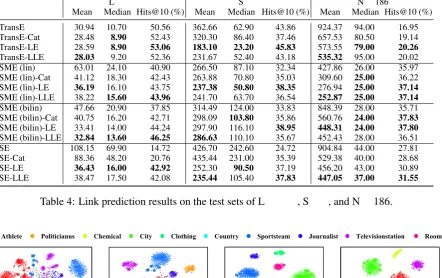
Results. Table 4 reports the results on the test sets of Location, Sport, and Nell186. From the results, we can see that: 1) SSE (regularized vi-a either LE or LLE) outperforms vi-all the bvi-aselines on all the data sets and with all the metrics. The improvements are usually quite significant. The metric Mean drops by about 10% to 65%, Medi-an drops by about 5% to 75%, Medi-and Hits@10 rises by about 5% to 190%. This observation demon-strates the superiority and generality of our ap-proach. 2) Even if encoded in a direct way (e.g. TransE-Cat), the entity category information can still help the baseline methods in the link predic-tion task. This observapredic-tion indicates that leverag-ing additional information is indeed useful in deal-ing with the data sparsity issue and hence leads to better performance. 3) Compared to the strategy which incorporates the entity category information directly, formulating such information as manifold regularization terms results in better and more sta-ble results. The *-Cat models sometimes perfor-m even worse than the baselines (e.g. TransE-Cat on Sportdata), while the SSE models consistent-ly achieve better results. This observation further demonstrates the superiority of constraining the geometric structure of the embedding space.
We further visualize and compare the geometric structures of the embedding spaces learned by tra-ditional embedding and semantically smooth em-bedding. We select the 10 largest semantic cate-gories in Nell186 (specified in Figure 1) and the 5,740 entities therein. We take the embeddings of these entities learned by TransE, TransE-Cat, TransE-LE, and TransE-LLE, with the optimal hy-perparameter settings determined in the link pre-diction task. Then we create 2D plots using t-SNE (Van der Maaten and Hinton, 2008)4. The
results are shown in Figure 1, where a different
Location Sport Nell186
Mean Median Hits@10 (%) Mean Median Hits@10 (%) Mean Median Hits@10 (%)
TransE 30.94 10.70 50.56 362.66 62.90 43.86 924.37 94.00 16.95
TransE-Cat 28.48 8.90 52.43 320.30 86.40 37.46 657.53 80.50 19.14 TransE-LE 28.59 8.90 53.06 183.10 23.20 45.83 573.55 79.00 20.26 TransE-LLE 28.03 9.20 52.36 231.67 52.40 43.18 535.32 95.00 20.02 SME (lin) 63.01 24.10 40.90 266.50 87.10 32.34 427.86 26.00 35.97 SME (lin)-Cat 41.12 18.30 42.43 263.88 70.80 35.03 309.60 25.00 36.22 SME (lin)-LE 36.19 16.10 43.75 237.38 50.80 38.35 276.94 25.00 37.14 SME (lin)-LLE 38.22 15.60 43.96 241.70 63.70 36.54 252.87 25.00 37.14 SME (bilin) 47.66 20.90 37.85 314.49 124.00 33.83 848.39 28.00 35.71 SME (bilin)-Cat 40.75 16.20 42.71 298.09 103.80 35.86 560.76 24.00 37.83 SME (bilin)-LE 33.41 14.00 44.24 297.90 116.10 38.95 448.31 24.00 37.80 SME (bilin)-LLE 32.84 13.60 46.25 286.63 110.10 35.67 452.43 28.00 36.51
SE 108.15 69.90 14.72 426.70 242.60 24.72 904.84 44.00 27.81
SE-Cat 88.36 48.20 20.76 435.44 231.00 35.39 529.38 40.00 28.68
SE-LE 36.43 16.00 42.92 252.30 90.50 37.19 456.20 43.00 30.89
[image:7.595.82.525.69.347.2]SE-LLE 38.47 17.50 42.08 235.44 105.40 37.83 447.05 37.00 31.55 Table 4: Link prediction results on the test sets of Location, Sport, and Nell186.
Athlete Politicianus Chemical City Clothing Country Sportsteam Journalist Televisionstation Room
(a) TransE. (b) TransE-Cat. (c) TransE-LE. (d) TransE-LLE.
Figure 1: Embeddings of entities belonging to the 10 largest categories in Nell186 (best viewed in color).
color is used for each category. It is easy to see that imposing the semantic smoothness assump-tions helps in capturing the semantic correlation between entities in the embedding space. Entities within the same category lie closer to each oth-er, while entities belonging to different categories are easily distinguished (see Figure 1(c) and Fig-ure 1(d)). Incorporating the entity category infor-mation directly could also helps. But it fails on some “hard” entities (i.e., those belonging to d-ifferent categories but mixed together in the cen-ter of Figure 1(b)). We have conducted the same experiments with the other methods and observed similar phenomena.
4.3 Triple Classification
This task is to verify whether a given triple ⟨ei,rk,ej⟩is correct or not. We test our SSE
mod-els in this task, with the same comparison settings as used in the link prediction task.
Evaluation protocol.We follow the same eval-uation protocol used in (Socher et al., 2013; Wang et al., 2014b). To create labeled data for
classifica-tion, for each triple in the test and validation sets, we construct a negative triple for it by randomly corrupting the entities. To corrupt a position (head or tail), only entities that have appeared in that po-sition are allowed. During triple classification, a triple is predicted as positive if the energy is be-low a relation-specific thresholdδr; otherwise as
negative. We report two metrics on the test sets: micro-averaged accuracy and macro-averaged ac-curacy, denoted as Micro-ACC and Macro-ACC respectively. The former is a per-triple average, while the latter is a per-relation average.
Implementation details. We use the same hy-perparameter settings as in the link prediction task. The relation-specific thresholdδris determined by
maximizing Micro-ACC on the validation sets. A-gain, training is limited to at most 1000 iterations, and the best model is selected by early stopping on the validation sets (by monitoring Micro-ACC).
base-Location Sport Nell186 Micro-ACC Macro-ACC Micro-ACC Macro-ACC Micro-ACC Macro-ACC
TransE 86.11 81.66 72.52 73.78 84.21 77.86
TransE-Cat 82.50 77.81 75.09 74.23 87.34 81.27
TransE-LE 86.39 81.50 79.88 77.34 90.32 84.61
TransE-LLE 87.01 83.03 80.29 77.71 90.08 84.50
SME (lin) 75.90 71.82 72.61 71.24 88.54 84.17
SME (lin)-Cat 83.33 80.90 73.52 72.28 91.00 86.20
SME (lin)-LE 84.65 79.33 79.25 74.95 92.44 88.07
SME (lin)-LLE 84.58 79.60 79.45 75.61 92.99 88.68
SME (bilin) 73.06 67.26 71.33 67.78 88.78 84.79
SME (bilin)-Cat 79.38 74.35 75.12 72.41 91.67 86.48
SME (bilin)-LE 83.75 79.66 79.23 76.18 93.37 89.29
SME (bilin)-LLE 83.54 80.36 79.33 75.35 93.64 89.39
SE 65.14 60.01 68.61 63.71 90.18 83.93
SE-Cat 68.61 62.82 67.62 62.17 92.87 87.72
SE-LE 81.67 77.52 81.46 74.72 93.94 88.62
[image:8.595.112.493.63.258.2]SE-LLE 82.01 77.45 80.25 76.07 93.95 88.54
Table 5: Triple classification results (%) on the test sets of Location, Sport, and Nell186.
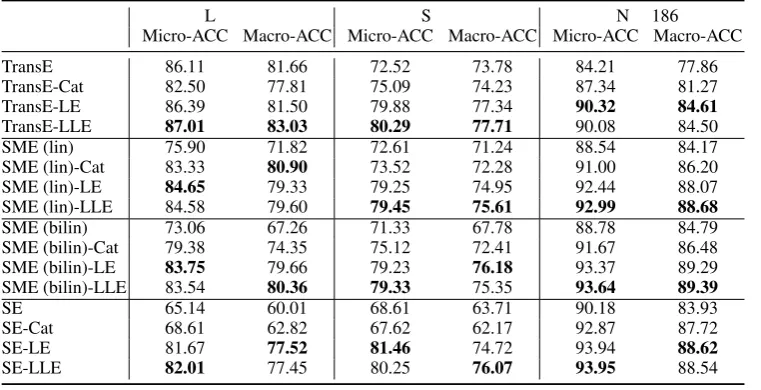
line methods on all the data sets in both metric-s. The improvements are usually quite substantial. The metric Micro-ACC rises by about 1% to 25%, and Macro-ACC by about 2% to 30%. 2) Incorpo-rating the entity category information directly can also improve the baselines in the triple classifica-tion task, again demonstrating the effectiveness of leveraging additional information to deal with the data sparsity issue. 3) It is a better choice to in-corporate the entity category information as man-ifold regularization terms as opposed to encoding it directly. The *-Cat models sometimes perfor-m even worse than the baselines (e.g. TransE-Cat on Locationdata and SE-Cat on Sport data), while the SSE models consistently achieve better results. The observations are similar to those ob-served during the link prediction task, and further demonstrate the superiority and generality of our approach.
5 Related Work
This section reviews two lines of related work: KG embedding and manifold learning.
KG embedding aims to embed a KG composed of entities and relations into a low-dimensional vector space, and model the plausibility of each fact in that space. Yang et al. (2014) categorized the literature into three major groups: 1) method-s bamethod-sed on neural networkmethod-s, 2) methodmethod-s bamethod-sed on matrix/tensor factorization, and 3) methods based on Bayesian clustering. The first group perform-s the embedding taperform-sk uperform-sing neural network archi-tectures (Bordes et al., 2013; Bordes et al., 2014; Socher et al., 2013). Several state-of-the-art neural
network-based embedding models have been in-troduced in Section 2. For other work please refer to (Jenatton et al., 2012; Wang et al., 2014b; Lin et al., 2015). In the second group, KGs are represent-ed as tensors, and embrepresent-edding is performrepresent-ed via ten-sor factorization or collective matrix factorization techniques (Singh and Gordon, 2008; Nickel et al., 2011; Chang et al., 2014). The third group embeds factorized representations of entities and relations into a nonparametric Bayesian clustering frame-work, so as to obtain more interpretable embed-dings (Kemp et al., 2006; Sutskever et al., 2009). Our work falls into the first group, but differs in that it further imposes constraints on the geomet-ric structure of the embedding space, which exists intrinsically but is overlooked in previous work. Although this paper focuses on incorporating ge-ometrically based regularization terms into neural network architectures, it can be easily extended to matrix/tensor factorization techniques.
Niyo-gi, 2001; Cai et al., 2008) and semi-supervised learning (Zhou et al., 2004; Zhu and Niyogi, 2005) to recommender systems (Ma et al., 2011) and community question answering (Wang et al., 2014a). This paper employs manifold learning al-gorithms to model the semantic smoothness as-sumptions in KG embedding.
6 Conclusion and Future Work
In this paper, we have proposed a novel approach to KG embedding, referred to as Semantically S-mooth Embedding(SSE). The key idea of SSE is to impose constraints on the geometric structure of the embedding space and enforce it to be semanti-cally smooth. The semantic smoothness assump-tions are constructed by using entities’ category information, and then formulated as geometrical-ly based regularization terms to constrain the em-bedding task. The emem-beddings learned in this way are capable of capturing the semantic correlation between entities. By leveraging additional infor-mation besides observed triples, SSE can also deal with the data sparsity issue that commonly exists in most KGs. We empirically evaluate SSE in two benchmark tasks of link prediction and triple clas-sification. Experimental results show that by in-corporating the semantic smoothness assumption-s, SSE significantly and consistently outperforms state-of-the-art embedding methods, demonstrat-ing the superiority of our approach. In addition, our approach is quite general. The smoothness as-sumptions can actually be imposed to a wide vari-ety of embedding models, and it can also be con-structed using other information besides entities’ semantic categories.
As future work, we would like to: 1) Construct the manifold regularization terms using other da-ta sources. The only information required to con-struct the manifold regularization terms is the sim-ilarity between entities (used to define the adja-cency matrix in LE and to select nearest neigh-bors for each entity in LLE). We would try entity similarities derived in different ways, e.g., spec-ified by users or calculated from entities’ textual descriptions. 2) Enhance the efficiency and scala-bility of SSE. Processing the manifold regulariza-tion terms can be time- and space-consuming (e-specially the one induced by the LE algorithm). We would investigate how to address this prob-lem, e.g., via the efficient iterative algorithms in-troduced in (Saul and Roweis, 2003) or via
paral-lel/distributed computing. 3) Impose the seman-tic smoothness assumptions on other KG embed-ding methods (e.g. those based on matrix/tensor factorization or Bayesian clustering), and even on other embedding tasks (e.g. word embedding or sentence embedding).
Acknowledgments
We would like to thank the anonymous reviewers for their valuable comments and suggestions. This work is supported by the National Natural Science Foundation of China (grant No. 61402465), the S-trategic Priority Research Program of the Chinese Academy of Sciences (grant No. XDA06030200), and the National Key Technology R&D Program (grant No. 2012BAH46B03).
References
Eneko Agirre, Oier Lopez de Lacalle, and Aitor Soroa. 2014. Random walks for knowledge-based word
sense disambiguation. Computational Linguistics,
40(1):57–84.
Mikhail Belkin and Partha Niyogi. 2001. Laplacian eigenmaps and spectral techniques for embedding
and clustering. InAdvances in Neural Information
Processing Systems, pages 585–591.
Mikhail Belkin, Partha Niyogi, and Vikas Sindhwani. 2006. Manifold regularization: A geometric frame-work for learning from labeled and unlabeled
ex-amples. Journal of Machine Learning Research,
7:2399–2434.
Kurt Bollacker, Colin Evans, Praveen Paritosh, Tim S-turge, and Jamie Taylor. 2008. Freebase: A collab-oratively created graph database for structuring
hu-man knowledge. In Proceedings of the 2008 ACM
SIGMOD International Conference on Management of Data, pages 1247–1250.
Antoine Bordes, Jason Weston, Ronan Collobert, and Yoshua Bengio. 2011. Learning structured
em-beddings of knowledge bases. In Proceedings of
the 25th AAAI Conference on Artificial Intelligence, pages 301–306.
Antoine Bordes, Nicolas Usunier, Alberto Garcia-Dur´an, Jason Weston, and Oksana Yakhnenko. 2013. Translating embeddings for modeling
multi-relational data. InAdvances in Neural Information
Processing Systems, pages 2787–2795.
Antoine Bordes, Xavier Glorot, Jason Weston, and Yoshua Bengio. 2014. A semantic matching en-ergy function for learning with multi-relational data.
Deng Cai, Xiaofei He, Xiaoyun Wu, and Jiawei Han. 2008. Non-negative matrix factorization on
mani-fold. InProceedings of the 8th IEEE International
Conference on Data Mining, pages 63–72.
Andrew Carlson, Justin Betteridge, Bryan Kisiel, Bur-r Settles, Estevam R. HBur-ruschka JBur-r, and Tom M. Mitchell. 2010. Toward an architecture for
never-ending language learning. In Proceedings of the
24th AAAI Conference on Artificial Intelligence, pages 1306–1313.
Kai-Wei Chang, Wen-tau Yih, and Christopher Meek. 2013. Multi-relational latent semantic analysis. In
Proceedings of the 2013 Conference on Empirical Methods in Natural Language Processing, pages 1602–1612.
Kai-Wei Chang, Wen-tau Yih, Bishan Yang, and Christopher Meek. 2014. Typed tensor decom-position of knowledge bases for relation extraction. In Proceedings of the 2014 Conference on Empiri-cal Methods in Natural Language Processing, pages 1568–1579.
Raphael Hoffmann, Congle Zhang, Xiao Ling,
Luke Zettlemoyer, and Daniel S. Weld. 2011.
Knowledge-based weak supervision for information extraction of overlapping relations. InProceedings of the 49th Annual Meeting of the Association for Computational Linguistics: Human Language Tech-nologies, pages 541–550.
Rodolphe Jenatton, Nicolas L. Roux, Antoine Bordes, and Guillaume R. Obozinski. 2012. A latent
fac-tor model for highly multi-relational data. In
Ad-vances in Neural Information Processing Systems, pages 3167–3175.
Charles Kemp, Joshua B. Tenenbaum, Thomas L. Grif-fiths, Takeshi Yamada, and Naonori Ueda. 2006. Learning systems of concepts with an infinite
rela-tional model. InProceedings of the 21st AAAI
Con-ference on Artificial Intelligence, pages 381–388.
Jens Lehmann, Robert Isele, Max Jakob, Anja Jentzsch, Dimitris Kontokostas, Pablo N. Mendes, Sebastian Hellmann, Mohamed Morsey, Patrick van Kleef, S¨oren Auer, et al. 2014. Dbpedia: A large-scale, multilingual knowledge base extracted from
wikipedia.Semantic Web Journal.
Yankai Lin, Zhiyuan Liu, Maosong Sun, Yang Liu, and Xuan Zhu. 2015. Learning entity and relation
em-beddings for knowledge graph completion. In
Pro-ceedings of the 29th AAAI Conference on Artificial Intelligence, pages 2181–2187.
Hao Ma, Dengyong Zhou, Chao Liu, Michael R. Lyu, and Irwin King. 2011. Recommender systems with social regularization. InProceedings of the 4th ACM International Conference on Web Search and Data Mining, pages 287–296.
Bernardo Magnini, Matteo Negri, Roberto Prevete, and Hristo Tanev. 2002. A wordnet-based approach
to named entities recognition. In Proceedings of
the 2002 Workshop on Building and Using Seman-tic Networks, pages 1–7.
George A. Miller. 1995. Wordnet: A lexical
database for english. Communications of the ACM,
38(11):39–41.
Maximilian Nickel, Volker Tresp, and Hans-Peter Kriegel. 2011. A three-way model for collective
learning on multi-relational data. In Proceedings
of the 28th International Conference on Machine Learning, pages 809–816.
Maximilian Nickel, Volker Tresp, and Hans-Peter Kriegel. 2012. Factorizing yago: Scalable machine learning for linked data. InProceedings of the 21st International Conference on World Wide Web, pages 271–280.
Sebastian Riedel, Limin Yao, Andrew McCallum, and Benjamin M. Marlin. 2013. Relation extraction with matrix factorization and universal schemas. In
Proceedings of the 2013 Conference on North Amer-ican Chapter of the Association for Computational Linguistics: Human Language Technologies, pages 74–84.
Sam T. Roweis and Lawrence K. Saul. 2000. Nonlin-ear dimensionality reduction by locally linNonlin-ear
em-bedding. Science, 290(5500):2323–2326.
Lawrence K. Saul and Sam T. Roweis. 2003. Think globally, fit locally: Unsupervised learning of low
dimensional manifolds. Journal of Machine
Learn-ing Research, 4:119–155.
Geoffrey J. Singh and Ajit P. Gordon. 2008. Relational learning via collective matrix factorization. In Pro-ceedings of the 14th ACM SIGKDD International Conference on Knowledge Discovery and Data Min-ing, pages 650–658.
Richard Socher, Danqi Chen, Christopher D. Manning, and Andrew Y. Ng. 2013. Reasoning with neural tensor networks for knowledge base completion. In
Advances in Neural Information Processing System-s, pages 926–934.
Ilya Sutskever, Joshua B. Tenenbaum, and Ruslan R. Salakhutdinov. 2009. Modelling relational data us-ing bayesian clustered tensor factorization. In Ad-vances in Neural Information Processing Systems, pages 1821–1828.
Joshua B. Tenenbaum, Vin De Silva, and John C. Langford. 2000. A global geometric framework
for nonlinear dimensionality reduction. Science,
290(5500):2319–2323.
Laurens Van der Maaten and Geoffrey Hinton. 2008.
Visualizing data using t-sne. Journal of Machine
Quan Wang, Jing Liu, Bin Wang, and Li Guo. 2014a. A regularized competition model for question diffi -culty estimation in community question answering
services. InProceedings of the 2014 Conference on
Empirical Methods in Natural Language Process-ing, pages 1115–1126.
Zhen Wang, Jianwen Zhang, Jianlin Feng, and Zheng Chen. 2014b. Knowledge graph embedding by
translating on hyperplanes. In Proceedings of the
28th AAAI Conference on Artificial Intelligence, pages 1112–1119.
Quan Wang, Bin Wang, and Li Guo. 2015. Knowl-edge base completion using embeddings and rules. InProceedings of the 24th International Joint Con-ference on Artificial Intelligence.
Jason Weston, Antoine Bordes, Oksana Yakhnenko, and Nicolas Usunier. 2013. Connecting language and knowledge bases with embedding models for
re-lation extraction. In Proceedings of the 2013
Con-ference on Empirical Methods in Natural Language Processing, pages 1366–1371.
Bishan Yang, Wen-tau Yih, Xiaodong He, Jianfeng Gao, and Li Deng. 2014. Learning multi-relational
semantics using neural-embedding models. arXiv
preprint arXiv:1411.4072.
Dengyong Zhou, Olivier Bousquet, Thomas Navin Lal, Jason Weston, and Bernhard Sch¨olkopf. 2004.
Learning with local and global consistency. In
Ad-vances in Neural Information Processing Systems, pages 321–328.
Xiaojin Zhu and Partha Niyogi. 2005. Harmonic mix-tures: combining mixture models and graph-based methods for inductive and scalable semi-supervised
learning. In Proceedings of the 22nd