MultiGranCNN: An Architecture for General Matching of Text Chunks
on Multiple Levels of Granularity
Wenpeng YinandHinrich Sch¨utze Center for Information and Language Processing
University of Munich, Germany [email protected]
Abstract
We present MultiGranCNN, a general deep learning architecture for matching text chunks. MultiGranCNN supports
multigranular comparability of represen-tations: shorter sequences in one chunk can be directly compared to longer se-quences in the other chunk. Multi-GranCNN also contains a flexible and modularized match feature component
that is easily adaptable to different types of chunk matching. We demonstrate state-of-the-art performance of MultiGranCNN on clause coherence and paraphrase iden-tification tasks.
1 Introduction
Many natural language processing (NLP) tasks can be posed as classifying the relationship be-tween two TEXTCHUNKS (cf. Li et al. (2012), Bordes et al. (2014b)) where a TEXTCHUNK can be a sentence, a clause, a paragraph or any other sequence of words that forms a unit.
Paraphrasing (Figure 1, top) is one task that we address in this paper and that can be formalized as classifying a TEXTCHUNK relation. The two classes correspond to the sentences being (e.g., the pair <p, q+>) or not being (e.g., the pair
<p, q−>) paraphrases of each other. Another task we look at is clause coherence (Figure 1, bot-tom). Here the two TEXTCHUNKrelation classes correspond to the second clause being (e.g., the pair <x, y+>) or not being (e.g., the pair <x, y−>) a discourse-coherent continuation of the first clause. Other tasks that can be formalized as TEXTCHUNKrelations are question answering (QA) (is the second chunk an answer to the first?), textual inference (does the first chunk imply the second?) and machine translation (are the two chunks translations of each other?).
p PDC will also almost certainlyspeculation aboutLonghorn’s releasefan the flames of. q+PDC will also almost certainlyreignitespeculation
aboutrelease dates of Microsoft ’s new products.
q−PDC is indifferent to the release of Longhorn.
x The dollar suffered its worst one-day loss in a month,
y+falling to 1.7717 marks . . . from 1.7925 marks yesterday.
y−up from 112.78 yen in late New York trading yesterday.
Figure 1: Examples for paraphrasing and clause coherence tasks
In this paper, we present MultiGranCNN, a gen-eral architecture for TEXTCHUNKrelation classi-fication. MultiGranCNN can be applied to a broad range of different TEXTCHUNK relations. This is a challenge because natural language has a com-plex structure – both sequential and hierarchical – and because this structure is usually not parallel in the two chunks that must be matched, further increasing the difficulty of the task. A successful detection algorithm therefore needs to capture not only the internal structure of TEXTCHUNKS, but also the rich pattern of their interactions.
MultiGranCNN is based on two innovations that are critical for successful TEXTCHUNK re-lation classification. First, the architecture is de-signed to ensuremultigranular comparability. For general matching, we need the ability to match short sequences in one chunk with long sequences in the other chunk. For example, what is expressed by a single word in one chunk (“reignite” in q+
in the figure) may be expressed by a sequence of several words in its paraphrase (“fan the flames of” inp). To meet this objective, we learn rep-resentations for words, phrases and the entire sen-tence that are all mutually comparable; in particu-lar, these representations all have the same dimen-sionality and live in the same space.
Most prior work (e.g., Blacoe and Lapata (2012; Hu et al. (2014)) has neglected the need for multi-granular comparability and performed matching within fixed levels only, e.g., only words were
matched with words or only sentences with sen-tences. For a general solution to the problem of matching, we instead need the ability to match a unit on a lower level of granularity in one chunk with a unit on a higher level of granularity in the other chunk. Unlike (Socher et al., 2011), our model does not rely on parsing and it can more ex-haustively search the hypothesis space of possible matchings, including matchings that correspond to conflicting segmentations of the input chunks (see Section 5).
Our second contribution is that MultiGranCNN contains aflexible and modularized match feature component. This component computes the ba-sic features that measure how well phrases of the two chunks match. We investigate three different
match feature modelsthat demonstrate that a wide variety of different match feature models can be implemented. The match feature models can be swapped in and out of MultiGranCNN, depending on the characteristics of the task to be solved.
Prior work that has addressed matching tasks has usually focused on a single task like QA (Bor-des et al., 2014a; Yu et al., 2014) or paraphrasing (Socher et al., 2011; Madnani et al., 2012; Ji and Eisenstein, 2013). The ARC architectures pro-posed by Hu et al. (2014) are intended to be more general, but seem to be somewhat limited in their flexibility to model different matching relations; e.g., they do not perform well for paraphrasing.
Different match feature models may also be re-quired by factors other than the characteristics of the task. If the amount of labeled training data is small, then we may prefer a match feature model with few parameters that is robust against overfit-ting. If there is lots of training data, then a richer match feature model may be the right choice. This motivates the need for an architecture like MultiGranCNN that allows selection of the task-appropriate match feature model from a range of different models and its seamless integration into the architecture.
In remaining parts, Section 2 introduces some related work; Section 3 gives an overview of the proposed MultiGranCNN; Section 4 shows how to learn representations for generalized phrases (g-phrases); Section 5 describes the three matching models: DIRECTSIM, INDIRECTSIM and CON -CAT; Section 6 describes the two 2D pooling methods: grid-based pooling and phrase-based pooling; Section 7 describes the match feature
CNN; Section 8 summarizes the architecture of MultiGran CNN; and Section 9 presents experi-ments; finally, Section 10 concludes.
2 Related Work
Paraphrase identification (PI) is a typical task of sentence matching and it has been frequently stud-ied (Qiu et al., 2006; Blacoe and Lapata, 2012; Madnani et al., 2012; Ji and Eisenstein, 2013). Socher et al. (2011) utilized parsing to model the hierarchical structure of sentences and uses un-folding recursive autoencoders to learn represen-tations for single words and phrases acting as non-leaf nodes in the tree. The main difference to MultiGranCNN is that we stack multiple convo-lution layers to model flexible phrases and learn representations for them, and aim to address more general sentence correspondence. Bach et al. (2014) claimed that elementary discourse units ob-tained by segmenting sentences play an important role in paraphrasing. Their conclusion also en-dorses (Socher et al., 2011)’s and our work, for both take interactions between component phrases into account.
QA is another representative sentence matching problem. Yu et al. (2014) modeled sentence rep-resentations in a simplified CNN, finally finding the match score by projecting question and answer candidates into the same space. Other relevant QA work includes (Bordes et al., 2014c; Bordes et al., 2014a; Yang et al., 2014; Iyyer et al., 2014)
For more general matching, Chopra et al. (2005) and Liu (2013) used a Siamese architecture of shared-weight neural networks (NNs) to model two objects simultaneously, matching their repre-sentations and then learning a specific type of sen-tence relation. We adopt parts of their architec-ture, but we model phrase representations as well as sentence representations.
Li and Xu (2012) gave a comprehensive intro-duction to query-document matching and argued that query and document match at different levels: term, phrase, word sense, topic, structure etc. This also applies to sentence matching.
formed on the level of single words only.
Gao et al. (2014) modeled interestingness be-tween two documents with deep NNs. They mapped source-target document pairs to feature vectors in a latent space in such a way that the dis-tance between the source document and its corre-sponding interesting target in that space was min-imized. Interestingness is more like topic rele-vance, based mainly on the aggregated meaning of keywords, as opposed to more structural rela-tionships as is the case for paraphrasing and clause coherence.
We briefly discussed (Hu et al., 2014)’s ARC in Section 1. MultiGranCNN is partially inspired by ARC, but introduces multigranular comparability (thus enabling crosslevel matching) and supports a wider range of match feature models.
Our unsupervised learning component (Sec-tion 4, last paragraph) resembles word2vec CBOW (Mikolov et al., 2013), but learns repre-sentations of TEXTCHUNKS as well as words. It also resembles PV-DM (Le and Mikolov, 2014), but our TEXTCHUNKrepresentation is derived us-ing a hierarchicalarchitecture based on convolu-tion and pooling.
3 Overview of MultiGranCNN
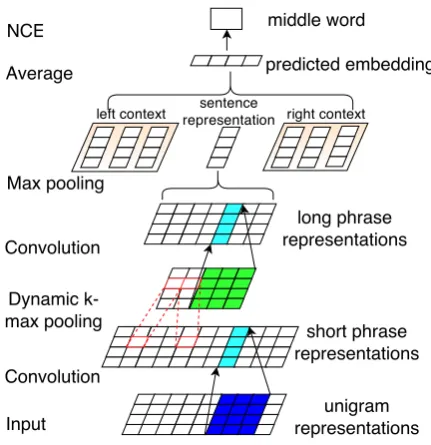
We use convolution-plus-pooling in two differ-ent compondiffer-ents of MultiGranCNN. The first com-ponent, the generalized phrase CNN (gpCNN), will be introduced in Section 4. This component learns representations forgeneralized phrases (g-phrases) where a generalized phrase is a general term for subsequences of all granularities: words, short phrases, long phrases and the sentence itself. The gpCNN architecture hasLlayers of convolu-tion, corresponding (for L = 2) to words, short phrases, long phrases and the sentence. We test different values ofLin our experiments. We train gpCNN on large data in an unsupervised manner and then fine-tune it on labeled training data.
Using a Siamese configuration, two copies of gpCNN, one for each of the two input TEXTCHUNKS, are the input to thematch feature model, presented in Section 5. This model pro-ducess1×s2matching features, one for each pair
of g-phrases in the two chunks, where s1, s2 are
the number of g-phrases in the two chunks, respec-tively.
Thes1×s2match feature matrix is first reduced
to a fixed size by dynamic 2D pooling. The
re-sulting fixed size matrix is then the input to the second convolution-plus-pooling component, the
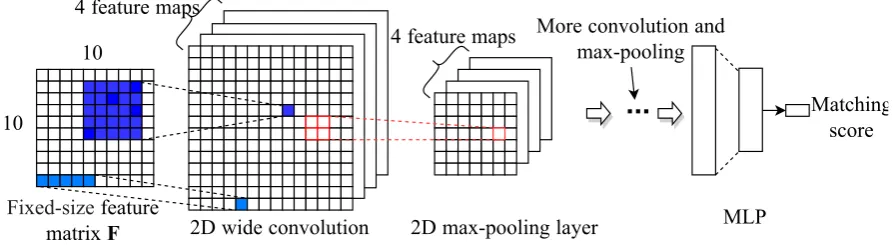
match feature CNN(mfCNN) whose output is fed to a multilayer perceptron (MLP) that produces the final match score. Section 6 will give details.
We use convolution-plus-pooling for both word sequences and match features because we want to compute increasingly abstract features at multiple levels of granularity. To ensure that g-phrases are mutually comparable when computing thes1×s2
[image:3.595.311.527.249.472.2]match feature matrix, we impose the constraint thatall g-phrase representations live in the same space and have the same dimensionality.
Figure 2: gpCNN: learning g-phrase representa-tions. This figure only shows two convolution lay-ers (i.e.,L= 2) for saving space.
4 gpCNN: Learning Representations for g-Phrases
We use several stacked blocks, i.e., convolution-plus-pooling layers, to extract increasingly ab-stract features of the TEXTCHUNK. The input to the first block are the words of the TEXTCHUNK, represented by CW (Collobert and Weston, 2008) embeddings. Given a TEXTCHUNKof length|S|, let vectorci ∈ Rwd be the concatenated
embed-dings of wordsvi−w+1, . . . , viwherew= 5is the
filter width, d = 50is the dimensionality of CW embeddings and0 < i < |S|+w. Embeddings for wordsvi, i < 1 andi > |S|, are set to zero.
We then generate the representation pi ∈ Rd of
matrixWl∈Rd×wd:
pi = tanh(Wlci+bl) (1)
where block indexl = 1, biasbl ∈ Rd. We use
wide convolution (i.e., we apply the convolution matrixWlto wordsvi,i <1andi >|S|) because
this makes sure that each wordvi, 1 ≤ i ≤ |S|,
can be detected by all weights ofWl– as opposed
to only the rightmost (resp. leftmost) weights for initial (resp. final) words in narrow convolution.
The configuration of convolution layers in fol-lowing blocks (l > 1) is exactly the same except that the input vectorsciare not words, but the
out-put of pooling from the previous layer of convo-lution – as we will explain presently. The con-figuration is the same (e.g., allWl ∈Rd×wd)
be-cause, by design, all g-phrase representations have the same dimensionalityd. This also ensures that each g-phrase representation can be directly com-pared with each other g-phrase representation.
We usedynamic k-max poolingto extract thekl
top values from each dimension after convolution in thelth block and thek
Ltop values in the final
block. We set
kl= max(α,dLL−l|S|e) (2)
wherel = 1,· · ·, Lis the block index, andα= 4 is a constant (cf. Kalchbrenner et al. (2014)) that makes sure a reasonable minimum number of val-ues is passed on to the next layer. We setkL = 1
(not 4, cf. Kalchbrenner et al. (2014)) because our design dictates that all g-phrase representations, including the representation of the TEXTCHUNK itself, have the same dimensionality. Example: for L= 4,|S|= 20, theki are[15,10,5,1].
Dynamic k-max pooling keeps the most impor-tant features and allows us to stack multiple blocks to extract hiearchical features: units on consec-utive layers correspond to larger and larger parts of the TEXTCHUNKthanks to the subset selection property of pooling.
For many tasks, labeled data for training gpCNN is limited. We therefore employ unsu-pervised trainingto initialize gpCNN as shown in Figure 2. Similar to CBOW (Mikolov et al., 2013), we predict a sampled middle wordvifrom the
av-erage of seven vectors: the TEXTCHUNK repre-sentation (the final output of gpCNN) and the three words to the left and to the right of vi. We use
[image:4.595.314.525.65.167.2]noise-contrastive estimation (Mnih and Teh, 2012) for training: 10 noise words are sampled for each true example.
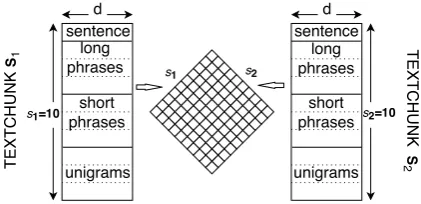
Figure 3: General illustration of match feature model. In this example, bothS1andS2have 10
g-phrases, so the match feature matrixFˆ ∈ Rs1×s2
has size10×10.
5 Match Feature Models
Let g1, . . . , gsk be an enumeration of the sk
g-phrases of TEXTCHUNK Sk. LetSk ∈ Rsk×dbe
the matrix, constructed by concatenating the four matrices of unigram, short phrase, long phrase and sentence representations shown in Figure 2 that contain the learned representations from Section 4 for thesesk g-phrases; i.e., rowSkiis the learned
representation ofgi.
The basic design of a match feature model is that we produce an s1 ×s2 matrix Fˆ for a pair
of TEXTCHUNKS S1 andS2, shown in Figure 3.
ˆ
Fi,j is a score that assesses the relationship
be-tween g-phrase gi of S1 and g-phrase gj of S2 with respect to the TEXTCHUNK relation of in-terest (paraphrasing, clause coherence etc). This scoreFˆi,j is computed based on the vector
repre-sentationsS1iandS2j of the two g-phrases.1
We experiment with three different feature models to compute the match score Fˆi,j because
we would like our architecture to address a wide variety of different TEXTCHUNK relations. We can model a TEXTCHUNKrelation like paraphras-ing as “for each meanparaphras-ing element in one sentence, there must be a similar meaning element in the other sentence”; thus, a good candidate for the match score Fˆi,j is simply vector similarity. In
contrast, similarity is a less promising match score for clause coherence; for clause coherence, we want a score that models how good a continuation one g-phrase is for the other. These considerations motivate us to define three different match feature models that we will introduce now.
The first match feature model is DIRECTSIM.
1In response to a reviewer question, recall thats
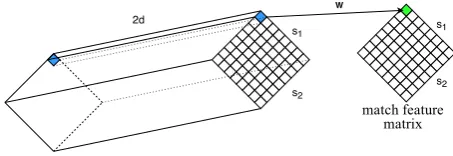
Figure 4: CONCATmatch feature model
This model computes the match score of two g-phrases as their similarity using a radial basis function kernel:
ˆ
Fi,j = exp(−||S1i−S2j||
2
2β ) (3)
where we set β = 2 (cf. Wu et al. (2013)). DIRECTSIM is an appropriate feature model for TEXTCHUNKrelations like paraphrasing because in that case direct similarity features are helpful in assessing meaning equivalence.
The second match feature model is INDIRECT -SIM. Instead of computing the similarity di-rectly as we do for DIRECTSIM, we first trans-form the representation of the g-phrase in one TEXTCHUNKusing a transformation matrixM∈
Rd×d, then compute the match score by inner
product and sigmoid activation: ˆ
Fi,j =σ(S1iMST2j+b), (4)
Our motivation is that for a TEXTCHUNK rela-tion like clause coherence, the two TEXTCHUNKS need not have any direct similarity. However, if we map the representations of TEXTCHUNK S1 into
an appropriate space then we can hope that sim-ilarity between these transformed representations ofS1 and the representations of TEXTCHUNKS2
do yield useful features. We will see that this hope is borne out by our experiments.
The third match feature model isCONCAT. This is a general model that can learn any weighted combination of the values of the two vectors:
ˆ
Fi,j =σ(wTei,j+b) (5)
whereei,j ∈ R2d is the concatenation ofS1i and
S2j. We can learn different combination weights
wto solve different types of TEXTCHUNK match-ing.
We call this match feature model CONCAT be-cause we implement it by concatenating g-phrase vectors to form a tensor as shown in Figure 4.
The match feature models implement multi-granular comparability: they match all units in one TEXTCHUNK with all units in the other TEXTCHUNK. This is necessary because a gen-eral solution to matching must match a low-level unit like “reignite” to a higher-level unit like “fan the flames of” (Figure 1). Unlike (Socher et al., 2011), our model does not rely on parsing; there-fore, it can more exhaustively search the hypoth-esis space of possible matchings: mfCNN covers a wide variety of different, possibly overlapping units, not just those of a single parse tree.
6 Dynamic 2D Pooling
The match feature models generate ans1×s2
ma-trix. Since it has variable size, we apply two dif-ferent dynamic 2D pooling methods, grid-based poolingandphrase-focused pooling, to transform it to a fixed size matrix.
6.1 Grid-based pooling
We need to mapFˆ ∈ Rs1×s2 into a matrix F of
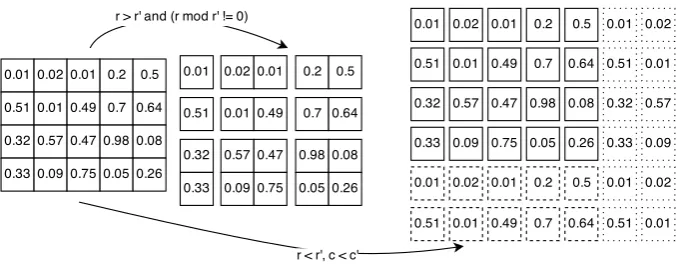
fixed sizes∗ ×s∗ wheres∗ is a parameter. Grid-based pooling divides Fˆ into s∗ × s∗ nonover-lapping(dynamic) poolsand copies the maximum value in each dynamic pool toF. This method is similar to (Socher et al., 2011), but preserves lo-cality better.
ˆ
Fcan be split into equal regions only if boths1
ands2 are divisible bys∗. Otherwise, fors1 > s∗
and if s1mods∗ = b, the dynamic pools in the
first s∗−bsplits each have s1
s∗
rows while the remaining b splits each have s1
s∗
+ 1 rows. In Figure 5, as1 ×s2 = 4×5matrix (left) is split
intos∗×s∗= 3×3dynamic pools (middle): each row is split into [1, 1, 2] and each column is split into [1, 2, 2].
Ifs1< s∗, we first repeat all rows in batch style
with size s1 until no fewer than s∗ rows remain.
Then the first s∗ rows are kept and split into s∗ dynamic pools. The same principle applies to the partitioning of columns. In Figure 5 (right), the ar-eas with dashed lines and dotted lines are repeated parts for rows and columns, respectively; each cell is its own dynamic pool.
6.2 Phrase-focused pooling
In the match feature matrix Fˆ ∈ Rs1×s2, row i
(resp. columnj) contains all feature values for g-phrasegi ofS1 (resp.gj ofS2). Phrase-focused
Figure 5: Partition methods in grid-based pooling. Original matrix with size4×5is mapped into matrix with size3×3and matrix with size6×7, respectively. Each dynamic pool is distinguished by a border of empty white space around it.
for a g-phrasegon the assumption that they are the best basis for assessing the relation ofgwith other g-phrases. To implement this, we sort the values of each rowi(resp. each columnj) in decreasing order giving us a matrixFˆr ∈Rs1×s2 with sorted
rows (resp. Fˆc ∈ Rs1×s2 with sorted columns).
Then we concatenate the columns ofFˆr(resp. the
rows ofFˆc) resulting in listFr ={f1r, . . . , fsr1s2}
(resp.Fc={f1c, . . . , fsc1s2}) where eachfr(fc) is
an element ofFˆr(Fˆc). These two lists are merged
into a listFby interleaving them so that members fromFrandFcalternate. F is then used to fill the
rows ofFfrom top to bottom with each row being filled from left to right.2
7 mfCNN: Match feature CNN
The output of dynamic 2D pooling is further pro-cessed by the match feature CNN (mfCNN) as de-picted in Figure 6. mfCNN extracts increasingly abstract interaction features from lower-level in-teraction features, using several layers of 2D wide convolution and fixed-size 2D pooling.
We call the combination of a 2D wide convo-lution layer and a fixed-size 2D pooling layer a
block, denoted by index b(b = 1,2. . .). In gen-eral, let tensor Tb ∈ Rcb×sb×sb denote the
fea-ture maps in blockb; blockbhascb feature maps,
each of sizesb×sb (T1 = F ∈ R1×s∗×s∗). Let
Wb ∈Rcb+1×cb×fb×fb be the filter weights of 2D
wide convolution in blockb,fb×fbis then the size
of sliding convolution regions. Then the convolu-tion is performed as element-wise multiplicaconvolu-tion
2IfFˆ has fewer cells thanF, then we simply repeat the
filling procedure to fill all cells.
betweenWb andTb as follows:
ˆ
Tb+1
m,i−1,j−1=σ(
X
Wb
m,:,:,:Tb:,i−fb:i,j−fb:j+bbm)
(6) where0≤m<cb+1,1≤i, j < sb+fb,bb ∈Rcb+1.
Subsequently, fixed-size 2D pooling selects dominant features fromkb ×kb non-overlapping
windows of Tˆb+1 to form a tensor as input of
blockb+ 1:
Tbm,i,j+1 = max( ˆTbm,ik+1b:(i+1)kb,jkb:(j+1)kb) (7)
where0≤i, j <bsb+fb−1
kb c.
Hu et al. (2014) used narrow convolution which would limit the number of blocks. 2D wide convo-lution in this work enables to stack multiple blocks of convolution and pooling to extract higher-level interaction features. We will study the influence of the number of blocks on performance below.
For the experiments, we set s∗ = 40, c
b =
50, fb= 5, kb= 2(b= 1,2,· · ·).
8 MultiGranCNN
We can now describe the overall architecture of MultiGranCNN. First, using a Siamese configu-ration, two copies of gpCNN, one for each of the two input TEXTCHUNKS, produce g-phrase representations on different levels of abstraction (Figure 2). Then one of the three match feature models (DIRECTSIM, CONCATor INDIRECTSIM) produces an s1 ×s2 match feature matrix, each
Figure 6: mfCNN & MLP for matching score learning.s∗= 10,fb = 5,kb= 2,cb = 4in this example.
increasing complexity from the basic interaction features computed by the match feature model. Fi-nally, the output of the last block of mfCNN is the input to an MLP that computes the match score.
MultiGranCNN bears resemblance to previous work on clause and sentence matching (e.g., Hu et al. (2014), Socher et al. (2011)), but it is more general and more flexible. It learns representa-tions of g-phrases, i.e., representarepresenta-tions of parts of the TEXTCHUNKat multiple granularities, not just for a single level such as the sentence as ARC-I does (Hu et al., 2014). MultiGranCNN explores the space of interactions between the two chunks more exhaustively by considering interactions be-tween every unit in one chunk with every other unit in the other chunk, at all levels of granular-ity. Finally, MultiGranCNN supports a number of different match feature models; the corresponding module can be instantiated in a way that ensures that match features are best suited to support ac-curate decisions on the TEXTCHUNKrelation task that needs to be addressed.
9 Experimental Setup and Results
9.1 Training
Suppose the triple (x,y+,y−) is given and x matches y+ better thany−. Then our objective is the minimization of the following ranking loss: l(x,y+,y−) = max(0,1 +s(x,y−)−s(x,y+))
where s(x,y) is the predicted match score for (x,y). We use stochastic gradient descent with Adagrad (Duchi et al., 2011), L2 regularization
and minibatch training.
We set initial learning rate to 0.05, batch size to 70,L2weight to5·10−4.
Recall that we employ unsupervised pretraining of representations for g-phrases. We can either
freeze these representations in subsequent super-vised training; or we canfine-tunethem. We study the performance of both regimes.
9.2 Clause Coherence Task
As introduced by Hu et al. (2014), the clause coherence task determines for a pair (x,y) of clauses if the sentence “xy” is a coherent sen-tence. We construct a clause coherence dataset as follows (the set used by Hu et al. (2014) is not yet available). We consider all sentences from En-glish Gigaword (Parker et al., 2009) that consist of two comma-separated clausesxandy, with each clause having between five and 30 words. For each
y, we choose four clauses y0 . . .y0000 randomly from the 1000 second clauses that have the highest similarity toy, where similarity is cosine similar-ity of TF-IDF vectors of the clauses; restricting the alternatives to similar clauses ensures that the task is hard. The clause coherence task then is to selectyfrom the sety,y0, . . . ,y0000 as the correct continuation ofx. We create 21 million examples, each consisting of a first clausexand five second clauses. This set is divided into a training set of 19 million and development and test sets of one million each. An example from the training set is given in Figure 1.
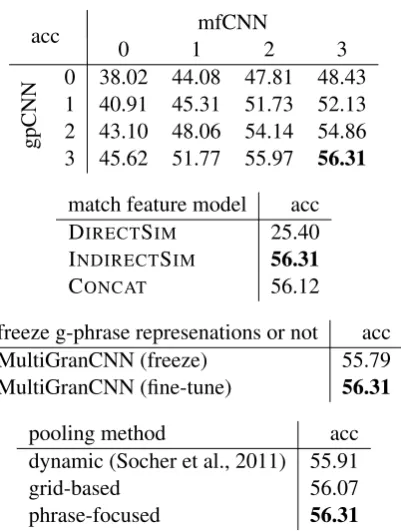
Then, we study the performance variance of different MultiGranCNN setups from three per-spectives: a) layers of CNN in both unsuper-vised (gpCNN) and superunsuper-vised (mfCNN) training phases; b) different approaches for clause relation feature modeling; c) dynamic pooling methods for generating same-sized feature matrices.
pooling. This suggests that multiple layers of con-volution succeed in extracting high-level features that are beneficial for clause coherence.
Figure 7 (2nd table) shows that INDIRECTSIM and CONCAT have comparable performance and both outperform DIRECTSIM. DIRECTSIMis ex-pected to perform poorly because the contents in the two clauses usually have little or no overlap-ping meaning. In contrast, we can imagine that INDIRECTSIM first transforms the first clause x into a counterpart and then matches this counter-part with the second clausey. In CONCAT, each ofs1×s2 pairs of g-phrases is concatentated and
supervised training can then learn an unrestricted function to assess the importance of this pair for clause coherence (cf. Eq. 5). Again, this is clearly a more promising TEXTCHUNKrelation model for clause coherence than one that relies on DIRECT -SIM.
acc 0 1mfCNN2 3
gpCNN
0 38.02 44.08 47.81 48.43 1 40.91 45.31 51.73 52.13 2 43.10 48.06 54.14 54.86
3 45.62 51.77 55.97 56.31
match feature model acc
DIRECTSIM 25.40
INDIRECTSIM 56.31
CONCAT 56.12
freeze g-phrase represenations or not acc
MultiGranCNN (freeze) 55.79
MultiGranCNN (fine-tune) 56.31
pooling method acc
dynamic (Socher et al., 2011) 55.91
grid-based 56.07
[image:8.595.84.285.327.593.2]phrase-focused 56.31
Figure 7: Effect on dev acc (clause coherence) of different factors: # convolution blocks, match fea-ture model, freeze vs. fine-tune, pooling method.
Figure 7 (3rd table) demonstrates that fine-tuning g-phrase representations gives better per-formance than freezing them. Also, grid-based and phrase-focused pooling outperform dynamic pooling (Socher et al., 2011) (4th table). Phrase-focused pooling performs best.
Table 1 compares MultiGranCNN to ARC-I and ARC-II, the architectures proposed by Hu et al.
(2014). We also test the five baseline systems from their paper: DeepMatch, WordEmbed, SEN-MLP, SENNA+SEN-MLP, URAE+MLP. For Multi-GranCNN, we use the best dev set settings: num-ber of convolution layers in gpCNN and mfCNN is 3; INDIRECTSIM; phrase-focused pooling. Ta-ble 1 shows that MultiGranCNN outperforms all other approaches on clause coherence test set.
9.3 Paraphrase Identification Task
We evaluate paraphrase identification (PI) on the PAN corpus (http://bit.ly/mt-para, (Madnani et al., 2012)), consisting of training and test sets of 10,000 and 3000 sentence pairs, respectively. Sen-tences are about 40 words long on average.
Since PI is a binary classification task, we re-place the MLP with a logistic regression layer. As phrase-focused pooling was proven to be optimal, we directly use phrase-focused pooling in PI task without comparison, assuming that the choice of dynamic pooling is task independent.
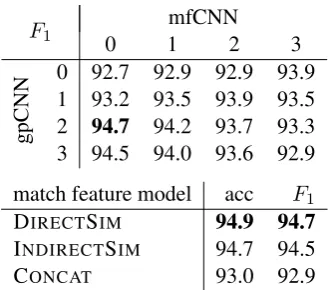
For parameter selection, we split the PAN train-ing set into a core traintrain-ing set (core) of size 9000 and a development set (dev) of size 1000. We then train models on core and select parameters based on best performance on dev. The best re-sults on dev are obtained for the following param-eters: freezing g-phrase representations, DIRECT -SIM, two convolution layers in gpCNN, no convo-lution layers in mfCNN. We use these parameter settings to train a model on the entire training set and report performance in Table 2.
We compare MultiGranCNN to ARC-I/II (Hu et al., 2014), and two previous papers reporting performance on PAN. Madnani et al. (2012) used a combination of threebasic MT metrics(BLEU, NIST and TER) and five complex MT met-rics (TERp, METEOR, BADGER, MAXISIM,
model acc
Random Guess 20.00
DeepMatch 34.17
WordEmbed 38.28
SENMLP 34.57
SENNA+MLP 42.09
URAE+MLP 27.41
ARC-I 45.04
ARC-II 50.18
MultiGranCNN 56.27
[image:8.595.359.475.608.744.2]SEPIA), computed on entire sentences. Bach et al. (2014) applied MT metrics to elementary dis-course units. We integrate these eight MT metrics from prior work.
method acc F1
ARC-I 61.4 60.3
ARC-II 64.9 63.5
basic MT metrics 88.6 87.8
+ TERp 91.5 91.2
+ METEOR 92.0 91.8
+ Others 92.3 92.1
(Bach et al., 2014) 93.4 93.3
[image:9.595.81.283.129.266.2]8MT+MultiGranCNN (fine-tune) 94.1 94.0 8MT+MultiGranCNN (freeze) 94.9 94.7
Table 2: Results on PAN. “8MT” = 8 MT metrics
[image:9.595.334.500.584.729.2]Table 2 shows that MultiGranCNN in combina-tion with MT metrics obtains state-of-the-art per-formance on PAN. Freezing weights learned in unsupervised training (Figure 2) performs better thanfine-tuningthem; also, Table 3 shows that the best result is achieved if no convolution is used in mfCNN. Thus, the best configuration for para-phrase identification is to “forward” fixed-size in-teraction matrices as input to the logistic regres-sion, without any intermediate convolution layers. Freezing weights learned in unsupervised train-ing and no convolution layers in mfCNN both pro-tect against overfitting. Complex deep neural net-works are in particular danger of overfitting when training sets are small as in the case of PAN (cf. Hu et al. (2014)). In contrast, fine-tuning weights and several convolution layers were the optimal setup for clause coherence. For clause coherence, we have a much larger training set and therefore can successfully train a much larger number of param-eters.
Table 3 shows that CONCATperforms badly for PI while DIRECTSIMand INDIRECTSIMperform well. We can conceptualize PI as the task of deter-mining if each meaning element inS1 has a
simi-lar meaning element inS2. Thes1×s2 DIRECT
-SIM feature model directly models this task and thes1×s2INDIRECTSIMfeature model also
mod-els it, but learning a transformation of g-phrase representations before applying similarity. In con-trast, CONCAT can learn arbitrary relations be-tween parts of the two sentences, a model that seems to be too unconstrained for PI if insufficient training resources are available.
In contrast, for the clause coherence task, con-catentation worked well and DIRECTSIMworked poorly and we provided an explanation based on the specific properties of clause coherence (see discussion of Figure 7). We conclude from these results that it is dependent on the task what the best feature model is for matching two linguistic ob-jects. Interestingly, INDIRECTSIM performs well on both tasks. This suggests that INDIRECTSIMis a general feature model for matching, applicable to tasks with very different properties.
10 Conclusion
In this paper, we present MultiGranCNN, a gen-eral deep learning architecture for classifying the relation between two TEXTCHUNKS. Multi-GranCNN supports multigranular comparabil-ity of representations: shorter sequences in one TEXTCHUNKcan be directly compared to longer sequences in the other TEXTCHUNK. Multi-GranCNN also contains a flexible and modu-larized match feature component that is eas-ily adaptable to different TEXTCHUNK relations. We demonstrated state-of-the-art performance of MultiGranCNN on paraphrase identification and clause coherence tasks.
Acknowledgments
Thanks to CIS members and anonymous re-viewers for constructive comments. This work was supported by Baidu (through a Baidu scholarship awarded to Wenpeng Yin) and by Deutsche Forschungsgemeinschaft (grant DFG SCHU 2246/8-2, SPP 1335).
F1 0 1mfCNN2 3
gpCNN
0 92.7 92.9 92.9 93.9 1 93.2 93.5 93.9 93.5
2 94.7 94.2 93.7 93.3
3 94.5 94.0 93.6 92.9 match feature model acc F1
DIRECTSIM 94.9 94.7
INDIRECTSIM 94.7 94.5
CONCAT 93.0 92.9
Table 3: Effect on devF1(PI) of different factors:
References
Ngo Xuan Bach, Nguyen Le Minh, and Akira Shi-mazu. 2014. Exploiting discourse information to identify paraphrases. Expert Systems with Applica-tions, 41(6):2832–2841.
William Blacoe and Mirella Lapata. 2012. A com-parison of vector-based representations for semantic composition. InProceedings of the 2012 Joint Con-ference on Empirical Methods in Natural Language Processing and Computational Natural Language Learning, pages 546–556. Association for Compu-tational Linguistics.
David M Blei, Andrew Y Ng, and Michael I Jordan. 2003. Latent dirichlet allocation. the Journal of ma-chine Learning research, 3:993–1022.
Antoine Bordes, Sumit Chopra, and Jason Weston. 2014a. Question answering with subgraph embed-dings. Proceedings of the 2014 Conference on Em-pirical Methods in Natural Language Processing. Antoine Bordes, Xavier Glorot, Jason Weston, and
Yoshua Bengio. 2014b. A semantic matching en-ergy function for learning with multi-relational data. Machine Learning, 94(2):233–259.
Antoine Bordes, Jason Weston, and Nicolas Usunier. 2014c. Open question answering with weakly su-pervised embedding models. Proceedings of 2014 European Conference on Machine Learning and Principles and Practice of Knowledge Discovery in Databases.
Sumit Chopra, Raia Hadsell, and Yann LeCun. 2005. Learning a similarity metric discriminatively, with application to face verification. InComputer Vision and Pattern Recognition, 2005. CVPR 2005. IEEE Computer Society Conference on, volume 1, pages 539–546. IEEE.
Ronan Collobert and Jason Weston. 2008. A unified architecture for natural language processing: Deep neural networks with multitask learning. In Pro-ceedings of the 25th international conference on Machine learning, pages 160–167. ACM.
John Duchi, Elad Hazan, and Yoram Singer. 2011. Adaptive subgradient methods for online learning and stochastic optimization. The Journal of Ma-chine Learning Research, 12:2121–2159.
Jianfeng Gao, Patrick Pantel, Michael Gamon, Xi-aodong He, Li Deng, and Yelong Shen. 2014. Mod-eling interestingness with deep neural networks. In Proceedings of the 2014 Conference on Empirical Methods in Natural Language Processing.
Baotian Hu, Zhengdong Lu, Hang Li, and Qingcai Chen. 2014. Convolutional neural network archi-tectures for matching natural language sentences. InAdvances in Neural Information Processing Sys-tems, pages 2042–2050.
Mohit Iyyer, Jordan Boyd-Graber, Leonardo Claudino, Richard Socher, and Hal Daum´e III. 2014. A neural network for factoid question answering over para-graphs. InProceedings of the 2014 Conference on Empirical Methods in Natural Language Process-ing, pages 633–644.
Yangfeng Ji and Jacob Eisenstein. 2013. Discrimi-native improvements to distributional sentence sim-ilarity. InProceedings of the 2013 Conference on Empirical Methods in Natural Language Process-ing, pages 891–896.
Nal Kalchbrenner, Edward Grefenstette, and Phil Blun-som. 2014. A convolutional neural network for modelling sentences. In Proceedings of the 52nd Annual Meeting of the Association for Computa-tional Linguistics. Association for ComputaComputa-tional Linguistics.
Quoc V Le and Tomas Mikolov. 2014. Distributed rep-resentations of sentences and documents. Proceed-ings of The 31st International Conference on Ma-chine Learning, pages 1188–1196.
Hang Li and Jun Xu. 2012. Beyond bag-of-words: machine learning for query-document matching in web search. InProceedings of the 35th international ACM SIGIR conference on Research and develop-ment in information retrieval, pages 1177–1177. ACM.
Xutao Li, Michael K Ng, and Yunming Ye. 2012. Har: Hub, authority and relevance scores in multi-relational data for query search. InProceedings of the 12th SIAM International Conference on Data Mining, pages 141–152. SIAM.
Chen Liu. 2013. Probabilistic Siamese Network for Learning Representations. Ph.D. thesis, University of Toronto.
Zhengdong Lu and Hang Li. 2013. A deep architec-ture for matching short texts. InAdvances in Neural Information Processing Systems, pages 1367–1375. Nitin Madnani, Joel Tetreault, and Martin Chodorow.
2012. Re-examining machine translation metrics for paraphrase identification. InProceedings of the 2012 Conference of the North American Chapter of the Association for Computational Linguistics: Hu-man Language Technologies, pages 182–190. Asso-ciation for Computational Linguistics.
Tomas Mikolov, Ilya Sutskever, Kai Chen, Greg S Cor-rado, and Jeff Dean. 2013. Distributed representa-tions of words and phrases and their compositional-ity. InAdvances in Neural Information Processing Systems, pages 3111–3119.
Robert Parker, Linguistic Data Consortium, et al. 2009. English gigaword fourth edition. Linguistic Data Consortium.
Long Qiu, Min-Yen Kan, and Tat-Seng Chua. 2006. Paraphrase recognition via dissimilarity significance classification. InProceedings of the 2006 Confer-ence on Empirical Methods in Natural Language Processing, pages 18–26. Association for Compu-tational Linguistics.
Richard Socher, Eric H Huang, Jeffrey Pennin, Christo-pher D Manning, and Andrew Y Ng. 2011. Dy-namic pooling and unfolding recursive autoencoders for paraphrase detection. InAdvances in Neural In-formation Processing Systems, pages 801–809. Pengcheng Wu, Steven CH Hoi, Hao Xia, Peilin Zhao,
Dayong Wang, and Chunyan Miao. 2013. Online multimodal deep similarity learning with application to image retrieval. InProceedings of the 21st ACM international conference on Multimedia, pages 153– 162. ACM.
Min-Chul Yang, Nan Duan, Ming Zhou, and Hae-Chang Rim. 2014. Joint relational embeddings for knowledge-based question answering. In Proceed-ings of the 2014 Conference on Empirical Methods in Natural Language Processing, pages 645–650. Lei Yu, Karl Moritz Hermann, Phil Blunsom, and