Perceptually grounded selectional preferences
Ekaterina Shutova Computer Laboratory University of Cambridge, UK
Niket Tandon Max Planck Institute for Informatics, Germany [email protected]
Gerard de Melo IIIS
Tsinghua University, China [email protected]
Abstract
Selectional preferences (SPs) are widely used in NLP as a rich source of semantic information. While SPs have been tradi-tionally induced from textual data, human lexical acquisition is known to rely on both linguistic and perceptual experience. We present the first SP learning method that si-multaneously draws knowledge from text, images and videos, using image and video descriptions to obtain visual features. Our results show that it outperforms linguistic and visual models in isolation, as well as the existing SP induction approaches.
1 Introduction
Selectional preferences (SPs) are the semantic con-straints that a predicate places onto its arguments. This means that certain classes of entities are more likely to fill the predicate’s argument slot than oth-ers. For instance, while the sentences “The au-thors wrote a new paper.” and “The cat is eating your sausage!” sound natural and describe plausi-ble real-life situations, the sentences “The carrot ate the keys.” and “The law sang a driveway.” ap-pear implausible and difficult to interpret, as the arguments do not satisfy the verbs’ common pref-erences. SPs provide generalisations about word meaning and use and find a wide range of appli-cations in natural language processing (NLP), in-cluding word sense disambiguation (Resnik, 1997; McCarthy and Carroll, 2003; Wagner et al., 2009), resolving ambiguous syntactic attachments (Hindle and Rooth, 1993), semantic role labelling (Gildea and Jurafsky, 2002; Zapirain et al., 2010), natural language inference (Zanzotto et al., 2006; Pantel et al., 2007), and figurative language processing
(Fass, 1991; Mason, 2004; Shutova et al., 2013; Li et al., 2013). Automatic acquisition of SPs from linguistic data has thus become an active area of research. The community has investigated a range of techniques to tackle data sparsity and to per-form generalisation from observed arguments to their underlying types, including the use of Word-Net synsets as SP classes (Resnik, 1993; Li and Abe, 1998; Clark and Weir, 1999; Abney and Light, 1999; Ciaramita and Johnson, 2000), word cluster-ing (Rooth et al., 1999; Bergsma et al., 2008; Sun and Korhonen, 2009), distributional similarity met-rics (Erk, 2007; Peirsman and Pad´o, 2010), latent variable models ( ´O S´eaghdha, 2010; Ritter et al., 2010), and neural networks (Van de Cruys, 2014).
Little research, however, has been concerned with the sources of knowledge that underlie the learning of SPs. There is ample evidence in cogni-tive and neurolinguistics that our concept learning and semantic representation are grounded in per-ception and action (Barsalou, 1999; Glenberg and Kaschak, 2002; Barsalou, 2008; Aziz-Zadeh and Damasio, 2008). This suggests that word mean-ing and relational knowledge are acquired not only from linguistic input but also from our experiences in the physical world. Multi-modal models of word meaning have thus enjoyed a growing interest in se-mantics (Bruni et al., 2014), outperforming purely text-based models in tasks such as similarity es-timation (Bruni et al., 2014; Kiela et al., 2014), predicting compositionality (Roller and Schulte im Walde, 2013), and concept categorization (Sil-berer and Lapata, 2014). However, to date these approaches relied on low-level image features such as color histograms or SIFT keypoints to repre-sent the meaning of isolated words. To the best of our knowledge, there has not yet been a multi-modal semantic approach performing extraction of
predicate-argument relations from visual data. In this paper, we propose the first SP model integrat-ing information about predicate-argument interac-tions from text, images, and videos. We expect it to outperform purely text-based models of SPs, which suffer from two problems: topic bias and figurative uses of words. Such bias stems from the fact that we typically write about abstract topics and events, resulting in high coverage of abstract senses of words and comparatively lower coverage of the original physical senses (Shutova, 2011). For instance, the verbcutis used predominantly in the domains of economics and finance and its most fre-quent direct objects arecostandprice, according to the British National Corpus (BNC) (Burnard, 2007). Predicate-argument distributions acquired from text thus tend to be skewed in favour of ab-stract domains and figurative uses, inadequately reflecting our daily experiences withcutting, which guide human acquisition of meaning. Integrating predicate-argument relations observed in the physi-cal world (in the form of image and video descrip-tions) with the more abstract text-based relations is likely to yield a more realistic semantic model, with real prospects of improving the performance of NLP applications that rely on SPs.
We use the BNC as an approximation of linguis-tic knowledge and a large collection of tagged im-ages and videos from Flickr (www.flickr.com) as an approximation of perceptual knowledge. The human-annotated labels that accompany media on Flickr enable us to acquire predicate-argument co-occurrence information. Our experiments focus on verb preferences for their subjects and direct ob-jects. In summary, our method (1) performs word sense disambiguation and part-of-speech (PoS) tag-ging of Flickr tag sequences to extract verb-noun co-occurrence; (2) clusters nouns to induce SP classes using linguistic and visual features; (3) quantifies the strength of preference of a verb for a given class by interpolating linguistic and visual SP distributions. We investigate the impact of per-ceptual information at different levels – from none (purely text-based model) to 100% (purely visual model). We evaluate our model directly against a dataset of human plausibility judgements of verb-noun pairs, as well as in the context of a semantic task: metaphor interpretation. Our results show that the interpolated model combining linguistic and visual relations outperforms the purely linguis-tic model in both evaluation settings.
2 Related work
2.1 Selectional preference induction
The widespread interest in automatic acquisition of SPs was triggered by the work of Resnik (1993), who treated SPs as probability distributions over all potential arguments of a predicate, rather than a sin-gle argument class assigned to the predicate. The original study used WordNet to define SP classes and to map the words in the corpus to those classes. Since then, the field has moved toward automatic induction of SP classes from corpus data. Rooth et al. (1999) presented a probabilistic latent variable model of verb preferences. In their approach, verb-argument pairs are generated from a latent variable, which represents a cluster of verb-argument inter-actions. The latent variable distribution and the probabilities that a latent variable generates the verb and the argument are learned from the data using Expectation Maximization (EM). The latent variables enable the model to recognise previously unseen verb-argument pairs. ´O S´eaghdha (2010) and Ritter et al. (2010) similarly model SPs within a latent variable framework, but use Latent Dirichlet Allocation (LDA) to learn the probability distri-butions, for single-argument and multi-argument preferences respectively.
Pad´o et al. (2007) and Erk (2007) used simi-larity metrics to approximate selectional prefer-ence classes. Their underlying hypothesis is that a predicate-argument combination(p, a)is felici-tous if the predicatepis frequently observed in the data with the argumentsa0 similar toa. The sys-tems compute similarities between distributional representations of arguments in a vector space.
fea-tures to lexical preference learning. However, our work casts the problem in a different framework: rather than relying on low-level visual properties of nouns in isolation, we explicitly model interactions of predicates and arguments within an image or a video frame.
Van de Cruys (2014) recently presented a deep learning approach to SP acquisition. He trained a neural network to discriminate between felic-itous and infelicfelic-itous arguments using the data constructed of positive (observed) and negative (randomly-generated) examples for training. The network weights were optimized by requiring the model to assign a higher score to an observed pair than to the unobserved one by a given margin.
2.2 Multi-modal methods in semantics
Previous work has used multimodal data to de-termine distributional similarity or to learn multi-modal embeddings that project multiple multi-modalities into the same vector space. Some studies rely on extensions of LDA to obtain correlations between words and visual features (Feng and Lapata, 2010; Roller and Schulte im Walde, 2013). Bruni et al. (2012) integrated visual features into distributional similarity models using simple vector concatena-tion. Instead of generic visual features, Silberer et al. (2013) relied on supervised learning to train 412 higher-level visual attribute classifiers.
Applications of multimodal embeddings include zero-shot object detection, i.e. recognizing objects in images without training data for the object class (Socher et al., 2013; Frome et al., 2013; Lazaridou et al., 2014), and automatic generation of image captions (Kulkarni et al., 2013), video descriptions (Rohrbach et al., 2013), or tags (Srivastava et al., 2014). Other applications of multimodal data in-clude language modeling (Kiros et al., 2014) and knowledge mining from images (Chen et al., 2013; Divvala et al., 2014). Young et al. (2014) apply sim-plification rules to image captions, showing that the resulting hierarchy of mappings between natural language expressions and images can be used for entailment tasks.
3 Experimental data
Textual data. We extract linguistic features for our model from the BNC. In particular, we parse the corpus using the RASP parser (Briscoe et al., 2006) and extract subject–verb and verb–object re-lations from its dependency output. These rere-lations
are then used as features for clustering to obtain SP classes, as well as to quantify the strength of asso-ciation between a particular verb and a particular argument class.
Visual data. For the visual features of our model, we mine the Yahoo! Webscope Flickr-100M dataset (Shamma, 2014). Flickr-100M contains 99.3 mil-lion images and 0.7 milmil-lion videos with language tags annotated by users, enabling us to generalise SPs at a large scale. The tags reflect how humans describe objects and actions from a visual perspec-tive. We first stem the tags and remove words that are absent in WordNet (typically named entities and misspellings), then identify their PoS based on their visual context and extract verb–noun co-occurrences.
4 Identifying visual verb-noun co-occurrence
In the Flickr-100M dataset, tags are assigned to im-ages and videos in the form of sets of words, rather than grammatically coherent sentences. However, the roles that individual words play are still dis-cernible from their visual context, as manifested by the other words in a given set. In order to identify verbs and nouns co-occurring in the same images, we propose alist sense disambiguationmethod that first maps each word to a set of possible WordNet senses (accompanied by PoS information) and then performs a joint optimization on the space of candi-date word senses, such that their overall similarity is maximized. This amounts to assigning those senses and PoS tags to the words in the set that best fit together.
For a given wordiand one of its candidate Word-Net sensesj, we consider an assignment variable xij and compute a sense frequency-based prior for
it as Pij = 1+1R, where R is the WordNet rank
of the sense. We then compute a similarity score Sij,i0j0 between all pairs of sense choices for two
rel-evant sense pairs, we maximize the coherence of the senses of the words in the set as an Integer Lin-ear Program, using the Gurobi Optimizer (Gurobi Optimization, 2014) and solving
maximizeP
i Pijxij+
P
ij
P
i0j0Sij,i0j0Bij,i0j0
subject toP
jxij ≤1∀i, xij ∈ {0,1} ∀i, j,
Bij,i0j0 ≤xij, Bij,i0j0 ≤xi0j0,
Bij,i0j0 ∈ {0,1} ∀i, j, i0j0.
The binary variablesBij,i0j0 are1iffxij = 1and
xi0j0 = 1, indicating that both senses were
simulta-neously chosen. The optimizer disambiguates the input words by selecting sense tuplesx1j,x2j, . . . ,
from which we can directly obtain the correspond-ing PoS information. Verb-noun co-occurrence information is then extracted from the PoS-tagged sets.
5 Selectional preference model
5.1 Acquisition of argument classes
To address the issue of data sparsity, we generalise selectional preferences over argument classes, as opposed to individual arguments. We obtain SP classes by means of spectral clustering of nouns with lexico-syntactic features, which has been shown effective in previous lexical classification tasks (Brew and Schulte im Walde, 2002; Sun and Korhonen, 2009).
Spectral clustering partitions the data, relying on a similarity matrix that records similarities between all pairs of data points. We useJensen-Shannon divergenceto measure the similarity between fea-ture vectors for two nouns,wiandwj, defined as
follows:
dJS(wi, wj) = 12dKL(wi||m) +12dKL(wj||m),
(1) wheredKLis the Kullback-Leibler divergence, and
mis the average ofwi andwj. We construct the
similarity matrixS computing similaritiesSij as
Sij = exp(−dJS(wi, wj)). The matrixS then
en-codes a similarity graphG(over our nouns), where Sij are the adjacency weights. The clustering
prob-lem can then be defined as identifying the optimal partition, or cut, of the graph into clusters, such that the intra-cluster weights are high and the inter-cluster weights are low. We use the multiway nor-malized cut (MNCut) algorithm of Meila and Shi (2001) for this purpose. The algorithm transforms
Sinto a stochastic matrixP containing transition probabilities between the vertices in the graph as
P =D−1S, (2)
where the degree matrix D is a diagonal matrix with Dii = PNj=1Sij. It then computes the K
leading eigenvectors ofP, whereKis the desired number of clusters. The graph is partitioned by finding approximately equal elements in the eigen-vectors using a simpler clustering algorithm, such ask-means. Meila and Shi (2001) have shown that the partitionI derived in this way minimizes the MNCut criterion:
MNCut(I) =XK k=1
(1−P(Ik →Ik|Ik)), (3)
which is the sum of transition probabilities across different clusters. Since k-means starts from a ran-dom cluster assignment, we run the algorithm mul-tiple times and select the partition that minimizes the cluster distortion, i.e. distances to cluster cen-troid.
We cluster nouns using linguistic and visual fea-tures in two independent experiments.
Clustering with linguistic features:We first clter the 2,000 most frequent nouns in the BNC, us-ing their grammatical relations as features. The features consist of verb lemmas appearing in the subject, direct object and indirect object relations with the given nouns in the RASP-parsed BNC, indexed by relation type. The feature vectors are first constructed from the corpus counts, and sub-sequently normalized by the sum of the feature values.
Clustering with visual features: We also clus-ter the 2,000 most frequent nouns in the Flickr data. Since our goal is to create argument classes for verb preferences, we extract co-occurrence fea-tures that map to verb-noun relations from PoS-disambiguated image tags. We use the verb lem-mas co-occurring with the noun in the same images and videos as features for clustering. The feature values are again normalised by their sum.
desire hostility anxiety passion doubt fear curiosity enthusi-asm impulse instinct emotion feeling suspicion
official officer inspector journalist detective constable police policeman reporter
book statement account draft guide advertisement document report article letter
Figure 1: Clusters obtained using linguistic fea-tures
pilot aircraft plane airline landing flight wing arrival departure airport
concert festival music guitar alternative band instrument audi-ence event performance rock benjamin
cost benefit crisis debt credit customer consumer
Figure 2: Clusters obtained using visual features predicate-argument structure. In addition, the im-age features tend to be sparse for abstract concepts, reducing both the quality and the coverage of ab-stract clusters. We thus use the noun clusters de-rived with linguistic features as an approximation of SP classes.
5.2 Quantifying selectional preferences
Once the SP classes have been obtained, we need to quantify the strength of association of a given verb with each of the classes. We adopt an informa-tion theoretic measure proposed by Resnik (1993) for this purpose. Resnik first measuresselectional preference strength (SPS) of a verb in terms of Kullback-Leibler divergence between the distribu-tion of noun classes occurring as arguments of this verb,p(c|v), and the prior distribution of the noun classes,p(c).
SPSR(v) =
X
c
p(c|v) logpp(c(c|v)), (4)
whereRis the grammatical relation for which SPs are computed. SPS measures how strongly the predicate constrains its arguments. Selectional as-sociation of the verb with a particular argument class is then defined as a relative contribution of that argument class to the overall SPS of the verb.
AssR(v, c) = SPS1
R(v)p(c|v) log
p(c|v)
p(c) (5)
We use this measure to quantify verb SPs based on linguistic and visual co-occurrence information. We first extract verb-subject and verb-direct object relations from the RASP-parsed BNC, map the ar-gument heads to SP classes and quantify selectional association of a given verb with each SP class, thus acquiring itsbasepreferences. Since visual verb-noun co-occurrences do not contain information
about grammatical relations, we rely on linguistic data to provide a set of base arguments of the verb for a given grammatical relation. We then interpo-late the verb-argument probabilities from linguistic and visual models for the base arguments of the verb, thus preserving information about grammati-cal relations.
5.3 Linguistic and visual model interpolation
We investigate two model interpolation techniques: simple linear interpolation and predicate-driven lin-ear interpolation.
Linear interpolationcombines information from component models by computing a weighted aver-age of their probabilities. The interpolated probabil-ity of an eventeis derived aspLI(e) =P
iλipi(e),
wherepi(e)is the probability ofein the modeli
andλiis the interpolation weight defined such that
P
iλi= 1; andλi ∈[0,1]. In our experiments, we
interpolate the probabilitiesp(c)andp(c|v)in the linguistic (LM) and visual (VM) models, as follows:
pLI(c) =λLMpLM(c) +λVMpVM(c) (6)
pLI(c|v) =λLMpLM(c|v) +λVMpVM(c|v) (7)
We experiment with a number of parameter settings forλLMandλVM.
Predicate-driven linear interpolation derives predicate-specific interpolation weights directly from the data, as opposed to pre-setting them uni-versally for all verbs. For each predicatev, we com-pute the interpolation weights based on its promi-nence in the respective corpus, as follows:
λi(v) = Preli(v)
krelk(v), (8)
whererelis the relevance function of modelifor verbv, computed as its relative frequency in the respective corpus: reli(v) = Pfi(v)
Vfi(v). The
interpo-lation weights forLMandVMare then computed as
λLM(v) = relLM(relv) +LM(relv)VM(v) (9)
λVM(v) = relLM(relv) +VM(relv)VM(v). (10)
represented in text. Relative linguistic and visual frequencies of a verb provide a way to estimate the relevance of linguistic and visual features to its SP learning.
6 Direct evaluation and data analysis We evaluate the predicate-argument scores as-signed by our models against a dataset of hu-man plausibility judgements of verb-direct object pairs collected by Keller and Lapata (2003). Their dataset is balanced with respect to the frequency of verb-argument relations, as well as their plausi-bility and implausiplausi-bility, thus creating a realistic SP evaluation task. Keller and Lapata selected 30 predicates and matched each of them to three ar-guments from different co-occurrence frequency bands according to their BNC counts, e.g. divert attention(high frequency),divert water(medium) anddivert fruit(low). This constituted their dataset ofSeenverb-noun pairs, 90 in total. Each of the predicates was then also paired with three randomly selected arguments with which it did not occur in the BNC, creating theUnseendataset. The pairs in both datasets were then rated for their plausibility by 27 human subjects, and their judgements were aggregated into a gold standard. We compare the verb-argument scores generated by our linguistic (LSP), visual (VSP) and interpolated (ISP) SP mod-els against these two datasets in terms of Pearson correlation coefficient,r, and Spearman rank cor-relation coefficient,ρ. The selectional association score of the cluster to which a given noun belongs is taken to represent the preference score of the verb for this noun. If a noun is not present in our argument clusters, we match it to its nearest clus-ter, as determined by its distributional similarity to the cluster centroid in terms of Jensen-Shannon divergence.
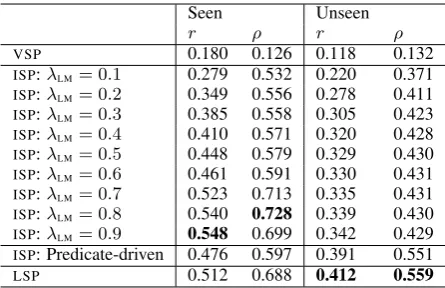
We first compareLSP, VSPand ISPwith static and predicate-driven interpolation weights. The results, presented in Table 1, demonstrate that the interpolated model outperforms bothLSPand VSPused on their own. The best performance is attained with the static interpolation weights of λLM = 0.8(r= 0.540;ρ= 0.728) andλLM= 0.9
(r = 0.548;ρ= 0.699). This suggests that while linguistic input plays a crucial role in SP induction (by providing both semantic and syntactic informa-tion), visual features further enhance the quality of SPs, as we expected. Figure 3 showsLSP- and VSP-acquired direct object preferences of the verb
Seen Unseen
r ρ r ρ
VSP 0.180 0.126 0.118 0.132
ISP:λLM= 0.1 0.279 0.532 0.220 0.371
ISP:λLM= 0.2 0.349 0.556 0.278 0.411
ISP:λLM= 0.3 0.385 0.558 0.305 0.423
ISP:λLM= 0.4 0.410 0.571 0.320 0.428
ISP:λLM= 0.5 0.448 0.579 0.329 0.430
ISP:λLM= 0.6 0.461 0.591 0.330 0.431
ISP:λLM= 0.7 0.523 0.713 0.335 0.431
ISP:λLM= 0.8 0.540 0.728 0.339 0.430
ISP:λLM= 0.9 0.548 0.699 0.342 0.429
ISP: Predicate-driven 0.476 0.597 0.391 0.551
[image:6.595.307.530.61.205.2]LSP 0.512 0.688 0.412 0.559
Table 1: Model comparison on the plausibility data of Keller and Lapata (2003)
LSP: (1)0.309 expenditure cost risk expense emission budget spending; (2)0.201 dividend price rate premium rent rat-ing salary wages;(3)0.088 employment investment growth supplies sale import export production [..]
ISPpredicate-drivenλLM= 0.65
(1)0.346 expenditure cost risk expense emission budget spending; (2)0.211 dividend price rate premium rent rat-ing salary wages;(3)0.126 tail collar strand skirt trousers hair curtain sleeve
VSP: (1)0.224 tail collar strand skirt trousers hair curtain sleeve;(2)0.098 expenditure cost risk expense emission bud-get spending;(3)0.090 management delivery maintenance transport service housing [..]
Figure 3: Top three direct object classes for cut and their association scores, assigned by different models
cut, as well as the effects of merging the features in the interpolated model – the verbs’ experiential arguments (e.g.hairorfabric) are emphasized by the visual features.
LSP: (1)0.523 girl other woman child person people;(2)
0.164 fleet soldier knight force rebel guard troops crew army pilot;(3)0.133 sister daughter parent relative lover cousin friend wife mother husband brother father;(4)0.048 being species sheep animal creature horse baby human fish male lamb bird rabbit [..];(5)0.045 victim bull teenager prisoner hero gang enemy rider offender youth killer thief [..]
VSP: (1)0.180 defeat fall death tragedy loss collapse decline [..];(2)0.141 girl other woman child person people;(3)0.128 abuse suicide killing offence murder breach crime;(4)0.113 handle weapon horn knife blade stick sword [..];(5)0.095 victim bull teenager prisoner hero gang enemy rider offender youth killer thief [..]
Figure 4: Top five arguments ofkilland their asso-ciation scores, assigned byLSPandVSP
(1)0.442 drink coffee champagne pint wine beer;(2)0.182 mixture dose substance drug milk cream alcohol chemical [..];(3)0.091 girl other woman child person people;(4)0.053 sister daughter parent relative lover cousin friend wife mother husband brother father;(5)0.050 drop tear sweat paint blood water juice
Figure 5: Error analysis: Mixed subjects and direct objects ofdrink, assigned by the predicate-driven ISP
them to incorporate visual statistics helps to avoid the above problem for the interpolated models, whose output corresponds to grammatical relations. However, static interpolation weights (emphasiz-ing l(emphasiz-inguistic features over the visual ones for all verbs equally) outperformed the predicate-driven interpolation technique, attaining correlations of r = 0.548and r = 0.476 respectively. This is mainly due to the fact that some verbs are over-represented in the visual data (e.g. the predicate-driven interpolation weight for the verbdrink is λLM = 0.08). As a result, candidate argument
classes (selected based on syntactically-parsed lin-guistic input) are ranked predominantly based on visual statistics. This makes it possible to empha-size incorrectly parsed arguments (such as subject relations in the direct object SP distribution and vice versa). The predicate-drivenISP output for direct object SPs ofdrink, for instance, contains a mixture of subject and direct object classes, as shown in Figure 5. Using a static model with a highλLM weight helps to avoid such errors and,
therefore, leads to a better performance.
[image:7.595.306.528.62.192.2]In order to investigate the composition of the visual and linguistic datasets, we assess the average level of concreteness of the verbs and nouns present in the datasets. We use the concreteness ratings from the MRC Psycholinguistic Database (Wilson, 1988) for this purpose. In this database, nouns and
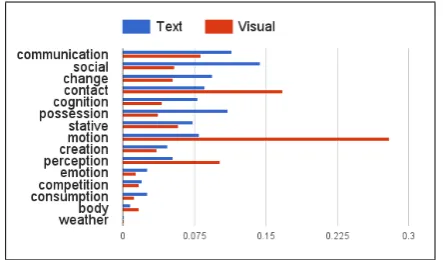
Figure 6: WordNet top level class distributions for verbs in the visual and textual corpora
Seen Unseen
r ρ r ρ
Rooth et al. (1999)* 0.455 0.487 0.479 0.520 Pad´o et al. (2007)* 0.484 0.490 0.398 0.430 O’Seaghdha (2010) 0.520 0.548 0.564 0.605
VSP 0.180 0.126 0.118 0.132
ISP(best) 0.548 0.699 0.342 0.429
LSP 0.512 0.688 0.412 0.559
Table 2: Comparison to other SP induction meth-ods. * Results reported in O’Seaghdha (2010).
verbs are rated for concreteness on a scale from 100 (highly abstract) to 700 (highly concrete). We map the verbs and nouns in our textual and visual corpora to their MRC concreteness scores. We then calculate a dataset-wide concreteness score as an average of the concreteness scores of individual verbs and nouns weighted by their frequency in the respective corpus. The average concreteness scores in the visual dataset were 506.4 (nouns) and 498.1 (verbs). As expected, they are higher than the respective scores in the textual data: 433.1 (nouns) and 363.4 (verbs). In order to compare the types of actions that are common in each of the datasets, we map the verbs to their corresponding top level classes in WordNet. Figure 6 shows the comparison of prominent verb classes in visual and textual data. One can see from the Figure that the visual dataset is well suited for representingmotion, perception and contact, while abstract verbs related to e.g. communication, cognition, possessionorchange are more common in textual data.
We also compare the performance of our models to existing SP induction methods: the EM-based clustering method of Rooth et al. (1999), the vec-tor space similarity-based method of Pad´o et al. (2007) and the LDA topic modelling approach of
´O S´eaghdha (2010)1. The bestISPconfiguration
1Since Rooth et al.’s (1999) and Pad´o et al.’s (2007) models
(λLM = 0.9) outperforms all of these methods, as
well as our own LSP, on the Seen dataset, con-firming the positive contribution of visual features. However, it achieves less success on theUnseen data, where the methods of ´O S´eaghdha (2010) and Rooth et al. (1999) are leading. This result speaks in favour of latent variable models for acqui-sition of SP estimates for rarely attested predicate-argument pairs. In turn, this suggests that integrat-ing ourISPmodel (that currently outperforms oth-ers on more common pairs) with such techniques is likely to improve SP prediction across frequency bands.
7 Task-based evaluation
In order to investigate the applicability of perceptu-ally grounded SPs in wider NLP, we evaluate them in the context of an external semantic task – that of metaphor interpretation. Since metaphor is based on transferring imagery and knowledge across do-mains – typically from more familiar dodo-mains of physical experiences to the sphere of vague and elusive abstract thought – metaphor interpretation provides an ideal framework for testing perceptu-ally grounded SPs. Our experiments rely on the metaphor interpretation method of Shutova (2010), in which text-derived SPs are a central component of the system. We replace the SP component with our LSP and ISP (λLM = 0.8) models and
com-pare their performance in the context of metaphor interpretation.
Shutova (2010) defined metaphor interpretation as a paraphrasing task, where literal paraphrases for metaphorical expressions are derived from cor-pus data using a set of statistical measures. For instance, their system interprets the metaphor “a carelesslyleakedreport” as “a carelessly disclosed report”. Focusing on metaphorical verbs in subject and direct object constructions, Shutova first ap-plies a maximum likelihood model to extract and rank candidate paraphrases for the verb given the context, as follows:
P(i, w1, ..., wN) =
QN
n=1f(wn, i)
(f(i))N−1·P
kf(ik), (11)
wheref(i)is the frequency of the paraphrase on its own andf(wn, i)the co-occurrence frequency
of the paraphrase with the context wordwn. This
results for their re-implementation reported by O’Seaghdha (2010), who conducted a comprehensive evaluation of SP models on the plausibility data of Keller and Lapata (2003).
model favours paraphrases that match the given context best. These candidates are then filtered based on the presence of shared features with the metaphorical verb, as defined by their location and distance in the WordNet hierarchy. All the can-didates that have a common hypernym with the metaphorical verb within three levels of the Word-Net hierarchy are selected. This results in a set of paraphrases retaining the meaning of the metaphor-ical verb. However, some of them are still figura-tively used. Shutova further applies an SP model to discriminate between figurative and literal para-phrases, treating a strong selectional preference fit as a likely indicator of literalness. The candidates are re-ranked by the SP model, emphasizing the verbs whose preferences the noun in the context matches best. We useLSPandISP scores to per-form this re-ranking step.
We evaluate the performance of our models on this task using the metaphor paraphrasing gold stan-dard of Shutova (2010). The dataset consists of 52 verb metaphors and their human-produced literal paraphrases. Following Shutova, we evaluate the performance in terms of mean average precision (MAP), which measures the ranking quality of GS paraphrases across the dataset. MAP is defined as follows:
MAP= M1 XM j=1
1
Nj Nj X
i=1
Pji,
where M is the number of metaphorical expres-sions,Nj is the number of correct paraphrases for
the metaphorical expressionj,Pjiis the precision
at each correct paraphrase (the number of correct paraphrases among the topiranks). As compared to the gold standard,ISP attains a MAP score of 0.65, outperforming both the LSP(MAP = 0.62) and the original system of Shutova (2010) (MAP = 0.62), demonstrating the positive contribution of visual features.
8 Conclusion
typically focus on objects rather than actions, by providing information about predicate-argument structure.
In the future, it would be interesting to derive the information about predicate-argument relations from low-level visual features directly. However, to our knowledge, reliably mapping images to actions (i.e. verbs) at a large-scale is still a challenging task. Human-annotated image and video descrip-tions allow us to investigate what types of verb– noun relations are in principle present in the visual data and the ways in which they are different from the ones found in text. Our results show that visual data is better suited for capturing physical proper-ties of concepts as well as containing relations not explicitly described in text.
The presented interpolation techniques are also applicable outside multi-modal semantics. For in-stance, they can be generalised to acquire SPs from unbalanced corpora of different sizes (e.g. for lan-guages lacking balanced corpora) or to perform domain adaptation of SPs. In the future, we would like to apply SP interpolation to multilingual SP learning, i.e. integrating data from multiple lan-guages for more accurate SP induction and project-ing universal semantic relations to low-resource languages. It is also interesting to investigate SP learning at the level of semantic predicates (e.g. automatically inducing FrameNet-style frames), where combining the visual and linguistic knowl-edge is likely to outperform text-based models on their own.
Acknowledgements
Ekaterina Shutova’s research is funded by the University of Cambridge and the Leverhulme Trust Early Career Fellowship. Gerard de Melo’s work is funded by China 973 Program Grants 2011CBA00300, 2011CBA00301, and NSFC Grants 61033001, 61361136003, 61450110088. We are grateful to the ACL reviewers for their in-sightful feedback.
References
Steven Abney and Marc Light. 1999. Hiding a Seman-tic Hierarchy in a Markov Model. InProceedings of the Workshop on Unsupervised Learning in Natural
Language Processing, ACL, pages 1–8.
Lisa Aziz-Zadeh and Antonio Damasio. 2008. Embod-ied semantics for actions: Findings from functional
brain imaging. Journal of Physiology – Paris, 102(1-3).
Lawrence W. Barsalou. 1999. Perceptual symbol sys-tems. Behavioral and Brain Sciences, 22(4):577– 609.
Lawrence W. Barsalou. 2008. Grounded cognition.
Annual Review of Psychology, 59(1):617–645.
Shane Bergsma and Randy Goebel. 2011. Using vi-sual information to predict lexical preference. In
Proceedings of RANLP.
Shane Bergsma, Dekang Lin, and Randy Goebel. 2008. Discriminative learning of selectional preference from unlabeled text. In Proceedings of EMNLP 2008, EMNLP ’08, pages 59–68, Honolulu, Hawaii. Chris Brew and Sabine Schulte im Walde. 2002. Spec-tral clustering for German verbs. InProceedings of
EMNLP, pages 117–124.
Ted Briscoe, John Carroll, and Rebecca Watson. 2006. The second release of the RASP system. In Pro-ceedings of the COLING/ACL on Interactive presen-tation sessions, pages 77–80.
Elia Bruni, Gemma Boleda, Marco Baroni, and Nam Khanh Tran. 2012. Distributional semantics in Technicolor. InProceedings of ACL 2012, pages 136–145, Jeju Island, Korea, July. ACL.
Elia Bruni, Nam Khanh Tran, and Marco Baroni. 2014. Multimodal distributional semantics. Journal of Ar-tificial Intelligence Research, 49:1–47.
Lou Burnard. 2007. Reference Guide for the British
National Corpus (XML Edition).
Xinlei Chen, Abhinav Shrivastava, and Abhinav Gupta. 2013. NEIL: Extracting Visual Knowledge from Web Data. InProceedings of ICCV 2013.
Massimiliano Ciaramita and Mark Johnson. 2000. Ex-plaining away ambiguity: Learning verb selectional preference with Bayesian networks. InProceedings
of COLING 2000, pages 187–193.
Stephen Clark and David Weir. 1999. An iterative approach to estimating frequencies over a seman-tic hierarchy. InProceedings of EMNLP/VLC 1999, pages 258–265.
Santosh Divvala, Ali Farhadi, and Carlos Guestrin. 2014. Learning everything about anything: Webly-supervised visual concept learning. InProceedings
of CVPR 2014.
Katrin Erk. 2007. A simple, similarity-based model for selectional preferences. InProceedings of ACL 2007.
Yansong Feng and Mirella Lapata. 2010. Visual infor-mation in semantic representation. InProceedings
of NAACL 2010, pages 91–99. ACL.
Andrea Frome, Greg Corrado, Jon Shlens, Samy Bengio, Jeffrey Dean, Marc’Aurelio Ranzato, and Tomas Mikolov. 2013. DeViSE: A deep visual-semantic embedding model. InProceedings of NIPS 2013.
Daniel Gildea and Daniel Jurafsky. 2002. Automatic labeling of semantic roles. Computational Linguis-tics, 28.
Arthur M. Glenberg and Michael P. Kaschak. 2002. Grounding language in action. Psychonomic Bul-letin and Review, pages 558–565.
Gurobi Optimization. 2014. Gurobi optimizer refer-ence manual, version 5.6. Houston, TX, USA.
Donald Hindle and Mats Rooth. 1993. Structural ambi-guity and lexical relations. Computational Linguis-tics, 19:103–120.
Frank Keller and Mirella Lapata. 2003. Using the web to obtain frequencies for unseen bigrams. Computa-tional Linguistics, 29(3):459–484.
Douwe Kiela, Felix Hill, Anna Korhonen, and Stephen Clark. 2014. Improving multi-modal representa-tions using image dispersion: Why less is some-times more. InProceedings of ACL 2014, Baltimore, Maryland.
Karin Kipper-Schuler. 2005. VerbNet: A broad-coverage, comprehensive verb lexicon. Ph.D. thesis, University of Pennsylvania, PA.
Ryan Kiros, Ruslan Salakhutdinov, and Richard S. Zemel. 2014. Multimodal neural language models.
InProceedings of ICML 2014, pages 595–603.
Girish Kulkarni, Visruth Premraj, Vicente Ordonez, Sagnik Dhar, Siming Li, Yejin Choi, Alexander C. Berg, and Tamara L. Berg. 2013. Babytalk: Un-derstanding and generating simple image descrip-tions. IEEE Trans. Pattern Anal. Mach. Intell., 35(12):2891–2903.
Angeliki Lazaridou, Elia Bruni, and Marco Baroni. 2014. Is this a wampimuk? cross-modal map-ping between distributional semantics and the visual world. In Proceedings of ACL 2014, pages 1403– 1414. ACL.
Hang Li and Naoki Abe. 1998. Generalizing case frames using a thesaurus and the mdl principle.
Computational Linguistics, 24(2):217–244.
Hongsong Li, Kenny Q. Zhu, and Haixun Wang. 2013. Data-driven metaphor recognition and explanation.
Transactions of the Association for Computational Linguistics, 1:379–390.
Zachary Mason. 2004. Cormet: a computational, corpus-based conventional metaphor extraction sys-tem. Computational Linguistics, 30(1):23–44. Diana McCarthy and John Carroll. 2003.
Disam-biguating nouns, verbs, and adjectives using auto-matically acquired selectional preferences. Compu-tational Linguistics, 29(4):639–654.
Marina Meila and Jianbo Shi. 2001. A random walks view of spectral segmentation. InProceedings of AI-STATS.
Diarmuid ´O S´eaghdha. 2010. Latent variable mod-els of selectional preference. InProceedings of ACL 2010.
Sebastian Pad´o, Ulrike Pad´o, and Katrin Erk. 2007. Flexible, corpus-based modelling of human plau-sibility judgements. In Proceedings of
EMNLP-CoNLL.
P. Pantel, R. Bhagat, T. Chklovski, and E. Hovy. 2007. Isp: Learning inferential selectional preferences. In
Proceedings of NAACL 2007.
Ted Pedersen, Siddharth Patwardhan, and Jason Miche-lizzi. 2004. Wordnet:: Similarity: measuring the relatedness of concepts. InDemonstration Papers
at HLT-NAACL 2004, pages 38–41.
Y. Peirsman and S. Pad´o. 2010. Cross-lingual induc-tion of selecinduc-tional preferences with bilingual vector spaces. InProceedings of NAACL 2010, pages 921– 929.
Philip Resnik. 1993. Selection and information: A class-based approach to lexical relationships. Tech-nical report, University of Pennsylvania.
Philip Resnik. 1997. Selectional preference and sense disambiguation. InACL SIGLEX Workshop on Tag-ging Text with Lexical Semantics, Washington, D.C. Alan Ritter, Mausam Etzioni, and Oren Etzioni. 2010.
A latent dirichlet allocation method for selectional preferences. InProceedings ACL 2010, pages 424– 434.
Marcus Rohrbach, Wei Qiu, Ivan Titov, Stefan Thater, Manfred Pinkal, and Bernt Schiele. 2013. Translat-ing video content to natural language descriptions.
InProceedings of ICCV 2013.
Stephen Roller and Sabine Schulte im Walde. 2013. A Multimodal LDA Model integrating Textual, Cog-nitive and Visual Modalities. In Proceedings of
EMNLP 2013, pages 1146–1157, Seattle, WA.
Mats Rooth, Stefan Riezler, Detlef Prescher, Glenn Car-roll, and Franz Beil. 1999. Inducing a semantically annotated lexicon via EM-based clustering. In
Pro-ceedings of ACL 1999, pages 104–111.
David Shamma. 2014. One hundred million Cre-ative Commons Flickr images for research. http:
Ekaterina Shutova, Simone Teufel, and Anna Korho-nen. 2013. Statistical Metaphor Processing. Com-putational Linguistics, 39(2).
Ekaterina Shutova. 2010. Automatic metaphor inter-pretation as a paraphrasing task. InProceedings of
NAACL 2010, pages 1029–1037, Los Angeles, USA.
Ekaterina Shutova. 2011. Computational Approaches to Figurative Language. Ph.D. thesis, University of Cambridge, UK.
Carina Silberer and Mirella Lapata. 2014. Learn-ing grounded meanLearn-ing representations with autoen-coders. In Proceedings of ACL 2014, Baltimore, Maryland.
Carina Silberer, Vittorio Ferrari, and Mirella Lapata. 2013. Models of semantic representation with vi-sual attributes. InProceedings of ACL 2013, pages 572–582.
Richard Socher, Milind Ganjoo, Christopher D. Man-ning, and Andrew Ng. 2013. Zero-shot learning through cross-modal transfer. In Proceedings of
NIPS 2013, pages 935–943.
Nitish Srivastava, Geoffrey Hinton, Alex Krizhevsky, Ilya Sutskever, and Ruslan Salakhutdinov. 2014. Dropout: A simple way to prevent neural networks from overfitting. Journal of Machine Learning
Re-search, 15:1929–1958.
Lin Sun and Anna Korhonen. 2009. Improving verb clustering with automatically acquired selectional preferences. InProceedings of EMNLP 2009. Tim Van de Cruys. 2014. A neural network approach
to selectional preference acquisition. In
Proceed-ings of EMNLP 2014.
Wiebke Wagner, Helmut Schmid, and Sabine Schulte Im Walde. 2009. Verb sense disambiguation us-ing a predicate-argument clusterus-ing model. In Pro-ceedings of the CogSci Workshop on Semantic Space
Models (DISCO).
M.D. Wilson. 1988. The MRC Psycholinguistic Database: Machine Readable Dictionary, Version
2. Behavioural Research Methods, Instruments and
Computers, 20:6–11.
Peter Young, Alice Lai, Micah Hodosh, and Julia Hock-enmaier. 2014. From image descriptions to vi-sual denotations. Transactions of the Association
of Computational Linguistics – Volume 2, Issue 1,
pages 67–78.
Fabio Massimo Zanzotto, Marco Pennacchiotti, and Maria Teresa Pazienza. 2006. Discovering asym-metric entailment relations between verbs using selectional preferences. In Proceedings of
COL-ING/ACL, pages 849–856.
Be˜nat Zapirain, Eneko Agirre, Llu´ıs M`arquez, and Mi-hai Surdeanu. 2010. Improving semantic role clas-sification with selectional preferences. In